Episode 44:
APPLE PIE
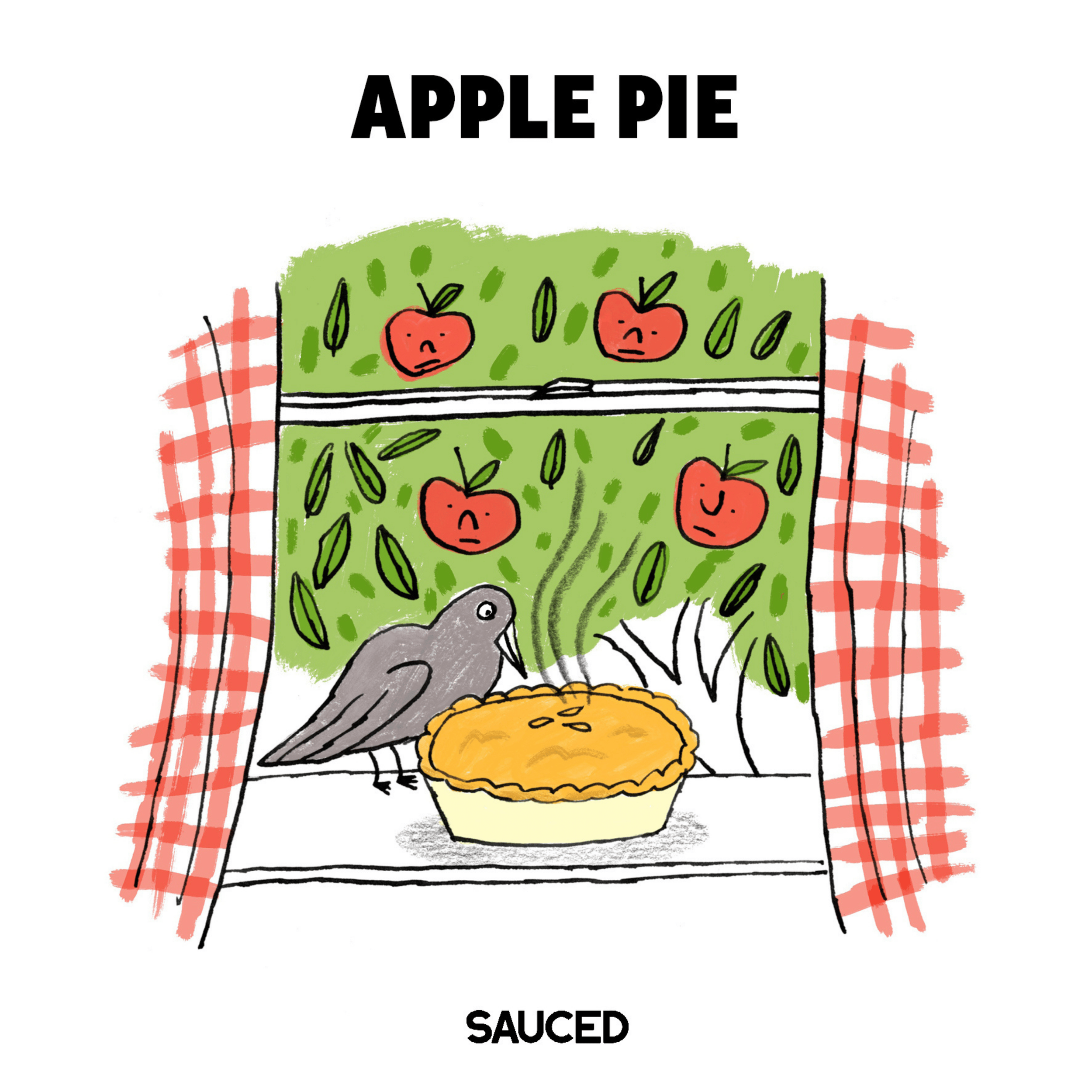
The verdict on a homemade Apple Pie arrives with the first cut, and a filling that slumps across the plate means the pie failed. Nearly every decision we make here is about keeping that slice standing.
The story runs from an English royal scroll written around 1390 to the pie's place as a symbol of America, with a real disagreement over the filling along the way.
"It's not soup, it's pie."
What we settled on:
Granny Smith and Honeycrisp apples, half and half
An all-butter crust with ice-cold apple brandy in the dough
Apples drained, then cooked gently before baking
The juices reduced with a little flour and more apple brandy
A metal tin on a preheated sheet pan, 425 to start, then 375
Egg wash twice and plenty of demerara
Three hours of rest, or a full day
The Cocktail:
Johnny Heavy Cream: Apple brandy, lemon and demerara topped with dry hard cider and a float of heavy cream, in a glass rimmed with cinnamon sugar.
RECIPE CARD:
Premium subscriber? Check out the full recipe card here.
LISTEN
EpiSOde Partners
Thanks to the following brands for partnering with Sauced to bring you this episode:
TRANSCRIPT
Tim McKirdy: Sother.
Sother Teague: Tim.
TM: We've said it a few times about a few different dishes on the show before. Hot Dogs, Burgers. Does it get any more American than that? I think today might pip it.
ST: Pip it? Top it, is that what that means?
TM: You know what a pip is?
ST: It's a button, isn't it? A pip? Oh, the dot above an "i."
TM: No. Well, potentially.
ST: I think that's what it is too.
TM: Yeah, but maybe this is an Anglo thing, but it's a synonym for a seed, specifically apples. Apple pips.
ST: Oh, okay. So our American dish is...
TM: Apple Pie.
ST: As American as Apple Pie. Well, that might be contentious in its own right.
TM: Yes, in some respects.
ST: Turns out, and I'm sure you've got the dirt on this, that Apple Pie wasn't invented in America. We just usurped it and then took it on to be our sort of patriotic symbol, right?
TM: But it is literally a synonym, speaking of synonyms, for being American, for American things, right? Merriam-Webster has a thing in it, and we'll get into it, that says that's the second definition of Apple Pie.
ST: Crazy. You know, there was a Chevrolet ad in the early 1970s that I still remember, and the jingle went something like, "Baseball, hot dogs, Apple Pie and Chevrolet," which was just to symbolize, these are the things that are America. And I still remember it. I was six.
TM: Those ads, copy guys, they weren't getting paid enough, clearly.
ST: Clearly. Ads today don't stick with you like that.
TM: So what about personal or professional associations for you? I mean, personal, you have the Chevy ad.
ST: Yeah, and then obviously I've eaten Apple Pies throughout my life. I've made a few. I wouldn't say I'm an expert Apple Pie maker. I've made many, many pies, many of them fruit, and certainly this one has been in the rotation. I have never once worked anywhere where I made them. Surely, maybe not even noticed by me or remembered by me, there's been places I've worked where they've been on the menu, but I didn't have any part in the process, because they are ubiquitous. I think without having any numbers or stats in front of me, if you said, "Name a fruit pie," apple would be first. I think a close second would be cherry, but apple still wins.
TM: Definitely. Weirdly, I've had Tarte aux Pommes, and I cooked so many of them. In fact, I like to think I was a little bit of a specialist at them as well, among the guys who were on the pastry section.
ST: Oh, wow, okay.
TM: It was the one thing my chef gave me praise for, and he used to have me try and teach some of the other guys. But it is nothing like the Apple Pie we're talking about today. It was a puff pastry, flat, in a circle. We made an almond cream, I forget the name of it, and then it was sliced apples fanned around.
ST: It's frangipane, right?
TM: It's like frangipane, but yeah, we had a different name for it. And I don't know whether that was just the kitchen or... It's annoying, I should have looked it up. I've got it in a recipe book right over there. But the point being, this was single serving. We used to serve it, I think, with a crème fraîche ice cream. It was beautiful.
ST: Right, and you also really like, there's a design element in this.
TM: It looks beautifully fanned around. And then you would turn all the edges on the puff pastry as well to give it a nice crust around the outside. But yeah, I don't know whether I've ever eaten the American version.
ST: What? You just got your stamp of approval to be an American citizen, and that wasn't on the test? I'm surprised that wasn't part of the test. "Identify and eat this pie."
TM: I could identify. I don't know why that is, though. Who knows. But so then, I've seen images of it and whatnot. So I really had to deep dive for this week's episode on just preparation, what people do, and that led to a load of discoveries for me, including that booze can be a pretty big component here.
ST: Oh yeah, for sure. In two pretty distinct ways, I think, right? And we'll get into those. So it fits perfectly into our ethos of cooking with booze and drinking with...
TM: Yeah. And I'll definitely have to be making one after this, for us to get our recipe, but also so that they don't take my passport away.
ST: Yeah, the freshly printed passport you just got and you just used. Welcome back.
TM: Thank you. I can confirm three curries were consumed.
ST: Okay, only three? You had predicted up to five.
TM: It was looking that way, although even three is a little bit of a stretch, because the one that I had on the plane was supposed to be a korma, and it was red, and it actually kind of reminded me of the story we told on the show, which was like someone had just cooked chicken and then put condensed tomato soup in there, because it was very sweet, very little spice. But there we go. You live and you learn. All right, should we get into some origins on the Apple Pie?
ST: Let's hear it.
TM: Normally we like to do an ingredient deep dive later on, but I think there are so many things about the origins of the apple that will set this up quite nicely. Do you know where it comes from? Or do you know where it traces back to?
ST: The apple itself? I mean, Garden of Eden, right? The forbidden fruit. No, of course I don't know where the apples come from, Tim.
TM: Central Asia. The USDA's Agricultural Research Service thinks either Kyrgyzstan or...
ST: I'm a stan for apples.
TM: Kazakhstan. And they believe it was carried west by Silk Road traders. Every named variety, right? So you've got your... I don't know, what's your favorite variety of apple?
ST: For eating out of hand, I'm kind of a Granny Smith guy. I like that tart, sour sharpness that a Granny Smith has. I don't know. I like Fujis. I like Honeycrisp. It's kind of newish in my world, anyway. There's one called Ludacrisp. I like apples.
TM: So every named variety is a clone, right? Kind of like grapes. So to grow them, you have to propagate them, take a cutting and replant that or whatever. As you say, new ones are still being bred to this day.
ST: Right, because my understanding, and you'll correct me if I'm wrong here, is that an apple tree will produce whatever the apple from that tree is, but the seeds will all produce different apples.
TM: The seeds are highly heterozygous, so it doesn't grow true to its parent. If you plant a seed instead of using graftings, they commonly grow into what they call spitters.
ST: Right. Apples that are too astringent or tart or whatever to eat. You bite them and you spit.
TM: Exactly. There are roughly 2,500 named varieties, and as you say, new ones are being bred all the time. The University of Minnesota released Honeycrisp in 1991. Washington State University chimed in with Cosmic Crisp, which took over 20 years to develop and launched in 2019. It brings a whole new definition to the idea of the Apple launch.
ST: Oh, right. Do these guys all come out in a black turtleneck? "We've launched a new apple."
TM: Do you know what the market grades are for them?
ST: Oh, I don't. And I'm shocked. That's usually information I like to know.
TM: I was gonna say, you're my 16/20 guy.
ST: I mean, there are sizes still, right? And again, the size of fruit almost universally is based on the size of the box. The box is always the same size. The larger the number, the fewer pieces of fruit fit in that box, right?
TM: And what is the box unit for apples?
ST: I don't know, actually.
TM: It is a fun fact, this. What is it called? Bushels.
ST: Oh, bushels. Yeah, yeah, yeah.
TM: And that, fun fact, is my dad's favorite unit of measurement, despite it not being metric. And what is it? There's four somethings in a bushel, something weird like a crank or something. It's odd, right? Anyway.
ST: Antiquated.
TM: But those market grades are U.S. Extra Fancy at the top, U.S. Fancy, U.S. No. 1 and U.S. Utility.
ST: Right, and utility just probably means, based on my knowledge of these things with other things, apples that are misshapen, malformed, miscolored. They're going to get used to make applesauce. That's the ones that the industrial apple users are purchasing and making apple juice, right?
TM: Yeah, they have more cosmetic flaws.
ST: These aren't pretty enough. And I'm betting that that's probably the majority of the reasons that they're even graded at all, for apples.
TM: Exactly. Every single one is hand-harvested, so labor is a massive part of the cost of the apple industry. Most of the time is spent moving ladders around. And then they're stored in controlled-atmosphere rooms, where nitrogen pulls the oxygen levels down from normal air level to 1 to 3%, and that protects the fruit for up to four months after harvest, so it can still be sold.
ST: Right. Which I learned only recently. I learned that about 20 years ago, and I was blown away. Most of the apples you get at the grocery store, probably not your farmer's market, but most of the apples you get at the grocery store are probably four months old before they got put in front of you. Wild.
TM: So what happens the remaining eight months?
ST: When you're just in a rotation. But I don't know why, right? Why do I have to have apples sitting for four months when they're pulling apples pretty much every day?
TM: Yeah, but I don't know whether that's more like it's up to four months. So it could be up to four months old. I don't think it's four months and then it's out the door. But what I'm saying is, this is an agricultural product. You have seasons. The harvest season is ending as we speak.
ST: Sure, here. But the world is round, you know what I mean? There's other places to get apples from too. I don't know why the apples have that treatment that's been done to them. I don't know of any other fruit or vegetable that's held in nitrous-deprived environments so that they can last that long. I'm certain that it also has to do with, there's probably a tremendous abundance, too many apples to use up. And then, like you say, seasonally, okay, people are going to be making a lot of Apple Pies this month, so let's release more apples. You're in control of the floodgate. It does then make me question why the fluctuation in prices is so common. I do eat a lot of apples, actually. Sadly, I eat only a few varietals, because that's what I can get a hold of. But I do notice the prices change all the time.
TM: Oh, really? Couldn't tell you what an apple costs.
ST: I would say right now in New York City, anyway, they're ranging from like $2.29 to $3.29 a pound, hovering in the $2.49 zone, always with a nine at the end.
TM: What's the bushel going for?
ST: I don't know. But I'm buying them by the piece these days, which is, you get cheaper by the dozen, as they say.
TM: So that's the background on apples.
ST: You know, I do have one little gripe about apples and their nomenclature. I think the least delicious apple is the Red Delicious apple.
TM: Marketing, though.
ST: Yeah, I mean, it is the idea. It's probably the one, if you type "apple" into your phone, that's probably the icon you'll get. The emoji.
TM: Yeah, well, you like a Granny Smith. That's green, but it looks like a cooking apple.
ST: But it's also crisp and tart. The Red Delicious is kind of mealy and pasty.
TM: I don't like a mealy apple at all. No, no, get out.
ST: Which is odd, because you know what I really do love, and I eat probably a lot of this as well? I'm realizing right now on the air that I eat a lot of apples and apple products. I love applesauce. I love it. I'll buy a jar of applesauce and it'll be gone in two days. I eat it alone, or I eat it folded into yogurt or sour cream, put it on pork chops. I eat a lot of applesauce.
TM: When I was a child, I went through a phase, a young child, I went through a phase where it was this thing called stewed apple. It's basically like applesauce, to the point where my mom was trying to make it herself and put it in the jar, but you could taste the difference. Probably all the sugar that was in the commercial one. Luckily, my tastes have expanded since then.
ST: I also drink a pretty fair amount of apple brandy, so there's that too. I'm consuming lots of apples.
TM: Yes. So you have alluded to it a couple of times. It is not American. It is English. Around 1390, King Richard II's master cooks compiled The Forme of Cury, which was a recipe scroll of the English royal kitchen that's still around today. It's held at the John Rylands Library in Manchester, if anyone found themselves around there. Its apple tart recipe was "for to make tarts in apples," was the name of the recipe, and it calls for good apples. The spellings here are wild. You've got to look it up, in the old English. But good apples, good spices, figs and raisins and pears, colored with saffron, and then baked in a coffin.
ST: Yeah, I saw that.
TM: Which was like a pastry case.
ST: And the things that caught me off guard were the saffron and the coffin, right? The saffron: why are we throwing in this expensive ingredient? You just said colored. They weren't even doing it for flavor. We just wanted this yellow result. And then the coffin. Yeah, I read about that. I don't usually dig into the origins, because that's usually your part of the show, but I was fascinated by it. You cooked it in this pastry shell, for sure, but you didn't eat it.
TM: Yeah, it was more just a vessel for cooking the apples. Weird that they would color it with saffron, but another very expensive ingredient from around that time was not included. What do you think that was?
ST: Sugar. Yeah, you were getting all the sugar from all those dried fruits.
TM: Yeah, exactly. And I think sugar at the time... I was like, well, maybe, when did sugar arrive in England? About 300 years before this recipe, but looking completely different to what we see now. It would have been big blocks. It wasn't like the fine grains that we get, ultra-processed. You don't want to do a deep dive on sugar, folks, for many reasons.
ST: Wow. Yeah, it's dark waters.
TM: So the British food writer Olivia Potts, in The Spectator magazine, has said that cooking vessel was more than a crust, it was a cooking vessel more than a crust to eat, and says Pippins, crisp, tart apples prized for cooking, were the preferred fruit in those early pies. Britain's pie apple is now the Bramley, the cooking apple. Someone called Mary Ann Brailsford grew the first Bramley apple tree from a pip, or seed, in Southwell, Nottinghamshire, sometime around the early 1800s. Decades later, the local nurseryman Henry Merryweather was allowed to take cuttings from the tree, so he wasn't going for the spitters, on the condition they be named Bramley's Seedling, after the house's new owner, who was a butcher, Matthew Bramley. Merryweather sold the first three apples for two shillings from his crop on October 31st in 1862.
ST: Halloween.
TM: Yeah. So how does it become American? Well, obviously you have Europeans arriving, including the British. When they did arrive in North America, only the small, sour crab apples were here and existed. A man called John Chapman, aka Johnny Appleseed...
ST: That's right.
TM: ...planted his frontier orchards from seed, not grafts, so most of his apples were spitters, and they went into cider. In 1796, Amelia Simmons published American Cookery in Hartford, Connecticut, the first cookbook by an American published in the United States. Her buttered Apple Pie is baked, then the cook would gently raise the top crust, add sugar, butter, cinnamon, mace, wine or rosewater, and put it back on.
ST: Why wouldn't you put it in at the beginning?
TM: I don't know.
ST: I didn't find that. I found stuff about her, about that book you just mentioned, American Cookery, and that it was the first American cookbook published in America by an American author. But it had two Apple Pies in it, but I didn't find anything that mentioned that you lifted the top off, or maybe I didn't dig too much into the recipe. That's wild.
TM: That's weird to me.
ST: I would also point out that, I'm from here, you're not from here, you're one of us now, Johnny Appleseed was actually, in a strange way, responsible for the survival of early frontier people, because you may live far from a fresh water source, but because of him, there were apples and you could make cider.
TM: Funny you should say that. Michael Pollan, in his book The Botany of Desire, wrote, "Up until Prohibition, an apple grown in America was far less likely to be eaten than it was to wind up in a barrel of cider," which is more potable than water.
ST: Well, right. As you just said, they were spitters, right? They weren't good for eating, but you could make cider out of them. And frankly, you could make applejack out of them, which is early-day methodology for distilling. You'd make your cider, you'd allow it to ferment and become alcoholic, and then you would put it in shallow containers in the winter and let it freeze. But the only part that would freeze would be the water. And you'd scrape off that water, and you let it freeze overnight again, and you'd scrape off that water. And every time you're scraping off water, you're reducing, which is what a distill does. You're just doing it with cold instead of heat.
TM: And hundreds of years later...
ST: And that's called jacking. Apple jacking.
TM: So do you think, actually, do you think Johnny Appleseed, was he the first to be like the Johnny something?
ST: Right, like Johnny on the spot.
TM: Or like...
ST: Everybody's Johnny.
TM: Exactly.
ST: I mean, could be, because the darker story, there's always a darker story, right, is that he was also pretty prolific at spreading his own seed, rambling around from town to town, if you know what I mean.
TM: Well, you know who's going to like that shout-out, and I know is a listener to the show, so might as well give him a little call-out here on air: Brad Thomas Parsons, BTP. He uses that all the time with me. He'll be like, "Johnny LA," if I'm visiting LA. I think "Johnny London" when I was in London recently. So he's going to enjoy Johnny Appleseed.
ST: Right on.
TM: All right, Brad, hello if you're listening. Sother, that is, those have been the origins. Time for us to take our first break of the day, then we'll be back with the luminaries.
TM: All right, Sother, we're back. Culinary luminaries.
ST: Well, before we do that, you went over the Tarte aux Pommes, which is the French version of this, but we didn't really give the elevator pitch, like we always do on the show, of what the dish we're about to do is. So the kind of pitch slash definition that I have here is: Apple Pie is a baked pastry filled with apples, sugar, often spices, enclosed in or topped with a pastry crust, with the apples' acidity, sweetness and pectin balanced against the crust's fat, flour and crispness. The American version is typically a deep, double-crust pie, which is the one we're going to make today, I'm sure. Double crust meaning crust on the bottom, crust on the top. And that top could be, but doesn't have to be, latticed. I don't think so.
TM: Me neither.
ST: Often seasoned with cinnamon. Here, we use a lot of cinnamon in our Apple Pies, but I want to talk about that when we get there. With a filling that holds together when sliced, and I think that's the real technical proficiency to an Apple Pie. If it's falling apart when you slice it, you blew it.
TM: Nice.
ST: You got an Apple Crumble, because you're watching it crumble.
TM: I love... Now, Apple Crumble, there's a dish.
ST: I mean, well, we'll get to that one. The show goes on. We have many episode opportunities.
TM: All right then. All right, so who's your first luminary? Julia or Jacques, anything to say?
ST: Nothing.
TM: Wow.
ST: Wow. Yeah, I mean, well, not nothing nothing. Again, if we dig into their vast legacy and portfolio of recipes and discussions that they've had, they've touched on all of the technical ingredients that go into this dish, but neither of them had anything that I could find to say specifically to Apple Pie. Of course, Julia specifically did talk about pie crust, keeping everything cold when you're making a pie crust so it'll be nice and flaky. Jacques talks about making sure that you're picking the right apples for cooking. So all the things are there. I was going to mention Amelia Simmons, but you mentioned her already. I was going to mention John Chapman, but you dug into him already, because there aren't really a lot of luminaries that I could find who have taken up the mantle of this specific pie. There are lots of bakers out there who are known for making pies, but no one that I could find who had a whole lot just to this pie. I did want to point out that there was one thing that I think is worth noting, and we kind of touched on it earlier, which is the pie doesn't originate in America, but somehow we've created this patriotic symbol out of the pie. I think a lot of it had to do with World War II-era rhetoric, and there was a phrase that they used in World War II. So when you were off somewhere in a foxhole and you would look at your infantry mate or what have you, and you'd say, "For mom and Apple Pie." That was the World War II slogan that we had as Americans, and it really solidified the pie's place in our patriotic worldview. If you say, picture some images of what patriotism is in America: certainly the waving flag, maybe tattered on the ends, some fireworks going off behind it, an eagle flies by, there's an Apple Pie on the window. That is America. Maybe a wheat field in the background. So I think there's something really to be said about the hold that this particular dessert pastry has on Americans as a sense of place and home and patriotism, again, even though it wasn't invented here. We just took it.
TM: Well, I think that's a very good call. But again, look, we spoke about this. We say every week: what defines a dish? Is it the beginning? Is it what it's become? Is it the evolution? It can be all of the things.
ST: Yeah. I did skip one. James Beard was a pretty big champion of, as we all know, American cuisine in general, and he helped establish the Apple Pie as an American regional baking dish. And he talked about it in... he's kind of the first one who talked about American food in a serious way in general, and he certainly exalted this pie as well, but nothing specific. What do you got? You got anything?
TM: I got one or two.
ST: Okay, hit them.
TM: There's one, I believe you used to live near it. There's a bakery in Brooklyn, I don't know whether it was around when you were in the neighborhood: Four & Twenty Blackbirds.
ST: Oh yeah, I've heard of it, but I've never been.
TM: So just one of the things that stood out to me about what they do was they use a variety of different apples, so bringing different ones into the equation for different things, right? As you mentioned earlier, some are sweeter, some are more tart, some are more acidic. They use Angostura bitters in theirs. And I'm looking at your face now, and you're like, "Why have I never thought to do that?"
ST: Well, that's funny you would say that, because when we get to the end and we say what do we serve Apple Pie with, one of the things on my list is whipped cream, and I say with bitters in it, right? Because almost anytime I'm going to make whipped cream, I'm going to add a few dashes of some kind of bitters that ties into whatever I'm serving that whipped cream on or with. And I was like, yeah, some whipped cream with bitters, and Ango would be the reach. That's cool, though.
TM: And then the other one, just a recipe that's become quite famous online. I think it's the Cook's Illustrated one by Kenji López. And do you know where his booze goes in?
ST: The crust. He's using probably vodka in the crust.
TM: And why is he doing that?
ST: Because it's going to help hydrate the flour just like the water would, but it's going to evaporate quicker than water does, because it has a different boiling point, so it makes a flakier crust. My question, though, and I was going to question this when we get to it, for us, is why wouldn't I use apple brandy in an Apple Pie?
TM: I don't know. And I think also, the thing that we explored for Fish and Chips, I was like, if you didn't know, I would give you that hint. So it stops the gluten formation, and therefore it gets that flakier crust. So yeah, I mean, those have been the luminaries, I guess. Those have been the notable folks. We'll take a second break of the day, and then we'll be back with some decisions to make: the non-negotiables.
TM: All right, so we're back. The non-negotiables. What you got?
ST: Apple Pie. Well, apples are the star, so we're going to need a filling that tastes recognizably of apples. Here's where I want to get into some of the thing I kind of alluded to earlier. I don't love a ton of spices in my... and we'll get to them, we do need them, but I don't love a ton of spices in my Apple Pie. I want Apple Pie to taste like Apple Pie. I don't want a cinnamon pie that's backed up with apple product. You know what I mean?
TM: Save those for your Pumpkin Pie.
ST: Your pumpkin pie spice, yeah. So I think you've got to have apples, and we can get into the nitty-gritty of apples right now if you want, but there are so many options. But I think that the clear differentiation is you don't want an apple that is too soft in the first place. I think that's the real crux, right? A Golden Delicious apple is too soft when it's raw, much less after it's been cooked for over an hour inside of a pastry crust. It's going to fall apart, in my opinion.
TM: There's some science on how you can get around that.
ST: Yeah. We've got to employ some chemicals.
TM: No, no, no, no. Just the heating, the cooking process before it goes in the pie.
ST: Oh, are you pro-cooking the apples before they go in the pie?
TM: Pre-cooking, yeah.
ST: Oh, wow. See, I'm not.
TM: There's a scientific reason why that's the way to go.
ST: All right, well, we'll get there.
TM: We'll get there.
ST: Cool. But anyway, apples, number one.
TM: Yeah. Apples, and we'll say a mix.
ST: I prefer not a mix, for kind of what I was just talking about. But again, we have a different philosophy. I don't pre-cook, but I kind of, like eggplant, I'm going to season it and let some liquid drain off, right? Because that's the real problem with apples. They're 70% or more water, which means that when they cook, that water is going to release, which is going to get you a soggy bottom crust, right? And that is not a great... that's a poor result. You failed if your bottom crust is soggy. So I season with all the things, but also sugar, which is hygroscopic, and it's going to pull out some of the liquid. When we get to this part, I talk about how I take that liquid and I reduce it down a bit with some flour, making almost like this thick apple caramel, for lack of a better term, that then I fold back into the raw apples before putting into the crust.
TM: So we should talk about the science, because we're talking about it now.
ST: We're talking about it. Yeah, we're talking about it. Let's talk about it.
TM: Pectin.
ST: Which is a natural thickener that's inside of apples and other fruits. That's what helps make jams and jellies.
TM: Yes. It's activated by gentle heat, around 122 to 158 Fahrenheit, 50 to 70 Celsius.
ST: "Like I say, around," and then you give very specific numbers. "Around exactly 122 to 148."
TM: So heating it over a gentle heat first, and I don't mean cook them, heating it gently. And look, I saw Kenji doing this as well, that's why, and he seasons it as well. So yeah, I'm still advocating for that step of pulling out the liquid and then doing as you say, finishing in here. But heating it reworks the pectin, so calcium can lock it in place, and the tissue, sort of counterintuitively, firms up. So it will still hold its structure. And I think I would rather, I guess, a combination of tart and sweeter apples, so that I'm not having to add as much sugar.
ST: Gotcha. I think I'm in the camp of, I don't want my pie to be excessively sweet, because as you know, I'm not really a sweet palate in general, so that part of it never comes into the equation for me. I'm never going to make it too sweet. But listen, we've already discussed, right, my professional experience with this pie is pretty minimal, and that means that it only leaves my home experience, and I've baked, let's call it, I don't know, maybe I've baked 20 Apple Pies in my life, right? So I'm easily swayed in any direction. But I will say I prefer the method that I just described, where I season, drain off some of the liquid, cook that liquid into a slurry if there's enough of it, fold it back in.
TM: I just think, I guess, another thing here for me too is, well, I'm just surprised that you're going against science. Usually you're quite a rational...
ST: Is this making me irrational?
TM: You know what I mean. Usually the science sways you.
ST: Yeah, I mean, there's also the notion of buying pectin, which comes in powdered form, just like gelatin does, and using some pectin in your pie making. I have done that when I've made like blueberry or cherry pies, which are much looser, right? But I just, I don't know. Listen, let's move forward. What's next?
TM: Also, okay, second one for me, just about that method: I feel like you get a better color, but who cares. Next is the crust, and it has to be a double crust.
ST: It has to be, 100%.
TM: I get the sense that neither of us are lattice.
ST: I don't think so. They don't bring enough joy or beauty to me to make the difference. In fact, I think a full crust is more beautiful. And if you've got some trimmings, maybe you can make some leaves or what have you that add to that beauty. Plus, I really like the addition of a pretty rich egg wash and a fine but noticeable dusting of demerara sugar.
TM: I wouldn't go as far as egg wash. I'd just go butter.
ST: Just butter on the exterior of the pie crust.
TM: Next non-negotiable for you.
ST: We need something to balance, right? So I think we're going to need some tartness, some lemon juice specifically. And maybe we can go ahead and use the lemon zest as well.
TM: Delicious. You mentioned it earlier, but those apples will cook down even as we're cooking. So we really need to power this thing, because I don't want a hollow Apple Pie, and I don't want an Apple Pie that falls apart. As you said, you've kind of failed if that's what happens, if it doesn't maintain.
ST: Correct. And I think how you do that, we'll get into that in more of the technical side of it all, but you need to fill your pie tin sort of mounded in the middle, right? Because it's going to collapse quite a bit. But then that also means you need to pay close attention to how much top crust you put on, because you want it to not have a gap between the apples and the crust, right? Unlike when we make a Schnitzel, where we want that little puff of air in there, we don't want it in our Apple Pie, because again, that'll make it troublesome to stay together when you slice it. You want the crust to be in contact with the surface of the top of the apples. So build the apples inside a little bit too high and stretch the dough as tight as you can without tearing it.
TM: But we do want to score it, maybe five times, so that it vents.
ST: Oh, you've got to have some vents, because if you don't vent it, it'll pop, basically.
TM: Next one for you.
ST: We need some spices, right? Cinnamon's certainly gonna be in there. I just don't want a ton. Cinnamon, nutmeg, mace, maybe some dried ginger, some kind of spices that...
TM: Allspice.
ST: Sure. Cloves...
TM: Oh.
ST: ...even, that make you wanna eat this pie or smell this pie. And I think that I use that as an example all the time when I talk to people about what's the difference between sweet and bitter and aromatic quality, right? And I say, a bowl of sugar has no aroma, right? But I also am the guy who says, on my tombstone it will say, "Aroma dictates 90% of flavor." Well, sugar has no aroma, so what's going on? Okay, so there's that. But cinnamon does. Cinnamon has a huge aroma, and we love it. And you go to your grandma's house around holiday time and you smell that cinnamon and you think, "Mm, sweet." Cinnamon is not sweet. It's because we use it in a lot of sweet preparations that make us think that. Bite into a cinnamon stick and you will realize how not sweet cinnamon is.
TM: Try the Cinnamon Challenge.
ST: Oh yeah, that too. I've never tried it. I mean, I never would. You can't win. Same with cocoa, right? You can't. There's something about the way that it reacts with water or liquid.
TM: So you're saying the science is leading your decision there.
ST: Yes.
TM: Yes. Okay, that's good to know.
ST: I contain multitudes. And then we already kind of went over my last one, which I think is your last one too. Same thing, right? I said a fully baked, sliceable filling. Apples should be tender and thickened by their own juices. The bottom crust baked through and crisp. The filling could be juicy, but it shouldn't be a puddle. And I think we have a lot of ways to get around that, some of them scientific and some of them not.
TM: Well, yeah, I mean, we can't call it a non-negotiable, so maybe it's a bridge into the technical considerations here. You have to let it set.
ST: Oh yeah, 1,000%. We use technique as non-negotiables all the time. Yeah, this guy needs to sit. I'm saying minimum three hours. Don't touch this pie for three hours, which is hard to do, because it smells amazing. Your house smells great, the pie smells great when it comes out of the oven, and now you've got to wait. You've got to wait way longer than it took you to make the thing.
TM: You know what you shouldn't do? One thing I would warn against: leaving it on a windowsill to try and accelerate it.
ST: Right, because errant cartoon characters will come by and steal it.
TM: Brilliant.
ST: Errant cartoon characters will float by and steal it. They're always floating. They smell it, and they float with the aroma.
TM: Because of the aroma.
ST: Now you're gonna have to find that clip. Remember when it took you so long to find the fish clip with the cat?
TM: Tom and Jerry. So what is that thing called, where everyone believes something was a phenomenon and it wasn't?
ST: Oh, Mandela. The Mandela effect.
TM: I think that is an example of the Mandela effect. I think there's very few, if any, clips of Tom, from Tom and Jerry, eating a fish and pulling the bones out. Wait, was Tom the... Yeah, Thomas. Took me hours to find a clip. Don't think it was worth it.
ST: Totally worth it, for me, because I had to do nothing.
TM: Other technical considerations for you? So we're saying we're venting the lid.
ST: Are we jumping to that now? Gotta vent the lid. Gotta make sure... well, we'll get into more of them as we go through the technique, right? Because the Apple Pie, specifically with the double crust, is a pie that I'm not just bumping in my food processor. I'm doing it by hand. Do you know the sort of flaky method? Or flaky's the wrong word. Shingle. Shingling method, they call it, where you cube your butter to similar sizes, and then you coat them with flour, and then you take each one individually, but two at a time, one in each hand, and you press them into a flat, almost like flattening a dime on a railroad track. And then you don't really crumble them up more than that. You fold it together with cold...
TM: Cold butter. Technical consideration.
ST: Cold butter. Oh, right, sure. And you fold them up, you just coat them enough, and then when you add your cold liquid, which can include booze, and I think ours probably will, just enough till it will hold together. You can see the butter.
TM: Ice cold. Ice cold vodka.
ST: Ice cold booze, ice cold butter. Keep your flour in the fridge or freezer if you want to. Let's be as cold as you possibly can be.
TM: Not ice cold water, because that would be ice, but very cold water.
ST: Right. Iced water.
TM: And some of the people I saw as well, there's someone who's... sorry, what was her name? Kate McDermott is a pie teacher in Port Angeles, Washington, who does butter and leaf lard. The high-quality lard made from leaf fat. What is leaf fat?
ST: Leaf fat. Like, when you are butchering, and you can literally see the delineation between two different muscles, and you pull... you know that sort of crackling sound you hear, and that fat that just sort of looks like what we're making here, that's called leaf fat. It's not intramuscular, it's not sinew. It's the firm parts of the fat that can be pulled apart pretty easily with your fingers.
TM: Yeah, so she uses equal parts of that. I think I'm probably just a butter guy, but...
ST: I feel like that's maybe a hangover from the suet days, right, when you'd use suet in your flour or in your pastry crusts. Ina Garten uses Crisco, half and half, Crisco and butter.
TM: What is Crisco?
ST: Shortening. Vegetable shortening. But I saw her doing that, but I also saw her using her Robot Coupe to blitz it all together, which is fine.
TM: Totally fine.
ST: But for this specific pie, I want a crust that is almost a quick version of puff pastry, right? It's not, but it's gonna have some visible layering because of this methodology, right? I'm using my... I'm making a gesture here, sorry. I said between each thumb, you press it out.
TM: This is not great for an audio medium. It's like I'm counting my money. It's like when you're counting money. No, what is that?
ST: He's doing the money symbol. Yeah, you just kind of roll it off your thumb, and it'll again look kind of like a dime that's been flattened on the railroad tracks, or those crank machines that you do a penny in. But you don't really break them up much more than that. You can literally visibly see them in there.
TM: Any more?
ST: I think it's highly technical. I think it's highly important to make sure that the dough gets some rest. Minimum 30 minutes. I would say make it yesterday.
TM: Yeah, exactly. What about chilling the assembled pie before cooking? Allow everything to set again.
ST: Oh yeah, yes, that too. Yeah, and especially if we're gonna go with the cooked filling method, that filling needs to be spread out on a sheet pan and thrown in the fridge or whatever, so that it's got the most surface area and can cool as quickly as possible, because we don't wanna add a hot, sort of moist product to our uncooked base pie crust, or we will absolutely never come out with a crispy one. I think another technical consideration is I wanna use a metal pie tin as often as I can. It's a better conductor of heat than glass or ceramic. And also, I wanna preheat my oven with a sheet pan already in the oven, because when I set that metal pie pan onto that sheet pan, there'll be more heat right away, which will again ensure a crisp bottom. And now that I'm thinking about it, when I bake pies like this, because I do more savory pies, I do Chicken Pot Pie a lot for Natalie. So, and the final one, I think, is you need to be on that bottom... You rarely use that bottom third rack of the oven, for the initial cook. And I think there's a secondary cook with Apple Pie, and my Chicken Pot Pies as well, where we'll move it up and lower the temperature.
TM: Yes. I think it's start high, finish lower. I love all these. I love how you owned it there afterwards too, but I love how you're always like, "Yeah, so I make Chicken Pot Pie for Natalie." It's like, are you not eating it? I'm sure you're eating it too. You're making it for both of you.
ST: But I cook a lot, and it is mostly for her. Of course I eat some of it, but I'll make a Chicken Pot Pie and we will have that for dinner, both of us, and that will complete maybe half the pie. The rest of the pie, I never see again. So it's cooked for her. She'll eat it for lunch the next day. She'll eat it like it's gone.
TM: I don't know. It's kind of... no, it's nice. It's nice.
ST: It is nice.
TM: No, of course, it's lovely to cook for people, but I'm just being like, I know you're eating all this food too. All right, well, I think that's been everything when it comes to non-negotiables, negotiables and technical considerations.
ST: I got one last sort of pitch for the technical considerations, and it might be even a slightly hot take. This pie, as well as many pies, it's better tomorrow. So if you can, this has strangely now become a three-day process. If you can, and you don't have to, but if you can, make your dough yesterday, cook your pie today, eat it tomorrow. Those pectins will seize up the pie a little bit better. You can still gently reheat it, and it won't fall apart and still have that hot, satisfactory sensation of eating a warm Apple Pie. But I think this pie fares better the next day.
TM: That makes sense. Give it time to set. All right then, well, time for us to take another quick break now, and then we'll be back with the preparation.
TM: All right, Sother, we're back. The preparation. I think we're going to handle this one together. You know, both sides of the Atlantic coming together. The origin over here, the destination over there.
ST: All right, that's fair. Plus, we disagreed on methodology, so we're gonna go with yours, the cooked interior, the scientific one. Okay, fine. Listen, it's just not familiar. I think the intimidation factor with a lot of foods that we talk about is experience, and I've not experienced that method. This doesn't mean that it won't work. It doesn't mean I can't make it work. It doesn't mean... just like I know the method that I use works, and I like the results.
TM: No, look, I'm glad you're coming back to the science here, as a former dry-brining skeptic. You can change your mind on things.
ST: Oh, man. I did change my mind on that, and then it was hard. Okay, so we're making the American Apple Pie recipe. We're gonna go with traditional nine-inch pie crust. I think we're about to make the dough, but I think, again, I mentioned it already, we need a metal pie dish. I didn't say in the non-negotiables or in the...
TM: Technical considerations.
ST: Technical considerations. But we're baking here, which means break out your gram scale. So I'm gonna say we're gonna take all-purpose flour, that we're weighing out, granulated sugar, a bit of fine sea salt, right? Some unsalted butter, that's why we're using our own salt, and then you're gonna need some ice water. Now, ideal world, all of these items are as cold as possible, right? I'm not suggesting by any means you keep your salt and sugar in the fridge, or even your flour, but you could if you want to. You can keep whatever mixing bowl you're gonna use in the freezer before you get started on this, and that'll keep everything cold as well. Cube that butter.
TM: No booze?
ST: Oh, wait, sorry. Yeah, and I'm gonna say let's use some apple brandy as part of our ice cold liquid. So keep that apple brandy in the freezer. Or vodka, or bourbon, or rum. There's no wrong answer here, right? I don't think it's gonna have a tremendous impact on the flavor. It's gonna do the things we talked about before. It's gonna retard gluten formation, which will then result, and also steam off quicker than water, which will result in a flakier crust, and that's the goal. So any booze, high-proof alcohol you got, will work in this part of the recipe. But you just wanna keep it as ice cold as possible. So to make that pastry, let's whisk together the flour, sugar, salt, and cut in that cold butter in that method that I just described to you. So let's have our cold butter already cubed. So basically, take a stick of butter, cut it lengthwise, roll it over, cut it lengthwise again, and then cut it into small enough cubes that you can first break apart and toss into the flour, and then, with your thumb and forefinger, mash them all as we described earlier, and then gently fold them in. You're really just coating them with the flour. I can't describe enough how many times I've made this...
TM: I'm realizing you can't describe it enough.
ST: Well, it doesn't look like it's coming together, but you have to trust. It is, and it will. Okay, so you're cutting in that cold butter with what I call, in my notes here, the thumb method, and then slowly and gradually add your ice water slash cold booze mixture, honestly by the tablespoon, and start folding that in. And there's no hard and fast numbers, and we'll get as close as we can, but we'll say use as much as you need in the recipe card that you get with your subscription, until it starts to come together. When you can pick up some of the dough out of the bowl, there's not a lot of powder left in the bottom, and you can squeeze it and it stays together, that's when you know you're there. Then you're gonna form this into a disc, two discs actually, equal parts if you can, ish. Form it into discs, wrap it up in film, and then park it in the fridge for at least 20 minutes, but hopefully literally overnight. That'll finish the hydration, that'll pull the dough together, and it'll be ready to go.
TM: Nice. So when that's going into the fridge...
ST: You're gonna prepare some apples.
TM: Yep. I'm going to take our mix of apples.
ST: You want a mix? What's the mix?
TM: We will decide afterwards, on air, off air, and you know what, you will find out in our recipe cards.
ST: Oh, okay.
TM: And our recipe card, which will have arrived...
ST: If you're already listening, if you're listening now, you already got it, if you're a subscriber.
TM: You know what I realized this last week, that went out? We were so proud about, "Yeah, it'll arrive 5 a.m." Folks, for the premium subscribers out there, I have to put my hand up and say I was maybe a little bit tired from coming back from the travel, and I accidentally scheduled for 5 p.m. rather than 5 a.m.
ST: Oh my goodness.
TM: The week we'd been making so many claims saying, look, if you sign up, you get the recipe cards, you get them, they'll arrive in your inbox by the time you're listening to the episode. In that instance, the recipe card arrived before the episode. So sorry to those listening on the premium version. But hey, folks, if you are interested in getting this recipe, consider becoming a paid subscriber. $7 a month, $70 for the year, if you want to take a punt.
ST: Which means two free months, basically.
TM: Two free months, and a whole bunch of other perks out there, folks. But yeah, this will have gone out today, as you're listening to this, at 5 a.m. Eastern. Also, the clocks went back a week... the clocks go back a week earlier in the UK, so I was all weird with timing differences.
ST: Oh, wow.
TM: So yeah, anyway, we are going to take that blend of apples, a blend of things that are going to be maybe tart, some are going to be sweet. We're going to peel, core, and we really don't want to take too much away with the coring. I see people... and my chef always used to stress this. It's like, so much wastage happens when people are preparing apples. Take as little as possible away. Then slice. We want pieces that are not too thin, but you don't want something that's going to be too big and is not going to fit on a spoon, right? It's the old soup thing that we talk about. It's got to go on a spoon. Or is it a fork that you eat Apple Pie with?
ST: I'm eating my Apple Pie with a fork.
TM: Why?
ST: But I understand what you mean, because it should be firm enough to hold together. It's not soup, it's pie.
TM: But still, you can use a spoon.
ST: I could use a butter knife.
TM: Spoon is for desserts, come on. And we are going to toss those with sugar, maybe a little salt as well to help with that process, our spices and lemon juice. And then I'm going to put it in, kind of like where you would drain your potatoes or whatever, a colander over some other receptacle, so we're collecting all of that juice that comes out, as you said. Meanwhile, or once we're confident that most, if not all, of that juice has been drawn out, on a wide pan, we're going to get it over medium-low heat and just, again, stirring. You don't want to pile them too much in there, right? Ideally, they will all be in contact with the heat. But again, really low, slow, 15 minutes, just until a fork starts to be able to slide in. I don't want it to be like going through a hot knife through butter, but you can feel it's already tender. Tenderize them. We'll remove them, get them on a sheet pan, like you said, get them in the fridge or in the freezer if you can, cool them right down. Use that pan, that wide pan again, for those juices. Reduce it down. I'm going to pitch something to you here: why don't we deglaze as well with a bit of alcohol?
ST: There we go.
TM: Let's add some more booze in there.
ST: Apple brandy again.
TM: Apple brandy again. Be very...
ST: Because this one will have an effect on the flavor. I think it's such a small amount, and it's gonna be buried inside the crust and butter. You're not gonna get a lot of flavor in the crust, but you've already got it, so let's use it, and it will give some flavor to the apple filling.
TM: Yeah. You want to make sure you're not taking that too far down or burning anything, but a nice syrupy consistency. Cool that down again, separately, but not making it too firm. You don't want to leave any left over in the pan. And then, as you said, we're going to bring our apples back into a mixing bowl, toss everything together, and I'm going to hand it back to you.
ST: All right, so then I'm gonna pull my crust out of the fridge, just one of them. I'm gonna flour the surface of the bench and the surface of the dough, and I'm gonna roll it out to about a quarter of an inch thickness, with a solid inch of overlay around the edge of my pie tin, and I'm gonna line the bottom pie tin. And then that's when we'll take that cold mixture that you made, pile it into the tin with a mound at the top. I'm gonna then park that back in the fridge while I then pull out my second pie crust, because again, it's all about keeping this thing cold. Roll that one out, pull the pie back out of the oven, which I've now... or back out of the fridge, which, I've now preheated my oven with that sheet pan on the bottom third rack in there. And then I'm gonna roll that top crust on top, pinch it all the way around, crimp it, mark some vents into it, and you wanna brush it with just butter.
TM: For me.
ST: Any sugar?
TM: Sugar, yeah.
ST: So we'll brush it with melted butter, gently and quickly, because again, we wanna keep it cold, and then we'll dust it pretty heavily, pretty liberally, with demerara, aka sugar in the raw, because that'll give us a nice caramel-y, shiny, crusty-looking exterior. And then we're gonna go into the oven at the higher temperature for around 20 to 25 minutes. Then we're gonna raise it up to the higher rack and lower the temperature for probably another 30 to 35 minutes. Then we're gonna pull it out and let it rest for at least three hours.
TM: On your windowsill.
ST: Definitely not on the windowsill. If not until tomorrow.
TM: I'm going to say, you know what? You met me on the apples, I'm going to meet you on the egg wash.
ST: Yeah, yeah, I'd prefer an egg wash.
TM: I'm giving you the egg wash. And you know, like you cooking for Natalie, I'm giving you the egg washes for our Apple Pie.
ST: Great. So I would egg wash them, which would just be a whole egg whipped with just a little bit of water to loosen it. Brush it liberally all over the pie, put it back in the fridge one more time to let that get sort of tacky, pull it out, brush it once more, then sugar, then into the oven.
TM: I saw someone making Kenji's video, Kenji's famous Apple Pie, and learned a technique that maybe you are familiar with. It was the first time I'd seen someone do it, and I'm like, this is really cool. Right? We have been stressing as much as possible today, when it comes to the dough, keeping it as cold as possible. But to help you handle that dough a little bit better, when you've rolled it out into a circle, fold that circle in half, and then fold it in half again. So you've got a quarter of a circle. And then, when you pick that up and put it into your dish, then unfolding twice is going to be easier. Less chance that you're going to tear something.
ST: Sure. There's two methods to go about that: one, the sort of quarter fold, and also rolling it up on your rolling pin and then unrolling it over your dish. So those are two very good methods.
TM: Two methods. I've always done the rolling pin one, so yeah, it's like, this is news for me. Sides?
ST: I got kind of a curveball, I bet, for you, but we'll start with the obvious one: vanilla ice cream. Or some flavor of ice cream that goes well with Apple Pie, but vanilla's the king for this, I think. Am I wrong?
TM: Some people track it back to the 1893 Chicago World's Fair. Other people say it arrived later in the '80s, but some point in the 1890s is when vanilla ice cream was introduced to the Apple Pie equation. What else? What's your curveball?
ST: Curveball: some sharp cheddar cheese.
TM: Oh, yes.
ST: You know about this? Yes. I lived up in Vermont for quite some time, and it is a common practice. Well, funny enough, it's common practice up there to have your Apple Pie with sharp cheddar cheese, either kind of on the side or melted right on top of the pie. But funny enough, I think all the people who pay attention to this show know that one of my very first jobs ever was I was a cook at the Waffle House in Panama City Beach, Florida. It wasn't sharp cheddar cheese, it was American cheese, but that was an option you could get with your Apple Pie at the Waffle House. We would sit it on the flat top, put a piece of American cheese on top of it, throw a couple cubes of ice next to it, and then put a lid on it and melt the cheese on top of the pie.
TM: So I got something for you here. Glad you brought up Vermont. Since 1999, sorry, Vermont's statute book has read, in full, quote, "The state pie shall be Apple Pie." The same 1999 act that brought this in was read on Vermont Public, the state's public broadcaster, and they created a serving rule, for sort of a good faith show of goodwill. They said, "Serve Apple Pie with a glass of cold milk, a slice of cheddar weighing at least half an ounce, or a large scoop of vanilla ice cream." And I was like... apparently a grade school class proposed the pie, and others added the different things. But that got me thinking as well: great marketing, considering what are three things Vermont does very well?
ST: We got plenty of apples in Vermont, and there's plenty of dairy, so cheese and milk.
TM: Yep. And a very famous ice cream maker up there as well.
ST: Oh, yeah. Ben and Jerry.
TM: B&J's, yeah, absolutely. So you know what that is?
ST: The Porco fun fact.
TM: Making a comeback.
ST: Making a comeback.
TM: All right, so yeah, I mean, I've never had Apple Pie with cheddar cheese, but that sounds phenomenal to me, and I really wanna try that.
ST: It really is. And I think that there is a little bit of eyebrow-raising skepticism until you remind people that it's not uncommon to have a piece of cheese with an apple.
TM: The other way around. Apples are on your cheese board.
ST: Yeah, exactly.
TM: You have apple paste, quince paste, on the cheese board.
ST: So it tracks, and it makes sense. I think the sugar throws people off, but it is delicious, and even with American cheese, it's a winner every time. In fact, it makes me wonder why has no one been like, "You know what? I'm gonna shred some cheese and put it into the filling." Might help hold the pie together.
TM: Yeah, that's good.
ST: Cheat code. All right.
TM: You mentioned your whipped cream earlier, with your Ango bitters.
ST: Whipped cream with a little bit of bitters folded in is a great thing. Minimal sugar. I like what's called a Chantilly cream. Chantilly is just whipped cream without sugar, or very, very little sugar, but flavored with some bitters of your choice, or flavored with an extract of your choice, right? A little almond extract, a little lemon extract...
TM: Vanilla.
ST: Angostura bitters. I don't know, cardamom bitters would be great. Maybe even, not for me, but coffee bitters. Coffee and Apple Pie, right? Then things that can be accoutrements, right? Caramel sauce, toasted nuts, candied nuts.
TM: You're missing my number one here.
ST: Oh yeah? Okay, what's your number one? That was the end of my list.
TM: Well, being British...
ST: Oh, okay. It's something I don't know.
TM: No, you know it.
ST: What, sardines? I don't know what you got.
TM: Custard.
ST: Oh yeah, custard, which is...
TM: Come on. I want, maybe if I'm being really nostalgic, Ambrosia custard. It's a brand. I also was very fond of that when I was a child, but these days I'll probably make a really nice crème anglaise, but served chilled. All right, I think that's everything. And is that the first time we've sort of gone back and forth like a ping-pong on the preparation?
ST: I think it is. Who knew? A dessert.
TM: You know, I didn't wanna call you out on it.
ST: Uh oh, but you're gonna.
TM: But you know, we're doing pastry work here. You missed a step.
ST: What did I miss?
TM: Putting on your apron before you do the work, right?
ST: Listen, I don't want to be covered with flour in the end of this thing, so you're right. I need an apron.
TM: You need an apron. And you know what? You need a good quality apron.
ST: Yeah. You got a line on one for me?
TM: Funny you should say that. So over here at Sauced, ever since our launch days, and when we started with the Kickstarter campaign...
ST: A year ago.
TM: A year ago, we came together and said, what is our ideal apron look like, right? It's gotta be thick and durable. We went back and forth on the color. Do you want it dark, so that when you're cooking savory stuff it's less likely to show up? Or do you want it light, so when you're doing pastry stuff it's less likely to... I want it light. You know why? Because we both know a mutual friend who went for years with a dark apron that may never have been washed. And I wanna be shown out.
ST: Holy cow. Showbiz.
TM: So if we've got our own apron, I'm like, I want the stains to show up so we're regularly washing it. Weirdly as well, we said, back in the day in the kitchen, professional chef aprons: in the pastry kitchen they will wear white, and in the savory, blue. You never want pockets, because you don't want food and stuff getting in there. In the home kitchen, we said, what are you doing with your phone? What are you doing with this? Maybe you've got a thermometer probe. So we have these really nice flush-fitted pockets on our aprons. It's got our chef on there, our chef mascot, Maurice.
ST: Maurice, chef with a tray of Martinis.
TM: Yes, absolutely.
ST: Because he's cooking in the kitchen.
TM: And we are selling them on the Sauced Podcast website, saucedpodcast.com. We have them on there. We have a couple of other merch, but that's our hero apron. And anyone who follows us on Instagram probably sees us there in the apron.
ST: Every time.
TM: And maybe they didn't realize. We have done a terrible job of advertising the fact that we are selling these Sauced aprons.
ST: I feel like this is maybe only the second time we've mentioned them on the show. Which is, you're right, not very business savvy of us. But we have them in stock, and it is near holiday time. Treat yourself, treat someone else. Also, this would make people know about us. Maybe they would subscribe and join you in your journey of cooking with us. Maybe give an apron and a subscription to your friends.
TM: Yes. And you know what? If you use the code Maurice, we'll throw in 10% off. How about that? For the month of November, because we're nice people. Say that, Sother, you're a nice guy.
ST: Yeah, that's what they say about me.
TM: All right, well, that has been the preparation. And then at the end, just to finish the preparation, I'm taking my apron off. I'm hanging it up.
ST: Hang it up.
TM: Until next time. We still have another segment to do, though.
ST: Yeah, we do.
TM: We've got a final break, and then we're gonna be back with the pairings.
ST: My favorite.
TM: All right, Sother, we're back. The pairings.
ST: Yes. What does one drink when eating Apple Pie?
TM: Good question.
ST: I got a few. Do you want to kick off? You got a wine choice here?
TM: Well, only wines that we've spoken about before, but generally during the desserts, if I had my druthers, I'm going a sweet wine made using the noble rot method.
ST: Correct.
TM: Sauternes, most famously and classically, from southern Bordeaux, or Tokaj, from Hungary. I was sad to see recently they've gotten rid of the puttonyos rating system, which is a shame. You know, there used to be a number of different puttonyos, and puttonyos, very much like bushels, was how many went into making the wine, and how many of the grapes, or whatever.
ST: This bottle contains basically X number of grapes.
TM: So for those not familiar with that, the noble rot process is dependent upon conditions where you get foggy mornings and nice sunny afternoons. What happens is the fog in the mornings creates a beneficial fungus. What is it called again? Not Brettanomyces, we don't want that. Anyway, it's more commonly known as noble rot. As the rot is on the grapes during the foggy mornings, the spores pierce into the grape. The fog clears, sun comes out in the afternoon, clears the fog away, water starts to evaporate from the grape, and the grape becomes smaller and smaller and smaller and smaller. I can't remember if I've mentioned it on here before, maybe once, but I've had the pleasure of visiting the Royal Tokaji vineyard in Hungary, and I've seen the grapes that go into the final wine, and it is ridiculous how small they are, and shriveled. But yeah.
ST: Yeah, they're basically somewhat raisins on the vine.
TM: Exactly. But what makes them more prized than raisins? Raisins are dried out and sort of cooked, in a sense. You're changing the flavor. So yeah, Sauternes or Tokaji, which is spelled T-O-K-A-J-I, just in case. Then I'm gonna hand it over to you.
ST: Sure. I would say, for having Apple Pie, why not a dry cider? Just makes sense. It's an intuitive pairing, again, going directly at the pie, in more ways than one. I don't think that there's really much call for me to want to drink a beer with a pie, but if I did, it would be like a brown ale or a porter.
TM: Or a farmhouse ale. Get a bit of the funk of the... yeah.
ST: Sure, sure. I could easily see myself sipping on some bourbon. But I think the smartest thing to do is to go with the thing we talked about that's in the pie that we've made: apple brandy. I would have probably said right off the bat Calvados, specifically, but because we're leaning hard on the patriotism of this pie that we stole from somewhere else, I'm gonna say apple brandy, which is a uniquely American contribution to the boozy landscape. And you can make... let's make an Old Fashioned out of that apple brandy, or let's make an Old Fashioned with bourbon, put a lot of cinnamon bitters in it or something, tie it together in some way. But I've got a cocktail for us. Again, you'll have to name it. And I think it's kind of in the realm of, sort of like, I don't know, Americanized sodas. Let's take some apple brandy. I'm gonna say one and a half ounces. Lemon juice, half an ounce. I'm not looking to make a Sour here, by any means. Some demerara sugar... sorry, demerara sugar syrup, at two to one. Let's go with one quarter of an ounce, because the cider's gonna have some sweetness already. And then the last thing is, pile this high in a tall glass with ice and top it up with sparkling cider. Here's the fun part, I think. First, let's rim the glass with a cinnamon sugar rim. And then, once we got all that stuff in the glass, let's top it with just a little bit of heavy cream. Right, so we're kind of building a float. But instead of ice cream, we're just using heavy cream, unseasoned, unfettered, and then that cinnamon sugar rim around the edge.
TM: That's... you know what, that's gotta be, don't you? That's gotta be the Johnny Heavy Cream.
ST: Johnny Heavy Cream.
TM: I don't know, it's a tough one.
ST: That's a good one. I like it. Johnny Heavy Cream. So yeah, my vision of this cocktail, when coming up with it to go specifically with a slice of Apple Pie, was like Americana, '50s diner. I'm having a slice of pie and some kind of soda. And I also follow a couple guys on social media who make sodas for a living, and I was blown away by how many of them use cream, or milk, or dairy of some kind. And it's really just a takeoff of the float, right? Instead of a scoop of ice cream, they're just using actual cream, or coconut cream, or oat milk, or whatever, to finish sodas. And I thought, well, sparkling cider's kind of a soda-like thing. We're gonna add in some booze and a little bit of lemon juice to tarten it up a little bit, and a little bit of sugar to round it out. But that cream will sit on top at first, and then you can stir it in with your straw as you're eating your pie, and it becomes a little bit richer.
TM: Very nice. Well, that's nearly us for today. But any final thoughts? Any quick final thoughts for us here today? I feel like we've had a great old chat today.
ST: Yeah, we've been yapping. Which, again, sometimes these episodes surprise me, about how deeply we get into them, when I'm thinking, like, it's Apple Pie, we're gonna talk about Apple Pie. I think you don't need to make Apple Pie every week, but making one from scratch at least once teaches you why a genuinely good pie is more than the sum of its ingredients. And I think really the two keys to this pie are making a filling that's gonna hold together when sliced, and learning that making pie crust itself is not as intimidating as I think a lot of people think it is.
TM: Fantastic. I'm just walking away from this being like, you know what, maybe I must have tried some at some point, but it doesn't stand out to me, and I certainly haven't made this version. So I'm really looking forward to it, and then we will share our... we'll have the recipe ready by the time...
ST: Yeah. Maybe.
TM: All right, so there are two things left to do. Time to put on the apron that you can buy from saucedpodcast.com.
ST: Break out the shaker, which is maybe soon to come from saucedpodcast.com.
TM: Let's get cooking.
ST: Yeah, and drinking.
TM: Cheers.
ST: Cheers, buddy.