Episode 19:
JERK CHICKEN
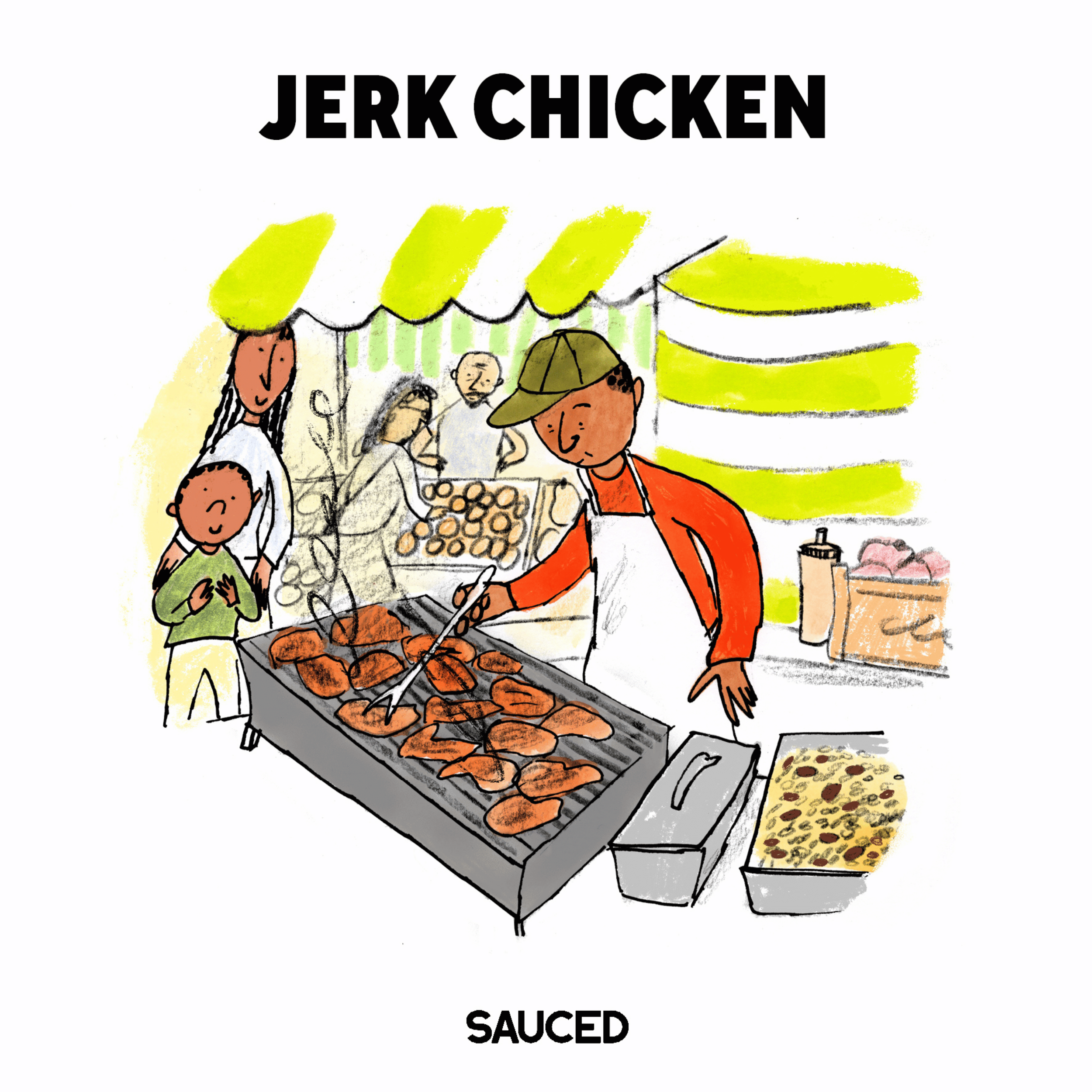
Most cooking woods are fuel. For Jerk Chicken, Pimento is the seasoning — it's the smoke, not just the marinade, that gives the dish its defining flavor.
We dig into the Maroon smokeless-pit origin, the scotch bonnet science, the Boston Bay tradition, and why Red Stripe — not rum — goes in the marinade.
"Jerk is freedom manifested in food." — Gariel Ferguson, via Smithsonian Magazine
What we settled on:
Pimento wood is the non-negotiable — allspice in foil on coals is the workaround
Bone-in chicken leg quarters, slashed for marinade
Pork belly thrown in for the party version
Scotch bonnets only, blended whole
Marinade overnight, max 24 hours
Red Stripe in the marinade — cocktails carry the rum
275-300 degrees grill, 185-190 degrees internal for pull-apart
Reserved dry-rub dust for the final caramelizing pass
The Cocktails
Jamaicain Jerk Daiquiri: Wray & Nephew Overproof, Allspice Dram, lime, demerara, Pimento bitters, dry-rub rim.
Lion’s Tail: Bourbon, Allspice Dram, lime, demerara, Angostura.
RECIPE CARD:
Premium subscriber? Check out the full recipe card here.
LISTEN
EpiSOde Partners
Thanks to the following brands for partnering with Sauced to bring you this episode:
TRANSCRIPT
Tim McKirdy: Sother.
Sother Teague: Tim.
TM: Jerk Chicken.
ST: Who you calling a jerk?
TM: What a fantastic dish — and one that I feel like, obviously, the history goes back a really long way, but has been very present in my life, I think due to popular culture over the past maybe 20 years or something. So excited for us to get into it.
ST: Yeah, like really popular in the island nations, of course — Jamaica, where it hails from — and then you see it plenty in New York City on the streets.
TM: Yeah. And places literally where — and this is a crazy thing we've spoken about on this show before, right? Like, you're not allowed to cook with charcoals in this city, but I think there are one or two.
ST: There's tons. I see them everywhere. Like down on Flatbush Avenue.
TM: Yeah, and whether or not they are operating within the correct licenses, I don't know. But there's certainly some that do have them, because I watched a video on — I think it was Eater — of a place out in Queens that looks incredible, and I need to get to. But you know, oftentimes we'll talk about personal and professional associations with the dishes that we cover. This one I think will really resonate with a lot of British listeners. So I think — you know there's a show here called Shark Tank?
ST: Uh-huh.
TM: Do you know what we call Shark Tank over there?
ST: Dragon's Den.
TM: Dragon's Den. So I think it was in the 2007 series, there was someone called Levi Roots who went to sell his Reggae Reggae Sauce — or went to get funding for his Reggae Reggae Sauce — which was like a tangy barbecue jerk-style condiment seasoning. Absolutely delicious. One of the major UK supermarkets picked it up, got exclusivity, thought they would sell 40,000 bottles in the first year. Sold 40,000, I think, in the first week. And so just the whole idea of the Reggae Reggae and the jerk chicken, and suddenly it was everywhere. You know what I mean? And suddenly once you'd seen it, you couldn't look past it. But what about yourself? What about beyond the Flatbush and the folks you see around the city making it?
ST: I mean, you know me, I like to be on or near the water whenever I can, so I go to islands as often as I can for vacations, and it's always a part of that. I've never cooked anywhere where we had it on menu. And I've certainly made jerk chicken in my backyard plenty of times. It's a 100% win rate. It never loses.
TM: And not classically a dish — I think when people see the episode title, they will be like, "What's the alcohol in this?" It's not one that you have to have it or you can't make the proper version without alcohol, so I feel like we're —
ST: I can't. No. I need it.
TM: You need it in there? Well, I'm interested to hear what route you want to go for that then, but it's not a bourguignon. I feel like it's very similar in sort of soul and preparation to Carne Asada and a lot of the discussions we had on that episode.
ST: Oh, for sure. Plus some of the flavor notes are gonna come through in that same vein as well, you know — sort of tangy but spicy, but like finger-licking. You can't stop eating it once you start because it's gonna light you up a little, so then it's like bite, swig, bite, swig. You're going back and forth from your beer or whatever. It's interactive — like our Drunken Noodles as well.
TM: Interactive — which is what we're all about here. Another defining aspect of this dish that I know we're gonna enjoy talking about is just the method of cooking and a definite non-negotiable in there, and I think we're gonna have to explore how we navigate that here. But I'm sure you're coming with some various different hacks for that.
ST: I got a few pointers to give, to get to that more traditional flavor. But you know — it's a primary part of the dish, right? You're referring to the pimento. Pimento, yeah. We have to have pimento wood to make the smoke. It's indigenous to the Jamaican island, so it's probably on a bunch of islands down there. You can't really find it too easily at stores, but it's online. I think there's literally a site that I've gone to in the past called buypimentowood.com.
TM: Yes. Yeah, I think that's where I got it before.
ST: It's not cheap, but it's super specific to this dish, and it really brings a very specific flavor. You're gonna get about two — I think I saw last time it was two pounds of pellets if you've got a pellet smoker. It's gonna cost you about 12 bucks a pound, but pellets, I don't like to use them. You can get the wood chunks. That's about double that price. It's about 25 bucks a pound, I think.
TM: And look, we're both people who are like, "That's worth it. That's worth the investment."
ST: It is. And also, we're gonna speak mostly about jerk chicken, right? Pork is also an option. But chicken's pretty cheap, and if you've got a big enough grill, just cover the thing. Make a bunch of this so that that same amount of wood can smoke a much greater amount of chicken, right? So economize it. And have a party. This is a party dish.
TM: 100%. Which does then make us looking into the origin and stuff as well. I think whenever you explore food and drink from the Caribbean and different Caribbean islands, especially Jamaica, there are always going to be difficult conversations to have.
ST: Yep. This is no exception.
TM: No. And it's great that the dish itself now is something that we really do associate with partying and gathering around, bringing people together, because I think that's a good antidote to —
ST: To its origins, which are fueled by hardship and difficult times.
TM: So, I mean, we'll get into those now. Let's explore the origin. I want to begin, as oftentimes we do, just by looking at etymology and the word. So jerk derives from the Spanish word charqui, which is also — it's a Quechua word — which means dried salted meat. Jerky has the exact same roots. It's the very same idea. And that's important to note because I feel like a lot of times we recognize the English influence on Caribbean islands — the slave trade, and how that tied into the sugar trade and subsequently the rum trade. But very much worth noting that the Spanish settlers would've been on the island before the Brits got there, and they were living in tandem with the Arawak people, also known as Taíno, and they were indigenous Caribbeans. They called Jamaica — just to get into more etymology here — they called Jamaica Xaymaca, X-A-Y-M-A-C-A, which means the land of wood and water.
ST: Wow, that's cool. But the Taíno — I always thought it was Taino. How'd you say it? Taíno? Taíno.
TM: Yeah, the accent's over the I, so it could be Taíno.
ST: Got it. But they suffered greatly at the hands of the Spanish, not necessarily out of just sheer oppression — though that was part of it, right? They were conquistadors. They were there to conquer. But they suffered because they were a segregated population, and when the Spaniards came, they caught diseases that their bodies couldn't handle. A vast portion of those people died away almost overnight, right? Like first contact with a new planet or something.
TM: Which is, you know, again, once again, a harrowing story that we hear time and time again if you're looking at the late 15th century, 16th century and beyond. They were there before Columbus arrived, would have been pushed out or pushed oftentimes into hiding — where they created cooking techniques for smoking and cooking meat that were surreptitious, that didn't produce a lot of smoke, that didn't have open flames that would be visible to those people who are looking to do them harm. The Spanish conquistadors did begin bringing over enslaved people from Africa, and those people would go on to become — and again, sorry for folks if this is a bit of a history lesson, but very, very important to the —
ST: This dish is steeped in history. When you eat this, you are eating history.
TM: Yes, exactly. So any of the enslaved people who managed to escape their oppressors and flee into the mountains, they became known as the Maroons, which comes from the Spanish word cimarrones, which can mean various different things, some very horrible and others — you can look it up, folks, but it's not a very nice origin there. But the Maroons, peoples who managed to escape, they interacted with the Taíno people and they learned their cooking techniques from them. They learned how to stay hidden and cook meat in such a way that would help preserve it. I believe they also learned different spices and curing, which is probably that jerk and that jerky originally. And then I think that's really where this dish is born and its roots are. Like we said, we're talking smoking pits over wood that does not have a massive open flame, right? So you would be able to do that. And as a byproduct of that, what you're eating when you eat this dish is you're tasting the wood. The wood isn't just the thing that we're cooking it with — it is the seasoning.
ST: Well, right. You know, I am a huge proponent and fan of smoking meats low and slow, and the choice of wood that you pick for whatever dish you're making makes a huge difference. And this particular wood, pimento wood, it's kinda oily. So there's a definite nuanced flavor that comes from pimento wood, which is, A, similar to allspice berry — 'cause that's what the pimento is — and B, it's kind of almost like eucalyptus. So the choice of wood is gonna make a huge difference in this. And again, I'm always saying on the show, I hope I don't sound too repetitive — don't not make this dish if you can't get ahold of pimento wood. Use whatever wood you got. And frankly, you can do this dish without a grill. You can do this in your oven. You're still gonna have a great time.
TM: And you alluded to it earlier as well, you touched upon it directly — the meat in question very much would've been traditionally hunted wild boar, seasoned with pimento, with allspice berries, salt, peppers local to the island, wrapped in pepper elder leaves, and finally cooked in an underground smokeless pit, roasted over dying embers. And I think that is really some of the time where you get those best flavors as well, right? It's optimal for smoking. We don't want too much flame, even just ourselves in our back gardens, right? For flavor there.
ST: Yeah. You can go to my Instagram and find several instances of me out back smoking, and I'll usually take at least a second to film the smoke coming out of the grill with the lid closed. It's just a wisp. We don't want to over-smoke anything. Smoke is acrid, right? You can go plenty wrong if you're roaring too hot. So smoke is slow and low.
TM: Yeah. And then — so at what point does it become jerk chicken? At what point does chicken become the vehicle? Very much more of a modern thing, and very much more mimicking, I would say, the subsequent diaspora of Jamaicans and Jamaican culture around the world. I think this really is, like I was talking about earlier with the Reggae Reggae Sauce — but just, you know, like reggae as music and this as a dish. I think it really does speak to the outsized cultural impact that a relatively small island in the Caribbean has had worldwide.
ST: Yeah, punching above weight. I mean — but again, here's why. It's delicious. It is universally loved. Again, it's 100% success rate. I guess unless you're a vegan, this is gonna work. So let's get into jerk.
TM: Let's get into it. So yeah, those are our origins. That's our etymology. We'll take a quick break now, I think, and then we're gonna get into some luminaries and culinary direction.
ST: Cool.
TM: All right, we are back in the studio. Sother, culinary luminaries or culinary voices speaking about jerk chicken for us here today.
ST: Well, my first one you already got. My first one was Levi Roots. And that's how I found out the name of that show. I would have never known. I was wondering. But I didn't put it together the way that you did. I didn't know that bit about the store being an exclusive and selling that much.
TM: Sainsbury's supermarket, for anyone in the U.K. who cares. But now it's available across the board, I believe. Tesco have it.
ST: Sure, they probably had exclusive for the first year or something, right? First right of refusal. There's a woman, Helen Willinsky. She is known far and wide for writing books about Jamaican jerk. And she kind of like spearheaded the codification of it, right? Really sort of dialed it in so that we can all be kind of on the same page. There's a dude out on the West Coast named Paul Chung. His restaurant — I should've written it down. I can't remember the name of his restaurant — but his restaurant is entirely cooked over wood. Everything they do comes out of the kitchen cooked over wood, so he's strong into Jamaican jerk. A more familiar name, maybe to some of you out there — Mimi Sheraton. She was the first ever female food critic at The New York Times. She wrote a bunch of books. She says, "Jerk is an astonishing balance of heat, sweetness, smoke, and perfume." I think that says it pretty well. And then probably the most notable name that I could find — Anthony Bourdain. He repeatedly described authentic Jamaican jerk as one of the greatest street foods in the world. He admired its intensity, smoke, and cultural depth. He said, "You haven't lived until you've eaten jerk in Jamaica." So we all gotta go to Jamaica or we don't live.
TM: Well, I'm willing to make the sacrifice.
ST: Well, there's one more. Scroll down — I forgot about him at the bottom here. José Andrés. I love that guy for numerous reasons, not just his talents in the kitchen — just a very good guy. He highlights jerk as an example of how smoke and spice can create not just a memory but an identity in a cuisine. So I think that really ties it up nicely.
TM: Beautiful. You mentioned Helen Willinsky. Jerk: Barbecue from Jamaica, I believe, is a book from 1990, I think, is an authority there. So if anyone wants to go check that out, I believe it's got all the info you want. And then Norma Shirley —
ST: Oh, I don't know that name.
TM: — who I believe Vogue magazine nicknamed her the Julia Child of Jamaica.
ST: Oh, cool.
TM: She trained as a nurse, started cooking while living in Scotland, returned to Jamaica in 1985 —
ST: To learn how to cook. To unlearn what she learned in Sco — I'm just taking the piss.
TM: She opened Norma's on the Terrace in Kingston, Jamaica, and Norma's at the Wharfhouse in Montego Bay. Those were subsequently named some of the best restaurants in the world by no other such publication than Condé Nast Traveler. And I wonder whether that was the double-L or the single-L Traveler, 'cause before they used to have a U.K. publication and a U.S. one, and we spell it different.
ST: Right. So then they merged. We won probably.
TM: I think the Americans did, 'cause we use double-L. But yeah, she is known for being — and I forget who it was — well, we kinda talked about it with Mario Batali for Shrimp Scampi? Yeah, Shrimp Scampi. It has been the person who's sort of taken this classical dish, still paying it a bunch of respect, but saying, like, "We're gonna elevate," or "We're gonna bring it onto the white tablecloth dining fine establishments." But very much people do say — I think it's on the northeast of the island where you get the majority of people making the jerk chicken just on the streets, on the side of the road there.
ST: Yeah, that area's called Boston Bay.
TM: Boston Bay. Have you been to Jamaica?
ST: I've not. It has long been on my list, but somehow I've been to a bunch of other islands. I've just never made it to Jamaica.
TM: Never made it to Jamaica. Wow. And then finally, just as I thought this was pretty cool for us here with something of a New York tie — where would you go in the East Village or the Lower East Side for Jamaican food? And cocktails.
ST: And cocktails? In the East Village? I don't know.
TM: It might be Lower East Side. I'm bad with my geography.
ST: Miss Lily's. Oh, yeah, duh, right there on Avenue A. Just around the corner. That place is a constant party. If the weather's even reasonably nice, all the windows are open, the music is pumping out of there. There's often a DJ. It's brightly colored. It is like a little haven of Jamaica right there on Avenue A.
TM: Yeah, so that's a great spot to get it. A chef called Andre Fowles. So they have three. They have one in the East Village, they have one in Dubai, and one in Jamaica, Miss Lily's Negril, and he is the culinary director of that location. He released a cookbook this year — like two months ago — called My Jamaican Table. And the forward is by Bruce Springsteen, because I think he was also Bruce Springsteen's private chef at one point. So just some other sources, and that being good, right? Like oftentimes the books that we quote or we point people to, those are a little bit older, but I thought that's great, and that has that New York tie for us.
ST: Well, yeah, some of the things are older, that's true. But this woman that we talked about just a second ago, Helen Willinsky — her book Jerk from Jamaica, you said was from the late '90s or something.
TM: 1990, I think.
ST: Oh, early '90s. The first edition. But she still has an active Instagram account. I saw her on Instagram doing some kind of — she doesn't just do jerk stuff, but I saw her roasting some lamb the other day.
TM: All right. Well, those are the voices and the direction for us here today. Let's take another quick break, and then we're gonna be back with the non-negotiables. All right, Sother, we're back. I think I have seven decisions for us here to make, but I might be wrong. More like debates than ingredients or techniques, but I have seven things on my list here, and I see you looking through yours too, so we'll go back and forth. Let's do it in order of importance. Where are you heading first?
ST: I'm torn. I think there's two that must be here. I mean, these are non-negotiables, they all must be here, but which of these two is the more important? I'm gonna say allspice. Do you know what the other one was?
TM: Pimento wood?
ST: Well, so allspice is pimento. The word pimento — in English we more think of it as pepper, but on the island of Jamaica, the pimento is the allspice berry. So when I say allspice, I kinda want both. I want the wood and the berry. The twigs and the berries.
TM: Gotcha.
ST: The other one that's just as important — so when I say allspice, it sort of encompasses all that. But then the other one that's so important to me is the peppers, right? Scotch bonnets. Which are pretty indigenous to Jamaica as well, and specifically the Scotch bonnet.
TM: Yeah. So before we get into that, and I did mention it earlier, let's talk about the pimento question here and the allspice question, right? So we mentioned you can buy the wood. It's a bit of an investment, but it is this dish, right? And I agree, you need those flavors. If you don't have them, I had one or two potential workarounds, but I was curious to hear how you would approach it if you were instead maybe working with allspice berries only or something else.
ST: Well, we're gonna grind some allspice berries to put into the rub/marinade. But then you could also soak some allspice berries in just water or beer or what have you, and use those as your smoking element, right? Just put them in a pie tin or whatever, right on top of the coals, and they'll smolder. And you'll get a little smoke out of that. That's about the best you can do.
TM: I think that's the way to go. And then I believe — again, this might be no easier to get hold of than the wood that we spoke about, but I looked it up, and there's certainly Caribbean grocers, and if you're in a city like New York or a larger metropolitan city, go to a Caribbean grocer. They carry dried pimento leaves, which is another thing that we could use as a workaround or whatnot.
ST: Yeah, similarly, I wouldn't put them directly on the coals because they're just gonna flame up. And I wouldn't — that's why I wouldn't put the pimento berries on the coals either, because they're just gonna fall down in between them. They're just tiny. Just put it on a — you know, I have an old lodge pan that has been, you know, seen some things. It's just a little 10-incher, but I keep it out by my grill, and that's — I'll use that as a smoke pan, right? So you can just put the pan on the coals and then put whatever you're smoking. That way they won't flame up and just go away. They'll just smolder.
TM: Yeah. So all right, I think the pimento is the non-negotiable, and we're saying we want it on the grill but also in the marinade. Fresh, wood, all of the above. However you can get it. You mentioned Scotch bonnets, so let's look at the heat now. Talk to us about what makes this such a special pepper and ingredient that you love.
ST: Scotch bonnets are often subbed out with habaneros, right? Scotch bonnets are from the Caribbean. Habaneros are from Mexico. They're similar in size. The habanero is a little bit bigger and pointy. The Scotch bonnet's a little bit smaller, and they say it looks kinda like a bonnet, like a hat — someone said it looks like a tam o' shanter. I don't even think I know what that is. Isn't that what a leprechaun wears?
TM: It's a hat favored by those of Gaelic roots. But I think it's more Scottish than —
ST: But I don't see how that —
TM: It doesn't to me. I think it just looks more like a shriveled up, dried pepper or like a bell pepper, but smaller. Or — what is the thing? What is the fruit? We'll move on. It'll probably come to me an hour later. You know them. If only people had this utensil that they would carry around with them all day where they could just type it in and see what something looks like, rather than us having to just sit here in the audio medium.
ST: The entire mass of information just at our fingertips. And it makes us lazy. So they're a smaller pepper. They're typically kind of a —
TM: Persimmons!
ST: Oh, yeah. It did come to you. Look at that. Which one, though? There's the Fuyu, and I don't know the name of the other one. Anyway, yes, they're kinda like that shape, but obviously small. They're also that color, right? This orangey, yellowy color. And they are fiery hot as a habanero. However, this is the trick on the Scotch bonnets. They are much more floral and fruity, and the heat comes at you much more slowly and lingers for much longer. If you bite — and I don't recommend you do this, I do it 'cause I love these things — if I bite a habanero, I'm getting hot right now, and it's gonna last a while. If I bite a Scotch bonnet, I'm gonna be like, "That was nothing." And then in a few minutes, I'm gonna be like, "Whoa, that was something." And then it's gonna stay with me for a long time.
TM: 100,000 to 350,000 Scoville units?
ST: Yeah. Mr. Scoville. What a masochist. Or no, other way around — he was the sadist. You know, this all just comes from his friends. He just sat his friends down and said, "I'm gonna make you guys eat this, and you tell me how hot you think it is." He was a scientist, with air quotes. You know what that has to be. That's the Porco fun fact of the day?
TM: Does that mean you got a Porco coming later down the line?
ST: I don't.
TM: Don't worry, I got you covered.
ST: I was about to say, I hope you do. Anyway, floral and fruity, and they also have — peppers often have a sweetness to them as well, and this one has a great sweetness. So it's a real fun ride. Get the Scotch bonnets. If you can't, of course, get a habanero. If you can't, of course, use a — I don't care, get a serrano. But this thing needs peppers.
TM: But jalapeño, for example, by way of comparison, we're talking 2,500 — less than 10,000 Scoville units. Just for comparison's sake. So almost at least 10 times less fiery than what we wanna be working with here traditionally. It's a non-negotiable.
ST: Yeah, so you're gonna have to go up by 10 times. And jalapeños now, they've been bred poor — on purpose. They've been bred now by American farmers to be less hot, so that they can go into jarred salsas all over the country, and it's a real shame. I almost never even bother with jalapeños anymore. They don't even —
TM: They don't register for you.
ST: They make me angry.
TM: All right. Well, my first non-negotiable that we have here today, I'm gonna say protein. The dish is called jerk chicken — or the dish that we know, the dish that became popularized, is jerk chicken. I think this does just as well with pork. If I cut up a Boston butt for this, I can imagine it being incredible, and in fact, I wanna do it immediately. So I'm gonna say protein — chicken, pork, slower cooking cuts. I will say, too, I know we've been through it before where we're talking about breaking down chicken. You can do it yourself. The more you break down, the more practice. I can already hear you in my ear. We had someone —
ST: We had someone do it. Remember that someone posted on their Instagram. They went and bought three chickens, and they broke them down. Incredible. I love it.
TM: Love to see it. I will say, though, for this — and especially if I'm having that party — I'm just gonna buy either bone-in thighs or legs. Or quarters, leg quarters.
ST: Leg quarters.
TM: Exactly. I want leg quarters. So you want the drumstick and you want the thigh.
ST: Yeah. Plus I'm gonna, when we get to it, I'm gonna slash 'em, right? And they'll just hold together better if it's a leg quarter than just a leg or a thigh. And then at the end of the thing, we're gonna chop it up anyway. Also, I'm in total agreeance with you about the pork. If I'm making this again, I'm probably having a party. This isn't something I do just for myself and Natalie. I'm probably gonna go ahead and grab several leg quarters and maybe a chunk of pork belly and just throw that in there with it. So then there's a little bit of pork belly, there's a chicken. Let's go.
TM: Having a jerk party.
ST: Yeah. Lovely. I don't think that means what you think it means.
TM: Come on, let's keep it clean.
ST: Hey, keep it classy.
TM: So pimento. Protein. Heat from Scotch bonnets. Where are you going next?
ST: I'm gonna do the thing you always do to me and name something that's not obvious. Smoke.
TM: Yeah, but we talked about that with the pimento. That comes into the pimento.
ST: But that was the third one I have listed here. I don't think I listed them in order. Then we need — this dish has to have scallions. That's a non-negotiable. Do you want me to start listing them now? 'Cause they're not as important anymore, I don't think. But they all have to be here. Am I missing a big one?
TM: You missed one of my style non-negotiables.
ST: Uh-oh.
TM: So I'll say — this is a dish where the primary ingredient, the protein, needs to be marinated. And unlike when we were talking about Carne Asada, we wanna go longer here, right? We're not brining the chicken. We might go with a dry rub or a wet rub or a combination of both. I wanna get your take on that. But we need to marinate it, and I think overnight, maybe maximum 24 hours, is your sweet spot.
ST: Maximum. 24 hours is great. Let's get it done. I'm gonna get my chicken ready today for cooking tomorrow. And that marinade is gonna be — that's where the peppers and the scallions are gonna come into play. You need some thyme.
TM: Yes, thyme is also like very important to this dish. Super important.
ST: Obviously — well, maybe not obviously — garlic, and then another one that's really important, ginger. And all those things, along with just regular onion to give it some bulk, are just gonna go raw right into the blender to make this paste that we're gonna smear all over the chicken and let it sit for 24 hours.
TM: So some of the videos I watched, I did see chefs where they would go from dry into wet. They were using a blend of black pepper, allspice, nutmeg — very important for a lot of people — salt, sugar. And they were doing it in these buckets, and then they would have that wet marinade that you were talking about and walking us through there. I don't know whether I wouldn't just be tempted to make everything in the same marinade. I don't know whether there is much to be gained from doing dry then wet.
ST: You're just getting more — maybe some more surface contact from the salt, that's doing a little bit of curing for you. I don't think you need to do that. I think when we get to building this recipe, I do want to — we haven't finished ingredients here, but I want all those ingredients you just listed, those dry ingredients — I'm gonna put most of that into my marinade and reserve some, because when it's time to actually get towards the grill, I'm gonna dust the rest of that onto the chicken itself. So there'll be an exterior layer that has that sugar in it, which will help do some caramelizing.
TM: Nice. What other ingredients — is that it for the non-negotiables for you here today?
ST: Yeah. Well, there's one more. Beer. I'm gonna put beer in this. Doesn't take a lot. I just want enough beer to get the blender spinning, right? 'Cause those things aren't — onions, they have a lot of wetness in them, but they're just gonna bounce around in the blender unless they can catch, and you need some liquid to get them to catch. Citrus? Not a non-negotiable for me, but orange juice is quite common in a lot of recipes I saw, and then weirdly, then wedges of lime on the plate when it's cooked, so you can squeeze a little citrus over the top. So I don't know why they wouldn't just put lime in the marinade. But — well, maybe because lime would maybe kinda over-cure.
TM: Yeah, maybe. Especially if we're talking about doing this for longer, like 24 hours — more than just our sort of bell curve that we've spoken about before.
ST: Orange juice is not nearly as acidic, so it won't cure it. But it is important to note — and we talked about it a little bit in the history part — the ingredients in this dish and the technique all have curative/preservation properties because they were mountain people, and they needed to have the protein last. So allspice ground has a curative property. Obviously, sugar and salt we just mentioned are both in cures, preserving. Smoking is a technique of preservation. So all these things combined are really making this dish economical, so that you don't lose any of the product.
TM: So I think just other ingredients, 'cause there's not too many more, right? I think a lot of these are pretty much non-negotiables, but other things that I came across while watching various chefs do it — Chef Kwame, using soy sauce, Worcestershire sauce —
ST: Yeah, I saw that too. I was like, "That seems a little odd to me, but okay."
TM: And maybe like dried Maggi powder. Did I see that? Or that might have been a different video. But the other point here is that a lot of those — I've never used a store-bought, but from the Caribbean, like powder or marinades or seasonings — a lot of people are just defaulting to that, and I suspect it might be that thing as well that's kinda like — it's the taste that you associate with the dish. It's kinda like Sazón in various other Latin American and Caribbean cuisines. Just those seasonings are what you associate with it. I saw some people being like, "Yeah, but it's not the real thing." I will say though, just to come back to our kind of U.K. and supermarkets and the extent to which this has taken off — so in 2020 there was some backlash against Jamie Oliver in the U.K. Usually someone who —
ST: The Naked Chef.
TM: — usually someone who's quite affable and who people really like quite a lot. He released — Jamie Oliver obviously has his empire. He has prepackaged, pre-prepared foods, microwave dinners, stuff like that. He released something that was described as jerk, and it just inspired a lot of backlash online just because it wasn't any of the traditional flavors. It was just basically somewhat Caribbean-leaning in style, and people were like, "Yeah, man, this is —"
ST: This ain't it, Jamie.
TM: This ain't it, Jamie. So that came up in a wonderful Smithsonian article that I read called A Brief History of Jamaican Jerk by Vaughn Stafford Gray, from the end of 2020. So just another great resource for folks if you wanna do a little bit more of a dive on the background and origins of this. And that article is gonna come up a little bit later, so I wanted to make sure we were name-checking it properly and specifically. But yeah, sorry, Jamie Oliver, how did I get — that was the lead in that article, and I'm like, "Oh." Tough one.
ST: Listen, people get really upset, but you were talking about buying a ready-made jerk dry rub. Listen, dry rubs are so easy to make. I love all these companies that are out there making them, and they're all splashy and making waves and hopefully making their makers a living and all that jazz. But they're so easy to make on your own, and then they're personalized to you. And the biggest part of that personalization, in my opinion, is you're in control of things like salt and sugar content. When you're buying dry rubs that are pre-made, they're mostly salt. You're basically just buying a seasoned salt. And you don't have control over that aspect. We talk about it a lot on the show, I don't like to buy salted butter for that same reason. Dave Arnold disagrees with the both of us on this point — which I find fascinating and crazy, but he is also fascinating and crazy. So make your own. It's not that hard.
TM: Fantastic. Any other ingredients that you came across or you saw in the mix, or is that time for us to call it a day on the non-negotiables and the negotiables?
ST: I think so. We've assembled a list of all the quality stuff that we need, and now it's time to start putting it together.
TM: Sounds good. All right, well, before we do that, let's take another quick break here today, and then let's get into the preparation. All right, Sother, you've given us a brilliant head start already. Let's bring it all together. Let's talk about the preparation here, how you would attack a jerk chicken or a jerk party if you are going with that pork and the chicken.
ST: Why not? Let's do it. I think we're gonna get the legs and thighs. We're gonna leave the skin on. The skin is an important part of the jerk. And leave them connected, leg and thigh as a quarter. Take your knife and slash into the meaty side of the thigh and slash into the leg. That way we're creating crevices and more surface area for this marinade to get into, get onto, et cetera. And then let's do the same thing. Let's take a chunk of pork belly. We'll get into the specifics in the recipe card, but a nice chunk of pork belly. Do the same thing, slash it on the meat side, leaving the skin side — or you can maybe do a little diamond hatch, and that'll help it render. And I would leave it whole. Just do a nice big chunk about the size of a laptop. I wasn't prepared to talk about pork, but I love it, so let's do it. Then once you've got all that slashed and patted dry with a paper towel so it's as dry as it can be, throw it back in your fridge while you're making the marinade. And if you got a fan in your fridge, even better, and it'll get tacky so that the marinade will stick to it really well. Then into a blender with all of the things we listed before, and a pretty heavy amount of those Scotch bonnets. We want this thing to be brightly flavored with those peppers and pretty hot. But don't forget that there is sugar in the mix that we're gonna talk about, and the caramelization of the protein cooking on the grill is also gonna add a sweet layer as well. So you'll kinda balance that heat. When you're making the marinade itself, taste the marinade — obviously, it should be a little too spicy. You'll think, "Oh my gosh, this is too spicy." But once it gets cooked, it will calm down quite a bit. Not an easy thing to do, tasting hot sauce as you make it. As you know, I'm a hot sauce maker. I make and sell a few hot sauces, and you have to take a break. You're just like, "I can't taste this right now. I gotta go away for a couple hours." But you'll muddle through. Anyway, all this can go right into the blender. You don't have to pre-do anything. So Scotch bonnets, all those things we listed before —
TM: Are we deseeding those?
ST: I'm not.
TM: I think you should deseed at least some of them. Well, or gauge the room.
ST: I love the sort of chunky style that you're gonna get from this marinade in general, right? It's not a smooth sauce. You're not gonna pass this or anything. And then Scotch bonnets being as small as they are — it's gonna be tedious, and I also think that I generally don't deseed anything because I don't find that it's gonna really make that huge a difference in the spice level in the end product. But also, what's the difference if I deseed them and then I use an extra Scotch bonnet to make up for the heat that I just lost? And then the last thing is — man, oh man, have you ever touched your eyes after you've deseeded peppers? It happens, and I just don't like it. I'm not gonna — I'm throwing them right in the blender whole.
TM: Even with the stems?
ST: Well, pluck the stem off.
TM: Pluck the stem. Okay.
ST: But I could see not, you know. So anyway, going into a blender with a heaping dose of Scotch bonnet peppers, chunk up an onion. Let's go in with several scallions, a big handful of thyme, several cloves of garlic, and a big knob of ginger, and some beer. What beer are we gonna use here? Of course, Red Stripe, right? Red Stripe. You know, they make one that's lemon? Red Stripe Lemon. Never had it, but it sounds super refreshing. I bet that's a banger over ice.
TM: I've got some Red Stripe stuff for us later on.
ST: Oh, do you? Excellent. Oh, you mean stuff to talk about. I thought you were saying you have some beer for us later. Got my hopes up. And then those things you mentioned, the dry part, right? Let's go in with some salt, some sugar, some black pepper, and you listed a fifth thing.
TM: Allspice berries — we don't wanna miss.
ST: I already threw those in.
TM: Cinnamon.
ST: Remember I said throw them in whole.
TM: Yes, cinnamon. Nutmeg.
ST: And nutmeg. But yeah, cinnamon. Something I've certainly said in my life, I don't know if I've said it on this show — it's always funny to me that we think of those things you just listed, allspice, cinnamon, nutmeg, mace, ginger even — we think of those things as winter spices. All of them come from islands where winter never visits. So yeah, cinnamon. Wanna get a little cinnamon in there. And then just whiz it up.
TM: Bit of oil as well?
ST: Yeah, whiz it up. Maybe a small amount of oil just to help it kinda open up all those flavors and spread them around. And then that's exactly what you're gonna do. Now you've got all your protein in a roasting pan or something that's got sides on it — not a sheet pan — and you're just gonna dump it on top and massage it in. Oh, but remember what I said, we're gonna save some of the dried stuff to the side because we're gonna use some of that again later. And then you can also save some of the marinade, and we can do something with that later too. But then get it covered, put it in the fridge, leave it overnight, and then tomorrow let's light up the grill.
TM: Nice. When it comes to cooking on the grill, what temperature are you gonna be aiming for, for this — so that we get that low and slow, so we can maximize the effect of that wood that we've spent a little bit of money on and time sourcing?
ST: Two temperatures I'm gonna give you here. Grill temperature, I'm gonna hover my grill around 275, 300. But internal temperature of the protein, I wanna achieve much higher than you'd think, right? Chicken we can eat at 170, right? Is that the number? 165, 170. But I'm gonna probably shoot for like 185, almost 190, to have a little bit more of a breakdown. And the reason we're doing that is because this is not a fast cook, right? We're gonna cook slow and low. And the meat — both the pork and the chicken — will be much more tender and pull apart when it's time to eat if you achieve that temperature.
TM: Lovely stuff. And then what do you want on the side with it? What are you serving this with? Food-wise.
ST: Yeah, food-wise. Certainly, this dish screams out for rice and peas, which is traditional. But also festival.
TM: Sweet fried cornmeal dumplings.
ST: Yeah. They're like a sweet corn dog minus the dog. It's just like little puffs of delicious corn. I don't know — why are they called festival? I don't know. I should've looked that up.
TM: When was the last time you had a corn dog?
ST: Me? It's been too long, I can tell you that, 'cause I love corn dogs.
TM: I had one but three days ago.
ST: Very random. I'm jealous. I love a corn dog. You know what, you know who makes a great corn dog? Crif Dogs right there in the East Village.
TM: Yeah, after your trip to Miss Lily's.
ST: Yeah, right next door, basically.
TM: Fantastic. And then anything else? Yeah, it's gonna be your classic sort of Caribbean fare across the board when it comes to sides. But yeah, gotta have some rice on the table with some peas.
ST: Yeah. So it's important to talk about the grill setup, right? We're gonna do indirect heat. So my grill has a smoke box on the side, so that's what I'll be using. But if you don't, you're gonna build your fire to one side or one end of the grill, however it's laid out. You're gonna get the — hopefully those wood chunks — you're gonna have those pre-soaked in some water so that they'll smolder for longer and lower. And then if you don't have those, the options that we offered — throw in some allspice berries or some allspice leaves if you can get a hold of those. But again, let's get some wood happening here. This is not just a grill, this is a barbecue. And in fact, it's important to note, this is kind of the progenitor of what we think of as barbecuing. Not grilling. Let's not confuse those two terms. But this is where cooking with smoke really sort of became a thing and was obviously taken over by the world. Everyone cooks with smoke now. So build your fire, and you're cooking not over direct heat yet. The final step of this, once you've achieved the temperature of the protein, is to then stoke the fire a bit and move it over the direct heat to get some of those — burnt is not what we're looking for here, but we're looking for that caramelization that's pretty dark. Some crispy edges on that pork and the bits of the skin of the chicken. And that is also another reason that we're not removing the skin from the chicken. The skin is helping to sort of self-baste the bird while it's out there. So when you line up your protein on the grill, we're lining it skin-side up, so that the skin can sort of protect and get some of that smoke adhered to it.
TM: So one of the other things that I saw some folks doing that I enjoyed — yes, keeping the skin on, but also peeling it back. Doing that delicate dance of, you know, wanting to make sure that that wet marinade gets into and in contact with all of the meat. But also not getting rid of the skin fully, because like you said, we're gonna be basting. It's gonna protect that meat. Fantastic.
ST: And — oh, I forgot to mention one thing I always do. Right before we move it over to that stoked fire to get that caramelization, that's when we're gonna take the remainder of that dry rub and like hit everybody. And again, you can lift up the skin there too and jam some underneath.
TM: Fantastic. The only other thing I was gonna say was — and I didn't have this verified — but you were mentioning sort of like piercing the, you know, or cutting in to have pockets where that seasoning is gonna develop further, penetrate further. I think I had saw some people saying that that technique is covered by the word jerk as well — or that jerk is a sort of synonym among some people for pricking the meat. So jerk is the act of cooking it, it's also the marinade. Again, I'd only seen one person say that, and that might be apocryphal, but it kinda makes sense to me.
ST: Sure. Yeah, I can see it. You're sort of jerking at the meat, right, with your blade. You're slashing. And then — what do we need to talk about next?
TM: We need to take a quick break now, and then we're gonna be back with the drinks.
ST: Well, let's not take a break right away. Let's talk about how the listener should become a subscriber if they're not already.
TM: Ooh, okay. Make the case for us here today.
ST: Well, subscribers get a little bit closer contact with us. We're building a community, and you know, we answer people's questions directly through social media and things like that, but we have a back channel —
TM: You know, like last week where I said, "Someone please remind me to share the dressing recipe because I'm gonna forget"? Guess what happened? I forgot. Someone reminded me, and that went out this weekend. Excellent.
ST: Yeah. So there's all kinds of closer contact. Our parasocial relationship can become deeper and more entwined. But also you get the recipe cards for all of the stuff we're talking about. We don't ever talk about amounts and things like that when we're building the recipes here, because we haven't sort of sorted those out ourselves yet. But also, you don't wanna try and take notes while you're listening to the show. We're gonna send you a digital recipe card with some beautiful, handmade art by a human being, not AI generated, from our U.K.-based artist, Charlotte. She's doing fantastic work for us. What else do you get?
TM: Well, I'm gonna say this. Oi, Sother, cost of living crisis alert. It's difficult these days. Don't get me wrong. I know some folks out there — it's $7 a month. There is a discount available, though. If you sign up for the year, that's $70. There's a discount there. I forget what that discount works at, but you know it. So you get two months for free, basically.
ST: Two months free.
TM: And you know what? If folks are loving the show and they say, "One day we wanna become a subscriber. It's not right for my budget right now," we get it, totally. And if it's not right for your budget but you wanna help out Sauced — you're getting something from the show, you're enjoying listening to the show — if you can head over there to the comments, the ratings, leave a review in Apple, Spotify. It sounds repetitive, folks, but that stuff really helps us. It would be doing a big favor for us. And like we said, it means the world when people come on as premium subscribers. But if it's not right for your budget right now, we get it.
ST: Yeah, totally. And also, if that's too much of a bother for you or if you just don't wanna play the algorithm game, the next best thing you can do is tell your pals. Tell your friends who love to cook and you love to cook with, "Hey, you should listen to these guys, chop it up."
TM: Throw a jerk party.
ST: Let's throw a jerk party.
TM: And then tell your friends.
ST: Yeah.
TM: All right. How about that ad break?
ST: Yeah, let's do that.
TM: Oh, that's the other thing you get: no ads.
ST: No ads. That's true.
TM: All right, Sother, we're back for the good stuff.
ST: Is it time to get some drinking done? Well, by the way, we've been drinking the whole time on this dish, right? I'm cracking open that Red Stripe to use in the marinade, but I'm also drinking one while I'm doing all this prep. And then I think tomorrow when we cook this thing, I'm gonna make a cocktail. But do you have — I know I always ask you, especially on dishes that don't seem like it's obvious — do you have a wine rec?
TM: I — no. I honestly, I love wine. I'm not one of those people who's very much like, "You have to have X with Y." But I'm more — if I'm doing this in my backyard, right, there's gonna be a cooler, and it's gonna be full of Red Stripes. Then it's also gonna have a couple of bottles of wine in there as well. There might be a heartier-bodied white wine. We might have an orange wine. We do have folks that tend in our friend group towards the sort of natural stuff. Not too natty. We might have a chilled red with it. So there's nothing that really screams to me, "Oh my God, you have to have this pairing together. It's a religious experience." I think that exists in the world of wine and food, but I'm just like, anything that you can slap in that cooler next to your beers full of ice — you're gonna be having a great time. You're not gonna be thinking too much about the nuances of the pairing or whatever, but I think it's all gonna be a lot of fun.
ST: What if I whacked up some fruit and dumped some Wray & Nephew rum on top of it, and then filled the bowl with ice and white wine, made sort of a sangria with Wray & Nephew?
TM: I was gonna say, what if you did that again? Sother has turned up at my house before with a boozy watermelon. Let's just say — a good time was had by all.
ST: Apparently. Legend has it.
TM: Got some stuff on Red Stripe for you, though.
ST: Oh, yeah. Let's talk about Red Stripe then. And I think we both have a cocktail to talk about. You got a classic, and I got a twist on a classic, which is mainly what every cocktail is.
TM: So another one of our subscribers, our backers, Clay Dillow — his name has come up on the show before. Clay and I, I would like to think, did a lot of good work together when I was working as an editor at VinePair, and he was one of my writers, and we developed a good streak of doing sort of cultural interest stories but with a business slant. And in 2023, it came to our attention — not, not like came to our attention — there was a press release where Red Stripe was trying to revive its sales with a bunch of rum-based ready-to-drink cocktails, so canned cocktails, right? More like coolers, not so much cocktails in the tip-top cocktail sense of it. More like Nutcrackers. Porch-pounder stuff, right? So made with rum, but not Jamaican rum. Fruit-flavored, but natural flavors, not like real fruit. And this just got us both wondering about the fact that, again, growing up when I was a teenager, Red Stripe was everywhere. Red Stripe was sponsoring music festivals. Red Stripe was on sports commercials as well. They had this guy called the Red Stripe Ambassador. A lot of fun as well.
ST: I remember that.
TM: Wasn't a trained actor, by the way, was a trained musician. But they said, "We don't want a polished actor for this. That's Budweiser. That's Bud Light. They're high production value. We want someone with soul, and we're not even trying to say that we're the best beer. We're just like, 'Drink beer. It's fun and refreshing.'" And that's the Red Stripe vibe, right? So we worked on that story together — what happened to Red Stripe? Why did it fall out of the zeitgeist? So you can go and check that out, folks. That's online, and if you search VinePair Clay Dillow Red Stripe, that will be the only article that comes up. But while working on that, and I reread it today, I was reminded of the fact that Red Stripe is not originally Jamaican, nor was it a lager.
ST: What? Where do you think Red Stripe came from? The whole Drunken Noodles thing again. It's a complete misnomer. Where did — so, yeah, no, you're catching me. I don't — this is —
TM: Think of countries who care about stars and stripes or stripes.
ST: I mean here.
TM: Yep. So there is a brewery — I wanna say I think it was 1800s. Check it out in the article. But there was a brewery here in the U.S., in the Midwest. It made White Stripe, Red Stripe, and Blue Stripe beers. They went bankrupt, and they were bought by two British guys who then took the brand rights and started making Red Stripe beer in Jamaica for British people stationed out there — officers. So it was much more of a — not even darker lager — like an ale. Didn't prove to be too refreshing or enjoyed by the locals. So over the years they decided, "Okay, let's adapt the recipe." They changed it. They started making a lager, much more apt for the climate. And then they started contract brewing for the Caribbean for other major breweries. So Red Stripe was making Heineken, they were making Guinness, they were making all this different stuff. Then they got bought by Diageo, acquired, a lot of mergers, and then the rest is history. But Red Stripe Lager — Jamaica's most iconic beer — not originally from there and not originally a lager.
ST: Wow. That's crazy, crazy news.
TM: That might be something of interest to your old friend Porco, no?
ST: Oh. Your old friend Porco. There we go. That's our Porco fun fact. Yeah. That's crazy. I think the craziest part of that story, though, isn't that the product moved and changed. That happens — it's just time, right? The craziest part is that they made RTDs not using rum from Jamaica, not using real fruit, and not using even their beer, it sounds like.
TM: Yeah. What was the point? And that's how they chose to resurrect a brand?
ST: Yeah.
TM: That has so much more cachet.
ST: Yeah.
TM: That seems like an opportunity missed to me.
ST: Well, let's talk about some Jamaican rum. How about some Wray & Nephew?
TM: Talk to us about Wray & Nephew.
ST: Well, it also comes in screaming hot at 63% ABV. So that's gonna really strip all the spiciness out of your mouth when you're eating this chicken. Might take some of the enamel off your teeth, too. But I'm just gonna make us a nice daiquiri. But I'm gonna cut some of the Wray & Nephew away. And by the way, again, at that proof, I'm using less in the first place, right? I'm gonna reduce my amount from two ounces to just one and a half. But then I'm even gonna cut some of that. So let's call it one and a quarter ounces of Wray & Nephew, and then I'm gonna go in with a strong half ounce of Allspice Dram. Which is exactly what it sounds like. It is an allspice liqueur. So it's really got those pimento flavors. I'm gonna double down on the allspice, and I'm gonna put some bitters into this drink, with Dale DeGroff's Pimento Bitters. So now we're drying it a little bit. And then, of course, freshly squeezed lime juice, and I'm gonna use a demerara syrup to make the sugar in my daiquiri. Then I'm gonna shake this guy up, and remember we saved some of that dry rub? Just a little bit, I'm gonna rim the glass with just a little bit of that dry rub. Not all the way around, just on one side so I can kinda come and go as I please. And give this guy a shake and strain it out.
TM: Very cool. I suspected that might be making a reappearance in the cocktail section.
ST: Yeah. Just a little twist on the daiquiri that's gonna really pair nicely with the flavors that are happening in the dish. And as I mentioned earlier as well, there's usually wedges of lime laying around when we go to eat this dish. Also, the chef or whoever is gonna chop it up, right? So we're gonna chop that leg and thigh into probably three, if not four pieces. We're gonna chunk up that pork belly that we made, so then you can just squeeze some lime on there and eat this guy with your fingers. This is party food.
TM: Nice. I saw a stat out there that says that Wray & Nephew Overproof white rum accounts for roughly 90% of all rum consumed in Jamaica. Now, this is one of those statistics that appears a bunch, but I can't find an original source for it. So I don't know whether it's just like, you know, when people say, "Kentucky makes 90% of the world's supply of bourbon."
ST: Yeah. No, they don't.
TM: And we're like, "No, someone made that up." So I don't know, but it's pretty crazy to think — imagine 90% of all whiskey drunk in America was just from one brand, one SKU from one brand. Would be crazy. But again, we don't have that verified, so it's out there.
ST: But they're drinking it mostly Wray and Ting, right? You ever get a hold of some Ting? You know, they have it at the Food Bazaar.
TM: Nice. My first ever, my first associations with Wray & Nephew were actually when I was working in London as a chef. I lived near a neighborhood called Peckham, and on the night bus home from working as a chef, there was a pool bar in Peckham run by Jamaicans. It was incredible. They would serve Red Stripe and Wray & Nephew, and by the time I was knocking on the door to get in, they were locking up for the night and having lock-ins. You could still smoke in there back in the day if you were a cigarette smoker or whatnot, and it was just basically all they would serve was Red Stripe and Wray & Nephew. And wow, was that an introduction to something I had no context for.
ST: Yeah. A young man getting handed glasses of 63% ABV rum that has the funky hogo. So this is what drinking's all about. Let's talk about hogo a little bit. It's a great word. It really means the funk of rum. And this comes from the fermentation process and what are called dunder pits, right? And if you're imagining a hole in the ground when I say the words dunder pit, that's pretty much what we're looking at here. And that's where they start the sugarcane fermenting, and then they take that ferment and distill it into what will become the rum. But the older a distillery is, the older the dunder pit is, and the dunder pit is never completely empty, and it's never cleaned. So these rums that have been around for a while have some funk. And it's —
TM: It's like your sourdough starter.
ST: Yeah, exactly. That's exactly the analogy I was about to make. But it also signifies that you are drinking some delicious — I think I made it sound gross. It is a thing that is sought after. This is a high-ester, aromas coming off of these rums that are just appealing in so many ways.
TM: I saw a chef on YouTube as well who did essentially the same thing with their jerk marinade, right? So they would marinate a batch of chicken — and this helps if you own a restaurant that serves this dish, right? This isn't gonna be useful to you or I, maybe — but would marinate the chicken in that, pull all the chicken out, and there'd still be some marinade left, and mix the new one in there. So you had a jerk solera.
ST: Yeah. There's a couple of examples of that out there in the world. You know, famously — if you don't know this, it's a weird one — but Tootsie Roll candies, there's always some of the last batch in the next batch. And they've been around since the early 1800s. So that means that when you eat a Tootsie Roll, you've got some shaves of the DNA of the original Tootsie Roll. And then there's a restaurant here in New York City that has effectively a solera mole sauce.
TM: Well, it's Pujol — Pujol is the famous one, right, in Mexico City?
ST: Right. But the one here in New York City is — they're related. And I'm struggling to remember the name of the restaurant.
TM: Pujol or Pujol.
ST: But not the one here.
TM: Oh, here is — yeah, yeah. I've been there.
ST: They put a number on the top. I think they put a number on the top of the menu, and that's how many days that the mole has been active. And then I follow a guy on Instagram called Perpetual Stew.
TM: This is gonna be the last one, please.
ST: Yeah, he just adds stuff to his stew every day.
TM: Yeah, we get it. Shouldn't work, but it does. All right. Very cool. Well, you had a drink too, didn't you? Well, let's hear it. So I have a post-prohibition or prohibition-era classic for us. 'Cause I had a feeling you were gonna grab the Wray & Nephew, so I said, "Well, I'm gonna focus on the Allspice Dram," and you did that as well. But I was like, there are very few classic cocktails — those pimento berries — there are very few classics that have it. So the Lion's Tail is a drink from the 1930s, I believe. It's a bourbon drink. It's gonna be two ounces of bourbon, half an ounce of Allspice Dram, half an ounce of lime juice that you've squeezed for us. Thank you very much. I'm also gonna use one bar spoon of that two-to-one demerara syrup that you've made, too, just give it a little bit more body. Gonna shake that up. Actually, I believe it classically has two dashes of Angostura bitters as well, which makes sense — aromatic. Shake that up. Serve it in a coupe, no garnish. Although I think you said as well that you've come across instances where this is served as a stirred drink.
ST: Yeah, this one — when you brought it up earlier today, I recalled having worked at a place when I first moved to New York owned by a very famous chef, and we had a Lion's Tail on the menu, and it was stirred. It was a stirred cocktail. I think this is a stirred drink. So one of the very rare occasions where there's a juice involved and it's not shaken.
TM: You come across both examples on the internet, folks. So I did not reference my Oxford Companion yet.
ST: Fight it out in the comments.
TM: Well, those are our drinks, our pairings, a wonderful barbecue dish — the origin of barbecue for us to get into and to enjoy at home here. Before we do those, Sother, any final thoughts for you today on jerk chicken or anything we've discussed?
ST: Yeah. I think that if you don't make this dish at least once in your life, you're gonna miss out on one of the clearest examples of how a food can carry history, resistance, migration, survival, and celebration. This dish speaks to all of those things, and it does it in a way that is reverent of everything that had to happen for it to arrive here, and in a way that we can celebrate at the same time.
TM: Yeah. I have a very, very similar final thought from my side as well here today. Going back to that Smithsonian article, “A Brief History of Jamaican Jerk,” one of the chefs in there that was quoted, someone called Gariel Ferguson, who is an acclaimed Jamaican chef and participated in something the James Beard Foundation was doing called Savoring Jamaica, and I believe continues to work out on the island, has a restaurant, does live events, has an Instagram profile, looks very fun, looks like they're doing amazing stuff. And Gariel was quoted in this piece, and I just thought there was no better way to sum up this dish than, "Jerk is freedom manifested in food."
ST: There we go.
TM: That's a wrap. Well, it almost is, but first — time to put on the apron.
ST: Break out the shaker.
TM: And let's get cooking.
ST: And drinking.
TM: Cheers.
ST: Cheers, buddy.