Episode 47:
MEATLOAF
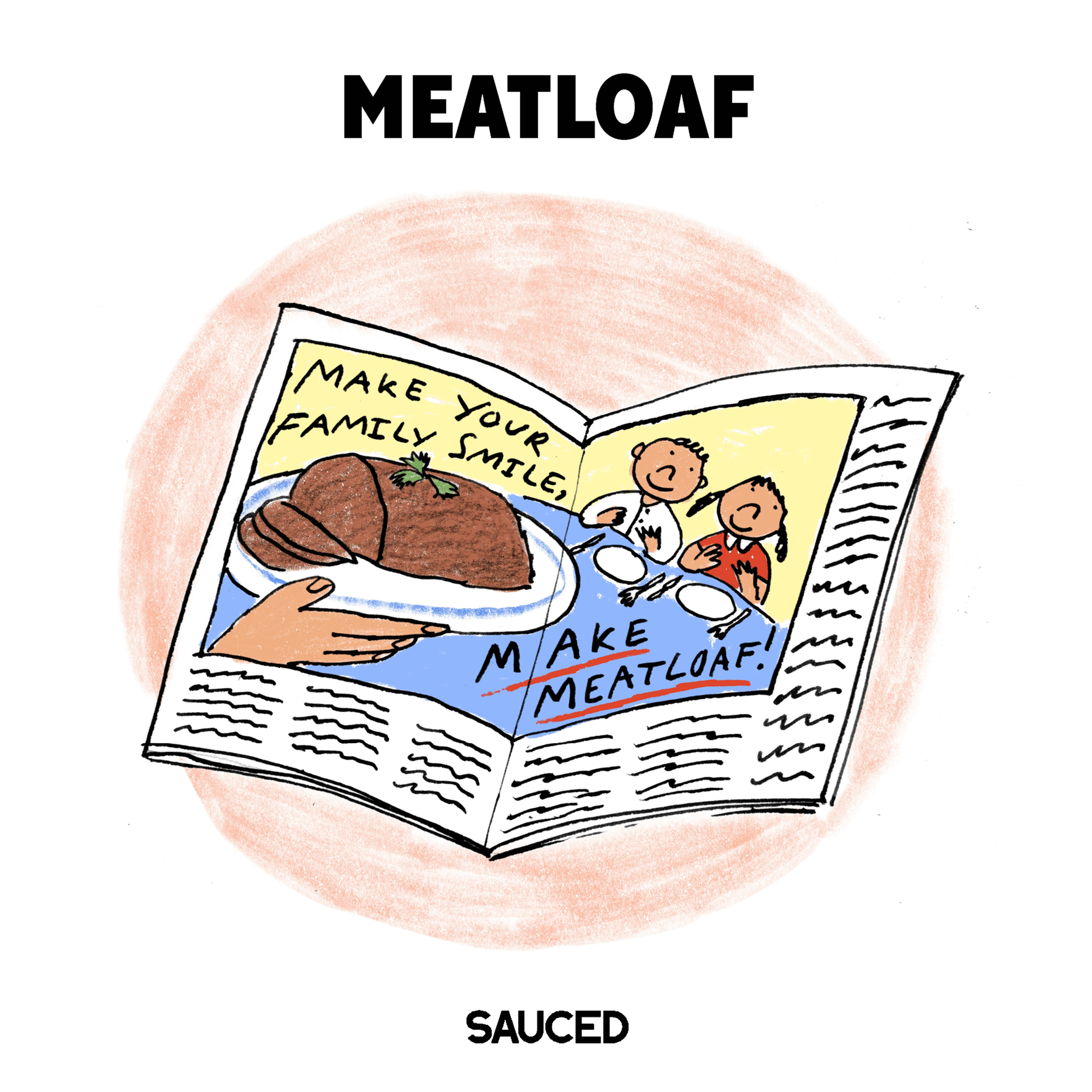
Work the mix like a meatball and the loaf turns bouncy. Handle it like a patty and it crumbles. A good Meatloaf avoids both, which takes a few calls most recipes rush past.
The last of those calls, the glaze, sends us down ketchup's long road from a fermented fish sauce to an 1812 recipe with brandy in it.
"Squarely between meatball and hamburger."
What we settled on:
Half 80/20 ground beef, a quarter each veal and pork
A panade of fresh breadcrumbs soaked in milk
Onion and mushrooms, cooked down with dry vermouth
Mixed gently, never tacky
A free-form loaf on a sheet pan
Two coats of Manhattan Glaze
Mashed potatoes, caramelized onion gravy and peas
The Cocktail:
The Bat Out of Hell: bourbon shaken hard with grapefruit, maraschino, brown sugar syrup and a little Driftwood Bitters.
RECIPE CARD:
Premium subscriber? Check out the full recipe card here.
LISTEN
EpiSOde Partners
Thanks to the following brands for partnering with Sauced to bring you this episode:
TRANSCRIPT
Tim McKirdy: Sother.
Sother Teague: Tim.
TM: His name is Robert Paulson.
ST: His name is... oh, from Fight Club.
TM: And who was Robert Paulson?
ST: Yeah, it was Meat Loaf.
TM: I was considering opening with that.
ST: I didn't put that together at all. It's been forever since I saw the movie, but somehow it rang to me. I'm usually not good with movie trivia. I don't see enough movies.
TM: This one you would have got much faster, I think, although I need to deliver it slowly. Ketchup. Ketchup. Ketchup. Ketchup.
ST: I have no idea what you're talking about.
TM: Ah, I thought you were a fan of The Simpsons.
ST: Oh, is that from... yes, yes, yes. I think the ketchup thing that he does that I remember the most is when he says, you know, those little cocktail weenies that come with that red sauce that looks like ketchup and tastes like ketchup, but brother, it ain't ketchup.
TM: It is, of course, for those wondering, or maybe, like, do you know The Simpsons? The one that I read is Mr. Burns. He loses his fortune and has to go shopping for himself, and gets stuck in the condiments aisle.
ST: Oh, he's looking at the two bottles. That's right.
TM: Turns out possibly the same thing. Why am I opening a show with a meatloaf reference? Well, obviously the Meat Loaf one, but a ketchup reference.
ST: Because ketchup is, I think, a non-negotiable. We're going to get there, but I think it's in the non-negotiable list.
TM: This is good. This is retribution, I think, for me being taken down for mentioning ketchup in our Mac and Cheese episode as a preferred side of mine. So we brought the ketchup to the table.
ST: I think you might have gotten taken to the carpet because you said it was a side, like a little bowl of ketchup with a spoon in it.
TM: Listen, there's someone in this household who does treat ketchup like a side, and it ain't me.
ST: I've seen it.
TM: Probably more so for our British contingent, our British audience. What are we talking about today? Meatloaf. I think people will be familiar with it, as I am, from pop culture references, cultural references, TV and stuff. But this seems very much like a continuing of our Americana streak.
ST: Oh, 1,000 percent. I mean, you know, I'll just jump to my elevator pitch. The classic American version typically combines ground beef with breadcrumbs or soaked bread, like a panade, some eggs, onion, herbs and seasonings, often finished with a sweet and savory tomato-based glaze. Frankly, it sucks to me that it isn't always, because I consider it kind of a non-negotiable. A good meatloaf should be cohesive enough to slice but tender enough to eat without feeling like a compressed hamburger, right? So it's a loaf of ground meat, seasoned well and glazed, and baked.
TM: And I like that you said as well "the American version," because Europe has its own loaves.
ST: There's a bunch.
TM: In Germany, Hackbraten, minced roast, and a loaf with whole hard-boiled eggs running through the middle is called Falscher Hase, which means false hare. In Italy, it's polpettone, literally a big meatball, coming from polpetta, which is a meatball.
ST: Right. But I would, and we will talk about this, this should not have the texture of a meatball. It should be between meatball and hamburger, right? Meatball too bouncy, hamburger too crumbly. It needs to be sliceable without falling apart, but it doesn't need to be bouncy like a meatball.
TM: Personal or professional associations with this dish?
ST: I've got both. Certainly I've eaten this dish all my life as a, you know, red-blooded American, and it's common. Also, I grew up in the Deep South, and any time you go to what's called a meat and three... you ever been to a meat and three?
TM: Meat and three veg?
ST: Meat and three veg, yeah.
TM: Never. Never been.
ST: Those are tons of restaurants all over the Deep South, kind of like buffet style. You walk down and sort of point to the things you want. They put meat and three on your plate. Meatloaf is always featured there. Always, always, always with the ketchup glaze. So I've had that all my life. My dad made meatloaf for us when I was a kid. And then professionally, when I was the helm of the bar at Rye in Williamsburg, we were known for our meatloaf sandwich. A Michelin-starred restaurant, and people would make a reservation a month in advance to come and have a meatloaf sandwich. Listen, it was delicious. I don't know that I would go that far. But yeah, and I think that we'll talk about that too, but the meatloaf sandwich is, I don't know, it might be 60 percent, more than half the reason to make meatloaf in the first place for people. I think it's the only dish that I can think of, right here on the spot anyway, where people make it with intention for the leftovers. Maybe turkey at Thanksgiving, right?
TM: But that's part of the draw.
ST: That is part and parcel to the draw. So yeah, I worked at Rye, where we had a beautiful meatloaf sandwich made with ground beef and braised short rib and a really decadent sauce on a house-made ciabatta loaf. It was something to see, for sure.
TM: You see, you bring a sandwich into the equation and I'm like, okay, now you're really getting my attention.
ST: Right. And as you know, it's a point of contention for me. I'm not a sandwich guy.
TM: I will say that my own personal associations really are close to non-existent beyond, again, being familiar with this as a part of American culture from afar. Professionally, I've had it once or twice. We had an Austrian-Japanese sous chef at the bistro called Dom, who was great, and was really a bit of a mentor, and was the level-headed one, we can say, in the hierarchy and the higher tiers of that kitchen. But he would make it, and I'm sure that probably comes from those sort of German associations. He would make it sometimes for staff dinner, for family meal. But then just beyond that, and one of the things we'll get into today, the panade being a part of making it, we did use that technique a lot more for, like, boudin blanc, white sausages, things like that. But yeah, I mean, it has all the makings of a dish that I enjoy, including being able to slather ketchup on it.
ST: Why do you reckon it's not as popular where you're from as it is here? Is it because you have the culture of a roast joint, as we've talked about before, a chunk of meat instead of a ground meatloaf?
TM: I think it possibly comes down to... it speaks more to how popular it became in the US versus us not really paying attention, if that makes sense. Or, yeah, I don't know, just culturally it's not there. I think it just embedded itself, and there's deep ties to, obviously, the Depression and this being a sort of cheap staple dish you can make. And I think, yeah, you're probably right. We have other cheap staples that we lean into instead. But I think, yeah, this definitely is something that Brits would enjoy eating. And I do wonder whether those sort of cheap or poor or hard-time associations that then permeated through popular culture, then we would be like, why is this something we're going to adapt or adopt?
ST: Right, right. Like maybe it's perceived as less than.
TM: Exactly.
ST: Meanwhile, again, a Michelin-recognized restaurant was serving a meatloaf sandwich. You know what I mean? We can elevate anything we want.
TM: We love elevating things. Let's look into those origins now, though.
ST: Get into it.
TM: The first recipes, weirdly enough, once again, we can take it back to the UK. The earliest American recipes printed under the name "meat loaf," two separate words, ran in newspapers in February 1876, including the Grange Advance of Red Wing, Minnesota. They didn't start from raw ground beef, though. The cook was told to chop fine whatever cold meat you have, fat and lean together, add pepper, salt and onion, then two slices of bread soaked in milk and one egg, and bake it in a form. This is kind of like...
ST: We talked about this before when we talked about Shepherd's Pie. You take your roast joint of meat, that's where we introduced me to the term "joint." I already knew it, but I've never really used it. And you ate what you ate, and whatever was left over, tomorrow you chopped fine and threw in some veg and covered it with mashed potatoes and baked it.
TM: And I think that then makes your point about, because we have the joints, that this wasn't a thing. That makes that even better. We're probably having, in place of a meatloaf, we're having like a shepherd's pie or a cottage pie. Its first job was breakfast or tea.
ST: I read that too. I didn't dig too deeply into it because I go a different route on these episodes, but that actually seemed a little bit shocking to me, because I know my experience with breakfasts is the reason that we eat the things we eat here in America for breakfast are, they're pretty quick. Making a meatloaf for breakfast sounds like I had to get up really early.
TM: So yes, definitely. I think the London book that recognized it, called The Mothers' Treasury, again 1876, and Housekeeping in Old Virginia, which was the American one, they both called it "an admirable tea or breakfast dish." Now, we need to look into what tea means, because I think the American association of tea and high tea in Britain is very different, depending on where you are in the country, what tea means. In Housekeeping in Old Virginia, dinner was the midday meal and tea comes towards the evening. Bread was set to rise at 11 in the morning for early tea, and waffles wanted for tea are made up directly after dinner in summer. In Britain, it really did depend on the household. For many middle and working-class families, tea at five or six was the evening meal itself. That's why, depending on where you are in the country, if you say "What's for tea tonight?" that means dinner.
ST: Right. Chippy tea, you told me.
TM: Chippy tea, we had, yeah. And again, that's more the north and the northeast, or the east of England. In the south, people would say supper, you know, that kind of thing. But yeah, certainly it did have some breakfast associations. Then we head into the Depression, as I said, stretching the meat. The Depression made it a staple. In 1931, the US Department of Agriculture's Bureau of Home Economics put beef loaf among the old favorites in Aunt Sammy's Radio Recipes Revised, a collection of 400 recipes for the tougher times, shall we say.
ST: Sure. You might get into this, but right around that same time is when we produced commercial grinding machines. So minced meat was suddenly... ground meat was suddenly more accessible to the common person.
TM: Exactly. And that's where we can make sure we're using all of those cuts, right? Putting them all together, taking a little bit from here, a little bit from there, bringing it all together. The food historians Jane Ziegelman and Andrew Coe tell how the home economists of the 1930s taught families to stretch food in their book A Square Meal: A Culinary History of the Great Depression, which was published in 2016 and won a James Beard Award.
ST: Oh, wow.
TM: So yeah, that's basically the background, the origins of meatloaf.
ST: Not a whole lot there. It seems like it's just, what's the word I always use? It seems like it's very collective subconscious. We have these things around where we can make this thing pretty easily. It's not like a... I don't know. I don't feel like there's an inventor of meatloaf. It's just a thing that exists.
TM: A thing that exists, using a technique which is popular in, like, sausage making or whatever, right?
ST: I mean, it's very much a... it's a large-form uncased sausage.
TM: Some people I've seen as well are not even doing it like that, and we'll get into the different culinary luminaries' approaches. But I'm surprised, when I asked you personal associations or professional, this one maybe slipped your mind. Davis Street Fish Market. What was their slogan?
ST: "Forget about the meatloaf, Mama, I'm coming home with the crabs." I worked there for years. It's one of my first real, what I would consider real, grounding restaurant jobs. It doesn't exist anymore, sadly. It closed a couple years back, but it was in Evanston, Illinois, right there on the campus of Northwestern University. Somewhere in my closet I still have that T-shirt. It's got a big caricature of a sailor with a rope over his shoulder, and he's dragging this giant crab. The crab is tied by one of its claws, and the other claw is snapping at him, and underneath it says, "Forget about the meatloaf, Mama, I'm coming home with the crabs." That's a deep cut. This is 1991.
TM: And then just another one, when, you know, we're talking about the origins, or you said no one really has invented this. As we discovered in our hamburgers, or burgers, episode, there was that original Roman dish that included, like, a panade. It had wine through it. It was a big chunk of meat. So probably an early prototype of this. Just so that we are ticking all of our boxes here, I think it's fairly straightforward: prince or pauper's dish?
ST: Pauper. I don't think there's any escaping the fact that it's a dish for the common man, made from common ingredients that are easily accessible, inexpensive. I think that maybe a new angle to the definition of our prince versus pauper could be: is it highly malleable? Right? I can make a meatloaf with onions and carrots, or I can make a meatloaf with bell peppers and spicy pepper. You know what I mean? There's no true hard and fast codification, and I think that lends itself to accessibility, what's on hand, what I can afford.
TM: Cleaning out what's in the fridge.
ST: Cleaning out what's there, maybe rotting or going off. Yeah, it's a catch-all, and I think meatloaf neatly fits into that box.
TM: Neatly done. All right, so those have been the origins, our personal and professional associations. Time for our first break of the day. Then we'll be back with the culinary luminaries.
ST: All right.
TM: All right, so we're back. The culinary luminaries. Who you got first? Julia or Jacques got anything to say here?
ST: Well, no. Nothing. I couldn't find anything of substance from them other than the usual patter about the fact that they are, especially Jacques, economical cooking, and Julia's influence from France and how maybe that could have played in with using panade and things like that. But no direct quotes or anything from them, and I couldn't even find a video of them making it, which shocked me. I thought that there would be something from Jacques. But I'd like to point out that one of the culinary luminaries in this dish is you, the people. Local community cookbooks and home cooking and potluck dinners and diners have really made this dish a foundational piece of the culinary landscape in America. I'm surprised it took us 47 episodes to get to meatloaf, because in the beginning we made those lists of what should we do, what should we make, and we were trying to make things that are popular, that people want to hear about, that they love eating. I'm surprised this wasn't episode three.
TM: I think, to your point there, though, or something that can kind of explain the drift from, like, episode one to more recent episodes, where we haven't had things from Julia and Jacques to say about this dish, is very much that, like, she was teaching people to embrace French cooking and not be intimidated by that, because they'd already mastered these kind of things and these staples. So it doesn't surprise me, especially when we've been doing things like, yeah, Mac and Cheese and Meatloaf.
ST: That even solidifies my point about, I really thought I'd find something from Jacques. It's funny, if you look at Jacques and Julia, who are our two favorites in the luminary category: Julia, from America, went to France and brought French cooking back to America. Jacques, from France, came to America and adapted to American cooking in the French way. So I would have certainly thought I was going to find something from Jacques. Even one KQED episode of him making a meatloaf and saying what you just said, like, it's a great lunch. I could see that. I could even see him saying it makes great sandwiches. I couldn't find anything from him.
TM: So who do you stumble across?
ST: Fannie Farmer, who we've brought up a few times, with her Boston Cooking-School Cook Book, that's a mouthful, from 1896. She talked about how it's a great recipe to do what I just said kind of isn't done, but she sort of standardized weights and measures on making dishes like this. Not specifically to this, but she certainly spoke tons to this style of cooking. You already mentioned, and again, not really a luminary here, but a thing that had influence: the Great Depression and World War II, when they overlapped in the late '30s, early '40s. This dish was a dish of resourcefulness, based on the fact that we had to use what we could get our hands on. Don't forget, meat was rationed, right? How would we stretch the meat? If you've got four people to feed but you only got enough meat for two people: meatloaf, right? It's the old joke, right? You got ten people and only two apples, how are you dividing this up? We're making applesauce. Right? We're going to stretch this thing out with the things that we use, bread or oats even.
TM: Imagine, even stale bread, because you're going to soak it as well, right? So you're taking something which you can't use...
ST: Which you can't use, but you can't throw away either, so you are gonna use it, right? So there's that. And then, you know, even right when the war ended, the post-war home cooking had a boom of convenience foods, and as I mentioned, that's kinda right when the commercial grinder came on the scene, and so ground meat was a more common thing to see at your butcher shop. Because back then you'd go to the butcher shop and you'd get whole joints or roast-sized pieces of meat or big ol' steaks, but ground meats were used in sausages that were made in the house of the butcher. There weren't as much options for ground meats until the commercial grinders came along.
TM: And then if they're making sausages with it, or whatever, they're doing work, you're paying for that work. But if you can buy the raw minced meat, ground beef, sorry, I keep wanting to say the correct American term, the ground beef, then you can make it yourself. You can adapt it yourself and not pay for someone else to do that.
ST: Other ones that touched on it: The Joy of Cooking, which we always refer to, Irma Rombauer. And then there was a meatloaf recipe that appeared in an American newspaper in 1875 with instructions to use finely chopped leftover meat, which we just talked about, right? So I didn't find any real voices. Again, I think it's a crime... is the wrong word, it's too strong a word, but it is a failing, I think. Some chef should step forward and be like, "I'm the voice of meatloaf." And maybe it was Cal. You know, he missed his opportunity. The guy that I worked with, he was the chef-owner of Rye, and he stood behind that sandwich like crazy. And I was always like, why is this even on the menu? You know, it's like when I go to 4 Charles, and I see people, it takes forever, by the way, it's one of the hardest reservations to get in New York City, 4 Charles, and when you go there, you know that you waited a month, maybe two months, to get in, and you see a table next to you order a hamburger. You know, you waited a month to get a hamburger. It's called 4 Charles Prime Rib, not 4 Charles Hamburger. So anyway, Rye. So maybe Cal could have taken up that mantle and been the...
TM: The voice of meatloaf.
ST: The voice of meatloaf.
TM: Like a bat out of hell.
ST: Other than Meat Loaf himself, yes.
TM: Well, I believe that post is vacant now, sadly.
ST: All right.
TM: Rest in peace. I came across two names that we have brought up on the show before. Ina Garten.
ST: Oh yeah, sure, love her.
TM: Ina. Ina.
ST: I think it's Ina.
TM: Ina, host of the Barefoot Contessa, of course, very popular here. I had no cultural reference for her. And one time when I was working at VinePair, people were like, "Oh my God, the Barefoot Contessa just made, like, a 40-ounce Cosmopolitan," or something. Can you remember this video that went viral?
ST: I do, yeah.
TM: And I'm like, who is the Barefoot Contessa, and why is everyone losing their mind right now? But anyway.
ST: And you're like, is she really barefoot? Could she not afford shoes? Contessa of what? Or where?
TM: Exactly. I had so many questions. She's got two fairly famous recipes, but her second that I thought was quite notable here is called the 1770 House Meatloaf, based on the 1770 House restaurant in East Hampton. She uses beef, veal and pork, a pound of each, with panko breadcrumbs. So not bread, which she grounds fine and then rehydrates with whole milk. So that stood out to me, because that seemed weird to me, and I was curious your thoughts on using panko.
ST: I don't think panko or even dried breadcrumbs are the way to go. Those are what I want to use when I'm making a meatball, a little bit more sort of bouncy structure. Again, I want this meatloaf to have a binding agent in there, which is going to be fresh breadcrumbs, right? Meaning I make them myself, and they're pretty large, and I soak them in milk so that they, you know, they disintegrate, basically. They become a paste. This is a... man, I hate to use words like this when I'm talking about something I'm going to eat, but it becomes the glue that's like the grout that's in between each little bit of ground meat that's in the meatloaf. Invisible. You don't see it, but it's what's holding the thing together without having to compress it so much.
TM: And it's, yeah, again, like stopping that coagulation of the proteins, right? Which is the barrier, kind of like we use booze in our batters to stop gluten...
ST: Gluten formation.
TM: Gluten formation. Thank you very much. You know what I was talking about. Second person I came across here. We mentioned her quite a lot: Marcella Hazan. Her loaf, polpettone alla Toscana.
ST: I was about to say, hers is a polpettone, not a meatloaf.
TM: Interestingly, she cooks hers on the stove, not in the oven. So the loaf is browned in butter and oil in a pot that's barely big enough to hold it, right? And then dry wine. So she's cooking with booze. Dry wine goes in and boils down, reduces down by half. And she includes soaked porcini as well. She does use small pieces of crustless white bread. But yeah, that seems weird to me, right? That's just like, you know, when you're browning your meat for your Bolognese and you're leaving it in the pan so it gets good color and then you break it up. It's like you never break it up.
ST: Right. I don't think this is... this isn't what we're talking about. We're talking about an American staple, family meal meatloaf. I don't think that's it. That sounds tasty, and I'm not going to say no to it when it arrives at the table, but that's not... I would not be happy.
TM: Well, I'm yet to come across a pan that's shaped like a bread tin, you know what I mean? So it's not a loaf. It's like a giant cymbal. I don't know. But interesting. I'm sure it's tasty.
ST: Like a giant hamburger.
TM: And yeah, she was purely beef. Did find it interesting, people's different approaches with the meat. Of course, that is a decision we're going to have to make. But we'll take another quick break first, and then we will be back with the non-negotiables.
ST: I'm ready.
TM: All right, Sother, we're back. Non-negotiables. Number one.
ST: Ground meat. I'm going to be vague and say meat, because I am flexible on this, but it's going to be mostly beef. But nothing's off the table. You can make a meatloaf with ground chicken if you want. Be my guest. Won't be what I would expect, but again, meatloaf. It doesn't say beefloaf. It used to, I guess, as you said, but that sounded horrible.
TM: Yeah, that doesn't sound good. Although the nondescript "meat loaf" is also a little bit weird when you think about it too much. But let's make that decision now, then. Or, you know, standard, I'm going to guess if you were going beef only, you'd want chuck, 80 percent, 20 percent.
ST: Sure, ground. I would go 50 is going to be your 80/20 beef, and then we can split the other two into 25 and 25 of veal and pork, just to give it some different texture and some different flavor and a different fat, right? Almost like, again, meatloaf is, in its base construction, it is a sausage, and that would be a good ratio to make a nice sausage too.
TM: Veal brings gelatin, tenderness. Very nice. You feel that when you're handling it. I definitely think that's something you could do here in the US quite easily, because that quite mimics the mixes that people use for Italian, you know, Sunday sauces and stuff like that. Meatballs, like you say. I learned in research for this that the US caps anything sold as ground beef at 30 percent fat. Like, you can't go above 30 percent fat and call it ground beef.
ST: What do you have to call it at that point? You've got to have a name for it.
TM: I don't know. This is the limit of it.
ST: Right. Again, at the grocery store, your local butcher will do what you'd like.
TM: Yes. All I'm saying is, at the grocery store, I much more commonly find 91/9 and 80/20. I'm not seeing 85/15. And on beef. On turkey, chicken, obviously a different story. So that's our first non-negotiable. I'll come in with a second: the panade.
ST: That's my second one as well. A binder.
TM: It's in every version that we've covered already today. So we're going to say that is bread soaked in liquid, and you've explained why that works for this.
ST: But I would also go further to make people understand it doesn't have to be bread, and you just said liquid, it doesn't have to be milk specifically, but that's what we're going to use, I believe. This could be cracker crumbs, this could be oats. What else could we go in there with? I'm sure we could go in there with barley, other grains, right? But we're going to soak them so much, or overcook them so much, that they're soft enough to be made into sort of a paste that'll be, again, I used the word grout, glue, I don't know what you want to call it, but it's going to bind the thing together.
TM: So we're using enough liquid to soak it. Then just talk about how you then work with that, because there's something we should discuss here as well that relates to the meat and the panade. So are we, like, squeezing it at the time when it comes to use it? Are we squeezing out excess, or are we keeping just whatever is soaked in there?
ST: I'm going to say you don't necessarily need to squeeze it out of there, but you might want to tip the bowl and sort of drain some out if there's any excess, or simply add more of whatever your panade base is to soak it up. The idea is to add enough liquid to soak the product and saturate it, but not have any leftover. It should be like enough water to put in a bowl with a sponge, that the sponge takes up all the water. And if you need a little more, you need to add a little more, but you should never have excess.
TM: Excess. And then when we are mixing that with our ground meat, we don't want to overwork it, much as we discussed for the burger episode.
ST: Right. And what we talked about on the burger episode, and what we would talk about if we talked about meatballs, is I'm going to work the meat gently with my hands, with gloves or whatever, wash your hands, and then you don't want to take it to the place where you can put a bit of it in your hand and hold your hand upside down and have it not fall. That's too tacky. That's going to create that bouncy structure that is right for a meatball, but not right for the meatloaf. And then even softer, you're so gentle without the panade, just mixing your ground beef together for a burger, right?
TM: Because we're not even seasoning that beforehand as well, the burger.
ST: Right. So I'm just using those as reference points. The meatloaf is kind of squarely in the middle of the meatball or the meat patty.
TM: And we don't want to be making this too far ahead, I guess, then, in time, the mix, because we have to season the mix here, unlike the burger.
ST: Correct. And if you mix all your stuff together too far in advance, you'll start to do what we've talked about in the past. Like, it'll begin to kind of cure it, and that'll alter, obviously, flavor, but it'll also lend to that texture being firmer than you want, again.
TM: Next non-negotiable for you.
ST: We need some eggs.
TM: No. Yeah, we do.
ST: So I know it's like splitting hairs here, but your binder that we just talked about is your breadcrumbs, or sorry, your panade made with bread and milk, but eggs are going to give you more cohesion. So binding versus cohesion, two different properties happening here. And you don't need much. I would say no more than two eggs for every pound of meat, right? That's going to be plenty. Again, it's just the protein matrix that eggs have are going to just help hold everything together, so you have a nice sliceable product in the end.
TM: Nice. Well, you mentioned this earlier on, and I was surprised you didn't go for this for your next one, if we were talking about an order of importance, which we didn't clarify, but we need a glaze.
ST: Well, I kind of broke it into two pieces, really, my non-negotiables. I have one more for the meat, and then my next one is the glaze. So my one more for the meat is, you already said it actually, seasoning, and I think we should, weirdly, include specifically something that's always been in my meatloaves...
TM: Worcestershire sauce.
ST: Worcestershire sauce. Okay, good. We're in agreement.
TM: I would also say, for the version that I want to see of this, I want some onions cooked down. I don't want to caramelize them, but I want them softened, translucent, if you will.
ST: Sure. Any veg that's going into the dish, the loaf itself, needs to be pre-cooked to some degree, cooled, so you're not folding hot things into raw beef, but cooled and then folded in. So that could be, as you say, onions, that could be peppers, mushrooms, whatever we're going to put in here. Same rules apply. Like, I don't ever make a quiche, which is basically just eggs and cream held together in a custard, I don't put zucchini and mushrooms and tomatoes in there unless those things have been cooked first, right? Same thing if I was making a pizza, right? Those things need to be cooked first. You can't just throw raw mushrooms on top of a pizza and cook it. They will be still pretty much raw mushrooms on top of your pizza.
TM: Yeah, as you see it, it's so sad when you do see that. It's quite common.
ST: It's one of my biggest pet peeves, and it's so common. Anyway, okay, so we've talked about the...
TM: Wait, before you get to...
ST: ...loaf. Okay, go ahead.
TM: Well, you haven't discussed one thing with the loaf here, or it should be a non-negotiable, right? Its shape. We want this to be a loaf.
ST: Yeah, you know, it can be squared or ovaled, but it needs to be a loaf, right? And I'm not cooking it in any kind of loaf-shaped pan, right? I'm not cooking it in my bread pan. I'm cooking it on a flat sheet pan with a lip to catch all the fat that's going to render out. But that's why I'm not cooking it in a pan: I don't want it to be boiling in oil at the bottom and browning on the top, right? So, loaf should be shaped. That's why you're going to need both the panade and some egg, cohesion and binder, that'll hold it in shape, and then cook it flat on a pan so that we can render off the oil but get as much Maillard as possible.
TM: Fantastic. Now get to the glaze.
ST: Now to the glaze. Yeah, we need a glaze. I think it needs to be, you know, for the American style, it needs to be ketchup-based. Ketchup, brown sugar, maybe an added burst of, you know, fruit vinegar like apple cider to brighten it up. We can season it however we want from there, but it needs to go on towards the end of the cooking process. A healthy dose of it, back into the oven, then pull it out one more time and hit it once more with the glaze, and then back in the oven. And that's how you glaze a meatloaf.
TM: Should we do a little deep dive on ketchup for a second? Otherwise known as catsup.
ST: Yes, thank you, Mr. Burns.
TM: Do you know where it comes from?
ST: Excellent. I mean, originally it was bananas. Am I wrong? No?
TM: You are wrong.
ST: Oh, yes, I am wrong.
TM: Although I do love banana ketchup, and I love mushroom ketchup.
ST: Kecap manis, is that...
TM: Kecap manis is another one, yeah. The word comes from Hokkien, which is the language of southern Fujian in China, and Taiwan. Or Fujian. The Stanford linguist Dan Jurafsky traces ketchup to a fermented fish sauce, in which "ke," the K-E, means preserved fish, and "tsiap" means sauce. How it reached England: English and Dutch sailors brought the fermented fish sauce home from Asia in the 1600s, and English cooks made their own. No doubt that's how we got Worcestershire sauce. But by the 19th century, ketchup had become a catch-all word for a spiced sauce made with mushrooms or oysters.
ST: Mushrooms.
TM: The first tomato ketchup published in 1812 by James Mease, a Philadelphian physician and horticulturist, in his Archives of Useful Knowledge. He called tomatoes love apples. His recipe has no sugar and no vinegar. The booze, we need to talk about booze soon, is in the bottle: half a gill of brandy to each bottle.
ST: All right. No sugar, no vinegar, but brandy and tomatoes. All right, I'm ready.
TM: I'm on board. Henry J. Heinz began bottling horseradish in 1869 and added tomato ketchup in 1876, the same year as those first meatloaf recipes. By 1906, he was producing more than five bottles a year.
ST: Wait, five bottles a year?
TM: Five million bottles a year.
ST: I was about to say, that's humble beginnings right there. It's not even one a month.
TM: So, the sweet, sharp ketchup that we know today: at around that time, as he's producing five million bottles a year, the federal chemist Harvey Wiley campaigned against the use of the preservative sodium benzoate. So Heinz launched a preservative-free ketchup, and it was made shelf-stable by having twice the salt, sugar and vinegar of other commercially made ketchups, or catsups. Kraft Heinz says about 650 million bottles of Heinz ketchup sell each year. And a survey from 2013, done by NPR, found that ketchup, or a bottle of ketchup, is present in around 97 percent of US kitchens.
ST: I bet the number is actually higher.
TM: Yeah, probably.
ST: It's 97, with a 4 percent margin of error.
TM: When I came across that, it did make me think: I wonder if Sother actually has ketchup in his home kitchen.
ST: I do. It is not in the fridge. It's mostly, you're gonna hate me for saying this, it is mostly used by Natalie.
TM: This time I will allow that, because I figured you probably had one on hand for cooking, but I figured it wasn't something that got used regularly. And you know what that, though, is...
ST: She puts it on hot dogs. It's embarrassing.
TM: Nice. It's not. Hot dogs need ketchup. And 650 million is the Porco fun fact of the week.
ST: All right. I mean, that's a lot of ketchup. That's a lot of sauce.
TM: You know, Kraft Heinz getting a lot of love from the sauce guys recently. Can we talk about booze now for a minute?
ST: I mean, I'm always ready to talk about booze, Tim.
TM: You know this is a show about cooking with booze.
ST: Yes.
TM: We mentioned some of those earlier recipes were much more classically involving booze. This one, I would say, perhaps not so much. I've already mentioned Marcella Hazan, the white wine. What are some other areas you've seen booze incorporated, or you would consider incorporating booze here?
ST: I think there's two clear and present ways to put booze in a meatloaf. As mentioned, we're going to sauté, probably, whatever veg is going into the dish, or into the loaf rather, in advance of making the loaf. So there's an opportunity to deglaze that pan with whatever booze you want. In this case, I think beer seems like a good option for the deglazing, because beer and ground meat sounds great to me. And then the glaze. We can easily get, like, let's make this bourbon-y ketchup glaze to go on top. So yeah, there's two opportunities to get booze into this dish.
TM: I would say, not to recycle something, but I would say that our Manhattan Glaze we made for our ribs... and as a reminder, that was rye whiskey, sweet vermouth, Angostura bitters, ketchup, brown sugar, cider vinegar, brown mustard, Worcestershire sauce and honey. I would say that maybe we're reusing that again here, because it's so good. And I mentioned this on subsequent episodes, you know, every time I make it and eat it, I'm like, Sother, this was a fantastic idea. I love it.
ST: So I'm completely on board. Let's do that. Easy to do. It's a recipe that I know and love. I made it long ago. It's actually in my book, I'm Just Here for the Drinks. I did Manhattan ribs and Martini pickles. We should make the pickles too one day. Yeah, pickles pickled with gin, dry vermouth and orange bitters. So yeah, that's two clear and present ways to get booze into this dish, and we will employ probably both of them.
TM: One interesting one that I came across, don't think we're going to do this, but are you familiar with Edward Lee, the chef?
ST: Yeah, from... he lives in the South somewhere, but he's Korean descent.
TM: 610 Magnolia in Louisville, but he's Brooklyn-born.
ST: I think that's his deal. He lives in the South, but he makes Southern cuisine with a Korean influence, but he's born in Brooklyn, yeah.
TM: But yeah, I believe he has a bourbon and Coke meatloaf, which mixes bourbon and Coca-Cola into the meat, and ends up in a sandwich, which is why I was interested when you brought up a sandwich earlier, with fried egg and black pepper gravy. Sounds good, doesn't it?
ST: It does.
TM: That's really good.
ST: Minus the sandwich part. I would eat that meatloaf with a fried egg and brown pepper gravy. That sounds delicious.
TM: It's almost like meatloaf meets breakfast sandwich and steak au poivre. What is black pepper gravy? Just that, like a sauce?
ST: Sounds like sawmill gravy, right? Which is, I'm pretty sure, I could be wrong here, I didn't do any research on this because I didn't know we were gonna stumble into sawmill gravy on the meatloaf episode, but when I was a kid, when my grandmother would make it, it would have so much ground pepper in it that it felt like sawdust, right? So it was called sawmill gravy.
TM: Ah, that makes sense.
ST: But it's a white gravy, a pan sauce made for your biscuits in the morning, and it would have so much ground pepper in it, like, she'd be over there cranking.
TM: Love it.
ST: Yeah, so I think that's what he's probably talking about. But yeah, sounds like... and that harkens back to the origins being a breakfast dish.
TM: I would love to do meatloaf au poivre.
ST: Sounds good. Yeah, there's a few burger joints here in New York that do hamburgers with au poivre.
TM: Including Bar Snack, their famous one that you mentioned during the steak au poivre episode.
ST: Oh yeah, I forgot.
TM: Very cool. Still haven't had it.
ST: I haven't either.
TM: But I was waiting for the season to turn. Now that it's getting colder, we're overdue a visit.
ST: We are, and we're closing in on the end of the year, and I've only had three hamburgers this year, and I only allow myself four. So we could go to Bar Snack. Ian, are you watching? We're on our way.
TM: Let's go. I was just there last week for the two-year anniversary. So Ian, if you are watching, happy birthday, and congratulations to you folks. It is a favorite of Sother's and ours, and Sother's and mine. All right. Any negotiable ingredients we haven't discussed yet? And can I get an answer from you on the vegetables?
ST: Like, what vegetables are we putting in here? I think I would like to see mushrooms and onions. I can stop there.
TM: Perfect. No carrots, no celery. Onions, mushrooms. Love it.
ST: No bell peppers, although I think my dad always put bell peppers in ours.
TM: I think you get the mushrooms for the umami, the savory. The onions, because it's just... onions and ground beef are incredible. Leave it at that.
ST: Sure, so we'll stay with those. I think there's only one real non-negotiable for me that I am absolutely happy to come or go with: bacon. Do you ever have bacon-wrapped meatloaf?
TM: No, but I can see why that would be great.
ST: Yeah, it's a common, you know, version. You wrap the thing in bacon, and the bacon gets, you know, browned. It doesn't get crisp, because it's up against the meat, but, and then you glaze that, so you've got this glazed bacon layer that's on the exterior. I can come and go with it.
TM: It's funny, because that aligns so much with the pâtés that I would make at the bistro. Like, everything would be wrapped in stripped bacon. Not back bacon. Streaky bacon.
ST: Streaky.
TM: There we go. Got there in the end. And that was generally either pork or, what is the word that I'm thinking of, like chicken livers and stuff. Awful.
ST: Oh yeah, sure.
TM: Yeah, I think that's negotiable. I don't think it makes it into the official Sauced version, but...
ST: Nah, I like the way it looks more than it brings to the actual flavor of the thing, so I can totally go with that.
TM: Fantastic. All right, I think that's everything decided. Sother, time for our next break here today. Then we'll be back with the preparation.
ST: Can't wait.
TM: All right, Sother, we're back. The preparation. Take it away.
ST: Well, this thing is gonna get baked in your oven, so first step to anything that's gonna get in the oven: preheat the oven. I know it sounds dumb, but we can't forget to do that. Get it up to 350 degrees. Then get yourself, as we talked already, I don't want a loaf pan for this. I want just a sheet pan that's got a lip on it, because it's gonna render a lot of fat out of there. You've already got your mixture of meat that we decided, which is gonna be 50 percent ground beef at an 80/20 ratio of fat to lean, along with 25 percent each of ground veal and ground pork.
TM: Perfect.
ST: And then we're gonna, I think the first step to do really is to prepare your panade, which we've already talked about. Roughly every cup of breadcrumbs, you're gonna need about six ounces of milk, and that'll soak up without any excess liquid left over.
TM: So what kind of breadcrumb? You're not using panko.
ST: Oh yeah, I'm using, you know, there's always loaves of bread around the house, right? I'm using bread, stale bread from yesterday or the day before, or bread that's even fresh, right? Fresh breadcrumbs. They'll really soak up that milk and be able to turn into that paste that we're looking for. And also, it's a good idea to get your panade made pretty quickly, that way it can do that, right? It's gonna take like 10 minutes to soak in that liquid. You're gonna sweat the aromatics. We decided that those aromatics are just gonna be onion and mushrooms for our meatloaf, the Sauced meatloaf. Sweat those down, deglaze your pan using some white wine or vermouth. We always talk about using vermouth, because it adds a little aromatic, herbal quality to the thing. So yeah, sweat that stuff down, and then get it spread out on a flat sheet pan as well, so it can cool as quickly as possible, because you don't want to mix hot veg into your cold raw meat. In the meantime, let's prepare a seasoning mixture. We're gonna combine a couple of eggs per pound of total volume with some Worcestershire sauce. We didn't mention it, but Dijon mustard. Any herbs that we want to use, I think maybe some thyme and parsley. Obviously salt, pepper. Maybe paprika? Do you want to put paprika? We didn't talk about it.
TM: Meh.
ST: Nah? Okay. And then I like to scrape in some nutmeg. You have a rule about this, don't you?
TM: I have a standing rule that's come up twice on this show.
ST: Yeah, hit it again.
TM: I said you can take it for granted, or as given, that if we're ever doing a savory dish that includes milk, I'm hitting it with nutmeg.
ST: There it is, and there's milk in the panade. So just whisk all that stuff together. Adding to this, you can fold in now your cooled mixture of onions and mushrooms, and then combine that with your ground meat in a bowl, tossing it pretty gently to get everything coated, folding in that panade. Work it just enough to distribute everything evenly without becoming tacky. Again, we're not making meatballs. I can't stress that enough. Here's a technique that you can employ any time you're making something like this, a sausage, a pâté, a loaf of meat like this: take a small little bit of it, make a little patty, fry it up in a pan real fast, and taste it. Then you'll know where your seasoning is at, because this is one of those things that, like, once it's in, it's in, all right? So if you didn't season it enough and you make this whole big old loaf, you didn't hit the mark. So it's a good way to test. So take the minute to test, if you want to make sure your seasoning levels are appropriate for what you've got going. Shape this thing into, you know, sort of pile it into the center of that sheet pan, maybe line it with a Silpat or parchment paper or foil, whatever you want. Shape it into that loaf. Don't make it any higher than, let's say, three inches, because we want it to get a nice browning on the outside, but we still want to get it cooked all the way through, and if it's too big, it'll get too burnt on the outside and not done in the middle, and then sliceability won't happen, right?
TM: What did you preheat your oven to? Sorry.
ST: I said 350, yeah.
TM: 350. Okay.
ST: Yeah, standard baking temperature. You might crank it up to 375, 400 in the first initial, just to give it a blast, because when you open the oven, you drop, but then set it back to 350. That's what I have to do with my stupid electric oven at home. I know you have a gas oven, and I'm very envious. Get the meatloaf in there on the center rack of the oven. We're going to bake this thing for, you know, maybe around 30, 35 minutes. And then in the meantime, while that's baking, let's prepare that glaze that we talked about. And you had it on the screen, but it was, I don't remember, it's my recipe, but it's American whiskey. We used rye whiskey in that thing. Ketchup, brown sugar...
TM: Rye whiskey, sweet vermouth, bitters, ketchup, apple cider vinegar, honey, and Worcestershire sauce, brown mustard.
ST: There we go. Whisk that together until it's nice and smooth. You can put it on a flame and kind of bring it down a little bit, so it's nice and thick, right? Because we're making a glaze out of this stuff. Pull the meatloaf out of the oven and get that glaze on there, all over it, any surface area that you can, that should be brown from being in the oven. Put it back in the oven for another 15 minutes. Pull it back out of the oven again. This is the time for you to check the internal temperature, just so you can get a reading on it. Put another healthy layer of the glaze on there, and throw it back in the oven one last time to get that to set. Then pull it out. Here's an important thing. You don't think about it, I think, as much when you're dealing with a ground product, but it needs to rest. Your patience will be rewarded. You know, it needs to rest, because if you slice into it right away, we're going to lose a lot of moisture, and fat's going to pour out everywhere, all over. So rest it for at least 15 minutes for this size of a loaf, and then you can slice it. It'll still be piping hot, don't worry about that. And serve it. And the next question is, what are we serving this with?
TM: Well, before we get into that, you mentioned measuring temperatures. I saw a guy, J. Kenji López-Alt, he starts pulling it to glaze at 140. And I believe that you're supposed to cook this, unless I'm mistaken, to 160 total.
ST: 160 is the goal. But again, we can pull a little early, and in that rest time, it'll carry up.
TM: Carry on. Nice. What are we serving this with? What is it traditionally served with? Why do I think that's probably mashed potatoes?
ST: It is not probably mashed potatoes. It is definitely mashed potatoes. Also, those mashed potatoes are not naked. They have gravy. Meatloaf, mashed potatoes, gravy. That is a for sure.
TM: That's probably why we don't have this as well, because we have bangers and mash. And it's the same kind of thing, right? It's a ground meat product.
ST: Sure. I mean, that's an obvious comp, yeah. In my home it also had green peas and/or green beans. So green beans of some kind, mashed potatoes with gravy, brown gravy, and then that meatloaf with that tangy glaze. Oh, my mouth is watering. It's been a while.
TM: Fantastic. The gravy... might I suggest incorporating another, bringing another Sauced ingredient into this? You, in your freezer right now, I'd assume you have, or you're at the point where you're going to restock it with, bags of caramelized onions down for French onion soup.
ST: Always.
TM: Let's take some of those onions and put it in our gravy.
ST: Okay, I love it. I love it.
TM: Very nice. And I think that's maybe... I think I'm thinking of this right now because you'll traditionally find that in gravy for bangers and mash. Onion gravy. All right.
ST: Do you have anything? I mean, again, it's not a dish that you have a whole lot of history with, but you said mashed potatoes. Anything else you'd like to see with it?
TM: No, I'm good with all of your calls there. I'm like, okay, every single one was adding. I'd probably go peas instead of green beans.
ST: Because you like to fold them into the mash?
TM: And I like the sweetness.
ST: Or do you do the peas with the little bits of carrot in there too? Adds some sweetness.
TM: Oh, yeah. I mean, how else to get a child to eat vegetables? I think that's why I grew up with that.
ST: Honey.
TM: Honey.
ST: That's how you do it.
TM: Ketchup.
ST: There was a poem that we said when I was a kid. Let me see if I can remember it for our audience: "I eat my peas with honey. I've done it all my life. I know this may sound funny, but it keeps them on my knife." And then there was, like, a drawing of a guy dipping a butter knife into honey and sticking the peas.
TM: At what point are you having peas with honey, or at what point is it actually just honey with a side of peas?
ST: Correct. It's honey soup with little bits of pea floating around.
TM: Listen, two things for us here. We rattled through that recipe, and we made some decisions on air, as we always do. And we have come up with our approach to the recipe, but no quantities yet. Nothing shared.
ST: Right. That's boring listening, and I don't think the listener wants to have to scramble around for a pen and paper to try and jot things down, in quantities and quotients. So what do we do instead, Tim?
TM: I would say we release, every week, along with the episode, an email goes out to our premium subscribers with a beautifully designed digital PDF recipe card for that week's dish. It is designed... the thumbnails and the recipe cards are designed by Charlotte Ager.
ST: A real human person who makes our artwork for us.
TM: I sometimes feel like people prefer the artwork to the episodes. I get a lot of compliments. We get a lot of compliments about the artwork, and I'm like, it is great.
ST: Well, she's a known artist, right? Her work stands alone. She's not just waiting for us to tell her what we're cooking.
TM: She's brilliant, yeah. No, they're wonderful illustrations. We should also highlight JP Watson, who we've mentioned before, is a co-founder of The Coaster, you know, our podcast network. And JP puts them together every week, painstakingly. Charlotte designs the thumbnails, JP puts it together, designs it, and they come out looking great. You can only get access to those, as we said, if you're a premium subscriber.
ST: For the low, low price of $7 a month, you get ad-free listening. You get these recipes with the illustrations delivered to your email box the day the episode drops. You get... what else do you get?
TM: You get a bonus monthly episode.
ST: Oh, the bonus. I always forget about the bonus episodes. They're great. Bonus episodes that are either about a specific side dish, a specific ingredient, a technique, or the fun ones for me, they're all fun, but the ones I've really been enjoying lately are, like, culinary history. What are we calling it? Rotten History?
TM: Rotten Histories, yeah.
ST: Where we're finding all of these cases that exist in the past, or currently, about nefarious dealings going on in the food world. Agri-mafia.
TM: I love those episodes too.
ST: Wild stuff.
TM: We also get into side dishes, including mashed potatoes, which we covered.
ST: We did.
TM: So folks, if you want to find out about that, you can find those. You know, those episodes, the side dishes, the ingredient deep dives, they're very much like standard episodes of Sauced, but you'll never see them on the public feed, apart from the one or two that we have released. So if you want the mashed potato recipe, go check it out. It's in the public feed. Get a little taste of Sauced. And I will just say, final thing, you know, we've been getting a lot of new subscribers, so I want to say hello to those people. Thank you very much. We appreciate the support. We appreciate the support of the people who have been with us since day one. And then my final thing here: Sother, new question for you. An either-or question. Is this a dish where you're going to get more value out of making sure you're wearing a beautifully designed and, you know, very well-made apron, or would you rather burn a candle after cooking it, scented either to smell like a Manhattan or a Martini?
ST: I'm a mess, Tim, as you know. I need an apron all the time.
TM: It is true.
ST: So we have aprons that we have on the site for sale, with our little logo of Maurice, our chef. He's a chef guy, but he's carrying a tray of drinks, because we're cooking with booze...
TM: And drinking with food.
ST: And you can get that and the candles on our website. They're great for yourself. They're great for gifts, as is a subscription to the show. Again, $7 a month, but we'll knock off two months for you if you pay for the year in advance. So just $70 for the entire year. Pretty cool.
TM: And guess what? Through the entire month of November, us knowing now that, you know, we're getting into gifting season, use the code MAURICE on saucedpodcast.com, on our shop. You can get 10 percent discount on any product you buy. Fantastic.
ST: Awesome.
TM: All right. Well, for the regular listeners, we're going to head into an ad break now. For the others, it's just going to be a little bit of music, and then we'll be back...
ST: With the pairings.
TM: All right, Sother, we're back. The pairings. I know it's your favorite section.
ST: I don't know. All the sections are my favorite. I feel like I learn something every day, or every episode. You know, you bring some history, I learned some things about the luminaries. Like, this is a... they're all my favorites. But also, my favorite is the pairing.
TM: I know. I think it's a running joke that we have, that you enjoy the alcohol. We don't shy away from it here on Sauced.
ST: Listen, I've made a career of drinking.
TM: So I have an interesting one here for you. You know, all through this month we've been working with a brand new partner, Seelbach's, an independent retailer and online shop founded in 2018. I've been a big fan of theirs basically since the pandemic. And every week we are going to explore with them a different pairing or cocktail using one of their bottlings. The last two weeks we've done cocktails. So this week I said, you know what, let's do a pairing. Let's select a bottle from Seelbach's that either, you know, literally makes sense to be drinking with this, or spiritually, thematically, it makes sense. I did some digging on the website, and I found one that I think you're going to enjoy here.
ST: Let's hear it.
TM: So the bottle is called Seelbach's Private Reserve Usonia. It is Kentucky straight bourbon finished in Mizunara barrels, the Japanese barrel that adds this je ne sais quoi. People love it. It's a type of Japanese oak, right? Terrible thing to make barrels out of, because they're very porous, and they take a long time to grow these trees, and these trees are not straight. And separately, when I was working at VinePair, I did this whole article looking at the business of Mizunara barrels from Japan. The people who make those casks, or use them in their spirits, they're very judicious. They won't just let anyone buy these barrels. The bourbon industry, you use a barrel once, they'll sell it to anyone. American oak.
ST: Right. We've got to get rid of it. By law we can only use it once. It has to be brand new American oak to age American whiskeys in, if you want to put those labels on your bottle.
TM: Mizunara casks, because they're rare, because they're expensive, and just because of my understanding of how a lot of Japanese business culture gets done and works, they're judicious. They won't just let anyone use them. So if you see a Mizunara cask finish or statement, you know...
ST: Something special.
TM: ...it's a good sign of quality. So this one, the Seelbach's Private Reserve, retails for $99.99 on seelbachs.com. This is 117.5 proof, aged nine years, six months at first, then five months in light-toast barrels of Mizunara, a Japanese oak. The whiskey is sourced from Bardstown, Kentucky. And the mash bill, because I know you like mash bills: 75 percent corn, 21 percent rye, 4 percent malted barley. And 432 bottles made. So this is a special... it's a small release.
ST: Wow.
TM: And guess what? You're probably thinking right now, well, why would you... you know, this is a show about an American staple. We're talking about Japanese barrels here. Clearly we had to go bourbon. But the name: do you know what Usonia means?
ST: I was going to ask, but you blazed right past it, so I don't know. But I'm hoping it ties in somehow. King of the segues.
TM: It's Frank Lloyd Wright's word, from 1936, with the Depression still on. You know Frank Lloyd Wright, architect.
ST: Of course. Yeah. Strange twist of fate: when I got married, I almost got married at the Frank Lloyd Wright house in Chicago. We ended up getting married at the zoo instead.
TM: Wow. That was a right turn I wasn't expecting. Frank Lloyd Wright, the zoo.
ST: Yeah, the Chicago Zoo.
TM: Nice. Love it. So, with the Depression still on, from 1936, he designed modest, affordable Usonian houses for American families, and the name, he said, meant belonging to the character and the landscape of the United States. He designed 308 of them by 1959 and saw 140 built. Seelbach's says the series takes after that philosophy of, quote unquote, honest materials. And I mean, what better pairing is there for that than some meatloaf?
ST: I love it. Perfect.
TM: There we go. And just, yeah, I haven't tasted that bourbon yet, but thematically it makes so much sense. I've had some of the other Seelbach's Private Reserve releases. I'm looking at one up there right now, and I'm like, maybe me and you are going to have a shot of that after we've finished the episode.
ST: Sounds good. Yeah, only 430-some-odd bottles. We've got to get one. It's our treat to ourselves for Christmas.
TM: Let's treat ourselves.
ST: I think we should.
TM: And yeah, folks, get it while it's hot.
ST: You got a wine choice? I actually have one. Shocking. It's not normally my route.
TM: Let me hear your wine selection, then.
ST: Well, I started thinking about how we've already talked about it, right? Meatloaf sits squarely between meatball and hamburger, or meat patty. And what's the wine that everyone wants with their hamburger? I feel like that's the wine to have with a meatloaf, and it's Zinfandel, right? It's got ripe fruit, moderate tannins, peppery character, complementing that sweet, savory glaze that we're making on top.
TM: It's an American classic.
ST: It's an American classic. Meatloaf is an American classic. It all falls together. So I don't think I've overextended myself by picking a wine, but that's the wine.
TM: I love it. Here's another thing, you know, Zinfandel: most Zinfandel you'll see written as old vine Zinfandel, right? Technically speaking, that word carries no legal definition in the US. You can have a vine that is the youngest age to produce wine-worthy grapes, and then you can label old vine if you want. There is no distinction, which kind of works in with the philosophy of the whole meatloaf thing too, right? Like, maybe extending things, maybe making things seem a little bit more grand than they are. But you know what, find yourself a good Zinfandel producer, and yeah, it's going to go so well with this. I had one that I thought, you know what, because we mentioned the polpettone, I thought if we were going to go Italian here, because we don't go Italian too often: Dolcetto. Its name means little sweet one. It's a black grape from Piedmont, northwest Italy, which is more known for your Barolos and your Barbarescos. But yeah, low in acidity, moderately tannic and deep in color. It's a dry wine. It's not sweet like the name suggests. And it's just very agreeable. It goes really well with food. And I felt: the little sweet one, Manhattan Glaze, Bob's your uncle, Fanny's your aunt.
ST: All right. You're in, you're out. That's that phrase that I don't understand from England. We'll talk about it off air. Beer: I think with a meatloaf, like an amber ale. Bell's Amber Ale.
TM: Talk about an American classic.
ST: Exactly. Or Fat Tire. They have a Belgian...
TM: What are they called again?
ST: They call it New Belgium. Fat Tire is the brand.
TM: New Belgium. Which, I would just say as well... sorry, carry on. I don't want to interrupt you.
ST: That's okay. Jump in any time. I think we're too polite on this show. I think we need to get on top of each other more. I picked it because, caramelly, malty quality, slight bitterness, is going to help with that sweet glaze, which is also going to be savory. It's not a sweet glaze, but it does have an inherent sweetness, with some brown sugar and the ketchup itself. I think that slight malt goes great with the caramelized beef.
TM: Yeah. And, like, look, New Belgium Fat Tire, it's an icon in American modern, or craft, brewing history, right? But these days, New Belgium makes all of its money from its Voodoo Ranger infinite lines of hazy IPAs.
ST: Man, the army of IPAs.
TM: Yeah. And you know what, good luck. You know, fair play to them. They're making money in the American brewing landscape right now, which isn't true for everyone. But we need to keep buying the icons, the classics, for them to keep making them. Otherwise they'll go by the wayside. And that is, like, a beer, if you did a timeline of the most important events or beers in American craft beer history, it would certainly find its place on there, if not just New Belgium itself.
ST: Yeah, I think so.
TM: Nice. What you got, cocktail?
ST: Well, you talked about bourbon, and oddly enough, my cocktail pairing classics are both bourbon. A Whiskey Sour. A Whiskey Sour would be great with this dish. The tartness cut through the fattiness of the meatloaf itself and complement it in great ways. A Boulevardier, which is, effectively, for the listener, effectively a Negroni made with bourbon instead of gin. That's going to have that bitter, rich, complex, slightly bitter orange flavor that's going to play well with the glaze, again, I think, and cut through some of the fatty heaviness of this dish as a whole, especially if we're serving it with mashed potatoes and gravy as well, and a big wedge of butter melting into it all, I'm sure. But I made a cocktail, and of course, you're already thinking, but you have to name this, so get ready. My cocktail is going to be 1 1/2 ounces of bourbon, 3/4 of an ounce of grapefruit juice, so kind of heading down the Brown Derby road. I'm going to augment here, though, with a quarter of an ounce of maraschino, as well as a quarter of an ounce of a simple syrup, but it's brown sugar, because we're tying into the brown sugar that's in the glaze. And then two dashes of my bitters, right? Driftwood Bitters, which is a cinnamon and grapefruit bitter. So that little bit of baking spice from the cinnamon, that grapefruit bitterness to match the grapefruit juice. We're going to shake this vigorously and serve it over the rocks.
TM: Nice. I was torn on what we would call it, but because you said shake it vigorously, it made me think: Bat Out of Hell.
ST: Okay. The Bat Out of Hell, by Meat Loaf. Perfect.
TM: You know what? You mentioned bourbon, right? We've done some cocktails for our partnership here with Seelbach's at an earlier date, or earlier shows. That's a much cheaper bottle. Why not? Just reminding folks, because not everyone looks in the show notes: if you use code SAUCED, there's a discount. So get on there, snag yourself one of those small-batch bottles, and then say, hey, I'm going to get the more utilitarian one that's made for cocktails, priced for cocktails. Get both. And then that way, you know, you're like, okay, I'm not just buying one bottle of whiskey online. Like, treat yourself to a few things.
ST: Yeah. Shop in bulk.
TM: There we go. The SAUCED discount. So, the final thoughts for you here today: what is someone missing out on if they never make meatloaf at least once in their life?
ST: Well, we talk about it often on the show, how it's fun to be in the kitchen. I enjoy it. It's therapeutic in a lot of ways, and I need it in my life. It's even more fun to be in the kitchen with other people. And I think that the takeaway for this dish, for me, is this is a true example of cooking for other people. It is a rare occasion you're making a meatloaf for yourself, right? This is a dish that, by its very nature, invites a group. So I think that you're getting this genuine feeling of hospitality. You're cooking something, hopefully with and also for someone else, who's doing it with and for you at the same time. So I feel like you're missing out on, obviously, an American traditional classic dish that is going to be a home run every time. But you're missing out, if you don't make it, you're missing out on that camaraderie that can only be found and forged by the fires of the hearth of the kitchen.
TM: Love it.
ST: All right.
TM: Love it. The open fire during which we roast. Otherwise, it's just baking.
ST: That's right. Also, I would say you're missing out on some delicious leftovers, because the meatloaf, again, as we talked at the top of the show, almost half of the impetus of making the thing is knowing that you have leftovers for that sandwich, and/or not a sandwich. I just like the meatloaf.
TM: You can wrap yours in lettuce, if you like.
ST: I could just eat it. I could just reheat it and eat it.
TM: You know what, I'm coming out of this conversation extremely pumped to make one, right? Like, it's not something... because it's not in my...
ST: Your DNA.
TM: I was going to say, like, my repertoire, my rotation. I never think about it. It never comes to mind, "Hey, let's make a meat... you know, like a meatloaf for the week. Great meal prep."
ST: Oh, for sure.
TM: Especially if there's only two of you in your house, and we know that you cook at home exclusively for Natalie. So that stretches it even further. You know, good meal prep for the week. I'm pumped to do it. By the next time we record, if I haven't made a meatloaf, a neat meatloaf, hold me accountable.
ST: I will.
TM: Say, "Tim, made that meatloaf yet?"
ST: All right, I will. I'll call you out.
TM: All right, two things left to do.
ST: Yeah, let's put on the apron.
TM: Pull out the shaker, and...
ST: Let's start cooking.
TM: ...drinking.
ST: Cheers.
TM: Cheers, buddy.