Episode 17:
BANANAS FOSTER
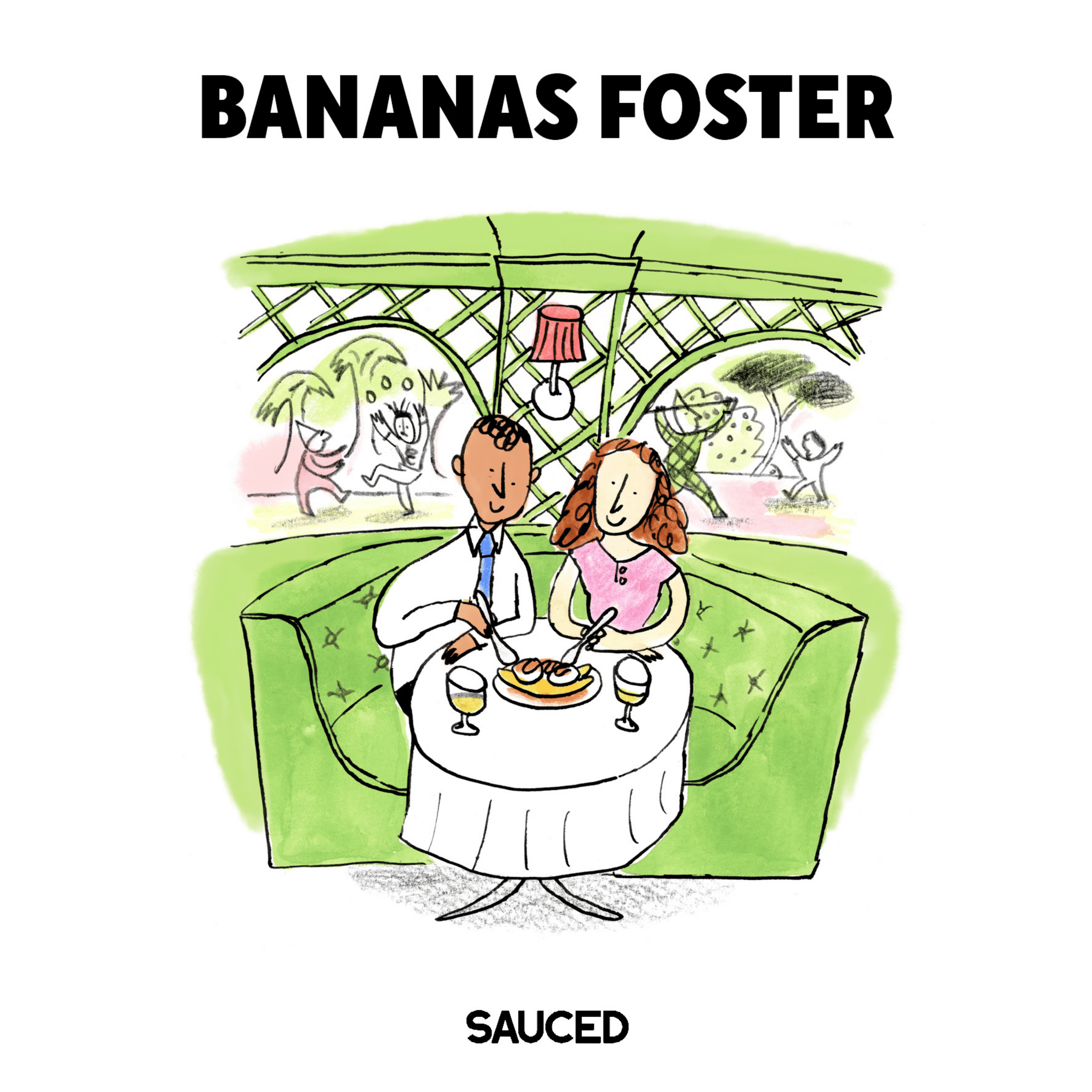
Bananas Foster was invented in a single night in 1951 to honor a man fighting French Quarter police corruption, inspired by an Irish-American breakfast, and made with a banana that's vanished from American supermarkets. Brennan's still flambés 35,000 pounds a year for it.
This week, the 1951 invention scene, the Big Mike-to-Cavendish swap, the Paul Blangé method, and the science of why the vapor burns, not the liquid.
"Wildly impressive and ludicrously inexpensive."
What we settled on:
Light brown sugar — molasses is the point
Bright yellow bananas, no spots — firmer than your cereal banana
Halved lengthwise then crosswise
Crème de banane goes early, builds the sauce
Aged Barbadian rum (five years minimum) goes last, carries the flame
Vapor burns, not the liquid
The Cocktails
The Commissioner: Jamaican rum, crème de banane, Sother's Driftwood Bitters.
The Big Mike: Sother's hot rum-coffee with caramel-cream foam.
RECIPE CARD:
Premium subscriber? Check out the full recipe card here.
LISTEN
EpiSOde Partners
Thanks to the following brands for partnering with Sauced to bring you this episode:
TRANSCRIPT
Tim McKirdy: Sother. Episode 17.
Sother Teague: Here we go. That's the big one-seven.
TM: The big one-seven. Some might call it B-A-N-A-N-A-S.
ST: It is bananas. Bananas Foster. It is bananas —
TM: Foster. It is in so many different respects. Some folks who know us will know why we're chuckling like little children here, others who might not, care to enlighten us as to the origin of this as a bit for —
ST: Well, I think we were in New Orleans, you and I, down there for Tales of the Cocktail as we are wont to do, and we somehow, I think we were at the Carousel Bar and they had a drink on the menu that was modeled after the Bananas Foster. Is that what it was? Somehow the Bananas Fosters came up in conversation and you pointed out as a pedant yourself, why is it Bananas Foster when it's one banana? And I said, why isn't it crab's cakes? It's crab's cake. Because it's more than one crab.
TM: Yes. Right. So we started a theory, is it more than one? And all of this stuff. But it is genuinely a strange phenomenon, right, that you don't see a lot — or do you — but, you know, recent dish that we have covered on this show, shrimp scampi, not shrimps, scampi.
ST: You're only having one that's shrimp scampi. You're gonna have more than one. But shrimp is the plural of shrimp as well, right? You can have a shrimp or you can have several shrimp.
TM: Yes.
ST: But, but I do see the word play and I think it's, you know, I notice it because I'm definitely nerdy about words. You notice it because you've spent most of your adult life being an editor and looking at words. And it was, I like, again, we were probably more than a little buzzed when you brought it up and we were —
TM: Three Ramos Gin Fizzes, at least deep. Think I'd already had a swamp water that day —
ST: As well. Two. Oh yeah, you had —
TM: I recall.
ST: I recall. Yeah, you'd been down to Manolito already had a swamp water, and you met us up at the Sazerac Bar as you wanted to have a Ramos. And I told you that's the best place in the city to get one.
TM: We also, and we have said this too, but we also had a wonderful Vieux Carré. It made a triumphant return for those who —
ST: Oh, the carousel.
TM: At the carousel. And also, you know, pertinent to today's conversation.
ST: Yeah. Well, all of this is pertinent to today's conversation, right? Yes. We're talking about Bananas Foster, and it is, well, I mean, what's the elevator pitch on this drink? Of course. Or this food stuff. This is a dessert item. We don't cover desserts a ton, but we want, we wanna make sure we don't leave the category out. It's caramelized bananas typically served with iced cream. And it's flambé so it's got a real showstopping element to it. And it originates in New Orleans. But you're gonna tell us about the history. That's your part of the job around here.
TM: Yes, we will.
ST: I know a lot of this one's history because I lived in New Orleans for so long.
TM: Near and dear to your heart, near and dear to our heart as well. With our new connection to Maurice as well — our wonderful chef — Rachel Depo, again, thanks for that, for the support in our Kickstarter campaign. Maurice fond in our hearts. But Bananas Foster, it's interesting that this is the American evolution of the only other dish we've covered on this show in a sense. Crêpes Suzette, right? We're talking about tableside preparation, flaming, theatrical. There are a number of reasons though, why this dish would become the New Orleans version of it. So let's get into them. Let you know, without further ado. So this is one of the few dishes on this show where we can categorically say we know its place of origin. We have a year. We have names. This is incredible. We have places. So the year is 1951 at Owen Brennan's Vieux Carré Restaurant, founded in 1946, which means this year they're 80 years old. Fantastic. The longevity of New Orleans restaurants that we seem to cover on this show is nothing short of spectacular.
ST: Yeah. It's really incredible too, because you have to factor in that, you know, that's a town that gets hammered by hurricanes all the time. Of course it went through the same stuff that we went through everywhere with the pandemic, recessions, all things, family, politics, et cetera. And we keep talking about restaurants and businesses there that have been around for a really long time. And this is one of them. 80 years.
TM: And so that name Brennan's as well. I mean, you can travel across the city and there's a bunch of different incredible restaurants there under that family. Later renamed Brennan's from Vieux Carré and relocated after Owen Brennan's death to 417 Royal Street in a building constructed in 1795. And as you pointed out to me earlier, that is across the street from —
ST: No, the original place was across the street.
TM: The original.
ST: The original was on Bourbon, right across the street from the old Absinthe House, which I believe Owen Brennan had some hand in starting that place too. I'm not a hundred percent sure about that, so don't quote me. But what I, you know, I dug around a little bit and I think he had some hand in the old Absinthe House. And there's some lore out there that someone was kind of making fun of him and saying, you know, you can run a bar, but you could never run a restaurant. You're Irish and your entire culinary history is just the potato. And so he sort of defiantly crossed the street and built a restaurant that became this 80-year phenomenon.
TM: Wow. Yeah, just such a rich history there. So, like I said, the year is 1951. Owen's brother John ran a produce business and had a surplus of bananas. Owen had asked his sister, Ella Brennan, the then restaurant manager, and Chef Paul Blangé to build a dessert around bananas for dinner that evening, honoring Richard Foster, who was owner of the Foster Awning Company. More notably or more interestingly for us, I think at least, he was also Owen's friend and a fellow member of the Citizens Commission investigating police corruption in the French Quarter. That commission was formalized the year after this invention, and known as the Metropolitan Crime Commission. So yeah, Richard Foster, Owen Brennan just out there trying to keep the French Quarter clean.
ST: Yeah.
TM: No mean feat. Tough task.
ST: Back then and today.
TM: And so Ella Brennan, Owen's sister, took inspiration from the sautéed bananas her mother had made for her breakfast in her Irish American family. So take that, people who say Ireland's cuisine is only potatoes, because this dish was inspired by her mother. So the story goes, I believe Ella's daughter recounted this to NPR in an interview later down the line many years later. And it was Paul Blangé who added banana liqueur and dark rum and finished it with fire. Now notably a couple of things at this point. I mentioned Crêpes Suzette, or we alluded to Crêpes Suzette earlier as being the canonical, you know, your guy Charpentier — 14-year-old —
ST: Young prodigy. Yes.
TM: Maître d' to the stars and royalty. So that had sort of brought flambé tableside, but also another iconic institution in New Orleans that we've covered. Antoine Alciatore, Antoine's, based only a few blocks away. Again, also in the French Quarter. They invented the flaming Alaska, Florida.
ST: Alaska, Florida — like the two farthest states from one another. I don't get what — what's the cold and hot? I guess that's the idea. Is it like in Alaska, so it's ice cream on fire, so it's hot and cold.
TM: It's a baked Alaska sort of twist. And again, flaming, so sort of taking that inspiration, but then bringing in the bananas from his brother's produce company. I just wanna set one final little bit of context here for the historical tale. So, New Orleans, it's a port city. Was at the time the biggest U.S. banana port in the U.S. — the biggest banana port in the U.S. There were two rival companies, and I feel like we also came across this with oysters when we're talking about those Gulf oysters and New Orleans being such a hub for it. The number I have here, sorry, just searching my notes. One of the two main importers I couldn't get details for. So the two main importers, Standard Fruit and United Fruit. The latter, United Fruit, were at their peak unloading some 50,000 bunches of bananas every year into the port of New Orleans.
ST: Crazy.
TM: So maybe a hundred thousand bunches every year between the two of them, maybe even more. Just, I had no idea that bananas were so integral to the history of New Orleans.
ST: Nor did I. Now, I can certainly see them obviously winding up in this dessert and making their name there, but I'm shocked that there isn't some kind of banana cocktail that would've originated in New Orleans, you know, like a piña colada, but with bananas instead of coconuts or, I don't know.
TM: Exactly. And well maybe, maybe we can make that right today. I'm interested to see what you have later on down the line. I've got some for myself as well, but yeah. Anything you wanna add or any thoughts you have just on that nice little historical context for us?
ST: I mean, I think this is an undisputed one, right? The people involved are still alive, the business is still active. No one's disputing where the Bananas Foster originated and where it came from. I do think that it is lovely, delicious, and really, really simple. And then one more thing to make it even more appealing — fast. You can make this dish in less than 10 minutes.
TM: Have you had the classic version at Brennan's?
ST: Oh, I mean, yeah. That's actually the only one I think I've ever had. I don't think I've ever had it not tableside at Brennan's.
TM: Wow.
ST: I would say I've probably only had it maybe four times in my life. But it is delicious every time. And it's one of those dishes — and we've come across this in the show before — it's one of those dishes that's iconic and it is delicious. And as I just said, it is easy to make, but I don't make it. So I hope that we're gonna change some hearts and minds with this episode and get people to make some Bananas Foster. I can't wait to see some photos on Instagram and such. Because we're gonna make it for sure, but I've never worked anywhere where we made it, and I don't think I've ever really had it outside of specifically Brennan's. Maybe I've had some similar items, but not Bananas Foster.
TM: I'm trying to think of what the drinking equivalent of that would be. Like, the only time I've ever had a martini in my life is when I'm at Dukes, or the only Irish coffee I've ever had is —
ST: Oh, that's what I was about to say. The Irish coffee in San Francisco at — why am I spacing on the name?
TM: I'm at — is there a cafe in the name? I forget. I know the place. I've seen the videos of them just smashing them out and topping them with cream. I forget the name of it, but it's a classic. You could also say here in the Dead Rabbit, they didn't invent it, but a place historically known for something. Got one final number for us here on the history and origin. 35,000 pounds. You know what that represents?
ST: 35,000 pounds.
TM: We're talking weight and not sterling.
ST: I know. No, what do you got? 35,000 pounds per day?
TM: No, per year.
ST: Okay.
TM: At Brennan's —
ST: Oh. Of just bananas at Brennan's —
TM: For the Foster.
ST: 35,000 pounds of bananas. That's a lot of bananas.
TM: 17.5 short tons.
ST: That's a lot of bananas. Wow. 35,000 pounds of bananas. And don't forget, every one of them that gets served is served tableside. You don't get this just from the kitchen. If you order this dish, they're wheeling out the cart.
TM: Mm-hmm.
ST: And it's beautiful. And they have it so down. Like, they're so smooth about it. It's like, you know, when you go somewhere and you see someone who's really good at their job — whatever that job is, bartending, being a chef —
TM: Oyster shucking.
ST: Oyster shucking. Auto mechanic changing tires, like whatever. They've just done it so many times that it's so second nature to them, that it's fascinating to watch. Watching these guys do Bananas Foster — that's why they sell so many. 'Cause it's monkey see, monkey do. Soon as the first one goes out at night, they know they're just going all night long. Like, gotta have that. What's that? Gotta have it.
TM: A hundred percent. One brings three. And so that 35,000 pounds is also our Porco fun fact of the day.
ST: 35,000 pounds Porco fun fact of the day.
TM: And this is the crazy thing, despite what the name says, that's one banana at a time.
ST: Yeah. Oh, that's right. Don't forget that. Actually, it's a half.
TM: A half.
ST: Everybody gets half a banana, split in half.
TM: Yes.
ST: A portion is —
TM: I've seen differing, but I believe the original, like you say, is actually more like the half.
ST: Yeah. They have to. So they cut it in half lengthwise and also vertically, right? Vertically and horizontally. So you get two halves and then a scoop of ice cream in the middle. So it's like a little banana split with all this caramel sauce on there. But I'm sure they have to adjust that when sometimes the bananas are huge, sometimes the bananas are small. Like a banana isn't, as much as Americans would like it to be, it is not a unit of measure.
TM: I wonder whether they need the equivalent of — and this is a final thought for this section — but that wonderful avocado supplier that we have that I was informed of by way of yourself and your friends. So tell us about that. 'Cause I'm sure they might need some kind of similar thing.
ST: I'm certain that they must have their own system for this.
TM: Yes.
ST: Right. So there's an avocado place that sells solely avocados here in New York City. They sell mostly wholesale. But you can, as a customer, just walk in off the streets and you can literally tell them, I want five avocados. I'm gonna eat two of them right now. I'm going to eat one of them in two days, and I'm going to eat the others later this week. And they will give you the right avocados to make that happen. It's incredible. Because they know exactly the ripeness of all the ones that they have. And in fact, speaking of bananas, I'm sure that the Brennans have created a system like this in their own house where they know the ripeness of the bananas so that they can serve the right ones that evening. But I saw not too long ago on Instagram, it was a picture from — I wanna say Thailand, I could be wrong — but it was a backpacked bananas and there were five of them and one was darkly green and then they gradated. Gradated. How I'm blowing that word. Gradated. The gradation. How about that? Gradation. Gradation, led to the one that was very ripe on the other end. And this was like your bananas for the week. You're gonna eat one this one today for breakfast, and then you've got one for every day of the week.
TM: Well, I believe that is the case as well when it comes to a lot of fruit importation and whatnot, like lemons. When they're shipped, everything being shipped under-ripe. But there's usually — or this is what I came across — like when we would buy a case of lemons in the restaurant, you quite often find one that was completely rotten, because originally the case was all under-ripe. And you'd have this extremely ripe one that would help that process, right? I dunno the science of that specifically. It does bring me to my personal association myself with this dish, which is not the dish itself. And not even New Orleans, although I do love it down there, but haven't spent anywhere near as much time as yourself. But when I was living in Cambodia, one of the things I had no idea about when it came to the rest of the world, or places I'd lived before, was just how much we deal in monocultures or mono-varieties when it comes to different types of fruits and vegetables —
ST: Here in America. Yeah.
TM: South America as well, I would say too. Right? Or like the —
ST: Americas.
TM: The Americas. Europe as well, I think as well. Unless it's something you specialize in. So the bananas were just like — there was a banana section of the grocery store. Phenomenal. And you can see why we don't favor a lot of these ones, right? Like, we've practically bred seeds out of bananas. And so you would get these short ones, like incredibly short, like maybe two inches, you know, max in size. Thick seeds, very, very sticky skin as well. So just like a lot of these things that — yeah, maybe, I guess as Americans, we don't like hassle. We don't like to have to work to get to our food. We want something convenient. We want the biggest, the easiest peeling.
ST: Yeah, but then we also claim we want the best tasting. And those things just do not work together.
TM: No. Well, we're just like, go and invent it. Figure it out. So yeah, those tiny little bananas, I'm like, I wonder what they would be like in this dessert. Alas, I wasn't thinking about Brennan's or whatnot when I was out there, but it was fun. Those have been the origins. That's time for us to take a quick break and then I'm curious to hear what you've got by way of princes or paupers and luminaries.
ST: Alright.
TM: Alright. Sother, we're back. We are back. We didn't answer it in the last one, but maybe we're leaving a little bit of suspense there. But Prince or Pauper — what you got for us?
ST: I think this is a dish for a prince only because of the pomp and circumstance of the presentation and the cooking methodology. The ingredients here are a short list of inexpensive and readily available items. So you would think pauper, but it's all about the show. And I think the show elevates this — this is a princely dish. You know, again, I said the pomp and circumstance. It's very trotted out, you know? They're gonna bring it out on the guéridon, they're gonna have that shiny silver pan that's almost like a mirror. There's gonna be flames happening. The wow factor — this is a show.
TM: Yeah, I totally agree.
ST: But I also wanna really impact on the listener — it is a show, but it is just as much steak as it is sizzle. Right. It is not a show that doesn't deliver. The dish is delicious.
TM: Yeah. The Flo, right? These things are not just for show.
ST: Right.
TM: It is a show, but it's just for show, not for show.
ST: There we go.
TM: Well put. For sure. Nice. Pauper's ingredients in a sense, in some ways, right. Prepared in a Prince's way. 'Cause like, even look at like rum, the spirit of pirates, right? People talk in modern times. The Wild West, they say there's no regulations. That's a lie. There are regulations when it comes to rum and they're quite strict, but they're maybe not as strict as bottled-in-bond bourbon. But, you know, that versus Cognac that you might have had in the city. And, I dunno, bananas versus elaborate, very thin crêpes and stuff like that. So yeah, I agree with you on that one.
ST: It does kinda shock me knowing that it originates in New Orleans, that it wasn't made with Cognac.
TM: Yeah.
ST: Which would have been much more readily available in that city than maybe rum at that time. But maybe not, I dunno. But —
TM: Also a man called —
ST: A port city. Everything's coming through there.
TM: Chef Paul Blangé.
ST: Mm-hmm.
TM: He might have been leaning towards Cognac. Or maybe it was just like, this city has too many Cognac cocktails and too many Cognac desserts. I dunno. Would certainly probably be cheaper. And I said certainly, probably. But I think rum would —
ST: Certainly, probably.
TM: I'm certain that it was probably cheaper.
ST: Yes.
TM: It's probable. My certainty is correct. Love it. Who do you have for us by way of culinary luminaries? Did you have anything from Chef Paul or the Brennan family that you came across?
ST: No, I don't. And frankly, I came up pretty dry on all luminaries. Jacques and Julia — I couldn't find anything from them specifically Bananas Foster. I found plenty of things from them, Bananas Flambé, which is close, but no cigar.
TM: Do you think that that is in any way related to perhaps at times like not wanting to respect because there is an institution that came up with it and that is tied to it?
ST: I think that because the dish came around when Jacques and Julia were alive and adults in this field of endeavor, I think that maybe they never really mentioned it. And both of them, you can find both of them talking about Bananas Flambé, right, which just kind of predates this. It didn't have all the same components. It didn't have the caramelized brown sugar. It didn't have cinnamon. It didn't have banana liqueur, obviously. It just had — I think actually now that I'm really thinking about it, I think it was Cognac. So it was much more of a French dish. I think that they were just relying on the classics, you know, when they were young. And then maybe as they got older it just never really resurfaced. But yeah, couldn't find anything from those guys. Dug around looking for just even cool, interesting quotes from chefs, from anybody specific to this dish, and couldn't find much. But then the flip is there are dozens upon dozens upon dozens of both long-format and short-format videos all over YouTube of people making this dish. And I'll tell you, there's a running theme. There's a thread through all of them. All of these chefs — like that dude Ken Cook, I like him. He's pretty funny. And a couple other ones that I was watching. They all kick off their videos with almost the same phrase. It's pretty crazy. I noticed as I was watching these videos, Bananas Foster is one of the quickest and best. They were all just like, this can be done really fast and it's very good. So that was my big takeaway from any kind of luminary — this is a dish that comes together real quick and is impressive. You know, words like that were thrown around a lot. So it's really all about the show, and as we already said, but it is not for show.
TM: Mm-hmm. One of those — well, I guess it really depends if you are making your ice cream from scratch or not. And I guess we will get into that, although we won't be doing a deep dive. I'm sure that's one for a future bonus episode.
ST: Sure.
TM: For our paid subscribers.
ST: Why not?
TM: Yeah, I think that could be a good one. Ice cream. Definitely got a couple of anecdotes to share about that down the line.
ST: Well, I wanna know — did you find anything from any luminaries? What do you got? 'Cause I came up dry.
TM: Not so much a quote. Emeril Lagasse. I always, I never know how to pronounce his last name.
ST: You got it.
TM: Emeril Lagasse was, and has been cited as, one of the people to bring this dish to national TV audiences in the nineties, which again makes sense, right? If this doesn't get invented at little 51, probably takes about 10, 15 years before it becomes kind of legendary in its hometown. So yeah, around the nineties. The only major distinction, but it's one that I enjoyed and I guess this will come up in our negotiables — includes nutmeg.
ST: Oh, okay. Yeah, I could absolutely see nutmeg in this. But also, you know, I would point out maybe you don't make the connection, but Emeril really made his bones as the head chef at Commander's Palace, which is also in the Brennan family.
TM: Oh, I did, I did. I'll be honest, I did not make that connection, 'cause I knew Emeril — I know Emeril as a TV chef personality, and I'd be like, pretty sure he is from the South, but I dunno too much more than that. If not, spent a lot of time on the old Food Network watching here.
ST: Sure. Yeah. I watched it, you know, a ton as a young person. He's actually from somewhere up this way, where he is from, but he moved down to New Orleans, became the head chef at Commander's Palace, which is massive. I had some buddies who worked at Commanders when I lived there, and they'll have on the books 900 for lunch, you know what I mean? Like, it's insane.
TM: That's scary.
ST: It's crazy. And they're cranking out really, really top-notch products. So then when he got his show, I can easily see why he brought it to the show because he was certainly probably serving Bananas Foster —
TM: For sure.
ST: At Commanders as well.
TM: And like so many of those videos that you watch say, it's delicious and it's super simple to make. Like, it's a great TV.
ST: I was about to say — yeah, that was the very beginnings of the Food Network and food television in general. Food as a visual medium. And to have something that you get to set on fire for the audience, 'cause he always had a live audience plus the camera. I mean, come on. It's a no-brainer.
TM: Yeah. It's an interesting one, but yeah, I didn't really get anything beyond that. Too much variation, I guess. Yeah. Let's cover this now rather than later on. The Paul Blangé method, right? We're talking two alcohols in this. Banana liqueur and rum. The liqueur is much more of a sauce-building ingredient. And the rum is the flambé, the fire, the caramelization. Is that how you would approach it as well?
ST: A hundred percent. The banana liqueur is there to bolster the flavor of banana. Even though typical banana liqueur is a little bit Jolly Rancher, it's not a ton. And when added to actual bananas, it certainly enhances that flavor. And then the rum is coming in with the proof and the heat and the flames.
TM: Yeah. Let's talk about that banana flavor for a while now.
ST: Okay.
TM: For a little bit. Because look, you know, spoiler alert, we know banana is gonna be in our non-negotiable section. But before we get too far into that, 'cause I want to hone in on that point you were talking about — that banana candy flavor.
ST: Mm-hmm. Runts.
TM: Exactly. Those, those kind of shrimpy — not shrimpy — whether the foamy kind of candies as well. I'm trying to — I know Runts is the name here. I'm trying to think of the U.K. equivalent and I can't, but they're like little bananas like this and they're kind of like foamy, soft, whatever.
ST: Oh, like circus peanuts. They're like a form of marshmallow.
TM: Like a form. Exactly.
ST: Similar to that. And do you know this while we're on bananas? Did you know that — I think, and there's some articles out there to maybe back me up — that the reason that circus peanuts have such a bad rap with the American consumer is because it looks like a giant peanut. So it's outsized for what it's supposed to be. And the flavor is banana. It's not peanut flavored. So it's very confusing to the brain on two levels, and I think people really have a bad time with them, but I love them.
TM: Yeah, I totally agree. I forget there is a name of the chemical or the compound that creates that very artificial banana candy flavor.
ST: Buena Vista. Oh my God. It just came to me. Cafe Buena Vista.
TM: Oh, there you go.
ST: Really was bothering me.
TM: That's for the Irish coffee folks, just —
ST: San Francisco. Buena Vista Cafe.
TM: So the original banana that Paul Blangé used in 1951 to create this dessert is not the same banana we use today.
ST: Cavendish is the dominant banana today. What was it back then?
TM: A variety called Gros Michel. Big Mike.
ST: Gros is large. Yes. And Michel — is Michael in French? Yeah. Big Mike.
TM: So Big Mike Bananas dominated the U.S. —
ST: Oh my gosh.
TM: In the 1950s.
ST: So they were making, uh, Richard Foster, or Dick Foster, out of Big Mike Bananas.
TM: Bananas.
ST: Right.
TM: So —
ST: That's enough on Tundra for the show.
TM: Exactly. Gros Michel Bananas were starchy.
ST: Mm-hmm.
TM: Denser, creamier and more intensely banana flavored than Cavendish Bananas in the 1950s. There was a disease, Panama disease, that wiped out plantations across Central America. And they were replaced commercially by Cavendish, which is resistant to that disease. Cavendish has a milder flavor, softer flesh, and less starch. So the one final thing I just wanna say about this — that banana candy flavor, a lot of people claim —
ST: I've heard this claim.
TM: That was —
ST: That the flavor comes from the banana that we don't have anymore.
TM: Yes.
ST: And so people say, well, the flavor that you don't like that's artificial is the real flavor.
TM: This is disputed by food historians.
ST: Yeah.
TM: Who also claim that the artificial banana flavor that we're talking about — and I forget what it's called, iso-something —
ST: It'll come to you. It'll come to you halfway through the rest of the show. Just like the Buena Vista came to me out of nowhere. Like a lightning bolt.
TM: Yeah. That material, that compound, that — using that — predates imports to the U.S. of bananas. So we can't say like this was flavored after that. But anyway — the Gros Michel, the Big Mike, the big banana — those have been our luminaries and our origin. We know — and one of our non-negotiables. We're gonna take another quick break and then we're gonna get back into the rest of them.
ST: Yeah, let's go.
TM: Alright, here we go. Big Sother on the mic.
ST: Mark the Dark. Thank you very much.
TM: Hit me with some more non-negotiables.
ST: Past bananas, we're gonna have to have brown sugar, and it specifically needs to be light brown.
TM: Okay.
ST: You in with that one?
TM: Yeah. Talk us through the differences that you're talking about there and talk me through the scale from dark to white castor sugar, and why it matters here.
ST: Sure. The darker the — the darker brown your sugar is, the less refined it is. This just means that the molasses hasn't been spun off. So darker brown sugar is gonna have a more molasses flavor. Light brown has more of that molasses spun off, and by the way, it's captured and kept, and we use molasses for other things. So the light brown has more spun off, and then the white sugar is all spun off.
TM: Mm-hmm.
ST: And when I say spun off, it's not exactly that, but you can kind of picture sort of a centrifuge with the sugar in there that's brown. It's kind of wet, sort of sandy wet, sort of like wet sand. And it's literally spinning at high rate and the molasses spins out and the sugar gets kept in. So that's how they do it. But we don't want this to have like a crazy molasses flavor, but we wanna maintain some of that molasses flavor when we make the caramel. So light brown sugar is what is used specifically at Brennan's, and we're gonna — I think I'm gonna aim to be as true to them as possible with maybe a non-negotiable in there.
TM: Ooh.
ST: But I'll give it a maybe.
TM: Well, that leads me very conveniently onto our next non-negotiable here. I'm gonna say rum.
ST: Yep. Got rum. But we need to talk about what kind of rum.
TM: Yes. And we have spoken about recently as well about how — is kind of my kryptonite.
ST: Yeah, you love it, right?
TM: No, I don't hate it either. Treacle, you know, all that kind of stuff. Just, eh, not my, uh, not my — what are you thinking? Because I will use the sugar as a guiding North Star.
ST: I looked all over at the Brennan's website and anything I could find about Brennan's, and I don't have one of their books — they have many, I wish I had one — but even if I did, it might still say the same thing that I found on their own website. It just says aged rum. That bothers me endlessly. We have so many different rums out there and so many different things can be going on. And what does aged mean? You know, are we talking a five-year from Barbados, or are we talking Zacapa 23? You know what I mean? Like, those are both aged. So that bothers me that it just says aged. So I think we get to choose. I don't think we should choose like a black strap, which would be heavily molasses-driven —
TM: No, thank you.
ST: Like a Cruzan or Goslings or something like that. I don't think we want that in this. That's gonna be too much, because don't forget, we're gonna caramelize the sugar also. So I think — I mean, I already kind of said it myself — I think like a Barbados five-year minimum rum is kinda what we're looking for here.
TM: A hundred percent. I'm with you on that. I think I like the clear identity of Barbadian rum. Like, it's clearly rum, but it doesn't lean too far to either end of the spectrum, right, where you have some — I dunno — light Puerto Rican rums that don't really taste too much more than vodka with a hint of rum.
ST: Right. It's like a brown crayon was melted in your vodka.
TM: Mm-hmm. And then on the other end of the spectrum, you have some super funky, incredible, but complex Jamaican rums — pot still rums — full of that hogo character that I just don't think is gonna be ripe for the dessert table.
ST: Not for this. Yeah. Not for this. 'Cause again, it's a dessert. I love those rums, of course. And I wanna use 'em in different applications. And if you wanted to, maybe you could take just a small portion of the rum out of this and add just a little Jamaican pot still to get a kind of a funk in there. But again, it's dessert. I don't think we need to be too — nobody wants a funky dessert. Like we're looking for banana sugar ice cream. Let's go. You know? We're not building a Mai Tai here. We're not going Brian Miller on this thing with multiple rums.
TM: You got your Mai Tai rum blend. What's your Bananas Foster rum blend?
ST: Yeah, this Miller — this one can be done with just the one.
TM: Speaking of which, I did actually put a little sort of asterisk for myself here to keep myself accountable. And I said, look, we talk about these things — we're talking about, like, what is the best category, what's the best type of sugar. I would say we're both saying no Jamaican. However, if the only bottle of rum I had in my house was —
ST: Do not go out and buy a bottle of rum for this dish. If you've got rum, that's the one to use.
TM: And especially like, look, it's Jamaican, but if I have Appleton 8 —
ST: That's, yeah —
TM: I think that is totally within the realms of possibility for this dish. It's not too funky. It's got a pretty good price point on it as well. It's a delicious rum.
ST: Look, I wanna go even further and say if you don't have rum at all, but you've got some soft bourbon, if you've got some Cognac, like this dish is doable. These are the non-negotiables on making it as historically correct as possible. But the next non-negotiable, I think you must have. And you don't have to go buy a bottle, you can go buy a nip 'cause we don't need much. Right. Go get yourself some banana liqueur. 99 Bananas is a great option. It's made with actual bananas. It's a hundred proof. It really punches that banana flavor forward. So you can't get away without the banana, but you can certainly get away without being too specific about your rum choice.
TM: Mm-hmm.
ST: But if we have our druthers, we're gonna say about a five-year Barbadian rum, right.
TM: Five-year Barbadian is the standard. When it comes to my —
ST: I am deadly curious though to know what they use at Brennan's. Anybody out there who's ever worked for Brennan's, please pass me this information on our Instagram page or whatever.
TM: Yeah, I wonder.
ST: YouTube, whatever, wherever you wanna reach us.
TM: Worth noting as well — there is a Louisiana sugar cane rum brand these days, which is pretty good.
ST: Yeah, Only's.
TM: There's a bottle peeking out above, right on the top shelf over there. None of us — we can't see it. Is it Only's only? How do you say it?
ST: I forget the name of it.
TM: I forget the name of the brand. But they make a mix of like agricole-style stuff as well, which is really good. Okay, so when it comes to banana liqueur — my, the lowest on the totem pole for me. I'm just gonna go through some brands here, and this is throwing no shade, but these are gonna be — I would say here in the U.S., if we're talking three tiers —
ST: Okay.
TM: Beyond what you've shared there, your 99 — uh, bottles of beer on the wall — at the lowest, De Kuyper.
ST: De Kuyper. Yeah.
TM: Neon yellow, artificial, not great.
ST: Yeah.
TM: The middle tier, but probably the one you're gonna come across the most, potentially, Bols.
ST: Bols. Okay.
TM: They've yet to find an ingredient they wouldn't turn into a —
ST: It's true. They have a rainbow.
TM: And then at the top end of the spectrum, I'm going Giffard.
ST: Mm-hmm.
TM: If you, like you were saying as well earlier, real banana distillate there. Or American option — and I love these guys — Tempus Fugit.
ST: Oh yeah. I forgot they have one.
TM: Yeah.
ST: I would reach for that. But again, I'm not advocating for going out and buying a bottle —
TM: No.
ST: Just for this dish. You know, I wanna make things good and I want people to make good things, but I want them to make them in a way that's practical and reasonable. And if you're gonna go out and buy a bottle of banana liqueur just for this dish, then you're gonna have a bottle of banana liqueur sitting at your house for a long time. And that's taking up real estate and you gotta dust that thing.
TM: The thing about the Tempus Fugit, and I remember —
ST: And I don't know that they make a nip, right? I know — I've seen the 99 Bananas nips. They make 'em.
TM: Tempus certainly does not.
ST: This episode not sponsored by 99 Bananas.
TM: Tempus is drier in profile.
ST: Sure. Okay.
TM: Which makes it amazing for cocktails. But you will need to —
ST: Adjust —
TM: Adjust your sweetness — adjust, respect for this dessert. So that has been one or two of my preferences when it comes to banana liqueur. Next non-negotiable for you?
ST: For me, of course, it's butter.
TM: Yeah. And give us — we know what you're gonna say.
ST: Unsalted. Gotta have unsalted butter. You can — you're never gonna be able to control the salt in your dish if you're using salted butter. I think it's just a patent mistake. I never have salted butter in my house, never had it on the line in my kitchens. We can add salt. We cannot remove salt. So — and this is especially this dish, we're talking dessert. We want this like creamy creamery — the old word that's not used anymore — creamery butter, right? We want butter from the creamery. So we want it to be nice and creamy. Do you have a preference? What's your — we've never actually talked about this. Do you have a brand of butter that you prefer?
TM: I, you know what, I bounce between them. I've been exploring it a lot recently. Yeah. Because I know you like the Amish butter.
ST: Yeah. I get a butter here in New York. It's, I think it's just called Amish Butter. And it comes in a log that's a little over two pounds. Usually they're hand-formed, so they're not consistent. And I get the unsalted one and I cut it into manageable pieces and I keep it wrapped in the plastic that — or the wax paper that it comes in — and I take out one of these chunks and put it in my butter bell, which keeps it nice and soft for spreading on stuff. But it's got a very creamery flavor. Anyway, non-negotiables. Carry on.
TM: Next one for me —
ST: I think there's, for me, there's only one left, so I'm curious if you're about to hit it. You must be.
TM: Probably not, but maybe.
ST: Okay.
TM: I'm just saying, as I often like to do, I'm coming in with a technique. Has to be flambé.
ST: Oh, okay. Well, sure. We know that's for sure coming. So that's a non-negotiable on the technique. But there is one more non-negotiable ingredient, and then I have a couple of negotiable ingredients I'd like to at least discuss. Non-negotiable ingredient we're missing so far. Cinnamon.
TM: Yes.
ST: Right. And that's it. That's the Brennan's recipe.
TM: Yes.
ST: It's aged rum — I hate that they don't define — banana liqueur, butter, unsalted, brown sugar — sorry, light brown sugar — and cinnamon. That's it. That's the deal. Now then, some negotiables. They serve it, of course, over vanilla ice cream. I'd like to suggest we serve it over butter pecan ice cream.
TM: So I actually was gonna come in with an alternative ice cream as well.
ST: Ooh, what do you got?
TM: Dulce de leche always.
ST: I could see that too.
TM: Works so well with bananas.
ST: Yeah, it does.
TM: And peaches as well, by the way. Also peach ice cream and dulce de leche ice cream — weird combo — works so well.
ST: Well, also I could see Peaches Foster working quite well. Remove banana liqueur, replace with peach.
TM: I believe it was a favorite of that very well known and sadly recently passed away architect, Norman Foster.
ST: Oh, yeah. I don't know what the hell you're talking about.
TM: His name is Norman Foster. His name was Robert Paulson.
ST: Oh my goodness.
TM: So cinema. So you're —
ST: But wait —
TM: But wait —
ST: Mm-hmm.
TM: I'm not letting you off the hook that easily.
ST: Okay.
TM: You're coming onto this show and advocating for a very specific flavor of ice cream for this dish.
ST: Hmm. I know where you're going with this.
TM: Fess up.
ST: I only eat vanilla and chocolate ice cream. But I'm saying for the dish — yeah, it sounds good. Because, no — yeah. One of my other non-negotiables — or one of my other negotiables — was gonna be, I like to see some toasted pecans on this dish. So in the finished dish in my vision, there's ice cream, whatever flavor we decide on, but then the bananas go down with the caramel sauce, and then some freshly toasted, still warm from being toasted pecans — not candied, just toasted. And then I do have one final, final negotiable. I think it needs a brightness, so maybe some orange or lemon zest.
TM: Yeah, yeah. Let's see.
ST: But now I'm really getting off the reservation here. Like, it should just be vanilla ice cream and get outta here. But now I'm suggesting butter pecan ice cream. I'm suggesting nuts on top of that. I'm suggesting some zest on top of that.
TM: And I think for a restaurant that sells 35,000 pounds of banana every year, it's not a good idea to put in something that is so tied to allergies in the dish.
ST: Oh, sure.
TM: You know what I mean? Right. So like — and nuts are expensive too, right? But like, how many times are you gonna get — like, you know, obviously you got gluten, you got dairy allergies, whatever, intolerances, stuff like that. But, you know, let's be honest. Nuts. That's what I was thinking about. Where are you landing then on Emeril's nutmeg?
ST: I said earlier when you brought it up, I said I could absolutely see it.
TM: You could have it.
ST: Because it certainly ties in with all the things we have here.
TM: Yeah.
ST: You know, again, if I was making a drink using aged rum and banana liqueur and cinnamon — you know, like a hot butter something or other, which would have brown sugar and butter — I could easily top that with some nutmeg before it went out to the guest or whatever. So it absolutely makes sense.
TM: Yeah. Well, I think that's a nice little list of negotiables and non-negotiables for us here. I think what you're doing as well is you're really getting to the heart of a dish like this, which is like — when it is so simple, how far are you allowed to go? How far do you allow yourself to go?
ST: Don't forget, I said those were all negotiables.
TM: Yes.
ST: The bottom line is Brennan's is selling 35,000 pounds worth of bananas a year doing this without changing a thing. So I'm not suggesting by any means I'm gonna take something that's been going on for, you know, nearly 80 years and make it better by adding pecans.
TM: Yeah.
ST: I'm saying that seems like it'd be a nice addition to me. But absolutely not necessary.
TM: Yeah, I like it. Alright, well let's take a quick break now.
ST: Well, let's take a quick break to remind the listener —
TM: Yes.
ST: That they should absolutely be a subscriber to this show so that they can get more quality content like this, plus these bonus episodes that we're alluding to, and they can hang out with us more often.
TM: I think so. I think people should do it. And you know what, we are gonna put out publicly one of our bonus episodes that we've done already to say, hey guys, let's —
ST: Here's what you're missing.
TM: Here's what you're missing. Let's do it. We're gonna put this out the same week that this comes out. We'll put it out on the weekend on the public feed.
ST: Great.
TM: And we'll give folks a listen. And, yeah. And also, by the way, if you are a premium subscriber, we mentioned recently as well, you know, we had our friend there who was entering a chili contest, you know, he was looking for some advice. You could also go on there and go on the platform, you know, where you can get the premium episodes, the recipe cards as well. You can go on there and say, guys, when are you gonna cover this dish?
ST: Oh, yeah.
TM: You know what I mean?
ST: We've been getting some — we've been getting some suggestions and that's turning our attention.
TM: Yeah. So we'll give you a little taste, we'll give you a little teaser. We'll see if you like it. And then we'll move on from there.
ST: Yeah, let's go.
TM: Fantastic. Alright, so we are back in the studio. Time for a wee bit of science before we get into the preparation.
ST: All right. What do you got, professor?
TM: I wonder whether anyone ever takes down these technical terms as well, but it's good to understand. I enjoy looking into it myself. Okay, so you spoke about that idea of banana ripeness and that sort of progression and looking at what that looks like visually. So bananas store anywhere up to one third of their weight as a fresh ingredient as starch.
ST: Okay.
TM: So they are 30, up to 35% starch. Right. Ethylene gas — so the fruit itself releases a gas called ethylene, which triggers amylase, which are enzymes which break down that starch into simple sugars that we can consume. So the —
ST: We talked about amylase in the garlic episode.
TM: Amylase. Yeah, there was a lot of technical terms in that one, but you know where you can find it.
ST: Yeah, yeah, yeah. Be a premium subscriber to the Sauced program.
TM: Yeah. But it's on there. So that in essence is the science of ripening when it comes to bananas, right? You're converting starch into sugars. At the same time, the cell wall hydrolases — more enzymes — break down compounds and softening the flesh. So I guess I just never considered to think about what was happening when my banana goes from green to dark brown and why it gets softer and sweeter. So those two conversions happening at the same time. And then I would just say when it comes to — actually, let me end it with a question. What are you looking for? If you are in that situation where you're looking for a banana that you want today — not — you know, this isn't the avocado — what's that name? The place called — by the way —
ST: I think it's called AAA Avocado.
TM: AAA is called AAA. You are definitely right there.
ST: So they get four A's, so they're the top of the top of the list.
TM: Smart.
ST: AAA Avocado.
TM: Aaron. He was always the first getting called out at school.
ST: Yep.
TM: So yeah, what are you looking for in a perfectly ripe banana that's ready to use?
ST: Well, for this dish, I'm looking for — it needs to still be pretty firm, because the cooking is going to soften it and I don't want this thing to fall apart. However, if it does fall apart, it'll just become part of the sauce, which is fine. So, like, don't stress yourself out getting the perfect banana. If you don't, you know, if you got bananas and you got sugar and you got some rum, like, you can make this dish. Like, let's go. Don't mess around. But I want, for this dish, I want something pretty firm. So not green, but like a bright, bright yellow with no dots on it yet. And firm. I am a total outlier when it comes to fruit in general. As a young boy, I worked in a produce department and I was an athlete at the time, so, you know, taking in lots of calories every day. And I was told by my boss that I could have any of the fruits and vegetables that were culled — meaning that we took off the floor because they were damaged or whatever. And so that set my palate in motion for preferring effectively rotten fruit. Like, when I see an apple that's got bruises on it, I know that it's gonna be sweet, right? Because those bruises are sugar spots, really. And a lot of people get a little bit grossed out when I say this — I like a banana that is effectively Go-Gurt, like that is barely holding on inside the skin. You sort of rip the top off and squeeze it out like toothpaste. That's my favorite banana. It's almost a banana pudding in its own skin. But that's not gonna be useful for this dish.
TM: We had a bunch of Jamaican chefs that I worked with in London — loved that banana, that stage of banana as well, because they would put it in their morning porridge or oatmeal.
ST: Yes.
TM: So you would see, one time you would go to different areas of the kitchen and they were like ripening bananas in like humid and warm areas.
ST: Put 'em somewhere warm.
TM: Yeah, exactly. And they're like, oh, Ricky's forgot his banana. This is actually rotten at this point.
ST: Yeah.
TM: Um.
ST: Well, the — you know, when they've gone too far is when you smell them and they smell like alcohol.
TM: Well, this is what I was gonna say as well. It's no —
ST: Wonder they begin to ferment.
TM: No wonder you love booze as well.
ST: Yeah. 'Cause when fruits are in this stage, they're beginning to ferment inside their own skin.
TM: You were probably fermenting inside.
ST: Yeah. I probably still am.
TM: You were the precursor for our modern obsession with microbiomes and Danone and that —
ST: Gut. Gut health.
TM: Gut health.
ST: But so, to reiterate, I think for this dish you need a banana — you, the listener, need a banana that is like one day too young for putting on your cereal.
TM: Mm-hmm.
ST: It's firmer than you want to put on your bowl of cereal slices or whatever, firmer than you want to put in your peanut butter and banana sandwich and do your best Elvis impression. 'Cause it's gonna get softened by the cook.
TM: Yeah. And we're adding sweet components as well too, so we're not too worried about that. You mentioned you wanted to stay as close as you possibly can to the Brennan's preparation. So why don't you take it away for us?
ST: The Brennan's methodology is they're gonna wheel out their guéridon — that's your little trolley. You don't have to have a guéridon at home. They slice their butter to a disc, and on top of that disc, they place a packed amount of light brown sugar with just a little dot of cinnamon on top of that so you can see it, and they get your pan — your wide, shallow flat pan, sauté pan — on the medium heat or so. And then they float this thing out there and it kind of skates around like it's on ice for a second as the butter melts, and then it starts to crumble in on itself. Go in with your Maurice — that's your spatula. Kind of crush that around until you got this kinda wet sand look. Now you're gonna go in with your bananas, which you have split — both, you've bifurcated in the middle and then split them. I dunno how to say this. It's, it's a visual medium here.
TM: In half lengthways, and —
ST: That's the word.
TM: Perpendicular to that.
ST: Sure. Cut the banana in half, twice, in two different ways. So you've got these little, sort of crescent-ish shaped pieces of banana. So you're gonna go in with those with the flat side down, you know, so that they can kind of start getting the caramelization on the banana. As that sugar and butter begin to really break into a more of a sauce, you know — and again, stay on medium heat 'cause we don't wanna break the butter. Then you go in with your banana liqueur. If it is of high enough proof, it can flambé, but a lot of banana liqueurs aren't gonna be that high proof and they won't really flame up. But then literally just not even a full 10 seconds later, you're gonna go in with the rum, which will flambé. So be careful when adding the rum. I would pull my pan away from the flame and add the rum, then put my pan back on the flame and tilt it gently to the right or the left, depending if you're right-handed or left-handed — not towards the front, because flame's gonna run in the direction opposite the way you tilt it — and it'll flame up. Always keep an appropriately sized lid for your pan handy in case things go a little awry. You can snuff the flame, but we shouldn't have to worry too much. The flames will be above the product. It's the vapor that's burning, not the sauce, not the liquid.
TM: Yeah.
ST: Not the sauce itself. And then, you know, flip the bananas over so that they can get fully coated with this caramelly sauce that you're creating here as the flames die. And then that's it. On the side have a couple of bowls — that were hopefully the bowls themselves in the freezer. A couple of scoops of whichever ice cream you've chosen — we're gonna stay with the original. It's gonna be vanilla. And then everybody gets two pieces of this banana kind of on either side of the scoop, and then spooning some of the very hot, very delicious, super aromatic sauce over the top of the whole thing. And Bob's your uncle.
TM: Mm-hmm. Fanny's your aunt.
ST: I did that for you. I don't even know what it means.
TM: Bob's your uncle, Fanny's your aunt. I'm glad you mentioned that at the end. I was like, is he gonna say this? I would say for home cooks, and I would include myself in this —
ST: I mean, I don't have a job right now. I am a home cook. I cook at home. That's where I cook.
TM: Yeah. But, you know, I worry sometimes when we talk about, like, for the home cook or, you know, consumers will find this confusing. I've always been confused by that. I'm like, I'd love to meet one of these consumers one day, because the way we talk about them in the industry and in media, it's like they're this weird sort of being out there not knowing anything, walking into walls and just like accident, looking at vodka and looking at bourbon, being like, I don't know the difference in this. That must be because I'm a consumer. But I don't wanna sound condescending, right, though. It's like, you know, including myself in this, when it comes to cooking at home, it's probably not a dish I'm just gonna do for myself and Gabriela. It's probably gonna be one that —
ST: Why not?
TM: 'Cause I think it's — well —
ST: You need one banana, very little other ingredients, and you're good to go in five minutes —
TM: Probably 'cause we don't have that much dessert. But also what I'm saying is —
ST: That, that I'll take. I don't really eat a lot of desserts myself, so that answer I'll take. But like, it's not about, like —
TM: I'm not flambéing on the regular at home for presentation. You know what I mean? So I'll probably do this if we have friends over. And I will absolutely keep those bowls and pre-portioned ice cream in the freezer. Because I don't care how often you make this dish or whatever — you're talking about a pan sauce —
ST: Mm-hmm.
TM: An ingredient that is degrading the longer you cook it.
ST: Yes.
TM: And the flambé. So like, it's a lot to be on top of.
ST: Yeah. Having the ice cream rigged and ready is gonna be —
TM: Good to go.
ST: Key to your success with this dish.
TM: As long as your freezer doesn't smell like fish.
ST: But — well, I mean, not keeping it in there forever, but yes. But let's also at least explore a couple of things here. Really, this whole quote-unquote dish minus the ice cream is a sauce, as you just said. So how about Bananas Foster waffles in the morning for breakfast? How about Bananas Foster, I don't know, biscuits? How about Bananas Foster crumble, right? There's a lot of ways that we can use this sauce.
TM: I love a banoffee pie.
ST: Yeah, that's a — I don't know much about banoffee pie. I hear that term a lot, but it's not an American thing at all.
TM: Ah, it's so good.
ST: Alright, is it an episode we have to do?
TM: It is gonna have to be one. We are gonna boozify it.
ST: We can booze it though.
TM: Look, it's a dessert. Any desserts are fair game, I would say.
ST: Look, I jotted down in my notes over here, since you brought it up — we need to do a Baked Alaska.
TM: Yes, true.
ST: Honestly, even if we just do that for the Instagram, it's gorgeous. I have worked at a place that had a Baked Alaska.
TM: And there's an iconic place serving it not too far from here.
ST: Really?
TM: Gage and Tollner.
ST: Oh, that's right, they do. Yeah.
TM: Yeah. They built — they —
ST: Wow. They don't call it the Alaska, Florida though.
TM: Wait till that episode folks. So yeah, that's been the preparation today.
ST: Mm-hmm.
TM: We're gonna come back in just a jiffy with our pairings and cocktails.
ST: Let's go.
TM: Alright. I can see you getting excited.
ST: So there I am.
TM: Hit me with some pairings first.
ST: I think, you know, let's go sweet on sweet and have like a Sauternes dessert wine. I think that's the first one that jumps out at me. And then I have a cocktail, but that's all I got.
TM: Mm-hmm.
ST: What do you got? I know you — well, you know, I could actually see like a — now that I really think about it, I thought Sauternes at first, now I'm thinking like a Madeira.
TM: Yeah. Madeira would be great.
ST: Yeah, Madeira — I —
TM: Especially —
ST: If you're put — I take back my Sauternes and I add in Madeira.
TM: Especially if you're adding those pecans in there, or having that pecan ice cream — the nuttiness just works so well. A Malmsey —
ST: Malmsey. Yeah, I could do a Malmsey Madeira. And then you just said if we do the pecan or the butter pecan ice cream, I could also see like an Oloroso Sherry to be drying. The Madeira's gonna be sweet on sweet, but the sherry will be drying. Dessert wines.
TM: Yeah, dessert wines. The other thing — and it's always a bit of a cop-out, but — like if you are using a really nice rum in this dish, have it side by side.
ST: Yeah. Rum.
TM: Yeah. Have rum.
ST: Neat. Neat. Rum is neat. Alright, so we both — do you reckon there's a shade of a chance at a beer going in here anywhere? Isn't there a beer out there that has like a banana quality to it? Am I crazy in saying that?
TM: Yeah, yeah, yeah. Wit beers — German wit beers — are super banana. And actually really evocative of that almost artificial banana smell. But in this instance, it's definitely a product of fermentation and not like adding natural flavors. I was gonna say there's another one that has become a bit of a thing in recent times. What is it? Kriek Beers. The cherry one.
ST: Oh.
TM: And people have been doing it half and half with Guinness. I think I actually made a video about this a couple of years ago for VinePair. But like, there's —
ST: You did. But you did Framboise, didn't you?
TM: Framboise, yeah, yeah, yeah. Not Kriek. Yeah, that's right. The Framboise was the — yeah, raspberry beer.
ST: Because then you did that other weird one with the, like a monster in Guinness or something.
TM: The Gonster. Yeah, yeah. We were serving those at the swamp war party.
ST: The fine career —
TM: Yeah.
ST: Of Tim McKirdy and the intersection with Sother Teague.
TM: The elevated palate.
ST: I forgot that we even served The Gonster at my event.
TM: We served that at your live popup.
ST: Wow.
TM: Alright, so we both have cocktails today.
ST: We do. I want you to go first. Okay. I always do the cocktail first.
TM: Okay. So my inspiration comes from — I was thinking about this kind of era and also liqueurs as an ingredient.
ST: Mm-hmm.
TM: That get, I would say, as you say, a bad rap.
ST: Yeah.
TM: Or as most folks in the English-speaking world would say, a bad rep.
ST: Yeah. You know, it's rap. It comes from your — what you had to — when you were a bad egg, when you were incarcerated a bunch of times. A rap —
TM: Sheet.
ST: The rap sheet. Mm-hmm. But when you have a bad rap, it means you have a lengthy sheet of things that are against you.
TM: What is brass tacks again? So my drink — I was like, what if I look at the Godfather for inspiration? Right? So Godfather, equal parts Scotch and amaretto, stirred over ice. Very much of that weird kind of — the, I would say, seventies.
ST: Yep.
TM: So I'm going — I'm switching out the spirit and I'm switching out the liqueur. Obviously we're gonna go with banana liqueur, and we're gonna switch out Scotch for — now I am gonna go for a dark aged Jamaican rum. Something funky. I'm gonna go two ounces of rum. I'm gonna go half an ounce of crème de banane. Probably actually gonna go for the Giffard instead of the Tempus Fugit. Just 'cause that — and that dark rum is gonna be like — the best Jamaican ones are gonna be super dry. And then I'm going two dashes of my old pal Sother Teague's Driftwood Bitters.
ST: Oh, hell yeah.
TM: 'Cause those are your kind of tropical —
ST: Cinnamon and grapefruit. It's a — I model tiki — I modeled them after Don's Mix, which is cinnamon and grapefruit syrup.
TM: So I —
ST: This is a cinnamon and grapefruit bitter.
TM: What could be better for that? And then I'm just gonna mix that in the glass over a large rock and hit it with a peel of whatever I've got in the fridge at the time. Probably an orange. But I don't wanna work banana in. And [orange peel] is the garnish.
ST: I love it. This sounds great. This sounds like a fancy old fashioned —
TM: Mm-hmm.
ST: Effectively. And it sounds — I —
TM: Yeah, it's more of an old fashioned than a Godfather. 'Cause it's not equal —
ST: That's what the Godfather was too, yeah.
TM: Yeah.
ST: Godfather was basically like —
TM: An old fashioned for sweeter palates.
ST: Sure. It only has two ingredients in it, but it still kind of rings all those bells. It still has, you know, sugar, water, spirit, and bitter in there.
TM: Yeah.
ST: Right.
TM: Oh, and I have a name for it.
ST: Oh, good. Because, yeah, I thought you were gonna make me name yours, 'cause I always make you name mine.
TM: Well, after our old pal Dickie Foster, I'm calling this one The Commissioner.
ST: The Commissioner. The commission —
TM: Because he was part of whatever, you know.
ST: The crime fighting — the —
TM: Crime commission.
ST: Well, the commission then was fighting crime in the police force, which I think is admirable.
TM: Yes.
ST: And probably deadly. Great. That sounds great. The Commissioner. I'll take one right away.
TM: What are you going for?
ST: I'm gonna go a little bit off the reservation for myself, because I'm making a cocktail here that I believe should be served hot, which is not usually my bag. I don't like hot drinks. In any way. Right? I don't wanna make people think — I don't like hot cocktails. I don't do coffee. I don't do hot tea. I don't do hot cocoa. I don't do hot drinks.
TM: Barely goes near soup, folks.
ST: I don't like soup. It's too — I don't like hot liquid. Something about it. As soon as it gets in my mouth, I'm like, why do I have this hot liquid in my mouth? I hate it when I accidentally brush my teeth and have the hot water running. You know, it's like, oops, 'cause I just washed my face, but then I forget to turn it to cold water for my tea, whatever. I don't like that. Too much information about Sother. Okay. I follow this woman. Oh, and here's the other part that's going off the reservation. Coffee. We're going coffee, which is crazy why I couldn't think of the Buena Vista earlier.
TM: I think I know where we might be heading. Or I think I know.
ST: I bet you don't. I follow this woman — because, I just, this is not anything normal for me — I follow this woman, Morgan Drinks Coffee on, I think she's on everything. She's a really well-known barista and she makes very interesting coffees and coffee drinks. So I'm gonna take some of her components, but then I'm gonna, you know, do what I do, sauce it up. I'm gonna put some booze in it. She makes a brown sugar caramel, which is just brown sugar, butter — so the same components that we have in our Bananas Foster. Get those two melted together until they start to form a caramel. Add in just a little bit of — well, until they start to form like sort of a buttery sauce. Add in some cream to form a caramel. And then here's where it gets, I think, really good. A little pinch of smoked Maldon salt. Have you ever had the smoked Maldon? It's pretty good. It's got a smoky flavor without being aggressive. But it's still kind of, you know, obviously it's salt. So now you've made it basically a salted caramel. I'm gonna add in just a touch of both almond and vanilla extract. And that's gonna be my foam that's gonna go on top of my resulting drink. So now I've got this kind of like caramel cream situation that I can whiz with a foamer or just shake in an empty tin without any ice. I'm gonna take hot coffee in my, you know, Irish coffee glass mug, whatever you wanna call that thing. Jamaican rum, right? I switched to Jamaican as well for the drink, though not recommended for the dish. Something with a little funk on it. And then maybe literally two ounces of Jamaican rum to three ounces of coffee. That'll fill my mug almost to the top there. I'm gonna float that cream on top so it'll look like a little Guinness. And I am gonna go the pedantic step and add — I'm gonna take some of that brown sugar and put it on a slice of banana and hit it with my torch to caramelize. Stick that on a pick and float it right on top of there. And — what's the name for this? And I don't have a name for this.
TM: Come on.
ST: I don't — come on. I don't, I don't know. It's, um, Morgan's Rum Coffee Drink.
TM: Alright, well I'm gonna take the liberty of calling this one The Big Mike.
ST: Big Mike. I like it. The Big Mike.
TM: Not to be confused with — what was that movie with Mike?
ST: Magic Mike. Channing Tatum.
TM: Yes.
ST: Magic Mike.
TM: Yes. Not to be confused with Big Mike. This could be confusing. I've not seen the movie, but —
ST: So anyway, a hot drink with a nice cold cream caramel foam on top that's got a slight smokiness and saltiness. Both those extracts in there are gonna pull flavors out of the coffee itself and out of the rum in the drink. I think this is — and then a little caramelized banana on top is just a little bonus, little treat.
TM: I like that. Yeah.
ST: I think it's served hot to go next to your hot saucy banana situation and frosty cold ice cream.
TM: Hot, cold dessert as well. I like it. Really cool. Really cool. I thought when you start mentioning coffee, I was like, he's gotta be going chicory.
ST: I mean, we — I guess we could have. Yeah. Because —
TM: You could have, you could buy that as, you know, to take away. Very cool, very cool. Sother, any final thoughts for you today, or what are people missing out on if they never make Bananas Foster at least once in their life?
ST: I think you're missing out. I don't wanna like beat the dead horse here, but we spent a good part of the show talking about how this is super accessible, really quick to produce. And I think — you know, I use the term a lot in the drinks world, bulletproof. Right? And when I say bulletproof, I mean there's a lot of steps here that you could increase or decrease or change, and you're still gonna have a delicious result.
TM: Mm-hmm.
ST: You know, the margarita is bulletproof. Ooh, this margarita has too much tequila in it. No one's ever said this margarita has too much lime in it. No one's ever, you know what I mean? Like, the ratios don't have to be exact on this drink. The ratios don't have to be exact on this dish. And the result is gonna be great.
TM: Mm-hmm. Yeah. Kind of the Negroni again.
ST: Yeah. Negroni — kind of bulletproof, man.
TM: You know, it just —
ST: You got all three of the components there, you're good to go.
TM: You don't need a jigger.
ST: Yeah. Measure with your heart, Tim. So I think what you're missing out on is just the opportunity to show yourself that there is some creativity and some flare and some pomp and circumstance. And as we said at the top of the show — it is a show, but it's not for show.
TM: Mm-hmm.
ST: And, uh, as to belie the show thing — it's a showstopper.
TM: Yeah.
ST: How about you? What do you think people are missing out on if they don't make Bananas Foster once in their life?
TM: So the pastry kitchen — desserts — is in our discipline that is where errors are generally much more apparent and easier, right. There's a lot less wiggle room oftentimes. But it is also the field in which I think you have the most potential for wowing people, right? Like when it comes to presentation. We've all seen that guy on Instagram who does those insane chocolate stuff, right? So here's a little starter kit when it comes to impressing folks with a dessert. And again, the payoff is there in the dish. This is a delicious combination. There's a bit of theater to it. And again, you put that ice cream in the freezer, you're pretty much bulletproof. As long as you don't split your sauce, you can't really mess this up. So it's really good. I've also been saving something for you here.
ST: Ooh, let's go.
TM: The final thought here today.
ST: Hit me.
TM: So I thought I had to kind of do a deep dive and try and figure out — why is the bananas plural in Bananas Foster?
ST: Oh.
TM: Okay. And folks, if you are not — because it's not —
ST: Even a whole banana per person.
TM: If you are not watching our YouTube channel, folks, you should have seen — saw this — the —
ST: My reaction.
TM: Reaction right there. Okay. So, and we've been through this and I will say that this isn't a brand new theory, but I think I've formulated my thoughts or brought together my thoughts in a way where maybe one struggles to do after five Ramos Gin Fizzes. I don't know.
ST: It was three earlier, now it's five. The number keeps climbing.
TM: Ah, well, you should have seen the size of the fish that got away as well. Oh. So, Steak Diane —
ST: Oh no.
TM: Singular.
ST: Yeah.
TM: Chicken Kiev, Beef Wellington —
ST: Mm-hmm.
TM: Crab Louie.
ST: Mm-hmm.
TM: But the convention when it comes to dishes like this where you have ingredient and then a descriptor after it — eponymous dishes that are built on small, discrete units — are the ones that pluralize. And I realized we've actually covered two of them on this show already.
ST: Oh no. What —
TM: Oysters Rockefeller.
ST: Yeah.
TM: Moules Marinière.
ST: Oh my gosh.
TM: But there's more. Pêche Melba. And that's quite difficult because we don't see it, but it actually is peaches and it's not just Peach Melba. Right. Cherries Jubilee. Eggs Benedict. Generally speaking, like I said here — it's when you have small units of things, multiple small units of something, they will pluralize. And the ones that aren't, also it's often a lot more like protein. Steak Diane, Chicken Kiev, Beef Wellington. So on the protein savory side, where you're getting generally one chunk of the thing that's gonna fill you up, it's singular. And then we pluralize where it's smaller. But then that does also just leave me with one final question for you.
ST: Sure.
TM: I love the presentation of the halved banana and how that can look and sort of knowing what the ingredient is. Is this dish arguably better prepared if you cut the banana up — not significantly smaller, but into quite a few more pieces, thus increasing your surface area, thus increasing your potential for caramelization, and also crucially adding a bit of texture into this dish that it currently lacks?
ST: Yeah, I mean, I could certainly see that. I saw many, many a video where they were just cut into discs — like you slice 'em for your cereal or what have you. I saw at least one video where they cooked it further so that the bananas began to kind of fall apart and sort of melt into the sauce. So there's just more of a sauce, like a chunky sauce at that point. I could see arguing for both, but I think that, again, this dish is really about the show, and the show dictates that you just have these larger pieces that you're moving around in the caramel as it's forming. You can see them — as you said, they're easily identifiable as what they are. They're a marker for what the dish is. So I think I'm gonna leave 'em alone.
TM: Mm-hmm. I feel a little bit sad here that we've gotten to the bottom of that, because —
ST: I know.
TM: Turns out Bananas Foster — it isn't breaking the rule.
ST: It is the rule.
TM: The rule that none of us realized existed despite having done two of those dishes. And you also said to me off air, shrimp scampi, singular.
ST: Yeah.
TM: Shrimp is the plural of —
ST: Yeah. Shrimp is the plural of shrimp. But crab's cake still bothering me. It's more than one crab per cake.
TM: But it's protein.
ST: Right. Them's the rules and we have to stick with 'em. Anyway, I got one last piece, I think. Okay. Just one last little thing that I thought of as we were talking. This dish right here — you make this for your date. This is a date dish and it's wildly impressive. And it is ludicrously inexpensive.
TM: Mm-hmm. Yeah. Fantastic.
ST: Yeah.
TM: Alright, Sother?
ST: Yes.
TM: With that, time to put on the apron.
ST: Pull out the shaker.
TM: And let's get cooking.
ST: And drinking.
TM: Cheers.
ST: Cheers, buddy.