Episode 16:
SHRIMP SCAMPI
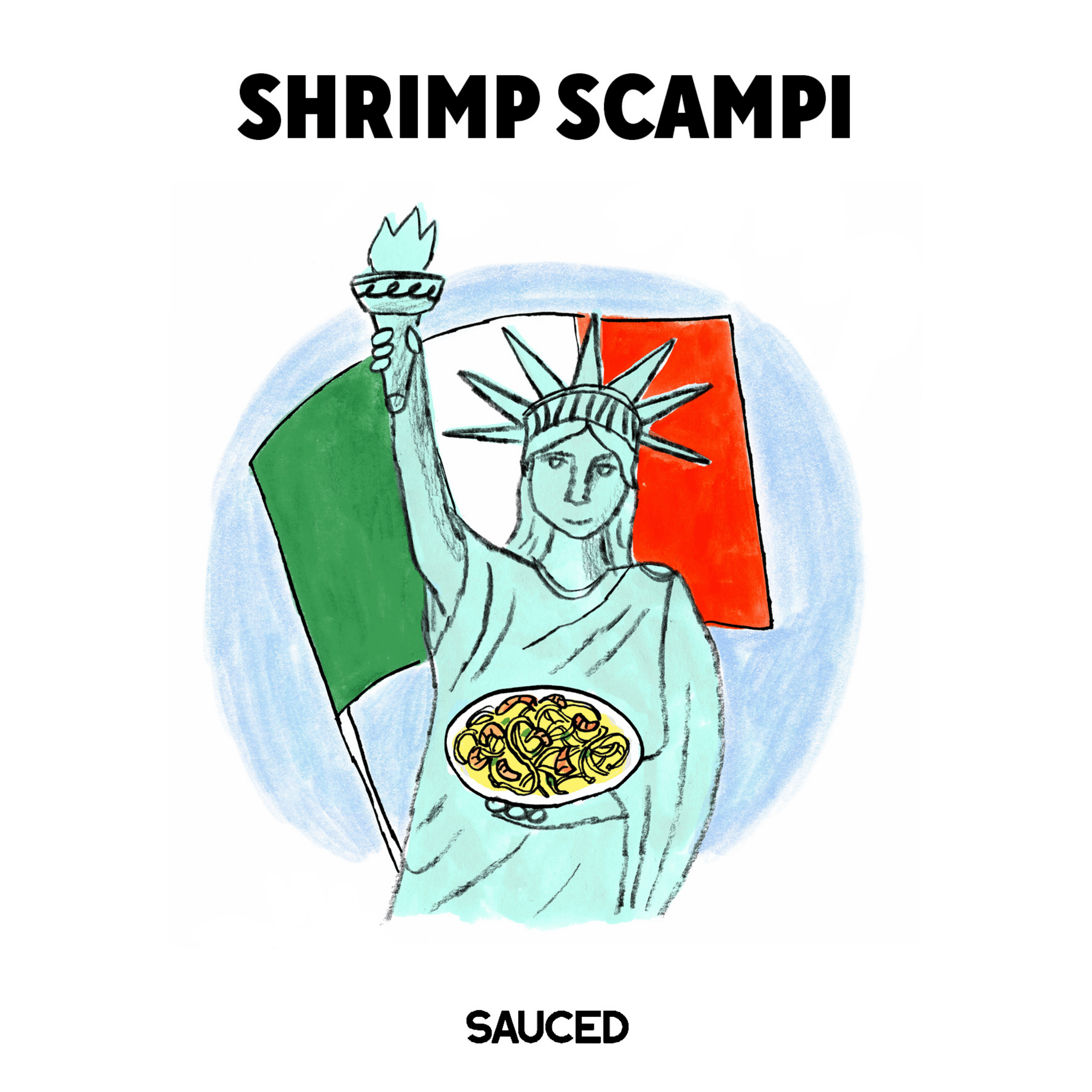
The name says shrimp twice — except it doesn't. "Scampi" is Italian for langoustine, and what we call shrimp scampi is really shrimp cooked in the style of a creature that Italian immigrants couldn't find when they arrived in America. A translation accident, a weeknight classic, and a prince's dish behind a cartoonish name.
This week, the identity, the technique, and the 90-second window where it all comes together or falls apart.
“Two ingredients in the name — one isn’t even in the dish.”
What we settled on:
16/20 count shrimp — salt and baking soda cure, 15 minutes
Shrimp shell stock from peeling scraps and vermouth
Dry vermouth, not white wine
A splash of Pernod
Garlic sliced thin, Fresno chili bloomed in oil
Cold butter mounted piece by piece
Brass-extruded, slow-dried linguine with concentrated pasta water
The Cocktail
Lo Scampo: gin, fresh Ruby grapefruit juice, marjoram syrup, and seltzer. Garnished with brûléed grapefruit.
RECIPE CARD:
Premium subscriber? Check out the full recipe card here.
LISTEN
EpiSOde Partners
Thanks to the following brands for partnering with Sauced to bring you this episode:
TRANSCRIPT
Tim McKirdy: Sother — Chicken turkey for us here today. Oh, sorry. No, I mean, shrimp scampi.
Sother Teague: Chicken, turkey, pedantic. But I looked it up. It doesn't mean shrimp. The word scampi in Italian is the plural of the word scampo. Which is for what's called a Norway lobster, AKA, the langoustine. So what happened is this dish was always made in this way, served with langoustines, and then when it came to America and got Americanized — Italian American cooking — they were using shrimp to cook in the way of the lobster.
TM: I know.
ST: So shrimp scampi doesn't mean shrimp shrimp like we were joking about before. It means shrimp in the style of lobster.
TM: So it is the rare — and to my mind only — instance of, and I thought I was gonna trump you with this one as well, because I was thinking about it. But exactly what you're saying. It's the rare and only instance off the top of my mind where there are two ingredients named in the name of the dish. But one of them actually isn't an ingredient. It refers to the preparation, the style of the dish. So yes, shrimp cooked in the style of scampi. A creature that's very similar to shrimp, but also different as we'll get into.
ST: Absolutely. And I think that was the Porco fun fact of the week. It's not shrimp shrimp.
TM: It's the Porco linguistic technique. Whatever. Love it. So personal associations or professional with this dish?
ST: I've absolutely made scampi or some version thereof in a restaurant situation where I was at work. And I think whether I made exactly shrimp scampi — this dish is effectively all about a sauce. You are making an emulsification. It's a beurre blanc. We're really just making a heavily fortified with ingredients and flavor beurre blanc that involves shrimp in our case. But classically langoustines. So this dish has reared its head numerous times in numerous restaurants over my career.
TM: I think this is arguably the simplest dish we have covered yet in terms of ingredients and preparation, but as we know, the devil is in the details. The easier things seem on the surface of it —
ST: The dose makes the poison.
TM: The more to dig into. So my associations with just scampi for a second here. Very different to the dish we know as shrimp scampi here in the U.S. The first thing I think of when you say to me scampi is pub. The boozer, a good old fashioned juicer.
ST: Where are you going with this?
TM: So you have what we like to call pub grub, and the scampi, if you order scampi, is a dish in a pub in the U.K. — and I say a dish, right, in a pub that serves food — you will get either breaded or battered, but deep fried shrimp. Served with something like french fries or pub chips and peas, not mushy. Garden peas. And lemon. So scampi is breaded, deep fried shrimp. Scampi fries are crisps as we call them. It's so confusing. And they're fish and lemon flavored snacks that are, as far as I know, only sold in pubs. I've never — I'm sure they sell them at supermarkets, but they're these small packets and you'll either go for scampi fries or pork scratchings, which is basically like chicharrón.
ST: So this is just shrimp chips like you get at Asian markets.
TM: Shrimp chips. Yeah, in the green packet. I forget the brand, but it's very iconic.
ST: They make a whole bunch of them. That's cool and funny and weird that it has the same name. Why? Why are these three things — the dish that we're gonna talk about, which is also then bastardized 'cause it's not the original ingredient, the shrimp deep fried and served with fries and peas, or this bag of crisps?
TM: Well, I wonder — I was thinking about this, right? Look, we talked about our Italian diaspora in the U.K. and also the fried fish and those sellers in our fish and chips episode. So I wonder whether this is simply the way that Italians took fish and fish dishes when they came to the U.K. versus the U.S. Because this again, like you said, scampi or scampi al vino bianco, as the dish would be — very much, and if we get into the origins, Southern Italian, Sicilian, where you have a rich bounty of seafood. And also — and I can't believe I didn't bring this up in our fish and chips episode — I was talking about chippy tea, something you'd have very regularly on Fridays. Because in the Catholic church — and there's a lot of days throughout the year, holy days where you wouldn't eat meat. So you're fasting, but that just means fish are on the table. The Italians that would've brought this dish over would've subscribed to that. And if you're based in Sicily or in the South and you have all that seafood, I'm guessing that when you had those holy days, it wasn't really that bad. Didn't really feel like suffering 'cause you have so much great seafood.
ST: And then langoustines just aren't as common an animal over here. You don't see them as prolific as you do in European countries. Although I do love them. And when we get them, it's quite a special thing. But you don't see them very often.
TM: Really confusing ingredient for me 'cause it's like langoustines, like you said. Norway lobster. And also Dublin Bay prawns. And then what's the difference between a prawn and a shrimp? And a shrimp and a langoustine? Do you wanna get into the main dish? Let's talk about langoustines here and shrimp.
ST: I don't know a ton about them. I know that prawn is fresh water, shrimp is salt water. 'Cause prawns are typically river, right? River prawn. I don't know much about langoustines, but I know they're delicious and I know we don't get them very often. They're little lobsters. They're somewhere — like if we put a size scale, you could have your lobster on the right side and crawfish on the left side, and langoustines would be in the middle.
TM: So that is the main distinguishing factor, right? That langoustines have claws and meat in there. I don't really know how easy that is to access. You don't need a big cracker like you would get for lobsters?
ST: No, they're really thin and small and long. And what you do is you take the butt of your knife and you clip off the end, and then you can lay it down and either using your thumbs or if you're just prepping and getting the meat, use a rolling pin and you roll it and it'll shoot them out.
TM: My response-cost meter is going.
ST: That's a lot of work for not a lot of reward, but the tail meat is delicious.
TM: So that's the difference of those. And look, hey, while we're at it and we're getting into the technicalities of it, you'll often find whether you're in the supermarket or buying from your fish purveyor or whatnot, things like 16 slash 20 or U-20 or the sizing scale. What's going on there? What is that?
ST: That's a great question and I think it's confusing to the consumer. That is telling you how many shrimp are in a pound. All that number is — with shrimp specifically, it's usually a fraction, right? So it'll be like a 16/20, like you said, so around 16 — 'cause they're not all exactly the same size — you're gonna get about 16 to 20 per pound in a 16 to 20. Whenever it says U before it, that means that they're huge because under 10 per pound. U-10s are big shrimp.
TM: Wow.
ST: Which is an oxymoron. But I think that's a good thing to drop on the list.
TM: So how many? So 16 to 20 in a pound. And that once again brings us to our "anything but the metric system" moment of the week.
ST: Anything but the metrics.
TM: So roughly somewhere between 16 and 20 per — kilo? No. Pound.
ST: Pound.
TM: And how many langoustines then?
ST: Oh my goodness. Here we go.
TM: Alright, well that's a little insight into our ingredients for us here today. We've covered a little bit of the origin, the weird etymology there. I believe — I want to verify this — but the name scampo as well comes from Italian all the way back to ancient Greek, and I think it refers to the shape of that creature's body, which will be exacerbated when cooking and will also be a good visual cue for us when we're cooking.
And then, like you said, the peak Italian immigration into the U.S. happens in the late 19th century, early 20th century, arriving mainly in coastal cities — New York, Boston, Philly, et cetera. Not that coastal. And langoustines not available here, so we're cooking with shrimp in the style of scampi. It becomes a red sauce joint classic.
ST: Do what you can with what you have, where you are.
TM: We've done chicken marsala. I'm trying to think if there's any other sort of red sauce joint dishes we've done, but in the sort of pantheon of American and Italian American dishes, where do you place this?
ST: It's high up there. This is absolutely gonna be on your gingham tablecloth restaurant menu, right next to chicken parm, chicken and/or veal parm, chicken marsala — which I was kind of blown away at how prolific marsala is out there. And shrimp scampi is gonna be on that list. Can't think what else would be on that menu though. What's a must have at a red sauce joint? I mean, obviously red sauce, meatballs, spaghetti.
TM: Sunday sauce. Or maybe that's more of a home thing. I think desserts — your tiramisu, your zabaglione. And I think we —
ST: Risotto. We did an episode about risotto and I think we should probably do an episode on saltimbocca. I think that's always gonna be on the menu too. It's been a while since I've even thought of that, so we could explore that later.
TM: Nice. Well, I think this dish, much as we are right now as we're recording, this is a really lovely way to sort of break into spring and some warmer weather, a little bit lighter. This is one of those classic ones where Sother is gonna set you a challenge and he is gonna say something like, start to finish, you can do this in 10 minutes.
ST: A little more than 10, but this is a very quick dish. Shrimp cook quickly. The sauce comes together quite quickly. Really you're gonna spend more time, I think, making whatever it is you decide to serve with it — whether that be some crusty bread or some pasta, which are the two leaderboard items for this dish. And I have my opinions on which one I like, but this dish — again, you're really just making a beurre blanc and cooking some shrimp with it. So it comes together really fast. And peeling the shrimp — if you gotta do that peel and devein — but if you get that done by your fishmonger or whatever, we can have dinner in 20 minutes.
TM: There's also a little bit of jeopardy to this dish where it's basically like success or failure arrives in the final 90 seconds. And if you mess it up, there's not really anything you can do, especially — well, there's two things, right? The success or failure lies in, have you managed to emulsify your beurre blanc? And have you overcooked your shrimp? And if you're struggling to emulsify, you're almost certainly gonna overcook as you're trying to do that.
ST: It's a little tangled web there. And you're right — in the last 90 seconds, this thing either comes together flawlessly or it falls apart spectacularly.
TM: Do you like jeopardy in your cooking?
ST: Not particularly. No. But I deal with it nearly every day. I make an omelet almost every morning for Natalie. And she doesn't like any brown on her egg. Neither do I. No brown on eggs. People — eggs aren't meant to be Maillard reaction. I don't like that crispy edge. Anyway, every morning I have to make an omelet and I'm bleary eyed in the mornings, especially after working or being at events or things like that at the bar. But I don't love having to be challenged by what I like to think of as the act of cooking that I enjoy. But there are things that are just that way. So you have to prepare yourself and that's what we're gonna talk you through — getting prepared. And we're gonna make sure you have some delicious shrimp scampi on the table.
TM: I personally, just as a quick aside — I love that Natalie is so committed to the bit of not being cliched, that she turns around and says, actually, you don't need to crack a few eggs to make an omelet.
ST: Just crack one. She — it's a one egg omelet.
TM: Is there a dictionary minimum for how many eggs constitutes an omelet?
ST: There should be. Because that's also a challenge, right? I don't have a pan small enough to flatten out an entire omelet with just one egg. So I tend to try and make it on one side of the pan and just flip it over into sort of a weirdly triangular shaped mini omelet.
ST: Like a crêpes suzette style looking thing. Oh man.
TM: We're gonna take a quick break so that's gonna be a nice little opportunity for folks to hit pause and maybe like, subscribe. Leave us a review. We say it a lot. Sometimes we say it later in the episode where people might be comfy already, but this stuff really helps us, huh?
ST: Get it done. We're building a community here. We're really excited about how engaging you all are with us already. And we just want those numbers to grow so that we can continue pumping out these episodes and cooking with you guys.
TM: If you like this show, if anything comes up in conversation where you're also like — maybe it's a Porco fun fact or a "Maurice, anything but the metric system" moment — maybe you're walking down the street and you see something and you go, ah, Sother's right, anything but the metric system here. Bring that up to a friend, let them know. Share — word of mouth is real in the podcasting world. And if you can share with some friends, that really helps us out. So folks, we're loving it. We're gonna take a quick break and then we're gonna be back with the luminaries.
Alright, here we are. We're back, Sother. Once again, Italian American territory. So I don't know — where are you at with Julia and Jacques on this? Did you encounter anything?
ST: Nothing really from them struck me as noteworthy. But everyone has a scampi video or short — just type shrimp scampi into your browser. The list is kind of endless. And of course the ones that rise to the top are names. Ina Garten is up there a few times. Even Thomas Keller, Eric Ripert. But I didn't really see much that was of note from Jacques and Julia. Thomas Keller said — and I love his quote 'cause it is what it says and it's the thing — he just said a beautiful thing. Simple garlic butter, lemon, parsley, boom. I don't expect Thomas Keller to say boom.
TM: Sounds like Thomas Keller is just getting into his non-negotiables phase.
ST: And then I did mention Ina Garten. I like her a lot and her style of cooking resonates with me in a lot of ways. 'Cause it's so — I think she fills her kitchen with a sense of welcome and hospitality, and then we're gonna make some food. And it may or may not look perfect, but it will be delicious and everyone's gonna enjoy it. So I just like her style. I don't have a direct quote from her, but I jotted down some notes. She makes the dish approachable yet luxurious. She emphasizes that good wine, good butter will bring the balance to this thing. And then she has a baked diversion that I definitely wanna talk about, that I don't know that I would really go with. But it does show that there is some flexibility here while still kind of preserving the soul of this dish. And it's also very much in line with what I just said about her style of cooking in general, which is that you can sort of assemble it in your baking dish and then when it's time to throw it in the oven, it only takes a few minutes. And that way you can be at your party, not cooking for your party.
TM: That — I wonder whether she was inspired by the British, although it's not like breaded, but a completely different preparation. I also think I saw one of her preparations where she went, no wine. Lime juice only.
ST: That seems crazy. This dish absolutely has to have wine. We'll get to the non-negotiables. That's one of them. There aren't many. Again, I'm finding that we're choosing dishes that we want to explore and I'm finding in a joyous kind of way that the ingredients lists are quite short on many of these dishes to come out with a great result. So this one really exemplifies that. We'll see when we get to the list.
TM: So I went for Lidia Bastianich. As I have done when we've done other Italian American classics. Something notable about her preparation was she makes a shallot and garlic paste in the food processor, almost like the jars of sofrito you can get for other regional cooking or other cuisines.
ST: Garlic and shallot and what's happening? A bit of wine?
TM: Oil.
ST: Oil. She's making almost like toum.
TM: And she uses that and then she'll fry that off as the base and then build it from there, which I'm like — it's good. I mean, I would definitely do that if I'm cooking shrimp scampi for 25 people. I think for just two or four at home, you're gonna need a really small food processor or a lot of ingredients. And then also one of the things that I'd seen — she suggested using breadcrumbs as a thickener, if you struggle to emulsify the sauce. Is that common, calling for breadcrumbs in this dish or even on the shrimp itself?
ST: There is actually a debate on the internet about whether breadcrumbs belong in scampi or not. And they're definitely kind of, similar to the beans and chili conversation that we had. But there are definitely stands for both sides. I kind of think I don't want the breadcrumbs in my scampi. I can see how using some finely powdered sort of breadcrumbs to help pull the sauce together at the end might be helpful, but we can come up with other ways to avoid that calamity, I think.
ST: Can I suggest a counterargument?
ST: That's this whole show's conceit.
TM: So I'm gonna go for some Panko. And then I'm going to — and these are all things that would be in there otherwise if we weren't using — but I'm gonna go Panko, lemon zest, because I think zest and juice are two completely different profiles. And too often we miss out on the zest. And I'm gonna finely chop some parsley and I'm gonna run that through my little breadcrumbs and I'm just gonna pat them. And also that's gonna help dry out my scampi because once — we always say this — if it's not dry when you put it in the pan, you're steaming. And we don't want Maillard reaction either on this 'cause they cook at a lower temperature than that. But I don't know. I just really like that idea. I must have had it at some point. The sort of texture of the shrimp with a little crispness. And also if that's being finished with butter or there's butter in the pan — I don't know, maybe I'm going non-traditional for this one.
ST: Well, I think that sounds a little bit different than what you described that she was doing. She was using the breadcrumb to pull the sauce back together, to be a thickener like we did in the rouille for our bouillabaisse. Or like you do when you make carbonnade flamande, where we used whole slices of that bread to sort of disintegrate into. 'Cause what is bread? It's just flour that's being held together in a different way. And flour is a thickener. So I can see her pulling it together. I could see also if I had a scampi dish that was over pasta at the pass, we would often have a microplane and a piece of really, really hard toasted bread, and we would just dust the top with this aroma of toast and give a little bit of texture. Toast has a very obvious distinct aroma and it's a good tool to use to elevate the sensory experience of some dishes. We used to do all kinds of weird stuff like that. We would grate with a microplane. We would grate Altoids over the top of mussels that had mint in the sauce, and it would just give this burst of minty aroma without adding any — an Altoid, you scrape it on a microplane five times, you just get a little powder, but it disappears. The aroma though —
TM: Is this back in your era when you used to eat Altoids like Tic Tacs?
ST: Yes, because they were always up on the pass. Anyway, we're getting way off topic here. So back to Lidia. What else did she say?
TM: Oh, no, that was the last thing I had from her. And one of the other things that I saw — one or two references to — so I wanna be careful and respectful here. Obviously Mario Batali is a chef who has tarnished his own reputation. And that won't be news to anyone listening to the show. But he opened a restaurant in 2000 with Joe Bastianich called Esca. And linguini scampi was one of the dishes that they had on there. And the reason people were calling out, or when I was reading into this, was like, rather than treating this as some kind of Italian American, almost kitschy embarrassment or whatever, it was more like, hey, we can elevate this, we can do fine dining with this. And the other thing that I saw that I found quite interesting about that, and this is gonna be one of our debatables, is his chili flakes. He finished the dish with, rather than getting it in this sort of sauté in the beginning —
ST: That seems weird. You wanna kind of have them open up in the oil. You wanna bloom them, surely.
TM: So that was just something of note there. Three big names in American and Italian American cooking. Anything else by way of culinary minds?
ST: No, nothing particular stuck out to me, but I do want to pause and go back a little bit there. You said that they at the restaurant with Mario, they tried to elevate it to a luxury dish, which I think — we skipped over our Prince and Pauper situation that we usually talk about. I think this dish is a prince's dish. And I'm curious — even at that restaurant, were they going ahead and doing it with langoustines or were they staying with shrimp or large prawns or what have you?
TM: I mean, it was called linguine scampi, so I think they must have been doing langoustines.
ST: Langoustines are luxury, crawfish are like backyard. And they're so similar.
TM: It's all just basically semantics, isn't it?
ST: But I do think this dish is quite elegant. It is built for a prince. And I think it's also achievable by the everyman.
TM: One of those weird instances of this is more of a weeknight dish than a weekend dish. Not that it can't be. But also more of a prince's dish than a pauper's dish, purely because of the protein.
ST: Well, and also when executed correctly, the sauce that we're gonna make is going to be quite luxurious. It's heavily laden with butter. It's gonna have a really rich, fantastic mouthfeel. It's gonna be a pale yellowish color, it's gonna be very attractive. And it smells amazing, right? Because we're gonna have the shrimp happening in there. I think this is — and you're right, it is a weekday dish. I don't think I would be breaking out the shrimp scampi on a Saturday. I'm either going out or I'm gonna cook something more intricate. I think it stands out as a weekday dish because the preparation is so quick.
TM: I think I don't know. It's also just quite absurd to me because of what I think of as scampi. And also, just as a word, it doesn't sound refined. It sounds cartoonish and pub grub and scampi fries. And so to describe it —
ST: You have that memory. That connotation.
TM": But no, I do think if anything, it leans closer to a prince. And also the wine is in there purely for flavor. We're not trying to tenderize anything. We're not trying to braise anything. This is cooking with something you would drink. It's a show about cooking with booze and drinking with food. We're gonna take another quick break and then we're gonna come back with the non-negotiables.
Alright. So the non-negotiables. Anything else you want to add about shrimp? Or about shrimp as an ingredient?
ST: We gotta have shrimp and I think if you're gonna make this dish, go ahead and splurge and get some pretty large ones. You don't have to get the U-10s, but let's get a lower number per pound — that's a larger shrimp.
TM: And for context and for the listeners, what would that be? 16 to 20?
ST: I think I would go with the 16/20. It's a good sized shrimp. It's gonna look nice on the plate. It's gonna be satisfying to eat. So that's our shrimp situation.
TM: Before we move on from shrimp — this is something that came up when I was looking at some videos as well, and I think our guy Kenji has also verified this or stands behind this as well. Should you actually buy frozen instead of — and I'm gonna do air quotes here — fresh?
ST: It depends on where you are and how well you know your fishmonger. When I'm down — I grew up on the coast of the Gulf of Mexico. Shrimp are literally coming off the boats. But this doesn't preclude them from having been frozen. Often shrimp boats have the facility on the ship that they freeze them as they catch them, but those are the ones that are staying out for a long time. But you got day boat shrimp that are coming back every day — they're not freezing those.
TM: Gotcha.
ST: So look for those terms. Ask your fishmonger if it's day boat. Which doesn't necessarily mean they went out this morning and came back today, but they're not out there for a lengthy time. They're catching and bringing it back and getting it to market right away. Let's not discount frozen. Frozen is great as well, especially with all the technology we have now. It's what's called IQF — individually quick frozen. That's the bags you'll see at your grocery store where the shrimp are in there and they all feel loose. This is the way frozen peas are done, right? They're not in one big clump. They were frozen individually really quickly. So cell damage is minimized. And then you can just slack — it's called slacking. You just take your shrimp and put them in a colander with a bowl underneath it to catch any liquid that pours off, and you park it in the fridge for 24 hours and they'll be ready for tomorrow. Or conversely, if you're in a hurry, you can run them under cool water in that same colander and bowl situation. They'll thaw in five minutes — waste a lot of water, but it'll get it done. So I don't have a problem either way. I think when I can get day boat shrimp, I would prefer those. But the technology has superseded any myths or mystery about frozen food in general, but certainly fish. And in fact, United States law dictates that all seafood that's gonna be served as sushi has to be deep frozen and then slacked out.
TM: So that's the point, right? Even if you're buying quote unquote fresh, there's a high likelihood that was frozen at one point. So I think it's probably better economically if you buy frozen as well, and you get those big bags, you stick it in the freezer and look, again, this is a weeknight meal. If you always have that on hand, basically every other ingredient in here is a shelf or fridge staple. Both. So you have it right there. And also — I know this doesn't really matter in a lot of our conversations, but this is a pretty healthy dish too. The protein is — I'm not done with shrimp yet. Got one or two other questions for you.
ST: Go ahead.
TM: Number one, so when you're buying those — whether it's say you're buying frozen — you're not gonna buy peeled and deveined, right? Like, those are things you're gonna have to do yourself.
ST: If you're buying frozen, they're almost always already peeled and deveined.
TM: They are?
ST: But if you're buying them fresh — well, let's back up two steps. If you're buying frozen at the grocery store, they're probably gonna be like I just described, IQF in a bag. But if you're buying them from your fishmonger, they can be frozen in a five pound block. Those are not peeled and deveined, but they're lined up perfectly. Like they look like when you open a can of sardines. Those are gonna take a little bit longer time to slack or run under cool water, and then you can peel and devein. I want to have the shells, so I'm gonna peel and devein my own.
ST: Yes. We're gonna use the shells in the process here.
TM: And talk to folks about what that vein is, why you're getting rid of it, and how you're getting rid of it.
ST: It's not that difficult to process. You are gonna peel the shrimp first. What I do is — anytime we're cooking and prepping things, we're kind of going into the Henry Ford production line model. So I have this big bowl of shrimp sitting there, and that's where it begins. But I'm gonna peel them all one at a time. I'm gonna throw the shells into a separate bowl that I'm gonna hold onto, because we're gonna use those later. And then I'm gonna line my shrimp up on my cutting board. I'm right-handed, so I'm gonna line them so that their back is curved to the right. So I'm gonna have this whole line of all these shrimp and then I can come in with my paring knife and start at the top — what would be the head of the animal — and make an incision down its back, what would be its spine. Doesn't have a spine, but down the back of it, pretty shallow. And that's gonna open up where I'm gonna be able to see the digestive tract of the animal. I can use the tip of my knife then to sort of scrape it out. I'll usually keep a napkin there so I can touch my knife on that to get rid of it. And then I'll move that one outta the way and then the next one's just there. So I can just kind of go down the line and do these pretty quickly, pretty easy to do. It's also not a thousand percent necessary to do it. I'm gonna do it when I'm making this dish. But at the same time, if I'm at a backyard barbecue and someone made peel and eat shrimp, which haven't been peeled and deveined 'cause they're served as peel and eat, I'm just gonna peel and eat it.
TM: You can take that for what you will. Final shrimp question for you here today. Are you serving tail on or tail off?
ST: I'm tail off. And I also am a pretty meticulous shrimp peeler. And there's a method that we can employ — maybe we'll get a video out about this — where when you remove the tail fin, there should still be a little piece of meat hanging there. And it kind of drives me crazy when people don't get that. Because I feel like you're just wasting some of the meat. But we're gonna use the shells either way. So even if you don't get them all — I've never really understood the desire to serve with the tail on. I know there's some aesthetic quality to it that people seem to enjoy. I think that's the main argument. But then where — what am I doing with this tail?
TM: I don't like the aesthetic quality of me having to get my hands in a dish.
ST: A dish that's all buttery, fishy. And — well, I don't mind that necessarily. I've eaten my share of crawfish, I've eaten my share of shrimp that I had to peel and eat. But it's not that part. It's that unlike, say, a plate of wings where I'm gonna get my fingers all messy, I'm not also then picking up a fork to eat pasta. So I don't wanna maybe get my hands messy eating shrimp scampi 'cause I'm probably eating pasta with it. And that just seems weird.
TM: And where were you putting it? Where's my unpitted olive stone going when I'm having my Martini? I'm not — I'm having lemon — but you know what I mean?
TM: Next non-negotiable for you here — let's bring it back to that question we used to say as well. In terms of order of importance.
ST: Oh, importance. Oh, I thought we always did it in order of use. Which already I think shrimp would have to be first 'cause we gotta peel them. Importance — then I'm gonna have to say wine.
TM: You're not team Ina.
ST: No, I'm gonna use wine. This is again, back at the top — I said we're effectively making a beurre blanc that is fortified with shrimp.
TM: I'm gonna hit you with another argument here.
ST: Let's go.
TM: You are already on my side. I know. But we're gonna go through the motions. I — the more I think about it, the more I'm questioning whether anytime there's white wine, I would rather go for vermouth because — a few things. A, more flavor. B, lasts longer in the fridge. C — what do we do with leftover wine in this household? And that's a trick question.
ST: I'm assuming there's no such thing as leftover wine in this household.
TM: Exactly. So I've had to go and buy a bottle and then that's — so I'm just like, look, and then maybe I can start buying 750s of vermouths rather than 375s, which is gonna be better for the planet, better for my bank balance.
ST: Brilliant. No, I'm on board a hundred percent. Let's use vermouth then.
TM: Let's use vermouth. But look, vermouth is an aromatized white wine. So we're saying wine is a non-negotiable. Great. Next — I'm gonna come in here.
ST: Hit it.
TM: Garlic. Gotta have it. And I'm putting that above butter for one reason only. And that's — this is a recipe where I'm like, look, don't go one or two cloves. You gotta go four or five. And I was going off about people who made garlic and how much they use their personality in our bonus episode, but every recipe I saw for this was like, no, it's a significant amount of garlic.
ST: Well, because shrimp scampi is closely related to — I'm gonna butcher it, but in Spanish, right?
TM: Gambas al ajillo, which is shrimp and garlic.
ST: And butter. So yeah, it needs a lot of garlic.
TM: Your guy Babish — use the garlic press.
ST: I mean, he probably does that all the time. The guy's got like 10 million or more followers on his YouTube channel, and he's been around for more than a decade now and still claims he's not a professional cook. You do this for a living, you are a professional at it.
TM: So this is the first ever Babish I've ever watched.
ST: Oh really?
TM: And he was referring to the guy. Is that — is he not the guy who's on screen?
ST: Yeah. He is.
TM: He was calling himself like Eric or something. Anyway, watch the Babish scampi video. It's good. I enjoyed it. So next important — next in order of importance.
ST: Now it's butter. Gotta have butter. Unsalted is our go-to all the time. Because you have more control over the saltiness of the dish. If you start with butter that doesn't have salt in it, the only thing salted butter is doing for you is buying you some more shelf stability. It does obviously add some flavor, but if you're putting butter on your toast, then add a little salt if you want salty flavor. Buy unsalted butter. I'm just gonna say that over and over.
TM: It's not the only fat in the dish.
ST: Nope. It's gotta have oil too.
TM: That's my next non-negotiable here.
ST: Me too. Something really fruity. The kind of oil that's a little scratchy in the back of your throat. I want something that has some bite.
TM: Start with olive oil because this is Italian, especially Southern Italian. Finished with butter. Next.
ST: Gotta have a little more acid. Need some lemon juice. And as you already stated, some zest. So zest it before you cut it in half for the juice. They're hard to zest when they're cut in half. And I've had to do it — you forget to do it, or you're like, oh, I've got another lemon. No you don't. Oh man.
TM: Alright, well then you've hit the ball back in my court, which means I have to go with parsley.
ST: Which is your favorite. And I kind of manipulated it so that you had to say it.
TM: Are you going curly or flat leaf for this one?
ST: This is flat leaf. Curly has its uses and I love it, but it's more for things like tabbouleh — stuff where I want that texture. I'm not looking for that texture in this dish. So it's flat leaf.
TM: Alright, next one for you. I've got two more here on my list.
ST: Oh, that was it for me. For my non-negotiables, I had shrimp, oil, butter, lemon, wine, garlic, parsley.
TM: I think chili flakes are a non-negotiable.
ST: They're on my negotiables list. And the reason is I am of a mind of do I want chili flakes dried or do I want a fresh sort of Fresno style chili?
TM: So we'll say the non-negotiable is heat. The negotiable is, alright, let's chat about the form. What about those Calabrian ones that I bought in the jar that we used for — I can't remember what we used them for.
ST: I don't know what, but they were delicious. I'd like to get some of that and some of that little oil from there in there as well.
TM: So chili is — some kind of heat is the non-negotiable. What form is the negotiable.
ST: I bet I know what your next one it is 'cause it's on my negotiable list.
TM: Pasta.
ST: Oh, I didn't know what it was. Holy smokes. 'Cause I'm team bread. I just want some crunchy bread, or even soft bread, like a focaccia. I want the dish to come out to me sort of like a pile of shrimp in this sauce with a low-lipped ceramic kind of dish that I can just scoop some shrimp and dip into the sauce. That's what I want.
TM: I hate to play my hypothetical restaurant scenario card here. If you order shrimp scampi at a restaurant and they bring it out and there's no pasta — you're gonna feel shortchanged.
ST: You think so?
TM: I think you'd be surprised.
ST: I mean, if you order shrimp scampi at the pub, you're getting a bag of crisps and you're happy about it.
TM: Me and my guy Baggy.
ST: He stole the S. It's a story for another day. Subscribers only.
TM: Subscribers story, that one.
ST: I really thought your final pitch for a non-negotiable was gonna be shallots.
TM: Oh yeah.
ST: They're on my negotiable list. They're not required, but I do like them.
TM: Definitely my allium. Is it non-negotiable? I then have to put myself in my hypothetical situation again and say, look, if I had it, it's gonna be much less of a glaring omission than pasta. And if I am going pasta — what type of pasta?
ST: It's gonna be linguini. I want something kind of mildly wide and flat so they can catch all of this. It needs to be something that went through a bronze extruder. It needs to be something that's slow dried. Maybe we should talk about pasta for a second. I worked for a long time in an Italian ristorante. And even when I worked here at Gus's, we had a brass extruder. We made our own pasta every day.
TM: What is a brass extruder?
ST: So the brass — when you think about your Play-Doh kit when you were a kid where you mashed something through and it came out looking like spaghetti —
TM: Like a mincer.
ST: Yeah. Well, sure. Here in America, that's the grinder. But yeah, sort of these spaghetti noodles of Play-Doh are coming out of that — that's the extrusion, right. And when that device for pasta is made out of brass, what happens is it leaves a rough edge on all of the pasta. And that rough edge translates to cling ability — for sauce to hold onto. If you use an aluminum one or a steel one, this doesn't happen. So if you're buying dried pasta at the store — if you're not making your own pasta, which I love dried pasta, I love fresh pasta, they have different uses in my mind — in this case, I think I'm going with a dried pasta. I would get a linguini that's been — and check the box. They'll all say different words, but look for one that's using slow dried. The words "slow dried" will be on there somewhere, and the words "brass extrusion" or just find the word brass. Those are the really big ones. If you're the one to get granular about this — no pun intended — make sure that your ingredients list says semolina, not semolina powder, right? Because there's a finer version of semolina that's quicker and more easily manipulated into becoming the pasta. So that pasta isn't quite as sturdy. And again, if you do these things when you're buying pasta — the brass extruder, the slow drying, and the semolina flour — your chances of having better pasta are elevated tremendously. So take two seconds and take a look at the box. Not all pasta is the same.
TM: So what's brass tacks?
ST: That's when we're getting right down to the bottom of it. I'm not exactly sure where that etymology comes from, but this probably has to do — a lot of weird phrases that we use come from the textile world, like "the whole nine yards" that people always think has to do with football. It doesn't. The whole nine yards is — it takes about nine yards of fabric to make a nice suit. And so you wanted to make sure that your tailor was using the whole nine yards.
TM: And presumably brass creates a better outcome and there's a tax associated with it.
ST: I dunno. But you know the phrase brass tacks. It's not tax like income tax. It's tacks like a push pin. It's probably the brass tacks that hold the upholstery together. I'm guessing.
TM: The more you know.
ST: This is just me guessing 'cause I know all these weird things about words and phrases.
TM: So you're — crusty bread?
ST: No, no, we're going pasta. So this is — as we do, we are deciding right now. It's gonna be pasta because I think as I sit here and think about it, you're probably right. If I was out with 10 friends and all 10 of us ordered shrimp scampi and it came without pasta, nine of us would be unhappy. I'm the outlier on this one. I would encourage you, listener, dear listener, to just make a big plate of this and eat it with some bread and have a big plate of it right in the middle of the table and everybody just reaches in and dips and grabs and shares and whatever.
TM: It's funny you say you are the outlier. 'Cause this is literally the line that I wrote here in my notes — it says, linguini is canonical. Crusty bread for sopping is the no-pasta way to go. Rice is the outlier. And if you serve me this with rice, you're about to — I don't know how to finish — be violent.
ST: I mean, define rice. If you gave me this on white rice, I would be a sad person. I would be like, oh man, it smells so good, it looks so good. Wait, is that rice? But if they're saying rice — is it risotto? I could have a nice risotto. Risotto al shrimp scampi.
TM: Well, I'd seen a couple. And then again, if you do a really nice, like a Puerto Rican style rice or whatever — there's gonna be a bunch of flavor in there. That would be delicious.
ST: I did have two more negotiables that I wanted to touch on at least.
TM: Well, I mean, there's barely any other ingredients, so we might as well cover them here.
ST: I'm gonna sneak in some Pernod.
TM: Listen, I was literally sat at my kitchen table earlier today looking at the bottle of Pernod as I was thinking about the vermouth. I wonder if he's gonna go Pernod.
ST: Well, listen, we've already encouraged our listener to make oysters Rockefeller with us, which means that they have absinthe in their home. And they're probably thinking to themselves, how do I use this up outside of the drinks that we've suggested using it in? So I say, let's get some — just a little bit. Not much, man. We don't need much. Frankly, we don't need much of any of these ingredients except for kind of shrimp and butter. Those are the two big boys. But I'm gonna squeak in a little bit of Pernod, and then I'm gonna — in addition to parsley — marjoram.
TM: Ooh. Not — so for those who don't really know — make the case for those who are unfamiliar or like that seems like — I know a lot of cooks in my life that will skip ingredients and steps. They're just like, nah, not for me. Don't need to, not worth the effort. Make the case.
ST: Well, I think parsley's a very cleansing herb and I've definitely made my point clear on parsley in other episodes. I love this stuff. I find it freshens dishes. In this case, marjoram — for the listener who doesn't know what marjoram is — if I described it to you, I would say it's kind of a cross between thyme and oregano without the assertiveness of either of those. It's not as gripping as oregano. It's not quite as floral as thyme is. We've got notes of citrus and pine here, which I think go really well with the shrimp and the butter sauce that we're making. But also, if we're gonna use Pernod in the final result of all this — and I think we're headed that way — it'll pair very well with those anise, licoricey flavors as well.
TM: That made me wonder whether, if I was cooking this in a restaurant, and this was when I was thinking about the pastis earlier as well, whether I might go for a little fennel frond or fennel as a garnish.
TM: I'm with you on that. Given that we're gonna round out ingredients here, I just have two points to follow up on. Number one — if you were going wine classically, I mean, as much like we cover all the time, I would go Pinot Grigio, but it wants to be crisp, assertive, acidic. Sauvignon Blanc works well, but come on, we're in Italy.
ST: Verdicchio. That would be very nice as well.
TM: Or whatever you're planning on drinking with it as well, and we'll get into that.
ST: Well, but also we decided it's vermouth. We're going for vermouth on this one. I think that's a really clever thing to do. And also I think, as you sort of mentioned as well, it encourages the user to go through the vermouth more quickly.
TM: Keeping it fresh for your cocktails — even better. And then I just have one final question mark. When it comes to garlic — how are we preparing it? Because as we know from our bonus episode, that makes all the difference.
ST: For me, I want it to be present but mild. So I'm going the very thin slices, à la Goodfellas. I'm not gonna break out a razor blade, but I'm gonna just make some nice thin slices. I wanna be able to see them in the finished dish. I want them to have a little texture. Mincing is gonna be a more assertive garlic flavor, but also they're gonna sort of disappear. So I wanna be able to see them.
TM: In my separate universe, alternative future, where I'm going with my little seasoned breadcrumbs route — probably add a little bit of dried garlic in there too. But yeah, I've got sliced as well. I mean, Lidia's paste from the food processor — that's gonna be aggressive, but good on her.
ST: I mean, I said toum. It's basically garlic paste and oil. Garlic made into a paste with oil. It's very assertive. It's a delicious thing though. When used correctly, it's super delicious.
TM: Very cool. Alright, well those have been the non-negotiables and the rest of our ingredients. Some delightful tangents. We're gonna take another break now and then we're gonna come back with the science, technical considerations, and the preparation.
ST: Delightful Tangents is the name of my high school band.
TM: Tell the listeners what the name of your radio handle was.
ST: I was — when I was in high school, I was on the radio station, WILN, Radio Island. I lived on the beach. So it was Island 106. Mark the Dark on the Dark Side of the Island, pumping the wattage into your cottage.
TM: Oh. For those who still don't know — my dear friend Sother Teague —
ST: I've lived many lives.
TM: — is, well, all I'm gonna say is his name was Mark the Dark. So you make that what you will. Mark the Butcher.
Alright. Alright folks, we are back. WILN in the house, coming into your cottage.
ST: Reaching the beaches and shaking the lakes. I'm not kidding though — that was the thing I used to say.
TM: We mentioned at the top of the show — these are technical considerations right here. There's two that you need to navigate — one of which is the shrimp protein and rubberiness and cooking duration, and the other is mounting the sauce. Walk us through the expert's view on how to properly cook shrimp, how to make sure it's not getting too rubbery, and some maybe visual cues that are gonna let you know, hey, this is when you wanna start pulling this off.
ST: Well, I wanna talk to you a little bit about a technique that we haven't touched on here — curing the shrimp in advance. And pedantic me, I know I'm pedantic, but it really gets under my nails when people say "dry brining." That's curing — it already has a name. We're not dry brining anything. Brining is wet. Okay, I'll get off it. Anyway. But what we're gonna do is just a little bit of salt. When I say a little bit, I mean a little bit. Per pound of shrimp, I'm talking about a teaspoon of salt. And we're gonna go with iodized in this case, right? So it's the most fine. So a teaspoon of salt, and also I want it to spread out more. A teaspoon of salt to a quarter teaspoon of baking soda. So just toss that into your bowl of shrimp and then lay them out flat on a sheet pan or whatever and pitch them back in the fridge. We're only talking about literally 15 minutes. So you do this right after you peel and devein and then while we're assembling the rest of the mise en place — doesn't take long. And the reward here is great because the baking soda is gonna help create an alkaline situation, which is going to make the shrimp remain tender. And the salt is going to go through osmosis into the flesh, which is gonna make for the end result being a plumper, juicier product that will mitigate some of that rubberiness if you hammer these shrimp too hard.
TM: Beautiful.
ST: And I didn't always do this and became a convert to this some years ago. And this will change your shrimp cocktail in ways that you can't even prepare yourself for. So I do this for shrimp for all preparations now.
ST: Very cool. So then to cook them — once you pull them back outta the fridge, you got your pan going. Are we walking through the whole recipe right now?
TM: No, no. Just in terms of what are the visual cues.
ST: Your shrimp — well, they're gonna do that scampo thing, right? They're gonna curl up even tighter than how they come to you. They're already, just by virtue of the way that their bodies work, curved, but they're going to tighten that curve. And they're gonna change color — like when you cook a lobster, they start out sort of brown and they come out bright red. So we're looking for a color change and a shape change on these guys. And you don't wanna go too far for this dish — you don't wanna go too far with either, because there's a two-stage cooking process on a thing that already doesn't take long to cook. That's why I was a little skeptical of Ina Garten's baked version. 'Cause I feel like they must have been hammered, but also they looked delicious. And again, I bet the party was great.
TM: They were hammered.
ST: That's also a mitigating factor in cooking — pour heavy on the wine, get everybody a little soft.
TM: A little loose. A loose C — which is the shape of your shrimp — instead of a tight O.
ST: Well put. And then you asked something else and I got distracted.
TM: The other thing — I mentioned earlier as well, just making sure we're patting dry so we're not steaming when it goes in the pan. But the other thing, mounting the sauce, right? So we're going to finish this with butter. And in this instance, it's not just sort of grandma's cooking technique, but the starchy pasta cooking water is gonna help us out here a thousand percent. And I have another method of mitigating the sauce breaking as well. 'Cause we've all seen a dish like this come to the table in homes — hopefully not in restaurants — where the sauce is pretty broken. It looks — it doesn't look like a sauce, it looks greasy. And that's all about the emulsification techniques that you employ to pull that sauce together. And that starchy water will absolutely help because there's starch in there. Never throw away your pasta water until you're completely done cooking. And never throw it all away — just keep some. But we can mitigate too with another tool from our toolbox. When you're squeezing your lemon juice into a little dish or whatever, about a quarter teaspoon of cornstarch whipped into that lemon juice will buy you a lot of insurance on your final sauce.
TM: Jacques.
ST: And listen, man, I'm just — a little insurance.
TM: No, I like it.
ST: I don't need it. But the listener might feel a little more comfortable if they know that their sauce isn't gonna break.
TM: I'm actually just a little bit upset that you knew what I was referencing when I said that. The great man.
ST: Listen, I don't even think he's one of the great — he's the great.
TM: And look, come on, we want Jacques on this show one day, man.
ST: Let's get him on soon. 'Cause the clock's ticking.
TM: Don't say that. The clock's ticking. He just celebrated his 90th birthday and he is still out there doing it, man.
TM: Still kicking.
ST: Listen, he's gonna outlive us all and I hope he does. He's a culinary idol of mine.
TM: We named a section — 50% of a section — after him. So, no, that's — and we say that only because I'm sure Jacques would take it with the nature in which it is intended.
ST: It's always in good spirit.
TM: Okay. That's a good reminder. So I was thinking here as well when you were talking about it earlier — bam, we gotta do a bonus episode soon on pasta, fresh pasta. And this also reminds me of one of the common myths, which — and this will be a little teaser for that. So regardless of whether you use fresh or dried, your pasta cooking water is useful. If you're using fresh pasta, then yes, go in with olive oil. If you're using dried pasta, you don't need the olive oil. It doesn't stick together. Or is that a myth?
ST: I think it's a myth, but people do it and people swear by it. So I'm fine with it. My input here would be more — reduce the amount of water. When you're reading the box of pasta, when it says cook your pasta in four quarts of water, that's for the whole box. If you're using half the pasta, then cut the water. Because when you are using that pasta water, you want it to be as concentrated as it can be. If you're cooking one pound of pasta in a 30 gallon pot, that is not starchy water. But if you're cooking that one pound of pasta in just three and a half quarts of water, or three quarts even, the water's gonna be starchy. And that starch will absolutely help your final product. That's what cornstarch is doing — starch. They're both starch.
ST: So my thing about pasta — which I've cooked and made so much of in my lifetime — everyone, I think, uses too much water.
TM: Fair. You want the right balance as well, right? You don't want to drop the pasta in and bring the temperature down. But listen, folks, if you want some of this —
ST: You will have to join us over there on the premium feed. That's right. Where we do bonus episodes every month. We have four different categories of bonus. We do them about a specific ingredient — so it sounds like we're gonna do a pasta one soon. We do them about a side dish. We do them about a historical fact — or fiction maybe. And then — why do I always forget —
TM: Technique.
ST: And a technique. And so the next one that we have coming up is a historical one.
TM: Onion futures. Just gonna leave that dangling there for us. That's gonna be our next one. And then we'll come back with an ingredient, and that could be great for pasta. 'Cause I love it and I love making fresh pasta. And that is maybe what brings this dish — yanks it from the week and propels it into the weekend for me.
ST: 'Cause it becomes a project. Although, and I know just because of how much pasta I've made in my life —
TM: It's not that hard.
ST: It's not that hard, man. Like even watch some of your fun cooking competition shows. There'll be a guy who's like, I got 30 minutes, I wanna make fresh pasta. And you're like, what, are you crazy? But then he pulls it off. And then the judges are always like, oh my God, you made pasta in 30 minutes. Like, I think that's a little quick, but you can make your pasta dough and have it wrapped in plastic and in the fridge hydrating. And you don't have to roll it all out at once. You can make a chunk of pasta dough and then cut off quarters of it and roll out fresh pasta nightly.
ST: I do think you're right though. For the average home cook, maybe making your own pasta does take this out of Wednesday and move to Saturday. Or at least Sunday. Let's do it. Let's do Sunday supper with some shrimp scampi. That's a lot of S's.
TM: Sunday Shrimp Scampi. Love it. Alright, well that is the end of our science. Let's take another quick break and then we're gonna go into the preparation.
ST: Let's get after it.
TM: Alright. Shrimp scampi, a la Sauced. Sother Teague.
ST: Alright, well we talked about everything we're going to use and we talked a little bit about some of the things we're gonna do. We missed one of them so far, so we're gonna cure those shrimp as I described earlier. And then while that's happening, I'm gonna take the shrimp shells.
TM: I wondered where you were going with this.
ST: I'm gonna take the shrimp shells and get them into a saucier or a shallow sauce pot with just a little bit of oil and kind of get them sort of browned up. They'll be pale color. They'll turn sort of reddish brown. And you'll get this really beautiful burst of shrimpy aroma. Get them a little bit brown in the oil, and then go in with maybe just one shallot cut into quarters — no big deal here — maybe a sprig of thyme. And then hit this with a good glug of — we're gonna use vermouth, so go in there with a good glug of vermouth. And then we're talking about 10 minutes. We're not trying to make a crazy reduction here. And shrimp shells are very thin and very small. We don't need a lot of time — we're not making beef stock here. We don't need eight hours. 10 minutes is plenty. And then strain that off real quick and that's gonna be part of the sauce in the end.
TM: Interesting. And so you're straining that off?
ST: Strain it off. Get rid of the shells and whatever you put in there. You don't have to put anything in there, honestly. I said throw half a shallot in there and some thyme if you got it, if you want to. It doesn't matter. What we're really trying to do is extract some more shrimpy flavor.
TM: Very nice.
ST: And then now rinse that pan out and we'll go right back into it with some oil. To begin — we said we're definitely using shallot, so I'm gonna cut my shallots into long thin strips. 'Cause I want a little bit of texture out of them. You're shaking your head yes. You're agreeing. You wanna mince?
TM: I think I personally would, but that's a — that seems like a very Sother way to approach it, so I'm happy with it.
ST: I wanna keep you happy, Tim. Then we're gonna go in with that sliced garlic. So we're gonna get that shallot a little bit of time to get soft. I'm not looking to caramelize anything here. In fact, my heat isn't crazy high right now. We got olive oil, shallot going in there in little strips. Then I'm gonna go in with the garlic that we sliced nice and thin, Goodfellas style. And then we are gonna use some kind of chili. We didn't decide — we're gonna decide right now. Which is it? Chili flakes, Calabrian chilies, fresh Fresno?
TM: You're driving this car.
ST: I think I might wanna go with the fresh one this time.
ST: So like a Fresno chili — kind of looks like a red jalapeño. They're not crazy hot. If you wanna amp up the heat, maybe reach for a Scotch bonnet. But tread lightly into those waters. I like to remind people I'm a chili head. I like it spicy and you can't make it more spicy than I want — I love it. But understand that we don't taste chili, right? We taste five things — sweet, sour, salty, umami — my favorite — bitter. Where is spicy on that list? It's not there 'cause we don't taste it. We feel it. So when people tell you they don't like spicy, what they're telling you is they don't like pain. So tread lightly when dealing with chilies always. That's just my little tirade about that. Anyway, so we're going in with some chilies. And basically what we're letting that do is — well, sorry, back up. So we got the shallots in there getting a little bit soft. Then in goes the garlic. I wanna get the garlic a little bit toasty. I'm not looking to get it totally brown and dry, but I wanna get it some toastiness. And then that's when the chili goes in and that'll bloom into the oil. That'll flavor that oil. Then I'm going to go in with this sort of impromptu shrimp stock made from the vermouth, which is our wine component of this dish, to sort of deglaze everything. Oh wait, I skipped a step. Chilies are blooming in the oil. Then you go the shrimp, right? For just — literally, we're talking like for the size shrimp that we talked about, 16/20s — we're talking 45 seconds. We're gonna get them in as one layer as we possibly can. Don't make yourself crazy. Go for 25 or so seconds, give them a quick flip or just toss the pan sauté style. Sauté — that means jump. Jump the pan. Get them tossed around and coated a little bit. And then get them outta there. It doesn't matter that they're not done because we're gonna cook them again. We just needed to get them started at this phase so that we'll get a little bit of texture, right? I don't wanna just poach them in the sauce. I want to get them into the pan and come into contact with the pan. Now, once I've cleared those outta there, that's when I'm gonna go back in and deglaze with the sort of impromptu stock that we made out of the vermouth. This would be when I might also at the same time go in with, let's say a tablespoon — we're not even talking a full ounce — of Pernod in our case. And then let that come to a good simmer, and then reduce the heat. And now we start emulsifying in cold butter, unsalted, piece by piece. We're stirring that in so that it creates an emulsion and comes together. I forgot the lemon juice. Dammit. I need to write these things down better. Back up — two steps back to the deglazing with the wine and the Pernod. This is when also the lemon juice goes in. So that's a different type of acidity. If you're gonna use that insurance, this would be when a little teaspoon or half a teaspoon even of cornstarch could go in there to buy you some insurance. But if you do these things the correct way, I don't think you're gonna need the insurance. Now we're mounting in the butter to create that emulsion and pull everything together into a beautiful silky sauce. The shrimp go back in at this time. Hopefully at this point you've got your pasta cooked. Toss the shrimp around for maybe another 20 seconds. In goes your pasta, which will come with it plenty of pasta water. Check your sauce is still holding together. In goes your herbs — in our case, parsley and marjoram. If you need it, grab your measuring spoon — in a little bit of maybe a tablespoon, two tablespoons of the pasta water. That'll pull that sauce back together. And then get this guy on a plate. It's a really quick process. I feel like I was talking too fast and I kept skipping steps, but in my mind, I'm doing the process right now and it's fast. It's a super fast dish to make.
TM: Falls slightly outside of the Sother 10 Minutes Onto the Plate dish. We said earlier —
ST: We're gonna time me. If I have my mise en place set up —
TM: Gordon Ramsay did it from scratch in 10 minutes, and he said, set a timer.
ST: Oh, really?
TM: There's a video of him on YouTube Shorts doing it in 10. Although I didn't watch the whole thing. I just saw him set the timer and I'm pretty sure he wouldn't have put the video out if he didn't do it. And I'm pretty sure he was making shrimp in the Italian American sense and not in the pub grub sense. And then, look, I will allow you as well, of course, the bread on the side to mop up the sauce at the end. But we're going both.
ST: That's good enough. I really — I think what it is for me is if I had to give up all seafood except one item, I would be torn because I'm a huge oyster fan. But I'd have to keep shrimp.
TM: I've seen you hoover a shrimp cocktail on at least one occasion.
ST: I love shrimp. I love shrimp cocktail. I love them on the grill. I love them in sauces like this. There's a dish at a restaurant in New Orleans that I love, where they put them through the grinder and they do like a hot chili shrimp pasta dish that sort of toes the line. There's a lot of Vietnamese people living in New Orleans and there's an emerging cuisine there called Viet Cajun. So it's like this crossover between some Vietnamese flavors and some Cajun flavors over pasta. It's incredible.
TM: I love it. In a fish burger as well.
ST: Oh, for sure. Plenty of macro salmon. Great. So shrimp for me are a real home run.
TM: Very cool. Well, it's time for our final break of the show. And then we're gonna get back with the pairings and today's cocktail.
ST: Let's go.
TM: Alright, we are back. Scampi al vino bianco. Let's talk about white wine here. I liked where you were coming from with the Verdicchio. I'm gonna hit you with another V — Vermentino. And Sardinia. Or coastal Tuscany. Beautiful. Love those Italian whites. And probably a little bit more interesting than Pinot Grigio or Sauvignon Blanc. You know what else though? Friend of the show, listener — Dan Petrosky, over there at Massican Winery, has been a supporter of Sauced and is certainly the first — I don't know whether this continues to be the case — but exclusively white wine producer over there in Napa. Sorry, Dan, if I'm butchering that, but I'm pretty sure it's exclusively. So Dan was in media, then became inspired by wine, went out to Italy, fell in love with that. And so he makes only white wine varietals in a region that's known exclusively, or much more known, for its reds. And any of those Massican whites are phenomenal. So any excuse I can have for that — and again, that's just a little organic thing that we're throwing out here because I know Dan listens to the show. And if I think about Italian whites, part of my brain is always gonna go to Massican and those wines. So a great opportunity for us to plug a friend of the show here.
ST: Love it. I think, while I am — it's not like the chicken marsala episode where we were drinking Marsala while we were making the chicken marsala. 'Cause it takes some time. Not a ton of time, but there's time. This dish comes together so quickly. I don't know that it makes sense to say "while I'm making it." But maybe while I'm peeling the shrimp, maybe while I'm getting that little stock going, I'm sipping on some of this vermouth on ice.
TM: Ooh.
ST: I love vermouth. I think it's underrated. And I think people come to me all the time and say, can you drink that on its own? And I do have a pretty glib response — shocker — where I say, no one in the history of mankind ever put anything into a bottle and thought, I hope it goes good with other stuff. If they thought it was missing stuff, they wouldn't have put the cork in the bottle yet. So vermouth is definitely meant to be drunk as it is. We have obviously taken to making Martinis and Manhattans and et cetera with it. So I would sip on some of this vermouth. Maybe just a lemon twist, during the process of hanging out and chatting with my friends while the bread is baking or whatever's going on that day. And then I want to ask you a question that might drive the answer that I have for a cocktail. 'Cause of course I have a cocktail for this. Where do you see — set the scene for me on eating this dish. Where are you? What's going on?
TM: So, assuming we're not Wednesday night dinner at home — I'm at that restaurant in Italy. That's on the coast in the caves. You know the one that's built into the caves? Sea is crashing against the shore. Got some beautiful cold wine in the glass. Probably got a couple more buttons undone than normal — I'm usually just one here, just — folks will see on the YouTube — but I've got a couple more undone. Probably wearing some white pants.
ST: Sun kissed.
TM: Certainly rosy cheeks. This man has never tanned in his life.
ST: Well, so you're right in line with what I was thinking. I think this dish — you've got a cute little backyard, which is a luxury in New York. But you've got a table and a chair back there. So I picture you out there. The sun is on you.
TM: Beautiful.
ST: And same with me. I've got a little backyard as well. I could see knocking this up in the kitchen and trotting it out on a big tray and sitting it down in the middle of the table for a bunch of people to be outside, alfresco. But it's summer or spring like this. I'm setting the scene because the drink that I'm gonna make here — which I'm gonna give you the honor, if you want, of naming, 'cause I never name these things, that you do — gin with grapefruit juice, probably something rosy, and marjoram syrup. And lengthen it with seltzer.
TM: Nice.
ST: So kind of a highball, really, but super refreshing. Herbal — that's gonna pair well with the dish that has that same herb in it. Herbal from the gin itself. Refreshing and fresh and outdoorsy from the grapefruit. I've mentioned before, I grew up in Florida and we had at one time two of each citrus tree in our yard — a lemon, lime, orange, and grapefruit. So I love a grapefruit right off the tree. Hundred degree day. The grapefruit's warm. I love that. Anyway —
TM: Eat a little grapefruit with a spoon for breakfast. I'd never seen anyone do that till I watched Seinfeld.
ST: America is a strange land for you. No — you know what I like to do? I like to take some Demerara sugar and coat a slice of grapefruit and brûlée it. That's the ticket. So maybe we could do that. We could do a brûléed slice of grapefruit as the garnish for this drink. That way you'll get another aromatic and flavor quality. But this drink is delicious.
TM: Hit me with some approximate quantities on that.
ST: So we're gonna use a highball glass, something maybe 10 to 12 ounces in total. You're gonna use two full ounces of gin because everything else in here is non-alcoholic and sort of wet, so you want it to stand up. I'm gonna go in with maybe two and a half to three ounces of the grapefruit juice. With maybe — let's call it — I'm gonna do a two-to-one syrup in the recipe that we'll print. So it'll be two parts sugar to one part water with the marjoram, so stronger syrup so you don't have to use as much. So I'd say a scant half an ounce. And then we're gonna get all those things in the shaker and give it a good shake. Strain it into fresh ice in that Collins glass. And then we're gonna flood it — flood it back all the way up to the top with the seltzer.
TM: Well, you know, I love a project. I'm going to clarify my grapefruit juice. And then I'm gonna batch and carbonate this cocktail.
ST: Why not? What's your clarification methodology?
TM: I'm probably gonna go to — is it the Modernist Pantry? And I'm gonna buy some chitosan and — I forget the other name of the — pectinase. And I'm probably just gonna juice a bunch of that and I'm going old school — I don't have a Spinzall or whatever — so I'm just gonna sort of let that settle in my fridge for a decent amount of time. It'll work and then just sort of slowly strain that off.
ST: Grapefruit is shockingly — it's called racking. Grapefruit is shockingly —
TM: I should have known that from wine.
ST: Grapefruit is shockingly easy to clarify. If you just squeeze a quart of grapefruit juice and leave it sit in your fridge for a couple of days, you'll see that you could rack off quite a bit of clarified juice from doing nothing. So grapefruit's really easy to clarify. Let's clarify this thing. I'm gonna hold you to it. We're gonna get some video.
TM: And you know what we're gonna call this cocktail?
ST: What do you got?
TM: The Whole Nine Yards.
ST: 'Cause we got weirdly pedantic in this episode.
TM: I like it though. Well, that's the clarified sparkling version of it. Otherwise we'll just call it Lo Scampo.
ST: Great.
TM: Well, Sother, any final thoughts for us here today? What is someone missing out on if they never make shrimp scampi at least once in their life? Or just anything else you wanna mention?
ST: I think this is really all about sauce making. So you wanna pay attention to the notion that you're really just making a large-scale beurre blanc. And then finishing some shrimp in it with, in our case, pasta. So this is gonna sharpen your sauce-making skills. I think also what's really been thrilling me about the show in general lately, Tim — with you — we're, I don't know what episode this is, but we're not even up to 20 yet. But what I'm discovering over and over while we go through the process of choosing the item that we're gonna talk about and then doing the digging for information about that item is that the ones that fascinate me the most are the ones with the least ingredients. It really is making me take a look at my pantry, my style of cooking, and the results that we can tease out of such a small list of ingredients has been a joy. And it's also been a joy for me to say, well, oh my gosh, there's only so few ingredients in this dish. We gotta talk for an hour. How are we gonna get it done? And then every time I'm like, oh my God, are we going over — like, there's much to be said about how something simple lives in both worlds of simplicity and elegance. And I think this dish really nails that.
TM: Love it. It really has caused a lot of that sort of self-reflection and questioning things. I really enjoy it. I am gonna leave you with a candidate I had for Porco today.
ST: Oh, okay. I jumped right in with the Porco at the beginning.
TM: I liked it. I forget what it was at this point, but I remember enjoying it. So — when you mentioned where are you eating this dish? There is another thing when you start to think about Italian American cooking and fish in particular.
ST: The Feast of the Seven Fishes.
TM: Feast of the Seven Fishes. Did you know — so, the vigil itself is legitimately old and Italian. I think they call it literally the Italian version of the word vigil — La Vigilia. But the phrase "Feast of the Seven Fishes" and the number seven are a pure American invention, and no one knows why seven. There are theories. People look at sacraments, the hills of Rome, the days that it took to create the Earth, the days in the week — if you go with the Old Testament. However, all of those explanations are post hoc. So the Feast of the Seven Fishes — the earliest documented print use of the phrase wasn't until the eighties.
ST: Wow.
TM: And also I don't think scampi was actually in that. I don't know whether it's even in it now. I've never done it. I remember the year that I moved here, someone said, oh, you gotta get up to Arthur Avenue on Christmas Eve and enjoy the Feast of the Seven Fishes. But yeah, purely American invention.
ST: Wow. That's a shock to me. I've never been to an official Feast of the Seven Fishes dinner. I was at Dale DeGroff's house one time and he was doing something that he kept alluding to it, but it didn't seem like it was formalized in any way.
TM: Did you count how many?
ST: I didn't, but I think we probably not only had seven — I think we had more than seven. 'Cause we had caviar to start and there were definitely shrimp and oysters and several different types of fish and octopus. And there was calamari. There was a lot of fish.
TM: That sounds like what I imagine dinner at the DeGroff household would be.
ST: Humble brag there.
TM: Get the broom out. He's dropping names again. No, I love it. Dale — also as well, when we talk about luminaries.
ST: That guy.
TM: Sother, that has been the chicken turkey episode.
ST: Chicken turkey. Shrimp shrimp.
TM: Shrimp langoustine shrimp lobster. Sother: Time to put on the apron.
ST: Break out the shaker.
TM: Let's get cooking —
ST: And drinking.
TM: Cheers.
ST: Let's get Sauced.