Episode 23:
BEER CAN CHICKEN
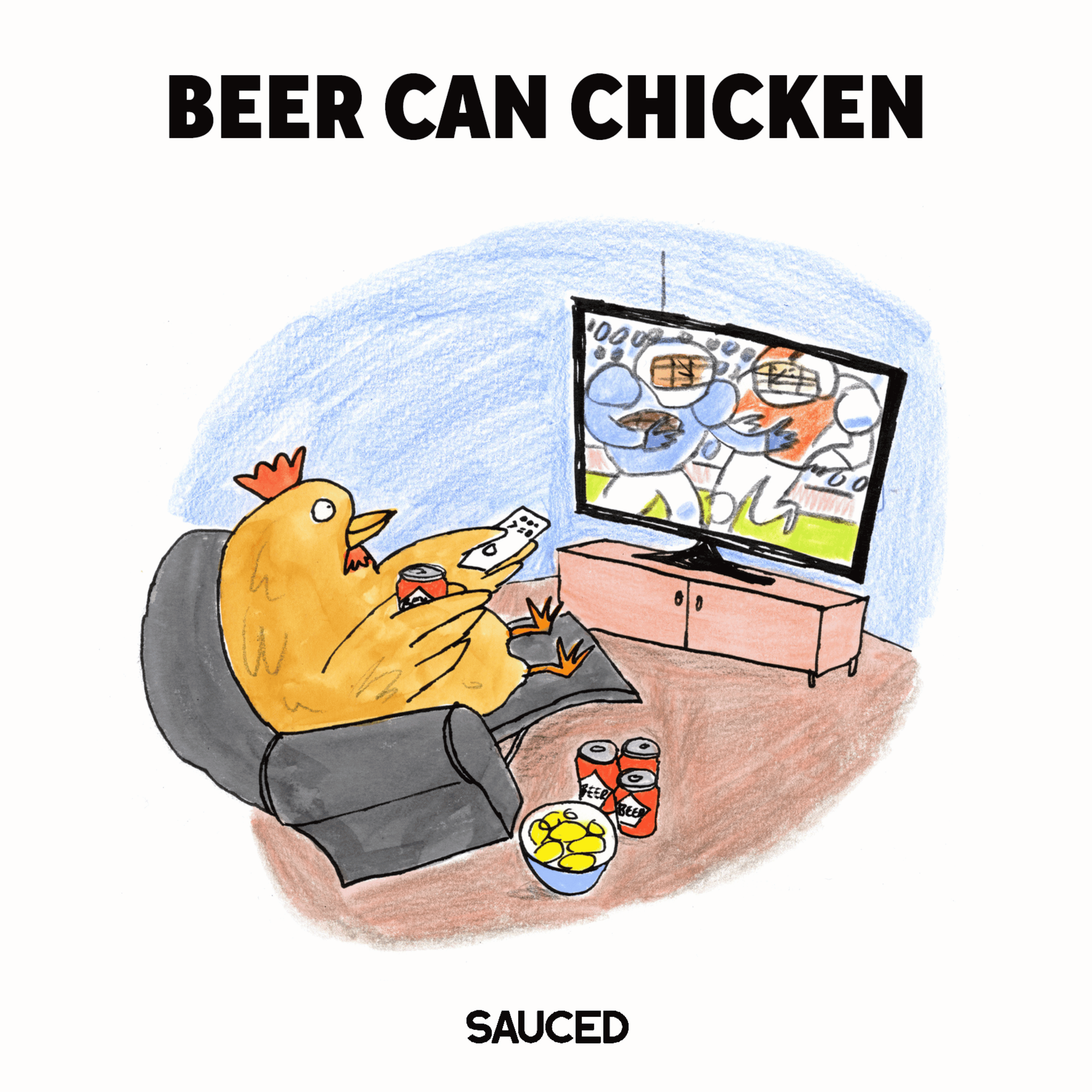
Beer can chicken is the dish that defies its own science. The most credible American barbecue scientists tested it and concluded the beer in the can does almost nothing the cook thinks. Backyard chefs from Memorial Day to Labor Day have kept doing it anyway.
We dig into both origin claims — including a 1993 Houston Chronicle article that puts the technique in President George H.W. Bush's kitchen — what the geometry is actually doing, and where we land on what goes in the can.
"It has created its own culture."
What we settled on:
Whole chicken, 4 to 4 1/2 lb, wishbone removed first
Soft Cure 12 to 24 hours uncovered in the fridge
Top removed, beer drunk, can stuffed with onion, herbs, bay, and half a lemon
Hickory wood, indirect at 275 to 350 degrees
Spritz with apple cider vinegar and 100 proof mezcal — never the breast
Finish with the Big Bob Gibson Alabama white sauce dunk
The Cocktail
Coq au Can — a beer-cocktail highball in light and dark, with tequila or mezcal on one side and bourbon on the other.
RECIPE CARD:
Premium subscriber? Check out the full recipe card here.
LISTEN
EpiSOde Partners
Thanks to the following brands for partnering with Sauced to bring you this episode:
TRANSCRIPT
Tim McKirdy: Sother, it's the cookout classic that food scientists have tried to retire, but the backyard grillers — myself and yourself, I hope — have refused to listen. It's beer can chicken.
Sother Teague: Let's go! I mean, this seems like tailor-made for Sauced. It is definitely cooking with booze.
TM: Right? Cooking with booze, and you know when we've got that on the grill, we're gonna be drinking in anticipation of food.
ST: So beer can chicken is a whole chicken roasted or grilled — in our case specifically, we're gonna grill this thing — upright over a partially filled can of beer, which produces a crispy skin, juicy meat, and a dramatic presentation.
TM: Love it. I mean, it really is one of those things. We talk about it a lot in cocktails — your Espresso Martinis, your Ramos Gin Fizzes, things that are visually striking that immediately appeal to people. It's not the prettiest image, but just the image itself is so striking that it makes you wanna do it when you learn about this.
ST: I think it's, as I said, dramatic. So suddenly you're — and it's also oriented differently than you normally envision a roast whole chicken. It's standing up instead of lying on its back. And that alone causes you to take a second look.
TM: Well, plucked chickens are weird looking beings. So just to see — they look like feathers. Don't tell our man Jack, who spent a whole career painting them. Good old Jack. That's the last Jack reference I have for today, by the way. Skipping ahead to the culinary luminaries, we didn't have anything from our great man. Like we said, though, this is one that maybe the food scientists have some gripes with, and we're certainly gonna get into that. Before we do, and before we get into our origins, what is your personal association with this dish? Like, beyond what we've discussed already — can you remember the first time you came across this technique, the first time you saw it? I know it's something that you've done before. It's certainly something I've cooked as well.
ST: There's no way I could remember where I saw it first. My life has been populated all the time with grilling out. As a kid, my dad did ninety percent of the cooking in my home, and I would say eighty percent of that cooking was done outside on the grill. I don't know if my dad ever did this, but I was always around grills. There's no way for me to trace back the first time I saw this dish, and I've certainly done it. And there is controversy, but the result is always kinda showstopping and pretty foolproofly delicious.
TM: I think this is probably a dish for myself that I would put in the class of I only learned about it when I moved to the US. I certainly never attempted to do the method before I came here, which leads me to suspect that as well. But yeah, I think as soon as I learned about this, loving grilling, loving cooking, immediately it was something I had to try. So let's get into the origins now.
ST: Yeah, I'd like — I mean, I can't imagine it's been around for long. And also, I'm just curious, 'cause the origins are always your bag. So let's hear it.
TM: So this is not one where we have a definitive person, place, or year. We have a rough decade, and we have a state. So the late 1970s to early '80s, people tie this back to Louisiana. During that time, beer can chicken starts appearing at college tailgates and during backyard cookouts. There's really not a lot of written record of it, you know, in cookbooks or anything at this time, but it seems like it spread from Louisiana up through Mississippi, through Texas and Kansas. And what are all those things known for, or at least two of them? Competition barbecue circuits. So this is a dish that's perfect for competitions, looks great, like you said, visually appealing, and that's when the spread begins.
ST: I mean, listen, I'm just gonna jump in here, but I think — and this is total conjecture — barbecue competitions typically don't circle around chicken. Barbecue takes a long time to cook. I bet that this came around as maybe a convenient way to not take up a lot of space on the grill and to be the family meal of the people cooking the barbecue. Am I right?
TM: Well, there's no evidence of it, but that is a very, very strong theory. I think what's interesting about it is we've discussed regional grilling via barbecue ribs. We've discussed regional things that you can put on the grill, like wings, and different approaches. No one's trying to claim beer can chicken in the way that they are with barbecue — that they're really putting a stamp on it. But all roads seem to point back to Louisiana. The next phase in the story — the early '90s, those competition circuits we spoke about. So now we do have some receipts, we have some written records. On the 25th of June in 1993, a writer called Steven Long in the Houston Chronicle food section publishes an article called "The Ritz of Pits: Houston Brothers Smoke the Competition." It's the earliest printed reference of the technique. The recipe in his piece was credited to Wayne Whitworth of Pitt's & Spitt's — a Houston barbecue business run by the Whitworth brothers, founded in 1983, so 10 years earlier and very much around the time when this is beginning, or people think it begins in Louisiana. Mr. Whitworth — Wayne — claims he taught the beer can chicken technique to President George H.W. Bush at the Bush family home in Houston post-presidency, and his recipe was half beer, half water, with some chopped onion and spices in the can. That's 1993. Almost one year later, June 1st, 1994, a man called Steven Raichlen — who I think will be important in today's episode — publishes an article called "Hog-Wild in Memphis" in The Washington Post. This is the first mention of the technique from himself, and he credits the technique to the Bryce Boar Blazers of Texas, which is an independent barbecue team. He notes in the article that the Blazers use Budweiser, and he watched them cook that technique at the Memphis in May World Championship Barbecue Cooking Contest during that year. So yeah, '94.
ST: The Bryce Boar Blazers Budweiser beer can chicken. Lot of alliteration there.
TM: Those brothers — the Blazers — they love their alliteration. And then in 2002, so a little over a decade later, Raichlen publishes Beer-Can Chicken, the cookbook, which has sold half a million copies to date and got a revised edition in 2024, thus taking the dish and the technique national.
ST: Wow. Half a million copies of a book about cooking a chicken on a beer can.
TM: Which is more startling — that he sold half a million copies, or he managed to get a whole book out of one technique?
ST: Those are both startling. But also that it was warranted being reprinted just two years ago. That's pretty incredible, to be honest.
TM: That would seem to suggest that the technique endures — that the love remains for this, and the curiosity for sure. So those are our kind of origins. Those are the people we can point back to, the receipts that we like to bring, but also there's the sort of folklore. I wanna throw it over to yourself now — just culinary luminaries, and maybe revisiting that man, our guy Steven Raichlen.
ST: Yeah, I don't have much, because as you mentioned, the technique isn't that old, and there is some controversy out there about it in general. But Raichlen had a TV show called Barbecue University, and obviously the book that he wrote. Easily he's the most influential champion of the technique, because he delivered the information to such a broad audience. But then as you said, competition barbecue cooks and pit masters embraced it. I, I think — well, I just now add to my theory that I think they were just cooking their family meal. They were cooking for themselves. They gotta be out by the pit for 14 hours. They gotta eat. So I think they were cooking it for themselves, but then realized that it was such a visually striking thing that's, again, pretty foolproof. Like, let's make this a thing that we make on purpose instead of just something we're making to economize space on the grill and use the heat that we have and feed ourselves.
TM: It reminds me a lot of when you go to bars — or say yourself, having worked in bars — right? If people in your trade and your colleagues working at different bars come to visit you, you like to pull out something that will shock them, or they haven't seen before. A new technique, a new ingredient. You wanna up the ante a little bit. I'm just imagining your theory here — the competition cookout and people sharing this technique with friends, being like, "Hey, my brisket's doing fine over there. Don't worry about it. But have you seen this?" And just pulling up the lid and showing the chicken there like that.
ST: It's a little shocker. You're just casually opening up the grill to spritz your brisket or baste some ribs or whatever, and then they're like, "What is that? What's that on the side there? What's that little guy doing in there?"
TM: Maybe you pull out a cold one from the cooler, chuck it over to them, crack a beer and be like, "Hey, check this out." By the way, just a quick side note — competition barbecue, are they strict about whether you're allowed to drink while you're doing it? Do the people take it really seriously so they won't drink and stuff like that?
ST: I've been to many a competition barbecue, and there is definitely no strictness. I'll just say that. The pit masters are typically keeping themselves hydrated with plenty of water 'cause it's hot. But also, there's some crisp beers floating around, and typically maybe even a bit of whiskey.
TM: Oh, very nice. Just in amongst all the RVs and stuff. I'm fascinated by it. I'd love to do a competition barbecue circuit one summer.
ST: I mean, well, 'cause even like what you just said, right? If I'm maybe trying to impress you by casually showing you my beer can chicken standing there on the grill, once you've walked over, I might throw you a beer. I might say, "Hey, I've got a pour of something here I'd like you to try, some whiskey," what have you. It's a very communal environment — that's what barbecuing and grilling is all about. You're not doing this for yourself.
TM: Absolutely not. This is the joy of cooking for other people. Raichlen — inducted into the Barbecue Hall of Fame in 2015.
ST: Holy cow. You told me that earlier, and my initial thought was that's amazing that there's a Barbecue Hall of Fame. There's not like a Soup Hall of Fame. There's not a Sandwiches Hall of Fame. Barbecue is its own thing, man. Barbecue to the culinary world is tropical and tiki to the bar world. It has created its own culture. You know what I mean?
TM: That is brilliant. I love that idea. It's like rock and roll, right? I love it. Any other luminaries or any other folks you wanna highlight here?
ST: Not really. I did dig into the people that we always look at — Jacques and Julia, and even Anthony Bourdain, and even some of the more modern people that I know and love — and none of them have anything specific to say about beer can chicken. They all have plenty to say about chicken — especially a whole bird — there's plenty of opinions on how to cook and roast a whole bird. But none of our sort of luminaries speak to beer can chicken specifically, and I think for a couple of reasons. One, again, it's not that old a technique. And two, there's controversy.
TM: I, like yourself, tried to look up things from Anthony Bourdain on this because I was curious which way he would lie on the topic. Like, would he be like, "Yeah, this is kinda cool, and I can see the appeal," or — Bourdain wasn't afraid to make fun of things, especially something as visually weird as this. I think he could've gone either way when it comes down to it, and I suspect it might have been purely the mood he was in had he been recording it that day. And whether it fit with the narrative of the story he was telling.
ST: Had he been drinking Negronis this day, or had he been drinking just beer? That alone could change the trajectory of his opinion.
TM: That's a great point. Who's he trying to fit in with, or who's he hanging around with? I just have one more name that I wanted to bring up before we conclude this section — Chris Lilly. So Chris Lilly is a fourth-generation pitmaster. He married into the Gibson family. His wife, Amy, is Big Bob Gibson's great-granddaughter. And Big Bob Gibson's Bar-B-Q in Decatur, Alabama, has been going since 1925. This is where Mr. Large Grande Bob himself — Robert Grande — invented Alabama white sauce.
ST: Alabama white is an anomaly in the barbecue sauce pantheon. And for the listener, Alabama white sauce is notoriously a barbecue sauce based on mayonnaise. Whereas most other barbecue sauces are based on tomato, ketchup, or vinegar, or molasses — this one is based on mayonnaise, and it is delicious. And it is almost specifically made or served with chicken. You can get it with other things, but you get a little slant-eyed look if you do. But it's a chicken barbecue sauce based on mayonnaise. And that's it. And that's the other thing — it's really simple, but it's super delicious.
TM: So Big Bob pioneered dunking whole smoked chickens into the Alabama white sauce over there at the barbecue spot. And I think the science behind it is that if you dunk a hot, recently cooked chicken into colder sauce, the sauce will nicely coat it. Like we were talking in our wings episode — you can maintain a crispy skin but also get that sauce, if you've got the right temperature difference. Chris Lilly, though — the man that I brought up originally, married to Big Bob's great-granddaughter — he is something of a notable figure in the barbecue world as well. That Memphis in May tournament that I was talking about earlier, where Raichlen discovered it via the Bryce Boar Blazers — Lilly was a champion in 2000, 2003, and 2012. So definitely got some barbecue chops, this fella. Well, Sother, those have been our luminaries and origin. We keep hinting at the fact that there is some pushback about this. We're gonna get into that in just a second, but a few first pieces of business for us to attend to. First of all, is this a prince or a pauper's dish?
ST: I think this is absolutely a pauper's dish. This is chicken — the most sort of common protein that we see on plates. And it's very simply prepared. There's not a lot of hidden techniques or mysterious science going on here. But this is a pauper's dish — elevated with a bit of showmanship.
TM: So if you were to replace both chicken and beer with another poultry and another booze receptacle, what is the prince's version of this? I'm thinking maybe half a bottle of Champagne — you know, like the mini halves you get.
ST: And what bird? I was thinking maybe a 750 of Cognac with a goose.
TM: Exactly. Or miniature quails over little bottles of Underberg for us here, 'cause we love our friends over there at Underberg. How about that? Amazing. All right. No, definitively a pauper's dish. And then final thoughts before the break, Sother — for those who have had their appetite whetted so far and they want to get our final beer can chicken recipe, plus the recipes for every single dish we've covered today on Sauced, how can they go about that?
ST: It's easy, Tim. Be a subscriber. Subscribe to Sauced. A subscription to Sauced will get you ad-free listening, recipes for every dish we've ever made, including every drink we make, which are many. And the bonus episodes.
TM: Gets you bonus episodes. We cover techniques, we cover single ingredients, we cover side dishes. We've got a fun little history series going on there now as well. One of the techniques, in a very recent bonus episode for us, brining and curing, is gonna definitely come up later today. Basically any time I season protein now, I'm thinking about that episode that we did. And then finally, it will get you a closer relationship with myself and yourself, right?
ST: A little bit more access to you and I through our social media, through the website as well. You can directly ask us questions if you have anything that maybe we didn't cover or that you'd like to see us cover. We've been pretty active at responding directly to people. And it's a bargain at twice the price. Seven bucks a month. If you sign up for the entire year, you get two months for free, saving yourself fourteen dollars. I think what we're doing is putting on a great product, and we're getting a lot of really excitable response from our audience so far, and we're on our way.
TM: Totally. And I think that's the final thing listeners get from this, and it's not to be discounted — you get to walk away from it feeling like, "Hey, I'm supporting an independent podcast." There is no massive media company behind us. Nothing against massive media companies. That's just not what we operate in. We're a small little independent operation. And you will be supporting us, folks. So those who have done so far, thank you very much. Those who are considering it, well, why don't you listen to the rest of the episode, and then you can make a decision at the end. All right. Let's get Sauced.
TM: All right, Sother, we're back. It is what I am calling for this episode the Steam Question — the scientist skepticism. So just to go back to our little timeline here. From 2008 onwards, as you would imagine, this dish starts to get a lot more recognition. People start thinking about what is being claimed — the idea that this beer can inside of the bird's cavity is steaming and cooking the bird from the inside out, and thus infusing it with flavor. People did scientific experiments on it. Very famously, a man called Meathead Goldwyn.
ST: Meathead strapped on his lab coat and eye goggles.
TM: Founder of AmazingRibs.com, author of Meathead: The Science of Great Barbecue and Grilling, a New York Times bestseller, and himself inducted into the Barbecue Hall of Fame in 2021 — the 40th member. So he basically says — actually, let me pull up the exact quote from him here. He says: "Beer can chicken remains a gimmick, an inferior cooking technique, a waste of good beer, and is potentially hazardous." Do you know what he's referring to with that last point?
ST: I'm sure it's something to do with the lining that's inside of a can of beer. Yep, it's the inside.
TM: The outside. Yeah, or — inside or outside — but it's something called BPA. So he's done his experiments. People have also tested that. The BPA dangers are nothing to worry about here.
ST: I would imagine pretty slim. And I can tell you why I think so. Even though obviously the beer can wasn't meant to be heated up, the heat that it is achieving isn't that high in the grand scheme of things. Because it's inside your bird, which you're pulling off the grill at probably one-fifty-ish, and it's been insulated by the bird itself, so it's not even close to one-fifty. It's not really steaming at all.
TM: So Meathead — there's a video you can watch of him debunking this whole method on YouTube, and he likens it to a beer cozy. You know, you put that on your beer to insulate it, to keep it cold, and your bird is essentially doing exactly the same thing. Do you know how cozies work? Or maybe that's something for a different episode.
ST: Well, we got time. What do you got? It's 'cause my hand is warm, right? My hand is warming the beer. No? I don't use them, by the way. If you need a cozy for your beer, you're not drinking your beer fast enough. I've never once been like, "Man, this beer is too warm."
TM: So when you are very hot outside as it is today, what generally happens?
ST: Condensation.
TM: Yeah. I think the whole idea of the beer cozy is that that sweating and condensation you get when you have a cold one and it's outside — if that soaks into the cozy, then you're keeping it reliably cooler, rather than that sweat and condensation dripping off the beer.
ST: 'Cause there's no wicking. It's not wicking away.
TM: 'Cause there's no wicking. You have the technical terms there, and I was the one who apparently came with the science.
ST: So yeah, the chicken is acting as a sort of koozie for your beer that's inside there. So it's not achieving a high enough heat to maybe make that BPA or whatever you said melt or interact.
TM: Well, that does happen, but it's something at 20 — I can't remember whether it's micrograms or whatever — 20 very small portions of a gram, whereas the FDA safe limit is 50. So it's comfortably below during the test. I think that was — who did that?
ST: Cook's Illustrated.
TM: Yeah. They also did a test to see how much of the beer flavor had penetrated the bird, and they used a flavor probe. I'm not sure what that is exactly. They found only trace amounts of beer at the neck of the bird and nothing more. But they did dispel the myth that this is not potentially dangerous.
ST: Because that's the other thing. You gotta use a minimum 12-ounce can on this thing because — sorry, a 16-ounce can, I think, because the 12-ounce can's a little too short and you can be top-heavy and your bird can fall over. So if the can is that tall, it's almost sticking out the top of the bird already. So any steam that's coming off of it is, as you just said, around the neck. It's not like it's steaming inside the cavity. It's too tall.
TM: It's also, by most accounts, just not steaming. Beer boils at two hundred and twelve degrees Fahrenheit. Like you mentioned earlier, we're cooking our chicken — the breast at least — to a minimum of one sixty and letting it carry to one sixty-five. The thigh's a little bit higher. And Meathead's testing — the beer koozie thing — he found that the can makes the cavity on average forty-seven degrees Fahrenheit lower than it would be without the can in there.
ST: Cooler, yeah.
TM: Cooler than it would be without the can in there. So we're not steaming. Other arguments that people have had — they claim that the fat drips onto the can, and eventually will seal the hole of the can, and because fat is hydrophobic, steam cannot pass through it. So even if it were boiling, the steam couldn't pass through any kind of fat seal.
ST: Well, if it were boiling, it would be roiling, so there would be places that the steam could escape. But again, we're not even getting close to boiling. Like not even close. So if there's a fat layer on top, there's no liquid that's getting away. No liquid that is subliming into steam.
TM: Cook's Illustrated also, during their experiments, tried to test the difference between cheap and expensive beer. Again, had no impact. But I mean, why would it have impact? I think the science clearly points to the fact that we're not steaming. Which might lead you to say, "Why are we doing this?"
ST: Well, I think there's a part of us that wants it to work. There's a romanticized vision of this thing that's like, "This is doing something." Where the bottom line is, the beer is mostly for the cook. I say drink a beer and then refill the beer with some water, because you need the weight — the weight is what's keeping your bird from falling over. And then why do you want the bird to stand up in the first place? Well, we do know from cooking and science that the vertical roasting is an effective way to make the chicken delicious and have a great crispy skin. The vertical roasting in this case is absolutely doing more than the beer is doing.
TM: And that is a great point to note. If for no other reason, you employ this method, the vertical roasting is gonna get better air circulation of the bird. The bird will, in a sense, self-baste. Fat's gonna be flowing down. And also the positioning — versus if you have that bird flat on the grills — you're getting more even flavor, more even cooking. So there's arguments to be made there, to the point where we have some gadgets out there. A lot of these publications who've run these experiments said, "Skip the can. Buy a metal rack stand." There's something — a Kamado Joe, the Chicken Throne, retails for $80. Now, there's all manner of these online, though.
ST: They call it the throne 'cause you're sitting your chicken on it like it's a throne. Guess what costs less than 80 bucks? A can of beer.
TM: Some are kind of ceramic and solid. And also the wire racks. Yeah, there's cheaper knockoffs these days on Amazon, and let me tell you, I did consider buying some earlier today as I was doing a little bit of background on this. However —
ST: I would say, listen, I'm not here to poo-poo anybody's product, nor am I here to get in the way of anybody's good time. If you want the rack, buy the rack. But man, you must be really committed to this particular cook if you think spending 80 bucks on a thing that can only do this. You know, we used to always say there's only one thing in the kitchen that has only one job. Everything else is a multitasker. That one thing is the fire extinguisher.
TM: You've mentioned this before, and I always try and catch you out, and I'm not ready in the moment, and then I think about it later and I'm like, "Ah, I should have pulled that one out." However, when I was reading about all this science, I'm not gonna lie — it made me sad.
ST: Again, I think we collectively want this to work. We want it to do all the things that it looks like it's doing, but it's not. Oh, in comes Tim with the solution.
TM: But I have a solution.
ST: Oh. Interesting.
TM: I was determined to make this work with most of the principles, and also overcoming some of those supposed difficulties. So the first thing I started thinking about — alcohol boils at a lower temperature than water. Beer is 5% alcohol. What if we increase the volume of alcohol in the liquid? So I started running the numbers, doing a deep dive into the science of all of this. If we can assume that the cavity temperature is in the sort of 180s — which is what a lot of the literature points to — at 180 degrees, what percentage of alcohol do you need for this thing to start reliably steaming? 50% ABV. That's not too bad, right? That means we can employ some higher strength bourbons. You can even go cask strength, and if you're up to like 63% ABV, you are fine. This thing is reliably steaming. Amazing.
ST: Well, but that's a couple of hefty glugs of your Ray and Nephew.
TM: Here's the next thing. The more liquid you have, the longer it's gonna take to come up to temperature and therefore start steaming. So we don't want half a can or a full can. You want a third of a can, or maybe slightly less, but I think a third of a can is a good way to go here. So I'm gonna get rid of my beer. I am gonna replace it with a third of 100 proof or higher spirit. And then I start thinking about it even more, and I was like, "Wait a minute. Which is a spirit we can reliably turn to?" Because then your next question is — well, that first round of evaporation that you're getting and steaming, those are gonna be the more volatile compounds in the alcohol, not the hearts of it, right? What other spirit can I think of where people pull off those first runs — the heads, or otherwise known as puntas? I might give you a little hint right there. In what type of alcohol production do people actually drink those? Exactly. What is most traditional mezcal, artisanal or ancestral method, bottled up?
ST: Usually definitely over 100 proof.
TM: Definitely over 100 proof. What is another technique employed almost exclusively, but most traditionally, in mezcal distillation? Pechuga — which is hanging a turkey breast or poultry or any other protein inside the still and infusing — so, dripping down into the alcohol, and then that infusing and the vapors passing through it through distillation. That's the pechuga method of distillation. So I propose the inverse pechuga: Mezcan Chicken. Mezcal in the can chicken. It's the same vapor-to-meat exchange, but run in the opposite direction. And the vapor will deposit different types of flavor compounds and chemicals from the spirit into the bird. We can say that reliably. And then my final thing here — I don't really buy the fat sealing the opening, but what's to stop us just taking a can opener and just lopping off the whole top of the can?
ST: Oh, yeah. I saw a lot of guys doing this while I was digging around. A lot of guys whack off the top of the can and then, well, they chug some of the beer first, take the top off so it's out of the way, and then they throw in aromatics. You know, some garlic, some onions, some herbs, whatever.
TM: So we could absolutely do that. Now look, a few things to point out. Yes, this is gonna be more expensive. A third of a can — what is that? Of 16 ounces, you're talking about, I don't know, five ounces of mezcal. And the kind of mezcal that we wanna work with here — expensive but not crazy. And also, how much are you paying for your chicken? The second thing, and we should really note this, is if anyone is looking to try it, there is a real fire risk here. 100 proof spirit, once heated up, suspended over — ideally not open flames, but you're grilling here. There is a real risk there, and folks should proceed with caution.
ST: Well, I also think — and again, I love this, and I love you and your effort for going through this thought experiment — but there's also this one underlying thing that not a lot of people mention, although I did see a few people mention it. When we steam something, it dries it out. Like, when you open up a can of tuna, that tuna's been steamed. When you open up a can of canned chicken or whatever, that chicken's been steamed. It has that little tacky bite that you can feel when you chew on it. So in a weird way, kind of glad that it doesn't work. Even though it'd be inside the carcass, it's not really up against the meat.
TM: I would push back ever so slightly against that. I think you can cook anything dry if it's overcooked, and if we're talking about canned products, then maybe they go way past the recommended temperature.
ST: Oh, of course. I'm just using that as an example. That's a steamed product that is common for people. My metaphor against. I do like this. But again — and I'm not pushing back too hard, but I am pushing back — why not just have a trigger bottle of some mezcal, and every time you open the — 'cause when we get to the preparation — one of the things that I do when I do make this dish is I go and rotate it. So it's kinda like a very, very slow spit roast, because I'm doing it with indirect heat, and I wanna make sure that each part of the chicken faces the heat at some point. But every time I open, every 15 minutes, why wouldn't I just give it a little spritz?
TM: My only thing on that is I would spritz the wing area and the legs and the back. I would avoid the breast because I wanna get that crispy.
ST: Exactly. This chasing down being steamed is gonna be counter to our desire to be crispy, and I think I'll take crispy over flabby on the chicken any day. Although I do love the Hainanese poached chicken. That's a delicious dish.
TM: Oh yeah, so good. Khao mun kai. There is a restaurant in Queens, near Jackson Heights in Elmhurst, that's the only thing they do. Eim Khao Mun Kai. It's phenomenal. I go once a year. We'll need to go.
ST: Holy cow. You know me — I love knowing that there's a place that just does one thing. I need to go there too.
TM: All right, Sother. Well, those have been the scientifical skepticisms and a potential solution in the form of the inverse pechuga. We'll leave that one up to the listeners to decide, but the science — we'll try it out. We'll see if it works. We'll see if it makes a difference, and we'll be honest about it.
ST: I figure we'll do some experimentation over the summer. Listen, Tim, we'll do it for science.
TM: All right, quick break now, and then let's get back with the non-negotiables.
TM: All right, Sother, we're back. Non-negotiables. Let's roll them off.
ST: I mean, you gotta have a chicken — a whole chicken. I say somewhere between four and five and a half pounds.
TM: Four and a half and five? Okay. Nice. I had three and a half to four and a half. Not that that makes any material difference. The other thing I was thinking maybe really depends upon the kind of grill that you're working with. Feel like your grill setup is gonna be easier than me with the Weber. Whenever I've cooked this in the past, I've had to take out the center circle of my grill — the grates — so I kinda suspend it down there. It works. It's fiddly. I wouldn't wanna be doing it with 100 proof booze. But yeah — four, four and a half-ish. Anything smaller is gonna be difficult.
ST: Listen, it's not that you can't do it. I just think that if we're gonna go through this process, let's go ahead and get some value for our time.
TM: What about anything to do with preparation of this that you would normally do yourself? Are you prepping this for the grill in any way?
ST: Oh man, listen. If we wanna talk about a whole chicken — anytime you and I — I'm making a statement here — anytime you and I talk about a whole chicken preparation moving forward on Sauced, or anywhere in your life, listener — the very first thing you do is you remove the wishbone. Remove the wishbone while it's raw, just to get that thing out of the way, and then you will have a much easier time carving this bird when it's cooked.
TM: And a good point about that there too — when it comes to eating chicken that's been cooked whole, just 'cause it's something I don't love myself, I try and remove as many bones as I can for people. I try and make the eating experience as easy as possible. I love the kind of Central and South American chicken places that you get. There's some incredible ones. I think it's called American Chicken something, but in Jackson Heights they got a little chain of them. Incredible. But I hate it when they serve the legs on the thigh — the cage as it connects to the backside of the bird. I just hate going through all that stuff as well. So if I can personally carve that after we've cooked the whole chicken, I like to do that, just 'cause it's something that annoys me.
ST: I can go here or there on getting rid of that. But I definitely, definitely, definitely — if I'm preparing a whole chicken — first thing first, I'm removing the wishbone.
TM: And the reason I brought up that incredibly pedantic point was that the wishbone is gonna make carving so much easier, and you're gonna get a better yield.
ST: That's all. Ease — you'll learn. You'll get better. It is the yield. I wanna get all that meat off the carcass. And then beyond that, we'll get into it in preparation, but there's more. But obviously I'm gonna want a whole chicken. I wanna remove the wishbone right away. What's the next non-negotiable?
TM: Beer can is a non-negotiable for me.
ST: The non-negotiable for me in that arena is vertical orientation of the cook. I don't need necessarily a beer can. I can use that contraption, whatever you called it. It had another name. The Chicken Throne. I'm gonna use a throne.
TM: Kamado Joe? No, man, come on. I'm gonna put my foot down on this one. It's called beer can chicken. If you disagree with the science or whatever, we can take the top off, we can finagle it so it's stood up without too much liquid in there, but we have to have the beer can. We can get rid of the beer.
ST: All right, I'm in. Beer can it is. Also, I don't have one of those thrones, so I'm gonna use the beer can or a Coke can or whatever can I have. It doesn't matter. I just need the height of it and the weight of it to make sure that my bird remains vertical.
TM: Love it. Next — tough when it comes to non-negotiables here 'cause I have a lot of things that I will do every time I make it. You'd be hard-pressed to say to someone, "Hey, you haven't done this, and therefore this isn't a proper beer can chicken."
ST: I think you're right. Because what we're really talking about here is the technique of the vertical cook. This would be maybe tantamount to talking about sautéed chicken. We can go anywhere you want, sautéed chicken. Beer can chicken is the beer can and the chicken. From there, we can flavor it however we want.
TM: And we can cook it however we want — or are we saying grilling's a non-negotiable?
ST: I think for us, for this episode, we're grilling this thing 'cause it's the time of year, and that's why we're here. We wanna have a happy party style atmosphere. We wanna open that grill and have people see it standing there proud and ready. I want that thing. But obviously this can be done in the oven. We live in New York City. We're very lucky, you and I — 100% of the two of us — has a quote-unquote backyard that's big enough to have a grill. So we are the outliers for sure. But we drove our lives in that way. We wanted that thing. Speaking of non-negotiables — this can obviously be done in the oven, so don't let that statement deter you, listener. I want you to make this dish as well. When we get to the part about what we're flavoring it with — go nuts. Do what you want. Do what you have on hand. Do what your favorite thing is. If you wanna go kind of down an Asian route, let's break out some sweet soy and some Thai basil. You wanna go Mexican style — let's bring out some chipotle chilies and some lime juice. We can go anywhere we wanna go with this dish. So I think the non-negotiables on this dish are more about the brass tacks, the non-moving parts. Bird vertical on a beer can. I think the next thing I was gonna say is a dry exterior. We want a crispy skin on this thing. So I'm saying — I know the listener doesn't like to hear this — plan ahead. Get your bird two days in advance, get that wishbone out of there, put it on a rack, and put it in your fridge, and let the skin get really nice and dry.
TM: I was gonna say, just to round out our cooking conversation — I want this slow-cooked. What I mean is, I don't want this above 400. I want it somewhere like between 275 to 325. That's definitely what I'm gonna be aiming for on the grill.
ST: Okay. I'll go with you there. I was gonna go a little higher than that, but nowhere close to 400. No, that's crazy high. And then I was gonna say for our recipe, we throw in some wood — but not a ton. I'm not trying to make a smoked chicken here. I'm trying to make an indirectly grilled chicken, a roast chicken on the grill, but I want kisses of smoke on this thing.
TM: With a seasoning of smoke. What would you go? I've got down here — do we want hickory in the Alabama style? Oak, which is Raichlen's go-to? Apple or cherry for some fruit? Pecan, as we brought up before? Or is mesquite too much for this?
ST: I think for our purposes today, mesquite's too much. Although I love a chicken hit with some mesquite smoke. I was gonna say the very first one you said — hickory. Because I was also gonna suggest, unknowing that you were gonna bring it up, that we serve this maybe with some Alabama white. Just because it's unique and interesting, and I don't think enough people know about it, and I don't think enough people give it its due. Just because you may not have heard of it doesn't mean it isn't wildly popular in the state of Alabama, where I used to live.
TM: Roll Tide. Is that Alabama?
ST: Yes. Yes, for college football.
TM: Season's nearly upon us. I wanna revisit one more thing here, and then I guess we're done with non-negotiables. So you mentioned drying out in your fridge. I mentioned earlier our — the easy cure, as I — or the Soft Cure, as I think we christened it.
ST: I was gonna come back to this too. Soft Cure we called it, yeah.
TM: And osmosis comes back into it. I figured you would be salting this bird. What is it — one teaspoon per pound? We have more accurate instructions, listener, in the techniques episode — in the bonus one — but about one teaspoon per pound of chicken. And I said, if you can do that 24 hours in advance — I figured maybe two days in the fridge you're gonna risk being overseasoned, but I don't know.
ST: So I would say either get your bird, get the wishbone out, pat it dry, put it on a rack, stick it in the fridge for two days. Or get your bird, get the wishbone out, pat it dry, put it on a rack, and salt it like this for one day. Third option — get your bird, get it patted dry, get the wishbone out, add that teaspoon of salt per pound to a quarter of a teaspoon of baking powder this time, just like we did in the wings episode, and get it on your bird at least a couple of hours before you go onto the grill. Hopefully each of these three methods will result in a similar end crispy product.
TM: And a reminder how that's aiding us with our seasoning. The salt is drawing moisture out of the chicken, which seems counterintuitive in the beginning. But then creating a solution between the solid salt, the water that's being drawn out, which then leaches back into the poultry via osmosis, getting a really nice even seasoning throughout. Serious Eats did a test on this. They called it easy cure. They called it dry brined chicken.
ST: And we talked about this on our bonus episode. I am right there with them. I know that language is fluid, and we talked about how dry brining seems like an oxymoron at first, but it has become its own thing. So go check out the bonus episode and you'll hear more about that.
TM: If people understand what you're saying, fine. And they're not alone in it, by the way. Everyone that I could do some research on how people were approaching this — everyone used the term dry brine. Whatever. But their experiment found that cured chicken with that one teaspoon per pound ended up being 23% juicier and 40% crispier-skinned than wet brined or untreated chicken. And they found that the ideal time required was 12 to 24 hours, and that beyond 24 hours, some of the fat under the skin starts to dry out. So another one for us to consider there. I don't think you were ever suggesting seasoning it for two days in your fridge. Possibly might be burying the lead here, but it seems like the single most important consideration when it comes to cooking beer can chicken is just seasoning ahead of time. Being prepared. Very cool. Those have been the non-negotiables. How about we run over some ingredients or additional ingredients now? We said there's plenty of techniques we would want to apply. So tell me what you got there.
ST: Yeah, it's not an incredibly long list, because I want it to be something that can be built on or exchanged for personal flavor choices. So it's just a dry rub. And I'm gonna eliminate the salt because in the scenario that we're gonna talk about at length, we've already seasoned the bird in advance. So you probably won't need any more salt than you've already put on your bird. So coarsely ground black pepper, paprika, garlic powder, onion powder, maybe a little bit of mustard powder. I like mustard powder in my rubs, but some people — namely my partner — don't. And then you'll need just a very small amount of neutral oil. So what you're gonna do there is, hopefully you've got your bird prepared as we said before, and then you're just gonna hit it with a very scant, atomizer of oil just to hold this to it. And you're gonna rub it all over the bird. Try and get some under the skin.
TM: I have everything that you had there. I was leaning towards sweet paprika specifically 'cause we're getting the smoke from our wood. And where you brought —
ST: By the way, I know I have a lot of these little things in my life, but if I say paprika, it's sweet paprika. I will always call out smoked paprika because it's the one that has a more pronounced, greater effect on the final result.
TM: Gotcha. Then where you went mustard powder, I was like — you know that malt vinegar powder I bought for our fish and chips recipe recently? I would love to put that in there, just to hit it with a little bit of acid.
ST: Sure, why not? And we hit it with some acid that's not a liquid, because we don't wanna damage the opportunity to get crisp. Steam is the enemy of crisp, and liquid turns to steam.
TM: And citric acid — you can go way too far way too fast. Yeah, man, I think that's literally everything. Oh, actually — so you mentioned that when it comes to the can, you want something in there for weight. I would agree. I was gonna though — rather than the liquid, and rather than that potential issue of bringing the temperature down, whatever — I might instead use the can as a vessel for some very rudimentary aromatics. Chop up an onion in quarters, some herbs, whatever I've got in the fridge, some bay leaves, maybe half a lemon, whatever. Just stuff that into the can, and then I don't know whether that's gonna have any effect, but that will at least anchor it with some weight. And I'll do that instead of liquid. Great. Well, that's pretty much everything for us here today, apart from the preparation. And then I know your favorite part — the drinks.
TM: We're gonna take a quick break now, and we're gonna be back very soon with the preparation, and then we're gonna set up our Sauced — Cooking with Booze, Drinking with Food.
TM: All right, Sother. Preparation. I'm gonna take a stab at this one. You're gonna keep me honest. Hit me at the end with any feedback or, like, the different things that you would change, or things you would clarify for the listener. I think it's always good we keep each other in check on these.
ST: I just realized I'm drinking out of a beer can-shaped glass. For the viewer on YouTube, you can see my beer can-shaped glass.
TM: So step number one, like you said — secure your chicken. Remove the wishbone.
ST: That's the Maurice mandate of the episode.
TM: The mandated Maurice preparation of the week. We're gonna cure for 12 to 24 hours. So like we said, about one teaspoon per pound. Get it on a wire rack. What we're gonna do is the surface. If you can get any salt into the cavity, if you can get it under the skin without rupturing it — amazing. That's gonna be great. If not, don't worry about it. Next day I'm gonna take out my bird just to slowly bring it up to room temperature. Hopefully it's gonna be in my nice cool house, 'cause if I'm grilling, I might have some AC on. That's by the by. But if it's grilling weather, it's probably AC weather. I'm gonna get my grill set up for indirect heat. I'm gonna have the two zone fire. We're gonna do exactly as we've mentioned in carne asada and other episodes. We are gonna get that bottom grill — once we've got everything lit, once we've got the fire ticking along nicely — we're gonna get the bottom vent open to 25%, and then we're gonna use the top vent, the exhaust, as our temperature control. I'm gonna be looking to maintain, like I said, probably 275 is on the very low end to 350 probably. Once that's nice and steady and feels like it's in a good place, we're gonna get our beer can set up. We're gonna take the top off and drink the beer. Hell yeah, let's throw the aromatics in the can for the weight. If we're a little bit worried about it, maybe we can top it up with a little bit of water as well, just to get that feeling good. Get the chicken positioned on it, get us onto the grill, and for the first 30 to 45 minutes, I don't wanna open the lid. I do wanna do the technique that you're doing — quarter turns periodically.
ST: Yeah, yeah. But it's not from the very first 15 minutes. It's from 30 minutes or so in. Then you crack it open every 15 or so and give it a rotation.
TM: Give it a little rotation. At that point, let's say we've got a little mixture in a spray bottle of apple cider vinegar and some really nice 100 proof or plus mezcal. And what we're gonna do as well is, when we are applying that, like I said — thighs, legs, back, wing tips, avoid the breast. We're gonna cook this until we get an internal temperature on the breast at one sixty, which we want to raise to one sixty-five during resting, and then one seventy to one seventy-five in the thigh. Gonna let it rest. We are gonna carve after everyone's got their photos. Camera eats first.
ST: Everybody gets a selfie with the chicken that's standing on the grill.
TM: Then we're going to carve it out. We're gonna take the breasts off, legs off, quarter them or halve them — halve the two legs, slice up the breast, serve that. And then we are gonna serve with our Alabama white sauce. If people want that nice coating, the thin coating of the sauce, it's gonna apply really nicely. Alternatively, if people do wanna treat this more like baby back ribs — if you want to get barbecue sauce on the skin for the last five to ten minutes of cooking, just to nicely apply it, but you already have your crispy skin — go for it. Have at it. Definitely feels like neither of us feel it's the non-negotiable, but we want some kind of sauce.
ST: Not only do I want some kind of sauce — for this preparation, for the rub that we just talked about, I want specifically Alabama white. It's gonna be delicious. It's gonna blow people away. The only thing I would say is, be mindful of setting the bird up in such a way that the beer can itself plus the two legs of the bird are kind of a tripod. Because what you don't want — as you just said, that first 30 to 40 minutes, we're not even gonna open the lid. If our bird falls over during that time, we maybe have a little calamity on our hands. So make sure that you're securing the bird in such a way that it will use those three points as a tripod for itself to stand. And of course, it's important to mention — I think intuitively you would do this, and that's why you didn't mention it — but you wanna pin the wings back, you know, like he's relaxing on the beach. Put the wings in the back so that they will tuck up next to the breast a little bit better, and they'll cook at a better speed.
TM: Oh, I thought that was just for photos. No, I'm joking. Just to make it — like we said up top — the chicken looks very odd as an animal. And then hit me with three or four sides beyond the sauce that you wanna have with this.
ST: This is classic backyard barbecue — well, classic backyard grilling fare. I wanna see some potato salad — something colder than the hot chicken I'm gonna eat. Staying in that vein, I want coleslaw. And I think if it's the right time of year, I want some grilled corn. So let's have grilled corn, and then two cold sides. We have a hot chicken and a hot corn, and then two cold sides to go with. Let's have some booze. Now we're getting into the — well, I guess we already did the meat of the matter.
TM: Now we're getting into our final break of the day here, and then we'll be back with some pairings and a signature cocktail from yourself.
TM: All right, Sother, final stretch for us here today. It's the drinking with food. What do you wanna start with?
ST: I'm gonna start off with — we talk about kind of all the options, and I mean, it's a clear and present option here: beer. I think that you're already gonna have a can of — no one buys one can of beer. Well, that's not true. I do that all the time, I guess. But you bought some beer to have a can on hand to do the beer can chicken, so drink some beer. Whatever beer you're drinking, I think it's gotta be what I like to refer to as hammock beers. I joke all the time that my compatriots and my friends all refer to them as lawnmower beers, and I say to them, "I have no interest in a lawnmower. I, however, have interest in a hammock." So I'm thinking your favorite American pilsner or lager. I'm a big fan of Lone Star beer. This dish having at least some history from Texas seems like a great reach. We can't have Schlitz anymore, apparently.
TM: You got any Louisiana or Alabama beers for me?
ST: Oh, sure. Louisiana — you've got Abita, Abita Amber. Abita Amber would be great. Dixie. Dixie's a lager. It's right in the same vein as Budweiser. So those are two great Louisiana picks. Lone Star and Pearl are Texas, but Louisiana — yeah, Shiner Bock, sure.
TM: And you got Shiner from Texas as well. Nice. A couple of other classics — Yuengling.
ST: Oh, I love a Yuengling, but a little big for this, I think. I don't want it to get too much in the way of the subtle, gentle flavors of the chicken itself. National Bohemian is definitely a pick, I believe.
TM: What about then Natty Boh? Yeah, that's a Maryland pick, I believe. Fantastic. Yeah, I'm with you on this one. I've got mainly beers. Kind of — I don't wanna repeat myself — but reverting to the classic rule of wine-wise: anything you feel comfortable chucking in the cooler. A light-bodied red, a juicy red, a Lambrusco as a sparkling red, orange wines, white wines, rosé — anything you want. I think if it's going in the cooler, you can drink it with a little bit of chill. It's just absolutely gonna complement this bird. But I am curious to hear —
ST: About a cocktail? Let's get into it. The way I wanna go here is a beer cocktail. I have two that I kinda landed on that I enjoy, and they're both very easy, and they're both relatively the same build. I was not leaning towards one of these that I'm gonna mention until you mentioned your mezcal pechuga — reverse pechuga, the ninja inverse pechuga situation. So basically build like a highball. I think you could take some tequila or even mezcal, with a bit of lime juice, a bit of agave — give that a quick shake, put them in the bottom of an iced glass, and then top up with the Modelo. Would be quite delicious. But the one I was gonna lean towards for myself — very similar. Let's do bourbon with lemon juice and honey, which I think will pair well with everything that we've talked about cooking here. And then top that with like Lone Star or High Life or just a standard American style. So they would both be built the same. These are more like — I know it sounds counterintuitive to say low ABV when I said tequila and beer and bourbon and beer, but we're talking about just an ounce of the spirit. So let's go with an ounce of spirit, a half ounce of the citrus, a quarter of an ounce of the sweetener. So again, that would be one ounce of tequila or mezcal, half ounce of lime juice, quarter ounce of agave — or one ounce of bourbon, half ounce lemon, quarter ounce of honey.
TM: Would you be making a honey syrup, just 'cause it can be quite hard to work with?
ST: I should have said syrup. Anytime I say honey — it's intuitive to me, but the listener — honey syrup is always at least one part honey, one part water, hot water made into a syrup. Because your honey will simply seize up if you try and put it into a cocktail and give it a shake, and you'll have this little ball of honey down at the bottom. So a quarter of an ounce of honey syrup, I should have said. Give those items a shake, put them into a tall glass that's got some ice in it, and then top up with that beer. And then keep that beer on the side. Your glass is probably not gonna have enough space given the ice and the things that you just added. Keep that beer on the side and keep sipping and topping up as you go. If you wanna get a little flair about the thing, reserve some of your rub, whatever you've made for your chicken, and put a little rim on the glass with that rub — before it touches the chicken, obviously.
TM: My suggestion — or I'm definitely doing this. I'm doing this this weekend. My thought is this. You know how a favorite institution of ours, McSorley's, serves light or dark? I'm going light for the agave and dark for the bourbon. So I'm gonna go all those beers you mentioned for my agave, and then maybe pull out that Yuengling or maybe go Modelo Negra, maybe go something else — a darker beer. Not a massive stout, but a darker, maybe that amber, you know what I mean? Shiner.
ST: Well, like you said, the Shiner Bock would probably work in that. Or even frankly like a wheat beer, to give it kind of a bready quality.
TM: Some of them can lean kind of banana-y for me, although that would probably work quite well with a bourbon. Imagine this: you got folks over for the grill, and this is a legit drinks option that you're giving them. To me, it's kinda like the whole philosophy of beer can chicken — wowing people. Be like, "Do you want a dark or a light?" And you're just offering that. We need to nail down the name, though. So what is it — the dark or the light?
ST: I, historically, leave the names up to you.
TM: All right. Well, how about this — final thought for us here today. Maybe this can inspire it. I have a little quiz for you. This we're calling the Presented by Porco Quiz. It is the name guessing game. Sother, today I have for you four alternative names for beer can chicken, one of which I have invented. I'm gonna present them to you now, and you have to guess which one's the fake.
ST: Ooh, a quiz. You've never quizzed me live on the show before. The other ones actually already exist. Okay. Yeah, let's go.
TM: The other three are real. Name number one — Beer Butt Chicken. Let me roll through.
ST: I know you need to go through them all, but I can already see where they're going. I think you're giving yourself away, or you're misleading me.
TM: Name number four — Beer in the Rear Chicken.
ST: Yours is the Saddleback. The fake one is the Saddleback?
TM: It is.
ST: I knew it. Because the other ones are so on the nose that — that's just how it is, you know? I've told you a million times, I've worked at many a seafood bar and restaurant in my life, and they all have some kind of double entendre. Shuck'em's Oyster Bar — we shuck 'em, you suck 'em. Mr. B's Oyster Bar — get it up, keep it up at Mr. B's. Davis Street Fish Market — forget about the meatloaf, mama, I'm coming home with the crabs. There's something these people can't resist themselves to do this kind of stuff, and I think that that is totally alive and well in the barbecue world as well. So those three being so on the nose, I was like, those are the real ones. Yours was too innocuous.
TM: Ah, see, I thought I might be able to trick you with that one. So I will say the name of our cocktail today — we're calling it Coq au Can. And we have a dark version and a light version.
ST: Coq au Can. I love it.
TM: Well, Sother, those are my final thoughts of the day — or my final little Porco quiz for you. What have you got for me? What are people missing out on? Make the case if they never cook beer can chicken at least once in their life.
ST: As we've said numerous times throughout the show, it's kind of like really built around ritual. It's a fun dish to cook at a gathering — to be a real showstopping piece. Look at the Norman Rockwell paintings of the turkey at the center of the table. It's a real center focal item. It's giving you some lessons in barbecuing and grilling in general — especially indirect heat. As you mentioned, like having to deal with the airflow of the fire. It's giving you some attention to distribution of that. This little guy's gonna stand there proudly on your grill, and he's gonna invite your guests to come right over. This technique has endured for only 40 years so far, but it's done so flying in the face of you and I picking it apart and saying, "Most of these parts of this technique don't really work or make any sense" — yet we still desire to do it, and are going to do it more than once this summer, I guarantee. So what you're missing out on is — you're not joining the flock of crazy chickens.
TM: I love it. What a preparation. What a dish. What a way to really embrace the summer. It is the beer can chicken. Sother, one final thing for us to do today. Time to put on the apron.
ST: Break out the shaker.
TM: And let's get cooking.
ST: And drinking.
TM: Cheers.
ST: Cheers, buddy.