Episode 22:
CLAMS CASINO
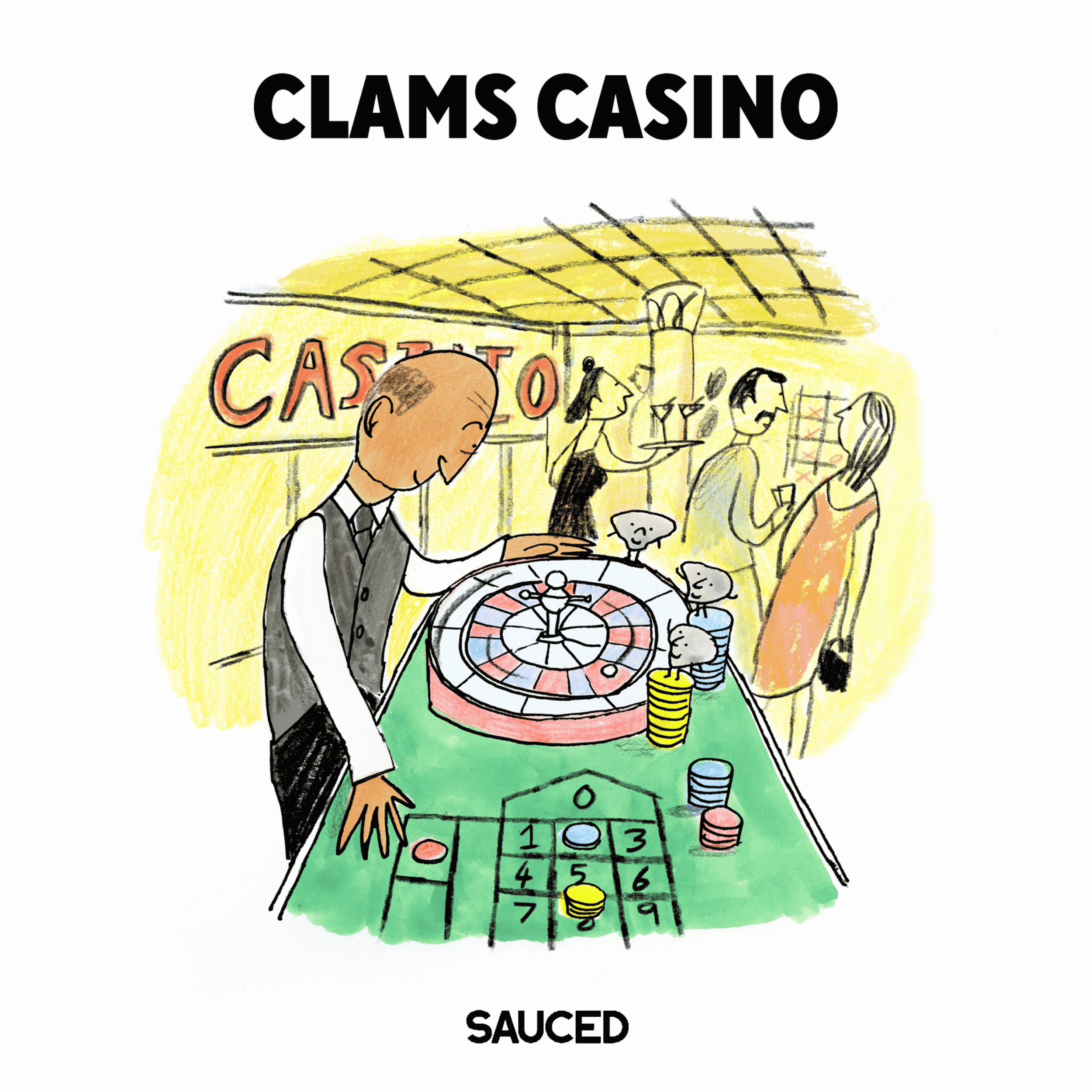
Clams Casino has a paperwork problem. A Rhode Island maître d' named Julius Keller claimed to invent the dish at the Narragansett Pier Casino in 1917 — but a January 1900 menu from the Central Park Casino in New York City, held in the New York Public Library, predates him by 17 years. And neither one was a gambling house.
We dig into both origin claims, the Portuguese-American "stuffies" tradition in Rhode Island that may pre-date both, and where we land on the booze in the topping.
"A working man's ingredient dressed up for the Gilded Age."
What we settled on:
Cherry stone clams — meatier than top necks, not as tough as quahogs
Three-way pork: smoked bacon, unsmoked bacon, and a paper-thin lardo finisher
Italian-style fresh breadcrumbs — no panko
Sweet pimiento or piquillo peppers
Dry vermouth and a splash of dry brut Champagne to deglaze
No cheese, no added salt — the clams and bacon supply it
425 degrees for 6 to 8 minutes, then 60 to 90 seconds under the broiler
The Cocktail
The Central Park Casino — an aquavit dirty Martini with vermouth and a pureed olive brine, named for the 1900 menu that started the argument.
RECIPE CARD:
Premium subscriber? Check out the full recipe card here.
LISTEN
EpiSOde Partners
Thanks to the following brands for partnering with Sauced to bring you this episode:
TRANSCRIPT
Tim McKirdy: Sother, you feeling lucky?
Sother Teague: Why? You wanna — are we gonna do some gambling today?
TM: Our track record together would suggest we're nought for one.
ST: We've only been gambling together one time, and we did not do well. I don't think we were in the casino for more than 20 minutes. We walked out very short.
TM: Very short. We shall need to reapproach our strategy, rethink our strategies, maybe choose some different games.
ST: Maybe not be as inebriated as we were when we went.
TM: Inebriated, yes. They saw us coming.
ST: Yeah, they saw us coming all right.
TM: Of course, today's dish is Clams Casino. We shall see whether or not we're talking about actual casinos and things people consider casinos. But what about the dish?
ST: Clams Casino — it's kind of American fare for sure, invented here. You're gonna get into that. It's a hard shell clam baked on the half shell with breadcrumbs, butter, herbs, peppers, and I think most importantly to the dish, bacon. The result, of course, a smoky, rich, sort of old school American fine dining dish.
TM: Most similar to Oysters Rockefeller when it comes to the dishes that we've covered here, beyond origins and whatnot. How would you compare the two? Or if someone was to ask you, Clams Casino is to Oysters Rockefeller what X other thing is to Y, if you were to give an analogy?
ST: Clams Casino is to Oysters Rockefeller what — yeah, I don't know. I don't think they're really that comparable. They're both hard shell seafood, served on the shell and baked, but the Oysters Rockefeller for me feels more weirdly specifically steakhouse-y, whereas I think Clams Casino feels kind of like — again, I mentioned earlier — a little bit fine dining-ish.
TM: Or red sauce joint, Italian.
ST: Right. Now that I'm really picturing it, I'm picturing like a gingham tablecloth. Desi's Clam Bar, you know, over in Brooklyn.
TM: Exactly. Isn't there one Lenny's as well? Funnily enough, there is an article still online on Eater from 2015 — 10 places to eat Clams Casino across the US. I was browsing through it earlier. That's where I came across Lenny's, which was by means of recommendation from Robert Sietsema, so probably pretty legit. But also — and I didn't wanna get into this, I was just browsing through quickly — I sort of shuddered to think of how many of those places might not be open now post-pandemic and 11 years on. But yeah, that's a throwback. A 2015 article that's still live for something like that. Kind of crazy. Professional or personal associations for you?
ST: Man, it's a dish that I really enjoy. I've never worked anywhere where we made it on menu. I grew up on a beach. I love seafood of all variety. If I'm at the right place, I will order these for sure. What I don't like is — in my mind, for another personal touch here, it is a dish that I refer to often when I refer to cuisine that I don't really like, which is diners. I'll often say, "At a diner you can get matzo ball soup, steak frites, Clam Casino, waffles, and eggs any style, and none of them are very good." That's usually my little line. But I'm just kind of pointing out that weirdly they're a diner dish as well.
TM: And certainly Rockefeller isn't. Not to latch onto that kind of comparison too much, but I do think that when we're talking about the flavor profiles and the stuff involved and the length that you go to to make the compound butter — more crowd-pleasing than Rockefeller. Rockefeller is kind of like you said, oddly specific. There's your absinthe, your Pernod — not to everyone's taste. Clams Casino doesn't even necessarily have to have booze, although I think a lot of the modern versions do incorporate some white wine. So more of a crowd-pleaser, which is why you'll find it in those diners. Any final thoughts on our little intro there or our overview before we do dive into the origin stories and origins of this?
ST: I love them. For me, they kind of come off as little tiny briny cups of clam stuffing. You know? Like we're one step away from just taking them out of the shell and making a big casserole of this stuffing to serve on the side of other dishes too.
TM: Much like you said again with oysters, this is an appetizer, right? It's not like, "Okay, I'll order Clams Casino as my protein, and then I'll have a salad and whatever as a side."
ST: Not gonna make a meal out of these, I don't think.
TM: I've certainly never worked anywhere where we've prepared this professionally. It's a dish I've had a handful of times and enjoyed it. Find it to be comforting flavors that are very natural to us. Bacon, pepper, breadcrumbs — amazing. Delicious. All right. Origin stories. Sort of. As usual. We'll start with the popular one, though. Oftentimes I'll go in chronological order, but let's go with the most popular tale. The year is 1917. Julius Keller is a maitre d' at the Narragansett Pier Casino in Narragansett, Rhode Island.
ST: I mean, Narragansett Beer — home of the clam. Or sorry, beer of the clam. Narragansett, on the can it says, "Hi, neighbor. Narragansett, the beer of the clam."
TM: I've enjoyed the rebrand they did in recent years and sort of coming back because — on this here day that we're recording — all too recently Schlitz has gone out of business. These classic American beers, regional, we love it. We love to see that story continue. The casino was a Rhode Island resort hotel. It wasn't a gambling house. There was no gambling to be done in the Narragansett Pier Casino.
ST: Is casino one of those words like arcade? Remember, you used to have arcades when there were no games?
TM: Exactly. So casino in 19th century American English commonly referred to a public assembly building or social club, so had nothing to do with gambling. I wonder whether that's one of those ones where the gambling houses have usurped it and they were just one of many establishments that fell under that umbrella. So Mr. Keller, the maitre d', in his 1939 autobiography called Ins and Outs, recounts a tale where he invented the dish for a socialite called Mrs. Paran Stevens. I'll pull up the passage here actually, because there is a version. It's an old and not an especially popular book, but there are versions you can find online, like the digital publications of them. His story — I don't wanna lead the witness or lead the jury here, but I find it to be a little bit suspect. So he says, "It was at Narragansett that Mrs. Paran Stevens christened me the Mighty Atom." Not too sure what he means by that, but he calls her a ruler of her set, a woman of strong will and biting speech. So you can imagine this sort of socialite woman, ladies who lunch. Anyway, on an order she had left for luncheon one day, she had included soft clams, but had neglected to mention how she wanted them served. "Seizing the opportunity," Keller writes, "I prepared the dish which I had tried on my own cultivated palate and found eminently satisfactory. For each person in her party, I had a service of eight clams prepared. I used soft clams of the larger size, which I had removed from their shells with the strings cut off so that only the bellies remained." This is standard practice for us in these kinds of dishes. "They were placed on half shells, and on each one went a small quantity of butter mixed with paprika, salt, pepper, chopped shallots," which have a mild garlic-like taste, he notes. "Small strips of bacon atop the clam bellies completed the concoction, and after baking for ten minutes in the oven, it was ready for consumption. When Mrs. Stevens and her guests assembled, I had a waiter take it to her table and explained to her that she had neglected to indicate the kind of soft clams she'd desired, so I had been bold enough to prepare a dish of my own conception. She tasted it and expressed her delight, as did her guests. 'What do you call it, Jules?' she inquired. 'It has no name, Mrs. Stevens, but we shall call it Clams Casino in honor of this restaurant.'" So essentially the story is someone had pre-ordered clams for lunch, not indicated how they wanted them cooking. So the maître d' took it upon himself to prepare. What is the chef doing right here?
ST: I think there was a time when there was a little bit more communal working environments in restaurants. It wasn't so separated by your station. I think the maitre d' may have had some say, sway, input, whatever.
TM: I just know that in kitchens where I've worked before, if front of house comes in and starts chopping things up and broiling clams, the chef's going, "What are you on about? Get out of my way."
ST: The team is preparing lunch for Mrs. Paran Stevens. Why are you doing the appetizer? Why are you there?
TM: What are you — why aren't you doing the appetizer? Why aren't you out there? Make sure your guéridon is polished and nice and ready, right? So again, he claims this happened in 1917 in his 1939 autobiography, Ins and Outs. However, receipts.
ST: Oh, here we come. Show me the proof.
TM: I do need proof. So 1883, similar clam top dishes appeared in American cookbooks and newspapers. There's a menu from January 1900 — the Central Park Casino in New York City, again, not a gambling house — published a menu featuring soft clams à la casino, and the menu is held in the New York Public Library to this day. We don't know exactly what this preparation was, but by this point, serving clams on the half shell with toppings is broadly an approach that is common or common enough, and someone else has already used the name à la casino. So it does poke a few holes in the Narragansett story. One final thing to consider as part of all of this is a sister dish to Clams Casino called stuffies. Stuffies — again, late 19th century, so would've predated the formal Clams Casino. Very similar though, stuffed clams cooked. This owes a lot to Portuguese immigration in Rhode Island. So we are still in Rhode Island, and they use the larger quahog clams. Am I saying that correctly? A word I only know from Family Guy. These were a staple at clam shacks, dive bars. People were selling them on the street. So I guess if we're to talk about that question we like to ask ourselves often — prince or pauper — stuffies certainly are the pauper version, and the version of this dish that if it remained in Rhode Island exclusively would probably be what it is. Clams Casino — how do you feel about agreeing to the point that we've princified it and it spread across the nation since?
ST: I would say it's a working man's ingredient that has been dressed up for the Gilded Age. That's how I'd put it. And I think that tension gives the dish some appeal and some identity, right? I think that we see that a lot in the things that we choose to talk about and eat.
TM: Totally. So another maître d', another server claiming a dish. I don't know what it is about all of this, but I do enjoy the stories. I had a little bit of a read once again of Ins and Outs, this book. Kind of interesting. I don't know whether I can sit down with the whole thing, to be honest with you. So those are our origins — the ancestors, the competing tales. Let's move on now to our culinary luminaries, and I would love to hand it over to you, Sother.
ST: Sure. Not a whole lot coming from, say, Jacques Pépin or Julia Child, other than to say that they both championed straightforward cookery in general. Again, taking a working man's ingredient and making it nicer. Julia Child says of seafood specifically, "You don't have to cook fancy food. You just have to cook with good ingredients and make good food." I think this dish sort of exemplifies that. James Beard chimes in a little bit — well, not that he said, but he just was known for celebrating New England in general. That's where he was from, and seafood traditions that define dishes like this one, Clams Casino. He defended it against the dismissive attitudes that people had, especially the modernists, in the mid-century American cuisine being worthy of its place in the pantheon. He was a big proponent. Pépin basically just said — well, he didn't say anything specifically about Clams Casino that I could find, but he says over and over, "Seafood should be treated gently." I don't know exactly what he means by that, but we're gonna treat this gently. Bourdain — I've been finding lots from him lately — on this one, he said, "Clams Casino is maybe unfashionable but deeply satisfying." I think that's kind of where this dish lands. They had their time in the Gilded Age when they were presented and invented by whomever, and even the description that you gave — it's this luncheon dish, right? This is kind of a fancy ladies' luncheon. But now, like I said, you can get 'em at any diner.
TM: Which is probably why it became unfashionable, right? In the eyes of Anthony Bourdain. And we got to mention as well — was it Rhode Island where he spent his early career? Certainly in the Northeast, and certainly seafood places. I can't remember exactly where it was. I think it might have been Rhode Island, but now I'm getting flashes of — I'm not sure if you've seen, there's a drama, a film set to be released about his early days. I think it's called Tony or something similar, and it's about his time cooking there, the formative years, as it were. Not too sure how I feel about that one or whether I'll be watching it, but I'm sure there'll be a lot of interest around that.
ST: I think for our edification, I'll have to watch it. Like, it's one of those things. He was an important figure. I'll have to watch.
TM: Yes. I got one or two others here — more in terms of where the ultimate places where you would wanna experience this dish, or let's say a fashionable version of this dish these days. Rao's. Red sauce, exactly. For those listening, I think everyone can remember the time they first learned about Rao's and how it operates. So for those listening who aren't familiar — this is for you guys, everyone else bear with us for a second. It's been run by the Pellegrino family since 1896. They have 10 tables. They don't take walk-ins. Well — there is a way where you can turn up on the day and sort of, but essentially there's no walk-ins. It's 10 tables, and they have a generational reservation system whereby people own the tables, kind of like a timeshare when it comes to vacationing or whatever. One of my former employers, his father has a table there. I think he did a very good deal with the restaurant as well — he said, "If we take the early slot, the earliest slot on the days that we have our reservations, can we get one or two extra per year?"
ST: That's a very good way to put it. I mean, I've never been. I probably never will. I don't know anyone who owns one of those 10 tables.
TM: I think they signed off on that. But yeah, essentially 10 tables accounted for every night of the year, and those reservations held by the de facto owners of the tables on those days. They've been serving Clams Casino there since the 1940s. It's one of the dishes that — I mean, you gotta try everything if you go there, right? But Frank Pellegrino Sr., who sadly passed away in 2017, spoke about this dish in the Rao's cookbook. They just take a very classic Italian-American approach. Again, the sort of red-saucified versions. If we wanna go modern upscale Italian-American, we can point to chefs Andrew Carmellini or Carbone. I think Carbone, instead of the bacon, they use lardo. And man, I love lardo as an ingredient. You know, where you just get the white block, peel some off —
ST: Yeah, very, very thin. Like see-through almost.
TM: Put that over some warm bread, or indeed some stuffed clams. Fantastic. So if you're gonna go anywhere, if there's one place where you wanna have this dish —
ST: Well, you listed two. I wanna go to get 'em both, but there's no way I'm ever getting into Rao's. The closest I'm getting to Rao's is the jarred sauce they have on the shelf now at the grocery store. I mean, I think that's a whole nother show, but that's a brilliant strategy. You have your restaurant that's, as you said, solidly locked up, booked forever. You cannot generate any more money there, so generate money on the shelf at the grocery store and have people like me who are like, "I'll never get in, but at least I can have this."
TM: Anything else for us to add here just about their sort of foundational origins and what people have to say about the dish?
ST: No, I think we should start cooking them up. Let's go.
TM: Well, before we do, a little quick reminder here for folks. As we have experienced in recent weeks, and it continues to this day, we've been getting a lot of new paid subscribers to the show. So to those folks, we wanna say we see you. Thank you very much. We hope you're taking full advantage of all the recipe cards and the Recipe Card app on our website. Maybe a good reminder for folks — if you're a premium subscriber, you can use your email address on saucedpodcast.com. Go to Recipes, put in the email address that's associated with your premium account. Easy access to all of the dishes there. The recipe cards, all the information in one place, easy to navigate, whether you're at the grocery store or just browsing at home. We've got a few little plans for some additional features for that, so keep your eye on that. That is to say, folks, thank you very much. And if you're not a premium subscriber — Sother, give me a 15-second pitch on why folks should be.
ST: Premium subscribers get more access to you and I. They get first right of refusal on live events that we are hosting. They get commercial-free listening. They get the recipe cards and the bonus episodes, which are amazing. A monthly episode either about a technique, a side dish, an ingredient, or something historical.
TM: And as if folks are listening to this on the day it comes out, we have literally just this past weekend on the Sunday released our May bonus episode. Sorry, forgot what month we were in. Welcome June. Our May bonus episode all on brining and dry curing. Soft curing, hard curing, and the differences therein. That was a fascinating one, and honestly, I learned some lessons there that I will take going forward forever. All right, so the quick break now, then let's be back with the non-negotiables.
***
TM: All right, we're back. Clams Casino. Dice and cards negotiable, but tell me what absolutely needs to be brought to the table and/or the kitchen here today.
ST: Well, the first one, we need clams. We should talk just at least briefly about which clams we wanna use. You mentioned quahogs. I say it quahog as well, but I've heard it also said quahog. That seems like a more maybe Native American pronunciation, I don't know. Anyway, quahogs are the larger ones. You can use them for this. They're bigger, they're tougher. So what you do in that case, though, is you pop the clam out of the shell, chop it up, and then put it back in the shell, right? And then make your stuffing and whatever.
TM: And those were only for the stuffies, not the other preparations historically? This is reminding me of the oysters that you get in the jars. Selects. Not that they have to be in jars, but they're the bigger ones. You have to process them. I'm gonna put my hand up and say those are not gonna be the clams or the oysters for me.
ST: No. Well, you gotta have selects when you're making like fried oysters or something. Otherwise the oysters that you would eat on the half shell are so small they shrivel up. That's a different episode though. So quahogs are not gonna be your choice. I'm gonna say cherry stone is the way to go. They're larger than a little neck. They're meatier than a top neck, but they're not as big and tough as the quahog. So cherry stone clams is what we're looking for.
TM: Cherrystone — those were the original. Those were what Keller used. Or maybe not the original. And if I'm going up in order of size, it's gonna be little necks smallest, small, sweet, tender —
ST: Those are the ones you almost always are eating on the half shell, raw.
TM: Middle necks will be next up from that, and then cherry stones. Okay, so those are the three. Cherry stones are the classic, and if you wanna go down in size, you're gonna go middle necks. You're not gonna go little necks for this at all.
ST: Yeah, they'd be too small. They'd kind of get swallowed up by the breadcrumb and stuffing and everything like that.
TM: So clams, and we're committing to cherry stones. Bacon. Next one. What's your approach here, though? Are you going bacon? Are you maybe turning around and being like, "This is an area where we can plus it up a little bit if we want." You know, like pancetta, guanciale, lardo —
ST: Well, you said lardo earlier, and that started the wheels turning. Maybe we could do both, a little bacon and a little lardo as the finisher. Like when you got them baked, and maybe you're gonna throw them under the broiler just for a second to get some browning. A thin, thin, thin, almost see-through sheet of lardo right on top to kind of melt in. That would be delicious. But I think I'm just going with some pretty standard but obviously smoked bacon. I know you don't love the smoke.
TM: I'm gonna say I'd rather unsmoked here. Just — I want the saltiness. I just feel like the smoke overpowers the dish and takes us in a different direction. So you have Highland single malt, no smoke. Islay, all but one or two producers, heavily smoked. Speyside, oftentimes a little bit of a blend of the two, a lighter. If you can find me the Speyside whisky of bacon and smoked bacon, I'll take that. A light smoke, but not too much. Or maybe if I had my druthers, half and half.
ST: I was about to say, you're not gonna find one that just exists, but we can do mixology here. So we can get some smoky bacon and some unsmoked bacon and cut them in half.
TM: Maybe we'll split it three ways. Smoked, unsmoked, and lardo. Fantastic. We're tipping our hat to Mr. Enderwick. Sandwiches of History.
ST: We're really plussing this thing up. Let's give these clams a go. We're paying homage. Sandwiches obviously. What's next on the non-negotiables? Is it my turn? Butter. You need butter.
TM: Peanut butter? No.
ST: I mean, I don't think that's crazy. Why do we need the butter? For one of the other non-negotiables. I'm gonna toast up my breadcrumbs in butter. Might even go a little bit brown. Brown butter toasted. Something about brown butter these days. It's kind of zeitgeisty.
TM: Do you wanna once again split the difference there as well? In terms of the breadcrumbs, we often joke about panko and whatnot. Speaking of Andrew Carmellini earlier, he favors fresh breadcrumbs, not dried for this. Someone else I saw — I can't see it now, so we'll skip it — but someone else was using sourdough instead of just your standard breadcrumbs. I don't know whether we need to get that much in the weeds. Obviously, we're talking Italian-American dishes, or ones that have been embraced by, so maybe those Italian ones will suffice for today.
ST: I would say, strangely — well, not strangely. I would say that this is not the place for panko. I definitely want the more Italian-style breadcrumb, and I could do a fresh breadcrumb and then toast them up in a little slightly browned butter. This is all coming together for me.
TM: I would say I've only got one more or potentially two non-negotiables.
ST: One more non-negotiable. See, I have — I think I'm kind of done on nons, but let's hear it. What do you got? I've got a list of things here that I also want. What do you got? Specifically.
TM: Pimiento peppers. I think you need peppers in this. I think it's one of the defining things, 'cause otherwise it's just butter, bacon, breadcrumbs. But pimiento's often misconstrued by modern cooks as just red bell peppers. No — we're talking about the sweet pimiento peppers you get in the jars, peeled, roasted, peeled, delicious. They're so good with seafood, and I think as a kind of hat tip to Iberian cooking as well, so Portuguese, Spanish, our stuffy connection there. So that's a non-negotiable for me.
ST: I'll accept that. It's literally the first one on my negotiable list, so I'll absolutely take that.
TM: Final one. I would be shocked and astonished if I ordered this and it arrived at the table and there wasn't a lemon wedge.
ST: Right. But that's a service piece. Is it in it or is it on the side for the user to negotiate? I didn't even consider it as a non-negotiable or negotiable for the dish. It's certainly gonna be on the plate.
TM: Exactly. It always goes back to that debate. If you order the thing in the restaurant, what is in front of you? If I don't have a lemon, I'm like, "What's up with the chef, and where's my lemon?"
ST: Yeah, I'd be like, "Can I get a lemon? Would I have to ask the bartender, 'Can I get a lemon wedge with this?'"
TM: All right, fantastic. Those have been the non-negotiables. Now let's look through our other ingredients and the other things that you're saying, "Yeah, I want these in my dish."
ST: I'm probably gonna want — well, it's Sauced. I'm gonna want the white wine when I'm making my — this is like a dressing, it's a stuffing, you know? It's gotta be here. It needs to be Sauced.
TM: Let's put a pin in the booze for now, but I agree with you. This being Sauced.
ST: Or even not — I want white wine in here. And to that end, I think I'm gonna have to have some kind of oniony situation. Probably shallots. That's it.
TM: You and your man Julius. Do you agree with his garlic-like description?
ST: I feel like Julius was writing his book and using a little bit of flowery language, and also maybe of the time shallots were less common, so he had to describe it somehow.
TM: Maybe less sweet than they are now. It would not surprise me to believe that we have manipulated shallots —
ST: Speaking of garlic though — it's not on my list, but do you think this dish needs garlic? It's coming at you from the red sauce place. You're probably gonna have garlic elsewhere. So do you need it in this or not?
TM: If I am on autopilot making my mix, garlic's definitely going in there. If I forget it or if I don't have garlic or the one served to me doesn't have garlic, I'm like, "That's fine." But a little bit of garlic would be nice. Cheese?
ST: I'm not a fan for this dish. I don't think cheese is a requirement.
TM: Hit it with a little bit of Pecorino to finish?
ST: You could maybe fold a little into the breadcrumb situation so that it'll help them brown under the broiler or whatever. But I'm not anti — I'm not that guy who's like, "Don't serve fish with cheese." I just don't think this dish needs it.
TM: Fair enough. To your point, I don't think there's anything else here that we have to navigate. What about — we mentioned this earlier, right? Appetizers. What are common things you wanna be eating alongside this? Or is it very much restaurant specific?
ST: I think it's maybe restaurant specific. I'd like to see these — some pasta is probably on the menu. Maybe a brothy soup, like a tortellini soup, which is also pasta, of course, would be here. But these — this is the premium. This is the first thing to hit the table. A little communal, everybody's reaching in and grabbing one, and you're chatting and sipping on some wine and talking about what the day's goings on, and the next dish is coming out soon.
TM: Maybe a little bit of garlic bread. That's where you're getting your garlic from.
ST: 'Cause this dish gets eaten pretty quickly as well. I was surprised that Mrs. — what was her name? I already forgot. Paran Stevens. You know why I can kind of remember it though? 'Cause it sounds like Darrin Stephens, who was the character of the husband on Bewitched. Anyway, I digress. Big fan of Bewitched. I'm surprised that they were serving Mrs. Paran Stevens a selection of eight Clams Casino. I think this is half dozen. You just need six. You can probably get away with five. I mean, it's just a big mouthful of bready clam stuffing.
TM: Spaghetti of some variety, maybe a salad, but I'm fully on board with bread myself. Why eat it out the shell when I can scoop it onto bread, and anything that can go on bread I can and will accept.
ST: You got my mind turning when you mentioned the jarred peppers that have been roasted and peeled. I was like, what if we just took all the clam and everything and crammed it inside that pepper and baked that thing? Serve it like a tapa, with a little aioli. Lemon aioli.
TM: Delicious. All right. We're here to refine them, to give opinionated takes on, and to share our non-negotiable ingredients, which we have done now. Signaling our next break for today, and then we'll be back with the booze.
ST: We're not here to mess with the classics though, Tim.
***
TM: All right, we are back with the booze. The booze question. You mentioned white wine. I had two other thoughts here. One of which we had semi-agreed to on air at some point, which was that in all instances when we are going for white wine, would it not make more sense to reach for the vermouth instead — the dry vermouth?
ST: Oh sure, we did talk about that. I kind of forgot. And I think I'm agreeing right now as well. Let's scratch white wine and go with a nice herbal vermouth.
TM: That will also — 'cause you didn't mention herbs. I thought you might try and sneak some parsley in here, but —
ST: It's on my list. I didn't mention it 'cause I could absolutely live without it.
TM: It is an option. So if we use the vermouth — okay, it's not a like for like, but it's a sort of analog. We're getting the botanicals. It takes care of that. Alternatively, and this is purely because of the profile of the wine and not its texture, which will get lost — Champagne. Why don't we say, you know what, if we're really going for the prince, the upper class version of this — some Champagne.
ST: Why not do a little bit of both? Like you said, a little Champagne, a little dry vermouth will bring some herbal quality, some acidity, some extras. It's wine with extras. Also, who doesn't like to pop open a bottle of Champagne while they're cooking?
TM: Exactly. We're not using too much wine in this dish, so you can definitely put a splash in there. A splash of dry Champagne in this dish is gonna bring the acidity technically, which is gonna help cut through everything. And also, if we're going something that's like predominantly Chardonnay, maybe not spent too much time in oak, we're gonna get that sort of citrusy freshness. 'Cause let's not forget, we're fighting a lot of salt in this dish potentially.
ST: Clams are salty, bacon is salty. I was gonna bring that up when we get to the cooking part — don't go reaching for the salt. It's already in there.
TM: It's a tough one to navigate. Although when we get to the pairing section, I'm doubling down. So just planting a little stake there, a little teaser. Anything else you wanna bring up right now before we get into the preparation?
ST: I don't think so. Let's make this dish.
TM: All right, fantastic. I'm gonna let you take the reins here today. Starting with — I'm assuming prepping the bacon, but talk us through where you wanna go.
ST: Sure. I think the first thing you need to do is get your clams shucked open. You gotta grab a clam knife. This is different than an oyster knife.
TM: Let's talk about that for a second. Actually, that's one thing I really did like — this is something where the distinction matters. The clam and the oyster knife.
ST: Oh yeah, absolutely. So a clam knife — similar in size and shape to your oyster knife, except the blade is very wide and flat. It almost looks like it's made to spread butter. It's super flat with a rounded tip. It doesn't have a pointy tip like your oyster knife does, especially yours. Yours has got a crazy pointy tip. Scares me, because I've stabbed my hand with my regular one. I can't imagine what that thing would do. Anyway, hard to describe as we sit here, but what you want to do is grab the clam in your non-dominant hand with the hinge facing your body, and then you want to take that flat blade and put it right up against the opening of the lips of the opposite side, and with your fingers, you pull the blade into the shell. So unlike an oyster, which you open from the hinge, a clam you open from directly opposite of the hinge. And then similarly, once you've gotten the knife inside, you angle it upwards so that you're disconnecting the muscle from the top of the shell, and then you can easily open it, and then you disconnect the meat from the bottom of the shell. It's a really simple process. They're much easier than oysters, in my opinion, having shucked hundreds of thousands of both. But it's a technique that seems counterintuitive because after you've shucked — and I think more people have shucked oysters than clams — when you approach it, you think, "Oh, similar. I'm gonna go the same way." Not the same. Going from the hinge — you're not getting into them very quickly from the hinge. It's a much stronger hinge than an oyster because these guys move. They have locomotion, and how they move is they open and close, so they sort of flutter away in the water, but that hinge is very strong. So you want to go in from the open side.
TM: Amazing.
ST: So get your clams shucked. That's step one. You might want to put down a little bit of rock salt or something on your sheet tray just to keep them and try and preserve the juice. In fact, when you're opening the clams, open them over a vessel so you'll catch any juice that comes out, and you can use that juice later. And we can also just buy bottles of clam juice if we need them. To make a Bloody Caesar or whatever. Okay, so get the clam shucked. Then bacon. You're gonna cut a pretty small dice — not quite as big as a lardon, because I don't want them to be in competition with the clam. This is a clam dish, not a bacon dish. I'm gonna slowly render the bacon so that we have some pliability. I don't want it to be bacon bits. I don't want it to be crunchy. I want to have some give, but rendered the fat. Then I'm gonna — we decided we're definitely going in with shallot. Did we say yes for sure on garlic? You want some? All right, so some shallot and garlic minced up pretty fine. We're gonna get those into that same bacon fat along with a bit of that pimenton. Then we have our fresh breadcrumbs that we're gonna toast up in some butter. Then we're gonna deglaze the pan with our mixture of Champagne and vermouth. And then we're gonna fold those things together. You're gonna come out with a sort of almost wet sand texture at this point in the game. And then you're gonna take a heaping spoonful and from edge to edge on the clam, we wanna get it very covered in sort of a dome, and then stack them back onto the rock salt or whatever's keeping them from wobbling and falling over — crinkled up aluminum foil, whatever you got. And then we're going in the oven, pretty high heat oven, I would say at least 400 degrees, probably eight minutes maximum, and then maybe throw them under the broiler just for a second to get them crispy on top, and then that thin, thin, thin slice of lardo. Very easy dish to make.
TM: Nice. And that is our Porco pick-me-up of the week. Plus up, even better. I was racking my brain and I forgot. Our Porco plus up of the week is our finishing slice of lardo.
ST: Lardo. And I think it's fitting given that it's pork.
TM: This is a bit of a detour, but in Tuscany, Dario Cecchini, I wanna say his name is — the very famous butcher, the rockstar butcher, in a little town called Panzano. He has his butcher shop, and it's a massive tourist attraction by this point. You know the guy that I'm on about here? He's like a big guy, he's got a cleaver, and he welcomes everyone into his butcher shop. Half the people that go in there — you get a glass of wine on entry, the classic Italian table wine served in a little cup. You know what I mean? Like nondescript bottle. You go in and you just go there for the show and you watch him butchering. I think you would love it in there. But they do serve little bites of things when you go in, and everyone goes in and just gets a little bruschetta with the lardo on top. And let me tell you, everyone's walking out there with lardo as well. They've tasted that, they try it, and they're like, "This thing is amazing." That's my association with that specific ingredient. I don't know whether I've seen lardo around recently. I suspect it's one of those ingredients I would need to search for here.
ST: There was an appetizer that was always on the menu at Marea that had lardo draped over a very lightly broiled piece of fish on a very crispy piece of bread, and it was just so simple, so sublime. You know? If you see it on a menu, order it. And if you see it for sale, buy it.
TM: Yeah, bring it. All right, Sother, that's been the preparation. Time for us to — we're making good, good time today. Time for us to take a final break of the day, and then we'll get into more booze.
ST: Let's get Sauced.
***
TM: All right, we're back. I want to lead this one because I felt like in recent weeks the dishes we've covered, we haven't gone down too much of the wine road. So I thought I want to be intentional about today's dish. I knew we were probably going to cook with vermouth. I was going to throw in the Champagne. But I want to come up with some other picks beyond the standard grapes we go for and the most well-known ones. So I mentioned earlier — I want salt on salt. We're doubling down. Minerality. Oftentimes we talk about, and you talk about in this section as well, right — when it comes to pairing, it's either opposites attract or like for like. You want to avoid obviously sweetness, but I think you want to avoid anything overly floral or too fruity. We want primary citrus fruits, minerality, and if we're really lucky, a bit of ageability. White, we're talking about here obviously. So I've got four picks for us today, three of which are Italian. Number one: Caricante. That is the Sicilian white variety grown on Etna volcanic soil. This wine tastes like ash, lemon, sea salt, minerality. It's very much of the mode, à la mode, right? Etna, Sicilian whites, Biancos — people love them. Go to any cool wine shop in your town, in your neighborhood. You will find some Sicilian whites. Next one: Pecorino d'Abruzzo. Pecorino being the variety, Abruzzo being the region. Once again, we're talking citrusy, probably less complex, less earthy, but very clean. Very oftentimes fermented in stainless steel or cement. So no oak influence, just a really clean, piercing, lovely, minerally white wine. Next, and this is where we do really have to be led by producers, and sorry to say this — but price. Trebbiano d'Abruzzo. So you will get a lot of Trebbiano wines that are — there's different clones of Trebbiano and types of Trebbiano, the white grape. You will get a lot of very average mass-produced Trebbiano that's often probably got other grapes blended in. But if you can find the ones that are made from serious producers — I'm going to give you two to look out for here. Valentini, or perhaps more well-known these days, Emidio Pepe. Emidio Pepe is certainly the cool producer. Valentini's gonna run you — I was looking on Wine-Searcher, the average cost of a bottle right now is $257. Emidio Pepe you can get for just south of 100, but you'll need to look. But these are powerful, highly ageable white wines. They will, much like sherry, take on an oxidative character. And between their sort of piercing straight line citrus and mineral in their youth to those more complex tertiary aromas and flavors with age, those kind of wines are gonna blow your mind. So I was like, "Look, if we're going the fancy route for this, if we're really plussing it up — Valentini and Emidio Pepe." And then finally, spoke about sherry — let's get some Manzanilla. Let's get some — again, complex, not sweet, very dry, oxidative aged wines from the Sherry Triangle. Sanlúcar de Barrameda is gonna be where we're gonna get our quality Manzanillas from. And look, if you're finding anyone selling Manzanilla and it's priced above a cooking wine, you wanna bet they're taking it seriously, and it can be very reasonable. So yeah.
ST: I love all of those, and what I really love is that two of those wines I'd never even heard of. So I like that you're bringing some stuff to the table that's opening my eyes. I was gonna go with a cocktail, and I was gonna really lean in a little bit on — again, I was gonna chase the salt as well. I was thinking a dirty Martini, but not with gin. I think aquavit. And then I wanna lean in a little harder, and I wanna take some of my olives and the brine and puree those two together and then fine strain them and have a more olivey, not just salty, dirty to this aquavit Martini. So we're gonna have aquavit, vermouth, and this pureed olive brine situation to give it a little bit of body and also really change the flavor of the brine from just a salty liquid to an olivey salty liquid.
TM: And this is an aperitif I'm imagining, or are you having this with the dish? A — I wanna try this. Sounds amazing. B — the slight alarm bell or the little red flag that's going off in my mind. Aquavit being such a distinct and strong flavor — is that gonna compete with the dish, or do we not need to worry about that?
ST: I think it's gonna be a little bit bracing. It's gonna be its own thing, but I think that's gonna create some good palate confusion. I'm having a bite of this salty, bready, rich, clammy thing, and then I'm hitting it with this briny caraway notion and then going back —
TM: Don't get me wrong, I mean, caraway is such a present ingredient in Nordic cuisine where so is seafood, so are fish. So yeah. Do you wanna hit us with some quantities then for that drink?
ST: Sure. I'm gonna make this Martini maybe a little bit closer to two to one. So two ounces of the aquavit, three-quarters of an ounce of that vermouth, and then just one quarter of an ounce of the pureed olive brine situation that I described. And for that, we're gonna take — let's say, to get your blender blending — six of your nicest Martini olives up against two full ounces of the brine, puree that together, and then strain it through a fine mesh strainer, which is what I've done in plenty of restaurants where I've had dirty Martinis and things like that on the menu. I always augment the brine with some pureed olives. Nice olives. It'll give it a sort of slightly cloudy look, but it's a dirty Martini. Who cares? Okay, so then we're gonna stir all that stuff and get it into a glass, and then I do want the expression of a lemon over the top of this guy. So a lemon twist, discarded. You don't have to put it in the glass. What we call lemon disco.
TM: Twist and disco. How do you feel about a Gilda? But I don't want any smoked or highly salty fish on my Gilda. But how about a nice pitted olive on a stick and maybe just some of those peppers with it as well? Piquillo peppers is what you wanna be looking at. Piquillo, or I forget the other common name, but yeah. How do you feel about that? Or is that going too far? I think that's leaning more into the dish than the drink.
ST: I think that's stepping away. I don't think I need a garnish on this. Like I said, just the expression. Just the disco. I just want that pop of aroma that will be the bridge, because I'm gonna have that lemon squeezed right on my clam at the last second too. So that'll be the bridge between the two for me. I leave the names to you, remember? Central Park Casino. And also, I would say this technique of pureeing some of your olives into your brine — that's your Maurice manipulation of the episode. Snuck that one in there with Maurice.
TM: Thank God. Was worried. You know what my Maurice was gonna be for today? I like your preparation. The only thing I would've done potentially different myself — render the bacon in strips, so rather than cutting it up first. And then also, I would wanna cook that only 75% of the way there, 'cause we're going under the broiler later. Take that out, reserve some of the rendered fat, and also just mince it up finely post cooking. So my Maurice was gonna be mince your bacon. But it's a chef's tip alternative. Chef Maurice. We're definitely splitting smoked and unsmoked, aren't we?
ST: We'll add it to the recipe card. Chef Maurice. Finishing the lardo. So we're getting three kinds of pork products going on in this dish, which is great for me. I'm down always. My final thoughts on Clams Casino are I wish I ate them more often than I do. In fact, I'm gonna go a step further and say I wish I bought more clams than I do. They're delicious. They're usually pretty inexpensive. They're easy to work with. They're easy to get out of the shell. I think that this episode and digging into this information is reminding me that I love clams and I don't eat them enough.
TM: Gotta go out of our way. The other thing that we didn't bring up, and I guess I'll leave as my final thought for the day here — what a fantastic little dish we could do if we're smoking something on the grill, right? We had the barbecue ribs episode recently. We say you gotta let it rest afterwards. After I finish doing that — open all the vents or do the vent control that you walked us through — get my grill ripping hot, and then just put it in there a couple of minutes, get a bit of smoke. I think that could be really cool. Really nice for a griller. How often do you see people doing seafood when you're doing grills?
ST: It's a little less common. I mean, I grew up on the beach, so it's in my wheelhouse. But speaking of clams — last summer, good friend Blake Walker came over to my backyard for his birthday, and we had 100 clams on the grill, in addition to some whole fishes. He's a big seafood guy. So in addition to some whole fishes and some filets of fish and whatever else we were grilling, we grilled 100 clams. And yeah, you get that smoky —
TM: Wow. How would you be doing that? 'Cause I'm talking specifically — you're talking plain casinos. I'm talking casinos. So rather than putting the dish with the salt in my oven, I'm just gonna smash that on the grill. I love that.
ST: What we did for this occasion was — it was just a huge hotel pan full of clams, and I just put the entire pan onto the grill, closed the lid, let it get really hot in there so they all popped open. And then we had a bunch of garlic bread that we were just dipping down into the liquid that had come out while we were eating the clams right out of the shells. It was a real good time.
TM: Fantastic. Love it. Well, that answers the question we didn't know we were gonna ask ourselves today. Will it grill? Absolutely, yes. Hell yeah. Sother — time to put on the apron.
ST: Break out the shaker.
TM: And let's get cooking.
ST: And drinking.
TM: Cheers.
ST: Cheers, buddy.