Episode 41:
BIRRIA
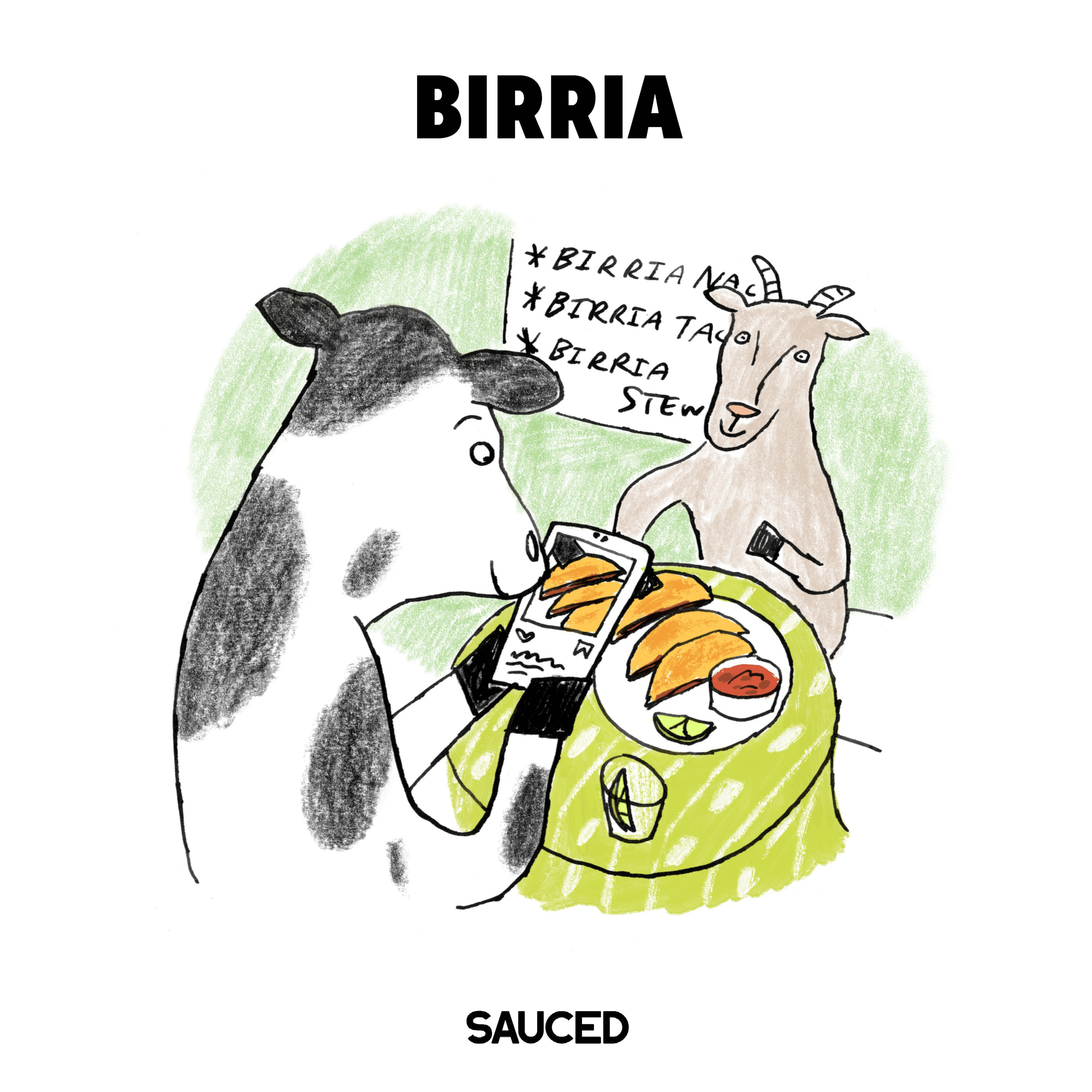
The word started out as an insult, meaning a person or thing of little value. Birria kept the name anyway and became one of the most sought-after tacos in the country.
We trace it from Jalisco's celebration tables to Tijuana's red, cheese-stuffed version, then build our own from the adobo up.
Dippin’ and sippin’."
What we settled on:
Goat shoulder or beef chuck, bone in
An adobo of ancho, guajillo, cascabel and árbol
A day in the marinade, and no sear
Tequila, Mezcal and Negra Modelo in the braise
A 325 oven, with the lid off at the end for tatemada
Fat-dipped tortillas, with consommé on the side
The Cocktail:
The Sizzle Swizzle, Amontillado Sherry and Mezcal over pebble ice with lime, grapefruit, ginger and falernum, finished with Peychaud's bitters.
RECIPE CARD:
Premium subscriber? Check out the full recipe card here.
LISTEN
EpiSOde Partners
Thanks to the following brands for partnering with Sauced to bring you this episode:
TRANSCRIPT
Tim McKirdy: Sother.
Sother Teague: Tim.
TM: Birria.
ST: Birria. I mean, yeah, it's a drink that is food.
TM: Beer in the name.
ST: Well, no, but you know, the consommé on the side, right?
TM: True. Very much.
ST: And consommé is a real stretch. But I think they're using it in the more Spanish way to say consommé, right?
TM: But certainly not something I want to be perfectly clear or perfectly translucent or whatever — you know, transparent.
ST: No, me either. I want it to be rich and unctuous and have maybe even still a little sheen of fat on top.
TM: Oh, definitely got to have the fat. And this is just a dish as well — you want to get messy.
ST: Sure. This is no time for proper utensils. And this is not a pinkies-out affair.
TM: You do not want to de Blasio this one.
ST: No. God. Eat my pizza with a knife and fork.
TM: Modern sensation, too, just in terms of — as we look at the dishes that in particular dominate video platforms, especially short form.
ST: It's been around, obviously, for quite a long time. However, it has come crashing onto the scene, I would say, in the last 10 years for sure. I've lived all over the country, and I've certainly seen this, but suddenly in the last 10 years you see it everywhere.
TM: I think that's going to be one of the central questions of the show for us here, too, because the modern version that people know is traditional in its own right, but it's not the authentic one. And I think the one that everyone makes, and certain techniques that they use to make it, fly completely in the face of the original. So it's interesting. But then it's like, what's more important: the way it was first done, or the thing that most people know it for?
ST: Right. I mean, I think just like we see in the cocktail canon, we see it in food as well. Things evolve. Things evolve to modernized tastes, things evolve to modernized techniques. This is just one of those things as well.
TM: Elevator pitch for this dish.
ST: Birria is the Jalisco-born Mexican tradition of slow-cooking goat or other meat — but it started with goat — in heavily seasoned chili adobo until tender, then serving the meat with its intensely flavored cooking juices on the side. Today, most famously as tacos and quesadilla. That's the elevator pitch.
TM: Beautiful. Beautiful pitch. Got nothing to add to it.
ST: I mean, I guess I didn't say that the juices served on the side, that consommé, is treated very much like the au jus that you get with your dip. You're meant to dip the final product in this.
TM: It's like a French dip.
ST: And in the wintry months, I definitely see people picking it up and sipping it too, like it's a hot broth.
TM: Well, it's certainly —
ST: And well you should.
TM: Yes. Certainly going to warm the soul during the colder months. The last time I made this dish at home — because I've never made it professionally —
ST: Same.
TM: — was in, I think it was in January. And I think I brought this up in a very early episode of this show. Or it might have been when we were talking about chili, and making adobo and toasting chilies.
ST: You smoked yourself out.
TM: I smoked out the house. The dogs were coughing. I think it was snowing outside.
ST: You couldn't open the windows. It's too cold.
TM: Oh, yeah, no, it's absolutely freezing. It was football season, January, that kind of thing. You can set the scene. But yeah, it was worth it. Let's put it that way. How about yourself?
ST: I've never worked anywhere where this was on the menu, because I've never worked anywhere that had this style of cuisine, basically. A lot of the techniques are obviously crossover to other things, and frankly, I've never made this dish at home. So this is pioneering for me.
TM: Strikes me as one that would very much appeal to you, though. It's low and slow. There's marination. There's multiple processes.
ST: It's ringing all the bells, but I think that at home, when I'm doing a dish that hits all those, I'm doing a dish that's more in my wheelhouse. But I do love them. Birria is delicious.
TM: Absolutely delicious. Let's dive into the origins now. Well, we kicked it off with the name. I was very tongue-in-cheek, saying "beer in the name." It's not. It sounds a little bit like it —
ST: No.
TM: — although in Argentine Spanish they borrow Italian words, and they do say "una birra" instead of "una cerveza." So it's halfway there. But anyway, Spain's Royal Academy dictionary defines birria as a person or thing of little value. Only further down the entry, marked as Mexican Spanish, does it mean barbecued goat or lamb.
ST: A person or thing? Person, as in, you are birria?
TM: Yeah. Basura. Garbage.
ST: I was about to say. Wow.
TM: The word itself traces back, according to the Academy, through vulgar Latin "verrea" to the Latin "verres," which means a boar. So the worthless dish carries a pig in its name. A pig.
ST: Wow.
TM: Vulgar Latin — I had to look this up. Do you know what vulgar Latin is? It's not swearing.
ST: No, I don't know, then.
TM: So there was a distinction during the Roman Empire between the written Latin of texts and scholars, and the common Latin spoken by the common people — the vulgaris.
ST: I see.
TM: Yes. The commoners.
ST: Commoners are always the vulgar ones.
TM: And this is a really kind of negative start to the origin stories, just in terms of the positioning. But we'll see why very shortly.
ST: Okay, keep going, because I've got some guesses.
TM: The goats, as we said, the original, came with the Spanish. From the 1500s, Spain shipped goats to the Caribbean and on to what became Mexico and the United States. And most of Mexico's goats today still descend from those Spanish animals.
ST: Cool.
TM: Much like your man Hernando de Soto.
ST: Right, with his four pigs that became 700 over the course of only three years. You know, there's actually — let's tie in a real quick goofy story. Escobar. Pablo Escobar. Do you know about this?
TM: Oh, yes. The hippopotami.
ST: The hippopotamus. Oh my gosh. So he — notorious drug lord — decided to open up a zoo of his own. Imported all these animals from all over the world, including a couple hippopotamus. Hippopotami, is that it? Octopi? I don't know. And then, of course, his world went topsy-turvy. The zoo ends up closing down, and they shipped most of the animals back to their countries of origin, to zoos, et cetera. But hippopotamuses are quite unruly, large and, I don't know, difficult to wrangle. So instead they just let them go. And now there's hundreds of hippopotamuses along the river.
TM: They're vermin.
ST: And they are — I don't know if people realize this, because they kind of look cute and we played Hungry Hungry Hippos as a kid — they're super dangerous. They're one of the most deadly animals on the planet.
TM: They're definitely at the top of the food chain.
ST: Unbelievable. Anyway, all right, so yes —
TM: And they've taken over.
ST: From humble beginnings. Four of them — it was just four, and now there's almost 700.
TM: In three years. So the story of the name, as it is believed even in Mexico, is that the Spanish found goat meat to be tough, strong-smelling and hard to digest. Hence, they called it bad meat, and they left it to indigenous cooks, who then rubbed it with chilies and spices and cooked it low and slow in earthen ovens. The dish's name kept the insult.
ST: I mean, that's real shortsighted of them, because goat meat is delicious. I can't even imagine. And then I think they're just tacking on that hard-to-digest thing at the end. They just didn't like it.
TM: They're like, "No, I want some beef." And again, the pig's getting the name, too. It's like the potatoes that were only good for pigs, a few episodes back. We learned that too. Interesting as well: when you look at Caribbean cuisine, curry goat is one of my favorite dishes. So good. So that makes sense now to me, with the migration, the moving through the Caribbean, Latin Caribbean countries, and then into modern-day Mexico. Jalisco is where it belongs. Ricardo Muñoz Zurita's dictionary of Mexican cooking defines it as a barbacoa of lamb or goat, originally seasoned with chilies and spices, and counts it among the state's most representative dishes, alongside pozole and menudo. It was party food before it was street food — made for birthdays, weddings and baptisms. The old method, per his same dictionary — and he's a chef, and a pretty notable guy; we might return to him later, perhaps in our luminaries, I would assume — the old method was meat marinated in ground chilies, wrapped in maguey leaves from the agave plant, and cooked in a pot sealed shut with corn masa so nothing escapes. Today it's often done in a steamer, in the oven or in a pressure cooker. Tijuana is the state that turns it red and swaps out the goat for the beef most of us know today — the very same border city that gave us the Caesar salad. Texas Monthly's taco editor, José R. Ralat, says the style has been evolving there since at least the 1980s. The Tijuana build swaps those meats, introduces crispy tacos stuffed with shredded, saucy beef and melted white cheese, served with a cup of consommé. With the cheese, as you mentioned, it becomes quesabirria. Just to tie things up, a small group of Tijuana taqueros tested their recipes in Southern California, among them Teddy Vasquez, who opened Teddy's Red Tacos in LA in 2016, and his Instagram posts took care of the rest. Ralat — the Texas Monthly taco editor, terrible job to have, one can only imagine — "By 2018, thanks to viral Instagram posts, birria de res became the must-have taco across the U.S." Those are his words. Birria de res — de res meaning of beef. The same year, El Remedio in San Antonio became the first taqueria to serve it that way. So you're spot on, man. I mean, 2016, opening that place in LA; 2018, it moving into Texas, a taco mecca. And the rest, as they say, is modern history.
ST: Yeah, it's really fascinating how this dish — I mean, it really exploded. I can remember pretty clearly, even just those years ago, right? Literally everywhere I looked — every place, because I walk a lot in New York, I did back then too — every place I would walk by would say "birria, birria." And I was like, why did this suddenly become the thing? And it's because it's delicious, it's economical — I'm always gonna pull that into the conversation as well. And again, I don't wanna diminutize the work that has to be done, but it's relatively easy to produce. And similar to our pulled pork episode, it's pretty forgiving. You can really kind of veer off the path quite a bit and still come out with a delicious outcome. It's not like making a cake. You veer off the path too much and you've really ruined it, right? So I think it has all the right parts to be popular: inexpensive, pretty easy to make, there's a lot of passive time involved, pretty forgiving on success-slash-failure rate, and delicious. Did I say delicious at the top? It can be delicious on both ends.
TM: It's deserving of double delish, aye.
ST: Hippopotami.
TM: I think maybe where things have changed — I mentioned them earlier, and I think we can get into it now, because we've laid out the origins — notably, in those authentic preparations, the meat wasn't being seared. It was being marinated and then, as we said, steamed or cooked in the oven or whatever, right? But often with a lid on, so we're keeping all that moisture in there. Pressure cooker. The other thing, moving from goat and even lamb to beef — it makes sense, right? Because what are we more used to eating here? What is more available?
ST: That's the issue. It's not even what we're used to eating, it's availability. Availability then becomes what we're used to eating.
TM: It compounds. It snowballs. And then just that technique of steaming — okay, you're not going to have agave leaves or whatever, but you can use masa, corn, to —
ST: To seal your —
TM: — cover, to sear the top. I don't think many people are doing that at home, especially as we've had the Instapot craze of recent years.
ST: I mean, Instant Pot. But even before that, Crock-Pots. There's plenty of opportunities to easily slow-cook and/or pressure-cook meat. Also, I have an Instant Pot. I bought it — I don't know, when the craze was happening. I think I've used that damn thing 10 times.
TM: Really?
ST: I just don't pull it out. It's heavy and bulky. I'm just gonna cook on the stove.
TM: I think depending on your kitchen setup, and maybe even if you don't have a lot of space, right, it does a lot for one thing. Pressure cooking is just fun, too. I don't know.
ST: Yeah, I need to break it out and get more into it. Maybe by the end of this I'll convince myself to make some birria with goat meat from my butcher, who I know, Muddy — shout-out to Muddy at Ends Meat — and I'll do an Instant Pot version.
TM: Fantastic. I'll save the sear debate for our non-negotiables section.
ST: I think you already did it, didn't you? Well, yeah, we'll get there.
TM: I haven't shared my opinion on it.
ST: Oh, I see. Okay.
TM: Well, so there, that has been the origin. Personal reflections, final question of the first section of the show: prince or pauper's dish?
ST: It's pauper, right? It was made from a known inexpensive meat that you have to spend more time than money on. And I think that's always kind of — not always, but that's certainly an indicator of prince versus pauper. If I have to spend more time making the dish delicious than more money buying the ingredients for the dish, then it's probably pauper. Because paupers have time and princes have money. I mean, that's what it comes down to, right?
TM: Totally. That's a very good way of distilling it. I think as well, it remains the every-person's dish. There's a very famous, or very popular, food truck — taco truck — in Jackson Heights devoted to this dish only. People queue up on the street for that thing. It's incredible. Really highly recommend it. I don't think it's great food to be eating on the street. It's great street food.
ST: Hard agree. It's, as we said at the top, right — you're gonna make a mess. And if I'm out on the street, it's probably not a handy sink.
TM: And it's not just the sauce. It's the fat and the oil that we spoke about, in that bright red. You get that on your shirt, call off your plans for the rest of the night. You know what I mean?
ST: Well, or call off the plans for that shirt for the future. Yeah, and we'll get into that — the reason that we save that fat, how we use that fat — and how there's kind of no avoiding getting it on your fingers and dripping down your chin, whatever. It's not the greatest food to eat on the street, but I will say, in the winter in New York, when I walk past a truck that has birria, I love seeing that cup of consommé and just steam billowing off of it, in someone's gloved hand while they're holding on to their bag of tacos or whatever.
TM: Well, don't speak too affectionately of it, because we're about to end — winter's coming.
ST: Yeah, I hate it.
TM: It's going to be chilly.
ST: I know.
TM: All right. Well, that's been the first section. We're going to take the first break of the day, and then we'll be back with the culinary luminaries.
TM: All right, Sother, we're back. The luminaries.
ST: I got a few for us.
TM: Julia and Jacques.
ST: Man, they had absolutely nothing to say on this. This is outside of their realm of expertise, I think, cuisine-wise, but also they missed it by the era, right? I don't think this was a popular enough dish for them to pay attention to. I would say this, though: obviously Jacques is still with us, 90 this year, but if they were still with us and they were still doing their thing, I bet they would touch on it. Why wouldn't they? It's in the zeitgeist, and they are of the people. Did you know that Julia is interred in an underwater cemetery?
TM: I recently learned that.
ST: Yeah. Pretty cool. Somewhere off the coast of Florida, I believe. Anyway, it's like a cemetery that's been turned into sort of an underwater monument, but also it's becoming an artificial fishing reef. So she's still giving back to the community. Wow.
TM: We love her.
ST: Tremendously. Okay, I've got a few here. Speaking of her, how about we start with the lady: Josefina Velázquez de León — love that name — was super important in the Mexican culinary world. She has a cookbook from 1946, and you'll have to forgive me, but I'm going to give it my best shot. It's called Platillos regionales de la República Mexicana. The Regional Plates of Mexico, which documented birria as one of the regional expressions of Mexico's border barbacoa tradition, which you already talked about. She was way ahead of the current boom. This was 1946 when she wrote the book, or when the book came out, which means she was writing this book for a couple years prior to that, surely, meaning that birria was on the scene back then. I think that a lot of people look around since the 2010s and think it's kind of a new thing. It's kind of new, but it's also not new, as you described its history. But also, its popularity isn't super new either. It's just that we're looking around now. We have more access to information — the internet, social media. Things pop, as you said. There's another guy, Guadalupe Zárate, in Tijuana around 1950, so only five years later-ish. He began making his birria with beef rather than goat. That's where this sort of transition changes, to carne de res. It was exactly as we described: it was an economic and taste preference. There was more beef around. It wasn't like, I don't want to make the original one with goat. It's that I don't have goat around. Here's some beef. I still want this dish. I'm going to make it. That became known as the Tijuana-style birria, which now is the most common here in America. It's just another regional adaptation. I think this is how food moves from country to country and from community to community. I have to imagine that, I don't know, if I lived on an island somewhere where most of the proteins that we took in were pork or chicken, we'd still make birria. We'd just make it with pork or chicken. It's kind of one of those things. No wrong answer. Let's jump to Rick Bayless. Surely didn't invent birria. He's such a massive teacher of Mexican regional cooking. He's so devoted to it in his entire career and his entire life, going to Mexico all the time, coming back with all these great things and teaching us and spreading the — I mean, he's a total evangelist for Mexican-style cuisine. I love his take: he's not a big fan. He argues against the quesabirria. He wants the pork to speak for itself. But he's also a super big fan of what we're going to talk about when it comes to the preparation: saving the fat that rises to the top when you're making the braise in the first place, and using that fat to fry the tortillas for the birria. That's why our fingers get all pink and red, and we get super greasy and messy.
TM: The red on top of the consommé — quote-unquote consommé — is chili color dissolved in fat. Red chilies get their color mainly from two carotenoids, capsanthin and capsorubin, which are practically insoluble in water but soluble in fats and oils. So the color literally rides up through the dish with the fat to the top as you're cooking this. And then, as you said, that's the thing that you're dipping it in. And when you're dragging through it, you're not just picking up the color but also the fat, which is going to help you when you put those things on the griddle, to get a nice texture.
ST: I love it. Wow. Let's say the things again, though. Capsaicin is what makes the chili hot. You said two other caps —
TM: Capsanthin and capsorubin.
ST: Capsanthin and capsorubin are going to be the agents that make the chili the color that it is, and they are fat-soluble only, not water —
TM: They're practically — yeah, exactly. Practically —
ST: Not water, slash liquids. Yeah, that's fascinating.
TM: Which also then says as well, too — what would this dish look like? What would the sauce look like? It would look completely different if they were soluble in water, right?
ST: Right. Sure. It'd be much more red than brown, I mean, whatever. Those are close to me. But it's just fascinating also that you specifically said red. So this does not, and has not, happened? You don't get a green oil if you make a green version?
TM: That doesn't seem to be true. No.
ST: That's fascinating, because the peppers — it's the same pepper. It's just a different age of the pepper.
TM: It must be due to that. I don't know. That is the extent of my knowledge on carotenoids.
ST: I think it's carotenoids, but yeah.
TM: Carotenoids. Carotenoids. Maybe that's it. The carrot.
ST: Exactly. Carrots are full of carotenoids.
TM: Is that true?
ST: Yeah. I think it's a similar color scale, right?
TM: Wow. It makes sense. Why am I asking the —
ST: I got one. Pati Jinich — do you know her? She's a James Beard Award-winning television host. Pati's Mexican Table, which was the name of her show, also the name of the book that she wrote. She talked about kind of what we were just saying, the philosophical point where Mexican cooks migrate and adapt the dish to whatever ingredients are available in places like, of course, New York, or wherever they move to. She really is a proponent of stomping out the notion of appropriation, and just saying it doesn't make the foods illegitimate. It's a living, breathing thing, and when it moves and its environment changes, then it changes to the environment that it's in. I think that's a pretty beautiful take on food in general. Food moves around the world, and I think that's the brilliance of it. If I was only locked in — I'm not going to say I'd have a hard time with it, but I grew up on the coast, and if I was only able to eat seafood all my life because that was my culture or my locality, I think I'd be missing out a lot. And that leads me into the last one on the luminary section, for me, anyway: Bourdain. Bourdain, from No Reservations, did a visit to East LA's Birrieria Chalio in 2007, and he simply went on about how it's delicious food that can help you travel the world, which was his entire message, I believe. We've talked about it before, how we can travel. There's three ways to travel the world. One, literally travel the world. Two, read books. Three, eat food. So I think it's just another great way to travel the world, and he was finely tuned to that notion.
TM: I'd say, too, watch TV, which is what he was making, so that we could travel the world. But yeah — reading, watching. I don't know, I'm just a — I'm a millennial. I'm a TV kid. I was brought up on morning cartoons.
ST: I said "read a book" to a writer, and he said, "I'm a TV kid."
TM: Sorry about that. Well, folks —
ST: It's all right.
TM: — to tie a bow in something we mentioned earlier: Ricardo Muñoz Zurita, I mentioned, is the author of the Diccionario enciclopédico de gastronomía mexicana.
ST: It's a mouthful.
TM: Yes. Also the chef of Mexico City's Azul restaurants. And that dictionary, like I said, defines the dish. He was born in Tabasco, raised in Veracruz. He does go with goat, and does also not go for a sear. But again, I think that's just honoring tradition.
ST: Yeah, he goes for the goat, as you said, and the goat is the greatest of all time. I would like to know — and I know you don't have it with you, because you didn't study this up, probably — but we talked about lamb recently, and how it makes up only 1% of — what was the stat? What was the 1% of?
TM: One percent of the meat that we consume.
ST: 1% of the meat that we consume in America is lamb. I'm now painfully curious about what percent of it is goat. Do you happen to have it? Oh my gosh, you're looking at your notes.
TM: I have — sort of. I have some stats on goat, because it's the first time this has come up on the show. We can do a little deep dive, if you want.
ST: Let's go. Let's goat.
TM: So —
ST: Because I love it, and I think it's highly, highly undervalued and underused. And then that makes a problem for me, and I'm in this for me, people. The problem for me is, then, if no one's demanding it, there isn't a supply, and that means I can't get it. So there's only a few places I know. Lucky I'm in New York, I can get it. It's not a huge problem, but I do have to go out of my way if I want to get goat on a regular basis, of any kind.
TM: Totally. Maybe put a call in ahead, just in case.
ST: I have to put a call in ahead. I have to go to places that I know are going to have it on hand. I have to know that probably, when I do find it, it's going to be frozen, because they're not selling enough of it to keep it fresh all the time. So we need to — I think collectively we need to get — I mean, it's many things. But we don't eat enough varieties of apples, so that means that we don't get offered enough varieties of apples. If we'll eat a variety of things, we'll get offered a variety of things.
TM: Keep it alive. It's like language. The more words we use, the more they persist in whatever. So, Mexican Spanish names goat by age, much like we encountered with our lambs. Cabrito is the kid that's still nursing, which is usually roasted. Cabrito asado would be the roasted. Chivo is weaned but not yet of breeding age. That is the animal of birria de chivo. And cabra is the adult. And cabra — you're going to get queso de cabra. That's your goat cheese.
ST: Right. He's the target of the chupacabra — the goat sucker, the mythical creature that kills and eats goats.
TM: Oh, what is that from? Or just —
ST: It's a thing that I — I mean, it's a thing that doesn't exist, but the idea of it exists. It's like a vampire. They don't exist.
TM: Oh. Well, we don't know.
ST: We know.
TM: We don't know. I've been meaning to get your take on something. What came first?
ST: Oh my God.
TM: Weirdly, just tied to the birria, though, here — I don't know if this is only Argentine Spanish, and then I'm even starting to question myself, am I misremembering this — but chivo: if something had "olor a chivo," it was like a foul smell. Possibly related to hygiene or whatever, you know what I mean? So I don't know whether that's just, again, Argentine, or across Latin American Spanish, or Spanish in general. But I just thought that distinction was interesting there.
ST: I don't know. I think it's probably just a colloquialism. Here in America, we say it smells like a wet dog. I think that's maybe just like — the scent of a goat is a specific aroma that we can attribute to some animal. Wet dog smell.
TM: Mexico keeps around 8.8 million goats, concentrated in Zacatecas, San Luis Potosí, Puebla, Oaxaca, mostly in the dry and semi-dry north and center.
ST: Domesticated?
TM: They're mainly raised criollo — local animals that descended from the Spanish breeds. Where America's goats might come from: in 2023, the U.S. imported about 10.3 million kilos of goat meat.
ST: Wait, I'm sorry, back up. How many total goats did you say are in Mexico?
TM: 8.8 million.
ST: That's full-on goats. And we import 10 million pounds of goat?
TM: Kilos.
ST: Oh, sorry, it's in pounds. All right, but still close.
TM: Yeah. 96% of it came from Australia. And most Australian goat is harvested from semi-wild goats rather than the criollo, which are kind of more, you know, roaming. Interestingly, 2.6 grams of fat per three-ounce serving of goat, versus roughly eight for beef or lamb. So these are very lean meats. Very flavorful.
ST: Well, exactly. That's going to increase its sort of flavor — that maybe people don't like, that sort of gamey aspect. It's also going to make it so much leaner that these braising techniques are really kind of the only way to go, right? It's not common to have a goat steak.
TM: So I don't know what that works out to as a percentage. I'm guessing it's less than the 1% of lamb, right?
ST: It's gotta be.
TM: Because if you've 10 million kilos — how many kilos of meat do you eat a year on your own? Multiple —
ST: I mean, me? A lot.
TM: Dozens. Myself too, right? And then, what is a kilo in pounds?
ST: I don't even know. I hate that I don't know this stuff. I hate that you don't know it.
TM: I just — it's just like —
ST: You're the one who's being forced. I'm not being forced. You came from that system and are forced into mine. I feel like you would know the difference. I've never used your system. It's just abstract to me. I wish we did. It's the smarter system. I'm still trying to get my groove on with milliliters versus ounces.
TM: I think that when I moved here, one of the first things I did was change the weather app on my phone from Celsius to Fahrenheit. Because on the one hand, I said, well, I could teach myself to do that conversion, which isn't a great one, obviously. But then I was like, then I'm just going to be doing maths all the time, trying to be like, okay, someone said this, what is it? I need to know what a 65-degree day feels like, so that I can plan what I'm wearing. You know what I mean? And it's kind of been the same with food. The two things exist in my mind, and I haven't connected them.
ST: I've never noticed, because you don't even wear a watch, but are you a 24-hour-clock person?
TM: Oh, yeah. Army time.
ST: But that's just normal time in the rest of the world. We call it army time because the army adapted to the rest of the world. We're so stupid. Anything with the metric system. Anything.
TM: Anything. Well, that's goat, then. And yeah, certainly we can be confident in the fact that it's probably less than 1% of the protein, or the meat. Those have been the culinary luminaries as well. Time for a second break of the day, and then we'll be back with the non-negotiables.
TM: All right, so we're back.
ST: We are back.
TM: The non-negotiables. Interested to hear where you go first, because we do often, when we remember, try and do it in order of importance. There are two options for me. I'm interested to hear where you go.
ST: I think for me, I'm going to say, if I'm going to make this at home — which I am — it's goat. Specifically goat. For me. For our listener, do we have to change this? And maybe we should, because goat's not easy to find. As you just described, there's not a whole lot of it here in the country in general. I've already said it's kind of hard for me to find here in New York City. If I'm out in Des Moines, Iowa, I might have a real problem. But for me, in my mind, I want it to be goat. And by the way, when I make it at home, which I will, it will be goat. How's that?
TM: That's great. Just in keeping with our non-negotiables, and because traditionally it's been made across that spectrum of goat, lamb or beef, I would say meat is the non-negotiable.
ST: Meat. Okay.
TM: And I think the call that you and I have to make today is: is it goat or is it beef? I think we can take lamb out of the equation, because it's kind of the bridge between the two in many respects. Because we have that question of goat or beef, that's why I'm like, maybe that would be number two for me. And number one is the adobo of whole dried chilies that forms the base of all of this. You cannot make this dish without it.
ST: Agree. I had to sit there and stew on that. Stew.
TM: Whoa.
ST: I stewed on that one for a second, but yes, I agree. The sauce that is created, and the consommé that is the result of that, is frankly more important than what meat we're using. That's what you're saying.
TM: Yes. Classically, our guy Muñoz Zurita, he goes ancho, guajillo and cascabel. The dictionary list goes longer: chilacate, pasilla, morita.
ST: I like the morita peppers. No árbols? I like a little árbol in there to get some heat.
TM: I think it's your color palette, isn't it? You can go whichever chili takes your fancy. Or, frankly, what you can get hold of.
ST: Well, I was about to say that. Again, I'm very fortunate. I live in New York, and I go to a shop that has plenty of choices for dried chilies. But also, those choices aren't always there. You look at the rack, and it's got the name of the thing, but it's empty. So that's not going to ever stop me from making whatever it was I was buying to make, you know what I mean?
TM: Yes. So we have two resources here as a podcast. On our Instagram account, you can look at what the chilies are in their fresh guise and then their dried guise. We put a guide out there. And also, for paid subscribers to the show, one of our bonus episodes — we did a deep dive on chili peppers.
ST: That's right. That's what made us make the map and put it out on the Instagram.
TM: So all your information is in there. And I think we did a pretty good deep dive in that episode as well of, like, if you're bringing together a sauce or a mole: your rough breakdowns, percentages, what each chili kind of brings, what's the backbone, what's the seasoning. You know what I mean? So I think those are our two first non-negotiables. Next one for you.
ST: Well, that kind of lumps a whole bunch of them together. So I think then it's: do we, or don't we, need tortillas? Because I think that, weirdly, if you're going to talk about the peppers that go into the sauce, and the sauce as a whole, the adobo, there are some things that I need to make that happen. But once we have that, we're kind of done. We'll just have that consommé and we'll have meat. And in the place where Anthony Bourdain went, in that 2007 clip that I watched, that's what it was. It was a plate of meat with broth poured over it. And there were tortillas on the side, but that plate was the birria. I know I'm being pedantic about our own definition of what non-negotiable means, but —
TM: No, it's a good question. And it is the central theme of this episode: is what has become expected more important than what is traditional? The non-negotiable, right? Like, to your point about meat, if I served you a birria taco with beef, you wouldn't turn around to me and say, "This is beef. I ordered birria." Same with goat. You'd be like, "Oh, this is goat." And the person would tell you, "Yeah, that's traditional." But as long as you got your taco, and it looked that way, and it was seared on a cast iron or a griddle or whatever, right — I think that's what it's become in people's minds. I'm gonna say the taco probably is a non-negotiable now, for me.
ST: Okay, so we need a corn tortilla.
TM: We need a corn tortilla, yeah. But only if we're doing — sorry, for those only doing audio, that startled my co-host here.
ST: I started because you were so vehement.
TM: Only if we're giving it the fat treatment.
ST: We are giving it that. Okay, so, all right. Some of our non-negotiables aren't actual things, but actual technique parts, right? We're doing that.
TM: Yes.
ST: We're going to clear the fat off of the top of the consommé — soup, whatever we want to call it — and then we're going to lightly dip our corn tortilla in that before it goes in the pan, which is going to be hot, and then kind of fry our tortilla before we add the meat from the birria, and fold it over and flip it one more time so it gets fried on both sides.
TM: Yes. I think we commit to that, and you can't do that without the taco. So that's a twofer. Speaking of techniques: has to be low-and-slow cooking.
ST: Oh, of course. This is a braise, or a very slow roast, or, as you mentioned, break out your Instapot — which I believe is what I'm planning to do. I'm done. This is it. I'm getting goat and I'm putting it in the Instapot. And — oh, I would say this. Let's go back to the meat. Whatever the meat you get — we talked about this on our pulled pork episode — bone-in.
TM: Yeah, 100%.
ST: Bone-in. Because by the end of the cooking process, the bones will come out nice and clean anyway, so there's no point in bothering yourself to butcher. You're just going to waste your time, honestly, and we're already putting enough time into this dish. Bone-in. Pull the bones out when you're completely done.
TM: In terms of that low and slow — when you make it, will you be searing the meat?
ST: I don't think it's a requirement for this dish.
TM: No, I don't either.
ST: And we touched on that too, I think, in the pulled pork episode, which we absolutely smoked, which doesn't get a sear beforehand. But we talked about how pulled pork isn't just barbecue. You can just roast or braise your pork, and when I do it at home, I just literally throw a chunk of shoulder in a slow cooker with some vegetables, no liquid even. Enough liquid seeps out — weeps out — from cooking the meat. No sear on that guy.
TM: I think that might be all of them, in terms of —
ST: I'm sitting here looking at my own notes and thinking, yeah, that's all I got. I would throw one here that's not a non-negotiable, so I guess that we're moving on to the negotiables —
TM: Let's go into the negotiables. I've got a couple of those.
ST: — that I've never seen or done before. I've never thought of an avocado leaf as a seasoning, but Pati Jinich, the James Beard Award-winning show-and-book woman that I spoke about earlier — the Mexican Table show and book — she uses avocado leaves, toasting them before adding them to the pot where it's going to be roasted. And apparently this adds a depth of flavor that's unique, and I'm powerfully curious about this. But also, have I ever even seen an avocado leaf?
TM: I was gonna say, can't say I've ever come across one, let alone cooked with one.
ST: What does an avocado leaf even look like? But again, we can find a Mexican market here somewhere, and I bet they'll have them. And I bet — both of us, we go to these markets all the time — I bet it's something we've seen and simply looked right past, because we don't know what it was. I don't know.
TM: Or also, they're maybe not bringing them to the market because no one's cooking with them, you know what I mean? It's like you said earlier, about not eating all these different varieties.
ST: No demand, no supply.
TM: Weirdly, though, I —
ST: But it's in my notes. I put it in bold. I was like, I want to remember this: avocado leaves. I've never even heard of it.
TM: So, not to make this about Argentina, but when I lived in Buenos Aires, the avocados that we're used to — like Hass avocados, the ones grown primarily in Mexico — those were very expensive and prized. They had a local one that was much bigger, probably like four to six times the size.
ST: It's smoother-skinned, right?
TM: Smoother skin.
ST: We call those Florida avocados. I'm not sure why they get named Florida, because I grew up in Florida, and I don't think they were growing around there. But yeah, they're the size of, like, a small —
TM: Almost like a football.
ST: Ball, yeah.
TM: An American football. They would have so many of those trees around the city. There was one train station I used to take to work every day, and every day I would see a guy there with a big pole and a net on the end, just grabbing these things from the trees. And listen, they went a lot further than your standard smaller ones, and as I've mentioned —
ST: They have a nuttier flavor. And when they're less ripe, when they're firmer, I like to take those guys and batter them and fry them.
TM: Ooh.
ST: Cut them into long strips, almost like a steak fry, and then batter and fry them.
TM: I would grill them.
ST: You can grill them too, for sure. But the skin on the exterior is smooth, rather than crinkled, right? The avocado that we know and love, the Hass avocado — its previous name, its name got changed to be more marketable. It used to be called the alligator pear.
TM: Oh, I kind of like that.
ST: Didn't sell too well. So they called it the avocado, and it started selling a little bit better. But yeah, the Florida one is real smooth and pale green, instead of dark green-black, like a Hass is. And then the interior texture is, again, more nutty.
TM: It generally had less flavor across its life, in my experience.
ST: Yeah, and paler, right? Even when it's fully ripe, the interior is a paler color than the interior of a Hass avocado. Anyway, they're delicious. I don't balk at them. I just use them for different things.
TM: A negotiable, but I think it's very much gonna be part of the sauce technique, is marinating our meat for at least 24 hours, if not more, in that adobo, originally. I can't call it a non-negotiable, because I couldn't rightly tell if you served me one blind, but I think you have to go that route. And then one thing we have to discuss here as well: booze.
ST: I think there's plenty of ways to get booze in here. Adobo is the cleanest and clearest method of doing so. Now, we need to have some liquid added. So the adobo is basically a paste at this point. When we get to the technique, we'll talk about it, but it's sort of smeared slash rubbed all over the meat. We're going to let that sit for at least 24 hours before we get it into whatever vessel we're going to braise it in. And then we're going to need an amount of liquid. And here's the thing: it's not a lot. As I said, sometimes I throw a chunk of pork into my slow cooker with no liquid. There will be liquid in the end, right? And that liquid is super concentrated and delicious. So here's an easy opportunity to make that liquid be beer, or some portion of the stock-slash-water could be Mezcal — might be a great one — Tequila. And it's a long, slow cooking process. We're going to cook off all those harsher flavors, and we're going to be left with some of that aromatic quality. So there's plenty of ways to get booze into this dish. But once again, we face down the notion that our show's premise is cooking with booze and drinking with food. This one's more leaning towards drinking with food. But there's an easy opportunity to put beer in, right? I think beer is the way I'm going to probably go.
TM: Are you suggesting mixology? Mention of the week here.
ST: I love it. Mixology. You have to say it with a whisper, so it's like prayer.
TM: So, traditionally, or commonly, in Jalisco, they will use pulque in the adobo, right? And now we're talking, like, the most —
ST: That sounds delicious. But it doesn't sound like it's easily located for our listener.
TM: No. So what I'm suggesting instead: a little bit of Tequila —
ST: Yes.
TM: — to honor Jalisco. Some Mezcal, to honor Oaxaca, where our goats, our little chivitos, are raised. And then a Negra Modelo, just to tie it all together and bring a little bit of beer in.
ST: I love it. I also love the notion that as I'm pouring in that beer, I can have a little. As I'm pouring in that Tequila, I can have a little. And as I'm pouring that Mezcal, I can have a little copita.
TM: Yep. Oh, wait, actually, this is reminding me — and maybe you have this in your ingredients — one thing that was —
ST: Oh, a bit of vinegar.
TM: That would — yes.
ST: Yes. I think whenever you're cooking gamier meats, a little bit of vinegar in play. And I mean a little bit. It doesn't take much. I'm talking, depending on the amount we use here — my notes have four to five pounds of bone-in goat meat, and then I have down the list here four tablespoons of vinegar. And I would probably use a fruity vinegar, like apple cider, or maybe something like Champagne vinegar.
TM: And it wakes it up. I mean, it's incredible how similar this is, in so many respects, to our pulled pork that we covered recently, right? Just with a different accent. Maybe speaking a different language.
ST: I was about to say: a Southern accent and the Spanish language.
TM: Some other final ingredients here: when we make that adobo, and for the consommé, we're gonna at some point roast some tomatoes in that pan, get some color on them. Garlic and onion. And then, optional, but to serve: chopped white onion, cilantro, lime, and a white melting cheese if you wanna make quesabirria.
ST: Right. I would throw a few extras into my adobo sauce here. I'm going to get some cumin in here, and I'm going to throw in a couple of cinnamon sticks.
TM: Oh, yeah. I'm going big on the cinnamon.
ST: Oh, yeah? Big, okay.
TM: I love cinnamon in savory dishes. It is my crutch. Is crutch a bad thing? A good thing?
ST: No. I mean, it can be both. Generally speaking, they are a good thing. They help you through life. However, when you rely on them when you don't need them, then it's a bad thing. Does that make sense?
TM: Gotcha. Yes.
ST: Also, a quick side story. My dad — when I was a kid, my aunt, his sister, his baby sister, she had broken her leg or something like that and had crutches. I was like five years old, and he was goofing around on the crutches, and my grandmother wisely looked at him and said, "Now, Benny, you keep playing with those, you'll get your own set." The next day, he broke his foot. So I don't sit in wheelchairs, and I don't play with crutches.
TM: So I gotta say, until now, the two definitions had lived separately in my mind. I never put two and two together, that we're talking about a crutch, right? A figurative version of something you lean on for support. Wow. Who is the writer among us?
ST: I don't know.
TM: Not me. I think that's everything for our non-negotiables section. What do you say?
ST: Yeah, I think we were a little bit looser on this one than we normally are, but because this dish is so loose. However, we still described everything that's in my notes here as the traditional Jalisco-style preparation. And then I went on to say individual recipes vary considerably — and I want to emphasize that word, considerably — because, again, this is one of those dishes where if I don't happen to have cinnamon, I'm still making it. If I don't happen to have the exact list of chilies —
TM: Spices or chilies.
ST: — I'm still making it. I'm still making it. That's it.
TM: Well, speaking of recipes, speaking of recipes being different —
ST: We're gonna codify one, and we're gonna print it up on a beautiful PDF. We're gonna have our good friend Charlotte make some of our fun art that everyone seems to love — I love it too — and we're gonna ship that out via email to all of our subscribers at 5 a.m. on the day this episode is released.
TM: Eastern time.
ST: 5 a.m. Eastern time, that's right. And all you've got to do to get that is be a subscriber. To be a subscriber is just $7 a month. If you sign up for an entire year, you get two months off, so it'd just be 70 bucks for the entire year instead of 84, whatever that is. You also get ad-free listening. You get first right of refusal on any events or fun parties that Tim and I might be doing — you and I might be doing. What else do you get? I feel like I'm forgetting the fun things you get.
TM: No, everything beautifully put. The only one to add — and we mentioned it earlier — those bonus episodes.
ST: Bonus episodes.
TM: Which we are gonna be recording, actually, in short order after this today. Just a look at how the old — how the kielbasa gets made here.
ST: That's right, how the sausage is made. So, yeah, I think if you're enjoying our programming, you should consider supporting us. We're moving into holiday time. OND: October, November, December. A subscription for your friend or family member might make a great gift.
TM: Exactly.
ST: Introduce us to them. We're trying to build a community. We want people to interact with us more. We want people to give us suggestions. We want people to play along by making some of the food that we talk about all the time, drinking some of the drinks that we talk about all the time, and sharing them with us on social media. There's plenty of perks.
TM: And loads of perks there. And if someone says to you, "Hey, what do you mean? You're recommending Sauced? What's Sauced?" — Sauced is a show about cooking with booze —
ST: And drinking with food.
TM: There we go. All right, so, time to take that break, and then we'll be back with the preparation.
TM: All right, so we're back. As you mentioned, we codify on air. We make decisions as a conversation. We both have ours. We've committed to some things there. Shall we just say beef or goat for this? Let's do that.
ST: Well, frankly, I'm gonna say meat. You know, if you have some lamb on hand, if you have chicken, turkey — turkey meat would work. We're gonna have different outcomes, but the process here is largely the same.
TM: If we are going beef: chuck.
ST: Yeah, we talk about chuck all the time when we do chilis and stews and bourguignon.
TM: Burgers.
ST: Chuck's a great —
TM: Stand-up guy.
ST: Chuck is a hell of a guy. Chuck's a great choice for this. Inexpensive.
TM: If you're doing pork: Boston butt, picnic roast. If you're doing goat: shoulder.
ST: Yeah, same.
TM: Lamb.
ST: If you want to do — I don't know that I'd do chicken. I think —
TM: Nah.
ST: — it would get too tough and dry. But if you do, you could probably do turkey. Get the thighs. Some big old turkey thighs that'll cook nice and slow and still stay pretty juicy.
TM: I might even do some lamb shanks.
ST: Oh, man.
TM: I'll put a pin in that one.
ST: Oh, you know what? This sounds good. I'd like to have a nice lamb shank that's just still on the bone, so I can eat it with a knife and fork, and have tortillas on the side. Oh, yeah, that sounds good. Okay, anyway.
TM: So we're committing to — we're gonna put on our recipe card "beef or goat," but you're saying most meat will fly.
ST: I think so.
TM: Okay, wow. Pigs can fly.
ST: Again, because we're doing it nice and low and slow — we're not boiling this thing — I think we can be pretty loosey-goosey.
TM: So talk me through your preparation.
ST: All right, let's start at the top here. We're gonna season the meat with just salt, and let that kind of rest in your fridge while you're preparing the adobo sauce. That way, we'll just get some penetrative — yeah, we've talked about it numerous times. I finally came over the bridge. It is dry brining. Oh, it took me a while.
TM: Covered that in a bonus episode as well.
ST: We did. Took me a while, because I always wanted to call it curing, but that's not exactly what we're doing. It's definitely its own thing. It's in the middle. So, anyway, what's gonna happen there is some of the moisture is gonna get drawn out. That moisture that gets drawn out — because salt is hygroscopic — then dissolves the salt into the moisture itself, and then it gets reabsorbed. So that's what dry brining is. So basically, this is only, let's call it, 30, 45 minutes, while you're preparing your adobo sauce. Anyway, you're gonna take your chilies, the ones that we listed before. You're gonna toast them for just 20 seconds in the pan. If you've got a weight, it's really a good idea to set a weight down on there. If you don't got a weight, use another smaller pan, just so they really come into good contact. And then lift the weight off and flip them over. This is taking 30, 45 seconds. Nice hot pan. We're gonna toast these chilies. Don't smoke yourself out like Tim did.
TM: Window open. Fan on.
ST: Get a window open. Turn your hood fan on, if you have one. My apartment doesn't have a hood. Drives me crazy.
TM: I think all of them have them, but none of them work, right? These are just —
ST: Well, I don't even have one that doesn't work. You know what I mean? It's non-existent.
TM: But that's —
ST: But I know what you mean. There it is, and it's like the dial on your toaster. You think you're in control. You're not. The toast is coming out when it wants.
TM: It's like that door — isn't there a door on The Simpsons, in their house, that doesn't lead anywhere? Or is that Friends? I don't know. My only thing I'll say, though — and we mentioned it probably in the chili episode and the bonus episode — another way to do it, if you are worried about smoking yourself out, or it's a really small apartment: on a sheet tray, in a hot oven.
ST: In the oven. Yeah, yeah, yeah.
TM: And you'll contain a bit of it there.
ST: That's true. And then we're gonna pull the chilies out of the pan, and we're gonna cover them in hot water and let them sit for 20, 30 minutes while we're preparing the rest of the stuff. We're gonna char the aromatics. I char my aromatics in the way you just described, but not just in the oven: under a broiler. So let's get all your tomatoes and garlic and —
TM: Onion.
ST: Onion, thank you — cut in half and spread out on a sheet pan underneath the broiler until you're literally seeing pretty substantial amounts of blackening. Right? We want to char them. In this case, that char is part of the seasoning. That make sense?
TM: Yes.
ST: And then, by the way, this is not about cooking those vegetables through, either. That's why we're doing it under the broiler. I don't want to come out of the oven and have a totally soft onion. I want to come out of the oven and have a blackened onion that's still probably pretty crunchy, right? So now we're gonna make that adobo using those rehydrated chilies. And by the way, when you strain the liquid off those chilies, hold it. We need some of that liquid. So we're gonna take the rehydrated chilies, the garlic, the onion, the vinegar, the cumin we talked about before — I don't think we said it, but I want oregano in here too, specifically Mexican oregano — some black pepper, some cinnamon sticks. Bear in mind, your blender may not be as aggressive as mine. I have a Vitamix, and it can shred a cinnamon stick with no problem. So you might want to break them up first.
TM: Or just have them in the broth, so you can fish them out yourself.
ST: You can do that too, sure. You can pluck them out. A little bit of salt in this as well, and some of that liquid I mentioned from soaking the chilies goes in to help the blade begin spinning, right? Because all this stuff is just piled in, and then there's no contact with the blade. Spin it until it is totally smooth. I usually spin it until it's almost getting hot. Right? A Vitamix can make hot soup. I don't think people use that feature enough. If you want to make, I don't know, roasted squash soup, just roast some squash and put it in your Vitamix with a bit of cream and some seasoning, and turn it on until it's hot. It will spin and create friction and make you hot soup.
TM: As one might expect from a thousand-dollar blender. Always preferred them to the Thermomix, though, by the way.
ST: I've never ever even used a Thermomix, and I feel embarrassed by that in a weird way. Every time I see someone use one, I'm like, I don't even know how this thing works. Anyway, so now we've got that. It's gonna be kind of warm, so pour it into a bowl, and sink that bowl into another bowl of ice water to get it chilled down. You don't want to dump this hot right onto your meat — but you can, because we're going right into the cook, so it doesn't really, really matter. Anyway, so now we're building the braise. Pour that adobo over the meat. Smear it all over there. Oh, right — no, no, no. We're marinating in our adobo. That's why. So yeah, you do want to cool that adobo. Then you want to pour it all over the meat that you've salted earlier. Rub it in pretty good. Just get it completely coated. It should look like a mess, and that's where I think the name comes from. Not comes from, but I think that's where it's used more now. It's a messy thing to make. It's a messy thing to eat. It's a birria. I don't take it as a derogatory. I take it as a descriptor. You know what I mean? It's just describing the thing.
TM: A few things here.
ST: Yeah? What did I miss?
TM: Probably — and maybe it doesn't stand out to you as much, because you are using that Vitamix, which I think is considerably more powerful than most people's blenders at home — a lot of recipes and approaches, that adobo will get strained —
ST: Oh, right. Yeah, you're right.
TM: — because it's very gritty, especially if you're blitzing up those cinnamon sticks or whatever. And are we going in with our three: our Tequila, Mezcal and beer?
ST: Yeah, that's when we're going into the pot.
TM: Okay. Gotcha.
ST: We're getting to that. So now we're building the braise. So now, again, we've rubbed everything down with the adobo. Now we're going into the pot the next day — into the braising dish, or your Instapot, or even your Crock-Pot, whichever methodology you're going to use here. This is where you're going to add any of that leftover liquid from the chilies, our Negra Modelo, our Tequila and our Mezcal.
TM: Love it.
ST: And then, if you're not using a Crock-Pot, go ahead and get this up to a simmer, and then put a lid on and go down into the oven, probably. Or you can stay on top of the oven; you just got to stay on top of it more. When I want to do long, slow cooking, I'm going down into the oven, so I don't have to keep babying it. I don't want to scorch the bottom. So ideally, you're in a Dutch oven at this point. You go into the oven. We don't have to seal it up with masa around the edge, although that's cool. 325-degree oven. I wouldn't even start checking this thing until three hours. I want it to meld and fall apart, and the sauces all come together. Then we're going to pull it out of there, separate the meat out of the liquid, separate the bones out of the meat, once it's cool enough to handle, anyway. Pulling it into larger chunks — I don't want it to be as shreddy as pulled pork, but I do want it to be pulled apart. Then, in this time, hopefully the fat is rising up to the top. Also, here's a technique that I use. If I'm going to do this right away, I'm going to take that liquid that I've separated off of the pork and put it into something thinner and taller. So I'm reducing my surface area. If it stays in that pot and I've pulled out the meat, it's so thin and low that the fat layer on top is hard to get off. But if I put it in something thinner and taller, the fat layer will be thicker. Does that track? Am I describing that well?
TM: Yeah, that's how you're skimming as well, if you're making a veal stock or whatever. That's gonna be your friend.
ST: Sure. So get that fat off the top of there, and if we're going for immediate service, then we're going to use that fat to crisp up our tortilla. We're going to dip our tortilla in it, frankly. Put it into a relatively dry pan and start to get it crisp, while we put the meat on top of it. Fold it shut — if you wanted to put cheese in, now's the time. Flip it over one more time to get it nice and brown. Onto the plate. Served with all the things you listed before. Let's eat birria. Oh, and of course the consommé on the side.
TM: Consommé on the side, which I want to keep a little bit of fat in.
ST: For dipping and sipping.
TM: Exactly.
ST: Right. We're never going to — you know, the only way to really, really, really get all the fat off of something, in my opinion, is to refrigerate it overnight, so the fat becomes a hockey puck on the top that you can lift off. And then, even still, there's a thin layer that stays behind, but you can easily scrape that off. No, we want to leave a lot of it.
TM: Want it to coat the lips a little. I want to get that.
ST: Yeah. We're leaving it. It should still have a slick of oil on the top, but it shouldn't be a cap of oil.
TM: A few little things to add here. There is a sort of traditional preparation, or serving, called tatemada.
ST: Tatemada. It sounds exotic.
TM: Which calls for the lid to be on cover for the last 20 to 30 minutes of cooking —
ST: To bring some concentration.
TM: — and to bring some color to the meat, frankly. So, you know, we didn't do the sear in the beginning, but if we do that, then we're gonna get a little bit more of that sort of —
ST: So any of the pieces that are sticking up above will get a little browning on them. Little icebergs.
TM: Give us a bit of color variation in the final pulled meat.
ST: If your sauce is too thin, by the way, once you've pulled the fat off of it, you can always reduce it some. Let's bring it down and tighten it up some. To be honest, everybody wants to eat what they've cooked kind of right away. In my opinion, this dish would be much better served to stay till tomorrow.
TM: Tomorrow's dish.
ST: I love, of course, cooking a pot roast and eating it right away. It's absolutely better if I leave it in the liquid to cool, so that it can kind of reabsorb some, and then I do all the rest of the process the next day. Same would hold true for this.
TM: So it's interesting — and this is kind of a little aside, but we're getting so much into this — this weekend, on Sunday coming up, I'm going to one of these things called the Longest Table.
ST: We've talked about it.
TM: We've spoken about it in private before. Basically, just one street in a neighborhood, a massive table spanning the whole block. It's a way for people — you sign up, you bring your food, and you're free to go to anyone's table and ask them for a little bit of this, a little bit of that. And it's communal eating, giving. It's lovely. We went last year with some friends, so we're going again.
ST: Cool. Are you going to bring birria?
TM: I was going to bring — because I wanted to spread the good word of Sauced, brother — but I was gonna bring jerk chicken —
ST: Are you going to bring Jacques and Julia and have people swear on the Bible?
TM: I was gonna bring some jerk chicken, and then chili with beans —
ST: My God.
TM: — to serve in little bowls to people. But now I'm like, I think I need to make birria. I think I have to.
ST: All right. Well, get cracking.
TM: I know.
ST: Today's Friday. You're going on Sunday. What time is it?
TM: Midday-ish. I'll be up against it, but it should be okay —
ST: I think you can do it.
TM: — if I can get that marinade going today. Two more things, and I knew I had this somewhere earlier, when you were mentioning Bourdain. So, in Jalisco, it is served like pozole, in a deep bowl, topped with chopped onion and oregano, with lime, hot corn tortillas on the side, as you said.
ST: And they've not been dipped in the oil.
TM: No.
ST: Right. Which seems kind of anathema to how we view it today.
TM: I think that that really was aided by Instagram —
ST: It does make them look attractive.
TM: — and YouTube. And it does, the colors are beautiful. It's also my final point in this section: also known as cruda cure in Mexico. Cruda, normally meaning raw. A bowl of hot, spicy consommé to sweat out a hangover. Which is great for —
ST: Oh, of course. Perfect. We're going to give it to you and then help you —
TM: Sauced.
ST: — take it away.
TM: All right, so that has been the preparation. Final break for us. Final ad break, which you would not get —
ST: If you're a subscriber, you can skip right past this.
TM: But also, thank you very much to our partners.
ST: Of course. We love —
TM: They help us maintain the show, putting out all this content, doing the cooking, the food, so you don't have to. Something like that.
ST: That's right. We get to eat it too, though.
TM: We get to eat, and you should be cooking it too. But a final break for us here today, then we'll be back with the pairings.
TM: All right, let's go. We're back.
ST: We are back. It's almost like we didn't leave. We kind of glossed over this real quickly, but I just want to put a point on it: what to serve with. And the "with" is all the things we mentioned. It's kind of a standalone meal. So it's the birria itself. It's the corn tortilla, as we described. Cheese optional. Chopped onions. Herbs like cilantro and oregano. Or should I say coriander?
TM: No. Please.
ST: And oregano. And a lime wedge. That's kind of it. It needs no — what else do I want with this?
TM: I mean, it's the two major food groups: soup and sandwich.
ST: The consommé on the side.
TM: And it's a sandwich, you know, by your logic.
ST: Could we have some elotes?
TM: Yes. Sign me up.
ST: Some tostones? Or no, not tostones. Totopos. Chips, basically. Some guacamole. You know, all your standard accoutrements that we see on Mexican tables all the time could easily be here. But again, this is street food. It's kind of like you're already wrestling with having the taco in one hand and the consommé in the other. There's not much room for any other side dishes. So let's get into pairings.
TM: Begin with wine —
ST: As we always do.
TM: Where do you think I'm going?
ST: I think you're going — I have no idea, to be honest. I don't even have one listed in my notes. This does not say wine to me.
TM: Interesting you should say that. We're going to Mexico.
ST: Mexican wine. Let's go. I've got friends who refer to Tequila as Mexican Chardonnay.
TM: Mexican wine is really experiencing a bit of momentum, especially in Baja California. But we need to go back to the 16th century once more. Hernán Cortés ordered vines planted in 1524. In 1595, Philip the Second banned new vineyard plantings in the Indies, and still, in 1597, the Hacienda de San Lorenzo in Parras, Coahuila, got its land grant. Today it's known as Casa Madero, the oldest continuously operating winery in the Americas. Dates back to the end of the 16th century. And this is the story, as well, of American wine, right? When California was part of Mexico, the grapes followed the missions all the way up the West Coast, because, you know, what do the good religious people need? Wine.
ST: Communion wine. Gotta commune with our God and our flock.
TM: Our oldest recognized grape has become known as Mission. In some other countries as well, it's called País. But yeah, modern-day Baja California — really experiencing people taking more interest in the wine, and people making more wine there, and people experimenting more with it. So that's in the same state as Tijuana. So we're literally like, okay, this is from the home of — or the home of a variation of — birria. It makes roughly three-quarters of Mexico's wine, and nearly all of the Mexican wine sold in the U.S. today. It centers on the Valle de Guadalupe, which is around 20 miles northeast of Ensenada. Hot and dry, cooled by Pacific fog, ocean breezes. Vineyards that are planted on granite soils. The grapes there: Cabernet Sauvignon leads — I think that's a legacy thing, just because it is the world's most planted red grape, and most well-known red grape. Tempranillo, a Spanish variety used to warm, arid climates. Grenache, or Garnacha — similar story: south of France, Grenache; Spain. The valley also has a famous Nebbiolo grape that might not be Nebbiolo at all. In fact, they've done studies on it that suggest it's much more likely to be a variation of something pretty old called Lambrusca di Alessandria. A Baja California winemaker put it more plainly: "I don't know what it is, but all I can say is it's not Nebbiolo." So, amazing. What an opportunity for us to explore a new wine region, to have wines made in the same state.
ST: Wow, that's pretty incredible. What I immediately jumped to, as you probably assume I would, is, like, okay, wow, this is a lot more wine than I even knew. I don't think I've ever heard of a Mexican wine. So you're saying that they have not only wine, but they have multiple grapes, meaning they have multiple wines, probably multiple producers.
TM: A bunch, yeah.
ST: Somebody — one of them — is distilling that wine. What sort of brandies do we have coming out of Mexico? I want to try a Mexican brandy.
TM: Gotta try it. Probably even if it's only like — I think that would be stunning for this dish, specifically. I think I'm gonna go past the Cabernet Sauvignon. I'm gonna go to the Garnacha, the Grenache, or the Tempranillo. Tempranillo certainly is soft, and, you know, we don't want anything with too much tannin, or peppery, whatever, bitterness. So, yeah, that's our wine today. And you can bet your bottom dollar I'm serving that Grenache chilled.
ST: Oh, yeah. Rocket cold. Beer: clearly we need a Mexican beer. We're going to put Negra Modelo into the dish itself. Let's have a Negra Modelo. Clearly.
TM: I find the classic more refreshing. Just the standard Modelo.
ST: Right. Certainly any Mexican lager would fit right in here as well. Give me a can of Tecate, I'm on my way. You know — you and I both have an affinity for, and I think would go great with this dish, and I think we could even incorporate some of the dish into this: the michelada.
TM: Oh, yeah.
ST: We could take some of that adobo and make it part of the michelada mix.
TM: Please. Let's go.
ST: I haven't said it in a while, but my mouth is watering. Tequila: any Tequila cocktail that we want. Let's have a Tommy's Margarita with this dish. Let's have a Paloma. Let's have a Batanga. There's no wrong answer on that one. If I was going to drink Mezcal, I think I would choose something more elegant than brutish. I don't want it to be a big smoky Mezcal. I'd want it to be a little bit more minerally, instead. Frankly, if I was having Mezcal, I would probably just want it neat, on the side, and I would have little sips as I eat my birria.
TM: Another thing I'll say here: you mentioned the ads. Before, we mentioned our partners for our non-negotiables, our good friends over there, the PKGD Group. And, you know, regular listeners who aren't on the premium tier will be familiar — we mentioned G4. We mentioned that's for Tequila, right? You've got your Mezcal Ultramundo from those guys, El Acabo Raicilla. Guys, we're very fortunate to work with them, because every single product in their lineup is stunning. And I would say, if you haven't tried a Raicilla before —
ST: This is the time.
TM: Now's the time. Or, outside of their portfolio, other partners we've had in the past as well: El Buho Mezcal. Love those guys. Great product. Look for some of their ensambles. Finally, different category, and I don't know too many producers: look out for Bacanora. A sort of relative of agave spirits.
ST: And I think it's finally starting to strike in America. You're seeing Bacanora pop up more and more on menus, which, again, demand results in supply, so you'll start to see it more and more at your favorite watering hole slash liquor store.
TM: Beer and a shot as well. Just not a shot, folks, but, you know, a copita of anything, and an ice-cold beer.
ST: And sipping on the side. But I made us a drink. I think this dish, in its richness and fattiness, unctuousness, mouth-coating — especially as it is, but especially if you're going in with the cheese, it's even more so — I think I want something fruity and kind of tart, and almost, like, tropical. So I'm going to start with some Sherry. We'll print this up for you, of course, for our subscribers, but even for our listeners, I'm going to say this: if you're not a subscriber, get your pen out and write this down. But if you're a subscriber, we'll send you the recipe. I'm going to use one ounce of Amontillado Sherry, because I'm getting a little bit of nuttiness there. I'm going to use one ounce of Mezcal — but again, not a heavily smoked one, a little bit more elegant style. Half an ounce each of lime juice, grapefruit juice, ginger syrup — which I make myself, which is two parts sugar to one part ginger juice.
TM: You've been on a ginger kick recently, my friend.
ST: I know I have, actually.
TM: This is your third ginger cocktail in, like, five weeks.
ST: All right.
TM: No, I'm happy. Listen —
ST: Well, listen, listener: you made your ginger syrup, now you're getting to use it.
TM: Now you have three. There you go.
ST: No, it's not done.
TM: Don't call it a crutch, people.
ST: Yeah, where was I? So, half ounce each of lime, grapefruit, ginger syrup — again, that's two to one. A half ounce of falernum, which you can buy, you know, John D. Taylor's Velvet Falernum, out of a bottle. I also encourage you to go look up a recipe and make your own falernum.
TM: Ooh, you know who has one?
ST: Well, I do, first. But also, yes, Jeff Morgenthaler. Oh, who else?
TM: No, I was just gonna say, our friend of the show who provided us with his hot dog onions recipe: Frank Caiafa's got a great falernum recipe there, in the Astoria bar book. And is yours in your book?
ST: You know what, actually, I don't think it is in my book. I think it's in my Let's Get Blitzen book. Now that I think about it, yeah. Anyway, but I do make my own falernum. What is falernum, people ask all the time, right? It's a sweet, spiced Caribbean syrup that is kind of house to house. People make their own, but it always involves ginger, almond, lime, clove, often grapefruit — I use a lot of grapefruit in mine, zest and oil. And then, it doesn't have to be alcoholic, but John D. Taylor's created a shelf-stable one that's alcoholic, and it's kind of become the norm. But I don't find it to have enough — but certainly use it. It's still delicious, and again, it's shelf-stable, so if you're not planning on using a lot of falernum, maybe it's not worth you making it. But also, our listeners, I think, are pretty ambitious, and you might want to make this stuff. And it's great. If you have it, you'll use it. Again, supply and demand. Suddenly our show is very economics. Economics 101. Anyway, so, half ounce of the falernum, and then you're going to need some Peychaud's bitters. This here is going to be a swizzle.
TM: Ooh.
ST: I'm going to basically take all those ingredients and put them down into the bottom of a tall fluted glass, or a pint glass, whatever you've got at home. I'm going to pile in a ton of pebble ice — well, actually, not a ton. I'm going to pile in half the glass full of pebble ice, and then I'm going to swizzle. And to swizzle is to take what's known as a swizzle stick, which isn't the little stirring stick you get at every bar you've ever been to. A swizzle stick is a natural plant that grows on the island of Martinique and Guadeloupe.
TM: The swizzle tree.
ST: Swizzle stick. The islands, yeah. How to describe on the radio? Picture the — you know, if it was the very bottom of this, right up out of the ground is a straight-up stalk that then bursts in five directions with stems and leaves, right? And then it does that again and again. And you just clip it at those, and then clip off all those stems and leaves, and you have this stick that's got five prongs on it that go straight out. So, anyway, you sink that in. If you don't have that, just use your bar spoon. It'll work just fine. And you rub between your hands real quickly to swizzle the drink. Now, this is adding a little bit of air. It's also chilling and diluting pretty rapidly. You should see some frost starting to form on the exterior of your vessel. Once you've got it nice and frothy, you start sort of lifting and falling as you swizzle, and then you pile in more ice on top. And once you've got all that ice in there, I want to dash several dashes — paint the top of the pebble ice with Peychaud's bitters. If you've got maybe some candied ginger around, that's your garnish. Otherwise — this is a Mezcal swizzle. I talked as slow as I could so you could come up with a name while I was saying it all.
TM: And I only remembered halfway through. Remind us again of the — I think I missed where you put the Mezcal in.
ST: It was the second ingredient. An ounce of Amontillado Sherry, an ounce of Mezcal, half ounce each of lime, grapefruit, falernum and ginger syrup. And then we're going in with all that pebble ice and getting the swizzle going. And then we're going in with more pebble ice and painting the top with Peychaud's bitters. We can garnish this with candied ginger, or a slice of grapefruit, or a lime wedge, or what have you. You're going to need a straw to drink this. I'm not a big straw proponent, but pebble ice drinks need a straw.
TM: I don't know. The Sizzle Swizzle.
ST: The Mezcal Sizzle Swizzle.
TM: I don't know, but something about this dish — I know we're deciding not to sear it, but we're gonna get that sizzle when our taco goes into the oil.
ST: When the tortilla goes into the oil.
TM: Yeah. A little Sizzle Swizzle.
ST: All right. The Sizzle Swizzle it is.
TM: Love it. Would you ever — no, no, actually, we wouldn't. Not for this drink.
ST: If, by the way, you don't have pebble ice, or any means to get some or to crack some of your own, just serve this thing over ice, but give it a good, vigorous shake with ice beforehand. But swizzling is the way to go on this one.
TM: Love it. I'm going to share a cocktail that people can go and get, and I know you love it as well. I've been a big fan of it ever since I had it the first time in my life. It is called the Dashi Papi, at Superbueno.
ST: Oh my gosh. I love the Dashi Papi. There's video of me telling you how much I love the Dashi Papi.
TM: I know. There very much is. I think there's a video of me — there's multiple out there of me just spreading the word, spreading my love for this drink. So that is at Superbueno in New York City, First Avenue. This is not so much a cocktail. It is a Mexican-style lager, or I think it's a Mexican lager. It used to be Monopolio, but I think they might be collaborating on a more craft-made one specifically for them.
ST: Oh, wow. Cool. But yeah, it was Monopolio.
TM: It was Monopolio originally, hot sauce covering the top of the can, and then on the side you got a hot shot of birria broth.
ST: Hot meaning not spicy. It's a warm —
TM: Warm.
ST: Yeah, yeah. I love it.
TM: And a copita of, I believe it was originally, Raicilla.
ST: It was. Have they changed it?
TM: I don't know, but it could very well be Mezcal, or a really kind of ancestral-style Tequila these days. But yeah, the three you get there — choose your own adventure, how you have it, how you drink it. That is one of the great modern — I would call it a modern classic of New York. Modern-modern, even newer than the modern classic era. But that is a city-defining drink these days.
ST: Yeah. And it's evolved, just like the dish has. If you're saying the beer has changed, if the Raicilla has changed — the thing that's remained the same is the birria broth. But even in the very beginning, it was called sopa de día, soup of the day. And then they changed it to Dashi Papi.
TM: So, Dashi Papi. Fantastic. Maybe we'll steal that word back from them, then, and we'll call your cocktail the Sizzle Swizzle Sopa del Día. Swizzle del Día. Who knows? Sother, final thoughts for us? Reflections here on everything we've spoken about today.
ST: Yeah. I think what you're missing out on, if you don't ever make this dish for yourself, is a visceral lesson in how cuisines can evolve. Birria isn't interesting just because somebody invented the perfect recipe and we've faithfully reproduced it ever since, right? It's interesting because we keep changing it. Goat became beef. Pit cooking became Dutch oven. A bowl — as we talked, Bourdain had it on a plate with a lip. A bowl became the taco. The taco got cheese. The consommé became a dipping sauce. This thing is still going. The birria we're eating today is literally just today's birria. Where can, slash will, it go next? People are putting birria in — I've seen it on all manner of social media — birria ramen, birria grilled cheese, birria on a pizza. Who knows?
TM: Sourdough, obviously.
ST: Oh, right. I saw that one. The guy made sourdough using the birria broth instead of water, and he even folded in some of the meat, so the bread had little bits of meat floating throughout. It's not a recipe. It's a conversation that's been going on. And you should get in the kitchen with some friends and have a conversation while making this dish that represents conversation of food, while listening to us prattle. And that, for me, is the real reason to cook this dish. Go add to the conversation. Share with us.
TM: I love it. I think as well, just a final reflection on my end: when we talk about the princes and paupers, and that conversation, so often we will say something continues to be an everyday or every-person's dish. However, we see these elaborate, expensive, over-the-top interpretations of it. I'm glad that this dish has largely avoided that, right? Because how do you make this more expensive? Well, you introduce Wagyu. We don't want Wagyu for this, right? We're low and slow, right? There's not too many ways where people can go over the top, and I like that, because then the conversation that's happening, that you spoke about — and I think it's a really good way to frame it — it doesn't go off on a weird tangent that it doesn't belong in, right? You know what I mean? And not that we're the arbiters of what belongs, but it will continue to evolve naturally, rather than just to impress people with videos or go viral with something.
ST: Right. I love dishes like this. They absolutely have far more than earned their seats in the Pantheon, right? They got season tickets. They're here to stay.
TM: You got a box with their name on it.
ST: And that's great. And I also do love that we can really take it wherever we want, and I don't think anyone should be upset by that. You know, there are things we can quibble over. Do beans belong in chili? Clearly they don't. But there are also dishes that just continue to evolve and change and create good banter, good conversation, and in the end a good meal that hopefully you get to share with people you care about.
TM: I love it.
ST: Salute.
TM: All right, only one thing left for us to do today.
ST: It's two. You keep forgetting it's two things.
TM: Time to put on the apron —
ST: Break out the shaker —
TM: — and smoke out the kitchen.
ST: Oh, man. While sipping on Mezcal.
TM: There we go. Salud.
ST: Buddy.