Episode 40:
Clam Chowder
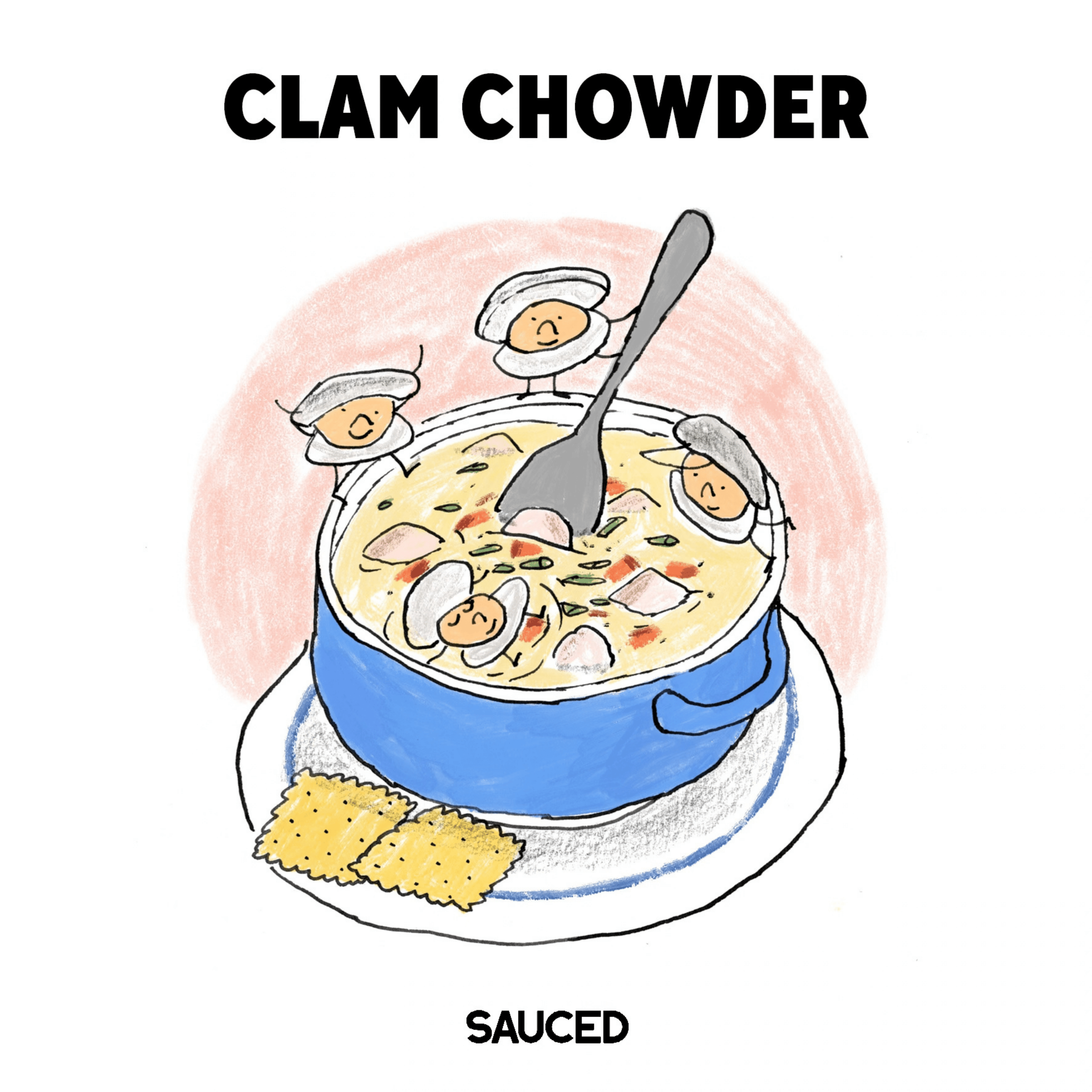
New England claims Clam Chowder as its own, but the dish carries a distinctly French accent, from the pot that gave it a name to the chef who set the modern standard.
We trace the bowl through a 1751 rhyme and Melville's Nantucket, then referee the East Coast fight over tomatoes.
"Seasoned by the ocean."
What we settled on:
Top-neck clams, pulled the moment each one opens
Clam liquor strained through a coffee filter
Salt pork over bacon, to skip the smoke
A white mirepoix with leek and one clove of garlic
Dry vermouth to deglaze, Fino or Manzanilla to finish
No roux, just a few potatoes mashed back in
Salt at the very end, and the cream never boils
A 10- to 15-minute rest, oyster crackers on the side
The Cocktail:
The Harry Johnson, a pebble-ice build of Manzanilla Sherry, ginger honey syrup, and lemon under a spritz of peated Scotch.
RECIPE CARD:
Premium subscriber? Check out the full recipe card here.
LISTEN
EpiSOde Partners
Thanks to the following brands for partnering with Sauced to bring you this episode:
TRANSCRIPT
Tim McKirdy: Sother.
Sother Teague: Tim.
TM: Clam chowder.
ST: Well, the weather is starting to turn.
TM: It is.
ST: All right.
TM: It is. Specifically this week, but especially — it's chowder season.
ST: Yeah, soup season is upon us, and chowder is a mainstay. Again, we're talking about seafood, so I'm in. You know I'm in, right? Like, I think I have two things that I'm always gonna be in on: pork and seafood. So I'm in for chowder. Let's go.
TM: Chow down. Time to chow down on some — well, interestingly, when we get into the origins, the etymology of this is contested, as is always the case. A little bit of personal associations, though. Professional?
ST: Both. You know, I ate many a style of chowder growing up on the shore of the north Gulf Coast of Mexico. And then I worked at a spot in Chicago called the Davis Street Fish Market. I worked there for years, and we had two chowders on the menu. We had a Manhattan-style chowder all summer long, and then all winter long we had the New England style. And people were so into the New England-style chowder at this place that we wouldn't serve it — it was off-menu until the wintertime. And when we would launch it each year, there was this guy who worked there, his name was Steve Newman, I still remember it. We all called him Scuba. Scuba Steve. We had this giant bell behind the bar, like off a boat, and he would walk the block of Davis Street ringing that bell to let people know that the chowder was back.
TM: Wow.
ST: And we would be just inundated with people coming in for it, coming in to get it to go. We'd make gallon upon gallon upon gallon of this stuff.
TM: There's something very Renaissance fair about that notion, and very New England — going with the bell.
ST: I mean, we did a bunch of weird stuff at that place. We were a bunch of young kids, and —
TM: You surprise me.
ST: Yeah. We were a bunch of young kids. The kids were all right. Anyway, so yes — and I loved the Manhattan one and I loved the New England one. Yeah, chowder's a mainstay.
TM: Give us your elevator pitch for this dish — because you're mentioning New England, you're mentioning Manhattan, we'll get into that — but what is it, for those who don't know?
ST: Oh, and more. So, my elevator pitch here: clam chowder is a hearty coastal soup built around clams and their liquor, traditionally combined with potatoes, onions and salt pork — so, two things I love — with regional versions ranging from the creamy New England style, which everybody knows the most, I think, to the clear Rhode Island style, which nobody knows, to the tomato-based Manhattan style.
TM: It's a surprising regional difference — discussion, argument — for this, I think. Like you say, the one everyone knows, or maybe their mind goes to first, is the creamy New England style.
ST: Well, I think you say chowder and — even in the three that I listed there, we didn't even list things like corn chowder.
TM: Yeah.
ST: That's a chowder too. Vegetable chowders. I think for me, certainly — and I don't know how different I am from everybody else — but I picture a bowl of creamy something happening, right?
TM: Mm-hmm.
ST: Yeah.
TM: This is not a dish I had ever had or tasted before I moved to the States.
ST: Oh, wow. And any variety? What'd you have over there — cioppino? No, that's San Francisco.
TM: Not really.
ST: Did you do an oyster pan roast? Any kind of seafood soup? Sea crab?
TM: Bisque.
ST: Bisque, okay, yeah.
TM: What's the one with the wonderful name — that's more of a dish with a soup in it. Traditionally made with pike and egg whites, but more often these days salmon. It's like a salmon aerated mousse that you would poach a quenelle of in your soup, whatever. Beautiful. In bisque.
ST: Mm.
TM: Yeah, just much more fish soups. I mean, of course I'm familiar with the concept of it. It's very likely that I never —
ST: So you have no professional connection —
TM: — never made this professionally. No.
ST: — but you do have at least a personal one, which is: I never had it till I came to America.
TM: And if you were to say what is your immediate association that you have with this dish — I would guess that it's the first I ever tasted, but it's certainly the one that stands out to me. If I'm thinking where am I when I'm eating this, I'm in Grand Central Terminal at the Oyster Bar, the restaurant there. And I'm sat at one of those bars, and I'm getting those little biscuits —
ST: Oyster crackers, yeah.
TM: — oyster crackers. Westminster, has to be.
ST: Yes.
TM: And just being like, this is a really foreign, alien experience, but I'm enjoying it.
ST: Yeah, well, just because it was foreign to you doesn't mean it's not enjoyable by many, many people, so I can see that you folded right in. And you're a curious and adventurous eater, so I'm glad you did it. Also, I'm glad that was your experience. Wow. What an iconic place to have your first experience with chowder. I'm surprised you didn't have the oyster pan roast, because they have those small tilt kettles right there on the bar top where they're making it to order.
TM: Yeah, it's a great place. And there's a bit in the back as well where you can go have really overly strong, oversized martinis. Love it. And it literally is kind of the gateway to the Northeast if you are here in New York as well, too. So it's a nice little tie-in there. Any other thoughts for us before we get into the origins?
ST: I would just say I love it in all of its versions. I like the clear one, I like the tomato one, I like the creamy one. I think overwhelmingly I'm going to prefer it be a seafood version than maybe a vegetable or other. But yeah, because that's what comes to mind for me is seafood. It's a seafood dish for me.
TM: Yeah, totally. And I'm going to reveal some cards here, but I'm putting some corn in there too, because why not.
ST: Maybe. Yeah, maybe.
TM: All right. Origins. Etymology, we said. The dish even is named for the vessel it was cooked in. Chowder comes from the French chaudière — chaud meaning hot — which is a cauldron or cooking pot. That comes from the late Latin caldaria, which is also the same root that gives us cauldron. Or — this is the most accepted theory. The word and the practice traveled to America together. They were carried by Breton fishermen, our guys with the nice striped t-shirts, to Newfoundland, then down through the Maritimes into New England, where the word first surfaces in print in 1751.
ST: As chowder.
TM: As chowder.
ST: We dropped the French and we went with the anglicized.
TM: We've been known to do that.
ST: Yes.
TM: Another theory, which is less accepted but is out there, traces the name back to an old West Country word — so the West Country in the UK, Cornwall and around there — jowter, which was a Cornish fish peddler, which would make the chowder the fishmonger's stew rather than the pot's stew, if you see what I'm saying. But yeah, the pot is the stronger bet, but the jowter has some of its backers.
ST: I mean, you having grown up in the UK and just telling me that you never had chowder — I'm going to discount the UK version right away.
TM: That's just me. I wasn't a fish eater growing up. The other thing I guess I would say is, well, then where does "chow" become a synonym for eating?
ST: I mean, I bet it goes back to that pot as well. We're just all hovering around the pot and eating.
TM: Chowing down.
ST: Chowing down. Chowdering down. Jeez Louise.
TM: So, that first reference in print. We say that a lot: okay, this is 1751, but we say it a lot — oh yeah, we can trace it back, this is where people first appeared. This has to be, by some measure, the best iteration of that we've ever come across. The oldest printed chowder recipe — I'm going to do air quotes there — is a rhyme that appeared in the Boston Evening Post, September 23rd, 1751. And it described a layered fish chowder — no clams, no milk — thickened with soaked biscuit. And here it is whole, if you will indulge me on this one.
ST: Yeah, let's go.
TM: "First lay some onions to keep the pork from burning, / Because in chowder there can be no turning; / Then lay some pork in slices very thin, / Thus you in chowder always must begin. / Next lay some fish cut crossways very nice, / Then season well with pepper, salt, and spice; / Parsley, sweet marjoram, savoury, and thyme, / Then biscuit next which must be soaked some time. / Thus your foundation laid, you will be able / To raise a chowder high as Tower of Babel; / For by repeating o'er the same again, / You may make a chowder for a thousand men. / Last, a bottle of claret, with water enough to smother her, / You'll have a mess which some call omnium gather'em."
ST: I love it when you read poetry to me. I mean, all right, it's far more complex than the — what's the poem about punch?
TM: Yeah.
ST: Four of strong, three of weak, two of — I don't know. I'm butchering it.
TM: Two of something, something of weak.
ST: Yeah.
TM: Two of sweet, one of weak. Something like that. The punch poem. Most of it holds up, right? Sort of 275 years later, as we are. The one that I had to Google: "you'll have a mess which some call omnium gatherum." You ever heard of that term before?
ST: I mean, omni is everything, gatherum is to come together, right? It's just like everything came together.
TM: Everything. Hodgepodge, everything pulled together.
ST: Yeah.
TM: It's pseudo-Latin. It's not even Latin. It's a term that exists to sound kind of smarter than it is.
ST: I mean — I know the movie just came out, but it's like when Wile E. Coyote would be running across the screen, they freeze him for a second and then they say, you know, Coyoteus Maximus.
TM: Yeah, exactly.
ST: Then he goes, and the Road Runner zips in, and it just freezes him, you know. Speedius Birdius.
TM: One of the most eye-opening things for me from this: "last, a bottle of claret." Bordeaux red wine from the era. Clams not specified, fish cut crossways — but red wine.
ST: Yeah. I mean, everything that I read getting ready for this episode said you simply used whatever liquids were at hand. And where were we when this dish was kind of forming itself? We were on a boat out at sea. So it wasn't like you just had water at hand. You probably had beer or wine, and whatever color that wine was was going in.
TM: Yeah. Red wine is a little bit more stable than white for these times. To continue our literary tract —
ST: Did somebody update the poem?
TM: A hundred years later, Herman Melville —
ST: Yeah, of course. Oh, yes.
TM: — author of — Ishmael —
ST: Moby-Dick.
TM: — and Queequeg reach the Try Pots on Nantucket, where the landlady's only question is "clam or cod."
ST: The Try Pots. Chowder, yeah.
TM: Melville's bowl is a historical recipe in one sentence. Chowder, quote, "made of small juicy clams scarcely bigger than hazelnuts, mixed with pounded ship biscuit and salted pork cut up into little flakes, the whole enriched with butter." The milk-and-cream chowder we now call the default was a 19th-century development. James Beard's American Cookery dates the rich version to the 1800s, well after Melville ate his.
ST: Yeah. I mean, I think the only thing we need to pick apart in there for the listener, and maybe just regular people, is: what the heck is ship's biscuit? Ship's biscuit is the seafaring version of hardtack. They're the same thing — I don't know why they have two different names. And that is just an unleavened, dense cracker. It's flour and water and salt, baked until super dry, but then it's highly travelable, nearly inedible unless you soak it and wet it in something. And so the chowders of early times — again, you might be out on a boat, you're using whatever liquids you have, and you're soaking the ship's biscuit in there until it starts to hydrate and fall apart, and that becomes the thickening agent. That's why we associate chowders with being so thick. So that's without cream or roux or anything like that, or any potatoes maybe, but the biscuit is what's making it thick.
TM: That is what eventually inspires oyster crackers.
ST: Right, yeah. A hundred percent. So now chowders are traditionally served with oyster crackers — and those are little round crackers because ship's biscuits were typically round. And then your chowder's supposed to come not as thick as it maybe quote-unquote "should be," and you add your oyster crackers and they fall apart and become the thickening agent as you're eating the soup.
TM: Choose your own adventure.
ST: Yeah, a little bit.
TM: For any Lord of the Rings fans out there, it's reminding me of lembas bread, I think. But that's maybe revealing myself as a bit of a nerd there.
ST: Oh, you've revealed yourself in the past, though. You just read us a poem about chowder.
TM: You come to me with a better poem about a soup and I'm all ears.
ST: Bubble, bubble, toil and trouble.
TM: So you mentioned earlier three chowders. New England: white, milk or cream. Rhode Island: clear, no milk, no tomato. Manhattan: red, tomato instead of cream, plus more vegetables.
ST: Did you know there's a secret fourth option? Long Island. Long Island chowder is pink, because they use tomato and —
TM: Cream.
ST: Cream.
TM: That's the Penne alla Vodka.
ST: It's like a culinary joke. It's a culinary inside joke, I think, because they're in between the two, so they just did them both. It's like the Miami Vice of soup.
TM: Yeah, I mean —
ST: The Miami Vice — for those listening, not the show with Don Johnson, who used to live in my hometown — is a cocktail that is a blend of a piña colada and a strawberry daiquiri, frozen, and they swirl them together.
TM: Love it.
ST: So this Long Island chowder is the Miami Vice of soup.
TM: The Manhattan clam chowder most likely didn't originate in Manhattan, but instead Coney Island and Fulton Market. The name only stuck by the 1930s. It's been somewhat controversial over time.
ST: How come?
TM: Namely the fact that New England hates it. So New England has such contempt for tomato-based chowder that it kind of nearly got banned.
ST: Oh, there was a guy who tried to make it illegal to put tomatoes in. He was, like, the mayor or something.
TM: Maine representative Cleveland Sleeper had floated joke bills for years to ban tomatoes from chowder.
ST: Sleeper. There. Right.
TM: The 1939 version of his joke bill set a penalty of digging a barrel of clams at high tide if you were found to be guilty of doing this — which, sit about that and think about it for a moment, it's impossible to do. It's clearly having a joke. But this thing eventually got settled at the Maine Hotel Association's Midwinter Frolic in Portland. Sleeper's chef and his traditional chowder were pitted against a Philadelphia restaurateur, Harry Tully, his chef, and a Manhattan red — not sure why the guy's coming from Philly and not Manhattan. The judges: Governor Louis Barrows and Ruth Wakefield, who was the inventor of —
ST: Wow. I was about to say, when you said her name, I was like, I've heard that name.
TM: — the Toll House cookie.
ST: The Toll House cookie is the quintessential chocolate chip cookie.
TM: The chocolate chip cookie, not the massive ones.
ST: Your standard chocolate chip cookie.
TM: So, Ruth Wakefield there. They both went unanimously for Maine. Tully tried to defend the Manhattan red. He said the tomato lends flavor to the clam. He lost the room. Sleeper, on tasting the red one, quote, "this is vegetable soup, not clam chowder." And after the cream clam chowder won, he said, "if a clam could vote, I would be elected president."
ST: I mean, sounds like it was all in good fun.
TM: It does sound like good fun. We don't have enough of these things anymore, do we? Like the Judgment of Paris — although they're trying to redo that — but the blind tasting, these contests. One final piece of clam trivia for you.
ST: Also just some good city-to-city, or region-to-region, rivalry.
TM: Regional rivalry. Hard-shell clams carry a purple rim on the shell. Coastal nations, most specifically the Narragansett, cut the shell into small cylindrical beads called wampum, and drilled them and strung them together. There were two different colors. White beads came from whelk shells, and the purples came only from the quahog. They were rarer and worth double the value. The Dutch eventually turned this into currency. About 120 beads, in the 1620s, could get you two beaver pelts — which is probably one of the most colonial-era sentences you will ever think about.
ST: Two beaver pelts and some hardtack.
TM: Massachusetts made it legal tender for a while, for debts of under 10 pounds — I think that's British pounds. And around 1640 the conversion rate was two to four beads to the penny. Harvard would let you pay your tuition in wampum.
ST: Wow. Was it that hard to find these clams? Clams were everywhere.
TM: The purple shells. I guess it's the money that goes into it — they were rarer, it looked nicer.
ST: All right.
TM: So, the clam's Latin name is Mercenaria mercenaria, which means "hired for wages." An animal named after money, its shell then became legal tender. And Rhode Island made the quahog its official state shell in 1987.
ST: Well, and as we know — and it'll come up in the pairings — Narragansett is the beer of the clam. Says so right on the can. The official beer of the clam.
TM: Love it.
ST: "Made on honor, sold on merit." Narragansett. That's a hell of a bumper. If you want to be a sponsor, Narragansett, we'd love to have you.
TM: Yeah, we'd love to have you.
ST: I drink plenty of that stuff — not just because I'm a huge fan of the movie Jaws, where Quint crushes the Narragansett can.
TM: And not just because I love the Steven Grasse redesign and rebrand of recent times. It is looking real good. The man, the individual, that also brought us Sailor Jerry —
ST: Oh yeah. Yeah.
TM: — Hendrick's Gin.
ST: Oh. I didn't know that.
TM: The branding.
ST: Yeah, yeah.
TM: Anyway, those have been the origins. And that has probably got to be our final, our defining porco fun fact of the week.
ST: I can pay for Harvard with clam shells. Hey. And that's probably — surely, clearly — that's where the phraseology around using the word "clams" for money comes from. Hey, that's a lot of clams, right?
TM: Yeah, a lot of wampum.
ST: That'll set you back a lot of clams.
TM: All right, so those have been the origins. Time for us to take our first break of the day, and then we'll be back with the culinary luminaries.
ST: Yeah.
TM: All right, we're back. Luminaries. Do we have, at long last, a Julia Child or a Jacques Pépin entering the conversation?
ST: It's been a while since we have, and we absolutely do. I think you're teeing that up, because you knew Jacques Pépin probably has a huge hand in the popularization of chowder across the entire country. Because before he became the culinary luminary that we see him as now — an educator that he has been for decades — he worked at a little hotel chain called Howard Johnson's. Which, you're not from around here, but back in the day those things were everywhere. There was a Howard Johnson's everywhere. In fact, if you go far enough back, you can find the quote from Dale DeGroff where he uses Howard Johnson's in his statement about the "cocktail revolution." I'm going to loosely paraphrase it, but he said the cocktail revolution will be won when you can get a decent — and the strong word is decent — when you can get a decent Negroni at any Howard Johnson's. And I feel like we've won, even though Howard Johnson's is gone now. I think they're completely gone.
TM: I've never encountered one.
ST: Yeah. Jacques made clam chowder — New England clam chowder — a thing on the menus at Howard Johnson's. There's reports of him making quantities as large as 3,000 gallons at a time, which is a feat.
TM: I saw a video where he mentioned that. Wow.
ST: Yeah, that's crazy. And he made it based on his own memory slash foundation. But I think what I'm trying to say is, it seems to me that everything we know about chowder — that we've dug to find out about for this episode, and everything we may have known before — that Jacques's recipe came along and codified it. Jacques's recipe for New England-style clam chowder is sort of the benchmark.
TM: Which also makes sense — when we talked about the origin of the word, the French cauldron coming across here, it's a very classical French cooking technique, dish. So it makes sense.
ST: Yeah. His involved leeks, which I don't think were common in the seafaring days that we're talking about before that. He put a little jalapeño in there to bring just some background of spice, but not noticeably spicy. But he used corn, as you mentioned, as well, obviously, baby clams, heavy cream, garlic, thyme, et cetera. So he kind of codified what I think we all know as chowder.
TM: Took a Frenchman.
ST: Took a Frenchman to bring home this quintessentially New England dish.
TM: I bet Jacques liked it because it's a pretty quick preparation.
ST: There's that too. We talk a lot about how, all the way back — and this is his early days in his career, all the way back to the beginnings — he was always about making food that was delicious and accessible and pretty quick to get to the table. I think that's been his core philosophy from the beginning.
TM: Love it. Get people involved. You mentioned earlier — this is coming in, but I think he used it in the recipe that I saw too — salt pork. What is the difference between salt pork and bacon?
ST: It's a bit fattier than bacon. It's from the same area, but the fattier end of the belly. And it's not really cured with anything but salt. So it's just salt-cured bacon that's never smoked, almost entirely fat. When I was a kid, my grandfather referred to it as streak-o'-lean. Streak-o'-lean. Streak of lean. Because when you slice bacon there's streaks, there's striations of fat and lean. Streak-o'-lean is like there's barely any lean in there. It's almost entirely just a brick of fat.
TM: So it's funny, because — I think we discussed this before as well — like, in the UK we have streaky bacon, which is salt pork, right? We have back bacon, which is the loin and has fat and has a little bit more on there as well. And those two, when you're buying them, are assumed unsmoked, and then you have smoked back, smoked streaky.
ST: Closer to Canadian bacon here. And then — where does what I would call bacon fall in?
TM: That's smoked streaky bacon.
ST: But you just said that the streaky was more like the salt. So where's salt pork then?
TM: Salt pork is streaky bacon.
ST: Right. So, yeah, no — here, when you look at salt pork, it's almost entirely white.
TM: Oh, okay. No, this is more like bacon.
ST: Like I say, when you look at bacon there's striations of fat and lean, fat and lean. When you look at streak-o'-lean slash salt pork, it is almost entirely white. There might be like a little drawing of something lean in there, but it is mostly fat. And that's great, because —
TM: So ours is streak-o'-lean, sorry, yeah — which is streaky.
ST: Streak-o'-lean, yeah. So — and I get it, I get it. That's like a very descriptive way to name something. But so, salt pork is highly travelable. And it's bringing two things to the party. Three, really, but two for sure. It's bringing salt and it's bringing fat, so that you can sauté things, cook things. You can use that rendered fat to cook stuff in. And then, of course, there's gonna be some flavor from that stuff that's porky. So you're gonna get this real porky-flavored fat for cooking your — sweating your veg in before everything else goes in the pot. And it wasn't just used, obviously, for chowder. Streak-o'-lean and salt pork are used for all manner of cooking, but those are the things that it brings.
TM: Rendering. Love it. Without that smoke — because not that I'm against it, I'm just saying certain dishes it doesn't belong in, for me.
ST: And I agree, and I agree that that statement is true. And I also think in this particular case, I'm not looking for bacon. I don't want smoky. I just want the porky and the salt.
TM: Jacques also went for pre-cooked, out-the-can, chopped. We'll get into that later — we'll get into clam juice later. In the meantime, who else do you have on the luminary front?
ST: Well, Julia was sort of in a similar camp. She treated chowder as more like a method slash template rather than a fixed recipe. And her basic chowder began with most of the same things, though minus the cream — she was more of a clear version. But she really harked on the notion of, you don't wanna boil it. Just get it to a bare simmer, because the clams are gonna be steamed. If you're getting them from the shell directly, you're gonna steam those and pluck the meats out in advance, so they're basically cooked. So any time further in that hot liquid is just gonna render them to be rubbery, and we don't want that. So, even when I worked at the Davis Street Fish Market, the body of the soup was built, but to order they would put the clams in at the last minute, just to get them warmed through, so they'd still be plump and juicy and not rubbery and hard. You beat me to the punch — not that he's a luminary, but I had Herman Melville here, and I wanted to talk about what we already talked about, so there's that. And then that's kind of it. I didn't have anybody who wanted to step forward and take chowder as their own, except for Jacques — where I don't think he took it as his own. It simply got placed upon him, right? Because he made so much of it, and he made so much of it at a place that was so prolific and all over the country, that it became a more widely accepted slash widely known dish. So I don't think he set out to be the champion of this dish. He just worked in a place, in a position, where whatever he touched touched so many businesses. Because Howard Johnson was a hotel, but it was also a restaurant. Frankly, I think more than the hotel, its reputation was its restaurant. Which were economically priced, solidly good, obviously chef-driven places to eat throughout the country.
TM: Very democratic.
ST: Yeah, exactly. And also, again, so prolific — and really reliable. If you're traveling with your family, which people did back in those times, like cross-country trips to go on vacation or what have you, you knew that every so many miles you could hit a Howard Johnson's and have a good meal that was gonna be of quality.
TM: I never got to see a Howard Johnson, though. To me, also, just the wording is weird. It's like, a Howard Johnston's.
ST: No T. Johnson.
TM: Johnson's, even. It's like a singular. "Let's go to Howard Johnson." I don't know, something about the S at the end is throwing me off. You want it to be singular, but it's possessive anyway.
ST: Yeah.
TM: James Beard, obviously — I mentioned as well that was kind of codified in his American cookbook. Just one thing that stood out for his approach to me: he brings all the ingredients to the same temperature before he combines them, so that there's no shock going on, no separation.
ST: Oh, okay.
TM: I saw Jacques thickened his with flour, but he made a little paste of it first. So you're not adding that in and separating and whatnot. Just a little —
ST: Yeah. I think if we're gonna use cream, you can avoid having a roux by a couple of methods that I prefer over the roux in this case. And I have no problem with roux, it's useful — or even a flour slurry is useful. But I think if we're gonna have potatoes in there, we can pull some of the potatoes out and mash them and fold them back in. And that's a great thickening agent. And I think also just sheer reduction. We can reduce — obviously we're gonna be using cream in ours that we can reduce, but to get to that point we need to make sure that we're never boiling, because we don't wanna boil cream or break it, and then we'll have this sort of greasy slick on top. I don't want that. And then we can also rely on those oyster crackers.
TM: Yes. Yeah. Let the people thicken it themselves. Let them eat soup. Do you eat soup?
ST: I'm not a soup fan, but chowder doesn't really qualify as soup. It's more chowder. And chili, especially cream chowder like we're talking about — and even the Manhattan style can be quite thick. I guess I veer away from soups. I'm more in the stew camp.
TM: Yeah, no, I just meant more, are you eating it or drinking it. But anyway, that's it.
ST: Oh, right, yeah, I understood. I thought you were talking to me personally, because you do know that I rarely eat —
TM: I know you don't like hot liquids.
ST: I don't like hot liquid. I know. Listen —
TM: But he loves a room-temperature cocktail, people.
ST: I do. It's not hot.
TM: All right. So those have been the luminaries. Time for a second break today, and then we'll be back with the non-negotiables.
ST: Sure.
TM: All right, so we're back. The non-negotiables. Number one.
ST: Clams.
TM: Do you want to do a little deep dive? A little deep dive.
ST: Yeah, a little deep dive. A dive deep enough to get the clams.
TM: Not that deep.
ST: Jacques uses canned clams in his, but he's making 3,000 gallons at a time, so can't blame the guy, to be honest. That's a lot of clams. Hey, that's a lot of clams. But if I'm gonna do it myself at home, I'm not gonna need that many, and I want it to be as fresh as possible, so I'm gonna get shelled clams from my seafood monger. And there's a few varieties that we can choose from. Countnecks are pretty small, and I don't think that they're the right ones for this use, to be honest. So I would at least start at littlenecks, which are gonna run around an inch to two inches across. Followed by that would be topnecks, which come in at two-plus inches, up to three. Cherrystones, which are still nice and tender — those are the ones that you typically find on a raw platter when you're out having seafood in the raw — those are around the three-inch mark. And then you've got your what are literally called chowder, or quahog, or sometimes pronounced co-hog — and those are the very large ones that are three to well over five inches. They're huge, bigger than my hand.
TM: These are like those oysters that you like.
ST: Well, a little bit different, in that clams, the bigger they are, the tougher they are. But that's why the quahog is used in chowders — because you steam it open and then you chop it up into smaller pieces, and it's a little bit more economical. So I would either frankly go for quahogs, or — I'm gonna skip one in the middle. I don't think I would pay the price, because cherrystones have sort of a premium price because people eat them raw and they're kind of valued in that way. Topnecks are eaten raw sometimes, but they're not as expensive. So I would go either topnecks, which are gonna be smaller than the cherrystone, or quahogs, which I would need to chop up. Either way, I'm gonna try and use fresh clams.
TM: And you're going to steam those first. You're going to keep all that lovely cooking liquid that comes off, and you're going to use that in your soup, your chowder.
ST: Yeah, we'll talk about that in preparation. But yes, I'm gonna put them in a steamer basket over just enough water to create steam to open them. I'm gonna pluck them out of there as they open and pull them out of the shell. And then I'm gonna save that liquid that's at the bottom, and definitely, definitely, definitely gonna run that liquid through a fine strainer, because almost without fail there's gonna be some sand in there.
TM: Yeah. Next non-negotiable for me here. I think — I mean, I'm trying to hold myself to the standard. So I would say, if we're in the style of chowder that we're clearly doing, it's cream. That's the next non-negotiable for me. It was a toss-up between two ingredients, but I'm like, if I'm on about what am I expecting from clam chowder — number one, it's clams. Number two, it's the cream in that consistency.
ST: Sure, I'm down with that. I don't know what your next one was, but I'm betting I've got it, since we're going back and forth. That's some kind of pork.
TM: Yes.
ST: So — and I'm gonna wanna go for salt pork, which you can find at any butcher shop, really. And again, it's because I don't really want the smokiness of bacon. I'm not even really looking for the meaty part of bacon. I wanna have something that I can render down, get the fat that I need to cook the rest of the things that are going into this process, with some salt. And by the way, when we get to process here, we're not gonna be salting this dish until the very end, because we're dealing with clams, which are salty, the liquor from the clams, salty, salt pork, which is salty. We're gonna wait till the very end to season this thing with any extra salt, by any means. So, yeah, salt pork.
TM: Nice. Next for me.
ST: And it'll — by the way, it'll render down. It won't render down to completely liquid. It still has some protein in it, so there'll be some textural addition to the party as well. It just won't be much.
TM: Yeah. I'm going to say onions — a white mirepoix — and I'm going to go leeks as well. I'm going to go onions and leeks. Love it. And it's an underutilized vegetable.
ST: I'm gonna take you to task. As a non-negotiable — I mean, I gotta have onion, yes.
TM: Celery, I'm going —
ST: Ooh, as non-negotiable?
TM: Well, just as a white mirepoix. Maybe a little bit of fennel in there — no, that's not a non-negotiable. Okay. Onion is the non-negotiable, but I would say, in that camp, let's make it actually a white mirepoix.
ST: Okay.
TM: Yeah. Next one for you.
ST: I'll take it. Well, we're gonna need a potato.
TM: Yeah, yeah.
ST: Gotta have some kind of potato. I got one more.
TM: Yukon Gold, or a russet — high-starch potato.
ST: Right, something that'll add to the thickness of the thing.
TM: Thicken it up.
ST: Because I don't think — correct me if I'm wrong, while we're in the non-negotiables — I don't think we're the roux type, are we?
TM: No, we're not.
ST: Not for this.
TM: No. Also, the roux — I was always taught you need to cook it for at least 45 minutes to get the flavor of raw flour out of it. And we said this is a dish that can be brought together relatively quickly, or we're not cooking it for long and hard, so, yeah.
ST: Sure. I will push back on that just a little, by saying that seems like a long time to cook a roux.
TM: No, when you add the roux to your thing, it needs to cook for —
ST: Oh, I gotcha. Yeah, yeah. Copy. But I would also say, in the South we generally have roux made in advance. Right? If I'm gonna make a roux for something white, I'll have a white roux. I'll make a lot of it, I'll use what I need, and then put it in the fridge, basically like a stick of butter. And then I'll do a darker roux, an even darker roux — so I gotta just have rouxs already.
TM: Yeah. But also, if it's not adding anything flavor-wise, use potato starch, use instant mashed potatoes. You know. Smash.
ST: Yeah, no, that's such a great culinary technique, is to use those potato flakes as a thickener.
TM: Mm-hmm.
ST: Often, also in the South anyway, we'll use grits. A handful of grits — like literally a tablespoonful of grits in your gallon of vegetable soup — will give it some body.
TM: Instant grits.
ST: No.
TM: No self-respecting Southerner.
ST: That's right. You like it al dente. All right, is that it for non-negotiables then? No —
TM: No, there's one more, come on.
ST: What am I forgetting? Oh, the crackers.
TM: Yeah, the ship's biscuit.
ST: The ship's biscuit, or the hardtack — yeah. In our case it's gonna be oyster crackers.
TM: It's gonna be Westminster oyster crackers.
ST: Yeah, because we don't need to make a hardtack.
TM: Apparently. Have you ever had hardtack?
ST: Yeah, it's everything it sounds like.
TM: It sounds like lembas bread.
ST: It's survival food. It's something that can travel, because all the moisture's baked out of it. It's basically dehydrated. It's not a cracker, but it ain't bread either. It's just this dry mass. But, you know, life-sustaining.
TM: Nice. As that plane goes overhead — I'm sure people can hear it in the background — I would say it reminds me, in a slightly different way, of a Soreen bar. You ever had this thing?
ST: Soreen? No.
TM: It's like a fruitcake, and it's incredibly dense, even more so than fruitcake, which is already very dense. Packed with sugar and whatnot, so it's quite shelf-stable. And as an adolescent, I would do a lot of hiking at school with friends or whatever, and you would be carrying your camping gear. You'd be out there for four days and you had to carry all your food with you. So we'd be in this — because it's really, really high-calorie, these Soreen bars. So you just, you had to map out your calories for every day that you were eating, knowing what you were burning, and just be chomping on those as we're hitting the road. If only I knew I could have had some ship's biscuit instead — would have been lighter.
ST: Well, one more reason for me to not go camping. That sounds horrible.
TM: Yeah. And why are people — I actually don't know too much about different oyster cracker brands. I just saw a video of Kenji making it, and he's like, oh, this is what I have because it's available, but Westminster is what we want. And then I looked into it, and apparently the building that's on the logo is still there. And why are Westminster oyster crackers superior?
ST: I don't know. Why is Oreo the world's most famous chocolate sandwich cookie? Did they do it first, or did they popularize it? I don't know, because there was Hydrox cookies, that are basically an Oreo, that don't exist anymore. You know what I mean? You just have to outlast them. You have to be — what's the old bear analogy, right? When you're being chased by a bear, all you have to do is outrun one other person.
TM: Another reason not to go camping.
ST: That's right. All right, so that's non-negotiables.
TM: Yeah.
ST: Yeah, I don't have anything else on mine.
TM: Talk to me about some negotiables, then.
ST: I want other fish in here too.
TM: Interesting.
ST: Yeah. I want some white fish, maybe even some bits of — these are obviously all negotiable — but maybe even some diced-up squid, calamari. Yeah, I want maybe some other fish.
TM: I want corn. Fresh corn.
ST: Oh, right, you did say that earlier, but not a non-negotiable. Yeah, I'm down with corn. I love corn. And you know what's crazy, I'm just realizing, the whole past summer I didn't get any corn.
TM: Didn't do any corn?
ST: No.
TM: I saw Jacques doing this technique where he's pulling the knife towards him, which seems — if you're trying to encourage more people to cook, I would turn the corn the other way and run your knife, you know, lean your corn on something and run your knife down it, so you're cutting away from yourself, rather than holding the corn in your hand and pulling the knife towards yourself.
ST: We are in total agreement here. I saw that same video — I think I saw the same video, or he's probably done it more than once — but yeah, never ever the knife towards you. That's the first thing I taught in butchery. First thing I was taught in butchery, and that's the first thing I taught in butchery.
TM: Also not having your fingers in the way. But the one thing he did say that I took away as a tip that I thought was quite good: you'll see a lot of people coming at it completely perpendicular and flat. He's like, no, this is cutting. So you want your knife to cut the corn at 45 degrees.
ST: Like a guillotine.
TM: Yes. He knew all about that. He's a Frenchman. Obviously some other ingredients here, not non-negotiables: bay leaf, thyme, Fino Sherry for me, or vermouth.
ST: It's sherry — that's what I have in mind. Again, a negotiable. You don't have to have it to make this dish, but I like sherry to finish.
TM: It's the saltiness, the savoriness.
ST: Yeah. And I think you maybe brought that with you from overseas, right? Oftentimes bisque has a little tiny pitcher of sherry that you finish at the table, right?
TM: Where are you adding yours?
ST: In the last minutes. I'm not doing it in a bowl, I don't think.
TM: Oh, yeah. Not deglazing.
ST: I was thinking I was gonna use some vermouth for that.
TM: You're going to deglaze with vermouth, and you're going to finish with a little sherry.
ST: Because, again, as you said, salinity from the sherry — there's so many salty things already happening here. I'm gonna use that as the finisher, but at the very end. But not at the bowl, tableside.
TM: Yeah. No other potential ingredients? I mean, I want a hearty bread on the side.
ST: Well, that's what's coming. We'll get to that — what are we serving with it, part of the show. But no, I mean, well, let's pause for a minute and remind ourselves: chaudière, right, that was the name of the pot. It was named after the pot because it's just where you threw stuff. What do you got laying around? Throw it in the pot. And then we're gonna have chowder later. Hey, we may have started with some clams and some corn and some potatoes. We may have also thrown in a hunk of lamb, a rabbit that we caught earlier today, the bits of chicken that were left over from yesterday. The perpetual stew keeps going, right? So I do love a bunch of the white root vegetables. I could easily see parsnips, rutabaga, turnips. I think there's no wrong answer. If we wanna try and stay as a white chowder, I wouldn't throw in beets, but I could see beets. You know what I mean? There's no —
TM: That's weird to me, but, yeah.
ST: But you get it, right?
TM: Yeah, yeah.
ST: Like, I don't wanna throw carrots in there either, but I could, right? So, again, the negotiable list seems like it's kind of endless, so I think we should just end it. Yes.
TM: Yes.
ST: Sorry, the negotiable list, it seems kind of endless, so we should just end it.
TM: Yeah, but I mean, I think there's things that spiritually align with this dish and things that don't. Beetroot, I'm not sure whether I'm letting in the door, but parsnip, swede, sure.
ST: Swede.
TM: What?
ST: I don't know, it's funny to me.
TM: It's a more normal word to me than rutabaga, put it that way.
ST: Frankly, I think it is too. It's just funny.
TM: Final piece of trivia while we're talking about all this, before we hit another break. So, you were talking about clams at the top of this section. They are harvested by hand using bull rakes, or trod up out of the mud with bare feet. They're slow-growing. Three to four years is the legal size in Rhode Island. Wild clams can live 40-plus years.
ST: Whoa.
TM: And the record, dug off of Cape Cod's Buzzards Bay, was 106 years old.
ST: How big was it?
TM: Must have been huge.
ST: Yeah.
TM: Yeah, 106-year-old clam.
ST: I mean, how do they — is it like a tree? Are they seeing the rings?
TM: It has to be, yeah.
ST: So then it had to be huge. I'm not shocked that it lived that long. I'm shocked that whoever reported on it living that long didn't also say, and also it was huge.
TM: Well, I mean, yeah, maybe that's a given.
ST: Is this like a 10-pound clam? Is this like a clam the size of a pizza?
TM: Listen, we've all seen — or I know you've seen them — those videos of oysters and stuff that are coming out, and I'm like, yeah, too much for me. Creeps me out a bit. But all right. The quahog. From clam to quahog to chaudière to corn — question mark.
ST: I'm in. I'm in with the corn. Let's go, yes.
TM: Yeah, no, I was just — anything that began with a C, I was just throwing out there, in anticipation of the break. And then we'll be back.
ST: Crackers.
TM: Harry Johnson's.
ST: Howard.
TM: Oh, that's enough. Let's take a break. Yeah. So, there — we both love the pairing, but before the pairing, you gotta pre-pair. It's the preparation.
ST: I guess so. Pre-pairing. All right, I'll get into it. First step, we're gonna steam our clams. I think we're gonna go with the topnecks — unless you wanna go with the quahog, the big boy.
TM: Yeah, we'll go with the topnecks. I just thought the quahog just because I like the name, but yeah.
ST: They're cool. I think they're more difficult to find.
TM: Okay.
ST: Because those are the ones that are getting snapped up by whatever — Campbell's —
TM: Restaurant.
ST: — for their canned chowder or whatever. So you just don't see them as regularly. You can ask your monger, I'm sure they can get them for you, and they are pretty impressive to look at. And yeah, restaurants get them too. So I'm gonna go with topnecks, because they're gonna be cheaper than the littlenecks, but also still of good size and quality for this. Give them a quick scrub if you can — at least run them under some water — before putting them in a steamer basket with just an inch or so of water in it. And then pluck them out as they open, because you don't wanna wait for them all to open, because those ones that opened earlier are just gonna get too cooked. And again, the problem we're gonna run into kind of often in the seafood world is overcooking just means rubbery and bouncy, and I don't want that. I want every bite to be supple and luxurious. So that includes the vegetables that we're gonna cook, and everything, but it definitely includes the clam, which is the star of this show. Once you've got them plucked out, just set them aside for now. Take the liquid that's in there and strain it through as fine a strainer as you have — maybe even all the way to a coffee filter — because you don't wanna get any sand that might be in there. And when I say "might," I mean definitely, there's gonna be some sand in there. There's just no way to get around it. There's sand inside the clam that you're not washing off when you scrub the clam. So get that done, and then reserve both of those things. If you happen to get larger clams, and you want to — don't forget, this is a soup, so everything needs to fit on a spoon — give them a little chop. But you shouldn't need to with the topnecks. Next, take your heavy-bottomed Dutch oven or what have you, and put in some of your salt pork that you've finely diced. Allow it to start rendering down. You know, that'll take longer than you'll think, honestly. It's not like — again, you're not just melting butter. This is gonna take five minutes or more. Then you've got your chopped onion, we're gonna add that in. Go until it's nice and soft. Everyone always says the word "translucent." I don't think it's translucent, I can't see through it. But you know what we're talking about — sweating it down, getting some of the liquid to come out. Then we decided we were going with white mirepoix, right? So we're gonna add in at that point our celery — what else did you say? Sorry. Leeks. Yeah, celery and leeks and anything else.
TM: Garlic.
ST: A little bit of garlic, you think?
TM: Yeah. One clove, Jacques went for. Maybe that — I'm just biased.
ST: All right. So, celery, leek, and just a little bit of garlic to give us a little bit of flavor. Sweat that down in the same manner. Then this is where I'm gonna go in with just enough dry vermouth — because we've switched to dry vermouth as our default, well, we switched to vermouth as our default, dry or sweet depending on what the application is. A little bit of dry vermouth to do any deglazing, and to flavor the aromatics that we have in there with a little bit more of that herbal flavor that you're gonna get from the vermouth. Then you're gonna whisk in the clam liquor that you saved from the water slash clam juice that dripped out when you did the steaming. Then you're gonna go in with your herbs, which we said bay leaf, thyme — and did we say three?
TM: Well, there was marjoram in the original.
ST: In the poem.
TM: Yeah.
ST: Yes, I remember hearing that in the poem, but I think he just put it in because it sounded good. That's poetic license versus culinary license.
TM: Yeah. Okay, bay leaf and thyme then.
ST: And your potatoes. Bring that just to a simmer and cook it for 15 to 20 minutes or so, depending on how firm your potatoes are. Get them cooked all the way through. Then you're gonna add in your dairy. This is the point where you don't wanna bring it back to any kind of boil. Keep it just below a simmer till everything starts to come together. You can at this point, if you want, pull some of the potatoes out and mash them and fold them back in. That'll help give your soup quite a bit of body. Or, frankly, take your wooden spoon and just smash a few against the side of the pot, depending on how thick you like it, right? I do not like — if I can stand my spoon up in the chowder, we made wallpaper paste.
TM: Yeah.
ST: And I know that there are people out there who do like it that way. It ain't me. So I want my potatoes to be able to be cooked enough that if I pull some out and mash them, they'll mash. But if I leave them in there in the shape that they're in, they should still maintain their shape. Does that make sense? And again, that's gonna be around the 20-minute mark if I'm doing cubes that are enough to fit on my spoon — but about three-quarters of an inch squares. This is the time when I'm gonna adjust a little bit of seasoning. I'm gonna come back in there with a little bit of pepper, probably white pepper. And this is where I'm gonna then add my clams back in, along with that bit of sherry that we talked about.
TM: Nice.
ST: Here's the technique — I think it's important to pause before directly ladling into the bowl. Chowder, like other soups and stews, does well with a bit of rest. So pull it off the heat. It'll stay plenty hot enough to eat, but let it kind of come together. Because we put all these things in there in stages, so they didn't get to be together the whole time — and they couldn't be — but let it come together for 10, 15 minutes. Like you're willing to rest your meats to have a better flavor, let's rest this delicious chowder that you made. And do that with the lid on, so it stays nice and warm. Then bowl it up. And again, I think it's a requisite, we need to have oyster crackers. I serve them on the side, so that the person enjoying the soup can have as many or as few as they want.
TM: Beautiful.
ST: Sounds like a delicious chowder.
TM: It does. Serve with some lovely crusty bread.
ST: Don't forget to pull your bay leaf out of there at some point. Or not — in the South we say all the time, if you got the bay leaf you get to kiss the cook. I think that was an invention of a cook, somewhere.
TM: Craving kisses, maybe.
ST: I guess so, right?
TM: Yeah. Love it.
ST: Did I miss anything?
TM: No, no, I think that is — I liked that you didn't include any other fish in this, because I was like, I think the canonical Sauced —
ST: That was a negotiable.
TM: Okay.
ST: I like that I didn't say it had to be there. Oh, but I also forgot to add in, we wanted corn.
TM: We do want corn.
ST: So the corn would have gone in there right about the same time as the potatoes.
TM: Yeah.
ST: Yeah. Delicious.
TM: Love it. All right, well, that has been the preparation.
ST: Yeah. What are we serving with?
TM: What are we serving with? We are gonna find out in just a jiffy. But before we do — we built the plane in the air there, we're putting the track in front of the train. We need a recipe. We will have a recipe literally already done and in people's inboxes by the time they're listening to this, because it arrives in your inbox, if you're a premium subscriber, 5 a.m. Eastern, the exact same time the episode drops in your feed.
ST: That the show drops.
TM: Only premium subscribers have access to those recipes.
ST: Right, because we don't want people listening and trying to, at the same time, jot down numbers and times and weights and things like that.
TM: We don't even have most of them at this point, right?
ST: Right, because, again, we're doing it as we go. We'll put this recipe together before the air date. But so what we do is we put them on a beautiful file that comes in your email, that's got some great artwork by our friend Charlotte out in the UK — a human person, not an AI, a human person is making the artwork for us every time — with all of the specs, ingredients, times, temperatures, everything you need to make this dish. Seven bucks a month if you're a premium subscriber. Will knock off two months of the year, so it's a bargain.
TM: Seventy.
ST: Yeah, it's a bargain at twice the price, is what I was gonna say. Yeah, so, 70 bucks instead of 84 for a year-long subscription. Listen, and if you're enjoying listening to us, then hopefully you'd enjoy supporting us in the work that we're doing. And frankly, if you enjoy it, I bet your friends would too. And a subscription for you is great; a subscription as a gift for someone you love is also great. And we're moving towards the holiday season.
TM: We are.
ST: So, something to think about.
TM: Getting chilly here, you know. Time to —
ST: Time to cozy up with a nice bowl, and-or cup, of chowder. A nice big coffee mug full of chowder, with a blanket wrapped around you while you watch the snow fall.
TM: Ah, looking forward to it already.
ST: Not me.
TM: And then, you know what else you get?
ST: You get ad-free listening.
TM: We're literally just about to pause right now for an ad. If you're a premium subscriber —
ST: Yeah, you could skip it.
TM: — you know what that means.
ST: It means you skip it.
TM: Yeah, exactly, straight past. All right, time for that final break, and then we'll be back. All right, Sother, we're back, with the pairings. Wine. Vino.
ST: I think you're gonna need something with a bit of a mineral slash maritime vibe. Muscadet.
TM: Muscadet is a classic, for sure. We mention it a lot. We mention two others a lot: Chablis, as an interpretation of Chardonnay, and Albariño. Because we mention those a lot, I'm going to go back, and I'm going to say that same little sherry we were finishing our chowder with. I think you've got to have a glass of sherry with this. Although I'm doing it in a — and I'm skipping a little bit here — but I'm going to go, probably because I'm just thinking of Grand Central Terminal, I'm going to have an ice-cold, massive martini. Maybe just three oysters on the half shell, just in the meantime. A little mignonette. Get the palate going. I'm going to carry that martini just into the beginning of my chowder. And then on the side, I'm going to have a glass of really dry Fino or Manzanilla sherry. And I'm going to get the salt, the savory. This might be the ultimate wine for this dish.
ST: Yeah. Wow.
TM: Technically it's sherry.
ST: Yeah. I mean, that's still wine. I love it. I don't see — no notes on that. That sounds delightful and perfect. Up to and including the oyster martini lead-in.
TM: Excellent approach, sir.
ST: That got the plane off the ground. Beer — I already mentioned it before. It's the only one for me for this dish. Narragansett from Rhode Island. Is it Rhode Island? Wait. Narragansett. Yeah, Narragansett from Rhode Island. They claim themselves to be the official beer of the clam, and it makes sense. Like, let's go. Cocktails — I said in my notes here, you know me, I love a Gibson. And so that little bit of brine from the onion is gonna add some salinity that just sort of pairs quite well with this dish. Or, frankly, a dirty martini. You said a martini, but like, a dirty one. Like, why not? Here's another one that gets off-topic a little, but I like the idea of the way that it sounds. Modern classic cocktail, Sammy Ross, the Penicillin. That little bit of peat and smoke, along with that honey. But here's the trick: I think you make the cocktail and put it in a highball glass with tonic. So you have this slightly sweet blended Scotch whisky, honey, ginger situation happening, with a little bit of peated Scotch on top, in tonic.
TM: Hmm. I mean, that's an approach. That's a different approach.
ST: That's an approach. Beyond that, I have a cocktail. Our cocktail is going to be some basis of what I just described, but the bulk of it is going to be, as you said, Manzanilla sherry. So I'm gonna say two ounces of Manzanilla sherry, up against three-quarters of an ounce of a ginger honey syrup, alongside half an ounce of freshly squeezed lemon juice. All of that in a tall glass of pebble ice — so, almost like a cobbler build. All that in a tall glass of pebble ice, topped with a spritz from an atomizer of peated Scotch.
TM: Lovely.
ST: So you're gonna have this little slightly smoky aroma, zippy ginger along with the honey and salt from the Manzanilla, with some fresh fruit from the lemon. And then that's that, on that pebble ice.
TM: Nice. The maritime of the peated Scotch, you know, comes from an island for the most part. We're going to call that one The Harry Johnson.
ST: Pfft, pfft, pfft, pfft. Uh.
TM: That got me thinking earlier as well — you know there's that bit at the end of Austin Powers where they're like, peanuts, get your peanuts. And then there's a reference. People understand it — if you've seen the movie you know what it's all about. Did they use a Howard Johnson's for that bit of it?
ST: I don't know.
TM: No? It would be good, wouldn't it?
ST: Who would —
TM: I believe it was not. I believe it was a child named Johnson in a school that got referenced. Anyway, yeah.
ST: The Harry Johnson.
TM: The Harry Johnson.
ST: Cocktail. Loosely based on the Penicillin.
TM: Add a sherry cobbler. Maraschino liqueur optional.
ST: Maraschino liqueur optional.
TM: Not advised —
ST: — according to some.
TM: Well, I saw that. That has been the chaudière, the chowder, the chow-down. One final thought for us here today. What you got?
ST: Well, we usually talk about what would one be missing if they didn't make this dish, and I will talk about that. But then I got one more preparation alternative for you as well. I sort of said it earlier — the chaudière was probably a hodgepodge of everything just going into the pot to become chowder. Obviously then it got sort of narrowed down, and then, frankly, Jacques Pépin I think kinda is the guy who codified it. But it shouldn't be an excuse to just throw everything that you have in your kitchen into the pot. It should be seasoned by the ocean. It should taste like clams, potatoes, pork, and, I don't know, sea air. So what are you missing by not making this? You're missing an opportunity to transport yourself from wherever you are. If you live in Des Moines, Iowa, you can make this dish and be beachside in New England. So I think you're missing out on an opportunity to transport. And then that other preparation that I meant to mention earlier: I have often used chowder in the same way that in Louisiana we used étouffée, right? And the word étouffée is a French derivative — it's to smother, right? So étouffée is a sauce, usually of crawfish and a dark roux, that gets ladled over the top of a piece of fish. If you have some chowder today for lunch, or whatever, maybe tomorrow for dinner you ladle some of your chowder over a piece of grilled fish.
TM: Yeah.
ST: I like an étouffée.
TM: I love it. It's got that consistency of a — yeah, beautiful. And it's like, I love those bowl plates. And I love the idea of this sort of being the base of that, and then having something else in there, and then napping and saucing it over the top.
ST: Right.
TM: Yeah. My final thoughts is just, like, look, obviously we design these episodes to be evergreen, so that people can listen to them or discover them whenever they want to. But I'm just kind of happy that chowder season is approaching, and I'm looking forward to that. That idea, like — look, winter can be pretty unbearable here, but there are certain things that make it worthwhile and you look forward to. So I'm looking forward to my first chowder of the season. I'm just going to say that.
ST: I mean, I can hear Steve "Scuba" Newman walking down Davis Street ringing that bell right now.
TM: Roughly — what, was there a date? Was it like Labor Day, where you're like, only after this do we have it?
ST: I don't think we had a specific date. I think it was just when the weather was turning. So, not far past that, I guess. But, yeah, yeah.
TM: Scuba Newman Day.
ST: Steve "Scuba" Newman.
TM: All right, Sother, time to put on the apron —
ST: Break out the shaker —
TM: — and let's get cooking.
ST: — and drinking.
TM: Cheers.
ST: Cheers, buddy.