Episode 27:
BOLOGNESE
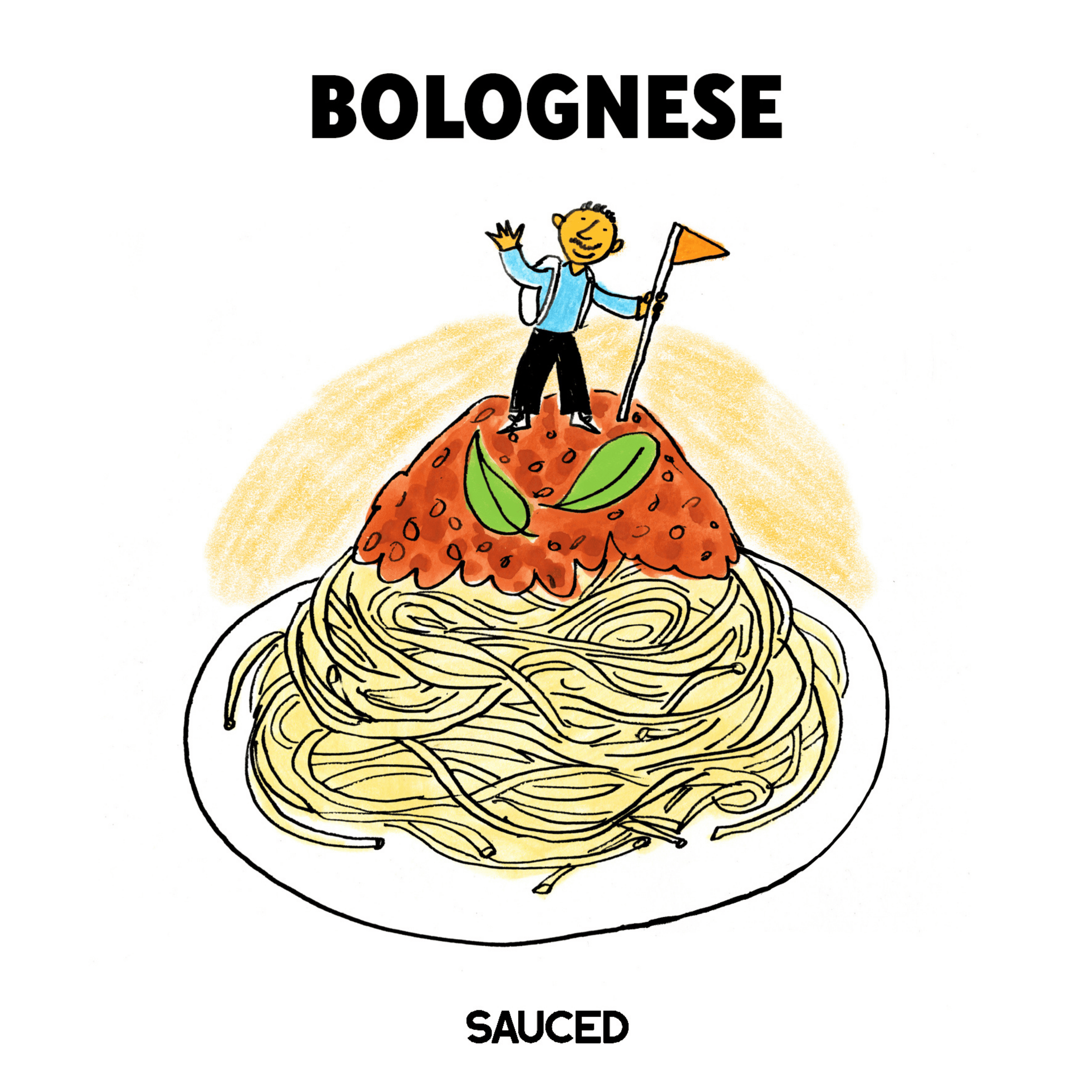
Real Bolognese is a meat sauce that happens to contain a little tomato, not the tomato sauce with meat that most of us grew up on. That's only where the misconceptions start. It's never served on spaghetti. And Bologna guards the real thing so closely that the city registered the official recipe, right down to the exact width of the pasta, with the Chamber of Commerce.
We trace it from a cardinal's cook in the 1700s to Pellegrino Artusi's 1891 version to the codified recipe, then argue out the wine, the milk, the pasta, and the one ingredient the official recipe bans.
"The longer it cooks, the better it tastes."
What we settled on:
Beef and pork, with unsmoked pancetta rendered first, no smoke and no bacon
Soffritto of onion, carrot, and celery, cooked soft with no color
Milk in early, cooked off before the wine, to tenderize the meat
A 50/50 split of dry red and white wine, low-tannin on the red
Just a whisper of tomato, paste plus passata, because it's a meat sauce, not a tomato sauce
A low "swamp" simmer for hours, until the fat separates and pools at the edges
Fresh tagliatelle, never spaghetti, finished with Parmigiano-Reggiano
The Cocktail:
The Academy — a gin Martini with fresh tomato water stirred in, named for the institution that codified the sauce.
RECIPE CARD:
Premium subscriber? Check out the full recipe card here.
LISTEN
EpiSOde Partners
Thanks to the following brands for partnering with Sauced to bring you this episode:
TRANSCRIPT
Tim McKirdy: Sother. Bolognese. Bolognese. Ragù alla Bolognese. I was thinking about this during preparation, and I believe this is probably the most well-known and iconic pasta dish in the world. And I would say Italian dish, but I think pizza just pips it.
Sother Teague: Okay, I can agree with that. Pizza is certainly more ubiquitous than this particular sauce preparation, and then also we misuse it here in America almost across the board.
TM: The version which is most well known, spaghetti alla Bolognese. Because spaghetti is a southern Italian pasta, and this requires — so tagliatelle is the correct one, codified as we will learn.
ST: Oh yeah, I dug into it too. I tried not to, but I couldn't help myself.
TM: Fresh pasta as well, whereas spaghetti is the variety always used for this is dried. So you're using something from the South and the wrong type of pasta.
ST: Right, and it's a dried pasta that's extruded through the brass pasta extruder, and so it's super smooth, so it doesn't have any grip. You want that fresh pasta, you want that wider noodle, and we'll talk about why as we go, as we dive deep into Bolognese.
TM: So I cut this from my notes, but now that we're talking about all of this, and we've teased that there is a codification, so we know where that's probably headed if you're a regular listener to Sauced and some of the things we cover there. But there was something where the mayor of Bologna, in recent years, was trying to show that the world does Bolognese wrong. Like, that everyone's doing it wrong because they're not using tagliatelle, and they're making other mistakes that we'll get into. So he was asking people to share photos online from around the world, and people were coming back with tinned versions from the U.K., and one from Scandinavia that literally comes out of a tube — spaghetti Bolognese. So while he was trying to show that everyone does it wrong, what he inadvertently proved was that the dish that's gone out into the world, the dish that everyone thinks of, has superseded the true Bolognese preparation. So it kind of backfired.
ST: I mean, it seems like everyone proved him right, that everyone does it wrong. The tube I'm gonna have to look up. Not only am I gonna have to look it up, I'm probably gonna have to get one.
TM: A tube of — I mean, who is that for? Children? I don't know.
ST: I don't know. Spaghetti Bolognese on the go. It's Go-Gurt. It's a slurpable tube of pasta and meat sauce. I worked for years at an Italian trattoria in North Carolina called Pop's, and we certainly made our fair share of this ragù. And plenty, plenty fresh pasta too.
TM: This is a dish that I would say was part of one of my mom's regular rotations at home. Definitely grew up eating it, and I think it also speaks to the versatility. You can have it as Bolognese one day. You can use it for a lasagna if you want. It'll go with other things.
ST: Well, and it's also so mildly seasoned that — in fact my dad, when I was a kid, now that you're bringing that up and giving me a pretty quick visceral memory, my dad would make a huge pot of this and we'd have pasta, and then the next night he would bury it in taco seasonings and we'd have tacos.
TM: Totally. You could also make sloppy joes out of it if you dry it out a little bit. You can just take it in so many different ways. But again, if we're giving this the full sauce treatment, which of course we're gonna do, we're gonna explore all the areas that we need to dial into and where we need to respect tradition — because I don't think we need to respect all of them, but you know what I mean. We'll land on the Sauced version.
ST: Oh yeah, there's a few things that I discovered that I was like, "Well, I'm still gonna do it this way." I definitely am never and would never serve it with spaghetti, but there's some other things where I was like, "What? I'm gonna go against that one."
TM: I think I know, or maybe not. We shall see. The one professional association I have with this — when I worked at The Bistro in London, one of the dishes on the room service menu that each section was responsible for, and these were only things that were cooked and served by the night porter. So when the kitchen shut down, there's a handful of stuff. It would be lasagna in these classic mash boats, or dauphinoise boats. So whoever was on the grill station had to prepare those and make sure that every night when they were leaving, they had six or eight en place, just to make sure. Wasn't a massive hotel. There was this one South African chef called Adam, who was the kind of chef who was out of a Bourdain book. Verifiably crazy, obsessed with movies, smoked, wasn't good with hygiene particularly. And he wasn't a great chef by any means. He was kind of slow. But the one thing he always prided himself on was his ragù base for the Bolognese, and actually doing a lot of research for this, he was pretty spot on with a lot of stuff he used to do. He would have that thing taking up half of his stove during service, just slowly simmering away, not even simmering. And he was like, "Yeah, you can't touch it, bru." Terrible South African accent there, but Timmy. So whenever I think of authentic ragùs, it's a skinny South African that first comes to mind. God knows where he is in the world these days. Give me the elevator pitch before we get into the origins.
ST: I always try and boil it down to a quick elevator pitch, and we have to come to the understanding before I even give the pitch that Bolognese is a meat sauce that happens to contain some tomatoes. This is not a tomato sauce with meat in it. Those are different things. So Bolognese, or ragù alla Bolognese: slow-cooked meat sauce from Bologna that transforms humble ingredients into a rich, silky, deeply savory accompaniment for fresh pasta. That's as boiled down as I can get it.
TM: And it is interesting that you use the word "humble" there, because that's what I think we all associate with this. The early versions, looking at them now, sort of hundreds of years on, this is more of a prince's preparation, as we'll see. But we will decide that after we get to it. To do so, we need to travel all the way back to the late 1700s. In Imola, just down the road from Bologna, a cook named Alberto Alvisi writes down what is the first ever mention of ragù in text. And it was a dish he made for the local bishop, a man who would later go on to become Pope Pius VII. So what was in it? Rendered lard and butter, a finely chopped onion, minced meat, including veal, pork and giblets. Browned hard, then loosened with a little bit of broth and bound with a little flour, and seasoned with salt and pepper and a touch of cinnamon. So no tomato anywhere in sight. That recipe got forgotten for centuries until two Bolognese journalists, Aureliano Bassani and Giancarlo Roversi, discovered it and resurrected it and printed it in a book that they published either in the late '80s or '90s — I got two versions of that one. So the first ever ragù, no tomato sauce, and just a slight hint of cinnamon with awful giblets in there. Very far from what we know today. Awful. Awful.
ST: That's offal — O-F-F-A-L. Offal. It sounded like you said "awful." Offal. And you reckon that they weren't putting any tomato at all in back then because tomato was still considered maybe poison? The whole nightshade debate.
TM: I also just wondered whether — you made this point recently for us too — where you're talking much more seasonal times there, and we're talking northern, or certainly central-north Italy there, that being an ingredient much more grown in the south. So I wonder whether it was that, and purely maybe this happened in winter. You know what I mean? The first time "alla Bolognese" appears in a cookbook was one very, very famous Italian cookbook from 1891 by an author called Pellegrino Artusi. Science in the Kitchen and the Art of Eating Well. That was a maccheroni alla Bolognese. And what was in that? Veal, pancetta, a soffritto — uh-oh, don't go near that one, Sother — butter and broth, with optional luxuries of dried mushroom, truffle, and/or chicken livers, finished with a little cream. So once again, tomatoes out of the equation, and this is much closer to that Alvisi 18th-century ragù than the Bolognese we know today. The tomato sauce, or as it should be correctly, and as you pointed out, meat with a bit of tomato. So then comes — and this is something we've seen so often in our exploration of Italian dishes that go global — as tomato in the early 20th century becomes a fixed part of cooking and the sauce, that enters the equation much more frequently. And then by the mid-20th century, when you have the emigration of Italy to America, that's where you get the Sicilian dried pasta coming into it. I suspect also we're talking immigrants, people probably with very little means, so tomatoes are gonna be cheaper than meat. So you're flooding your sauce with more tomatoes just to stretch it out. Final one for me here, and the one that I thought you would enjoy, and it sounds like you've been looking into this. The Accademia Italiana della Cucina — or Cucina, I never know with the single and the double Cs in Italian; much easier with Spanish — in the '70s, they registered at the Bologna Chamber of Commerce what should be the correct tagliatelle measurements, the one that's used for Bolognese ragùs: eight millimeters wide, cooked, fresh egg pasta. And they have a registered codified recipe that I'm just gonna put a pin in until we've gone through our non-negotiables, so that we can compare ours to theirs. But there's a few things on there that I think might surprise some folks.
ST: Well, I think the coolest part about it, or just notable, is that they codified the recipe for the sauce in '82 and recently updated it in 2023, to be a little bit, quote-unquote, more modern — to meet the modern grocery list, basically. They didn't change much about technique, but they changed a little bit about the grocery list.
TM: Yeah, which is nice to see. Because when we were talking, for example, with Bouillabaisse and the charter of Bouillabaisse in Marseille, and them using fish that just aren't available for us over here — this is more flexible, and this reflects what's at the butcher shop and what people are commonly cooking with.
ST: Modern tastes. Being firm but flexible is great. And I also really adore that these academies, these institutions, exist at all. And that they are so passionate and nerdy about the dishes and the representation of their countries of origin that they codify these things. We don't have anything. There's no American Academy of Cuisine that's codified the hamburger or whatever, you know what I mean? And maybe we should. The platonic ideal, and then go your own way from there, but here's the roots. No beans in chili.
TM: Do you think that comes down to the fact that there are so many regional variations on what we would consider classic American dishes or American inventions? Not that that's unique to America.
ST: I mean, sure, but there are plenty of ways to use meat sauce that aren't this, but this at least is codified so that we have a sort of touchstone to look back on and go, "Well, it's sort of like a Bolognese, but I used ground shrimp instead of ground meat."
TM: Do you think that in the information age, the internet has essentially killed what is such a tradition in countries like Italy, where it's generally grandmother — but grandparents pass down the recipe to their sons and daughters, and then that passes through? That literal cooking and handing off of recipes. Do you think the internet, just because we have everything to hand now, that that is kind of — I don't know.
ST: I don't know if it's dead, but I will say that it's probably slowing down the changes that happen, because what you just described is a slow-moving generational game of telephone. My grandma's recipe that she gave to my mom, my mom changed it a little, and then my mom gave it to me, and I changed it a little, and then I'm gonna give it to my kid, and they're gonna change it a little. So slowly this thing is changing. And then of course the things that change around you, the things that are available. My grandma's recipe for biscuits, I can't make them here because we don't have the right flour here in the Northeast United States to make good Southern-style biscuits. So those things change too. Has the internet done good and evil things? Yes. Was that your question?
TM: No, I just wonder whether that cuts a line through and creates a clean break, for better or worse. Because then, say for example, if I had nieces or nephews or a son or a daughter, and handed down some recipes for, I don't know, sourdough — then someone could just look up that recipe and be like, "That's the New York Times Cooking one." It's not a family heirloom anymore. I'm pretty sure there's a sitcom, might have been Friends, where someone is trying to reverse engineer one of their parents' or grandparents' — I think it was cookies. Was that Monica in Friends? And then that creates another thing: how much is it down to the authentic recipe, and how much is it down to the nostalgia of who you're eating with, what you're eating, and where it is?
ST: And then it turns out it's the Toll House cookies. It's the recipe on the bag of Toll House chocolate chips. We've talked about this before, in real life and also on the show. Oftentimes it's nothing about what's on the plate or in the glass, it's about who you're with and where you're at. And also, is it raining today? Do you like rain? Maybe it's raining, but you love that. It's gonna make things different. So all of this that we dig into and talk about, it's fun for us and it's minutiae and it's details, but as I kind of always say on the show, I want you in the kitchen with me cooking. Let's do this together. It's fun.
TM: How about culinary luminaries, people that have had an impact on this dish or something important to say about this dish?
ST: Well, the only one that I really had specific to this dish you touched on — Pellegrino Artusi, considered to be the father of modern Italian cuisine, and kind of deserves the credit for popularizing this recipe in that book with a lengthy title, Science in the Kitchen and the Art of Eating Well. And I love that the title itself has both science and art in it. Because that's always been a discussion. When I was a young chef, people would be like, "Oh, you're an artist." And I'm like, "No, I'm a craftsperson." And they'd be like, "Well, what's the difference?" And I'd say, "Well, with art, I'm allowed to emotionally move you." And this was baiting them, because I knew that they'd respond, "Well, your food does move me." And I'd say, "Yeah, but with art, I'm allowed to move you in any direction. I cannot make you Bolognese that makes you feel morose. You will not come back for Bolognese. I have to make you Bolognese that makes you feel happy." So it's craft. But I love that he put the word science and art right in the title of his book, and it dominated. I looked at Jacques and Julia. Neither of them have anything really specific to say about it, except for things like, "take inexpensive ingredients and make them extraordinary," slow cooking, et cetera. That's usually their take on stuff like this if they don't have a direct thing to say. Marcella Hazan, excuse me, who we've talked about many times, is kind of the godmother of Italian cooking here in America. Her version in her book, The Essentials of Classic Italian Cooking, became the gold standard for American cooks, because it was such a popular book here in America, and she famously wrote, "The longer it cooks, the better it tastes." And I think that maybe that single sentence captures Bolognese entirely. It's not to be rushed. This is certainly a project that's gonna take you some time when you get into it.
TM: Her version is also available on The New York Times. I'm pretty sure it's verbatim pulled from Essentials of Classic Italian Cooking. If not, the steps are exactly the same. I've kind of taken to hers as being — actually, I think this is it. It's got certain things that were unexpected for me, but I can see why she does them, and she does them in the right order for my mind. And beyond that, just the steps. Everything seemed to click from her preparation, and maybe we can walk through some of those things just now, just to highlight them, and then we can debate them in the non-negotiables.
ST: Sure. I don't know her specifics, but you probably have it there in your notes. Let's go.
TM: So the unexpected ingredient, but that is traditional, number one is milk. And then also she opts for dry white wine instead of red, and we can get into that too. But she goes mirepoix essentially, then meat, then milk, cooked off completely. Tiny bit of nutmeg — that callback.
ST: That's a little bit of a — I kind of like nutmeg, but nutmeg doesn't have to be there for me. It's not a non-negotiable by any means. We'll put nutmeg in there, I know we will, but I'm just saying, this popped up in a little bit of my looking around. I've never put it in there, but I could see it.
TM: Me neither, but I just thought that nod back to the first ragù made total sense. And don't get me wrong, nutmeg and meat, nutmeg and milk, fantastic together.
ST: Well, if you're using that same ragù and you're building your lasagna with — bechamel has nutmeg. So I see it, and I also see that bechamel has dairy, so the milk, it all ties back together.
TM: So those were the things that popped up, and we can dive deeper on those. But for some reason, her preparation has cemented itself in my mind.
ST: I will say that I'm curious to talk about more the milk coming before the wine.
TM: Yes. And we will get into that. One or two other people: Massimo Bottura, we've spoken about him before. From Emilia-Romagna, so close by — or maybe, I don't know my Italian, which is the region and the province and wherein, but I know they're close by. Modena, I believe he's in. That's where — more famous for their balsamic vinegar. He goes with chopped meat rather than ground. And I think that's again a tie back to history and just what would've been done beforehand. I've never tried that out, and I guess that's kind of like the chili debate.
ST: For me that would make a texture that I wouldn't be looking for in this sauce, because — well, I just explained it to myself. This is a sauce. I'm not expecting to be chewing on meat. I want the ground meat, and the long, slow cooking is gonna break it down to a point where it's a sauce. But again, that's just one man's opinion. I've been getting raked lately for my opinions, so I gotta reiterate that that's just me. You can do what you want.
TM: I always make sure that we cut that qualifier from the social media clips, because no one wants a steady hand or an even take on social media, so you can say "that's just me" all you want on this. It ain't making it into the clips. Then one final one — this is a restaurant I would really like to go to, Felix Trattoria in Los Angeles, down in Venice Beach. We never get that far west into the coast. It is a trek to get out there.
ST: Well, you could do it for us. I can't. You know I don't have a driver's license, right? I can drive, and I will drive, but I can't rent the car. The license doesn't teach me to drive, it's just the legality of it all.
TM: It just allows you to. So a chef called Evan Funke — Evan Funke, even — he left a fine dining career to go to Bologna and to train under master sfoglina, like pasta maker, Alessandra Spisni. So his restaurant in Venice, Los Angeles, has a pasta lab in the middle of it, and it's got glass around it. And so obviously we've all worked in kitchens where you make pasta by hand, but they're processing everything by hand. No machines, everything is hand-rolled, with pins and stuff like that. The kind of work as well that Massimo Bottura is pretty famous for, if you've seen Chef's Table and stuff like that. The name of his is Tagliatelle al Ragù Vecchia Scuola, so I guess old school. He also goes for hand-chopped meat. Which again, interesting nod, but this is one of those ones where I'm with the Academy. I'll go with the evolution. I like the mince. Well, those have been our origins and our culinary luminaries and what they have to say on Bolognese. So then let's take a quick break now, and then we'll be back with the non-negotiables. All right, here we go. We're back. Non-negotiable number one, hit me.
ST: Meat. Meat is the star of this dish. And you got a couple of varieties of meat in here, but the bulk of it is gonna be beef. We just talked about that, so I'm definitely on the — we're going through the grinder on this.
TM: What are your others? You said it's the majority. What else are you thinking about putting in there?
ST: Well, we're gonna have to have some pancetta. Unsmoked, for this one, for sure. I don't want smoked pancetta in this. I don't want bacon in this. Can you get away with that? For sure, but the delicate nature of this sauce is really just about — we wanna get some saltiness from the pancetta, we wanna get some fat from the pancetta to cook the vegetables with, but this is not smoked. That's a hard one on this one. I know we've debated this before, and that's why I'm really stating my case.
TM: I might opt to go for a little bit of veal and pork in there as well, to keep it traditional and look at those other ones. Or, in a pinch, maybe it goes beef, pork mince, and pancetta. I think that's where I'm landing.
ST: I think I'm right there with you. I'm scanning through my notes real fast to see if I'm wrong — the Academy said the hard no on one or the other. Was it veal or pork? It must have been veal, because the pancetta's pork. So let's go pork.
TM: We'll get to the Academy's recipe. We'll see what they say. I don't remember off the top of my mind. They definitely have pancetta in there. I think the thing they changed their mind on was it used to be made with skirt steak, and they were like, "That's harder to get hold of and expensive." So let's go ground. Next non-negotiable for me — it is often overused, but I think it has to be tomato. Paste or a little bit of passata, the strained.
ST: I want both. I want the passata and, depending on the batch, a hefty spoonful of tomato paste to give it that tartness. You gotta have mirepoix. We're gonna make a soffritto, pretty standard — celery, carrot, onion. Gonna dice them pretty small. Gonna render them in the fat that we get out of the pancetta, but soft. We're not trying to brown anything here.
TM: And it's surprising, considering how often we just go for those ingredients normally and cook with them as our process, as French-trained chefs. It doesn't come up that often in these dishes we've covered on Sauced, so it's nice to see a little onion, carrot, celery action, a little mirepoix action happening. All right, then I'm gonna go wine.
ST: Gotta have some wine, and I know that you can go either way, red or white. I think I want red. It's so goofy, the reason I gravitate towards red is because that's how we made it when I worked at Pop's, but also the deep coloration of the sauce in the end product, I think, is helped along by the red wine. So I'm negotiable, I guess I could say. Am I non-negotiable? I want wine, for sure. We had talked about on Sauced how maybe in a lot of places we would substitute vermouth. I don't think vermouth is right for this dish. Because again, we want a really delicately beefy flavored sauce, and I think the herbs and added botanicals in vermouth are gonna be crowding it out.
TM: Where I lean white is for two reasons. Number one, we don't have any issue of tannins from the red. Now, of course, you can choose your red accordingly. Number two, you get some primary fruit flavors from white wine, so green apple, lemon. It depends on the white wine, but white cooking wine is gonna be acidic. It's gonna be fruity but light and clean. Whereas I think a red introduces bolder fruit character, red fruits that are going to — I wouldn't say clash with the tomatoes, but maybe distract from. Maybe we'll go 50/50. If only there were —
ST: That could be an easy fix for our conundrum. Are you suggesting mixology? Okay, fine. Milk. Gotta have some dairy in here. It's gonna give it some unctuousness and some silky quality. And we're gonna cook it — when we get to the cooking part of this, you cook the liquids out. There's almost none left behind, so what you're really getting from the milk is kind of the lactose, and that's what's gonna give it that mouthfeel.
TM: The lactic acid also helps activate the meat's own enzymes, so it starts to help gently tenderize it. Which is why I think the Hazan approach is so good, because if that's the first liquid the meat meets — which you've not necessarily heavily browned, or she doesn't — and then you reduce that right down so it's completely gone, I'm like, "Okay, that makes sense to me," rather than finishing the sauce with it, which would be odd.
ST: Honestly, it does, which is what I did my entire time. Every time I've made this, the milk is kind of the last thing, but now that makes perfect sense.
TM: And you know what I was also surprised at? I've never cooked this dish with milk, so this is a completely new ingredient for me for this one. What about the risk of curdling? If you have the extreme acid from the tomatoes and from your wine, and you're mixing milk into that, isn't there a risk of that curdling? I mean, we make our milk punches. So I think the traditional version is like you have done, at the end.
ST: I've never had it happen to me. I think the heat is helping. Like, I am nothing if not willing to learn something. I'm not a gatekeeper of information, and I'm willing to learn and change my opinion. And I don't even think I really had a strong opinion. I just was like, "Well, this is how it's done." And then you say that and I'm like, "Wait, yeah, that's true." It almost makes me wanna go — do I fold some of the milk into my ground beef before I even get it into the pan? No, because I wanna get some browning. But we do that with other things. We soak other things in dairy before we — think about your yogurt lamb, or your sweetbreads, chicken dipped in buttermilk. You know what I mean?
TM: So I've got one kind of related — we got into a little bit of milk science there. For me, I don't think this is a non-negotiable when it comes to something I would be able to tell as a diner, but it's a standard that I hold myself to at home, or when I was working in kitchens. For any dish that contains acidic ingredients and is gonna be cooked for a long time — cooking for a long time is a non-negotiable I think we can agree on — long cooking, therefore you should never be using an aluminum pan, or there's some other materials as well for pans. Now, I get that that's not gonna be an issue for most people at home. Most people have stainless steel; aluminum pans aren't that common in home kitchens. But the big stock pots — when you have massive pots in kitchens, aluminum's cheaper, and sometimes you don't have the pan you need available, and people would start sauces, and our chef would go crazy if there was any tomato in there.
ST: Yeah, I can agree. And you're right, this isn't as common at home anymore. I remember my grandmother had aluminum ware. I think it was actually Griswold aluminum stuff. Probably worth money if it still existed. But you're right, we had certain pots that we would make the Bolognese in at the restaurant that, yeah, no tomato going in there. That's a good call. I didn't even think about that. But also I did notice that when I went to the Academy's website and looked up the codification of the recipe, it does call for using enameled cast iron or — it lists like three that you can use. And I'm like, "Man, these guys got to the nitty-gritty." That was line one. Line two, a wooden spoon, specifically.
TM: Yeah. Stainless steel, enameled cast iron, or terracotta is the third one. And the reason we're saying this — it's not to be overly pedantic, but acid plus aluminum, the reaction, especially over a long period of cooking, will extract a faint metallic taste and a kind of bitter tinge to the dish. And it's not good.
ST: It'll also etch your pans. I have a great example right now at my house. I made a bunch of pickles recently out of watermelon, and I sat them in quart containers, deli-style quart containers, on an aluminum sheet pan, and put them in the back of my cabinet, and when I went to grab one recently, there's a ring where the container was sitting that is etched. It looked dirty, and I could feel it, and then I went to scrub it, and I'm like, "Oh no, the vinegar." Some of it bubbled out. The vinegar etched my sheet pan. So this can happen, and yes, it will produce some off flavors. Now, they're not gonna kill you, probably not gonna change anything really, but if we can avoid it, let's avoid it.
TM: Let's avoid it. And yeah, more of a technical consideration than a non-negotiable. Then final one for me here: finish it with cheese, and it has to be Parmigiano-Reggiano. It's true to the region, and I would at least expect to be offered it at someone's house or in a restaurant. So, the option of having cheese. Okay, so let's fly through now what Bologna registered, most up-to-date, in 2023. These are the classic non-negotiables. Meat is ground beef and unsmoked pancetta. The soffritto: onion, carrot, celery. The liquids: one glass of wine, and that can be red or white. They go for the double — passata and double-concentrate tomato paste. They do include milk, but now marked as optional, which — hmm, not sure they needed to dial back on that one. A little bit of broth. And extra virgin olive oil for cooking. I believe earlier versions had included butter, which seems distinctly non-Italian, although again, we're in the northern half here at least.
ST: Wow. Which we didn't mention — we need some broth. Butter.
TM: And then they have a method. And as I mentioned earlier, the most notable thing about their method is adding the milk at the end. The Academy. Makes me feel like that guy Pete's Pans that we love on Instagram. We love him. Is that his Academy? Maybe give a tiny bit of context. Give me a 30-second pitch on Pete's Pans.
ST: Oh, this guy — I assume his name is Pete — and he is wandering across the countryside in Italy and France and Spain, cooking these beautiful dishes outside, with a voice overlay that's very soothing, about the dish that he's making. And he does it all as traditional as possible with the local wine that he's drinking, or Armagnac or what. Each of his videos is around two minutes long, so it's just a great two-minute break from whatever you're doom-scrolling. Pete's Pans, and he has what he calls The Academy.
TM: His own codification of dishes and whatnot. Very similar to what we do, but he's out there in the wild traveling in a mini RV. You know what we've both forgot for a non-negotiable, which is pretty high up on the list, I'm just realizing? Pasta. I would say the show is Ragù alla Bolognese, but we're just gonna put "Bolognese" in the title because that's what people are searching for. But I think the distinction is: if you're serving this, it has to be served with tagliatelle instead of spaghetti. And no penne. Don't get me wrong, I love it when it goes in the penne and the — what's the other one? — the rigatoni. I love that. We'll save that for our vodka sauce.
ST: Riggies. Yeah. Okay. So we definitely need pasta, and it's gonna be tagliatelle, and hopefully you can make it yourself. You know what's crazy? I made so much pasta when I worked at Pop's those many years ago that I just never like to make it at home. It's one of those things. And it is satisfying, and I'm gonna make myself make some for this. But it just drilled it out of me. One day. Well, for this, I'm gonna. And then second to that, this is of course the springboard for making lasagna. But for our intents and purposes, we will make some pasta on the side.
TM: So I want to introduce what is fast becoming a regular feature, Jamie Oliver.
ST: Oh, mucker. I don't even know what that means, but you said it and I loved it.
TM: Mucker. It's a colloquial term for a friend, a mate, a pal. Jamie Oliver — specifically Jamie Oliver's Very British Bolognese.
ST: He's being careful with his wording.
TM: I mean, fair play. At least he's given that caveat. Published in his 2020 book, 7 Ways. I believe the recipe's also on his website too. So probably he learned from jerk chicken and paella-gate — sorry for those people that got annoyed about that. When I'm speaking Spanish, I will say paella. When I'm speaking English, British English, I will say it how we say it in Britain: paella. Just for those people out there who got annoyed and left us comments. No, we love all the feedback. So in 2020, which was four years after all of that, he published his recipe for a Very British Bolognese. Some pretty bad swaps out here.
ST: Oh no. So why call it Bolognese? Just call it a Very British Ragù. Ragù is the umbrella term. You can go anywhere from ragù. If you say the word Bolognese, we've got somewhere to go. It's in a cookbook, right?
TM: You don't need SEO — search engine optimization — for this. Someone's already bought the book or is reading it. You have a captive audience. Subs out wine for pale ale. Out goes Parmigiano-Reggiano, in comes cheddar. Out goes pancetta, in comes bacon. In comes Worcestershire sauce from nowhere.
ST: Just because. Well, it's very British.
TM: He starts his cooking with a fistful of rosemary — there's a video of him making this on Facebook, by the way — and he uses it to flavor the oil, but doesn't do a very good job of taking it out afterwards. Then he uses frozen mirepoix from the bag, and fair play to him.
ST: But also, I'll give him credit for that. Fair play on that. He's trying to get people to cook. So, okay, we're gonna eliminate a step for you.
TM: Fine, totally cool. But then he adds mushrooms, which he's finely chopping, and he's talking about how they should be the same size as the mirepoix. These things are like chestnut mushrooms sliced at best. And rather than tagliatelle, he cuts fresh lasagna sheets into two-centimeter-wide strips. Not really sure why he's doing that. And I think I covered everything there. And all that's left to say is that that is our Porco "Oh no, Jamie, you did it again" moment of the week.
ST: I just wanted to jump back for a second. When you said he used rosemary, it reminded me that they have a list of unacceptable variants on the Academy's site. Number one unacceptable variant is adding veal. That's what we talked about a minute ago — I couldn't remember if it was veal or pork, but it was veal. Number two unacceptable variant, smoked pancetta or bacon. Again, no smoke in this dish. This one I find kind of funny, but I get it: unacceptable variation is only pork. You can have beef, you can have beef and pork, but you cannot have only pork. Can't use brandy instead of wine, cannot use flour as a thickening agent, and then here's the one that made me come back to this: can't use garlic, rosemary, parsley, or other herbs and spices. This dish is delicate. This is all about the beef with a little bit of tomato and those vegetables and that little bit of fat and salt from the pancetta.
TM: I like those things, because they remind us to not go on autopilot, kind of how I was talking about earlier. Garlic maybe doesn't need to be in everything. And being intentional. We're just taught, "Okay, we're gonna start like this. This is gonna be the base of everything."
ST: It does. That's why this dish stands out and has some personality and a point of view. The Jamie Oliver version — the cheddar is what got me the most. Let's do a very American one and we'll use American cheese. No.
TM: Oh my God, can you imagine the uproar? Italy would erupt. All right, Sother, those have been our non-negotiables, and I think we've covered every ingredient as well. So time for us to take another quick break, and then we will be back with the preparation.
ST: Cool. You know how you can get away without these breaks? Be a subscriber. Subscribers get ad-free listening. But if you're not a subscriber, strap in, here comes your break.
TM: But we love our partners as well. So you're gonna hear a wonderful message now, and if you're already a subscriber, you're just gonna hear a little audio beat, and then we'll be back before you know it. It's like Interstellar. All right, Sother, we are back. Time to prepare some Bolognese.
ST: Let's get into it. We're gonna get that hopefully enameled cast iron pan, or whatever vessel you're gonna use, over medium-low heat. Get your pan surface in the 320-to-350-degree range. That finely diced pancetta goes in. We start to render that out. And take your time with this — again, this whole process is lengthy, but as happens a lot, it's got a lot of pretty passive time involved. So we're looking at, A to Z, this is six hours-ish. Can go longer. Could speed it up too, but don't. Your patience will be rewarded, and I think that's a common refrain in the cooking world. If you can be patient, you will be highly rewarded. So just a scant amount of oil and that diced pancetta into that pot. That little bit of oil is just gonna help the pancetta begin to render. You don't need a ton. Take your time, five to seven minutes of getting the pancetta rendered, and then in go all those vegetables that are pretty finely diced, because we want them to kind of disappear. We want them to melt into the thing. Go about 20 minutes on just the veg, getting them really soft. Trying not to get any browning, but just really soft. Then add in your meat, your blend of — we decided on ground beef and pork. Get that going for about 15 to 20 minutes. Break it up as best you can, and increase the heat a little. We're trying to get the moisture in the beef and pork to evaporate, and it should get cooked, but I don't want it to be crumbly and hard. Not trying to make the crispy bits on the edge of a smash burger here. I rotated a few things around in my notes real quick — this is when I'm gonna add the milk in. We're gonna simmer that until it's pretty much evaporated, like when you can take your wooden spoon and pull it across the bottom of the pan and not see any liquid down there. Then we can go in with the wine, and we decided we're going in with a split of red and white, and something low-tannin on the red. That's gonna stay in there for about 15 or 20 minutes as well, until, again, completely gone. We want it completely evaporated. Then we're gonna add in our two tomatoes. I wanna fold in a heaping spoonful of the tomato paste first and get it stirred throughout, and then add in the passata, which just means, as you said, strained. It's not chopped tomatoes. It's not diced tomatoes. It's not pureed tomatoes. It's strained tomatoes. Stir that thoroughly in and get it up to a simmer, then add in stock. My preference for this is vegetable stock, because again, I'm relying on the taste of the meats that we put in there, not the broth. So I would either go water or a light vegetable stock here, because it should be a really delicate flavored sauce in the end. Bring that to a gentle simmer, 180, 190 degrees. Partially cover it. Walk away, for a while. Go watch a football game. We got three to five hours here. Step by every now and again and give it a quick stir. Make sure your liquid isn't completely gone. So every 20 to 30 minutes, you do wanna come by and just check in, and if your liquid is going too fast, that means your heat's too high, so turn your heat down. And have some more stock handy to continue to replenish it a little bit. At the end is where we're gonna go in with a bit of salt and pepper. Give it a good taste, and we're out. Now it's time to make pasta. Well, during that long, slow simmer, that's when you were making your pasta.
TM: And maybe ideally the day before, as you spoke about in our bonus episode, which was on focaccia for paid subscribers, very recently. But resting that pasta overnight, hydrating it overnight.
ST: Yeah, that's advisable. I will be posting a video about the focaccia that I made that is a failure. I'm 100% sure my yeast was not alive.
TM: We spoke about that. And again, folks, that is a reminder: $7 a month, $70 for the year, two months free, bonus episodes on baking. And that's when you can hear Sother walking in full of hope for his first focaccia, and it sounds like that hasn't gone too well.
ST: I'm gonna bake it today when I get home. I've been fermenting it for three days, but it has not puffed up, so I know it was dead. But that's okay. I'm gonna bake it, and we're gonna talk about the mistakes that were made, and we will rectify them and do better next time. But the episode was great, and it inspired me to go home and make bread. And I don't mind failing, especially if we're gonna learn something from it. And also, it'll be edible.
TM: A few notes I had here on the Bolognese, on the ragù. Number one, I'd be tempted to season my meat when we're browning. And also when we add the milk to tenderize, I would like just a little bit of nutmeg in there, just as a nod to the tradition. And then this isn't an addition or a correction, but something — again, I believe it was in the New York Times Hazan canonical recipe — that I thought was great and really took me back to Adam in the kitchen there, South African Adam. When you're simmering it, you mentioned this: it isn't lightly bubbling. This is flat, and every so often you'll see a bubble, like a swamp. Every so often you'll see a little simmer and a bubble come to the surface.
ST: This swamp from the movies, because I've been to swamps and that doesn't happen. But I understand what you're saying. You need to be able to see a bit of steam rising off without really any action. So there is evaporation happening. It's just not even remotely violent.
TM: And then those occasional scrapes and stirs are to make sure nothing is catching and caramelizing and burning on the bottom. And then you know when it's done — that the fat separates from the stew and starts to pool at the edges of the pan. And again, if that's just on top, it's like you're making a veal stock or something; you've probably got maybe a tiny bit too much fat, but also you're not cooking it quite enough. But pooling on the edge of the pan is a good sign that, should you want to pull it off, and if the consistency looks good for you, then you're done. Or go another three hours. Then you'll serve with your pasta, and we'll have the option of Parmigiano-Reggiano grated fresh over the finished thing. Anything else you wanna eat with this on the side?
ST: Kind of no. Maybe a nice wedge of focaccia. I mean, the style of eating in Italy comes in waves. So we might have like a contorni, some vegetable offerings on the side, maybe some simply roasted artichokes, or even carrots, some sweet carrots that have been roasted on the side would be nice.
TM: Rubbed with a little garlic, because we're not allowed any in our dish.
ST: I didn't really think too hard about the side of this, because I'm just really enamored by the dish itself.
TM: I think the version I've had growing up, and the one that I think a lot of people expect, is just like a fresh salad of iceberg and tomatoes and maybe some onions and an acidic dressing. I think that's the common one, but I really don't think it's necessary, and it potentially distracts from it. All right. Well, that has been our preparation. Definitely booze in this dish. But we're missing some in our glasses. Final break for us here today, and then Sother will be back with the booze. All right, Sother, we're back. I'm banning beer for this one.
ST: Let's go. I think I can get on board with that, unless we're making the Very British Bolognese where we put beer in it.
TM: I think Jamie's made me ban beer for this. I'm gonna hit us with some wine pairings, and it's slightly ironic because something of a theme for us recently has been the primary pairing for this one. We've been using it out of context, and now we have to call for it again. It is, of course, Lambrusco. Traditionally paired with this dish in Bologna, chilled, lightly sparkling, dry red. I love it. And you do get a bit of tannins, but that interaction — it's such a novel texture and experience, having tannins in something that's sparkling. It's the regional answer, so we gotta go with it. But because we have been on a Lambrusco kick today, I thought I would share two others that are nearby and sticking with Italy. Sangiovese di Romagna — Sangiovese being the primary grape used in Chianti. Bright cherry you can expect, some savory herbs, nice acidity, not too heavy on the body. It's got good body, good cuerpo, but it's not domineering. It's not gonna overpower the dish. I think what you said about this is so true — it's delicate considering all the ingredients it has, so we wanna reflect that with the pairing. And then otherwise, and definitely easier to find than Sangiovese di Romagna, Barbera. A classic juicy red, black fruit again, bright acid, soft tannins, easy to drink, easy to pair, beautiful companion for Bolognese.
ST: I can agree with all those. And what do you reckon about Lambrusco? I find it to be polarizing. People either really dig it or they really are not for it.
TM: My experience has been that it's one of those wines that has suffered from associations that people have with sweetness. I think there was probably a generation of drinkers here that were only exposed to sweeter Lambruscos. Same goes with Moscato, same goes with Sherry, and I think that's why people are like, "Ugh, Lambrusco."
ST: Ugh.
TM: But I think anyone who has tasted the modern versions, the one that we're talking about, the classic dry one — anyone who's tasted it becomes an evangelist.
ST: Yeah. But I still find that when I pull out a bottle of Lambrusco, people are like, "Ugh." I think it's the carbonation, really. Some people just don't enjoy carbonation.
TM: And again, I can understand that too. If you're used to sparkling being white or rosé, and red is still — yeah, it's a weird one, the first experience you have with it.
ST: I love it. Anyway, let's talk cocktails. I think some obvious pairings here are in the Negroni realm. Let's have a Negroni. Let's have a Negroni Sbagliato, which is gonna be an effervescent one. Let's have a Boulevardier, because when I'm eating beef, maybe I want whiskey. Let's drop it down a little bit and have an Americano, which we talked about recently as well. But I've got an idea here. We are making this sauce that is meat with some tomato, so I think let's take a Martini and get some tomato into it. But not a ton. So let's make a tomato water, which I think is kind of a mystery to people, but it's super easy to make. Get some nice beautiful ripe tomatoes — and we're moving into summer right now, so they're hitting, pretty easy. For every about three pounds of tomatoes, you just need a teaspoon of either salt or sugar. This is just gonna help draw the moisture out, and it's gonna depend on your intended use. So I've made tomato water into syrups many times. For instance, I made an Old Fashioned recently with a bacon-fat-washed tomato water syrup that was supposed to go with a sandwich that had some of those flavors in it, like a BLT basically, for a charity event. You were there, recall. But in this case, we don't need to add any sugar to this, so just a little bit of salt, which is great to put into cocktails, don't forget. So, teaspoon of salt to around three pounds of tomatoes. Pulse them in your food processor or blender. You don't wanna make a complete puree out of this, but just really chop them up well, and then suspend them in your finest mesh strainer or cheesecloth over a container, and pitch it into your fridge and wait. And what you'll come back to several hours later will be almost water-clarity liquid that has dripped out of those tomatoes. Now, of course, that tomato product that you have left, we can use for something else. But now that you've got this water, you could make it into a syrup if you want, but I think we can just use it as it is and bring it into a Martini. So I'm gonna go — our standard ratio, you and I, is a five-to-one, so that's two and a half ounces of gin up against a half an ounce of vermouth. Let's just substitute one quarter of an ounce of our gin with this tomato water. And then stir this over ice till it's nice and cold, and serve it in a frozen glass with maybe a little cherry tomato as a garnish.
TM: Maybe even a little pickled cherry tomato? This is really good. Glad we're going with a Martini for a change. It's been a while.
ST: It has. Now I make 'em, you name 'em. You got a name for me?
TM: I think we shall call this The Academy.
ST: In honor of the Academy that have codified this recipe, and also our friend Pete from Pete's Pans.
TM: There we go. I love it, and love a tomato water. Question for you. If I was to do that, and during the process of pulsing in my blender, if I wanted to make it even more Bolognese-y — would it be cool if I added some carrots and celery in there too? I'm not gonna go onion, because I think that could be jarring, and I could get that from a jar — pickled onion. How would that — then we're looking at more like a — yeah, I don't know.
ST: Yeah, absolutely. I'm trying to think who it was who somewhat recently had a cocktail on their menu that had sort of a mirepoix Martini situation. And then they had the powders. It's Sip, from Sip & Guzzle. Downstairs. So you could certainly do that. Have you had it or not?
TM: It's at Sip, the downstairs bar at Sip & Guzzle. That's an intense drink. I admire the creation. I don't know whether I would run to order a second one. But super interesting, and interesting use as well of — I think as you mentioned, the seasoning on the side of the glass, almost like how we would go for a Margarita.
ST: I've only been upstairs at Guzzle. I had the burger though.
TM: It was very intense and a good use of dehydrated products that you would otherwise throw in the bin. Mirepoix Martini. What can't we Martini? That is the question.
ST: We have to do a deep dive on that very subject soon.
TM: In the meantime, what are your final thoughts when it comes to this dish, or what are people missing out on if they never attempt to make it at least once in their life?
ST: This seems to me a straightforward and basic recipe that has a few little gems in it that are gonna teach you some things — how, as we talked, I learned today myself how milk is gonna interact with meats, how patience can create flavors, how no single ingredient can achieve what this small amount of ingredients can achieve together. And it's gonna teach you that oftentimes very good food is less about complexity and more about understanding and transformation, because this is a transformative dish. It takes many, many hours for it to go from its raw components to the completed product. Your patience is rewarded. And if I didn't say it earlier and I meant to, when you make this, that six-hour commitment is if you make two servings or 20. So go ahead and make 20. And this is a product that freezes really well. Otherwise it's just a waste of resources.
TM: Don't be Tim with one rack of ribs on the grill, is what you're saying here. Otherwise, I'd be robbing myself of another occasion where I could be grilling. No, I love it. My final lingering thoughts on this are the things that I learned in discovery. The milk, brand new to me. A little hint of nutmeg, amazing. And then that wonderful descriptor of how it should be bubbling and at what point it's done. And my "what are people missing out on," I would flip that into more of a plea to people, which is: look, Bolognese is something that most home cooks have in their arsenal. It's very hard, if you've been making something the same way for 10, 15, 20 years, to turn around and say, "I'm gonna completely do this different today," because that's what you know, and that's what you like. I would urge those listeners for whom that is the case to say, "I'm gonna give the sauce recipe a go. I'm gonna try and hit all those beats," or at least please introduce milk, a little bit of nutmeg, slow simmer, fat separating. If you incorporate those, I'm happy. I think we've done our job today.
ST: And I think you'll come to a quick realization of why there's an entire Academy that devoted itself to codifying this dish. It is well worth the effort, and the exercise.
TM: Sother, one of these days we're gonna need to form our own Academy. But you know what we gotta do in the meantime? Time to put on the apron.
ST: Pull out the shaker.
TM: And let's get cooking.
ST: And drinking.
TM: Cheers.
ST: Cheers, buddy.