Episode 26:
BURGERS
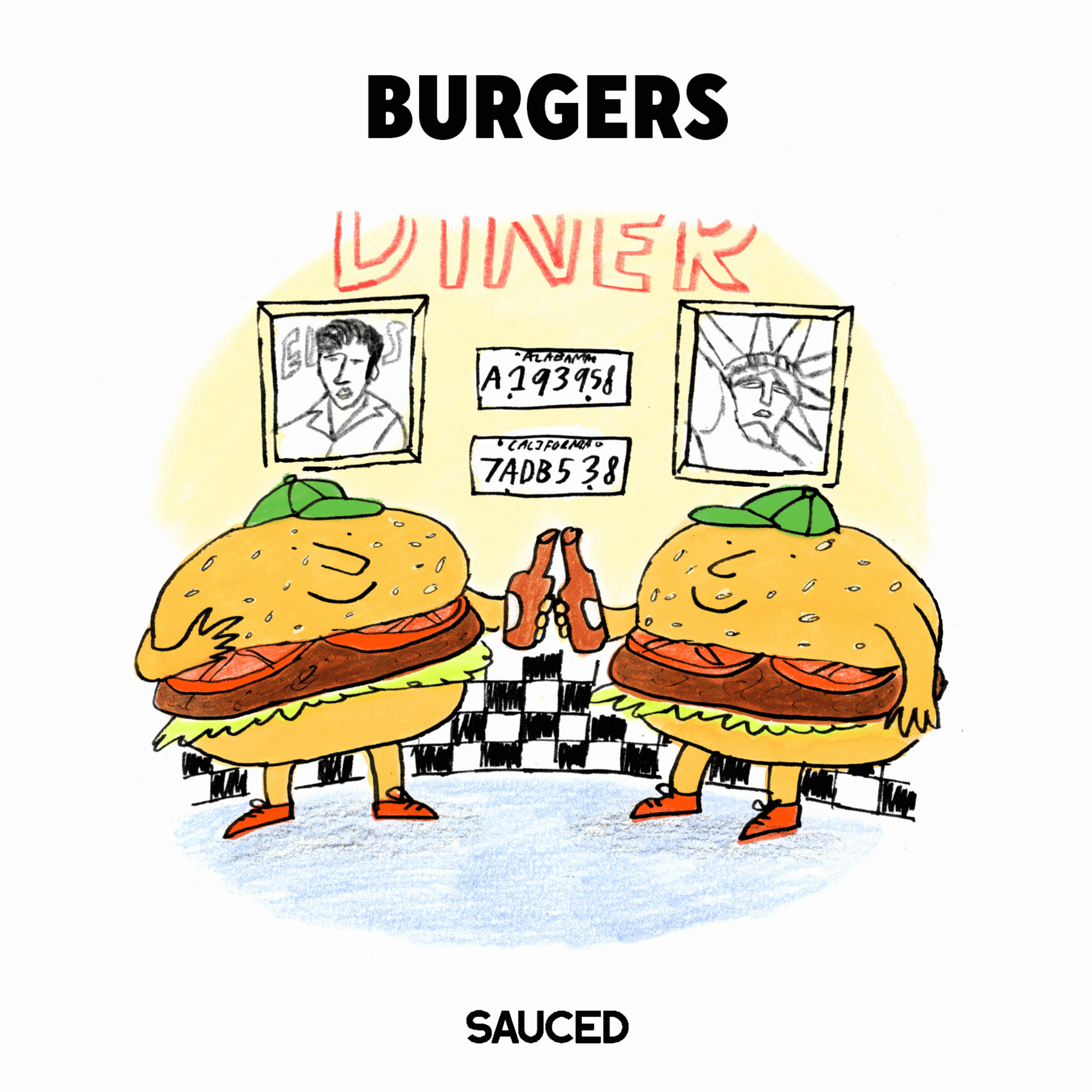
At least six towns claim they invented the hamburger — and the one the Library of Congress actually crowned still won't serve it on a bun or with ketchup. Which raises the real fight we spend the episode having: what even makes a burger a burger?
Just in time for the Fourth of July, we trace it from the Hamburg steak to the smash era, then go round after round on the bun, the cheese, the sauce, the doneness, and the counterintuitive salt rule that decides whether you get a burger or a sausage — with three ways to cook booze straight into it.
"The biggest American contribution to the culinary world."
What we settled on:
80/20 ground beef — chuck, brisket, and short rib
Loose 2 to 2 1/2 oz balls, handled as little as possible, unseasoned
Smashed thin on ripping-hot flat steel until the edges run lacy
Season the surface after the smash, never the mix
American cheese, melted under a cover; soft potato or white bun, toasted
Diced white onion soaked in ice water; yellow mustard, ketchup, dill pickle
Booze options — boozy caramelized onions deglazed with Bourbon or Cognac, or a spoonful of Manhattan glaze
The Cocktail:
The American Trilogy — rye whiskey and applejack, two of America's oldest spirits, built like an Old Fashioned for the most American holiday.
RECIPE CARD:
Premium subscriber? Check out the full recipe card here.
LISTEN
EpiSOde Partners
Thanks to the following brands for partnering with Sauced to bring you this episode:
TRANSCRIPT
Tim McKirdy: Sother. I don't think I've ever been more nervous to approach an episode than I have for burgers today. It's a big one — a white whale. People have a lot of opinions, and how far and wide do we set the boundaries on what we do? For me, it's really making me evaluate the structure and format of our show. Where I've ended up is: you can definitely add booze to this, but for me it's more of a "drinking with food" dish than a "cooking with booze" dish.
Sother Teague: But that's the whole premise of the show, right? It's the two things. And look, there's nothing more iconic or American than the hamburger with a cold beer. If there's any one food item that defines the American contribution to the culinary landscape, it's the burger. Am I wrong?
TM: It's the burger, right? And I think it's the burger and the cocktail — America's great gifts to the world when it comes to eating and drinking. And everything it represents: fast food chains, the Henry Fordification of putting food together, assembly lines, franchises. You ever seen that movie about the McDonald's founder? Is it called The Founder?
ST: Yeah, it's all about Ray Kroc. Michael Keaton, right? It was a good movie — pretty compelling.
TM: It was a good movie. Pretty dark in places. He wasn't the first, and we'll certainly get into that. What are your associations, though? I came in quite hot off the bat there, a little nervous. I'm settled in now — I'm curious to hear from you.
ST: I don't know that I was nervous, but I definitely saw it as a hurdle we were going to have to overcome. There's a little trepidation, at least, knowing that it doesn't matter what we say on this episode — we're going to get callbacks and clapbacks. People are going to have much to say no matter what. So, bracing for impact.
TM: It's that, and it's also — we've used the analogy before — like the soufflé going in the oven. We're sat down; this is the only time we can cover burgers for the first time. That's not to say we won't revisit them.
ST: Oh, I think we're going to have to revisit, based on what we hear back. We've chosen a path to take, and there are other paths we might want to explore — but we can't do them all in one episode. My very first cooking job was at the Waffle House in my hometown, and burgers are on the menu there to this day, so I cooked plenty. Then I worked at a place called Spanky's in Durham, North Carolina, where burgers were quite popular — standard college-town bistro style, customize it endlessly. Some were listed on the menu: your mushroom and Swiss, your blue cheese and red onion. But it was also just: here's the base, add what you want. Those are the two places I really had to dig in and deal with a burger. But I've made plenty, believe me.
TM: I first started working in kitchens — and was growing up — during the era of the burger becoming a category: the $20 burger. Suddenly you'd have a section on the menu that was all those different types, the bistro or grill burger, a thicker patty, everyone putting their stamp on it. So I came up in that era. It must have been fascinating for you, because you saw it evolve — not that I'm saying you're terribly older than me.
ST: Older enough, yeah. There was no real demand for the smash burger when I was cooking those. I'd note that the Waffle House burger I cooked was on a flat top, and at Spanky's we had a grill, so I cooked both of the most common methods. There's broiling too. But mostly it was about customization, and that was really just toppings. It's kind of like pizza — here's the pizza, what do you want on it? Here's a burger, we've got a few we think go well, mushroom Swiss, whatever, but then a whole list you can add for an upsell.
TM: Around that time for me — probably '08 onwards — there was a chain in the U.K. called Meat Liquor that specialized in two things: cocktails and burgers. Higher-end burgers, very Americana, styled as what you'd expect to get in America even if you'd never been — I hadn't by that point. And that thing spread. When I moved to London there was maybe one open; by the time I left there were five, up to Leeds, Manchester. Since, they've had to scale back — I think that moment's over. On the professional side, almost everywhere I've worked has had one on the menu in some form — the chefy, bistroy ones, or at hotels more on room service. Then when I moved to Argentina in 2014, the first place I lived was this centuries-old convent in the oldest part of town that a pretty rich expat had turned into apartments. They had a bar downstairs they didn't really use, and when they found out I was a chef they said, "We've got a kitchen if you ever want to do a pop-up." This was when Breaking Bad was red hot, so I started a pop-up night called Heisenburgers.
ST: I thought you were going to say Breaking Burgers. All right, Heisenberger, I'll take it.
TM: All the burgers were themed — we had the Crystal Blue Persuasion, the blue cheeseburger, that kind of thing. I only did a couple of nights. It was fun. But by the time I left Argentina a couple of years later, some expats had taken the name and opened their own chain in a different part of town, in Soho — where the tourists go, kind of like Williamsburg. So Heisenberg, the name had legs, if not the concept with me doing it.
ST: Someone took it and ran. Does it still exist, I wonder? Let's check it out.
TM: I think it was in Palermo Soho. But anyway — the burger. Anything else to add in the preamble before we get into our regular sections?
ST: I'll give you my one-line elevator pitch — and I can see taking some flak on this. Here's what I wrote down: "A hamburger is a ground beef patty cooked over high heat and served in a bun, celebrating one of the world's most successful combinations of meat, bread, fat, and texture." That's as vague-but-specific as I can put it. That's what a burger is.
TM: And there are so many ways to add to that or refine it — what's the bun, what's the meat, how are you cooking it, sauces, are there toppings that have to be there? We'll explore that in the non-negotiables. One other thing, I wasn't sure where to bring it up: the idea of the burger as a menu item for so-called serious or higher-end restaurants. Great on paper, terrible idea. My feeling is this — if you become known for your burger, people come for that one menu item.
ST: Say why. I don't think I disagree, but I want to hear why.
TM: It depends — in New York these days you can't charge much more than $25 to $30.
ST: That's kind of an outlier here in New York, I think.
TM: Even that. So let's say $20 to $30 is your range. Meanwhile the other main courses are selling for $50, $60. So you're leaving money on the table, and your margins are pretty thin.
ST: Right — your margin's going to be better than a steak, but not so much better that it's worth having someone buy an entrée that's half the price of that steak.
TM: Exactly. You put it on the menu, you become known for it, and suddenly you're not making much money. So either you take it off and people get mad, or you limit how many you do a day — and people get mad. That might be a real limit, like at Sip & Guzzle — a burger you've tried, I'm yet to have it — where they use the trimmings from their Wagyu.
ST: Right, they have a Wagyu sandwich downstairs at Sip, and the trimmings they render from that is what they grind into the burger upstairs at Guzzle. They only go through so much of that Wagyu — they can generate maybe 10, 12 burgers a day. You've got to be there first; the first group in are the only people who get the burger.
TM: And they came up with that over a year after they opened. I see that as a genuine solution — you've got offcuts, you use them, you price it appropriately. That's a real limitation. But when you put artificial limitations on it — "we only do 25 a day" — I think that's the case at Rolo's in Bushwick, known for their burgers, amazing burger, love it, but they only do so many a day and it's not really clear why.
ST: Well, I think you just described why — they have to battle that margin issue. From a business standpoint it's a clever maneuver, and it's helpful because it drives what would be a slow time. When you open the doors, the faster you get up into the air, the more revenue for the evening. If you say, "I've only got X of these," and people want them, they come early — filling the early slots, while the later slots fill anyway. It's a little bothersome, but business is cutthroat, and they're not doing it to anger their clientele; they're doing it to be more nimble. Good for them.
TM: Totally. I'm just curious — and we don't even need to answer it — what's the answer to this conundrum? If people want a burger and it fits your cuisine, why wouldn't you have one? But how do you navigate that?
ST: The rudder navigating this, especially for New York City restaurants, is your rent. You may have signed your lease knowing you'll have $50 entrées and a certain margin — and that's where you're going to live. Then you put a burger on the menu, it becomes your best seller, but it's half the price, and your rent didn't go half.
TM: You'd need to double your covers, put stress on the kitchen — and do I really want to be cooking only this one thing? But all that aside, I love burgers. I love making them at home, I love ordering them out, I like trying signature burgers. We're lucky that where we record, in Red Hook, Brooklyn, there's a vaunted establishment nearby, Red Hook Tavern, known for its burger — and they're doing fine business and continue to expand. Billy Durney has figured out the equation. All right, time to get into some origins.
ST: I'm assuming there's no hard and fast answer.
TM: There isn't. So I've tried to pull some stuff together — how far back do you go? What transforms beef prepared a certain way into a hamburger? What's the moment? Maybe we'll figure it out together. One of the earliest origins is a bit of a stretch, but it included booze, so I wanted to bring it up. The Romans — there's written record. Fourth to fifth century AD, the Roman cookbook Apicius records a dish of minced beef pounded with white bread soaked in wine, pepper, pine nuts, and garum — a fish sauce — shaped into a patty, wrapped in caul fat, and grilled. No bun. And the patties were glazed with a reduction of grape must, so wine again. So you've got wine in the mince, in the panade, and on the glaze — but it wasn't eaten between bread. Kind of a meatball.
ST: Kind of a meatball, kind of a crépinette. Do you know what crépinettes are? The patty, typically pork, wrapped in caul fat, served as a luncheon in fine French places.
TM: Interesting — we'd use crépinette as a synonym for caul fat in the bistro. Maybe that's the French name of the material.
ST: Could be. I've always known it as the dish.
TM: Very plausible. Throughout medieval times, big elaborate roasts would be served with these meatbally things that resemble the Roman ancestor — but again, not eaten in buns. Then we come to the name, the hamburger. Before it was American, a lot of claims point to the German port city of Hamburg, which in the 19th century was known for high-quality beef exports. And most importantly, the 19th century gave us the invention of the meat grinder — one of the biggest moments for the burger.
ST: The grinder has to play a role in its popularity — mincing meat by hand on a large scale isn't efficient. And the quality of knives and cutting boards too; getting a minced-meat product just wasn't the most common way to eat things.
TM: And what problem are you solving by mincing meat by hand? If it's a tougher cut, you braise it; if it's a nice cut, keep it as a steak. But German immigrants arriving in America through the Port of New York brought the Hamburg steak — chopped beef, lightly salted, often with onions and breadcrumbs. In 1873, Delmonico's in New York listed an 11-cent Hamburg steak developed by chef Charles Ranhofer. It's the oldest English-language menu reference to the dish — and it cost twice as much as the regular beefsteak. So it was a delicacy, not a cheaper thing.
ST: At 11 cents it was twice as much.
TM: The regular was five, five and a half cents, maybe six. And it's foreign — it has a bit of that allure, the European cachet. The late 1800s is when we really see people trying to claim this thing, especially with the buns.
ST: Because it was more work, more processing. Cachet, yeah.
TM: So there's a bunch of claims here — at least six towns and people. Starting in 1885, Hamburger Charlie — Charlie Nagreen — flattened his meatballs at the Seymour, Wisconsin county fair so fairgoers could walk and eat. Seymour calls itself the Home of the Hamburger and throws a burger fest every August. Also in 1885, at a different county fair, Frank and Charles Menches ran out of pork sausages at the Erie County Fair in Hamburg, New York, so they subbed in ground beef — feel like that town name is doing a lot for their claim. Later in the 1880s, Uncle Fletch — Fletcher Davis — served a ground beef and mustard sandwich at his Athens, Texas lunch counter.
ST: That one sounds closest, because he said the word "sandwich." That changes it — it's not just a hunk of meat I'm walking around the county fair eating.
TM: Exactly. Also — how does squashing a meatball into a patty make it any easier to eat? It's still hot.
ST: Exactly, I was thinking the same thing. I keep going back to the 11-cent thing — the guy had a German name, and I think he was playing on the cachet: "This is from Hamburg, Germany. I'm German. This is how we do it."
TM: Totally. Oscar Weber Bilby, 1891, put grilled patties on a yeast bun at a Tulsa, Oklahoma picnic. His claim isn't inventing the burger — it's being the first to put it on an actual bun, not bread, not toast. And then in 1900, probably the most famous story of all, Louis Lassen pressed ground steak trimmings between two slices of toast at his New Haven, Connecticut lunch wagon.
ST: Louis' Lunch.
TM: Louis' Lunch — this is the one the Library of Congress would eventually recognize in 2000 as the first hamburger. To this day they still cook on cast-iron vertical broilers, and they refuse to serve it on a bun or with ketchup.
ST: That's right. It's on just white bread, toasted, and you can get mustard and, I think, pickles. I've never had it, but I've seen plenty of videos.
TM: I think it's pickles, yeah. All these different ingredients being added to the collective consciousness of what this thing will become. And to go back to our American theme, some final origins: 1921, Walt Anderson and Billy Ingram open the first White Castle in Wichita, Kansas — square five-cent sliders smashed with onions, identical at every location. It becomes the first fast-food hamburger chain, and Time magazine would later call it the most influential burger of all time.
ST: Right — what they really did, as you said, is take it from the questionable "who knows what I'm going to get" to something trusted and standardized. That's the turning point: a known entity. They codified it.
TM: Weird thing, White Castle. Like anyone outside the country, my first reference for it was Harold & Kumar. I wanted to go for so long, then I ended up in Sunnyside, where there was one two blocks across the road. Went late one night. Extremely disappointing.
ST: It's its own thing. We didn't have those in the South where I'm from — we had the dupe, Krystal. Krystal and White Castle are effectively the same thing: little square burgers, steamed buns, steamed rehydrated dried onions. Very specific flavor — I can taste it right now. You don't eat one, they're tiny; you order them by the dozen. My dad would eat two dozen at a time. They're the size of a big oyster — you're eating 24 oysters, not that big a deal. So soft you can ball one up and put two in your mouth. And here's a unique thing I forgot to note: what we culinary dudes call the fish spatula was invented at White Castle. It was made to flip that little square steamed burger — the burger's about the size of a saltine cracker in every dimension, with holes in it so the meat steams on the flat top. They called it a flipper; we all know it as a fish spat.
TM: Something you said was very visceral for me. The flavor of those patties reminded me of the mincemeat you'd get for school dinner in the cafeteria growing up — "this doesn't taste like a normal burger."
ST: You're not getting any Maillard reaction. They're overwhelmingly steamed. It's a steamed burger, so it's not the most memorable — we have so many memories of ground beef browning, and in this case it doesn't.
TM: That's a great point. That's the answer.
ST: But weirdly, I'd eat a pile of them if they were sitting right here. They're craveable, they're tasty — they wouldn't be in business this long if they weren't.
TM: They're also a vehicle for sauce and condiments. Sadly, a White Castle just shut down this week as we're recording — I saw it on Instagram — but I think the Sunnyside one is still going. Two final things, then a question for you. Circa 1924, 16-year-old Lionel Sternberger —
ST: He has "burger" in his name.
TM: — dropped a slice of cheese on a patty at The Rite Spot in Pasadena, California. The menu called it the Aristocratic Burger. Kaelin's in Louisville, Kentucky claims its own cheeseburger to be the first after opening in 1934. And in 1935, Louis Ballast of Denver's Humpty Dumpty Drive-In actually trademarked the word "cheeseburger" — but it was no good; everyone kept using the term, to this day.
ST: Listen, if the Chicago Bulls can trademark "three-peat," he just didn't try hard enough, is all I'm saying.
TM: In-N-Out is quite litigious too. There was a lawsuit where someone used the term "triple double," which I think In-N-Out owned, so that place changed the name to Burger Burger, just to take the mick. But a question for you: you said you didn't have White Castle in the South; In-N-Out is famously not on the East Coast — I feel like they do that to artificially increase their standing. You've got Jack in the Box. Long way of asking: what's your preferred burger chain in this country?
ST: Ooh, tough — because over 30 years ago I decided never to go to chain restaurants again, of any kind. Not just fast food; I don't go to Chili's or Applebee's. I'd rather spend my dollars with the little guy. There are plenty of little places I'd go get a burger — Cozy Royale here in Brooklyn is really great, well known for their burger. It's a madhouse getting in; they go through more than 1,000 burgers a week in this tiny place, and that's not their only thing, they're a full restaurant. I've never been inside a Starbucks, ever — it didn't really exist when I made the decision. I try not to shop at chains of any kind. Just a personal moral stance.
TM: A sleeper-hit historic place, insider info for a great burger in New York — Julius' in the West Village, I believe the oldest gay bar in New York. They have a griddle in the middle of the room, cash burgers, amazing. It's a dive bar. Incredible place. It's an open kitchen, but not designed to be one — just like a burger stand.
ST: Wait, a griddle in the middle of the room — you grill your own? No? Okay. I thought you meant like a Turf Club. I see. But I will say, when I was younger we used to go to Whataburger a lot — kind of a Texas chain, but they're also in Florida.
TM: That was going to be my answer. In Texas, multiple — I'll travel to Texas for Whataburger. I know I don't have to, but I love that place. For years I heard of it and thought, "What's the deal with the water?" It's Whataburger, but everyone says "Water-burger." Last thing on chains — what was that one in L.A. we couldn't stop laughing about, across the street from our hotel?
ST: Oh — the one where you could get a corn dog as a side dish. Can't remember the name. Their side offerings were french fries, something else, or a corn dog. So your meal would be a burger, a drink, and a corn dog as your side.
TM: We were being pedantic about the name — kind of like the Bananas Foster thing. It'll come to one of us. So those are the origins — all the contributions to this collective culinary masterpiece. Speaking of which: culinary luminaries.
ST: There aren't a lot, right? You listed most of them — Louis Lassen from Louis' Lunch is certainly among them. Walt and Billy from White Castle. You kind of jumped right over Ray Kroc — arguably the individual most responsible for making hamburgers a global phenomenon. There's Daniel Boulud, who with his db burger helped legitimize the gourmet-chef angle — he put ground beef, braised short rib, and foie gras into a burger, which was insane. Never had one, but wow.
TM: I had that once. When I was in London during that period, they had an outpost — or someone who'd copied him; I think the latter, sorry, the former. I had the foie gras burger. Decadent.
ST: How was it? Sounds decadent — but was it a burger? That's the problem we're facing with this episode and the topic in general: there's so much ground to cover that there's always going to be someone who says, "Well, that's not really a burger," no matter what you do. And the one you didn't mention, who's probably the most important modern authority on burger history and its regional styles — you know who I'm talking about, the guy with the big lamb chops, George Motz. He now has Hamburger America here in New York City, where they specialize in smash burgers, but they also have a rotating menu — every two weeks they do a different burger from a region in America, where the burger was born. This guy basically has a PhD in hamburgerology, and in the current climate where the smash burger is king, he's really capitalizing on it.
TM: Good point — we're in the smash burger phase right now. It goes: fast-food chains for the best part of 60 to 80 years defining this thing; then chefs reclaim it with the $20 burgers we talked about — "hold my beer, what happens if we make each component fancier?" — and it goes to the foie gras, the Bloody Mary-garnish of food.
ST: I don't even know if they reclaimed it as much as they had to capitalize on it.
TM: What can we put in a burger, what can we make into a burger? The foie gras one, I'd argue, was doing more work trying to make the foie gras work than being a good burger.
ST: Sure. It's like the Bloody Mary garnish being so over the top that it's no longer about the Bloody Mary — it's about the whole fried chicken on a skewer with a lobster tail sticking out. A bouquet of giant food flowers lands on your table, and there's a Bloody Mary under there somewhere, but it's the least of the situation. That's where our conversation's going with the non-negotiables and preparation — we need to get into the nitty-gritty of the burger itself, and then the listener can go ham on it. And literally put ham on it. I've got two more to drop in fast. James Beard famously regarded hamburgers as one of America's defining foods, and I don't disagree — but he championed regional variations long before they were fashionable, and he was of the people; he wanted to speak to people. And speaking of guys who want to speak to people — our boy Bourdain. He falls into the same camp as you and me: famously skeptical of overly elaborate burgers, believed a great burger should be recognizable as a burger and not just a luxury stunt, as he called it. That's what we're describing with these Bloody Marys — a luxury stunt. So the burger's a foundation from which you can do as you please, but I think we need to go the simple route. I'm not stunting.
TM: George Motz and the smash burger moment we're in now — that's the current era, the reaction to the stunt burgers.
ST: Yeah, because the burgers he does are very simple, and they've stood the test of time. Does the db burger even still exist? I don't think it does.
TM: Probably not. Another one I wanted to highlight from that moment — April Bloomfield, Spotted Pig. You remember that burger? Char-grilled. The thing I hated about it: the shoestring fries. If I wanted potato chips with my burger, I'd have potato chips.
ST: Those fries were the worst. Crispy little threads — chew-thread fries. They weren't satisfying as a french fry or as a potato chip. That was the worst part of that burger.
TM: Slightly overcooked too — you could taste the oil. And I had the Roquefort blue cheese burger. I'll play my cards: not a blue cheese burger fan at all. I love blue cheese, but you associate a burger with sweetness and acidity from the sauces, and sharpness — whereas this takes the flavor in a different direction, which means I need more ketchup, but I shouldn't be adding ketchup to Roquefort.
ST: Interesting. I'm a huge blue cheese lover, but I like it with a piece of steak more than with ground meat. So I can camp with you on this one.
TM: Otherwise I want your take as the former butcher here. Pat LaFrieda.
ST: The Pat LaFrieda blend is ubiquitous here in New York. He'll customize, too — if you've got a shop and want a burger on your menu, you tell him how much of which grinds, how much chuck, brisket, short rib, how much fat to lean, and he'll customize. But he has a blend; I don't know exactly what it is, but it's at least an 80/20.
TM: It's 80/20 — chuck, which brings that strip-steak savoriness; brisket, which carries the fat; and short rib for a hint of sweetness. So you're pretty on it. For those who aren't familiar — who is Pat LaFrieda, or what's the company?
ST: It's an actual guy who's a butcher, but the company is Pat LaFrieda Meats, here in New York City — a massive butcher with a stellar reputation for great meats in general, but also a great grind.
TM: If they didn't invent the 80/20, they surely popularized it and spread the reputation.
ST: For sure — that's the right amount of fat to lean to get a burger that's tender, moist, and juicy, still retains its shape and doesn't fall apart. You don't want any leaner than that. At the store you're tempted, because you're watching your waist — but if you're watching your waist, maybe a burger's not the right choice. You can get away with the leaner 90/10 grinds for sauces like Bolognese, which we'll talk about another episode, but for a burger you need the fat. And when we talk about preparation, I want to talk about something probably controversial that has to do with the fat.
TM: I think I know what you're going to talk about, and I've got some Kenji López-Alt out here too, but we'll save that. Well, Sother — those have been the origins, our reflections, and the culinary luminaries. Time to take a quick break, and then we'll be back with what I think is going to be a very difficult non-negotiables. All right, Sother, we're back. Non-negotiables — what's your number one? Let's go in order of importance if we can.
ST: The most important thing is ground meat — we just talked about what it needs to be, at least an 80/20 blend. And it's beef. If you say "burger" and it's not beef, you'd better have prefaced it. You want to try my lamb burger? I'm in. But if you say "try my burger" and bring me a lamb burger, I'll be upset.
TM: Back to that smash situation quickly — how we can prove we're in that era: a place opened nearby in Carroll Gardens that's a chicken smash burger spot. You don't get a lot of ground chicken burgers; chicken sandwiches are generally whole cuts.
ST: That sounds like it's going to be lean and crispy and chewy in a not-pleasant way. But if they're doing it, they're doing it — let's go support the local guy.
TM: Haven't tried it yet, but I mean to. My next non-negotiable: you've got to have the bun. And it has to be a bun. That's the thing that takes us from the Roman era to the hamburger.
ST: Sure. Now, if I'm in your backyard and you've got some white Wonder Bread, that's what we're having, still delicious — but a bun is a defining marker. That's a hamburger sandwich; this is a hamburger.
TM: Let's debate buns. The stunt era, the chefification of burgers — brioche.
ST: Brioche. I don't think it's the best choice, because the chefified versions are always reaching for luxury and rich, and at a certain point you've gone too far. If I've got a rich blend of fatty meat with braised brisket and foie gras, maybe I don't need it on an intensely rich, buttery bread. Maybe the bread should be a foil to get me back away from that.
TM: It became the playbook — if you were known for your burger, it had to be a brioche bun, homemade ketchup (again, terrible idea; you know who makes good ketchup? Heinz), and all the other things. Triple-cooked chips entered the equation too.
ST: The mustard thing I'll fight you on, but that's because mustard can be different. If you say ketchup, everyone has a flavor profile in mind, and if you don't hit it, you've lost the plot — like I always say in the bitters world, make all the flavors you want, but don't bother trying to make an aromatic; Angostura has cornered that market, you can't beat the king. Heinz has ketchup covered. I like a potato bun — I think for our standard it's probably a potato bun — but to be controversial, I like the pretzel bun. A little denser, a bit more chew, a little saltiness. And since a burger is mostly seasoned on the exterior, a little extra salt from the bun is helpful.
TM: I like the German tie to it. But once again — if the pretzel bun is your delivery vehicle, you have to let people know.
ST: I'll say so. In my backyard, where I'm mostly serving burgers to friends, it's almost like the taco situation — I supply the burger, call out "you want cheese?", and there's a station with all the stuff, including brioche, pretzel, and potato buns. Go your own way. But for me, I'm probably reaching for the pretzel. Do you have another bread choice?
TM: The only other would be a classic soft white bun, a general bread roll — but I want it soft and pillowy.
ST: You know what that is? Sugar. The softening agent in baking — the difference between bread and cake is sugar. So pillowy soft is sugary bread. That's fine; I'm not decrying it, just defining it, and I like it too. I want a thinner patty if I'm eating that pillowy bread — then some pickles and mustard, maybe onion. Pretty basic.
TM: So what's our next non-negotiable? I think you need a sauce. I don't think you can serve one without.
ST: Weirdly, that's kind of it — you think a sauce is a non-negotiable? But now you're going down the road I always go down: unless you name a specific sauce, it's not non-negotiable.
TM: One of either ketchup or mustard, or both. I'm imagining the scene in the McDonald's movie where they're applying it, and how appealing that looks. Otherwise — at what point are we sharing our non-negotiables versus just describing a McDonald's hamburger? Pickles and some chopped onions.
ST: Right — again, the rehydrated dried onions. They really locked into something there.
TM: What type of bread do they use? White, pillowy — not potato, right? I'd say potato buns are much more common here than across the pond. How are we incorporating the potato into the bun? Most of these things I'll be buying — I might go to the effort, I might not — but how are you getting potato into your bun, in what form?
ST: I'm no baker, but it's mashed potato folded into the flour. Almost like an extended gnocchi. It gives a little more chew — not as pillowy as white bread, not as buttery as brioche, not as firm as the pretzel. They all have their spot in the spectrum.
TM: It keeps its integrity, which is good, especially if it's greasy. So we're saying ground meat, 80/20; bun. Will you allow sauces as a non-negotiable?
ST: Of course. My buddy I lived with when I was young in Chicago, from Nebraska, always called the blend of ketchup, mustard, and mayonnaise "sauce Nebraska." So you can have some sauce Nebraska. Throw in a few chopped pickles and you're heading toward secret sauce. I'm a big mayonnaise fan — I make it myself, always have homemade in the fridge. But there are other non-negotiables that aren't the product itself but the usage: direct high-heat cooking, either a flat top, a grill, or a broiler. Browning — Maillard reaction is a must. And strangely, we just talked about a burger chain where that's not even part of the program: White Castle and Krystal, no Maillard, no brown. And two seasonings are necessary — salt and pepper.
TM: I'll say, if we're adding cheese, it's got to be American cheese for me.
ST: If it says "cheeseburger," it better be American cheese. If it says "blue cheeseburger" or "cheddar," fine, describe it — but if you just say cheeseburger, I'd better get ground meat on a bun with American cheese melting, some kind of sauce, and we're out of here. That's a cheeseburger.
TM: But that's a cheeseburger — the title of this episode is Burgers. So a hamburger, going back to the test: if I order a hamburger in a restaurant — yes the bun, yes the patty, yes sauce; I might expect onions and pickles, they might arrive or not. But if it doesn't have the sauce — this is solidifying it for me — if it's just bun and meat, that's not a burger to me. All right, those have been the non-negotiables. Now let's look at the other ingredients and decisions. I'm putting a pin in salt for now. How do you feel about lettuce and tomato?
ST: Weirdly, I'm more okay with lettuce than tomato, because lettuce transcends seasonality and tomatoes don't. I'd much prefer you hand me a burger in the dead of winter with a thick slice of roasted beet instead of a terrible winter tomato — surprise me, don't even tell me. I think it's a real failure of the American approach that the burger almost always has a tomato when it can, and a bad tomato can make or break it. I don't eat BLTs all year either — the bacon's fine, the lettuce's fine, the tomato's the outlier. So how do I feel about it? It's fine, but only in season.
TM: So lettuce always gets a pass, tomato not. This was going to be my follow-up: what's your preferred onion delivery method or preparation?
ST: If it's a thinner burger, I want them diced. If it's a thicker burger, I like rings — and not loose rings, one disc of onion, all the rings still together.
TM: This reminds me — one of the hotel restaurants I worked at in London, my station was responsible for putting the burger together, not cooking it, but cooking the fries. The mise en place: a slice of tomato on the bottom, a sliced ring of red onion on top, then a pickle sliced lengthways, and a bunch of those ready to go. Just remembering pulling that out of the fridge.
ST: For me it better be a white onion, unless you tell me specifically it's red onion — which, by the way, I understand isn't actually red.
TM: It's more purple. So I'm actually more of a thin-burger person, but we'll get to that — depends how we're cooking it. White onions, same, I'm going with them. Once I've diced or sliced them, I rinse under ice-cold water and maybe soak them a bit to get rid of the bite.
ST: Why would you call a thing a red onion when it's not red? We also call them Bermudas. Whatever. Soaking is a great idea. Vidalia onions are common in the South where I'm from, much sweeter, less sulfur already. Walla Wallas, and a third sweet one I can't think of. There are sweet onions on the market, so you can go that route.
TM: Another opinion: I think the double is a terrible idea. I only want one patty in my burger.
ST: But you said thin — you mean smashed? You want a smash burger?
TM: Smash, yeah. I've come full circle, and maybe it's because I was watching a lot of George Motz videos before we came on.
ST: It's mouthwatering to watch those. There's something deep inside all of us when we see a burger being cooked.
TM: For those who aren't familiar with what he does: he has his 80/20 mix, not packed tight, in a bowl, weighed out. He puts it on a ripping-hot flat top — griddle — lets it sear maybe 10 seconds, flips it, smashes it down, at which point he seasons it, cooks it maybe 80% before flipping again, American cheese on top, a little cloche to melt the cheese, and serves it. Tell me why he's made all those decisions.
ST: That initial sear while it's still a ball is just getting some Maillard started. The flip and smash spreads the meat so it gets that frilly, lacy edge — and that's when the seasoning comes in, because if you season the meat ahead of time you get a sausage-like texture. The final flip gets that first side, which didn't get much Maillard while it was a ball, a bit more browning, and then the cloche melts the cheese. Did I get it?
TM: Exactly. These are the things that seem counterintuitive — the less you process it, the better.
ST: You mentioned they're gently balled. It's almost like bread-making, or — easier — pancakes. If you stir the batter too much to get all the lumps out, the pancake's tough. Lumps are good. If you patty the ground beef so there are no air pockets, you get a chewier, tougher burger — and the whole point of a burger is not to be chewy. You took meat that was chewy and ground it so it wouldn't be. So maintain the integrity by not making it too dense. He's gentle making the balls, weighs them so they're all the same.
TM: And for the science nerds — as you said, salt dissolves a protein in muscle called myosin. When you mix salt into ground beef, the dissolved myosin forms a sticky gel that cross-links the meat into a springy, bouncy, sausage or hot-dog texture. That's what we want for those things — not for a burger.
ST: You ever see someone making pâté or hot dogs get the meat to that texture, take a scoop onto their hand and hold it upside down? If it stays, they're at the right place. We don't want that for a burger — we want it for sausage, for pâté.
TM: Exactly, so this is why I'm Team Smash. The thinner we go, the more surface area for Maillard — and because we're not pre-seasoning the meat, you get more even distribution of salt. With a thick patty, if someone wants it medium or medium rare, I don't think the seasoning penetrates deep enough, so you get bites of unseasoned meat.
ST: I fully agree. That's why the pretzel bun adds a little seasoning per bite, and any accoutrements — the mustard — give more, but it's all external, not inside the patty. I can be swayed either way. When I do have a thicker burger, I don't want it medium rare — you need to hit 140 degrees to render all the fat, so it won't be as pink as a medium-rare steak, and it has a much better mouthfeel closer to medium. Now, the smash burger's so thin, paper-thin, there's no opportunity — it's well done all the way, which I'm game for.
TM: That's another gripe with the modern burger landscape — everyone asks for medium rare because they think that's what you're supposed to do, that it makes you look informed. You have enough knowledge to be dangerous to yourself.
ST: People want it medium rare, and I think that's a mistake. It would pain me as a chef when people ordered rare or medium-rare lamb chops — you're just going to get a mouthful of greasy fat. You need a high enough temperature to render the fat and still leave it moist and juicy. Everyone's had "medium rare is the way" beaten into their head, and it's not true — not for every cut, not for every type. So I'm planting my flag on a medium, thicker burger. But back to the smash burger — we skipped a piece. If we're doing a smash burger, we need thinly sliced onions in the smash: the ball hits the grill, a pile of shaved onions goes on top for that first sear, then you flip it so the onions are on the bottom and smash, so the onions become part of the beef and get very brown. The onion's now seasoning the beef.
TM: I think that's become the thing you "have" to do, but I don't see it as necessary — it's a choice, like your pickles or your sauce.
ST: I know Motz champions it because it's one of the specific regional ones — I think it's the Oklahoma way. It's become the way. But we could go without it.
TM: It's become the norm. But yeah.
ST: Now, you want this thin patty, but you only want one? For a smash burger I'm almost always two.
TM: No — I want two burgers on buns of their own. I think that's false logic people assume via McDonald's. I can see the appeal — "I want my ratio of meat to bread" — and people say "why get the single when you can get a double, it doesn't cost double, you're winning." But unlike Mr. Eleven-Cents with his Hamburg sandwich, the cross-section of a beautiful smash burger is: bun, sauce, patty, onions, pickles, more sauce. That's it for me.
ST: All right, I got it.
TM: You know what I'm coming around to, though? Love the burger at Red Hook Tavern. I'd say if I'm eating outdoors or casually, I want thin; if I'm sat at a table, I want the restaurant burger — and that's where I'll join you with your medium-cooked thicker patty. You can keep your pretzel.
ST: Pretzels go so good with mustard. And cheese.
TM: I know, I know.
ST: This is the great tension of this episode — so many roads to go down, and no real wrong one. I've said it about pizza: I've never had bad pizza. Have I had great pizza? Yeah. But it's never bad. A burger's pretty bulletproof too — if you hand me one, it's probably going to be pretty good.
TM: Sother, that brings up a good question. Those have been our non-negotiables and ingredients. Something we've yet to explore is booze — and we'll get right into that after another quick break. All right, we're back. The booze. It is a show about cooking with booze and drinking with food.
ST: We're definitely going to drink with this food. But we'll give you some options on how to cook with booze.
TM: Should you wish to incorporate booze, we've got a couple that are pretty strong.
ST: The first I'd start with — when we did our French Onion Soup episode, I talked about how I won't bother caramelizing onions without doing a whole bunch, so I always have caramelized onions in my freezer, and I cook those with some booze — a bit of Cognac, a bit of brandy, you can do Bourbon, whatever.
TM: I think we even had Cognac and vermouth in ours.
ST: So I have those on hand — an easy, delicious addition to a completed burger. They're almost a sauce in themselves, so tender and cooked down. You could even fold in a bit of diced bacon as you reheat them in a small pot on the side of the grill. A great, easy way to get some booze into a burger. What do you have?
TM: That'd be the main one for me. The other — the first restaurant I worked at, The Grill in Lincoln — this was at the height of the chefification of burgers, and on reflection we went too far. That burger was served on a board with a cone of chips — actually, by that point we had those mini deep-fryer baskets, a pain to load during service.
ST: Oh God. I used to follow this great Instagram account, We Want Plates — just photos people sent in of whatever they were served food on that wasn't a plate. Just: can we get plates?
TM: You know what slate tiles are good for? Roofing. I don't need my Roquefort on it.
ST: Roofing, and maybe your garden path. Glad you had to suffer that — I've never been in a place with weird plateware.
TM: It was worse as a runner, balancing these things up and down stairs. But the burger we made there — now that we've explored the science — every decision was completely wrong. I don't recall the fat-to-meat ratio; I don't think conscious decisions were made, they just ordered mince from the butcher. But on my days off I got a couple of kitchen shifts, as I was starting to take an interest in food, and that burger had a reduction of red onion, ketchup, wine, sugar, a bit of brown sauce, a bit of Worcestershire — finely diced red onions cooked right down to a syrup so they had no texture but carried the flavor. They'd have me finely dice the red onions to improve my knife skills, then mix that into the mince, really work it and pack it into patties, seasoning the meat too. We'd portion those at 150 to 180 grams, probably closer to 180. So that's another way — if you want to put things through your mince. If I did it on a thicker burger, I'd probably go very finely diced raw white onion. But you could do that to bring booze into the dish.
ST: You could do that minus mashing it so hard — just gently fold it in. Or, sure, put it in there, but also just spread it on the bottom bun; don't even put it in the meat. Sounds delicious. You said brown sauce, which is basically HP — Houses of Parliament — the British version of A.1., along with ketchup and sugar, probably brown sugar. And red wine, and tons of onions. Sounds delicious, like a jam.
TM: HP sauce, red wine, Worcestershire. You didn't want to burn it, let me tell you.
ST: Right — because it's a lot of work lost, and the dishwasher's going to hate you. We had a rule at every kitchen I was at the helm of: if you burnt something, you washed it. Made people pay more attention — you can't just throw it to the dish guy.
TM: Good, because too often that happens. Any other boozy options?
ST: I mentioned these before but not the booze — let's cook some mushrooms and flambé them with whatever booze you have, like bourbony mushrooms with a bit of rosemary. Love to put those on my burger, or have them on the side.
TM: The portobello mushroom was big in the blue cheese burger era. The only other thing you could talk about is beer cheese — why don't you tell us about beer cheese?
ST: Beer cheese is when you take literal beer and some cheese, put it through your food processor with maybe some seasonings — paprika, garlic, onion, even some diced onion — and make almost a spreadable thing. It's what you're getting with those cheese balls: take that mixture, soak it in red wine overnight, take the ball out and roll it in nuts, and that's your holiday cheese ball. Flavorful and delicious, and some places use it on burgers, though I don't think it's the best choice of cheese for a burger — if you're just doing it to squeak some alcohol in, not the best idea. But I love beer cheese; I'd make it and have it at the table with crackers while people wait on their burgers. And the Welsh rarebit — great thing.
TM: Welsh rarebit, love it. That on toast with some Worcestershire on top — beautiful.
ST: I think you need to describe a rarebit; I don't think the listener's keen on it, but I love them. We used to have one on the menu at one of my current restaurants — it's vegan, so we did it with a vegan cheese. Vegan cheeses have come so far; I think in the last five years we cracked the code, because the big makers of cheese cultures realized there was money in vegan cultures, so now the cheeses use the same cultures. You make basically a roux, fold in your cheese to make a thick sauce, smear it all over big slabs of bread, and broil it till it's bubbly and mottled with brown spots. It's a cheese toasty, but a special version.
TM: With the roux — and a lot of places I've worked incorporate some mustard in there. It brings sharpness. But again, that's such a rich ingredient; I'm looking for things to cut through my burger, not increase the richness.
ST: I was about to say mustard. One more I'm only just remembering — a place you and I both know and love in New York does this: they serve their burger with a fat ladle of a heavy, peppercorn-laden gravy made with Cognac over it. They serve it with gloves, because there's no way to pick it up, and no way to feel proper eating a burger with a knife and fork.
TM: I've been meaning to try it — a bar snack in the East Village. Wonderful place, great pint of Guinness, surprisingly great cocktails, great staff. I just don't think I can try that item until it cools down here in New York.
ST: The weather, yeah. It's basically a burger slathered in gravy.
TM: Exactly what I don't want in 80-degree-plus heat — a way to make yourself feel even greasier.
ST: I haven't had it or seen anyone have it — heard people talk about it, seen a few Instagram posts. If they're giving you gloves, they're probably giving you a bib; there's no way to travel it from plate to face without drips. Do some journalistic investigation and report back with the recon.
TM: Find a way to get booze into this — your classic Bourbon barbecue sauce. But here's why I wanted to mention it: at the weekend I was smoking ribs in the garden, just for internal use — don't worry, you didn't get an invite, no one did.
ST: I saw you post it. The same thing comes to mind every time — it's such a long process, and you have one rack of ribs. You may as well do as many as your grill will hold.
TM: It's more what my fridge can hold — it was on a whim. But for that I made our Manhattan glaze from the ribs episode. It's so good, that sauce you came up with — rye, sweet vermouth, bitters, ketchup, brown sugar, a handful of other stuff, reduced down. There's this American whiskey base, vanilla-ish, that works so well with the sweet vermouth. I thought, this would go great on a burger too. We've got some left over, so maybe I'll be doing burgers this weekend.
ST: Sounds great. What time do I come over?
TM: Internal use only, I'm afraid. Well, Sother, that's the booze. We'll take another quick break, then we're back with the preparation. All right, we're back. Preparation — we've been through most of it, so just a few final decisions. What I'm basically doing is the George Motz prototype. I want to cook this on my griddle, but outside — so my griddle on my grill outside. If you were doing the thicker ones, I'd do those on the grill.
ST: I love it. I was planning to grill one, and it sounds like you want a smash burger — I've jumped the fence, I'm with you. You can't do a smash burger on a grill — you've got to have your griddle, or your cast-iron or carbon-steel pan. But we're not, today; we've decided. Because I feel in my heart of hearts there's going to be another hamburger episode. What if we did four a year? We'll get back to that.
TM: Maybe we'll explore that one then. Maybe we'll resurrect the Grilly version, recreate it.
ST: We should, in fact — pack one really tightly and do a side-by-side, for our own edification. I already know the answer, but we'll do a video and show people: one you'll be able to pick up by the very edge and it'll stay straight out; the other will fold.
TM: All right — get my griddle really hot, lightly bowl the 80/20 blend; we'll commit to the Pat LaFrieda blend we mentioned, chuck-brisket-short rib. Because you've given me license, I'll dice my onions very fine and soak them a little in ice-cold water to take away the bite. Then, exactly as with George Motz: lightly sear one side, 10 to 15 seconds, flip, smash, cook till it's 70 to 80% turned from pink to brown — that less-seared side, where you'll see the fat coming around the edge. He mentions it in the video — it's almost like you're confiting it, the fat coming out and cooking it, keeping the burger juicy.
ST: You're sort of shallow-frying it. Before you get too far — this is radio, so we need to describe smashing the burger. It's thin — I'd say even thinner than half an inch; half an inch is thick. You need it thin enough that the edges look almost lacy. You've smashed it so hard the edges aren't smooth. It's not a piece of paper, but it's only a few sheets.
TM: There are tools for this, or you can use your cast-iron spatula. So get it that far, then flip, on with the American cheese. I'll lightly toast my white or potato rolls.
ST: I have a cast-iron spatula. It's awesome.
TM: No fat, just lightly, to get a little sear and light brown color. Take those off. While the cheese is melting, I'll go mustard on the bottom bun, take my burger off, put it on there, ketchup on the other side of the bun, a little of those onions — and because I'm in the driving seat, some pickles as well. If I'm doing this at home I don't know that I'm going to the effort of french fries, but I'd love french fries with it.
ST: We'll talk about what's on the side. The only thing you missed — you said it earlier — is salting. Hit it with a generous amount of salt. My mouth is watering. When you said "I don't know if I'm going to the effort," I thought the next part was going to be "to put this on a plate" — I thought you'd just stand there and eat it over the grill, because that's the thing about a smash burger, they go fast.
TM: No, we'll get a wooden board. But here's the other thing about Motz — his is very fine salt, and he has other spices in there: a little garlic powder, turmeric, which was news to me.
ST: Turmeric? Saffron's too expensive, so he went with turmeric. A little anti-inflammatory for you — take your medicine.
TM: Maybe I'll go a little garlic powder with my salt. So what do you want on the side?
ST: If I'm having a smash burger in your backyard, fries seem like a stretch, though that's kind of what you want. On the side, I'm a coleslaw guy, especially in the backyard — let's have some coleslaw, some potato salad maybe instead of fries. You ever have fried potato salad? Make them almost like British roasties, then make potato salad out of those when they're cool.
TM: We mentioned Red Hook Tavern earlier, Billy Durney — another establishment he has down the road, Hometown Barbecue. Have you had their potato salad?
ST: I probably have, but it didn't stand out — I'm not remembering. What's up with it?
TM: I've never had anything like it. Maybe it's common, you'll tell me — it's essentially mash served cold with a bunch of vinegar and chives. Delicious, and nice and cool.
ST: Skin on? Red potatoes or russets? Interesting. Sounds good.
TM: Beat the heat. Not traditional with a burger, for sure.
ST: I'll throw one more in — I'm realizing they're all cold. Macaroni salad, some kind of pasta salad, always good with a smash burger. Or, if you've got the grill going, maybe some baked beans. You down with that? You're a beans guy.
TM: I love beans, I always have beans in my house. Not my chili — that's a different episode. All right, that's been today's burger preparation. Sother, we talked about how we might work booze into the dish, but let's talk about getting the booze into the glass. All right, we're back — the drinking section. You handed over the preparation to me today, so hit me with some wine and beer recs first.
ST: Sure, buddy. You nailed it right away — the first thing I want with this is a beer. It's a clear and present choice. If we're in your backyard, I want a backyard beer, a pilsner or a lager, something crisp and easy-drinking — Modelo, but not the dark one; the Especial. Honestly, red-and-white dynamite, baby — bring me a Budweiser.
TM: I want those little ponies, the tiny ones, so by the time I've finished it's still too cold.
ST: High Life. Let's get some High Life ponies going, or Modelo in that skinny can — they stay nice and cold. Lagers help cut through the richness; pilsners refresh.
TM: Or a German pilsner, like a Bitburger — let's honor the roots.
ST: They refresh your palate. I could even see a pale ale, but not my first choice, because that adds bitterness up against all the fat.
TM: That's more if I'm having a thick burger at a brewery or brew pub.
ST: Right — they might even bring me a porter, something rich to go with a big, heavy burger. Wine-wise, I don't think I'm revealing anything: Zinfandel, the classic American burger wine pairing. We spoke recently about how I enjoy Syrah for its peppery note, which plays well with a burger. And if I'm adding that American cheese, I might reach for a Cabernet Sauvignon to tie it together. But honestly, what I really want is a frosty cold beer right off the ice from the cooler — which, please, people, don't just fill with ice. Fill it with salt as well, so your beers get cold.
TM: And water. The only other thing I'd say — I don't care what the question is, the answer is always Lambrusco.
ST: You're right. And right up until you said Lambrusco, I was thinking I skipped a glass of sparkling wine, Champagne. Champagne and a burger — let's go. Who says no?
TM: Champagne — that was another phase, wasn't it? More pizza and fried chicken, but the high-low pairings. Get a bottle of Krug and a smash burger, die a happy man.
ST: You're living. What do you have for me for a cocktail? I feel like you've got one in your pocket.
TM: Well — this being the most American of dishes, and grilling season, an American time of year, and it's no secret this episode's coming out just before July 4th weekend. The funny thing is we've decided on a method where we're not grilling, but we're using the grill. There's a cocktail I love that deserves more recognition — the American Trilogy. It was co-created by a personal friend of the show, Richie Boccato, along with Mickey McElroy at Milk & Honey in 2006, named for the Elvis number "An American Trilogy." I've interviewed Richie about this; I forget if it came up, but I love that song — one of my favorite Elvis songs. What is it? An American trilogy of rye whiskey, native to this country — well, created here; when people say Japanese whiskey is going extinct, it's not, stocks are just running dry. Rye whiskey, applejack — an American form of apple brandy; they do a weird freeze distillation, and I don't really know how it works.
ST: We don't do that anymore. How did you used to do it? It's called reverse distillation. To edify the listener: picture taking your hard apple cider — this doesn't work if you don't start with alcohol — and put it in a shallow pan. Back in the day you'd sit it on your back porch in the wintertime, and overnight the liquid part freezes, but alcohol doesn't. So you get a sheet, kind of a granita, of ice on top; you scrape it off and ditch it, and do that again the next night. What are you doing? Removing the water and leaving the alcohol, so you get a much higher-proof product. Now we just distill it, but this was called apple jacking.
TM: And now people in Scotland and beyond use that technique for switching in cocktails.
ST: Switching — you remove the water from whatever spirit you choose, in that same fashion, in your freezer now. You weigh the amount before it goes in, weigh it after you've scraped off enough water, and replace that weight with whatever liquid you want. One that's interesting to me: take blended Scotch, remove the water, and replace it with coconut water — because, as you know, down in Puerto Rico it's common to drink tall glasses of icy-cold Scotch whisky and coconut water, and it's delicious. So why not remove the water and replace it with coconut water?
TM: It's so good. I don't even like coconut water on its own, but I love it in this.
ST: I kind of don't either, but this combo — it's alchemy. Fifty percent of the thing I don't like, but I love the thing.
TM: All right, back to this American Trilogy. We have rye whiskey, applejack, and orange bitters — which I'm reliably informed is an American invention, probably further south than the other two, which would've been Eastern Seaboard. This is an Old Fashioned riff — one ounce of each spirit, a quarter ounce of demerara syrup, probably two-to-one, and three to four dashes of orange bitters, built like an Old Fashioned. You could do rabbit ears, but an orange twist is classic. Great drink.
ST: It's a neo-classic — it's been around since 2006. It hits every time; I love it. And it's fitting to pair — as we've said, the biggest American contribution to the culinary world is the hamburger, and I think the Old Fashioned is our biggest contribution to the cocktail world. Having those two side by side is kind of glorious.
TM: And to add extra seasoning — Richie Boccato, family originally Italian, moved over here; he's now a multiple business owner, very successful, with Hundredweight Ice and the bars. Dutch Kills in Long Island City is a personal favorite. Mickey McElroy, Irish by birth, an immigrant. These are people whose families, and who themselves, have lived out the American dream. To come up with that cocktail and celebrate it on this day is poignant — as someone who's a newly minted citizen myself.
ST: You are. I love your little flag. Do you keep it with you?
TM: Sother, any final thoughts today? It's been a long one, but a big one — this is The Burger. It's big for us.
ST: It's huge. In the cocktail realm, I'll just say a burger is also delightful with a crisp Martini — and, being the Gibson fan I'm known to be, a Gibson would be a great choice here. And I wouldn't be remiss to throw in: take that American Trilogy, dilute it, put it in a bottle in that frosty cooler, pull out one of those beer ponies and a little shot glass, and have yourself a boilermaker while you eat this burger. A little sip of beer, a little shot of the cocktail, a bite of burger. Let's go. That's my final glance at the cocktail section.
TM: I want your final thoughts, and you teased something earlier — but before that, I want to save something for the end. Let me rush through this. I spoke about Buenos Aires earlier and my short-lived Heisenburgers. When I moved there, it was just at the end of a short-lived fast food chain, and I want to bring it up because it's a curious tale. In 2011, Cristina Fernández de Kirchner headed the party in the Peronist, socialist lineage in Argentina — the Kirchneristas. Being a populist party, they had a slogan: Nacional y Popular. A guy called Alex Gordon founded a burger chain in 2011 on the wave of that popularity and called it NAC & POP — Nacional y Popular. It was built on "we're anti-American, protectionist; our hamburgers cost half of McDonald's; we use real cheese." Their slogan was "No es Mac, es NAC." At its peak, in about three years, they had something like 15 locations, 200 employees. By September — just as Argentina had once again defaulted on loans internationally, literally the month I moved there — this guy disappeared and stopped paying his employees. The chain went bankrupt. A company built on populist ideals, that claimed to treat its workers better than other fast food restaurants, and by the time he got up and left, all the workers had three months of unpaid wages — plus, every year in Argentina you get a 13th paycheck, an annual bonus called the aguinaldo. People were looking for him. His brother and business partner, Gabriel Gordon, said, "I don't know where my brother is. If you find him, tell me — I'm looking too." But there's a bigger irony: a chain built as anti-American, anti-capitalist, and pro-Argentine should've been called NAC y Pop — "y" being "and" in Spanish. Instead it was NAC & Pop, with an ampersand, which is English. The guy was Uruguayan, not even Argentinian — next door, sure — and had spent decades living in Israel. So the most aggressively pro-Argentine fast food chain went out of business the month I arrived, was terrible — I managed to have one, you got ham on these things, disgusting, worse than White Castle — wasn't founded by an Argentine, had English in its name, claimed to be pro-worker, and left its employees with months of unpaid wages. An insane story. I looked today — no one knows where he is; they assume he's in Uruguay or back in Israel. No updates on the internet.
ST: I have a few questions. Has he ever been heard from again? Not even by his brother? Okay — two people immediately at the top of my suspect list. One is the clown, from the business he was shaming. And two is the American government. Was this guy taken out by Ronald McDonald and/or the CIA?
TM: I think he just did a runner — I think the brother was maybe in on it. Some of the stores went employee-owned afterward; others got rebranded.
ST: They were all taken over by McDonald's. We can't figure out where he's at — he's somewhere wearing giant red concrete shoes.
TM: That is my Porco populist fast food chain of the week for you.
ST: Wow. Porco populist — that's incredible. I have a little thing I teased earlier — some listeners who know me know it's true. I love doing this episode, and I very much love hamburgers, I really do. But as a strange personal form of protest, I've made myself a limit of only four hamburgers a year. And frankly, almost every year I don't get all four — there've been a few years I've gotten zero. Because what happens is I'll think, "I'll go to X restaurant and have their burger," and then — unless it's a burger place — I look at the menu and go, "Well, everything here looks better than the burger," and I end up not having it. But I'll relay one anecdotal story that explains why I do this. I do it so the burgers I do have are exemplary, either in presentation and flavor or in the time I have when I get one. Some years ago, pre-pandemic, I posted on Facebook, as one did back then: "Hey, I think it's a burger day, and all of you who know what that means to me, I need your suggestions. Where should I go?" I got around 300 responses within the first two hours. Most weren't in New York City, where I was, so I culled those. Of the ones in New York, I counted the numbers and reposted: "All right, I'm going to Happiest Hour at 8:00 to have a burger." Sixteen people showed up to have a burger with me. Was it the best burger I've ever had? No — but it was quite good, a restaurant-ified version of the Big Mac, with delicious fries and 16 friends, even just Facebook-y friends. So the burger being so ubiquitous has become something people will somewhat suffer — like I said about pizza, it's still good, but I don't want it to just be good. I'd rather not have a burger than have one that's not great. That's where I stand.
TM: I've gone through a whole journey there. I did know that about you, but it got me thinking about artificially imposed limits on burgers — that you've put that on yourself, so your four burgers are under more pressure, to the point where you're not even fulfilling that four in most years.
ST: You're right, it's crazy. But I'll say, this year — we're approaching July 4th, and I've already had three. That was kind of happenstance. I was invited to Sip & Guzzle, ran a bit late because of weird weather and trains, and my friend said, "They told me they have a burger for you, want me to save it?" He knew I only have four a year, and I thought, "It's February, I haven't had one this year — sure." So I got one in February. Then, not even a month later, in March, I had one at Cozy Royale, which I'd been to a zillion times but never had the burger — finally pulled the trigger. Though I don't know if that one counts, because it was a happy-hour smash burger, so I still haven't had their actual burger. Do I put it back on the list? We'll decide later. The third one wasn't as memorable. So I'm on track to hit four easily this year, but who knows. And I never repeat — once I have your burger, that's it.
TM: Maybe you and I will go down to Red Hook Tavern. One final recommendation: I had a week recently where I had the Red Hook Tavern burger one night, and the next night the Minetta Tavern burger with a Martini — and none other than Keith McNally, the owner, was in the restaurant that night. Burgers, Martinis. He uses Pat LaFrieda; they have a custom Minetta blend, I believe. But Sother —
ST: So that's the Porco fact about Sother — oh, sorry, you did the Porco, I did the Maurice. That's the Maurice Mandate. Great episode. We covered a lot of ground, and there's still more to cover — that's the great part about this episode. I always love episodes where I feel like we can't get it all in.
TM: We just scratched the surface. Well, in the meantime — time to put on the apron.
ST: Pull out the shaker.
TM: And let's get cooking.
ST: And drinking.
TM: Cheers. Happy birthday, America. And down with the British — no taxation without representation. Except I've been paying taxes in this country for nine years and still can't vote.
ST: Cheers, buddy. Happy birthday, America. Let's celebrate with a burger.