Episode 14:
CARBONNADE FLAMANDE
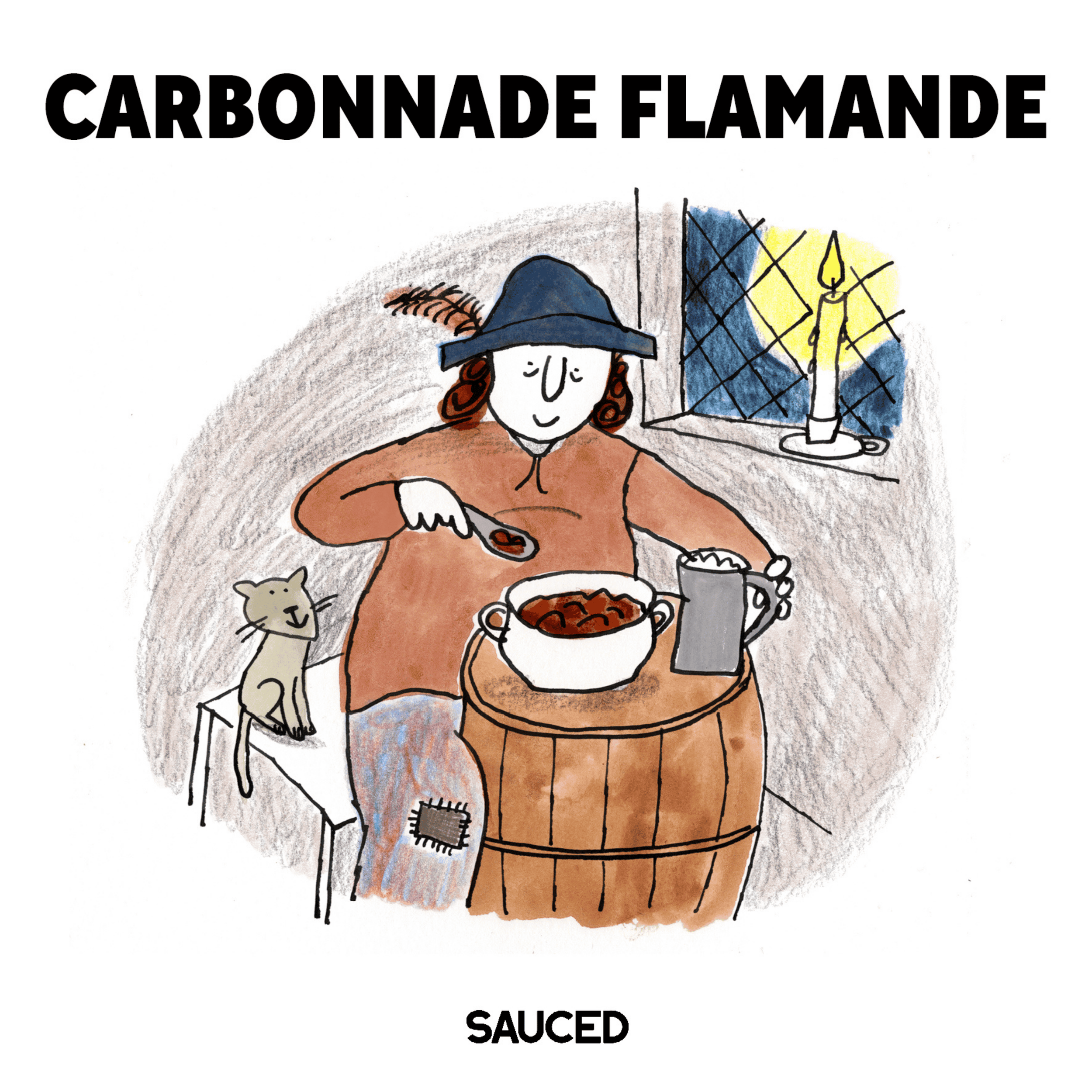
A Flemish dish with a French name. A stew named for coal, where nothing is cooked over fire. And a thickening technique that involves floating mustard-slathered gingerbread on top of the pot.
Belgium's answer to Beef Bourguignon — same method, different drink, entirely different class.
"Deceptively deep."
What we settled on:
Beef shanks, ossobuco-style — collagen and marrow for natural body
All Belgian dubbel, no stock — Chimay, Westmalle, or Rochefort 8
Mixed onions — yellow, red, pearl, whole shallots
Peperkoek slathered in whole grain Dijon, floated on top as a bread lid
Molasses, prunes, apple cider vinegar for sweet-sour balance
Herb sachet — bay, thyme, rosemary, crushed juniper berries
The Cocktail
Le Charbon: aged Jamaican rum, Falernum, dry curaçao, and a ginger-molasses syrup. A Mai Tai riff built around the dish's spice and sweetness.
RECIPE CARD:
Premium subscriber? Check out the full recipe card here.
LISTEN
EpiSOde Partners
Thanks to the following brands for partnering with Sauced to bring you this episode:
TRANSCRIPT
Tim McKirdy: Sother — Carbonnade Flamande, otherwise known simply as Carbonnade or as I think a lot of people might think of it — Belgian Bourguignon.
Sother Teague: I kind of like that actually. Belgian Bourguignon — or Carbonnade. Which just means it's a black dish, in color, basically. Really deep brown slash black. Super delicious. Gonna make your house smell amazing.
TM: Yes.
ST: And I think well worth the effort.
TM: Well, speaking of that, just the name there — comes from the French charbon, which means coal or charcoal. And obviously we'll get into the history, but the whole point of that was that this was simply named for any meat that was cooked over coals, so it had nothing to do with the stew that it's associated with today. And one of the other things that I just find interesting about this is it's Flemish. I triple-checked this — the language most commonly spoken in the northern half of Belgium, right, in the Flemish region, is Dutch. And this, Belgium's arguably one of its most iconic dishes, the name is French. Carbonnade Flamande. It's a French name. So what does that say about it?
ST: Well, I think probably that has to do, as we've discovered, there are plenty of examples that exist not just in the food world. The lines of demarcation from country to country have moved over the years. And I'm certain that maybe this part of the world was considered a different part of the world at some point. And this dish has survived that. The county line has moved.
TM: Well, maybe. I mean, the southern half of Belgium still speaks, is predominantly French-speaking. So I don't know whether that's the case. My theory on all of this — and once again, this is sort of poking ahead a little bit — but this being a dish that was included in Escoffier's writings and whatnot, I wonder whether it's, you know, how certain things we anglicize. I dunno what the French equivalent of that is, and I'm not even gonna attempt to try and figure it out. But I wonder because this was a dish that had been embraced by haute French cuisine, whether that was maybe just simply because of that and we continue to call it that today.
ST: Sure, that could be. Well, what is it? Carbonnade Flamande is a traditional Belgian beef and onion stew braised in beer. It is the quintessential comfort food of the Flemish region. The sauce is often enriched with mustard, typically like a spicy mustard like Dijon, tons of spices and sometimes gingerbread.
TM: The old peperkoek.
ST: Peperkoek. Is it peperkoek?
TM: Peperkoek, yeah. Trying to say that with a real — I was gonna say Dutch accent then. Actually, I believe it is a Dutch bread. I think so, yeah. Very interesting. And as we both alluded to, shares a lot in common with Bourguignon. So we are doing our darnedest today to explore the facts that are not Bourguignon — the things that make it different and the things that give it the identity.
ST: Yep.
TM: Just looking into that history and continuing it. So the name comes from the word charbon. Long-term associations to coal miners as well. And the dish itself was believed to have been prepared as far back as the 1400s. So this predates the French staple of cooking that we know and that's since adopted it. But also very much so during the Belgian Industrial Revolution, which I didn't know there was one as well, but I guess everyone underwent an industrial revolution. 1820s. So it was a staple. And once again, because we're talking tougher cut of meat, long, low and slow cooking, and using what's natural to you or what's close — the resources. The Belgians not known for their wine, but certainly known for their beer.
ST: And I think that all that tracks and makes sense. Have you ever worked anywhere where you served this dish on menu?
TM: Never on menu, although I did used to work somewhere in New York. The first office that I worked at was around the corner from a Belgian, traditional Belgian restaurant. So I've eaten this dish there. I dunno whether that place is still open, to be honest with you. But it's something I've enjoyed eating, but never made. Have you ever made this professionally?
ST: I've never made it professionally, and I've never made it personally. So I've never made it is the easier answer. But I've eaten it. I've eaten it when I was in France. I've never been to Belgium. And I've eaten it here in New York as well. And I'm curious if we were maybe eating it at the same place. I'm struggling to think of the name of it.
TM: On 23rd Street?
ST: Yeah. Between Fifth and Sixth Avenue.
TM: Nice little Belgian pub. That was around the corner — or 22nd Street actually, I believe it is.
ST: Right in that area. I mean, surely it's gotta be the same place. Not too many Belgian institutions in New York. I just remember we went there a few times after other events and it was somewhat late and they were still serving, and that's why we went. Because it was a reliable place to get a solid meal. And it served late.
TM: Could get some good mussels there as well, I'm sure.
ST: That's every time I've been, we've had both mussels and Carbonnade. I mean, every time, I think maybe twice, but still. It's delicious. It is a delicious dish. And I think what it really highlights is the maltier sort of malt sweetness flavors from the beer in contrast to say Bourguignon, which is the fruity nature of the wine. So it's more like grain and malt than grape.
TM: And the recipes, sort of the classical recipes that I encountered — some of the areas where it does differ from Bourguignon, one of the first things I encountered was it was made exclusively with beer and no stock. Is that something you encountered and is that something you would do?
ST: A hundred percent. A thousand percent agree. No recipe that I've come across bothers with any stock. You just go fully beer. My assumption is in its early days, this beer was probably — and nothing goes to waste, it certainly didn't back in those days — this beer was probably the beer that was maybe past its prime for drinking, so let's use it for cooking. Because we often maybe overlook or just forget that there was a time when water was dangerous. And we didn't really know why. Cooking, if you put water in this, back then the cooking would've made the water not dangerous, but if you didn't know that, then that's why we used so much wine and beer in cooking in the early days. But it would definitely be the beer that's been around a little bit and isn't, you know — again, they're gonna drink it either way.
TM: Especially if you're a coal miner in Industrial Revolution-era Belgium. I also wonder to what extent beer was going off in that time. They're probably drinking so much of it that it was just like — but certainly safer than water. Certainly. That's where we get those ties of alcohol. And then you mentioned as well some of those things, we're gonna get into that wonderful technique with the bread. Some folks as well adding prunes or vinegar or sugar, and really taking us back to an era where sweet and sour — back in those 1400s, sweet and sour was the go-to. And it's only sort of in more modern times where we try and go more savory, we think more first about the savory component for our entrees and stuff. What do you have by way of culinary luminaries for us today? There's been a bit of an absence of Julia and Jacques for a while over here.
ST: And they don't show up on this one either. Not for me anyway. Did you find anything?
TM: Yeah.
ST: Oh, from one or both of them?
TM: From both.
ST: Holy cow. I looked around, I didn't see it. But I did see, of course, this was in Escoffier's great work. And then, so most of the research I do on these dishes that I don't make typically myself, I go to YouTube frankly. And I watched about 40 different videos. I'm gonna say maybe 10 of them were in English. And even that English was usually someone who English isn't their first language. I didn't know any of these people. There was one guy that I saw that was doing some cool stuff, and all he goes by on the internet is Chef Vivian — gentleman. But he was the one who really kind of dug in a little bit and explained the bread technique that we're gonna talk about. And that was like really kind of new information for me because I don't think I — well, I certainly didn't know that was how this dish was thickened. And I don't think I've ever seen anyone thicken a dish other than two things that come to mind pretty quickly. Ribollita, which is a soup in Italy where you use yesterday's stale bread to be the thickener. And let's go back to France and back to a dish we've recently done — Bouillabaisse, when you make the rouille, you take some stale bread and soak it in the broth before you pound it into the rouille. Which becomes a thickener for that sauce. So not a lot of occasions that you see where it is canonized into a recipe where bread is the thickener.
TM: And you and I, among many other people, big fans of bread.
ST: You're a burgeoning baker right now. A lot of sourdough over here. You constantly got sourdough going in this house.
TM: Different starters all over the joint. I was watching a Scottish comedian recently who was talking about the fact that — why did bread get cancelled? It's like almost the foundation of any diet you come across is just like, cut out bread. Atkins diet, cut out bread. And they were like, oh, bread has been linked to tiredness. Do you know how that's verifiably false? Have you ever seen a duck yawn?
ST: I've not seen a duck yawn.
TM: Next time you go to the park and you go to the duck pond, look around. They'll be eating bread away. See if you see any lethargic-looking birds out there.
ST: They're not lethargic. So anyway — I didn't come away with anybody. I looked to all the guys and girls that I constantly look to, and I was like, not only can I not find anything that they've said about this dish, I can't find anything that they've done about this dish. But again, I think it's one of those background noise dishes that's been around for a long time, as we just discussed. That will not go away. It's just, it's always there, but no one's really exalting it or paying attention. And that's what we're here to do today.
TM: We're gonna give it the attention.
ST: We're gonna lift this dish. So what did Julia and Jacques have to say?
TM: So Julia, she included it in Mastering the Art of French Cooking.
ST: Oh, it's in the book?
TM: Yeah. And she weirdly opts for a Pilsner. A Czech Pilsner specifically. Which is — I think that's the wrong style of beer.
ST: It's the wrong style of beer.
TM: And she thickens using a roux, I believe. And because she opts for a Pilsner and she's not getting the maltiness and sweetness of the beer styles that we're gonna get into, she included dark sugar in her recipe for color as well, I would imagine.
ST: Which is only half the battle. You're getting the sweetness, but you're not getting that maltiness. We need that malt. That's tantamount to trying to make Scotch without malted barley. You need that flavor.
TM: And then the only other thing that I came across where Jacques did things different as well — didn't go for the bread technique. Floured his onions as he was cooking those down so that the sauce would sort of thicken naturally over time. Like kind of a roux. He went olive oil and butter again, which seems to be Jacques' kind of go-to.
ST: That — I'll tell you, man, us doing this show is really pulling back the layers on Jacques for me. I love him, longtime hero of mine. And I do see him doing some little things here and there that I'm like, I kind of don't agree with that. Jacques, the Hack, as we've deemed him once before.
TM: This was another thing about his preparation that was very notable for me, which was that rather than going with cubes, as we've discussed for Bourguignon and perhaps chili, him and a few other people went with slices of beef. Kind of like scallops, that cut. Not really sure why that is. So I guess it's just a distinction and something different. Although I will say that the way that you prepared it for our Bourguignon — those two chewing gum side-by-side, that sort of measurement. Anything but the metric system.
ST: The pack of gum. The Wrigley's gum. That's about how big you wanna cut this. That was news to me. I've never done it that way either. So maybe that's sort of like halfway on the way from what a lot of people do for Bourguignon to what some people particularly are doing for Carbonnade. Well, that kind of wraps up our luminaries, I guess, unless you have something more to say. I wanna back up one and ask the question that we always ask, but I think the answer is maybe plain. Is this a Prince or a Pauper's dish?
TM: It's definitely a Pauper's dish.
ST: I think so. This is a dish of the people, made with items of the people. And again, a pretty short list of items. There's not a whole lot of procurement to be done for this dish. If you just make some solidly good choices along the way, you will come out with a good product. I would say, let's back up one more time to Jacques. I would say a lot of the dishes that he does that you and I notice maybe he's doing a hack — maybe he's just identified his audience and he is making the dish to their comfort level. He's maybe cutting out a step here or there that will speed up the process without too much damage to the end result.
TM: I think that's a fair way to look at it. I think that's a slippery slope, though.
ST: Because I've always said, when I was head of kitchens, I would say, I don't want you taking any shortcuts. Because what happens is the shortcut becomes the norm and then someone takes a shortcut and that becomes the norm and someone takes a shortcut and suddenly we're several cuts away from where we really wanna be.
TM: A hundred percent. And I mean, you look at that in terms of traditional beer compared to the macro stuff that's out there these days that tastes almost nothing like traditional beers. But those are gonna be a topic for us to debate today. That has been the Prince and Pauper's, the culinary luminaries, the origin — which means it's time for us to take our first break today. And then we'll be back with the non-negotiables.
TM: Alright, we're back. It's the non-negotiables section. What's the number one on the list for you here today, Sother?
ST: Well, it's beef. We're gonna have to have beef. And also the beef for this is gonna be cooked long, low, and slow. So it needs to be something that can stand up to that. We've talked a couple of times about options for that. But I think I'm gonna pull one that we haven't used, and I think it's good for this dish 'cause it'll bring more than just the beef. It'll bring some thickening properties from all the collagen that's present. It'll also have a little bit of marrow in there. That's the shank, AKA the ossobuco slice of beef. Unless you wanna fight on that one, I think that's where I would go.
TM: No, I like it. I like the fact that A, it's different to what we've already covered in Bourguignon. And also B, I think this dish really does benefit from that collagen, that thickening more so than Bourguignon. It needs it more. I think that's a really smart choice. I would maybe argue — not argue. I would maybe say that if I'm going in a list of least negotiable to most negotiable, I think my number one would actually be beer.
ST: Number two on my list.
TM: I think that is more of the identifying factor, and then that does make me wonder — wow, what would this be like if we made it with a different protein? What would it be like? I dunno, lamb.
ST: I was literally about to say lamb. I would make this with — I would do the whole shank, right? 'Cause lamb shanks would be amazing. But we're gonna stick to the classic and do beef here. But I guess for the listener, what you need to understand is you can break the box and do this with lamb. I was already thinking that. When I was watching all these videos, when I was digging through my cookbooks at home — this dish, for me, I think lamb would be the first choice, to be honest. But we're gonna make the classic on the show here. So let's talk about that beer. What beer are you reaching for?
TM: Well, I think most traditionally this calls for a Belgian dubbel. Abbey-style ale. Your most common brands are the ones people are probably familiar with. Chimay. Love that beer. Also Westmalle. Rochefort 8. And these are rich, fruity, malty beers around 6 to 7.5% alcohol, I think. Not as alcoholic as your tripels, but also darker in color and sort of deeper in flavor than a lot of those beers.
ST: I wrote down a Belgian dubbel — fruity and dark, not hoppy. We're not looking for a hoppy beer. If you're gonna cook with a hoppy beer, you're gonna come out with a pretty bitter finish. Because any reduction in the volume, which is gonna steam out, you're gonna concentrate those flavors. St. Bernardus is a beer that I've had, I think probably at that Belgian place we just discussed that we can't think of the name of in New York. And that's what I was drinking on the side while I was eating the dish. And I think I might've jokingly suggested or asked, is this the beer that you're using in there? Who knows what they're using? They're probably using something that was on tap, not out of a bottle. But you want that malt-rich, dark in color, that's gonna bring some color to the party. It's gonna bring some sugar notes to the party. 'Cause again, as the beer reduces, it doesn't disappear. The water is disappearing. So what's left behind is gonna be that maltiness — and that maltiness is a sweetness as well.
TM: To kind of give Julia the same credit that we're giving Jacques here and just sort of revisit something I said about her choice of beer being categorically wrong — gotta look at the time when that book came out, what was available to her, to the country that she's trying to write a book for — French cooking. And I would argue that the popularity of Belgian beers in this country and the availability of them really coincides with the growth of the home brewing and then craft brewing movement. So I think that comes later than when she's writing that book. So she gets a pass. But still, I mean, it has to be Belgian and definitely look to that dubbel.
ST: Exactly. Just to stay true to it. Furthering the non-negotiable list here — onions.
TM: Yellow onions.
ST: I wanna mix. I wanna do some yellows, I wanna do some reds. I wanna do some, maybe even throw in some Vidalia or Walla Walla, like a sweet onion. And I wanna throw in some shallots. I think I wanna leave alone the leeks, but for me, if I'm gonna have this really sort of stewed kind of dish, let's stew it up because there aren't a lot of other things going into this dish. So let's mix up the thing that is in the dish. Does that make sense?
TM: It's an interesting approach as well. I hadn't really considered it. I don't often mix my onions when it comes to cooking, unless I just got like a rogue red one hanging around and I'm cooking with white onions or whatever. But yeah, okay. I like that.
ST: But again, as far as non-negotiables go, it's onions. We must have onions, not mirepoix.
TM: Not mirepoix as well.
ST: Exactly. That's what I'm saying. If I'm only gonna have onions in there — no carrots, no celery, no other things — then let's really dive deep on the onion. I'd probably cut 'em in various sizes. I want, when we get to the production of this thing, we can talk about getting some caramelization, but I also maybe want some that aren't so caramelized, that are just stewed. So I'd leave 'em a little bit larger. Maybe some pearl onions, maybe some smaller whole shallots. Just to give some texture contrast to this dish.
TM: Very nice. I again think we have to say that thickening with the peperkoek, with mustard. You said most of the videos you told me, most of the videos you'd seen, were just on one side. I would go on both sides. I know Dijon is traditional. I might opt for a whole grain. It seems closer aligned to me with the idea of a darker beer and beef.
ST: Well, you can get a whole grain Dijon as well. You can have the grains suspended in effectively Dijon mustard, so you're gonna be the best of both worlds.
TM: Oh, wow. Yeah. That's where I'm going then.
ST: I think honestly, I hadn't really pushed my brain to think about that part yet. But I think I would do that too, because I do like a stewed dish that has visible grains of mustard kind of floating around in there.
TM: Very nice. And just to note as well, that peperkoek — gingerbread, a very dense, it's more of a sweet bread.
ST: It toes the line. It's not sweet in the way that we would think of — like, it's not like a banana bread. Just 'cause it's gingerbread, it's ginger spiced in the spiced part of ginger. And then it's pretty dense, as you said. Very heavy. And it's, I think, one of the things that maybe — it's often eaten like a thin slice with a probably heavy slathering of butter as a breakfast thing.
TM: I wanna cut a piece of butter that looks like I'm having cheddar cheese. That's how thick I want my butter on this for breakfast. And using the peperkoek — you know what that is, don't you?
ST: That's gotta be the Porco Technique of the Week.
TM: It sure is. Also just, I really love that idea of using that as your thickener and also just sort of suspending bread above the stew, partway through the cooking process and just letting it dissolve. Something quite magical about that for me.
ST: And we'll talk more about it in the production of the dish, but it's pretty unique. To use this kind of thing and then to even go a step further and — well, let's make sure we spread mustard on it first. It's a pretty interesting way to deliver these things into the dish.
TM: A really fun vehicle there for us. Any other non-negotiables?
ST: I need a bit of herbs here. So I'm gonna say the combination of bay, thyme, rosemary, and a few crushed juniper berries this time. Because I think this dish — it's beef obviously, so it's not gamey, but I want to have those juniper berries in there to bring that thing that you usually put in the hunter stews or whatever. So make a little sachet of those things, with the juniper berries to throw in too.
TM: Nice. We could negotiate whether they're non-negotiables or not, but again, it's such a stripped-back dish. I think you need them in there. Or even just buy that poultry mix from the store and take out the sage and just everything else that's in there.
ST: That's my little hack. I think I told you once before — when I'm at the store, they have those little prepackaged things of herbs and I hate them. But you need the herbs. So I almost always purchase the poultry mix because it's got a little rosemary, a little sage, a little thyme, and usually got maybe a bay leaf in there as well. So it's like a good one because you never need nearly as much. But they just can't really sell you a smaller amount of thyme. I bought a thing of dill the other day and I was like, wow, this is like a year's supply of dill. But that's the smallest one I can get. Not a year's supply — I use a lot of dill, but it was huge. So that's my little hack — always buy the poultry mix. It costs the same as any of the single ones, and then you get a pretty fair amount of usage out of it.
TM: A little bit of everything in there.
ST: Like if I lived anywhere that had good, better sunlight, I would have a herb box growing in my window somewhere, but I just don't.
TM: So I think we can call that a wrap on the non-negotiables then for us. Let's take another quick break and then we'll be back with other ingredients, techniques, and preparation.
TM: All right, we're back in the studio. So here's my thinking. I know I said Julia is using brown sugar because she's not getting the maltiness of the dubbel beer. I do want us to explore sweetness, though — sweet and sour. 'Cause I'd spoken about that before. Don't think these are necessarily non-negotiable ingredients.
ST: I don't either, but I know where you're going.
TM: Prunes.
ST: Oh, I did not know where you were going. Well, you said sweet and sour and I thought you were gonna say sugar and vinegar. But yeah, prunes.
TM: That's my sweet, that's my sweetness. And that is traditional. I'm not just being like, where can I get some sugar from? I like that again, I just think that combination with the beer and the beef — or even our lamb shanks.
ST: A hundred percent. I have at home right now a loaf of fruitcake that I made — I'm gonna say three years ago. Maybe four. No, it was definitely three, three years ago. And I'm thinking if that fruitcake didn't have nuts in it, and maybe even still — that's the bread I would use. It's full of dried fruits. It's dense, it's full of spices, including ginger. It's got candied ginger in it. If I could smear that down with that grainy Dijon-style mustard, I think I could dissolve this and it's gonna bring a powerhouse of spices to the party as well.
TM: Let's talk about spices as well before we get into the sour, then. I think there's a case to be made here for maybe some allspice.
ST: Warming, baking-style spices. Island spices. Allspice, nutmeg, mace. Definitely gonna need ginger. That can be in the bread, but it could also — you could just add some, honestly, throw in a knob of ginger and just let it ride with the braise. Or some powdered ginger.
TM: Or we're Sauced — let's add some Falernum.
ST: Ooh, look at you. That's gonna add kind of all that stuff. And sweetness.
TM: And sweetness. Hold the prunes please, waiter. We're going for what? Carbonnade — hold the prunes. Alright, that's gonna be three hours, sir. Is that okay for you? Otherwise, yeah — good vinegar. I'm gonna say, I don't know. Am I being swayed just because of Bourguignon if I say red wine vinegar versus maybe cider or white wine. How do you feel about that?
ST: I think for this dish, which you're already alluding to the fact that you might wanna add some dried fruit to it — it's a fruit vinegar. So let's go with apple cider. If we're gonna include it, and I think we probably are — definitely a negotiable. You certainly don't have to have it. But it's going to help you balance out some of that malty sweetness.
TM: As opposed to that red wine that's not made with fruit.
ST: Well —
TM: No, I agree. And also it's just more alive and vivid.
ST: Always jabbing me. Grapes aren't fruit.
TM: Sother Teague, 2026.
ST: I can't have grapes 'cause I'm allergic to grapefruit. Not kidding. Had someone say that to me at the bar once.
TM: Oh my god. That is brilliant. So moving swiftly on from that — tomato paste. Yay or nay.
ST: Totally negotiable. I don't think we need it here. If we do, then we probably don't need as much vinegar. 'Cause the tomato paste is quite acidic. I'm swayable, but I think we could go without it unless you just wanna have it.
TM: Nah. I think it's really interesting because we've spoken about this before where I think because we've both been trained in this sort of French style of cooking, your autopilot when making anything of this ilk is onion, garlic, mirepoix, tomato paste, alcohol, stock.
ST: This one's kind of breaking a lot of those rules.
TM: We are. And I like that. And also something that we both acknowledge a lot on this show is you gotta question — why would celery be in here? You just question your autopilot and be like, no, let's be a little bit more intentional with our cooking. So yeah, I think those are — is that all the ingredients? Well, actually, tell me —
ST: There's a negotiable on the table here for me. And I saw some recipes had it, some didn't. And I know how you feel about it. Some pork product, maybe some thick-cut bacon.
TM: It's a no for me.
ST: Okay. I'm willing to leave it out. It's on my list, but it is not on the non-negotiable list.
TM: Well, and I think this also stems from recently here at the Sauced HQ, we were doing some cooking ourselves. And I got some heavily smoked bacon. And I hadn't been able to get the smell outta my kitchen for about five days after that. It was so smoky. So I think I'm just a little bit off bacon for a little while.
ST: Well, bacon doesn't always have to be smoky. And if I were using bacon in this dish, I think I would go with a cured but not smoked bacon. I'm just looking for that salty quality, I'm looking for some of that fat that I would use then to brown the beef. So in lieu of bacon, then we're gonna need at least some kind of fat — butter, oil, or a combination of both to brown the meat and get the onions cooked down in. But are you gonna mount this with butter at the end, or are you just satisfied with the peperkoek?
TM: I think I'm satisfied with the peperkoek.
ST: Good Dutch there.
TM: Yeah. You like that? I was hanging out with Phil yesterday.
ST: I love the way that man says genever. Listen, you wanna be the best at something? Pick a category that no one's competing in. That's how he became the best genever in America.
TM: Oh god. Old Duff Genever. Friend of the show, Phil Duff, we should say. Great, great, great guy there. Works with a lot of great brands. So I think that's all of our ingredients actually. It's a short list.
ST: Like I said, it's a short list. What we're gonna have to do here is coax out the best in all of these items, 'cause there are not many items.
TM: I'm surprised there's an omission from you that I was expecting you to say, when you said "I know how you feel about this."
ST: Oh, what did I omit?
TM: Parsley.
ST: Oh, yeah. Well, I mean, maybe I'll have some chopped parsley on the dish when it's on the plate. I did miss one. If we're gonna use sugar, I think it's gonna be Demerara. However, I could also be swayed pretty easily because of the sort of spiced nature — and we're gonna talk about this ingredient later when it comes to drinks. What about some molasses?
TM: Really nice. So I could kind of go either way, depending on how sweet my beer is. Or neither, depending on how sweet the beer is, how sweet the gingerbread is. There's all these levers we need to pull because again, we're gonna really try to take a small handful of ingredients and just gingerly — ginger — gingerly coax out the best of all of them.
ST: Just gingerly.
TM: I think this is something that, when I was hosting the Cocktail College podcast —
ST: Professor McKirdy at the Cocktail College.
TM: I graduated, folks. Completed it. One of the things that was a big realization for me was — and this might be very normal for a person such as yourself — but when I had the realization that if you're breaking drinks down into different components, everything should justify its inclusion in the glass. So if you're looking for sweetness, yes, simple syrup is the easiest way to go, but it has no flavor. All you're adding is Brix. If you're gonna use an ounce in a cocktail, why not bring sweetness and flavor? And so like a Demerara or molasses, things like that. That was an eye-opening thing for me to realize. And then in that vein, if we can apply it to cooking — let's add sweetness with something with its own flavor.
ST: A hundred percent.
TM: So those are the ingredients. Any science for us to get into today?
ST: Science? I mean there probably is. I bet you looked something up.
TM: Only one. Maillard reaction. It's back. But double Maillard.
ST: We're getting it from the onions that we're gonna caramelize a little bit.
TM: Triple actually. Sorry.
ST: Oh, well — double, triple. Let's use a dubbel beer and get a triple Maillard.
TM: Well, therein — your malt character is going to, once you get up to that point of like 270 or whatever when you're braising in the oven, we're gonna get some Maillard reaction on the braising liquor itself.
ST: Sure. Very nice.
TM: Alright, well those are the ingredients. Let's take another quick break. And then we will commit to our Sauced Carbonnade. Let's go.
TM: Alright, we are back in the studio. Time for the preparation. Take it away.
ST: Okay. Let's get those shanks, effectively ossobuco cut. And let's get some fat into our braising pan and get it nice and hot and get those in there and get 'em browned. Once those are nice and browned, remove them. This is a one-pot thing, but you gotta put things in and take them out as is often the case. Let's remove them once they're nice and brown. And then go in with the onions. We talked about having a mix of onions, so I think it's gonna be every variety you can get your hands on, to be honest. Which will just give you different textures and flavors. And also a little bit different cuts. Let's keep maybe some pearl onions in there whole. Let's keep some smaller shallots whole. Let's then slice everything else pretty much the same so we can get some caramelization. Once we got that caramelization going, let's then maybe add — depending on how sweet our beer is — a little bit of, I'm gonna go molasses, which is also gonna get all bubbly and thick in there with the onions. Then we can layer the beef back on top of the onions. Then we can go in with an absolute ton of beer, the Belgian beers that we talked about earlier. We can then go in with our sachet of bay, thyme, rosemary, and crushed juniper berries. And then here's the real thing that really makes this dish what it is. We're gonna take that — I'm gonna mispronounce it. Say it again for me. The bread.
TM: The peperkoek.
ST: Peperkoek. Because what it's saying is pepper cake. You're gonna take that pepper cake bread, slather it pretty generously on both sides. With the mustard — and we are choosing a whole grain Dijon mustard. So we get the nice spicy, sharp notion from Dijon mustard, but also the sweet, multi little, almost like caviar pops of mustard seeds in there as well. And what you do is you float those right on top of the whole thing. And you had mentioned putting it in in stages, but every dish that I saw just puts it in from the beginning. So they're floating right on top. And then we're going to get that to a simmer on the stove top. We can make a cartouche if we want, and then put this down into the oven at like 300 degrees for, let's call it three hours. And then we can pull that out. We can remove the cart, put it back in for maybe 30 more minutes so that that bread that's on top will become pretty blackened. And I think that's maybe part of where this dish gets its name. And when I say that bread, at this point it's no longer bread. It's just this kind of congealed mass that's floating at the top. Once you've then got it kind of blackened as I said, then you want to kind of gently remove the meat and the onions from the dish. And then maybe take your stick blender, immersion blender and buzz all that together. This would be the place, if you feel it necessary, to mount in with some butter. But I don't think it's gonna be necessary. No. This dish is pretty rustic. It doesn't need to be really refined anymore. This would be your opportunity to maybe give a little bit of extra seasoning of salt, and then put the meat back into the dish and or put the meat onto plates and ladle this stuff over the top with the onions and everything.
ST: And that's it. It's pretty straightforward. Did I skip anything?
TM: No, I think you covered everything there that I would go for.
ST: Sometimes you bust me. Keeping you honest.
TM: I mean, one of the things that we have to speak about right now, though — what are you eating this dish with?
ST: Aha. We left the — I think we left this out on purpose, or I did. This dish is traditionally served with Belgian french fries. Belgian french fries — is that a thing? Belgian frites. Delicious double, if not triple-cooked fries. That you put kind of on the side slash on top almost. It's almost like a loaded fries situation. I don't like to put it on — I don't like to put the fries down and put the stuff on top of it. I go the other way, put the fries on top so they don't get so soaked and soggy. I like my fries to stay crisp. I never understood that. I never understood the loaded fries thing with the fries buried and all this stuff. And then it's just these weird sticks of mashed potatoes. But yeah, we're gonna serve this dish with some really delicious, pretty aggressively salted, crispy fries.
TM: I would just serve it on the side personally.
ST: I'd like it to be on the plate together. Sort of a shallow bowl, wide. But the fries are definitely kind of to the side and cascading a little on top.
TM: Just making sure that we're not — all that work we've done to get beautifully crisp fries, you know, soaking them.
ST: That really drives me crazy. Nachos drive me crazy for the same reason. I don't like nachos. I like everything that's in nachos. I want it to be a dip, with crispy chips. I don't want it to be mixed together so that it's kind of almost chilaquiles then. Anyway, we're getting off topic. And then the last thing I'm gonna do, of course — well, the last two things I'm gonna do. One is I'm gonna crack open a beer, and then two, I'm gonna sprinkle the top of this whole dish with a bunch of parsley.
TM: Nice. I'm going with some mayo as well, 'cause we are in Belgium.
ST: Oh man. This is one I've never understood, and also I'm party to it. I am absolutely a fries-with-mayo guy, but it doesn't make sense to me. Even on the dish we did recently where we talked about fish and chips — I don't understand why tartar sauce, which is just kind of dressy mayo with fried fish. But I do want mayo with my french fries. Why? It's fat on fat. You'd think I'd want something acidic.
TM: It works.
ST: It does work.
TM: There's method to the madness, or there's madness to the method.
ST: I mean, I've worked at several restaurants where when you ordered the fries that were on the menu, of course they were well prepared, but they automatically were served with mayo. We sort of forced the guest to ask us for ketchup, and I don't know why — is that just us being dicks? You even when you put it down, you say like, here you go, it's served with our house delicious mayo. And they're like — but you have to say, would you like ketchup? And like eight outta 10 of them say yeah. Unless you force the issue.
TM: Before we get into the alcohol, I wanna say — we were talking about baking earlier. Sourdough is gonna go great with this, and there I will perhaps allow you to put that in the bottom of the bowl. Maybe toast it first a little bit. In the bottom of the bowl, cover it and have that amazing treat waiting for you at the end of it.
ST: Honestly, if you have the opportunity, I think that piece of sourdough is pretty moistened with some good olive oil and grilled over a flame so that it's got some char to add to the Carbonnade. And then go underneath and pour the stuff over the top. And maybe a wedge of it on the side too. So you got a crunchy piece, but you've also got this piece at the bottom of the dish that's just soaking it up.
TM: I would also, for myself, slather mine in more of that whole grain Dijon. And again, not for everyone, but if I'm serving myself this — yes, technically speaking, you might mess with the overall balance of what we tried to achieve with the sauce. But I love mustard.
ST: That's on a bite-by-bite basis. You're in control. I'm not saying I would slather it with oil to get it grilled, but then slather it with mustard before you put it on the dish. Let's go.
TM: The other final thought from me before we get into alcohol — and this is maybe a -ism that I didn't realize — but we're, and I had to count this, we're 14 episodes into Sauced now. Plus three bonus episodes. And they're different. And this is a good reminder for the folks — by the way, those bonus episodes, we cover techniques. We cover single ingredients. We cover side dishes. So far we've done mashed potatoes, seasoning pans, polymerizing pans, and a massive deep dive on garlic.
ST: Yes. Garlic.
TM: So that's what you get as a premium subscriber to Sauced.
ST: And there's a fourth — not to interrupt you once more, but we've decided to add that we're gonna do bonus episodes that are about history. 'Cause we've found some really cool, during the digging for all of these episodes, we've found some really cool tidbits that could be their own episodes, honestly.
TM: And some historical stuff where we're like, this dish is too abstract, too esoteric, even for Sauced. Where we cannot spend the hour talking about that dish. However, we can do a bonus history episode on it.
ST: I think those are gonna be the most fun for me.
TM: 14 dishes we've covered. Three bonus episodes. And you have yet to allow the inclusion in any of them of leek. Do you dislike leeks?
ST: I love leeks. Have I really?
TM: You've gone straight past it in the metaphorical grocery aisle every time we've done our dishes.
ST: That shocks me. 'Cause I really do love leeks.
TM: There's a leak in your pan joke that I've been meaning to make for three months now, and I just wasted it there. You gotta be careful about that. So confirming you like leeks — love them. And next week we're gonna do Leek and Potato Soup. Great. Folks, you'll need to come back next week to find out. In the meantime, we're gonna take a break.
TM: Alright, we are back for the final stretch of Sauced. It's time to get to the drinking part of this. Pairings. What do you got before we get into cocktails?
ST: Well, I think the obvious pairing is beer. Specifically a Belgian beer. We've mentioned a few that we might cook this dish with. I think any of them would be delicious to go alongside of it. I don't think this is a place for a cider. I definitely think it's a place for a cocktail, and I have one, but we wanna talk about other things first. For me it's gonna be a Belgian beer, probably like Chimay. Or that one that I had at the place — St. Bernardus.
TM: BXL — I think it might have been called, that place.
ST: Yes, that's it. Wow. Just came to me. Were you thinking of it this whole time?
TM: In the back of my mind, yeah.
ST: And even at the top of the show, you said you wondered if it was still there. I'm pretty solidly sure it is still there. I think it's been there for like 40 years. I don't think it's going anywhere. BXL — why was it called that? Oh, 'cause that's Brussels. Duh. Answered my own question.
TM: Which is in the Flemish, Dutch-speaking part of Belgium. But of course it's also the home of the European — what is it? Courts and councils — like Europe's answer to the UN. They operate over there.
ST: What about wines? Talk to me. What do you got?
TM: I think a light red, but again, given the fact that so many of our dishes we opt for wine, I'm going to go past it in this one. But I think a light red, a Beaujolais, that kind of thing. Or maybe a northern Spanish red, like a Ribera del Duero. I think that's always a nice alternative. And those are only getting better and better — the representation of those wines in the U.S.
TM: I'm gonna do something a little different for us here today, though, because we don't often call out specific brands by name or specific products in this section, especially when it comes to spirits. But it would be remiss of me not to mention one of the funnest whiskeys I've had in a long time. It was made a while ago. And I received a bottle of it. It's the Starward Australian whiskey. They did a finished — a limited edition finished whiskey that was aged in ginger beer casks.
ST: Oh, cool.
TM: And that thing is phenomenal. Just imagine a whiskey with all those added gingerbread, spiced notes. And I'm just like, if we're getting our peperkoek, then we gotta go for a little dram of Starward after. I think I've probably got a couple of ounces left of that, that I'm rationing. So, folks, if you go out there and have a look for that, you are gonna love it. I'll have to give you a taste later, Sother. Let's get into your cocktail. And if you are not using genever, I'm calling up Philip Duff.
ST: Give him a ring, 'cause I'm not. Although — the drink that I'm about to describe, you could certainly put in the oude. That means old or aged genever. Versus jonge. Yeah, jonge and oude. I think their language is just our language with weird pronunciations. Peperkoek — pepper cake. Got it. Anyway, you could, I think you could do this with the oude. I didn't even consider it because my brain was going down a different route. I wanted to squeeze molasses into a drink and I thought, let me twist up an interesting Mai Tai. So I stayed with an aged rum, probably a Jamaican. I went with lime juice. Falernum, because it's gonna have all those spices that you just mentioned. So the Falernum was kind of taken over for what orgeat would stand in. A bit of curaçao to bring that citrusy note. And then here's where it changes a bit — a ginger-molasses syrup. So molasses, just like honey, if you wanna make a syrup out of it, you're gonna need to thin it with water, typically at least one to one. So instead of water, let's use ginger juice. So now we've got a sharply gingery — and we don't need a bunch of this syrup in each cocktail, maybe a quarter of an ounce — but we've got this sharply ginger but sweet and layered with spice molasses syrup inside this Mai Tai riff. I think you could get away with pulling out the Jamaican rum and using an oude genever.
TM: Or even doing like a genever Old Fashioned with an allspice dram or something as your sweetener instead of a syrup. That could be really cool. Any name? What are you going with for the Mai Tai?
ST: Yeah, that's you, man. Remember, you get to name 'em.
TM: Okay, let's go. Le Charbon.
ST: Le Charbon — which means carbon in French. I don't think this drink would come out black, but we can call it that.
TM: Inspired by — yeah, the word that inspired the Carbonnade.
ST: I mean, listen — the Carbonnade isn't black either. But this drink is delicious. So I happen to have, strangely enough, an absolute crap ton of molasses at home from an old project I was working on. And I have a Breville high-speed juicer. And so I made the syrup, so I have the syrup at home. I didn't make the full drink, but the syrup is delicious.
TM: Nice. Well, you've admitted in the past that coffee is your kryptonite.
ST: Uh oh. What's yours?
TM: Molasses. Don't love it. I love pomegranate molasses, but I don't like licorice.
ST: I think in the United States, it's not used as much as it's used in other countries. And maybe you have more association with it, so you have more opportunities for bad association with it. Where did you have, how did you have it as a younger person that maybe turned you off?
TM: Well, it's more just the licorice aspect. And you know — what's it — all sorts. Licorice all sorts. Those candies, Bassett's Licorice All Sorts, I think they're called. And just having a treat and having candy, which was a treat. And then if you have that, I'm just like, no, I want chocolate. I want this sweet — too complex for this simple young palate. Definitely back in the day. And then just anytime I've used it in cooking, I've been like, yeah. And that's why I will never be a full kind of tiki head. I mean, I love the category, I love the drinks. I love a Mai Tai. But that Jamaican rum is not on the top of the list for me, sadly. Sorry, Brian Miller.
ST: Sorry, Brian. Sorry, captain.
TM: Well — any final thoughts? What's your Maurice final thought of the week for us here today?
ST: Carbonnade — Carbonnade — no.
TM: You were doing so well. You made it all the way through.
ST: I know. Carbonnade Flamande. Final thoughts are — this dish is deceptively deep in flavor. Equally deceptively easy to make. It's, normally when I talk about the process of making each dish, it takes a chunk of time on the air. This took no time to talk about because there's not a lot to do. It's overwhelmingly — and of course, if it's gonna braise for three hours, it's passive time — but it's overwhelmingly passive time. Your whole active time on this dish is 20 minutes. 20 minutes from start to finish, and then it's just let it ride in the oven. That's a pretty incredible high impact, low response cost. You're not having to do a whole lot to get a real reward out of this dish.
TM: Another thing I guess we didn't mention, but worth flagging now before we wrap it up. Unlike Bourguignon, there isn't a debate or a school of thinking where it's like, let's marinate the beef in the beer beforehand. No, this is straight out the bottle and into the pan — or out the keg if you're lucky enough. And yeah, I agree with you. I'm just like, look — what are people missing out on if they never make this dish at least once in their life? That cool, fun bread thickening technique. That's novel and I like it.
ST: As I mentioned, the only two examples that I could come up with. And not a technique I've really ever used. And it's pretty cool. And not only to do it with bread, but to do it with the pepper cake bread — to do it with a unique, spicy, flavorful product. And then the putting the mustard on there, which I think is — I don't wanna say the word hokey, but there's no — you could just stir the mustard into the sauce. I don't know why it has to go on the bread, but it does. And so it does, and I don't wanna take a shortcut because a shortcut becomes a shortcut. So follow the steps — again, your investment here is 20 minutes of active time, and then three hours of go watch a movie or whatever. Clean your house. Read a book. Take a walk.
TM: Go visit your butcher.
ST: Yeah. Go hang out with the butcher.
TM: Alright, Sother — with that, time to put on the apron…
ST: Pull out your shaker…
TM: And let's get cooking…
ST: And drinking.
TM: Cheers.
ST: Cheers, buddy.