Episode 15:
CARNE ASADA
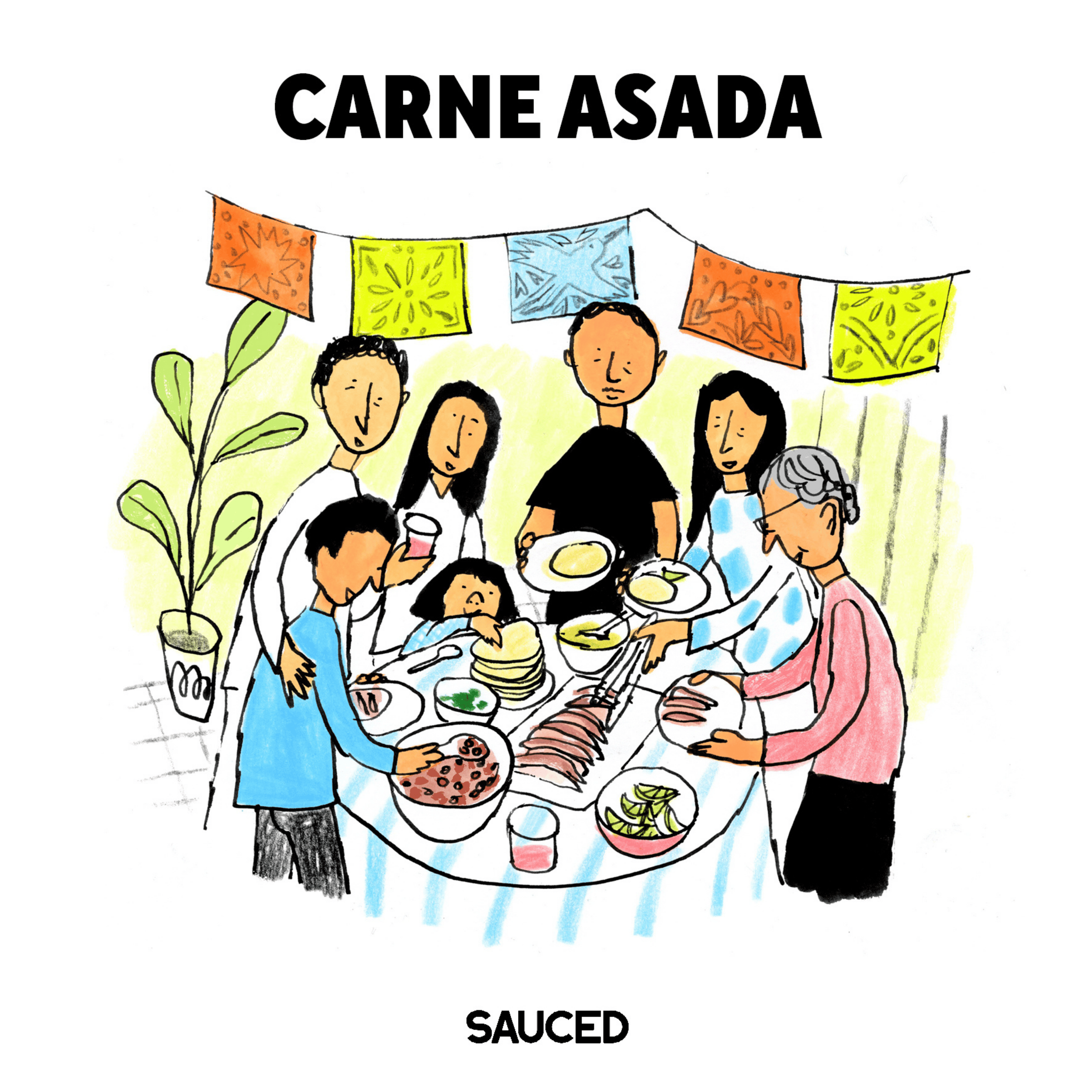
Carne Asada isn't a recipe — it's a verb, a noun, and an event. In Northern Mexico and Southern California, the gathering IS the dish. A feminine word carried across a border, a communal fire ritual that built its own language, and a cut of meat that's less about technique than it is about who's standing around the grill.
This week, we work through the whole thing — the flap steak vs. skirt debate, the two-agent marinade paradox (acid denatures the surface, alcohol carries flavor into fat), the eight pillars of an actual asada, Maurice's Method for cooking directly on white-hot coals, and a Michelada built on Clamato, chamoy, Tajín, and a secret spoon of eel sauce.
"Seek the perfectly imperfect."
What we settled on:
Flap steak (ranchera) — thin, fast-cooking, better than skirt for this
Beer and mezcal marinade — acid denatures the surface, alcohol carries flavor into fat
Pineapple juice in the marinade for enzymatic edge
Max 2 hours marinating — past that, the acid reverses
Squeegee the excess before hitting the grill
Cut perpendicular to the grain
Maurice's Method: cowboy steak cooked directly on white-hot coals
The Cocktail
Sauced Michelada: Chamoy and Tajín rim, Clamato, lime, Maggi, Worcestershire, Valentina, eel sauce, topped with ice-cold Mexican lager. A shot of mezcal, tequila, Sotol, or raicilla if you want to amp it up.
RECIPE CARD:
Premium subscriber? Check out the full recipe card here.
LISTEN
EpiSOde Partners
Thanks to the following brands for partnering with Sauced to bring you this episode:
TRANSCRIPT
Tim McKirdy: Tim McKirdy: Sother, serendipitous timing for us here today with today's dish, today's event, and recent events for us.
Sother Teague: Let's talk about that.
TM: Carne Asada. You love it.
ST: I love it.
TM: You know who really loves it?
ST: Southern California is a big fan.
TM: They sure are. Southern California, Northern Mexico, and we ourselves are just back from Los Angeles for another successful trip for the LA Spirits Awards, but also —
ST: We did our first ever Sauced live event at our friends' bar The Wolves in downtown LA.
TM: This was real fun. We did a couple of drinks, four drinks inspired by dishes we've done on the show, or maybe even drinks we've created for the show itself.
ST: I was behind the bar shucking oysters.
TM: And I was pouring some freezer Martinis, and serving up some French onion soup inspired broth with beer and shots, and a load of goodness, a lot of great people in the room. We just gotta say thank you to the folks at The Wolves for hosting us, but also thank you to all the Sauced fans who came out and raised a glass with us in person. That kind of blew me away.
ST: Yeah, me too. It was great to see that we have fans all the way on the West Coast, and who showed up. Even though it was a Sunday evening, it was Easter. We had a lot of hurdles in our way, but people still showed up and showed out, and it was a ton of fun. I think the drinks went over really well. They were all, as you mentioned, inspired by or directly from the show. Each one of them had sort of a culinary slant to the drink. So this was our opportunity to put food into the booze instead of putting booze into the food, which is our want here at the show. Cooking with booze and drinking with food. The Beef Bourguignon was our Gibson style cocktail.
TM: There's No Wrong Way was the name we gave for the cocktail we created for the French onion soup episode, the Adonis inspired drink.
ST: That's right. That had some charred thyme as the garnish to give it some aromatic pop. But There Is A Right Way also kind of pulling from the French onion soup episode, where we did an ice cold beer in a can with a shot of brandy and a shot of warm French onion soup broth to kind of chase it, like a sangrita almost. Really worked quite well.
TM: Also worked really well with a nice kind of savory, meaty mezcal that we were pairing it with, shots later in the evening.
ST: That's right. Isaac, owner of The Wolves, has a hand in on a mezcal brand, and it went really well with his mezcal. So we were doing those late in the evening. And then the final drink — the one that we called I Shuck 'Em, You Suck 'Em — based on my time at Shuck 'Em's Oyster Barn. Not really from the Oysters Rockefeller episode, but inspired by the fact that I was gonna be behind the bar shucking oysters as a garnish. And for the garnish, we used these beautiful Pacific oysters, pretty plump. And we made a mignonette, but in the mignonette we used all the standard mignonette ingredients plus some of the freezer martini batch, to put right on top of the oyster. And then the drink was — why am I forgetting what the drink was? I was trying to buy myself some time there, but it didn't work.
TM: Absinthe, sparkling wine…
ST: Oh, right. Kind of loosely based on the Death in the Afternoon. It was a sparkling wine, absinthe, rhum agricole — and then I used a toasted coconut syrup just to give it some mouthfeel and body. Long over ice and bubbly, with that big oyster on the side as a little garnish. What a fun time we had.
TM: Yeah, absolutely. Wonderful evening and great time in LA, like we said as well, with the LA Spirits Awards.
ST: That's why I couldn't remember what we did Sunday night. 'Cause for the next two days we just drank booze all day
TM: Tasted.
ST: Tasted booze all day —
TM: Judged.
ST: Judged. Judged responsibly.
TM: But that does bring us nicely back to today's dish. Carne Asada. Grilled marinated beef, seared fast over high heat, sliced against the grain. Lots to get into with a sort of linguistic point of view as well. What's your first thought or your first association when it comes to Carne Asada?
ST: My first association really isn't necessarily a hundred percent about Carne Asada specifically. It's about the notion of what Carne Asada is. The phrase Carne Asada literally translates to cooked meat. You speak Spanish, I don't. What they're saying — and it's more verb than noun. It's tantamount to, in America, when we have a barbecue. Meaning that barbecue is the thing you do and the thing you eat, but it's also the thing you attend. My first blush impression of the dish itself is more about the ritual of what the dish means to people.
TM: Yeah, exactly. This really isn't a phenomenon that exists in the English language, kind of like you say. The verb here, to grill, asada — or that's also an adjective. It is grilled meat. But we don't say, hey, I'm coming over for a grill later today. Although —
ST: But in English I say, come over for the barbecue.
TM: Yeah.
ST: And that could mean a thing that I've cooked nice and slow and is ready for you to eat upon walking in the door. But it could mean the event itself.
TM: Yeah. You come over for a little Carne Asada, it doesn't just mean the meat, or even just the means of cooking. It means getting together. I think we have both said that so many times when it comes to this show, just how much we love the ritual of getting together and cooking. And I do believe, especially when we get into this dish and all the components — we can't get too far into all of them, 'cause there's so much that can be on the table. But this isn't something you can do alone. Like, by definition, you can't.
ST: I think you're right. And nor would you want to. The energy and effort that's put into this is not to feed one or two people. The Carne Asada is like, let's have a group gathering, and let's have everyone have some sort of task that is theirs to accomplish, or some sort of item that is theirs to bring. Back in America, this is getting invited to the barbecue and getting assigned the dish that you're supposed to bring.
TM: I know the assignment that you want, and that I would happily give to you.
ST: Yeah. What do you think that is?
TM: The asador?
ST: Yeah. I wanna be the guy at the grill.
TM: Yeah. Or parrillero could also be —
ST: But I think — yeah, sure. But I think in the Carne Asada, unlike the barbecue — right, when I'm doing barbecue. 'Cause there's a difference in English between a barbecue and grilling out.
TM: Yeah.
ST: Grilling out is burgers, hot dogs, maybe some steaks. Barbecue is something that I started long before you even got up and thought about coming over to the house. This is something that's gonna take 12, 14 hours. The great thing about Carne Asada is it's all about quick cooking. So throughout — and it's all about — it's not really about a mealtime and a plate up. It's more about a constant flow of good times and good foods. I could certainly be manning the grill, but I don't think it'd have to be just me and just all day.
TM: No, totally.
ST: We can switch that job out as the hours wear on.
TM: So looking at the origins of this — and the extent to which we can — again, this all lies within this sort of idea of cooking meat over an open flame. The practice did originate — or what we understand as Carne Asada now and celebrate — originated in Northern Mexico. Particularly Sonora and Nuevo León. Interesting to note here that as a nation, Mexico, over hundreds and hundreds of years, meat wouldn't have been the primary source of protein. You're looking for other things.
ST: Beans and rice and legumes.
TM: Insects.
ST: Yeah, exactly.
TM: But with Spanish rule and occupation, and bringing over meat and sort of ranchero — this is where it would've been, the center of that. So then you have these rancheros, these people looking after the cattle. They would have been eating meat over an open flame, very stripped back, and in contact with the earth and the environment. As a practice — and probably the best point for me, or the first point, I can point out this great book here that I have on the table, if you're looking at the YouTube. Asada: The Art of Mexican-Style Grilling by Bricia Lopez. Wonderful book. This is gonna go into so much more of the stuff that we're gonna talk about today. The author, Bricia Lopez, notes that this really breaks into Northern Mexican and Southern Californian culture in the 1950s. That is the thing that we understand as the event Carne Asada, versus the cooking technique, grilling meat. And I got a little statistic here for you.
ST: Oh, you love statistics. You like numbers. I like words.
TM: So Sonora and Nuevo León, which would be the two sort of epicenters in Northern Mexico of this culture — Hermosillo became the capital, and Monterrey became the rival. The two of these places having the highest per capita meat consumption in Mexico. We're talking 37 kilos per year per person, versus 14 kilos in the national average. So more than double.
ST: Wow.
TM: And in 2023, Hermosillo set the Guinness World Record for the largest Carne Asada. 2,182 parrilleros — or parrilleros, if you're Argentinian — folks attending the grill. Grilling five tons of meat simultaneously on 1,200 grills in Plaza Zaragoza. So imagine that for a second. Five tons of meat in one go.
ST: That's 10,000 pounds. And how many people were in attendance? Only 2,000 people?
TM: Well, 2,182 people attending the grills, I would imagine.
ST: Oh, multiples of that attending — attending the grills. I thought you meant attending the event. Holy cow. Okay, that makes a lot more sense.
TM: Can you just imagine the smell?
ST: Yes, I am imagining the smell, and my mouth is watering. You knew you were trying to goad me into saying it. My mouth is watering though. I gotta.
TM: But that is just our Porco. Unbelievable.
ST: Stat of the week.
TM: Stat of the week right there.
ST: Incredible. That's impressive on many, many levels. First of all, just the sheer volume of coal and wood that are burning. Probably brought the temperature of the town up by a few degrees.
TM: So this is one of the things — actually, this is a nice point for us to get into this here. The coal. In a lot of the background reading I was doing on this, both in the book here and multiple sources, talking about mesquite specifically. Yourself being a wonderful grill master, as I know — do you wanna talk to us about just some of those different types now of fuel, and what you would be grilling over?
ST: Mesquite wood is great for burning and cooking over. When we talk about woods and the grill, I think most of us are jumping to the notion of smoking. But a mesquite log is a great thing to cook over. It imparts a nice, sort of almost spicy flavor to the product that you're cooking, whether that be protein or vegetable or what have you. You kind of caught me off guard with the question, but pecan wood brings sort of a nutty aroma to the smoke, and that smoke will penetrate whatever you're cooking. So there's that. Apple and cherry both bring very fruity qualities to whatever it is you're cooking over. I feel like I'm forgetting at least one piece of wood that I use with some regularity. But mesquite is the only one of the ones that I also use for smoking that I'll get logs of mesquite and cook over a mesquite wood fire. Not just for smoke.
TM: Fantastic. And I think that does bring us into one of the defining characteristics of this versus smoking, or different types of grilling in sort of South America, whether that's Brazil or more like Argentina and Uruguay, which is — this is fast cooking, this is high heat. You don't get a lot of opportunity to imbue that meat with flavor from the grill itself, or from the smoking material. So you really wanna amp up the flavor in your fuel source.
ST: Yeah. Get some flavor in the fuel source. And then in this scenario, the key is the marination.
TM: Mm-hmm.
ST: We'll talk at length about it, but it can be ludicrously rudimentary and simple. In fact, that's where it really began. Just some acid, probably lime juice, and some salt. And that's enough. But we're gonna gild the lily at every opportunity. We'll come up with a nice marinade for ours.
TM: Absolutely. So a question we have to ask ourselves, but one we probably already know the answer to here. Prince or pauper's dish?
ST: This is a dish for the everyman. It's typically at least reasonably priced cuts of meat. It's cooked quickly because of efficiency of time and efficiency of fuel source. Again, the ritualistic aspect is to be community and communal. I think that's more of an everyman approach to cuisine and food in general. We're not gonna be separated by several feet at a long table, and having someone cook and serve for us. We're up. In fact, commonly there really isn't a table. You're sort of standing around. It's gather around the fire, the furnace, the hearth, whatever you wanna call that. And again, everyone gets their hands in it. So yeah, this is a dish for the everyman. It's a pauper.
TM: Fantastic. I am gonna do a little quote here from the book, just to round out our first section. 'Cause I think that really ties in nicely with what you're saying there. Look, you can even hear the pages opening. That's right folks, we still got 'em.
ST: Got a Foley artist.
TM: So this is the opening right here. "In millions of backyards across Southern California, an asada represents more than just meat. It means family, friends, memories, great music, cold drinks, good times, and the community you've built, all centered on the promise of juicy, grilled meat and all the fixings that remind you of your upbringing."
ST: That speaks to me on so many levels. When you get invited, you feel good about yourself. In fact, next up we're gonna talk about our luminaries or things like that. I've got a few quotes from folks who resonate that same sentiment.
TM: Fantastic. Why don't you kick us off with one of your quotes here.
ST: Well, Aarón Sánchez, who's long been on the scene of Mexican-style cooking. He was on the Food Network many, many years ago, but he's done many other projects since then. In fact, he had a show for a while on the Heritage Radio Network, where my other show is. With his mom.
TM: Wow.
ST: Yeah. I can't remember what it was called, but he's been around for quite some time and he's a good dude. He said, of the Carne Asada, "This is a place where you get to go and eat and make friends while you do that. And if you get invited, you're special." And just that little bit at the end there — "if you get invited, you're special." This means that you're being welcomed in, you're being folded into the community at large, or even a more tight-knit subset of that community. That's resonating exactly what the book just said as well. That thought stuck with me really good — if you get invited, you're special.
TM: Yeah. And that special sentiment as well of — what is there more — I don't know that that speaks to the human condition better than this act of cooking for someone, inviting someone into your space, and cooking for them. This is a personal experience that I've had actually, wherein a few years ago I was traveling in Oaxaca, in Mexico, visiting a bunch of extremely traditional mezcal producers. Farmers really, who mezcal just happened to be the part of what they would make or produce throughout the year.
ST: Part of living off the land.
TM: Part of living off the land, exactly. For part of the year they'll be distilling mezcal, and for another part they'll be growing squash and harvesting beans. It just struck me that every single person we visited, it was a given on their part that there was no "we're here from 12:00 PM to 2:00 PM and then we gotta go onto the next spot." It's like, no, we're gonna talk, we're gonna break bread. This person's gonna cook for you. It doesn't matter whether you ate at the last stop. Everyone's gonna cook for you. Oftentimes over an open fire, with tortillas and tacos. Just incredible — that idea of bringing people into your space.
ST: Yeah. I'd go on and add another one here. Enrique Olvera. Who is it — Pujol. Do you know this guy?
TM: Yeah.
ST: He said of Carne Asada, "A cuisine that is inclusive gets stronger, and one that excludes simply stalls." And he also went on to say, "There is no right way to make Carne Asada. No mistakes that you should worry about making along the way. Just dive right in. Seek the perfectly imperfect."
TM: Nice.
ST: Yeah.
TM: Don't feel too pressured.
ST: Don't feel too precious. I think, right? Which will relieve the pressure. Show up, and you've done more than 90% of the work. If you showed up — just show up. Like we said in a couple ways earlier already, everybody kind of has their piece to the puzzle. Maybe yours was to swing by the tortillería and pick up some freshly made tortillas for the party. Maybe you were to make the salsa picante, or you were to bring the guacamole. But just show up and bring your part.
TM: I love it. Then I think, the only final thing — I'll just go back to Bricia Lopez here for myself. Less of a quote here, 'cause I've already given one, but more of the asada as an ecosystem. This book does a really good job of splitting it down to eight different elements. So la botana, which would be your starters, carnes, meats; mariscos, seafood; then your sides, salsas, aguas frescas, cocktails, which I know we will like to get into, and then the dessert. So these are sort of the eight pillars — unofficial, you know what I mean?
ST: Sure.
TM: Not codified, but the eight pillars of Carne Asada as an event. And just so much room for exploration. This is something as well, especially the time of year that we're recording here, I think you and I are both itching to get back out.
ST: Oh, man. And grilling again.
TM: Itching.
ST: Itching in the kitchen. Well, Sother, those have been the origins, and the prince and pauper, and our luminaries for us here today. We'll take a quick break and then we'll come back with the non-negotiables.
ST: Yeah.
TM: Alright. We are back. Non-negotiables. Carne Asada — the name of the event and the dish doing a lot of heavy lifting here for both of us, I think, for the first two. What do you wanna hit me with first?
ST: I love that this dish has — I think for me, thus far, our 15, 16 episodes deep here — the smallest list of non-negotiables. Which I kinda love. I love that we can really draw great results from a simple list of ingredients. So I had even written down here "beef" as being my number one non-negotiable, but then I backed off of that and I just put in parentheses, "just something to grill." That can be meat, vegetables, mushrooms. Something needs to be going on the grill. That's the asada. I know it says carne, but I don't think that's a total non-negotiable.
TM: Interesting.
ST: From the former butcher who loves to eat meat.
TM: Well, I think this gets into another nice little interesting language debate here. Because carne — right, meaning meat — but also used as a synonym for beef.
ST: Oh, yes.
TM: So it could just be meat in general. The carne — you're going to the butcher shop, you're not just gonna find beef there. But you have that. So I'll say, I think in terms of everything we've been talking about here today — and this is an event, I agree with you on that one.
ST: Mm-hmm.
TM: But I would like for us to get into specific cuts of beef right now.
ST: Oh, okay.
TM: 'Cause I think for a lot of people, especially if you do eat meat, this is gonna be the star of the show.
ST: Of course. I was just trying to really broaden my aperture on viewing this as the event, the ritualistic part of this. We are going to the grill, so we need something to go on the grill.
TM: I think it speaks to that sort of — not tension, because it's all positive — but the tension, if it were between the dish and the event. And if we're looking at it as the dish, we're talking about marinated beef.
ST: Yeah.
TM: The interesting thing here is I've seen a few different sources — and this probably isn't surprising — that are like, this is the most common one, or this is the favorite cut. But actually they're all similar in style, but folks have different opinions on this. So I'm gonna start with the flap steak, otherwise known as a ranchera by many people.
ST: Sure. Also known as the bavette, right?
TM: Right. For your French cooks.
ST: So it's the inside part of the skirt steak, which is gonna be a little bit thicker, and a little bit less extra-muscular fat, but a little bit more marbling. So more intramuscular fat. Oftentimes you can take the bavette — or, what'd you say in Spanish? Let's try and say in Spanish here.
TM: Ranchera.
ST: You can take the ranchera and you can sort of butterfly it lengthwise and fold it out so that it's longer and thinner. Because again, the whole technique of the Carne Asada is quick cooking.
TM: Mm-hmm.
ST: And when I say quick cooking — we'll get into it when we get into the recipe breakdown — but we're talking literal two to three minutes per side and we're outta there. 'Cause we're gonna be super high heat, and thin meat. So we wanna get it in, get it out.
TM: So that would be the flap or ranchera — the inside skirt. And then the outside skirt would be another cut for us here. Very popular.
ST: Sure. I think that's the more popular one that you're gonna see at the butcher shops. Because I believe, frankly, the inside one is going to the restaurants. They're picking it up. 'Cause I think that is probably the best choice to make this dish. But, like you said, everyone's got their opinion. It's kind of regional, depending on where you are in Northern Mexico slash Southern California, or even into Texas, et cetera. And then, especially, the region changes based on availability. So you've got people who are, you know, way up here in New York City — I'm using what the butcher shop has for me. That's what I'm using. And you can get into quote-unquote nicer cuts to do this as well. You just have to then cut them nice and thin, so that we can get that speed of cooking. So anyway, skirt, I think, is probably the most common one. It's the one that when you kind of hold it up, it looks sort of like — well, the edge of the fringe of a skirt. It's got a lot of chunky pieces of extra-muscular fat. It's not quite so marbled, but all that fat's kinda on the outside. It's not a smooth layer of fat like you see on, say, a ribeye, or sirloin, or a strip steak. And you leave a lot of it on there because it's gonna render off, it's gonna help flavor the dish. So you don't have to do a whole lot of trimming to clean this guy up. And it's got these almost stringy-looking fibers. That's a real key to this dish as well — the cutting of the steak itself. You have to cut against the fibers. I've been thinking about this for a while — we're gonna make a video for our Instagram, where I use some props to make you understand what it means to cut with and against the grain of a piece of meat, and why that matters to the mouthfeel in the end. So that's skirt steak. I think probably the most common.
TM: Yeah. Otherwise known as ranchera. But I was chatting to some of our fellow judges actually about this, who are based in Southern California and grew up, with Mexican-American heritage. And they were saying, yeah, ranchera, maybe that's — they were like, this is more a term we associate with a fancy restaurant might use. And then they were also saying as well, which is, most common is — you have your preferred carnicería, your preferred butcher shop, that is gonna prepare it and sell it just as carne, and probably pre-marinated.
ST: Ooh.
TM: And we will get into that as well.
ST: Speeds up the process.
TM: Just two other common cuts here are worth noting. One more common than the other. Flank steak is another sort of thin, fast-cooking. Anything to add to that?
ST: It's, of the two we've talked about so far, it's the leaner of them. I prefer this to be for other uses, like — I'm gonna slice this a little thicker than I would've Carne Asada, and I'm gonna use it with maybe some chimichurri. Going in a whole different direction. It's not my top choice for Carne Asada.
TM: Mm-hmm. And the final one I had here, which is very much a Sonoran preference, or a commonly-used cut, would be diezmillo. Otherwise known as chuck roll.
ST: Diezmillo. What does that mean?
TM: Diezmillo. Not too sure what it means in this context.
ST: Oh, it sounded too close to “Dios Mio”
TM: Diezmillo.
ST: Oh my God.
TM: But yeah — the chuck roll. So again, that idea of a cut that we've spoken about a lot for long, low, and slow cooking. But if you can cut that thin enough, and marinate it nicely enough, you can absolutely whack that on the grill.
ST: 100%. Chuck has a — a beloved cut of meat, because it is quite versatile. Leave it in big, large chunks, even fully whole. You can do a pot roast, or as we've done in the past with Beef Bourguignon, et cetera. You can certainly obviously grind it. Chuck is the most ground piece of meat I think there is. And then, yeah, if you slice it thin, you can use this for all manner of things like this. Korean barbecue, Carne Asada. You can cut it into strips and make a beef and broccoli Chinese dish. It's super versatile.
TM: Very cool. So you mentioned this is one of the dishes with the fewest non-negotiables for yourself. What would be your next one here today?
ST: Hmm. I think we're always gonna have to have citrus. Probably lime juice, possibly orange juice, maybe a combo.
TM: I would instead say I broaden it more and say a marinade and marination time. Because that can suit so many different preferences. You're definitely gonna have citrus in there. But then other things on top of that. We're not just seasoning meat with salt, pepper, oil, and putting it on the grill.
ST: No. That's what you do for a steak. When you wanna have a thicker piece that you're gonna get some more flavor from the grill and things like that. This — it's thin, it's going on quick. You need to get as much flavor into it as it can through a marinating process, then we're going on the grill.
TM: Which brings me to my first non-negotiable here for us today. We have to grill this, and I'm gonna say, I'm not allowing gas.
ST: Oh, I didn't even think about the mode being the non-negotiable.
TM: I think that grilling with — okay, some form of charcoal, or whatever. But ideally if you can get that mesquite, I think it's gonna be your most traditional, or most authentic to the origins of this. But yeah — has to be grilled, has to be over flame. Because, to your point as well, you mentioned a cut of meat that has fat that's gonna render. I just love that when you're grilling and that's dripping down onto the coals and the smoke's coming up. And again, we don't have too much time to get flavor from the grill onto this meat, or into it. So that's gonna do it for me.
ST: Yeah. So what you're talking about is live fire cooking. Live fire. People always say, what does that mean? If you've got a gas grill, that's fire. It's not live fire. Live fire is something you have to make come alive by burning something. But there is a methodology out there for the gas grill user. I can't recall what they're exactly called, but I have a couple of them 'cause I tested 'em out for a company. They look like a long metal tube full of tiny holes. You can pop the end of it — it's got two caps on either end. You pop one of the ends off and you pack it full of whatever chunks of wood that you like to make that smoke. And then you put the cap back on it, and you set it over the flame of your gas grill to imbue that smoke, but it keeps it contained. So it's not gonna contaminate your — it's not gonna get down into your burners, and you're not gonna be able to get it out. So these things work pretty well. In fact, I tested it for a gas grill, but I ended up using it on my charcoal grill, just to throw it on top of the coals with some wood chips in there, and created a smoker. It worked great there. So that's a great — I'm glad you brought that up so we could mention it to the listener.
TM: So actually, then let me be a little bit less dogmatic here. Let's say again —
ST: No, I still say, get rid of your gas grill. But if we do know that you live somewhere where you have to have one, I get it.
TM: Exactly right. We do know, if you were on the island of Manhattan right now, you can't be doing coal-fire cooking on your roof or whatever. That's always gonna be gas. So let's maybe say, if you're using gas, incorporating wood somehow into the equation. Just to get some of that more traditional — just better flavor.
ST: Yeah. And you don't even have to have this goofy little tool. It just comes in handy and it's nice and clean. If you've got some heavy duty foil, make a few layers of that. Put some wood chips in it that maybe you've soaked in water so that they're kind of wet. Rumple it up but don't seal it, and set that on top of the flame. It'll create smoke out of there too. There's methodologies. The little gizmo is helpful, but it's not a hundred percent required.
TM: It's not a non-negotiable.
ST: No. But the non-negotiable part is we need to get some wood smoke flame happening — that live fire.
TM: What if we were cooking over live fire, but without a grill? Do you wanna talk about that for us?
ST: Well, sure. I was gonna get into it with preparation, but — this is a ranchero or gaucho, right? It's cowboy style. Gaucho's more South America. So ranchero is the cowboy, and cowboy steak is also a method that I've used before. I think I had done one when you came over to my house one time. You get your coals going, you get 'em blisteringly hot, white hot, literally. So the coals appear to look white. And then you drop your meat, or whatever you're grilling, right onto the coals. So this sort of is a great way to impart some flavor, 'cause it's literally coming into contact with the coals. It also is very rapid in cooking style. And then it's a fun way to prove to yourself that high heat, especially when cooking the protein, is non-stick. Because when you go to lift it off, the coals will fall right off. Even if they happen to hang on for a second, just give it a little shake and they'll fall off. Nothing's gonna stick to your food that's gonna be inedible or gross. So you flip it over and you hit it on the other side, and then you're outta there. Really speeds up the cooking time. Especially on something like Carne Asada, really imparts some good flavor because it's right in contact with the heat source. This is a fun way to cook. It's called cowboy steak.
TM: Nice. And I might attribute that one to our Chef Maurice's Method of the Week.
ST: Ah, that's right. Maurice's Method of the Week is cowboy steak cooking.
TM: Any final non-negotiables for you here today?
ST: Yeah, there's a couple. But they seem like they don't need to be listed. When we have a list that's this short, they do need to be listed. We're gonna have to have some salt. We're gonna have to have some kind of oil. And for me, it is a non-negotiable — I think we're gonna need some garlic. There are other things that I want to add, but I think garlic has gotta be there.
TM: Again, I think I might lump all of that into my marination.
ST: Yeah, no — but that's part of the negotiables of the dish.
TM: Yeah, totally. I think my final one here today is not any single one, but just those kind of eight pillars of the event itself. We need sides, we need rice, tortillas, tacos, whatever it is. An assortment of goods beyond the meat that's being prepared on the grill.
ST: Yeah.
TM: Fantastic. Alright, well that's been the non-negotiables. We're gonna take another quick break now, and then we're gonna be back with the rest of the ingredients.
ST: Let's go.
TM: Alright, we are back. Time to dig into the remaining ingredients. So we've covered the meat, so folks can choose their own adventure on that front. Now let's get into basically the only other one, in a sense. That marinade. Let's talk about components, what they're bringing to the table, and also the science of some of it.
ST: Sure. Well, we're definitely gonna get into the science when we get into the part we haven't yet mentioned, which is certainly important to the show. Sauced. Booze. We're gonna get some booze into our marinade. What you're gonna do here is gonna take some kind of juice, probably acidic. So citrus. I like a combination of lime and orange, but I wouldn't be opposed to putting in some pineapple juice.
TM: Ooh, yes.
ST: Right. Because pineapple already has an enzyme in it that helps to break down protein. So it'll act as a tenderizer. Pineapple's also delicious when it's been charred by being grilled. So maybe a little bit of pineapple juice is going in here as well. I'm gonna mince up some smashed garlic. Based on our episode about garlic — our bonus episode — I'm gonna maybe get that mincing done a little earlier in the process, so that it can kind of bloom, as we described it on the show. The garlic flavor will get stronger as it sits for a minute. I want that strong garlic flavor. A bit of oil. And then there's some optional stuff — maybe some soy sauce to give it some umami, maybe some Maggi, which is more common in that part of the world. Definitely gonna add some chilies to this situation, be they fresh ones that I've minced up, or dried ones that I've rehydrated and pureed into a paste and then folded into the marinade. I'm gonna add probably some spices that are common to this area and this style of cooking. Cumin, oregano. And then I'm gonna probably add in a little bit of beer, for lengthening the marinade. But I'm probably still gonna squeak in some spirit too. And the two to reach for here are tequila or mezcal. If I'm reaching for tequila, it's a Blanco, so that I'm gonna get some of that peppery, lively flavor of Blanco tequila. But I can also absolutely add in some mezcal. And if I'm gonna reach for a mezcal, I'm gonna reach for something that's got a pretty hefty amount of its own smoke — because that's a different smoke than I'm gonna get from the grill. So now I've got this layering of smoky flavors.
TM: Very cool.
ST: And that's pretty much it. I know I say "pretty much it" — it sounds like an easy list to me, and I know maybe, to the listener, it's a little bit more complex. But again — the amount of effort that you're gonna put into this versus the result that you're gonna get out of it is way up there. Oh, I think I missed one. I always have cilantro on hand, for use in whatever — the guacamole, et cetera. I never throw away the stems. Stems, minced up almost as fine as chives, really are effective in marinades. A lot of flavor in the cilantro stem. I don't know why we don't just whack it into the whole thing.
TM: Yeah. That is a fallacy — people getting rid of those so often. Thinking that they're not the good part of it as well. And we'll retain a decent amount of color and chlorophyll as well. So makes this thing look lovely. I think a great way to think about this and to approach it as well is looking at what you have on hand — not tying yourself too much to quantities, but just hitting all those different groups and aspects of the marinade. Your acid and juice, your alcohol, your umami, your spices, and then fresh vegetables and herbs — chilies, cilantro. I want to just do a little overview here of the science of that marination, and why that works. And let's see if I cover everything, or if there's anything you have to add here. So — the acid and alcohol. And it is important to note as well that I think, in the Sonoran preparation, we're literally just going, I think, lime, salt, oil. But bringing in the acid and alcohol serves a twofold purpose. The acid is gonna start to denature the surface proteins. So it's gonna start to break down the meat and tenderize it. But where the acid can break down the meat, it can't break down the fat. And our alcohol's gonna do that for us. So the acid will sort of begin the process, the alcohol's gonna take our flavors deeper into the meat. One of the things I found interesting as well, is that you'll see folks online saying, do it for one hour, a minimum, but overnight's gonna be good. And also, like I said, you can buy this meat marinated from the carnicería. But we're talking about actually a bell curve reaction. The acid is gonna improve the meat up until the point of about two hours at room temperature. Then the opposite effect starts to happen again, and it starts to tighten up. So from everything I could find, the home style is like, marinate it overnight. But actually, if you wanna get really technical — if you want the optimum results — we're talking about one hour to two hours max at room temperature, and you're gonna be good to go.
ST: Agreed. Agreed, a hundred percent. I would also say, when we get the marinade made, you can either take some of it right now, before you even put it on the meat, and put it in a pot and get it to reducing down a little bit, so that we can use this as a glaze or sauce in the end. Or, as you're pulling it out of the marinade, get that pot going. But the problem is, again, the meat's only gonna cook for a few minutes. So your meat's gonna be done before your marinade is gonna be cooked down to a sauce.
TM: Well, speaking of that — and just speaking of finishing this. Coming back, as we sort of always do, to the Maillard reaction. Part of the process that you're probably really gonna want to do here, or I wanna get your take on — so if I'm marinating something that's gonna go onto the grill, also worried about maybe some of those fresh aspects burning. Am I patting this dry? Am I removing some of the — not removing, but you see what I'm saying? Like, letting some of the marinade drip off, so that it's as dry as possible when we go on the grill.
ST: I think you're getting yourself tied up in the semantics of "as dry as possible." I think what you wanna do is, just as you're lifting — they're using these longer pieces of meat, the ones that we described using. So as you're lifting it up, you take one of your hands and sort of squeeze it off. So almost squeegeeing it a little bit before it lays onto the grill. And if, for the viewers who are watching, you can see, these things are about as long as my arm. So you're gonna grab one end with your tongs, and using your hand, probably gloved at this point, just give it a sort of squeeze, and pull it through your hand. And then all that comes off is enough. Because we wanna keep some of it on there, because don't forget, we've got a pretty short marination time.
TM: Yep.
ST: We're not getting a ton of penetration. We'll leave a good amount of it on there, and that's okay that some of it might get singed or burned. Because again, it's only gonna be on there for two minutes per side. So four minutes total. And I've joked around many times and said, to chefs that I've worked with, when I see that they're kind of burning things, I say — I remind them gently — carbon is not a spice. But it's a joke because it kind of is. Look at your roasted peppers. Look, especially in this cuisine — let's literally throw tomatillos and peppers and onions and garlic on the grill and get them almost blackened, before just throwing them into a blender and pureeing them to make a green salsa. It's part of it. So don't freak yourself too much on those little bits that might burn. They will burn. Enjoy them.
TM: And I guess just the alternative as well — the reason that we wanna remove excess liquid is 'cause we don't wanna steam this thing. And obviously that's gonna evaporate first, or at a lower temperature.
ST: Sure. And again, when we sort of squeegee off — that's the word I'm gonna use for this — some of that excess marinade off of the product, that's just less of it to drip down and create flames that are unnecessary. When you get fat dripping down and this rendering out, the flames kind of lick up. We don't want it to be engulfed in flame.
TM: Fantastic. That's just the classic you see — any Brit barbecuing, especially if it's on the beach or in the seaside, their bangers and their burgers — often you see these guys trying to get the flame as big as possible. I'm like, guys, that's —
ST: Yeah.
TM: That's not gonna serve you up the best results.
ST: Looks cool.
TM: Yeah, definitely looks cool. Isn't that funny actually — a lot of this stuff, we've mentioned it before, that looks cool when you're cooking is actually counterproductive. Like stirring a pan too much, we've spoken about before. It's only gonna slow you down.
ST: Yeah. And I think this is true of — people don't get to grill out every day. And so when they do get to grill out, I think they want to go ham on it. They want to build that fire. Let's see it. Because, again, this whole thing — Carne Asada — it is a gathering, and that gathering is around the fire. That's very primitive. But still, part of our — we want to be around the fire.
TM: Yeah. So if you were to do it this weekend, just as we're on this ingredient section — what are gonna be some of your favorite sides and accompaniments that you enjoy preparing, or that you've enjoyed eating over the years?
ST: I mean, I'm a huge fan of rice. I love the Mitch Hedberg joke — anytime I want to eat thousands of something, I turn to rice. So rice is gonna need to be somewhere around. I skip the first one — corn tortillas.
TM: Corn for you.
ST: I think it's corn. And the small. They gotta be the small ones. I don't need this big old burrito situation. I need one that's barely bigger than my palm. A couple of strips of meat, fold it and eat it. Again, we're probably not even sitting down. I'm walking around. I got a drink in one hand. This needs to be manageable in my other hand. And that's okay, 'cause I can eat a dozen of them. When I visit Mexico, I go to a lot of restaurants there that do Carne Asada as a restaurant dish. They often have — oh, you want the Carne Asada taco? They come in orders of 10, 'cause they're tiny. They're just a couple of bites. How many tens do you want? Yeah, I'll take two tens. Which seems crazy — and then you eat 20 little tacos, and you're like, that was not enough, and you need 10 more. So for me, corn tortillas have to be there. I think I do want some rice. And that's just as a foil.
TM: Green or red rice?
ST: I'm a green. I'm almost always green. I don't know why. I'm always drawn to green. The green salsa — tomatillo typically, some poblano, Serrano, fresh. I love the red salsas too, but they're more earthy. Because they're made with peppers that have been dried, so they have that more earthy, kind of raisin-y quality. Which, don't get me wrong, I love that too. But I'm always drawn to green. It feels fresher and brighter, especially if I'm eating in a group of people. There's something about — you don't wanna weigh yourself down. So yeah, I need some green rice.
TM: So what's interesting as well — that distinction between the green and the red. Both of which would be traditional. Not mentioned in the book here, but, as I understand it, the red preparation will also be known as arroz español, Spanish rice. But when it's mentioned in English, it's called Mexican rice. Like, you can do this and confirm that I'm not crazy here or mistaken — you can Google arroz español, and then in English, Google would be like Mexican rice. We had some for lunch last weekend in Los Angeles, we did. So those would be your two preparations. You're going green rice and green salsa over red rice or red salsa. I mean, we're gonna have it all on the table. But if we're doing an either-or situation here —
ST: I'm probably gonna reach for the green first. If they're both there, I'm having 'em both. Because don't forget, there's not a specified mealtime for the Carne Asada.
TM: Oh yeah.
ST: It is an event that lasts as long as it lasts. And that means it's a buffet that is constantly being refreshed. Like I said, my gut tells me I wanna run the grill — but maybe I'm running the fire. And that way — then letting other —
TM: Other people —
ST: Other people can come up and be like, hey, I brought this, can I throw it on? Yeah, you're right up after Tim, or whatever. And then the party is just constantly moving along, and I'll man the fire. I'll keep the home fires burning.
TM: There was another thing that I wanna point out, from that sort of opening description of Carne Asada in the book there — which is setting the scene. One of the younger kids who's been up for too long all day, and probably drinking sodas, is asleep in the most uncomfortable position on a chair.
ST: Yeah.
TM: And then two of the party have decided to go for a walk, and then they come back, and they're laughing, and suddenly very hungry again. People turn up with guests that haven't been invited but then are always gonna be invited. I just love that idea. One of the final things I wanna bring up though, just in terms of what's gonna be on the table here — guac. You mentioned it. I've had your guac. I think you've had my guac. Although mine is kind of fluid, it'll change depending on what I have on hand.
ST: I don't know that I have a recipe.
TM: What is your kind of preferences? Or what are your non-negotiables when it comes to guac?
ST: Oh, wow. Obviously avocados. And I will often have — I make the salsa that I just mentioned at home all the time. The tomatillo, garlic, poblano, Serrano, tons of cilantro. Broil everything until it's kind of blackened all over. Pitch it all in the blender, whiz it till it's smooth. So I make that all the time. So I would fold in a couple spoonfuls of that. Probably some fine dice — or sorry, medium-sized dice — of onion, and maybe a sweeter red pepper, like a Fresno. And — did I say cilantro already? Plenty of cilantro. And then, here's a technique that I use that I don't think I've ever really seen anyone else do. And I had it at a restaurant once in Tennessee of all places —
TM: Wow.
ST: — a million years ago. I will — very, it's very hard to do this — but I will finely dice, almost mince, specifically iceberg lettuce. And fold that in. You don't really see it. It creates a texture and a moistness —
TM: Ooh.
ST: — in the guacamole that I really enjoy. And I do it all the time. And usually when someone has guacamole at my house, they'll be like, what's giving it this texture? And I'll say, it's diced lettuce. Minced, like, fine-diced lettuce.
TM: Well, with that — those have been our ingredients. We're gonna take a quick break now, and then we're gonna be back with the preparation.
ST: Okay.
TM: Alright. So we're back. Preparation.
ST: Yeah. You're gonna lead the show this time.
TM: I will lead — my sort of proto-recipe — or, like I said, if we're gonna do this this weekend, here's what I'm gonna be seeking out in the store. So we will go with that flap, that ranchera. Just as you said, gonna be the most common, beloved. I would say, like, half a pound per person. Right? Seems like a lot, but obviously it's gonna cook down. And this isn't a meal where you're satisfying your hunger. This is the event. You're eating all day. You're not listening to your stomach.
ST: Yeah, we're grazing here.
TM: Yeah. So then we are gonna marinade that in Mexican lager. I think I'm gonna go to dark lager again, the Modelo Negra. I initially wasn't convinced by the idea of why you would go with mezcal if we're cooking this over the fire. But you convinced me when you were talking about introducing a different style of mezcal here — or a different style of smoke, sorry. So I'm saying, yeah, you know what, let's go with that. And I do think that I really, really do like the fruitiness that those high-quality mezcals have too as well. So that's gonna be in there. We're gonna go with lime juice, garlic, minced jalapeño, cilantro, cumin, olive oil, salt, pepper. Anything else that I'm missing here? There was one or two other things that you introduced that I didn't have on my list that I was like, okay.
ST: I think I said I would maybe go with some cumin, oregano, or both.
TM: Yeah, I think I had cumin, but definitely oregano as well. Gonna add that to that. We're just gonna pulse that all together. Oh, and the cilantro stalks, like you said. Right? Stalks, the stems. Pulse that in a robot, if you're not just chopping it all by hand. And then, yeah, let's get that in our flap steak. Let's marinate it at room temperature for two hours.
ST: Yep. Be sure to coat it all, kinda massage it a little.
TM: Coat it all. And then maybe, after that two hours is done, maybe just put it on a wire rack while you start making sure that everything that you have with the grill, you're happy with — the mesquite positions, and the heat of the grill. And then do that one motion, like you said — sort of lift it up, squeeze off a little bit of the excess marinade, and then, as you're placing that onto the grill, I want the grain to run perpendicular to the grill itself. So that when we are cutting against the grain again, we're getting that really nice char. And then, yeah, it really comes down to preference whether you want to cook that from something like a medium or medium rare, or if it's thinner — depending on the thickness of the cut, I might actually, if it's thinner, I might actually cook it much longer just to get, like, crust. I'm not gonna be too precious about cuisson. I'm looking more for the crust here, and that Maillard reaction. Once that's done, take it off. Definitely give it a rest, as you're maybe chucking some corn tortillas on the grill, or other accompaniments. Or maybe you're putting your plate together. And then you're gonna come back, slice against the grain, serve with some fresh lime juice, some of those wonderful salsas, and anything else you might be looking for.
ST: I mean, I think you nailed it. I think rest time — you don't need a ton of rest time, 'cause we're not going at heat for that long. But rest is important. And then, really, really, really, the most important technique of this whole situation is the cut. You need to cut against the grain, so that you're not putting long strips of meat in your mouth that won't break apart. Again, I have a great visual that I'm gonna use to do a little video for us — to talk about how I like to — props help me out when I was learning as a younger person. So I use props all the time. I've got some props that I'm gonna show on a large scale, what we're talking about.
TM: Oh damn. Does that mean we're gonna have to make Carne Asada?
ST: Oh man. Sadly. Sad but true.
TM: A tough assignment.
ST: Invite the crew. Let's go.
TM: Alright. Well, I think that's been our preparation. I mean, again — we're sort of, everything is overlapping with each other, but I think we've nicely covered everything but the sides. And you know where we will cover the sides for this?
ST: Probably on a bonus episode.
TM: Bingo.
ST: I love bingo. And how does one get bonus episodes from Sauced, Tim?
TM: Very great question. So a bonus episode is gonna be available to our paid subscribers over there on Supercast. Just a reminder, folks — that's $7 per month. You get a discount if you pay for the year up front. 70 bucks for the year. And —
ST: That's two months free, Tim.
TM: Exactly. Good man. Because I was trying to work out the percentage discount and I couldn't do it off the top of my head. But, yeah, bonus episodes over there, as well as our recipe cards, for every single dish. And, like we said, your marinade is gonna be this, or you're gonna pick that there, and the other — but we are gonna put this to the test, and we're gonna come up with our definitive marinade for this. And, you know, anyone can go out there and buy the cut of meat themselves, but if you wanna try the Sauced Carne Asada, we're gonna post that. We're gonna dial in the quantities. And also, just to what we were speaking about earlier — the live events.
ST: Mm-hmm.
TM: Now, that happy hour that we did there, over at The Wolves — that was, anyone was welcome to join us and come. They did. And we had a great time. Our paid subscribers found out about it first. But when it comes to ticketed events that we're gonna be doing, and live recordings, and in-person masterclasses — those are gonna be limited number of slots, spots available. And of course, our paid subscribers are gonna find out about those first.
ST: First dibs for paid subscribers on ticketed events that we're gonna be doing, as the show continues to grow.
TM: One final thing —
ST: So it's like first right of refusal, if you're a paid subscriber.
TM: Exactly. One final thing that we've never brought up before, but that now is a sort of wonderful time to mention it. So we recently had a paid subscriber join up. Thank you very much to them. And they had been listening to our Chili episode. And, as it transpires, I think — perhaps getting some notes from our recipe card there — went onto our platform, and shared with us, hey guys, I'm entering a work Chili Cookoff soon. And had a couple of different questions for us, in terms of direction, for beyond the classic Chili that we covered on the show. A different style of Chili. And they were able to get a direct line to Sother Teague, and into the mind of this chef sat next to me.
ST: Yeah. And I gave them some good recommendations on something non-traditional to make that might get 'em the bragging rights at their workplace Chili Cookoff. So being a subscriber gets you a little closer to us. We can create a parasocial relationship, or whatever you wanna call that. But I'm open to that stuff, and I love it, and I've said it on past episodes. One of the things that's the most satisfying and gratifying to me about doing the show so far, is that people are listening, then going out shopping, then getting into their kitchen, then cooking the meals, making the drinks that we talk about, and then posting and tagging us, and we repost, and we communicate with them. It's very, very satisfying to know that people are out there, listening and cooking along.
TM: Mm-hmm.
ST: And drinking along.
TM: And drinking along. Well, speaking of which — other time for us to take our final break here today, and then let's get back with the booze.
ST: Yeah, let's go.
TM: Alright. So we're back. Time to get Sauced.
ST: Yes. My favorite part of the show.
TM: Talk to us about — and we're just gonna blow past, beer, wine, whatever you want. Whatever fits in the cooler. Whatever we're drinking communally. Fantastic. But I'm dying to hear what you've come up with for us in terms of a custom drink for today's dish, and episode, and event.
ST: Well, unplanned. But, as you mentioned a couple of times already, we were just in LA together. And we have this tradition, you and I — every time we go out for this event, we stop by this same spot, and we have a Michelada. And — I mean, we don't need to beat around the bush here. There's no point in us reinventing the wheel. If you wanna have a drink with this event, this meal, a Michelada is a great way to go. It's low ABV. It's savory. It's slightly effervescent. It's refreshing. There's kind of no way to ruin it. Somewhat bulletproof. And if you do want to amp it up, there's an easy fix to that. Just drop a shot of your favorite tequila, or mezcal, or sotol, or raicilla. Hell yeah. Right in there. So to that end, we popped into this spot that we go to called The Oyster Gourmet, in Union Market there, which is —
TM: Grand Central.
ST: Oh, sorry, wait. I thought it was called Union Market.
TM: I believe it's Grand Central Market.
ST: Okay, I'll be damned. Well, I knew it was one of the ones here.
TM: Yeah.
ST: Anyway, okay. So we're at the market. I'm just gonna go with "the market." At a place called The Oyster Gourmet. And we've been getting the Michelada there for a couple of years in a row now. And we just finally asked, like, what's in yours? But I'll say the normal stuff. We're gonna rim the glass with chamoy, which is a paste, basically. Thicker than a syrup, but thinner than a jam, I would say. Of fruits. Apricot is kind of one of the main ones. What did I say before? Apricot, plum.
TM: Pickled fruits, chili peppers, and lime.
ST: Pickled.
TM: Mm-hmm.
ST: That's what gives that tartness. Yeah, it's cooked down. So rim a glass with some of that. And then dust that sticky part, now, with Tajín. Which is a common condiment that's put on, typically, fruit actually, in Mexico. But it's very savory as well. And then you're gonna have a base that's gonna be Clamato, specifically, instead of just tomato juice. It brings more savoriness to the dish. Lime juice. Maggi, which is another condiment that's quite — I wouldn't say similar, but both have tamarind in them. So at the place we went, they used, instead of Maggi, A.1.
TM: Mm.
ST: That changed their game a little bit. But typically, it's Maggi and Worcestershire. I think the A.1 kind of brings both of those to the party.
TM: Mm-hmm.
ST: Although they said they used Worcestershire as well. Hot sauce — I'm going Valentina here. It's a little bit thicker. Pretty acidic, but also quite salty. And then beer. I typically like a lighter Mexican lager. But I have definitely seen it with the darker ones, like the ones Tim uses in his marinade. And then there's a little bit of a debate here. Wait, one last ingredient from the Oyster Gourmet. They told us that their kind of secret weapon — eel sauce.
TM: Eel sauce.
ST: Right. The stuff that you get on your eel, from sushi. Which is just a sake, mirin, and sugar cooked down until it's that consistency.
TM: Delicious.
ST: So a little bit of eel sauce going into theirs. I bet we could probably sneak in a little fish sauce too, to give us some funkiness.
TM: Ooh, yeah. I think we'd both appreciate that.
ST: Oh yeah. So all that goes into your glass. Everything needs to be very cold. Because we do have a little bit of a new debate here that we sprung up while we were out there. I have always enjoyed a Michelada on ice. They serve theirs not on ice. And I really enjoy it.
TM: Same.
ST: So, but I think the key here is that the beer has to be frosty cold, and so does this mixture. Because you've got no ice to fall back on for temperature. Now, the thing is, it kind of doesn't matter in the end, 'cause I cannot stop drinking these kind of — once it touches my lips, it is gone. I don't think I really set it back down for long on the counter. 'Cause they're so refreshing and delicious, and just, in my mind, kind of the perfect drink.
TM: Yeah. I'd always been served Micheladas over ice before. I'd always prepared them at home over ice. Kind of didn't really think about it the first couple of times that I was enjoying these Micheladas with you — the fact that the ice wasn't there. And then it kind of did strike me, and I'm like, actually, I think this is my preferred route. Provided that, like you say —
ST: Everything's gotta be cold.
TM: Everything's gotta be ice cold. Including that mix. Which again, is gonna require a little bit of forward planning.
ST: Yeah. I think I'm still mostly team ice, but I could go either way. If I was out in the backyard on a hot day, I think I'd really want that ice to be in there. But — either way, either way. But I will say — the Michelada, having them on ice, is what made me also drink — and you've seen me do it, many beers, especially in the summertime — I like 'em on ice. I think the first time I had a Michelada, I was like, you can put beer on ice? And then I was like, why not? You put Coca-Cola on ice. It's just a carbonated beverage. Let's go.
TM: Exactly.
ST: So I like to have lighter beers. I'm not drinking my Guinness over ice. But, like, Pabst Blue Ribbon, Lone Star —
TM: Pacifico.
ST: Pacifico, High Life. Yeah, let's get that over ice. I get funny looks at bars a lot, 'cause I'll go into a bar, and in the summer, if they've got a Pabst in a can, I'll be like, hey, can I just get a pint glass of ice on the side? And they look at me, wide-eyed, as I pour my beer over ice.
TM: And then they go, I'd say you're onto something here.
ST: Yeah, yeah. This guy might know something.
TM: So I've got no notes, and I've got no way to improve that. And that is the only thing I wanna be drinking. I think, if I was gonna say — look, if you're looking to amp it up a little bit, have a little side to them. Maybe it's mezcal, maybe it's tequila. Maybe you're looking to explore some of Mexico's other incredible spirits. Sotol.
ST: Raicilla.
TM: Raicilla. Basically, we work with this incredible group there —
ST: That's right.
TM: PKGD Group that presents all of our non-negotiables. And I get — I'm saying this truly as a fan, and not as one of our partners — everything they have is incredible. I just hope folks do listen to those and venture out and try them, because those spirits blow me away every time. Yeah, that's just gonna amp it up a little. And if you're not looking to imbibe — and like we said, this is a whole family affair. This is a communal gathering. Someone might be choosing not to drink, for whatever reason. But you have committed to buying that bottle of chamoy. There's another drink preparation that I kind of stumbled across during the pandemic that I like to make at least once a year during summer when I'm grilling. Chamoyada — or Mangonada is another name for it. Are you familiar with this one?
ST: I'm not at all. I'm waiting to hear.
TM: So you'll take mango — fresh mango, really ripe. Add some lime juice, maybe some ice. Blitz that up. And then pour it into a similarly-rimmed glass to what you'd spoken about before, with some chamoy on the rim, some Tajín. And then you're gonna layer, alternately, this blitzed mango and acid preparation with the chamoy. You might give it a stir with a straw. Serve it with a lime. I'm just gonna show you a photo of this here. Just look how incredible this thing looks.
ST: That's exactly how I imagined it. It looks like a swirly.
TM: Yeah. Yellow, a bright yellow, bright red. Really nice, tangy, sweet, sour, fresh, not too savory. A fantastic preparation if you're deciding not to drink, or maybe taking a break between rounds. The old zebra striping.
ST: Just giving yourself a treat. When you were describing it, there was one thing that I thought — and I know it doesn't match to the cuisine here — but, like, what if I whizzed into that mango part a heaping dose of yogurt?
TM: Ooh.
ST: Like a mango lassi.
TM: Like a lassi, yeah.
ST: To give it that sort of creamy feel, but some extra tartness. With all that chamoy. That either way looks gorgeous. I would — 10 out of 10 recommend.
TM: Fantastic. Well, Sother, what is your final thought for us here today, when it comes to Carne Asada — the preparation, the event, and everything we've discussed?
ST: I think I'm gonna go back to one of my previous thoughts, which wasn't mine — it was a quote that I pulled out from the owner of Pujol. I'm gonna change it a little. I'm just gonna say — I think the idea here is to enjoy the people as much or more than the food. And to delight yourself in the imperfections, and see them as the perfection.
TM: Very nice.
ST: Got a little philosophical on that one. But I think it's certainly both of us — but I think I really do champion the concept, on all these episodes, of not cooking alone. Don't turn it into your job to be the cook, so that maybe you can take the credit for the meal's deliciousness, or whatever, or have some ego or bravado in the thing. Get everybody in the kitchen, get everybody involved with you. You're gonna be more fulfilled and satisfied if you do so. And this particular dish, and its ritualistic sort of beginnings and tradition, only magnify that notion. I think, get everybody involved. Like, even I said during the conversation, I wanna be running the grill — but maybe I'll just run the fire. And let everybody get up there and grill. Everybody gets in that bat.
TM: Nice. My final thought for us here today — I'm gonna go back to language a little bit. There's something that sort of dawned upon me while exploring this dish. As I mentioned before, and as you well know, the place where I learned Spanish was in Argentina. Technically speaking, castellano — it's a slightly different form of Spanish. Not just a dialect — different, slightly different verb conjugations. But one thing that was really tripping me up early on was understanding the idea that it was Carne Asada — could be the event, and the dish, and the meat, and the preparation itself. Because this was something I was very familiar with from Argentine culture, except where carne is feminine in Spanish. So, you know, carne's a feminine noun. So the descriptor becomes feminine, by nature. In Argentina, you have the exact same phenomenon, but it's called an asado. And so, that is the event. So you have all these different words for things relating to the grill, the process of grilling, and the asado — the verb, to grill, becomes the event. But just thinking about those differences. So Argentine grilling is — I mean, your seasoning is literally salt, pepper, oil. It's low and slow. Where we're talking about, for Carne Asada, you're having this sort of classic bucket grill. That's all you need. The little Weber, I like to call it the Ford F-150 of cooking. That thing will do everything.
ST: Yeah. I call it the Camry. Just, there's so many of them.
TM: There's so many of them.
ST: And they're kind of unstoppable too. Like, Ford F-150 is a tough thing, but a Camry's unstoppable as well. They keep on going.
TM: They keep on going. That would be a much more elaborate grill setup, where you're gonna have to wind it up, and down again. Low and slow. They are a little bit more precious about who is the person who is attending the meat, and who's tending the grill. But despite those sort of stark contradictions, the feminine and the masculine, and the low and slow, and the high and fast — just this notion that, as humans, we love coming together over a fire, and for a communal meal. And just that being the event — food being the thing that brings us together, and giving color and definition to the day. But it really is about the people. And just the fact that this persists in so many different cultures around the world, and they have all these different interpretations of it. There's something very romantic about that for me.
ST: Super romantic. Even as you were saying that, I was thinking — I was picturing — like, we've constantly, all the way back to our beginnings, we gather around the fire. We moved that to gathering around the hearth. We moved that to gathering around the stove. And now we move that to gathering around the grill. We like to be next to one another. Obviously, as a biological imperative, we have to eat. We'd like to do that with one another. So there's a real community feel to cooking in general for me — but certainly a dish like this.
TM: And I think, just one final thought again here on that. It's just, I think looking back, that's why the pandemic — and I actually interviewed someone who was talking about this during the pandemic, for — we were sort of reflecting on what would be the long-term effects of this thing. This would've been April or May 2020, really in the thick of it. And they brought up this idea, this notion of — humankind, we gather around the fire. What happens if we're not able to do that again? Like, we can still eat.
ST: Yeah.
TM: We still have food. We're still surviving. So it's not necessarily the food. It's the act of getting together. And in that dark time, wondering whether that would ever happen again. Thankfully, full swing — we're doing it again. And you and I are gonna do a Carne Asada very, very soon.
ST: Yeah. Real soon. Soon as the weather will allow. Which is soon. We're there.
TM: And for both of us, that's a very low bar when it comes to be.
ST: Yeah. I'm not one of those guys in New York who, on the first — "hey, it's almost 58 degrees out, I'm putting my shorts on and going for a run." No, I'm not that guy. But I'm like, is it 50 degrees? I could probably grill. We could light the grill today. Let's get outside.
TM: Exactly. Well, Sother, with that in mind — time to put on the apron —
ST: Break out the shaker —
TM: And let's get grilling —
ST: And drinking.
TM: Cheers.
ST: Cheers, buddy.