Episode 36:
CHICKEN CAESAR SALAD
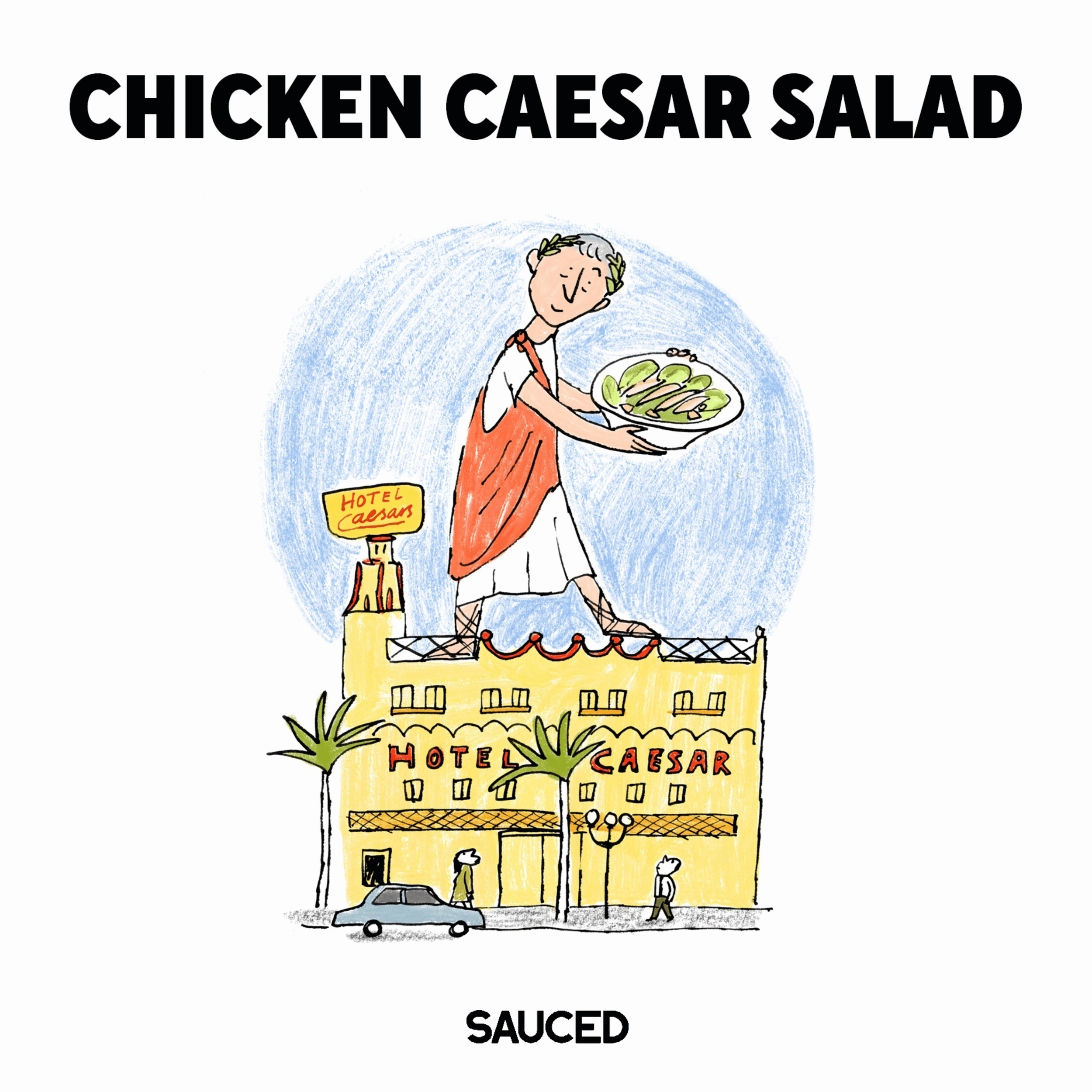
For most of its life, Shrimp and Grits was breakfast, the dish shrimpers ate at dawn in season. A Chapel Hill dinner menu and a 1985 New York Times write-up turned it into a Southern icon.
From tableside luxury to the most shelf-stabilized salad around, we settle what makes a Chicken Caesar worth cooking from scratch.
"Textures and temperatures."
What we settled on:
Chicken breast, grilled and sliced, never with bones
No anchovy, with Worcestershire carrying the savory backbone
Real Parmigiano-Reggiano, shaved and grated, never pre-grated
A hand-emulsified raw-yolk dressing with Dijon, garlic, lemon, Worcestershire
Neutral oil, not extra virgin, so the dressing leads
Small, bone-dry croutons in garlic oil, added last
Romaine spun bone-dry and kept cold, booze slipped into the marinade
The Cocktail:
The Aviator, a dirty Daiquiri of white rum, lime, and olive brine that puts the salad's savory side in a glass.
RECIPE CARD:
Premium subscriber? Check out the full recipe card here.
LISTEN
EpiSOde Partners
Thanks to the following brands for partnering with Sauced to bring you this episode:
TRANSCRIPT
Tim McKirdy: Sother — let's take a little plane down to Mexico, of course, because it's the Chicken Caesar Salad. Is that not where your mind goes to when you think Caesar?
Sother Teague: I mean, it's not where my mind goes to when I think Mexico, but it's a great dish and we're going to have a good time talking about it. And I also think it's — it's still summer, so it's summer appropriate.
TM: Is this the world's most iconic salad?
ST: Wow. I mean, what else you got? Waldorf. And then, you know where I'm from in the South, you got Ambrosia.
TM: Where I'm from, Ambrosia's custard.
ST: Well, it's — where I'm from, it's a salad in the most stretched terms. I mean, it has Jell-O and marshmallows in it.
TM: I mean, you got niçoise.
ST: Oh, sure.
TM: I think just in terms of what marketers might call share of voice, this is probably the one that's most recognizable.
ST: Sure. You know, is the Martini glass the most recognizable cocktail glass? For sure.
TM: I mean, that's why they made it the emoji for cocktail.
ST: Yeah, exactly.
TM: What are your personal associations with it, though? How do you feel about the Caesar?
ST: There is an emoji for salad. It's so tiny. Can I zoom in? Is it a Caesar? I feel like it's got a tomato in it, though.
TM: I was going to say, I'm sure I've seen something red in there. Not in my non-negotiables, though.
ST: No, me either. But my personal association with it is I've worked at many places who've had it, or versions of it, on menu. I don't know that this is a salad I make at home, though. I have a professional more than a personal. And I do enjoy this salad. It's a great salad.
TM: That surprises me, just because the dressing contains so many things that I know you love, and I know you like making fresh. I know you have a stance on fresh mayo.
ST: I do. I have a stance on mayo in general, and it only kind of weirdly recently formulated as an idea in my own mind. I have dozens of mustards. I probably have nearly a hundred hot sauces. Why is it that I'm supposed to choose a mayo to rule them all? I have different mayos, a variety of mayos for different uses.
TM: Horses for courses.
ST: Yeah, man. I've got my homemade stuff that I love, and it changes slightly every time I make it because I just make it with whatever I've got laying around. I have Kewpie, because when I want something sort of savory and sweet. I've got Duke's when I want something rich and creamy. I've got Hellmann's when I just want sort of standard mayonnaise. I would never touch with a 10-foot pole Miracle Whip. No offense to Miracle Whip, but it says right on the label: salad dressing.
TM: Oh, salad cream. You ever had that stuff?
ST: Oh, that's a very British thing, right? I've not had it. I've seen it, and I just assume it's the British Miracle Whip.
TM: Probably. Very vinegary.
ST: But to that end, this dressing for this salad that we're talking about today — Caesar is effectively an aioli slash mayonnaise that's been augmented with a few extra items.
TM: So why do you think it is so iconic then?
ST: I think that you're going to get into it in the history, but it has a shy-of-glamorous but at least a glitzy origin story and luxury angle. Am I wrong about that? It got weirdly tied to nightlife and celebrity, and so it just kind of rode the wave.
TM: Well, that is true, but I didn't really — I wasn't familiar in any real way with the origins of this until looking it up for the show. But yet still it's just, like, the Caesar salad. Maybe it's the name, right? Caesar's, right? It's grand. It's got a standing.
ST: We've talked about this in the cocktail world as well. Jim Meehan said in his book The Meehan Manual, a cocktail's only marketing campaign is its name. Just as we know that there are many, many terrible cocktails that exist because they have a great name, there are probably double that many great cocktails that don't exist because they didn't have a name that stuck with people.
TM: And I would argue that the Waldorf is doing a lot of heavy lifting for what's actually in the salad, because it's not something — I love a Waldorf salad, but the name is iconic, right? The association. So yeah, maybe that's a non-negotiable question. This is something that's universally easy to enjoy, right? It's neutral green, a tasty dressing, and chicken breast, and —
ST: And some crunchy croutons.
TM: Some crunchy croutons. What's not to love? Anyone can enjoy it. It's inoffensive.
ST: But I wouldn't take it away from the canon, because there are plenty of things that we love and enjoy that are sort of inoffensive. You know, look at the pizza margherita. Pretty straightforward. That is sort of the baseline of pizza. We can go anywhere from here. I think that in some ways this salad speaks to that. A great dressing, crunchy, crisp, juicy lettuce, cheese, crunchy crouton, and we're going to throw on some chicken.
TM: Fantastic. Well, let's get into that origin now, and let's look at the beginnings of this wonderful dish. I mentioned at the beginning, we got to head to Mexico. Caesar salad.
ST: Which seems like the wrong place.
TM: What I love about this story, though — because, again, let's be upfront here. This is a dish that I'm eating with booze, but I'm not cooking with booze. This is a drinking-with-food dish.
ST: I can see — I mean, listen, if it was Caesar salad, I'm in your camp, but we said chicken Caesar. So there's a way to get some booze in here.
TM: Okay, but booze played a pivotal role in its beginnings.
ST: Oh yeah, how's that?
TM: So it was born in Tijuana, not Italy. Had nothing to do with the Romans. It was at a place called Caesar's, run by an Italian immigrant named Caesar Cardini. Cardini was born in Baveno on Lake Maggiore in Northern Italy in 1896, emigrated to New York in 1913, and by the 1920s he moved to San Diego, but he plied his trade and worked in Tijuana, because Tijuana had one thing that San Diego could not sell at the time.
ST: Booze.
TM: Prohibition, my friend.
ST: That's right. Also, young man — all these people in our history, of course, are young. 'Cause I guess we died younger, I don't know. But from what you just said, it sounds like he landed in New York at age 16 or 17. What were the numbers again?
TM: Yeah, 17.
ST: Then he traveled all the way across the country to San Diego. That's an incredible feat for a young man as well.
TM: In the 1910s.
ST: And then he decided, I'm going to live in San Diego and cross the border to go to work, because there's booze there.
TM: Wow. Yeah, I mean, the tourists were going down there. Think of Cuba, Havana. Godfather.
ST: And you're just chasing them, just chasing the paycheck, just chasing the money. I don't begrudge him.
TM: So despite that name, it has obviously nothing to do with Julius Caesar. As I said, it's named after its creator, or supposed creator. The tale that has been recounted often was by his daughter Rosa, and she says that on July 4th, 1924, a holiday rush ran the kitchen low, so Cardini improvised a salad from what was left and tossed it tableside for show. This was something that was theater from day one — and often theater that we've lost these days. What it had: whole romaine leaves left long, tossed to coat, lifted by the stem, eaten with your hands. No cutlery here, nothing cut up either, right? Like, you think of this, you think of chopped lettuce — not at all. Had an interesting coddled one-minute egg, with olive oil, lemon juice, garlic, Parmesan, garlic oil, croutons, and Worcestershire sauce. Rosa, his daughter, was adamant on one point: there were never any anchovies.
ST: Notably — I was about to say, notably no anchovies in the original.
TM: Now, where does that creep in? Well, anchovies form the base of Worcestershire sauce, right? It's made from fermented anchovies.
ST: I mean, I've always referred to Worcestershire sauce, when trying to explain it to people, as it's effectively the UK's version of fish sauce.
TM: Yeah, I don't find it especially fishy, though.
ST: Me either. But the way it's made, as you just said, we're fermenting some anchovies as part of the base of the sauce. That's what fish sauce is.
TM: It's umami, right?
ST: Right, super umami bomb. I mean, everything in this thing is umami.
TM: But the anchovy would end up being something of a sticking point, right? So the family starts fighting over it, and the workers at Caesar's. His brother Alex Cardini claimed his own version, the aviator's salad, made for American pilots, which included mashed anchovy fillets on the croutons and lime instead of lemon. That to me seems like a riff, not a whole new salad.
ST: Well, when the thing is brand new, you're still vying to see who's going to be the original kind of, right? Just 'cause yours came first doesn't mean it's the original.
TM: It's who popularized it, we often say.
ST: We go over this all the time. Also, I love that it's a sibling rivalry. Also, that means that his brother came over as well.
TM: Yeah, must have. But the aviator salad is to the Caesar what a Vesper is to the Martini, right? It's a variation. It's got a name, but it's really not that different. We put lime instead of lemon. Come on, dude, who's noticing that? And then he's spreading anchovy fillets on croutons. Not for me. Another person who got into the fray, a cook in Cardini's kitchen, Livio Santini, said the recipe was actually his mother's. And his mother was an Italian who had improvised it from wartime rations in Austria — sorry, not America — during World War II. By 1946, a columnist named Dorothy Kilgallen had put Caesar recipes to print with anchovies worked in. So that's 22 years after its supposed creation — anchovies were already the norm. I guess 22 years is a pretty long time when you think of things.
ST: Sure. In the scale of a human life, in the grand scheme, it's not even a second.
TM: But Caesar Cardini himself, in 1952, was unequivocal in saying, I originated it 28 years ago in Tijuana, Mexico, and these others, they just aren't the same. So yeah, kind of glamorous, right? Travelling south of the border, chasing damn booze. I should have looked up pictures of this place. I'm imagining it looking kind of grand and cool.
ST: Sure, tableside preparation. That's the thing I forgot to mention earlier, too — that's where that sort of luxury angle came from. It was popular at restaurants at that time where people would — you'd still get dressed in a suit to go out to a restaurant. But then in Southern California, AKA LA, Hollywood, this became popular. And again, the tableside preparation giving it some theater, the whole leaves giving it some uniqueness. I've jokingly called this dish, like, lettuce nachos, right? Which tracks as well, if he was in Mexico making this. I think there was theater and luxury, and then it got associated with fame, and then thus it became famous.
TM: Let's not forget as well just the whole idea of when there's something new, right? And how often had the salad been experimented with? I guess the Waldorf was definitely established at this point. So yeah, it's just something new, something cool. He trademarked his dressing, by the way, in 1948. And just two years ago, the humble Caesar celebrated its 100-year anniversary.
ST: Wow, I didn't know that. That's cool.
TM: I didn't even do anything to mark the occasion. Did you?
ST: I didn't. I wasn't aware. I'll celebrate next year. I'll celebrate on the next hundred.
TM: Well, those have been the origins. I guess final thing for us to discuss before we take our first break of the day: prince's or pauper's dish?
ST: I think this is neither. Can it be neither?
TM: Which one are you leaning more toward?
ST: I think it's a pretty modest dish, but it started in Tijuana, and I don't know about Tijuana then, but Tijuana now is a place where you can go with very little money and get a lot. So I think — is it pauper then? I don't know. I'm torn on this one, to be honest. Because the opulence of the setting and the places that it gets served —
TM: I'm leaning Prince. Here's my thinking. Yes, I imagine that Tijuana and these kinds of establishments, I'm sure they were probably catering, like you said, to the rich and famous, people who had means to go and travel in search of booze. The fact that it was made tableside — okay, that was probably to add theater, because he was running out of ingredients. And also, okay, the original didn't have chicken, but the fact that we most commonly use chicken breast — which I know we both have our own thoughts on this, but I think chicken breast is the one for me for this dish, just in terms of if I'm making the textbook version of it. Well, the textbook version wouldn't have it. So that to me leans more Prince. I guess a final question I have, though, is: this guy, right, so resourceful that he was traveling the world in search of a buck — what the hell was he doing going into July 4th weekend with not enough supplies to feed the guests?
ST: Well, there's that, and there's — this is a bit romanticized, right? 'Cause there's that, but there's also the notion that, like, okay, we're running low on stuff, I'm already scrambling around, I'm going to add in now — I'm going to wheel a trolley out and do this tableside? No, I'd be making this in the kitchen and whipping it out the door.
TM: But if it's like, well, all we've got is a couple of eggs, some standard pantry ingredients and these lettuce leaves and some bread — well, let's make it fancy in front of people.
ST: Right. I mean, he was from Italy, so maybe he wasn't ready to celebrate July 4th as a normal thing. And he's also in Mexico, so he wasn't thinking it was going to affect him there.
TM: I don't know. I guess it's the same as we encountered in our wings episode, right? Like, oh, it was the end of the day and they had nothing, so these wings that they normally used for stock, they cooked them. I'm going to start running down my supplies in the fridge upstairs and see what I come up with. Necessity.
ST: Yeah, the mother of invention.
TM: There we go. All right, Sother, let's take that break, and then we will be back with the Culinary Luminaries.
ST: Cool.
TM: All right, Sother, we're back. The Luminaries. I'm not going to mention it, I'm going to hand it to you, but I did find one of our icons entering the conversation, which was nice, because they haven't been here for a while.
ST: I found them both. Well, I mean, both in the same breath, really. Kind of a fun, interesting culinary disagreement that these two had. Jacques and Julia were talking about — of course Julia was a hard stand for the non-anchovy version, and Jacques was completely in the other camp. So there's that. And Julia, she said that she remembered eating a Caesar salad at Cardini's restaurant when she was a child, which is crazy. What was she doing in Tijuana as a child? And later obtained the recipe from the aforementioned daughter Rosa. And she stood with Rosa on the no-anchovies point. So that's how Julia's Caesar was.
TM: That's got to be our Porco pun of the week right there. Julia's Caesar.
ST: But Jacques liked to put in the anchovies. And why is it that all of us — I think all of us who enjoy good food want the anchovies in there? They bring glutamates to the party, which is going to really back up all the other umami bombs that are already in this dressing. You know, Parmesan, garlic, rich egg, oil. My mouth begins to water as we talk about it. Mark that on your bingo card. And then we're going to go in and add chicken, another savory item. So this dish becomes super, super savory. As far as luminaries go, oddly, that's kind of all I could get. It's such a — they just don't really talk about it. It exists. No one has stepped forward and owned it like it was owned in the beginning. So weirdly it seems kind of ripe for the picking. Any of the guys that we love — like, why doesn't Bayat put a definitive Caesar on his menu? Why don't the guys at Fallow go, Caesar, this is it? Why doesn't Eleven Madison Park have a Caesar?
TM: It's a great question. I wonder whether it's just because it's seen as too common.
ST: Right, I totally agree with that. But I also feel the same way about a lot of drinks, but there are places who have championed the Martini. It is too common, but there are plenty of restaurants and bars here in New York City and worldwide where the Martini is exalted. So I think it's an opportunity for someone to champion the dish, and obviously it belongs to Cardini, but to make it their own for today's market.
TM: This is just reminding me now, and I didn't get into it in the beginning, but professional associations with this or whatever — I'm now realizing that the place where I first learned about the tableside preparation, including the dressing, was at culinary school. And if I recall, one of our tests, we had, like, what are all the components of a traditional Caesar dressing? And then what are all the components of the salad? And some of the stuff we included in the salad, I'm like, well, they're definitely not in the original but wouldn't be considered non-negotiables. Soft-boiled egg —
ST: Is that because of the coddled-egg origins?
TM: Well, no, because the coddled egg would just be the dressing.
ST: Right, but I mean —
TM: Let's talk about a coddled egg for a minute now. I had never encountered this before.
ST: Coddled egg is like gently steamed, right?
TM: No, rapidly boiled for one minute.
ST: Oh, what was I thinking? I was thinking, what's the one where you put it in a dish and you steam it?
TM: Oh yeah, oeuf en cocotte.
ST: Yeah, there we go. So this is still in the shell. You drop it in rapidly boiling water just for a minute. It starts to coagulate some of the proteins, but it's still quite raw. Why do we do this?
TM: No idea. Because the science of it, it's like, it's not cooking for long enough to —
ST: To pasteurize.
TM: Pasteurize it. So you need pasteurized eggs. I don't know. I just don't know the answer to that.
ST: Or trust your farmer. Well, I'm curious if, at that culinary school, the coddled part made people think there should be a cooked-egg component.
TM: Well, and this is maybe where it gets into the princes, right? Because I remember distinctly being shown in a wooden salad bowl —
ST: I was about to say, I remember this from culinary school as well. It had to be a wooden bowl, because the first thing you do is take a clove of garlic and scrape it across the bottom of the bowl to scent the bowl with the garlic oil.
TM: And then you go egg yolk, start making your emulsion. Once the dressing is made, then start tossing the things in it. I believe another one that we had was crispy bacon. Like, this is what's in Caesar. So it would've been anchovies, croutons, soft-boiled egg, chicken, romaine, dressing. Bacon.
ST: Bacon. Yeah, it sounds good, but it's not a —
TM: So I think that's the answer to that question, though. When it comes to all things Caesar, what comes first is the egg. At the end.
ST: Caesar. But in the joke argument, the chicken came first.
TM: Still up for debate in my opinion. Then, yeah, I mean, like, to your point — okay, so there was one Nancy Silverton made, a deconstructed Caesar. So speaking to your point about, like, has anyone taken this — it was a small dressed romaine salad set beside a crostino spread with garlic aioli and laid with anchovy and hard-boiled egg. There's that egg. Eaten by alternating the two with your two hands, a little bit of salad, a little bit of crostino.
ST: The '80s, what a wild time. I like Michael Symon's take on Put It In Your Mouth podcast recently, where he said, why are chefs deconstructing things? It is our job to construct your dinner. We're here to construct dinner for you. I'm in his camp, I think.
TM: Yeah, I don't know, it's fun. Trends and whatnot, they sway over time. But yeah, those are the luminaries then. Kenji doesn't go with the coddled egg.
ST: Who does?
TM: Who does? I don't know. Uses raw egg, basically does exactly what we would do but makes it in a food processor rather than whisking it by hand.
ST: I use my immersion blender when I'm making mayonnaise. I guess that's what I would probably do if I was making this dish at home. But honestly, if I was making this dish at home, it'd probably just be for me and Natalie. I would probably do it in the bowl, the old-school way. I need one egg. You know what I mean? What's the point? I'm not going to break out another piece of equipment and mess up more dishes. I'm just going to make it in the bowl.
TM: This would be a staple for family meal — Caesar dressing. And it was a way in the kitchen, as an apprentice or with apprentices, to be like, okay, now you're going to dial in your mayo and Caesar dressing, and this is how you make it. And you could tell a lot about a person by how garlicky or anchovy their dressing was.
ST: Non-negotiables.
TM: All right, well, those have been the Luminaries. We'll take another quick break now, and then we'll be back with the Non-Negotiables. There we go. All right, so here we go, the Non-Negotiables. What you got? Number one.
ST: Number one for a Caesar salad, it's lettuce, and that lettuce has to be romaine specifically. It's sturdy, crisp, just wet enough to be, you know, quote-unquote juicy. I know that's weird to think of lettuce as juicy, but it is. It's got a slight bit of bitterness, but it's generally a sweet lettuce. I think romaine is a must.
TM: I think next in line for me, given that we're calling this specifically Chicken Caesar Salad, there's chicken. I'm leaning breast as non-negotiable.
ST: Wow. See, this is where we're going to fight.
TM: I'm not saying it's the best version. I'm just saying it's the expected one.
ST: And you fall on that assumption a lot, and I often agree with you. I don't know if I'm going to on this one. Well, I guess let's ask the second question here, because I was holding this in the bag for a minute. How are we cooking this chicken?
TM: I think ideally grilled.
ST: Yeah, I think there's only two answers for me. It was either going to be grilled or fried.
TM: Like deep-fried?
ST: Fried chicken Caesar. Let's go.
TM: That is — no, that's wild.
ST: Why is it wild?
TM: No, I mean, delicious, don't get me wrong.
ST: But I think grilled is the way. But I just wanted to point out that we could have poached chicken. We could have pan-fried chicken. We could have roasted a whole bird and peeled some chicken off of there. We could barbecue chicken and pull it and put it on. Still would be Chicken Caesar Salad, right? Kind of like in the shrimp and grits episode, where no matter what you put in there, whatever you take away, it's still shrimp and grits.
TM: You know, Sother, something that people say about me, they say, he's a reasonable guy. They say, not McKirdy, right?
ST: I disagree. Challenging.
TM: So I'm going to meet you in the middle here. I'm going to say, all right, the cut of chicken is up for debate. Non-negotiable: no bones.
ST: Oh yeah, no bones. I wouldn't put a piece of chicken on a salad that had bones in it. Even if I was making this in the platonic original style of eat with your hands, I still wouldn't put chicken with bones. I wouldn't put chicken wings on here. I wouldn't leave a bone in the thigh. I wouldn't leave the cage in the breast. I wouldn't do an airline breast. It's a salad. That's a thing that chefs — I'm not a chef, but I think most of them, if they're conscientious, is like, how is the final result going to be consumed? Like, that's why you're not chunking in half a potato into a soup, right? It needs to be cut into a size that'll fit on a spoon.
TM: Well, then let me stop you in your tracks here for a second. If we're thinking about the original way in which this was intended, in the deconstructed version, the Nancy Silverton or whatever — if we're eating this with our hands, actually bones are probably something you'd want.
ST: Interesting. Yeah, you're not wrong.
TM: Well, we have more non-negotiables to discuss. That was an unreasonable amount of time for a reasonable guy to spend on that one point.
ST: Sure. Should I start with Parmesan? Got to have cheese, and it's got to be Parmesan.
TM: Interesting. I agree. That was another one that was in the culinary school. But I was like, Parmesan's higher up than dressing for you? The dressing is the salad.
ST: I mean, you're right. If — again, that's what I had as number three. I had romaine, Parmesan, number three dressing. But the dressing has so many pieces to it, I just wanted to get the things that are separate out first.
TM: And I agree, the real Parmigiano-Reggiano, shaved, nothing grated, certainly not the pre-grated stuff that people buy.
ST: Right. And then you can just use your peeler and make some shavings. That way, again, if we are going to serve this in the nacho style, they would stay on there a little bit better and be a little bit less messy for your fingers. We're not going to do that, 'cause we're going to have chicken on ours, and then it's probably not going to have bones in it, so we're going to need to eat this with a fork.
TM: I'm just thinking about that and talking about the different styles of cheese. I'm just now finding it unbelievable that growing up we would have a tube of —
ST: That green thing.
TM: No, no, it's like a salt container of cheese, not in the fridge, in the whirligig.
ST: That green one that was like sawdust inside. And also, what is that, a lazy Susan?
TM: Similar to a lazy — it occupies the corner of a kitchen, but it's circular inside. It's a lazy Susan inside. I don't know whether that whirligig is the technical term, but that's what we called it.
ST: I love it. Yeah, no, I know what you're talking about. The Parmesan — was it even spelled wrong?
TM: I think it must have been, these days especially, with the EU.
ST: I just look back on it all the time, and I think it just looks like sawdust. Okay, anyway, Parmesan. Let's jump to the dressing. And the dressing has to meet the requirements of being super savory, still quite acidic, garlicky, rich in texture — and I think that's a real huge one — and fully emulsified. So again, it's thinner than, say, mayonnaise slash aioli, but it's thicker than a dressing. I don't want to have, when I'm finished eating, I shouldn't see a pool of anything in the bottom.
TM: Yeah, I think even just a little bit of texture too you can leave in it. I think that's a nice thing, right?
ST: It needs to cling to the lettuce.
TM: Yeah, so we'll go through it, right? Egg yolk, oil, lemon juice, garlic, Worcestershire sauce, Parmesan, mustard, Dijon.
ST: Yeah, a little mustard with the egg yolk in the very beginning to help emulsification.
TM: So a fancy Caesar dressing for me, or a gourmet Caesar dressing, is one where I get the texture of the Parmesan in the dressing from the dressing itself. Croutons —
ST: That was next on my —
TM: From real bread, real croutons.
ST: From real bread. And also the crouton needs to be somewhat savory slash garlicky. Frankly, I'm going to make probably a garlic oil, which I always have in my house. We've mentioned on the show before, I always have a confit of garlic in my home. So there's always garlic oil in my home, and I'm going to fry these up, and they must be dried and super crispy. I don't want them to have any give. They shouldn't be like bread anymore.
TM: Not even interior?
ST: No, because I think they should also be quite small.
TM: Okay, interesting.
ST: I don't like a big old crouton on this salad. Now, I've worked in the past — I worked at a French place in Tennessee, years and years and years ago, where we had a salad on the menu that was delicious. But the chef instructed us to take a half-inch-thick slice of sourdough bread and literally plunge it in clarified butter before slapping it on the flat top to griddle it, and then cutting it into big cubes to toss into a salad. Those were crazy delicious, but they were just bread. They weren't croutons. They had a crispy exterior, but they were definitely buttery on the inside.
TM: Oh, that's where I would go. It's not a non-negotiable, and I know I'm the outlier there. I remember a place where I worked where this was on menu, at the County Hall Marriott Hotel in London, five-star hotel, very much like — this is a hotel dish, right? With your burgers and whatnot. One of the guys who worked on the larder station with me, he was such a hack that, to make his croutons, he was so lazy that he would just slice up his bread and deep-fry them. Well, that was the same guy that fried his churros in fish oil. Oh, Phil.
ST: This guy was the fry chef.
TM: Yeah, he just loved it.
ST: Wow.
TM: I remember one day I came into work, and we had probably at any one time five different soups on our station. And I came in and he'd seen me doing something for the leek and potato soup that I'd learned at culinary school, which is you cook and use some of the green tops of the leeks to give it a bit of color. I came into work one day and I had seen this leek and potato soup that he'd made, and it was bright green like Monster Energy drink. I was like, what's going on here? He goes, little bit of food coloring.
ST: Oh my gosh. My guy. Oh, my guy.
TM: No food coloring in this, though.
ST: Yeah. All right, so croutons we agree. What else you got?
TM: That's it.
ST: That's it. Are we going no anchovy?
TM: Listen, man, I cannot believe that I'm the one saying to you here — the purist, the one who always goes, this is how it was originally done, and then I'm doing it that way. Don't let your preferences cloud your judgment.
ST: Let your conscience be your guide. All right, I had it as one, and I even put me slash us, hopeful that you would agree.
TM: You know how I feel about tinned oily fish.
ST: I do. It's unfortunate, but I do. We talked about the dressing. I think if there's a non-negotiable — I don't know if we mentioned, we did, we'd mentioned texture. It needs to be very well integrated. That was my last one.
TM: Thick, clinging to the —
ST: I think you mentioned it before we got to the end. How about some negotiables then? So now we'll call anchovies a negotiable. Obviously for Chicken Caesar Salad it must be chicken, but negotiables on a Caesar salad — I love a shrimp Caesar. And we talk ad nauseam about how much I love shrimp. Recently I went with our good friend Max Green to Keens and had a steak Caesar. It was quite good.
TM: So this was when — sorry to interrupt, but when I worked at the bistro, we would always have on the grill section there would always be steak, and the garnish for the steak would change depending on the season and the menu. Caesar was a longtime side to the steak, with a slow-cooked soft duck egg. So there's that egg again.
ST: Ooh, I love it. But slow-cooked and soft, that sounds delightful. Because now you're having, like, steak and eggs, but for lunch or dinner. Sounds great. Other negotiables — we mentioned already one, and I didn't think it needed to be on ours, but bacon. And I know you have sort of a strange relationship with bacon. You love it. Sometimes you hate it. Sometimes you don't. Love a smoke, though.
TM: I love bacon. I don't like it when it's too smoky and it overpowers.
ST: Right. Avocado comes into play in a lot of Caesars these days. Tomatoes, which I definitely think do not belong, but I see them happen a lot in Caesars, especially maybe some just split cherry tomatoes. And then one that I am on the fence about, because we've already spoken about how much the lettuce is important to this dish — I do, however, like from time to time, kale Caesar. Maybe because every time I say it, I think in my mind, kale Caesar, kale Julius Caesar.
TM: All right, well then let me propose an ingredient that I think lives naturally with all the other stuff. It's not classic, but if we were gonna introduce something left field, I think you could make the strongest case for sweet corn.
ST: Say why. Because it's crispy? Because it's —
TM: Just vibes.
ST: We're cooking on vibes, like we did in Trippin' Grits.
TM: Let the guides be your — anyway, I forgot what you said, but no, right?
ST: I think I said, let the guides be your vibes.
TM: No, you said, be vibed. But anyway, does sweet corn, chicken, mayo, lettuce — these are standard things that go together? Can I tempt you to any potatoes?
ST: Potatoes, maybe some like those really crispy little tiny matchsticks.
TM: I was gonna say persillade kind of style, yeah, or that you would put in a persillade, exactly that.
ST: Yeah, I could see that for sure.
TM: You know, okay, I've had a realization.
ST: Well, I got one more negotiable, and this is just me trying to think about this episode, of course, but also trying to think about, well, it's a show about cooking with booze. I think when we get to the chicken and the preparation part, we're going to probably add some booze to some sort of marinade, right? Some small amount of wine or vermouth or what have you. I think also, if we think hard about the emulsification that is this dressing, we could easily take some, say, shallots and herbs of some kind and reduce those down with either white wine or that white vermouth again, and let that cool and then incorporate that into the dressing, so we're making somewhat of a chilled béarnaise slash Caesar dressing. Again, I don't think we're going to do that on this episode. I don't think I want that, but I can see how that would be delicious. And again, if I was out there running a restaurant and trying to champion this dish and maybe make it my own, that's something I'd consider doing.
TM: Okay. I do know that there's a contingent of listeners — and I say this as having spoken with friends who listen to this show — there are some people who cannot get past it if it's like, chicken Caesar, well, there's no booze in that. How are you putting the booze in that? I'm like, it can be in the glass.
ST: You've got to listen to the show. Tune in.
TM: So if you wanna push it, I agree with that approach. I think tarragon.
ST: Because I've never done that, and I've made many a mayonnaise in my day, and I've made many a hollandaise and béarnaise in my day, but I've never taken the reduction style from the béarnaise and added that to a mayonnaise. And why wouldn't I? That sounds delicious. You're going to add a new layer of acidity to your dressing. It can easily bring some herbaceous quality — a handful of cracked peppercorns, classic stuff like shallot and tarragon for the Caesar. Maybe tarragon, dill. Dill sounds like it might be good, I don't know. There's a real opportunity there that I've never considered until this episode, and I think that that's another of the beneficial points of doing this show, hopefully for the listener, but certainly for me. It makes me take a hard look at things sometimes and say, well, why do we do it this way? Why wouldn't we try this? Why wouldn't we carve a new path?
TM: I was thinking — I mentioned a minute ago, like, I've had a realization in real time. As we're flying the plane, we're very much building this plane as we fly it this week.
ST: Yeah. Greg says one that I like: lay in the tracks as the train's already running.
TM: We've all seen that cartoon.
ST: Let's just stay ahead of it.
TM: I think the reason that this isn't viewed as grandiose anymore — or maybe it's a prince's dish that's become a pauper's dish — let's look at all of these ingredients, and let's look at my anecdote about cheese from a box that's shelf-stable. This salad, more than any other, has been shelf-stabilized. People buy croutons from a packet, shelf-stable cheese, salad dressing that's shelf-stable, right? All of these things — the only thing really that's fresh for a long period of this dish's history were the lettuce and the chicken. So maybe that's it. This is a salad that could travel to Mars.
ST: Yeah, I don't disagree. And also, again, it had its heyday as luxurious, with the tableside setting and the famous people eating it and famous restaurants and dressing to the nines and whatever, probably drinking illicit Martinis.
TM: Well, legal south of the border.
ST: Well, right, but I'm saying this dish traveled to Hollywood, and that was still during Prohibition. They're out there making your Caesar tableside, and they're probably shaking you a Martini tableside, totally. But it doesn't have a ton of opulent ingredients, and even as the origin story dictates, it was like, we were down to the last of the stuff. You know, the last of your stuff isn't usually your best stuff. We were running out of our supplies, our larder was low, we made this out of what we had.
TM: But we made it with love and by hand.
ST: Yeah, delicious.
TM: Final one for this section. We brushed over it, we said oil. It needs to be a neutral oil.
ST: Neutral, yeah, pretty neutral.
TM: I don't want extra virgin in this. I don't wanna taste my oil.
ST: Right. Now the oil is just there to be the emulsifier.
TM: All right then, Sother, well, that has been the Non-Negotiables plus the negotiables. Time for another break for us, and then we'll be back with the Preparation. All right, Sother, here we go. Table side. Supplies are running low. It's July 4th.
ST: There's nothing in the kitchen, so you may as well run out into the dining room. I can't even imagine the chaos.
TM: Walk us through.
ST: Okay, well, first thing, the major pieces of prep here are the chicken and the croutons. So we're going to take our chicken. In this case, we're going to use breasts, because that's the way Tim wants it. No, no, I agreed, I agreed. You're right, it's the more expected. I personally would do this with thighs, but for our show, we're using breasts. So take a couple of breasts. You might want to manipulate them, pound them a little bit to get them evenly thick, but not much — we're not trying to make a paillard here. Let's marinate them a little bit. Standard marinade, nothing crazy. Use some of the things that are already in the dressing. Let's go with some lemon juice, maybe a little bit of Worcestershire. If we want to squeak some booze in here, this would be a great place to put in just a little bit of vermouth or white wine, and then some salt and pepper, and that's it. Just an easy marinade. Get that done 30, 40 minutes before you're going out to the grill, because we decided we aren't grilling. While that's marinating, let's get the croutons cut, tossed in a pretty garlicky oil, spread out on a sheet pan and into the oven until they're nice and dry and crisp, and let's not make them too big. Once we've got the grill fired up, let's get the chicken on there and grilling until it's done, and then once it's done, let's let it rest, and then we'll assemble our salad. Salad starts with the dressing. So let's make a dressing using an egg yolk, a small clove of garlic, a bit of Dijon mustard, and let's start emulsification in a bowl with a whisk and/or your tool. If you're using a tool, you're going to add the oil right to your immersion blender. But if not, let's get those things together, and as they're coming together, squeeze in a bit of lemon juice for brightness. In goes a bit of Worcestershire sauce, and now we're drizzling in the oil, nice and slow, as you've seen everyone make a mayonnaise your whole life. Then we're going in with some of that Parmesan cheese, but finely grated, because you want that mouthfeel. I was listening to you, so I put it in my notes. And then, as it comes together, taste it, of course. I don't think you're going to need much if any salt. I think that the Worcestershire and the Parmesan cheese are going to bring those things to the party, but you want to hit this with a little cracked pepper, and then now you've got your dressing. Let's make sure we have washed our romaine and dried it. It's important that it stays nice and dry, because we don't want any liquid coming off of the lettuce — there's liquid in the lettuce, but we don't want any liquid just coming off the lettuce thinning our dressing. As mentioned earlier in the show, when I'm finished eating this, I shouldn't see a pooling of anything in the bottom. The emulsification should be clingy to the lettuce leaves. So dry it off, and also chill it, right? So wash it and dry it even while you're doing the other things, the croutons and the chicken, and keep it in the fridge so it's nice and cold as well. I think one of the things about a Caesar salad is that crispness and that chill, right?
TM: Crisp. How do you feel about a salad spinner?
ST: Yeah, man. Well, we used to have the big ones, the ones that are about the size of a small garbage can with a big crank on top of them. We had those at the shop. I've never had one in my house. I do see a value for them, and we used it all the time in the restaurant for this exact thing, to dry lettuces especially, or greens or what have you. I can't argue against them, but I personally don't own one. I never have.
TM: We have one at the house. I had to lobby for it.
ST: Did yours have the pump thing or the string thing?
TM: No, it's the regular crank. And every time I use it, I am astounded by how much water you get out of the washed salad when you think it's already pretty dry.
ST: Yeah, no, it is actually quite shocking. Again, that one that's the size of a small garbage can, you're slinging off like half a gallon of water.
TM: One of a chef I work with, James Peckman, who I went to culinary school with as well, a dear friend — when he was spinning salad, he would get it up to a speed that it sounded like a jumbo jet taking off. I'm like, this cannot be good, the salad.
ST: I think that was all of our goal.
TM: Oh really?
ST: Oh really. Also, it would never be in perfect balance. You'd be cranking this thing and it would be shaking. It's like you're holding onto a barrel going over the waterfall.
TM: Yeah, the little joys in life, spinning salad. But yeah, I was curious to hear whether you had one, just knowing your rules, your hard rules.
ST: Yeah, I don't, and I never even considered that while thinking about this, but if this was at a restaurant that I worked at, we would surely be doing this to this product. So then now you've got your — I'm going to say, for ours, actually I'm on the fence here. Are we cutting the lettuce? Are we leaving it whole? We're going to cut the chicken. We're going to eat this with a fork.
TM: I think we're cutting the lettuce.
ST: But I want to cut it pretty big then, pretty chunky style. I'm not looking for shreddice here. I hate that word. Actually, I kind of like it. I wouldn't have used it if I didn't like it. All right, so let's assume we're going to cut in maybe almost an inch-wide slices of that romaine. So let's get our romaine cut and/or tore. You could just tear it. Let's get that. Now we've got our dressing that we made. If you made it in the bowl, perfect. If you didn't make it in the bowl, get yourself a nice large bowl, big enough that you can toss these things, and put some dressing in the bowl first. I think that is the common mistake that people make at home, is that salad goes in and then dressing goes on top, and it's very difficult to incorporate this way, and you end up frankly overdressing. So put a modest amount of the dressing in the bowl, sling it all the way around the bottom. Don't just put it right in the bottom. Then in goes your lettuce. Gently toss to start coating. Now our chicken has been rested enough so that we can slice it. In it goes. Gently toss to coat that. Those shaved bits of Parmesan can go in now as well. The final thing you want to put in are the croutons, because if you put them in too early, they'll start to get soggy from the dressing and any remaining moisture that's in there. And then plate up, and maybe a few more shaves of the Parmesan on the top.
TM: Are we going crispy bacon in ours?
ST: No, we didn't do bacon. We said that was a negotiable, not a —
TM: Okay. Nah, you just seem — whether you wanted to put it in the Sauced version. No, that sounds delightful to me.
ST: Then I think the real thing about a Caesar is one of the reasons it was done tableside in the beginning is because it needs to be served and eaten immediately. The clock is ticking on this thing for those crispy croutons to get soggy, for the warm chicken in our case to start wilting the lettuce. Like, you want to get it to the guest immediately. That way — and frankly, when you're having a chicken Caesar, or any Caesar that has a hot protein involved, you're getting that dichotomy of, like, the protein is hot, but the lettuce is cold, and the dressing is clinging and creamy. There's a lot going on.
TM: A lot of textures and temperatures. And yeah, I like it.
ST: I mean, I think that this salad, that's what this salad is. It's textures and temperatures.
TM: And filling, isn't it? Just the very nature of that lettuce. I always forget what it's called — the response? No, the payoff.
ST: A response cost. Response cost.
TM: Response cost, yeah. You know, it's a lot of effort eating a big romaine salad. It will make you think you're fuller than maybe you are. All right, well, that's what's in the bowl. Time for us to take our final break of the day, and then we'll be back with the Pairings.
ST: Love it.
TM: All right, so we're back. The Pairings. Wine, let's start with wine. Crisp, high-acid white is where I wanna go. Actually, where I always wanna go is Burgundy. A light — but, you know, I love some oak on my Burgundy, or on any Chardonnay. Not too crazy — lightly oaked, I think, is the absolute maximum when it comes to the influence of those characteristics. I think Mâcon, the village, but again, pretty expensive. If we're talking high-acid and crisp, maybe you're gonna find more friends in Chablis.
ST: That's the one that's on my list. Chablis — acidity, minerality, cutting through that dressing, complementing that Parmesan. That's the only one I — oh, well, sorry, I have two. I forgot I had two. But we get through the Chablis. Yeah, I'm in the Chablis camp, I think.
TM: The other one, if we wanna stay in Burgundy and if we wanna continue high-acid white, let's look at the other white grape there: Aligoté. Becoming — certainly it's become more famous and more coveted these days, again, as Burgundy prices have skyrocketed. I think somms and wine buyers turned around and said, look, here's this lesser-known grape that the region also does. And oftentimes that can be a really good marketing event for a lesser-known grape or style of wine. The other one I had, just in that crisp — or two more, I guess — would be Picpoul de Pinet.
ST: Whoa, that's a new one to me. Did you say pit bull?
TM: Picpoul. It's from southern France. It's a white. I've often described it as Aldi's Grüner Veltliner. In the UK, it's an Aldi wine. When people wanted to think that they were buying bougier than Sauvignon Blanc but still continuing to play pretty rock-bottom prices, Picpoul's always been a great option. But the other, like I say, Grüner Veltliner. There's a boxed Grüner — I forget what it's called. I can see it now, though. It's like yellow and black, and it's almost like a cool kind of cartoon on it. Pretty widely available. That's something of a staple in my fridge over summer, just having that on hand. Basically just citrus fruit or a green orchard fruit, acid. Good to go.
ST: Love it. I was thinking, to go with this dish, Muscadet, right? Because it's got some saline. And so again, my approach is always right at it or kind of against it. So the saline in the Muscadet, I think, is gonna be up against all these umami-bomb parts of this salad. It's gonna really pair well.
TM: Yep, love it. If someone at the table is calling for red, we've said it before —
ST: Is it Lambrusco?
TM: I mean, yes. Just assume that there's always a bottle of Lambrusco there. Gamay or Beaujolais.
ST: Oh, okay.
TM: I mean, the same thing, but like Gamay, Beaujolais, or somewhere else. And that's wine. What do you think on beer and cocktails?
ST: Beer — I know I've brought it up a few times recently, but this dish being as light and crisp as it is, Kölsch. Like a tall, skinny glass of Kölsch, which is also — the Kölsch is traditionally served in an 8-to-10-ounce glass.
TM: Schnit. No, that's the other thing.
ST: No, that's what it was called, right? Yeah, the schnit. So they're frosty cold, and this salad, again, is supposed to be consumed kind of right away. I feel like these two are in cahoots in that regard. It's the only beer that I listed.
TM: Mexican lager.
ST: Obviously.
TM: Just based on —
ST: I was about to say, obviously there's some other options that could be considered, and I hadn't even thought of that until you just mentioned it. But yeah, Mexican lager, this is. Or let's go the other way, an Italian, like Peroni.
TM: True.
ST: I mean, this was made in Mexico, but it was made by an Italian. Otherwise it would be Cesar salad.
TM: Cesare. How about I see your Mexican beer and I raise you Modelo, now made in America?
ST: Is it? Did they move their facilities?
TM: Let's just say the Teamsters are lobbying pretty hard for it right now.
ST: Wow.
TM: Yes. It's still currently made in Mexico, but the extent to which that will be true in the future remains to be seen.
ST: Wow. Let's get into a cocktail. I got a couple of classics that I want to pitch that I think would go great with this dish. One of them I think you'll like, one of them I think you'll not like. I think you'd like a Tommy's Margarita. You got some sweetness, you got some saline on the edge of the glass, as you just tied it to the Mexican beer. This is clearly a Mexican cocktail in its origins. Tommy's is just three ingredients — four if you count the salt on the edge. But it's just tequila, lime, agave. And I think that would pair beautifully with this salad, which is deceptively complex — simple to look at, simple to eat, but there's a lot of moving parts in that salad. Second one that I think you won't love, because I don't think it's your style, but a Martini, specifically a dirty Martini.
TM: Oh, listen, I'm yet to meet a Martini I don't like. Actually, that's not true. 50-50 — come on, where's your backbone? Where's your spine?
ST: I don't know, one of these times I put orange bitters in your Martini, which is classic, and you snubbed it.
TM: Mutual friend of ours who you used to work with, Andrew, at Gus's — he's working at a bar in the neighborhood, and I walked in there the other day, and he clocked me before I clocked him, and he goes, hey, Tim, good to see you. Martini? I'm like, yes. And he goes, five to one? I said, yeah. And he walks off, starts making it, and he comes back to me and goes, is it Regan's or Angostura orange that you don't like? I'm like, great memory.
ST: Good man. Way to go, Andrew Gelfenbaum. Good dude, good dude.
TM: Good guy. Regan's.
ST: So yeah, a dirty Martini. I think obviously the brine is gonna stand up to that savory nature of the drink. If you wanted, maybe you could garnish this drink with an olive and an anchovy, to tie it together a little bit. Like almost a Gilda, like we used to do with Andrew over at Gus's. And then the drink I think I wanna pitch to go for us from Sauced — because I do want some citrus, because I do want some salt — let's make a Daiquiri, but let's make it dirty. I have for a long time been a big proponent of a fresh-made Daiquiri, just lime juice, sugar, rum, shaken vigorously, strained, with a salted rim. But let's go ahead and put some brine in this as well. Make a dirty Daiquiri. You can come up with a name, but I'm gonna say a solid, hefty two ounces of white rum up against three-quarters of an ounce of fresh-squeezed lime juice, up against just a half an ounce of simple syrup, and then let's go in with a quarter of an ounce of olive brine from your favorite olives.
TM: Beautiful. Lovely.
ST: I don't think you need to do the salted rim, like I do when I have a Daiquiri these days, but I could also still see this being served with an olive, to kind of warn slash remind the imbiber, you know.
TM: I can imagine how that would sort of confuse me, in a good way. Challenge me.
ST: Yeah, well, because also, like, how many times have you reached for whatever innocuous thing — not even alcohol — how many times have you reached for a glass of Coca-Cola that was sitting there, and you took a big old gulp of it, and it was iced tea? Now, this doesn't mean you don't like iced tea, it just means, what a shock that was. So I want some kind of reminder that this isn't just your regular Daiquiri, or you're gonna be, like, spit-taking.
TM: You've had the Aviation before. This is The Aviator.
ST: Ha, perfect. How do you do that, man? You come up with these names right on the spot.
TM: So this is an invitation.
ST: Back to that imitative salad from the sibling, no less.
TM: So I want to actually bring some value to the personal anecdote that I told earlier as well, about Andrew, and not just indulging my hatred of Angostura orange in a Martini. I like the product. The bar and restaurant itself is called Trudy's, just opened in Carroll Gardens here. They have on menu a Martini that just thinking about it right now would be perfect for this. It's a split base of gin and vodka.
ST: You're already pissing me off.
TM: Sherry takes place of vermouth.
ST: What kind of sherry?
TM: Dry sherry. I can't remember if it was mentioned — might be Fino, but pretty neutral, dry. The garnish, I think they're Castelvetrano olives, but the signature add from them, they top it with chicken schmaltz.
ST: Oh ho ho, like this little dot, so you got like three little dots floating on the top.
TM: Little dots. Which I thought was brilliant, because it was salty, savory, flavorsome, slightly oily, right? We've seen this as a trend over there in the East Village at Schmuck. They do a really nice olive-oil top on it. I love it. It coats your lips and adds a new dimension to the drink. But good extra virgin olive oil is very herbaceous and green and peppery and whatnot, and you can't drink it. This schmaltz stuff, you could — I could do a little shot of it. So they offer that on menu, small or large.
ST: Coming soon to Trudy's, the chicken shot. What kind of chicken shot place is this?
TM: Well, literal —
ST: I can see it. And let's not confuse the listener, we're talking literal drops.
TM: From an eyedropper.
ST: Yeah, it's not an oil slick on top of your cocktail. This is a technique that's been happening for quite some time, but picture just like three or four little drops floating across the top of your drink.
TM: So anyone who's based in New York, maybe living in Brooklyn, head over to Trudy's. Andrew might be behind the bar. Just say Tim and Sother sent me.
ST: Yeah, that's right. Do that. That'll freak him out.
TM: All right, Sother, well, final question for us here today, as we always like to ask: what is someone missing out on? And I think especially true for this dish, if they never make a Chicken Caesar Salad from scratch at least once in their life — that's where I'm leaning, I'm thinking it's —
ST: What are they missing out on? You're missing out on taking a pretty small set of ingredients and making — this is a true definition of greater than the sum of its parts. There's not a long list of ingredients here. Most of them are pretty much pantry staples, as the origin story dictates. Being able to bring them together in such a way that became known for being opulent and fancy, and is now sort of known as just de rigueur, but then winding up with a thing that just hits all the marks. It's crunchy, it's crisp, it's creamy, it's acidic, it's salty, it's got some umami, it's got some fat, it smells delicious with the chicken on top. This is a dish that — I don't know, I'd like to say that it's more exciting than maybe at the top of the show I was even thinking of it as. The dish has a little bit of panache that it's maybe been embarrassed about itself, but that's how it —
TM: One of those things that's so ubiquitous you just don't see it. But when you start looking at it, and ask yourself the question — yeah, when was the last time I purposefully went out and said, I'm going to make a Caesar salad today, and I'm going to dial in every little ingredient of this? Yeah, I think let's try and make Caesar cool again. Cutlery optional. All right, Sother, well then, that leaves us with only one last thing to do. Time to put on the apron —
ST: Break out the shaker.
TM: Oh wait, that's two things. And let's get cooking.
ST: And drinking.
TM: Cheers.
ST: Cheers, buddy.