Episode 35:
SHRIMP AND GRITS
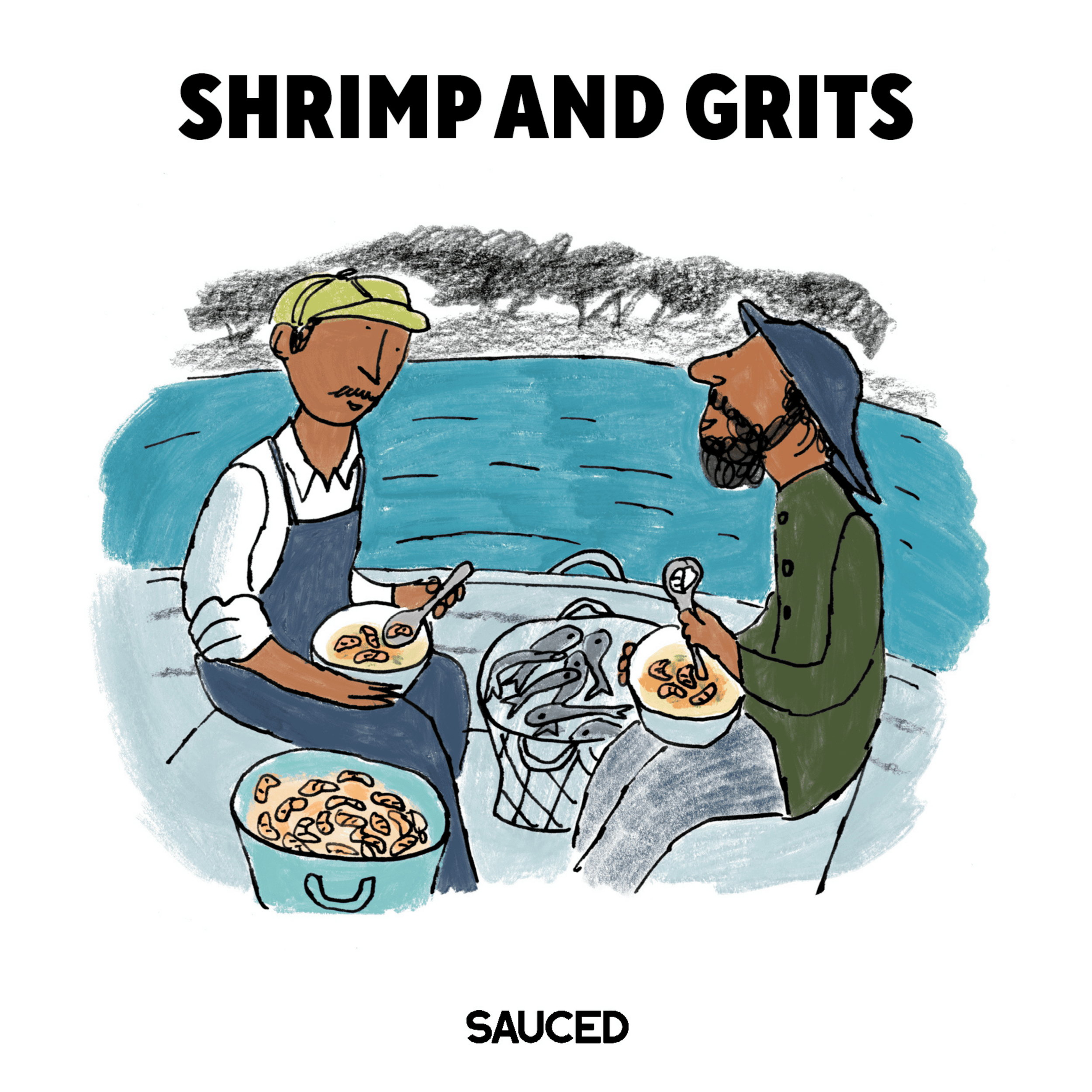
For most of its life, Shrimp and Grits was breakfast, the dish shrimpers ate at dawn in season. A Chapel Hill dinner menu and a 1985 New York Times write-up turned it into a Southern icon.
We trace the climb from the docks to the white tablecloth, then settle what really decides the plate: the grits, the shrimp, and the booze in a dish with barely room for it.
"Be guided by the vibrations."
What we settled on:
Stone-ground grits, never instant, soaked overnight
Shell-on 16/20 shrimp, cured then cooked just to a curl
A shrimp-shell stock in both the grits and the sauce
Bacon and butter for fat, sharp white cheddar to finish
A pan sauce deglazed with sherry, finished with Tabasco, lemon, cold butter
Okra, tomato, and an egg for the breakfast version
The Cocktail:
The Not Your Modern Milk Punch, a Southern-style milk punch with real milk, not the clarified kind, split between apple brandy and a Charleston bourbon.
RECIPE CARD:
Premium subscriber? Check out the full recipe card here.
LISTEN
EpiSOde Partners
Thanks to the following brands for partnering with Sauced to bring you this episode:
TRANSCRIPT
Tim McKirdy: Sother…
Sother Teague: Tim?
Tim McKirdy: It's a big Sother dish for us today, I think.
Sother Teague: Oh yeah, for sure.
Tim McKirdy: Sother — and Southern. It’s Shrimp and Grits.
Sother Teague: Low Country cuisine, let's go! I kind of made my bones cooking Low Country stuff, right, when I was a young man working at a place called Spanky's — we've brought it up before, in Durham. Well, it's actually in Chapel Hill, North Carolina; I lived in Durham, part of the Research Triangle — Raleigh, Durham, Chapel Hill. And I was making this dish at Spanky's, and I was literally just down the street from where this dish really became popularized. We're talking, of course, about Shrimp and Grits.
Tim McKirdy: That's an amazing one for us to cover, because of those associations and because you're so close to it. I really like it when either of us have a strong personal or professional association. That's your professional one — what about on a personal level too?
Sother Teague: Oh man, listeners are no stranger to the notion that I grew up on the beach and I am a massive fan of seafood. I've been eating shrimp all my life. And I can say with concrete authority: the very first dish I ever cooked for myself — you know how you remember the first album you bought for yourself? The very first dish I ever cooked for myself was absolutely grits for breakfast. So I have a longstanding love of grits themselves, I'm a huge seafood fan, shrimp come into play, I lived in the Low Country and cooked these dishes. A lot of personal meaning to me.
Tim McKirdy: And what about your elevator pitch, too? Because I've got some additional questions there, but for those who maybe aren't as familiar with the dish, or are discovering it for the first time today — what is this?
Sother Teague: I've already said the term Low Country, and the Low Country is sort of the edge of South Carolina — sorry, the edge of North Carolina — all the way down into the tip of Georgia on the coast. That's considered what's called the Low Country, and there's a whole cuisine wrapped around it. So Shrimp and Grits is a Low Country dish of fresh sautéed shrimp in fat and aromatics, served over creamy ground-corn grits. It's a marriage of the sweetness of coastal shellfish with the earthy corn grits, and it is delicious and soul-nourishing.
Tim McKirdy: You mentioned as well, you were making this for yourself for breakfast.
Sother Teague: The very first thing I ever cooked for myself was just the grits. But yeah, this is a breakfast dish traditionally. It certainly made its way to the dinner table and got elevated by one particular guy — I'm sure we're going to talk a lot about him — but sort of in conjunction with a writer, right? So, Craig — you typically dive into the history of these things, but I do know this because I'm so close to it. Craig Claiborne, famous New York City — New York Times, rather — food critic, visits Crook's Corner in Chapel Hill, North Carolina and eats Shrimp and Grits at Bill Neal's restaurant, and writes about it in the New York Times along with a recipe. And then this thing's history was ironclad at that.
Tim McKirdy: Really interesting when that happens, and not for the first time the story of this dish will be how something goes from a regional staple onto the white-tablecloth tables at restaurants. You might be surprised to learn this is also something that I have — at least once, or during one period — cooked professionally, although very different to the version you would know. When I was working at The Grain Store, a restaurant we've explored before, that was really about putting grains and vegetables as the star of the show and having the protein — especially where that protein was meat — being the afterthought, the side to the star of the show. We had a Shrimp and Grits on the menu. We were definitely using real grits, and that's a whole thing for us to explore. But the shrimp was much more in the UK literal sense, and I'm interested to hear what the name would be here. We've discussed shrimp scampi and different things, we talked about the different sizes. Remind me of some common ones here.
Sother Teague: Sizes are based on a number set for the pound. So U10 means under 10 per pound. And then any number you see — 16/20s — is going to be around 16 to 20 of that size per pound.
Tim McKirdy: So as the number goes up, the size of the shrimp goes down.
Sother Teague: Correct. And this is common of lots of things — this is how lemons are sold, apples: they're sized by how many fit in the box. The apple box is always the same size; how many apples can fit in there is going to be the number that the size is.
Tim McKirdy: So when we're talking about shrimp here, we're talking about prawn over there. The shrimp that I have cooked with are tiny, like less than the size of a five-cent coin.
Sother Teague: Yeah, I love those little guys. You don't really see those in American cuisine, but all over Europe that's kind of the norm.
Tim McKirdy: There's a very classic dish called potted shrimp that we make with them. It's almost like a pâté — you're not blending anything, but you're cooking these things in fat, putting them literally in little ramekins or jars, setting that, and then you'd just spread it on toast.
Sother Teague: Yeah, I love that. It's basically like a rillette of tiny, tiny shrimp. You don't purée them — they're still somewhat visibly identifiable as what they are, but they're so softly, gently cooked, and the texture is quite soft, so they're spreadable.
Tim McKirdy: So those would have been what we were using for Shrimp and Grits at The Grain Store. I'm not sure whether that was lost in translation or an intentional nod to the fact that we use different terminology and there are different animals by literal association.
Sother Teague: To be honest, I would probably love it, because — it's come up on the show before — I love eating little things. I love couscous, I love quinoa, I love rice. So I can imagine a pile of those on top of some grits. The grits are also little things. I love that texture. I bet they were delicious.
Tim McKirdy: And really something that did speak to British cuisine in some ways too, right? We love porridge, we're familiar with having that style of food for breakfast. There's something interesting about a kitchen being helmed by a very classical French chef but going in a new direction, interpreting this cuisine for the British public. But what is food if not a story of evolution — and one we can get into now by looking at the origins of this.
Sother Teague: Let's hear the origins of Shrimp and Grits. I have some insider knowledge on what you're going to talk about, but let's get into it.
Tim McKirdy: And I'm sure there's a very clean point at which I'll be able to hand it over to you. But just some foundations you've touched upon already: we are of course talking about this as Low Country food, where it was and continues to be. It is breakfast, and the dish and the cuisine belong to the Gullah Geechee people, who are descendants of enslaved West and Central Africans on the sea islands in the coastal strip. And I think that's the thing to point out at the beginning here. Oftentimes when we're talking about this period and these cuisines, and the South specifically, these are uncomfortable conversations to have, but history that needs to be examined and certainly recognized.
Sother Teague: Sure.
Tim McKirdy: It was breakfast, and it was seasonal. Shrimpers and their families ate it in the morning during shrimp season, which is why the traditional name for it is either "breakfast shrimp," which is quite literal, or the period term containing what is a misnomer, "shrimp and hominy." Hominy is different, and we will get into that. South Carolina — and as I understand it, different regions — do have very specific shrimp seasons. They change from year to year, correct?
Sother Teague: There are two seasons. You've got sort of a late-summer season and then a kind of early-spring season.
Tim McKirdy: And that's when shrimp trawling these days can begin. The first written — or the most notable first — mention of this dish in text was by historian David S. Shields, who quotes an 1894 Charleston News and Courier account of the dish at a family table. And then, from a cooking perspective, we have Vertamae Smart-Grosvenor, born in South Carolina Low Country in 1937, who put a Gullah Geechee kitchen on the American bookshelf with "Vibration Cooking, or the Travel Notes of a Geechee Girl." Her rule — and I love this — "When I cook, I never measure or weigh anything. I cook by vibration."
Sother Teague: Okay.
Tim McKirdy: Vibes.
Sother Teague: Vibes, yeah. She's cooking on vibes.
Tim McKirdy: So these are mentions of it, and where the cuisine gets put onto the American bookshelf. In terms of the first printed recipe — in 1930 the first published version sits in "Two Hundred Years of Charleston Cooking." The recipes were gathered by Blanche S. Rhett and published in 1930. The recipe is titled "Shrimps with Hominy," so again it's not Shrimp and Grits, but it's the same thing. Its head note is the whole origin in one sentence: "This is a delicious breakfast dish served in almost every house in Charleston during the shrimp season." The attribution line underneath reads "William's recipe," and elsewhere in the same book she names William: "It is prepared always now by Miss Rhett's able butler, William Deas, who is one of the great cooks of the world." And I hope I'm pronouncing that properly — D-E-A-S — he's also the man credited with inventing she-crab soup.
Sother Teague: Ooh, delicious. Oh my God, it's so good. We've gotta do a show about that.
Tim McKirdy: I looked it up and I'm like, this one's got Sother written all over it. He ran the kitchen at Everett's on Cannon Street until he died in 1961. The 1930 recipe had no gravy at all — one pound of shrimp, half a cup of butter, salt, pepper, over two cups of hot hominy, and that's the entire dish. And then, to your point, Chapel Hill being the next chapter: Craig Claiborne, then the food editor at the New York Times and a Mississippian, came to eat there, at Crook's Corner, in 1985, and he wrote about Neal. This is the moment the dish goes national and upmarket. Neal told the story himself later: "In 1985 Craig visited Crook's Corner in Chapel Hill for dinner and sampled many dishes. After dinner he asked me to prepare Shrimp and Grits for him in my kitchen the next morning." So he still served it as a breakfast dish there, before it became the white-tablecloth dish. And that's where my history kind of takes me up to. Anything else you want to add, or personal associations with that history?
Sother Teague: Yeah, I've been to Crook's Corner, I've met Bill Neal, and I've definitely had the Shrimp and Grits there. He put it on the menu at nighttime as a dinner dish, and at first, for the locals, apparently he got a lot of blank stares — like, why are you putting breakfast on the dinner menu? But then, as time went by, there are records of it being more than a third of total sales on any given night. More than a third of your total sales is just Shrimp and Grits. So he clearly is the engine that popularized this dish, especially at his own restaurant, but also getting into that New York Times article, being now part of the New York Times cooking-section recipe archive. It just keeps going, and for a good reason: it is simple and delicious.
Tim McKirdy: And it brings up that question as well — it's a very modern notion of what should be eaten and when during the day, right? In antiquity we would have eaten what we had available when we had it.
Sother Teague: I think maybe what you're leaning towards is the grits part, right? It is quite common for grits to be consumed for breakfast in the South. And the comparison is always, well, grits are just Southern polenta, or polenta is just Italian grits. It's not — they're slightly different in their grind, but they're very different in their cultural usage. I don't think it's common for Italians to eat polenta for breakfast. But it's very much the same thing. So there's that cultural shift. In the South in the '80s it probably was considered quite contrarian to have grits at the dinner table. That's a breakfast dish. How did biscuits make the jump? I'm not sure. Biscuits are pretty common on the dinner table as well as the breakfast table.
Tim McKirdy: When are pancakes going to get their moment?
Sother Teague: Savory pancakes, I guess. But yeah, I think that was the real shakeup at the time — "Oh my gosh, he's serving breakfast for dinner," at a pretty fancy-at-the-time place. Crook's Corner was a well-known and highly regarded place with a bona fide chef behind the stove. It also wasn't white tablecloth, but it was a nice place. And I think the real shakeup is: all you had to do then to be cutting-edge was serve something out of its normal meal period. "Oh my gosh, is he serving hamburgers for breakfast?" That would blow people away.
Tim McKirdy: You can't call it breakfast, but you can call it brunch.
Sother Teague: If I put an egg on it, I could.
Tim McKirdy: And why is it in the realm of breakfast? We might have spoken about this before, but I know it's a drink we both love — why is the Bloody Mary confined to breakfast and brunch?
Sother Teague: Right, yeah.
Tim McKirdy: The Michelada's definitely broken out a little bit, but why not have a Bloody Mary at 6 p.m.?
Sother Teague: Yeah, I don't want that, though.
Tim McKirdy: Why?
Sother Teague: I don't know. Is it cultural, or have I just been conditioned? It seems wrong. There's a time of day when there's no more Bloody Marys. They're done. Move on.
Tim McKirdy: Well, mentioning grits and talking about how it's different to polenta and has such a regional identity in South Carolina and the Low Country — something that's often repeated is that South Carolina made grits the official state food in 1976. It did not. The bill was filed on March 22nd, 2000. It went to committee and never came out. The 1976 is just the codification year of the code it would have amended. So to this day South Carolina has no official state food. Meanwhile, Georgia quietly named grits its official prepared food in 2002, and no one mentions it.
Sother Teague: Georgia snuck around.
Tim McKirdy: And you know what that is.
Sother Teague: That's gotta be the Porco fact of the week.
Tim McKirdy: Our Porco fun fact of the week.
Sother Teague: I love it. Because I definitely thought South Carolina's state dish was grits. That's not true. Hilarious.
Tim McKirdy: Not true. What should it be instead? Well, conversations for a different episode — perhaps a bonus episode. Who knows.
Sother Teague: Even having Georgia take it as their official state dish — that's not grits, to me, isn't a dish, it's a thing.
Tim McKirdy: It's official prepared food.
Sother Teague: Okay, there we go, prepared food. I'll take that. And it's gotta be stone-ground, nixtamalized.
Tim McKirdy: I can't wait for us to get into that.
Sother Teague: And it takes a while to cook.
Tim McKirdy: So, final thing for us to decide before we take our first break here today. Sother — is this a princess or a pauper's dish?
Sother Teague: I think it's a little bit of a rule-breaker. I don't think it's either. It's a dish of abundance and economy. The origin story you just described was because the shrimp were plentiful. And there's a saying in the South: 10 cents' worth of grits will feed a family of four. So grits are cheap and plentiful, the shrimp were cheap and plentiful, and the dish evolved to a white-tablecloth restaurant level over time. So I still feel like it's humble.
Tim McKirdy: Yeah, it kind of meets all of the criteria of everything. And it really comes down to preference. Are you someone who wants to focus on authenticity, or are you open to evolution? You see a lot of cooking shows or articles where we celebrate humble foods being elevated, given the Michelin-star treatment or whatever that looks like. And then you have other people who are vehemently against that. I think both things can be true. We don't need to live in a binary world.
Sother Teague: Yeah, there's plenty of space in between, and I think this falls in there. Again, in its pure origin, sure, it was a pauper's dish, I guess. These were folks living off the land and sea — but again, it was so abundant. I think it's just abundance.
Tim McKirdy: Fantastic. All right, we'll take that quick break now, and then we'll be back with the culinary luminaries. All right, Sother, we're back. The luminaries.
Sother Teague: Well, there's not a lot, because again it was such a commonality that I don't think there's anyone who can really lay claim to it. Low Country cooks clearly created it, and those early recipes, as you mentioned, were simply shrimp, grits, butter. Bill Neal reinvented it for the restaurant world, as we've spoken about, at Crook's Corner in Chapel Hill. Craig Claiborne told America about it, and that's where things started to get more exposure. There's a guy named Robert Stehling who worked for Bill Neal and moved down to Charleston and opened what he called the Hominy Grill in 1996 — sadly it closed in 2019 — but he carried some of those traditions with him down to South Carolina from North Carolina, which propagated it a bit more. Then, in 2005, comes a woman named Nathalie Dupree, and she wrote an entire book devoted to this one topic. It's called "Nathalie Dupree's Shrimp and Grits Cookbook," and it has like 70-something recipes in it, all just variations on the same dish, demonstrating how broad it can be — how localized family preparations had their own influence on it. In the book — I found an archive where I could flip through a few pages online — there are literally local family homes and then restaurant chef guys giving their input. There are influences from regionality: there was one I could see that was Shrimp and Grits with Tasso, and that was from New Orleans — Tasso's a spiced ham product made in New Orleans. So regionality has its influence as well.
Tim McKirdy: It speaks to how dishes themselves can be templates, with different things you pick and choose from.
Sother Teague: For sure. As long as we've got shrimp and grits, we can go anywhere we want to go.
Tim McKirdy: I love that you say that, because someone I encountered as well was a guy called Benjamin Dennis IV — BJ Dennis, a Gullah Geechee chef from West Ashley, Charleston. I've got a quote here from him that really speaks to everything we're talking about. He said: take the six and eight different things on the Shrimp and Grits dish, take them off, and it's still shrimp and grits. And it's deeper than shrimp and grits. He said it's about the shrimp coming from this water, and it's supposed to shine. And he's a water purist — he cooks this with water rather than stock. But it speaks to that: that's how one dish can become a book with 70 recipes. You remove it all and the essence is still there — those two name-defining ingredients.
Sother Teague: Yeah. Other luminaries that we typically tap on had nothing to say — I couldn't find a single word about Shrimp and Grits from Pépin or Julia Child. And the more I think about it, the more I think: when's the last time you saw Shrimp and Grits on a menu here in New York City, where we live? Have you ever?
Tim McKirdy: If I have, it didn't register.
Sother Teague: Right. You might find "prawn and polenta" so we can charge more — it's New York, baby. But that's an option, and that still stays true to the dish itself. So maybe this episode will get into some chefs' ears here in New York and we'll see it pop up on menus again, because it's delicious.
Tim McKirdy: I would say one other big name in South Carolina, Sean Brock. I saw a video he had with, I think it was Vice Munchies, where he was cooking this and talking through it, and gave some good tips, especially on the grits aspect — but was using country ham in it as well. There are examples out there, but again, nothing stood out in terms of what he was saying; it was just more his love of the dish. Although he did have one thing I saw — I think he wrote in a book, always soak grits for at least six hours, preferably overnight. And we'll get into why we'd do that.
Sother Teague: Mm-hmm.
Tim McKirdy: The second thing: stir, stir, stir. We have a rule in my kitchen: if you walk past grits cooking, give them a stir.
Sother Teague: That's fair.
Tim McKirdy: It's like the equivalent in French kitchens for me would be, skim the stock. If you walk past that big pan of veal stock, there's going to be a pool of red fat on top — get rid of it.
Sother Teague: Yeah, that's brilliant. The soaking part I'm curious to hear about; that's not a thing I've ever done.
Tim McKirdy: It's in that video, there's a visualization there, and it's an interesting thing. And it gets into the difference between hominy, I guess, and the grits, and what we're talking about today. That has been a rather brief luminary section for us, but the luminaries seeped into the origins as well. Time for us to take another quick break. But before we do — just a little reminder. I said maybe we'll explore that in a bonus episode someday. We just published our bonus episode this past weekend, a topic that we had promised. And that's all I'll say on it, for those who don't have the premium feed. It was promised in a prior episode.
Sother Teague: And we delivered.
Tim McKirdy: We delivered, and we also delivered a bonus episode in the public feed so that people could get a little taste. If you haven't listened to that one yet and you're on the public feed, check it out — Mashed Potatoes, published all the way back in January. It's good to see some of the jokes we were telling then, we're still telling now as if they're brand new. That's how I went back and listened to it.
Sother Teague: I love that for us.
Tim McKirdy: And how might folks access that, if they get a little taste?
Sother Teague: Become a subscriber. For a mere seven dollars a month, you can subscribe and you'll get every single recipe of both the food and the drink from every single episode, on these beautifully artistic cards made by our friend —
Tim McKirdy: Charlotte Ager.
Sother Teague: Charlotte Ager. I keep mispronouncing it, and then I forget it too. But Charlotte does these beautiful art pieces for us that you can see on our Instagram as well. And then we attach all the recipes to that, and you get episodes without commercials — so, frankly, you get shorter episodes. We're taking something away from you.
Tim McKirdy: But we're giving you something back.
Sother Teague: That's right.
Tim McKirdy: Four episodes, which means four recipes every month, one bonus episode. Occasionally we send out recipes with the bonus ones — like we said, we definitely gave that for the Mashed Potatoes and the Focaccia, which I've been enjoying recently. All right, let's take that quick break, and then we'll be back with the non-negotiables. All right, Sother, we're back. Non-negotiable number one.
Sother Teague: You'd think it'd be shrimp, but the number one is grits. And let's talk a little bit about grits. What are they? Grits are what's called dent corn, which frankly is animal feed — it's the corn we grow specifically to feed the animals. The dent corn is nixtamalized, which we've spoken about before, when we talked about making tortillas for our Baja shrimp tacos. And in that nixtamalization step, the dent corn — the nixtamalization produces this plumper kernel that's a little paler in color, and that's what we know as hominy, which is edible as is. You find the hominy in your pozole. Anyway, the hominy is then dried and ground, and that's grits. And you had some information on commodity versus — what was the other word you used? Commodity versus stone.
Tim McKirdy: Stone-ground.
Sother Teague: Stone-ground uses the entire kernel — the germ, the endosperm, and the — what's the third piece?
Tim McKirdy: The bran.
Sother Teague: The bran. And then the commodity stuff removes the germ.
Tim McKirdy: De-germinated.
Sother Teague: De-germinated. I think it's important to point out real quickly — and I think we did on the Baja tacos episode — nixtamalization helps make the food itself more bioavailable. Specifically, B vitamins are more easily absorbed once nixtamalization happens. So this is a process to make the thing edible, but it's also a process that makes the thing more nutritious. And I got that information from Maurice — that's our Maurice fact of the day.
Tim McKirdy: As we remember from the tacos episode, we were saying not only does it make it edible and give us more access to these vitamins, it helped stave off something that was literally killing us. Saving lives.
Sother Teague: Yeah. Vitamin B, niacin, and amino acids become more bioavailable through nixtamalization. Which also is a crazy process — you're soaking in lye, a poison. It's the dose that makes the poison, as we always say.
Tim McKirdy: So the U.S. Department of Agriculture actually has guidelines on where each of these types of grits live. If you're buying quick grits, they must take no longer than five minutes to cook. Regular grits, 25 to 30 minutes. Whole corn, 25 to 40. Anson Mills says coarse grits want 50 to 90 minutes of cooking, or roughly 50 minutes after an overnight soak. I think both of us are pretty much purists here — we're saying we want stone-ground.
Sother Teague: Stone-ground, that's the way. That's right — never instant grits.
Tim McKirdy: No instant.
Sother Teague: There's a scene in the movie "My Cousin Vinny" — bear with me — where Joe Pesci, playing the lawyer Vinny, is interrogating a witness on the stand, and he says, "How do you cook your grits? You like them regular, creamy, or al dente?" To which the character — his name is Tipton — says, "Just regular, I guess." And Vinny says, "Regular. Instant grits?" Tipton replies, "No self-respecting Southerner uses instant grits. I take pride in my grits." So that's all well and good, but it turns out Tipton was using instant. But that statement is a pure identifier, and I am that. You will not find instant grits in my household.
Tim McKirdy: That's why we call it the non-negotiable section. Another thing I got from the Sean Brock video: one of the advantages of soaking, beyond beginning that process of cooking or making it quicker to cook, is that some of the things that get maintained — because you're not processing it as much — are parts that will never become edible. They'll have that kind of texture, and you might keep trying to cook them down, overcooking the mass trying to cook these little bits. So what he does is, after you've soaked it overnight, all of these little stones and imperfections float to the top, and you can just take a little sieve and scoop them off.
Sother Teague: Like a pool cleaner.
Tim McKirdy: Much like you do with your Puy lentils before cooking — you're getting the stones out of that. All right, that's number one. Number two is pretty obvious — we're going shrimp.
Sother Teague: Preferably, find your seafood monger and get to know him, just like you know your butcher and your sommelier and your liquor-store owner. And get some fresh shrimp. Fresh, never frozen — they're just going to have a better texture, they're going to be sweeter, if you can find them. If you can't, the frozen ones — the vessels out there shrimping are freezing on the boat, right away, so they're at peak freshness. But if you can get hold of fresh shrimp, that's the way to go.
Tim McKirdy: And what size roughly do you think is a good fit for this dish?
Sother Teague: I think a 16/20 is a great shrimp for this — that's considered a medium. If you want larger ones, go for it, have the day you want to have. But I think this is the way to go for me, and that's also because I know I'm going to have enough of the shrimp for my meal to peel them and maybe make a quick stock to use in making the grits and the sauce.
Tim McKirdy: Loves a shrimp stock, does Sother Teague.
Sother Teague: I do. And it's also, if I'm buying the shrimp, they come with stock.
Tim McKirdy: Give me the parts that have the flavor.
Sother Teague: It's just attached to them, right? Even better, at absolute best, when you're getting those fresh shrimp head-on. So now you've got even more flavor opportunity for making a stock.
Tim McKirdy: Next non-negotiable for you.
Sother Teague: For me, we're going to need some fat. And I can go one of two ways here, but — no, I'm going to back out. It's one way. I need fat, and that fat is from bacon. So, bacon.
Tim McKirdy: Okay, and we will explore —
Sother Teague: I was going to say butter, but we're going to need that too. It's just not non-negotiable. I think the bacon is non-negotiable.
Tim McKirdy: And we'll explore where that comes into the dish and when. Next for me is more of a question that I want your take on: the cooking liquor for the grits. Water is classical, as we've explored. Milk is common. Stock, or cream. Maybe what I'm saying here is that my non-negotiable — the liquid aspect — needs to have its own flavor of some variety.
Sother Teague: Well, that's what I was saying about the peels. Just peel those shrimp and make a quick stock — that's where I'm going with this. And then for me — and we can come to this however we want — for me, liquid dairy is not part of the process. I don't need any milk or cream or half-and-half.
Tim McKirdy: Okay. I'm happy to leave that on the table, and butter.
Sother Teague: We are going to get some dairy in here, because the next non-negotiable for me is cheese.
Tim McKirdy: Oh, you already said the butter wasn't, and now the cheese.
Sother Teague: Yeah, but I'm backtracking on the butter too, because I'm forgetting about the sauce. I'm going to need to finish the sauce with butter. So we need both. On my list it says "fat: butter or bacon," but I think I meant to say butter and bacon.
Tim McKirdy: All right. And so you're not considering maybe a light chicken stock? I'm just thinking about how I would approach this if I was told, here's the end result, use how you cook normally — a kind of hybrid stock, the fresh one with the shrimp heads but a light chicken, might work for this dish.
Sother Teague: I'm game.
Tim McKirdy: I said chicken, not pheasant. Tell me about the cheese, then.
Sother Teague: I'm going to want some sharp cheddar. That's the Bill Neal approach, and that's the one we did at Spanky's, and that's what we've got to have.
Tim McKirdy: I was shopping — it wasn't cheddar, it was provolone the other day, and it had sharp, mild — and there were two others: extra sharp and a medium. And I couldn't help thinking, so there's a scale for the sharpness of provolone?
Sother Teague: Wow, I've never —
Tim McKirdy: But apparently it's just words. Again, anything but the metric.
Sother Teague: Anything but the metric system.
Tim McKirdy: So, cheddar.
Sother Teague: Sharp cheddar, yeah. I like white.
Tim McKirdy: What makes cheddar sharp?
Sother Teague: I don't know, but —
Tim McKirdy: Acidity.
Sother Teague: Yeah, exactly. It's also — if we had a block of it in our hands right now, the milder the cheese, the more sort of mashable; I could do it in my hand. The sharper the cheese, the drier, so I think it's lost some of its moisture level, and you can almost crumble it.
Tim McKirdy: Which stands to reason that the inherent flavors become more pronounced, because there's less moisture.
Sother Teague: So I want a sharp cheddar. I like white, but we can go white or yellow.
Tim McKirdy: You know, Dupree uses — or used, sadly, I think she passed away — used Parmigiano-Reggiano.
Sother Teague: Well, la-di-da, Nathalie.
Tim McKirdy: Bobby Flay's in the sharp-cheddar camp, just so you know.
Sother Teague: There's a couple more non-negotiables here, though. What do you got?
Tim McKirdy: So, the next one I have down here: you need acid at the end. Lemon juice.
Sother Teague: Correct.
Tim McKirdy: I also want Tabasco.
Sother Teague: Tabasco is a non-negotiable, it's my next one. Specifically Tabasco. Specifically the original Tabasco.
Tim McKirdy: Because it's basically just vinegar. Okay, talk me through both things — the lemon and the Tabasco.
Sother Teague: Well, the lemon's going to be there to help us finish the sauce at the end. That's a final flourish, to be honest. And the Tabasco is a little bit of acid, but it's also bringing just a little bit of heat. This is not a spicy dish by any stretch of the imagination, but it needs that little bit of fire from Tabasco to back up everything that's coming together in this pan sauce we're going to make. Which is also going to involve a couple more non-negotiables. Got to have some garlic. Scallions are a key to this dish as well, and they're going into the sauce — you can keep a few off to the side and put them over the top at the end if you want. And then white button mushrooms, but not too many. Sliced.
Tim McKirdy: Non-negotiable?
Sother Teague: Mushrooms are part of this dish, for me. Again, I'm going by what I made at Spanky's, what was made by Bill Neal. For me, that is Shrimp and Grits. And again, we understand from this conversation that the whole original was simply grits, shrimp, butter. This is the one that Bill Neal codified, and it is the one ranked in my memory as number one.
Tim McKirdy: Imprinted. One that I don't think would be easy to tell, as just a diner, just someone eating this dish — but if I were making it in the kitchen, or teaching someone how to do this, I would say a cooking non-negotiable, which maybe is just a technical consideration: you're seasoning the grits as they cook, not at the end. That will read and taste as something completely different, because we're soaking that seasoning into the grits.
Sother Teague: I agree. But I would also hold and say the fat — which is the butter and the cheese that are going to finish the grits — goes in at the end. That is the finishing blow to the grits themselves.
Tim McKirdy: So our non-negotiables there are veering into our technical considerations, of which — do you have any other? And then I have to address the elephant in the room.
Sother Teague: Uh oh. Okay, other technical considerations. Well, just like we did in our scampi episode, I'm going to use a little bit of baking soda and salt to quickly cure my shrimp for 15 minutes or so prior to hitting the pan. We didn't talk about this in the scampi episode, but — I saw a video, and I don't know who it was, but they talked about cooking shrimp in general and how 145 is the recommended temperature for shrimp doneness by the FDA. But people often cook them much further than that. And he said the difference is, when you're looking at the shrimp itself, it's going to curl up as it cooks. He said you want to cook it to a J, not to a C.
Tim McKirdy: I think we might've mentioned that in the episode as well, but it's a great reminder.
Sother Teague: Cool.
Tim McKirdy: I think it seems to stand out to me, or at least I had it in my notes. Maybe we didn't bring it out, but that's a great consideration.
Sother Teague: So, the curing and the cooking of the shrimp — those are the two technical considerations I think we haven't talked about. And the rest is going to be an exercise in simply making a pan sauce out of all these ingredients that then go on top of our grits with cheese in them, which should have the consistency of a nice risotto. They shouldn't spill and run all over the plate, but they should hit the plate and slowly spread.
Tim McKirdy: You mentioned the fact that we spoke about curing the shrimp in our shrimp scampi episode. Some people listening might not have heard what that is, or might need reminding. What is that process, and why are you doing it?
Sother Teague: Sure. For every pound of peeled and deveined, cleaned-and-ready-to-go shrimp, I'm going to put in a teaspoon of salt. It doesn't sound like much, but also then a half-teaspoon of baking soda. A lot of folks tried to take me to the mat on this one in our other video and say, well, why don't you just call it velveting? That's what velveting is. That's the first step in velveting. If I walk up one flight of stairs, I did not walk to the top of the Empire State Building. That's the first step in velveting. But the baking soda reacts with the proteins in the shrimp, and it ensures you're going to have a much more delicious, juicy final texture in your shrimp. I started doing it, let's call it an easy 10 years ago, and now I just do it out of hand every single time. It just makes for a much better result.
Tim McKirdy: Do you need to wash off the baking soda before you cook it?
Sother Teague: A lot of people question that as well, and I don't. It's such an infinitesimally small amount that there's no flavor noticed, but it is a chemical reaction, so the reaction is happening. It's too small to bother washing off. Good question, though — it did get a lot of people asking me that too.
Tim McKirdy: Fair enough to explore it once again. Certainly a technique that was popular, intrigued people, so worth us highlighting it again today. And then I did say to you, there is an elephant in the room here.
Sother Teague: What's the elephant in the —
Tim McKirdy: Sauced is a show about cooking with booze. Tell me your thoughts on alcohol in this dish.
Sother Teague: So it doesn't really have a lot of opportunities to get alcohol in the dish. However, as we've discussed numerous times on the show, I think I can deglaze my pan with a bit of white vermouth. We're talking less than two ounces for a pan of Shrimp and Grits. It'll add a little herbaceousness and some florality, but I wouldn't put it in the non-negotiable category. We've had other episodes where we try to force some alcohol in — the hamburger episode, not a lot of places to put booze in your hamburger, but we did; we made caramelized onions that we finished with beer or something like that, I can't recall. There are ways to do it, and sometimes we just say, we're still going to drink with this dish. So we're not always cooking with booze — we are always drinking with food.
Tim McKirdy: Exactly. So is it more of a drinking-with-food dish?
Sother Teague: Yeah, and I've got a drink that we're going to talk about when we get to that part. But again, I didn't put it in my non-negotiable list, though it is in my methodology. I say, here's an opportunity, you could deglaze with some vermouth, which we've kind of taken on as our thing. Have we done anything with just wine since we decided that vermouth is the way to go?
Tim McKirdy: No. We just said, you know what — some alternatives I was thinking about, just in case, but exactly the same concept. Vermouth, great. Might I lean into perhaps a sherry, or even a Madeira, just to speak to those mushroom notes you're talking about there?
Sother Teague: A little bit of nuttiness. Oh yeah, why not.
Tim McKirdy: And it'll work great with bacon as well — we know that from our Marsala. I could use a Marsala here as well, right? Definitely not a non-negotiable. And then I'm making a bet here — I might be completely wrong, and if this is not true then I'll explore it for us in the pairing section — wondering whether one of the ingredients in your cocktail might be from Charleston, South Carolina.
Sother Teague: Well, we'll reveal it when we get there.
Tim McKirdy: Ooh. Well, Sother, we need to inch closer to the pairings, which I know is your favorite section. But before we do, we're going to take a little quick break, and then we'll be back with the preparation.
Sother Teague: We've got to prepare this dish before we compare. Prepare before we pair.
Tim McKirdy: That's why they call it pre-pair. All right, Sother, we're back. Preparation.
Sother Teague: Let's get cooking.
Tim McKirdy: Shrimp and Grits — take it away.
Sother Teague: The very first thing we're going to do is peel those shrimp and maybe make a quick little stock, so that we can use that liquid to cook the grits. The grits are going to be the bulk of the cooking of this dish; the rest is really just a pan sauce. Everything else just needs to be mise'd, sliced, assembled.
Tim McKirdy: You might want to soak overnight, though, those grits.
Sother Teague: You might — which is new for me. I've never done that, and I do use Anson Mills in my home. Even when I worked commercially and made large batches of grits, we didn't soak them overnight. I'm going to go home, probably literally tonight, and do this, because I want to see the difference. I can understand what the difference is going to be — they're going to be much more tender and creamy. Now, will that affect the thing that I love, which is eating these little things? Will I be able to notice that they're separate from one another? Does it homogenize? I don't know. I'm excited, though.
Tim McKirdy: So, Anson Mills being the brand worth us reminding or sharing with people who don't know — founded in the late '90s, 1998, by Glenn Roberts in Columbia, South Carolina. They brought back — well, I thought they were older as well, but they've done a lot of work reviving and maintaining heirloom varieties, one famously the Jimmy Red corn variety. Anson Mills themselves say that, covering the grits in the cooking water the night before — even within a minute you should be able to skim off the chaff, which is the better word. People say sort the wheat from the chaff; sort the grits from the chaff, and the hulls will float to the top. Anson Mills says soaking cuts the cooking time by about half and gives a better texture, in their opinion, because the corn takes less punishment in the pot — you're cooking it for half the time, so you're stirring it theoretically half as many times. So if you have the time, if you have the foresight, give them a soak.
Sother Teague: If not — or either way — you don't want these to ever really be at a rolling boil. You're going to hover at a low simmer. It's like lava: little percolating bubbles that'll pop up. And do stir it as often as you can. And then, when everything is nice and tender after the allotted amount of time — we're talking somewhere between an hour and possibly up to 90 minutes if you didn't soak, and you can cut that in half if you did soak — that's when you're going to fold in your fat, which is going to be butter, and in our case sharp white cheddar, I think, is the way I like to go. That's what we did at the restaurant. And then season with a bit of white pepper as well. But, as you mentioned, salt — you should be salting as you're cooking. And so now your grits are good. Let's put them into a bain-marie and keep them warm and covered. If you don't keep the top covered, it'll form a thick skin on the top, and grits can go from this lovely silky texture to concrete in pretty short order. So you want to keep them warm but not too hot, and covered so that skin won't form.
Tim McKirdy: Maybe a cartouche.
Sother Teague: You could use a cartouche if you want.
Tim McKirdy: You know who would use a cartouche on this?
Sother Teague: The guys at Fallow.
Tim McKirdy: The guys at Fallow.
Sother Teague: But I do highly recommend putting them in a bain-marie, unless you're literally jumping right to plating and eating the whole batch. But I also always make a little extra grits, because at the end of the day I'm going to pour them into a shallow pan, get them in the fridge, and then the next day you can literally cut them into squares or batons or whatever and pan-fry them.
Tim McKirdy: Like polenta fries.
Sother Teague: Like polenta fries.
Tim McKirdy: Yeah, love it. Big fan of those.
Sother Teague: For the shrimp — again, we've peeled and deveined, we've used those shells to make a quick stock, and that's what we cooked our grits with. We held some of that back because we're going to use it in the pan sauce as well. But then we've cured them, as we described earlier — the first step, but not the entire process, of velveting. Boy, I took a lot of heat for that.
Tim McKirdy: You did.
Sother Teague: I did. While we're doing all this, you can be rendering some bacon. I'm going to use some pretty thick-cut bacon from my butcher. Throw it in the freezer for 15 minutes or so, so it stiffens up and makes it much easier to cut into little cubes. Start in a cold pan and bring it up to medium heat, and that way you're not overly crisping the bacon. I still want it to be meat-like, not crispy. I'm not looking for bacon bits here. This is not to say I don't look for that sometimes, but not in this dish. Pull out the bacon, so now you've got the fat left in the pan. This is when the shrimp go in there. Add them in a single layer, don't crowd the pan — we're looking to get them a little bit seared. If you crowd the pan too much, it'll be more like steaming them. We're talking 60 to 75 seconds on the first side, flip them over for even less on the second, 30 to 50 seconds maybe, because you're not totally finishing them here. We're getting a little sear on them. Again, that's C to the J — let's stay in the J zone for sure. Slightly undercooking. I know it seems goofy, but it works.
Tim McKirdy: No, I love it.
Sother Teague: Slightly undercooking them, basically. Then we're going to pull them out of the pan, and now we're going to build the rest of the sauce. Lower the heat a little bit. This would be the time to come in with that deglazing — I think we decided maybe we're going to go with sherry. Sherry sounded good to me. At first I was just thinking let's go with our standard vermouth, but let's use sherry for this one, because I think the nuttiness will tie in nicely with both the mushrooms and the grits. Grits have kind of got a nutty corn flavor of their own. So let's deglaze, and then we're going in with the aromatics — scallion and garlic, about a minute. We used to cook this dish so fast at the restaurant. Then you're going in with a little bit of that shrimp stock — oh, sorry, then go the mushrooms, get them nice and brown as well. Then we're going to splash in some shrimp stock, let that reduce down a little bit, fold the shrimp and the bacon back in, dash in some Tabasco, hit it with a little bit of lemon juice, pull it off the heat and swirl in some soft butter to tie it all together. Ladle a big ladle of your grits into a shallow bowl, and then top with this delicious shrimp sauce that you made.
Tim McKirdy: Fantastic. I'm very hungry now that I listened to that.
Sother Teague: I kind of am too. It's been a while since I said it, so I will: my mouth is watering. And it is because I am going to go home and make grits tonight. Tonight, I'm making grits tonight.
Tim McKirdy: And what might we find on the table with this? Classically, we said breakfast — we can really pare it down.
Sother Teague: It's kind of its own dish. If you're angling for the breakfast side of it, why not decoratively lay your shrimp around the edge of the dish and plop a poached egg, or a fried egg even, sunny side up, right in the middle? That would be pretty acceptable to me. I might want something on the side that's pretty Southern and pretty seasonal as well — just some thick slices of tomato with flaky salt on top. I am also a huge fan — and if we're going to be Southern about this dish, let's go all the way — of whole roasted okra. Some roasted okra on the side sounds good to me. I don't think I want anything too fatty, because the dish is pretty unctuous and rich on its own. But I could easily see someone being like, let's get some fried green tomatoes on the side of this dish. Or, like I mentioned earlier, a biscuit — again, it seems like it's adding heavy on heavy. I could also see maybe some collard greens.
Tim McKirdy: I was going to say, I was waiting for you.
Sother Teague: I was getting there, it's on my list.
Tim McKirdy: I know, because I know you like to — at least once a year you make a big, big old batch.
Sother Teague: I do. And I like mine with enough vinegar in them that — they're certainly not pickled, I don't want to say they're pickled, but there's enough vinegar in them that I make a big enough batch and they'll last weeks.
Tim McKirdy: And I can see how that would work really well with this too, just another means of cutting through all that fat and richness — and maybe allowing me to bring some cornbread into the equation as well.
Sother Teague: Also kind of rich, cornbread on corn polenta, I don't know — but I wouldn't say no. It was there, I'm having it.
Tim McKirdy: I guess what I'm talking about here is if we wanted to put together a whole table of stuff: the okra, yeah, maybe some red rice. Again, we were talking about this moving from one dish to a whole party.
Sother Teague: Yeah, you're making a buffet here, which I'm all for.
Tim McKirdy: All right. Sother, now —
Sother Teague: We did our pre-pairing, now it's time for the pairing.
Tim McKirdy: It's time for the pairing. Before we do, we've got one final break for us here today. We mentioned earlier about the perks of being a premium subscriber. Might not be for everyone, so this is a point at which we always like to point out as well: if you could drop us a rating — give us a star rating, whichever you want.
Sother Teague: Drop a review, give us a star rating. We're all beholden to the algorithms, and this will just get us in front of more eyes. And if you enjoy what we do, maybe someone else will be able to see it too. And then beyond ratings and reviews, share this with your friends who you think might like it, and then you guys can get together and cook these dishes together and listen to us prattle on about it.
Tim McKirdy: Something as well — if you're listening and you enjoy it, the comments and the reviews are oftentimes some of the only feedback we get, and it's really nice when it's positive.
Sother Teague: Sure, and it's helpful, frankly, even if it's not positive. It might lead us to fix some errors that we're making. We'd love to hear from you either way, is what I'm saying.
Tim McKirdy: But we did — we got a comment from a Canadian butcher over there on Spotify, and apparently Sauced has become a part of his regular rotation. He found us out by way of listening to the Cooking Issues podcast with Dave Arnold, where we were guests on.
Sother Teague: That was fun.
Tim McKirdy: We should definitely point people in that direction too. Dave's a fun guy, gets into a lot of stuff.
Sother Teague: He does.
Tim McKirdy: If you think we get nerdy about stuff, that's only the tip of the iceberg when it comes to Mr. David Arnold.
Sother Teague: He is the mad scientist of the culinary world, and he's a fascinating person in general, and a good friend of mine — we used to work together. He's brilliant.
Tim McKirdy: So, glad someone found out about us by listening to that show. Glad it's a butcher as well. We always keep saying —
Sother Teague: You have to know your butcher.
Tim McKirdy: Get to know your butcher. And then, finally — that was really nice to see. Something that's really nice as well and deserves recognition here today: we received a gift from one of our fans of the show, listeners, subscribers.
Sother Teague: Yeah, a guy named Phil made us some coasters that have Maurice on them and have the Sauced logo, and then have our name on them.
Tim McKirdy: Anyone watching on YouTube can see those, we have them here. We're not using them as coasters, Phil, just because, it being slate —
Sother Teague: It's too loud if we sit our glass on the slate.
Tim McKirdy: We'll hear them during it.
Sother Teague: So we can't use them, but now they're our name tags.
Tim McKirdy: We'll use them in everyday life, and then we'll have them showing here as we record the show.
Sother Teague: Fan art, I love it.
Tim McKirdy: We love it. And huge things —
Sother Teague: He also sent me a jar of kimchi that he made, and it was delicious. I literally ate the whole jar in one sitting.
Tim McKirdy: I'm going to check in with Phil, and I'm going to see if that was supposed to be for both of us, because I know it has all gone.
Sother Teague: Oh, it probably was. You don't have to check, I'm sure it was for both of us.
Tim McKirdy: Well, thanks, one and all. That's our final break for us here, and then we'll get into the pairing. All right, so here we go. The wine — obviously not a massive, deep tradition where the dish itself is from, so we're not going to be going into "grows together, goes together." I thought this might be a nice opportunity for us to explore a wine that we've mentioned before but don't really get into too much: Sauvignon Blanc and its dual personalities.
Sother Teague: Dual personalities. Go on.
Tim McKirdy: So this is obviously a crisp, high-acid white wine. The Loire Valley is its home — I believe it's where it originated, but it's certainly the spiritual homeland if nothing else. Those run leaner, more citric, more minerally. You will be familiar with names such as Sancerre. I would also suggest looking into other sub-regions. They tend to run great whites, very vibrant, very classical in style — a little bit, I don't want to say restrained, but certainly not as tropical and in-your-face as the examples from New Zealand, Marlborough in particular, that are going to be in your face, like I said, tropical. Really nice. Those are the interpretations that got so many people onto Sauvignon Blanc. And might be why people know it and don't even realize that when they're drinking Sancerre they're drinking Sauvignon Blanc, because they just know the name Sancerre as being famous.
Sother Teague: I think you're right.
Tim McKirdy: I love it. Like I said, high-acid whites, an opportunity for us to explore them today, and a great way to cut through the richness of this dish.
Sother Teague: Yeah, 100 percent. My only option — I wrote down, I thought maybe a Muscadet would go nice. Pretty bracing, a little bit of saline in a Muscadet that's going to play well with that seafood. And there's a mineral quality there too that's going to give a richer mouthfeel to the wine without being flabby or cloying to the dish — which has already got plenty of butter, bacon fat, cheese. Like, something to get in there and strip some of that out between bites. Beer — you know, honestly, Low Country, it's Budweiser. Let's have a frosty cold Bud in a long-neck bottle right next to this Shrimp and Grits, even if you're having it for breakfast.
Tim McKirdy: King of beers.
Sother Teague: There's something to be said for that. It has its time and place. In the South we call it "red and white dynamite," because of the color scheme of the label. I think a lager, maybe a Kölsch — but, honestly, grab yourself a Bud, and don't do it ironically.
Tim McKirdy: Don't overthink it.
Sother Teague: Just have it. And then we can move on and talk about cocktails. I got a couple that I want to talk about just real briefly, but then I got one that is a complete left turn, and I think there's no way — you were trying to guess if something's in there, and frankly it could be, but it isn't. Have a Daiquiri — have something that's got a balance of sweetness against tartness and some punch from booze. A Daiquiri sounds like a great thing to have with this dish. Try a South Side, a little bit more vegetal, with cucumber and gin. But I think — and again, I'm leaning pretty heavily on the notion that this originated as a breakfast dish — I think you should have a milk punch. Bourbon milk punch, the Southern style, not the clarified style that's so popular today. Actual milk with your bourbon, and that's how we do it in the South. So you're going to take — I like to split it actually between bourbon and brandy. As you know, I'm a huge fan of brandy. So let's go an ounce each of bourbon and brandy up against four ounces of specifically whole milk. And granted, we left the dairy out of the grits, but we can have some dairy in our drink. Three-quarters of an ounce of a simple syrup — but let's make the simple syrup with brown sugar, and then a couple of drops of vanilla extract. So you've got this brown-sugar vanilla syrup, and then you're going to shake this thing pretty vigorously and pour it over fresh ice in a lowball glass that you've rimmed with crushed cocoa nibs. And then you put a couple of scrapes of nutmeg on top. And that is supposed to have this foamy texture. It'll have this vanilla brown-sugar action going on, with a real hit from the booze.
Tim McKirdy: It's great that you mentioned that with the nutmeg at the end too. I think we didn't mention it at all today, but certainly a candidate for something that could go in the cook — not a non-negotiable, but —
Sother Teague: It could, yeah, for sure.
Tim McKirdy: That would work.
Sother Teague: A couple of scrapes of nutmeg and some grits is a delicious thing.
Tim McKirdy: What are we calling that?
Sother Teague: I mean, that's always your job. I just said milk punch, but the classic Southern milk punch, not the clarified version you see at bars and restaurants all over the place today. I teetered — while you're thinking of a name — I teetered around the notion of doing a Julep, because Juleps were traditionally taken, quote-unquote, as a breakfast tonic. And I keep thinking of this dish, its origins being breakfast; that's what brought me around to the milk punch. But also, it's just been a long time since I had one. Even these recent trips to New Orleans, I haven't had one — but that's a town that really made the milk punch famous. And they're on menus all over the place, especially at jazz brunches.
Tim McKirdy: What if we just call it Not Your Modern Milk Punch?
Sother Teague: Not Your Modern Milk Punch. I like it.
Tim McKirdy: Because, yeah, the classic milk punch — Instagram has sort of taken that drink in a different direction these days.
Sother Teague: For sure.
Tim McKirdy: Understandably so.
Sother Teague: But you asked me about a specific bottle, and we could use that bottle. Or — you were going to ask me about a specific bottle. I know what it is, and I didn't think about it, I should have. So let's shout them out.
Tim McKirdy: So, mentioned Charleston. We both love — I love going down there for the wine and food festival. In recent years I've gotten to know Scott and Ann.
Sother Teague: Over at High Wire Distilling.
Tim McKirdy: High Wire Distilling, just the nicest folks in the world.
Sother Teague: I've been a fan of theirs for a long time, and they make an amaro that I love. It's called Southern Amaro. It's made with dancy tangerines and black tea, so it's like this tea-and-orange amaro. It's delicious.
Tim McKirdy: The product I would say the whiskey they're most famous for is their Jimmy Red corn bourbon. We mentioned the heirloom variety earlier — Jimmy Red corn. They use that as the corn, which, you know, bourbon legally must be 51 percent corn. That's got this great character. I really like it, I love the story behind it.
Sother Teague: It's a handsome bottle too.
Tim McKirdy: It's a really handsome bottle. It's reasonably priced too — I don't know the MSRP off the top of my head, but it's within reach for everyone, if you're a bourbon drinker. They also — I was very kindly gifted, I think it was just before the holidays last year, and Scott and Ann were in town, they did a little event here at Travel Bar in Brooklyn — they shared their Jimmy Red corn cornbread mix. I don't think you can buy it; you have to be friends with them. My God, I made that and it was so good. I really liked that. So I thought, maybe the Charleston connection, the Jimmy Red, the heirloom.
Sother Teague: So we'll go back, we'll amend our recipe. That's one ounce of brandy of your choice — let's go ahead and stay American and use an American apple brandy — and then one ounce of the Jimmy Red bourbon from our friends at High Wire Distilling.
Tim McKirdy: Love it. Cheers, Scott and Ann. Sother, that final thought about your cocktail. Just a little personal anecdote here: this reminds me of possibly the first cocktail I ever, quote-unquote, made. It was a Brandy Alexander, except that it was not. So, like many youths, my friends — when I just turned of legal drinking age — we were all obsessed with the Beatles.
Sother Teague: John Lennon famously got wasted on Brandy Alexanders.
Tim McKirdy: He loved them. It was his favorite cocktail.
Sother Teague: Yeah.
Tim McKirdy: Now, cocktail literature on the internet back then certainly isn't what it is now. All that we could ascertain — we had this John Lennon documentary, we watched it over and over again and talked about his love of that — all we could really ascertain from the internet was that it was bourbon, brandy, and milk. So we bought ourselves a bottle of brandy and started drinking it with milk, and we were like, this is disgusting. We had no sweetener in there, it didn't resemble a classic Brandy Alexander at all.
Sother Teague: Youth is wasted on the young.
Tim McKirdy: We're like, gotta be missing the trick with this one. This does not — but you know what, had we known then what I know now, it would have inspired us to think about mixology, to say, okay, what is this missing? It's got the richness of milk, it's got the booze — why don't I like this? Probably because it's missing sweetness. All of which is to say, that's why we should have tried harder, and we should have set out to make a proper Brandy Alexander. Why? Now I'd say to someone listening to this: make this dish, even if it's just one time in their life.
Sother Teague: I mean, Shrimp and Grits is a true expression of American regional cooking. So to make this dish at all is to take a look at American culinary tradition and to literally then consume it — take it into yourself. History and regional identity are kind of what this dish is all about. But it is also about the techniques we described. You're going to make this cornmeal porridge, you're going to make a pan sauce using shrimp, we're going to cure those shrimp — so there are a lot of pieces to the puzzle. And then you're going to make a sauce that you're going to bind, mount, with cold butter at the end. You're really missing out on — a phrase I use at the top of the show — a really, not just physically nourishing, soul-nourishing dish. So get in the kitchen with some friends and make some Shrimp and Grits.
Tim McKirdy: Just cook with vibes.
Sother Teague: And cook with the vibrations.
Tim McKirdy: Vibrations. I love it.
Sother Teague: I love it too.
Tim McKirdy: Vibrations.
Sother Teague: Vibes. It's hot.
Tim McKirdy: If nothing else, folks, next time you step in the kitchen, be present, feel the vibrations, search for them. Put down the — don't put down the measuring cup, use the measuring cup when necessary. But be guided by the vibes.
Sother Teague: Let the guides vibe you.
Tim McKirdy: All right. Time to put on the apron.
Sother Teague: Pull out the shaker.
Tim McKirdy: And let's get cooking.
Sother Teague: And drinking.
Tim McKirdy: Cheers.
Sother Teague: Cheers, buddy.