Episode 42:
Chicken TIkka Masala
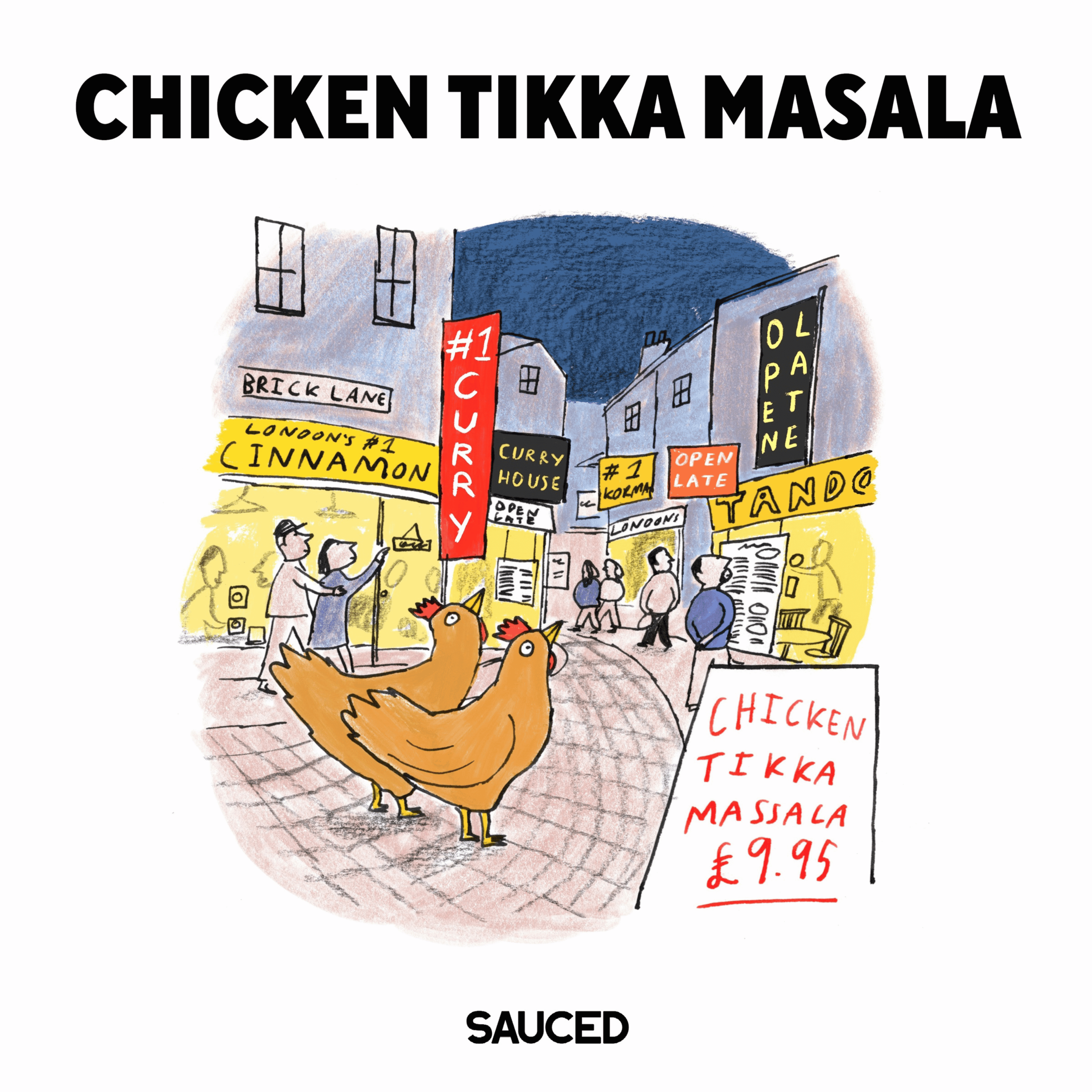
Before it had a sauce, chicken tikka was cooked dry and charred in a tandoor. On its way from Delhi to curry houses in Scotland and England, Chicken Tikka Masala picked up a spiced tomato gravy, and more than one kitchen has a fair claim to that moment.
We follow a dish that kept evolving as it traveled, then cook a home-style version of our own.
"Food travels with us."
What we settled on:
Whole boneless thighs, marinated overnight in yogurt, lemon, ginger and garlic
Charred hard under the broiler
Whole spices toasted, ground and bloomed in the fat
A garlic, ginger and green chili paste, then a tomato base cooked until the oil pools
No sieve, so the sauce stays rustic
Greek yogurt, butter, garam masala and kasuri methi to finish
Honey or agave to balance the tang
The Cocktail:
The Masala Mango Lassi, a mango lassi blended with cardamom, salt and dark Demerara rum.
RECIPE CARD:
Premium subscriber? Check out the full recipe card here.
LISTEN
EpiSOde Partners
Thanks to the following brands for partnering with Sauced to bring you this episode:
TRANSCRIPT
Tim McKirdy: Sother.
Sother Teague: Tim.
TM: Chicken Tikka Masala. Just off the bat, probably top three dish of all time for me.
ST: Okay, wow.
TM: I mean, it's up there with being sort of death row meal, final meal for me.
ST: Wow. Really? Did you eat this as a kid?
TM: Yeah.
ST: This doesn't seem like a kid's dish to me. And all those death row meals, I think, are things you're just so fond of because you've eaten them all your life.
TM: It's comforting. It's an ingrained part of the British culture and the British cultural fabric. It's woven into that. And it says so much to me. I mean, the curries. Here is a way that I can provide a real-life example of this. This is partly by choice and partly just weird coincidence. Next week, as we're recording this, I'm going to be heading to the UK for a very short trip to see family. Really looking forward to it. Gabriela and I, one of the nights, have booked dinner somewhere. There's a restaurant I really wanted to go to, and it's an Indian restaurant. Not a classic British curry house, but more of a sort of Indian restaurant. So we're doing that. There is a separate family celebration going on on a different night. And then the night before that, there's a little family get-together meal. My family booked a meal at an Indian place, and for whatever reason they subsequently canceled our reservation. So my family booked another meal at another Indian place. And then yesterday I received an email from Delta saying, "Time to choose your main course for the flight."
ST: Is it Tikka Masala?
TM: Well, it's actually technically chicken korma. But it's just like, I'm going to be visiting the UK for five days, and three of my meals are going to be curry.
ST: That we know of, so far. You might get it on the return flight, too.
TM: And I'm not mad about it.
ST: Do you find that you can't hit those same notes here in New York City? Because it's not strange to me to hear that this is so comforting to you. I know that Indian cuisine is very popular in the UK. But I'm around you all the time. I don't think we've once eaten Indian food.
TM: Sother, I have made you my curry.
ST: Oh, that's right. You did. You did. But also, I would point out, that was literally once.
TM: What?
ST: I came to your house before you lived here. Brian Miller was there — me, you, Gabriela. And you made naan bread from scratch. And you made — I think you made Tikka Masala, right?
TM: Yeah.
ST: And it was delicious. But that counts as exactly once in our multi-year friendship. You and I have never been out and about and you've been like, "Let's hit up a curry spot," or whatever. Which I would be into. You know what — because my problem with Indian food is — my problem, by the way, it is — that I still haven't cracked the code. Even when I order takeout, I just kind of order a bunch of stuff and hope it's a good meal. I really don't know the differences between the things. I don't know —
TM: A balti, a Tikka Masala, a biryani, a korma, butter chicken.
ST: Right. You just said a korma, I'm like, what? All the different breads. I feel like I've cracked the code on the takeout Chinese menu. I got a clear idea of when I order lo mein versus chow mein versus —
TM: See, I have no idea there. What we need to do is, I'll come over to yours, you'll order Chinese, and then we'll have curry here. No, actually, just again, personal associations. One of our annual traditions that Gabriela and I have is on Thanksgiving, we like to do a food crawl in Jackson Heights.
ST: I did know that. I forgot, because I'm not a part of it. But I've seen you documented on social.
TM: We hit up one different restaurant per bottle of wine, or per cuisine, or whatever. So we'll hit three, four restaurants. One time, I think, we've had folks join us, but otherwise it's just the two of us. But then, one is always a place called Angel Indian Restaurant. They do not do a Tikka Masala, because they're much more authentic Indian. And this is something —
ST: We're going to get into that.
TM: But it's some of the best Indian food I've ever had, and it's a favorite restaurant of mine in New York City as well.
ST: Well, my good friend and your friend Max Green, he lived in India for a couple of years. So the few times that I've gone out to eat Indian food with him has been knocked out of the park, because he orders. But again, I feel like I'm just crapshooting every time I go, just rolling the dice. It's always good. I'm never disappointed. But I don't think I've ever been like, "Man, this is the thing I like," and then remembered that so I could order it.
TM: But again, you're just like, "Oh, these little things are good," or "this little potato dish."
ST: "What's that guy over there having?"
TM: So it sounds unlikely that you have any professional associations with —
ST: None whatsoever with Indian food. None. Zero. It wasn't even a class in culinary school, that I went to or the culinary school that I taught at. There's no crossover professionally. And then personally, I think the closest I've gotten isn't close at all. I've done Japanese curries at home for myself, but I don't think I've ever made a true, true Indian curry-style dish, and definitely have not made Tikka Masala. But I'm going to — right after this show.
TM: My professional association is sort of a — I don't know what the best word to use is here — tangential. I've never prepared this professionally, but one of the first kitchens I worked in was a Marriott hotel. I'm forgetting the name of the hotel, but it was a five-star affair, in the center of London. It was overlooking the Houses of Parliament and Big Ben from the other side of the water, where the London Eye is. If you know, you know London geography. The Marriott being a global international organization, and a long-tied history between Britain and India, and visas and immigration, I would say 80 percent of the chefs that worked in that kitchen, minimum, were Indian, and from different parts of India, and a lot of the front of house.
ST: Oh, wow. That's the other thing: India, no small place.
TM: No, not at all.
ST: Not sparsely populated, nor small.
TM: It's kind of like when you say, "Oh, yeah, I love Asian cuisine." Okay, great. "Love Indian cuisine." Okay, we're talking Punjab, or we're talking from the South, Kerala, things like that. But that meant that every single day — and this wasn't a very busy restaurant. This was not a taxing chef job, which was actually the reason why I left, because I'd wanted to do the kind of French 15-hour days, Marco Pierre White, that kind of thing. I'm like, this is — I'm doing eight-hour shifts here. This is not what I kind of signed up for. But that meant we had a lot of time on our hands, and the kitchen family meal, staff dinner, one of the guys every day would make it for everyone, and for the pot washers as well. And that was a brigade. And I have never eaten so well as a chef in my life as my period there. None of it was British style, though. It was much more of a — so, biryani will be where you're cooking the rice and the sauce, the extent to which there is one, and the protein all together in the one dish. And it's not saucy like a gravy. It was always that style, one with meat, one vegetarian. On special occasions, the chef from Kerala, from the South, would make seafood, because seafood's a delicacy there. And I just — and they would always make a separate portion for me as well. They were like, "Tim, we know you can handle spice, but you can't handle our spice."
ST: We see you coming.
TM: So, fond memories. But just, like I say, as you pointed out, to the British ties there — is it the national dish? We've called fish and chips the national dish before. And maybe at this point — well, we're going to get an elevator pitch from you, and then I'm going to get into it.
ST: My elevator pitch: Chicken Tikka Masala is a dish of marinated, char-grilled — usually, I'm going to throw "usually" on there — char-grilled chicken tikka, finished in a richly spiced, tomato-based sauce enriched with some kind of dairy. Typically, I think, yogurt. I think I'm going to buy for yogurt, because I love that flavor. But it can be cream or milk or, just frankly, butter.
TM: So we said: is it traditional? Who lays claim to the dish? Whose national identity is it? Chicken Tikka Masala starts out life as two separate dishes. Chicken tikka, which is the boneless, marinated in spice and dairy, skewered and charred hot, like you say. In restaurants, that heat comes from the tandoor, charcoal-fired clay oven. I'm sure you've seen the videos as well of the guys where they slap the naans into the side of it. Then the tikka goes into a creamy, spiced tomato sauce. Like you said, that is the masala. The word tikka is a Hindi and Urdu word meant for a bit of meat, and, borrowed from the Persian, has been used in the English language since 1955. Masala —
ST: So when you say chicken tikka, you mean chicken pieces?
TM: Yes. Masala means the spice blend, and it was used in English since 1833, so a long time before. And the name altogether means, roughly, spiced bits of chicken in a spice sauce.
ST: Right. Because masala is like the spice and sauce, right? Because there's a spot in the Lower East Side called Masalawala, which just means the spice trader.
TM: Yes, so it's exactly that: masala carrying that dual meaning of the mix and now the connotation of the sauce. It is the signature dish, as we said, of the British curry house, and not of a home kitchen in India. Madhur Jaffrey — who is someone I think we'll explore a couple of times this episode, is an actor and cookbook author whose BBC series made her something of a household name in Britain — puts it as the top of Britain's curry list and calls it "probably created in Britain."
ST: "Probably" is doing a lot of work.
TM: "Probably" is doing a lot of work. So the ancestor is butter chicken, which is still prepared these days, which started in Peshawar, a city in what is now northwest Pakistan. In the 1930s, a restaurant there called Moti Mahal was cooking their meat in the tandoor. So I think they were the ones to pioneer this, because I think those ovens were primarily, before that, for the breads, for the naans, because obviously we're not leavening this or doing loaves of breads. In 1947 — and I think this is a big part of the regional splitting of everything — British India was split into India and Pakistan. Moti Mahal's cooks moved to Delhi and reopened the restaurant in one of the neighborhoods of Old Delhi. A publication called The Week had described it as the first restaurant in India to serve tandoori food. Two of its partners shared a first name: Kundan Lal Gujral and Kundan Lal Jaggi. The story that both families tell is that leftover tandoori chicken that had been cooked went into a rich, buttery tomato gravy to keep it moist, to stop it from drying out. That was butter chicken, and its other name, Makhani, comes from makhan, meaning butter.
ST: Isn't one of the big differences between Tikka Masala and butter chicken also — butter chicken has cashew butter in it? Cashew puree.
TM: Some people use that in this preparation as well, but I would say it leans much lighter in color, so heavier on cashew and less leaning into the tomato.
ST: Got it.
TM: Also, we're saying butter here, but I'm wondering whether it's more like ghee is actually what we're cooking with, for the most part.
ST: Sure. And again, my understanding — like peanut butter, cashew butter — that's where the butter in butter chicken comes from. It's more about the nuts.
TM: Yes, the paste. So both families agree on that story, but where the families disagree is whose grandfather made it first. In 2019, Jaggi's heirs opened their own Delhi restaurant, also called Daryaganj, like the original that they shared together, with the tagline "Inventors of Butter Chicken and Dal Makhani." Dal makhani — dal, in Indian cuisine, lentils — a separate dish. So in 2024, Gujral's family, who owned the Moti Mahal brand, sued them in the Delhi High Court, because they say you cannot make that claim, or we contest that claim. It was our grandfather, not yours. The suit runs over 2,700 pages long —
ST: What?
TM: — and seeks 20 million rupees in damages, around 240,000. The counterclaim has been called baseless. The filings reported include an original 1949 business agreement, and as of late 2025, which is when I could last see anything reported about it, no ruling had been reached.
ST: Wow. That's still an ongoing case? Or is it just part —
TM: Still ongoing feud. But note again as well about this: yes, it's the butter chicken. There's no mention of Tikka Masala. There's the tandoori chicken. Enter Britain, or Britain enter the fray here. And something personal and close to my heart: Glasgow, the 1970s. The best-known claim to that is in Scotland. A man named Ali Ahmed Aslam was born in Pakistan in 1945 and moved to Glasgow as a child. In 1964, so as a 19-year-old, he opened the Shish Mahal, an Indian restaurant in the city's West End. His story goes — and this will be familiar to a lot of our cocktail historians, in some senses, here — sometime in the 1970s, a customer sent back his chicken tikka, saying that it was too dry, and asked for some sauce. The famous version says that Aslam reached for a tin of Campbell's condensed tomato soup, which he had been eating to settle an ulcer.
ST: That story's already got holes in it. Why would you eat acidic tomato sauce when you've got an ulcer? Condensed tomato sauce.
TM: Well, I bet — I think it's the sweetness. And so that's been the origin story, largely regarded and considered to be a myth. But in his own words to a news agency in 2009, he said, "Since then, we've been cooking it with a sauce made of yogurt, cream and spices." He died, sadly, in December 2022, aged 77. So, Glasgow. There are other chefs who claim the same things, most notably in Birmingham. And I know the British listeners — especially JP Watson, co-founder of The Coaster, a Birmingham born and raised, Birmingham resident. There were competing claims in Birmingham as well, although I believe there's — I forget, is it the balti? There's one that is widely known and recognized as invented there. But there's another chef in Birmingham as well who said basically the same thing, used it as a marinade when someone said something was too dry. And so whether it's Glasgow or Birmingham — well, Glasgow did try and get credit for it.
ST: Officially? Okay. Officially. Another court case. We're off to the magistrate.
TM: Even higher up than that. In 2009, the city's Glasgow Central MP — Member of Parliament — Mohammad Sarwar, put a motion to Parliament crediting Aslam with the invention of the dish and backing a bid for EU protected designation of origin status, i.e., the same thing that says Champagne can only be made in the Champagne region. Chicken Tikka Masala has to be made in Glasgow, is what he was going for.
ST: Wow. Otherwise, it's just sparkling masala.
TM: Otherwise, it's just condensed tomato sauce. Nothing ever came of that.
ST: Was that another stunt thing? Was he truly thinking this was going to go, or was he just putting it up there, like the guy who tried to get tomatoes outlawed from the chowder?
TM: I suspect it's a bit of both. I suspect it's trying to get recognition for the individual, trying to get a little bit of buzz about things, probably inject a bit of attention and energy back into the economy, tourism. Prior to that, though, British politicians had claimed it outright for the country. In 2001, Tony Blair's foreign secretary — you know Tony Blair, of course — Robin Cook gave a speech on what it means to be British. He said, "Chicken Tikka Masala is now a true British national dish." His reasoning was that —
ST: It's like saying what it means to be American is to eat tacos. It's not from here. They're delicious, I love them, but it's not from here.
TM: Well, some people would say that — Glasgow, Birmingham. Yeah, of course it's not. Its origin roots go way deeper than that. His reasoning was, though, that chicken tikka was Indian, or is Indian, but "the masala sauce was added to satisfy the desire of British people to have their meat served in gravy."
ST: I could see it coming.
TM: And so I think that that's maybe a fair assessment, in a way, or it makes sense to me that that's where the evolution would go.
ST: But for me, then, I feel like there would be some other — I'm not going to argue, really, here. It is what it is. But I feel like if that were the case, I would want to see some of the ingredients that are in naan bread find their way into my Yorkie. Let's make a Yorkie naan so I can have my gravy in a Yorkie.
TM: Well, there's not that much — oh, yeah, no, I mean, no eggs in naan, no dairy in Yorkie. Well, there is dairy, different type of dairy.
ST: I mean, fascinating trail of events to create a dish that is heavily structured on a cuisine but is not attributed to that cuisine. That's what we kind of wound down to. This uses every technique of Indian cooking, but it wasn't created in India.
TM: And it didn't — I think the final third of its journey didn't take place in India. Maybe a better way to —
ST: Right. And even what I spoke about earlier, we have examples of that. Like I just said, the Chinese takeaway here in the United States is not Chinese food. It is entirely invented here. Frankly, I feel like we've got a lot of that. We've talked about it many times on other episodes, when we talk about Italian American, right? A lot of Italian, quote-unquote, dishes here in America are only in America. They're not in Italy.
TM: Even more recently, our birria episode, right? What people would recognize as that dish in Jalisco looking nothing like the one that's become popular across the border and in the South.
ST: And this is how food — this is how we can travel with food, and this is how food travels with us.
TM: I think the thing that ties this all together as well is not so much the chicken tikka itself, but the curry and the curry sauce. It ties back to our fish and chips episode, and me being like, "That's gonna be in all your chippies." So that representation as part of the national identity, I think, is there. But I don't know, I mean, I think what was interesting for me, just as a final thought on the origins and everything here, is I've always known growing up, and it's constantly said, "Look, this isn't traditional Indian food. If you go to India, it's very unlikely that you're gonna get served this, unless they're pandering to tourists and visitors." So I've always known that, but I never knew the details and tried to piece everything together. I just think it's really interesting, which is: this is a cooking technique that wasn't even originally used for meat. Then it gets applied to meat, which has been marinated and spiced. And then, as a reaction to that, we're adding some kind of sauce, but it's a different sauce to the one that then became — maybe that's what it is, too. I think there's just a lot of — the tomato is probably more of a British thing, the sweetness, the lack of spice or heat in the final version.
ST: It's got a lot of warming spices, but there's nothing spicy about this dish.
TM: Exactly. So, curious journey. I don't know why people are always trying to claim things when it comes to food and drink, and ending up in courtrooms, and just the lawyers winning.
ST: I mean, you're right. Nobody wins but the lawyer. I think it's points of pride. I want to say my biscuits are the best because I grew up in North Carolina, whereas South Carolina is going to retort and say, "No, our biscuits are the best." The barbecue debate that we've had over and over on the show: who's making the best barbecue? Well, depends on where you're from.
TM: It depends on, honestly, your appetite that day, with what you're doing. Final question, as we always like to ask: prince's or pauper's dish?
ST: I mean, I think this clearly exemplifies a working man's dish. I don't think it's — but I also would say to you, and I've seen it here in the United States, I'm certain you've seen it in Britain, this is a dish that can get itself onto a fine dining table, but it's pretty much a working man's dish. So I would — it's kind of in the middle, but I would split the difference and say it's a pauper. Relatively inexpensive, a lot of dry goods that you just have on hand: dried chilies, dried spices, et cetera. Not a lot of pieces to the puzzle that are expensive. And we keep coming back to this, and I think we're learning together that a real indicator of prince versus pauper is: did I spend money on making the dish, or did I spend time on making the dish? Princes spend time, paupers spend money.
TM: Nice. Excellently put. And this is more time than money. Your most premium ingredient is gonna be chicken breast. However, I would say that there was a time where spices were for princes, but we're talking way back. And then, as you said and recognized, it has found its way onto fine dining restaurants. In fact, I think that the number one ranked New York Times restaurant right now is an Indian place. I'm forgetting the name of it, but you know the one I mean.
ST: Starts with a J — oh, I'm struggling.
TM: I know they have in their group Adda and one or two others, and this one — anyway, it's a hard place to get into, and people love it. I would just say as well, final thought for this — I can't remember whether I've said this on the show before, and I really hope this doesn't get misinterpreted in any way — but Indian is the one cuisine that I really don't care to see the fine dining version of it, or experience, because the real version is so good. I'm like, nothing can top this. I don't want three-Michelin-star Indian food, unless it's one of those anomalies where — you know how you have the noodle shacks in Hong Kong or whatever that will have one star, and it's just one guy on the street, and you're like, how's this a Michelin star? Give me that version of this.
ST: I can see that. I feel kind of similarly with the cuisine that's the closest to my heart, which is Southern, right? It's hard for me to think, is there a Michelin-starred fried chicken and collard greens place? Maybe that's just a thing that doesn't belong there. And again, I don't want to offend someone who thinks it should, and maybe — does Sean Brock have a Michelin star? I don't know.
TM: And where I said — I don't wanna cause any confusion either. I'm not saying that the flavors and components and techniques cannot be interpreted that way, or somehow not deserving of it. I'm just saying I don't care to try it because the real stuff is so good.
ST: The accessible stuff is so good.
TM: All right, so those have been the origins, personal experiences, associations, professional ones to the extent to which there were some. We'll take our first break today, and then we'll be back with the culinary luminaries.
TM: All right, so they're the culinary luminaries.
ST: You already spoke about one.
TM: Let's close that circle there. Madhur Jaffrey, mentioned. She is an Indian-born actor and cookbook author. Her first book, An Invitation to Indian Cookery, came out in 1973. It widely popularized and sort of interpreted Indian cuisine for the Western world, if you want to frame it that way, or the English-speaking world. I believe so. I mean, we've said that about Marcella Hazan in the past, Julia Child, Jacques Pépin. I believe it was inducted into the James Beard Hall of Fame in, I think it was 2006. I read this earlier and I didn't note it down, but yeah.
ST: The book was?
TM: Yeah.
ST: Oh, wow.
TM: Amazing.
ST: Wait, I mean, the "oh, wow" is like, I didn't even know there was a Hall of Fame in the James Beard. I thought you got your James Beard and that was it. I didn't know there was, like, a let's-look-back-and-make-a-Hall-of-Fame.
TM: Oh, and did you not grow up in America?
ST: The Hall of Fame for James Beard?
TM: No, I mean, everything has a Hall of Fame. Rock and Roll Hall of Fame.
ST: Oh, well, that's true. Soon enough we're gonna have a Hall of Fame for all the Hall of Fames.
TM: Exactly. It's like the Hollywood Star Walk of — She had a BBC series, which made her, like I said, something of a household name. I've actually never seen it. And she had subsequent cookbooks, but —
ST: Neither have I, but I looked around for her. She really kind of framed the distinction between regional Indian cooking and what we now call British curry house tradition, which is really where this dish squarely lands. This isn't regional Indian nothing, right? This was completely fabricated, as you said, in Glasgow, and then in the UK, and it became — teetering on the balance of being the national dish of the UK, right? Is it confirmed or denied? Did we cover that? Did I miss it?
TM: Well, I mean, how can you confirm something like that? Where does that live? I know we have, like, national —
ST: Doesn't the government somewhat step up and go, "Our national tree is this, our national bird is this, this is our national dish"?
TM: But what does that even mean? And who are they speaking for, you know what I mean? But let's say top three candidate, for sure.
ST: What's the top three, then? This, fish and chips — what's number three?
TM: Sunday roast.
ST: Oh, yeah, sure. But Sunday roast is so loose. I was gonna say, like, I don't know, eel pies and mash, bangers and mash — okay, let's not run down the toad in the hole. Okay, we're out of here.
TM: Listen, it won't last that long, according to what people think about British cuisine. But yeah, let's keep going.
ST: The more we've dug into this show, the more I'm realizing British cuisine does a lot of work. Like, really. Every episode that we've done, I can trace something back to some of my favorite chefs who are British. It's been a pretty wild ride for me, actually. I did look around for Jacques and Julia. Of course, this is way out of their wheelhouse. Neither one of them had much to say about it, but of course both of them do talk deeply about the techniques that we're gonna talk about when we get into the making of this dish. Because the bottom line is, sort of like good storytelling, there's really only seven themes, right? There's more than that in the cooking world, but it's not unlimited methodologies, right? So a lot of the things we're gonna do here: we're gonna marinate, we're gonna grill and get some char on, we're gonna build a sauce using spices and some veg and some aromatics. And all these processes, they've of course gone over and over throughout their careers to make food accessible and democratized for the home cook, and also then to make people interested in dining and cuisine and cooking at all. So they didn't have anything directly to say about these dishes, or this dish, but certainly everything that they've ever done could lead you to this place.
TM: So you're saying that the techniques are applicable across the board, doesn't matter what cuisine you're doing — the fundamentals.
ST: Exactly. And that's what the word fundamental means, right? I did find this other guy — just one real quick thing about him — an Indian chef who has published a version of tikka masala. His name is S-U-V-I-R, Suvir. Suvir Saran, first and last name: Suvir Saran. He just made a comparison when discussing how different cooks interpret the dish, right? And I think he said, "A recipe doesn't become authentic because a celebrity chef approves it. The proof is in the technique, the history and the eating." That's a quote from something he wrote. So I think that kind of lets you a little bit on the hook, but a little bit off the hook, on having to be too traditional or too rigid about this dish. Because again, when we talk about prince and pauper, I always kind of bring in there's a middle ground in there that's kind of the working man. He's kind of got some money, but he doesn't have all the money. So then that's when these techniques start to come into play, where you can say, well, I kind of know the rules, but I'm gonna kind of break a few of them, right? So I feel like that's a good place to land on this dish, because as far as I could tell — and I watched, I don't know, somewhere in the neighborhood of 50 different videos on YouTube, plus I dug around through some books that I have, plus I dug around on the wide world web —
TM: The wide or —
ST: World.
TM: The worldwide?
ST: Whichever. I did both. And there doesn't seem to be, like, a hard and fast, codified, this-is-it recipe. There's definitely a framework. There's definitely, as I said in my elevator pitch, there's an outline. But Chicken Tikka Masala — I mean, if you've got chicken and some spices and some tomato and some dairy, you're in the right zone, right? I know that's really, really loose, and we're gonna tighten it down, obviously, when we get into it, but that statement from him just says that — again, what did he say? "The proof is in the technique, the history and the eating." If I sat a dish in front of you that had that loose framework and said, "This is tikka masala, Chicken Tikka Masala," you'd be like, "Okay, it's delicious."
TM: So, two things here — and not to keep going back, but I think it is a really interesting — I mean, all of anything we ever discuss is about identity, ultimately, right? And the reason for that identity. If you're talking about the proof is in the eating, here is where I will say the Chicken Tikka Masala we're thinking of and we're describing here, what makes it decidedly not traditional Indian. When you think about — it's very common to eat directly with your hands in India. I have Indian friends growing up who'd be like, "I use cutlery, but it's tastier when I'm eating with my hand," right? This is a part of culture and tradition. It goes back as well to different religious places of worship, where you would go, you would spend the day, you wash, eat — literally eat off the floor with your hands. You can't do that with a gravy sauce. It's much more of that biryani style that I'm talking about, where it's rice, protein, everything all together. It won't be dry, but it definitely won't be sauce. So that, to me, is more traditional, right? Quite difficult to eat a stew with your hands.
ST: No easy feat.
TM: So yeah, maybe that's one thing. The other thing just occurred to me — and again, these are just thoughts that are coming up — but I think this will interest you. More than anything — and this is probably just curry rather than Chicken Tikka Masala — I think more than anything, just growing up, and my memories are, it's the one dish where I think everyone has their own approach. Everyone has their own way of making — but I mean, in the UK, each household will make a completely different curry. The foundations will be the same, the ingredients, but the way you put it together is different. And I can remember as well, growing up, some of my parents' friends — the guy never cooked, but he had his curry.
ST: Chili. It's chili. You're describing chili in America.
TM: Okay, so curry, this is —
ST: The guy never cooks. Mom always cooks everything. Dad rolls in when it's time to make chili, though.
TM: Yeah, the Saturday night, you got guests coming over, and you're like, "Oh, that guy, his curry is great." And everyone has a secret ingredient or technique that makes it theirs, and identifying is theirs. So, I don't know, that's funny. And maybe stakes a claim for the national dish — who knows? Maybe by the end of the episode we'll know.
ST: Well, maybe we can lobby.
TM: We can lobby.
ST: I mean, you can — you're now a dual citizen. You can lobby for both. Let's lobby for Chicken Tikka Masala over there and chili over here.
TM: Over here — fantastic.
ST: No beans. No beans in either.
TM: Please. So those have been our luminaries. A little bit different interpretation this week, but obviously this is a very, very unique dish and a new cuisine for us. Time for another quick break, and then we'll be back with the non-negotiables.
TM: All right, Sother, we're back. Curious to hear where you're going to go with this one.
ST: Non-negotiables. I think number one for me, it's chicken, for Chicken Tikka Masala. And we're gonna need to be in somewhat chunky but bite-sized pieces. I think for this dish, boneless is the way to go.
TM: I'm nodding.
ST: And frankly, I'm gonna lean — I would like it to be more heavily thigh than anything else. We can do 100% thigh if you want, but I'm also into using the whole bird, right? But I would like to maybe augment my whole bird with some extra thighs.
TM: Yeah, I think thighs is the way to go.
ST: It's the most forgiving piece of the chicken. And this is gonna get marinated and charred and simmered in the sauce, so I feel like it needs to be —
TM: Yeah, but almost that, to me, is almost a potential reason to use breast, just because most of the cooking happens before, so you're just finishing it in the sauce. Now, I think breast is more common in the UK, but thigh is the way to go here.
ST: Yeah, I think so.
TM: I'm not going to do the whole chicken thing. I understand why you like doing that, why you do it, but ultimately it's not saving me enough — not saving me enough money or time. Well, it's not saving me any time, it's not saving me enough money. And also, my decision to buy a two-and-a-half-pound packet of boneless, skinless thighs versus a bird and augmenting — me not doing that is not going to have an impact on the overall chicken economy.
ST: Sure. My angle on that is, I'm just keeping my axe sharp by being able to break down a chicken. And also, I'm encouraging the listener to do the same.
TM: Fair play.
ST: Get a whole chicken, and then get a pack of a couple extra thighs, and break down a chicken, and then pull the bones out of the thighs.
TM: So what if we do an experiment? I'm not going to buy or break down a whole chicken for three years. We'll check back in three years, and we'll see if I can remember how to do it.
ST: I think you'll remember how. You'll just be fumbly about it. It's like riding a bike. You're not gonna forget, but you might be wobbly. So we nailed it down: it's chicken. I want to lean more on the thigh than maybe the whole chicken is going to give me, so I'm going to augment, depending on how many people I'm feeding, obviously. But also, you may not have heard me say, I said marinated, so it's marinated chicken. Marinating — I know we often talk about our non-negotiables are the things, but also the processes. So you can't just throw chicken into the mix here. It's got to be marinated.
TM: Yeah, I actually had the marinade as number two on my list, a separate thing, because we need to define the marinade. And the marinade is acid, dairy and spice: lemon juice and salt, then a dairy coat carrying those other aromatic ingredients — ginger, garlic, ground spices. Some people use Greek yogurt — I know that's where you want to go. Others use cream or a quick yogurt dip. Why do you think they do that?
ST: It brings some tenderization to the mix, right?
TM: Does it?
ST: I mean, does it?
TM: Does it?
ST: Oh, you're looking at me like you're catching me out, so I'm going to say they're doing it for flavor.
TM: So I was wondering this: does yogurt actually tenderize chicken?
ST: I mean, I assume that there's some level of tenderization happening from the acidity from the yogurt.
TM: Well, there's a lab test published in 2023 by the food science journal Foods. Held chicken breast 10 to 15 hours in yogurt acid whey — the sour liquid of yogurt — at a pH of 4.5. They determined that the tenderness did not change, though the meat resisted oxidation better. The theory behind the sour marinated yogurt, what it does — from the same review, same journal — when meat is in a scenario that's more acidic, of a pH of around 5, 5.2, poultry's muscle proteins swell, and then the meat's own protein-breaking enzymes start to do their work, and they perform best at between 3.5 and 5. So this gets you into that window where they do their best work. But once again, this journal tasted it, cooked it, whatever, found the chicken to be no more tender than the chicken that wasn't marinated. So why are people marinating with yogurts? You said —
ST: Flavor.
TM: Exactly. Browning and tang. Cook's Illustrated did a test as well, where they're like, you don't need the long yogurt soak, but we are going to put it on just before we cook. The heat, when you're doing that charring that we spoke about, drives off the yogurt's water and leaves a protein-rich and sugary coat that browns fast. And they did a side-by-side test, because I was like — and this is what led me there, right? — if the thing that we think makes it tender, if that's not true, then why use it at all? Just use spices, acid and maybe a bit of oil if you want to bind it. They did a test side by side, and the one that had no yogurt, and was my approach there, had much less color.
ST: We got the milk solids that are in there that are browning. And also, milk solids, when they brown, they get nutty, so you've got another layer of flavor happening.
TM: And also, just thinking about having Chicken Tikka Masala, right? You get the texture of it, the texture of the yogurt. So, yeah, the marinade. I thought that was a little fun aside.
ST: I love it.
TM: Next one for you.
ST: Well, let's stay with another technique part that is non-negotiable. I want some charred bits: grilled, or hard roasted under your broiler. If you don't have a grill, if you're doing this in your home, your cast iron pan, something. We deemed it once "leoparding," right? I want to see some little brown and black spots happening.
TM: I don't ever love the experience of grilling something that's got the yogurt.
ST: It's a mess.
TM: It's a mess, and it sticks, and I've got to do the cleanup, so I'm probably going to just — under the broiler.
ST: Yeah, if you've got a broiler, that's the way to go. But if you don't have that, or if yours isn't powerful enough, you're going to have to clean up a mess.
TM: All right, well, next non-negotiable: the sauce.
ST: That was next for me.
TM: Needs to be tomato. I would say tomato in various guises as well, but maybe that's not a non-negotiable. That's a thing for us to explore, but I would use a mixture of tomatoes and tomato paste.
ST: Bingo. I'm in.
TM: And then, okay, building that sauce is going to require some of my other non-negotiables. I've gone really, like, exploded mine out. It's tricky.
ST: This one's a little bit — this one isn't as straightforward as many of them have been.
TM: But tomato-based sauce, for color, for tang, and eventually will need to be rectified with sweetness, which I think is the one mistake that everyone makes. Home cooks, when they make curry, if you taste their curry and you're like, "This doesn't taste like the curry I'm used to, something about this is wrong," it's because they haven't put anything sweet in there, and you're just getting the pure tang and acidity of the tomato.
ST: What do you like? Sugar or honey? Or some other thing? Some secret third thing?
TM: I like honey, but then I also use some other negotiable ingredients that you kind of touched upon earlier, that will bring a perception of sweetness, such as a nut butter, or I'll even just put ground toasted almond flour in there. And it just gives you, again, that perception of sweetness, really nice nutty flavor.
ST: I'm sure that also gives the sauce a little bit more of a tightness. Oh, that sounds good.
TM: And that was in the curry that I made you for my birthday, if I recall correctly.
ST: It probably was good. As far as I remember, it was great.
TM: You're not remembering that well, because I don't think Gabriela was there either.
ST: Wait, she definitely was there. I didn't come all the way to your house — that was the first time I'd ever been to your house — I didn't come all the way to your house just for me, you and Brian to eat curry together.
TM: I think I'd probably promised there were more guests.
ST: I think you did do that too, actually.
TM: No, I didn't.
ST: Anyway, non-negotiables. Again, hard to nail down in a non-negotiable list. We'll get to it when we do the specifics of the list, but then a rich finish for the sauce, right? And that's going to be the dairy, right? Cream, yogurt, butter. As you just said, maybe a nut butter that's not dairy, but something to make it rich and mouth-coating and full.
TM: Cashew paste, exactly. So next, I'm going to spices, and I'm going to split this into two different lanes. One is the build and one is the finish. And when I say the build, it's actually going to be not just spices. It's going to be aromatic ingredients. So the base of our sauce is going to be — garlic and ginger are the non-negotiables for —
ST: As a paste, right?
TM: — your paste, and a green chili. Those are going to be our fresh ingredients.
ST: Okay. Can we go ahead and make all three of those into a paste, or is that out of the bounds?
TM: Oh, no, yeah, that is our paste.
ST: Okay, cool. So it's your paste, which is, by the way, just those three items into your food processor or what have you, with just enough water to spin it around and make it a paste.
TM: Yes. I would say onion, despite being what we all reach for for this kind of thing, is by all accounts a negotiable.
ST: Really?
TM: Doesn't need to be in there, and traditionally is not in there.
ST: Oh, I saw so many people bring up the onion —
TM: Everyone makes it with onion.
ST: — and point out that it's — this caught me as odd — most of them pointed out that it's specifically red onions.
TM: I think that's an association by the color. I would say maybe our red onion's more of a — if you're deciding to include some solid vegetables in there. Are you saying in the paste, or are you saying —
ST: Not in the paste, no.
TM: Oh, so as a serving vegetable?
ST: No, no, just as part of the sauce.
TM: Hmm. I disagree.
ST: Okay.
TM: Wow. Either way, I'm fine if onion goes in there, but I don't think it has to. And then you're going to need a selection of spices, dried spices, during the start. We don't need to get too much into the preparation here.
ST: And I think for the American cook, this is where it starts to get a little intimidating. And I don't know why that is, because, as it sounds, every British home has all these things in it. Why can't we have all these things in our American home?
TM: And most places, you can just buy curry powder that will cover most of it, right? I would advocate for — our version's non-negotiable is going to be the different lanes of spices: when you add them, how you add them.
ST: Right. Again, this goes back to the chili conversation that we had, right? You have the — and you kind of have that here too. We're going to use a lot of these things in the marinade. Then we're going to use a lot of the same things in the sauce making.
TM: Man, this is kind of like our adobo from Birria.
ST: It's the second dump, right?
TM: Yeah, the second.
ST: People didn't love it when I said that, but that's what it's called in the chili competition world. You do your first dump of spices, and then you have a second dump later.
TM: So it's Birria, Tikka Masala and chili. There's so much connective tissue.
ST: I can see a new infographic forming itself now for our Instagram.
TM: So here's another thing. The final — my final word on spices here, and the two most important to name, that are your second dump, your finishing spices, are garam masala and fenugreek.
ST: Right. The leaves, right?
TM: Well, fenugreek is — yes, the dried leaves are called kasuri methi, which is named after a town near Lahore, which I believe is in Pakistan, which I believe is — again, was, prior to the partition, a single region that got divided after. Garam masala simply means hot spices.
ST: Right. And I think that's another intimidating part for the American consumer, is that these things aren't codified. Curry: not codified. Garam masala: not codified. It's hard for — the American doesn't want to let go that much. Let go and let it happen. Let it wash over me.
TM: So I would maybe frame it slightly different. You know how you get the — what is the seasoning in a lot of Central American, Caribbean cuisine, like Puerto Rican? Is it adobo? What's the name of the —
ST: Adobo.
TM: Right. Adobo is a defined thing that brings a lot of different ingredients together. That is garam masala. It's a defined thing. It's heavy on cinnamon, heavy on different spices. One of my favorite condiments in my spice rack. Curry spice is more like the chicken seasoning that you buy on the McCormick shelf, and you're like, "Okay, what is that?" I don't know, but it's —
ST: It's good on chicken.
TM: Yeah. So one is more defined and one isn't. But yeah, dried fenugreek. It's the leaves traditionally used. And did you know that both its leaves and seeds can be used for spices? It has a maple syrup-like aroma from a compound called sotolon. Weirdly — connection — that is the same molecule that appears in wines that have been aged under flor, that we love, right? So, vin jaune from the Jura region — yellow wine — sherry.
ST: Was drinking sherry last night at dinner. I had that little maple note.
TM: Were you living in New York in 2009?
ST: Yeah.
TM: Do you remember anything about the air in 2009 and before that?
ST: I mean, no. You're leading me. What's going on?
TM: On February the 5th, 2009, Mayor Bloomberg announced that the maple syrup smell that had drifted over Manhattan on and off since 2005 — did you ever experience that?
ST: Yeah, I did. We used to always just joke that we were smelling Canada.
TM: — had been traced across the Hudson River to a flavor company's processing plant — or plant processing fenugreek seeds — in North Bergen, New Jersey.
ST: Wow. Yeah, we definitely — I definitely remember talking about this back then.
TM: I wonder what it smelled like in North Bergen.
ST: Pancakes.
TM: They do love a diner out there, don't they?
ST: Right. Oh, that's hilarious. I do have memories of that. Yeah, we'd always be like, "You can smell Canada today."
TM: Now we just get wildfires.
ST: Simpler times, Tim. Simpler times. So wait, do they not process that fenugreek there anymore? We don't smell that since 2009? Or I haven't —
TM: You know, it's a loss.
ST: Okay, did we cover all of our non-negotiables?
TM: I think we did.
ST: I think we covered them pretty good, looking here. What about mustard oil? Is mustard oil negotiable for you? Do you use it?
TM: I have never used it in this.
ST: Never?
TM: No.
ST: Okay. I saw tons of recipes that use it. I saw just as many who didn't. I think it would bring a unique complexity to the dish, but it's certainly not a non-negotiable. And it's also difficult to find.
TM: Exactly. I'm like, yeah, mustard oil — I'm like, where am I getting fenugreek from? I've been let down that many times recently at the old —
ST: Kalustyan's?
TM: Well, not Kalustyan's.
ST: I mean, yeah.
TM: No, I meant just at the Food Bazaar.
ST: The Food Bazaar, I think, puts on an air of being globally ethnic, but really it's pretty Latin.
TM: And they have two shelves of British stuff.
ST: Yeah, it's mostly Latin. Which is great. I mean, I love everything there. I go there all the time.
TM: But I'm just saying, I'm complaining about the spice. Anyway, we've gone over that before.
ST: We have. All right, so that's our non-negotiables. What's next?
TM: Well, maybe just name some of the spices for the marinade that you would hope to have in there.
ST: Yeah, scrolling back to my marinade: I want to have cumin, coriander, garam masala, Kashmiri chili powder — which is easy enough to find in New York, but if you can't, standard mild paprika will stand in. I want some turmeric, and that's kind of it for the marinade part. Some salt, obviously.
TM: I would save the garam masala for the finish.
ST: I only put a little in my list here. Like I said, it's like a second dump. There's a little in the marinade, and then there's more in the sauce.
TM: Well, this — we're getting three.
ST: Where's the third coming from?
TM: The third, when you're cooking off your paste. So you've got your marinade spices —
ST: You're right. Ooh.
TM: The spices for my paste, or for my base, are going to be cardamom pods — ideally black and green. Get both. A piece of cinnamon and some cloves. And then the final — the finishing ones, like we said, garam masala is what I'm going to go for there. Did you mention paprika?
ST: I said the Kashmiri or paprika.
TM: Oh, yeah. And then the fenugreek leaves. So those are our ones. And then the only other negotiable ingredient is going to be onion. The thing for me about all of this — if you want — I guess what we have to ask right now, before we get into the preparation, probably our biggest —
ST: Which it sounds to me like you're leading —
TM: Okay. We need to decide: are we making curry house chicken, or are we making home — British home Chicken Tikka Masala?
ST: I want that —
TM: The home one?
ST: Yeah. We're talking to our home listener. I want them to make the home version.
TM: So would you not then want to be able to recreate, though, the thing that's really hard? That's the tension of the British home curry, because it's great, but you never really get the same thing that you have when you're eating at a curry house. It's two different styles, and it mainly comes down to texture.
ST: Which is better? You're going home, and you told me you're eating it out, so you want to go out. And what is that texture difference?
TM: Essentially, if you go to a curry house, or if you buy a ready meal from the supermarket, it's going to be chicken and sauce, and your sauce is going to be smooth as a velouté. At home, it's going to have more texture. It's going to be more rustic. You're going to experience the vegetables. You're not going to experience the vegetables in the curry house one — only their flavors. Now, some people might put veg in there. And basically, the main thing is — the main difference — maybe, okay, we'll make this optional.
ST: Are we passing it or not passing it?
TM: Exactly. But at a certain stage, which we'll leave for the preparation. Otherwise, we'll have nothing left for the preparation.
ST: We need to get into this thing. And we did skip something that we just — doesn't really jive here, right? This is, again, going to be drinking with the food or cooking with booze. I think our options are the standards. We could certainly find a way to deglaze in here somewhere with some sherry, or some wine, or some — I don't think vermouth would work in this one. We've been leaning on vermouth a lot for deglazing, and I don't think vermouth is the right choice for this dish. We could maybe get in a bit of whiskey, something sweet. Maybe a dark rum would be a good deglazer in here. But I'm going to say I don't think we need booze in this food.
TM: I don't think — and honestly, I just don't think it's going to add anything to the equation that you're going to be able to tell.
ST: Yeah, that's why. That's why I'm saying I don't think it needs to be in there.
TM: All right. Well, those have been the non-negotiables, the negotiables. Shall we put a pin in the side dish for after we've done the preparation? Or do you want to talk about sides now?
ST: I mean, we usually talk about it after preparation, but I think we've already mentioned them, right? There's really kind of two choices here, and you kind of need them both, right? We want some naan bread, and we want some basmati rice. Anything else? You want to fold some peas into the rice?
TM: No. A few things about the rice.
ST: Oh, no.
TM: You really want to jazz it up a little.
ST: All right. You going to bring out the saffron?
TM: Yeah. Basmati rice, pilaf style. Here is where, when I'm doing it at home, I will introduce an allium. I'm going to have shallots, very finely diced. Sweat that down in butter.
ST: Ghee?
TM: Ghee, if you want. I don't think it's worth going out of your way to get. If you really want ghee, just make clarified butter.
ST: Yeah, I mean, what's the difference? That's what ghee is, right?
TM: Yeah, but I thought ghee was edging on slightly rancid. I thought ghee had more of a funk to it. I might be making that up. That was always the distinction I had.
ST: See, again, not enough experience for me with Indian food to even have noticed that distinction.
TM: But the basmati rice, you're going to have to wash it quite a lot, drain it, soak it a bit beforehand. When that water is running clear, that's when you're going to add into your pan where you've got everything sweating. I think a few things have to be in there. A bay leaf. Clove, or cloves, because you would always get that in there. It would be soft by the end, so that's good. Good for your teeth. Cardamom. And optionally, some color: some turmeric or some saffron. And that's going to go foil over it —
ST: Turmeric? You might get executed.
TM: Fake —
ST: Just don't say it. Don't say it. Saffron. And that comes from our bonus episode all about the most expensive ingredients you can use in food.
TM: It sure does. Foil over the top —
ST: Worth its weight in gold. Sorry, I keep interrupting you. Yeah. Still over the top.
TM: Foil over the top, because that's starting on the stove, then a lid, then in the oven. Cook till dry, fluffy, let it rest, whatever. The naan —
ST: Non-negotiable.
TM: 100. Flour, yogurt, yeast, sugar — agave, honey, whatever you want — water. You can make this morning of or afternoon of. To be honest, I've done it. I've started my naans — if we're having people over for curry, I start at 3 in the afternoon. It's always good. I love Peshawari, which is filled with coconut and — or sometimes I'll do raisins. But that's optional. But if it's me, if it's on my deathbed, it's a Peshawari naan.
ST: Yeah. Peshawari naan.
TM: These we're going to make. It's super easy. You don't even need quantities. You can do it all by eye. Just get a nice dough texture. Let it rest a little bit, into balls. Roll it out. I want you to be cooking that in a ripping hot cast iron with clarified butter. And you're going to pile them after you're cooking them. And then I'm going to have a butter with raw garlic that's just heated ever so slightly in a little — what is this?
ST: The little metal dishes that they use in the Indian cuisine?
TM: Oh, no, no. Like a thing to spread it on the — like a paintbrush. But what is that?
ST: Pastry brush.
TM: A pastry brush. And I'm going to — as each one of my naans comes off the pan, I'm just going to give it a thing. And then, amazing, it's going to be garlicky. Garlic is making its way in there either way.
ST: Yeah. Got it. All right, well, let's get into the technique, and let's build this thing.
TM: Well, before we do —
ST: Oh, yeah. What's that?
TM: You mentioned a bonus episode.
ST: I did.
TM: We're still figuring out our recipe right now. All of this will be ready by the time it comes out. As will our — well, our recipe cards will be ready by the time we publish this. And the bonus episodes there, where we do explore such topics as ingredients worth their weight in gold — those are available to our premium subscribers. Hit me with a pitch.
ST: Yeah. Seven bucks a month. If you opt to go for the yearly subscription, we'll knock off two months and save you 14 bucks over the year. Gets you a monthly bonus episode, and we do four different versions, depending on — in rotation, so whatever the month is. And we just talked about how we do an ingredient, and recently we did Worth Their Weight in Gold. We talked about all the ingredients that are supposedly worth their weight in gold: the caviar and saffron and gold leaf, et cetera. Pretty fun exploration. We do a technique. We've done a few in the past. My favorite one was the first one we did, which was polymerization: how to polymerize your cast iron and carbon steel pans. Make them basically nonstick. We do a side dish that usually is relevant to some of the dishes that we've talked about. We dig deep on that side dish. And then we do history. Those have proven to be really fun, where we get to talk about things like agromafia, et cetera. So some deep dives that are kind of nerdy, that aren't necessarily about a dish but are about things that we're interested in. And then, as you mentioned, we're not gonna — we're gonna build this recipe as we go, right here on the air together, and you don't have to listen as a listener and jot things down. If you're a subscriber, you'll get in your inbox, the day the show drops, the recipes with all the quantities, et cetera. Not to mention, you'll also get the recipe for the cocktail that I'm gonna pair with this dish, which is coming up soon, and every cocktail that we ever do. And they'll be illustrated by our good friend Charlotte Ager, who is an illustrator from the UK — a human person, not an AI bot — who's making our illustrations that are adorable. So, yeah, pretty cool.
TM: And you — I can't wait to — well, I can't wait — by this point, people listening to it, they will have seen it there in their icons. I can't wait for you to see it, because I got a sneak peek at that one recently —
ST: Oh, did you?
TM: — and it's very good. Very British. Maybe, actually, I'll put a pin in that for the end. Something to share with you as a final thought. Before that, though — before that, though, we'll take a quick break now, and then we'll be back with the preparation.
ST: Let's go.
TM: All right, so the preparation. Let's go. Am I leading this one?
ST: You got it, man. This is a dish you have such a fondness for, and memories of making it in your home. This is you.
TM: Okay. We're going to start with our marinade, as we always do, because it's going to be happening the day before. We're going to get our boneless, skinless chicken thighs. We are going to separately mix yogurt, lemon, grated ginger and garlic, and our spices — a selection of all the ones we mentioned earlier, or the ones that you have on hand, frankly. Mix that all together, marinate the thighs. I'm actually going to keep them whole rather than cut them up at this point. I prefer to process those after we've cooked them. And we're going to cover that and refrigerate that, ideally overnight, if not a little bit longer. Next, getting that char on those thighs: preheat your oven to 465 degrees Fahrenheit, with the broiler on if you can do both, or ideally, if you've got an annoying broiler underneath the oven, just get that one ripping to finish it. I'm going to lay my chicken out onto a foil-lined sheet tray —
ST: Saving yourself some cleaning.
TM: — and on top of that, though, I'm going to have it on a wire rack. I'm not going to squeeze off the marinade —
ST: No, we want a — we want it to cling.
TM: — but I'm not going to use all of the marinade either. We're not going to have massive blobs of yogurt here, so we're going to mix that up a little bit, put it on the wire rack, make sure we've got a nice amount of separation between those thighs. We don't want to crowd everything, and then it's going to lower the temperature. We're not going to have as much surface area as we would like exposed to the heat, and then later the flame. We're going to cook that not too long, for about, probably, eight minutes — certainly less than ten minutes — and then see where we're at color-wise, and then give it a finish in the broiler, or under the broiler, using the broiler if you have one.
ST: Right. Hopefully we'll be getting that leopard that we talked about before.
TM: That leopard. Yeah. Black spots are fine on this. We don't want it to be fully black, but black spots are fine. And I think what's more important as well, that we want to see, is that the water has evaporated from the yogurt, and it's a visibly different texture to yogurt, or half-cooked marinade, or raw chicken, right? I think you'll see that almost like a skin — a new skin. Going to take that out, going to set it aside, going to let it start to sort of cool down to room temperature, at which point we'll be able to either chop it up or even just tear it into rough, sort of nice nugget-sized pieces, I guess. While we're doing that, we're going to cook down the base — or we're going to get the base going. I suggest we go in with half oil for heat and half butter for flavor, or you can do clarified butter fully, or ghee. Sizzle down, you can either go garlic and ginger paste and then spices, or spices and then the garlic and ginger paste.
ST: I want to go spices first, because I want them to infuse into the oil.
TM: Oh, wait, great point. If we're doing that, and if we're not going to strain it later, we're going to say, okay, we'll do the home style here. Separately, those cardamom pods and the ones that are sort of more like whole spices, we're going to toast those first, release the aromas, grind them — pestle and mortar, or using a blender — into a fine paste, a dust. So in that instance, yes, we'll infuse our oil. Then we'll go in with our paste of garlic, ginger, green onion — green chili —
ST: Green chili. There we go.
TM: — because serrano's probably going to be where both of our lanes here.
ST: Serrano, or the little green before they turn red. Thai birds are good too.
TM: Once again, if this is not something that — well, we're not going to pass it, but I'm going to take the stalks off, and I'm probably going to de-seed, personally. I know you're a chili head. We're going to mix that well, cook it down over a medium — medium to low heat, probably medium — until all the water's gone. We're going to add tomato paste and vine tomatoes, or tomatoes out of the can, and we're going to cook that down for around 20 minutes. Once again, until most, if not all, of the water is cooked off, we're going to be looking for oil to start to pool on the edges of the pan.
ST: You can also listen for that too. It'll make a different sound.
TM: It's going to go from a bubbling to a sizzling, or approaching a sizzle. That's going to be our sauce itself browning and taking on more flavor. We're going to keep a close eye on that and let that process ride out for about five minutes. This is where, if you were going to sieve it, I would add a cup of water, remove it, pass it through a fine sieve — but really strain it through there with a ladle. We don't want this to come out like water, but we want to get rid of some of the hard, textured ingredients, spices, whatever. For this, we're not going to do that, though. We're going to add our water. We are going to add our chicken. We're going to use water to get it to a slightly loose consistency, but not a finishing consistency. Then, when we're ready with everything, we are going to add our dairy, which we said is going to be Greek yogurt. We're going to add our butter to get a nice gloss, get a nice sheen on that sauce, add richness to it. At this point, I'm going to add my finishing spices — garam masala, fenugreek — simmer it for a little bit longer, maybe another five minutes.
ST: This is to finish the chicken, to pull the sauce together.
TM: To bring everything together in one homogenous mass. This is the point where I'm going to be tasting quite regularly, and this is where I'm tasting for the sweetness, making sure we're balancing that acidity and tang — the calling card for the one lost ingredient. I'm probably going to use honey, or, to be honest, these days, agave, because it's what we have on hand and it's supposedly good for us. When we've found that right balance, serve it with our lovely basmati rice, your naan of choice, and finish it with a sprinkling of fresh coriander. And I'm going to use coriander instead of cilantro as the word of choice here today, because —
ST: Listen, it's the British version. Let's go. Any room on your table for a bit of raita?
TM: That will be the thing we're having while we're waiting for it to all come together.
ST: That's what we're nibbling on — some naan and a little raita. Is that the —
TM: Mango chutney —
ST: Ooh.
TM: No, naan is for the curry. Poppadoms.
ST: What are we eating raita with?
TM: Poppadoms.
ST: Oh, poppadoms. Oh, the very crispy —
TM: The deep fried.
ST: I remember those. It's almost like — man, when I was a kid, there was a bag of crisps — chips, we call them here. They were called Munchos. And they were wispy thin and very crisp, and they were effectively poppadoms. We didn't know that as kids in the South, but they were, definitely. I don't think they're a commercial product here in America anymore. I'll have to look it up, but I'm just having a visceral memory. Yeah, poppadoms.
TM: So your standard sort of things, whether you're ordering takeout at a curry house or what you would serve: you're going to kick it off with the poppadoms, the raita —
ST: Right. That's your chips and dip.
TM: Actually, the raita's quite low down the scale here. Actually, it's more of — what I normally serve it with, I will make a very, very fast yogurt: yogurt, coriander, cilantro, acid — normally lemon — sweetness — again, honey or agave — a little bit of spice from maybe the tip of a green chili. Going to blitz that in a blender. It's going to be quite watery. It's nowhere near — you're not looking for a guac or anything. I mentioned yogurt, yeah. It's going to be more of a sauce that's going to easily come out of a squeezy bottle. That's going to be one of your main ones. Next to that, mango chutney, which someone will just buy, and, optionally — but I do love it — lime pickle.
ST: Do love the lime pickle, and those do often have the mustard oil. I don't know if you know that. All right, well, this sounds delicious, and we're making it this weekend.
TM: Where — God, have we got to make a curry, especially curry.
ST: You gotta make it for me the weekend before you go away and have it five times.
TM: Let's just make it. Yeah, let's bring my average up to — what — four out of seven.
ST: But is this a dish you can eat over and over and over and never get tired of?
TM: 100%.
ST: I have those dishes in my life too. Honestly, we talk about it a lot: it's chili.
TM: I'm never getting tired of curry.
ST: I can make a hundred-gallon pot of chili and I won't get tired of eating it before it's gone. Leftovers, yeah. Breakfast, okay.
TM: And like I said, I think that's our dialed-in tikka approach. If I'm just making you my house curry, I'm definitely gonna be using some of those other things, like I said, like a cashew paste or an almond paste. Honestly, I love Peshawari naan, so some of that desiccated coconut that's getting toasted and going into the naan — I'm getting some in the sauce as well. Helps thicken it up. And just curry coconut — I love. But that's the house one; that's slightly different.
ST: All right, well, we've codified the Sauced Chicken Tikka Masala. We'll have recipes ready for everyone as they're listening to the show, and I'm excited to make it this weekend.
TM: All right, final break for us here today, and then we'll be back finally —
ST: With the pairing —
TM: — and the booze.
TM: All right, Sother, we're back.
ST: Do some pairings.
TM: Let's do some pairings. All right, what do you got?
ST: You want me to start? I think, as we always do, we talk about beer and wine, so let's talk about beer. I think for this dish — it's so rich and unctuous, and it's got so much going on — I hate to fall back on it all the time, but this is a pilsner, right? Something crisp and easy to drink, to cut through that richness. Do you agree or disagree? You winced a little.
TM: I've got a yes, however, for later. But I would love to give you the floor here.
ST: For me, I think that's the best all-around one. I could also do maybe something a little bit more bitter, because this dish is somewhat sweet — not in a sugary way — so, like, an ESB. We're over there; let's go. But, yeah, and then there's kind of a weird, obvious choice that's hanging out there: an India Pale Ale, IPA. But that's too floral for me for this dish.
TM: So — you're missing Indian beer.
ST: I said India Pale Ale.
TM: No, that's a British beer.
ST: I know, I know.
TM: Have you never had a Kingfisher?
ST: Oh, Kingfisher beer — oh, yes. And I've also had Cobra.
TM: Cobra. Indian-style lager, poured in British curry houses. Features in — 98% of the UK's Indian restaurants carry Cobra.
ST: Wait, I'm sorry — 98%? That's wild.
TM: It was founded in 1989 by a man called Karan Bilimoria, who came to the UK in the 1980s to study law at Cambridge and found British lagers to be, quote, "too fizzy, gassy and bland," unquote. In his words, they were horrible with food because they made you bloated. So Cobra's definitely a sort of gentler style, the lager. He aimed for the lager's refreshment with the smooth texture of an ale, and developed a beer with the brewmaster of Bangalore's biggest independent brewery at the time. And the other thing — the India Pale Ale —
ST: 98% market share is unbelievable.
TM: I mean, I thought that, and then I was like, well, what would the equivalent be here?
ST: I'm trying to think that too.
TM: How many Mexican restaurants carry — or what percentage of them carry — Corona? And you could say, well, if it's not Corona, they have Modelo or —
ST: Pacifico.
TM: — Pacifico, which are all owned by the same company. But I do like a Kingfisher or a Cobra. The India Pale Ale, though — we should, this being our first Indian cuisine dish, talk about the name and the origins and why it exists. Pale ale was shipped to India from at least the 1780s, drunk mainly by officers and civil servants, whereas the ordinary soldiers stuck with stout. George Hodgson of Bow, in East London — put a pin in East London — was a leading early exporter, but there's no evidence he invented the style. The name East India Pale Ale shows up first in print around 1835. It's way lower in strength compared to the IPAs that we see over here, especially the hazies — you're looking around 6%. But the story goes, this style of beer was developed to be heavily hopped, and that the hops helped maintain the freshness of the beer during the long voyage from Britain to India.
ST: Right, they're a bit of a preservative, but they're also — the problem for me is they're so floral. The hops are flowers. They are also bitter. They're the thing that brings bitterness to beer, and you'd think that that alone would make me a big fan, but it's the floral nature that gets me every time. I can't get over it. I almost never drink IPAs.
TM: It took at least 60 years of the product being made and exported before it was ever fully embraced — or first embraced — in the UK. But yeah, the IPA, the hops.
ST: That's all about them hops.
TM: And those two are where my pairings are in today. I'm not even having wine, and I knew you would come at us with a cocktail.
ST: You know, I will touch on wine real quick. I think the two that I would choose here would be a Riesling or a Gewürztraminer, right, for that acidity and aroma to tie into the dish. But if you're gonna skip wine, then let's skip it. Cocktails: classics. Let's have a gin tonic. It's a British dish. A nice dry one.
TM: My kryptonite: tonic.
ST: Is it? Have we talked about this?
TM: I don't know. I don't think so.
ST: Holy cow.
TM: I hate tonic.
ST: I mean, my kryptonite: coffee. It's not that I hate it, it's that it ruins me. I love the smell. So you're probably more familiar with this drink than I am, but I'm gonna make an alcoholic drink out of it: mango lassi, which is — correct me if I'm wrong, I looked it up — but it's mango spun in a blender with yogurt and a little bit of milk to loosen it up, and then seasoned, and then served as almost like a smoothie. But you eat this with dinner — or you drink this with dinner. And I think it's kind of the first realization that I've had of, oh, people drink smoothies with food. I think in America we think of a smoothie as, like, that is the food, right? You're having a smoothie for lunch; you're not having a smoothie and a hamburger.
TM: Well, true. Although people have a milkshake and a hamburger, and some of those shakes —
ST: Yeah, but smoothies are, like, fruit. Anyway, so I think I'm gonna take a full cup of chopped fresh mango, as ripe as you can get. And by the way, go grab this stuff from the frozen aisle —
TM: Frozen, yeah.
ST: — it's good stuff too. Up against a half a cup of plain Greek yogurt, up against a half a cup of milk — and that's really just to get it spinning. Then go in with a quarter teaspoon of ground cardamom, because I'm gonna make it a little savory, right? I don't want it to be this sweet, weird thing. I want it to go with the food. Get in there with a pretty healthy pinch of salt, taste that to make sure you've got a nice balance going, and then, while it's spinning, just pour in four ounces of dark rum. And then —
TM: Which style of dark rum?
ST: I was thinking something like Demerara. Right, so a Demerara rum. So, like, El Dorado — the five year is a great option for this. And then spin it until it's all incorporated, and then right at the end, throw in a couple of ice cubes to make it cold and give it a little bit of dilution. But this is going to be delicious — rich, thick. If you want to go that extra mile — I know that when I go out and have mango lassi at the Indian places that are right over next to me, in what's called Curry Row — you know, my bar is on 6th Street and Avenue A, but 6th Street between 1st and 2nd is called Curry Row, because it's just — every business is a curry restaurant, or an Indian restaurant — when I get a mango lassi at those places, they also always top it with whipped cream. I don't know if I necessarily want that with my meal, but this mango lassi with rum, that little bit of cardamom and salt, is going to make it somewhat savory. It's going to be a delicious cocktail to have with your Chicken Tikka Masala.
TM: Love it. And we're gonna go really simple on the name this week. It's gonna be called the Masala Mango Lassi.
ST: Masala Mango Lassi. I love it.
TM: Sounds delicious. Love that. Love a bit of rum. Been a while since we've had rum on deck.
ST: It's been a while since I leaned on the rum.
TM: And the officers are not happy.
ST: So this could be a bumbo, right? Do you know that phrase, bumbo? So if you dig around, you can find that the servicemen, or whoever the sailors were on the boats — they were drinking grog, which is rum and water, and the officers were drinking bumbo, which is rum and stuff. Stuff being whatever they could get a hold of from whatever port they were in. The officers got stuff to put in their rum, and it was just called bumbo.
TM: Wonder where they were getting the water from for the other guys. Well, there's probably bad water, but there's so much booze in the thing that that's why. That is always the case. Wow, so that has been a marathon. Chicken Tikka Masala — Chicken Tikka Marathon.
ST: It went a little deeper than I expected, but I should have expected it, especially given your history with the dish. So I'm happy that we dug into it deeply. I hope you feel satisfied with the information we've relayed to the people.
TM: I think so. And I'm watching you here. You're looking through your notes. You're getting ready for your final reflections of the day — or maybe you're gonna just ad hoc one.
ST: No, I got one here. You always say, what is someone missing if they never make this? Well, I think the obvious answer here is a very good dinner. But I think the more interesting answer is that you're getting to — as I said at the top of the show when we talked about our luminaries — you're getting to really, maybe — as a guy who cooks Western food all the time, most of my life — it's a good example of how the world of cuisine is still really built on the same tried-and-true techniques. So we're going to do some marinating. We're going to do some browning and developing of roasted and savory flavors. We're going to do some extraction of spice flavors by cooking those spices in a little bit of that oil first. We're going to do some reduction and concentrating of the sauce itself as we bring it down. We're going to puree everything, and that's going to be emulsification. Then we're going to do, as you said at the end, let's make sure we got some sweetness. Let's do some balancing. So this dish has its history. It's a little bit muddled. It's not really 100% codified, specifically, this dish, but we've just codified our Sauced version. You're the new Tim Curry. I just thought of that. But we can employ these techniques and skills that we definitely already have as listeners to this show. I'm sure you're a fine home cook. So these aren't skills that are outside your bounds. These are just ingredients that maybe you're not used to applying these skills to, and you can come out with this delicious, beautiful thing. And by the way, every time you cook Indian food, your house smells amazing, because you're basically turning your kitchen into one giant candle, right? Using all these different spices and cooking them in oils, and the fragrance that comes out. So what are you missing? You're missing making your house smell great. You're missing a really delicious meal. And you're missing the opportunity to use the skills that you probably already have, but applying them to things that you don't apply them to very often.
TM: Amazing. I love it. I think — you got me thinking about this. There were — and we had a comment recently, actually, on our premium subscriber portal, which, apologies, I need to get back to this person, because I needed to ask you, and you've been away, and it's been very busy — but the Sauced spice blends that we released last year during our Kickstarter campaign —
ST: Last year? It's been a year now. Wow.
TM: Someone's running out of theirs, and they were wondering if and when and how they might become available again. Obviously, we did do it, but it was more of a generic curry spice. But just listening to the process here, in our three separate dumps and different things — man, how do you feel about us potentially bringing back — don't anyone tell, like, government stuff — but how do you feel about us bringing back a trio: your marinade, your first one and your finisher?
ST: Oh, yeah. We can do it.
TM: Especially as we have access to, here, stuff like — I know some people listening are gonna struggle to find fenugreek, but you mentioned it earlier: Kalustyan's, over there on 28th and Park, or in around there.
ST: In what's colloquially known as Curry Hill. I got Curry Row in the East Village, and then I got Curry Hill up there.
TM: Which is the neighborhood of Murray Hill, or just south of Murray Hill, right?
ST: It's Murray Hill.
TM: For those who are not New Yorkers. What if we, on the side, put some of those together and maybe make them available ahead of the holiday gifting season?
ST: You know, I've been looking for a project. I always do something around holiday time. So yeah, let's get it done.
TM: And as long as you don't tell the FDA, I won't.
ST: They're dry spices. They're fine.
TM: So my final thought, though — which is interesting, and you mentioning Curry Hill and Curry Row — are you familiar with Brick Lane?
ST: I mean, only in name, but yeah.
TM: That, and those looking at our thumbnail today, and those having received the recipe cards — that formed the inspiration for today's episode title, thumbnail. And I guess it just got me thinking, like, look, I cannot vouch for the quality of any of those restaurants, because anything that gets a reputation for something becomes a bit of a tourist attraction, and you're like, wait, this one's actually low-key amazing, and this one sucks, right? I don't know, and it's been so long since I've eaten in a restaurant on Brick Lane, but you gotta visit it if you're in London, because it's a spectacle. And, like, we don't have blocks. This is a really long street, and it's in the middle of where a music scene has happened, and arts, and very cool stuff going on, and it remains there, right in the heart. And I was just like, yeah, gosh, I think if we're talking about that British identity — which one stakes the claim for a dish — I couldn't tell you of having been in any other street in the country that's devoted solely to one cuisine and one dish.
ST: I was about to say: not just the cuisine. One dish. It's like Hamburger Alley or something. I mean, that doesn't exist, but if it did.
TM: Like, what would the equivalent here be?
ST: Even in New York, I don't think there's any place that you can go to just to find one dish. As I said, there's Curry Row, which is chock-a-block with Indian restaurants, but they serve —
TM: But you're talking about, like, a block there, right?
ST: Right. It's not even that long, right? It's just a block and around the corner a little bit. And then even in Curry Hill, it's more — really, I think it's really Curry Hill's name for Kalustyan's. Huge Indian — mostly Indian — market. I can't think of it. Even in any other city I've ever lived in, I can't think of anything that's like, this is where you go to get whatever — pizza. This is where you go to get —
TM: Bourbon Street. Messed up.
ST: Well, yeah, this is where you go get drunk. But again, no solitary drink.
TM: No.
ST: There's no place where you can go to get one item from a bunch of different places. That's wild.
TM: There we go.
ST: So Brick Lane is Chicken Tikka Masala.
TM: Well, it's curry houses.
ST: Okay, okay. Cool.
TM: But that is the famous one. All right, Sother, only two last things for us to do today.
ST: What's that?
TM: Time to put on the apron —
ST: Break out the shaker —
TM: — and let's get cooking.
ST: — and drinking.
TM: Cheers.
ST: Cheers, buddy.