Episode 2:
moules marinièRE
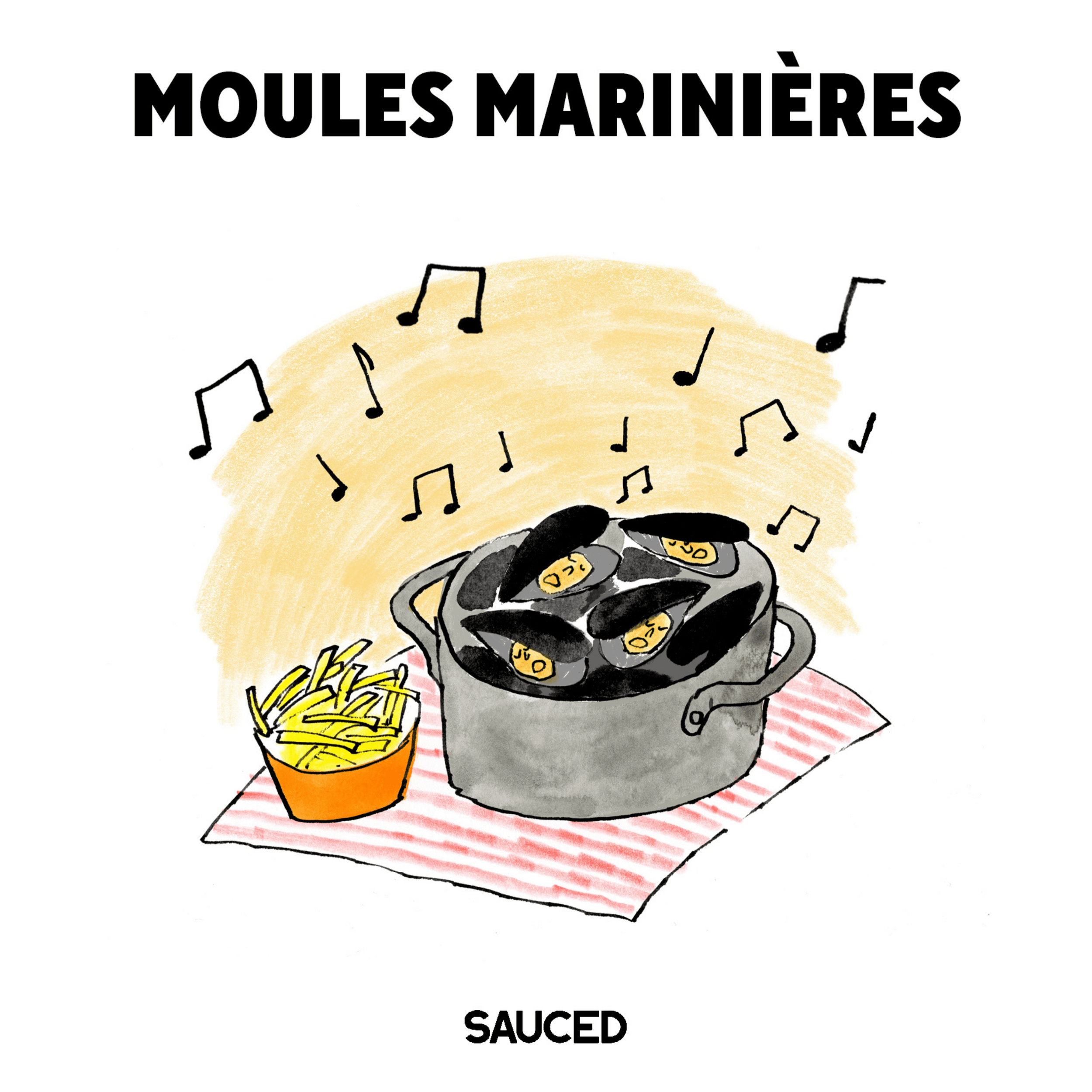
A big, steaming bowl of mussels — simple, fast, and impossibly satisfying.
In this episode, we break down Moules Marinière: the classic bistro dish that proves you don't need lots of time or effort to create something beautiful.
It’s the sound of cooking — the dulcet tones of salty bivalves clacking inside the pot as they steam.
What we settled on:
PEI mussels — smaller, sweeter, and they steam perfectly
Clean in ice water, then lift out — never strain
Shallots, not onion ("I would never make a beurre blanc with onions")
No cream — finish with butter only
Open doesn't mean done — wait for plump flesh
Serve with crusty bread in the bowl and fries on the side
The cocktail:
The Bouchot: Calvados, Suze, Cocchi Americano. Stirred, served over fresh ice, lemon twist.
RECIPE CARD:
Premium subscriber? Check out the full recipe card here.
LISTEN
EpiSOde Partners
Thanks to the following brands for partnering with Sauced to bring you this episode:
TRANSCRIPT
Tim McKirdy: Sother, big old steaming bowl of Moules Marinière. Can you hear it clacking?
Sother Teague: I love that sound. The mussels rattling around in the pot as they open up. Great.
TM: Absolute classic of a dish here. Perfect for Sauced. For those who don't know, what are we talking about here? Marinière specifically.
ST: Turns out that it's one of the national dishes of France. And Marinière just means mussels in the style of the mariner or the sailor. It's also a reference to the striped shirts that the French sailors wore. What's that called again?
TM: The Breton, I believe. The Breton stripes.
ST: I think it's an incredibly simple dish that is packed with flavor and also is super easy to make.
TM: Mussels, wine, shallots, garlic, butter, essentially. That's it.
ST: Essentially. A couple of herbs and we're good to go.
TM: You know, fun fact about that. I dunno whether this is true, but you mentioned one of the national dishes of France, I read during prep that it's the second favorite dish in France. What do you think the first is?
ST: Man, I'm really torn. I wanna say something as simple as an omelet, but then I wanna say something like steak frites.
TM: No, it's something, think more about in a sense French pride, a very quintessentially French, classical French dish.
ST: I mean, the things that come to mind are like coq au vin, baguette, pâté en croûte. I'm lost.
TM: Duck a l'orange…
ST: Duck a l'orange!
TM: I mean, I dunno where they're getting this from, but...
ST: That's a future episode.
TM: That's definitely gonna be coming up for us here on Sauced. As we always like to start the episodes and the discussion, personal or professional experiences with Moules Marinière for yourself?
ST: I don't know that I've ever worked anywhere where we made it specifically, but we've certainly made many, many different mussel preparations that are all quite similar in build and structure, but with maybe different flavors, you know, lemongrass and ginger and things like that. To give it the flavor of wherever it was that I was working. So professionally, not so much. Personally, you know, when we were doing prep just recently, I was talking about how it shocks me how easy this dish is to make, how quickly it can be put together and how infrequently I make it at home. Even though if I see it on a menu, I'm pretty tempted to order it. If I don't order it, I'll sit there thinking, man, I should have ordered it.
TM: I'm with you on that one as well. Whenever I worked in kitchens, mussels was more of an ingredient that we would use, right? It would be incorporated into different fish dishes classically, like a bouillabaisse or things like that. But it was never really something that we ever offered on the menu. But yeah, I just think another thing about this dish is it's so easy to prepare. It's probably not something that you want to order if you're out on a first or second date.
ST: Well, this definitely categorizes itself as country French cuisine, right? I think the characteristics there are super casual. Often something you're eating literally with your hands. So I think, not a first date for sure, but like a third or fourth date where you're gonna have someone over and you're gonna cook it with and for them, this is a super fun thing to do.
TM: I'm with you on that one as well, and it's one of those ones that over delivers on sort of shock value or wow factor for the amount of effort that goes into it.
ST: It's always beautiful when it comes out because it looks inviting and abundant, and there's steam wafting off it. There's plenty of aromas. I love it when they bring it out with the secondary bowl on top so they can flip that bowl over and you can use that as your shell bowl. But in doing that, you get this crazy burst of aroma, this plume of steam coming out. It's gorgeous.
TM: I really do love the look of this. Also, I forget the name of it and there might be one or two more actually, but there's a restaurant in New York City specifically, I think it's in the Upper East Side now, but there used to be one in the West Village. I think they have 20 different mussels dishes on the menu.
ST: Let's go.
TM: One and a half to two tons of mussels they get through a week. I went there for my birthday once.
ST: A lot of mussels.
TM: The aromas were intense.
ST: I bet. I think that speaks to the mussels as well, though. To the mussels specifically. Not necessarily the dish specifically, but they are a great blank canvas. Like in this case, this is the chicken of the sea, right? Not tuna, but this, because you can go in any direction you want. I think that's an asset to have in the kitchen. Anything that can be malleable into any direction you wanna go, I think that's a great thing to have.
TM: Simple dish, but then you do really want to be finding that balance. To your point, because it takes on flavors of things, it's quite delicate in some respects.
ST: Oh, I agree. I mean, it's still seafood, it's a shellfish. So I would say they're very delicate. But at the same time, they just taste of the sea. Very briny, but yet they have a creamy quality as well. They're kind of mouth coating as you're eating them. They taste obviously a bit salty and fresh. There's a very fresh flavor about them.
TM: So, looking at origins, right, starting in the beginning, where can we trace this back to? It's one of those things that's so simple that it's difficult to believe that any one region or person came up with it. Right? There are sort of two conflicting stories though, when it comes to a little bit more about how mussels are farmed. Actually, do you wanna get into sort of what mussels are as an organism first? They're bivalves, right? But how do we grow these things?
ST: I mean, I've never been to a mussel farm, but I've been to oyster farms and it's likely quite similar. The mussels themselves, they have what's called a beard. And you know the technical name, I can't ever pull it up.
TM: Yes, I'll find that shortly.
ST: You have it in your notes then. I thought you knew it. But the beard is this little stringy appendage that sticks out of the shell, and it attaches to things like ropes or chunks of wood or even rock surfaces. And once we sort of figured out how they were doing that, we say, okay, let's string some ropes between some posts, and they'll just start naturally growing on there when they spat the water. And then you just go back out there and harvest them once they're at sort of market size.
TM: Otherwise, wild mussels, they do exist. You can buy them, you can also harvest them yourselves, but you have to be a little bit more careful because of the water source that they are in.
ST: Of course. I was out in Vancouver, Washington, a little over a year ago, and we got up with the early morning tide being out and we went out with a five gallon bucket and some waders on, and we came back with a five gallon bucket of little free mussels.
TM: In that sense, they will just sort of latch onto, I forget what exactly it is. You see that on the video, what I'm doing here, but like more like rocks and things like that.
ST: Yeah, this was a rock surface. These were just totally a hundred percent wild. And plentiful. The crazy part is they're plentiful because they reproduce and grow pretty quickly. So farming these things is quite easy. And that also leads to the fact that the expense on these is quite low. Which is strange to think. Typically when we think of things from the sea, and as I just said something that would be one of France's national dishes, you'd think, wow, this must probably be pretty expensive. They're not.
ST: Julia Child, you mentioned, called them poor man's oysters, which I think is a strange way to put it because you don't eat these raw, but I get the meaning that she was kind of driving at, that they're beautiful, bountiful, fresh seafood that is inexpensive.
TM: And you know, her and Jacques Pépin have done an episode, it's available there on YouTube about shellfish, and it was the two of them. Mussel comes up in that and I think that's where the quote comes from on that one there. So maybe it was just comparing and contrasting there.
TM: To go back to those sort of harvesting mussels. The advantage you get from growing them on those planks, or as they're known technically bouchots, they are not then sitting on the ground and sort of getting too much sand and dirt and stuff into them. Right. Of course you will get that and we're gonna get into that later when it comes to cleaning them. On the origins and on the etymology of that word bouchot, some folks, according to legend, like to trace that whole idea and that this discovery back to someone called Patrick Walton in the 13th century. He was either Irish or Scottish, depending on who you believe. He was shipwrecked, I believe, somewhere off the coast of France. He planted wooden stakes to stretch nets between for catching seabirds.
ST: He was trying to catch birds?!
TM: Yes. And instead, mussels colonized the poles. They grew fat and clean and he was able to survive off of them. He called these stakes bouchot, coming from the Celtic Gaelic "bout choat," I dunno if I'm pronouncing that correct, but it's B-O-U-T-C-H-O-A-T, meaning wooden fence.
ST: So this Celtic guy built a fence in the water to catch birds and ended up growing mussels….
TM: There is a counterclaim. Other regions said they've been doing that for centuries. But regardless...
ST: I think a lot of foods that we just literally can walk out into the world and find are collective subconscious. It's almost like how alcohol was discovered, right? It's just some fruit that had rotted and fermented. So I think there's no claim to who found mussels. Who found, I don't know…chicken?
TM: What came first?
ST: It was definitely the egg.
TM: I've been meaning to get your take on that.
ST: No further discussion is required. It was the egg. The egg was first.
TM: I think it's also worth noting though, beyond that technique, Moules Marinière as a dish is beloved across that sort of northern Europe, right? From the northwest of France all the way through to Belgium, the Hague. They eat a ton. I think it's something like 20 to 30,000 tons of mussels a year in Belgium.
ST: I mean, that's incredible. And again, I think it has a lot to do with the fact that, well, obviously culturally, but I mean globally, I think it has a lot to do with the fact that they are sort of universally delicious and easy to eat because they'll adapt to any cuisine and they're very inexpensive. I've been kicking myself since we've been doing the research for this episode because I don't think I employ them as often as I should, given that they're so readily available and inexpensive. And delicious. You're rarely gonna hit the trifecta of like, I can always get it, it doesn't cost much, and it's delicious. Maybe you get two of those at a time.
TM: You mentioned earlier this is a country dish or a staple, right? This isn't haute cuisine. We do like to ask, is this a prince's or a pauper's dish? So we're saying definitively a pauper's dish.
ST: We ask ourselves this question for the dishes that we look at, and I think that we're gonna find as we go that too many of them are both. It's a pauper's dish because it's cheap and it's plentiful. It's easy to do. It's a dish that can be prepared with next to nothing. And it's a prince's dish because it's a national staple of France. So I think it's very difficult to call it one or the other. I think we'll have other dishes that tell us pretty clearly, but again, it wouldn't have exalted itself to the level that it has if it wasn't made for the upper echelon.
TM: This is one of those ones as well, where you don't want to go too far in the weeds, but the whole idea and concept of a restaurant doesn't exist until sort of, it's a relatively modern invention, right. It's post revolution in France. And I think by the 19th century, this is something that was sort of being widely consumed in restaurants, and by the 20th century, it's a bistro classic.
ST: Absolutely, I was gonna bring that up too. I will say this in the prince versus pauper thing, and I've worked at many very fancy restaurants. I've been to many very fancy restaurants also in Europe and in France. And I would say even though it's considered to be one of France's national dishes, you don't find it very often in the nicer restaurants. You find it in the bistros. Almost ubiquitously. Any bistro you're going to is gonna have it. Rarely a fine dining restaurant, haute cuisine, et cetera, which I think is odd.
TM: I think it's apt just because I don't wanna see too many fancy techniques being applied to this. This is a dish that really leans into ingredients, simple techniques. But refinement. I don't want molecular gastronomy when it comes to my Moules Marinière.
ST: I agree. It's almost like you're not playing to your strength if you are running a fine dining restaurant and serving Moules Marinière. Although the opposite could be argued as well. You go to many fine dining restaurants in France that have, for dinner, an omelet. A beautiful, no browning, glossy, yellow, shiny omelet of simple cheese and herbs. It's just proving to you that the chef can master those techniques that we consider simple. Because everyone does them. That doesn't mean everyone does them well. Anybody can make an omelet. Can anyone make an omelet well?
TM: We've spoken about it before on this show, but when it comes to culinary school, one of the things that we had as a test was turning mushrooms. But there was also the omelet test, and that was always a good one. And as you said, no color, still liquid in the middle. Beautiful. I think that's a great introduction to Moules Marinière. I think that's everything. A little bit longer than an elevator pitch, but I think that's everything folks need to know about Moules Marinière. So we're gonna take a quick break now, and then we're gonna move on into the next section of the show.
ST: Excellent. Let's do it.
***
TM: All right, and we're back. Sother, fun one for us as always. Kicking off the second part of the show here today, what did Julia, Jacques, and other culinary luminaries have to say about Moules Marinière?
ST: I didn't find anything. I didn't specifically look for anything from Julia. I did look up Jacques, as I mentioned earlier. And he didn't have anything insightful. He just approached it as though it was just an everyday commonality for him. And then I also checked out a guy that I like to follow. His name is Adam Byatt, B-Y-A-T-T. I'm probably butchering that pronunciation. A great chef I've been following for a while. And he just talked about how, sort of what we've been talking about as well, how comforting it is. What a warming dish it is. He alluded to that big steaming bowl. Just this really welcoming, inviting, salivary inducing, even when I talk about it, my mouth starts to water. So the general consensus that I get, and you probably got some more insights, is that this is a very comforting dish.
TM: That leads to an interesting question. What is the best season to eat this dish?
ST: I find that I love seafood the most in the warmer months, but maybe that's just because I grew up on the Gulf of Mexico. However, I think when I talk about this dish, even just now, I look back based on you asking this question, I look back at everything I just said and it's got this very stew, warming, comforting... I'm gonna eat the broth out of the bottom with a big spoon. It's got this very winter vibe. I could see snow being on the ground while I'm eating.
TM: Well, I mentioned that I went to that exclusive mussel restaurant for my birthday. My birthday of course for the folks listening is in November. As is your own as well.
ST: That's right.
TM: It's not the same day. There was some confusion recently on that. Story for a different day. I had down here though, Julia Child, as we mentioned earlier, she described them as poor man's oysters. Jacques Pépin, again, nothing too quotable on it. Although, one of the things that I thought made his preparation unique and I really liked was the use of herbes de Provence.
ST: It is different.
TM: And then a fun one for us here, there's a whole cream debate. Between folks, do you add cream or not to finish the sauce? People get quite heated about this. What's your thoughts on that?
ST: Ooh. Is there a heated debate? I knew there was a little bit of a debate. I didn't know it was heated. It's like putting peas in your carbonara.
TM: Carrots in your Bourguignon.
ST: That gets people upset. I didn't know there was a heated debate. And I would gladly eat them either way. But I prefer no cream. I prefer to finish the process with a heavy mounting of butter. We're gonna start the process with butter and oil. We're gonna finish the process with mounting with butter and herbs. To get some glossiness and that more buttery feeling. And the reason I think I feel that way is I would put it in the camp of like eating lobster or crab legs or other seafood that we dunk in butter. I'm just looking for that butteriness. I'm not necessarily looking for that creaminess. Now, I know we can argue that clams are in clam chowder, New England style, which has plenty of cream in it. I'm not saying get your mussels out of here if they've got cream in them. But I would prefer that more buttery nature.
TM: Among the other luminaries and culinary icons, Escoffier. I saw him getting some stick online for this for his version of the dish. He included a velouté sauce in his, so he was adding fish stock and then something to thicken it. But he cooked, if I'm remembering correctly, from his preparation, he cooks the mussels first and then spends a bunch of time finishing and correcting his sauce. At which point you have to imagine the mussels have gone cold. Or rubbery, if you're keeping them under a heat lamp or whatever.
ST: Do they have heat lamps back then? A bunch of guys with candles.
TM: Well, they're keeping it warm somewhere, aren't they?
ST: We hope, we hope. I'm imagining a lot of food was eaten at room temperature or colder in those days.
TM: Not in Escoffier's kitchen. That's why he invented the brigade. Just add more people in the kitchen.
ST: That's right.
TM: So yeah, back to that great cream debate. Belgians say absolutely no cream, period.
ST: And they stake a little bit of claim on this dish because they added the thing that goes with the dish the most, and we'll talk about that, but moules-frites, right? Mussels and fries. That's the Belgian way. And so I guess they have some say in the matter because they've carved out a very niche part of the dish. Or the dish service at least. I think for me, I just want that clean, buttery wine. It's basically you're making a beurre blanc.
TM: Yeah.
ST: You're making a white wine beurre blanc — white butter, white wine butter beurre blanc, with shallots and these herbs and then the mussels open up and they spill their liquid into this. And it's usually gonna be about double, when we talk about the recipe, the quantity of liquid that comes out of the mussels is about equal to the quantity of liquid that you've added to the pan in the first place. So I just don't know that I want to get too far away from this, more beurre blanc flavored with mussel liquor. I don't wanna get too far away from that, but again, I'm not gonna say no.
TM: I think as well that brings up something that's important and that Julia Child stresses when it comes to the preparation of this dish, is you want to build all of those elements of flavor and the sauce before you start cooking the mussels, unlike Escoffier, because yes, you are gonna get that release of liquid and you don't want to be having to spend a couple of minutes reducing a sauce after the mussels are ready to go. So you get it to that consistency first and then finish monter au beurre and we'll get into that later with the preparation. So that has been what the culinary luminaries have to say about this dish or what people are saying about their preparations. Let's head into non-negotiables.
ST: Today's non-negotiables are brought to you by Palomo Mezcal, built on balance. Palomo keeps the smoke lighter than most mezcal and pushes the proof a notch higher. Sip it neat, or let your cocktails sing with cooked agave and bright citrus.
TM: So what defines this dish? What if you don't have it, are you saying that's not a proper or quintessential Moules Marinière?
ST: Again, I know this is a thing we talk about on each episode, and this one I feel like is a little bit looser or maybe it's the opposite. It's tighter in that it only has a few ingredients and I think they're all non-negotiable. We have the mussels themselves. We're gonna use Prince Edward Islands probably instead of the New Zealand green lips, which are really only your two commercial options. We're gonna have to have butter, shallot, garlic, and then we're gonna go in with some thyme, parsley, and of course white wine.
TM: That's it.
ST: I mean, that's it.
TM: And I think, not that I know how you would do otherwise, but I think the other thing is the cooking technique itself is a non-negotiable, right? Steaming it, opening it, doing it that way. If you're not doing this in one pot essentially.
ST: The process has gotta be pretty much the same across the board, and those ingredients are all non-negotiable. You’re missing any one of those and you miss the mark.
TM: It is a negotiable, but I would like to nudge it in the direction of non-negotiables by saying I want to be wearing one of those striped Breton shirts while I'm eating this.
ST: You wear the shirt, I'll get you a beret.
TM: I used to have a bunch of those and that was a staple in my wardrobe and I haven't had one for years, so maybe I need to get back into it.
ST: We'll get us both one and we'll take pictures of ourselves in the kitchen, making mussels for dinner or for lunch. This is a great lunch dish.
TM: Good point. I would like you to bring up your thing because I forget what it's called, but when it comes to actually eating this dish, it's, to your point, a great lunch dish because it doesn't fill you up too much because it's quite an effort to eat. What is that called again?
ST: Response cost. So response cost, when we're talking about eating, is the amount of time it takes you to get something to the position where you can just eat it versus having something that's already at that position when you sit down. So peanuts are a great example. If there's a bowl of shelled peanuts on the table, you will consume so many of them, sort of mindlessly taking on calories and all that stuff. Whereas if they were in the shell, it takes you long enough to open them and your brain goes through what's called response cost. And then you don't eat as many, right? Because when they're just there to eat, you're eating them faster than your brain says, I think I'm full. But if you're eating them slowly, your brain can go, yeah, I'm full now. Stop. Because your brain and your stomach communicate, but not well.
TM: Let's get into eating these, actually. Because it is a fun part of it. The ritual of Moules Marinière. Talk us through how you would go about that.
ST: Oh, man. I'm not gonna go digging around and find the exact smallest one, but I'm gonna find the smallest mussel that's on the top. I'm gonna grab it. I'm gonna pop the meat out and eat it. And then I'm gonna use that small shell as a little pincher. That's my tiny tongs. And that way I can just grab each shell by the very edge with my non-dominant hand, and I can go in there and pluck out the meat and eat them directly from my little tongs. So this one gets saved to be my tongs for the whole rest of the meal. And I'm not alone in this. I've seen many, many people do this. Many chefs talk about this. It's just a very convenient and easy way to eat them. But there is a thing that I do that I've never seen anyone else do. And every time I'm with someone and I do it, they're blown away. Every time I'm at a restaurant and they come to clear away my plate of shells, they stop and make mention of it. I've had literally people walk by my table who are just customers and be like, what the hell are you doing? So once you've got the shell emptied and spread open like butterfly wings. Then the next shell, you insert into that one. And then you continue to do that. And you don't have to eat them in any order. They'll fit together no matter what. They're like legos. And what you end up with in the end, and it starts to curve and the more you eat, the more curved it becomes, but what you end up with is this sort of crazy chevron, rhinoceros horn looking thing, and it's just one long thing. Instead of this pile of empty shells, you just have this one long, sort of bone looking thing. It literally gets mentioned every single time I eat mussels.
TM: Great. Well, those are our non-negotiables and our fun technique of the day when it comes to how to eat them. Ingredients in order of importance here now for us, let's head into that. In doing so, I think we've covered most of the things when it comes to mussels, but you mentioned two of the most common breeds or types earlier. Can you remind us of what those are again?
ST: I think they're really the only two you're gonna get on the market. Other than just going out and getting some wild ones yourself, you've got Prince Edward Islands, PEIs, and that's a designation of both origin and the style of the mussel. I don't know if they literally originated on the Prince Edward Islands, but they're just the smaller, thinner, black shelled mussel that you see kind of everywhere. Then you've got what are called New Zealand Green Lips. And again, I don't even know if these are from New Zealand, but I assume they probably are. Those are the much larger ones. The edge of the shell, I'm colorblind as we know, but the edge of the shell has a green tint to it. Well, the whole shell has a greenish tint, but the edge of the shell is quite green. They call it the green lip. Those are the much more meaty and dense, and to get those ones cooked all the way, I don't think pairs well with this preparation.
TM: Right.
ST: They become too sort of rubbery because they're so big that to steam them this way, it doesn't get them there. Those you can pop open and broil or grill or do other things with. Overwhelmingly the listener's gonna find PEIs when they go shopping. And how you're gonna find them in the market is gonna be typically in a mesh bag so that they can breathe. You can't put them in a plastic bag, they'll suffocate. And then they're almost always two pound bags.
TM: And would you say that's generally good for two portions?
ST: I think it's two entrees. Or it's four appetizers. But also, I mean, how many restaurants do we all know that offer, you know, Tuesday night is all you can eat mussels, and each portion's probably about a pound. And you sit there and eat four, or I do. And I've got this giant horn because I don't let them take it away till I'm done.
TM: Of course. That does bring us onto though, at this point I want to talk about how we're cleaning our mussels. Because I think we're front loading a lot of the work when it comes to prepping this dish and it's basically just cleaning the mussel. So talk us through it.
ST: Cleaning mussels is really, really easy. It's not nearly as hard as cleaning oysters. Especially Gulf Coast oysters, which just come out covered in mud. Cleaning mussels, you just wanna tear open the bag, dump the mussels into a vessel that's large enough to submerge them in cold water, ice cold water. Then you're gonna kind of get your hands underneath there and sort of rough them up a little. This is just knocking dirt and debris, anything that might be on the outside of them off. Then just walk away and let them sit in that cold water for about 10 minutes. Once that 10 minutes has passed, you're gonna go back in and again, put your hands underneath the mussels and lift them out into a separate container. Because if you just strain them out, if you just dump them over into a colander or whatever, you're just dumping all this water that is filthy back over the top of them. And you'll see, by the way, even if you just get two pounds, you'll see a pretty visible browning of the water and debris on the bottom. So just lift them out, and then that's good. You're good on cleaning them. Now we gotta deal with the beard if there is one. That's the other thing. Aquaculture has come a long way and the beards are getting smaller and smaller and smaller. I'm not exactly sure what they're doing to keep that at bay, but I remember when I was a younger chef in the kitchens and we would get them and they would have these pretty intense beards on there. And your fingers would be sore by the end of cleaning them. Because it's like strings across your fingers. You pull them. But here's how you get rid of them. You wanna hold the mussel in your non-dominant hand with the beard facing towards your dominant hand. You wanna hold the hinge, sort of facing downward to the floor. And then you wanna grab that beard with your thumb and finger. And if it's a small beard, if it's really little, pull straight out, sort of perpendicularly and it'll pop right out. No big deal. If it's a little bit more aggressive, you wanna pull out and down towards the hinge because the hinge will help cut the beard. Because if you pull up and away from the hinge, you will tear the muscle meat inside. Because that beard is ultimately connected to the muscle of the mussel. So if you snatch them upwards, then when you steam them open, they'll all be kind of torn and busted looking. Pretty easy though. Very easy. Takes no time.
TM: That beard again, I think we mentioned it earlier. Technical name for it, byssus. B-Y-S-S-U-S. Byssus was once and historically spun into a fabric called sea silk. In many, many different countries, this silk is so fine and precious you would make a pair of gloves out of them or stockings.
ST: I don't know where it's from, but as soon as you started saying it, I was like, I remember this.
TM: Incredibly luxurious material. Those gloves would be so fine that apparently you could fit them into a walnut shell. One of the funny things, the Julia and Jacques episode...
ST: I'm gonna make it my mission to find a pair of these gloves.
TM: I could only find them in museums apparently. One of the things, and I don't know where the disconnect came from here, because I couldn't find anywhere else talking about this on the internet, but in that episode of Jacques and Julia, where they're cooking with shellfish and they're, and this is one of the dishes that they make, or they talk about mussel preparation. Jacques was saying that he had learned that in Greece, they would make gloves out of them for fishermen. And they were so strong.
ST: This is what I knew. I didn't know they were so fine. Are they fine and strong? I knew you made gloves out of them that were strong enough that you couldn't cut through them.
TM: With a knife wouldn't cut through them.
ST: Yeah.
TM: I just saw that the sea silk, maybe you can do both. I don't know. But there seems to be a big disconnect for me here between ultra fine silk gloves that you'll only find in a museum these days and stuff fishermen are using that are so strong.
ST: That's the ones I think I'm gonna try and find, because that's what I had read, that fishermen would make them into gloves and then they would wear those gloves while doing hard work on their hands, that would protect their hands. And they were apparently really resilient, like almost like chain mail. Like those gloves oyster shuckers wear. You can make a glove out of this stuff.
TM: Which is incredibly apt. I forget how many, it was something like 50 pounds or maybe 15 pounds, to make one pair of gloves.
ST: Heavy gloves.
TM: We'll have to look into that. And not that it should ever be trusted as a source, but under the Greece entry for sea silk on Wikipedia, they don't mention fishermen's gloves. And that's what Jacques was saying. But anyway, I'm gonna move us onto our second ingredient here. I'm gonna talk about this one. Dry white wine.
ST: Dry white wine.
TM: So classically, we're looking at Muscadet from the Loire Valley. It's one of the great whites, well, actually there's many great whites from the Loire Valley, but it is one of the iconic light whites made from the Melon de Bourgogne variety. And here's something about this and one of the alternatives that I would give, and this is definitely something I would drink with it, and we can talk about this later. If you encounter a bottle of Muscadet that has the words or phrase "sur lie" on the label...
ST: S-U-R-L-I-E, sur lie, right?
TM: S-U-R-L-I-E. Two words. That is gonna signify that the white wine has spent a little bit of time aging on the lees, which are the dead yeast cells as a remnant from fermentation, the process of fermentation. I love whites that spend a bit of time on lees. It's that thing that you're gonna get in Champagne. It's gonna make Champagne really bready and yeasty and brioche. Toasty. But it also adds texture and weight. So you have, on the one hand, a really nice, crisp, acidic wine. You get a little bit of weight from that. So that's gonna be our classic. I know you're a fan of Sauvignon Blanc for this as well.
ST: Yeah, I picked Sauvignon Blanc, but I didn't specifically look to see if there was a specific wine that was traditional. But I'd also just mention that, though we have non-negotiables specifically, and that certainly is gonna be wine specific. This dish is also quite good with beer or with cider.
TM: Yes.
ST: Or this preparation, I shouldn't say this dish. This dish is Moules Marinière. We're gonna talk wine. But you can steam mussels in beer, you can steam mussels in cider.
TM: And I think that leans into, and I totally agree, which part of this sort of northern or northwestern or northern central Europe, wherever you are, right? If you're in Normandy, you're probably leaning for apple cider. Hard cider. Gonna be delicious.
ST: Sure.
TM: If you're in Belgium, you're probably gonna be looking at, Flemish sour ales, Gose, or Saison beer as well. Getting some of that really funky bready loveliness.
ST: Yeah.
TM: If we wanna go for the harder stuff...
ST: I mean, let's sneak some absinthe in the game.
TM: I was gonna go similar, but different.
ST: Well, you got ouzo, arak, all anisette.
ST: I love anisette with seafood, especially shellfish. Last year at Thanksgiving I made oysters Rockefeller, which everybody knows, of course, is sort of a cream spinach situation with absinthe that's then spooned on top of oysters on the half shell and topped with breadcrumbs and broiled. I was like, I want that without the shell. So I made oysters Rockefeller casserole where I laid down the spinach, then a layer of oysters, then another layer of spinach, then breadcrumb on top and baked the whole thing until bubbly. Crazy good.
TM: You wanna be careful, I guess, with any of those anisette, you know, style liqueurs, just because a little goes a long way.
ST: Oh yeah, sure. It's a very strong flavor. We're not doing this one-to-one. This is not a replacement for all the wine. This is a replacement for some of the wine, or if you're using stock or whatever. Or the beer. But I just wanted to mention, again, we get oftentimes, I think us nerds about food and drink, and maybe the listener gets too tied down to the specifics of any given recipe. When, again, if you just zoom out a little, the whole thing is simply a template. Or a technique. So we can just talk about the technique of steaming shellfish and we can apply this to oysters, shrimp, clams, scallops, let's go.
TM: If we are using those types of alcohol or introducing those flavors, one of the things that I have enjoyed doing and have enjoyed eating is introducing some finely diced or brunoise celery into the mix. Peeled please, folks.
ST: Always peel your celery.
TM: Peel your celery. If you're not peeling your celery, what are you even doing?
ST: You must not love your mom. You're just a bad person.
TM: But yeah, I really like the savory notes that can bring into it. I have another thought about that when it comes to sort of a kitchen sink dish. We'll save that for the end of the show, but please remind me to bring that up if I forget. Some of the other ingredients that we're talking about here, those are the two key ones, right? Like you have to have them. Butter. You mentioned you're gonna go butter and oil.
ST: Yeah, honestly, I would choose unsalted butter. I didn't mention that. But we're gonna get a lot of salinity coming from the liquid that's inside the mussels, so we don't need to be tinkering around with any extra salt.
TM: Speaking of salt, I think, not something we mentioned, but worth noting very briefly. Those mussels, how do you know if some are gonna be dead? What should they be smelling like?
ST: Yeah, sure. This is a live product. The smell, right, just in that mesh bag that you're picking up at the store or at your local fishmonger. And I've talked on episodes in the past where you should have a relationship with your butcher. You should also have a relationship with your fishmonger. You should pick it up and it should smell fresh and salty like the sea. And they're in that bag. So, and you can't open it. There might be some in the middle that aren't doing so well. But that's just the cost of doing business. You're probably gonna wind up with a couple dead. That's okay. But when you get home and you do that cleaning process that we talked about, as they come out of there, you're inspecting them. Cracked or crushed shells, which there may be one or two of those in there, just go ahead and get rid of those out of hand. Don't even think about them. It doesn't matter. And again, the cost is so low on this. It's not a great loss. If they are beginning to open, this doesn't mean that they're dead just because they're open. This means that they are struggling to survive outside the water and they're trying to gain oxygen. All you wanna do is just kind of pick it up and give it a squeeze all the way shut and let it go. It will recoil and bounce back open, but it will slowly start to close if it's still alive. So don't squeeze it shut and see that bounce back and think it's over. It's just it doesn't react as fast as we do. It'll start to very gently close, and if it moves at all, it's alive. So you're in good stead. There's a lot of, especially, well, I guess it's mostly our only seafood items that we don't eat when they're dead. And mussels, crabs, lobsters are among those because they have enzymes inside them that begin to break them down immediately. And this is a postmortem, predation protection. Those are fancy words, but that just means that once that animal has passed away, it degrades really quickly. So that other animals won't feed on it. And you think, why? It doesn't matter. You're dead. But if an animal feeds on a, let's say a lobster that's passed away even within the hour and the meat's unpalatable or mushy or, I don't think the predator cares if it's mushy, but nutritional value is lacking, then they won't attack the animals that are alive. So it's like this weird postmortem predation protection.
TM: Next ingredient here, I'm going definitively shallots. I don't want white onion for this. And my thinking here, and I think a good general rule of thumb, if we're talking about quicker cooking techniques, if we're looking at a dish that is more elegant, maybe not the right word, but more refined, if you're looking for a balance of flavor here, I think the shallots have that they're gonna be slightly sweeter. Those white onions I'm gonna save for something that's gonna take much longer to cook. Whether it's a stock, a stew, something braised. That's my thinking on that one.
ST: I think I agree with you and I'll go back to something I said earlier and put those pieces together to come to a conclusion, and that is basically we're building a beurre blanc. I would never make a beurre blanc with onions. It's always shallots.
TM: Garlic we're using, we're not gonna get into, we'll do a separate episode on garlic one day in preparation and everything.
ST: Technique episodes.
TM: Exactly, for our premium paid subscribers. That's exclusively once a month folks, we're gonna be covering ingredients, techniques, side dishes, which we'll get into a little bit later here today. But keeping it in this feed and this episode, next one, parsley.
ST: I know, Tim, that you are not a fan of parsley, which blows me away as a chef. I just love the freshness that herbs bring of all manner and variety. And parsley is kind of like the unsung king because it's ubiquitous, it's everywhere. It brings a cleanliness to dishes that I can't live without. And you seem to wanna throw it out all the time. In this case, I would probably go with flat leaf, which is also a departure for me. I typically like the curly parsley, but I think in this dish, flat leaf, we're just gonna mince it up nice and fine. Tell us why you hate it.
TM: Well, in a word, texture. First of all, I think you can very thoroughly clean parsley and still end up with a little bit of grit at times. Finally chopping that up, I still find it to be something of an irritant texture wise, especially if you're garnishing at the end. And I did see some techniques here where some people were adding half of their parsley with the wine as you're reducing.
ST: I'm in that camp, I'm more three quarters, let's say, and then a little bit fresh to finish. A little bit on top to give it that pop.
TM: But also, again, I don't know what it is about the texture that's a bit of an irritant for me. But then I'm just thinking as well, if I spent all that time making sure I've cleaned the mussels properly. I might have even scrubbed the outside of the shells, making sure I've properly taken them out of the water and then I'm getting something and I'm like, is this grit or is this just parsley? I dunno, it's not a hill that I wanna die on. I'm just like, what are some herbs that I might find more interesting in this dish? Chervil, sticking in the herbs realm. I know you have some thoughts when it comes to thyme, bay leaf, and as I mentioned earlier, some folks may even go a little bit further, like Jacques Pépin with the herbes de Provence.
ST: I don't think, I think thyme has to be in this specific dish. And I think people get upset about thyme because picking the leaves off of thyme is a tedious, time consuming process. Oh man, how many times are we gonna make a pun about thyme? But I would remind the viewer and listener that when you're picking those leaves off of thyme, if you can hold the stem and then strip with your other hand the leaves off, then get rid of that stem. If you grab the stems and you pull to strip off and the stem keeps breaking, it is tender enough to simply chop into your thyme. So the ones that are easy to pull off, well that's easy, and you get rid of the stem. And the ones that are difficult to pull off, don't. That's gonna save you some time.
TM: Speaking another, there's another time. And then I don't know if you mentioned, or if I wasn't listening, I do like to put a bay leaf in.
ST: You're in the bay leaf camp?
TM: Absolutely.
ST: Okay, great. That's someone else who doesn't like bay leaf that you know.
TM: I keep thinking it's you. I thought it was parsley and bay leaves that you don't like. Because I hear so many people argue against bay leaves, and I'm gonna tell you, it's hard to pin down what they are doing when you're making a stock or something like that. But it's one of those things that you shouldn't notice. Until it's missing. The only way you should notice it is if it isn't there. And I have a great example of that from a friend of ours right here in Brooklyn. A chef who owns a place that we love called Gus's, Chef Chris McDade. And he was making for a while, or he makes from time to time, a bay leaf crème brûlée dessert. Now when you taste a stock and you say, I don't know what that bay leaf did, it brought some earthiness and some herbal oil quality to the overall stock or even sauce, if you're making a beurre blanc, et cetera. But when he made this dish, this dessert, it was an instant way to go try one bite of this and tell me bay leaf does nothing. It is so good. And it just lets you know, and again, if it wasn't there, you'd just have a custard of cream and sugar and eggs. So it definitely is bringing something, it's just hard to put your finger on.
TM: I have a theory and this is based on a recent event actually. I had to ask permission from my wife, Gabriela, for me to be allowed to get rid of a tub of bay leaves that I had, right? Because I had gotten, you know how in the supermarket when you're buying herbs and spices and stuff like that, generally they come in those cylindrical jars and there's not a ton in there. It depends what it is. And then sometimes you can get those cheaper ones. I think I may have even, sorry to say this, gotten this tub of bay leaves from a dollar store years ago.
ST: So they were probably pretty good when you got them.
TM: When I got them, they were great. But I bought too many. And let's be honest, if you're a home cook, how often are you cooking per week and how many of those dishes include bay leaf?
ST: I have a solve. I know where you're going.
TM: I'm saying how many of those dishes include bay leaf? So all I'm saying is for those folks who might think bay leaf isn't bringing much, it might be because their bay leaves are so old because they haven't gotten through them.
ST: Absolutely.
TM: So that's why I asked Gabriela, can I chuck these out? Because I need to use bay leaves and these are not fresh and they're not doing anything and I'm never gonna get through them. So I got a much smaller jar.
ST: I would say do that. Buy in quantities that you can go through quick enough. Here's another great solve for you though. A lot of markets now, even online markets, sell fresh bay leaves, not dried, that arrive to you frozen. So get yourself a stack of like 25 bay leaves at a time and put them in the freezer.
TM: Right there next to your lime leaves.
ST: Or keep them in the freezer just like lime leaves that come frozen as well. And because they aren't dried out yet, this flash freezing process captures all those oils that are in there and that's what you need anyway. And then you just use them in this fresh frozen state instead of the typical dried state.
TM: Herbes de Provence. I think stuff like oregano would be great in this. My final little one: lemon thyme.
ST: Okay. I mean, we have thyme in the mix here already. Seafood and lemon, fast friends. This makes sense. I'll allow it.
TM: Maybe some zest to finish it as well.
ST: Not that I'm the judge, but yeah, that makes sense to me. I also, I would say this too, and this is actually a great point to bring up and I'm glad we're stumbling across it. It's a quick one for the listener as well. Listen, I know you have to buy herbs in these what seem like super large quantities for what you wanna do at home. My answer to that is use more than it asks for in the recipe, A, or B, use whatever herbs you have all the time. Almost no dish comes out of my kitchen without getting a hit of herb at the end. And it doesn't matter. It's just whatever herbs I have. So just use them.
TM: They're only going to add another dimension to any dish. It might not always be good, but they're only going to.
ST: Right. There's some that stick out. You can't just throw cilantro in everything. But you can kind of get away with, oh, you got a little basil and a little tarragon and some parsley. Chop it up and throw it on top of whatever it is you're making. It's gonna make your sauce look beautiful. It's gonna bring an aromatic pop, it's gonna bring some flavor notes to the thing. And it's just gonna make you feel better. Because you're like, oh, I didn't just buy this large clump of something that I used for one recipe and I feel bad because I threw it away. We all go through that. I hate it. A big chunk of my career when I was in kitchens, I worked as the head garde manger, which meant that it was my responsibility to kind of oversee what went in the garbage. And I'm not kidding, in the kitchen, my station would be the place where every other station would have to come over before they threw whatever they thought was garbage away. And I would pick through it and save what could be saved and do stuff with it. And that was just part of my job.
TM: For the folks not watching on YouTube, and for those just listening on the podcast, a dog has joined us in the studio and is sitting on my lap.
ST: That's a dog.
TM: It's a great reminder though for everyone. These episodes are also available on YouTube. Tend to be more uncut, so if you wanna see what's going on inside the Sauced HQ, The Coaster Studios here, join us over there on YouTube and give us a follow. Give us a subscribe.
ST: And say hi to Chispa, who's licking the microphone right now.
TM: What does that little dog weigh?
ST: You think it's more than one? It's the smallest dog ever.
TM: Well, Chispa arrived at just the right time now, folks, to remind us that is the end of our ingredients section. We're gonna take another quick break here. And now I'm gonna take this dog back upstairs. And then, Sother, we are going to get into the preparation of the dish.
ST: Yeah. And service. Today's preparation is brought to you by Underberg. Herbs, bitterness, balance, like any great dish, like Underberg.
TM: Alright, that's us back. We're here. Time to talk through prep. We're dog free in the studio right now.
ST: You got rid of Chispa.
TM: Sorry, Chispa. So there, I'm gonna kick it off. We're gonna start with that butter, optional butter and oil to begin with. The oil's gonna deal better with heat, as Jacques notes as well. A good olive oil is also gonna be healthier than butter.
ST: I don't disagree with that. I'm just saying I don't know that I'm thinking about health when I'm eating a buttery sauce in the first place. Because even if you start this with oil, you're still gonna finish it with butter. So you're still getting butter in there. Do you wanna save those calories or do you wanna just say, I'm willing to spend those calories.
TM: Commit to the bit.
ST: Because I think that's a crazy thing. We always talk about saving calories, but there's also a place to spend them. So this is maybe a place to spend some calories.
TM: I'm gonna add my finely minced or finely diced brunoise shallots in there. Cook those around for around one minute. We don't want any color on these, we just wanna get them sweated, translucent. I'm gonna add the garlic. At that point, I'm gonna continue cooking for about 30 seconds till you get that real nice pop of aroma of garlic. And we're both doing the same thing here.
ST: This is the aroma gesture.
TM: Blowing it into our faces. At that point as well, I'm gonna add our bay leaf, our thyme, and any other of those woodier herbs that you want to use rather than fresh. And I'm gonna add a big old glug of wine to the pot, and then I'm gonna hand it over to you.
ST: Okay, cool. Speaking of the big old glug of wine, I know I talk about knobs of butter and pours of cream or whatever, but for the wine, just to give a ratio. Because people love to have things spelled out for them. I think we're looking at roughly four ounces, half a cup per pound of mussels. But I think that also scales wonky once you get past five pounds. But who's cooking that at home? You don't still need four ounces once we're at five.
TM: What size is your pot?
ST: Well, I mean, I got big pots, and I do not lie. Anyway, half a cup of the wine, is that where we were? And then, so now once that's bubbling away again, now we're gonna go in with the mussels.
TM: How much are you reducing that by? About a half?
ST: Oh, right, sorry. Yes. Let's reduce it down. Not quite even a half, I don't think. I'm not looking to make a syrup at this point because I want enough liquid to be in the pot to create enough steam to get the mussels to start opening, which then they'll release their liquid, which will then add to the liquid. This whole process sort of eats itself. Okay. So we're gonna reduce by about a third maybe. And then we're gonna lower the mussels in there, kind of use a big wooden spoon or something to toss them around and get them a little bit coated. And then the lid goes on. And this process from this point is gonna go pretty quickly. We're looking at maybe three minutes or so until our mussels are gonna begin to open. And then here's the trick, right? Once a mussel is open, doesn't mean it's finished. And I think this is a failing that people have all the time. You see the shell starting to open and you think, oh, I'm done. Not quite. If you take a look at one of those ones that's begun to open, you'll see that the meat of the mussel itself is connected to kind of both sides, and it's being spread open by its own shell. This is the mussel desperately trying to not be dead. He's trying to hold it together, but he's being spread apart. You know, mini crucifixion of the mussel. We got maybe another minute or two to go from that point. And then the mussel will release from one side or the other. And then that's when the mussel is just this little plump ball that's attached to one side of the inner of the shell and not the other. That's when you're fully cooked. Here's where it starts to get a little technique-y again. What you're gonna do at this point then is using a slotted spoon or a spider, you're gonna lift the mussels out into your service dish. At that point, then you can take that sauce down a little more if you want. Taste it at this point. See if it's seasoned well enough, a couple of good cracks of pepper. Maybe you need some salt. Maybe you need to add a little water to bring the salt down if the mussels are particularly salty. And then mount with that butter and then pour that butter over the top of the mussels back in that bowl. And that's when you hit it with that last flourish of herbs.
TM: It brings me to a point that I was thinking about when you were explaining your wonderful pinching technique when it comes to eating this.
ST: My little pincers.
TM: One of the things that is really enjoyable and notable about it is when you do have, so you might have pinched that mussel out and you're eating it, but you do have a little cup of broth there, which is really nice, right? Because, let's talk about that now. How would you serve this? What are you typically serving the dish with in order to get the most out of it, right? Because if you have a bunch of shells in a bowl at the beginning, you might have a spoon to have that broth, but you're sort of fishing around in there.
ST: I think there's really just the two choices of what to serve with this dish. It's either some crusty bread or some fries. And my choice is both. Although I will say that I'm not as big a fan of the standard french fry shape for the fries. I would prefer them to be the more sort of British roasted potato, which is effectively a fry. Maybe even tossed in some more of the same herbs that are going in here just so it's something I can kind of fork or maybe even plunge right into the sauce. Either as a dip or just throw some in the bowl and then they're getting soaked as they go. And as far as the bread goes, that's exactly what I'm doing. I'm probably gonna take one of the staples in my kitchen, in every kitchen I've ever worked in as well, confit of garlic, and I'm gonna smear it on some toasty bread. And when I earlier talked about the service of the mussels, I'm gonna put that toasty bread in the bottom of the bowl before I lift those mussels on, before reducing the sauce and finishing it and pouring it over the top. That piece of bread is then my reward for finishing all those mussels. I'm not gonna even try to get to it till I've whittled away at all those shells. So that's how I would serve this dish. And my mouth is literally watering, even talking about it.
TM: We hinted at it before, but of course, if you're serving it with fries, it is that classic Belgian national dish, moules-frites. And also, do they not stake a claim, I think you hinted at this earlier, do the Belgians stake a claim to have invented french fries?
ST: I think they do. The frites is a Belgian invention, and it only became named French, I think, because of the culinary term of frenching, to cut in a bâtonnet style of that size. That is a french fry.
TM: Huh.
ST: That was my hint when I said french fries. As I say iced tea, as I say iced cream.
TM: Oh no, we're not getting into this, are we?
ST: It's pedantic. Listen, we made a podcast because we're pedantic.
TM: What was the, bananas Foster?
ST: Bananas Foster. Something for another day, folks. Let's not even get into that.
TM: Listen, that's cooking with booze. We'll get there. That's a dish we'll get into in another extremely pedantic discussion. Great point though, to remind the listeners and the viewers there on YouTube, if they're watching us there. So if folks want the full recipe, you gave some very helpful ratios there. But if folks want quantities and stuff, we're not gonna get into that in Sauced when we're going through it. It's too much of a detour.
ST: Yeah.
TM: But if you sign up to be a paid subscriber of the show, every month, not only are you gonna get those bonus episodes that we mentioned earlier, you are gonna get a digital recipe card for every dish and drink that we cover on this show, the recipes that we have for you. You're gonna get four of those every month, plus the bonus episodes, and that's a great deal. It's basically the price there, it's about a cup of coffee these days. $7 a month. Join us over there among the premium subscribers and for those who are subscribers already, thank you very much. We're an independent podcast. We really appreciate the support.
ST: Once you get to hang out with us and be a part of a community and talk with like-minded people, including us, get our feedback on things, get the feedback of the group, it's gonna be a great community.
TM: It's a great community. And you're gonna get early access to live events because, you know, Sauced, we wanna get Sauced together in person. And you're gonna be the first to hear about that if you are a paid subscriber. We're gonna take one final break right now, and then we're gonna talk about another type of side. The thing that's in the glass.
ST: The pairing.
TM: I'm gonna get to the Sauced part of Sauced.
ST: Let's get Sauced. We'll be right back.
Thanks to Underberg for presenting today's preparation. The tiny bottle that saves big dinners. Head to the show notes to learn more about Underberg today.
TM: All right. It's time to really get Sauced. Now it's time to talk about booze because this is a show about cooking with booze and drinking with food.
TM: I'm gonna act as our sommelier here today as I often do and as I like to do.
ST: I'm leaving it open because I'm learning a lot from you. I really am. I have better than a base knowledge about wine. It's just not something that I am typically drawn to first. I have made my bones in the cocktail world, so I think of spirits as alcohol and cocktails first.
TM: I think those are always something as well. I think we're both big proponents of having a cocktail. Maybe it's with the food, maybe it's after, maybe it's while you're cooking. Maybe not for this one because it's quite a fast process as we mentioned. And we are gonna give you a custom cocktail recipe as we do every episode. Before we do though, that wine. Wanna come back to Muscadet for a second. Mentioned it was from the Loire. Melon de Bourgogne. Exactly. Canonical pairing for me. And the Loire, in case my geography is wrong, it probably is. But northwestern France as well. Getting close to Brest where, this is, you know, stakes a claim to the origins of this dish. Dry, light bodied, crisp acidity, citrus. Primary fruits are gonna be citrus, green apple, that kind of thing. It's gonna cut through maybe that rich sauce that you have. It's gonna pair perfectly with the fish. I mentioned earlier as well, this isn't critical for cooking, but for drinking. I do love those ones that are called, the sur lie, that spent some time on lees. This brings me to an alternative that I really like with this. And we're sticking on a northwestern coast, but we're going to Spain, we're gonna have some Albariño. We're going to Galicia. Albariño. You will get some, and they're incredibly well priced, Albariño that have spent some time on lees as well. I think for both of those varieties and wines, not only does it give you that added texture, it's also gonna add some ageability to the wine. And this is something we don't drink too often or we don't look for too often, especially if you're outside of Burgundy or Champagne. An aged white wine is a thing of beauty.
ST: You're right. You don't see them often enough. And I think that little bit of time in barrel is gonna bring some, is gonna bring out more of that toasty bready note, which again, if you're serving this dish with some toasted bread, in that rich sauce. But then this wine also has the acidity to cut through. It seems like you're just hitting on all cylinders all of a sudden.
TM: You mentioned Fumé earlier, or Pouilly-Fumé. Two different wines.
ST: Pouilly-Fumé. Yes. I don't know how to pronounce it. My French is terrible. So is my English.
TM: Well, if we wanted to stick in the Loire Valley, Sauvignon Blanc.
ST: That's what I would've reached for, to cook the thing in the first place until you corrected me.
TM: Fumé you're gonna have for that one. And the Fumé is, I forget the specific soil and rock type that you have there for some of the best Sauvignon Blancs. But you get this sort of flinty, almost smoky note from a Pouilly-Fumé. Hence the fumé.
ST: Fumé means smoke.
TM: And Sancerre as well, classic Sauvignon Blanc.
ST: Sancerre. Gimme a Sancerre.
TM: Some final recommendations from me. Picpoul de Pinet from the Languedoc. Citrusy, mineral. Generally really cheap and young and fresh and delicious. If you have an Aldi, that might be more of a U.K. thing, but Aldi wine, you'll pick up a bottle for a couple of quid. Beautiful with this, it's kind of like the white equivalent of Provence rosé. Just refreshing and acidic.
ST: That sounds delightful.
TM: I think that's all I'm gonna get into when it comes to wines. Actually, would be remiss of me not to mention a cheap but lovely, delightful, fresh Vinho Verde from Portugal. Gonna be amazing with this dish. Again, we're talking about coastal wines and seafood.
ST: Every time.
TM: Goes together, grows together, everything. Fantastic. Sother, beer. Before we get into cocktails.
ST: Okay.
TM: As a pairing, we mentioned cider earlier, but beer.
ST: I think we're definitely looking at lighter, brighter, easier drinking pilsners. We may be reaching for maybe a Belgian ale or a Gose which is gonna bring some of that citrusy note that we love that goes with seafood. And then not beer, but in the same vein, I think cider. Let's have a nice dry cider. Not the fruity ones we think about here in America, but the more dry sort of Spanish style ciders.
TM: Oh, I love those as well. And you pour them from the, the porron style thing or the way you pour them like that, you get a bit of effervescence in there. Ever so slightly petillant.
ST: And then I was gonna actually pitch a wine for this dish, which is unusual. And I was waiting to see if you'd say it and you didn't. So then I think maybe it's not a good one. Or you just overlooked it. Let's have a Crémant.
TM: Oh yeah.
ST: Let's have something that's bubbly and effervescent, and does have a little bit of that bready quality as well. For the listener who isn't aware, Crémant is made from the same grapes that Champagne is made from, but simply outside the Champagne region and literally sometimes on the border. It literally is just across an imaginary line in the same field. So you can often get Crémant at a very reasonable price. And again, I know I've harped on it throughout this episode, but this is such an incredibly inexpensive dish to create. And it's so, it's not elevated, it's simply refined. It's a very good dish that I think could deserve and stand up to a nice Crémant. Delicious. I was drinking a lot of Crémant throughout the holiday season and New Year's. But let's talk cocktails.
TM: Yeah. Tell me, because I know you've come up with a custom cocktail. You've come up with our custom cocktail for this dish.
ST: You know, there's no cocktail pairing that's out there that is associated with this dish. And that's not gonna be uncommon throughout this whole exercise on Sauced. Cocktails and food, spirits and alcohol and food are hard to pair together. But so I thought to myself, the nature of the dish itself lends itself to fruity spirits. So I thought, Calvados. So let's drink some Calvados, which is apple brandy.
TM: Sometimes apple and pear.
ST: And sometimes both. Yes. But let's make a cocktail. So I thought, well, we're in France again. We're gonna have some Suze, which is essentially a French apéritif, bitter liqueur, which was founded the same year as the Eiffel Tower was built. So that makes it even super Frenchy.
TM: I love the branding. I love everything when it comes to the bottle, the font. Everything. Great people as well.
ST: A hundred percent. And then we'll grab a bottle of Cocchi Americano, which is an Italian aperitif wine. It's basically a vermouth. And we'll make a white Negroni out of this. So apply Calvados, the Suze has a sharply grassy and bitter grapefruit peel quality. That Americano is gonna stand in and be the softening agent, but it also is quite fruity. It's made of grapes. So there's wine. There's wine in the dish. This all kind of makes sense to me. And then I would put just a simple lemon twist over the top of it, which is gonna bring that pop of lemon aroma and some oiliness that'll sit on top of the glass and on top of the cocktail throughout the sipping. I think the ratio here is pretty simple. It's two parts to one part to one part. So two parts Calvados to one part each of the Suze and the Americano. Stirred, served over fresh ice. And then with that lemon twist to give it that poppy bright aroma. Of course we associate lemon with seafood all the time. And that's gonna tie them together as well.
TM: Delicious. If I'm slightly averse to bitter flavors. Keeping the Suze in there as a non-negotiable, might I be able to swap out the Cocchi Americano for Lillet Blanc?
ST: Oh, a hundred percent. These two are really close cousins already. And that would stay in the French vein.
TM: That's what I was thinking as well. Why are we allowing Italy into this? We've already got France and Belgium.
ST: All right. So let's modify. We'll give both recipes, but we'll just sub that one thing. That's a great point.
TM: What are you calling this drink?
ST: This is what happens when we surprise each other with our information. Then we end up contradicting each other on air. That's good. I didn't name this thing. Here's the thing. We'll figure out a name for it to put in the recipe. But I will just at least say what I was about to say, which is I don't always name every cocktail. And the way that I explain that to people is sometimes the sandwich is just a sandwich. They can't all be Reubens. Sometimes it's just a thing I put together that's delicious. And it lives here and it lives now, and then it's gone and we move on. But okay. What are your candidates? I'm ready to listen.
TM: I was thinking the Bouchot.
ST: Oh, because of the fence posts? The roped fence underwater to catch birds. I'm not clear if this guy was...
TM: It wasn't underwater. I believe it was set, well...
ST: Then how did the mussels grow on it?
TM: The tide? I dunno. Other than that, what did I have? I had here the Patrick Walton Special.
ST: It's a long name for a white Negroni. But, I'm of these two so far, the first one's winning.
TM: The Bouchot. Here's why I think the Patrick Walton Special might be a good name for it. As a bartender, you like those points where you get to talk to guests, where you get to hand sell stuff.
ST: A hundred percent.
TM: Who was Patrick Walton?
ST: We gotta talk.
TM: You got the whole backstory there. And then...
ST: I think all over the world, people would be curious, but I think here in America, they'd all be like, is this one of the Waltons from Walmart? Isn't that the Walton family?
TM: Exactly. So, you know, I dunno. All good names. And, folks, reach out to us.
ST: The Bouchot Crisp? Anyway, it's delicious, delicious cocktail and I think it would go fantastic with this dish.
TM: Final part of the show for us here today. What is someone missing out on if they never make this dish, even if it's just once in their life?
ST: I think that what you're missing out on is just the ability to connect the dots. Between the fact that the base of this dish is also a sauce, and how in the culinary world we're constantly just building on separate techniques that come together to make different dishes every time. There's an old sort of joke out there that's like, Mexican food is just six ingredients with a thousand dishes. Because they're just manipulated in different ways. You got rice, beans, corn, cilantro, and an avocado, and you're good to go. You can make a thousand dishes. I think that's true of all cuisines. That's just an easy one that people can kind of see and understand. But I think you're just missing out on stretching your culinary muscles, and in this case, not even working them out too hard. Just staying limber in the culinary exercise. This is something to stay limber. And then I think you can, there are plenty of things you can do beyond this dish. Like, let's say there's gonna be two of us and we said about a pound each. Well, let's make double that. And then when we get to the end, let's pop the mussels out of the shell and chop up some roasted peppers and some olives and coat those with a little bit of olive oil and put on some vinegar. And then we have these marinated picky mussels that we can eat for a picnic tomorrow. Let's pop all the remaining mussels out of the shell and literally puree them into some cream and crème fraîche and rice and make like a mulligatawny style soup. I think that we get too caught up often in the culinary world of just making tonight's dinner or this dish. We can see beyond this dish what we can make from its remains. It's like the planned leftover, but not the leftover casserole. Do you know what that is? That's a side quest. The leftover casserole was when you were a kid and once a week you had a casserole that had six layers because it was the leftovers from every meal the whole week long. And you knew you were in trouble when this week's leftover casserole, one of the layers is last week's leftover casserole.
TM: Solera casserole…
ST: It's the solera casserole!
TM: Fantastic.
ST: Now, I'm not gonna let you off the hook here. You told me to remind you, you said you had a kitchen sink.
TM: That's exactly what I was about to say.
ST: Great. I dunno what you meant when you said kitchen sink.
TM: Well, you know, everything but the kitchen sink. Or so I look into my fridge. And I think this is a great repository for stuff I might have hanging around. I mentioned celery earlier because again, it's one of those ingredients that you buy and generally you're not gonna use all of it for whatever the dish is.
ST: They sell you a whole head of celery and you need two stems.
TM: Exactly. So I think celery is great in this, but just again, reminder folks, please be peeling your celery.
ST: Peel it.
TM: I think you might have half a leftover fennel bulb in the fridge or something, or those fennel fronds, those tops, those fennel leaves are gonna be great.
ST: You got a leek hanging around in there somewhere.
TM: Gonna be fantastic. Anything that might go in a white mirepoix or for a base of a fish stock gonna be fantastic. And those herbs, like you said, or I can't believe I'm saying "herbs," it's those "erbs," like you said, anything in there.
ST: We've Americanized you, Tim.
TM: I will stick to oregano. So yeah, that's, I just think it's great for that. And you can use up whatever's in there. Maybe that leftover wine you have as well.
ST: There's such a thing as leftover wine.
TM: Not in this house. But my final thought for the day, or the thing that I think first comes to mind when making this dish, and I did hint at it at the top of the show as well, the joy of the clacking of the mussels as you're cooking them. There's an auditory quality.
ST: Yeah.
TM: And it's one of the things that's so often underestimated when it comes to cooking. The sound of cooking. We'll get into, maybe we'll get into this in a different episode more, but it's not just about what you're seeing. Because in a professional kitchen you have five or six pans on the go during prep. You know what the sound of an onion burning is like, it's a different sound. Or your risotto. You put your risotto rice in with your onions. It's in oil, but you haven't added any liquid yet. Your wine, you can hear when it's ready.
ST: There is a cue.
TM: Exactly. So I think just the pure beauty of the sound of the clacking of Moules Marinière, for me it's fantastic. And that is what you're missing out on and it's a great shame.
ST: Yeah.
TM: Sother: time to put on the apron.
ST: Pull out the shaker.
TM: And get cooking.
ST: And drinking. Cheers.
TM: Cheers, guys.