Episode 3:
Crêpes Suzette
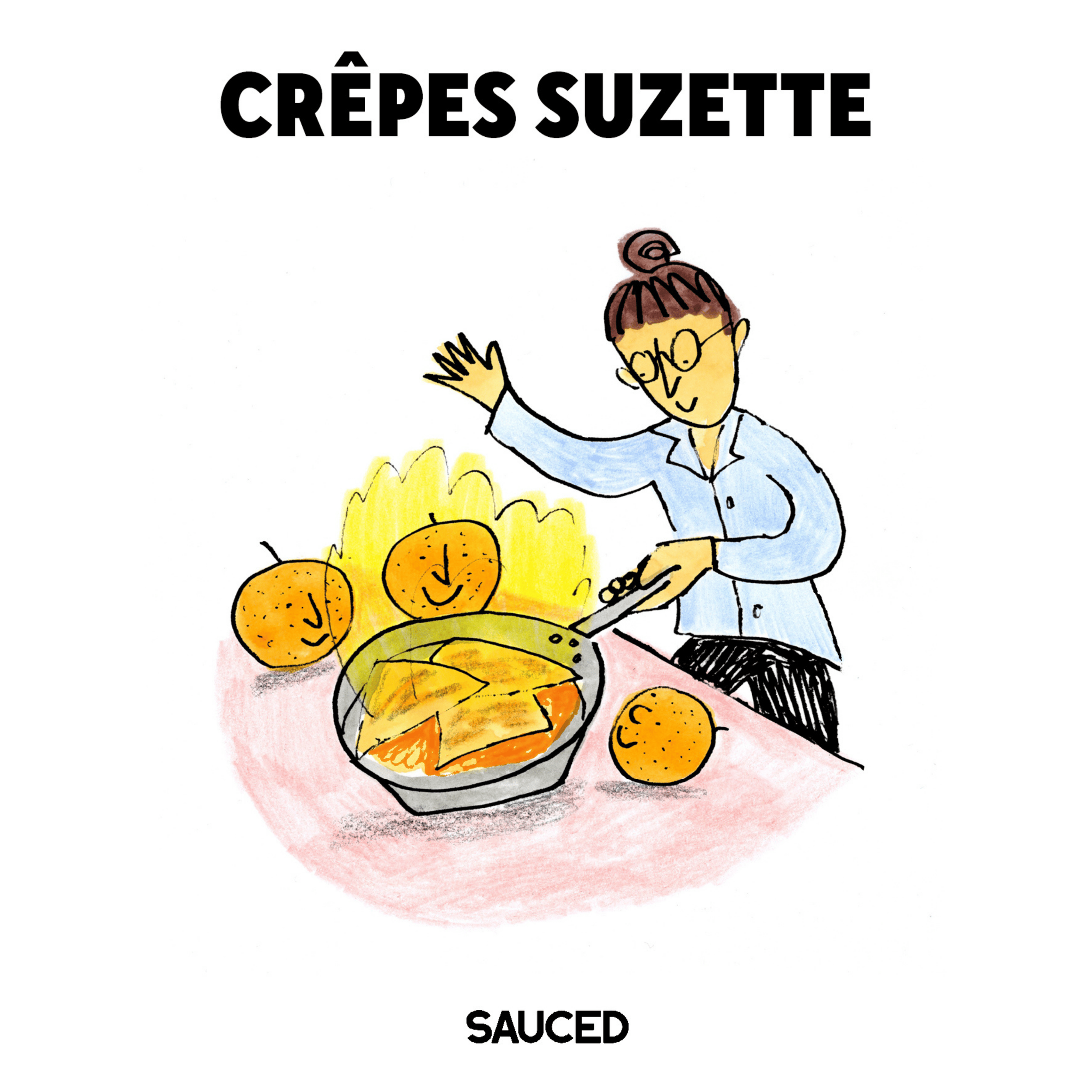
Butter, batter, booze — and a whole lot of theatre.
In this episode, we tackle Crêpes Suzette: the French classic that proves dessert can be a spectacle. Paper-thin pancakes folded into a caramel-orange sauce, doused in Cognac and Grand Marnier, then set ablaze.
It's not just delicious; it's a show. And you must do the show.
What we settled on:
Rest the batter overnight — Julia was right, Jacques was impatient
Add lager to the batter for effervescence, lacy patterns, and browning
Batter should be the consistency of heavy cream — thin and pourable
Get color on your crêpes — they shouldn't look anemic
Both Cognac AND orange liqueur in the sauce — we cook with booze here
Warm your spirits before flambéing for reliable ignition
Dust with castor sugar before the flambé — that flame does double duty
Dim the lights — ethanol burns blue, and you want to see the show
The cocktail:
Sidecar Suzette: Cognac, Grand Marnier, lemon juice, rich Demerara syrup, cardamom bitters. Shake with ice, strain into a coupe. Express and flame orange peel over the glass.
RECIPE CARD:
Premium subscriber? Check out the full recipe card here.
LISTEN
EpiSOde Partners
Thanks to the following brands for partnering with Sauced to bring you this episode:
TRANSCRIPT
Tim McKirdy: Sother, I hope you've polymerized some pans because today's task at hand is cooking some of the thinnest pancakes known to man or women or humankind. It is Crêpes Suzette.
Sother Teague: Oh yeah. Delicious dessert. A lot of fanfare. A big kind of a show. Plenty of techniques to dive into. Let's get cooking.
TM: So, you know, elevator pitch for this dish. What is it? Overview, hinted at it. This is a French preparation. Crêpes, very thin pancakes folded into quarters.
ST: Or rolled up.
TM: Or rolled up. Very true.
ST: Like a cigar.
TM: I think the rolling up is easier.
ST: I think the folding is easier.
TM: You think the folding is easier?
ST: Yeah, I really do.
TM: I think the presentation is better on the roll.
ST: Say why?
TM: Just I like the sort of conical shape of it.
ST: Hmm. I think for me, savory seems to be more of the rolled one. I'm gonna roll up sort of some mushrooms and cream sauce. I'm gonna roll up things like that inside of one. I think the sweet ones for me are folded.
TM: I would do the opposite, but we shall agree to disagree on that one. Finishing the dish, of course it is cooked. And what makes it a great candidate for Sauced here? It's finished in a caramel butter, orange sauce, and then theatrically you'll add some Grand Marnier, or perhaps other Curaçao and maybe even some other alcohol. And then you're gonna flambé, right?
ST: That's right, which is a duality of purpose, right? It's certainly cooking off the alcohol. But it's also, if you're finishing this thing correctly, it'll help caramelize the top of the crêpe. Right. We dust a little castor sugar on top before flambé, then that flame will caramelize that sugar as well. So you're in this caramelly sauce and you got this like almost brûlée situation on top.
TM: So it serves a double purpose there, cooking off the alcohol.
ST: I think the largest purpose that it serves though, frankly, is it's a dynamic show and you gotta wow the crowd. You know, this is right up there with cherry jubilee, something you're gonna do tableside, Bananas Foster. We're gonna — that's another episode.
TM: That's a good point though. And a really important detail when it comes to the origin story or purported origin story. Stories of this dish. Right. Classical French dish. We're talking tableside preparation. Which really just isn't something we see too much of these days in modern times.
ST: Why do you reckon that is? I think it's — I mean, I think I know why it is. It's laborious, so it costs labor dollars. But I think the payoff is worth it. Like it's theatrical. One table orders it, every table's gonna want it. You know, you go down to New Orleans where I used to live and where we go — well, I go frequently for Tales of the Cocktail every year. Tableside services of all manner happen all the time. That's what makes me think of Bananas Foster. That's a very common thing in New Orleans to get tableside and it's dynamic and fun and, you know, it's certainly all the modern things too. It's Instagrammable, there's plenty of photo ops to be taken, but like, it also is delicious.
TM: Yes.
ST: Right? Like it's not just a sizzle, it is also steak.
TM: I think if I were to put a theory out there for why we see this less and less these days. It's because the idea of the kitchen brigade, the kitchen brigade remains true. Right. And is alive and well. Like the way you progress up a kitchen, I would argue that that was more mirrored front of house historically than it is now. Right. Where you would have different stations. And we still use some of those job titles today, but I don't think it exists as much.
ST: The captain, the back waiter. Exactly. And then there would be this position in the front of the house that was — I don't know what a proper name for it would be, but the — you would be the person who would have the guéridon and you would be doing the pulling of the Dover sole tableside. Exactly. It was a, I think a position of prestige, but also, again, I think that position cost money to the house and to the business. And I think it was an easy one to simply erase as capitalism continues to march on.
TM: Totally. And I think we're seeing that even now, like in modern times as well with the sort of — I wouldn't say demise, but I don't think the sommelier profession, for example, is as strong as it was maybe 10 years ago. Agree. You know, now it's servers are expected to have that knowledge, or there's maybe one person on the floor that knows about the wine and they're sort of pooled about for everything during service. But do allow me to pull us back to Crêpes Suzette right here and that origin story.
ST: 1895.
TM: Tell us about this and tell us what you think about it.
ST: Sure. Yeah. Café de Paris in Monte Carlo in 1895. The story that is the most prevalent — and there are several stories, by the way — says that an assistant waiter, right? Again, back when we had a hierarchy of wait staff in the front, named Henri Charpentier, was preparing this dessert. Crêpes didn't have a name yet, for the Prince of Wales, who was the future King Edward VII, and the cordials in the pan accidentally caught fire, flaméing the sauce. Now, I think I hold a little bit of contempt for the word accidentally in all these stories because flaming was a technique that had been around for a long time, even if this was 1895. This was mentioned in Charles Dickens' book, you know, A Christmas Carol in 1843 about setting fire to the Christmas pudding. And then, you know, the Moors were flaming food, you know, even further back than that in the 14th century. So I feel that it's a story that sounds quite touching, but also sounds like a lie. Anyway, the story goes on to say the Prince and future king really enjoyed the dish. There was someone at his table whose name was Suzette. The waiter said, let's name it the Princess Crêpes, and he said, no, let's specifically name it Crêpes Suzette. And so the legacy and lore is born, but again, I think many of these stories are romantic and romanticized and not necessarily the truth. Regardless. Here we are. We have Crêpes Suzette and a fun romantic story to hash out.
TM: I like that. During his naming of the dish, he was talking about — because he later chronicled this in his autobiography, Life à la Henri. So this person apparently later went on to move to America.
ST: I think it's important to note the kid was 14 years old in the original story.
TM: Serving a prince.
ST: Serving the future king. And how old was he when he wrote the book?
TM: Sixteen? Well, you know, people were living shorter back then, so maybe 14 was like, maybe he had like a couple of kids back home and a wife and who knows.
ST: Right?
TM: People certainly — anyway, that is not for us to just speak up.
ST: “You're never gonna believe who I served at lunch today.”
TM: He said, speaking of Crêpes Suzette — and he just told the story in his book and he goes — "Thus was born and baptized this confection, one taste of which I really believe would reform a cannibal into a civilized person."
ST: Wow. That's some big talk from young Henri.
TM: And then he says, just to finish this off, just to round out: "The next day I received a present from the prince. A jeweled ring, a Panama hat and a cane."
ST: Alright. That's three very nice accent pieces to add to your wardrobe.
TM: As a 14-year-old in Monaco.
ST: I'm certain that he at once donned them all at the same time. But then maybe over time he realized the cane goes with this suit, the hat — or maybe the hat goes with this suit. The ring can go with this one.
TM: I'm getting the vibe from Henri that he might have been the person that sort of wore this so that people would ask him, oh my, that's a beautiful hat you're wearing there.
ST: Well, yeah. You know where I got it? I got it from the Prince who gave it to me when I made him this dessert. Would you like one? That is a sales technique. This becomes the sale.
TM: Nice. Good work. Strong work, Henri. That does do for us — it definitively answers one of our recurring questions.
ST: Right? 'Cause this question always is contentious, but I think you're right. This one's answered.
TM: What is the question?
ST: The question is, is this dish for a prince or a pauper? Clearly. It's for a prince.
TM: It's for a prince or a princess. So that's good.
ST: It's for royalty. Well, when we say prince and pauper, we're using it in the terms that we think of in the culinary world as like, is this high or low brow, right? Like, prince or pauper. You serve this to the upper crust, or do you just eat this on a weekend at home? Which by the way, again, going back to the contentious nature of this question, it's still a great dish to just make. I mean, it's just pancakes. Like every Saturday you're making pancakes for the kids, blow their minds and set 'em on fire. Make 'em some Crêpes Suzette. You know what I mean? Like, why in America do we only eat thick, fluffy pancakes or waffles? Crêpes are delicious, you know? And another we didn't mention, there's obviously the rolled and then there's the folded, but I also love the stacks of crêpes, right? We can take a savory or sweet filling and layer crêpes. Literally you have to layer 20 or more tall just to get it a few inches.
TM: Yeah.
ST: But then when you slice it, you have this great striation, you know, almost like a savory or sweet lasagna. Anyway, I digress. It's a prince's dish. We're sticking with prince.
TM: And even if Henri's story isn't true, even if you point to Escoffier, just the places and the names and the people that are involved, the time period that we're talking about, I think that is definitive there. So we could move on. What are our non-negotiables?
ST: I think almost every ingredient is non-negotiable because again, this is the second time we've had a dish that doesn't have a whole lot of ingredients, right? So we are gonna have to have, for our crêpes, we need egg, flour, butter, milk, salt, maybe water. We'll talk about that in the build. But then also maybe, and I didn't find any of the classics using this, but I find that I do it when I make these, some kind of extract, either vanilla or almond. But I guess that means that's not a non-negotiable. I think the other ones are. And then for the sauce, again, sort of non-negotiable, we need plenty of butter. Plenty of sugar. And we can talk about sugar. Is it white sugar, turbinado sugar, brown sugar? I see a use for all of them, but I think classically it's just white castor sugar. And for those who don't know what castor sugar is, that's a finer grind than your sort of regular granulated sugar, but not so fine as powdered sugar. And it just has a more even melt when we're gonna make a sauce like this. Orange juice and I think a little bit of lemon juice to acid adjust that, although that's not classical, so maybe that's not non-negotiable. Curaçao, which is orange liqueur. And that can be something from the Isle of Curaçao, which is in the Caribbean, it's owned by the Dutch. There's a certain fruit there — it's not an orange, it has its own name. That's where Curaçao gets its flavor. But then there's also ones that aren't made down there. And that's, you just mentioned Grand Marnier or Cointreau. Just get some, and you even joked you said you wanna make this with blue Curaçao. Let's go.
TM: You stole one of my non-negotiables.
ST: Oh, is that your non-negotiable? Oh, sorry.
TM: This is a blue Curaçao dish.
ST: Brandy, yes, I think it's a non-negotiable. We need both Curaçao and brandy, although we can look back and see classic recipes. They all have Curaçao; not all of 'em have brandy, but I think it needs both because otherwise it'd be a little too sweet. And I know that this will come up over and over in conversation on the show here. I am not the sweetest tooth, so anything I can do to kind of mitigate some sweetness, I'm probably gonna. Some zest in some form or another we'll talk about. And then I think the most non-negotiable to the whole thing because I think it's the whole point of this dish: fire. Fire has to be involved.
TM: I think there are other things we can look at when it comes to non-negotiables that are not necessarily ingredients. I think it's elements of the dish. And I think one of the most important for me is that the crêpes have to be paper thin. They have to be, you know, A, because you're gonna fold or roll them. But also that's the whole idea of this dish. It's not supposed to be an American pancake.
ST: And I think both of us in our digging around for this dish, were surprised to see that one of our kind of heroes did not at all. In fact, he made a point of how quickly he could make these.
TM: Yes.
ST: Jacques.
TM: Another thing I would mention too, you have to rest the batter. So let's move into it now. Let's move into what do Jacques, Julia, and other culinary luminaries have to say about this dish? Not a bunch of quotable material out there, but certainly as you hinted at there, Jacques Pépin not resting his batter. And Julia absolutely was.
ST: Yeah. So Julia whipped up her batter and then she recommended over and over to let it rest for — and this was all the way back to her show on KQED, The French Chef. But she recommended resting for at least two hours. I always make crêpe batter either using an immersion blender, which is gonna really buzz it up, or a blender. And then I put it in the fridge and let it sit overnight. Right? Because the mechanical manipulation, I've created so much air pockets in there that I want to let it settle. Also, the resting is to help the flour absorb the moisture and hydrate. And so that it's not as tough or sort of chewy. Right. Jacques, I was really shocked. The video that I saw of him, he literally put butter in the pan to start melting and said, I'll have the crêpe batter made by the time the butter melts. And I was like, whoa. He did — flour, water, milk, sugar, eggs. He pours in half the milk and whips. Which I also recommend if you don't — if you're not using a mechanical method — put in half of your liquid and whip that very well, and it'll come together into a smooth, thick paste. And then you can pour in the rest. If you pour in all the liquid at once, you risk having lumps, which are fine again in pancakes and waffles, but not so much in crêpes.
TM: There is an interesting thing about this when it comes to the batter and you've got into it there, so we might as well cover it now. The technique when you're making that — you know what this is, you know what that batter is? It's just a sweet Yorkshire pudding.
ST: Oh yeah. It kind of is.
TM: It's pretty much the exact same thing. The method for making it is the same, right? The ingredients bar sugar are exactly the same. Now, your consistency might be a little bit different. If you're a cheat with your Yorkshire pudding, you might add a little bit of baking powder, but you shouldn't do that if you're doing it properly. You would always make that batter the day before. So Saturday afternoon in the kitchen, you know, in the U.K. we're always gonna have Sunday lunch the next day. You cannot leave the kitchen on Saturday night until you have made that Yorkshire pudding batter. And the same should probably be true of your Crêpes Suzette if you have it on the menu.
ST: So now what you're saying is we're gonna get together and make a video of us doing Crêpes Suzette Yorkie. Like it'd be like a Dutch baby, right? Like we put it in a big wide pan with a healthy amount of, you know, hot fat in the bottom and then poured it in and slammed it into the oven. It would puff.
TM: Yeah.
ST: But we're not looking for a crêpe to puff. But this would do that.
TM: This would do that.
ST: Yeah. You're right, a hundred percent.
TM: So it is interesting when you see that, but yeah, and I think all of the literature that's out there, or all the schooling comes down to mixing half of your liquid ingredients with the solid ones first. Beating out any lumps. And then adding the rest of your ingredients, and you're gonna get that really nice consistency there.
ST: Smooth. Right. It's such an overlooked technique in so many use cases. And I see people failing things and I'm like, you just put in half the liquid first, right? Like, get this emulsion — effectively, you're trying to create sort of an emulsification — get this emulsification happening before you flood it. 'Cause once it's flooded, it's weirdly harder to mix things in. And I think that seems a little bit counterintuitive even to me when I say it out loud, but like it absolutely is better on that front.
TM: And also specific to Julia or something that Julia does that I don't think everyone does, and you certainly don't have to. She makes a compound butter in the food processor with her ingredients that you can use as a sort of base for the sauce.
ST: She whipped it in a mixer with beater blades. So it was like fluffy and she filled her crêpes with it first. So she had the flat crêpe, laid there, put on a healthy — and I mean, Julia was healthy with the butter — put on a healthy layer of that before folding it into quarters and then going into the pan with some of that butter to add sugar, to make a caramel, to add the juice and everything else. So this thing was like just oozing with melted buttery goodness. You know, I'm sure she was using some real high quality French butter. No slouch.
TM: Well, that makes a lot of sense, I think from a restaurant perspective to have that base compound butter for service portioned out.
ST: Yeah.
TM: At home. Probably a step too far.
ST: Yeah, I think so. A little bit, you know, gilding the lily. But also she did mention numerous times make a bunch of it and keep it in your freezer and then it's just on hand. Like, which alludes to the restaurant technique that you just mentioned, but she mentions using it for other things too. You know, put this on biscuits, put this in your buttercream and make a frosting for a cake. Things like that.
TM: Scones would be nice.
ST: For sure. Beautiful. And I think that spoke to the times, you know, and should speak to the times today too. Like, everything you do should have more than one use, you know?
TM: I'd love to see what Julia has knocking around just in her freezer. Like imagine the different compound butters and sauces and stocks.
ST: Well, I mean, you're getting there. You're soon to have a chest freezer in your basement.
TM: If we can find a chest freezer partner for this show, I mean, that is unbelievable. That will take things.
ST: I mean, I have a basement too. I could use one.
TM: Let's get two and we will be whole animal butchery.
ST: Listen. You know, two years ago I bought myself for Christmas a half a pig from a farm nearby. And I absolutely would've bought the whole pig, but I was already thinking like, well, I'm gonna have to put this in the freezer at my bar. Where, you know — anyway, yeah.
TM: Let's not limit myself to half an animal. You know what I mean? What do you do with the other half? We want it. Alright. So that's what the culinary luminaries have to say about this dish. Or how they approach the dish. Now it is time to explore our ingredients for this dish. For Crêpes Suzette. I'm gonna list through them. Nothing too crazy. Nothing too special in this one. All very common ingredients. Yeah. All-purpose flour, eggs, whole milk and butter for the batter. Anything to add to that or anything to elaborate on?
ST: Well, like I said, we can split some of the milk out with water, which seems common in the original recipes, but I don't know if that was just sort of economics at work or what. You know, I would say maybe if you're looking for the lighter version, then don't use whole milk, use — but I think you can get away with just regular, just using milk either way. Even if you use whole milk, it doesn't matter. But we did see that early crêpe recipes often cut the milk with water. And then I would say a little pinch of salt is gonna make — yes, please — you know, that's gonna give some balance to the final dessert in general. And as I mentioned earlier, I like to squeak in a little bit of extract, either vanilla or almond. But again, it's not a hundred percent, it is a negotiable. Right? We're doing non-negotiables before. Now we're talking about a few things that are maybe negotiable.
TM: Yeah. In that vein and in that spirit, I have always, when I've made this dish in restaurants, I've always added a little bit of lager to the batter. A little bit of beer.
ST: Right. And that brings you some, a little effervescence, which is gonna give your crêpe a little, kind of a lacy pattern.
TM: Exactly.
ST: Yeah. Beautiful.
TM: And it's gonna look beautiful in the pan.
ST: Plus there'll be some sugars in the beer that'll help get some browning. 'Cause crêpes cook so quickly, they're often a little bit pale.
TM: That should have been another one of our non-negotiables. The color on the crêpe.
ST: Well, but we're gonna caramelize them regardless. But like, I do believe that many crêpes that I see out in the wild are slightly — and there are a lot of, weirdly enough, in the Lower East Side where I lived for so long in New York, there's plenty of crêpe — like just a little hole in the wall, no bigger than this studio that you just step in and grab a couple crêpes and step out. Right. Like, it's like a slice of pizza. But I would say largely they're not — they don't have enough browning on them. Like, I don't want 'em to be brown like a piece of toast, but they need to not be pale.
TM: And I think that browning, I prefer to come from the pan. I think it's a different browning than caramelization. But both do the trick. You know, you want that color, you just don't want it to look anemic.
ST: That's the word. Yeah. To look healthy.
TM: Maybe a little brown ale instead of your lager, you know, if you wanna bring a bit of yeasty, kind of toasty notes into that. Sure. You're gonna impact the flavor, but it's just a touch. Right. That's not gonna take the full reins of the dish. Then when it comes to our sauce — sorry, just reminding myself here, looking at my notes — butter, sugar, orange zest, orange juice. Orange liqueur. And we are saying also, we are committing to brandy.
ST: I mean, I think the bulk of the recipes we saw that were early used both. So there's a historic reason to do that. And I think, frankly, our show is called Sauced because we cook with booze. So if there's an opportunity to use more than one booze, let's do it. Let's get some beer in the batter, let's get some brandy and some Curaçao, whatever. Let's go.
TM: Absolutely. That's the spirit we like to live in here. And that's all I think we have to say about ingredients. Like we said, very straightforward. We're gonna touch upon everything else in our other segments, so moving swiftly on to technical considerations.
ST: Okay. There's a few.
TM: We've covered everything I think, when it comes to making the batter, but do you wanna talk about the desired consistency?
ST: Yeah. This batter is much thinner than I think the general American home cook is gonna be used to. This is a very pourable batter. It is not thick, it doesn't — you know, it barely has nappe, right? When you dunk a spoon into it, you can make the line on the back and it will hold, but not forever. So it needs to be super pourable. And what that's gonna do is help you then achieve one of the technical goals as well, which is a very thin crêpe. Right. Because if you put too much in the pan, the underside, the side touching the pan will set, but then there'll be too much liquid on top for you to ever flip it. And thus ruining the crêpe, which — you're gonna do — first two crêpes always wind up either in the garbage or in the chef's mouth. Right?
TM: Well, you know, give them to the dogs, I think, is what some folks have said, although I believe one of Jacques or Julia doesn't subscribe to that theory. The consistency. I've seen some folks basically describing as like heavy cream.
ST: Yeah.
TM: Or an extra virgin olive oil. Like that liquidy we're talking about.
ST: Yeah. Yeah. It should look kind of like cream. That's a great one.
TM: And the reason for that, of course, is because then another of our technical considerations here, how do you make them that thin? How do you prepare this dish? We're looking at a very specific technique and ideally a specific pan if you have one.
ST: Yeah. Crêpe pans are basically just big flat discs that have almost no lip whatsoever on the edge. And that's for a couple of reasons. One, because you're gonna make this thin dish in the first place, but two so that whatever tool you're using can easily get to the edge without having to kind of come in through the slope of a pan. But then tertiary, there is a tool which I've never used, I think we can get away without this tool. I think this is just the makers that wanna make you think that this is essential. The crêpe spreader, right? That little thing that looks like you're making a zen garden out of your crêpes. If you've got those gigantic ones that you see on the streets where they're making 'em, it comes in handy. 'Cause you can't pick that thing up and rotate it. But the idea here is to take that thin batter — about, you know, quarter of a cup or so — and then lift your already heated pan. Whether it's a crêpe pan or a regular sauté pan, hopefully well polymerized if it's not non-stick, we'll talk about that on another episode. But well greased, and then — I think conventional wisdom or intuition tells you to put it in the center and then try and swirl it out. I think this is a mistake. What you wanna do is lift the pan at the same time as you then with your other hand, go in on one side of the pan with all of the batter at once, and then kind of tilt the pan so that it can kind of run across. You will do a little tilting back and forth, but you're not then trying to tilt 360 degrees. Right? Which I think results in poor results. Also note this batter is so thin and so easy to work with and so quick to work with that if it spreads down and a couple of holes appear, not a problem. Just dip slightly into your batter and patch those holes and it'll be fine.
TM: Easy as pie.
ST: Easy as making crêpes.
TM: I think something that I've always found useful when making this as well. Especially if you're going for that real, you know, like nice caramelization, that browning of the batter on both sides. Although the second side is always gonna be less than the first, just in terms of the time that it takes to cook it. Right. You're never gonna get as much color.
ST: You'll get a little browning on the first side. When you flip it over, it's almost cooked already, so the second side gets almost nothing. But I love that Julia referred to that side as the non-public side.
TM: Well, that is a consideration when putting everything together.
ST: Yeah.
TM: I like to use a little toothpick though. Just when you're checking the doneness of the crêpe, you know, like of course you can flip it like a pancake or whatever. It's, you know, especially if your pan is a nice non-stick or properly polymerized, but just a toothpick is gonna release that from the bottom. Just let you check and then you can flip it in whichever manner you see fit.
ST: Sure. And I would say, you know, and again, we'll make a video about this, but, you know, crêpes are so delicate and so thin, but when they set, they do have some handleability. And the truth of the matter is we're cooking them at a sort of medium, low temperature. You can get whatever spatula, wooden spoon, whatever you're using under the edge of it, and then literally go in with your second hand and just sort of touch the top as you flip it. You don't have to flip the pan, 'cause they wind up folding or whatever. And you feel like a failure. You can literally go in and if you're even using a larger pan, you can go in with just two hands and kind of grab it real quick and flip it. Right. I'm not advocating for anybody to burn themselves out there, but you — it's not as hot as you think it is. You can do this pretty easily and you can use your hands like a chef does.
TM: We would always — because I've worked, as I mentioned, worked in restaurants where we had this on the menu. The pastry chef would have a specific crêpe non-stick pan.
ST: Oh yeah. Just dedicated pan.
TM: No one else was allowed to use it. Don't touch my crêpe pan. You know the only other section in the kitchen that will have dedicated non-stick pans that no one else was allowed to touch was the fish section.
ST: Yeah, I was literally about to jump in and say that a hundred percent.
TM: So those two, but yeah, stay away from the chef's — the pastry chef's non-stick pan.
ST: Well, because I would — you know, we keep joking about polymerization, but I would say that those pans that you're talking about aren't quote unquote traditional non-stick pans. They are pans that have been seasoned well enough to become non-stick. And if someone gets ahold of your non-stick that you've seasoned over time and weeks and maybe even years, and they, you know, do some damage to it, then you've gotta start over.
TM: So I would always — and again, this moves us onto our next technical consideration — I would always do the sauce in the final preparation in a different pan than the crêpe pan.
ST: Oh yeah. Holy cow. Yeah, yeah. Of course. That wasn't even on my radar. Yeah. I mean, that's why they make specific crêpe pans. 'Cause you really can't use 'em for anything else. If you put anything else on there, it's got no sides. It'll just keep on going. You know?
TM: And I don't want the crossover of fish and crêpes unless we are of course, making savory ones. But that's not what is on the menu today.
ST: Not today. Different show.
TM: Different episode for us. When we are moving into that sauce. So I'm gonna start my sauce, right. I'm gonna get a — I'm either gonna use that compound butter if we've gone to the trouble of making some, or just standard butter and sugar at the same time. We're starting this, this is a caramel sauce. We are gonna add to that our citrus juice.
ST: Well, yeah, but we gotta get that caramel happening first, right?
TM: Yes, of course.
ST: Just 'cause you threw those in.
TM: Oh yeah, of course. I mean, I was allowing for some, you know, some time to pass there. I'm just rocking through this so that we can get to the point. In the next consideration, which is —
ST: Yeah.
TM: Flambé.
ST: Must happen.
TM: Has to happen. How do you do it safely?
ST: Safely. Okay. So ideally for a no failure at launch, you're gonna have your spirits warm already, right? So let's get those in a small saucepan of their own on a very low heat. I'm not trying to boil this by any means, and don't forget alcohol boils at a much lower temperature. I just wanna get 'em warm that way. They definitely, definitely, definitely will ignite. Once you've got your caramel going, you can go in with that liquid. You wanna stand back, especially if you're using an actual gas flame. You wanna stand back from the pan a little bit and pull it towards you and then tilt it slightly forward so that the vapors from that — the volatility of the alcohol can catch the flame and it'll burst into flame. If you're using electric or induction or whatever, you want to go in with a lengthy stick lighter, you know, like you light your grill with, or a long wooden match so that again, you're further away. This is just safety concerns. And you want to ignite the flame by using one of those methods. And then you wanna let it burn until the flame goes away. Right? You're not — it'll take a minute, but that's fine. But you don't wanna extinguish it before it needs to be extinguished. 'Cause then your final result will be a little boozy.
TM: This is a dish that I would advocate —
ST: Not that I'm against the boozy, but this is not what the dish is looking to do.
TM: Well, you're looking to taste the flavors of the alcohol, but not ethanol.
ST: Yeah.
TM: And there is a distinction there.
ST: A hundred percent.
TM: That's why we dilute our cocktails and whatnot. This is a dish that I would advocate buying a burner for, you know, like a blowtorch.
ST: Oh, sure.
TM: I think it's gonna be your friend. It's gonna make that flambé safer. Although there is — it is nice when you do lift up the pan and you do the flambé that way. But I think this is gonna be safer, especially if we're advising folks on how to make this. And then to your other point that we keep getting back to, you know, we're gonna dust those crêpes when they're in the pan, when they're already lathered in sauce, we're gonna dust them. And you want to caramelize that. You wanna brûlée it.
ST: Mm-hmm.
TM: The blowtorch is gonna be your friend in that scenario.
ST: You're right. And I think, again, if you're a listener of this show, you should probably have a torch in your kitchen. They're ludicrously inexpensive. And I would also go further and say, I do not recommend purchasing the little ones that they sell at gourmet shops. You know, the one that looks like a tiny little pistol. They cost about 30 bucks. They have that weird canister inside them. That's hard to find. When you can just get one at your hardware store. It's gonna be taller, a little bit more clunky, but it costs like 17 bucks. And the propane tank that it connects to will probably last the home cook literally years before running out. And they cost, you know, another 17 bucks. So you're gonna spend the same amount of money, about 30 bucks, and you're gonna have a product that's far superior. Also, those little ones, when you're trying to do a crème brûlée at home with that little guy, it may as well be using a lighter. It's so frustrating.
TM: This does remind me of a little bit of a sidebar here, but when we were hosting an event together, you were bartending, you asked me for a blowtorch, and this was at the VinePair office. The one we had was definitely more of those like craft ones, the more expensive.
ST: Goofy.
TM: It had this safety valve on it that made it so difficult to light anything. I forget what the garnish was. A smoked herb or something.
ST: Yeah, I think I was — who knows what I was doing.
TM: But he lost his patience, listener. Let me tell you — didn't lose his patience, but this is the closest I've ever seen Sother Teague to getting mad. It was that terrible blowtorch. So go out there.
ST: Listen, I'm on record in numerous outlets as saying I have no fear whatsoever of hard work. I do not like unnecessarily hard work. That was unnecessary. And it was a busy event, and there were lots of people there. And the torch was failing me.
TM: The torch was failing us all. Yeah. I gotta go out, I gotta get myself over to Ace Hardware and pick one up for myself.
ST: Yeah. Go to your local hardware store and get a hand torch and then this is a great thing. You know, it'll help you light your grill faster. It'll help you brûlée things faster. It'll help you in scenarios like this. Yeah.
TM: And so at what point do we know this dish is done? Because I look — between everything we've done already, we've covered the ingredients, we've covered the preparation through various things. At what point do folks know this dish is done?
ST: Well. So your sauce should be nice and thick and caramelized, and frankly, I think it should be pretty brown. You know, many of the videos that I watched for the past few days and a week or so getting ready for this episode, the caramel sauce didn't look caramelly enough to me. It looked like they had just sort of dissolved sugar and butter and then hit it with orange juice and booze and lit it up. So I think you should get a — not deep, deep caramel before adding the juice, but get a nice caramel of butter and sugar. Then in goes the juice.
TM: So they're in at the same time. They're coloring, you're mixing them. It's gonna start almost foaming.
ST: Foaming and bubbling. And what's happening is the sugar is caramelizing, turning brown. The butter is turning brown, so you get a little brown butter situation happening too. Then in goes the juice and that will stop that, or at least arrest that caramelization process because now you've got this influx of liquid. 'Cause don't forget, you know, so far you've got sugar and fat with a very small amount of water that's been bubbled out. That's what that foam is. So then that juice goes in to kind of arrest that caramelization process, but we're gonna reduce that some, so we get that nice consistency. And then in goes the booze — well before the booze though, your folded crêpes go back in the pan and like, I like to lay the whole crêpe down round, with the non-public side facing up. I loved that she said that. It was so great. So the paler side should face you when it goes down fully round and then with tongs or your spatula, fold it in half and then fold that in half again. And then lay the next one in there and there'll be enough room to kind of jostle it in there and then fold it in half and half again and lay it on top, you know, shingle it on top of the first one and do that and do that. So now we're getting the full coating on the outside. We're shingling them in there. Then in comes a dusting of sugar across the top. And again, you're not looking to get the full face of each one. They're shingled at this point.
TM: This isn't a crème brûlée, it's just a dusting.
ST: Yeah. But also, I'm just saying you don't have to cover the full surface of each one. 'Cause they're overlapping. So you're just gonna cover what's visible and then in goes the booze. Gently ignite, it will burn. The burn from that booze will caramelize that sugar on top. So now you've got a nice caramelly, rich buttery sauce, flavored with orange underneath. And then on top you've got a caramelized sugary top.
TM: And that is the classic Crêpes Suzette.
ST: Yeah.
TM: We're gonna make a few small tweaks and additions here today at Sauced.
ST: I think so.
TM: I, over the years, have become a huge fan of orange and cardamom as a pairing combination. It works so well. Countless places where I've worked and we've had orange and cardamom ice cream. Little hint there for you. But I'm gonna use some cardamom in that sauce originally. I just think that's gonna really bring a pop of a different type of flavor. Right. We've got our fruit, we've got our sweetness, we've got our fat. This is gonna bring us another dimension and it's really gonna spice things up.
ST: How are you planning to get it in there? And if you don't mind, I've got a suggestion.
TM: Gonna toast my cardamom pods.
ST: Okay.
TM: Just lightly. And then, well, you know, grind up the actual seeds that come out of those very, very, very fine. And a little is gonna go a really long way. And I'm just gonna add that sort of — less than, you know, using those small, like half a teaspoon measurements or whatever. So I'm just gonna use a little bit while we're finding the consistency.
ST: I love it. I would suggest, and I love this idea, by the way, I love the flavor of orange and cardamom too. I would suggest a couple of dashes of cardamom bitters right into your spirits before putting the spirits into the pan.
TM: That's good. Although I might reserve that ingredient for later. Who knows? Maybe just planting something there. I see — I know that both of us want orange or some kind of orange relative segment in the sauce. Probably at the end. So you're not destroying it with the heat or whatever. But I think you have some other thoughts when it comes to how you can incorporate orange into the sauce.
ST: Yeah, for sure. I think we're gonna take an orange and peel the skin off of it, and I'm gonna julienne that and then blanch it a couple of times in some simple syrup. Basically candying the zest. And I'm gonna add that into my sauce as we're making the sauce before the crêpes go in. Just again to add a layer of both orange flavor, but also texture.
TM: Yep.
ST: Conversely, I would do the same with maybe a clementine or a little mandarin. Just slice it. You know, they're pretty small size, like a golf ball. Really just slice it and have rounds of that, which I wouldn't need to candy in the sugar. Which will add, again, another layer of orange with orange flesh and orange skin. A little bit bitter. That's delightful as well. But then, if I have those segments from the previous orange, those are gonna go in. Once I've flamed everything and as the flames are dying, sort of the side of the pan that I've got just some caramel sauce in, I'm gonna throw those segments in, because I don't want them cooking and falling apart.
TM: Yes.
ST: And then as I plate, I'm gonna then ladle those over the top, along with some of that zest too. And this is really just to bring some texture to the party, because don't forget, crêpes are as thin as a paper napkin. And now they're drenched in this caramelly sugary situation. It's very — this is a soft dish, and we haven't talked at all about what we would serve with it yet, but probably anything you're gonna serve with it's gonna be soft too. So those bits of orange zest or slices of clementines or mandarins, and then those bits of segments are gonna just give some palate confusion as far as texture goes.
TM: Fantastic. And that's a way — it's a couple of different ways in which we're imprinting the Sauced thumbprint on this dish. We're gonna take a quick break now, and then we're gonna get into those side pairings.
ST: Yeah, let's go. We are just about to talk about what we would serve with our Crêpes Suzette.
TM: Very nice. That's a good reminder. I myself am pretty simple for this one, so I'm gonna give you my preference and then I'm gonna hear what you have for us here.
ST: Sure.
TM: And I already mentioned it, right? Orange and cardamom ice cream or ice cream of some variety. But I do think just doubling down on the components of this dish, of the flavors of this dish. And I just think that frozen crème anglaise, I should say, is just the perfect accompaniment to this dish.
ST: Yeah, I don't disagree. I would say like a really vanilla-heavy vanilla bean ice cream, very French style, super creamy and rich would be a great accompaniment to this. I love the idea of cardamom in there as well. But for me, I go a little off the path and I say crème fraîche or — this is a little bit of a curveball — sour cream.
TM: Yeah.
ST: Mixed in a bowl with a heavy dose of powdered sugar and again, either vanilla or almond extract, and then just a quenelle of that right on top.
TM: Beautiful.
ST: And I like the crème fraîche and or sour cream or a blend of the two. Because again, I'm always trying to click down the sweetness on desserts a little. 'Cause I just don't have the biggest sweet tooth. This is a way to say, like, I still want that creamy mouth coating quality, but I want it to maybe be a little bit tart or a little bit savory. Not as sweet as ice cream. And now even as I'm saying it out loud, I could fold like 50-50 crème fraîche and Greek yogurt with some vanilla or almond extract in there. And then, yeah, that'd be great.
TM: Sounds absolutely delicious. Crème fraîche, I think, really undervalued ingredient when it comes to desserts.
ST: In America, crème fraîche is undervalued just over the board. I don't think we reach for it nearly as much as it's reached for in European cooking. And I just don't know why. It's super delicious. It brings a quality to dishes that is quite unique and it's available and it's also easy to make yourself. I just don't know why we don't get into it here.
TM: You know, it's really hard to find in the supermarket as well.
ST: In your average supermarket.
TM: Just because they don't — or a lot of places generally won't carry it.
ST: Yeah. In your average supermarket, but I think in your sort of finer stores, you know, I've seen it definitely at Whole Foods and like I shop at a place called Lincoln Market and there's a place called Union Market here in the city. And they have it. But like, you definitely gotta look for it — it's over in the dairy section. But it's not common.
TM: Whole Foods — or as you like to call it, Whole Paycheck Foods. Place is pretty expensive, isn't it?
ST: Yes.
TM: I know, I know. I hear you. But I'll say this, right? I will say, one more string to the crème fraîche garnish bow that you are describing here. This isn't a dish that's that attractive a dessert, right? As desserts go. So I think that quenelle that you were talking about will add a nice classical flair to the presentation.
ST: Yeah. The dish comes out to be kind of like syrupy and brown. Kind of overwhelmingly — with the chunks of, if we've used the segments of orange or blood orange or whatever, those are in there, but they've — they're coated in that same syrup. So is the zest. It's all coated together. So yeah, this nice bright white contrast of a scoop of ice cream or crème fraîche, sour cream, yogurt, whichever one you wanna go with. Yeah. That's gonna give it a little bit of like eye appeal. But don't forget, this dish for me, really, really, really — it's first of all, it is delicious and a lot of things that are ugly are delicious — but it's also, it's show. Like, you must do the show. And one of the things I forgot to mention in the flambé part: turn the lights down. We all have dimmers on our lights. Bring the lights down if you're making this dish at home. 'Cause you want that fire to be part of the show. I'm not saying turn 'em off, I don't wanna be sitting in the dark while this happens. But bring the lights down to a level where we're gonna really see that blue flame popping up. 'Cause ethanol burns blue, so it's not gonna be as bright like an orange flame, like when you're sautéing something and the flame comes up. But this dish is a show. This is entertainment. This is, you know, you're getting just as much value for the dollar out of this dish from the entertainment of it as from the flavor and taste of it.
TM: Fantastic. Well, that's what we're serving it with on the plate. Now, how about what's going in that glass side by side? Let's kick off with wine.
ST: Yeah. You got some wine recs. I know you do.
TM: I got some wine recs.
ST: Here for us. I have one.
TM: What's yours?
ST: You know, I don't think it's a real surprise for me, but if I'm having a dessert like this, I want something bubbly. I'm thinking Champagne, but maybe on the sweeter side. I'm thinking possibly even a rosé Champagne.
TM: Ooh.
ST: And then I'm also thinking — and, you know, staying in France, since it's French — but I'm also thinking Crémant, which is kind of the only sparkling wine that I really love. I mean, you know, you're the wine guy for sure. I'll concede to you. But when I'm — if I'm reaching for sparkling wine, I'm probably — if I come to your house for a party and you tell me to bring sparkling, I'm probably bringing Crémant. Right. They're more economical and they're just as good as Champagne. And it's a hill I'll die on.
TM: Fantastic. No, I love all of those. I'm so with you there in the sort of demi-sec camp when it comes to Champagne or any classically made sparkling wine. I just think that this really benefits from that sugar content and all desserts will, right. You know, if the dessert — the Brix of the dessert is higher than the liquid in your glass, there's a chance that that pairing just really is not going to work and that glass, those sips that you have side by side with it, are gonna feel really disjointed. So I'm totally with you there. You know, this is a prince's dish, so let's go for —
ST: Let's get it.
TM: Demi-sec Champagne. The other one —
ST: And let's make a show of that too. Let's open that Champagne. Let's, you know, make a spectacle of that. Hey, let's saber the thing. Let's go.
TM: Let's saber it. And let's — I heard someone else saying this recently on a podcast, and I think it's so true. Gotta give him credit. Actually, Jeffrey Morgenthaler was talking about this on a show I listened to recently, and he was talking about, you know, the classic — the way you're taught as a sommelier or as a wine professional, the way you're taught to open up a bottle of Champagne is just a little hiss, you know, really softly.
ST: The French say it should sound like a nun's fart.
TM: Yes. I disagree. If I'm spending my money on Champagne, I want the world to know that I have forked out on some expensive wine. I wanna hear it pop. I want that celebratory moment.
ST: Yeah. But I think — and you know what, I'm of two camps on this one.
TM: Well, this is the guy that said he's gonna saber it. So —
ST: That's why I say I'm of two camps on this one. The problem with the celebratory pop is that usually means an attack of Champagne that gets lost because there's gonna be some spewing outta the bottle. I'm not so into that side of it if I'm spending the money. But then I am the guy who loves to saber because it's a spectacle and it's fun and it's super easy to do. And I will make a video of us doing that and we'll teach you guys how to saber. It's so easy. Sabrage. The art of sabrage. So I do like that. But usually I reserve that for, you know, lesser pricey bottles.
TM: I think if you're —
ST: 'Cause we're gonna lose a little, and even if I'm losing an ounce, like if I spend a lot of money, that's an ounce.
TM: Yes. Speaking of lesser pricey bottles or the like — if you are diving into the world of sabering and sabrage, make sure it is that same type, exact same type of bottle that's used for Champagne that can withstand those higher pressures of the wine inside, because that's the safest one when it comes to this technique.
ST: Yeah.
TM: The popping though. The colder the wine is, the less you're gonna lose on anything. So I think that's just truth. Get it really cold, you're gonna lose less wine. It's gonna be worth it. Have that glass, have that flute on hand so you can catch it straight away. Make that pop. The only other style of wine even that I'm really gonna consider for this, and I am gonna consider it quite seriously, would be sweet wines. Specifically, I'm thinking beyond a late harvest. I'm thinking a noble rot wine. So we're either looking at Sauternes, Tokaji, you know, Aszú wine I've had before. You know, something you serve on a spoon. It's so rich and decadent, that's gonna go great with this. And those wines and Champagne as well, all benefit from having this penetrating acidity that's gonna carry everything through. That means that things aren't gonna feel flabby at the end of the day.
ST: I would throw — you know, as you've been talking, I thought to myself like, what about a nice Malmsey Madeira? Gonna achieve that Brix, I think, and it's also gonna — it'll pair well with the caramelly notes, I think, going on in this dish.
TM: The nuttiness of it. Yeah, for sure. Yeah, I think that's fantastic.
ST: Because also, you know, speaking of nuttiness, you know, we didn't mention it earlier, but in Julia's recipe, on that very first episode that she did of the show with Crêpes Suzette, she incorporated — she kept calling it almond flour, which I guess that's true, but she was making it herself, meaning she was taking blanched almonds and pulsing them in her blender. And she was folding that into that compound butter. So she was adding this almond flavor, this nuttiness.
TM: Nice.
ST: Right. So I think that would — if you're considering something like that — but again, I keep saying like either vanilla or almond extract in this dish is gonna bring just a note of nuttiness without being a nutty dessert. You know, without being peanut butter. That might pair with something like that. What about a cocktail, Tim?
TM: I got a cocktail for us today.
ST: Let's go.
TM: The rare occasion. But I was thinking about this. I was thinking, what is this dish? What do you have with it? What is the identity of Crêpes Suzette? And basically it's a Sidecar, right? A classic sour, classic daisy in the cocktail realm. You're looking at Cognac and you're looking at Grand Marnier, Cointreau, orange liqueur, essentially, right? Lemon juice and sugar. All of those ingredients are in the dish.
ST: Yeah. They really are. What if we went a step further and made this drink into a royale? And for the listener, a royale in the cocktail world is when we finish a drink with sparkling wine, which we just talked about. But what if we made this sort of like a hybrid of the French 75 and the Sidecar? The French 75 Car.
TM: Well, we need a name for it. So I'm good with that. I like the idea.
ST: We're gonna let the audience name our drinks from now on, I think.
TM: We've both been thinking about some ways in which we can adapt this cocktail to make it a custom cocktail for the show. But also even more apt for Crêpes Suzette.
ST: Yeah.
TM: So, first of all, my thinking here — actually, I wanna give my recipe. When it comes to a Sidecar, classically, I'm gonna go for two ounces of Cognac. Usually a younger VS or VSOP. I'm gonna go for three quarters of an ounce of our preferred orange liqueur. I'm gonna go for three quarters of an ounce of lemon juice. And crucially, and I think this really is where you find the balance in a Sidecar, I'm gonna go for one teaspoon of rich Demerara syrup. So two parts Demerara sugar, one part water. I think that you need that sweetness to tie everything together. So I'm gonna continue to do that. I'm gonna do that across the board here. I'm probably gonna go Cointreau or Grand Marnier, just because we're keeping it French.
ST: Why not?
TM: You don't wanna use blue Curaçao from the Isle of Curaçao?
ST: Also, why did blue get the color? That thing already is named a color. I made, I got a new thing. It's called orange, but I made it blue. And then they became like crazy famous for it.
TM: That's a good point. I'm gonna reserve the blue Curaçao for the dish instead of the cocktail here.
ST: All right, we're gonna make blue Suzettes.
TM: Cardamom. I snuck it in there earlier. We teased it earlier. Cardamom. I'm gonna go two dashes of cardamom bitters, because the only way to misuse bitters —
SM: Is to not use bitters!
TM: So that's another flavor we can incorporate into this. I love it. My final thing here, if we really want to geek out. I haven't tried this, but I know it works on paper. If we really want to commit to the bit, rather than using lemon juice, I'm gonna use orange juice that I'm then going to acid adjust.
ST: Okay.
TM: To the pH of lemon juice. Mainly using citric, little bit of malic maybe just to sort of give us some of that, sort of more of a limey direction.
ST: So that's citric and malic acids, right?
TM: Yes. Powders.
ST: Which you can get from the Modernist Pantry or what have you.
TM: Exactly. You can look up — there are plenty of resources online when it comes to acid adjusting and turning your orange into lemon. But you could do that if you want to commit to the bit. Or — given that this is a Sidecar — I wanna get your take on the sugared rim debate and how you would tackle that for this version.
ST: Yeah. I think, again, if you wanna really, really hit it squarely on the nose as a pairing for this dessert, I think it would be prudent to maybe put some lemon zest into some castor sugar. Maybe even a little bit of those cardamom toasted seeds that you pulverized into that same sugar. Rim the glass with that. And then that torch that I told everyone to go buy, just gently, lightly tap the flame against it until it starts to slightly caramelize on the glass. So now you've got caramelized sugar on the glass, the caramelized sugar in your dish, the orange, the cardamom, the Curaçao, the Cognac — like all the pieces are kind of going back and forth from the liquid to the plate.
TM: I love it.
ST: And I think it's a great little way to elevate the drink in a way also — the acid adjusting. Not a very difficult technique, but one that is very commonly used in bars, but not so much I think at home. But these are two really great ways to elevate the thing without having to be like a nerdy cocktail guy. Like you and I kind of are. But like, I think even me, as nerdy as I am in the places that I've worked, I still lean towards the — can the average person do that? Do you want to? And these are pretty easy things to tackle. Like acid adjustment is so easy. I think the listener should invest in some citric and malic acids and then Google around and find some research where you can figure out how much you need to balance out — to make things like pineapple juice as tart as lime juice, to make orange juice as tart as lime juice. And you'll find that you'll use those things more and they'll be much more powerful in your cocktails. And your friends will be like, how did you make this so good? And you're like, hey, it's — you know, like, why is your piña colada so much better than mine? It's like, well, I acid adjusted the pineapple juice.
TM: Wait till you've had a Margarita made with acid-adjusted pineapple juice to the profile of lime. Oh my God. It is so good. Final thought. 'Cause the sugar rim is a de facto garnish.
ST: Mm-hmm.
TM: I don't really want a garnish on this drink. If I'm not going to all of that effort. One of the things I might do and to preserve the spirit of flambé, I'm going to express an orange —
ST: I knew where you were going.
TM: I'm gonna flame an orange peel onto this because apparently I'm stuck in 2005.
ST: Listen, I teach a class at the bar often. And that's always one of the techniques I show. Just to show people how aroma changes the flavor of things and how flaming a twist will add a dimension of aroma to a drink that will change its flavor and how simple it is to do. So simple. And it's — you got it on hand at all times, really.
TM: Fantastic. Well, that has been —
ST: We have one more thing to say.
TM: Yeah.
ST: Tim, question I wanna ask that you asked me. I'm gonna ask you. What is the listener missing out on if they don't make this dish at least once in their life?
TM: I was thinking quite hard about this because, if I'm putting both hands up and being completely honest, I think this is a dish that can be a little bit intimidating. Especially when it comes to making the crêpes. I think everything else — but there's a lot of things where if you are doing it for the first time — the caramel sauce — there's the whole flambé. I think —
ST: I think making caramel's a little intimidating for the home cook for sure. I think the crêpe part, I don't think, is that intimidating 'cause, of course, what's your loss ratio here? You might lose a cup of flour and couple of eggs and some butter and milk. Like, it's worth it.
TM: No, but I think I've seen — well, I did watch a few YouTube videos of people making this for the first time and the sort of fear when it comes to making those crêpes was a little bit palpable. But I, again, I get it. I'm the one putting my hand up and saying this. But beyond that, beyond overcoming those fears or learning those techniques, when you do master crêpes, this is a technique and that is an ingredient that you can then use in so many different ways. As you've mentioned, it can be sweet, it can be savory, there can be different fillings. And I think if you don't master crêpes — and it is easy to master, even if it's a little bit intimidating — once you master those techniques, you can take it in a bunch of different directions. I'd love to get your take on that.
ST: Well, I would like to say I agree, but I think the more intimidating part for the consumer, the regular home cook, our listener, is the caramel, because caramel, you know, we've all been told like, oh, it burns really quickly. It can burn you pretty badly. Like, I get it. But if you're a conscientious cook and you're paying attention and you're being concerted about your efforts, I think it's an easily attacked thing to do. And then the crêpe part, yeah, for me, it's all about versatility. I don't like doing things that only have kind of one use or one place. There are of course some things out there that are gonna be that no matter what, but like, if I'm making something, I wanna make sure that I can make it maybe en masse and then I can use it in different ways for several days. So, like, you're gonna make crêpes, you wanna learn how to get good at them, make a lot of them. So make a batch where you can make 50 or a hundred, and then eat the ones you eat. And then guess what, put a piece of wax paper between each one and freeze 'em in a zip-top bag. And then there you have crêpes on demand. And because they're so thin, they thaw out near instantly. Right. And they come back really well. Like, if you've ever frozen waffles or pancakes at your house, those are things that really do well going into and out of the freezer. So I think — the question is, what are you missing out on? If you don't make this dish at least once in your life, you're missing out on, again, a stack of techniques that are only gonna build your arsenal, that'll make you a better kitchen warrior.
TM: And versatile ingredient.
ST: Yeah. Yeah.
TM: Hit us with it before we finish.
ST: Hit you with what?
TM: There's a place in New York utilizing crêpes in an unexpected way.
ST: Oh yeah. There's a place in New York that uses crêpes in a very certain and special way, and that is Nom Wah Tea Parlor down in Chinatown. If you didn't know this, and I didn't when I moved to New York and I went there for the first time, it was an enlightening moment. The crêpe is the original egg roll wrapper. So they're much larger at Nom Wah Tea Parlor. And then they roll all the cabbage and whatever is going on, you want the shrimp one or the pork one, or the shrimp and pork one. And all the carrots and everything else go inside of a crêpe that gets rolled up nice and tight, pinned with toothpicks. And then deep fried. That is the original egg roll wrapper. They claim that they're the first to have done it. And then it became that crackly wonton sort of thing that is more known everywhere. But Nom Wah down in Chinatown claims that the original egg roll is crêpe wrapped. Delicious.
TM: As a Scotsman, I'm sort of duty bound to try every deep-fried thing possible.
ST: Every deep-fried thing on the planet.
TM: Exactly.
ST: Listen, it's like this crazy chimichanga, crêpe-wrapped chimichanga crossover. Who knows? But it is — and they're delicious.
TM: Gotta get down there for that myself.
ST: Thanks for reminding me. I did wanna mention that on the show, and they are delicious. And I don't — you know, we are not sponsored by Nom Wah, but like, go to Nom Wah.
TM: You would've woken up in a cold sweat tonight.
ST: I know.
TM: Just like, oh no.
ST: I will mention it in the video. That's — it's a great thing. We have a lot of ways to reach the audience.
TM: Well, so that has been, finally, Crêpes Suzette. Yeah. I was definitely not gonna forget that, but I'm glad you led us with that one today. Before we go —
ST: Mm-hmm.
TM: Just a few words on Sauced premium subscriptions here today for the listeners.
ST: Yeah. Do it.
TM: $7 a month.
ST: That's a steal at twice the price.
TM: You're gonna get a discount if you decide to pay for the whole year upfront. If you're forward thinking like that, which is great. And what are you gonna get for your money?
ST: Cheaper. Buy the dozen.
TM: Exactly. Well, the listeners are gonna get here for their money: recipe cards for every single dish and drink that we cover on this show with our preferred proportions and techniques. You know, we're never gonna list ingredient quantities. It doesn't make for good radio, does it?
ST: No, no. I'd have to try and stop it and listen and write it down and pause. Write it down. Rewind. And no, no, no, no. Just listen to the show. Enjoy it, take in the information and then go back and check out your recipe card to guide you through the kitchen.
TM: The fact that we're making these as well does mean that it affords us the opportunity to pay a real person, a wonderful U.K.-based designer. Charlotte makes these hand-designed recipe cards, and those are wonderful. So you go over there, check 'em out. You'll also get bonus episodes.
ST: Yeah.
TM: Access to live events.
ST: Yes. Fun.
TM: So if you haven't done so already, folks, consider a premium subscription with Sauced today. And until next time, Sother, time to put on the apron.
ST: Break out the shaker.
TM: And let's get cooking.
ST: And drinking.
TM: Cheers.
ST: Cheers, guys.