Episode 25:
PAELLA
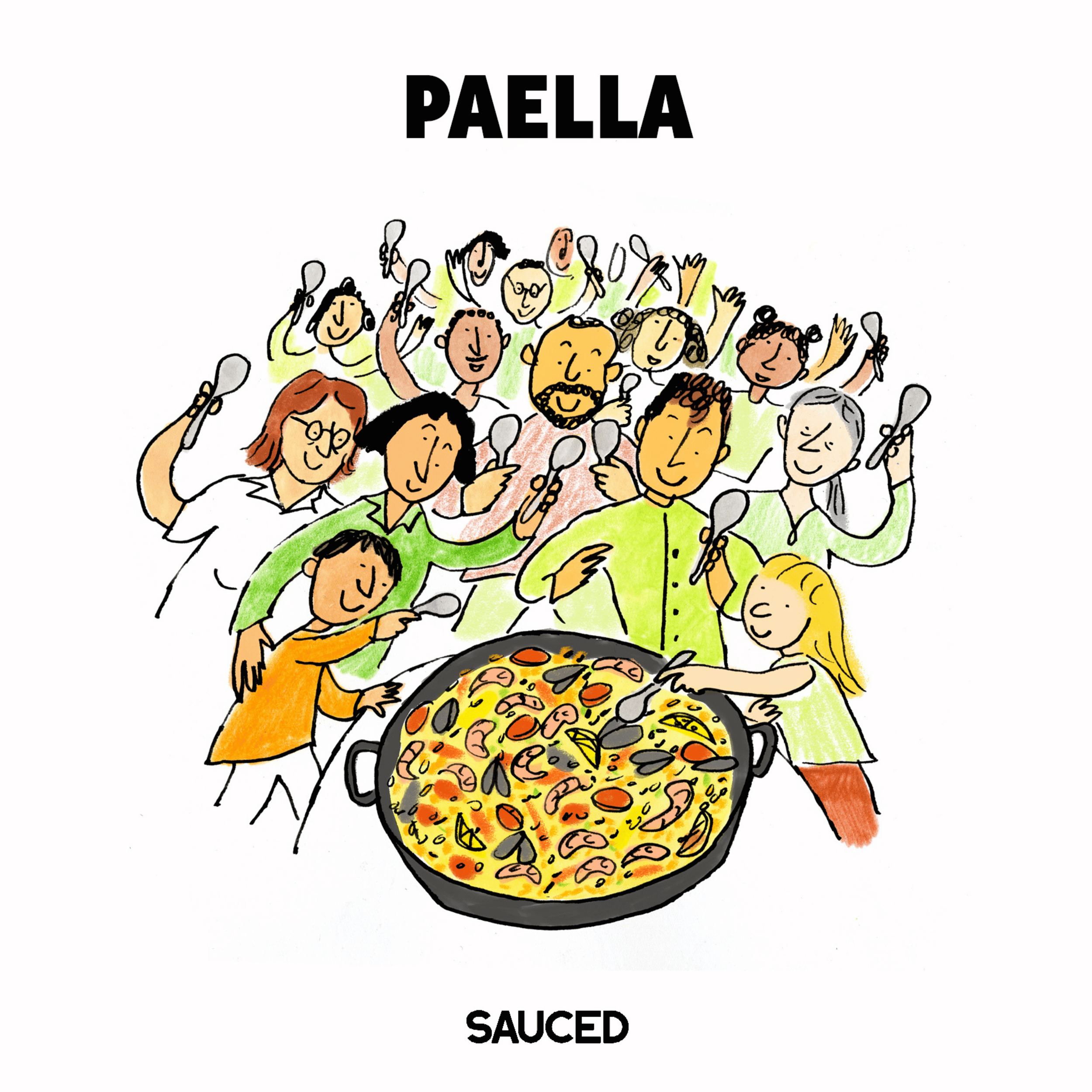
Paella isn't the rice — it's the pan. Or at least, that's where the name comes from. And in Valencia, where the dish was born, there's even a body that certifies which versions have earned the name and declares the rest "crimes against rice." Yet the seafood paella the whole world orders? The purists barely count it.
We get into the authenticity war, the official ten-ingredient list, why a whole category gets written off as "rice with stuff," the one ingredient that starts fights, and how a field worker's lunch became a prince's dish.
"We drink, we watch, we smell, we celebrate, and we let the fire do its work."
What we settled on:
Bomba rice, about 3 parts liquid to 1 part rice
Saffron, bloomed in hot stock
Dry Fino Sherry to deglaze the pan and bloom the saffron
A wide, shallow carbon-steel pan over the grill
Sofrito of grated tomato, garlic, and Andalusian olive oil with pimentón
Prawns, mussels, clams, squid, and halibut, with a quick shrimp-shell stock
No stirring once the liquid is in — that's how you get the socarrat
The Cocktail:
Tonic con Cosas — a low-ABV cooler of Manzanilla Sherry, dry Spanish vermouth, citrus, and tonic, finished with a rosemary sprig.
RECIPE CARD:
Premium subscriber? Check out the full recipe card here.
LISTEN
EpiSOde Partners
Thanks to the following brands for partnering with Sauced to bring you this episode:
TRANSCRIPT
Tim McKirdy: Sother. Paella. What is the first thing you think about when you think about today's dish?
Sother Teague: The first thing I think about is rice. It's a rice dish. I think the immediate second thing I think about is saffron. It's saffron and rice, right? And then there's plenty of argument, debate, discussion out there about what goes in this rice, and that's what we're gonna get into.
TM: And just association in terms of something to eat. It's a really iconic one, isn't it?
ST: Oh, man. I think there's plenty of evidence out there that says all of the great chefs, especially from Spain, deem this — this is the dish. The elevator pitch on this is saffron-scented rice. Paella is Spain's iconic dish, cooked in a wide, shallow pan, which is where the name itself comes from. The pan is the paella, right? Or all those different pronunciations you used. Where the rice itself — not the seafood, meat, or vegetables that may or may not be involved — is the true star.
TM: First Spanish dish for us here today. Feeling good about that? And something we will explore a lot as well — you mentioned it, rice, saffron. We've done that before, Risotto alla Milanese. But this is, in many respects, the opposite of that dish, or a completely different interpretation of the combination of those two, plus a couple of other overlapping ingredients.
ST: Which I love. It's just how different cultures get to the same conclusion, but through different — it's like a different accent, right?
TM: So when we covered bouillabaisse back in the day, I think both of us kind of had our minds blown by the charter of the bouillabaisse and just how codified it was. We've got another one of those situations today, which is cool and which is fun and which we'll get into. But in looking all of that up, I realized that I have cooked this professionally, sort of. So at the Grain Store — the sort of vegetable-forward, grain-forward restaurant that I worked in in London, where we did a lot of vegan stuff as well — we had a vegan paella on the menu. And I'm just gonna say paella today, I think. It's the one that flows most naturally for me, or for you. That's the British way, and it's a very popular dish over there — although, again, the way in which we do it, I don't think, would be accepted in Spain, and particularly Valencia. So we would serve this single serving. And the classic pans — the patella, I think, is the Latin word that it comes from.
ST: Where does that one come from? Can you edify me a little? Where did it come from?
TM: We would serve those, but the protein in the dish was this vegan chorizo that we used to make. So not only was it neither meat nor seafood, it was something inspired by chorizo — which I have since learned is an absolute no-no when it comes to paella.
ST: I saw a bunch of information about that. But why is it a no-no? And then why is it that so many people wanna add it?
TM: Well, I think this comes down to — and we'll explore this in the origins and evolution — but I think it comes down to when you get a dish that's become so renowned, the touristification of it happens. And chorizo just being another ingredient that people visiting would associate with those parts, I think they just think, lump it all in there. And there's actually a name that they have for, like, poorly made or inauthentic paellas. They call it arroz con cosas. Rice with things. Whatever you have in the fridge. And so that stands to reason that that would be the thing. You're tourists, maybe. Let's have all of the regional specialties in one dish, one go, and then we'll move on.
ST: I saw that too. It means, like, "with everything." Like kitchen sink. Let's just get it in there. Well, I think that's hilarious. And that's probably how beans wound up in chili. I don't wanna start any arguments on the internet — I've been arguing with people on the internet a lot lately. I don't know what velveting is. I'm just a guy with a microphone and a glass of water.
TM: We're back on that hill. So you don't know what a sofrito is, apparently? But how about yourself — is this one that you've cooked professionally? Or, I'm sure you've enjoyed it. Have you eaten it in its authentic manner as well?
ST: Sorry, two different questions. I have not cooked this professionally, because I've never worked in a restaurant that had this sort of Spanish angle. But I have definitely enjoyed this dish at many a Spanish restaurant, and lots of them here in New York. I don't think it reaches quite the level of compulsory order that I often have. Honestly, if I see rabbit on the menu, I'm almost always gonna order it. If I see duck on the menu, I'm almost always gonna order it. I love a shrimp cocktail. I see chicken liver mousse, let's go. Almost compulsory for me, those dishes. Paella, I think, is just one step outside of that window, because it also sort of dominates the table. So unless I get everybody on board, I'm not gonna compulsorily order paella. But I love paella. That was a long way to say: if I see it, I want it, but I kinda gotta judge the mood of who I'm with to get it.
TM: It's not a no-brainer, but it's very close to. And when you think about this dish, do you think meat, or do you think seafood?
ST: Man, this is the debate, right? And you can see it all over the place, in books and all over the internet, when I was looking around to get ready for this episode. The traditionalists will tell you in no uncertain terms this is not a seafood dish. However, its most popular version is seafood, right? And that happens with a lot of things. Some things get made, and then something else popularizes that thing. So the seafood one is the most popular, but the more traditional one is not seafood. And then to get to the second half of the answer: I like the seafood one. But really what I care about — and we're gonna talk about it a lot — is that crunchy rice on the bottom. I wasn't gonna try the pronunciation. People are yelling at me enough on the internet right now.
TM: Socarrat. I might have unintentionally given it a double R there. I know it's a double C. Also, Valencian dialect, and just Spain in general — there are so many regional dialects. Some of the stuff I was reading up when it came to this was written in, I would assume, Valencian, or the... Sorry, I don't know the name of the local dialect. But yeah, just like all this stuff, I'm like, "I'm not even gonna attempt to pronounce those." Should've just stuck with the Valencian. Do you wanna learn a little bit about how the mariscos — the seafood version — did overtake the...
ST: Of course I do. 'Cause I don't know the answer. And I do know that even when you suggested that we do this episode, my brain immediately went to the seafood, and then everything I looked up was like, "That's the most popular, but this is the more traditional." And I typically take the stance as the traditionalist, so it's a little bit pill-swallowing for me to have to say I think I prefer the seafood.
TM: Well, I like it too, because oftentimes when we get into our non-negotiables, I think sometimes we try and stick too much to the tradition, and we need to remind ourselves that we're codifying the Sauced version today. We're respecting tradition, but we're also leaning into our own preferences. So we're gonna go back now for the origin story. The eighth century, in what is now Spain: the Moors — sort of Berber and Arab population from North Africa — arrive in the Iberian peninsula, and in Valencia they bring rice cultivation. It's a specific area called La Albufera. It's a freshwater lagoon just south of the city, which is on the east coast of Spain, northeast-ish — kind of like the armpit of Spain, if you're looking at it as it would lead into southwest France. So La Albufera — they plant rice paddies there. They start cultivation there. Some 1,200 years later, 19th century, an early prototype of paella becomes what the local farm workers will have at lunch, and it's kind of whatever is on hand. So yes — using those traditional steel pans that literally give the identity to the dish and the cooking. Rice, of course, because that's what's nearby and that's what they're working on. But then anything else: snails, rabbit, sometimes chicken or duck, green beans, multiple types of beans — whatever the land in the day can offer. They'll make that on their lunch break, cook it over an open fire using orange wood and vine trimmings, which is kind of cool. I love the open-fire cooking of this, and I believe that's still the most traditional method. But then, as we move into the 20th century, this is when the dish as we know it today sort of comes together, and this is when those traditional proteins were swapped out for that seafood. So Spain's Mediterranean coast is becoming a place that's increasingly popular with tourists. Restaurants swap out things from the land — things that people probably aren't that accustomed to eating. Snails, duck, wood pigeon, some of these other things, not so appealing — and you have all that beauty of things from the sea. And I literally had to look this up on the map, because I'm like, "Okay, originally this was a dish with things from the land. I thought Valencia was on the coast — how far inland are we here?" That area really isn't that far inland at all. I think it was just more of a cost and ease and preference thing.
ST: Well, I think those things that you just listed are all kind of things that would maybe be hanging around the wetland where the rice is growing, right? I'm gonna find some ducks, I'm gonna find some snails, some wood pigeons. I'm gonna maybe find some grassy areas near those spots that are gonna be full of rabbits. This is just, like, the land provides. Literally.
TM: Literally living off the land, and then turning it into a restaurant dish for locals, but for tourists as well. Fast-forward another 100 years, and in the early 2010s, three Valencians — gonna name them here: Guillermo Navarro, Paco Alonso, and José Maza — found something called Wikipaella. You familiar with this?
ST: No.
TM: It is a non-profit organization that certifies restaurants that are serving genuine paella, and in their own framing, they declare war on — quote-unquote — "crimes against rice." They later run this statistical survey — I mean, all surveys are kind of statistical — where they're checking in with local restaurants doing things the right way, to try and codify and see which are the true ingredients of this dish. And this being the protein/meat version: Paella Valenciana. That's available on the website. They come up with 10 that are sort of their non-negotiables, and then some optional extras. A lot of folks might be happy to hear that the snails are optional extras, but allowed. And then in 2021, the regional government declares Paella Valenciana a bien de interés cultural — an intangible cultural asset — under the banner El Arte de Unir y Compartir: The Art of Getting Together and Sharing. And as of now, the next step in that codification/recognition process is a bid for UNESCO Intangible Heritage status. That hasn't been solidified yet. It's been sought, but it has not been granted.
ST: It seems like — surely it's a foregone conclusion it's gonna happen. But I do love that you just said it's for people to kind of gather around. Right? Because that makes me think of the episode we did about asada. It makes me think about dishes that we love that you gather around, that we've also done on the show — like beef bourguignon, chili. These are large-format cooking, because it's all about a gathering as well.
TM: I love that you latched onto that. I had a sneaking suspicion you might. And you know what there is on wikipaella.org?
ST: No, but I'm gonna add this to my tabs and go take a look.
TM: So they have a manual on how to properly eat paella. So that whole idea — and once again, not only was our vegan chorizo paella not traditional, the single-serving thing as well: big no-no.
ST: How to eat paella? Oh, yeah. Okay, now I'm really piqued. You don't see tiny paella pans. They're big. Some of them are as big as this table. Some are bigger than this table, I've seen.
TM: You will be happy to hear as well that I believe some people sell them in terms of measurements. Not inches, not centimeters — how many people are you feeding? Servings. That's pretty cool. Anything but the metric, my friend. So I want to point out some highlights from this guide, 'cause I think you might like them. So they describe it: paella is like a round box of mini portions of soft cheese. You eat from the outer edge and move towards the center at an angle, all the while meticulously avoiding the portion belonging to the person next to you. You should make sure — it's a good idea — not to place people with big appetites next to each other. The most appropriate utensil for eating paella is a spoon, not a fork. It's just tacky. And then the other one: if you'd like to squeeze a few drops of lemon, okay, that's normal. So this was the final one I wanted to call out today: if the paella is tasty, the cook will be praised continually throughout the meal, every two spoonfuls. Some of the common phrases that may be used — and this is the bit that's in Valencian, I'm not even gonna try and pronounce it — number one: "Each grain is worth sixty cents." "You cooked the rice just right." And one last one: "We praise your mother for teaching you how to cook paella so exquisitely." You heard it here, mommies.
ST: Wow. Gonna bring my mom into this. Listen, this is a dish for a cook with a praise kink.
TM: You know what I mean? Someone who needs positive reaffirmation.
ST: Affirmation, over and over and over. So wait, what you're saying is it's always in the round dish, and — when you said "at an angle" — so basically my piece looks like a slice of pizza. Like a pie. Okay, it's all coming together. And then working your way in. So wait, so traditionally, you don't even ladle to your own plate? We're all eating from the pan. Never have I done that. I wanna do that now. Next time I go, I'm gonna tell the waiter, "Do not bring us plates. Just put the thing down in the middle of the table and bring us a bunch of spoons. No forks, that's tacky. And let the chef know that I'm proud of his mother."
TM: And even if I — even if I declare that each grain of rice is worth 60 cents, please do not charge me that.
ST: That's right. That would be quite expensive.
TM: So yeah, I thought that would really... it certainly appealed to me. I think I knew we would have a lot of fun with that, and there's so much more on there. So that's Wikipaella — wikipaella.org. And there's some great slight mistranslations into English, which is our fault — we're not speaking their language. But it's a lot of fun if you want a little laugh, a little smirk, if you wanna feel good. We'll put the link in the episode description so people can check it out.
ST: Yeah, why not? I'm definitely gonna check it out. I love that kind of stuff. It's that stuff that adds — I mean, details are the seasoning of any good story. Details are the seasoning of life, right? So to hear those things is great. And I would dig further: why is it 60 cents? What was the dollar like when we decided 60 cents? Why wasn't it 50? Why wasn't it a dollar?
TM: Well, I think we might be talking in euros here, no?
ST: Well, sure, but what's the value of when that was created versus today, you know what I mean?
TM: Let me pull this up here and see. Cada gra d'arròs val vint duros. I think it must be an alliteration thing, or the way that it sounds when it's said there. Yeah, I think that must be the case.
ST: Right, it just rolls off the tongue. You look like a million bucks — why don't I look like a billion? Times have changed. It's just a phrase that you have. How about we call it here today?
TM: Yes. So those are the origins, the evolution, the codification. How about some culinary luminaries? Who do you have for me here today, and what are they saying, or what are they doing with this dish?
ST: Sure. Well, there's no — no one invented this dish, right? That's pretty established already. It's sort of a collective subconscious kind of a dish that happened. I'm curious — and I didn't look into it, and that curiosity only peaked right now — I would love to know who created the pan. I think the maker of the pan would probably be someone to dig into. But one of the most influential voices out there is a guy named Rafael Vidal. He has an acclaimed restaurant called Restaurante Levante — I'm probably mispronouncing that. This dude has been celebrated throughout his career for preserving the traditional wood-fired Valencian paella. He's a staunch advocate against the one you mentioned before, arroz con cosas — am I pronouncing that correctly? The rice with random things, is what he said. And he's known for making the authentic Valencian paellas. And again, that authentic one is almost always rabbit and/or chicken, but rabbit kind of comes first.
TM: It certainly comes first in Wikipaella's list of ingredients, out of the proteins. And they kind of do it like us, when it's like non-negotiables in terms of importance. I think it was rice, saffron, water or stock, then it was rabbit, then it was chicken.
ST: I think that's great, and I think it's another encouragement for us to deviate outside of the traditional — or, not traditional, the more common proteins that we sort of always defer to here in America. So let's eat some more rabbit. You mentioned José Andrés. He just said — sorry — paella is fundamentally about rice technique rather than simply piling meats or seafoods into rice. Jacques and Julia didn't have much to say, only more stuff about how to take simple ingredients and use proper technique and create something greater than the sum of its parts. The famed and fabled chef Ferran Adrià — am I pronouncing his name wrong? Is it Adrià? He said that rice cookery is among Spain's highest culinary arts. The mastery of rice dishes is one of the benchmarks of a great Spanish chef. That's a point of pride for them, right? And Ferran — his restaurant El Bulli sort of changed the map of the culinary world in its day. So to have a titan like him say that... You know, when I taught at the culinary school, I taught numerous things. I taught butchery, and I taught all the senior-level classes, because I was what's called tournant chef. So basically, I was the substitute teacher — any time any chef needed a vacation or a sick day, I worked those classes. But the classes that were on my roster were butchery and — the restaurant was called The Chef's Table. But I also taught ice carving. I don't know if you've ever heard me say that out loud. Ice carving at the school was an elective, and so I would make all the students come to me with their grades from their other instructors. And one of the things I would say to them — this is a weird tie-in to this — I would say, "You can't take my class until you get your grades better in your other classes. If you can't cook rice, you can't carve ice." But what I was saying to the students, and what I think Ferran is saying here, is: it's fundamentals, man. If you can't do the fundamentals, you're not gonna play a great game. And that applies to whatever your craft is, or your job is, for that matter.
TM: Well, this was the thing. There's a really great book called The Sorcerer's Apprentices, and I think the subtitle is A Year at El Bulli.
ST: Wasn't that a Disney book? Where the broom kept breaking and making more brooms?
TM: For those of us who love to cook and who love fine dining, it is sort of a Disney book. So it was about the writer spent a year behind the scenes at El Bulli. And they were talking about the fact that they would finely brunoise all of the vegetables for family meal, that would then be literally blitzed up or stewed, like a tomato sauce. Why? Just to get those knife skills in, just to get the fundamentals. Just get those reps in. That's always the thing. Go on — it's been a while. It's been 24 episodes since you last said it.
ST: Just get those reps, man. Reps are what make you good at anything. Repetition, you know? Said what? Oh my gosh — do I have another Sotherism I'm unaware of?
TM: Regarding repetition. Bruce Lee. Give it to me.
ST: Oh, Bruce Lee. Bruce Lee famously said, "I don't fear the man who practices 10,000 punches one time each. I fear the man who practices one punch 10,000 times." And then I usually follow that up by saying, "I've made at least 10,000 Negronis, so fear me."
TM: Well, you answered my follow-up question before I asked it. What's your punch? Negroni. Very cool. José Andrés — wanna return to him for a little second. Francis Mallmann: his sort of great export, and thing that he tours around the world with, is the pit cooking, and potatoes and vegetables.
ST: The Negroni. This guy cooks everything over fire — just for the listener to know.
TM: That's right, cooking on the fire. Argentine chef — has a little island down in Patagonia, has a property in Uruguay, works with the Faena Hotels a lot. And he became famous for a massive layered, like, 10,000-layer potato dish. Fun story — he's on Chef's Table. Similar to how that's been his calling card, I noticed that José Andrés has kind of made traditional Paella Valenciana his version of that — he champions the orthodox 10-ingredient recipe. He teaches cooking it over an open fire. And he tours around with this, and wants to bring Spanish culture and this dish to the world. He has this wonderful video he did with Bon Appétit — it's clipped on Instagram, but it's also available in longer form on YouTube. I would encourage anyone to go and watch it. But he's got this great line, and I kind of set it up in the opening here. It's comparing this dish to Risotto alla Milanese, or risotto. He goes, "We're not like the Italians — and I like Italians, they're good people — but it's so many injuries with the risotto, man." He says, "I call it the risotto elbow. They make you stir rice for 30 minutes nonstop. Who does that?" But as we will get into as well...
ST: Right — because this dish gives you the opportunity to, once you get to the stage where the rice goes in, you step away. You don't stir. Let's hang out and drink some tinto. Let's have some vermouth on ice and enjoy our friends and our company while the dish finishes itself.
TM: Yeah. And if we wanna explore the science of that as well: the whole purpose of making risotto, as we explored, was to release those starches to create a sauce. Risotto is a sauce. We're looking for the opposite here. We're looking to taste individual grains of rice on their own, with that beautiful caramelized Maillard socarrat crispy base. And that is what you're going for. And both of them are just as hard — I would argue maybe this is a little bit harder, in a sense.
ST: I think this dish is trickier, because you can't take a look and see how that crispy bottom is coming. It's a lot of other senses. You gotta be listening — and we'll talk about that when we get to the cooking — but you gotta be smelling, and you gotta be looking, because there's no turning back once you've gone too far. It's kind of like popcorn: if you burn the bottom popcorns, the smell of burnt is gonna permeate all the popcorns. You know what I mean?
TM: Yeah. Learned that to my detriment many times.
ST: I mean, seriously. So I think this dish is more — I won't say harder — this dish is more challenging than risotto.
TM: I think it also maybe relies more on experience, right? Risotto — repetition. Repetition, Bruce Lee. Risotto, you just keep adding liquid until you feel like you've got it in the right zone. You keep stirring. This, you set it and you go. It's like a soufflé — once that's in the oven, it's gonna work or it's not. And it takes a little while to get to that part. That's everything I had for the luminaries and the origin today. So, are there any further thoughts before we get into our non-negotiables?
ST: I don't think so. I do wanna just point out that some of the dishes I listed earlier, just in casual conversation — I have in my notes here: cassoulet, barbecue/asada, gumbo, coq au vin. Paella has made a journey from low-level peasant sustenance to a place of celebration and luxury, built on both technique and the ingredients that get used.
TM: And so I think what you're saying here is, it's time for us to answer the question I always forget to ask.
ST: It's time. This is definitely a prince's dish. I think it became that. It evolved. I don't think you go to someone's home or a restaurant anymore and have a very simple, very low-key paella. If you're out and ordering it, they're going all in. And if someone's making this dish, they're going all in.
TM: Yeah. And also, let's look at some of the ingredients. Very high-quality rice — gonna get into that. Saffron. And if you are going down the meat route, rabbit being the number one here — these aren't the same bunnies we were chasing around the field and hunting down. These are farmed. These are more tender, but they also don't yield a bunch of meat. There's a lot of butchery — well, it's not difficult butchery, but there's a lot of butchery that needs to happen if you're cooking for a bunch of people with this.
ST: Yeah. Rabbit — general market size is pretty small. They're a pretty lean animal in general. You're only really getting the legs and thighs. There's not a lot of breast meat, there's not a lot of back meat. So yeah, rabbit is pretty dear.
TM: Very cool. So: pauper's dish that became a prince. There we go. All right, Sother, we're gonna take a quick break now, and then we shall be back with our non-negotiables.
All right, here we go, we're back. Hit me with your Maurice spatula.
ST: Well, I think the first non-negotiable in this dish is the rice. This dish is a rice dish — but now we've got some depth to plumb with that statement alone, right? Which rice are we choosing, and why? And I'm probably gonna trash the pronunciations here, but there's three types that come up over and over again. Bomba — I'm pretty sure I got that one right. Senia? And Bahia. Bomba, Senia, Bahia. And I listed them in kind of the order of opulence. So if you're going all in on the dish — and I think you probably should. What other time in your life are you gonna have Bomba rice in your home? Go for the Bomba. Also, strangely enough, the Bomba being the more expensive of them, everything I can read tells me that it's the more forgiving of them as well. Because it absorbs so very much liquid. Two to three times —
TM: Two to three times, I think — it's volume in liquid.
ST: Yeah. Everything I read said 2.5 to three, which in itself is quite a variation. But understand that a lot of the liquid gets absorbed into the rice. When you make rice — any other rice, generally speaking — you cover it, and so it creates a steam trap. This is in that big wide pan, and a lot of it goes away. And I think that's also why, when you said a second ago "water or stock," it's often just water — because if it's stock, it's kind of reducing too much. So even if it is stock, it needs to be kind of lighter. So anyway, Bomba is the rice I think I wanna go for here. You can find it — I looked at Food Bazaar, I saw it there, so it's not crazy. And this is a shorter grain. In fact, strangely enough, the way that it expands when it's absorbing the liquid: you look at a grain of rice and they're elongated, right? But it expands outward —
TM: It's more spherical.
ST: — instead of lengthwise. Most rice kind of plumps lengthwise; this plumps outward. And I think — I could be totally wrong, I'm putting things together in my own mind here — but Bomba kind of means "bomb," right? So it's kind of like plumping like a little bomb. Almost exploding. So I think that may be the name of the rice. I don't know.
TM: I think there are expensive versions. If you wanted to ball out the most, you can look for regionally grown, from that Albufera — the paddies in the lagoon just south of Valencia.
ST: It comes in like a little gunny sack bag. They're kind of cute, whatever. But yeah — so, unless you have an argument there, I think it's rice, and I think it's Bomba. Let's do the most traditional. If you go to any restaurant in that area of the world, that's what they're using.
TM: I would, yes — and I will follow that up with agreeing with your point about stock. Saffron: A, you have to have it, it's part of the dish. I read that it's actually common, though, that people will use different food colorings in Spain to avoid doing that. Obviously, that's not traditional, but I think for flavor and color — and also the fact that if we're gonna go water instead of stock — then that saffron just becomes of tantamount importance to the dish. Next one for you.
ST: So now we've got rice, we've got saffron. I'm gonna say the pan. Now, does this mean you cannot make this dish without one? It certainly does not mean that, and I'll never say that. But this pan, because of its wide, shallow, slope-sided nature, is literally custom-made for this dish. Can I make a terrine without a terrine mold? Yes. Can I make paella without a paella pan? For sure. But man, the pan — I think for us... And by the way, I'm gonna buy one just for this. I bet if I have the pan, I'll make it more often.
TM: I'm agreeing with you — I'm saying it's a non-negotiable. If this is made in something different, it's not what we're looking for. It's not paella. Because now, knowing about that communal eating experience as well. This might be one where you're breaking your rule, where you're like, "Well, this thing can only do one..." Actually, no — this can do other things. It's just, other things can't do what this does. All tequila is mezcal —
ST: But not all mezcal is tequila. A equals B, but B doesn't equal A. Correct. These are carbon steel.
TM: So these are carbon steel. I've seen aluminum ones as well, but I think carbon steel — polished, of course, so you need to take care of this thing. Wide, shallow, got those maybe 45-degree-angle lips and two handles. Some of them have dimpled bottoms, that helps with the heat distribution. Hammered metal. And then the other thing when you're cooking this is you need some kind of burner that's gonna be big enough to get that even heat distribution — which is why it's so often cooked over wood. I'm sensing a grill dish here for us.
ST: Oh, we're grilling this. I'm sorry, I thought that was a foregone conclusion. Because what I'm saying is, I've already looked around online, and I'm gonna go find a used merchant, 'cause I like to buy things used. I'm gonna find a paella pan, and I think that my summer of grilling — which, I grill out a lot in the summer — I think paella is just gonna be the opening dish. I'm not gonna get a huge pan, because I wanna have some of it, but I wanna have it every single time. What I'm doing, I'm looking for those reps. I'm getting my practice in this summer. I'll post about it. This is a new determination for me. I sourced where I can get the Bomba rice. I'm gonna get a paella pan. I got a guy for saffron. This is happening.
TM: I can hook you up with some saffron. You've seen the supplies upstairs. Don't know where they all came from.
ST: You're my guy. So that leads to the next non-negotiable, which is — I was gonna say the cooking method, and I was gonna say we're doing this on the grill. For us, we're doing it on the grill. At home, hopefully you have gas, but if not, do it at home on your stovetop.
TM: Your biggest burner, or those catering burners that you can get that are bigger. I'm not suggesting people go out there and buy that specifically for this, but...
ST: It's $40 — I have one, it's called a cassette burner. They're nothing. I have one because I often bring it out next to my grill when I'm making a sauce or something. They're really inexpensive, and also they're great for just hauling around — they come in a little case, easy enough.
TM: I've got three that are connected right here, as the next one. So: no stirring, which we spoke about, which leads to the socarrat that we have to have. And I'm looking at my notes now, and it's actually one C and double R — so I was right ages ago when I said it. Socarrat. The way that we achieve it — I'm on the fence about whether this is a non-negotiable, but because they're all tied together — it should be one to one and a half grains deep, the layer of rice that you're putting in your pan. No more than that. So this is literally a couple of grains of rice on top of each other, and that's it. If you go deeper than that, it's gonna be mushy in the middle, and that's not what the dish is about.
ST: Right. This isn't a deep-dish pan of a rice situation. This is a thin layer of rice with stuff in it.
TM: And this is exactly why the pan is the way that it is. It's why it's wider. It's why we're going to lengths to make sure we're cooking it evenly — so that you can cook it in that way. So if you have all those materials, you bought the right rice, you got your burner, your pan, everything — and then you just pile this up like it's your basmati for your curry? Mm-mm.
ST: What do you got next? I got: not burnt, not mushy, socarrat. That was where my head was, too. I mean, and that's just for the rice, right? Now we're gonna talk about — I think it needs to have protein. We're gonna do seafood, I think. But protein is a non-negotiable. We're not going vegetarian. You did your duty at the Grain Store.
TM: I think it needs to have protein, and protein is a non-negotiable. We're not doing vegetarian — in the grain store. And the only other thing — I think this is a first for me, a non-negotiable in terms of what should never be included, just going back to that: chorizo.
ST: I don't know why, but I'm gonna agree with you, just based on the fact that I saw more than one chef mention this doesn't belong here. I couldn't root out exactly why, but you sort of explained it with the guy who said, "It's not just rice with random stuff in it — we have a reason. There's a rhyme here."
TM: Yeah. Arroz con cosas. So you'll never guess what related to that and the chorizo. Remember our old pal, our old mucker, Jamie Oliver? Remember how he — the Naked Chef — remember how he insulted an entire nation and culture with his punchy jerk rice that was not jerk in any way, and people... We had the backlash.
ST: The Naked Chef. We talked about it, yeah.
TM: The backlash. He only went and did it again. Well — actually, he did it before. In 2016, he tweeted a version of his paella with chorizo, and Spain erupted, resulting in Paellagate.
ST: Paellagate. My goodness.
TM: Among the replies: "Remove the chorizo. We don't negotiate with terrorists. First warning." He doubles down: "Well, I did say it was my version." Sorry, Jamie, not today. And that is Jamie Oliver's Porco.
ST: Punchline of the week. The Porco punchline.
TM: Porco punch. Maybe that's what we'll put on the... You know how we like to include a quote from every episode in the recipe cards — something either of us say, or something someone has said. Maybe the quote for this week's recipe card will just be, "We don't negotiate with terrorists." Requires some context.
ST: Can we retroactively go put that on the chili episode and get those beans out of there?
TM: Listen, we've spoken to a lot of people since that episode went live, and I would say people have been overwhelmingly Team Bean. All right, Sother — well, time for us to take another quick break. But before we do, and just talking about those recipe cards: that is a really nice, quick way for us to talk about the fact that those are available exclusively to paid subscribers. Seven dollars a month, $70 a year, two months free. Not just the recording of these episodes — but I'm reminded as well, when we're doing the edits and working through those. You'll get those in your inbox every Thursday — our codified paella from today, plus access to every recipe we have ever covered on this show.
ST: Right. And I think one of the important parts about that is to say, you're not, as a listener, having to get your pen and paper handy so that you can jot down all the things that we say. We're not gonna tell you all the amounts as we go, 'cause we're conversational about this, and we want you to kind of learn and absorb this through conversation — knowing that you've got these recipe cards coming your way, which will have all the specs.
TM: And the hard thing for us, as well, is we make these decisions on air. We can't have a recipe before we come on air, because then we lose the chemistry, right? Like, "Okay, before we start recording, you've got X grams of this." Nah, forget about that — we'll deal with it later. That's one of the perks. Maybe we'll tease some of the other perks later, but I just thought that was a nice way to bring it up. We're gonna take another quick break now, and then let's explore some of the other ingredients, and then finally the preparation.
All right, Sother, we're back with the ingredients. Let's go. I keep talking about these 10 codified ingredients, so I figure I'll just run through it completely now. One or two that we've kind of not mentioned so far. So again: that rice, water, olive oil — we're in the Mediterranean — salt, saffron, tomato, three different types of beans. One is green, one is like a white lima bean, and there's a third one that I'm forgetting. I think they're two sort of green-style beans.
ST: So it's like flat beans, like a fava bean kind of thing, right?
TM: Like a flat bean. And then chicken and rabbit, and then the regional add-ons that are still, quote-unquote, "legal": snails, rosemary — you'll be happy to hear — duck, artichoke. And sorry, the third bean — it's the tavella beans, which I've no idea actually what they look like off the top of my head.
ST: Snails, rosemary — I do like rosemary. I did not see artichokes coming. That one came kind of out of nowhere. I can dig it, but I did not see it coming.
TM: I can see how it all makes so much sense in my mind, especially if we're going down our seafood route — like with the saffron and the stock and the fish.
ST: Well, right — that's the codified version of the traditional one.
TM: That's the Valenciana. What do you want in your Paella de Marisco — the seafood paella?
ST: Well, I was just gonna point out, to reiterate for the listener, that that's the traditional version. But by far the world's most famous version — and it's the least traditional — is seafood. I want in my paella: shrimp, mussels, clams, squid, and some kind of firm white fish. Firm, large-flake white fish, like a halibut or a grouper would even be pretty good in this. Mahi-mahi, depending on where you live. Monkfish.
TM: Nice. Could we maybe argue, as well — actually, maybe I don't wanna go to the effort of it — but if you make a delicate fish stock, this is gonna be more...
ST: I think we can get away — yes, "delicate" being the key word here. Maybe we'll measure out the amount of water that we're gonna have, and we can just quickly sauté the shrimp shells in some oil real fast with a little bit of aromatics, and then splash that water on top of that, and let that come to temperature, and then strain it. No real stock-making here — almost like making a shrimp tea. So it wouldn't be too aggressive, because, again, you're gonna use so much liquid to rice — 2.5 to three times — and most of it's gonna evaporate away and reduce down and be absorbed. If you start this dish with too flavorful — salty or otherwise — too flavorful a stock, then you're gonna come out with too concentrated a flavor of the rice.
TM: I think my thinking here is also purely — and it depends on what you buy — but like you did for our shrimp scampi episode, where you took those shrimp heads and shells and made a super quick shrimp stock with that. If we're gonna have those available again, might as well make that. So that's Valenciana, that's de Marisco. There is actually one that is accepted or common — but, maybe "accepted" is the wrong word — there's a term for one called paella mixta, right? Which is the mix of meat and seafood together. Surf and turf. I've had this in, like, Tenerife. It was delicious. And rabbit and fish goes great together. So that is common.
ST: I saw a few versions that had rabbit, blood sausage, and shrimp.
TM: Ooh. You're verging on chorizo there. But trust me — never met a blood sausage that I would not love to eat. Absolutely amazing. But the mixta is different to the arroz con cosas. Arroz con cosas is, like you said, kitchen sink, whatever you have in your fridge, just splash it on there. The meat and seafood is common; whether or not it's accepted is maybe a different story. What about our other ingredients here? We've gone through rice. Saffron, I don't think we need to go through too much either — we've been through it in a bunch of other episodes. Next one I have here is part of our flavoring: pimentón, Spanish paprika. The one that you get, those lovely little tins. Very specific. That's gonna be a vital flavor-giving ingredient for this as well.
ST: Sure. And probably some very coarsely chopped, and/or fully pureed, tomato product. Not tomato paste — like, literally take whole tomatoes, blanch them and skin them, and then puree them.
TM: I mean, I don't even think you need to skin them — I think you just grate them. Just grate them. You'll be left with the majority of the skin. Mix that with a bit of garlic and olive oil for your sofrito.
ST: Oh, I went toe to toe on that one too.
TM: This man does not know what a sofrito is, according to the internet. And then that's what we cook down to a dark, jammy sofregit — which is Valencian for sofrito. And I'm starting to think that Valencian's very similar to Catalan, 'cause they have things like that. That's what we're gonna use. No onions. No onions in this one, and no other vegetables — apart from maybe those alcachofas, those artichokes, if you wanna...
ST: I think not. I think what I really wanna have here is a flavorful rice with a caramelized bottom and some seafood. I know that, generally speaking — and even as I spoke about it at the top of the show — paella comes and dominates the table. But as I just said, I'm gonna get a pan that's of reasonable size, and I'm gonna do a paella with every cookout that I do this year. So that's just gonna be kind of a first course. I'll set it right in the middle of the table, and everybody can get a few spoonfuls and tell me how much my rice is worth. And then we're gonna move on to whatever items I'm grilling for the day. But I want the dish to be elegantly simple.
TM: Can I lobby for an additional ingredient here? The flat green ferraura beans. We don't need to go all three, but I like the mix-up in texture, and if we're not doing other veggies. Snuck that one in there. And then — you know what we haven't discussed? What is Sauced?
ST: I mean — booze. We gotta have some wine in here, of course. We kind of skipped it.
TM: We are — I don't know how long — and we have not... We're just so engrossed in paella. But I'm thinking simple light white, or a dry Sherry.
ST: Yeah. I'm gonna go with dry Sherry, actually. Something that we'll use to deglaze the pan right before the rice goes in, and then we're gonna use it in the drink. I have a drink for us — believe me, I was always thinking about that.
TM: Nice. So — don't know whether that pimentón actually should've been a non-negotiable. Maybe not.
ST: I don't think so. The saffron's the non-negotiable. Pimentón — or pimento, or whatever you wanna call it — I want it for sure, but I don't think it's a non-negotiable.
TM: Cool. Any other thoughts on these ingredients, or techniques associated with them?
ST: No. We talked about needing olive oil, but I just wanna reiterate that I want an Andalusian Spanish olive oil — the type that, when you dip a piece of bread in it, it sort of makes your throat a little rough. A little scratchy. I love those olive oils. Nice and peppery. Gripping, I always say. That olive oil is gripping — got its hand around my neck.
TM: Well, you know what? It is gonna be time for us to take another quick break. But before we do — give me one more benefit of being a paid subscriber.
ST: Ad-free listening. You're about to listen to an ad that you could skip right past, without having to press any buttons or do anything.
TM: I mean, there you go. Short and sweet. All sizzle and steak. All right, Sother — the preparation. Time to get cooking. Cooking with booze, before we start drinking with our imaginary food here in the studio.
ST: But my mouth is watering. I haven't said that in a while.
TM: You haven't butchered anything in a while, either. Could've needed the rabbit. All right — I'll tackle the preparation. You jump in at any point if you think I'm missing anything. If not, hold it till the end and be like, "You forgot this." Whichever way you prefer. So, given that we are going with shrimp, I'm going to take the heads off, shell them first, prepare them. It's very simple. And because of that, I'm gonna get them in a small little pan with some oil, cook it until it's pink — deep pink. Probably deglaze a little bit with my booze there as well — looking for the opportunities to get booze in wherever I can. Add some water, keep it hot, strain it after 20 minutes.
ST: Sure. Just a quick stock using those shells. Again, not even a stock — it's a broth. It's a tea. You made shrimp tea here.
TM: Again, nothing with saffron is ever too complicated. You're making shrimp here. After that — and maybe when I pass that off while it's still warm — gonna bloom my saffron in there. Maybe add a little bit more booze, who knows. But the booze is gonna help with the saffron color extraction and flavor extraction, so we'll do that a little bit. In the meantime, getting that big pan, purpose-built for this, and getting that over a medium heat and doing my darnedest to distribute that as evenly as possible.
ST: Right. And I think, just quickly, one of the ways to do that is rotating it. 'Cause we're gonna be doing this over the grill, but even at home, your flame and your burner — electric or otherwise — they're not 100% even. And this pan has those two handles on the side; just move 'em around like they're a clock.
TM: Absolutely. So while that's coming up to temperature, gonna grate my tomatoes, mix that with the — no, sorry — mix that with the olive oil and some garlic, which I'll probably just squash, process fine. Get that onto the pan in olive oil, cook it down to that sort of jammy sofregit, get it to a really nice texture. At that point, I'm gonna pull it off the heat — not the pan, just the sofregit. Just really enjoying saying that right now. When I pull it off, put it in a container, I'm gonna mix in my pimentón there, so it's gonna start to bloom that flavor. In the meantime, gonna sear my fish in the hot pan. Obviously don't wanna cook it the whole way, but we wanna get a nice texture on that and a nice little bit of color. Once I've done all of that, pull the seafood off, add the sofrito back in and the rice, deglaze with booze. Cook that off super quick — so we're not using a lot of booze here, because we definitely don't wanna start soaking the rice or whatever. Once we've got that, once we're happy with that — that's brought down to the right consistency — add our water/saffron/prawn stock, roughly three times the amount, or three to one compared to the rice that we're using today. This is the only point where you can stir. Mix it all in together. You don't just need to smash the rice in, smash the liquid and leave it. We wanna stir, get that even — like I said, one and a half, maybe two grains tall, covering the whole pan. At that point, we're gonna bring it to a strong boil for the first ten minutes, to set our grains in place. Then we're gonna control our heat, and bring it down to a much lower simmer for another eight to ten minutes, complete that absorption. Arrange our mussels, clams, prawns on top in the first few minutes of that simmering, so they steam open in place — 'cause, again, like you said, we're not covering this stuff. And adding your fish in order of what's gonna take longest to cook to shortest. And that's the thing as well — because you've set that rice, you have the opportunity to do that. It's not adding everything together and stirring and hoping everything comes out well. When the liquid is almost all gone from that lower simmer, crank the heat back up for the final one or two minutes.
ST: And doing it somewhat decoratively. You want this dish to look presentable.
TM: At this point, like you said, we're gonna be listening for that sizzle, that crackle.
ST: Right — because what's happened at this point is the liquid has evaporated. Fats didn't evaporate; they're still in there. So the fat is gonna start sizzling the rice on the bottom. So now you can tune into your senses here.
TM: Start smelling for that toast, the crust forming — the socarrat. And again, this is where the experience comes in. You wanna be smelling that, but as soon as you smell like a caramel or beyond, game over — you're done. There's a one-minute, or 30-second, window where you can probably go from really good to ruined. But that's kind of a lot of time if you're really invested and you're watching over it. Bring it off the heat, cover it loosely with a towel, and let it set for five minutes. It's gonna finally steam a little bit, let everything settle down. While I'm doing that, I'm gonna cut up some lemon wedges for around the edge, 'cause some people might, you know — let people know to get ready. Paella's about to be served. Goes to the table. I'm probably gonna serve it with some bread, and I'm looking forward to getting into some booze. How'd I do?
ST: Yeah, I think you did great. And I don't really have any notes that I didn't drop as you went along — other than to say, you referred to turning the heat up and down, and I'm gonna be doing this moving it over and not over the coals on my grill, and also spinning the pan. I think that's gonna be important — whether I'm on my grill or on my stovetop — just making sure that I'm rotating the pan. Not saying spin it like a top, but just every now and again give it a quarter turn, just to make sure that the heat is even. Because what I really, really, really want is that crust on the bottom to be even for all of it. I don't want it to be some over here, none over there, too much over here. I want it to be as even as possible, and the only way to do that is by rotating it around. And then I think we need to talk about what we're gonna serve with it. We gotta talk sides first, then we'll talk drinks. You said you're probably gonna serve it with some bread — I kind of already gave mine away earlier. I'm gonna serve this with some pan con tomate. So you've got this fresh, tart, sweet tomato, toasty garlic situation, with that crispy rice and seafood action happening. I also want to have maybe just a nice, simple but bright green salad. And then — maybe controversial, maybe not, I saw a few chefs do it, but not many — aioli. Not crazy dissimilar to the rouille that we made for bouillabaisse. Just garlic and oil emulsified together, no egg product in this. Almost like a toum, right? I'm probably mispronouncing that one too. But if you grind the garlic enough, it will come together and make a nice, almost mayonnaise-like consistency that's just bright, garlicky, fresh. So now I wanna put a little bit of that on my pan con tomate, with a little bit of rice on top of that, with a mussel right on top of that, and make myself a little canapé bite. And that's what I wanna have this with.
TM: Spoon only.
ST: Spoon only, yes. And I wanna have this — like I said, I'm gonna make this in a reasonably small enough size that this is gonna be the first course for my friends and I. But my friends and I, by the way — every time I'm grilling out over there, there's at least 12 of us. So it's still gonna be pretty big.
TM: Fantastic. Well, I'm looking forward to that as well.
ST: Did I miss anything? Anything you wanted to serve this with?
TM: No — I mean, with everything that you added, I would absolutely, definitely smash that. But if I were going a little bit more conservative and not thinking about it as much, I'm good with lemon and bread. But then you introduced the tomato.
ST: Oh, for sure. This dish absolutely can stand alone. But I think those little accoutrements are just gonna make it a little bit celebratory, a little fun — a little movement on the table, not just spoons diving in.
TM: Well, then as well, you have that salad on the plate, and you have your bread there, and it's just — sort of taking a bite from the pan, then having a bite of refreshing salad. I guess this is another thing that I think about with this dish too: it's a rice dish, but I do associate it with sun, being outside, warm weather.
ST: Well, I think — you know what we didn't mention this whole time? The reason that I wanna cook it on the grill, the reason that it was often cooked on the grill — you mentioned the wood. A bit of smoke gets in. There's no lid on this thing, so the smoke is wrapping around and getting some smoky attributes into the dish itself.
TM: That traditional — Madera de Naranja, that's not... I think it's Madera Naranjo — but, like, orange wood. And we mean orange not in terms of the color, but the fruit. That little citrusy smoke wisps — amazing. Any other kind of lemony, citrusy, fruity wood is gonna go really well with this, and I like that.
ST: Yeah, I like that. Me too. And it'll tie back into the wedges of lemon that you're gonna put on the dish as well, especially the seafood version.
TM: All right, fantastic. Well, all of that cooking — especially under the hot summer sun — got me thirsty. Final quick break, and then we're back with the booze.
All right, Sother, we're back.
ST: Let's go. Tim, what are you pouring for me from a bottle to drink with this dish?
TM: So we mentioned earlier, and I think both of us are big proponents for dry Sherry. Fino — beautiful stuff. I love that. I'm definitely gonna have that on the table. I also understand it's not for everyone, whether that's because people have drank too much of the sweet sherry, or it's challenging — it's oxidative, it's extremely dry, it's acidic, and for some people that might not be their thing. Totally fine with me. So if we're not doing that, but I wanna stay obviously in Spain — Albariño.
ST: Sure. That was the first on my list. I got two listed. You're the wine guy, but I got two listed here. I'm wondering if you're gonna hit both of them. Tell me why an Albariño, though.
TM: Well, from the coast — Rías Baixas would be the classical region for it. Saline, citrusy, zippy, acidic. Different coast of Spain, but definitely a coastal wine. Also, I might sneak into Portugal and go for an Alvarinho. Same grape, same producers — incredible stuff happening in that category. And I can't remember whether this is something we mentioned before, but if you want something — if you're like, "Okay, that sounds great, but I'm someone who likes a bit of a fuller wine, a bit more texture maybe" — look for those versions that have been aged on the lees. It will note it on the bottle. Spanish word for lees being lías, I believe — L-I with an accent, A-S, I wanna say. But anyway, look for something — do a quick Google — a producer that spends a bit of time on age with their grapes. And for those wondering, that is the dead yeast cells, a product from fermentation. They create a little bit of butteriness — not like your Chardonnays — a little bit of richness, texture, all that stuff. So I'm thinking your other one... I think it's probably one of the other two that I have here. I have two more. Does it have bubbles? No. So then you're thinking Verdejo.
ST: You're not looking at my notes, are you? Verdejo. Nailed it. Love it. From the Toledo region?
TM: From the Rueda region. And, again — tell me why you like Verdejo.
ST: I just think that, again, it's another sort of tart and bright wine that's gonna go really well with — 'cause you got a real dichotomy happening here. The rice is gonna be a little bit crunchy from the bottom, but it's also gonna be tender on the top, so it's a little bit of a rich mouthfeel. And then you got this seafood situation, so you're gonna have that salty, briny situation, and I think this wine can cut into that nicely. Because I usually say something with bubbles, but I've been trying to curb myself from always reaching for bubbles.
TM: So you would go for Crémant. And one of the things you like to say is, it's made in the traditional method, just like Champagne, but it doesn't come from there.
ST: Right. There are literally some vineyards that are half Champagne and half Crémant, because the line is drawn, and they can't sell those grapes as that. So you're getting the same value — the value perception of these Crémants is very high, in my opinion. They're effectively Champagne, but they just can't be called Champagne.
TM: So Cava is the obvious option, right? It is also made in the traditional method — which, again, as a reminder for folks, means that the secondary fermentation takes place in the bottle, with the addition of a little bit of yeast and a little bit of sugar, or oftentimes it's like sweetened grape must. And what happens is, over the course of however long it takes for that fermentation to take place — but also how long the producer wants to age it in the bottle before release — these bottles have to be turned a quarter turn, to make sure they're bringing all of that yeast together so they can easily take it out after. I think it's the disgorgement?
ST: Yep. And someone has to do this by hand — each bottle — and it's called riddling.
TM: Riddling. They had to, until the producers of Cava came up with these machines that do it automatically. I don't have anything against that, and that's also why Cava became — I certainly remember this growing up — it was for the moments when you wanted to drink Champagne but you weren't on a Champagne budget: you had Cava. But unlike Crémant, which is oftentimes made with exactly the same grapes as Champagne, this is made with the Xarel·lo grape, or predominantly with that.
ST: I got Champagne taste and a beer budget.
TM: And then look — if you can make the process automatic, industrialize the process, you can bring the price right down. But the thing that happened with Cava was, in the race to become the global sparkling wine — and they will probably hate me saying this — but the Champagne knockoff, or made in the same way, different grape, cheaper: quality suffered during mass production. So there were some producers out there who, recently — within the last ten years — said, "Technically, we're Cava producers, but we're gonna start a new group, and we're gonna give ourselves a new name and a new set of standards, to set ourselves apart from that, so that you know that it's quality." Now, a lot of those wines being made in the Catalan region came with what I believe is a Catalan word for it that's sort of unfortunate for the American market. It's called Corpinnat — which, I think people who study wine and sales and marketing have looked into this and are like, "There's a little bit of an association with the corpse." Like, what do you think of when you hear that? And I think — I might be making this up right now — but I think Corpinnat has more to do with the body or something. But people think about that. Anyway, if you see Corpinnat on a label, it is gonna be beautifully made, traditionally made Spanish sparkling wine — very similar to Cava, but in many cases higher quality. There's a load of standards they're holding themselves to. And then finally — I think someone that was a part of it no longer is, but if there's one producer I will recommend when it comes to our bubbles today, 'cause I think they're amazing value, you can find them quite easily: Raventós i Blanc. Probably gonna run you about $25, $30 — probably $30 these days — a bottle. Made like Corpinnat, but I don't think they use the terminology. Phenomenal.
ST: Yeah. I mean, listen — every time we talk about wine, I learn something from you. It's great. And I do love bubbly wines. I'm admittedly not the biggest wine drinker, but when I'm drinking wine, I'm almost always reaching for bubbles. That's why I've been trying to curb myself from constantly saying bubbly wine.
TM: So, when one of your friends for your paella get-together comes over with a bottle of Crémant, be like, "Have you tried Corpinnat out?"
ST: But it's the same with water. I only drink bubbly water. I just love bubbles. Look, I will not only say, "Have you tried it?" — I'll say, "Look, I have one." I think beer seems like a pretty straightforward answer on this one. Maybe grab a Spanish one if you can, like Estrella Damm. It's pretty commonly found, crisp and bright. It's gonna go great with that seafood. Easy money. But let's talk about a drink. It happens to be, at time of recording anyway, World Gin Week. And I just recently posted a couple things about the gin tonic — the Spanish gin tonic — 'cause I'm in love with that drink in general. Changed my DNA when I went to Spain and had one for the first time. So I think that would be an easy lob. You have a nice flooded gin tonic. When I say flooded — the American gin tonic is usually in a highball glass that holds maybe 10 ounces. You got your ice in there, that's taking away a few ounces. You got two ounces of gin in there. You're probably only gonna get maybe two to three ounces of tonic water, which is the standard here in America, and is frankly the reason that I never drank gin tonics — because even upon its delivery, that thing I just said I love so much, the bubbles, they're gone. The Spanish gin tonic is typically seven ounces of tonic water to two ounces of gin, in a much larger glass — like a balloon goblet. So there's plenty of room in there with tons of ice, so ice helps carbonation stay better. Much more room in the glass, much more flooded. I always say they flood their gins with tonic when they do gin tonic. So much more refreshing. Highly recommend that — but that's not my cocktail choice for this one. I'm gonna make us a drink that's based on a common drink in Spain called the — and I'm definitely gonna get out in front of my skis on this one — Rebujito. Which is just sherry and soda. But I wanna maybe take it up a couple of notches, 'cause Spain is also quite known for its vermouths. So why not — let's make a Bamboo, with one and a half ounces of Manzanilla sherry, one and a half ounces of a dry Spanish vermouth. And that would basically be a Bamboo right there. But let's go in with a half ounce each of lemon juice and orange juice — lemon to be bright and stand up next to the seafood, orange to kind of match the tomatoey nature that's happening in the dish as well. Let's go in with two dashes each of Angostura and orange bitters, and then let's pile that in that big balloon goblet, or your biggest wine glass, with tons of ice, stir it to chill it, and then flood it with some tonic water. So we basically got kind of like a Rebujito, Bamboo, and tonic — cramming all those things together. And then, if you're really feeling it — 'cause we mentioned it earlier and it made me think of it, I didn't have it in my list here — let's stab a huge stick of rosemary in there as a garnish, so we got like an aromatic pop. And this is gonna go great with this dish. It's also gonna be pretty low ABV, so you can session it while you're out there by the grill, hanging out with your friends, cooking this dish. Super fun.
TM: Super fun. Nice. You know what I think we're gonna call this one? Tonic con Cosas. Just like tonic with a bunch of other things. Drink it, you'll love it. And just to be clear, though — that's one ounce and one ounce, and then you split the other two in half?
ST: Sorry, no — I said one and a half. Either way, equal parts: one and a half ounces each of the Manzanilla sherry and dry vermouth, about a half ounce each of lemon juice and orange juice, two dashes each of Angostura and orange, and then get that over ice in a huge balloon glass. Just build this right in the glass — pile in ice, give it a good stir. Your ice will collapse a little; pile in more ice before adding a ton of tonic. And then that rosemary sprig's gonna give you that aromatic pop and make it look cute, and you're gonna be the hero.
TM: Equal parts. Gotcha. So the only reason I mentioned those Valencian oranges earlier is because I came across — there's a signature drink of Valencia, as I understand it. I'm not sure how common it is, 'cause I'd never heard of it before. Agua de Valencia. And it's Cava, Valencian orange juice, over gin or vodka — or and.
ST: Have you ever had it before?
TM: I'm pretty sure "or." And yeah, it's kind of like a mimosa, fortified. I don't know. But I just thought that was cool — and if they have a dish, we should think about their drink too. But maybe that's just the sort of, while we're lighting the grill, just a little refresher. But yours sounds super refreshing.
ST: Yeah. I think they both hold sway. And you can always have a little bar there where people can kind of mix and match and make their own Tonic con Cosas.
TM: Tonic con Cosas. Yeah — you could just create your station, and people just add whatever they want.
ST: Yeah. Just say, "Here's my recommended." A little placard there that says, "Here's what I recommend-ish." Equal parts of this and that, plus this and that, and then top it up, or go for it. Here's a dish of olives. Here's some Marcona almonds — float a few of those in there. I love the gin tonic culture. I think we can sort of appropriate that and make it into our little sherry tonic culture. This is happening. You will be invited. You, the listener, could be invited — if you're a subscriber to the show.
TM: Yeah — 'cause you have additional access to ourselves via the Supercast platform. And also, you'll be the first to hear about when we do these live events. We don't just cook these — we do these for our friends, but we also do it in anticipation of doing this as well for the Sauced listeners. So folks, stay tuned for those. Sother — final thoughts for you here today?
ST: I think that what we've uncovered about paella — and specifically our paella for the show, seafood paella — is that it's not a seafood dish with rice in it. It is a rice dish that we have flavored with seafood. And it's more than just a recipe. This is a great cooking lesson, right? And it's a unique way to view the cooking of rice in general. I can't think of any other cuisine that cooks rice like this. Rice is almost always steamed and covered; this is uncovered and cooked. What'd he say about his — is it the risotto arm?
TM: Well, it's funny you say that, 'cause I only gave half the quote earlier, and I wanted to give the other half as my closer for us here today. So just a reminder — as he said earlier — he's like, "We're not like the Italians. The risotto elbow: they make you stir rice for 30 minutes nonstop. Who does that?" "Spanish people," José Andrés says. He goes, "We drink, we watch, we smell, we celebrate, and we let the fire do its work." And I just can't stop thinking about that, and the communal way to eat this and to enjoy it. What a dish. Paella. You know how you have five pepper mills?
ST: Yeah. I'm gonna have to source some orange wood, so that I can cook my paella over orange-wood fire.
TM: Now we need a little storage place somewhere — maybe here in the basement — for five different types of wood, 'cause you know we need our...
ST: Only five? We need eucalyptus, we need pimento wood, we need orange wood, we need hickory, we need oak, we need cherry wood, we need... Oh man — we're building a warehouse of wood. A wood library.
TM: All right, Sother. Only one thing left to do today.
ST: What's that?
TM: Time to put on the apron.
ST: Break out the shaker.
TM: And let's get cooking.
ST: And drinking.
TM: Cheers.
ST: Cheers, pal.
TM: Salut.