Episode 29:
RATATOUILLE
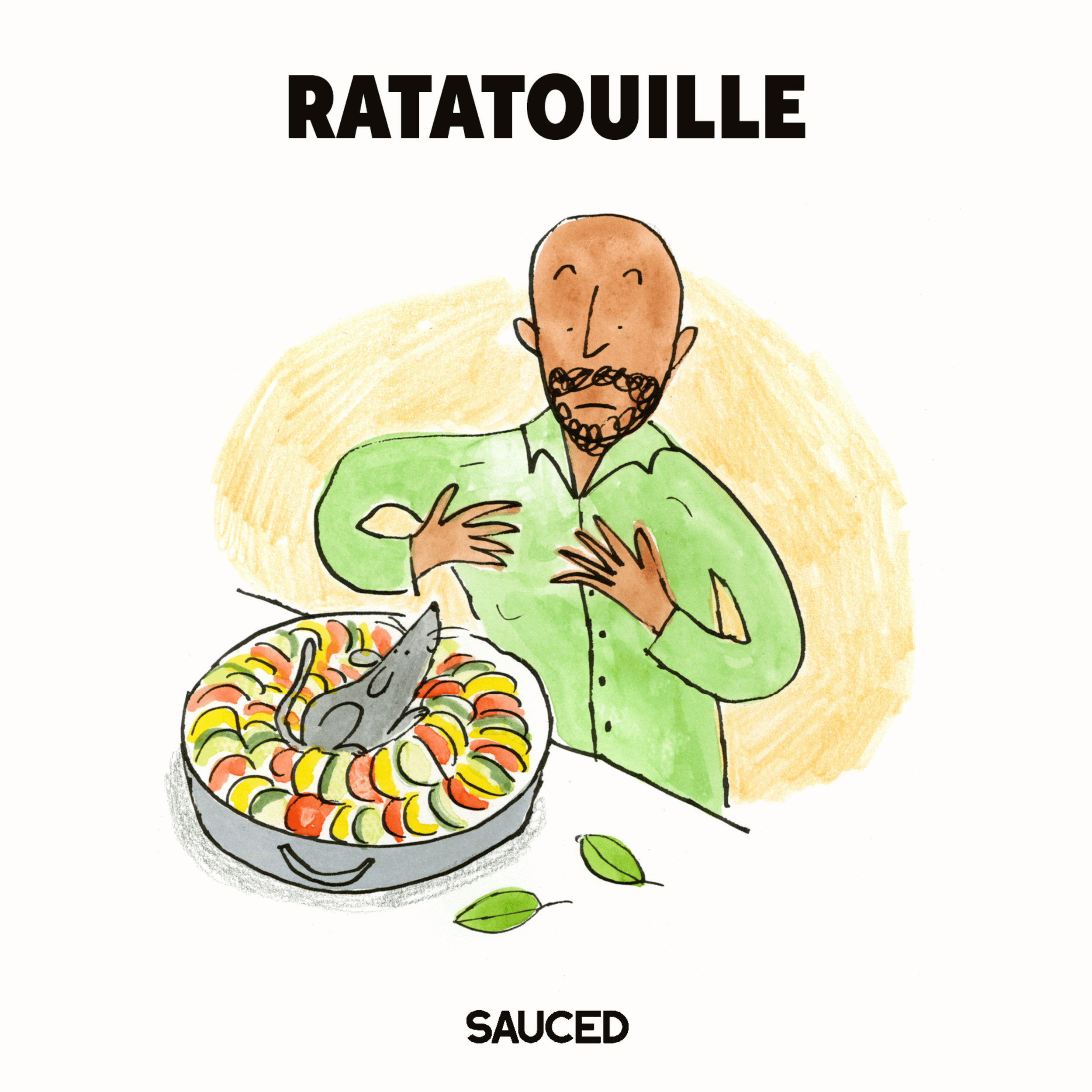
The most famous ratatouille in the world isn't a ratatouille. The dish that makes the critic weep in the Pixar film is a confit byaldi, thin sliced and fanned in a pan, designed by Thomas Keller off a recipe Michel Guérard published in 1976. What Provence actually makes is a stew, and this week we make the case that the stew is the better dish.
We trace the word back to the Occitan, where it meant a coarse stew of odds and ends and wasn't a compliment, then get into the argument that decides the whole dish: separately, or all in one pot. Traditional ratatouille has no booze in it at all, so we built some in.
"Each vegetable in this melange should taste like itself."
What we settled on:
The canon six: eggplant, zucchini, bell pepper, tomato, onion, garlic
Every vegetable browned separately, then brought back together
Salt the eggplant for texture and oil, not for bitterness
Everything cut to the same size, roughly three-quarter inch
Olive oil, heavy, and herbes de Provence in the base
French dry vermouth cooked until completely evaporated
Fresh basil chiffonade off the heat at the very end
Bound enough to hold in a ring mould, never dry
Better tomorrow, and good hot, warm, or cold
The Cocktail:
The Hugo Spritz: elderflower and sparkling wine over ice in a big goblet, garnished with dried lavender to tie it back to Provence.
RECIPE CARD:
Premium subscriber? Check out the full recipe card here.
LISTEN
EpiSOde Partners
Thanks to the following brands for partnering with Sauced to bring you this episode:
TRANSCRIPT
Tim McKirdy: Sother, it's Ratatouille…
Sother Teague: Okay, the first thing that pops to mind is, you know, a cartoon rat.
TM: A cartoon rat — Disney Pixar — probably the most famous modern movie about food and cooking.
ST: Yeah, I mean, I could get on board with that. Sure. Wait, but how old is that movie? It's pretty old at this point, right? Do you know?
TM: 2008. But I mean, I guess you have all of the post-food-truck and modern kind of stuff that leads into The Bear, right? You have Chef, the food truck movie, but that's a different style of cooking. And then what's that one with Bradley Cooper?
ST: Yeah, I don't know. I remember Chef — that was Jon Favreau, right?
TM: That's kind of the precursor to The Bear. Chef is Jon Favreau, yeah.
ST: Bradley Cooper was in that one where he was, like, crashing out. That's it. It seems like that's drama enough.
TM: He's in London. And it's taking that narrative from your sort of chef memoirs — your Marco Pierre White, your Gordon Ramsay, your, you know, bad boys of the kitchen, enfants terribles. Marco Pierre White. And then just kind of dramatizing that. Not that it needs dramatizing, you know what I mean? Just for our — well, maybe not just English, but British — listeners: a guy called Louis Theroux. You familiar with him? He's a documentary maker, a very sort of dry, slightly awkward English guy. Obviously became famous in the UK but has done a bunch of work over here as well, including documentaries on Scientology and mega prisons and stuff. He has a podcast, and recently he had Marco Pierre White on as a guest, which is a really interesting listen. I think there'll be a lot of overlap there for folks who are interested in sauce and cooking and chef culture. But one of the things that kept coming up was Louis Theroux would keep referencing things from his autobiography, and he just kept going, "Oh yeah, no, that's not true. The author added that in." And I'm like, you know, if you get someone to ghostwrite your autobiography, right? And it even includes dalliances with guests whose partners are maybe downstairs in the restaurant, and all this kind of stuff.
ST: Well, he definitely had that bad boy persona. And now, I don't know — I watched some of his episodes on YouTube and he's so calm. I don't know if the guy's on some good mushrooms, or if age just softens you, you know?
TM: Yeah, he certainly — I think he doesn't require that edge that he had when he was in the kitchen. First British chef to get three Michelin stars. I think youngest ever chef to get three Michelin stars as well. To bring that in a sort of roundabout way back to the dish, and personal and professional associations: ratatouille. It's an interesting one for us, because it's as much an aspect of dishes, or a side, as it is a standalone thing. But it certainly contains a very prominent identity in cooking.
ST: Yeah. I mean, my professional — I like this dish in my personal life. My professional, I've made mountains of this stuff. Like mountains. I don't know how to express it deeper than that. Many an eggplant has fallen for me, you know?
TM: Yeah. I think every single restaurant I've worked in, we've made this, including when I ran a kitchen.
ST: Oh yeah, wow. That's not for me, but I definitely worked at a place where we had it, and it was kind of always on, and we used it for numerous things. And I think that's what's great about this dish: as you just said, it can be a side, it can be a main, it can be a component, it can be a sauce, it can be easily whipped into a soup. It's got a lot of opportunities.
TM: Give me your elevator pitch before we dissect that a little bit more, because I think there's some additional comments there. But I want you to set us up and give us the framing.
ST: Sure. Ratatouille is a Provençal preparation in which summer vegetables are carefully cooked and become greater than the sum of their parts. It's a true celebration of summer's bounty, including most of the things that are really ripe at the end of summer. So we're talking eggplant, zucchini, peppers, tomatoes, onions and garlic. And not only that — those are all things that are kind of grown in your family gardens. These are pretty staple items in a family garden. So I think that's how it has created such an identity. Everybody had these things.
TM: Yes, at some point they did. You know, like we have explored in other episodes — but actually I think it was a recent bonus episode — Christopher Columbus and the spreading of certain vegetables from the Americas. And we're talking quite a few of them here. Tomatoes. Peppers. Exactly. So those have been brought across. So again, one of those dishes that's a little bit more modern than we might think. But it's interesting. And I think the heart of ratatouille for me is that it contains different identities. And so when I said it's been on our menu at every restaurant I've worked at, in different forms, right?
ST: Well, let's not even forget — between the two of us, every restaurant you worked at, many of them were in different countries. You were overseas, you were down in the South, you've been here in America. And this dish has followed you everywhere.
TM: And I think it's because of my ties to French cooking, and that being my training. Also this being a vegetable dish, so it really fit the mould at The Grain Store when we were working there. But not just the fact that it's appeared. You have the kind of stew version that's maybe got a little bit more of a sauce to it, or tomato to it. I've also encountered ratatouille presented as a fancy-named kind of garnish, or style of preparation. So like a ratatouille of cod, where we have cooked the individual vegetables, stored them separate, and had each one placed out on the plate. So looking a lot more like the sort of fine dining, or even rustic fine dining. You know what I mean? Just individual components. We would have it on the larder section, we would have it on the fish section. It's a great dish with fish. And finally, one of the guys who also worked on the larder section when I was at the bistro in London, a French chef from the north of France — I believe from Normandy — he was called Remy, which is also the name of the rat in Ratatouille. And let me tell you, Remy spoke about as much as the rat in that movie, because he did not speak a word of English in the 18 months that I worked with him. And not doing the job very well. Wasn't the cleanest chef, as I recall. Did love a Kronenbourg as well, was very proud of that. Obviously a French beer, and that was what those guys would turn to at the end of service. But yeah, it's a classic. It's one where you can have many different interpretations on it. Anything else for us to cover here, just sort of personal reflections, before we get into the origins?
ST: I mean, no. I would say, as you just mentioned, there's different forms of this thing when it lands in front of you. Sometimes there's a bit of liquid, right? It's almost like a stew. Sometimes it's almost as separate and dry as a hash. And then kind of everywhere in between. And you can serve it hot, you can serve it cold, you can serve it as its own thing or with things. I don't know. I'm a big fan. And I do happen to like every single component that's in here. And frankly, one of them took me a while to get over the hump. I used to really be against eggplant, but now I'm oddly really for it.
TM: I wonder whether that has to do with the evolution of eggplant as a vegetable that we have available to us.
ST: Ooh, is that a bonus episode we're talking about? Because my theory was — when I was in culinary school a million years ago, I was in San Francisco at the California Culinary Academy, and so many of the family meals that were cooked by the students involved three things that then, for a long time, I couldn't really eat, because of the terribleness of it. Eggplant, salmon, garlic were kind of off my list for a couple of years. And I already went into the situation with the notion that I didn't really love eggplant, and then that just really ruined it for me. Because eggplant is like — there are some things you need to do to care for it. And if you don't do those things, the resulting texture was the whole dish.
TM: That's the name of the game with this dish. And you could say that about every dish, but specifically this dish, I think all of your technical considerations come down to different cooking times and desired texture. Just before we move on from those eggplants, or aubergines: we salt a lot of these vegetables before we cook them to aid with that texture. There was a sort of — I don't know whether it's a wives' tale or a myth, or something that used to be true — about aubergine, which is that the vegetable was very bitter. And so standard practice was to salt it before cooking to help remove some of that bitterness, because it got extracted. I think the compound was water soluble, so if you salted it you could draw out the bitterness. Certainly not the case anymore. And I think it's really a vegetable that probably requires Maillard and colour and browning, otherwise it's just kind of mush and baby food.
ST: Well, I don't mind that, if the application is right. Like, I came to love baba ganoush, right? Where you roast it on an open fire until it collapses on itself, and then you scoop out that — at that point, effectively a purée.
TM: But again, all of your flavour is coming from the smoke and the char. Very cool. Well, this is just leaning into our origins now. We start with the word, as is often the case. Derives from the Occitan ratatolha, which is tied to the French touiller — t-o-u-i-l-l-e-r. Occitan being a Romance language spoken across southern France, parts of northern Italy, and leading into Catalonia. Although it's apparently not one dialect or language — it's a collection of six different dialects that are all closely tied. I believe it's the closest out there to Catalan. And that is a word that means to stir, or to toss. Dates back to the 1700s. And oddly, it was kind of insulting. It wasn't seen as a positive. It was kind of, this is a coarse stew of odds and ends and things you would throw in. Basically anything goes in the ratatouille. And from the beginning was often served with protein and meats in there, in that stew. So not the vegetarian thing that we know and love today. The vegetables, like we mentioned, came from far away. Tomato, pepper and squash all arrived in Europe from the Americas after the 1500s. So it takes a little bit of time for folks to become accustomed to them, for them to work their way into regional cooking, generational cooking. The epicentre of this is of course Provence, and Nice in particular. Not until 1877 does the dish get codified and put down onto the page. That was when the first written reference of ratatouille and the spelling appears — once again, still carrying a good deal of meat at this point. And then not until the 1930s is the version that we recognize: vegetables only, heavy on the olive oil, herbes de Provence. And that becomes canon. So an 18th-century word that once meant cheap slop, things thrown together, transforms into the dish we know today, and is about as old as jazz as a category of music. So pretty young.
ST: Yeah, wow. I didn't realize it didn't get sort of nailed down until the 30s. But I guess it's a catch-all, right? Like, I think when you say hash — depending on if you're talking about the meat version or the potatoes, right, hashed potatoes or hash of meats — we've kind of modified those, but they probably just meant, yeah, whatever I got. It's utilitarian cooking. Whatever I have in abundance that needs to get used.
TM: So, not to tread too far into the next section, but 1961, the publishing of Mastering the Art of French Cooking, Julia Child, volume one. So only kind of 30 years after the codification of ratatouille as a dish, she of course brings it to America, and does really take a very thoughtful approach of cooking each vegetable separately, treating them with care, bringing them together with just a light bit of sauce or tomato at the end. And then two other notable things since then. In 1976, the French chef Michel Guérard — the father, or one of the fathers, of nouvelle cuisine — publishes a cookbook with a lighter, elegant version that he calls confit byaldi. The vegetables are sliced thin and baked rather than fried in a pan or sautéed. And the name takes inspiration from the Turkish eggplant dish imam bayildi, which is kind of like a stuffed eggplant with certain things. And that, translated into English, means "the imam fainted." Apparently someone prepared this dish for the imam, he loved it so much he'd get weak at the knees, and requested that it be made for him every single day.
ST: Wait, I'm sorry — that was Michel Guérard? The guy who created nouvelle cuisine.
TM: Yeah, the father of, yeah.
ST: A.k.a. slimming cuisine. Speaking of Michelin stars, this dude at his place with his wife held three Michelin stars from the time he got them in 1977, for 47 years, until his death, which was recent. He just died in like 2023, 2024.
TM: Yeah. I mean, incredible contribution. And something that we kind of look back at now with a little bit of scepticism, the whole nouvelle cuisine — but definitely a moment in culinary history, and an era.
ST: Yeah, and it defined a lot of things. I think it really — obviously it was a pendulum, right? And it swung hard in the one way. Like, let's reduce the oil, let's reduce the portion size, let's reduce butter, fat, cream. Let's reduce, reduce, reduce. But what it did teach us is that we can coax out amazing flavours from things without having to have the crutch of butter and cream and everything on our side all the time. So I think the pendulum has definitely swung back, but we're finding equilibrium rather than an extreme in the landscape in general, you know?
TM: Yeah. And I think you require this to bring modern fine dining, which is the convergence of the two — like you said, the pendulum landing somewhere in the middle. So speaking of which, and speaking of that type of cooking and that approach: as we mentioned, Pixar releases Ratatouille in 2007. The hero dish that makes the critic weep was not, of course, the stew as we know it, but was inspired by Guérard's byaldi. And it was designed by chef Thomas Keller, who was the culinary food consultant on the movie.
ST: Yeah, and Susan Feniger.
TM: Susan Feniger.
ST: Mary Sue Milliken and Susan Feniger. Remember, they used to have a show on Food Network called — oh, I'm not going to remember. Anyway, they did Two Hot Tamales. Remember? Yeah, you told me, which is wild. But yeah, so I guess she and Thomas — he tailored the dish and she stylized it.
TM: And for those who haven't seen the movie, much like myself actually — I'm not sure, have you seen it?
ST: I've definitely seen parts of it. I can't recall if I've seen the whole thing. It doesn't seem like the kind of thing I would sit down to. Maybe if I was on a plane or something. There are a lot of movies that I watch on planes, because I'm on them enough, and then I don't remember at all. And then I'll see a movie when I'm at home and I'll be like, why does it seem so familiar?
TM: Yeah, I've definitely watched clips on YouTube, especially in preparation for this. One of the plane jobs.
ST: Well, because on the plane you're distracted, everything's happening, you're not really paying attention. It's just to keep your attention off the fact that you're crammed into a sardine can in the sky.
TM: So the preparation as it is in the movie, and as designed by Thomas Keller and inspired by that nouvelle cuisine, is in sort of an oval or round serving dish. Kind of base of onions and light tomato sauce on the bottom. The vegetables cut into very thin uniform rounds, probably using a mandoline, and then arranged in that dish in a sort of fanning motion. I believe finished with some cheese in there as well. Goat cheese, perhaps.
ST: I don't think so. Because, to go back to your question — no, I'm not 100% sure if I've seen the whole movie, but even just getting ready for this episode, when you search on YouTube for Ratatouille, it's mostly the movie. So I watched the clip of the guy taking the bite, and then he flashes back to being a kid, and then he flashes back to taking that bite. And then it showed them layering it together. I don't think there was cheese involved.
TM: Ah, well. I think one of those things that maybe commonly makes its way into people's variations, because goat cheese, for example, would go so well with this. I mean, that's the journey of ratatouille, from the peasant's pot perhaps to the big screen.
ST: Yeah, and what a humble dish. What do you imagine was going through the minds of the writers when they chose that dish to not only be the standout to the critic, that made him weep, as you said, made him flash back to his childhood, like really visceral memories — and also to be the namesake of the entire movie? So much so that most people think that's the rat's name. No, the rat's name is Remy.
TM: I will politely ask that we put a pin in that and we revisit it later, because I've been doing some thinking about that as well, and I think it's something I would like for us to cover. Can we say definitively — peasant's dish, or pauper's dish, sorry, that has had princes' interpretations along the way?
ST: Oh, for sure. Yeah. I mean, I think, again, folks who had a kitchen garden — you know, a garden that's out there cranking out stuff that you can use in the kitchen — they were everywhere. It was everyone. But then chefs got a hold of this, and we're like, okay, similar to the scene in the movie, we can pull on the heartstrings and memories of the people by making this dish and putting it in a more refined environment, or what have you. Which is, I guess, over and over again, what happens in the chef world, right? We pick an item and we say, well, let's elevate that to this level, or whatever that means.
TM: Yeah. I think if we were to analyze the stew — let's keep the individual vegetables sort of very intentionally placed on a plate, maybe served room temperature, maybe served slightly cold, not often warm, to accompany certain dishes. Let's forget about that for now. But if we look at the stew — I'm kind of doing air quotes there, because it's not loose like a stew, right — but the stew versus the layered dish cooked in the oven, I think the latter looks so much more visually appealing. I think the former is where you go...
ST: Yeah, I agree. I agree. And I'd also still, you know, one more fine line to put it firmly in the pauper camp: all these ingredients are very inexpensive and very abundant. So they're — it's food for the people.
TM: Yeah. Fantastic. Delicious. All right, so those have been the origins. How about now we continue our exploration of culinary luminaries and their approach to this dish, and maybe their imprint on this dish?
ST: Well, you mentioned one of our favourites here, Julia Child, and her book Mastering the Art of French Cooking. Her version, if you follow it step by step from the book, is a nearly three-hour process. But she stands firmly on the ground which I stand firmly on as well — it doesn't take me three hours to make it — which is: each vegetable in this melange should taste like itself. And by the way, there's an argument going on out there. Do you cook everything in one pot, or do you cook everything separately? I'm in the separately camp, mostly I think because of what Julia just said. If I cook them all separately and then put them together, each vegetable will have its own string in the quartet, or whatever. Also, as mentioned earlier in the show, I have made mountains of this. And by mountains I mean, you make it in a restaurant situation, you're making it by the mountain. I'm not making one eggplant, two zucchini. I'm making a case of eggplant, 50 pounds of zucchini or whatever. So there's no way to cook this thing all together without the end result being mush, and also, again, no individuality of the ingredients. So I think you can do it faster than three hours — thanks, Julia. But I do firmly stand in the camp of, the things should be cooked separately.
TM: Yeah. I mean, look what you're working with here, right? Like, you're talking eggplant and zucchini — sorry, took me a while — eggplant and zucchini, both very water-heavy vegetables, right?
ST: Yeah, all the things in here have a lot of water in them.
TM: Your pepper maybe less so.
ST: I would say the peppers are the least, but it's still quite wet.
TM: So yeah, you want that control. You want to be treating each one on their own. I believe this is a Julia quote from that volume one: "A really good ratatouille is not one of the quicker dishes to make" — as you said, three hours — "as each element is cooked separately before it is arranged in the casserole to partake of a brief communal simmer." Which I kind of like.
ST: Yeah, right. You're not just tossing it together like a salad and moving on. There's one last bit of cooking. But she does layer it into the dish, almost like — not nearly as sort of technical as the one you just described, right? But she does cook everything separately and then layer repeatedly. So it's like eggplant, then onion, and then repeat, like a lasagna basically.
TM: Yeah, it's nice. It's novel. I think that's a good hybrid. Who else you got here for us?
ST: You know what, our boy Jacques is going to chime in. He's from France. He is the opposite camp. He thinks it can all be done in one pot, because he's a hack.
TM: He's not — Jacques Pépin is the master of not overthinking things.
ST: Yeah, well, he always favours practicality in his cooking. And I think that's what really made him so endeared by his audience. He made everyone feel like, oh, I can do that. So, you know, I hope that to some degree we're doing that too. He made it in one pot all the time. He said attention has to be paid to the timing, because these things cook at separate speeds. So that was his angle on it. But he also — and I agree with this as well — he says over and over, every video I could find of him, every recipe I saw in a book, at some point he says a phrase similar to: it'll taste better tomorrow. Let it sit. And I agree with that, actually. You can make it and eat it hot right out of the pot. But if you let it cool, it kind of really marries. And then tomorrow, on reheat, or serve it cold — I like ratatouille cold as well — you're going to get a much more depth of flavour. I feel the same way about other dishes too, like chili. Chili tastes better tomorrow.
TM: I think this is definitely one of those preparations where a little bit of experience, or a few times making it, will give you a good judgment call. When it comes to probably most things, you want to undercook slightly, just given that fragile nature we talked about, water-rich. It's going to continue cooking, with the best will in the world, when you're trying to cool it down to serve it the next day or whatever.
ST: Well, even what we would do often at the restaurant is, every part of the dish would get cooked and then spread out thin on a sheet pan and racked into the walk-in, at least. And then this was a step we went even further. On assembly, when we put the thing all together, each of those sheet pans would have a fair amount of liquid on them, which we would not fold into the thing — but we would collect all those liquids and reduce them, and then fold them into the thing. So, concentrating that liquid that did come out. Chilling everything immediately after cooking so that it's not continuing to carry-over cook. Steps can be taken. Again, texture is so important to this dish.
TM: I wonder why we never see a sauce of ratatouille, served almost like a soup, or an actual sauce. You know what I mean? What's to stop someone? I would love to do it. I've never done it. I think the only thing might be colour.
ST: Well, yeah. A guy that I mention many times on the show here, Adam Byatt — his version takes a portion of the ratatouille and purées it into a sauce, and that's the binder that holds the bulk of it back together. Seems smart, to be honest.
TM: Tasty. Yeah. So I'm just taking it all the way there and having, like, maybe a little bed of potatoes and some fish on top of it. Beautiful. Maybe even serve it cold, like a gazpacho. Very nice for summer.
ST: I dug into one that I don't typically dig into, and I didn't find anything, and that's why I'm bringing it up. I find it pretty shocking that I couldn't find anything from Alice Waters, who is known to be the champion of vegetable cookery. No real input from her on this iconic vegetable dish.
TM: Yeah. So, any other luminaries there? I mean, we've covered Thomas Keller as well. I had Thomas Keller, Jacques Pépin, Julia Child, so it looks like we had some overlap in our prep there. I guess at this point, before we take our first break of the day, before we get into things such as non-negotiables and preparation — what is the style that you would like to commit to today of the ratatouille? The preparation. Are we treating this as individual elements on a plate? Are we treating it as that kind of proto-stew? Or are we going with the baked dish? Where does your heart lean?
ST: I'm not going for the baked one. I think it's the proto-stew. I don't like the way that sounds, though. But yeah, I don't want it to be — we're going to cook everything separately, but they're going to come together.
TM: And so our aim, exactly, right. And you know, maybe we'll take the byaldi method, maybe we'll take another method with the light-on-the-sauce, the reduction that you mentioned there. I like all of those things. But yeah, I think for me — and this is a nice way to set up our non-negotiables — if I order ratatouille, that is what I expect to get. Unless it's a very fine dining restaurant and it's saying like "ratatouille of so-and-so," the kind of naming convention on menus. So those have been the origins, our personal associations, and our culinary luminaries. First quick break of the episode for us here today, and then we'll be back with the non-negotiables. All right, Sother, we're back. Here we go. Non-negotiables. What have you got first for me here today?
ST: I mean, I think they're all of equal importance, to be honest. Normally I list my non-negotiables by importance, but I think of the vegetables, they're all equal. So, eggplant. Aubergine. Eggplants first. I have always made this with the big round standard eggplant, but you could easily make this with the long skinny Japanese ones, or even the little egg-shaped and coloured eggplants. Any eggplant will work here. I think the big market one is the one that we most identify with this dish. Oh, we're just listing them now? I thought we were going to go back and forth. But yeah, they're all equal.
TM: No, I mean, I think you're right. The vegetables is one non-negotiable.
ST: Yeah. Eggplant, zucchini, tomato, bell pepper, onion, garlic. Then we have other things, though.
TM: Yeah. My first non-negotiable, following on from there: olive oil. Got to go heavy on the olive oil. This is a Provençal dish. It's not just a whisper. It's not just kissing the pan with a bit of neutral oil, or a spray, heaven forbid. This is a nice hearty glug of good olive oil.
ST: At the restaurant where I made the most of this dish, we constantly had a giant pot of very low-temperature — not simmering, very low temperature — infusing olive oil with herbs, garlic, shallots. So that's the oil that we used in all of our cooking, really, but certainly in this dish. And that's the oil we put out with our bread service as well. This house infusion. Delicious. So you can think about doing something like that. But definitely, you're going to need olive oil for this dish.
TM: And I think that might nicely set up your next answer here, I believe.
ST: What's that? Oh yes. Herbes de Provence. HDP, we call it.
TM: HDP. Big H, small D, big P.
ST: Yeah, herbes de Provence. So I learned something about herbes de Provence — I'm scrolling back to my notes here. There's an official Label Rouge, the red label, standard in France that requires these percentages, which are quite exacting, on what exactly is herbes de Provence. And then there's a reveal here at the end that I learned, that I didn't know. 26 savory — which we need to talk about — 26 oregano, 26 rosemary, 19 thyme. I love that they gave all those percentages, and then the last one, it says "and a touch of basil." Okay. That's annoying. But then what I learned is, in America, where I'm from, it also always has lavender, but that's not true of the rest of the world. So how did that sneak in, and why? I don't know. I couldn't find any answer to that. It just said it's popular in America to put lavender in there as well.
TM: I think that is one of the strongest associations with Provence.
ST: Well, I mean, yeah, for me it is, because of the herbes de Provence. But if it's not even supposed to be in there, then I've got a wrong association.
TM: I think — I don't know. Yeah, maybe. But I think, you know, people. You have obviously South of France, now you have light pink rosé that people talk about. There's that wonderful book as well, A Year in Provence. I'm not sure if you've ever read that one. It is exactly what it is. A British guy moves to Provence and mild chaos ensues, as he tries to — I think it's set in like the 70s or whatever — and he's trying to get up and running, and learning the language, interacting with the locals. It's a good read. It's fun. But I think those are the things we associate with Provence. Noticing that you're missing marjoram, that I thought was also very common in this.
ST: Yeah, not according to the Label Rouge, the red label, whoever those guys are. Marjoram I could take or leave, but I just really always associated this herb mix with lavender.
TM: I mean, we've spoken about this on a different episode — herbes de Provence was something where we would be picking the herbs during service when it was quiet, drying them out above the ranges and stuff, quite high. It tended to be all of those herbs, or at least a good healthy amount of the ones that you mentioned there. We never would have used lavender though. Never came into it. But I see the association. Next for me: don't really have any other non-negotiables, other than that one that I mentioned just before the break, where I'm like, that's what I expect to be served. Something that is not just dry vegetables, but not a super wet stew. Something that will be held together. One of those things that, you know, back in the day when we would plate things using rings, and you would press them into it, and then put the pan-fried fish or whatever the protein on top — it will hold together, it will maintain its structure, but it would never feel dry. It will still be one homogenous thing of many different things held together by a bit of sauce. Bound.
ST: Right. It's not tightly bound, but it's bound enough to have it hold its shape. I had one last one. Even though the herbes de Provence contains a touch of basil, all those dried herbs — I want some fresh basil to finish the dish. Right as it's going to get to, you know, the last thing I'm going to toss in is a little chiffonade of fresh basil before it hits the plate.
TM: You know what, we didn't include that in our Bolognese, and I have had some folks reaching out being like, no, no basil in the Bolognese. The Academy hath spoken.
ST: Yeah, no herbs. Specifically it says no herbs.
TM: All right, well, those have been our non-negotiables today. One thing notably absent from those...
ST: Oh, I've got it though. I didn't say it. It's a non-negotiable for the dish — it's going to be a non-negotiable for us.
TM: For us. That is the booze question. Let's get into it. How does ratatouille earn its place on Sauced, beyond just being a wonderful dish, beyond being something we will be drinking with this food? Where are you — I think I know where you're going to go.
ST: I think you do too. I think we've discussed it on the show before. This is kind of our go-to now, right? We're not just going to reach for wine. I think we're going to reach for, in this case, dry vermouth. Yeah, let's do a French one. Because it's going to have plenty of herbal qualities, which we're already trying to incorporate into this dish anyway. It's a nice dry white wine, and it's going to bring some beautiful flavour, and we can easily incorporate it into this dish.
TM: That's where I would go, and I would leave it at that too.
ST: Yeah. I thought about, like, is there any opportunity here to go with a hard spirit? You know, we're in France, let's do some Cognac. But no, I think that's going to take it to a place that it doesn't need or want to go. Because it's a vegetarian dish also, right? Unless we're maybe talking about mushrooms, there's kind of no way I would imagine putting these fresh, beautiful, bountiful summer vegetables with a high-spirit deglaze or what have you.
TM: Well, us being in the south of France, I thought you might lean past this, because you certainly gravitate more towards that kind of flavour profile than I do.
ST: So the very next line in my notes here is, I said we're going to use some dry vermouth. But then I think, maybe — you know, on my bar I have an atomizer of absinthe for rinsing glasses and things like that. I think an atomized puff of absinthe, or pastis, again right at service. So we're going to have this burst of aroma.
TM: I might fight you on that one. I love the approach, right. And if the task were — which is right, like, this is literally the section of today's episode where, how would you incorporate booze into this? Because obviously it's not classic. If that were your task, I would say thumbs up, good job. I just think it's that — what's her name, Anna Wintour, I think it was, or Coco Chanel quote. That's like, you know, take one thing away. I think that's the thing that goes too far in this instance. Because you're right, it's a really fresh aroma.
ST: Stop at the mirror and take one thing away. Take one thing away.
TM: But it doesn't reflect anything in the dish classically, right? There's a "grows together, goes together." Okay, I get that association. That would be the one item of clothing I suggest taking off. Or garniture, as you like to call it.
ST: Then let's get it out of there. But I did want to at least bring it up, because we have done things like this numerous times in kitchens that I've worked in. Some aromatic pop added literally at the pass, on its way to the table. Two quick examples that I can come up with. We used to take really hard toasted bread and a microplane, and just grate a little toast on top of things, and you get this toasty aroma. Not enough to really even notice texturally or flavour-wise, but that aroma changes your perception of whatever it is you're eating. And then this is a crazy one, and I think I've talked about it before on the mussels episode, where we had a sort of Thai-style mussel dish that had tons of mint in it. And at the pass we would microplane over the dish just a quick ten scrapes of an Altoid. So it would really increase that bright minty aroma. We did a bunch of weird things. We weren't, like, avant-garde. This is one particular restaurant that all these things happened. One of the things we did was — but we stole it. We did a calamari dish at that restaurant, and the calamari at Union Square Cafe here in New York was super famous for folding into their dry batter, their flour mixture, finely ground graham crackers. So it would help with the browning, because you're going to cook calamari really quickly, so it doesn't stay in the oil long enough to get as brown as you want it to. So that sugar would create some browning, create a crisper exterior. So we did a similar thing, again a sort of Thai-style dish, where we ground ginger snaps into the flour so that we could make the fried calamari. Little techniques that change texture, aroma, can really have a huge impact on the final dish. A lot of it's subconscious. You don't walk away from that going, mmm, that calamari had graham crackers in it. You walk away going, that was delicious calamari. Anyway, so I can leave it alone, but I did want to throw it in there, just even for my own trying to square-peg a round hole or whatever — but also for the listener to understand that you can do these things.
TM: I think I might be more tempted to say, you know what, if we are serving this with some nice firm white flaky pan-fried fish, that's where I might add it in there. More on that in a second. More on some technical considerations as well too. Let's take our second quick break of the episode, and then we'll be back. All right, so we're back. I mentioned maybe that going with fish for me, that pastis or whatever, or hard alcohol there. That leads me to some other questions. Because if there were fennel in this dish, I would be like, absolutely. So if you were to add one or two additional vegetables or components to the ratatouille — if we're like, okay, we're great, we're happy with this — what extra components would you add, or have you seen commonly added? And would fennel be one of them, I guess, as a start-off point?
ST: I definitely have seen fennel added to this dish, and that would certainly tie those two flavours and that aroma together. What else would I add? I don't know. I hadn't thought of it. It's such a canonized classic for me. Again, having made so much of it at that one restaurant, it's just like, that's just what it is in my mind, you know? No.
TM: You know where I might go, it takes us to the Italian dish that I can't quite remember. Right, puttanesca. Might go olives. And then are we just cooking puttanesca then?
ST: Well, puttanesca also has a fiery element, right? A lot of chili peppers.
TM: Chili, yeah.
ST: Puttanesca, in the style of the whore. It's supposed to be spicy. Anchovies and capers and olives. Yeah, I know. I could absolutely see adding olives. And in fact, I think my boy Adam Byatt, when he was dishing up his, he dished it up in two forms. One was hot and one was cold, and the cold one he topped the dish with some marinated black olives. That looked good. I could easily see throwing in some capers, but that's not really a vegetable. What other vegetable would you add to this dish?
TM: Yeah, I mean, assuming that we're leaving the sort of squash family, because we're covered on two fronts there. I don't know, mate. Maybe it's the Gaelic in me. Just potato of some variety. A bit more sustenance to the dish.
ST: Right, yeah, that is the Gaelic. It would. But then are you heading down the road to hash at that point, maybe? But you said squash — what about the sort of harder squashes? Gourds. Which kind of mimic that.
TM: The gourds. Did I say squash? Sorry, I was thinking about that, but I meant zucchini, whatever.
ST: There's the umbrella, right. But I think that texturally we could go in with some chunked-up butternut squash, or kabocha squash.
TM: I think we are actually regressing to the — what was it, ratatouille?
ST: Yeah, we're going the wrong way. We're going the wrong way.
TM: Bring it back. Okay. Second half of this — sometimes we'll mention this after the preparation — but what is the protein you want to have with this, or that you have enjoyed having with it? I keep mentioning fish, but where does your mind take you?
ST: You know, I do enjoy fish with this dish, but I think for me, I don't know why, it's lamb. Like, number one, let's go lamb. Let's have a lamb chop and some ratatouille. I would be a happy man.
TM: Yeah, I think that is on the meat side where I go.
ST: But then there's other ways to go here too. And I guess we are putting the cart before the horse a little bit in our normal format, but ratatouille just tossed with some pasta is fantastic. Ratatouille folded into your base for your quiche. Or gnocchi. There's your potato.
TM: Or some gnocchi. Oh yeah. Sorry, just had to get it. Or a quiche of ratatouille. Ratatouille pizza.
ST: I've made a million quiches with ratatouille. Yeah, sure. Let's get it on a pizza.
TM: I can't remember right now whether I am conflating two things, or combining two dishes and preparations we used to do. But we certainly, at the bistro, as one of the starters we had on the menu, was the individually cooked and quite nicely cut vegetables arranged on a plate. So you'd have your bell pepper, your zucchini, your onions and stuff. We would actually pre-plate these and have them in stacks of ten dishes on top of each other in the fridge before service, and you would have a couple out at room temperature for serving and whatnot, because it was a bit of a faff to put together. Especially for — it was fast service, and that really wasn't what we were about. Unless I'm misremembering this here, I think we would serve those with a kind of romesco sauce dotted in between the vegetables. Imagine a kind of mosaic, or a Matisse kind of thing coming together here. And then we would serve that, I think — and even if we didn't, I still think it sounds delicious — we would serve that with octopus. So you've got a few tentacles here and there, a couple of slices of the head and whatnot, slow-cooked with the cork. That's a story for another day. But yeah, that came together kind of really nice. Your protein there. And I don't think we've really discussed octopus on this show before, so a nice one to get in there.
ST: Yeah, we'll get it. I mean, I think that what we've just described, again, second time in this episode — this dish is versatile and useful and handy in the kitchen. Because again, you can make a pretty large amount of this and have it in your fridge at a moment's notice. And then it's like, oh, I can't figure out what's for lunch. Hey, crack open a can of tuna and dump it on top of your ratatouille and eat it cold. Delicious lunch. Fry an egg and put it on top of it for breakfast. Make a quiche, make a frittata, make a pizza. It's a side dish. It's standalone. Hell, can this be in a wrap? Can we taco this?
TM: What is the journey from ratatouille to puttanesca via salade niçoise? That's maybe where my olives are coming from, and it being Nice and Provence and that part of France. All right, so many different ways to serve this. But ultimately, what would you go with? You said lamb. You're in for lamb. And if it were fish?
ST: I guess I would probably do something like you mentioned, sort of white and flaky. I grew up on the Gulf Coast, so I'd play like grouper. I love a big piece of grouper. Halibut, if you want something firmer but still supremely white. Maybe even scallops. I mean, again, it's one of those — it's grout. It goes in between all the bricks. It's a staple.
TM: Yeah. Well, on that preparation I mentioned earlier as well — and if people don't feel comfortable cooking octopus, or it's not something they love — you could take a flaky piece of white fish, kind of confit it. Or if you have a vac-pack bag machine at home, and a little bit of oil, season it, get it in there, cook it at a low temperature, low and slow, and then just flake little bits off of it, like you said, to fill those holes on the dish. A little herb oil to finish. Looking good, sounding good, making me hungry — but not in a way where I'm like, oh my God, I'm going to need to nap after this.
ST: That's the other thing. This is a dish that we had one recently too, I can't remember what it was. But this is a dish where I walk away going, like, man, I feel good that I ate this. You know, it's medicine. This is bounty and good for you.
TM: Well, you know what, those are a lot of little different choose-your-adventures. We're about to commit to ours. I would say 75% of the way in, the preparation segment. But you know what, we're not going to cover quantities. We're not going to commit to the recipe. Regular listeners to the show will know we do that in our recipe cards that accompany every episode, every single week. They go out to our paid subscribers. $7 a month, $70 for the year.
ST: Yeah, it's a two-month savings every year if you go for the whole year. And that way you don't have to try and listen to us and jot down notes. Just listen, enjoy the show, and then know that you've got those recipes coming your way, that you can then get in your kitchen and get to work. Are you up sending all those at 5 a.m.?
TM: Yeah, literally like owls, like Harry Potter, going out of the basement here, setting them free into the world. And you know, much like as you see on each episode, if you pull this up on your podcast app, we have lovely illustrations in there from our UK-based illustrator, Charlotte Ager. We get so many compliments about those. People feel like, yeah, you know.
ST: I love them. Yeah, they're whimsical and charming, and I don't know, they have a — we're constructing a vibe, that's for sure.
TM: The Sauced universe. I think they are the grout to the universe. They bring everything together. They visualize it. All right, Sother, we shall take a quick break now, and then we'll be back with the preparation. All right, Sother. Preparation. Walk me through it. Ratatouille.
ST: Ratatouille. Okay, so we're going to start with the eggplant. And if you've got those big globe eggplants — do they have a name? They're just eggplant, right? So the standard eggplant. But I mean, is there a market name for that shape? You know the one. Okay, so standard eggplant from your market. I like to peel them. Some people leave the peel on. Maybe based on what I said earlier about my eggplant experience when I was younger, the peels freaked me out a little bit. Although you can dry them and crisp them and make them into little fried things, which are quite delicious. So I peel the eggplant, and then everything from this point forward, all the vegetables are going to be cut roughly the same size, right? Because we want a sort of uniformity of look of the dish in the end. So I'm going to cut these into like three-quarter-inch cubes. And then I'm going to put them into a bowl, and then I'm going to pretty liberally season with some salt and toss it around, and then set the eggplant aside. So that way you can work on everything else. And then we're going to cut the peppers into roughly the same size. They're not cubes, obviously, because they're just sort of the flat part of the pepper, but into the same size kind of squares. Your zucchini, same size. Onions, relatively same size. Tomatoes roughly the same size as well. But I'm going to core the tomatoes, right? I don't want all those seeds and all that excess juice. Because one of the processes of the cooking of this thing is trying to get rid of some of that liquid. So concasse your tomato — which means then to put that little hash mark on the bottom, drop them in boiling water for 20 seconds, honestly, put them into a bowl of ice water. That way you can peel them, then quarter them, then fillet out the — what is that called in there, the seed pods or what have you, that sort of gelatinous pulp. Hang on to that. Use it for something else. I like to make quick tomato water with that stuff, and use that to make tomato syrup for cocktails or whatever. Okay, so anyway, while you're hacking up all that stuff, your eggplant are steadily over there releasing some of the liquid because of the salt that you put on. This should take you, let's call it 30 minutes. Now that you've got everything cut up, get the eggplant out of that bowl, drained off, and then roll them around with some paper towels or a tea towel or something, to kind of dry off any excess. Then what we want to do is, in a pretty large wide-bottom pot that you have — you know, I use my sauteuse, pretty standard size, I think it's like a 12-inch — we're going to brown each item separately. I'm going to start with the eggplant. Generous amount of oil goes in the pan, get it up to a nice medium-high heat, you know, around 200 degrees in your pan, and then in goes the eggplant. Don't overcrowd the pan. If you need to do it in multiple batches, your patience and your steadiness at doing this job will be rewarded by the dish being greater in the end. Because if you're overcrowding the pan in this scenario, you're creating steam, and steam will never get any Maillard reaction, right? Steam cannot brown. So let's get those browned, and then roll through everything, with the tomatoes being the last on the list. And then I think you're going to set these things aside and let them cool off separately still. Again, if you've got room in your fridge to manipulate all that stuff, but at least let them cool to room temperature. Then you can put them all back together. We need to make now the sort of sauce: the onions along with the garlic, the herbes de Provence, cook those down till almost no liquid is in there. In goes that vermouth we talked about. Cook that until it's completely evaporated. Again, we don't want any liquid in here. We're just wanting the flavour notes that are going to come. You're going to get some acidity from that vermouth. You're going to get some herb qualities from that vermouth. Your herbes de Provence are in here as well. And then season with a little bit of salt and pepper. And then that's going to be kind of the binder, when you pull all these things back together and gently reheat them for service. Oh, and I forgot — I did want to add, at the service point, that's when you're going to chiffonade a little bit of basil and toss that in at the very last second.
TM: One thing I saw, and I've never tried myself, as an alternative to the salting of the aubergine —
ST: Yeah, what do you do?
TM: Kenji López-Alt microwaves it between two pieces of kitchen paper towel. And that kind of collapses the eggplant, to the point that those air pockets that you have inside there, as well as the water, collapses it down. Because I guess one of the other things that you want from the salting action, apart from drawing out the moisture, is also — if you cook those things without salting them, it's going to soak up a load of that oil, and we want it to be oily. So this will negate that, apparently. I haven't tried it, but if Kenji's putting it out there, I'm pretty confident in his approach.
ST: Yeah. I mean, I don't own a microwave anymore, but I live in New York, I don't have room for that. But yeah, microwaves don't do anything but cook water. They agitate the water molecules into a state of friction that then creates heat, that then makes them steam away. So if our goal here is to remove the liquid, I do not see this as the wrong thing to do.
TM: Fantastic. All right, so that has been the preparation. Then you're going to serve it with a beautiful lamb chop, or with that nice flaky white fish that we talked about.
ST: Or just a nice crusty piece of bread. I baked some focaccia, finally got it right. Took me three tries. First try wasn't my fault — first try, the yeast was dead, for sure. Anyway, yeah.
TM: Fantastic. And yeah, absolutely, especially rosemary-heavy bread. And just talk about that oxytocin as well, you know, that romance-language panning southern France, northern Italy and whatnot. I think we can make a good case for that. I don't think anyone's going to get annoyed that we are, you know, crossing cuisines and cultures. So, time for our final break of the week, then we're going to be back with your favourite part. All right, we're back. We're in Provence.
ST: I mean, there's only one.
TM: Provençal rosé.
ST: You know it. I mean, it's a no-brainer. Like a big goblet glass of it, maybe even on ice.
TM: Maybe even — and this will not be a surprise to those who are on top of, or will soon be on top of — I don't think this has been released yet by the time this goes out, but our next bonus: jalapeño in your rosé, perchance. Yeah, well, folks, once again, those bonus episodes available to all premium subscribers. That's another added perk. You get one episode extra every month, a deep dive on an ingredient, a technique, a side dish. Ratatouille was straddling that — is it a bonus? But we said no, ratatouille comes into the big leagues. History as well.
ST: Yeah. And you forgot one: history. The history ones are kind of my fave. We dig into some really cool stuff.
TM: Former chef and butcher turned drinks expert sits down and says his favourite episodes on a podcast about cooking with booze and drinking with food — his favourite episodes are history.
ST: Yeah, history about booze and food. All right, do you have any other wines that you'd go to? I literally, my list here says Provençal rosé. That's it. I wrote one.
TM: I would say fantastic, and then I would be guided by the rest of the dish, right? If we are going with fish, I might go for a southern white instead. I think when it comes to rosé, obviously you are chilling it down a lot. I think as rosé production has increased due to the popularity over the years, you do get overproduction, and you do get a slightly bitter finish, because of maybe not the best quality fruit to try and meet those production demands. It's kind of like, if you want to be generous, you can say there's a white pepper note to this. And I think otherwise you can be like, yeah, this is just not the best quality fruit. Not to look down my nose at Provençal rosé — fantastic wines there. So if I'm going fish, I might go with a southern white instead, from Rolle — R-O-L-L-E — that's just the French terminology for Vermentino. It's a white made with Vermentino, and Rolle is something you will see on the label. I'm second-guessing myself here. Or sticking to the Provence region, Bandol being a signifier of — is it an IGP? Bandol being an appellation, is the word that I spent a lot of time looking for there. Signifier of great quality rosé. They also make fantastic reds. Some of them can be on the heavier side. You can also find some on the lighter side, which I probably like, with a little chill, for this. So keep it southern, keep it Provence, don't overthink it.
ST: Now I'm suddenly going back to the rosé. Now I kind of want a jalapeño-infused frosé. Let's make a frozen drink with jalapeño. Anyway, okay. Beer. I say, listen, this dish comes from the notion that you've got a kitchen garden, a culinary garden. Farmhouse ale. Right, let's have a farmhouse ale. Let's drink that. And I think the wine and the beer, I'm drinking these probably while I'm making the dish. A saison. Maybe even, or close enough, a Belgian blonde. Beers that are going to be structured enough to stand up to this melange of vegetables, but also still pretty refreshing and workaday.
TM: Love it.
ST: Spirits-wise, I mean, we already talked about it. What is pastis, by the way? Pastis was the answer to the near-global ban of absinthe in 1915. So pastis is basically an anisette that does not involve wormwood, that is a bit sweeter and lower in ABV. So anyway, pastis, just louched with a bunch of water. Let's drink some of that while we're eating the dish, while we're making the dish, whatever.
TM: And by louched, do you mean you're adding ice-cold water to the spirit, and that's going to turn it milky, which is the louche effect? You said louched. I think you threw that one out there like it's a very common term. I wanted to — you know, if we're asking what is pastis, I think we need to explain what is louching. Just a good little clarification. Where else you headed with the spirits?
ST: Yeah, I think something dry, like a Martini, gin and tonic, a French 75 even. Anything with a dry vermouth and soda or tonic. Easy things to do. I would just avoid really sweet drinks with all these vegetables. I think that'd be clashing, and not in a good way. You know, oftentimes we pair, like I always say, we either pair directly at, or kind of directly against. But I don't think I want anything sweet up against this dish. There's a classic cocktail that I would recommend, but I would tweak it a little. And I think we talked about it in another episode — I can't remember which one it was, it probably was mussels. Anyway, the Mauresque. Do you remember talking about the Mauresque?
TM: Or bouillabaisse.
ST: Yeah, yeah, that makes sense. So pastis, or orgeat, which of course is almond syrup. And then instead of flooding it with four ounces or so of seltzer water, let's use a sparkling rosé, right, to kind of tie it back together. And then I think the drink that I would really go for, for this one —
TM: Is this your cocktail of the week?
ST: Yeah. I mean, it's a modern classic. I don't think it's old enough to be a modern classic, but it's around. I didn't create this cocktail. The Hugo Spritz. It hit the scene a couple of years ago, has kind of really stuck in. It's made with elderflower liqueur, right. It can be — there's others on the market as well, but yeah, St-Germain probably the most dominant force in that category. You're going to go three parts of elderflower liqueur up against two parts of sparkling wine, on ice, in a large goblet glass. And then top it up with just one more ounce of seltzer water. Garnish it with a little dried lavender, and you're tied right into this dish.
TM: If you wanted to go boozier, you could go down the — I believe it's called the St-Germain cocktail. Otherwise there was a specific — so St-Germain and gin, am I making that up? Topped with a little champagne. And we actually used to do a version of this at some of the restaurants I worked at, called the Twinkle. So again, elderflower liqueur, spirit is alcohol. I think it was elderflower liqueur, simple syrup, vodka, topped with champagne. Was rocket fuel at the beginning of the night for people. All of this is to say, though, I love it. I love the approach. I like where you went with the ingredient. The Hugo Spritz is a really interesting phenomenon, because this is by no means a modern creation. It's just one of those — the Hugo, the name is modern. The preparation itself probably a little bit older. But what I think this embodies in a really fun way — and you can speak to this way better than I can — but St-Germain, however you want to pronounce it, an elderflower liqueur that became known as bartender's ketchup in the early aughts and beyond. Because this idea that you could add a little half ounce here and there to something and it would just kind of work with any other ingredient and improve any cocktail. Did that become sort of passé, or overdone, or people are just like, yeah, we're done with the ketchup for a while? But what's really interesting is, if you are launching a brand like that — and I believe his name was Rob Cooper — so you come from the bar world, the first people you go to are bartenders, who embrace your product. They love it. They start putting it in everything. But they're putting it in in quarter-ounce and half-ounce. It takes a lot of those to sell a bottle. So you're cool with the bartenders, but you're probably not blowing through as much inventory as you want. Then it gets adopted, especially by TikTok and social media, during the pandemic. It gets this name, the Hugo, which I think is actually northern Italian. And then suddenly everyone knows about this thing and you're selling cases and cases of it. So bartenders have turned their back on it. It's no longer cool. Those are the people who you probably wanted to be the champions of your product in the beginning. And then suddenly you turn around and now, I believe, Pernod Ricard, who owns them — I think it's Pernod Ricard — just laughing all the way to the bank. You have one. There's one here in New York, I believe, right?
ST: Is there? Yeah, I wouldn't doubt it.
TM: Challenger brands that are out there. I do love it though. I mean, it's worthy of its reputation and moniker.
ST: Right. And also, like what you said makes total sense to me, right? The technique has been around. A spritz. Insert any liqueur here. Insert any amaro here. Split your liqueur and/or amaro with some spirituous alcohol. There's no end to the possibilities.
TM: Fantastic. So, are there final thoughts from you here today on this dish and everything we've discussed, and why people should go out there and make their ratatouille?
ST: I think we've made our argument throughout the conversation here today. I think this is a premier example of seasonal cookery. I think it's inexpensive, abundant, and it's going to teach you restraint and technique. It's also — we touched on the fact that it kind of came, not out of, but it kind of refined by the sort of nouvelle cuisine movement. So you're not relying on cream or butter or cheese, although all those things can certainly be added if you'd like. You just need patience and vegetables, and you'll have this great dish that we have, kind of throughout this episode, really drilled home the notion that it is super flexible and useful in other ways. So you're really doing yourself a great favour by making this dish. And again, kind of make it in a little bit of bulk and have it on hand for, like, oh, I just need one more component on this plate, or I need one more item in this pasta. It's a good reach, right? It's at your fingertips. I think it's a great dish. And make it look pretty. And it's like a real opportunity to see that technique can create luxury. Because again, we're starting with humble components and pretty humble style of cookery, but the end result can be quite luxurious.
TM: Technique, texture, time.
ST: Yeah, the three T's of this episode. Is there three T's in ratatouille? Damn, that would be helpful.
TM: The trio of ratatouille. So, earlier on, ratatouille the movie, you asked me a question.
ST: I did. I asked, what do you think was the sort of motivation to name an entire movie after this pretty humble dish?
TM: So I have some thoughts. Before we do, let's just do a quick reminder of ratatouille the movie, by the numbers. Pixar's eighth film, comes out in 2007, made on a $150 million budget, grossed almost $625 million worldwide.
ST: You're about to blow me away with whatever this next number is. I can feel it.
TM: The sixth highest-grossing movie of that year. It won the Academy Award for Best Animated Feature, plus the Golden Globe and BAFTA in the same category — although no one cares about those, it's just the Academy, folks. Five Oscar nominations in all. Maintains a 96 rating on Rotten Tomatoes. We mentioned, of course, Thomas Keller was one of the culinary advisors on it. During the 2020 lockdown — just final piece of trivia before we get into the naming here — TikTok users created and crowdsourced a musical. So during the lockdown there was this trend, apparently, where people were coming together and remotely turning things into musicals and collaborations. Obviously TikTok starts with a lot of music and dancing and whatever. And people started doing parodies where they would use audio from Ratatouille, that was, I guess, from dishes that looked amazing in the movie, and they would put it over their very sad cooking, because they didn't know how to cook. And they came together and they did a benefit. It was called Ratatouille the TikTok Musical, and it raised over $2 million for charity, for the Actors Fund. So the legacy sort of persists. But I was thinking — and I kind of love when this kind of thing happens — someone comes up with a name or a concept first and they run with it, and then they create a business or whatever afterwards, right? So I was like, oh, Heisenberg, Heisenburgers, as we mentioned in the burgers episode. People love a good pun and they run with it. So I was wondering — I don't have an answer to your question, but I was like, well, rat is in the name. It's ratatouille. So you come up with a chef who's a rat. Which got me thinking: which other dishes can we do this to?
ST: Oh no.
TM: So I'm going to pitch you on three movies. You are a Pixar executive. This is going to be our next one. You tell me which one you want to go with here. These are all animated, by the way.
ST: Of course. Because we're about to make some monstrosities.
TM: Movie number one: Toad in the Hole. Toad, from Wind in the Willows, has gambled away the family fortune on motorcars and mad schemes. He's lost the Hall. He's washed up, and he's found himself living the life of a servant, and then a chef, in the bowels of Toad Hall. Picture Downton Abbey meets The Wind in the Willows. And basically his recipe of sausage and batter dish becomes so renowned that he gets back his fortune and once again becomes the Lord of Toad Hall.
ST: Wow. I mean, what a rollercoaster ride. How emotional. Riches to rags to riches.
TM: The critics come in, they say, what do you call this thing? Because he says, Toad in the Hole. They ask why. He never tells them.
ST: Yeah, just a mystery. All right, what am I supposed to do? Okay, you're going to pitch three and I'm going to choose the one. Okay. First of all, I'm kind of like a toad in a hole. Also, it's a misunderstood dish here — people don't understand. It's basically like a Dutch baby made with sausages, right?
TM: Yeah, I'll take your word for it. I've never had a Dutch baby.
ST: It's like a toad in a hole. Dutch baby can be sweet or savoury, but it's kind of like a very large pudding.
TM: Yeah, like a Yorkshire pudding. All right, pitch number two for you here. Welsh Rabbit.
ST: Okay, it's rare, but okay.
TM: It's Watership Down, but it ends in cheese on toast. So a rustic hill warren in Wales is starving through a brutal winter, and the elders insist a rabbit's only lot in life is to forage and hide. Our hero refuses. He slips down to a shuttered village pub and teaches himself the local larder: sharp cheese, dark ale, a hint of mustard, and bread crisped over the fire. Remember, this is winter. The dish he perfects saves the warren, and it carries a quiet act of defiance baked right into the name. It is called Welsh Rabbit, and there is not one scrap of rabbit in the dish. He made sure of that.
ST: That's right. Okay, so far Toad in a Hole is still winning, because Watership Down — the book was enough, but the movie, when I was a kid, I think I'm scarred. And it's also pretty brutal.
TM: These are two very prominent books and films from my childhood, so I enjoyed them.
ST: Yeah. Creating these fanfic. All right, what's number three?
TM: Number three is more of my sort of young adulthood or teenage years. And I figured you might want a drinks pitch from me here today. Movie number three, pitch number three: Moscow Mule. The drinks pitch, by way of Animal Farm. A broken-down Russian mule, worked to the bone on a collective farm and long past believing in anything, having lost all hope, unhitches his yoke and heads west, and further west, until he lands in a cold copper town in the American northeast. He buys a failing dive bar. Then one dead night, a glut of ginger beer, a stray lime, and the old copper yoke hammered into a mug collide into an accidental moment of genius. The jaded mule becomes a reluctant cocktail legend, and he never once admits that he liked his creation: the Moscow Mule.
ST: I'm standing on Toad in a Hole. Yeah, because I like the — again, rags to riches. Sorry, riches to rags to riches. Some far falling, some re-rising.
TM: It's like the George Best quote. Famous Northern Irish footballer, Manchester United legend, once said, "I spent all my money on booze and women. The rest I just squandered." It's very much the sort of Toad in the Hole attitude right there. And that is the first, and probably the only ever, Porco Pixar Pitch of the Week.
ST: Nicely done. Way to tie it in.
TM: Ratty.
ST: Ratatouille. Yeah. I thought you were going to come at me with some kind of buffalo wing, and we're going to have this character of a buffalo with wings or something.
TM: All right, so that has been ratatouille, Remy, and all things Welsh rabbits. One thing left for us to do here today. Time to pull on the apron.
ST: Break out the shaker.
TM: And let's get cooking.
ST: And drinking, pal.
TM: Cheers.
ST: Cheers, buddy.