Episode 30:
CHICKEN TERIYAKI
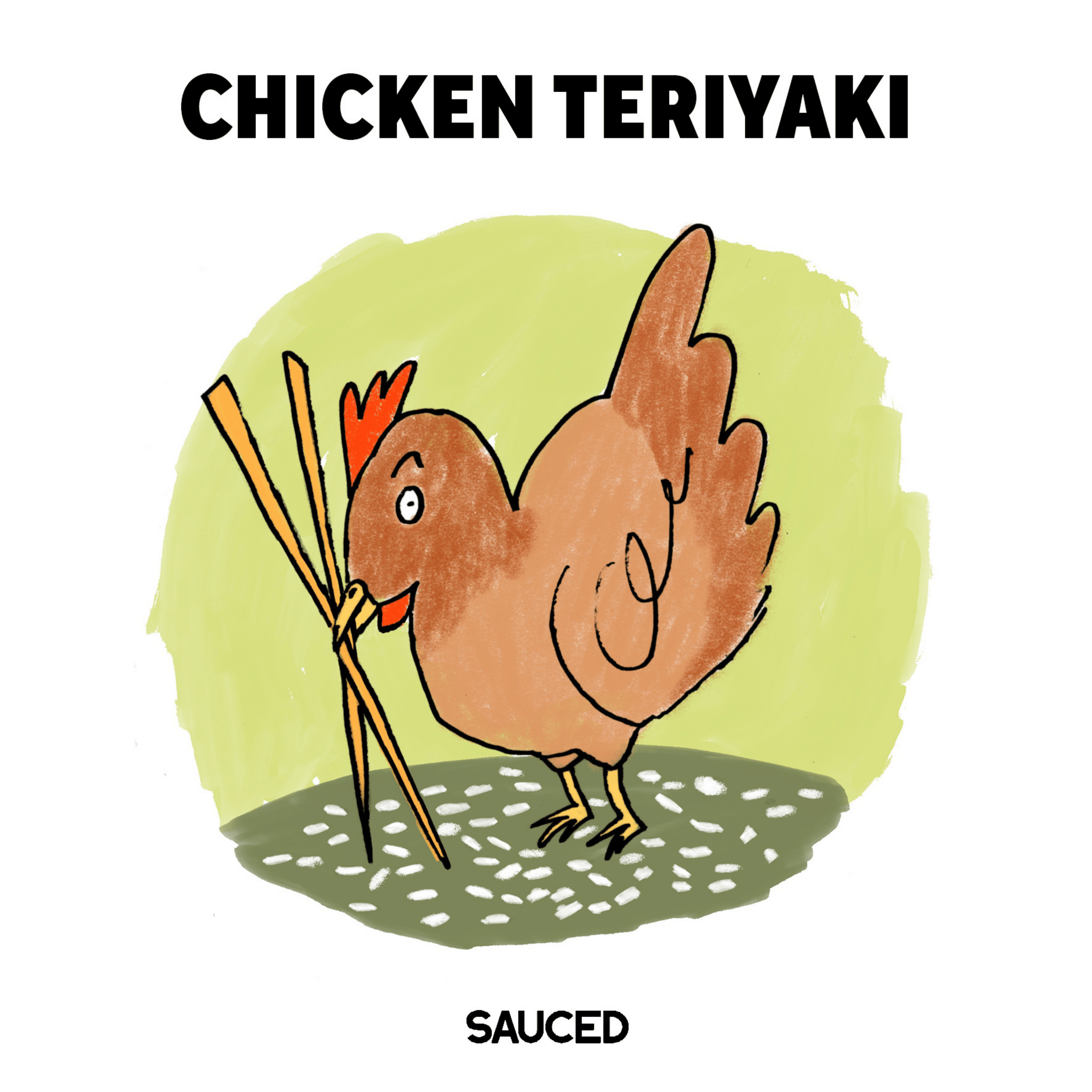
You might think teriyaki is a sauce, but it's a cooking technique: teri means the shine, yaki means grilled, and the name describes lacquering meat over fire, a move made in Japan since the 1600s. The bottle didn't arrive until 1961.
We trace it from an 1813 shrimp dish to the aisle, make the case for the four-ingredient original, and land between traditional and full Seattle.
"You're really doing yourself a disservice if you're buying a jar of this."
What we settled on:
Four ingredients only: soy sauce, sake, mirin, sugar. No cornstarch unless needed
Reduced slowly until glossy; it thickens as it cools
Boneless, skin-on thigh, boned by hand for bigger pieces
Marinate in half the sauce, glaze with the rest
Glazed in coats over high heat until lacquered
Garlic and ginger in, sesame seeds toasted fresh
Full Seattle: iceberg wedge, sweet Kewpie dressing, warm rice
Junmai sake for the pot and the pairing
The Cocktail:
The Pina Yaki: Japanese whisky with yuzu, roasted pineapple syrup, and a little teriyaki sauce shaken in.
RECIPE CARD:
Premium subscriber? Check out the full recipe card here.
LISTEN
EpiSOde Partners
Thanks to the following brands for partnering with Sauced to bring you this episode:
TRANSCRIPT
Tim McKirdy: Sother, Chicken teriyaki. Booze, classically, back in the dish.
Sother Teague: Love this one.
TM: I've learned a lot about this during research for the show. Obviously it's a dish that everyone is familiar with, and a sauce that people are very familiar with as well — I think it would be in most people's pantries or fridges, or you've definitely seen it on the supermarket shelves. But teriyaki, it doesn't mean the sauce. We think that it's teriyaki sauce, but it has a much more specific meaning, the term.
ST: Something about being shiny, right?
TM: So teri means the shine, and yaki means grilled.
ST: There we go. Shiny grilled.
TM: The shine that you get from grilling, in the specific way that you cook this. I believe tare — T-A-R-E — is the name of the sauce itself. Wonderful dish, though.
ST: Delicious. I associate it more with fish than with chicken, but I grew up on the coast. I also associate it with a whole lot of things that are absolutely not traditional.
TM: Well, associating it with fish actually makes you very traditional.
ST: Yeah, but like pineapple — not traditional. Lots of sesame seeds, usually served with broccoli — not really traditional stuff. More heavily leaning on the American style. And definitely my dad would use a jarred sauce, which — seeing now what the traditional ingredients are — I feel like you're really doing yourself a disservice if you're buying a jar of this, because it's so rudimentary.
TM: I would assume that most of the people who listen to this show, especially if they are active home cooks, don't have at least 90% of the ingredients that it takes to make the sauce — which is, of course, soy sauce, or shoyu, sake, which I think is the one that most people might not have —
ST: Oh, wait. Yeah, I don't have sake, but I have the next one.
TM: Like mirin. And sugar.
ST: Sugar, come on. Staple item. Just four ingredients. And then there's plenty of folks who do add some other things, but those are definitely not the traditional way. A little bit of garlic, maybe a little bit of ginger, some scallions, sesame seeds — I see out there all over the place. My mind sees sesame seeds, but definitely not traditional.
TM: I think, too, we've explored dishes through the Italian diaspora, and through the lens of what it means to be Italian American, or what it means to be American Italian. This very much is a dish that's gone on to get an American Japanese identity, and I would say is probably the predominant one throughout the world. Kind of like the Bolognese thing we spoke about recently, where everyone does it quote-unquote wrong — but if that's the way everyone's doing it —
ST: Then that's the way. The obstacle is the way.
TM: I don't think I have ever cooked this professionally.
ST: Definitely not professionally for me, no. But I've made versions of this all my life, back to literally being at home as a kid. I don't know if I've mentioned it on this show, but my dad did most of the cooking in my home, because my mom was an awful cook. And most of the cooking that he did, he did outside on the grill. So I have many memories of dad being out by the grill, brushing chicken legs, or mostly fish, with this sauce.
TM: Makes sense. So, booze in the dish classically, and a tale of origins, a tale of evolution. Getting into the origins now — a word that means shine, like we said. The word dates back to the 1600s onward in Japan, the Edo period. I will be honest, I don't know too much about Japanese history myself. Edo, in case I'm mispronouncing that — apologies if I am.
ST: I think it's edo.
TM: Edo. Brushed grilled fish with a sweetened soy glaze that was caramelized over the grill. Once again, that glaze, the shine that it takes on from that cooking technique, is the teri; the technique itself, the grilling, is the yaki. 1813 comes the first written reference of the word, in a dish named ebi no teriyaki — shrimp teriyaki. So again, seafood, not chicken. And to this day, at least from what I'm able to tell, it's still fish at home in Japan, which is the classic go-to. Oftentimes buri, yellowtail, grilled and glazed. Which is kind of all funny — through the modern lens we think of this as a jarred sauce, a weeknight dish that you make at home, whether it's chicken breast or chicken thigh. But we really kind of look up to yakitori and that kind of grilling technique, and we look at that and we're like, oh my God, this is amazing, this is a delicacy, this is something precious. Whereas we're talking about pretty much exactly the same thing here.
ST: Similar. Yeah.
TM: So, as we said, most people do know this as a sauce that begins, at least stateside, in 1961. Kikkoman — a Japanese company, soy sauce maker from Noda, with family roots going all the way back to the 1600s. It is not an American brand, obviously, but it releases its teriyaki sauce in 1961. It later built its first US plant in Walworth, Wisconsin, in 1973. So, speaking of that — pre-'60s, what are American home cooks using soy sauce for?
ST: Yeah, maybe nothing else. But what they are using at that time is stuff in jars and cans. This is like prime time for the convenience of canned goods and jarred sauces. Ready cooking.
TM: And then you mentioned earlier a lot of stuff that you maybe associate with this, or you've used in this, that's not traditional. It is kind of modern-traditional, though, right? So in Hawaii, where you have a lot of Japanese American population, they had already been adapting this idea of the soy and the mirin and the sake, and introducing things like pineapple to that, and pineapple juice. So it's not the classic mold, but it's not "oh my God, look at these Americans changing everything again." You know what I mean?
ST: Yeah. Let's add some American cheese. How much ketchup do I put in?
TM: Two more legs to our American origins, our American evolution here. One of which: Seattle.
ST: Seattle has a real love affair with teriyaki chicken.
TM: Yes. Dating back to 1976, the master Toshi Kasahara, newly arrived from Japan, opens Toshi's Teriyaki on Roy Street in lower Queen Anne, Seattle. Thirty seats, a short menu of chicken and beef teriyaki with rice and udon, $1.85 a plate.
ST: Wow.
TM: How about that. The Seattle Times critic John Hinterberger praises the sauce, the meat and the rice, and almost overnight Toshi's Teriyaki triples or even quadruples in business.
ST: Wow. Critics can make or break.
TM: It becomes a Seattle staple.
ST: It's a thing there. Every time I've been there, at least at one point we've gone for chicken teriyaki for lunch or dinner.
TM: Once again, this is something codified in its own way, unofficially. We're talking skin-on chicken thigh with the inclusion of garlic and ginger in the glaze, marinated then grilled over the flame, served with rice and oftentimes a salad of a big wedge of iceberg and a kind of sweet mayo dressing. By the late 1990s, teriyaki restaurants in Seattle had outnumbered McDonald's. By 2010 there were more than 80 of them in the city.
ST: Not just this one dude — just teriyaki restaurants.
TM: Name me another American city that has a Japanese grill dish as its default cheap lunch.
ST: I can't. And like I said, I didn't even put it together until you just said it. But when I go out to visit friends and family in Seattle, it's — depending on how long I'm staying — at one point we're having this. And it is exactly as described. Sort of a wedge-style salad, specifically iceberg lettuce, crisp and wet, with a little cabbage maybe, and carrot, and a sweet white sauce, with the teriyaki on rice.
TM: Maybe a Kewpie mayo, some mirin or rice wine vinegar, sugar, all that good stuff. One more Northwest story just to recount. Another fortune that began in a karate school. So Junki Yoshida arrived in Seattle from Kyoto in 1968 to teach karate. He moved to Oregon and began cooking his family's teriyaki-style sauce, first as a gift that he would give out to his students for Christmas. He started making it in his basement in 1982, then he started selling it commercially and grew something of an empire. This became a Costco staple and favorite, to where he sold his brand to Heinz in April 2000. So what began as a Christmas gift sauce prepared in a basement ultimately became a Costco empire, swallowed up by Heinz. But the story doesn't stop there. I think Heinz kind of mismanaged it and ultimately didn't do good things for the brand, to the point where in 2024, Yoshida was able to buy his own name back.
ST: Wow. Twenty-four years later. Wow.
TM: And I kind of love those stories, where someone makes the fortune out of their brand, exits with a decent amount of money, and then is able to get that brand back later down the line — because, as often happens, bigger conglomerates mismanage things.
ST: Yeah. Or they alter things and fall out of favor with the fan base.
TM: And honestly, then that just adds a whole new chapter to the story that I think people who care about these things, these stories, independent stuff, will really love and really go for.
ST: You didn't say the brand.
TM: I did. Did I not?
ST: No. I'm on the edge of my seat here.
TM: Mr. Yoshida's Original Gourmet Sweet Teriyaki Sauce.
ST: That's a long name.
TM: Yes. And if you Google it, the bottles you see there are still the Heinz ones. But then all those questions below it — it's like, what happened to Mr. Yoshida, and all this stuff.
ST: He's back in the game. He's back in the ring for another swing.
TM: I don't know whether we can get the new batch of that yet. I shall need to look into that more. It's certainly not something I've come across in stores. But much like yourself, I don't know whether I'm buying this sauce. It's easy enough to make.
ST: Not only easy enough, but given that it's just a ratio, really, of those four ingredients, you have better control over each one of them. And I think that that's ultimately what you want. Growing up having it in a jar, and now realizing — through this digging around, because I never made this professionally, I've made it at home — but even then, I've either bought the sauce or just made it out of whatever I had lying around. Like a little pantry-cleaning sauce: oh, I've got some soy, I've got some mirin, I've got some black vinegar, I've got some sriracha. You're all over the place, you just call it teriyaki. But now that I know exactly what it should be, I don't want to make this in bulk. This is kind of a pan sauce. But also you can make it in bulk and then just have it around, because it's so easy to make just to order. Everything I dug around and found was making it to order, or making it in very large batches so you can have it, because nothing in here is really not shelf stable. In fact, they're preservatives. So you could make gallons of this stuff and just have it around if you wanted to. But I think just making it to order seems to be the order of the day.
TM: It's like when I make sushi rice at home, right? I'm seasoning it, I have rough ratios, but I'm seasoning it to taste — with rice wine vinegar, with mirin, with whatever else. I could batch those things in the right proportions, and also always have my sushi rice seasoning, but what's the — you know? So those are the origins, and the surprising Seattle, Northwest connection, at least for me.
ST: That is a little surprising. I wouldn't have put it together until you pointed it out.
TM: And our next section to explore here today: the culinary luminaries, and what they have to say about this. It makes sense that this is a dish that our guy Kenji, based out there in Seattle, has had a lot to say about. But we'll put a pin in that for now — or maybe that's where you want to begin, but I'm curious to hear what you've explored yourself.
ST: As far as luminaries go, I found this guy Shizuo Tsuji. And I'm going to apologize in advance for all of the words I'm going to mispronounce throughout this episode. Founder of the Tsuji Culinary Institute, he wrote extensively about this particular preparation as an example of Japanese cooking that emphasizes ingredient quality over heavy seasoning. And again, it's only four ingredients, without the protein or the target — which could be vegetables too, by the way. And he ran an institute. So not only did he write it down and codify it and stand by it, then he taught it. So that helped it proliferate pretty extensively.
TM: He was the author of Japanese Cooking: A Simple Art, published in 1980 — the foundational English-language authority on Japanese technique.
ST: Wow, you dug deeper than me. I found another woman, Elizabeth Andoh. She's an American authority on Japanese cuisine. She moved to Japan in 1967 and lives between both Tokyo and Osaka, and she runs a culinary program called A Taste of Culture. She has done maybe more than anyone, really, for writing about Japanese teriyaki technique in English. So, an English voice who moved there and adopted the cuisine and the traditions. And then another woman, similarly, moved there in 1988 — Nancy Singleton Hachisu. She's from California, but she married a farmer and moved over there. And she's written prolifically, several books. And they all emphasize really what you just said: the simplest approach to cooking, which is kind of like a pillar of Japanese-style cooking. Everything they do is intentional, thoughtful, and relatively simple.
TM: When it comes to that — and you mentioned Americans getting pre-jarred things, and big flavors, and sweetness, and thick, you know, texturally — do you think that is the main distinction between the two cultures and our approaches when it comes to cooking? That emphasis on fewer ingredients but quality ingredients, and balance, and technique, that so much defines Japanese cooking. Whereas America, not to be cliché here, but it's very much like bigger is better, right? Our barbecue sauces, some of our marinades — more smoke, more flavor, more sweetness, more texture, all of that. It's not news to anyone that Americans like to go big or go home. Do you think that's simply what it is, and maybe why we feel less comfortable — like you say, a simple sauce, reducing it down, tasting for balance, seasoning as you go? Do you think that comes more naturally?
ST: Yeah, I do. And I also think that, based on the questions you're asking, the American home cook specifically is too nervous of failure to be adventurous and risky. And it is more of a risk to taste and balance as you go than it is to open up a jar and know that the consistency will be there. So I think that's been ingrained in us. Without getting too philosophical here, I think there's a part about the American cook who doesn't ever want to have a bad experience. And I'm not saying we're shooting for a bad experience — but you have to have some bad experiences to get to the good ones. If you don't have anything to compare to, then you don't understand what good is, either. So then we had that boom in the country where canned and jarred things were highly popular. They were seen as luxury in the beginning. To have a can of green beans was seen as like, oh, I've made it — instead of, oh, I have to string these beans myself. Wow, how plebeian of me. So there was this time where it became luxurious, a status symbol, to have a pantry full of things that were shelf stable. But then that consistency, I think, really was an undertone that burrowed into us, and we have not maybe been able to break those shackles.
TM: I encounter it more when talking about drinks, but I think it's very much true when it comes to cooking or eating as well. The amount of people that say to me, "But I don't have a good palate." When I'm talking about stuff, or almost apologetically, they'll be talking about a wine that they liked, but then caveat it with, "But I don't have a refined palate." And I want to turn around and be like, wait, what? So what, you lost your sense of taste? We all have phenomenal palates.
ST: We're engineered for it. That's how we've survived as a species. The ability to detect potential poisons or hazards is innate to us.
TM: Yes. So when it comes to seasoning — and it's probably one of the earliest things you explore in culinary school — you're certainly not taught how to season. You're taught the tools, you're taught that the outcome is balance, and you're given techniques to mitigate things. If something's bitter, you can add some sweetness, whatever. But it's just practice. And it's super simple. Like you said, it's the fear of failure — that people would rather buy a jar of something than put three or four ingredients in a pan and reduce it down, and ultimately have it not quite be right and then not know how to deal with that.
ST: Right. But again, that's where learning happens. And I think you're right, all of us are born with this incredible palate. What we don't do is have intention about it, and we don't take notes or read books or listen to shows like Sauced, where we can evaluate the things that we're tasting as we go. I remember when I was young and in culinary school, and then I kind of restarted it when I got behind the bar, I would carry around a little notebook — now it's in my notes app on my phone — where I smell and taste everything and write a note down about it. If I'm at the grocery store and I see something I've never seen before, I'm picking it up and smelling it. And if I want it, I'll buy it and go home and taste it. And take notes on everything, because that's where it is. It's vocabulary. They're not saying they don't have a good palate. They're saying, I don't know how to talk about it, because I've never taken time to codify it for myself. My own palate I've yet to explore.
TM: And not to get so deep here, but I think another good analogy is — you look at kids and toddlers, and raising a child, or just witnessing that happening. A baby cries, and a baby has no — a baby is crying to tell you something's wrong. It doesn't have the vocabulary or the means to communicate it beyond "something is wrong." The older we get, the more our vocabulary expands, the more we can be specific about things.
ST: Sure. I'm hungry, I'm wet, I'm tired.
TM: Exactly. I'm too hot. Build your vocabulary when it comes to tasting, seasoning and reps, like you say, because those actions are your culinary vocabulary and understanding. So I think all of us here just being inspired by that — the wonder that is the Japanese approach to cooking, and so many other things. Well, that's been a lot to digest, Sother. I think it's a good time for us to take a quick break now, and after that we'll be back with the non-negotiables.
TM: All right, Sother, we are back with the non-negotiables. A question I've been meaning and are purposefully holding back for you, right now until now — sorry — is the Sauced Chicken Teriyaki: are we going Seattle style, or are we going uber-traditional?
ST: Given that you only just kind of reminded me of the Seattle style, I think we're going traditional. But they're not very far apart, right?
TM: I guess maybe that is the distinction between our non-negotiables and our ingredients and our approaches. But again, just as a reminder to folks, the things that are very Seattle in nature, like we said — the serving, the salad that you get with it, and whatnot. But common ingredients added to the sauce beyond those four: garlic —
ST: Ginger.
TM: Ginger, potentially cornstarch, toasted sesame seeds, like you said. The garlic and the ginger very much are what makes the Seattle approach different.
ST: I'll tell you what — normally on our discussions I'm pretty rigid, but for some reason this dish tells me to be a little bit more relaxed. We got the four. I'm certainly down for some garlic and ginger. I'm certainly down for a healthy squeeze of sriracha or sambal oelek. It's on my non-negotiables list, but I want sesame seeds. For me, I don't know why — my childhood memories.
TM: Oh no, same here. Same here.
ST: I kind of almost want some pineapple, but I could easily let that one go, because I feel like that's not from my childhood — but it's childish for me. I don't know, I'm on the fence.
TM: I think we found a balance.
ST: I do love a good piece of fresh pineapple grilled — not the canned stuff, but a piece of fresh pineapple on the grill. Let's glaze that with the teriyaki sauce and just eat that as a side. I don't know that I need pineapple juice or pineapple chunks in my sauce. But it is evocative of a memory, which is canonically wrong for the sauce, but that's where I'm at.
TM: It's still traditional for some people, and it's still culture. Okay, well, then let's try — as we sometimes fail to — but let's try and keep our eyes on the prize of, okay, what is a non-negotiable in this dish. I'll go with the first one: that tare, that sauce, has to contain soy, sake, mirin and sugar. I mentioned Kenji López earlier has a great video of him making it Seattle style online. Good one for folks to watch if you want to get the visual technique here. One of the things he mentioned in that video that I think is pretty fair is, look, you can go brown sugar, but you've got a lot of big-flavor ingredients happening here, so it's probably diminishing returns. White sugar is probably fine. But those four things are the non-negotiables in the sauce. Where you take it from there, we'll discuss when we get closer to the preparation.
ST: Yeah. And other than a piece of chicken for chicken teriyaki — I'm going to go chicken thigh, boneless.
TM: Same. Skin on or skin off?
ST: Skin on. I want the skin on because I want to maybe get a little crisp on that as well. And then I want them boneless for the cooking, but I'm going to take the bone out myself. There's a couple of reasons for that. When you go to your grocery shop, the chicken thighs that are boned out already are usually much smaller. I'm not exactly sure why that's the case at grocery stores — not the same at your butcher shop, but he's probably buying the same-size chickens for everything he does. So I want to get bone-in chicken thighs and bone them out myself. The secondary reason is because they're larger. And then the other reason is I'm going to save all those bones and make stock, or do something with it myself. In fact, I might go so far — if I don't have a ton of them anyway — as to steep them in the sauce that I'm making. So I'm extracting some bone flavor into the sauce. But maybe not.
TM: I don't know whether I would take that — kind of like the little shrimp stock we've made for dishes in the past. I'd be more inclined to keep it, even if I'm just freezing it until I have enough bones for a stock.
ST: That's what I do.
TM: So, chicken and the sauce ingredients we mentioned are the only ingredient non-negotiables. What about the cooking technique here? Because, as we say, yaki means grilled.
ST: Grilled.
TM: But not everyone has a grill.
ST: If you've got a cast iron pan, I think you're good enough. You can do this in the house. Get your pan hot, because what you're really looking for is getting some of those crispy charred bits on the chicken. So you can do it in a pan. If you've got one of those grill pans, even better. But if not — let's go outside to the grill.
TM: One of the other foundational aspects of this, that dates all the way back to the 1600s when we mentioned it — some folks might just use the sauce as a marinade and then cook it. Other folks might not marinate at all. But the original technique was brushing with that sauce, glazing as you're cooking, to get that teriyaki, to get that —
ST: Lacquered.
TM: — shine. Yes. I would say that is a non-negotiable when it comes to the cooking. And also another great reason why chicken thigh is the one for this: because the fat that you get with that is only going to help with the sauce adhesion, and everything. And also just keeping it juicy. That's why fatty fish as well is another thing you'll be doing for this.
ST: I've even seen it done — I haven't done it, but I've seen people take thinly sliced mortadella and fold it up in crazy ways and skewer it and then grill that and brush it with teriyaki, which sounds delicious to me.
TM: That sounds like a culture shock right there.
ST: That's — where are we going?
TM: Mortadella teriyaki. Well, don't knock it till you've tried it, I guess.
ST: It looked great. I was like, wow, I would eat that right now. It was a video I saw, a little appetizer, hors d'oeuvre kind of thing. And I was like, man, that looks delicious. So I think that's it. High-heat cookery, so we can get some char, brushing — or you know —
TM: Maurice's mirin mop. I'm calling it. That's our Maurice's —
ST: We're mopping as we go.
TM: Maurice's mop. That's our technique. Don't think anything else.
ST: How do you feel about the use of cornstarch, or potato starch, or any kind of thickener?
TM: I saw Kenji doing it, and I know you saw that too. And I was surprised — I think he specifically did it in that video that he specifically called out as Seattle style. So maybe that was where that came in.
ST: I'm not a thousand percent opposed.
TM: This is my position. If you are making the sauce from scratch and you're reducing it down, you have a texture in mind. And you can probably marinate the chicken when the sauce is a little bit thinner. But you have a texture in mind. And if you're tasting this and you're like, okay, this isn't reduced enough yet, and even when it cools it's going to get thicker, it's not going to be there, and it's already salty — go with the cornstarch. I would be guided by texture and taste on that one. Because I think you make this point regularly, and with good reason: there's no point just having arbitrary rules for things, where it's like, I'm pro or against cornstarch.
ST: No beans and chili.
TM: You know? Actually, you actually do have a lot of arbitrary stuff. Four burgers a year, avoids chains —
ST: That's just for me.
TM: I know.
ST: But no beans and chili should be for everybody.
TM: Now he's started this new thing as well, where he's refusing — unless it's strictly necessary — he's refusing to walk the same block twice in New York City.
ST: Yeah, I'm trying to chip off all 89,000 blocks of New York City.
TM: Sother's arbitrary approach — add that one to the bingo card.
ST: Oh my gosh.
TM: No, but I think questioning things that are just like, oh, this is lowbrow, so we wouldn't do it — I think that's why it shocked us with Kenji. But he definitely seems to be a person who cooks with intention.
ST: What shocked me was because I saw somewhere else where he literally said, I kind of am against this. And then to see him do it — I think it's because that was the Seattle. And maybe it just slipped his mind. He does his stuff kind of live, like a live-to recording. He doesn't really do a lot of editing other than the cuts. But I wish he would have maybe said, "I don't normally do this, but this is the Seattle style," or whatever. But it looked delicious. And when I watched it I was like, I want to eat this. So I think that's it for negotiables and non-negotiables. I said I kind of want the ginger and the garlic, I kind of want sesame seeds, toasted of course. And we can have some cornstarch on hand to make a quick slurry, to make our decision on how thick we need the sauce to be, or how balanced we're looking for it to be. I think the other negotiable — and I'm in your camp, I think, as well — I want to marinate.
TM: Yes. The final thing, and then maybe we will be serving this on the side, like you said — grilled pineapple. Just a potential other note here beyond flavor: pineapple carries bromelain, an enzyme that breaks down protein and genuinely tenderizes the meat. Do you want to talk about that process, or how to approach that? Because I think I had an experience once where I did a big layer of chicken thighs that I had seasoned al pastor style, and had a bunch of pineapple sort of in the marinade but also on the skewers with the chicken. And I grilled it, and I came to you and said something weird about the texture of the chicken in the end. What was I experiencing there, and where did I go maybe slightly too far with the pineapple?
ST: If the pineapple was in direct contact with the chicken for too long, the enzyme is breaking down the meat. It's kind of like — at least that surface level of, however big these pieces of chicken were, or how thinly they were sliced — you were getting sort of an almost digested. The texture was like it's already in the process.
TM: Yeah, it was that. Flavor was delicious. It was just over-tenderized, and not in a way where it's like, oh my God, this is like Wagyu beef. It was more like it was strange, almost mushy — not dry.
ST: We did an experiment — when I taught butchery at the culinary school we did it in every cycle of class; classes were two-week cycles — where we would take papaya. Which, by the way, papaya, the seeds are toasted and ground, and they're what's in — I think it's the same thing. Brome... brome...
TM: Bromelain.
ST: Yes, bromelain. That can be extracted from those seeds. They're toasted and ground, and then they're added to your standard store-bought meat tenderizer powders. So we would take a papaya and basically just make a hole in it with my thumb, and then press a piece of pork into it, and then leave it sit in the walk-in for two days, and then come back. And hyperbolically it's basically soup — it's not totally liquid, but it's no longer really meat. So the papaya and the pineapple both have this enzyme in them that will break down protein.
TM: So what I would have done — and I'm remembering this as well — I prepped it the day before. Because I was trying to get the thin chicken, I would have bashed my thighs down, marinated them in this liquid that contained pineapple, and doubled down with the pineapple at regular intervals. Went too far on the pineapple. Okay, well, that's good to know. You used the word for it when I explained it to you, and I'm forgetting it, but I'm sure it'll come back to us. All right, Sother, those have been the non-negotiables — the ingredients, the technique, the Sauced approach. We're sort of semi-Seattle.
ST: I think so. We're our own thing. We're Brooklyn. We're making a Brooklyn Teriyaki.
TM: Brooklyn Teriyaki. Time for us now to take another quick break, and then we'll be back with the preparation. But before we do — we are coming up with this in real time. Regular listeners to the show know where we're going with this. If you want the recipe, folks, we give those out on a weekly basis: digital recipe cards, beautifully designed, along with ad-free listening, one bonus episode per month. This month we got chilies. Chili peppers.
ST: We did a deep dive on peppers.
TM: And at least 50% of the table here is a chili head, folks.
ST: It's me.
TM: The dopamine hit, the chili high.
ST: Sweats. So you get all that stuff for the low, low price of seven bucks a month. And if you sign on for an entire year, we'll cut off 14 bucks, which is two months for free, basically. And that way you don't have to try and listen to the show and jot down amounts and things like that. Just listen to the show, listen to us interact, listen to us build the thing as we fly. And then know that in your inbox you'll get a digital recipe that's gorgeous and well put together and ready to go.
TM: And you know what, folks, as well — if you're thinking, ah, this is good, but they keep mentioning Kenji's over there, he's got his approach. I was astounded to see, and I enjoyed watching, he does exactly the same thing. He's like, look, you're going to watch me make this thing; if you want to sign up, I think they get three recipes a month for seven bucks. But hey, who's comparing?
ST: Listen. Not us.
TM: Not us. Kenji is genuinely a gem, and someone we both look up to in their approach. All right, Sother, let's take that break now, and then let's be back with that preparation.
ST: Let's go.
TM: All right, Sother, we're back. Preparation. I'm going to handle the chicken teriyaki here today. We're going to go with the classic glaze method. We're going to start by making our sauce. So combine your soy sauce, sake, mirin and sugar in a small pan. You're looking at roughly equal proportions of your liquid stuff, and then sugar to taste. Simmer that over a medium heat until we get slightly thickened and glossy. You don't want to take it down too far, and as we mentioned earlier, as that cools it will get thicker. Let it cool to about room temperature. In the meantime, we're going to take those bone-in, skin-on chicken thighs that you've prescribed. We're going to carefully take out that middle bone. We're also going to be looking for parts of the cartilage and stuff — especially when you buy boneless chicken thighs, you're doing that work anyway. You have to look for it. And we want that skin for crisp and fat and deliciousness and juiciness. By the time your sauce has reached room temperature, let's marinate. Let's marinate for half an hour, an hour. Everything's at room temp there. If you're cooking this on the grill, get your fire going. If not, like you said, a good cast iron pan, a big thick one. We're going to get that pretty high-temperature cooking here. We want that Maillard reaction, we want to see the caramelization happening, we want great texture. Because we are skin-on here, we're going to start skin-side down.
ST: Correct.
TM: And we're going to flip that. And ultimately, when it comes to chicken, I do go back and forth. Whereas steak — I know you're a back-and-forth guy with the steak, but some people are like, no, one side and then one side and that's it. I think especially with chicken thighs, you're good and you're safe, so nice even cooking all around. You want internal temperature of about 165.
ST: Yeah, you don't have to go all the way up to 170 or 175, because we're going to have plenty of carryover happening here too. But I would also mention, I want to move this thing around, because I do have it over high heat, whether it's in my pan or on my grill, and I'm looking to get a little bits of char. Not just browning, a little bit past browning — obviously not burning. I've heard the term leoparding, right? Where it's got some little darker spots.
TM: Leoparding — cooking's answer to zebra striping.
ST: Well, someone said it to me. I recently posted a video after our fish tacos — I went and bought myself a tortilla press, and I was talking about how you just get them kind of sort of browning. And some guy said leoparding. So is that a term? I don't know. We could make it one.
TM: It is now. So we're going to get those flipped and cooked through, leoparded nicely, to that 165 internal. If I'm doing this in a pan at this moment, I'm going to drain off the fat that's rendered down, because it's going to make it harder for that sauce to adhere if it's greasy. If I'm doing it over the grill, I really don't need to worry about that. I'm going to take my sauce at this point — actually, you know what I forgot to say —
ST: Ginger and garlic.
TM: We'll do the ginger and garlic as well. And then we'll finish that with toasted sesame seeds. There's nothing more tragic — I've seen some supermarkets sell jars of toasted sesame seeds. No. We toast our sesame seeds a la minute to release all the fragrance. And we peel our celery.
ST: And we peel our celery. Thanks. I know you threw that in for me. Also, I've got a technique that I only recently stumbled across, and I've tried it twice now and it works quite well. I'm keeping a pretty good knob of ginger that's peeled and ready to go in my freezer. Because to try and mince ginger is a little bit maddening, because of the fibrous nature — to try and run it across your microplane is absolutely maddening because of all those fibers. But when it's frozen, it microplanes beautifully. Doesn't get caught up in the blades, because the fibers are stiffened by being frozen. It just slices them. I've only done it twice so far, because it was a recent thing that I saw someone do, and I was like, let me give this a shot. And I love it.
TM: So they cover your ears for a moment here too — you know what else you can do, folks? Get it through a garlic press.
ST: Oh my gosh. But even still, those fibers get caught in that press too.
TM: It's fine, though, if we're freezing. We'll have to check it out. So I've got my sauce, and I've remembered to put those ingredients in it. We're taking a nice little brush for your kitchen, mopping that on. And again, if it's in your pan, you're starting on the top, you're mopping it, and this is obviously going to fall off and around the chicken. And then you're almost like —
ST: Basting.
TM: Yeah, you're basting, and you're sort of shallow-frying the chicken in that sauce. We're going to get a nice beautiful shine on it. That's our teri. I'm going to take it off the grill or out of the pan, and we're going to let it sit and rest for a little bit, because this is a nice juicy tender cut at this point, and we really want that to relax a little bit.
ST: Plus that's also kind of like — I don't know, it tightens up a little.
TM: Almost congeal a little bit. Is that the right way we're looking for here? While we're doing that, I'm going to go for my warm rice — I'm pro rice cooker, although we don't own one. I'm going to take that iceberg. We're going full Seattle, right? I'm going to make a nice wedge. I'm going to whip up a quick dressing of Kewpie mayo, sugar, rice wine vinegar, salt and pepper to taste. Grate some carrots, now that I've gone through my ginger. Toss that together, dress it up. Then beautifully slice that thin chicken thigh — and looking for the right grain as well, you're cutting perpendicularly here, is what we're saying. And probably finish it as well with some extra toasted sesame seeds and some fresh thinly sliced scallions.
ST: My mouth is watering. I haven't had lunch today, and I wish I was in Seattle at Kenji's house.
TM: Well, you can settle for second best. You can go for the Brooklyn Teriyaki.
ST: Yeah. If I could — I fly tomorrow, I'm going off on a trip, so nothing's in my house right now — but now I'm stuck for dinner.
TM: Any other accompaniments, anything else you want to be serving with this?
ST: I like pickles, specifically sort of Japanese pickles, which are tsukemono, if I'm pronouncing that one correctly. Like daikon, and even sometimes there's eggplant and mushroom, but they all somehow remain crunchy. I don't know how you make eggplant pickle crunchy, but they do. I love those pickles, but specifically the daikon — that's the one that's like bright yellow. And then there's burdock, which looks like very skinny carrots. Crunchy, bright, acidic, up against this sweet thing. So that's the only thing I would add. Just a couple of pickles on the side. But that salad sounds great — that sort of sweet, mayonnaise-y Kewpie, specifically, has a lot of umami because it's got plenty of MSG in it. This — I'm in.
TM: The only other thing I might potentially throw your way as well: if I've got a cucumber in the fridge, I'll kind of roughly peel that — doesn't need to be too exact — cut it in like half-inch little chunks, salt it a little bit. Nice refreshing texture. All right, Sother, that's been our preparation. Now it's time to take a quick final break of the day, and then we'll be back with the booze.
TM: All right, we're back. Final section of the show: the drinking with food.
ST: Yes. My favorite section.
TM: Your favorite section.
ST: Yeah. This is calling out for a lot of things, to be honest. Every dish we do, there's more than one answer, and that's the part I love about the drinking segment. And we always kind of start with the same one. Let's start with beer. There's a specific brand out there that I love, Hitachino Nest. They make two different beers that I think would go great with this. I don't know the scale of their brewery, I don't know if they're big enough, but they make two different beers. One is a wit beer, basically a wheat beer that's quite refreshing and easy drinking, and I think that would pair well with this dish, because it's a little bit sweet, so that would be cutting. And then they make a red rice ale that's higher ABV — I think it clocks in around 7 — so that'll get you going as well. That's a little bit more rich. So at it or against it: the other one's crisper, kind of against it, and then the red rice one would be a little bit more full-bodied and kind of go at it.
TM: Where is this brewery based?
ST: Japan, out of nowhere.
TM: Oh, okay. But they distribute here in the US?
ST: Yeah. A bar that I used to frequent had it behind the bar.
TM: Tasty. Alternatively, the bigger mass-market options: Asahi, Sapporo, classic crisp delicious. Or something crisp, delicious, light and refreshing — a Japanese whisky, a Toki highball, could be very tasty.
ST: Oh, of course. I was gonna get to that, but yes.
TM: We shall get to that. Before we do — oftentimes the next category that we will cover is wine. And by all means, a little off-dry Riesling will be tasty here. It's going to work with the savory, the sweet, the fruit, everything. But we're cooking with sake. And important to note as well, we're cooking with Junmai sake. So that would be where I would go for the pairing as well. Sake is brewed, it's not made like wine, but a lot of people attribute it more to a style of drink like wine. So I thought now could be a good — like we were talking about earlier, people get a little bit worried, then armed with a bit more knowledge feel a bit more comfortable, make some mistakes. I think the three most common types of sake styles you're going to come across are Junmai, that I mentioned in the beginning, Ginjo and Daiginjo. The difference in preparation that we have here — these are beverages that are made from rice, and you're going to get into that a little bit more in a second — but the different styles and categories we're talking about are how much the rice is polished, and how much is taken off of the rice essentially before you start the process of trying to turn it into alcohol. Junmai has no polishing, whereas Ginjo and Daiginjo respectively are taken down much further, to 60 and 50-ish percent. What that's going to do is take you from a more full-bodied, savory style that you'll get with your Junmai — more rice-driven, more umami — to fruity, floral, lighter, more delicate, of the Ginjo and Daiginjo. So for this dish, for the fact that it's going to be salty, there's going to be a bunch of big flavors, Junmai is what's going in the sauce and what's —
ST: Junmai's the bigger sort of — it is the most common, because it's the less processed. Right, when you say they're polishing the grains of rice — not one at a time, by the way, it'd be a tremendous strain on the staff — they're taking away some of its starches and sugars, which then result in different levels of fermentation for the brewing, which then result in different flavor profiles. That's a very layman way to kind of describe it. But so the one that's the least processed is the boldest, most savory-flavored one, and that's the Junmai, and that's the one I have on my list. That's what I would have here as well.
TM: Something that is crucial to sake production, and indeed the production of other ingredients in this dish, of course, is —
ST: Koji.
TM: — koji.
ST: So koji's a mold, but it's obviously a beneficial mold that we use to our advantage, which we do all the time when we make cheese or vinegars or other things. We need mold to do things. Japan has been cultivating this particular mold for over 1,300 years, which is crazy to think about. And it's used to make — obviously we're talking about sake, but it's an incredible component in mirin as well, which is also in this dish. But it's also used as a meat tenderizer, it's used in soy sauce, it's used in shoyu, which is kind of like soy sauce. It rears its head so much, in fact, that the Brewing Society of Japan officially declared — and koji's the sort of common word, but the Brewing Society of Japan officially declared Aspergillus oryzae, and I'm probably trashing that, too, commonly known as koji mold, as the national fungus of Japan. I don't think we have a national fungus here in America, but now I wish we did. This guy named Dr. Eiji Ishishima of Tokyo University — the society approved putting forward this as the national fungus back in 2006, in October. He called koji the mold an indispensable engine of Japanese fermentation, and it's responsible for breaking down starches and proteins, making foundational ingredients for producing the things we just talked about: soy sauce, mirin, miso. And so, because of its obvious and tremendous impact on the culture there, October 12th is now informally celebrated as Aspergillus oryzae Day in Japan. So this October 12th, everybody — I don't know what you do to celebrate this, but we'll figure it out, and we will celebrate along with our friends in Japan. And that's my Maurice Mold moment of the show.
TM: Porco patriotic — mould of the show. Or, yeah, we got Maurice with the mop earlier.
ST: Oh yeah, I forgot.
TM: You know, it's interesting, I've been to a North American distillery that uses koji for whisky, in Alberta Premium, up in Canada there, owned by the Suntory Global company these days, so no surprise there. Also, those of us based here in New York City, you don't need to go too far out of the city these days to go to a traditional sake brewery. Or, "traditional" — it's new, it's from the — why am I blanking on the name? It's a very big sake brand from Japan, and they opened up a brewery where they have the CIA, on the CIA campus. What's it called? Just outside New York. Doing a very bad job of giving them their props.
ST: It always made me think of Tarzan. Like, I'm struggling.
TM: Where they have the CIA there is a sake brewery, opened a couple of years ago here.
ST: Is it part of the school program, or is it just adjacent?
TM: I think there must be some kind of commingling. And this is terrible that I don't know all of this stuff, too, because A, I was there for the grand opening, and had this wonderful delegation out from Japan to celebrate, and a whole weekend full of festivities.
ST: Sounds like you had a lot of sake, because the details are hazy.
TM: They have a sparkling sake as well.
ST: Oh my gosh, a sparkling sake — I would be so into that.
TM: It begins with D, and it'll come to us later.
ST: What? Okay, sake is brewed rice fermentation. So sparkling sake — is it not just beer? Is Budweiser sparkling sake?
TM: No, no, it's not. No koji was involved in the brewing of Bud.
ST: Fair enough.
TM: And sadly it's no longer on Netflix, but there was a documentary — I think it was called A Beer and Sake, or whatever — just to show you how insanely hands-on, quite literally, this process is. Of making it, of cultivating and mixing with the koji. And oftentimes the places where they're making this are extremely cold. And honestly, this will confirm everything you know and have come to believe about Japanese dedication to craft and whatnot. Dassai is the name of the sake brewery, and the CIA is based in — still don't know yet. It'll come. In the meantime, what have you got for me, cocktail-wise?
ST: I got some stuff I want to touch on, and then we'll move into a cocktail that I think I created for this dish. Japanese highball, you mentioned it, right? Absolutely the most over-engineered highball there is, especially if you can go somewhere that has the Toki highball machine on hand. I used to have one at one of my bars. We had it refitted and branded for rye, because my place was All-American Whiskey, so it was the Jim Beam Rye Ball, owned by the same company, so they gladly did it for me. So just rock-it cold, straight from your freezer, spirit as cold as you can get it without freezing, sparkling water over ice. That would go swimmingly well with this dish. The Bamboo cocktail — lower ABV, but also it's delicious, it's got some notes that I think tie in well with the flavor notes that are happening here. And then I thought, well, I don't want to go too sweet, because I don't want to run directly towards the sweetness that we're creating by making that sauce, but I do want to use some Japanese whisky. And let's make a sour. So again, I'll leave it up to you to name the thing, I just have it in my notes as the Yakisour. Let's go with Japanese whisky, again something light-bodied like Toki is great. Let's do one and a half ounces of that up against three-quarters of an ounce of yuzu — nice, bright and sharp, that's gonna help cut through this thing. I'm gonna use some sugar, but I'm gonna take a fresh pineapple and peel the skins off of it, lay those skins out on a sheet pan and dust them pretty heavily with some Demerara sugar, and then roast them in my oven until that sugar is bubbly and caramelized. Then I'm gonna take those pineapple shells and put them into a zip-top bag with an equal amount of weight of Demerara sugar, and just allow it to sit for a couple of days in my fridge, and it'll create this beautiful pineapple syrup. I'm gonna put about a quarter of an ounce of that into this, and then have it around to put on ice cream or make other cocktails — it's delicious. I'm gonna go in with just a couple of drops of a product called Wonder Foam. You can find Wonder Foam — specific brand — or there's Fee Foam, and Mrs. Better's makes one. These are just gonna give you the result of using an egg white without having to use the volume of an egg white, or for some people it matters that they can't have egg for whatever reason — it's completely vegan, these products. And it takes very little of them, which means it's not throwing your drink out of balance. Wonder Foam specifically — I don't work for these guys or anything — but four drops, and I can't emphasize drops enough, not dashes, four drops will shake a drink that will have a foam on top of it like you put an egg white in there, which is half an ounce. Four drops, so we're not throwing the balance of the drink off. Here's where I'm gonna get tricky. Once you've got your teriyaki sauce reduced down, I want a solid quarter of an ounce of that in my drink as well. So now we got the Japanese whisky, the yuzu, the pineapple syrup, because I have this desire to put pineapple in this dish or have pineapple associated with it somewhere, bit of Wonder Foam, and then a bit of your sauce. Vigorous shake, serve it strained and up in a well-chilled glass, and that's your cocktail to go with your teriyaki chicken.
TM: Nice. The Pina Yaki.
ST: Pina Yaki. All right.
TM: Cross languages and everything as well. It's not grilled, but we're caramelizing. I've also seen you make pineapple syrups where you've been smoking them and stuff as well. Delicious-sounding cocktail.
ST: Yeah, well, quite a while ago actually, a buddy of mine posted a video of him making a pineapple syrup, and I happened to have literally on my table at that moment a pineapple, which then I peeled and made this exact syrup that I'm talking about. I posted that on my Instagram, so if you're a fan of me you can go check that out — I think it's in my grid at the top. But it came out so freaking delicious.
TM: Nice. All right, Sother, final thoughts for today. What are folks missing out on if they never attempt to make this dish, even if it's only once in their life?
ST: I mean, you got some techniques happening here. You're making effectively a quick sauce — in our case we made it sort of larger to start and then used it as a marinade, but you could also make this as a pan sauce. So you're working some muscles. You can jar this thing. You could make a gallon of this stuff and keep it in a jar, it'll last literally forever. It's made of things that are all preservatives — it's got a lot of sugar, it's got booze in it, it's got a lot of salt in it, so it'll hold forever. So you can do some forward thinking, build your pantry, because the more things you have in your pantry that you can just reach and grab for, the more opportunities you create for yourself to make delicious food and drink. And not to harp too much on it, you're really taking something quite simple, and there's plenty of room here to customize and make it your own. Like we said, it's really the four ingredients, but then I want sesame seeds, and you want ginger and garlic, and maybe I want grilled scallions put into the sauce as well — some or all or none of those things, or pineapple is going to keep rearing its head. It's eminently usable. Obviously we talked about chicken; most traditionally it's fish or even seafood in general, shrimp, certainly vegetables, tofu, seitan. It's kind of like — I don't want to insult anybody — is it the ranch dressing of Japan? Anyway, so you're missing out on just building your pantry, honing your skills, and making something that's delicious as is but eminently customizable.
TM: 100% agree with all of that. I would say as well, that discussion we had earlier when it comes to balance and seasoning and trying things out and not being afraid to make mistakes — this is a great one for it, and the stakes are low. It's hard to get this wrong, and it's always going to end up delicious even if you don't have everything quite in proportion. Then I guess my final thought for us here today was just that I can't believe that we both forgot the Culinary Institute of America is kind of equidistant between Hyde Park and Poughkeepsie.
ST: There we go.
TM: There we go, folks.
ST: Did that come to you, or did you have to search it?
TM: By means of Google Maps and other location-finding services available.
ST: But what am I thinking of? I'm thinking of something about Tarzan. What's the campus in California? It's got a name that always makes — Greystone.
TM: News to me.
ST: Greystone. It's called Greystone. But wasn't Tarzan from Greystoke, England, or something, when he got reunited with his family? I don't know.
TM: No idea. Food for thought on another day.
ST: Also, it's just — how does our mind work? Holy.
TM: All right, so, in the meantime — time to put on the apron.
ST: Break out the shaker.
TM: And let's get cooking.
ST: And drinking, buddy.
TM: Cheers.
ST: Cheers.