Episode 45:
ROAST TURKEY
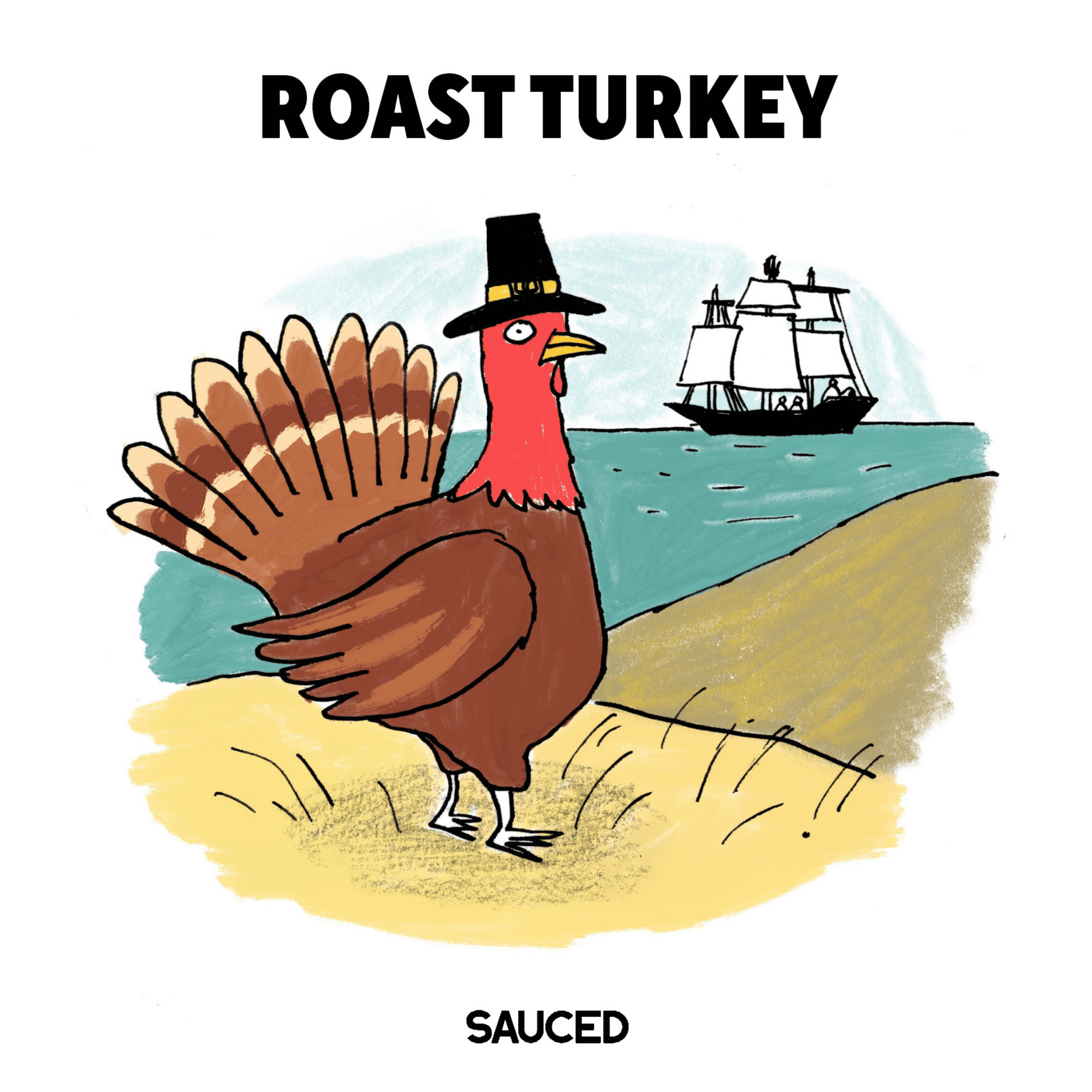
Most of us roast a whole turkey once a year, so ten Thanksgivings of hosting add up to just ten tries. No wonder Roast Turkey so often comes out dry.
So we track down every place the bird goes wrong, and the first is at the store, where a couple of words on the label mean paying for water. From there it's the skin, then the order of the heat, with apple brandy in the butter and Port in the Cranberry Sauce.
"All eyes on the bird."
What we settled on:
A heritage bird, 12 to 14 lb, air-chilled and never injected
Apple brandy butter under the skin and a salt and baking powder brine
One to two days uncovered in the fridge
Low heat first, high heat to finish
A calibrated thermometer instead of the pop-up
No stuffing in the bird, only loose aromatics
A gravy reduced from the drippings and stock, with no roux
The Cocktail:
The Cranberry Sauced, a bourbon sour made with the homemade Cranberry Sauce and topped with a smoking herb.
RECIPE CARD:
Premium subscriber? Check out the full recipe card here.
LISTEN
EpiSOde Partners
Thanks to the following brands for partnering with Sauced to bring you this episode:
TRANSCRIPT
Tim McKirdy: Sother.
Sother Teague: Tim.
TM: The old Roast Turkey. Wow.
ST: Let's talk turkey.
TM: A big bird.
ST: Intimidating for a lot of people. I also think that people lie to themselves a little. They say, "I only eat turkey once a year," and I'm like, it's the number one selling sandwich at every Subway shop. You know what I mean? You eat turkey every day, you just don't think about it.
TM: Well, that's a good point as well, because I was trying to think of the discrepancy here myself, just to kick it off with a little stat. The USDA counts around 46 million turkeys on Thanksgiving tables every year. For this year, the U.S. is projected to raise 199 million turkeys, up three percent from last year. I'm like, where are the other birds going? I was like, well, some people will do Christmas as well.
ST: There's Christmas as well. There's other holidays, other celebratory things.
TM: Friendsgivings.
ST: The bird itself, especially what we're gonna talk about, a whole roasted bird, it's a celebratory tablescape. You know what I mean? This is a serious celebration we're having. There's a whole bird, a huge whole bird. Not just a chicken, this is a big old turkey.
TM: So there's that, but then I'm sure a bunch of it goes to, like, Boar's Head.
ST: Sure, all of your deli meats, and then the dark meat probably winds up in chicken pot pies and things like that. Well, I guess it would be turkey pot pies. But your commodity goods, turkey gravy that's in cans and stuff.
TM: Because I was wondering, 199 million, that's almost two turkeys for every three Americans, and I'm like, that seems like more turkey than I eat. But it's the sandwich, of course it is. To your point, though, about how everyone says, "Oh, I'll eat turkey once a year," Roast Turkey maybe. Can you think of any other dishes or ingredients or proteins where people are like, "This is just a once-a-year thing that I do"?
ST: I mean, here in America we've already discussed how little lamb people eat, but the Catholics in America eat lamb on Easter. In the South, it's quite common for Christmas to have a ham. A whole ham. I can't think of anything else that pops off as really locked into a specific date.
TM: I think the ham's a good one. And again, for our British listeners, that's gonna make sense too, right? You would always boil a ham or roast a ham, or both, and a turkey for the Christmas dinner table. We're saying "roast," and it's in the title here, but it's not technically roasting, is it?
ST: Well, what is it?
TM: Well, I'm quoting a historic-ish cookbook here, Fannie Farmer's Boston Cooking-School Cook Book.
ST: That's not historic-ish, that's historic.
TM: Okay, this is from the 1910 edition. "Roasting" once and originally meant cooking in front of an open fire, and in the book Farmer notes that meats cooked in a range oven, though really baked, are said to be roasted.
ST: Sure. We used to have fire roasted, right? I get it.
TM: Baked turkey doesn't quite work.
ST: It doesn't sell. Gotta flower up the language a little bit. It's marketing.
TM: Well, speaking of marketing, give us your elevator pitch.
ST: The elevator pitch is, Roast Turkey is a whole turkey seasoned with salt, herbs and aromatics, then roasted, well, I guess baked, we just discovered, until the skin is browned and crisp and the meat is cooked through. Traditionally served as the centerpiece of a celebratory meal, notably American Thanksgiving. I go further here, and I say the best of them have a crisp brown skin, succulent white meat, flavorful dark meat and the drippings that become gravy. The worst are an enormous, expensive, overcooked bird that everyone tolerates because tradition says they have to. And I think that's a little bit of the tension for a whole roasted turkey for me. I hear people all the time say, "Oh, Thanksgiving, we don't even make turkey anymore. It's always dry, it's always dry, it's always dry." I contend that it's dry because you're cooking it poorly, and also that you don't have any practice. As we just described, people only cook this dish once a year. So even if you've been in charge of the bird for 10 Thanksgivings, you've only made 10 birds over the course of a decade. And I think that's the problem. Practice makes perfect with everything, including this.
TM: There are real practical excuses that you can give for that. Number one, you buy this generally frozen, so it takes days to thaw, depending on how you're doing that and the size. Number two, it takes up so much space at a time where you're also probably cooking for the most people you will in the year. There's only so much fridge space, freezer space, all of that stuff.
ST: Rangetop space, oven space.
TM: And then number three, it might be your closest friends and family, but you're cooking for a good number of people. There's pressure there, if you're the one putting the centerpiece there. But I agree with you, and I think where I'm approaching this episode, and it's probably not a question for now, but the tension for me in Roast Turkey is, do you go high then low, or low then high?
ST: Well, we'll get there. I have some opinions.
TM: You surprise me.
ST: I've cooked a lot of turkeys, professional and personal experience here. That's kind of our next segment, usually. I used to work for Sutton Place Gourmet in Washington, D.C., when I lived in D.C., and you could order your whole Thanksgiving meal from us, soup to nuts, or just pieces of it, whichever parts you wanted. But it always involved bird. So we were cooking hundreds of turkeys. Hundreds.
TM: In ovens in... right. Nice.
ST: And we had the trailer of a semi truck in the parking lot that was refrigerated. So we boxed them all up with everybody's names on them, and then somebody would have to be out there in the truck, and people would come up with their ticket with their name and you'd have to go find their basket. Insane.
TM: I mean, I do love this time of year, whether it's Thanksgiving, general holidays and holiday traditions, having those special days. Last year, for example, we stayed in New York for Christmas, and a day or two beforehand we went out in the neighborhood, went into Carroll Gardens and bought the supplies, right? Got ourselves a little bit of caviar, looking for some duck fat, the delicacies. And you see all these people doing the same thing in their routines. You got the line outside the fishmongers, you got the line outside the Italian butchers, and it's nice, those recurring traditions, even if it means you're waiting in line or online. We both mentioned as well some of the intimidation factor about this. Are you familiar with Butterball?
ST: Butterball turkeys, of course. Super famous, and I don't want to knock anybody, but not my choice.
TM: The largest U.S. producer of turkey, though. In November 1981, they launched...
ST: Is this the pop-up thing?
TM: The Turkey Talk-Line.
ST: Oh, yeah. And it's a madhouse every year, right?
TM: Six home economists fielded questions from around 11,000 callers that first season, over the course of the season.
ST: Six people fielding 11,000 calls. Crazy.
TM: What do you think the most common question was?
ST: "When's my turkey done?" "Do I have to unwrap it first?"
TM: How to thaw out the bird. Which is that difficult.
ST: Yeah, it is, especially with a chunk of protein of this size, right? It shouldn't seem that crazy for people to come to the same conclusion. You unwrap it and you put it on a rack in your fridge, literal days in advance. For something that dense, it's gonna take 24 hours for every four-ish pounds to thaw in your refrigerator, at around 40 degrees.
TM: A lot longer than it takes to cook each pound.
ST: Indeed. And can you speed this along? Yeah, but the way you would speed along thawing something is difficult to do with something this large. You would sink it in water with cold water running over it, but that's gonna take forever and waste a lot of water. You could do it in your bathtub, sink it in a five-gallon bucket right underneath the faucet and run cold water on it for 10 hours. I would recommend you do that if you're in a pinch. You gotta get it done, right? You bought your bird too late or you mismanaged your time. That's a way to get there. Don't recommend it. I recommend getting your bird early. That's why we're doing this show a little early. Getting your bird early enough that you can thaw it. It's gonna take several days.
TM: Other common errors: make sure you're removing the packet of giblets and neck and whatnot from inside.
ST: Happens all the time. I even have an experience with that at my own family Thanksgiving one year. My Aunt Sheila left the bag of giblets and necks and whatnot inside. Didn't ruin anything, but it was a surprise when we found it. It had shrink-wrapped itself. The plastic bag that it's in had melted around everything.
TM: Oh, my God. Well, just speaking of bags, I think they must do them for turkeys, but have you ever done one of the roast chicken bags?
ST: Roast chicken bag? Oh, no, I've never done that, because for me it just seems like it's just gonna steam it. When we talk about roasting slash baking, we're looking to get that crispy dry exterior, right? And that's never gonna happen in a bag. That's why I've never understood baked potatoes wrapped in foil. That's a steamed potato. It's tasty, but it doesn't have that crispy exterior.
TM: Never done that either. Well, as we mentioned from time to time, oh, you need my friend as a microwave.
ST: It's the one tool notably missing from my kitchen. I don't hate them, I just don't have one. It's a New York City apartment. I don't have room.
TM: Want to dive into a little history now?
ST: Yeah, I think you should, because there's plenty to dig into on this one.
TM: So let's talk about the origins of turkey. It has been domesticated not once but at least twice...
ST: Started in Mexico, right?
TM: In Mesoamerica, south-central Mexico and Central America, and by ancestral Puebloans in the American Southwest, by around 2,000 years ago. Early birds were kept largely for feathers and ritual, not for their meat.
ST: Oh, I didn't know that. So they were domesticating a bird that they weren't eating, just plucking. It's like furriers, I guess. Not eating those minks, but we're getting their skin.
TM: Getting there, yeah. The turkeys we eat descend from the Mesoamerican line. Spanish ships took them back to Europe after the conquest of the Aztecs, where they were bred into new varieties and later brought back to North America. Name-wise, the English name first belonged to a different bird, the guinea fowl.
ST: Guinea fowl. We used to have those on my property when I was a kid. We had a big chunk of land, and we had a bunch of weird animals. Not weird. We had cows, pigs, guinea fowl, chickens, rabbits. I had a clutch of rabbits.
TM: Guinea fowl are what, similar in size to chicken, or a little bit larger?
ST: A little bit larger.
TM: And those reached Western Europe through Turkish merchants in the mid-1500s, and so were therefore called turkeys. The name moved to the New World bird later on. In French they call it dinde, as in d'Inde, I-N-D-E, of India. In Turkish it's hindi. So everyone's just passing it on to probably the step before in the ladder. Thanksgiving, the story Americans learn. The story I recently had to learn.
ST: Was this on your big test?
TM: No, it wasn't, but I just felt I needed the cultural context, so grade me on how I'm doing here.
ST: I mean, I don't know the full story. I have some notes, but I know what you're about to dive into.
TM: Thanksgiving is a U.S. national holiday on the fourth Thursday of November, built around a family meal with a Roast Turkey at the center. This year, if you're listening during 2026, it falls on November 26, two weeks after this episode will air. The story that's taught in American schools: in 1620, the Pilgrims, English religious separatists who had broken from the Church of England, crossed the Atlantic on the Mayflower with 102 passengers and founded Plymouth Colony in what is now Massachusetts. Sadly, around half of them died that first winter. The Wampanoag, the Indigenous people of what is now southeastern Massachusetts, helped the survivors. After their first harvest, in autumn 1621, the two sides shared a feast. That meal is what Americans call the first Thanksgiving, usually pictured with a turkey in the middle of the table.
ST: That's all well and good. I thought you were gonna tell the story of Sarah Josepha Hale. Josepha, I love that. Is this in your notes? Do you wanna tell that story now?
TM: We can do. All I will say is what the record actually shows. There are two written records. One was from that year, sent back to Britain and published the following year, and the second was from a few years down the line, and basically none of the accounts mention turkeys being served. Apparently, yes, some men were sent out fowling, and the Wampanoag leader came with some 90 men, who went out and killed five deer. They feasted for three days. So turkey didn't really feature then. But what you're talking about is Sarah Josepha Hale, a novelist and editor of Godey's Lady's Book, the leading women's magazine of the day. She gave her 1827 novel, Northwood, a Thanksgiving dinner chapter with Roast Turkey at its center, then campaigned for decades for it to become a national holiday.
ST: Decades, that's the story. She was relentless about writing letters to Washington, D.C., to say this should be a national holiday. Relentless. Apparently there are hundreds of letters that she wrote. And finally, I think just sheerly being worn down, the government was like, "Okay, cool, we'll do it."
TM: On October 3, 1863, in the middle of the Civil War, Abraham Lincoln proclaimed that the last Thursday of November become a national day of Thanksgiving, days after a letter from Hale dated September 28 arrived. In 1939, Franklin D. Roosevelt moved it a week earlier to lengthen the Christmas shopping season.
ST: Oh, that's interesting.
TM: Critics called it "Franksgiving."
ST: Capitalism gonna capitalize.
TM: Congress fixed it on the fourth Thursday, signed into law on December 26, 1941. It is worth, and very important for us, to point out the other view. Since 1970, the United American Indians of New England have marked Thanksgiving Day as a National Day of Mourning on Cole's Hill in Plymouth. It began when Wamsutta Frank James, an Aquinnah Wampanoag leader, was barred from giving his speech at Massachusetts' celebration of the Mayflower's 350th anniversary. So something which is supposed to bring people together, sadly, in many cases will continue to divide. But I think we can all get behind the spirit of getting together and cooking together and putting a big old bird on the table.
ST: I mean, that's what this show's all about. Cooking together, getting together. I just would underscore the whole story about Josepha. She didn't invent the turkey dinner, but she helped popularize it as an occasion by being relentless in her letter writing to Washington, D.C. I think that's kinda cool, right? Today we can get a bunch of people to fire off a tweet at somebody and something will get done, because we can all do it at once, but she was writing letters one at a time and mailing them on horseback.
TM: Like regular old Andy Dufresne, Shawshank Redemption, till he got that library.
ST: Exactly. That's a good one.
TM: Well, also, just in terms of things that come up a lot on Sauced, how often do we see people campaigning for an arbitrary rule change, like banning tomato sauce in this dish or that dish? At least this has real, or sort of stretched, roots in something that happened in history, where people came together.
ST: It's a feel-good story in the end. And you know what else brings people together? Literature, right? Granted, Josepha was a writer and editor herself, but Charles Dickens kind of popularized turkey as the Christmas meal through, of course, A Christmas Carol, which came out in 1843. Very memorable scene, of course, where Scrooge buys the Cratchit family a huge turkey. By the way, he bought it on the day of. Now they gotta cook this thing. They're not eating till midnight.
TM: Especially, imagine that they got the gas oven.
ST: Right. Which is replacing the modest goose that they had, which, by the way, I love goose. We got to do a show about goose one day. But it became a symbol of generosity and abundance, and it really resonated with people who read that book, which is kind of everybody. It's a classic. I think it's notable that people were already eating turkey as a holiday Christmas meal in Britain, and then of course it became the centerpiece of Thanksgiving in America. It was already being consumed in a big, showy, celebratory way, but this solidified it. This made it the centerpiece. I think that's cool.
TM: Well, another piece of literature. I know you've got one more to cover, but one that I didn't mention because we jumped to the Sarah Josepha Hale moment, but before that, and a cookbook that's come up for us recently: 1796, Amelia Simmons, American Cookery. As we noted in our Apple Pie episode, the first cookbook written by an American, published in America.
ST: In America, yeah.
TM: It gave a recipe to stuff and roast a turkey or fowl. So it was being cooked, but this was, what, 30 years before the Hale campaign.
ST: Right. I think the last one that, for me, really solidified the popularity of the turkey being the centerpiece of this particular meal is the American poultry industry, right? The breeding of the bird to be broad. They're called broad-breasted, right? So they've got a much bigger breast. The breeding them, the husbandry or whatever that farmers do, to grow faster, to grow plumper and to be more marketable and, I don't know, aesthetically beautiful, right? The birds that we're talking about when Thanksgiving first started were a much thinner, leaner, worked bird, right? The birds were out there doing things. These are farmed birds. They're not doing much. So I think the husbandry and the change of the bird itself, due to the American poultry industry, certainly popularized it as well.
TM: Yeah, and I've got some other stuff for us to explore when we do a little deep dive later on, on turkey. Normally we like to ask, is this a prince or a pauper's dish? I might say it's a different P.
ST: What's that?
TM: It's a pilgrim's dish.
ST: Okay. Yeah, I think due to the thing I just listed, the American poultry industry, it became more accessible to more people, but it certainly had its mantle for a while as a sort of luxury, exorbitant showpiece. So it crossed the divide, as many dishes do, as we see through time, right?
TM: And then if we're going to apply your sort of new guidelines or rules, it takes a lot of time to thaw, to cook. You gotta rest it, carve it. Time is more of a pauper than a prince. But again, you go all the way back to Tudor feasts and stuff, and they would have had these centerpieces, right? The boar's head would have been a classic. There are Christmas carols about that, that I remember from my elementary school days. So those have been the origins, then, I guess.
ST: It's a lot to unpack.
TM: A lot to unpack. Time for us to take our first break of the day, and then we will be back with the culinary luminaries.
ST: There's a lot of those too.
TM: All right, so we're back. The luminaries. What have you got for us?
ST: Wow. A lot, to be honest. Again, plenty to unpack on this symbol of opulence and celebration, right? Starting with Julia Child, in her book The Way to Cook. She likes high then low, as you brought up, right? High temperature method, starting at 500 degrees for the first 30 or so minutes and reducing to 450, and then adding in chopped vegetables to be underneath the bird and a bit of liquid or stock to catch the drippings, that you can then make the gravy from. She said roasting a whole turkey is not just something you throw in the oven and hope for the best, right? You gotta be thoughtful about it. Pépin, oh, man, he takes a crazy turn. Did you read about this?
TM: Does he go 500?
ST: He steams the bird first for 30 minutes. Steaming it for 30 minutes and then roasting at 375 until finished. And he also makes some sort of strategic slices in the thigh and knee joint and at the wing joint to help it cook a little quicker around those areas that need a higher temperature.
TM: Is this Jacques being Jacques again, trying to cook things faster?
ST: I don't know about faster, necessarily. It's a turkey. You're not going to really speed up the program here, but he just claimed that the steaming created a moist cooking environment and then tightened the skin. I don't know if you remember, but just recently I grilled two ducks on my grill, but before I grilled them, I plunged them in boiling water to tighten the skin, right? So I think there's something to be said for that. I don't know that I would steam it and then get it right into the oven. If I were to do this method, I would steam it and then park it in my fridge for 24 hours and let that skin get really dry. Because, again, that moist environment, how are you going to get brown and crisp? I don't see how you're going to achieve the goal. Together, on their television program on KQED, Pépin and Child did a ballotine. Do you know what a ballotine is? Does our guest know... does our listener know what a ballotine is? There's ballotine and galantine. Do you remember the difference?
TM: Yes. So you debone something, you take it completely apart, and then you're putting it back together in a large sausage. As far as I can remember, a ballotine uses meat from something different to wrap it in, whereas a galantine uses the skin of the thing.
ST: Not necessarily. So ballotine, generally, if we're talking about poultry, we're going to debone it whole and not really tear it apart, right? You can surgically go in with your knife and get the bones out and leave the bird still whole. Then you're likely going to stuff it with something, a forcemeat or some sort of stuffing, back into its sort of original shape, if it's the whole bird. Ballotine almost always gets served hot. Galantine almost always gets served cold. That's really the difference.
TM: I'd like a third-party check on that.
ST: Our listener is the third party. They'll Google it. They'll check us. Once again, you put something out on the internet, if you don't know the answer, you'll get it right away. So someone will chime in, but I'm pretty right.
TM: I've made a lot of ballotines in my time. Never liked that.
ST: But they did a ballotine together on TV, which was a great example of how two culinary giants can come together and break tradition and do something else. Pretty cool to watch them do. James Beard: I couldn't really find anything specifically about a Roast Turkey that was germane to our conversation, but of course he's a champion of American cuisine on the culinary landscape in general. We've talked about Irma Rombauer before. The Joy of Cooking helped make turkey preparation accessible for generations of Americans. The book came out in the early 1900s. You just mentioned Fannie Farmer and her Boston Cooking-School Cook Book. She helped codify the practical, domestic cooking traditions of turkey in the late 19th and 20th centuries. And then I've got kind of an outlier here, not necessarily a culinary luminary, but the painting Freedom from Want, by Norman Rockwell. I bet you didn't know the title of the painting, because I didn't.
TM: No.
ST: But you can picture it as soon as I say Norman Rockwell, right? That grandmother coming down on the table with that humongous bird, and the table's looking at her adoringly, at that bird, with the excitement. That painting, I think, and its popularity, is a humongous factor in solidifying that that's the thing you eat on this day.
TM: Yeah, I can see that. And again, it's like in our Apple Pie episode last week, where we're talking about how does something become American, and the symbolism. I think that picture that you painted for us verbally, with the flag and the eagle and the Apple Pie, we can add someone just walking through the room with a turkey at the right time of year, right?
ST: On a big silver platter with some greenery underneath it or something.
TM: What it means to be American. Very cool. Well, I just had one more as well that I looked into. If I'm looking at technical stuff, for science, I always like to see what Cook's Illustrated has to say. Did you get your subscription yet, by the way?
ST: My first issue hasn't arrived yet. It's only a quarterly, so it doesn't come out that quick. I just subscribed a couple weeks ago.
TM: Nice. They start theirs breast side down.
ST: I've seen this technique.
TM: The thinking being that gravity and the juices will collect in the breast. I don't know. I think there's a lot of pseudoscience when it comes to doing this, and I think it's one of those, kind of to your point about what Jacques was doing, where people introduce steps to make their life easier or make it safer, a more fail-safe technique. But at what point are you adding so many steps that you're making your life more complicated?
ST: Right. It's like searching around your apartment for an hour for the remote control, instead of just walking over and turning on the TV. You've worked yourself harder than to try and work less hard.
TM: Exactly that. Or in mixology and making cocktails, like a reverse dry shake. Let's just get your shaking right first time around. You'll be all right.
ST: I mean, you didn't mean to, but you might be foreshadowing.
TM: Oh, maybe, maybe. All right, well, those have been the culinary luminaries, our sort of leading voices in American cooking and beyond, on what they have to say about the Roast Turkey. Time for our second break today, and then we'll be back with the non-negotiables.
ST: Non-negotiable.
TM: All right, so we're back. Non-negotiables. Number one.
ST: Number one, it's a turkey. We have to have a turkey. I think going one step further on the non-negotiable, it's a whole turkey.
TM: Yes.
ST: Okay, cool. I thought you were going to maybe fight me on that. I thought maybe you'd just do, like, the...
TM: The crown? Nah. Dark meat's the best.
ST: Dark meat is the best, but it's the cooking issue that we're going to have to get into. But I'm game for the whole bird.
TM: No pun intended.
ST: Game for the whole bird. It's not a game bird anymore. Fully intact. Spatchcocking? Not if I want it to be a presentation piece. You know what I mean? And that's what I want out of this thing. It's a presentation. I want that wow factor. I want all those eyes on me when I'm bringing that thing, or whoever's bringing it to the table. I'll cook it, someone else can bring it, I don't care. But I want all eyes on the bird.
TM: Exactly. Do you want a heritage turkey or do you want a supermarket bird?
ST: I probably want a heritage turkey. And that'll help with some of the issue of getting the legs and thighs cooked in tandem, because the problem is the legs and thighs versus that massive breast. The breast is taking too much heat.
TM: So, the heritage turkey. The Livestock Conservancy, a nonprofit that protects rare farm breeds, sets three criteria. It must mate naturally, live a long, productive life outdoors and grow at a slow to moderate rate.
ST: What is long in this scenario?
TM: So it's basically, like, X amount of time to reach X weight.
ST: Right. Which is the absolute opposite of factory-farmed birds, right? They want the least amount of time for the maximum amount of weight.
TM: Yes. We're talking, well, supermarket birds take 26 to 28 weeks, so I would imagine it would be at least 50 percent longer than that. If we're talking sort of longer and slower, like you mentioned, the supermarket bird, the first one, the Broad Breasted Bronze of the 1930s, still mated naturally and took 26 to 28 weeks to reach market weight. By the 1960s, they'd introduced a new one, like those Apples just rolling out a new launch. New turkey launch. The Broad Breasted White had been developed and soon passed the Bronze in popularity. Today both of those birds are still sold, but both need artificial insemination to fertilize eggs.
ST: Wow.
TM: So I don't know, something about that's a bit weird.
ST: How is that not pushing the price up? You have to do this for every single bird. That seems crazy.
TM: True. Well, it was like the whole saffron thing, of every single one needing to be germinated by hand. But then again, saffron, pound for pound, is a little bit more expensive.
ST: Yeah, exactly.
TM: Wholesale frozen hens rose sharply in price in 2025, last year, from 99 cents per pound the year before to around $1.68 a pound, because of the avian flu that was happening at the time.
ST: That's an incredible increase. What did you say, about 50 percent?
TM: Even more. 99 cents a pound to $1.68. About 70 percent increase.
ST: Wow. Incredible.
TM: And then finally, just as you said, the heritage bird's more even split of dark and white meat ensures it will cook a little bit faster, but also cook more evenly. Okay, so we're going heritage.
ST: Which is going to be a little more expensive, and you need to get it from your butcher, whose name you know.
TM: Your butcher. Exactly.
ST: I'm getting mine from Muddy. His name is John, but he goes by Muddy.
TM: Muddy John. Some breeds to account for, just especially if you're a Sauced fan: the Bourbon Red.
ST: Bourbon Red.
TM: The Narragansett.
ST: The Narragansett. Crush it like Quint.
TM: The beer of the clam.
ST: The beer of the clam.
TM: The turkey of my heart. And then you've got Standard Bronze, Black, Slate, White Holland and so on and so forth. All right, we're going heritage. Love it. Next non-negotiable.
ST: You're up.
TM: Got to be roasted.
ST: Yes. But not necessarily with an open fire. That'd be nice.
TM: Yeah. An Aga. You ever cooked on an Aga?
ST: Oh, those ovens.
TM: They're like the farm ranges that they have in the U.K. They're basically going all the time. I've never cooked on one. I've stayed at places that had them. Where do you land? Let's talk about it. High to low or low to high?
ST: I think I'm high to low. And you already can see that you want to fight me. Okay, let's debate.
TM: I don't know. Talk to me about your philosophy behind high to low.
ST: I'm just trying to get that initial sort of rendering and crisp on the skin of the breast, and then lowering the temperature to continue to cook. Am I wrong?
TM: But why do you need to seal it in the beginning? That's my question.
ST: Just conventional approach. I've never really given it that much thought. That's just kind of always how I've done it.
TM: I think a lot of the wisdom out there is that you seal it first to lock in the juices.
ST: Oh, no, we're not locking anything in. We're not locking anything in. I just think we're getting that, what do you call it when you're baking? Oven spring. That initial burst of heat, and then you lower the temperature, when you're baking breads or whatever. Not that I'm looking to get my turkey to spring, to plump up like my bread rising.
TM: So I hear where you're coming from there. But I think the quote-unquote common knowledge people cite is that you sear it so you lock the juices in. And in fact, there have been tests done, including by Serious Eats, where the seared-first or the high-heat-first roast actually lost more juice than one that was seared at the end. Mine is non-scientific in a certain sense. I guess it was how I was taught by my chef as well. But I go low to high, because I think about it like this, right? This is something that we cook for a very long time.
ST: You're already swaying me. I'm already picturing it in my mind, but go ahead.
TM: We're going to have it out at room temperature beforehand, right? We've done a lot of work to dry the skin out. We do want to get that crisp skin. But I think of the shock of something. Okay, even if you have it at room temperature, going into that hot oven straight away, I just feel like, how is that not tensing up the bird, like Jacques was doing, right? Think about it a different way. Something we both love: cooking low and slow. Pork shoulder in the barbecue. We don't try and sear it first and then go low. We go gentle. Let's bring it up gradually. Let's bring it up. And then when we have the temperature that we want, then we control the crisping and the browning.
ST: You're right. I'm swayed. I'm fully swayed. So we go low, then high.
TM: Low then high. I think it just allows you to keep a little bit more control as well. Because the other thing as well is, people go high first, and let's put some numbers on this, right? I'm calling high, like, 450, and low, like, 325. And I think, scientifically and medically, you don't want to go below 325, just kind of danger zone. People will color first, drop the temperature, and then towards the end of the cooking...
ST: Tent it.
TM: Yeah. Why would you do that? That skin that you wanted to get crisp, now you're steaming it.
ST: Because they're worried. You're right, this is all backwards. Now you're tenting it and you're steaming it. I don't use the tent method, but I get you. I hear you loud and clear. So it's gonna be low, then high, and then that way we can control the crispiness of the skin and its browning. To be honest, I'm sold.
TM: Next non-negotiable for you.
ST: So it's hard, because Roast Turkey is such a broad-stroke item, you know, target item. So I just wrote proper seasoning. Salt is essential. Aromatics and herbs can be variable. I think for Thanksgiving we're still probably aiming at some of the same things, right? I want sage, maybe some thyme. I don't know if I want rosemary on my Thanksgiving turkey, but maybe. So, proper seasoning is what I wrote for my non-negotiable, because there aren't really many more non-negotiables.
TM: Would you include baking soda in that seasoning, for the skin?
ST: You know, I've never done it for turkey, and we certainly could, right? I do it for chicken all the time. I think maybe I just haven't thought about it for turkey. Maybe I have done it and I've just forgotten, because, again, you cook this thing once a year.
TM: My one would be, and this really does test the limits of my own barrier when it comes to is something a non-negotiable, like, can you tell when someone served you this...
ST: Right, so no, it doesn't really cut it for non-negotiable.
TM: But I think it does, because if you're talking about mastering it and cooking it, a non-negotiable for me is that I'm putting butter between that skin and those breasts.
ST: So that's proper seasoning. So when we get into the technical considerations and the methodology, I'm gonna say we've got probably an herbed butter. So all those herbs I just said, folded into some soft butter that goes underneath the skin. Then let's do the baking soda seasoning situation, with salt, on the exterior. Then it's gonna sit in my freezer for probably one... fridge, rather, refrigerator, for probably one, if not two days, with a fan. I have a little battery-powered fan that I can put in my fridge, blowing on it to get it nice and dry. That's gonna really help us ensure... We just bought two insurance policies on that crispy skin, right? Using the baking soda method and a fan drying, and getting that butter under the skin early. That way I'm not getting butter all over the place when I've now tried to create this dry skin, because butter, don't forget, has water in it, so there's some moisture to it.
TM: A maybe unexpected point for us to mention booze here, when it comes to butter, skin, water and stuff. You said we'll get into it, but this could be a great opportunity to make a compound butter, like we did for Oysters Rockefeller, with herbs. What if we also put some booze in there?
ST: Let's go.
TM: Great. But speaking of butter and booze, did you see this thing that Martha Stewart does with cheesecloth?
ST: I mean, she does a lot of things with cheesecloth. You gotta be a little bit more clear.
TM: For Roast Turkey specifically.
ST: Oh, is she one of those ones who kind of soaks it and then lays it over the skin?
TM: Soaks it in melted butter and white wine, then lays it over the skin and then bastes it every, like, 30 minutes. What is that?
ST: No, I'll tell you what it is. And it doesn't have zero use. Sadly, it kind of harkens back to what I said at the top of the show, that we do a lot of things and we suffer a dry turkey just for tradition. It's gonna make, in modern-day terms, we call it an Instagrammable bird. It's gonna make your centerpiece look gorgeous. This is food styling. This isn't food cooking. You know what I mean? You're gonna come out with an evenly brown... Mine's gonna be brown, but it's not gonna be one color. So I think that's what that's getting for her.
TM: I mean, Martha loves styling with costumes.
ST: Of course, that's her whole brand. And I don't fight her on that.
TM: All right, what is the next non-negotiable for you, then?
ST: Wow. I mean, we've kind of weirdly covered one of them. I said rendered brown skin, but we already kind of covered that. So I would say properly cooked meat, right? We gotta cook this thing correctly. Again, to tie into what we just said about Martha Stewart, that bird with all that basting, which I think is a waste of time. You're opening the oven, you're dropping the temperature, you're wetting the bird, it's harder to get it brown, you're doing that cheesecloth thing. That's just extra work for yourself. You're gonna have a beautiful bird, but it's not gonna be properly cooked, right? I'm okay if the bird has some flaws in its visual effect. I'm not okay if it has flaws in the cook.
TM: I think we can get into technical considerations, or we can get into negotiable ingredients and sides, but I would say, for me, a non-negotiable if I'm having Roast Turkey: I need on the side a gravy made from the drippings.
ST: Oh, sure. From the drippings, yeah.
TM: The jus. What is it? A jus rôti, I think, is maybe the French term for it. Like a roast. And then the other one, this will bridge us into technical considerations, and low-key difficult to get right: resting for the right amount of time before you serve.
ST: It's on my list. It is on my list, resting period. And then I think for my maybe last non-negotiable, from me, you may have more: a reliable, calibrated thermometer is a non-negotiable in this case. There's no point in trying to guess on a bird of this shape and size and this importance. People are really relying on this thing to be good. And I would also point out, even the people that I eat Thanksgiving with every year, they're almost thinking that it isn't gonna be good. They're betting against it, in a weird way. They want it to be good, but they're not as hopeful. That's why people have stopped... I think turkey is on the decline as the centerpiece of the Thanksgiving meal.
TM: Wow.
ST: Because people are like, "Eh, it's always dry." We're gonna have two turkeys at my dinner this year with the people I'm having Thanksgiving with. I'm bringing one, but I'm smoking it. They asked me to bring a smoked bird.
TM: Interesting.
ST: And at the house that I'll take mine to, they're roasting the bird. So we'll have a roast bird and a smoked bird.
TM: Well, your reliable thermometer...
ST: Reliable meaning make sure it's calibrated. That's the reliable part.
TM: Meaning don't trust that little thing that's in the breast already, that says it pops out when it's done.
ST: Oh, my God. First of all, please don't buy that bird. We'll get into that too, right? But yeah, a reliable thermometer, not that pop-up. That's what I thought you were gonna bring up about Butterball.
TM: Breast, 150 degrees. Red meat, thighs, legs, 175. Just get one of those thermometers, because that's why you're overcooking it. Because you're worried about serving it raw. Take the guessing out. All right, another technical consideration. So I was saying resting, because you need to let it rest before you carve it, but you can't let it rest for so long that it gets cold. The gravy is going to be your friend there.
ST: Correct.
TM: What you have to do before anything goes anywhere near heat, any oven: take the wishbone out.
ST: I mean, yeah, that's what I do with every chicken. The only thing I would say about the turkey is, yes, get the wishbone out of there, but put it on the rack or put it with the vegetables and cook it, because we still wanna make a wish, and you can't make a wish with a raw turkey bone.
TM: No. I'm not saying eliminate it from the equation, but it's just going to leave so much less meat on the bone when you're carving. Any other considerations or negotiable ingredients for you?
ST: You know, for a long time, because of my relationship with another show I was on, brining was kind of always in play, but I don't think I'm in the brine camp anymore. Now I'm in the dry brining camp. I think that had its day, and it should've, and it was popular and it worked, but it's too much work and the result isn't what you want. So I say...
TM: Dry brine. We're going to go with a mix of salt and baking powder, and we're going to go one tablespoon for every... one teaspoon?
ST: Teaspoon for every pound.
TM: Teaspoon for every pound of meat. What is that in grams? Who knows.
ST: I think I would wrap it up by saying we talked about heritage versus conventional farmed birds. I think we also should at least touch on the market terminology around those birds, right? Air-chilled versus water-chilled, right? Water-chilled turkeys are exactly that. They're submerged in cold water to chill them when they're first being dispatched and butchered. But they absorb a pretty large amount of that water. So then what you're buying is water. You're paying for water, and that's gonna, A, not be as flavorful of meat. It's diluting the meat. B, it's going to be a little bit harder to get that dry, crispy skin on the exterior. So I would go for air-chilled versus water-chilled. And then you gotta look out for natural versus injected, and those are the things that'll be on the label. Injected just means that they've injected it with a brine solution, just water, salt, broth and sugar. Like a regular brine, they're just injecting it. But again, that can add four to 10 percent weight to the bird itself, which, again, even though it's adding a flavorful liquid, it's diluting the flavor of the turkey itself, right?
TM: Whoa.
ST: And the words you want to look for on the packaging will be "enhanced" or "self-basting," and that means it's been injected.
TM: I was just going to say as well, the other worry you have here, though, maybe not on an industrial scale, but if you're injecting breast meat with water and then you freeze it to ship it and sell it, what happens? The water expands, you rupture cells.
ST: Yeah, the texture of the meat itself is a little bit... mushy's a strong word, right?
TM: Mealy. Well, that's down to cooking too.
ST: But there is a textural difference as well. You don't want that in this scenario.
TM: I think I'm just going heritage from here on out.
ST: I hope so, but also I understand economics. I also understand that our listeners are maybe in places where that's not even an option. Just be at least knowledgeable, so you know what you've got on your hands, and then you can approach it in the way that it should be approached.
TM: Fantastic.
ST: I just wanted to at least touch on that.
TM: No, I think very, very useful terms to know and to arm ourselves with, especially if you're going into the supermarket or whatnot.
ST: So again, air-chilled and natural versus injected are what you're looking for. And beyond that, look for heritage, which are almost always gonna be those things.
TM: All right, well, those have been the non-negotiables. We'll take another break now, and then, Sother, we will be back with the official Sauced Roasted Turkey.
ST: Wow.
TM: All right, Sother, it's the preparation. A couple of last-minute things for us to decide before we get into that. We spoke about turkey at length. We didn't get into sizes, really.
ST: Sizes. I'm gonna shoot for a 12- to 14-pound bird every time. That's gonna get easily enough food for 10 to 12 people, fully, but if you're having less than that many guests, you'll have plenty of leftovers for sandwiches or pot pies or what have you. And I would even go further and say...
TM: Curry.
ST: Curry, yes. I would even go further and say if you've got more guests than that, do not get a larger bird. Get two birds of this size. Same as when I go to Peter Luger Steak House and they've got the porterhouse for two or the porterhouse for four. If there's four of us, we're getting two porterhouses for two. It's gonna be a better steak. This would be a better bird.
TM: Nice. We didn't even get into it, but I think that's because we were both so much on the same page that neither of us brought it up. Stuffing.
ST: Oh, no, we're not stuffing this bird. Stuffing changes the dynamic of the cook. It changes the temperature that you need to get the whole thing up to. You're almost always, in my opinion, gonna overcook the bird, because you gotta get the stuffing to 165 degrees, because it's inside of the bird, and that's food safety, et cetera. Make dressing. Dressing is stuffing, but it's made on the side.
TM: You know whose stuffing recipe I'm going to use?
ST: Who's that? Dave Arnold?
TM: Dave Arnold.
ST: Yeah, it's his mom's recipe.
TM: Legendary. From the Cooking Issues podcast, where we were lucky enough to be guests earlier this year.
ST: He posts it every year.
TM: You know what he also does? I think it's on the podcast that David Chang used to do, not The David Chang Show, and our mutual friend and judge at the LA Spirits Awards, John deBary, would be on there a lot. I'm forgetting what it's called.
ST: Recipe Club.
TM: Recipe Club. The Ringer. I listened to that episode. They did a Thanksgiving one. I mean, it's as chaotic as you can imagine, knowing Dave and knowing that lineup. But he completely debones his and then puts it all back together with meat glue. Hats off to you, Dave. I'm not doing that personally, but last year was the first year I ever did his mom's stuffing recipe, and it's fantastic.
ST: Yeah, it sounds great. I would remind the listener that a 14-pound bird is gonna take three days to thaw. I said it earlier in the episode: it's 24 hours for every four to five pounds. So just bear that in mind.
TM: Okay. Final thing from me, just because we were talking about stuffing before we get into the preparation here: I am going to put some stuff in that cavity instead, though.
ST: Oh, some aromatics.
TM: Some aromatics. I'll cut an onion in half, some garlic.
ST: Maybe a lemon. I'm all for that, but you don't want it packed. Again, you don't want it to create a density that then has to achieve that temperature. You want some stuff in there that's just gonna give some aromas. Some herbs, a stick or two of celery, half an onion.
TM: There we go. All right. So I think we're in the spirit of getting together, and we found a little groove on this last week. Let's do the preparation. We'll go back and forth. I'm going to hand it to you first. Your bird is thawed.
ST: My bird is thawed. So now that it's thawed... well, we have one preparation in advance of that, that we decided on the show here together, live. We're going to make a compound butter. So let's get some finely diced shallots, some herbs of our choice and our liking that are going to match with our meal, which is pretty much... we're all having the same meal, right? There's going to be green beans and sweet potatoes. All the same things are there. We've tried it over and over, we know it works. So get your herbs, get some finely diced shallots, sautéed in just a little bit of butter to get them softened. Throw in the herbs, so that they'll open up into that little bit of butter that's in the pan. Get that out and get it cooled, and then fold it into soft butter. And then that's your compound butter that's going to go underneath the skin. Then I'm going to take that baking powder and salt mixture that we talked about and get it all over the skin, all over the bird. I'm going to put it on a rack, so that it's got airflow underneath as well. I'm going to put it back in my fridge for at least another day, with a little battery-powered fan. You may or may not have that, but at least get it in your fridge, uncovered, and let that skin get as dry as possible before we move on.
TM: Fantastic. And that is a lot of the work done so far.
ST: Well, it's a lot of passive stuff.
TM: A lot of passive stuff, a lot of space, as we said. But that's going to set you up for success. So, day of, we're going to pull that bird out early doors, just to bring it back up to room temperature, or as close as possible, to get rid of the fridge chill from it.
ST: Yeah, while you're getting everything ready, while you're getting the oven preheated, while you're getting your mirepoix whacked up or what have you.
TM: And those are going to be the next things that I'm doing. Preheating my oven to 325, and roughly chopping some mirepoix: carrots, onions, celery, maybe a leek if you have it on hand, garlic, bay leaf, thyme, rosemary, all into a nice, generously sized roasting tin. We're going to keep our bird on the rack. We're going to set it above that mirepoix, or you can set it directly on there, but, look, airflow is never a bad thing when we're roasting. Then, when the oven's hit 325, I'm still going to leave it another 15, 30 minutes, because I don't really trust these ovens when they say they're at a certain temperature.
ST: I have a separate thermometer inside my oven.
TM: Oh, okay, great. And I was going to say, too, if you have one of those Bluetooth thermometers, like I do, now's the time it's going to go in. Or have your other one on hand, ready to check at certain intervals.
ST: I mean, I've still got my Polder, you know, the one that's wired. I've had it for, I'm going to say, over 20 years. It still works. I check it every time. By the way, we mentioned having a reliable...
TM: Calibrated.
ST: ...thermometer. So I'm going to dunk my thermometer into a glass full of ice and water, and it should read 32 degrees. That's what that temperature is, right? And then I'm going to go the opposite way. I'm going to boil a little bit of water, and I'm going to dunk it in there, and it should say 212. That's how we know that we're calibrated.
TM: Good way. Turkey goes in the oven. Then what are we checking? How long are we cooking for? Obviously, our final guide is the temperature, but what's next?
ST: I mean, now's the time to pour yourself a glass of wine and hang out, I guess, because there's not much to do for the turkey. But obviously this meal has a lot of moving parts, so you're probably going to be working on some other stuff. I don't think you even need to bother opening the door and checking on this thing, especially if you've got a thermometer that's giving you a constant read. You don't need to bother opening the door and checking on this thing for at least the first hour, hour and a half, right?
TM: And then we said, if we are going higher, what temperature are we thinking here? We want a final temperature of 150 to 155, highest, on the breast. So are we going to look at, like, what, 135, 140 before we crank the heat to get that crisping?
ST: I think so. And again, that's going to be around hour three for a 14-pound... our bird's 14 pounds. So for a 14-pound bird, we're looking at around the three to three-and-a-half-hour mark, and then we're going to crank it up for that last 30 minutes-ish.
TM: Fantastic.
ST: And then we should have a nice, brown, crispy exterior, with temperatures all being correct. Pull it out, leaving it on that rack that's collected all those juices. But you can lift the rack off of that onto something else, because it'll be a little bit of a mess. And then that way we can collect those juices to start making our gravy while we rest the bird for at least 30 minutes. And this is when we're putting other things back in the oven to heat back up: the sweet potato casserole, the green beans, all the dressing, et cetera. It's a real game of Tetris on Thanksgiving.
TM: We'll strain off the mirepoix from those roasting juices. We'll bring it up to the boil. We'll skim off some of the fat that's going to be on the top. Look, honestly, if you have good-quality stock, either in your freezer or even a cube of something, chicken stock, let's get that in there too. Because, put it this way, people love gravy, and you're never going to get enough gravy from just the roasting.
ST: Yeah, it's a little bit of a sunk cost fallacy, that people think you can get enough gravy just from the source. No, we need considerably more gravy than we can produce from the cooking of the bird. So again, at my butcher shop, they sell quarts of frozen turkey stock, especially at this time of year. But they have all the stocks always in the freezer, in a quart. So just grab a couple of those.
TM: Not going to season anything until we've finished it. Like we said, that's going to go up to the boil, then I'm going to reduce that down quite fast. And purely when we're very close to the consistency, okay, bringing everything else together that's going to go on the table, then right at the end I'm going to hit it with a last bit of herbs, maybe some tarragon, sage, a knob of butter. Monte that in, pull it off. So when it's shiny, velvety, great sheen to it. And then we're ready to bring everything to the table and carve.
ST: Well, yes and no. I just want to pause here on the gravy. No roux? You didn't roux-thicken this at all? You're just relying solely on reduction?
TM: If, as I said, the quality of our stock, that's our base, is good enough, I don't want a roux in gravy at all. If I want it closer to, like, a restaurant...
ST: Glace.
TM: ...sauce. Why would you go roux, out of choice or tradition?
ST: I think out of tradition. Just out of tradition. So, again, I'm willing to break with it, because I've been to enough Thanksgivings now to know that we do a lot of things just because that's the way we do it around here. Maybe we don't need to do it that way.
TM: And then carve and serve. We don't need to get too much into side dishes here.
ST: I think those are known factors.
TM: Well, actually, like, half of them I'm like, I don't know. But everyone has their own tradition in this. Okay, Thanksgiving is the anchor, but we really are talking about roasting poultry here and stuff too, right? But give me one or two of your favorites.
ST: If it's Thanksgiving Day, then there definitely has to be that weird mushroom and green bean situation. I don't know why I love it so much, I do. And there certainly has to be, we've already said it, some kind of dressing. I'm from the South. I like a cornbread dressing, right?
TM: By dressing do you mean stuffing?
ST: Well, stuffing is made inside the thing that's stuffed. Dressing is made outside the thing. That's just what it's called here, buddy.
TM: I thought that's what you put on salad.
ST: That's a different dressing. Cornbread stuffing. If I really am digging deep into my Southern roots, it's cornbread and oyster stuffing.
TM: Ooh.
ST: And oysters were a common thing in the early days of Thanksgiving, so there's a traditional tie there as well. But those are the things I have to have: the green beans and the stuffing... dressing. Now you got me doing it.
TM: A non-negotiable for me on the table, beyond the gravy: cranberry sauce.
ST: Oh, yeah. Are you from the can or are you homemade?
TM: No, we're homemade.
ST: Oh, man, I am so from the can.
TM: Really?
ST: Yeah. Me and a good friend of mine and yours, Dale DeGroff. Every time I have Thanksgiving at his house, there's the homemade stuff for everybody, and we basically split a can of cranberry sauce. We plunge it out of there. It's got the ridges still around the edge.
TM: Don't get me wrong, not knocking that, but come on. Here's the thing, too. Here's the deal. This being Sauced, we gave some quantities there. We don't give away the full recipes in the episode. It slows us down. It's not great radio, talking through two tablespoons of this, that and the other. But you know what? Okay, this is definitely going to be my cranberry sauce recipe, then, rather than the Sauced one. But as a gift, or as a thanks to our paid subscribers, who will have access to the recipe card on the day this goes out, and for the whole holiday season, and forever while you're still a subscriber, we're going to put in the Sauced cranberry, the Cranberry Sauce. We're going to include that in the recipe card this week as well. Sother, remind me how people can get access to that, though.
ST: We're getting Cranberry Sauced around here.
TM: Being a premium subscriber.
ST: Yeah, be a premium subscriber. It's $7 a month. If you go all in for the full year, you get two months for free, so it's 70 bucks for the entire year. You'll get all the recipes, for both the food and the cocktails that we discuss, sent to your email inbox at 5 a.m. Eastern time the day of the episode dropping. So by the time you're listening to the show, you've already got the recipes, so you can look at them while we talk, if you want. And that's the whole point of our show, right? We discuss the dishes together, we come to a conclusion together and then we create the recipe based on what we talked about. And that's the collaborative nature of Sauced. Also, we're in OND, deep into OND, October, November, December, for those of you who aren't in our industry, which is holiday time, and it's a great opportunity for you to give the gift of Sauced to someone you know and love. There's all kinds of cool perks. Ad-free listening. Did I miss anything? I feel like I missed something.
TM: No.
ST: No? All right, I nailed it.
TM: Expertly done. Well, that has been the preparation. Time for a final break, and then we'll be back with the pairings.
ST: My favorite part.
TM: All right, Sother, we're back. The pairings.
ST: Let's go.
TM: Some exciting news for us here today.
ST: What you got?
TM: We are partnering with our friends over at Seelbach's.
ST: Oh, yeah. The retailer.
TM: So over the coming weeks... Retailer, online shop for independent, small-batch whiskey and spirits, founded in 2018 by Blake Riber. Blake's someone who I know from my time at VinePair. We actually awarded them the 2024 Next Wave Awards Retailer of the Year. They're doing really cool things. I discovered them first in the pandemic, and I will tell you, I was buying, obviously, booze, not that I needed any more of it, but I was buying bourbons from there. Some brands and some whiskeys which have become absolute staples for me, right? They introduced me to Wilderness Trail, which then went on and blew up and got bought by Campari, and they have a phenomenal rye. Chattanooga Tennessee whiskey I got from them. Specializing in barrel picks. But one of the things I'm most excited about with these guys: they have their own private reserve line, Seelbach's Spirits. So we're excited to be partnering with them. As we've done before, in the past, where we've had recommendations from people, we will get bottles to sip on, we'll explore those categories. But today, you said earlier, that bird goes in, time to crack a wine. I've got a cocktail using the Seelbach's Private Reserve Classic Bourbon. Come on, folks. It's Thanksgiving.
ST: Of course.
TM: Can't get any more American than that. Got a cocktail for us. A little bit about the whiskey, though.
ST: Okay, cool. Let's hear it.
TM: Remember back in the day, it was like, you couldn't get age statements, or if there was a number on the bottle, you were paying a lot of money for it.
ST: Right. Like a lot of our favorite bottles dropped the numbers.
TM: Got rid of the numbers, couldn't keep up with it. This is what I love about this. This is a seven-year, eight-month bourbon, 99 proof. Cool little number, made from a mash bill of 70 percent corn, 21 percent rye, 9 percent malted barley, distilled in Owensboro, Kentucky. And that retails for $39.99 online.
ST: Wow.
TM: Great price. Like I said, where are you getting a close-to-eight-year-old whiskey for less than 40 bucks? Especially bourbon, these days. This stuff's incredible. I thought, classic American, high corn there. We're not just talking 51 percent, like you might see from some other people. I thought, turkey. I'm team make your own cranberry sauce. You might not be, but I thought, okay, let's go bourbon, cranberry. Let's come up with a drink here. We're going two ounces of that Classic Private Reserve. We're gonna go three-quarters of an ounce lemon juice, three-quarters of an ounce of cranberry sauce. Now, that might be the one that you get from the can...
ST: From the can.
TM: ...or, if you're a premium subscriber, you can use the Sauced recipe and pull that out. That's your classic sour. We're gonna introduce some sweetness in the form of simple syrup, or demerara simple syrup. It's gonna be a two-to-one ratio on that, so that we don't need to use as much of it, but we get that sweetness. And I reckon, depending on your tooth, about a quarter to half an ounce of that. Shake that up, serve it in a...
ST: Definitely gonna need to double strain this one.
TM: Definitely gonna need to double strain this one. Shaken, double strained, over a large rock, or over ice in a rocks glass. And then I'm gonna do a classic Teague move, where I'm gonna take some rosemary and I'm just gonna give it a little flame, just to get some of those scents in the air. Or maybe some sage. Just roll some sage over it. And there we go. And we're gonna call that one...
ST: Cranberry Sauced.
TM: Exactly.
ST: Cranberry Sauced. I love it. It sounds great. You're basically just making a delicious Whiskey Sour with obvious, right-on-the-nose holiday flavors. I love it. I like the idea of the burnt rosemary, but also burn a little sage. Just real quickly, over a match or a flame, just till it begins to smoke, and then just sit it right on top of the drink, so that smoke permeates.
TM: Love it. And then what about yourself? Just given that we're in the spirits realm here, we've spoken about the Seelbach's there, but what about some other sipping spirits? I bet you're gonna hit me with maybe a Calvados or an Applejack.
ST: I was gonna say apple brandy, right? Again, because we're trying to be an American traditional table. Calvados is certainly apple brandy, but it's from France, whereas apple brandy really made its mark here in America. We talked about that on our Apple Pie episode. Get a hold of something celebratory. I love Laird's, and they've got several marks that are beyond just their normal shelf, right? They've got a seven-year, a 10-year. They recently launched a 13-year, and that one's wildly expensive. Well, it's not expensive, it's priced what it's worth.
TM: I told you, didn't I? I met Lisa Laird for the first time recently.
ST: Oh, we're pals. I've known her for years.
TM: She's an absolute celebrity icon.
ST: The First Lady of Applejack. That's her Instagram handle. The Lairds are good friends of ours, and they are the oldest licensed distillery in America. Pretty rad. So get a hold of some delicious American apple brandy. I was gonna say bourbon, but you incorporated bourbon into the cocktail, and that's great. And then, just for me, let's drink some amaro. This is a big meal. You're gonna need something after the fact that's gonna help you digest, and that's what amaro does. So pick your favorite amaro and have some, either just sipping it on the rocks or along with seltzer, to help ease the suffering of the meal that you've just consumed, knowing that you're probably going back for seconds.
TM: And thirds.
ST: And thirds.
TM: And fourths. Or, as we call it, quarters.
ST: It just never ends. It's a meal that never ends.
TM: No, you know what? It's a good reminder, and it's one that I need to take heed of more, to be honest with you. When I'm in Italy, I drink so much more amaro than I do here, and it really does just help the digestive system.
ST: It helps move things along.
TM: You know what else is great after any good meal?
ST: After every good meal. Underberg, our fave. Listeners who have been around long enough know I have an Underberg every single morning. I don't drink coffee. It is a stimulant. It's my coffee replacement. Just one, but every morning, right when I wake up.
TM: What kind of case discounts are you getting? I need a line on that.
ST: I mean, I get the discount through ordering through Amor y Amargo.
TM: Just cute, the bottle, as well. I love it. No, that's a great one. What about wine or beer?
ST: Man, I think for this meal, your wine choices are pretty all over the board, again, depending on what's going out there with that turkey. But if we're just talking about the turkey itself, a Beaujolais. Let's have a Beaujolais, right?
TM: It cemented itself.
ST: And then, with those roasty flavors, and a lot of things on this table are roasted, a Pinot Noir, right? I'm not trying to pull any magic out of the hat here. You're more magical when it comes to wines than I am, but I think those are two great choices. No wrong answer with a Beaujolais or a Pinot Noir.
TM: My only thing, and I totally agree with you, what I had down here were basically wines made from Pinot Noir and Gamay Noir, the grape of Beaujolais. This is an American holiday. Let's keep it American. Go to Oregon or go to some of the cooler-climate regions of California and seek out some wines. Ones that I can recommend: Division Winemaking Co., up in Portland. They make a great sort of carbonic, fruity Gamay. And then, I mean, Sonoma is the classic for Pinot Noir in California, but I'd be like, get yourself closer to the coast. Look elsewhere. Look at some of the more emerging, the cool regions. It's just gonna really reward you, and that way the wine at the dinner table is not weighing you down, when, as we said, everything else is getting pretty...
ST: And then that's where I landed on beer as well. I think I have some choices here, but I don't think beer's the thing to drink, because beers tend to be weighing. I'm really gonna have probably something to sip neat. I'm probably gonna have that delicious cocktail that you just described, and then I'm gonna have it tomorrow. But if I'm gonna drink beer, it's the time of year for a Märzen, right? Oktoberfest-style beer. Toasty, malty. That's gonna go with a lot of things that are on the table here. Brown ales, similar vibe, that nutty vibe. And then if you really wanna hit one home and just make your whole day rich as possible, a porter. Something that is gonna... I just said it's a heavy day, but if you just wanna lean into it, lean into it.
TM: Or maybe even go bourbon barrel-aged, like a porter, stout. Ooh. The Bourbon County ones, you ever had those?
ST: Yeah.
TM: Classics. What is the weirdest thing you've ever seen someone drink at the Thanksgiving table? Or least expected. "Weird" sounds like we're judging. We don't judge anyone for what they drink or eat, but least expected.
ST: It would've been my grandfather. In his later years, his palate turned very sweet. We've talked about this, maybe on air or off air. It's a common thing for men. Generally, human beings, as they grow older, they lean down the bitter road, right? When you're born, you don't like broccoli. You're afraid of it. Anything bitter, you're scared of. Kids around the world, we wouldn't have broccoli. But as you get older, you attune yourself to those flavors, and you like them and you enjoy them. And generally speaking, weirdly, men at some point in their later age start going the other way. Women, statistically, don't as much. So by the end, my grandfather was just drinking everything sweet. And he was drinking... I always forget. The Dude, what did he drink?
TM: White Russians.
ST: White Russians. He drank White Russians like they were just chocolate milk.
TM: Wow.
ST: Which they kind of are. So, yeah, White Russians at the Thanksgiving table, for the old man.
TM: Nice. My first ever Thanksgiving here was very much an eye-opening experience. A lot of these side dishes that you've spoken about, I'm like, "Green beans?" Because we just think, or we have this perception over there, that Thanksgiving is just like... what, you get two Christmases? And it's like, obviously, much fewer people celebrate Christmas here too, as well, right? As we call it, the holidays. But I used to be very jealous as a child. I'm like, wait, does that mean they get two sets of presents, one month apart? No.
ST: Not quite. I'll ask you a question. What's the most shocking side dish at Thanksgiving you saw? Because I think I can tell you which one it is.
TM: There was just stuff that I'd never seen prepared before, like a kind of spinach-y soufflé thing, and the green beans. I'm like, odd.
ST: I have to have it. I have to have it.
TM: Why are we having two types of potato?
ST: Well, and one of them topped with burned marshmallows. Sweet potato casserole. That's the one I was gonna say would probably be the weirdest one.
TM: That didn't make it on there.
ST: How is that on the savory table? It is clearly dessert. No, it's meant to be eaten with the turkey.
TM: So all of this is going on, right? Watching football all day, having a good time. Some of the people who were at that Thanksgiving table had recently graduated from, or were still at, college at the time. One of them decided that their Thanksgiving drink of the day was gonna be a bottle of Baileys.
ST: Oh, no.
TM: But not just any Baileys. The Red Velvet limited-edition Baileys.
ST: Red velvet cake-flavored Baileys. Oh, my gosh.
TM: Polished that one off. Polished off the whole bottle over the course of the dinner. Didn't keep it in, just put it that way. And I'm like, oh, God, I think I like this country.
ST: This is not the meal to go out on a limb. Holy cow.
TM: So, are there any final reflections for us here today? What is, usually we like to ask, someone missing out on if they never roast a turkey at least once in their life? I think most people will, or they just won't, because they have someone else close to them who takes the helm. But final reflections for us here today.
ST: I think if you've never roasted a turkey, you're missing the satisfaction of producing a meal that brings people together. Roasting a whole chicken, it's nice, but it's not as dramatic. And I don't know, you're like the Pied Piper when you bring out that turkey. People are coming running. And there's something truly rewarding about cooking that dish and making it beautiful and having it be delicious and drawing people to the table with you. You're missing out on taking that chance at something that's, at the same time, theatrical and generous, right? It's a picture of bounty, and you produced it, and people are gonna come running, and that feels good. And we talk about it a lot on the show, and it's apt to bring it up on an episode that's about turkey, ostensibly, but it's really about Thanksgiving. It's an opportunity for you to give thanks to your friends and family, and to have them be reciprocal and be the recipients of that thankfulness that you have for them. Gracious hospitality and bringing people together, that's what our show's about.
TM: Yeah, that's what we strive for. That's what we aim to do. My final thought, beyond everything, just this being such a great celebration, but beyond the turkey itself being very much a metaphor for the history of this country, or so woven into it. We spoke about it last week. We're talking about Apple Pie, we're talking about putting on your apron, talking about Sauced aprons. We said we had some other merch. The other merch we have are candles inspired by the Manhattan and the Martini.
ST: Delicious cocktails that we both love.
TM: And I would say, right, if you were down to one classic cocktail, would you be a Manhattan guy? I think if I was down to one, I'd definitely be a Martini.
ST: I think I'm a Martini guy too, if I had to really, really dig deep and choose.
TM: But you have strong associations with rye and with whiskey, for sure.
ST: Huge.
TM: So we have these Martini- and Manhattan-scented candles that we're selling at Sauced, because one of the things we always talk about is, we live in New York, our apartments aren't very big, the extractor fans never work. For almost every other dish than today, so it's not apt for today, you're gonna wanna pull out a candle and light that after you've cooked. But one of the lasting things for me, when it comes to a turkey, is the smell of the house. It's just, you know where you are in the year, when it is. You know what I mean? It's transportive. But for any other dish you cook this year: saucedpodcast.com. Check out the shop and check out those candles, because those have been a game changer for me, and I'm really enjoying those.
ST: Me too. And you know, they make great gifts.
TM: Great gifting season. All right, Sother, well, two things left to do. Three things left to do.
ST: Oh, three.
TM: Time to put on the apron.
ST: Break out the shaker.
TM: Let's get cooking.
ST: And drinking.
TM: Let's light a candle.
ST: And let's light a candle.
TM: Cheers.
ST: Cheers, buddy.