Episode 38:
SHEPHERD’S PIE
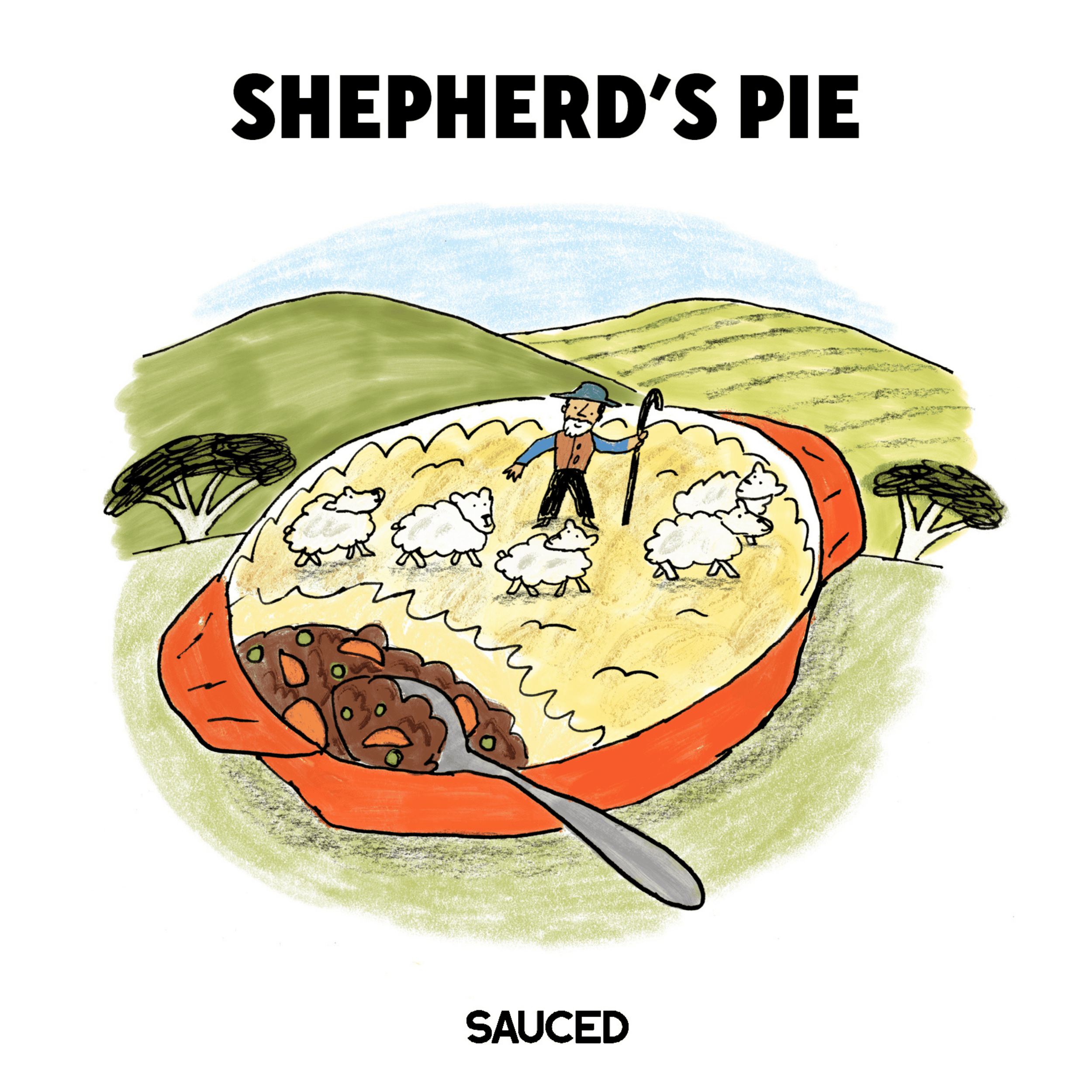
Shepherds keep sheep, so Shepherd's Pie means lamb and beef makes it a Cottage Pie. That rule turns out to be younger than the dish, though, whose oldest cited recipe asked for cold meat of any kind.
We trace it from Monday-night leftover to pub staple, make the case for lamb in a country that barely eats it, and build a version with a crust worth fighting over.
"Pub food royalty."
What we settled on:
Ground lamb from the shoulder, browned hard in batches
Guinness in the filling, reduced before the chicken stock
Simmered thick and chilled overnight so the mash stays on top
Duchesse mash with nutmeg, egg yolks, and Manchego folded in
Piped ridges, an egg and butter wash, and an even golden finish
Mint sauce on the table
The Cocktail:
The Parmentier's Fancy, an Irish whiskey and dry sherry sour with ginger, mint, and a mist of peated Scotch.
RECIPE CARD:
Premium subscriber? Check out the full recipe card here.
LISTEN
EpiSOde Partners
Thanks to the following brands for partnering with Sauced to bring you this episode:
TRANSCRIPT
Tim McKirdy: Sother.
Sother Teague: Tim.
TM: Shepherd's Pie.
ST: Love it.
TM: What do shepherds oversee?
ST: Sheeps and lambs.
TM: What do they not oversee?
ST: Cows and pigs.
TM: What would that be instead?
ST: Cottage Pie.
TM: Why do I see so many people on the internet being like, Shepherd's Pie, lamb or beef? No.
ST: Well, it's a constant debate, that's for sure. I don't know. Why is a Manhattan made with whiskey, but specifically American whiskey, but if you want the same drink with Irish whiskey, it's a Blackthorn?
TM: If you want it with Scotch, Rob Roy.
ST: A Rob Roy, exactly. I made myself a delicious Manhattan with blended Scotch.
TM: You had a Rob Roy.
ST: Right. Well, I made myself a delicious Shepherd's Pie with beef. You had a Cottage Pie.
TM: Nice. Congratulations. How was your Cottage Pie? Tell me about it.
ST: Does fish have its own name too? Just fish —
TM: Fish pie.
ST: Yeah, it's not fishermen's pie.
TM: Potentially. But I think fish pie is sort of a standard nomenclature, I think.
ST: I mean, listen, if we want to get real nitpicky here, and we do, that's the whole show —
TM: Please. Please do. Otherwise it'll be a short episode.
ST: Is it really a pie? There's no crust.
TM: No, you're right. It's not a pie. I think that is more because we're viewing this from the US, and you're looking at it in terms of US, how we name things and traditions. There is, though, actually — I will have some things for us to explore when it comes to lamb and the US's relationship with lamb, because frankly speaking, this is something that I have been astounded by in the nine years that I've lived here, which is when I walk down the meat aisle in a supermarket, how little space is devoted to and given to lamb.
ST: No, it's actually infuriating to me. We should eat more lamb here. It's delicious. It's pretty easy to raise. Super versatile in the kitchen. I don't want to say more flavorful than beef, but they have a personality of their own, flavor-wise, whereas beef is kind of sort of background noise, almost.
TM: Yeah, totally. And as I said, we will get into that. And I've uncovered some things that made it make sense to me, but also some other things that just call out how stark the difference is between the US and other — not just other countries, but other English-speaking countries, let's say. And before that, as we always like to kick off: personal or professional associations that you have with this dish.
ST: It is very comforting and homey, and I like that, and I enjoy cooking those kinds of things. But I've never worked anywhere that had this on the menu.
TM: Me neither.
ST: And that's a shame, because again, its build-ahead nature dictates this could be a great single-serve dish, right? In that sort of oval, you know what I mean? Get that thing sizzling hot, throw it under the broiler. Let's go.
TM: I think the reason for that is, look, you've had the emergence of pub grub being gourmet pub grub in the UK, right? Gastropubs. This is definitely a dish that's ripe for the picking there, and I'm sure a bunch of places do it really well. I've never worked anywhere that was of that sort of mold. The first ever restaurant that I worked at, where I was a food runner and got some early experience in the kitchen before moving to London, going to culinary college, this is something that we would make, but it was for functions. And oh my god, I can't remember, I'm really blanking on the name of it now. I'm sure people in the UK will understand this. There are these not-for-profit organizations that do charity work or whatever. I forget exactly what they are, right? But generally speaking, it's older people, predominantly men, and they will gather once a month, hold a meeting and then have dinner. Say it's a room of 30 people or whatever. They'll have their monthly meeting, or maybe it's a quarterly meeting or something. They're not particularly big spenders, and their tastes when it comes to the dishes we would make for them were these sort of classic dishes, right? So a Shepherd's Pie or a fish pie, things you can make in bulk. Functions that weren't making a lot of money. They were quite demanding clients for what they were paying. So the food always took on the sort of British classics. It would be, you know, bangers and mash —
ST: Love it.
TM: — fish pie, for sure, as well. So that's the only time I've encountered it in a professional setting.
ST: Got it. But you make this at home, I mean, you —
TM: Made it at home, grown up having it.
ST: Yeah, exactly. But I would say this was never in the repertoire of dishes that my family made.
TM: I think as well, it will be interesting for us when we get to the non-negotiables, because it is a bit of a one-stop shop for leftovers.
ST: Well, I mean, I think when we get to the history of the dish, we're gonna really dig into that, right? This wasn't born from ground slash minced lamb. It was born from Sunday's lamb leg roast that was then chopped fine, re-seared in the pan and built from there, right? It was, how do I use up the stuff that I already have?
TM: And I know that's something that you've gotten into a couple of times on this show, of just turning Sunday's dish into Monday's dish, and then Monday's into Tuesday's. And by the time you get to the following Sunday, if there's still —
ST: If there's still a layer of whatever the previous week was, then you haven't utilized it. Or you just haven't eaten well enough, I guess.
TM: You haven't eaten well enough. The infinite pie, but not a pie. What do you think, then? What would be a better way to describe it?
ST: I mean, it is certainly architectural. We're building a thing. It's certainly not a lasagna, but I think it's come closer to a lasagna than it is a pie. It's a casserole. I mean, it's in a casserole dish. It's, again, super hearty, homey, warming.
TM: It is a dish that traditionally calls for booze.
ST: Oh yeah, for sure.
TM: That's probably a nice moment for you to do your — it might not be in there — but give us the Sother elevator pitch of this dish.
ST: Well, we just kind of talked about it a little bit. I said it here: Shepherd's Pie is an ultimate British Isles leftover hack. Lamb or mutton cooked in a thick gravy, buried under mashed potatoes, baked until the top gets crisp and golden. Pub food royalty.
TM: Fantastic. We could have easily done Cottage Pie today. The reason, I think, from a personal perspective I wanted us to do Shepherd's, though, is this is our first lamb dish, and I'm pretty excited about that.
ST: Holy cow, we're half a year in and this is our first lamb dish. You're right.
TM: That's the American bias coming through.
ST: Wow. We need to get more lamb.
TM: So, great way for us to start. You mentioned a few times the origins. Let's go through that. For most of the dish's life, the two names were actually used interchangeably, and for either meat. So the codification, or the hard and fast split of shepherd versus cottagers, is much newer than the dish itself. It's not a modern thing, but it's much newer. As you said, this is thrift food, you know, built to stretch the last of a roast. Monday's dinner made from Sunday's leftover joint, chopped small and hidden underneath potato.
ST: Joint. That's the British way to put it. We don't say that here.
TM: A joint of meat, no?
ST: I knew exactly what you meant, but I thought we'd have to pause and make sure that everyone knows what you meant by Sunday's joint. But yes, a joint of meat. That's how you say it in the UK. That's not —
TM: Like you would say cut here, more so.
ST: I would just say my roast or whatever.
TM: That potato may or may not have been yesterday's mashed potato as well, right? So here's —
ST: It may have been yesterday's roast potato that you've made into mashed potato, right? Again, we want to bring all the same stuff out. We got to make it — we got to shine it up somehow so everyone, you know, the picky eaters at the table, will tuck in.
TM: The thing you might not know about the Sunday roast in the UK as well — now, a lot of people will, but many people will not — limit to one type of potatoes. It is not uncommon to see mashed potatoes and roast potatoes on the same plate on a Sunday.
ST: I'd love it. You know, my first visit to Italy — I've been a bunch of times now, obviously, over the years, but my very first visit — I was blown away by the fact that they would often serve me two different pastas on the same plate. Like, you'd get some sort of string pasta and a sauce right next to lasagna on the same plate. I was like, these guys know how to live.
TM: Why limit ourselves? You know what, I mean, they call it the pasta course.
ST: Yeah, you're right.
TM: So this is the potato portion of the plate. It doesn't need to be just one. Cottage Pie had appeared in print as a term by 1791, just as the potato was becoming cheap enough to feed the rural poor. Cottage pointed straight at the people who were eating it.
ST: That sort of implies that there was a time that potatoes were not inexpensive. Is that true?
TM: Not available and abundant. And this is going to be a big part of the origin, but for hundreds of years potatoes were seen as only fit for pigs to eat, and animal feed. The cottagers were laboring country families, and the potatoes were this new crop that was feeding them. The potato itself is obviously a New World crop, as we know, or maybe not that obvious. It reached Spain in around 1570 and spread into Britain and Ireland before the century was out, arriving, as I said, as poor people's food. Some folklore credits two famous men for the arrival of the potato. Number one is Sir Walter Raleigh, who planted it on his Irish estate and then handed it to Queen Elizabeth I, or I guess her cooks. The other being Sir Francis Drake, carrying it back from one of his voyages. Both are legend. The Tudor era, which is Queen Elizabeth, or at least her father, didn't eat peasant vegetables, the grandees of that era. So this thing, the potato, came in quietly on Spanish ships and worked its way from the bottom up, if you're looking at the class system, as it were. It became the everyday staple of working people over the next century, no more so than Ireland. Shepherd's Pie as a term doesn't reach print until the mid-1800s. Merriam-Webster dates the term to 1854, and the earliest recipe usually cited is in an Edinburgh cookery book, Mrs. Williamson's The Practice of Cookery and Pastry, and most people often trace that to an 1849 edition. The one that you can read, if you so wish, on Google Books is, I believe, the 1850s second printing or third printing of the book. And that first recipe called for cold meat of any kind, not lamb. So the signature name arrived late and did not mean sheep or lamb until much later.
ST: Well, even that implies, though, cold meat, meaning it was yesterday's cooked meat, right?
TM: Yes. And like you said up top, yesterday's cooked meat, like I said, a joint. We're not talking minced meat here either, right? This is like the offcuts. Now, obviously, the modern question that we will ask ourselves is, are we doing cubed meat or are we doing ground? I think we both agree we're doing lamb. I wanted to point out — and this is not something I knew about at all before looking into the origins — France has the very same dish, but names it after a man.
ST: Hachis, right.
TM: Hachis Parmentier.
ST: There we go.
TM: And hachis, spelled H-A-C-H-I-S, but that's hachis Parmentier. Chopped meat, usually beef, often yesterday's pot-au-feu, served under mashed potato. This is the French Cottage Pie. The person it's named after, Antoine-Augustin Parmentier, was a pharmacist, an agronomist, I think, who learned to eat potatoes as a prisoner of war in the Seven Years' War, when his —
ST: Wow. Learned to eat potatoes, right? I get it. It was unheard of.
TM: His Prussian captors fed it to him, because at the time France still thought the potato was only for pigs, or fit only for pigs. So your guy Parmentier runs a propaganda campaign. He says, I want to get people eating potatoes. These are good. Why would no one like this? The King of France at the time granted him a plot of poor ground at Les Sablons, which is west of Paris, in 1781, to prove the potato would grow where wheat would not. So he's saying, we've got this bad land. It's no use for you for other crops. Let's grow potatoes on it. As part of his propaganda campaign, he would throw elaborate all-potato dinners for guests, including Benjamin Franklin and, I believe, Thomas Jefferson.
ST: All right.
TM: Would they be the same period?
ST: Yeah, of course. These guys are edgy. They're men of adventure.
TM: Sometimes up to 20 courses of —
ST: Oh, just potatoes?
TM: Just potatoes, which —
ST: You'd be in heaven.
TM: — is — I would love it. I love it so much.
ST: Wouldn't hate it, but you'd be in heaven. And maybe —
TM: And this is something from a different episode. We mentioned our man Francis Mallmann, from down there in Argentina, became famous with his potato dish that he made in sort of like the ratatouille way. But I think, did he not also do something similar? He did a fine dining, multi-course tasting menu of just the potato. I think he did it in France, for some kind of exhibition or something.
ST: He was resurrecting this man's —
TM: Exactly.
ST: A Parmentier dinner.
TM: Yeah, Parmentier dinner. Parmentier would also pin potato flowers on Louis XVI and Marie Antoinette, who wore them in public, once again as a sign of getting behind the potato, promoting it. There is another story that, probably, largely apocryphal, people believe at this point, but it's a great story.
ST: Let's have it.
TM: So as part of his campaign, he said, well, we're growing this thing, but how do we get people to care about it? He had his crops, his ground at Les Sablons. And so the story goes that he posted armed guards on the field by day to make the crop look precious. He would have them leave by night — or some other people said he told the guards they could accept bribes to look the other way — while the locals could sneak in, steal the valuable tubers, because they're like, well, these must be valuable if these armed guards are looking after them. Pull them away, start to plant them themselves, start to cook with them, and sort of plant them in a figurative sense as well, in cooking culture in France. It's almost certainly a myth, sadly, because it's been pinned to him, this story, only after his death, and the same ruse has apparently been told of half a dozen other individuals. But Parmentier is a pretty well-known person in French cooking history. But this is kind of the thing that makes it most perfect for us here. The great potato propagandist, his most famous stunt itself is likely —
ST: Propaganda.
TM: Yeah. You know what that is, of —
ST: That's got to be the Porco propaganda piece of the podcast.
TM: The pie.
ST: Of the pie.
TM: So yeah, just imagine a world in which people are skeptical about the potato.
ST: I mean, we had a bunch of things like that, right? Tomatoes, eggplant, I mean, nightshades or whatever. But yeah, I guess I never thought that the potato had this kind of trouble, because certainly at the same time, before the potato came over, I'm assuming they ate meals that weren't dissimilar to this, using rutabaga, turnips. Swede is what rutabaga is, right? Turnips.
TM: Gourds of different kinds, yeah.
ST: Why did the potato get such a bad rap?
TM: I don't know. But then, you know, look at the things that are people's favorite things to eat. Potato chips, French fries —
ST: Nice. I know you did that for me. I appreciate it.
TM: — mash, just, you know, any type of preparation, dauphinois —
ST: Well, we're gonna talk about duchesse today, right?
TM: We are. I've got some feelings about that as well, too.
ST: Do you? I'm okay. We'll get to it, whatever. We'll get —
TM: I like that, though. I like that you're indicating something. Well, before we do, then, two final things for this first part of the show. First of all, is this a prince's or a pauper's dish?
ST: I think it's a pauper's dish. It is. It is the everyman. It's comforting food of leftovers in its origins. Of course now we make it, you know, fresh. But I think it comes from humble places, and it has kind of remained there. But as you said, it's this sort of champion of pub food. You know, any pub worth its pint of Guinness is gonna have a Shepherd's Pie or some variation, right?
TM: Totally, yeah, 100%. All right, well, that's the first thing we have to do. The second thing we have to do now is just take a first quick break of the week, and then we'll be back with the non-negotiables.
ST: Okay.
TM: All right, so there, we're back. Luminaries.
ST: I came up dry.
TM: Nothing from Julia or Jack?
ST: Nope. Nothing from anybody of any substance. Again, I think that that's what maybe keeps this firmly locked in the, you know, pauper section. It's delicious, and everybody loves it, but nobody wants to claim it or own it. You're not gonna see Tom Keller put this on the menu at the French Laundry. You know, too pedestrian. Meanwhile, I bet family meal at the French Laundry has Shepherd's Pie from time to time, you know.
TM: Do you think they allow them to use meat in family meal?
ST: Why wouldn't —
TM: Oh, we were never allowed to use meat in family meal.
ST: Really?
TM: Yeah, because you would have to buy it. Everything had to be organic, as either leftover, whatever, or produce that we were buying, or tinned or whatever. Oh, I mean, very occasionally we would be allowed things such as wings or ribs, cheaper cuts. But overwhelmingly —
ST: Is this common?
TM: I know, I think that might have been specific to our restaurant. There were also periods as well where staff meal, as we would call it, like staff dinner, there was a budget for meat. But yeah, when times were — or just when the chef was on a bit of a tear and the tension was high in the kitchen, you didn't want to be the sous chef ordering food for staff dinner.
ST: Wow. That's — wow. No, most of the places I worked had a budget for it and a rotation of who made it. You know, and you could plot and plan your thing. So you'd know that, okay, next Thursday is my day to make family meal. See if we can order, whatever, a turkey, and I'm gonna make Thanksgiving dinner.
TM: Nice.
ST: Because it's a Thursday, you know, or whatever. There was an opportunity for the team to kind of maybe show off some of their skill outside of what the restaurant normally does.
TM: A bit of flair. Yeah, that's nice.
ST: But also to maybe even workshop a dish that they might want to maybe get on the menu at some point.
TM: And understanding as well, like, being a younger cook, or lower seniority in the kitchen, starting to get your head around quantities for ordering for people, things like that. Meal planning.
ST: There's plenty of lessons to be learned in making family meal, and I do prefer to call it staff meal. But it is overwhelmingly called family meal here.
TM: Because — I'm sorry, and this is a big detour, but I —
ST: When you're here, you're family. You know, I don't like my family, so I don't want to be here, if that's true.
TM: I think as well — I've got three examples for us, just of Brits, to skim through. But we're dry, we're a little dry on this section. So something to just discuss from a bigger perspective: why I don't like the notion of "we are a family here." And actually, I saw someone posting about this who we both like, Iain Griffiths, over there at Bar Snack.
ST: Love that dude.
TM: They were posting for a job, and they said, we're not family, despite it being one of the best atmospheres for staff of places I've ever experienced, just on the other side of the bar looking in. But this is a job, right? And I think saying things like that — well, you would treat your family different than how you treat your colleagues, and so you should.
ST: Yeah, exactly.
TM: And you're being paid to be here. That's one of the only reasons. That's the only reason you're there. You might like it. You might love your work. You might love your colleagues. It's still a job. And you're an employee, and we collectively are staff.
ST: Yeah. You're getting no pushback from me. I am in total agreement with you on this, because —
TM: Is that a first for the show?
ST: That we're in total agreement? Maybe on a full concept, yeah. I've never — the closest I get is, I have teams. They're not my family. Though I love many of them, and I want them to be around, I want them to do well, and I want them to be healthy and all that stuff, and I hang out with them outside. That's not — once we're on campus, we're a team.
TM: Yeah, totally.
ST: Anyway.
TM: And I think, yeah, and I think that's where, just my final thought about it all is, I think that's where some of the worst aspects of hospitality, whether it's at the bars or restaurant industry or both, that's where a lot of wrongs can happen from that —
ST: It's too gray an area.
TM: — including wage theft, working conditions, all of this stuff. It's all real. And that's the realities of trying to make profit in a business where, what is the percentage of ones that don't make it past the first year or something?
ST: The NRA says — the good one, the National Restaurant Association says that 80% of all restaurants and bars will close before they hit two years. Of the 20% that make it, 80% of those will close before five years. It is a cutthroat, difficult — and the craziest part to me is how many people do you know, they're like, I'm just gonna open a restaurant. It'd be so easy. I love to —
TM: Everyone says I'm a great cook.
ST: — cook. Everyone loves my Manhattan. I'm gonna open a bar.
TM: Please stop doing that, people. It's so much more enjoyable cooking at home as well, if that is your hobby.
ST: Keep it a hobby. Anyway, we've jumped way off the rails here. Let's get back to Shepherd's Pie. You have some luminaries. I found nothing from anybody of any substance. Like I said, there were casual mentions here, but nothing meaty enough to present, I don't think. What do you got?
TM: I just got three different approaches from three Brits that we've named on the show before, but certainly have maybe a bigger standing over there, or maybe not. Number one, your guy, Jamie Oliver.
ST: No. Okay. Oh no, did he get himself in trouble again?
TM: The Naked Chef. No. Actually, this one, because he's not adopting the dish of a different culture, I think it's pretty safe on this one. His build is braised meat, not minced. He uses a whole lamb shoulder, slow roasted for four hours, then shredded into its own juices, pulled apart. Root vegetables, he includes onion, carrot, celery, swede —
ST: Rutabaga.
TM: — fried in the lamb fat with rosemary, then let down with flour and the roasting juices into kind of like a stew. The signature is texture on every surface. He gets a crispy bottom, sides and top. He greases the dish with lamb fat and breadcrumbs, and then presses mash up the sides, bakes it low in the oven so that even the base crisps up. Which is kind of a nice approach.
ST: Interesting.
TM: Not where your mind naturally goes for something like that. Delia Smith. Remember Delia?
ST: Oh, Delia, yeah, 'cause my great-grandmother's name was Delia.
TM: So, Britain's answer to Julia Child. TV personality, cookbook author, cook extraordinaire, baker of cakes for rock and roll albums.
ST: What was it? Make me an ugly cake for the —
TM: Rolling —
ST: Rolling Stones album.
TM: Was that Beggars Banquet? Was it the album? I think —
ST: I think so, yeah.
TM: I think, yeah. She gets depth without using wine. She leans on mushroom ketchup and Worcestershire sauce to do the savory work. She makes smooth, buttery mash, then a cheese and herb crust, browned under the grill, not in the oven, for a fast, blistered top. And she just described it as meat, so she doesn't split Shepherd's and Cottage Pie, just making a pie. And then Ramsay —
ST: Gordo.
TM: He does draw the line, and he opts for lamb for Shepherd's, beef for Cottage. Says the clue is in the name. Gordon does like calling things out. And he also says, no color, no flavor, his mother's line, and that applies to every aspect of the dish as well. So he browns — he uses mince. He browns it quite heavy and hard in batches, then builds up the dish with the various different ingredients. Worcestershire again, tomato puree, red wine, stock. Chicken stock he opted for, and —
ST: Seems weird.
TM: — rosemary. I mean, I get that most people don't have lamb stock lying around.
ST: Well, I guess, well, yeah, correct. So then your next available option would be beef, but then maybe you're — yeah, I think chicken is the way to go, actually, because you want it to be lighter than the lamb itself, and beef would be overcrowding it or talking over it, kind of.
TM: Absolutely.
ST: Also, what do you do then? Now you got beef in your Shepherd's Pie. It's right in the name, you donut.
TM: Yeah, you're right. It's gotta be chicken.
ST: It's got to be chicken.
TM: Good point. To his mom's point about no color, no flavor —
ST: Oh dude, when we get to the preparation, we're going to talk about how hard we want to get caramelizing everywhere, on the meat, on the sauce itself. We want to get the browning on the top of the potatoes. Like, Maillard every direction.
TM: He goes for, you know, making ridges in the mashed potatoes on the top. And he also folds egg yolks into his mash.
ST: Duchesse.
TM: Duchesse. And Parmesan. And also he tops with Parmesan before it goes in the oven, which I take umbrage with, but we'll get into that.
ST: Yep, we'll get into it. But does any single one of his restaurants have a Shepherd's Pie on the menu? I bet it doesn't.
TM: Ramsay has so much going on, he probably has, like, a chain of airport restaurants, right? That's, like, British pub food.
ST: He does. That he's never been to.
TM: Yeah, I mean, how often can he? But so, those have been the culinary luminaries, or a couple, plus some ruminations on the industry. Time for us to take our second break of the show today, and then we'll be back with the non-negotiables.
ST: Can't wait.
TM: All right, so there, we're back. The non-negotiables. Number one —
ST: I mean, number one, it's lamb, but not just lamb. It's well-caramelized lamb meat. And we'll get into what that meat is. I would have gone mince, but it sounds like you want to go something else.
TM: Not necessarily. But I do want us to do a little bit of a deeper dive on lamb, as we mentioned. This is the first time we've covered it.
ST: I mean, I'm game to go either way. Just like when we talked chili, I'm game for ground meat in chili. I kind of prefer it, to be honest, but I also like the big chunky style as well. So I could do that with this as well. Similar, you know, texturally.
TM: First non-negotiable for me, then: mashed potatoes.
ST: Right. And then the mashed potatoes are going to have their own special build too. You putting nutmeg in there?
TM: Yes.
ST: Are we doing duchesse?
TM: Yes. Explain duchesse as a concept, please.
ST: Duchesse is just mashed potatoes that have been enriched with all the things you're normally putting in your mashed potatoes, butter and cream, et cetera, whatever you want. And then egg yolks, which is going to give it structure, so that, especially in this particular use, we can get a really good, crisp browning crust on top of the pie.
TM: Perfect.
ST: Normally these guys are piped out, oftentimes just in little, almost like meringues, and then you bake them, and then, you know, you get five or six of them on the side of your plate. They're pretty. You can literally pick them up if you want. But yeah, it gives it structure.
TM: With a duchesse, you don't therefore require a subsequent egg wash before you're going in the oven?
ST: I'm going to do that anyway.
TM: You are gonna do that?
ST: Hey, let's do both. Why not? Like, again, I want this thing crazy brown. Crisp potato topping with a fluffy mash inside.
TM: Nice. I've got something else that I weirdly encountered recently, just when I was making hot dog buns. So for the finishing step, going into the oven, I just went milk on top of the buns. When they came out, I got a little bit of melted butter, just did a little brush right at the end, and then left it to rest under a towel for another 5, 10 minutes. It gave it this beautiful sheen, and when it's set, it was fantastic. Now, arguably, maybe you don't need it for this, because we're doing all the other steps, but that was a new little technique for me, or a different approach, because I always normally, especially with bread, and bread like that, I might go egg wash, or egg and milk, you know. Anyway, how about Parmesan in there? How do you feel about cheese in it?
ST: I don't hate it. It's certainly not traditional. And I don't think we do everything by the traditional here, so I'm perfectly willing to allow it. It's not required for me.
TM: It's not a non-negotiable, you're right.
ST: And when I say I don't hate it, I also say I do like it, but it's not a requirement. It will help with that browning. It'll add some seasoning, you know, especially — we're going to need Parmesan. It's going to add some salty nuttiness. Like, all sounds good. I'm not opposed, but I don't need it.
TM: So I think I don't want it, per se. I can understand why people would have it.
ST: Could we maybe — is there a hard sheep's milk cheese that we can think of instead? That way we stay with the lamb.
TM: I mean, there's got to be, yeah. There's got to be a bunch, but —
ST: I mean, is Manchego sheep's milk?
TM: Yeah, I think you're right.
ST: And it's a hard cheese.
TM: That'd be nice.
ST: Okay, I'm in. It's still not non-negotiable, though.
TM: However, I don't want the dual one that Ramsay does, because think about this. You said, right, we're adding egg and cheese and whatever to the mash to get this beautiful crust and color. Then you're topping this with cheese that's going to melt on top of it. So then you're not getting the crust on your mash, you're getting the crust on the cheese, which isn't supposed to be there.
ST: Well, not only is it not supposed to be there, a crust on cheese doesn't track, right? Otherwise your pizza would be crusty. It's melty, it's gooey. Not what I'm looking for here. If cheese is going to get employed, it needs to be in the mash, not on the mash.
TM: And that is a negotiable.
ST: There we go. And it's negotiable, right?
TM: Nice. Next.
ST: We need to make sure that we have a gravy or stock, but it needs to be quite tightened. And I think we just discussed earlier, it's chicken stock, but we need to tighten it up.
TM: We want to be cooking this long, low and slow, much like we did our Bolognese. We want the same texture there, I think, right? It's going to maintain its integrity. It's not going to become soup when it's hot and comes out the oven.
ST: Well, right, because the problem is, with making a Shepherd's Pie or Cottage Pie or any of these potato-topped pies, if the bottom layer is even remotely too loose, your potato layer will sink into it. What we want to have is a clear definition. When we take that scoop out, we want to be able to see white mashed potato, dark brown stuff below.
TM: This is obviously a fairly neutral dish when it comes to color, although you can get that beautiful color from the potato, like we said. There is nothing sadder than when your sauce is too loose and it starts to bubble up over it and come out on top. Sorry, it's supposed to look kind of clean, even if it is golden, right? To that stock slash sauce: booze is a non-negotiable for me.
ST: You don't think we have to have booze in this dish?
TM: It is a non-negotiable.
ST: Oh. Okay. Yeah, good.
TM: What is the booze, is the question. I think there are two contenders.
ST: We got some choices. I think there's three, and I bet my three include your two. Some red wine. I think the easy, sort of associated answer is stout —
TM: Guinness.
ST: Specifically Guinness. And then I think we could do some sherry.
TM: So are you practicing mixology here, or are you saying there are three lanes, choose one of them?
ST: I think there's three lanes. Choose one.
TM: Where do they rank for you, and why?
ST: And they rank in the order that I just listed them. Why? I think red wine is the right thing to do. Probably something peppery, like a — what's the peppery — Syrah, right, which is commonly paired with lamb. That seems to make sense to me. Stout makes sense, but also, is it just me trying to be like, I think of Shepherd's Pie as an Irish dish, so I want to put Guinness in it, right? Is that just too on the nose? And then sherry, I just thought, would add a unique sort of, again, kind of a nuttiness. Because in my potato — and I asked you earlier, you didn't really answer, I don't think — any nutmeg going in the potato? I like some nutmeg in there.
TM: Oh, I love it. Yeah, sorry.
ST: Okay, great. So yeah, that little nutmeg-y flavor. That sherry, you know, for scraping up the fond and getting a reduction out of the sherry before the stock goes in, could add just a hint of that to the sauce below.
TM: You can take it as standard from here that if I'm ever including potato, milk or cream in a savory dish, nutmeg's there, and bay leaf.
ST: Nutmeg, okay. Great. Oh yeah, perfect. Perfect.
TM: That is a non-negotiable for me, I would say. So I thought, yeah, red wine or Guinness.
ST: Yeah. Or if you've got a bottle of port laying around, you could squeak that in there too. I don't know, there's no — I guess what I'm really saying is, on this dish, because of its nature of being sort of a leftover surprise casserole, what have you got laying around? This leftover —
TM: Yeah. But we do things intentionally here.
ST: We do, and we are.
TM: We are one day gonna cover Cottage Pie. So the question becomes, which one are we using for our Shepherd's Pie, and which one are we using for our Cottage Pie, right? Are we going —
ST: I think that we should use the Guinness for the Cottage Pie, then.
TM: You think so?
ST: Unless you're going to argue me down.
TM: I think it's a flavor preference question. So then, for me, I'm probably in your lane as well, where I'm like, this is a Scottish and Irish dish predominantly. Therefore I'm leaning stout. I'm leaning Guinness, and I wanted to explore which Guinness.
ST: Ooh. The Guinness export in the bottle.
TM: So there's the — exactly, otherwise known as the original. So you got the — forget the draft, right, and in the cans it's called Draught as well, right? That's the standard Guinness. The export, and — standard Guinness is what, four-point-something percent ABV? I think it might be 4.1. It's really a lot lower than people realize.
ST: Yeah, sessionable. People forget that because of its look. Guinness is a light beer. When you make the half and half, the lighter one floats. That's the Guinness.
TM: That is also, like, a concept that I think is distinctly American. I don't think that half and half has really traveled, probably because it's a terrible name that it has. That's the draft. The original slash export comes in at above 5%. I forget exactly the — but the profile itself is, you're getting more of the malt character, right? It's deeper, it's richer, more coffee, which I know that's not great for you, but you're getting that. Then there's the Foreign Extra Stout. There are two versions of this. The one that is sold in the US primarily is brewed in Ireland and the UK, clocks in around 7%. It's even bigger on the profile. The Foreign Extra Stout that's made and consumed in Africa, which is the largest market in the world for Guinness, I believe, by some measure, that is higher still in alcohol. And that will often be made with grains that are not only malted barley, so things like sorghum and stuff, whatever, or base ingredients that are not just malted barley.
ST: Wow.
TM: And that can reach levels of up to, like, 10%, because of the higher alcohol, you know, potential of those.
ST: Wow, that's crazy. So which one are you going to use for this?
TM: I would say for this, we want the original, or the Foreign Extra Stout, but the 7% one here from the US. You can find it. It's not as common by any stretch of the imagination, but you can find it in, like, retailers that care about their beer selection. I'm saying —
ST: So wait, are you saying we're going to go with Guinness for this?
TM: The booze is the non-negotiable. That's my pitch, is why I would do Guinness for this. But we're going one with this dish and one with Cottage Pie.
ST: Which do you want to do? Sounds like you want to do Guinness. Let's do Guinness.
TM: Just from the storytelling perspective, I like the —
ST: All right, Guinness it is. Listen, I'm easily convinced. This dish is going to be delicious. It's a slam dunk every time. I know I say this on a lot of the episodes, but I'm going to be making this probably pretty soon, right? If we're going to talk about it, then I'm going to go make it.
TM: And then you can literally, like, yeah, enjoy that Guinness that you reach for less often than other types of Guinness. Next non-negotiable.
ST: We need — well, we talked about the baked potato, or sorry, the mashed potato, and all the things that go in it. We need some vegetables here. I think we need mirepoix, and I have one specific addition that I'd like to add, but again, it doesn't have to be a non-negotiable. We need celery, carrot, onion, minced pretty fine, because I kind of want them to disappear into it, you know, like, again — well, we'll talk about that as we get there. And then peas are always in my vision of this dish. Do they have to be there?
TM: They are not — well, that is up for debate. I would say traditionally, like you said, mirepoix of onion, carrot, celery. I would say even some people's celery is optional.
ST: No.
TM: I saw Ramsay just grated his onions and carrots, did not use celery, whereas Jamie Oliver did, brought in swede. I think peas are expected. If you're not getting it in the pie itself —
ST: That's what you serve it with.
TM: That's the vegetable that it comes with.
ST: Like buttery, peppery peas, right?
TM: Oh no, just blanched.
ST: No butter and pepper? Come on. Sure. All right.
TM: Traditionally, in a British household, this is coming straight out of the water, ideally — for some people, maybe the microwave. You're lucky if the water has been seasoned heavily, and onto the plate.
ST: Notoriously under-seasoning their food, the Brits.
TM: The only thing that I don't like about the peas coming into the dish itself is the color. You go from a vibrant green to olive, or worse —
ST: Sure. Lost in the sauce a little.
TM: — just because of the amount of time that it spent cooking in the pie.
ST: So leave 'em out.
TM: I say keep them in.
ST: Let's keep them in.
TM: Look, this is pub grub, right? We don't need — you know, yeah, exactly.
ST: That's all I've got for non-negotiables. Oh, sorry, sorry, I did skip one. Well, it's on my list too, I don't know how I skipped it. We need some herbs.
TM: Fresh? Or — so you're talking rosemary.
ST: Some rosemary for lamb, a little bit of thyme maybe. As you mentioned, a bay leaf would be good.
TM: Worcestershire sauce is a non-negotiable for me.
ST: It's not on my non-negotiable list, but it came up a lot in all the recipes that I saw, but not all of them. Why is it a non-negotiable for you?
TM: You're right. If I was handed this dish that wasn't made with it —
ST: I want it.
TM: I want it, but it's a negotiable. It's a negotiable that I would like to include. Same story re: tomato puree.
ST: Yeah, we're going to need some. I think so too.
TM: But can you make an amazing version of this without it?
ST: Yeah.
TM: Will you notice if it's not there?
ST: Probably not.
TM: Probably not. But that's just how we build, right? We are the architects of this Shepherd's Pie.
ST: Yeah. And then there's other things that I would put on the non — sorry, the negotiable list. I already mentioned a couple of them. We've mentioned it a few times: swede. Why is it called swede over there?
TM: Why is it called rutabaga over here?
ST: I don't know.
TM: Which is a better name? Which name do you prefer?
ST: Rutabaga. I don't know, it's the only one I know. Rutabaga, maybe some turnips. Leeks are often good.
TM: Leeks, I would think, is a fish pie thing, for me.
ST: Okay. I made a fish pie recently-ish, and I used a lot of leeks in it. Delicious.
TM: But if you have them, like you said, and if you need to use it up. But I would just ask that we're dicing them or mincing them in the same size as the rest of our mirepoix, right? Not having it as, like, rondelles or —
ST: Yeah, right, exactly. Mushrooms.
TM: Can see it.
ST: Again, these are all totally negotiable. But as you just said, this dish comes to my mind when I'm like, oh look, I have a little bit of a lot of things. I'm going to make some kind of stew, but I also have these potatoes. Why don't I put a potato topping on it and bake it in the oven? You know, so, like, it's a clearinghouse for all the things you got laying around. What's in your herb drawer? Do you specifically have thyme and rosemary and bay leaves? If not, use whatever you got. You got some oregano? It's not going to hurt anybody. Let's go.
TM: Poultry mix.
ST: Yeah, poultry mix. You got some basil? It's not going to hurt anything. Get it in there. If it's going to rot in your fridge instead of getting used, then let's use it.
TM: Basil and lamb? Yes, please.
ST: Why not?
TM: Mint.
ST: Oh yeah. Listen, if I had it, I would.
TM: Oh, you know what we need for this, then?
ST: What's that?
TM: A beautiful mint sauce on the side. I hadn't even thought about that, but yeah, really nice, fresh, vibrant mint sauce. Oh, you're giving me a little look there. Is that pairing calling us from the future?
ST: It might be. Yeah. This all sounds like it's coming together really well. You got any other negotiable items?
TM: Nothing.
ST: Why do you reckon Worcestershire is a negotiable? It seems like it should be there to me.
TM: It's in so many of the versions that I saw, but I'm just holding myself to the standard of, if you made this dish for me and you didn't use it, I couldn't defensively have a stance that was, well, that's not Shepherd's Pie, you doughnut.
ST: Yeah, you donkey.
TM: Well, mentioned earlier, lamb. Got a few little things for a little deep dive for us here, then I want your take as the butcher. But just setting a little bit of background here: so what is the difference between lamb, hogget and mutton?
ST: Mutton's the older one, hogget's the middle, and lamb's the baby.
TM: Lamb is sheep under a year old. The definition is the same in the US and Britain. It's the mildest and more tender. Spring lamb is the young seasonal animal slaughtered in the US March to October, by the USDA definition. The one-to-two-year animal is hogget in British English and yearling mutton in the US, and that's also stronger in flavor, prized in Britain. And mutton is anything over two years. Deep, fatty, unapologetically sheepy.
ST: Super unctuous. And we live here in New York City, where there's a great chop house that famously serves mutton: Keens. And I don't think I've ever been to Keens and not gotten the mutton. We often will go there — and when I say often, I go there maybe twice a year — but when we go, we'll at least get an order of the mutton for the table to share, and it's delicious. It's always served with escarole, bitter green, and mutton. So good.
TM: Love it. And I love that place as well.
ST: Me too. We should go.
TM: And I'm slugging a couple of Martinis beforehand.
ST: Yeah. You're having Martinis at Keens?
TM: Yeah, I've had Martinis at Keens with you. And I've had mutton at Keens with you.
ST: They have one of the most substantial whiskey lists in the world.
TM: Oh, I don't ever — I'm not ordering whiskey when I'm at a bar, unless I'm having a beer and a shot. Because, as you can look around and see, there is so much whiskey in this house that has not been drunk yet. The economics of it don't make sense to me, to be buying expensive whiskey at a bar.
ST: Copy. What else you got on lamb?
TM: So, a couple of things —
ST: Timmy's on the lamb. Why is that a phrase? You know what that means?
TM: On the lamb? No.
ST: That means, like, you're running from the law. But I think it's lam, L-A-M. But I still don't know what it means.
TM: No, that's a brand new one for me. I'll need to look that up. I'm sure that's interesting. All right, so we got some differences. Let's explore some things, just about the history here, right? In the US, lamb represents just 1% of the meat that we consume on average. The average American eats around 0.7 kilograms — that's 700 grams, or about a pound and a half — per year.
ST: For the year? That is shocking, I guess, because I live with a woman who's half Australian. We clear way more than that.
TM: Yes. Britain eats around 4 kilos per person per year. Australia, 10 kilos per person per year.
ST: There we go.
TM: New Zealand, 13. So the UK puts away roughly six times what the US does, and Australia 14. But it wasn't always this low. Americans ate about 4.5 pounds per head as recently as the early 1960s. So roughly three times what we're eating now.
ST: Why do you reckon it fell out of favor?
TM: So I was wondering, and I looked into this, because I'm like, it's bizarre. And why am I experiencing that when I'm at the supermarket?
ST: Yeah, but even when you said it, 1%, my mind went to the Food Bazaar near me. Not bizarre like you just said, but there's an actual store here in New York called Food Bazaar, and the meat section is pretty large. But in my mind, the minute you said 1%, I thought, yeah, about the total floor space of this meat department, about 1% of it is lamb.
TM: Well, and that is by no — and that is, what came first in that scenario, the chicken or the egg? Well, we'll find out. But, like, the mental strategies that go into supermarket placement and everything is by design, and with reason. So you're right, it probably is 1% of the food selection at your store. Two Ws: wool and the war. American GIs were fed canned mutton during World War II that had been shipped, I believe, from Australia, and came home refusing to eat sheep meat. This was a taste aversion that outlived them. Also, the flock that was raised in the US was as much for wool as it was for meat. So when synthetic fibers gutted wool demand, the industry collapsed. US sheep peaked at 56 million in 1942 and sits at around 5 million now. Beef, meanwhile, won the West, got the railroads, feedlots, fast food, and just our eating culture and food culture, in a way that lamb never managed to. So lamb became an occasion food, something you have at Easter, or prepared on Greek and Middle Eastern tables. The holiday roast, not something that we've incorporated into our sort of weekday or weeknight habits.
ST: I think it's a tremendous failure on the American — that we don't do, in the British way, as we've been talking about earlier, the Sunday roast dinner, because that's what you're talking about, right? A lamb leg would be your joint.
TM: Totally. You need to be kind of skilled to make that as well, but more of a pot roast is, I think, where most people would be making it. Americans eat almost no lamb, and still we import around half of what we do consume to the country, from Australia and New Zealand. And I think, beyond that, China is the largest producer in the world, but I think Australia or New Zealand is the biggest exporter. Yeah, you put them two together and they're the biggest exporters, for sure, one of them.
ST: Pretty wild.
TM: So that's why we don't really eat it as much. There's also another difference between US and New Zealand and Australia. New Zealand and Australia are grass fed, so that makes them leaner, smaller, gamier —
ST: Yes.
TM: — and earthier.
ST: Much more tasty, in my opinion.
TM: Yes. Whereas American lamb is grain finished, up to 50% heavier, sweeter and milder. And the final thing before I want to turn it to you as the butcher, what part are we using: I just discovered that the majority of that gaminess lives in the fat, not the meat. So take it away from there, and take it away from, like, what are we using for this? Like, what would be your inkling here?
ST: Yeah, I think, speaking of that fat, there's an interesting thing about that, because when I worked in the butcher shop, we rotated days that we were doing different things. I believe it was Tuesdays with lamb. But lamb fat contains lanolin. Lanolin is common in lotions. On lamb day, you'd come home and your hands felt great.
TM: Oh.
ST: So soft, so silky, because you had your hands in lanolin all day long.
TM: Wow.
ST: Pretty wild. Okay. So I think — and let's establish clearly — we're not doing mince. We're going to do sort of, like, the cube-style stew. That's what you want to do in this?
TM: Oh, I'm easy either way. I'm totally easy either way.
ST: Oh, well, if we're going mince, it's mince, right? You don't get to really choose. The butcher's grinding up whatever bits and parts he has. But if we're going to do, like, something cubed, we're going to go somewhere up around the shoulder. That's going to be the meat that's got some good marbling, some relative tenderness. And don't forget, lambs are much more active than cow — beef — so they're not nearly as tender, even in the tender cuts. Does that make sense? So up around the shoulder is where we're going to find the meat that we would want to cube, to do a stew-style Shepherd's Pie.
TM: Fantastic. And then you mentioned it before, in a different episode — we were talking about, oh, this was our hot take for burgers, and we said why you don't want a burger medium rare. And you said the same thing there, which is about the lamb fat. You said you don't want certain cuts of lamb rare either.
ST: Oh, right, yeah. Same reason, really. Well, even, like, let's go back to our good friend, you know, Ramsay, constantly yelling at people. There's many, many, many an episode where he would be sending back some lamb chops because he'd be like, look at that white fat in there. It's not rendered. You have to be able to have this delicate touch of getting the temperature you desire on the meat itself, but also rendering the fat so that it's not so pasty in your mouth, right? You want it to be juicy, not creamy. And, like, it's hard to — and there's a temperature that you have to achieve. I believe it's 140. We talked about it, right?
TM: It is, yeah.
ST: Yeah, 140 degrees is when that fat's going to begin to really render, right? And that's going to be beyond rare and medium rare. You just have to accept that this piece of meat is better cooked further than maybe, like, your piece of beef. We seem to hold everything up to the candle: that is how I like my steak, which is beef. That's just not — it can't just be a blanket rule. And frankly, it's not even a blanket rule from steak to steak, right? Like, I love a ribeye, but a rare ribeye is not good, because it has so much intramuscular fat that isn't getting rendered that now I have this coated feeling inside my mouth that is not pleasant, right?
TM: So part of the cooking process as well, and why we really want to cook this for a long time: as you said, collagen starts to loosen at around 140 degrees. It dissolves into gelatin over the course of hours, between 160 and 180 Fahrenheit.
ST: Right. And I think that's the important thing that we talked about on that last episode too, is it's not about hitting the temperature, it's about hitting and maintaining the temperature for a specified period of time, right?
TM: Maintaining, which you're not getting, again, with a prime cut and cooking it too rare, or —
ST: Think about, like — I don't love talking about bacteria when we're talking about food, but, like, think about when we sterilize something. It's not simply taking my scalpel and plunging it in boiling water and pulling it out. It has to remain in that boiling water for X amount of time to kill whatever pathogens might be on there. They can survive that quick splash, but they can't survive after a while. This is true of how this fat breaks down. You have to hit a certain temperature, maintain it for a while, to have it become the things that you want it to be. More unctuous, not greasy, not pasty. Juicy.
TM: When you're cleaning down a kitchen at the end of the night, and you have the sanitizer spray that you have to use, there is a rule, right? Our health inspectors will be like, you need to spray it and leave it on —
ST: And spray and walk away.
TM: — and then come back and clean it up. Cool. So we're agreed on that. So what is your thinking, just in terms of preference, on mince versus braise for this?
ST: I think for me — and it's come up on recent episodes as well — how I just love eating tiny things. Something about, like, a mouthful of rice or quinoa or, I don't know, Rice Krispies cereal, something. Just those little things, that texture, I love. So for me, this pie is going to have that creamy mash on top. And then we've got — we've established we were putting peas in here. Those are tiny things. And then I want the mince.
TM: I want the mince as well. Yeah. And you know what, we'll be doing the American lamb industry good, because we're using up all the remnants, right? Like you said, you don't get to choose, but you're ensuring that the whole animal is getting used. And then we can save that, maybe that chuck roast, the cubed, for our Cottage Pie episode.
ST: Love it.
TM: At this point, I'm not sure whether people need to listen to it, because we're making all the decisions for that one there.
ST: It'll be next year. I'm not going to do them back to back.
TM: Any other decisions that we need to make now, before we get into our preparation walkthrough?
ST: Decisions, I think we're clear on. I would just make sure that when we talk about mashing the potatoes, we don't overwork them. We don't want to be gluey. They need to be fluffy. And we are going to do duchesse style. So that means in go some egg yolks. Is it duchesse? It's just duchess, pronounced the French way. Duchesse.
TM: It's a French preparation.
ST: Yeah, of course. Everything is. The French didn't just invent food, they invented fire. That's what I was told by a French chef once.
TM: Wait till they discover manners.
ST: We're a long way off. Yeah, I think no more decisions need to be made. We've covered what we are putting in ours. Some of them are obviously non-negotiable. Some of them are negotiable, but we went with them anyway. It's time to talk about putting it together, I guess.
TM: All right. Well, before we do that, time for us to take another quick break, and then we'll be back with the preparation.
ST: Great.
TM: All right, Sother, we're back. The preparation. Walk us through the Sauced Shepherd's Pie.
ST: Sure. We're going to build the filling for this pie first, because I do have an added step here that I like to use. Absolutely you can get away without it, but it's going to be helpful. It's just going to take an extra day.
TM: Nice.
ST: Okay, so first thing to do is get that lamb mince. I keep saying mince, I don't know, because of you. It's ground, people. It's ground lamb. Don't want to confuse the audience.
TM: What's wrong with mince?
ST: What's wrong with mincing? We don't say that here. That's like a dance, mincing about. I don't know, like the little mice in Cinderella, they're mincing. I don't know. Anyway, so you're going to take your ground lamb and brown it really pretty hard. You shouldn't have to add much, if any, fat to the pan to get anything started. There's plenty of fat in ground lamb. I don't know — you know what, that's curious. I don't know what the fat-to-lean ratio is on just standard ground lamb. I would think it's more than 80/20, to be honest.
TM: Probably, yeah.
ST: Work in batches if you have to, like you mentioned Gordon did, because you really do want to get it browned. If there's too much in there, you're steaming. So then remove the meat, leaving the fat behind. This is when you go in with your mirepoix. We said celery, carrot and onion; we're going to use all three. Cook those until they're softened and just really beginning to caramelize. We're not trying to go too hard on these guys, because we did all the Maillard stuff on the lamb itself. This is when we're going to add in a little bit of garlic and that tomato paste that we want in there, because we're building and layering flavors. Then we're going to deglaze. We decided we're going in with Guinness. We're going to deglaze with Guinness. Probably a fair amount of it, not just enough to deglaze like we do with wine. Let's get a pretty healthy dose of Guinness in there and bring it down substantially. Then you can add in your chicken stock we agreed on. Start to bring that down, and then back in goes the lamb.
TM: We add our Worcestershire sauce at this point?
ST: This is where we're adding thyme, rosemary, bay leaf and Worcestershire. And then you're going to simmer this until it becomes really thick and glossy. So you want to be able to slide your spoon across the bottom and have it part like the Red Sea. It'll slowly come back together, but you don't want to never be able to see the bottom. Needs to be quite thick. And then you want to season this pretty aggressively, because don't forget, it's going to go under a mountain of potatoes, which are hopefully going to be well seasoned as well. Well, not hopefully, we're going to season those as well. But they'll sort of dampen your perception of the seasoning that you put into the stew part. Now, once you've got that made, into the fridge — and let's get it right into the casserole dish that you're going to do it in — put the thing in the fridge. And that way you will ensure that when it's time to put the potatoes on top, they won't sink into it. You're going to get that really crisp, very brown base and very white top. Honestly, looks like a Guinness. I just put that together.
TM: Even better. Are we — so we're skipping peas?
ST: Oh, did I not say the peas? We did. It was on my negotiable, so it didn't happen to my thing. But yeah, so the peas would have gone in right when the stock and the lamb and the thyme and the Worcestershire go in.
TM: Perfect.
ST: And reduce that till it's thick and glossy, season aggressively. Yes. Okay, I just didn't know it was — I forgot. Now, to the potatoes. I'm gonna boil them. Do you bake them for this?
TM: Boil.
ST: Yeah, baking is a technique, but I find it to be tedious. So yeah, we're gonna chunk up some potatoes and boil them, get them nice and tender, drain them really well, let them stand in your colander for a while to steam off some of that excess moisture. This is an underrated and often overlooked step. This is gonna help your potatoes be more fluffy and less gloopy. I don't know a good word here. You still wanna mash them while they're hot. You don't want those starches to reset. You're gonna add in your butter. Let's drizzle in some dairy gradually as we're mashing. Let's then season aggressively again with salt. Let's go white pepper on the potatoes. Let's get some scrapes of nutmeg in there as well. And then we did decide we're gonna go with some cheese.
TM: We said we would allow some Manchego.
ST: Yeah, some finely grated Manchego. Let's fold in some. Do not reserve any to put on top later; we don't need that. And then you're gonna need to whip in a couple of egg yolks. That's gonna be the duchesse part of this. And that's, again, gonna help the potatoes kind of stand up, get crispy and super brown. All right, you've chilled your filling from the night before, you've made your mashed potatoes today. Now take a piping bag with a star tip.
TM: Yes. Got to pipe it.
ST: Yeah, with a star tip, because that's gonna give some ridges, and those ridges are where we're gonna really excel on getting that nice, crispy brown situation going on.
TM: Larger surface area.
ST: Correct, yeah. I mean, you said Gordon went back through and, like, sort of hatched into it or whatever —
TM: With a fork.
ST: — with a fork, or the side of Maurice, or what have you. But those ridges are where the crispness is gonna really make itself known. You can give it a quick brush with butter if you want. I think we should.
TM: I think we should.
ST: And frankly, we can whip a little melted butter into an egg and do a melted butter egg wash in one go. Then we're gonna put this guy into the oven, 400 degrees, until it's bubbly and piping hot. And if it's not brown enough on top after it's plenty hot, then kick on your broiler and make sure you get that browning on top. You want it to be pretty evenly golden brown. It shouldn't — what did we — we had a term we learned recently. It shouldn't leopard. Was that the term? It shouldn't be spotty. It should be pretty evenly one color. And I think it's critical here to let it rest. Just like a lasagna, you don't wanna jump into this thing right away. It'll lose some of its structural integrity. Let it rest so that it kind of pulls itself together, and then you can go ahead and cut it, and you'll have that split like I just described, sort of almost like a little Guinness. And that's it. That's it. It's pretty straightforward, pretty standard, easy recipe.
TM: A few final notes from me.
ST: Yeah, what do you got?
TM: I might, especially if we're self-serving at the table, you know, you got some — you're putting it down on something because it's really nice and hot or whatever — maybe hit it with some chopped chives at the end, just for a little bit of nice color.
ST: Oh, sure.
TM: Or parsley, if you must, but I think chives would be nice here.
ST: Yeah, I love chives, man.
TM: That's number one. Number two, I was reminded of this watching Ramsay's version for his TV show, The F Word. And really ahead of his game, by the way, because he came up with this video 10-plus years ago. And when he was cooking for The F Word, it was basically what people are doing on Instagram right now. It's like a whole recipe down in two minutes, but just shot for TV rather than portrait for phones. He called it Worcester sauce. And I think that it probably is the more common. In America we're so, like, we struggle so much with that word itself, right? Like the whole, how do you pronounce this? Is it Warchestershire? Or is it like Leicester Square? No, it's Leicester, buddy.
ST: Wash-your-sister sauce.
TM: Exactly. So we're so focused on getting it right, I think I've just fallen into that, and calling it Worcestershire sauce. I mean, it is, but a lot of people would just say Worcester sauce. So if you want to feel more like a Brit, then —
ST: Nobody wants to feel more like a Brit. No.
TM: No.
ST: Hey, you signed it away. You're an American citizen now, pal.
TM: I'm a dual citizen. Final one. Final one is just, you mentioned that technique there about steaming out the potatoes. If you want to learn more about our approach to mashed potatoes, folks, we dropped that quite recently in the public feed. That was a bonus episode —
ST: For our subscribers.
TM: — for our subscribers exclusively, that we made and released all the way back in January, right? In the first month of the show that we did here. We've covered a lot of ground since. We put that in the feed to say, hey folks, here's what you're missing out on if you're not a paid subscriber.
ST: Yeah, a monthly bonus episode. We rotate between a side dish, which this one clearly was, mashed potatoes. We also do a technique; one of my favorites we did was polymerization, how to season your cast iron pans. A historical, sort of, like, fun story time between you and I, where we go back and forth and we talk about all kinds of things, and we dove a little deeply into agromafia. That was pretty cool. And then, what am I forgetting? What's the fourth one?
TM: Ingredient.
ST: Oh, an ingredient, which — we've done some dives on things like garlic and chilies. And they've been really fun. Yeah, paid subscribers get all kinds of fun stuff from us, plus a bonus episode every month. And we dropped that one out for non-subscribers to see, yeah, what they're missing. Hopefully we'll tease you into supporting the show and supporting independent journalists like us. Are we journalists?
TM: Yeah.
ST: Is this journaling? I don't know what this is.
TM: I hate the term creating content, so I lean more on that. Independent journalism.
ST: We're independent entertainers.
TM: Entertainment. This is edutainment.
ST: Yes. Infotainment.
TM: How much might one have to pay for said service?
ST: Well, that's not all you get. You get a whole bunch of other stuff. But it's a mere $7 a month. And if you sign up for an entire year, we'll knock off two months, so it's 70 bucks for the whole year.
TM: And if you do sign up, one of those other things that people get, Sother, as you mentioned, is ad-free episodes. And you know what? We're gonna take a quick break for our final ad of the show this week.
ST: Right on.
TM: All right, Sother, we're back. The pairings. Let's kick it off, as we always like to do, with red. With wine. You can hear where I'm leaning with that one, and you mentioned it already. Lamb loves red wine. Something dry, something medium bodied or above, depending what you're looking through and what you're working with here. And as you said, a big, big friend of lamb is Syrah, because it's peppery, and it just matches the flavor really well. Some examples will also bring their own inherent kind of gaminess. I'm looking specifically at the Rhône Valley in France. Wine nerds will know that Rhône is split into the Northern and Southern Rhône. Here I think we wanna lean Southern, for my preference here. So that's gonna be — I mean, they're all blends, but we're talking more varieties in there. The hero one, if you wanna drop some serious cash, and the one that people will be familiar with — and I know it's a staple during Christmas period and holidays in the UK — Châteauneuf-du-Pape.
ST: Ah, yes.
TM: That is, what is it, 12, 14 different grapes? I forget exactly. But you got your Grenache, Syrah, Mourvèdre, your GSM blends, predominantly. And then you got all kinds of other ones. What is the one — I love that there's an American producer called Tablas Creek, specializes in Rhône varieties, out in California. They've been doing so for a very long time. But they make — Counoise is the variety, and they make a single varietal wine out of that, which is phenomenal. I love it. But yeah, Châteauneuf-du-Pape is gonna be your hero. If you want similar quality, I'll say — and I think the one big downside of Châteauneuf-du-Pape is that it really does require some time in bottle for the tannins to soften, for it to become more approachable — not gonna be quite so much the case, and generally a little bit cheaper: Vacqueyras is one of the other subappellations there, or Gigondas. So if you want Châteauneuf style without the price tag, although it's not that much cheaper, look to those, or just more generally Côtes du Rhône, which is where you're gonna find your sort of catch-all cheaper wines. I also really like Rioja with this. Spanish, Tempranillo-based. Oftentimes it's spent a lot of time in oak, so if you don't mind that, a little bit of sweetness, I think, you get from that too. Or if you wanna go mass market, don't wanna think about it too much, a Malbec is always gonna be your friend.
ST: Sure. And I think that, given the historic nature of this dish and its humbleness, you don't need to spend a lot of money on wine for this dish. Just get a nice table wine. Don't mess around. I had written down here Northern Rhône Syrah. Gigondas I had forgotten about. Delicious as well. I also wrote down maybe a dry Riesling. Something a little bit more acidic to cut through this pretty heavy, rich dish. Cut through some of that salty potato-lamb situation.
TM: If you want to stick with Syrah as the hero grape, but if you want to honor some of the other nations we've been talking about in today's episode, go for an Australian Shiraz.
ST: Sure. Obvious. And also relatively inexpensive, to be honest.
TM: Yes, exactly. And doesn't get the love it deserves. I think they make some spectacular wines over there. Beer.
ST: I got two. Wanna hear them? Well, I got three, actually. One's not exactly a beer. Clearly, stout. Let's have that Guinness on the side. Let's find that Foreign Extra Stout, or foreign export.
TM: If — yes.
ST: Let's get that thing. But also an ESB, right? An English-style bitter. Something kind of maltier, that's gonna stand in there and be, like, again, a little bit piercing with its bitterness. And then I have one that's not a beer, specifically, and I brought it up a few times on other dishes that we've talked about. But I think the acidity and fruitiness of a nice cider would be a good go for this dish.
TM: Then you're leaning into your British as well. We love a cider. Irish, Magners, Thatchers. Wonderful.
ST: Yeah. So those are my beer choices. Cocktails: I mentioned it earlier, the Blackthorn, which is a perfect Manhattan made with Irish whiskey. You mentioned the Bobby Burns, which is a Scotch Manhattan, but it has Bénédictine in it, so that Bénédictine is gonna bring some herbal sweetness to the party.
TM: It's an improved Manhattan, or is it fancy?
ST: Fancy. Here's a modern-day drink that I think would be quite delicious with this dish — thank you, Sam Ross — how about the Penicillin?
TM: Ooh. Well, I was — okay, I like it. Explain, for people who aren't familiar, what the Penicillin is.
ST: Sure. Penicillin is a blended Scotch whisky sour, basically, with lemon juice and ginger syrup, but then it's just a bar spoon float of heavily peated Scotch on top. So you get this, like, smoky, gingery, bright, slightly sweet. Delicious.
TM: How about I see your modern classic cocktail and hit you back with a classic that — I don't think you — well, I know you haven't mentioned it yet. I don't know if you have any other classic suggestions.
ST: Nope. Got a cocktail that I'm gonna present to us, though. My own.
TM: Ooh. So, wildly overlooked, and it combines Scottish and Irish: it is the Cameron's Kick. Equal parts Scotch and Irish whiskey, lemon juice and, weirdly, orgeat, shaken into a sour. Not widely known. Comes from Harry MacElhone's 1922 ABC of Mixing Cocktails, in the Savoy Cocktail Book. I just immediately went to this for a few reasons. Number one, when I was working at VinePair, someone we mentioned on recent shows, the cocktail writer Robert Simonson, pitched an article on this before I'd ever heard about this cocktail, and was like, the drinks you drink for St. Patrick's Day, the cocktails you're drinking are wrong. People should be drinking this. It's a great drink, and it's been forgotten about. When I read that piece that he wrote, I'm like, I need to try this drink. I did go to a pretty good bar. The bartender hadn't heard of it. They were looking up the spec, which I'm more than happy for them to do. Like, want them to, if they don't know it, right? The balance was all off.
ST: The bartender made the syrup?
TM: So you just need to spend a little bit of time balancing. It's the sweetness that you need.
ST: Well, just for the listener, orgeat is almond syrup, which is exactly what it sounds like. You basically make almond milk and turn that into a syrup. Used in a lot of tiki drinks; the Mai Tai comes to mind immediately. But yeah, also, lots of old specs are out of balance. So I'm betting this bartender made it to the spec that it was written, but our palates have changed. So it's up to us to adjust the cocktail.
TM: And also, if they're — I would bet money as well that the mass orgeat, or the cheaper orgeat that people buy, is sweeter and more artificial-flavor-tasting than what bars make, or what bars probably use. I bet that's drier, though still a sweetener, and I bet that's why the drink itself felt like it was lacking sweetness. So I think maybe it was lacking —
ST: Lacking, or had too much?
TM: — because I got it at a good craft cocktail bar. So if they were going by the old spec —
ST: Oh, I see. I see. I got you.
TM: Maybe just a bar spoon or two of heavy simple syrup, if you have it on hand, I would add into the thing. But yeah, you don't get a lot of classic Irish whiskey cocktails, that's for sure, and there aren't that many Scotch ones either. And this is the only one I know that combines the two.
ST: The Cameron's Kick.
TM: And Cameron also sounds like an Australian name, even though it's Scottish. So, like, we're bringing it all in.
ST: All are welcome. I have a drink here, and you're, as usual, gonna have to figure out a name. I think a solid ounce of Irish whiskey, specifically, I think, Tullamore Dew for this one. So an ounce of Tullamore Dew, an ounce of dry sherry, three quarters of an ounce of lemon juice, half an ounce of ginger syrup. And I make my ginger syrup two to one, two parts sugar to one part ginger juice. I have a juicer, I juice my own ginger, so it's real zippy. I'm going in this guy with a dash of my garden-party bitters, which are bitters that I make, but it's cucumber, ginger and basil. And then I'm going in here with several leaves of mint, because we're eating lamb; mint has to show up somewhere. Don't need to muddle them or anything like that. Just get them in the tin with a couple of large cubes of ice and shake it vigorously, and that'll do all the muddling you need from the mint. And then strain it and serve it up, with maybe an atomizer of a little peated Scotch whisky over the top. Just one little puff. So you get this minty, smoked-aroma sherry sour cocktail. Delicious.
TM: Oh, that sounds incredible.
ST: Yeah. I try and keep talking while I see the wheels grinding and you're trying to come up with a name.
TM: Yes. I thought — I was just, like, I was surprised. I thought if you were coming with a custom cocktail, you revealed it earlier when I was talking about mint sauce — and please, folks, that has to be on the table when you're having this dish — but I thought, okay, he's gonna go with something. I expected rosemary to find its way in somewhere, just knowing how much you love that, and that's the other thing. But mint is very specific too. I think we're gonna call this Parmentier's Fancy.
ST: Okay. Parmentier's Fancy. After the guy who did all the propaganda for potatoes. Man, without him, where would we be?
TM: Oh God, you know, they'd probably only be serving 19-course tasting menus of —
ST: Now, I don't want to go too far afield here, but I think there's a little elephant in the room to discuss, because I think that for me, for sure, and I think even the people in my circles and the like, mint sauce is something I think is poorly made and badly understood in America. So can you talk to me? When you say you want mint sauce on the table, what is it? Not trying to catch you off guard here. I'm just saying we have mint jelly, and that's what people think mint sauce is, and it ain't.
TM: So what's mint jelly?
ST: Literally like it sounds. Like, it's in the same aisle as, like, the grape jelly.
TM: Oh, like jam. Okay, so mint jam you have. Yeah.
ST: And that's — if you said mint sauce, I would bet that nine out of ten Americans would be like, oh, that jam. They don't want that.
TM: So this is kind of like — and funny enough, it's as well — this is the same as — it's mint again — because we were talking about mushy peas in our episode, and I'm like, look, most of what Britain thinks mushy peas are, not the beautiful preparation that you can make with mint through it and whatnot, and, like, really bright and vibrant —
ST: Sure. Those marrowfat peas? I didn't know that was a thing. I thought it was marrow and peas.
TM: Yeah, yeah, completely different. But we get something sad out the can, you know what I mean? Like, very stale. The same is true, as well, of mint sauce. It is a beloved condiment. It is a condiment that almost everyone is buying. Now, it's present, it's shelf stable. I think people are probably refrigerating it after they open — yeah, they definitely should be — but it's like, it's bright, it's — well, it's bright, it's sharp, it's vinegary, there's a little bit of sweetness to it, it's intensely minty. It leans more into the savory side of mint. It has texture, right? It is — wow, it's weird that I would use this as the comparison that people would understand, but it's like a chimichurri —
ST: Okay. Yeah.
TM: — which is a much more common —
ST: Almost like a chutney.
TM: No, a chutney's like a jam, but that is chunky, right? So, like, a mango chutney.
ST: Got it. Right. Well, have you ever — I mean, I always buy the jar of cilantro chutney, and it's not like a jam. It sounds like it's like a chimichurri, but thicker.
TM: So this is — so that's what this mint sauce is like. And again, now, look —
ST: So this is, by the way — we have absolutely underscored my statement. Maybe we should make a whole video or whatever about just this notion, because again, I'm betting nine out of ten people on the street, if you say, what is mint sauce that goes with lamb, they would say it's jam.
TM: Or jelly, yeah. They would.
ST: Careful, careful here in America.
TM: Oh, yeah, yeah, yeah. That's what I'm saying.
ST: So that is why — that is why no one likes it. Yeah, this sounds delicious. Leaning towards the savory side, more like a chimichurri, made with this, you know, bright, floral, super aromatic product. Like, this sounds delicious, and I don't know that I've ever had this.
TM: And I was also worrying as well, too, because I was like —
ST: And I also didn't know it wasn't a thing you made. It's the thing you buy.
TM: And so when you asked me, like, what is it, I'm like, okay, let me deconstruct and do this. Again, I would need to look into — I would go to a handful of chefs who I really trust in terms of, let me dial this back in. I'm sure there'll be some shallots in there as well, you know what I mean, like, making it from fresh.
ST: We're on a side quest.
TM: The jarred stuff, it's not green anymore. It's almost like — I mean, it's kinda green when you buy it, but in most people's households, it's almost black, just from the oxidation over time that it spends in the fridge and whatnot.
ST: Sure. I mean, yeah, it's how my chimichurri looks after two days.
TM: A little goes a really long way, so the jars are typically small and will require a little spoon. But yeah, I would say that, almost to the point where some people will eat lamb because they just need it as a vehicle for consuming mint sauce. But yeah, seldom will you get people making it, especially for the Sunday roast. So yeah, that's the mint sauce. We'll definitely need to do a deep dive on that. We'll make some —
ST: We should make it. Or, can we — I'd love to even just go — can we find a, you know, British-leaning grocery and go get a jar?
TM: There's a British grocer in the West Village, I think. We should check them out. I forget the name of it. If not, Butcher Block in Sunnyside is an Irish grocery store, and they for sure will have it there. They also serve hot prepared food, and I've never bought one, but I bet I've seen it. They make pies. I bet they make Shepherd's Pie and a Cottage Pie. Final thing for us to do here, Sother: what is someone missing out on if they don't make this dish at least once in their life?
ST: I mean, you're just missing an opportunity to look at your pantry and larder and be frugal, and make a dish that is built on leftovers, originally. But it's just gonna show you how to make everyday ingredients fantastic. I mean, I don't have much more than that, right? It's about asking yourself not, what is the most exciting thing I can make tonight, and more asking yourself, what can I make with what I have that's going to be exciting, right, in the leftover vein. But otherwise, you're making a delicious stew. You're making it nice and thick. You're making these potatoes duchesse style; it's a little technique there. You're cooking and getting super brown. Some patience, if you're gonna do it like I do and make the base the day before, so it's nice and cold and firm, so the potatoes don't sink into it. I don't know, there's lots of things to up your game. I think this dish is another — it's an ax sharpener. You're sharpening your ax.
TM: I would say, folks, approach it with intentionality, right? Yes, it's a great use of leftovers, but also make this dish once, intentionally. And maybe it's the great Sauced side quest. Can we get that 1%? Can we creep up that 1%, just to 2%? Can we just get it higher? One and a half pounds per person per year is nothing.
ST: That's nothing.
TM: Honestly. And it struck me again. I was out over the weekend, went out to eat at a restaurant not too far from you, actually, where you are. And they had a lamb burger on the menu, which I'd been recommended. So I said, hey, I'll give this a go. It did make me think, why — yeah, when do I see — I don't really see lamb on menus that often. I get that it's a seasonal thing too, but, like, a lamb burger, I was like, wow, yeah, I got to try that. Also, this did irk me a little bit. It was served with watercress.
ST: You don't like watercress?
TM: Well, that's fine. Whatever.
ST: Wait, but it was on the burger as —
TM: No, as the side.
ST: The side. Okay.
TM: And I asked the server, I was like, is there any form of potato I can have with my burger here? Like, do you do — I don't see sides here, or don't see it on the sides. Like, is there anything we can do here? Or is there potatoes in any other dish that I can have a side of? I'm having a burger. Said no. You know, we try to be as accommodating as possible to guests as we can; however, the chef is very adamant about the way this dish is served and won't accommodate any requests for it.
ST: Wow.
TM: I'm like, you're serving a burger. What is this? I was like, this is the Christopher Nolan, The Odyssey, of dishes. The way the chef intended. Anyway, let's leave on a positive note. Let's creep that 1% up to 2%.
ST: Yeah, let's do it.
TM: Great burger, by the way. But I —
ST: Didn't have anything special on it, or preparation-wise?
TM: — kind of lost interest after that interaction. It was tasty, but I was kind of scorned. No.
ST: Wow. Tim. All right, yes. We're gonna encourage our listeners to get in the kitchen and make a Shepherd's Pie, and start sending us some photos again. You guys have taken a little bit of a break over the summer. We're getting out of summer now, so it's time to be a little bit more engaging.
TM: Yeah, folks, let's get it back up and running. In the meantime, Sother, time to put on the apron, and —
ST: Break out the shaker, and —
TM: — let's get cooking —
ST: — drinking.
TM: Cheers.
ST: Cheers, buddy.