Episode 39:
PULLED PORK
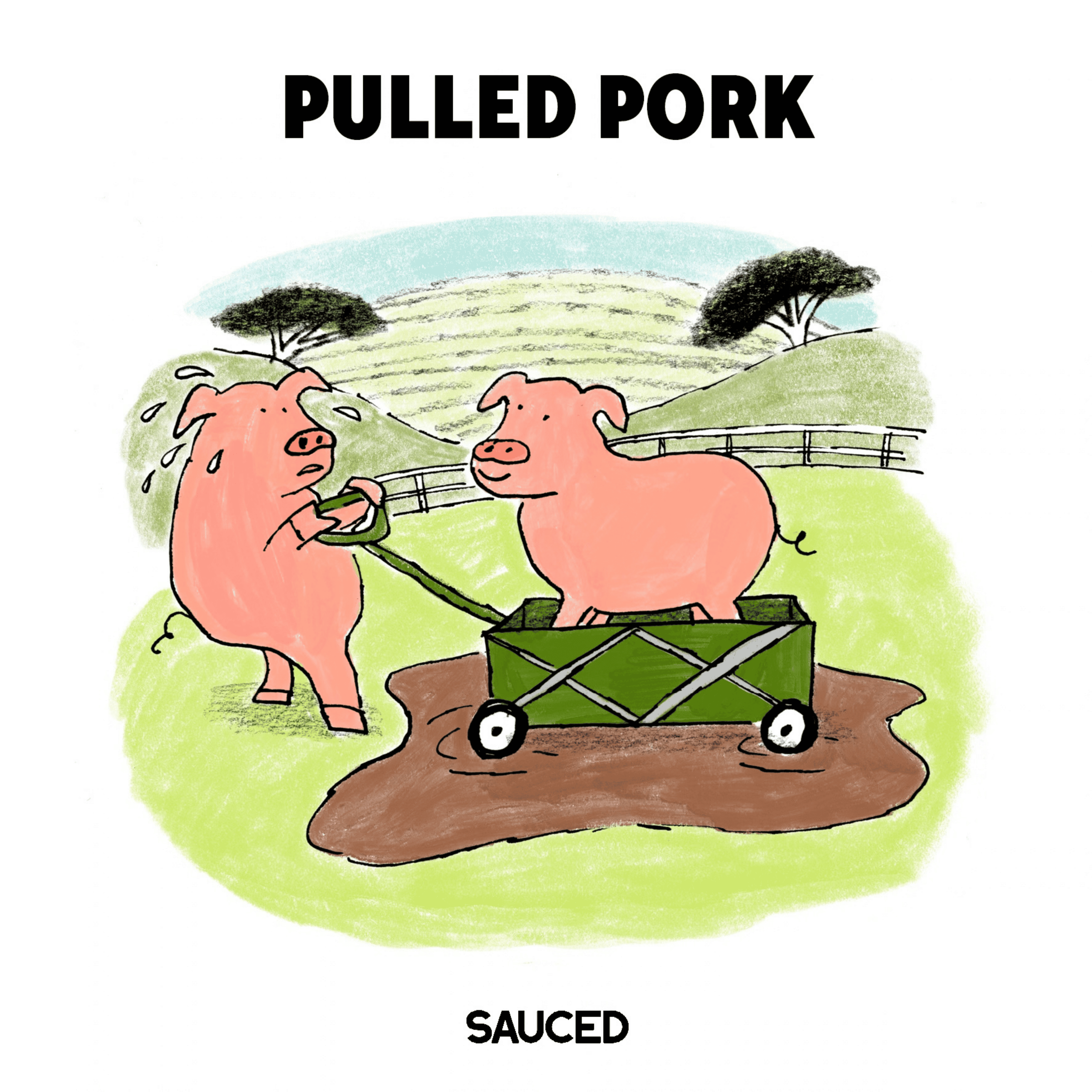
The pork shoulder spent most of its life as a cheap, tough poverty cut. Then Pulled Pork went from Carolina pits to a London street-food trailer to menus across the city, and worldwide searches for it peaked in the spring of 2020.
We trace the craze, find out why the shoulder is sold as a butt, and work out how to smoke one at home.
"Patience is your friend."
What we settled on:
A bone-in Boston butt, about 8 lb
Salt, coarse black pepper, and sweet paprika, on overnight
Indirect heat around 250 over oak and hickory
An apple cider vinegar and Mezcal spritz
Cook to 195-205, then rest it 45 minutes to an hour
A thin Eastern North Carolina vinegar mop in place of a sweet sauce
The Cocktail:
The Francis Bourgeois, a Stone Fence riff with apple brandy, a splash of the vinegar mop, Angostura bitters, and hard cider.
RECIPE CARD:
Premium subscriber? Check out the full recipe card here.
LISTEN
EpiSOde Partners
Thanks to the following brands for partnering with Sauced to bring you this episode:
TRANSCRIPT
Tim McKirdy: Sother.
Sother Teague: Tim.
TM: Time to pull out the smoker. Oh, wait, that's for later in the episode.
ST: Well, we're jumping right in for Pulled Pork.
TM: Pulled Pork.
ST: And Pulled Pork can be made in numerous ways, but we're definitely going to talk about smoking it, right?
TM: Yeah.
ST: Okay, good. Because that's what I prepared for.
TM: Same here. Been preparing years for it.
ST: I've braised pork in the oven or in a crock pot and made pulled — Pulled Pork, not barbecue, obviously — for other uses, making Brunswick stews or what have you. And it's delicious too. But I think we're going to dig into cranking up the smoker.
TM: Yeah, and we will, I think, obviously share an alternative method for all of those who live in a city —
ST: I mean, I live in a city.
TM: — and don't have a backyard.
ST: Oh, right.
TM: What is your initial gut reaction just to this dish, just to Pulled Pork? What does it evoke for you?
ST: Oh, man. Many, many fond memories of both making it in restaurant settings and in my home setting, or someone else's home setting. This is the style of food that I most enjoy preparing. I love the process that's involved, the low and slow, the sort of caretaking of the fire, minding the smoke. This is a dish that really speaks to me.
TM: Overcoming the stall.
ST: Overcoming the stall, yes. Patience. Patience is your friend.
TM: I'm curious to hear your modern — or how this has maybe evolved, or its cultural standing here in the US, how that might have evolved during your lifetime. Because, and I'm jumping ahead here and we'll get into it, but for me Pulled Pork really fits into that narrative of things that I've discussed in recent episodes, or fairly recent episodes, right? The burgers, the hot dogs, the influx of American cooking culture into the UK at a pivotal period in my life. So, yeah, is this a dish that's evolved, or its cultural standing has changed, during your life?
ST: Not so much during my life. It's kind of held its place. However, I would say that there's been a little bit more celebrity influence over it. And when I say celebrity, I mean, of course, named and known chefs who have come forward to elevate the dish, put it in finer dining scenarios, or even stay in the scenarios that it was in but make it more artistic — or artisanal would be the better word. People who are really leaning into exactly what I just described before, the process of it all, and elevating that process to glory standard.
TM: I wonder whether another thing, or another part of that, is maybe looking at it a slightly different way, where it's not that the artisans making it have changed their methods, more that society in general has given more capital to that preparation and those techniques and style of cooking.
ST: A hundred percent. That's kind of what I meant. You said it more eloquently than I did. But yeah, it's really that the imagination of the consumer is captured by all the things that have to go into making something like this, because you're taking humble ingredients, which is a lot of what we do here on the show, and you're really elevating them and putting them up on a pedestal through what you do to those ingredients. And in this case, it's a lot of time. You're putting in a lot of time on this.
TM: It's the embracing of the South and Southern culture as well too, right? And not being like, this is sort of — I don't know — backwards or whatever. I don't know, the tropes.
ST: Yeah, I mean, but I would take it out of just the South. I mean, I think the American Southeast is known for pork barbecue the most, but pork barbecue stretches all the way across the country, and everywhere. The cultivation of the pig is pretty smart farming. They're easy to raise because they don't need a lot of attention. They can forage around for their own food to a large degree. They replicate pretty quickly — how about reproduce? They reproduce pretty quickly. And then animal husbandry has come a long way in making the animals have a good yield. So I think that it transcends just the American South, but yeah, that's definitely where it kind of comes from. And that's where I come from. So I feel kinship with this dish and the people who love it.
TM: Well, our origin will begin in the American South. But before we dive into that, one more thing that I need us to agree on beforehand, or the stake that we're gonna put in the ground, right? So we said we're mainly gonna focus on low and slow and smoking. In certain parts of North Carolina, obviously, you'll have whole hog cooking, and not just North Carolina, but you can pull pork from whole hog cooking. But maybe we should focus specifically today on the Boston butt for what we're doing.
ST: I agree, because we're mostly talking to home cooks, and home cooks don't have the space, means or wherewithal to roast — to slow cook — a whole hog. It ain't little. The last time I did a whole hog was actually for a friend of mine's party. We did a 119-pound dressed animal, and it took just shy of 15 hours to get it to a place where we can pull it. And in that case, we didn't pull it. We did what's called a pig picking, right? So we laid out the entire animal, and people literally walked up and pulled it themselves. Yeah, with tongs. You get all your accoutrements on your plate, and then you step up to the pig and just peel off the pieces that you want.
TM: Pig picking.
ST: Yeah, pig picking.
TM: That's gotta be our porco alliteration of the week right there. Lots of opportunities for porco today, folks. Let's get into those origins, though. Mentioned the South and that association of the South with pork. Pork became the South's meat because of many of the things that you said: the pigs looked after themselves. An individual named Hernando de Soto landed in Florida in 1539 with a herd of Iberian pigs. The ones that escaped — some of them escaped — went feral and bred across the Southeast, foraging for themselves, like you said, needing no fences or feed to keep them in. Therefore they were cheap to raise. Okay, they were feral, but cheap to raise in terms of hunting. Easy to salt cure without refrigeration, which is a big factor. And thus pork became the everyday meat of the region. De Soto himself died broke on the Mississippi in 1542, three years later. The most valuable thing he left behind was that herd. By then, around 700 hogs.
ST: I mean, this guy died penniless. I feel really bad to hear that, because I'm no theologian, I don't know who or what God is, but they gave us no greater gift than the pig. And if this guy brought us the pig, then he should have died a very, very rich man.
TM: Yes. So sadly not, but they'd leave behind those 700 hogs. As for the terms and the cooking style itself, we have covered this before, but worth going into again. Barbecue itself, the word comes from the Taino word barbacoa, which itself is named for the wooden frame for cooking meat over fire. Merriam-Webster dates the English word back to 1733. And the whole hog, low and slow craft itself was, as we mentioned before, largely the work of enslaved African American pitmasters. The shoulder, like many of the other cuts, was a poverty cut, because it was tough, hard worked, unglamorous, required low and slow cooking. But as is so often the case, that is the thing that we then prize the most in the end, once we've mastered these cooking techniques. Right. We agreed: the Boston butt. Weirdly, nothing to do with the rear.
ST: No, it's the forearm — it's the shoulder of the animal. And it's called the butt for a couple of reasons. One, the butt is known as just the blunt end of something, right? The butt of your rifle, the butt end of a hammer. The butt end of the shoulder is that blunted end up at the top. There's a lot of myth — and I think this is maybe what you're about to get into, and I'm going to bust it, I hope, unless you've already busted it. There's a lot of myth that it was named after the barrel. Turns out that's not true. I believed that until literally, I think, this week.
TM: I think it's partially true, is my interpretation of it. So you're right. Butt comes from the Late Latin buttis, B-U-T-T-I-S, which is a cask and an old unit of measurement, roughly 108 to 140 gallons, or two hogsheads, if you will. The usual story is that in the 18th to 19th century, butchers packed these less prized pork shoulders into the barrels called butts, salted them, cured them, and they pinned the practice on New England, specifically Boston, so it kept the name Boston butt. Here's the thing that historians flag as shaky, and this is probably what you're referring to here: the main pork packing centers were Virginia and the Carolinas, later Cincinnati and Chicago. So no one really knows why Boston, and why that stuck.
ST: Right. But also, it came around because there was a printed occurrence in the Hotel Monthly in 1915 that referred to it as the Boston butt. However, as early as 1892, we had already had reference to this cut known as the butt. So obviously that doesn't line up. And there's more. I got a whole lot.
TM: Yeah, I mean, it's weird and it's tricky, because if you look at it the other way around, why, when we are so used to butt being the rear, why would we use something from the opposite end of —
ST: Because, again, the bluntness. It's the bluntness of the cut when it's lying there on the table, just removed from the animal. You don't know that it's from the rear or from the front. It is a blunt-ended piece of meat.
TM: — the animal. Sure. And probably more so than most other common cuts that you will get. The other one for us to mention, because it comes from a similar part of the pig, is the picnic roast. You wanna tell us about that?
ST: Sure. So that'd be the lower part of the arm, right? You mentioned earlier that the shoulder is tougher because it's used a lot. It's not used nearly as much as the lower part. So the lower part is even less expensive, not quite as meaty, a little bit tougher, still needs long cooking. So if you're going to do this, get the shoulder part.
TM: And generally has more skin when you buy it as well, the picnic.
ST: Yeah, exactly. Which — I'm not against the skin. Let's crisp it up.
TM: Why is that called the picnic roast? Who knows.
ST: Yeah, that I didn't look into. I just wanted to get to the bottom of the butt. I thought for years and years and years the barrel story was the story. But in doing research for this episode, I ran across an article that was like, no, we were calling it that many, many years before the barrel thing. And as you said, the locations that they were coming from wasn't Boston. And I was scrolling, trying to find it right now, but in my notes somewhere there's the fact that we already had other butts as well. There was the Chicago butt. I think there was even actually a New York butt, which were just different cuts up around the neck part of the shoulder, right? So again, blunt-ended pieces were just called butts.
TM: That makes sense. And you hear this a lot as well, and I'm sure you experienced it, having worked in a butcher shop: there are cuts, but different butchers take different approaches. How many ribs —
ST: There's regional cuts all over the country, and the world. As you know, I'm sort of — not obsessively, but I follow a lot of butchers on Instagram and social media from all over the world. And I just love to see how they deal with things and process stuff.
TM: So, barbecue cooking styles. Again, we got into this a lot more in our barbecue ribs episode. We did a bit of a deep dive on it as well on our Instagram page. Folks, if you're not following us there, that's @sauced.pod, or just search Sauced Podcast on Instagram. We put together a little carousel of the regional styles of barbecue. Obviously North Carolina, South Carolina, that kind of area, is big on pig, like you said. The very quick ones: Eastern North Carolina, we're talking the sauce is vinegar and pepper.
ST: My favorite.
TM: Lexington and Western North Carolina, vinegar plus a ketchup dip. South Carolina —
ST: The ketchup dip comes into play mostly, frankly, in the coleslaw. The red — it's called red slaw. So you fold some of this dip into your coleslaw with a bit of mayonnaise as well, and it kind of comes out red.
TM: Nice. And then Carolina Gold, with a bit of mustard in there.
ST: I'm a fan of that one, but, man, nothing beats the vinegar.
TM: So those are our different styles. Now I wanna jump ahead again to that modern kind of renaissance, or whatever — not really a renaissance — but I remembered there being a time, like I said, I'm gonna say 2010s, early 2010s, in the UK. I was working as a chef in London. This is when we had all those burger spots opening up. It's where you had your fancy Bubbledogs with your Champagne and your caviar and whatnot.
ST: Sure. The real heyday of the gastropub.
TM: Yes. At that time, Pulled Pork came out of seemingly nowhere, and within a few years it was everywhere. So American barbecue obviously wasn't a big thing in the UK, but you'd have certain places, and we'll go through the timeline of somewhere that opened up that really sort of was the catalyst for all of this. So in America, it seems like the story is almost gentrification. And if you wanna say where is one of the first moments in that story: Blue Smoke opens in New York in 2002. Did you ever go to Blue Smoke?
ST: Many, many times, actually. It was a Danny Meyer joint.
TM: Danny Meyer, on 27th Street.
ST: Jazz down in the basement. Really cool.
TM: And so, yeah, you have a chef known for fine dining turning their attention to barbecue, and opening it in New York, and, what, 24 years ago? I think it's shut down. Pandemic.
ST: It has, yeah.
TM: I think they had a number of different locations as well, and I think they've all shut down.
ST: I believe so, yeah. I believe he's focusing on burgers now.
TM: Yeah, well, there again, turns his attention to something that's not —
ST: Shake Shack.
TM: And he's got a new book coming out.
ST: Oh, does he?
TM: I think it's called What Could Possibly Go Right?
ST: Clever devil.
TM: That restaurant, Blue Smoke, launched the Big Apple Barbecue Block Party in 2003.
ST: That still goes on.
TM: Franklin Barbecue, the famous, from Aaron Franklin in Austin, I believe, Texas, started as a trailer in 2009. Restaurant opens in 2011. Bourdain shows up in 2012.
ST: Ooh, good timing.
TM: Obama is standing in line by 2014, and in 2015 Aaron Franklin becomes the first barbecue cook ever to win a James Beard Award. So you have that timeline. I'm not saying Danny Meyer's responsible. That's more the effect than the cause, right? If he's opening up a barbecue joint in the Flatiron District, New York —
ST: It was already happening.
TM: — it was happening, right? Or it started to happen, or he saw where it could go. Across the pond in Britain, there is a place, once again, starts a little later, but it started as a food truck, or a trailer, called Pitt Cue Co. In 2011, they were a street food vendor. Within a few years, I think even by 2012 or 2013, they had opened a brick and mortar, really, really small little space in Soho. Amazing place. I used to love going there. And this began the sort of — happening in tandem with burgers being treated seriously, but enjoying them being dirty, getting your hands dirty. It's American regional food and street food, and London really started embracing it then. By 2015, Time Out had written this article that was like, London had become the Pulled Pork capital of the world —
ST: As rage bait.
TM: — purely, and this was based on one metric. Of all of the photos in the world on Instagram — and look, these are the early days of Instagram — hashtagged with the word Pulled Pork, 7.5% of the posts were in London. More than any other city in the world. Now, again, that maybe speaks more to a moment. It doesn't make London the Pulled Pork capital of the world, but they said by that point, four years after this food truck opens, it's on every menu in town. And I do remember this. You couldn't go to a gastropub, you couldn't go anywhere without having their version of Pulled Pork. Jamie Oliver comes out with products and sauces. Sorry.
ST: That's fine. Well, that's what I wanted to ask. All of this Pulled Pork that's happening in London — I mean, there's somewhat specialized equipment that's necessary to make smoked pork on scale like this. Did suddenly every restaurant get a smoker? Or are we just talking about braised pork that's been shredded and sauced?
TM: Well, the laws are much more forgiving when it comes to gas cooking or open fire cooking and whatnot in London, right? Have you ever used one of those Josper ovens?
ST: I don't know what a Josper is.
TM: So imagine it is — I don't know — the oven that you cook in itself is maybe three, four foot tall. It's wood fired completely.
ST: Ooh. Wow.
TM: And it's got two or three grills in there.
ST: Okay, yeah. I've seen it. I just didn't know what it was called.
TM: And you can pull them out —
ST: With the drawers, yeah.
TM: In Grain Store, where I worked, it was called the Josper section that you worked on. We cooked everything in that thing. You could cook half a quail in 30 seconds, because I would get this thing ripping to 400 degrees Celsius before service. And you would just keep feeding — I mean, it was dangerous. But, so, yeah, we had the —
ST: Cooking with a jet engine.
TM: — Josper. But yeah, I imagine there would have been smoked, or, to your point, I think a lot of it was just braised, seasoned, braised, whatever. But then you get — so I looked through it — Subway, and this is across the board, this isn't exclusive to the UK. Subway had a barbecue Pulled Pork sub. McDonald's started testing Pulled Pork. Wendy's had Pulled Pork poutine. KFC, pulled chicken. Walkers Pulled Pork crisps — that's Lay's for our American listeners. Supermarket ready meals. Like I said, Jamie Oliver on TV. British Airways first class. All of these things serving Pulled Pork.
ST: Yeah, I love it.
TM: And then just my final thing about the rise of the phenomenon of this dish. Have you ever Googled — have you ever been on Google Trends?
ST: No. I don't think I'm cool enough to be on Google Trends.
TM: Well, as a user, and coming from an editorial background, you would be like — the data goes back to 2004. And this is a straight line graph that shows you the relative interest over time in a certain search term. So you can be like, when were the most people in the world searching for this thing, and what can we attribute it to? The data begins in 2004. It shows, when you search for Pulled Pork, that graph climbing mainly through the 2010s. So really aligning with what's going on with Franklin and Pitt Cue. And then peaking in the pandemic, in 2021. And looking into that, it lines up with a massive surge in wood pellet smoker ownership. It tripled, from 3% to 9%, between 2019 and 2021. And 20% of the new grill buyers who were surveyed for this data said that the reason they bought it was because they were spending more time at home. Go figure. There's a pandemic going on.
ST: Sure. Everyone's at home.
TM: So everyone's just searching for Pulled Pork recipe. They bought a smoker.
ST: Right. You got all the time on your hands, which, again, is the key ingredient to this dish: time. I know we say that about a lot of dishes, but this one, it really means it. And, yeah, so you got all this time on your hands. You bought yourself a Traeger or some nonsense with the pellets, which I'm not a big fan of.
TM: I don't like those Traegers.
ST: I'm not a fan of the pellets. It's not the grill brand. I don't care about your brand. I care about — let's use some wood. Why are we using compressed sawdust pellets?
TM: It's like when certain winemakers use oak chips rather than aging something in an oak barrel. If you don't have the money, if it doesn't work economically, don't do it. Do something else.
ST: Right. Right, because it's not a thing you can get out of, right? The winemaker may start that way because it's economical and then grow into barrels over time. But if you bought this grill that's a pellet smoker, you're doing pellet forever. You're not evolving.
TM: So, I don't know. That's all the origins I have for today, but curious to get your reaction just on that sort of story from, I don't know, the mid-aughts onwards.
ST: I mean, that tracks with everything that I've seen here in America too. And I lived all over the country and saw this dish everywhere. It exists everywhere. It's, again, at its most at home in the Carolinas, where I lived also for several years, and that's where my absolute fascination and love for this dish came from. And, honestly, I'm such an avid consumer of pork that this dish — desert island, this is a desert island dish. I would need to have some methodology for smoking some pork if I was on a desert island.
TM: And luckily it's one of the most rudimentary cooking techniques out there. So, yeah, you just need a couple of pigs across there with you. A regular old Sother de Soto. Take a couple of hogs with you —
ST: Yeah, I'll have 700 —
TM: Let them go feral.
ST: — in no time, and I'll die penniless.
TM: Listen, our man managed it in three years. I don't know. I think, again, if I can maybe theorize one final thing: if I'm sat here with all of that in front of me, trying to piece it all together, I would say that this is the perfect confluence of a few different factors. Anthony Bourdain makes cooking and being interested in food cool, but not just food: regional food, dishes with identities.
ST: Yeah, for sure. He taught us in many ways that it is easy to travel the world on a plate.
TM: And oftentimes more interesting than the style of cooking that we'd held in the higher regard before that, right? The Michelin star, the Michelin star obsession. Also, the Anthony Bourdain effect: he makes food media cool again, right? Would you have been subscribing to Saveur, Food & Wine? Or what does your regular, average Saveur, Food & Wine subscriber look like in 2001 versus 2015? Food writing is a profession. Just so many people. Everyone wanted to be the next Bourdain. And then to tie it into the people buying the smokers, or why does this dish seem so exotic? If I've just bought my first grill, I'm afraid of brisket, because you do enough research to know that that's a whole thing, right? That's the big leagues. Sure, I can cook chicken in there, burgers, whatever, but I can do that in my kitchen. The Pulled Pork, it's very forgiving.
ST: Super forgiving. I was gonna say that exact word. This piece of meat is so laden with fat and connective tissue that's gonna break down into gelatin that there's almost no way to blow it. Now, there's ways, and I think that's the fascinating part about this dish. There's kind of no way to blow it. You're not gonna have something that comes out the end that's ruined. However, by tweaking some dials, you're gonna have something come out that's excellent, that's exemplary, right? So then it just becomes a game of chasing that tail. How can we make it just a little bit better than we made it last time?
TM: The gamification of it all. I love it. So, yeah, it really is the perfect recipe of a number of different factors. And it's an icon. It's a desert island dish, like you said. I'll definitely put it up there for myself too. Final thing for us to answer: prince or pauper's dish?
ST: You know, I hate to cop out, but this one, it's a working man's dish. I don't think it's a pauper's dish, though it is priced to move. I don't think it's a prince's dish, though it has made its way onto some fine tables. It's a very democratic dish. It's a dish that is appealing to anyone who likes to eat, and that's, I think, all of us.
TM: Yeah, I agree with you.
ST: Super democratic.
TM: Equally at home on British Airways first class as it is —
ST: When you said that, I was blown away. I'm in a suit and tie on a first class flight across the pond, and I'm eating a Pulled Pork sandwich with sauce dripping down my hands.
TM: I think it got so big as well that other stuff became pulled as well, right? I mentioned the chicken, but pulled jackfruit is something I've seen for sale in supermarkets, for vegans.
ST: Mushrooms. Of course, we pull beef as well.
TM: Yeah, it's — pulled became a brand, and I'm invested.
ST: Yeah. Pulled — and, by the way, just real quickly, we should mention the difference between pulled and chopped, right? Chopped is a more — pulled is definitely kind of — it can be the whole hog, but it's more generally relegated to this cut that we're talking about, the Boston butt, shoulder. When you do whole hog, you can pull it, but generally you literally take a couple of cleavers and you chop it all together, because you're chopping in, at that point, what's been slow cooked as well: the loin, the ribs that go into it as well, the skin, the fat. Hopefully that skin got crispy, so you're chopping that in too, so you get this big pile of just all these different textures. But when we're using this particular piece, we're just mostly getting those — I'm not using stringy in the bad sense — but those strings of muscle fiber that we're just shredding apart, because they've cooked to a place where all of that fat has melted in and all that collagen has rendered, and just unctuous and so good.
TM: I think I already know the answer to this —
ST: What's that?
TM: — but I got to get your take. The bear claws that people buy for this.
ST: I don't see anything wrong with them. I've never held a pair in my hand. I don't think I need them. But I don't see anything — I'm not against them. The only thing I would be against them for would be, I don't like things that only have one use.
TM: That's what I was — yeah.
ST: But you could argue, oh, I'm gonna toss my big bowl of salad with it or something. I mean, I get it, but I don't need them.
TM: You've never been in an Ace Hardware store and said, wait a minute, I think today's the day I buy my bear claws?
ST: Yeah, no, I don't need it. I'm gonna put on two pairs of those dark black nitrile gloves, so that it's protecting my hands from the heat, and I'm just gonna go in there and shred it. The meat should be easily pulled.
TM: Yeah, well, I mean, that's another victor in the shadow of the Pulled Pork, has been those black gloves, because everyone sees their famous barbecue chefs on TV wearing the black ones. And we used to have to wear the blue ones in the kitchen, because it shows up more in food. Black looked cooler. It's pitmasters and tattoo artists. What's not to love?
ST: And there's a convergence there too. A lot of tattoo artists practice on pigskin.
TM: Oh, wow. That's not what I was expecting.
ST: Why not?
TM: Wow. All right, Sother, those have been the origins and personal associations, plus a little Prince and Pauper for good measure. We're going to take our first break of the show today, and then we'll be back with the culinary luminaries.
ST: Cool.
TM: All right, Sother, we're back. The luminaries. Hit me with your top three.
ST: Top three. Oh, man. Yeah, well, first I'll say, clearly Jacques and Julia didn't have much to say. And even if they did, I don't know that I'd be taking it into account. Jacques did love braised pork. He talked about that a lot, but not what we're talking about specifically today. You got Rodney Scott. We all know his name, yes. He said, clearly — I'm gonna quote him, and I'm gonna try and use the parlance that he's using here — "When you rush barbecue, man, you're taking chances on either overcooking it or undercooking it, or just screwing the whole thing up. Once you start, you're committed." That was a pretty strong statement from him. And basically the undertone of that statement is, it's not a very difficult thing to do as much as it's kind of unwilling to be rushed. And I think if there's any takeaway from this episode while you're listening, taking your time is what you have to do. You got a guy named Ed Mitchell. Ed Mitchell was a whole hog cook, and his philosophy was what I just talked about with the chop. He wants to incorporate all the pieces — he wants a texturally dynamic pull from his pork. And I think that that's certainly worthwhile, and it should exist. And then, let's see, he said three. Let's go with Sean Brock. Sean Brock viewed Pulled Pork as a Carolina food culture item, right? Which is kind of how I view it, from having lived there, and it was in my sort of formative years as a young cook, living in that place. I've jokingly said over the years, when I lived in the Carolinas, it was one of the first places that I cooked professionally at a level that we talk about here often. And I often say I haven't had pork since I lived in North Carolina, because the pork there is simply different, right? Every single day there'd be someone knocking on our back door and saying, hey, I'm a farmer from down the road, I just slaughtered two hogs, do you want some? Some? No, we'll take them both.
TM: Is that Spanky's?
ST: No, no, no, that was at Pop's, which was an Italian trattoria, but owned by a guy named Scott Howell, who owned a place called Nana's as well, which was a little bit more Southern style. So we kind of — Southern Italian — not Southern Italian — Southern United States slash Italian. But we'd get this pork, and also Ben Barker was a partner there, and Ben Barker literally held the title of King of Pork at the Magnolia Grill, which was a super famous restaurant as well, owned by he and his wife. They wrote a book years ago called Not Afraid of Flavor.
TM: Nice.
ST: Yeah, nice. But no, we would get these animals in, and I would break them down, and I would look at the loin just like I would look at the loin from a beef animal: marbling. Whereas now, anywhere I pick up a loin, it's just got a pale pink color. The other white meat, right? But these pigs were fed well, treated well, and had marbling. Anyway, Brock is pretty opposed to the pork swimming in barbecue sauce, especially a sweet one. The meat, the smoke, the pork, the fat and the acid are supposed to work together in harmony. The sauce is often there to simply wake up the pork rather than conceal it. And I think that's a pretty poignant thing. And it really drives home why I am so firmly in the camp of the vinegar-style mop sauce. Because, first of all, you can't coat the pork with so much of it. It's vinegar. It just drips off. But it's enough to season the pork. And what we're here to eat is pork.
TM: Yeah, I love that idea of waking it up. I think — just by the way, I was going to say this before, but now is a natural point for this — probably a decent chunk of the rise in popularity in that story that I was talking about is because none of us like admitting it, but we love sweet things. And most barbecue sauces, especially the ones that people buy, are very sweet. This became a —
ST: I believe — but I blame two sides for that, though. Yes, I agree. There are times where I'm like, I shouldn't be eating this, or whatever it is — tub of ice cream, whatever. And I'm known as the bitter guy, but even amari are full of sugar. But I think that part of the barbecue sauce specifically being sweet comes from the idea of, oh, I'm going to package this and sell it. And sugar is a great stabilizer on the shelf. I think that surely had some influence. I don't think these sauces were all this sweet in the beginning.
TM: Totally not. No, I'm for sure talking about the packaged versions. And then it just becomes a vehicle for that. And it's a novel vehicle for carrying those sauces, again.
ST: Right. I don't think kids like French fries as much as they like ketchup, and French fries are just edible spoons for ketchup.
TM: Exactly. And most people's introduction to barbecue sauce — or not most, a lot of people's introduction — is the thing, whatever it is they serve at McDonald's.
ST: Oh, the McRib.
TM: The barbecue —
ST: The McRib sandwich.
TM: Oh, no. But just even the little —
ST: Oh, the dip. Oh, yeah. Sure. For your chicken nuggets. Yeesh.
TM: So maybe that had a big thing to do with it. But sorry, I cut you off there.
ST: No, no, I was just agreeing with you. I think the popularity of sauces being jarred has driven those sauces to have to have sugar in them, because it's a shelf stabilizer. But then that's what people get used to. So then they go home, and when they even make one themselves, they put a ton of sugar in it, typically brown sugar or molasses, or sometimes honey. Yeah, I'm not a fan of the thick, sweet barbecue sauces when there's too much. I'm okay if it's just a glaze, or just lightly spread on, or what have you. But again, I am firmly two feet down in the camp of the vinegar-based sauce.
TM: One other individual here that I wanted to mention — we've already mentioned him — Aaron Franklin. And the reason I want to bring it up is because I learned something new that I had never come across. His rub is equal parts kosher salt — a little black pepper, a little paprika — but equal parts kosher salt and 16-mesh black pepper.
ST: Yeah, that's common.
TM: What is 16-mesh, for those who aren't familiar?
ST: Yeah, so you can picture what that is. The mesh that the cracked pepper is sifted through: 16 lets through a certain size, and lower numbers let through — it changes the size of the grind. So it's just a very visible-sized grind.
TM: The higher the number, the finer the grind.
ST: Other way around, I'm pretty sure.
TM: I think it's that way around.
ST: 16 is pretty freaking coarse.
TM: Yeah. And 30 is much finer.
ST: Okay, yeah, yeah, you're right. Yes. So, yeah, 30 is what you're going to find when you're buying pre-ground black pepper at the grocery store, in the McCormick jar or whatever. Yeah, the lower the number, the bigger the grind.
TM: The bigger, the coarser the pepper. Interesting. And obviously there are a number of reasons, which we shall get into, for why you do want a coarse black pepper on this, of course.
ST: Sure. And that's what I use, the 16, all the time when I'm rubbing down what you talked about earlier, brisket. And it's perfect for that.
TM: Any other luminaries here, or any other thoughts for this section?
ST: I mean, no. Surely we can't — and you did mention it earlier, and we mentioned it in other barbecue episodes that we've had — but there's a whole lot of the weight of barbecue culture that is carried by Black chefs from the past that are hopefully not being erased and overlooked. And several Black chefs are stepping forward and reclaiming this territory as their own, as they should. I think it's just — we should mention that.
TM: Yeah. And, yeah, great to call them out as well here as the luminaries that they are. And we'll take another quick break there now, and then we will be back with the debate: the non-negotiables.
ST: Yeah, let's go.
TM: All right, we're back. Non-negotiables. Let's go. Number one, what you got?
ST: Well, I think for our purposes — because my druther is a whole pig, let's do it. And I've done a whole pig in my backyard here in New York City, but it was a suckling pig, so very small. I think he was maybe 15, 18 pounds. But for our purposes, we've already discussed it, we're going to need the pork shoulder.
TM: Bone-in or no bone-in?
ST: Bone-in.
TM: Tell me why that approach.
ST: I've always been a fan of bone-in cooking of any variety, right? If I'm going to have a steak on the grill, I'd prefer to have a bone in there. The bone is going to impart some flavor, and also, in the steak scenario anyway, I kind of like to chew on the meat on the bone, so I get a little treat at the end, right? We're not going to get that with this, because we're going to cook so long that the bone's just going to slide right out of there. So why I want the bone in there is because it's going to be cheaper. You're paying a little bit for the weight of the bone, but you're not paying for the butcher to have removed the bone for you. Also, if you decide to remove the bone yourself, it's pointless. Why would you? It's literally going to slide out entirely clean by the end of this process. So it's just an unnecessary step to get it boneless.
TM: Can we pick apart a little bit, maybe, just the idea that the bone imparts flavor?
ST: Yeah, it probably doesn't vary much, if, frankly, at all. But visually, it sets a standard in my mind when I see a thing. That, I know, maybe tells my brain that there's flavor there. And then there's a part of me that's like, well, how could it not, right? If I've got that same bone in 200 — let's call it 195-degree water, making a slow-simmered stock, it's rendering flavor from that bone. So now if I'm smoking this thing at 250 degrees over a long period of time, while it's wrapped still inside of the meat that it came from, surely it's imparting some of its something into that meat. And I guess maybe if I had to throw at least one last-ditch effort towards, is there science behind this — without having any chance to go get in a lab and prove it — when I butcher that pork and pull that bone out, it's heavy. When I cook this pork and slide that bone out, it's light. So it left something behind.
TM: So if I'm thinking about making veal stock, first thing we do, we roast our bones in the oven. Even when you've got them to the right level of doneness, large parts of the bone are still ebony white. So what we're getting the flavor from is the marrow and the meat that's left on the bone. That's number one. So is it ever the bone itself, or is it the things that's encased within the bone, or still attached to the outside of the bone? Number one. Number two — and this is going to be probably my first non-negotiable here, so we'll slide into it — this needs to be cooked low and slow. You're going for an internal temperature of about, what, 195 to 205, right?
ST: Exactly. The target.
TM: Your bone is inside the meat, and are you getting Maillard at that point?
ST: No.
TM: Therefore, where is the flavor coming from?
ST: Well, in this case, to use your analogy, when I slide that bone out of there, there's going to be zero meat left on it. It's going to slide out clean. Whereas if I butcher that bone out of there, some of the meat goes away, thus some of the flavor. So it's just —
TM: Ah, so you're leaving more flavor in there.
ST: — we're just getting 100% yield, is really where it's probably coming down to.
TM: But I like your point as well. It's cheaper. Yeah, that's the main reason.
ST: I mean, you'll find, even if you go back and listen to all our episodes, Tim, I'm always looking to save a little money. We're both of Scottish descent, and I think our ancestors invented the word frugal.
TM: But also, yeah, I just don't like it when you needlessly spend money on things.
ST: And I don't just mean at home. And, frankly, I think about it less at home, unless I'm literally sitting and examining something and talking about it. But I did this for a living. I'm going to make sure that we're maximizing every dollar when I'm living on a margin at a business. And my job — largely, my career as a chef was always in positions of guarding that dollar. Literally, I worked garde manger for many, many years, which is where you take everything that's scrap from every station and you make something out of it that can be used either for the menu itself or for family meal. And then when I was a butcher, one of the many, many, many things that we did was make, obviously, tons and tons of sausages. Where do those come from? That's all scrap. Nothing's going in the garbage can that doesn't need to go in the garbage can. And the opposite end of that train is, I'm not going to pay for anything that I don't need to pay for.
TM: Yeah, fair.
ST: So buy everything as best quality, low price as you can possibly do it, and then process every bit of it to be useful.
TM: Perfect. So we're saying low and slow is my first non-negotiable.
ST: That was my second one. Long cooking.
TM: So we're cooking between 225 to 275. That's what you're looking for.
ST: Again, let's split the difference and call it 250. You're never going to be able to hold a temperature perfectly on a wood fire. But, yeah, that's the target. And the target, as you said already, is 195 to 205 to finish. But really, you also have to pay attention to the notion — and granted, most of the pork you're going to buy is coming from a big farm. I get pigs from local farms here in New York, and I have a butcher that, of course, I know, so I know where he's getting his pigs too. So you're going to have some differences in the animals themselves. But the target temperature of finishing isn't as important as the target texture of finishing. So don't be too tied to the thermometer. The thermometer is your guide, but the texture is your real target.
TM: And what's going on inside the cut, for those, again, who like numbers, who like science: collagen begins converting to gelatin at 160, and only fully breaks down, thus allowing the pulling, from 195 onwards, right?
ST: Right. And don't forget — I think that we've talked about it numerous times — there's also a curvature to the graph here. Just achieving 160 doesn't mean you've broken down all the collagen. That's where it begins to break down. We need to achieve and maintain those temperatures so that all of it fully breaks down, right? And I think that's massively important in this dish specifically.
TM: Which is also not to say, too, that this is the only way you should cook this cut, right? For Pulled Pork, it is. One of the things that I love doing with a Boston butt is a sandwich we used to eat very regularly in Argentina called bondiola. And it's the exact same cut of meat, but it's cooked more to, like, 170. And you can slice it.
ST: Yeah, almost like ham.
TM: Yeah. And, I mean, again, cooked low and slow over real wood. And, yeah, so it maintains its structure when you slice through it. And it's a completely different thing. It's delicious. Pork is amazing. Check out bondiola sandwich. It's a gift.
ST: Bondiola. All right. Well, let me do an episode. Have we done — we did hamburger. I was about to say, have we done a sandwich episode? We did hamburger.
TM: And hot dogs.
ST: You know what? One of the comments that we got on the hot dog post — I'm going to jump off on this for a second — is a hot dog a sandwich? I am firmly in the notion that it is not. One of the comments that I really enjoyed was when someone said, if I remove the bun, I'm still eating a hot dog. Oh, wait, I think that was me that said that. But one of the comments that I loved said, a sandwich can be cut in half. No one cuts a hot dog in half.
TM: But you can.
ST: Right, but you don't. Anyway, third non-negotiable for this episode: it's smoke. Wood smoke. We got to have some smoke. So we're cooking it low and slow. Where are we cooking it? On a grill slash smoker. Wood smoke is a must. Smoke is going to be a primary seasoning for this dish, so we must have it. Otherwise you're just doing roasted pork, which is also delicious, don't get me wrong. Again, the forgiving nature of pork in general, and this particular piece of pork: we can go so many directions here, but we're talking smoked pork. Barbecue.
TM: Next one for me: the rub. Gotta have a rub.
ST: You think so?
TM: I think salt and pepper are the only non-negotiables. Much like Aaron Franklin, I probably like a bit of paprika in there always too.
ST: Sweet or smoked?
TM: Sweet, if we're grilling it — if we're smoking it. So, yeah, sweet. Beyond that, have at it. Don't go too crazy, I think. This is not a spice salad. But, yeah: salt, coarse black pepper, sweet paprika. Then where am I probably personally going to go to next? A little cumin, sugar — dark sugar, probably Demerara, brown sugar — garlic powder, onion. But again —
ST: Mustard powder.
TM: Mustard powder.
ST: Yeah, your standard rub, I understand. For me, on this dish, it is non-negotiable: salt. I'm even negotiable on pepper. But for our purposes, I'll gladly go pepper. But I don't think it needs anything else. Again, the idea is, here I'm going to make that mop sauce, which is going to be quite flavorful. Just basically vinegar, salt, red chilies and a little bit of brown sugar. And then I want to taste the pork, right? This is a celebration of pork.
TM: It sure is. I'm going to hit you with something now. This is a new thing that we've been thinking about doing.
ST: Okay. Well, I probably forgot that.
TM: The top tip of the week.
ST: Top tip. The tip top, top tip of the week.
TM: Something I've recently discovered. And it was inspired by — I forget which episode it was that we recorded, and you were like, this is something I've recently discovered. And you started — have been keeping your ginger in the freezer and grating it. And I've been doing that since —
ST: Oh, yeah. It works so well.
TM: — and it's a great, great effect.
ST: Great. I get it.
TM: Top tip of the week: for all of my marinades and rubs recently, past month or two, I've been including coffee grounds. Espresso. Now, let me stop you there. I know coffee is your kryptonite. This is never for flavor, and never enough for flavor. It is purely if you want the black bark to develop on the outside of whatever you're grilling. It's so good at that. It gets you to the point where, when you look at it, you'll think you've burned that — this is inedible — but you want the texture of that, right? It's kind of supercharging our Maillard reaction here. It's so good. And I will tell you, it does not taste like coffee. And I can prove this to you after we finish this episode, because I've got some pork shoulder in my fridge that I smoked. Didn't take it as far as pulled. I did it more sliced, and I marinated it in all kinds of things, including coffee.
ST: All right. I mean, I'll try it, but it really messes with my head.
TM: You know what I should have done? I should have served this to you before I told you that that was in there.
ST: That would have been better.
TM: But it's like — and, by the way, I'm doing this in, like I said, rubs, marinades. Yeah, well, those are the two different styles of seasoning pre-cooking, for these purposes. That is our top tip, or maybe not, of the week.
ST: All right. Listen, I'll take it. There was a barbecue place that was here for a long time in Williamsburg, Brooklyn, called Fette Sau, which means — I forgot what it means. They had a place across the street called Spuyten Duyvil, which was spitting devil. Fette Sau was something, I forgot. Anyway, but Fette Sau, I knew the guy who operated the place. I loved the place, but all of their rubs for all of their meats had coffee grinds in them, and I just couldn't eat there. Couldn't do it. Messes with my head.
TM: It is a shame.
ST: It is. It really is. I know that coffee is obviously beloved around the world, but I ruined myself. I drank too much of it at a very, very young age, and now I cannot touch it.
TM: For the record as well, when I say coffee grounds, I'm on about either you freshly ground coffee, or you buy ground coffee for an espresso machine or whatever. You can use instant as well, but I'd rather not. But I'm not talking about grounds — you made yourself a cup of joe, what do I do with this stuff now? That's not the thing that's going in the rub. Next non-negotiable for you.
ST: I think that's it. This is pretty straight. I mean, now we want to have a sauce, right? But it's not non-negotiable. If I just had this — this was just laid on a table at a pig picking, and I was just picking it off and eating it — I would eat it.
TM: Pig picking is such a great name. You mentioned —
ST: It's a classic thing that's beautiful too, right? You lay out the whole hog, you cook it as stable as you can so that it remains in shape, and then the skin gets nice and crisp. And so you take a box cutter, actually, and you slice upwards from both sides and across the top to make a flap that just folds down, so people can pick away, and they can also pick away at the skin. And then when that side's done, you spin it around and you do the other side.
TM: — earlier, suckling pig, and this is definitely got to be another episode for us. Lechoncito.
ST: Lechoncito.
TM: Lechón is the whole suckling pig cooking that they do in Puerto Rico.
ST: Oh, yeah, yeah, yeah. Oh, I went up in the mountains of Puerto Rico and had lechón, yes.
TM: Oh, we did it last time we were there, and it is so good. I love everything about it. I love the restaurants. I love where you sit, the setting. It's happening behind the scenes. There's fruit stalls as you're driving up the mountain to get there. I love it so much.
ST: Yeah, yeah. The Hoppe brothers took me up there, the guys who own La Penúltima.
TM: La Penúltima, great bar. And, yeah, I knew you'd spent some time in Puerto Rico, so I felt chances are you followed the trail there. I'm going to agree with you here, then. I'm going to say those are our non-negotiables. But there are plenty of other ingredients, sides, technical considerations for us to discuss too. What do you think? Let's start with technical considerations.
ST: So you're gonna be doing this on a grill or smoker that has to be large enough that you can do indirect-heat cooking, because you don't want this to be directly over the flame, because it's gonna be on there for so long. So that's a technical consideration. You wanna use some great hardwood charcoal, and then you wanna use wood for smoke. And in the Carolinas, anyway, that wood is gonna be either oak or hickory, or some combination. And I say go for the combination. Why not?
TM: Many people will have a water bath in there as well, for temperature regulation and also bark formation.
ST: Yeah, well, we're not really looking for bark on Pulled Pork necessarily, like you do on a brisket or what have you. But yes, of course, and you can certainly try and achieve one. But, yeah, the water vessel in there will help insulate and regulate your temperature. I don't use one, but I have a pretty large grill. My grill is five and a half feet long, and it has a smoke box on the side. So my flames — or my fire, rather — is in a whole separate chamber that's feeding the heat and smoke over. So it kind of regulates itself pretty well. But, yeah, a water bath can be great.
TM: As someone who's using a standard Weber kettle over here, one of the things that I find that's useful from having that below it anyway is just that you'll catch all the juice going down to it. It keeps a cleaner grill at the end of the day, the fat that's dropping down and whatnot.
ST: Oh, yeah. Over Labor Day, I roasted two ducks on my grill, and I had a water bath beneath it, and I captured, I don't know, more than a quart of duck fat. Usable. Usable, right? Because I just lifted that water bath out and let it congeal, and then lifted the duck fat off the top, and then re-rendered it in a pan to get any soot and ash out of it. And I have all this duck fat.
TM: I'll know where I need to come this Christmas, as I'm looking for duck fat. You would not believe how hard it was for me to find duck fat in this neighborhood on Christmas Eve last year.
ST: Ends Meat, baby.
TM: Next technical consideration: you've got to rest it.
ST: Oh, yeah. I think I would couch that technical consideration in a larger one, which is to say you need to be prepared to have a flexible dinnertime, because it may take longer than you think to get to proper temperature, and maintain long enough to then have it be pullable. And then, yes, you need to wrap it and let it rest. If you're doing the shoulder, you're gonna need 45 minutes of rest time. And that's just everybody salivating, because there it is, it looks ready. But again, I use the phrase all the time: your patience will be rewarded. If you can be patient, it's gonna be so, so, so much better to let it rest for 45 minutes or more.
TM: Obviously, the easiest way to do it is wrapping in foil. The next trick that everyone does is wrapping it and then putting it into a cooler —
ST: So it's insulated, so it stays at temperature for longer.
TM: Then, if you want to be really fancy — and I'm only bringing this up because you were there, and our good friends Lala and Judith from the Put It In My Mouth podcast —
ST: Love them.
TM: — they came over here. We were grilling earlier this summer. I believe it was in June. As a lovely little gift, Judith brought over a meat resting blanket. I think it's called a blanket, but it's more like a bag. It's more like a Yeti bag, that's a cooler.
ST: What? I don't think I saw it. I was drinking. The rosé was a-flowin'.
TM: The funny thing: A, they arrived, and she was like, well, I couldn't bring booze, because we know where we're coming, and there's — ridiculous —
ST: We're surrounded.
TM: B, she's like, so I brought this. I hope you don't have one. Do you? I was like, I never even knew they existed, let alone have one. That was probably the most perfect gift that anyone could bring. Unexpected in every way. And I've been using that for ribs and for —
ST: That's awesome.
TM: — it's great.
ST: She just gave it to you as a gift, or she brought something in it?
TM: No, she gave it. It was brand new. It was a gift.
ST: Oh, okay. All right. Well, that's probably why I didn't see it. If she brought something in it, I'd have been like, what's in there?
TM: Well, later on, I think the ribs ended up in there, but it's a little hazy.
ST: Yeah, the rosé was a-flowin'. Well, that's cool. Yeah. So, yes, let it rest, either wrapped or — I just have an Igloo-style cooler that I use for this almost exclusively, because it's gonna make your cooler smell like smoke, and you never get the smell of smoke out of this cooler. So unless you like smoked beer, you don't wanna keep your beers in there.
TM: German helles or whatever.
ST: Yeah, right.
TM: The other technical consideration I have: I want you to walk us through — and not to fear — the stall.
ST: Ooh, the stall. Yeah, don't fear it. It's gonna happen, and we talked about it at length in the — I don't remember which episode, but we've talked about it before. The stall is what's happening when we achieve a certain temperature where, almost like when we sweat, there's enough moisture wicking out of the pork, in this case, that it's cooling itself. So the temperature stops rising and just hovers for a while. And of course, I've recommended numerous times on this show, get yourself a Polder or similar. I've had mine for, I think, 30 years. I'm not kidding. This thing's gonna outlast me, and it just takes AA batteries, whatever. Polder probe thermometers, so you got your reader outside, so you don't have to open the grill. Because once you hit that stall, every time you open the grill, you're just extending the stall. So don't open the grill anymore. But, yeah, watch for the stall. Don't be afraid of it. Don't try and rush. There's only a couple of ways you could rush it. Again, if you do have a fixed target dinnertime or whatever, at this point you could wrap. That'll speed up the process. But if you are trying to achieve any bark, that's out the window, because it's gonna kinda steam the bark off. You could increase the heat of your fire, but then there's problems that might arise from that, where you're gonna get too billowy of smoke. We don't wanna see the locomotive smoke coming out of there. We wanna see just wispy, thin smoke coming out of your grill the whole time. And I think those are the only ways you can speed past the stall, but just don't. Don't speed past the stall. Don't get nervous. Stay your course. Everything's working as it should. But I think people either don't hear us when we say these kind of things, or they forget in the moment. You're in the moment, you're out back, you're having a good time, you're drinking some beers, and you're like, man, we're gonna eat dinner right at six. And then suddenly the temperature doesn't change for — and the stall's gonna happen way early, right? Not way, but it's gonna happen early. You're looking, again, for a 195 to 205 target temperature. Stall's gonna happen around 165, 175, and you're gonna get like, what's happening? Why is it — my dinner is at six! Yeah, dinner needs to not be a fixed target.
TM: So I have one of those thermometer probes, like you do. I also have a Bluetooth one, which is a little bit fancier, that is like —
ST: Oh, there's so many cool ones out there right now, and I covet them. But at the same time, I'm like, I got my old Polder, and it works.
TM: I actually use the Bluetooth one much less these days. But what's interesting, what I like about it, is because it's got an app, so you can see the graph, and you can record each one you did, and you can look back. It's totally nerdy, but you can. And you can set custom ones. So I'm like, okay, Pulled Pork, whatever, right?
ST: That's kind of cool.
TM: The one thing I would say, though, is it can be misleading, in terms of — as soon as you've been cooking for a couple minutes, maybe five minutes, it will give you an estimated time left of cooking to reach your target. Now, everything we've described here: the temperature is going to rise fast, because you're bringing the temperature of it up. So in the beginning, it's going to say your pork is going to be ready in one hour. No, it's not. We'll be lucky if it's done in four hours, or whatever. It depends. So just never trust the time on there, is the only thing I'm saying, if you're doing low and slow.
ST: I was about to say, feels like that's probably only good for a steak. That feature. It doesn't really work for large —
TM: Exactly. Low and slow, it's not going to help you. But, yeah, perfect for steak. Bigger tomahawk, great.
ST: Yeah. Your steak will be ready in six minutes. Okay, great. I didn't need you to tell me that.
TM: Yeah, yeah, I'm literally timing this. So, yeah, anything else? Oh, another technical consideration.
ST: Sure. What you got?
TM: Mustard or no mustard? Binder.
ST: Oh, yeah. I'm on either camp. If we're just doing salt and pepper, I don't think we need one, but if you want it, it can go on there. It's not gonna really, really affect flavor that much. It's literally just to kind of hold things on. And you can use anything, right? I know mustard is kind of the most common one, but use hot sauce, use whatever you want.
TM: Ketchup?
ST: Use ketchup if you want.
TM: Okay.
ST: No, don't use ketchup. Yeah, I even follow a guy who —
TM: Rolling for barbecue, is it?
ST: — does brisket. Yeah, rolling for brisket. And one of the dice he rolls — he rolls dice to pick every step of the way. And one of the dice he rolls is, what's my binder? And he'll be like, teriyaki sauce. Okay, fine. It'll hold your rub on. Then he rolls for the rub.
TM: Okay, that's fair enough. I'm agreeing with you on that one. Are there any other final technical considerations for us here today, or is that us pretty good to —
ST: I think it's pretty good. I don't want to dogmatize this, but its base and non-negotiable ingredients and its base and non-negotiable technical considerations are both pretty small, because the biggest thing that's non-negotiable is time. The most effort you're putting into this dish is time. And, by the way, that time is more than 24 hours, because we're going to get our rub on the day before, right?
TM: So, unlike our ribs, where we don't want to be for too long, because that's going to dramatically change the final texture —
ST: Right. That's going to kind of cure.
TM: Right. This, we do want, for penetration, for evenness. Great, so overnight is your — all right, Sother. Well, it's time for us to take another break today, and then we're going to bring this whole thing together in the smoker. How's that sound?
ST: Let's go.
TM: All right, Sother, here we go. Time now, finally, to pull out the smoker.
ST: Yeah, light up the smoker.
TM: Light up the smoker. Walk us through your preparation of Pulled Pork from start to finish.
ST: Well, oddly enough, we kind of did that throughout this past conversation, but I'll break it down to getting it all together. You're going to get your pork shoulder from your butcher, that you know his name, and you're going to maybe even — that you know the farm's name where the pig came from. That'd be nice too. And you're going to rub it down. We decided no binder. We're just going to rub it down with 16 grade black pepper, equal parts with kosher salt. Not a crazy amount, either. It doesn't need to look like when you do a brisket, where it kind of looks like a static to my colorblind eyes. But enough to cover it generously. Rub it in, especially on the skin and meat parts, and then park that unwrapped in your fridge overnight. And then tomorrow we're going to do some smoking. Wake up in the morning and go out and light up your grill. Pull the pork out of the fridge while you're doing that, so that while the coals are getting hot and ready to spread, your pork's coming to some kind of temperature. It doesn't really matter, but I like — just habitually, that's what I'm going to do. Get your fire going till the coals are glowing. Going until glowing. And then get your wood chips in there, or chunks of wood, in this case, really. You're going to want to have chunks that are at least sort of two-inch square-ish, size of a tennis ball, maybe. Not just chips, because this is such a long process. Chips are going to burn so fast, it's going to be pointless. Get your chunks of wood in there and have them start that wispy smoke. How I do it, generally, is I'm gonna pile the coals to one side of my smoke box, and then I'm gonna put the wood chips next to them, not right on top of them, so that the heat from those coals will generate smoke without just igniting that wood into a fire. But it's okay if some of it catches on fire throughout the process, and it will throughout the day. You can't control that. Get your pork on it, indirect heat. If you think it's necessary for your particular grill, to stay clean and/or to insulate that temperature, let's get a pan of water in there too. It just acts as an insulator. And then close the grill and pay attention. If you've got a thermometer, cram it — stab it into the deepest part of the meat you can get it into, and pay attention to that too. My grill has a thermometer that's attached to the grill, and I trust it pretty well. Those things get beat up, because the grill gets so hot. Sometimes it warps your thermometer, but I've been using mine for years, so I kind of know where it's at. Every time your temperature starts to wane away from where it should be, open it up as quickly as you can, add some coals, maybe add some more wood if necessary at that point, if you notice that the smoke has dissipated. We've talked in the past about — you've got a vent at the bottom and a vent at the top. I almost never really touch the bottom one. The bottom one is gonna be where airflow is coming in, the top one is where air is going out. And if you just use one, instead of both of them, to try and maintain your temperature, I think you're better off.
TM: You know which variable is the thing that's changing the thing that you're trying to control.
ST: Right, yeah. If you start messing with both levers at one time, what are we doing here? It's a balancing act.
TM: And you say you like to keep the bottom one around a quarter open?
ST: Yeah, yeah. Quarter to half open, just to keep the airflow going. A quarter would be more for this longer, lower smoke situation. Half for when I'm cooking things a little bit more quickly. So now you're on there. You're definitely gonna hit that stall, probably three hours-ish in, depending on how big this chunk of meat is. Don't get nervous. Don't open the grill anymore if you don't have to at that point. Obviously you do if your fire's dying and you have to get in there and add more coals. Once you achieve 195 to 205, somewhere in the middle of that, check your texture as well. Don't just rely totally on the thermometer. Then you're gonna pull it out, give it a wrap, and/or drop it down into a cooler, or this cool new bag that Tim has that I haven't seen yet — from Judith, thank you — and let it rest for at least 45 minutes, probably closer to an hour, while everyone's getting super hungry because of all this effort you've put in. And then bring it to the table. And then that's where — we didn't really talk too much about it, but I wanna have that mop sauce, which every time I'm opening the grill to stoke the fire, I'm just gonna literally — it looks like a little tiny mop. You're just literally kind of dancing some of that all over. Or you can just have a trigger bottle full of —
TM: That spray bottle.
ST: — full of, frankly, just apple cider vinegar.
TM: So, as you were running through the preparation, I realized something we'd forgotten.
ST: What did we forget?
TM: Both of us are so involved in the Pulled Pork, we haven't once mentioned booze yet today.
ST: Well, I was gonna get to it with the mop sauce. I'm gonna put booze in my sauce.
TM: So, interestingly — because something that I adopted earlier this year, and I'm set on doing it forever now, I love it — you mentioned apple cider vinegar. I cut mine 50/50 with apple cider vinegar and Mezcal.
ST: And Mezcal. Ooh.
TM: And it just worked. Everything I've used it for, I've been like, it's noticeable enough without hijacking what we're doing. It's subtle. Okay, you don't need to smoke, because we're smoking, but you know what I mean. So apple cider vinegar, Mezcal, it's been a really, really nice little combination for me. And I'm like, this is my —
ST: Just in a trigger bottle, every time you open the grill, just give it —
TM: In a trigger bottle, yeah. Just a little spritz, yeah.
ST: I love it. That sounds brilliant. I was gonna simply add a hard cider to my — sorry, not a hard cider — apple brandy to my apple cider mop sauce, just to back up that sort of sweet apple flavor.
TM: Love it.
ST: But I like this Mezcal idea more, frankly.
TM: It's actually quite tasty just having it on its own.
ST: Right. A little Mezcal shrub situation. Spray for the pork, spray for me.
TM: And then I would say, otherwise, if you're looking at bringing booze in, I think both of us are very much of the camp here that we want to kind of avoid the heavier, sweeter, thicker barbecue sauce. Keep that for the ribs. Glaze your ribs with that. If you do, though — if you're like, look, I need booze in here, and that's the only sauce I want — I would turn people to our barbecue ribs episode, and to a sauce that you devised of that style, but based on the ingredients of a Manhattan: rye, sweet vermouth, bitters. Every time I make that, I'm like, this is so good. Really tasty.
ST: Yeah, it really works. And why wouldn't it? You're taking the classic structure of a barbecue sauce that you know and pitting it against a classic cocktail that's stood the test of time. Yeah, the Manhattan barbecue sauce. Not a town known for barbecue, but the drink can be. Yeah, there's other ways to get alcohol in here, I think. But again, this comes as a dish for me that — and we've had a few recently — this is more about doing it and drinking with the food than booze in the food. But, as I just said, apple brandy and/or Mezcal into your mop sauce, or even your spritz bottle throughout the cooking process, is one way. I was thinking you could also do, as you just said, a whiskey-based sauce, if you're into that. I do also love rum and molasses in drinks in general, but also rum and molasses barbecue sauce is a common thing to do. So there's ways to get it done. You could maybe put some beer into your water vessel, but I don't think you're gonna impart much flavor if you do that.
TM: We kind of debunked that with the beer can chicken.
ST: Yeah, it's kind of a waste of beer.
TM: So, sides — or sauces and sides — real quick here. We mentioned that vinegar and pepper rub — mop, sorry. That's the Eastern North Carolina approach. What's going in that, literally, just —
ST: All those things I listed before. It's apple cider vinegar, a little bit of brown sugar, salt and red pepper flakes. And then, of course, you can customize from there with whatever you might want. But that's the base of that sauce. Super simple, super easy.
TM: Gotcha. And then in our slaw?
ST: So, Carolina slaw: the Western Carolina has the red dip in the slaw, and it's red slaw. That's not my preferred. My preferred is the Eastern, again, Carolina, which is a mayonnaise-based slaw, pretty standard and traditional. But I do fold some of that mop sauce into that mayonnaise too, so it's not so thick.
TM: Yeah, tang it up a bit as well. Bring some life into it.
ST: Are we getting into sides now? Because I got a lot of those. Well, maybe not a lot of those. Maybe not a lot, actually.
TM: Like the top three favorite sides for this.
ST: I'm gonna want cornbread, because I envision myself just literally putting a piece of cornbread down on the plate and then piling this Pulled Pork on top of it, with some coleslaw next to it, and kind of eating it like that. Hush puppies are quite common, which is kind of just a cornbread, but in little fried balls. That's super well known in North Carolina. Brunswick stew — I don't know if you know what that is.
TM: No.
ST: Brunswick stew is a tomato-based, thick, chunky soup slash stew that always involves beans of some kind, chunky pieces of vegetable. And originally it was all about game meats, but has come to now mean you literally just make this stew and you put in some of your Pulled Pork.
TM: Tasty, though. Sounds delicious.
ST: And then, on the subject of beans, I love just some good beans, right? And the variety can vary. Your standard sort of, again, backyard baked bean style, or, I don't know, lima beans. Let's go.
TM: How about a soft bun? Potato bun.
ST: Oh, yeah. We're having sandwiches at some point.
TM: Oh, so is this a sandwich now?
ST: No, no, no, no. I said we're having sandwiches at some point. You didn't make all this Pulled Pork to eat right now. Unless you have a lot of friends, you're not finishing this in one go. So tomorrow, there's sandwiches.
TM: So if I put Pulled Pork on a potato bun, that's a sandwich?
ST: Why wouldn't it be?
TM: Question for you in the hot dog. That's all I'm saying. Because by your logic, right, if you remove the bread, it's still a hot dog. If I remove the bread —
ST: Still Pulled Pork.
TM: So how is that a sandwich anyway?
ST: Yeah. And then in North Carolina, it is very common to put the coleslaw right on the sandwich too. So it's a pile of the Pulled Pork, seasoned very well with that vinegar mop sauce, topped with coleslaw, in a bun.
TM: I'm going to hit it with some Crystal as well.
ST: Oh, sure.
TM: Yeah, love that. Hot dog —
ST: I mean, we're gonna have the table of accoutrements. Again, I think the customization per plate of this dish is unmatched, right? It's kind of like — I don't know — everyone eats their baked potato a little bit differently. Your Pulled Pork is kind of the same. I'm gonna put butter and chives. Oh, you want sour cream and cheese? I want bacon bits, right? There's all that, right? So on the table is gonna be the mop sauce, is gonna be some various hot sauces, coleslaw, all those things we just said, beans. You can customize your plate to your taste.
TM: Well, that's a lot going on. That's a lot pulled together.
ST: Pulled together.
TM: No pun intended.
ST: Pulled apart.
TM: And you mentioned quantities when it comes to the pork shoulder, or the sauces. Look, we got into that, but we didn't get too granular. Oh, two for two. Where can folks go, sorry, if they want the quantities, if they want the direction start to finish? Where should people find that?
ST: You could be a subscriber to Sauced. We don't talk about quantities and numbers that much on the show itself, because we're putting it together as we go. We agree on what dish we're gonna talk about, we do our research, and then we decide what the recipe for Sauced is gonna be, together. Then we put that recipe together on a beautiful digital card that has some art from our friend Charlotte Ager in the UK. And it's delivered to our subscribers in their email the day the show drops. So you don't have to sit there and listen to us and try and jot down notes. We're gonna send them to you.
TM: Fantastic. And, yeah, they'll arrive in your inbox every week for the price of $7 a week — $7 a month —
ST: A month, bro. Yeah, you just tried to raise the price by four times. I like your entrepreneurial spirit.
TM: And yet it didn't even strike me as too crazy. But, you know what, $7 a month, or $70 for the year — you can take two months free — on Sauced. And, yeah, big support. We really appreciate it.
ST: We're also trying to build a community, right? We've got people who respond to us and talk to us about some of the recipes and some of the things that we talk about. We've got people who are participating by making the recipes and posting photos on their Instagram and tagging us, so that we can repost and talk about them there as well. So come join the community. Let's talk about the foods that we talk about. Let's talk about cooking with food and drinking with booze. Together, let's get Sauced.
TM: There we go. And listen, if you're looking to sign up, the link is in every single episode description. We use a service called Supercast, which is also going to be a hub where you can find all the past recipe cards. It's where we send the emails out every week with the recipes. It's where you get your premium episodes delivered to your podcast player of choice. Ad-free —
ST: Of course.
TM: — of course, those ones. And then just the final thing, for folks who maybe are premium subscribers and don't realize this: we don't control that platform. We have a certain customization of it, but we use that because it should be super simple to — you're listening to an episode now, a couple of clicks, you're signed up. Amazing. But if you ever can't remember — you're like, what's my login, can't remember how to get there, can't find the email — we have another thing for people.
ST: What's that?
TM: saucedpodcast.com, our website.
ST: Oh, yeah.
TM: Go to Recipes at the top. Whatever email address you signed up as a premium subscriber with, just put that in. It'll recognize that you're a paid subscriber. You've got every dish on there. All the PDFs are there, all the recipe cards, every single cocktail recipe in one place that we've ever done.
ST: That's right.
TM: And a little shopping list function. So if you go on there, you say, hey, I want to make Pulled Pork tonight, but also I want beer can chicken, I'm doing a lot of grilling. Click add to shopping list, add to shopping list. It'll create a little note for your phone. You'll take it away. It even organizes it by section of the grocery store, because —
ST: Fantastic.
TM: — which psychopath puts lime and then laundry detergent and then pork? You know what I mean? I organize my shopping list by section.
ST: By the aisle, yeah, exactly.
TM: Yeah, but sometimes by the section of the aisle. Depends how well you know your supermarket. Anyway, so that's been a long way, but some folks paying for the service might not realize that's their one place.
ST: I forgot about it, to be honest. Oh.
TM: Sounds like it. All right, folks, time for us to take our final break of the day. That has been the preparation, and now we need the pairing.
ST: Let's get into it.
TM: All right, Sother, we're back. It is the pairing section. Normally we like to come in with wine. I don't think we need to spend too much time on wine today. I mean, anything you like drinking is going to go with this dish. If you're looking for red, American classic, Zinfandel, easygoing. If it's hot outside, maybe you want a chilled red. Maybe you want a Lambrusco, as we're big fans of over here.
ST: Love Lambrusco.
TM: Bet you probably got that in your notes there.
ST: I don't, but I was thinking it. I only have two choices on wine. It's not my first reach, wine. But for this dish, to be honest, I sat and thought about it for a moment, and I thought, no, there's a couple of wines that I would reach for right away. A nice Riesling —
TM: Nice, yeah.
ST: — or a Grüner Veltliner, right? Both kind of high-acid whites that are very associated with eating pork. Not necessarily barbecued Pulled Pork —
TM: More like schnitzels.
ST: But yeah, there's a relationship there, and that can be carried over.
TM: I like it.
ST: What do you got?
TM: I was going to say beer next.
ST: You didn't have any other ones?
TM: Oh, well, other ones. I would say, to your point about getting to know your butcher, there's the retailer aspect, but another trick I would say is: look on the back of your bottle and familiarize yourself with your importer. And, again, this takes a little bit of digging. You need to do a little bit of looking around. But if you have a local wine store that you like, and you bought a couple of bottles from them, and you're like, wow, all of these are firing, I love it, this is great, these guys have good choice — chances are they're probably buying — all those wines that you liked are coming from one or two different importers. Here in New York, we love Skurnik, for example. If I see Skurnik on the back of a bottle, I'm buying it. I don't care what it is. I'm like, I know this is good.
ST: Yeah, I mean, I'm that way with Haus Alpenz —
TM: Haus Alpenz?
ST: — as far as amari go. If they're carrying it, it's probably great.
TM: Totally, yeah. Jenny & François is another one. This is one where I think you need a little bit more caution, because they run the gamut of natty wine to natural wine, which is conventional-tasting wine, but made in a thoughtful way, with good for the environment. The natty stuff is going to be more kombucha-y. Jenny & François does run the gamut there. But we have a local wine store. Everything I bought from them from Jenny & François, the cleaner stuff, I'm like, great, I can trust this bottle. So, yeah, I was just going to say, whatever you're in the mood for, but think about it a different way. Think about how the wine's getting to you. Some people listening will be like, yeah, that's obvious, or, I know that. Other people will be like, wow, I didn't realize it could make a difference.
ST: Well, right. You can also find that, once you speak to your wine purveyor — whoever is at your wine shop, the actual person — you can find that maybe they are in tune with your tastes. And so then you can — you remember back in the day, you'd go to Blockbuster, and they'd have the staff picks? Tim likes these movies, and, man, I seem to like the movies that Tim likes. So every time I'd go in, I'd look for Tim's recommendations. So lock in with someone who has tastes that you like, or lock in with someone who has tastes that are exploratory, if you'd like to explore. I think it's —
TM: Find a Quentin Tarantino of your local wine store. I think he famously was a Blockbuster, wasn't he?
ST: Yes.
TM: Beer.
ST: Beer. I mean, listen, this is the time for just a crisp American lager. You're hanging out in the backyard. It's a long, slow process. You're gonna be out there all day. I am, anyway. I don't like to go inside. I know you've got your app, so you can probably wander away from your thermometer. I need to be next to the grill so I can see my thermometer. But I like being out there. It's time for me to be introspective and thoughtful, and maybe hang out by myself. Natalie doesn't come out there very much while I'm out there all day. And then everybody comes over when it's time to eat, and it's great. So anyway, I'm drinking some beer, pretty light, low ABV. This is a sessionable day, right? So I don't want to get too tanked. I might enjoy some hard cider — not cider, hard sparkling cider — while I'm out there, because, again, refreshing, tasty. That's what I would drink while making. I think we talk a lot about — on Sauced, we talk about what we drink while cooking and while drinking. And this one has such a lengthy process of cooking, I'm probably gonna have some things to drink while I'm cooking. So I would drink a beer or a hard cider. An easy, easy beer. Nothing too complex.
TM: Yeah. And then how about a final one for us here? Do you have a custom cocktail for us today?
ST: You know it. Well, first I would talk about cocktails in general. Barbecue screams out for classics like an Old Fashioned, a Whiskey Sour, or a standard highball, right? Those are the classics I would reach for. There is another classic, and I sort of alluded to it a little bit when I talked about cider. Do you know the Stone Fence cocktail?
TM: That's a new one for me.
ST: Stone Fence is typically whiskey, but can be apple brandy or rum, with hard cider and bitters.
TM: Love it.
ST: So it's just a highball with that apple-y note and some bitters. But I think we're gonna make one, and we're gonna amp it up a little bit. So I'm gonna go two ounces of apple brandy, right? Probably Laird's. We love Laird's.
TM: Laird's Bonded.
ST: Yeah, the Laird's Bonded. I'm gonna go a half an ounce of my Carolina mop sauce.
TM: Oh, yes.
ST: So it's almost like a shrub at that point. I'm gonna go a half ounce of that in there. I'm gonna put in a couple of dashes of aromatic bitters — Angostura, let's go. And then I'm gonna add ice and top it up with hard cider.
TM: Nice. Or, as they call it in the UK and the rest of the world —
ST: Cider.
TM: Cider.
ST: Well, because here we have cider that isn't alcoholic.
TM: Yeah, we call that apple juice.
ST: It is bubbly. I mean, I know it's confusing.
TM: Oh, you mean like Martinelli's? Like, yeah.
ST: Sparkling cider.
TM: Well, it's kind of like now — you know how there are hard seltzer brands that are releasing non-alcoholic hard seltzer?
ST: Oh my gosh.
TM: You know what that is?
ST: That's fooling your audience, is what that is. That's nefarious behavior.
TM: It's seltzer.
ST: That's fraudulent, is what I say it is. Yeah, yeah. White Claw.
TM: Okay, fair enough. You know, I'll take that. It's just — it's never going to not sound weird to me.
ST: Yeah, listen, I know it's a complicated category, because we have cider, we have hard cider — so that's just flat — then we have sparkling cider, hard cider sparkling. Yeah, it's ridiculous.
TM: But the cocktail sounds delicious.
ST: Yeah, yeah, it's a delicious cocktail. Obviously spawning from the original Stone Fence, adding in some of our Carolina mop sauce. And we're gonna call it — it's always up to you.
TM: This is a really — we're going to call this The Francis Bourgeois.
ST: Okay. That's a tough name.
TM: The Francis Bourgeois. Do you know — so this is a really removed reference.
ST: Because of the bourgeois pig?
TM: No. He is a British influencer who's become famous. He's a trainspotter. And he does those videos where he has the camera on his head, and him overreacting to trains. I'm sure he might have popped up on your feed.
ST: I think so. Yeah, actually.
TM: He's quite awkward and weird.
ST: I think I've seen that guy.
TM: Yeah. Now he's a presenter on The Grand Tour, which is a massive Amazon TV show. But when you were describing where we don't want to go, with the smoke billowing out of it and being toxic —
ST: The train.
TM: — it just made me think of all these steam trains, and all these videos I've been watching of him, just getting really excited. And I'm like, huh, The Francis Bourgeois, be a good name for a cocktail.
ST: I do love it. It's a great name, then. And I do love — I have seen him.
TM: Very wholesome.
ST: Yeah, he gets pumped about the trains. It's incredible.
TM: Yeah, good on him.
ST: Good on him. Do you know, while we're here, though — since you don't know about the Stone Fence, then you don't know why it's called the Stone Fence?
TM: No.
ST: The idea of the name of it — and this is a classic. It's not a new cocktail, it's old. But the thing that I read years ago about the Stone Fence was, careful, these go down — the overarching message was, careful, they go down easy. And if you're not careful, you'll wind up running headlong into a stone fence. The results will feel as if you've run headlong into a stone fence.
TM: So many of cocktail names are based on how it makes you feel, or what it makes you do, right? Like a French 75, like you've been hit with the full force of an artillery gun.
ST: Yeah, a 75 caliber gun.
TM: I'm more of a —
ST: The Fog Cutter. The Corpse Reviver.
TM: Yeah. Very active. I like it. I just like the fact that the Stone Fence also ties in as well, with the apple, with that idea, but thinking of those breeze blocks, cinder blocks — how whole hog cooking takes place, and building those for a whole hog cooking. It's basically those and planks of wood, right? That's the modern version of barbacoa.
ST: Yeah, sure. I get it.
TM: And it's kind of a stone — a Stone Fence. There we go. All right, Sother, I think we have both put a lot of heart and soul into this dish in today's conversation. But in case anyone is still on the —
ST: Stone Fence.
TM: On the fence — you choose your material. Give us a "why should someone make this." If only just once in their life, why should someone make this start to finish, from scratch?
ST: You need to make this dish because it's gonna show you how time, and, frankly, very little effort, can transform something inexpensive into something absolutely luxurious. Pulled Pork is unctuous and fatty and flavorful and, I don't know, decadent in a lot of ways, right? It's a dish where everything you did in the technique part of it fades away into pure pleasure. And it's also a dish — and we talk about this a lot on the show — it's also a dish you're not making for one or two. You're inviting, both literally and figuratively, people into your lives when you have this dish. And that's something to be aspired towards.
TM: Love it. And the only thing I would add to that — like you were saying to people earlier — don't go too crazy on the sauce. Even if just one time in your life, do it. Practice restraint. We've gone restrained on our rub. The sauce as well. That sweet barbecue sauce will always be there. Make some chicken nuggets, fry some mozzarella sticks, whatever you want. Make some French fries. Get your sauce fix. But practice a little restraint with this, and just let the pork speak for itself. And thank you, Mr. — who was it again? Probably a better name for the cocktail, wouldn't it have been, Hernando de Soto and his 700 hogs?
ST: Thanks, Mr. de Soto. We hardly knew ye. Only three years. Wow.
TM: Only two things left to do now.
ST: Oh my gosh.
TM: Time to put on the apron —
ST: Break out the shaker —
TM: — and let's get smoking.
ST: Yeah. And drink it.
TM: Yeehaw.
ST: That's more Texas than Carolinas. But nice try.
TM: Cheers.
ST: Cheers, buddy.