Episode 21:
TIRAMISU
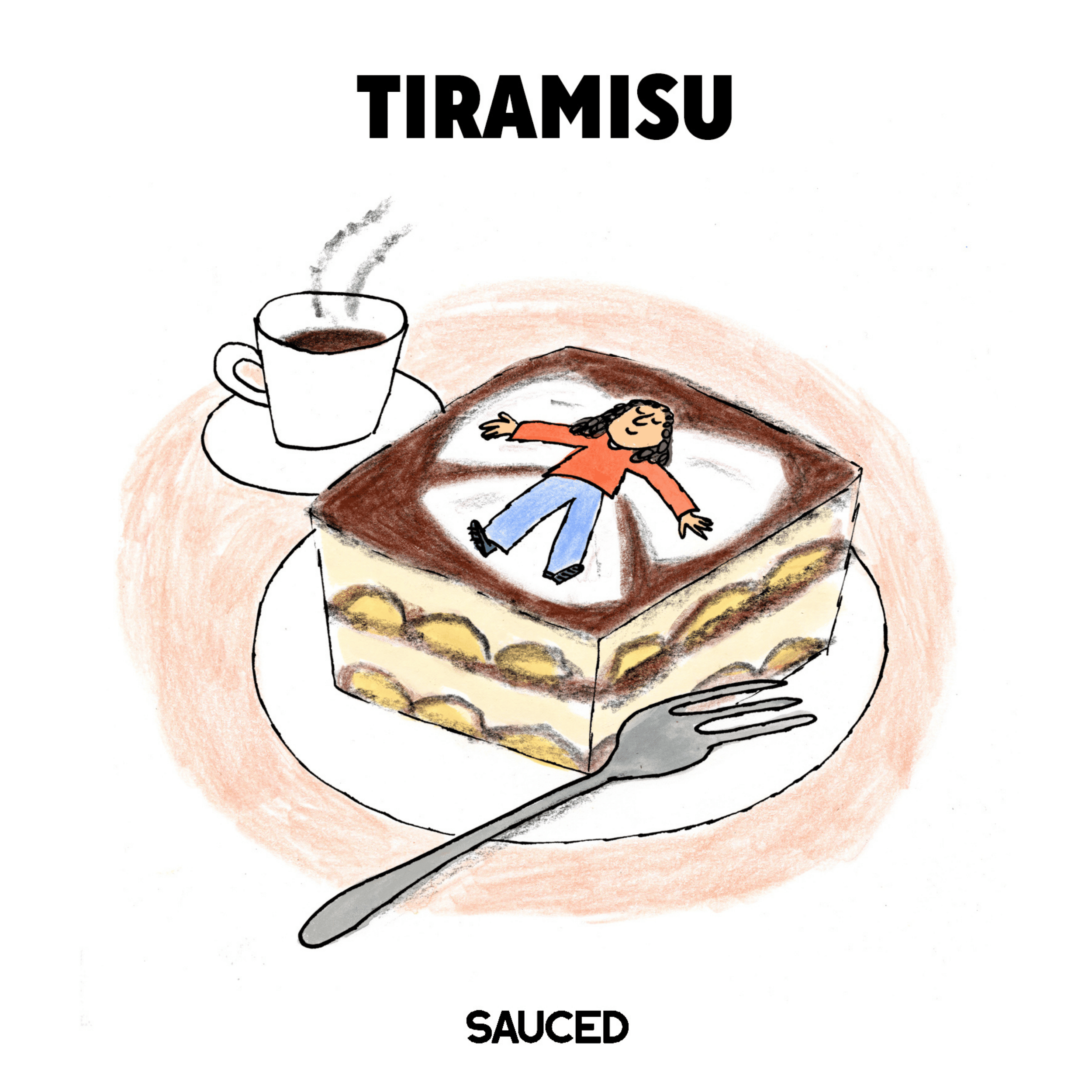
Tiramisu's origin is contested. One claim puts it in a Treviso restaurant in 1972. Another places it in Friuli, more than a decade earlier. But zabaglione — the dish's direct ancestor — has always been defined by sweet Marsala. The booze was the family inheritance dropped at Tiramisu's birth, and added back by everyone since.
This week: the 1972 Le Beccherie story, the rival Friuli claim, the egg-safety question across three Italian luminaries, and where we actually land on the booze.
"A middle-class prosperity dessert."
What we settled on:
Espresso only, cooled to room temperature — no weak brew, no cold brew
Mascarpone only in the cream — no whipped cream folded in
Yolks only, cooked over a bain-marie to ~158-160 degrees
Sweet Marsala in the cream
Coffee liqueur and a touch of Amaretto in the soak
Homemade savoiardi — five ingredients, uses the whites the cream doesn't
Quick dip, one to two seconds per side
Rest 12 to 24 hours, dust with cocoa and grate dark chocolate just before serving
The Cocktail
The Red Hook — rye, Punt e Mes, Maraschino, and a dash of coffee bitters to tie it to the dessert.
RECIPE CARD:
Premium subscriber? Check out the full recipe card here.
LISTEN
EpiSOde Partners
Thanks to the following brands for partnering with Sauced to bring you this episode:
TRANSCRIPT
Tim: Sother.
Sother: Tim, it's time to make dessert.
Tim: It's time to bring out your kryptonite.
Sother: Oh, yeah. You're right. This is my culinary kryptonite. It's the one — I literally think it's one. I don't think I have more than one thing. It is the one thing that I do not touch. I don't eat or drink this product.
Tim: Coffee.
Sother: Coffee. Coffee. Only because I abused it as a younger person. I haven't had coffee since I was 17, for a stupid reason, but it is still true to this day.
Tim: So does that mean you don't go near coffee desserts as well? Like in any form? Wow.
Sother: I won't touch anything with coffee in it. It's an aversion — there's nothing about the caffeine. It's all about — I had too much of it too often, and then now I just can't have it. And again, it's not the caffeine. I drink Coca-Cola. I drink Dr. Pepper like it was my job. It's not the caffeine. It is specifically coffee. If I accidentally take a scoop of your chocolate or coffee ice cream, I will feel terrible. I get sweaty palms, and I just feel bad. The value, oh yeah — the iconic, very understanding, of course. Of course. And also the iconic nature of coffee.
Tim: But you can recognize the — or, or I just mean like the iconic nature of this dessert and its standing. Tiramisu — tiramisu is the dish. Give us your elevator pitch.
Sother: I can see that the billions of people on the planet really enjoy coffee. I simply do not. Tiramisu, let's go. Tiramisu is a layered Italian dessert of coffee-soaked ladyfingers, mascarpone cream, cocoa, and often a touch of liqueur — and in our case, certainly. Simultaneously airy, bitter, creamy, and deeply comforting.
Tim: How do you feel about the fact that — well, how do you feel about the name and what it means, its connotation?
Sother: Yeah, it — I think it is a, you know, I think — well, yeah, I'll tell you.
Tim: What does it mean?
Sother: It means "pick me up" or "lift me up," and I think that is perfectly in line with what it is, right? A coffee dessert — coffee in general is a sort of pick-me-up, a wake-me-up, a get-me-going. And I think that we often see this in the nomenclature of foods and drinks in the romance languages that we just don't do here in English. But I like the name. The name is charming.
Tim: This is a dish, as you said, our version is certainly gonna have booze. I think a lot of people associate booze with it, but no booze in the original.
Sother: Yeah. Right. Well, no — was there not any, I thought Madeira was in the very, very original. No. No, just coffee.
Tim: Nothing in the original. No, just — intentionally left out. And also, this is a dish that is way younger than I thought.
Sother: Oh, yeah. I, again, just as a point of our show — unless I already know something, I try and avoid the history of things because I feel like that's your forte. But I did at least bounce across — its origin is pretty recent in the grand scheme.
Tim: Yeah. In the grand scheme of things. And again, for something that feels so iconic and feels so entrenched in culture — we can get into that now. We can get into our origin story. Well, it is Italian. It's not Italian-American, it's not American Italian, although some folks —
Sother: Yeah. Where's this dish come from?
Tim: There's an American aspect to this that maybe we'll get into. But we should probably start with the ancestor of this dish, which definitely did contain and does contain booze. Zabaglione. Egg yolks whipped with sugar and sweet wine, usually Marsala, cooked over a bain-marie — and has been documented in Italian kitchens since the Renaissance, so a long time ago. This was treated almost as medicine, so it was spooned to soldiers, invalids, new mothers, and so the story goes, grooms on your wedding night. The original wink, wink, nudge, nudge pick-me-up, apparently.
Sother: Okay. A different type of pick-me-up. Aphrodisiac, are you saying? They thought this had those qualities?
Tim: The different type of pick-me-up sans coffee. So even though we said this is a modern-ish dish, it is contested.
Sother: Oh, of course. Well, listen, food history and drink history are always contested, and that's what gets us here, I think.
Tim: So the mainstream story — 1972, Le Beccherie in Treviso. Le Beccherie being the name of the restaurant, Treviso being the place in the Veneto region. The owner of the restaurant's wife, Alba Campeol, and the pastry chef, Roberto Linguanotto… Yes, that's correct. I was like, "Wow, yeah, I got that first time." They developed it, and it landed on the menu in 1972.
Sother: Nailed it. Wow. So I knew it was recent. I was thinking probably like the '40s or '50s. This is within my lifetime. I'm three years old. Oh, okay. Carry on.
Tim: About three years old. Or maybe not. We shall see. So there are two creation stories within that one restaurant. Linguanotto said he accidentally dropped mascarpone into eggs and sugar while making vanilla ice cream, presumably maybe like an anglaise.
Sother: This story sounds false already. I accidentally dropped an entire tub of mascarpone? Like a spoonful I can see, but — a whole thing?
Tim: A whole thing. Meanwhile, Alba said she was inspired by the zabaglione and coffee pick-me-up that her mother-in-law fed her after childbirth. Again, just tracing that back to the zabaglione and what it was originally supposedly used for. However, in the 1950s and a few valleys east of Treviso in Friuli, a hotel cook was serving the same idea — the same sort of notion. Oh, actually, I should point out again — in the Le Beccherie version, they specifically took out the alcohol so that children could have it as well. This is 1972.
Sother: Wait a minute. This has to be the first time in history, 'cause in history we fed kids alcohol all the time. I mean, still. All right, fine.
Tim: So yeah, a few valleys east, at the Albergo Roma, a woman called Norma Pielli — she adapted an earlier dessert called Dolce Torino. She replaced the butter with mascarpone, replaced chocolate with cocoa, and then the liqueur that's used in that original dessert became coffee instead. There is evidence of this and their claim. There's a 1959 receipt from the restaurant that shows two orders of tiramisu, and hotel menus from 1963 and 1965 listing it in the local Friulian dialect.
Sother: I mean, that's literally bringing receipts. They're claiming this thing happened ten — nine years earlier.
Tim: They're claiming nine years earlier, yeah. There's one other person now based in Baltimore, and this one is really gonna stump me, so I apologize in advance. Carminantonio Iannaccone — Iannaccone, right? Carmine — basically a baker now residing in Baltimore — told The Washington Post in 2007 that he created the dessert in Treviso starting in 1969.
Sother: Right.
Tim: His version did include Marsala. Le Beccherie's owners have called the claim preposterous and said it's unverifiable, which is kind of funny considering our second story does have the receipts, as you say. And in 2017, Italy's Ministry of Agriculture added tiramisu to the traditional products list of the Friuli region, not Veneto, not Treviso. Veneto's governor, Luca Zaia, demanded the decree be suspended and threatened legal action. And so Treviso decided to fight back culturally by now hosting the annual Tiramisù World Cup.
Sother: Threatened. Yeah. Okay, and what do you have to do to get into the Tiramisù World Cup?
Tim: I don't know — I haven't applied. I would need to check this out and get some more facts on the specifics of it, but it's still running. Runs every year and sees who can be crowned the best tiramisu in the world. Is that our Porco potential pointless lawsuit of the week?
Sother: I think it's the potentially pointless lawsuit. Well, but it's not — listen, it's local pride in a historic thing that you believe to your core that you created. And listen, again, if they have the receipts, I can't even believe that Le Beccherie says your claim is preposterous, yet there's a claim before that that has receipts.
Tim: Le Beccherie being the first one.
Sother: Literal, literal receipts. I can't even stress that enough.
Tim: Literal receipts. I can't even stress that enough. And then what's a man now residing in Baltimore doing telling The Washington Post, "No, it's false. I created it." Just in the middle of the two with no backing.
Sother: Yeah. Just in the middle of the two with no backing, you know? And also, who's at the Washington Post who printed that? Come on.
Tim: Yeah, I know. Did they do their fact-checking? I don't know.
Sother: Listen, I would reach out. We should reach out to our good friend Dave Wondrich, 'cause he knows how to get to the bottom of these things, and it's usually with the first printed thing. And if these guys have a printed thing, that's the origin. Until you can show me a printed thing before that, that's it.
Tim: That's it. Well, the other thing as well, as we've spoken about so often with cocktails and cocktail culture — and as our friend of the show, Frank Caiafa, always likes to say — "It's not so much about who invented it, but who popularized it."
Sother: Oh yeah. Oh man, I'm in that same camp. You know, we know for sure that Select created the Spritz. Aperol popularized it. Yeah. Like undisputed. Listen —
Tim: Yep. Yeah. Nice little tie to the Veneto there as well in Italy, keeping it on brand. So yeah, I mean, all things told, pretty simple. I do like the Le Beccherie — the fact, though, that they have this story which reminds me very much of Bananas Foster, where you have the restaurant owner's wife collaborating with the chef to come up with an iconic dessert.
Sother: Sure. That probably happened more than you'd think. You know, I think we've dissected the roles that people play in restaurants today, whereas in the past, you kind of crossed roles because you were ownership, you were working it, you were — I don't know. I think we've, for better or for worse, sort of corporatized. Whereas this used to be just a family biz. You know?
Tim: Yeah. One of the things I don't love about this story — and my final thought on the origins. So the restaurant's owner, Ado Campeol, became known as the father of tiramisu, and I'm like, "How has this guy did that?" It's, okay, it's his restaurant, but he wasn't the chef, and he wasn't —
Sother: Right. He wasn't the — his restaurant. Well, I think you just nailed it. It was his restaurant, and I think you really nailed it with the word "his." Let me guess, a dude stepped in and took credit? Yeah. Historically, it never happens.
Tim: Yes, exactly. Oh, that's gotta be a first.
Tim: So Ado sadly passed away in 2021, and Linguanotto, the pastry chef, passed away in 2024 at 81. So again, this is much more recent than we would've thought or guessed coming into this.
Sother: Well, yeah. I mean, we'll get to our section about luminaries and people who have things to say about it. But I'm gonna jump ahead a little bit. Do you know the name Marcella Hazan?
Tim: Yeah, we describe her as the Julia Child of Italy, and we've brought her up in the Marsala and other ones.
Sother: Correct. Correct. Yeah. So her book, Essentials of Classic Italian Cooking — she famously disowned this dish because she did not consider it a true Italian classic, and that's what made me look back and go, "Oh, yeah, this isn't that old." I guess she was firmly stanced in, like, if it's not old enough to be a classic —
Tim: It's a modern classic of it.
Sother: Apparently later in her life, she softened her stance. She softened it — she relaxed her stance, but that's what she wrote in that book. Ado is on my list here. Lidia Bastianich — one of the chefs who helped cement tiramisu in our imagination while she was exploring regional Italian cuisine in the '80s and '90s. But again, in the '80s and '90s, this dish was ten to 12 years old. Well, if we go back to the 1960s, it's 22 years old at that point. Let's see, who else do I have? Oh, Massimo Bottura — the world-renowned three-Michelin-star chef — uses this dessert to champion instinct over strict rules while avoiding what he calls "instant fusion," which is confusion. That's his words. He spoke about tiramisu as an emotionally resonant symbol of Italian family cooking and memory. But even that — I'm pretty sure he's my age. So this dish appeared while he was alive. So I don't know. I think the history of it is pretty shocking because of those things.
Tim: Who else do you have on the luminary front? I think that's fascinating.
Sother: Yeah.
Tim: I have one more luminary for us here. You know who we haven't heard from in a while?
Sother: Julia and Jacques.
Tim: Couldn't find anything with Julia. Probably not French enough and not classic enough for Julia either. Your man, Jacques. You'll never guess what.
Sother: He's my boy. Don't hurt my feelings.
Tim: He has a version of this dish called Mock Tiramisu. He skips the eggs entirely. And this appeared on his show and in his book, Fast Food My Way, which was published in 2004. So what he does is — he mixes sour cream with mascarpone, lays the ladyfingers in a single layer, makes a coffee syrup, pours that over it, and then tops it with —
Sother: Mock tiramisu. Okay. So no — so it's basically just a layered whipped cream dish with cocoa and coffee?
Tim: And he does actually use a bit of booze. He goes for rum. And then tops it with the sour cream–mascarpone mix. Now you're basically — depending on, and this is gonna be a conversation we have — you're basically taking out the one step of preparation of anything that this dish really does have. Unless, of course, you make your ladyfingers. And do you wanna say the traditional name for those? Do you wanna tackle it?
Sother: Oh my gosh. I have it written down. Hold on. Ooh. Yeah. Savoiardi — you gotta roll that D.
Tim: Savoiardi. Yeah, I think that's it. Savoiardi. So that's the one and only time I wanna say that on this, because every time I have that in my notes I'm like, "Ladyfingers, it's easier." But yeah, Jacques once again just taking the fast train.
Sother: I mean, his whole show and that book was about taking the fast train, and I get it. Jacques the Hawk, I know. I know, I know. Listen, he was trying to get food to the people, and mission accomplished. Come on, man. That guy changed my life.
Tim: No, I know. Listen, he —
Sother: I'm gonna touch on one more guy that I've been touching on recently just 'cause he keeps popping up in my digging around about each dish that we've been doing — Anthony Bourdain. Bourdain jokingly criticized bad restaurant tiramisu for being, quote, "a soggy architectural disaster." He was making an important point in that statement — that texture matters enormously to this dish, and I couldn't agree more, and we'll talk about it as we build it. But this dish gives me, even though I don't eat this specific one — tiramisu with coffee — this dish gives me instant flashbacks to a very Southern dish, banana pudding. Right? Because it is all about obviously the flavor, but the texture is massively important as well.
Sother: Well, my notes say here — tiramisu is fundamentally a bourgeois home and restaurant dessert rather than an aristocratic court confection. It sits somewhere between peasant practicality and post-war Italian prosperity. You could reasonably call it a middle-class prosperity dessert. So sort of splits the difference. That's the first time we've had that, right? I think it's plumper.
Tim: Fantastic. Well, that sounds like that might be something of a point which you are not willing to budge on. We do have a section for that luckily, but before we get into it — break.
— — —
Tim: All right, we're back. Sother, the non-negotiables. Before we get into that, though — prince or pauper. We snuck past that one there. We forgot to bring it up.
Sother: Yeah. It's, um, you know — it's not quite as simple as an icebox cake, but it kind of fits that vibe. You really kinda just have to do a couple of steps to build it and then put it together and then wait.
Tim: We need to make a decision, though. Yeah, I do. You don't need any fancy ingredients. It's basically all stuff you have knocking around the house. Apart from maybe the mascarpone, but probably Italy, you know, that's banging around there. And from a technical perspective as well, it's a very simple dish to make.
Tim: So onto the non-negotiables. Number one for you.
Sother: Man, it pains me to say, but if we're gonna make tiramisu — coffee.
Tim: 100%. I would dial down on that and say that I want espresso.
Sother: Oh, sure. Yeah, it can't just be weak brewed coffee. It has to be — it has to be espresso. I think you could maybe do cold brew, but that — you know — it needs to be a strong — a coffee with a strong personality, and espresso is the way to go.
Tim: Yeah. I would also push back on the cold brew, 'cause I feel like cold brew really doesn't have the sort of richness that I want from coffee, especially when it comes to in a dessert.
Sother: Listen, I am the least expert on coffee. I just know that Natalie drinks cold brew all the time, and she has to water it down because it's too strong. So I was thinking maybe the strength is the thing, but — well, yeah, I mean, let's go with espresso. I don't have a whole lot to say about coffee.
Tim: Yeah, and room temperature as well. I don't want us to be using this coffee while it's hot for that part of the —
Sother: Right, because it'll do some damage to the savoiardi. Yeah, we both said we weren't gonna say it and we're saying it anyway.
Tim: Savoiardi. Yeah, because mostly what we're gonna say — we're saying the same thing. Well, that's my second non-negotiable right there.
Sother: Yeah. I'm gonna fine-line that one. You fine-lined the coffee, I'm gonna fine-line this one. Homemade. I think you gotta make them yourself. I think the store-bought ones are super convenient, but the texture — and again, if we go back to what I just said about the texture — texture is so important to this dish that I think if you really wanna have success here, you're gonna make your own, and they are not as difficult as you think. I know that you and I aren't the most excited when it comes to baking. I mean, you love to bake bread, but pastry, I don't think either one of us is great at — I'm good at it. I just don't love it.
Tim: Not where I'm gonna spend my time in the kitchen. Right.
Sother: Correct. But in this case, it is — I think on the scale, pretty shockingly easy to make these. So I say, let's make them.
Tim: Next non-negotiable.
Sother: Gotta have that cheese, baby. Mascarpone.
Tim: What is mascarpone?
Sother: It's like a sweet, almost like cream cheese sort of situation, that's almost always used in dessert preparations. I don't know how better to explain it than that. You know it when you got it. It's somewhere between cream cheese and crème fraîche, right?
Tim: Acidified cream. Yeah. Somewhere — but I agree with you, and no substitutions, right? No Philadelphia instead, please. All right, next one for me — non-negotiable, no egg whites. Yolks only, please.
Sother: Yolks only. Okay. All right. Make it nice and rich.
Tim: And correct me if I'm wrong, will the whites go into the ladyfingers? 'Cause to be honest with you, I was coming to this recording prepared being like, "You know what? In this instance, I'm just gonna buy the ladyfingers." So I can't remember in what that recipe looks like. I did watch a video of Joshua Weissman making them on YouTube. But I don't think that contains whites in either. Anyway —
Sother: No, it does. You need whole eggs. You need the yolks and the whites. But if you're talking for everything else, I can see it.
Tim: Yes, anyway. Next one for you.
Sother: I think we're done — oh, wait? Sorry, huge one. You need cocoa powder. And we should talk a little bit at least about the difference between Dutch process and quote-unquote "regular." This is so funny. I couldn't find what the other one's called. It's just regular.
Tim: Yeah, this is — I couldn't find what the other one's called. This is news to me. I have no idea what you're about to talk about.
Sother: I think the distinction matters in this particular application more than you might realize. Natural or regular cocoa powder is gonna be sharper and fruitier, but more bitter — which is kinda where I like to go. It'll be a little lighter brown in color, and it'll have a stronger raw chocolate flavor, right? So that's gonna give you more like an aromatic lift. Dutch process is treated with alkali, and this is to neutralize acidity. It renders it a darker color, but it has a smoother, more mellow flavor, more earthy and rounded. It'll give a darker appearance to the final product as well with a softer bitterness. Now, I like that bitterness. Natural is closer to the older recipes that we've seen. Not — and again, they're not that old. But a lot of fancier restaurants will prefer the Dutch because it has a more elegant appearance. I don't know why. But here's the key — blend the two. And guess what? I looked into my own cabinets at home and I have not one, not two, but four total cocoa powders, and I have one that's regular and the other three are Dutched. So I have plenty. Let's make some tiramisu.
Tim: Don't feel like you have to for this dish, but if you do have the two, folks, go for it. Scrape around in your pantry. Have a look, see how it is —
Sother: Listen, dig around in your pantry. It's probably in there. You bought it for one thing and you didn't think you had some, so you bought it again, and yeah, you know, that's how it goes.
Tim: You know, it's giving me a little bit of flashbacks of when I worked in the pastry section of the kitchen, and for service we had the two little dusters — one for icing sugar, or as you like to call it, powder sugar — one for cocoa. Not you, just this whole nation.
Sother: Well, and there's a difference though. I'm pretty sure, and you can correct me if I'm wrong — I believe icing sugar is simply sugar that has been powdered. Powdered sugar has cornstarch in it.
Tim: That I do not know.
Sother: Yeah. I know for a fact powdered sugar in the United States, if it says powdered sugar, there's cornstarch in it. It's to help it not declump. And that's why you can't use it to do things like — I don't know, you're gonna make this glue on the edge of your glass if you try and rim with powdered sugar.
Tim: So you're gonna make — well, so then we were definitely using icing sugar, and it's different because — the flashbacks and the PTSD that I was gonna talk about is that those little dusting things, you know, that you use to garnish — just them getting clogged up. The cocoa and the icing sugar one, and then it's a nightmare 'cause then when you clean it, you need to make sure you really properly dry it, otherwise you're just starting that problem again.
Sother: Yeah, yeah. We'd throw them in the oven for 20 minutes on low fan to dry them out.
Tim: And — hey, we're filming everything. And invariably you would run out during service. Annoying. But yeah, cocoa. Who knew? Who knew? Icing sugar as well. I've got one final thing here. You have to rest it overnight. This cannot be made à la minute, or I don't think you should be making it day of, unless you're doing it in the morning.
Sother: I think I know what it is. Yes.
Tim: But I think, yeah, you need to rest it overnight, because to your point about texture — that's what I'm looking for. I want it firmer. I wanna be able to slice into this.
Sother: Yeah. I think if I were to add another non-negotiable to the list and not have it be an actual ingredient, I would say the airiness. We need to make sure that our final product is as light as can be. It's not supposed to be dense like a piece of cheesecake. There's supposed to be some lift that will also result in a little bit of droop when you put it on the plate. It should start to kind of collapse upon itself, you know? Ever so slightly. Mm-hmm.
Tim: Ever so slightly, yeah. Ever so slightly. However, there are folks out there — I know, not that you know the people — that are making to order. I've seen at least one video of this.
Sother: Yeah, yeah, so did I. I can't remember where it was, but yeah — they wheel a cart, a little gueridon, right over to your table. They have their ladyfingers, and they dip them in coffee real fast. They lay them on a plate with their whipped mascarpone and cream and whatnot, and then another layer of the fingers and another layer, and then they dust the top of it heavily, heavily, heavily with cocoa, and they make it right too. It's a beautiful show. I'm curious, though, if those ladyfingers have absorbed any of the cream, right? They've certainly got wet, and they're absorbing some of the coffee, but are they absorbing the cream? Now, in that particular case, if you're making it for me as a show right in front of me, I might be a little forgiving on the texture, and I might even say to myself, "I kinda like this texture," but it's gonna be a different texture than if it sat overnight.
Tim: 100%. And I think that's probably an example of people trying to princify the pauper's dish. And in this instance, I don't think the preparation — I don't think it improves it. In fact, I think it makes it worse.
Sother: Yeah, I kind of do too. I would be happy to have it as a little show, but then I'd be like, "Yeah, but give me the one you made yesterday." Maybe that's what they should do. They should wheel out, and they should make one, and then put that one below, and then pull one up that they made yesterday, and then there's always a rotation.
Tim: Yeah. I think that's —
Sother: Yeah, 100%.
Tim: Here's one I made earlier. It's kind of like TV — cooking on TV, you know what I mean? Again, this is not a non-negotiable for me, it's more of a technical consideration, but we're speaking about it now. When it comes to the quote-unquote soaking of the ladyfingers — we're just dipping them in coffee. We're talking seconds. Either side.
Sother: Real quick, we're talking seconds. What you do is you get yourself a shallow pan or whatever, and you put in a layer of coffee that you can lay the ladyfinger down and it does not fully submerge, and then you flip it, and then they're out. That's it. Flip, out.
Tim: Yeah. Because we want the cream to soak in as well as the coffee. There we go, and we wanna maintain that texture. Great. We're in agreement there. Something for us to discuss now, though. We know it's not in the original. It is in the ancestor. But what are we doing with our booze here?
Tim: Marsala.
Sother: Now, I think we have an incredible opportunity to go anywhere we want, to be frank. Certainly — Madeira. I don't know why I said mascarpone. Certainly Madeira is — was the original.
Tim: Marsala.
Sother: Certainly Marsala was the original. But that's just a fortified wine. We could easily — you mentioned someone using rum. You could easily use whiskey. I would think maybe brandy of some kind would be quite good in this. Today's market has plenty of options for coffee liqueurs, so let's add in some coffee liqueur. You could put amaro in here. Like there's kind of no wrong answer, in my opinion.
Tim: Yeah. Unfortunately, that bottle of Marsala that we bought for our chicken Marsala, we won't be using for this — as we went for the dry secco. Right. And this we wanna go for the dolce, right?
Sother: Oh, right. Right, right, right. Of course.
Tim: We definitely want a sweet dessert version. Where would you go — what would — if you were making this dish tomorrow, today or tomorrow, what booze would you use?
Sother: Today for tomorrow. I think to be honest, I would reach for a coffee liqueur. Right? I wanna punch up the coffee notion and bring a little boozy action to the party.
Tim: Would you include that in your soak so you're not cooking off the alcohol? I mean, we're not gonna be cooking off the alcohol anyway with the zabaglione, but yeah.
Sother: I think I would do both, actually. Put an amount in the soak with the coffee and an amount into my zabaglione.
Tim: How about we split it and we go coffee liqueur for our soak and Marsala for the cream?
Sother: Okay. Sounds great. Yeah. Because I do like that traditional Marsala zabaglione, right? Like that on just a plate of fresh fruit — like classic Italian dessert. That's a true classic, right?
Tim: I like that idea. What about just a little touch of amaretto in with our coffee too?
Sother: Why not? It's gonna bring a little nutty quality. Coffee already has a nutty quality of its own, so I'm told. No, I remember. Listen, I drank my lifetime's worth of coffee before I was 17. I totally did. You know, I've never — at least — I have never, and I know this is probably not what you're saying, but understand this — I have never even set foot in a Starbucks.
Tim: But the problem is you missed the third wave. You missed craft coffee.
Sother: There has been no reason in my life to go into one.
Tim: You know, they sell other things. All those things probably go great with coffee though. In fact, most of them do not. Sandwiches.
Sother: But I do often go to local third wave coffee shops with Natalie to pick up her coffee or whatever, and I, you know, at the very most I'll be like, "Do you have a seltzer water?" Like, I'm not there for any of it. Even the aroma in there is a little overwhelming for me.
Tim: You know, and this is really getting going down a rabbit hole and a quick tangent. Final one on this. I avoid drinking coffee in this studio on days where I know we're gonna record 'cause I don't want the smell lingering around for you.
Sother: Oh, that's really sweet of you. You don't have to do that. But that's very kind. It's not that overwhelming to me.
Tim: The problem is we have a lot of materials around that are good at absorbing sound, so good at absorbing smells as well, you know? All right, Sother, those have been the non-negotiables. Time to take another quick break now, then we'll be back with some technical considerations and the preparation.
— — —
Tim: All right, Sother, we're back. Science, some technical considerations for us here. First on my list is just — classic tiramisu was built using raw eggs, raw egg yolks whipped with sugar, never cooked. Obviously there's a salmonella risk there.
Sother: There is, and you know, I don't wanna lead anybody down the wrong road here, but I've never worried about that. I don't know. But I'm a healthy person. I don't have any immune deficiencies. I'm not a pregnant woman. I'm not an elderly person yet. You know, I feel confident. But the fact of the matter is, pasteurized eggs are out there and they're available, and like — why not use them?
Tim: Yeah, especially if we've said this is a yolk-only dish, might as well buy pasteurized egg yolks. Or — and what I would probably do too — cook the zabaglione. So cook the egg yolks and the sugar over a bain-marie, whipping that. Get to around 158, 160. At that point they're fully pasteurized.
Sother: Yeah, like you do in the holidays or what have you.
Tim: Or, you know, if you're really worried about it, just do what our guy Jacques Pépin did.
Sother: Skip 'em all together. No, we're not skipping 'em. We need 'em.
Tim: No, I mean, we're not skipping. We're definitely not. Any other sort of science or technical considerations here for us?
Sother: I would just say we need to watch out when we're whipping mascarpone. We need to keep it at a cool, you know, room temperature at least. You don't wanna get it past, like, I don't know, 70 degrees, let's say. And then also careful not to over whip it, 'cause either it being too warm or being too agitated, it'll split. We obviously don't wanna have a broken sauce in our thing. And then I think the last one that we both sort of talked about already, but — let's codify it a little bit here. Once assembled, this dish needs 12 to 24 hours of rest before it achieves the texture we're looking for. And I think we also added to that — the clock begins to tick the other way after 24 hours. Now you've got 12 to 24 hours to eat this thing because that texture's — it's a bell curve. Right? It's gonna not be good, it's gonna not be good, it's gonna be good, and then it's gonna start going the other way again. But also, you know, you shouldn't be making this in much larger a vessel than your lasagna pan, and lasagna doesn't last more than 48 hours in my house. You know what I mean?
Tim: Yeah, most recipes that I looked at are definitely batches of what, like 24 ladyfingers I think. So yeah, a couple of servings. Speaking of which, how about we get into the preparation? I need you to walk me through ladyfingers, and I'm just gonna sit here and enjoy it because — yeah, like I said, I watched a couple videos, but I was prepared to just buy some for us.
Sother: Yeah, let's go.
Sother: Okay. Yeah, okay, cool. Listen, I harp on this all the time. I'm the economist. I think you are as well, but I talk about it more than you do. Based on the time you have, based on your level of expertise or interest in learning something new, and also based on the economy — if it's cheaper and more efficient for you to go out and buy the ladyfingers, go out and buy them. They sell them for a reason. I just think that the store-bought ones are built to last on the shelf for a long time, which means that their texture isn't gonna be as porous as to take on all these delicate flavors that we're adding to it — delicate outside the coffee. Everything else is kinda delicate.
Tim: I think one of the other ways you can convince me on this too is if you're using the store-bought ones, your tiramisu is essentially gonna taste like everyone else's tiramisu. If you're making them yourself, then it's Sother's tiramisu.
Sother: Correct. Oh, I love that. That's good. So — I would also impress upon you the ingredient list to make your own savoiardi is five ingredients long. You're gonna need some eggs — we are gonna use the whites in this, so you're gonna have to separate them. You're gonna need some sugar, also separated, 'cause you're gonna use it in two stages. You're gonna need some specifically cake flour, right? 'Cause you want these to be kind of tender. You don't wanna use bread flour for this, and that's because we've exalted how important texture is to this dish. Cornstarch, and then some powdered sugar — just powdered sugar for dusting. You're going to fire up your oven, and again, we'll give you recipes with all the numbers and stuff. You don't need to try and write this down as we go. That'll be on your cards. You're gonna fire up the oven, and then you're gonna whip the yolks with half of the sugar until a pale ribbon stage, which is only gonna take you four or five minutes with your hand whisk. I prefer in these preparations to not break out my mixer. Unless something requires me to turn on the mixer and walk away from it for eight to 10 minutes, I'm gonna do it by hand. In a separate bowl, you're gonna beat your whites to soft peaks, gradually adding the remainder of that sugar. And then bring it to medium peaks as you're — you don't wanna add all the sugar at once. You wanna get them to soft peaks first and then gradually add that sugar as you beat up to medium peaks. Fold the whites and the yolks together with the flour and the cornstarch. Put this into a piping bag, and pipe them out onto your parchment paper or Silpat-lined trays, in about four-inch — you're making ladyfingers. And then dust them heavily — like you feel like it's too much powdered sugar — and then wait 60 seconds to two minutes, and then dust them again, and that's gonna create the characteristic crust that a ladyfinger has. And then they take 12 minutes in the oven. Bake them till they're gold. It's pretty simple. And here's another cool thing you can do, and I saw only one guy do this, and I thought it was genius. Instead of making four-inch ladyfingers, he just did a zigzag pattern across his Silpat and then baked it, and then he just had a sheet that he cut to size to his pan.
Tim: Super simple.
Sother: Perfect. Right? So then when he's building the whole thing, it's just a full sheet.
Tim: Pretty cool.
Sother: Yeah. I think it was — I can't remember his name. Never mind. I was gonna say, but I can't remember his name. Anyway, so now let's talk about the tiramisu itself. You get to walk through that.
Tim: So first I'm gonna brew my espresso, and then I'm gonna let it sit, come to room temperature while I get all my other ingredients.
Sother: Do you have a fancy espresso machine in this house? Are you making — do you have that technology here?
Tim: Yeah, we have two espresso machines in this house. One is currently requiring maintenance. So we — that's why we have a backup. Listen, I don't drink coffee every day. I'm one of those people that just — I can just forget. I don't need it to run. Gabriella, on the other hand, is someone who —
Sother: All right. That's why you have two. Must have. Got it. I understand. You're gonna brew it or — for the listener, go pick some coffee up.
Tim: Absolutely, and her very specific coffee preparation, so we cannot be in a situation where we do not have a working coffee machine.
Tim: Then I'm gonna start working on my zabaglione. I'm gonna whip my egg yolks and sugar until pale and tripled in volume. I am going to be doing this over the bain-marie. I'm gonna include my Marsala at this point as well. Also worth pointing out — we're not using enough booze in this dish that that would render the risks of salmonella or whatever like that — that would get rid of them, right? Yeah. But even if we went down the spirits route, the booze isn't doing enough in this one.
Sother: Oh, right. Plus it's not high proof enough either.
Tim: So yeah, gonna whip that up, and like I said, until it's kinda tripled in volume. I'm going to pull out my mascarpone. I'm gonna fold it in in two or three different actions rather than all at once. For my folding motion, I'm going to be definitely gonna be using a Maurice.
Sother: Of course.
Tim: And that is our Maurice method of the week. Chef Maurice uses a Maurice for his mascarpone always when making tiramisu and folding it in. Now that that's prepared and ready, we're gonna start working on our soaking — or dunking, dipping the ladyfingers — just as we outlined earlier on in the preparation. Just a quick one, then we're gonna — coffee, amaretto, coffee liqueur. Mainly coffee and coffee liqueur with just a hint of amaretto. Almost using it like an accent.
Sother: Yeah, yeah. We don't want to go too far. Almost using it like an extract, right? Get that little almondy flavor.
Tim: Yeah, exactly. Give that little — yeah, nothing too crazy. Then we're gonna put that into whatever serving dish we're using for this. Gonna line the bottom —
Sother: Do you, similar to like a lasagna, do you like lay down a little of the mascarpone bit, like a real thin layer, like when you put down some béchamel at the bottom of your lasagna? I think it's gonna be helpful for getting it out of the pan later.
Tim: I like that idea, and I'm willing to take it on board. It wasn't where I was thinking, but definitely, yeah. Then our fingers, then we're gonna do another layer of our zabaglione on top of that. Then we're gonna do our second round of ladyfingers. Then we're gonna top with our final layer of cream — not cream, mascarpone and the whipped egg yolks, as we know. Then we are going to wrap that in plastic wrap, ideally hoping that we — you know, you have a dish where the plastic wrap doesn't come in contact with the cream 'cause we want that nice appearance. Gonna rest that overnight. Then the next day, within 48 hours when we wanna be eating this, slice it up into portions. Actually, no — heavy dusting of cocoa, then sliced into portions and served.
Sother: Yeah. I only have two things that I think I wanna question real fast. Or maybe actually it's just one, I guess. Did you ever whip any cream and fold that into your mascarpone, or are you just doing a mascarpone sabayon?
Tim: Just mascarpone. No cream. Not for me. I know that that can add — I know that that can help with our texture. But I prefer to avoid it because I really like the flavor of mascarpone. And I don't wanna dilute that with something that's a lot more neutral.
Sother: Yeah. Okay, great. I think the only second thing would be — I would think about, and again, not a dish I've ever really eaten — we didn't talk about our personal and professional experiences, but I did used to work in an Italian place, and we had several versions of tiramisu on. We did one that I loved so much. The pastry chef at the time, a good friend of mine named Heather, she made banana misu — which again, I spoke about it at the top of the show, and this was in the South, by the way. This was in Durham, North Carolina. And it really rang the bells of banana pudding in the Southern style but made with homemade ladyfingers, and I think she put a banana liqueur in there too, and it just really, really amped up this banana flavor. I love that one. We did another one that had coconut in it — coconut cream and coconut liqueur and shaved coconut on top. But anyway, I think that when she would make a standard one, that first layer that went down would also get a heavy dusting of cocoa before the next layer, but then the dusting of cocoa on the top, top layer only happened at service.
Tim: Nice. Yeah. So we will incorporate that into our recipe. I like that a lot. And you know another thing we can do, and I think we should be doing as well when we serve it — so if you're plating it for someone — just some high-quality chocolate, just grate some chocolate over the top as well. I think that'd be really nice.
Sother: Nice. Just to give it another layering of — I mean, this thing is a — it's a lasagna.
Tim: Nice little finishing touch. Amazing. Well, all of that pastry work is making me thirsty.
Sother: Thirsty work indeed.
Tim: So it’s the final ad break for us here today, and then we'll be back with the pairings, the cocktail, and our final thoughts of the week.
— — —
Tim: All right, here we go. The booze. The drinking with food. What you got?
Sother: Yes, now I step up to the bat. What have you got? I mean, lots of stuff. You know, it's dessert, so a little bit challenging to pair directly with. And I think that the listener is probably like, "Well, what about an Espresso Martini or an Irish Coffee?" I don't know that I wanna go coffee on coffee. I certainly personally don't, but also I don't know that that's gonna be the best pairing. And I know that I often talk about, like, when you're doing pairings, there's really two avenues. One of them is directly at the thing — that's what that would be. And one is sort of like go away from the thing. I think I'm more inclined to go away from it. But let's first talk about — like, Vin Santo and Marsala are obvious choices. It's dessert, it's dessert wine. Let's have those kind of things. Let's talk about, of course, my wheelhouse. Let's drink some amaro.
Tim: Why don't you throw out some — some amari, yeah, and maybe slightly lesser-known ones, but maybe ones that people can still find too, right? You know, find that little balance.
Sother: A little balance. I know it's the hardest part of my world, to be honest. 'Cause, you know, I'm an embarrassment of riches here in New York. I've got — if it's available in the United States, it's available here, but that doesn't mean it's available everywhere. I think I would go for things that are like a little strangely on the sweeter side. There's one called Punch Fantasia from the Varnelli family. And when you see the word "punch" on an amaro bottle, it typically means that it has a rum base and then notes of butterscotch. So like, a rummy, butterscotchy amaro would be great, and I think Varnelli is reasonably findable all over the country. But again, there are other punches that are out there. Look for a different punch. I would go for something maybe a little bit more dark and fruity, like maybe Ramazzotti, which by the way claims to be — and they brought the receipts too — claims to be the first commercially available amaro. But it's got a lot of dry fruit notes, and I think dry fruit and dessert go quite well together. And then I'll give a third here. How about something a little bit more esoteric? What about Pasubio? Pasubio from the Cappelletti family is mountain herbs and wild mountain blueberries.
Tim: Ooh.
Sother: Definitely not a sweet amaro, but it has some things in it that might make you think this would go with dessert. So I would say maybe those three.
Tim: Sold.
Sother: Yeah. To like offset the actual sweetness that is the dessert. But also I think — and again, I literally have not had this dessert in my adult life, and maybe ever, to be honest — I don't think that — this doesn't sound too sweet to me. Maybe with coffee and cheese. You know what I mean? It doesn't sound crazy sweet.
Tim: Those perception of sweetness that we like.
Sother: Yeah, let's go. There's some beers that I might have with this. You know, like a Guinness — bring it on. A porter. And then drinks-wise — we talked a little bit about this one off air — the Red Hook. Right? 'Cause I was thinking, okay, if I wanted to match the sort of eggy, you know, zabaglione part, I could do a flip, and maybe I would do an amaro flip — use a whole egg in a cocktail. But that seems too rich on rich. This is a hard, hard one to pair with. So — and then I said maybe something like a Black Manhattan, and then you said, "What about the Red Hook?" And the Red Hook is effectively, in cocktail nomenclature, a "fancy" — and I'm not just saying it's — it is fancy. That is a category, a "fancy" Manhattan. It's just a Manhattan made with a slightly more bitter vermouth, Punt e Mes, which means "point and a half," and the reason that it says point and a half is 'cause it's supposedly 1.5 times more bitter than standard vermouths. So rye whiskey, Punt e Mes, and a bit of Maraschino liqueur. And anytime we add a liqueur to a standard cocktail like an Old Fashioned or a Manhattan, then it elevates it to what is known as a "fancy." So this would be a fancy Manhattan style cocktail.
Tim: Yes, that would be where I would go. Two ounces and half an ounce and half an ounce there. Two ounces rye, half an ounce and half an ounce of the other ingredients there for those.
Sother: Right, which is almost always what's happening when you're making any kind of Manhattan variation. It's still gonna remain two-to-one. It's just — what are you splitting it into, right? We're not adding. It's not a two-to-one plus. Right now it's bigger than my glass. So it's gonna be two parts, half part, half part to make it a two-to-one. And I don't believe there's any bitters in a —
Tim: I don't think there is, and it was invented — you know, this is, speaking of which — this is modern, invented by Italian bartender Vincenzo Errico in 2003 while working at Milk & Honey.
Sother: The venerable Milk & Honey.
Tim: Yes. And Vincenzo, no longer in the United States, moved back to Italy. I believe residing somewhere in Naples right now. Also famous for another absolute banger that I wouldn't drink with this dessert, called the Enzoni, which is basically a Negroni made with grapes. It's a fun one.
Sother: Yeah, delicious. Super refreshing Negroni-style cocktail. Anyway, there's no bitters in this. Maybe we could put our own thumbprint on it by adding a bitters, and we could add something that would match what we put into the thing. We could easily reach for a coffee bitters — those are plentiful. But I think maybe — we decided to add amaretto, so we could put in like a pecan or an almond bitters just to give it a little sort of nuttiness. Because also Maraschino — which, you know, people see, and the liquid itself is clear 'cause it's not been barrel-rested or anything like that, but people know that it comes from the cherry. It's a distillate of the cherry pits, so it also has a slight nuttiness of its own. So maybe a little nut bitters in here, but not required. Just to make it match to our dessert. But as it stands, as a modern classic, it doesn't have any bitters.
Tim: Nice. Love it. Well, that's been the cocktail. Sother, final thoughts for you today, or what are people missing out on if they never make this dish at least once in their life?
Sother: I think you're missing some great cooking lessons, Italian specifically. Like, you're gonna make a zabaglione, you're gonna make the savoiardi. I feel like I finally nailed it. It's not a flashy dessert. It doesn't involve any crazy techniques like laminating dough or anything like that. It's a pretty simple list of ingredients. But you're gonna learn some things like texture control. You're gonna learn your balance of bitter versus sweet. You're gonna learn a little bit of hydration management — when I say like the thing needs to sit, because we talked about this place that's doing it à la minute, and I just think that's not gonna be a great texture. It is gonna be its own texture, and I'm okay with that. You know, I think the analogy that I used off air was — nachos are really one step away from being chilaquiles, and that one step is just letting them sit and soak and get soft, right? So it's a — and then the result is a very different dish and experience. So I think maybe you're learning hydration management, you're learning patience 'cause you gotta wait. You can't just make this and eat it. And I think it also is teaching you that hospitality in general can be luxurious without being extravagant.
Tim: Nice. Love it. My final thought is less so much a thought, more of a question or a thought experiment. Both of us astounded by the fact that this — you know, whether this was invented in the '60s or '70s — but just how modern it is.
Sother: Man, I hope it's the '60s. I would hate to think I have been alive longer than tiramisu.
Tim: I really hope it's '72. I really hope so.
Sother: Like, I'm already older than the internet.
Tim: So my thinking is — why aren't there more modern classics in the pastry realm, and what is the most recent one? I mean, us being here in New York, I was like — well, it's not really a dessert, but the cronut — that got international acclaim. There was also a place in Astoria that was doing something with — my God, what's the other Italian dessert with the sweet filling in it? The —
Sother: Cannolis.
Tim: Cannoli. They were doing cronnolis, I believe. So yeah, and then that just went on its whole separate subgenre of sweets and desserts. Why aren't pastry chefs shooting their shot? Doesn't someone wanna go down in history creating a new modern classic dessert, or have they just all been done?
Sother: Hmm. They got — I think they gotta be out there. I think that we're just maybe slightly blind to them, because to be perfectly honest, I don't eat a lot of desserts, and I don't think you do either. But I enjoy talking about them, and I enjoy making them, and we're gonna make this. Like, we made those crepes. I loved those. I absolutely will do again, but once a year, you know? Like I'm not knocking it. It's just not my thing. And I think — what I'm suggesting here is, your question is valid, but it is you and I who aren't looking around enough. So maybe we task ourself with that, and we bring that up on the next dessert issue.
Tim: Yeah. No, for sure.
Tim: Next dessert one. Yeah, let's do it. Let's put in the work, 'cause I'm sure there are — between all of the great chefs that we know and we've discussed and talked about and the restaurants, there must be. There must be ones, and we're just — well, there's a whole Chef's Table pastry season.
Sother: Yeah. Let's go. Well, but listen, you know, not to get off on a tangent here, but there's an upcoming new season of Drink Masters, and none of that stuff is trying to become a classic. It is trying to astound, amaze, and bowl you over right here, right now. So I think maybe that's what's going on too. There's plenty of great desserts out there that are being made by amazing pastry chefs, but they're of the moment and of that specific place. I don't think anyone's trying to make a thing that's replicable. They're trying to make things that are unique to them.
Tim: Yeah. I'll believe it when I see it about the Drink Masters, by the way. They've been saying that the second season is coming a hell of a long time now. We shall see. Anyway, in the meantime, Sother — time to put on your apron.
Sother: I will, and you should break out your shaker.
Tim: And let's get cooking.
Sother: And drinking.