Episode 34:
BEEF WELLINGTON
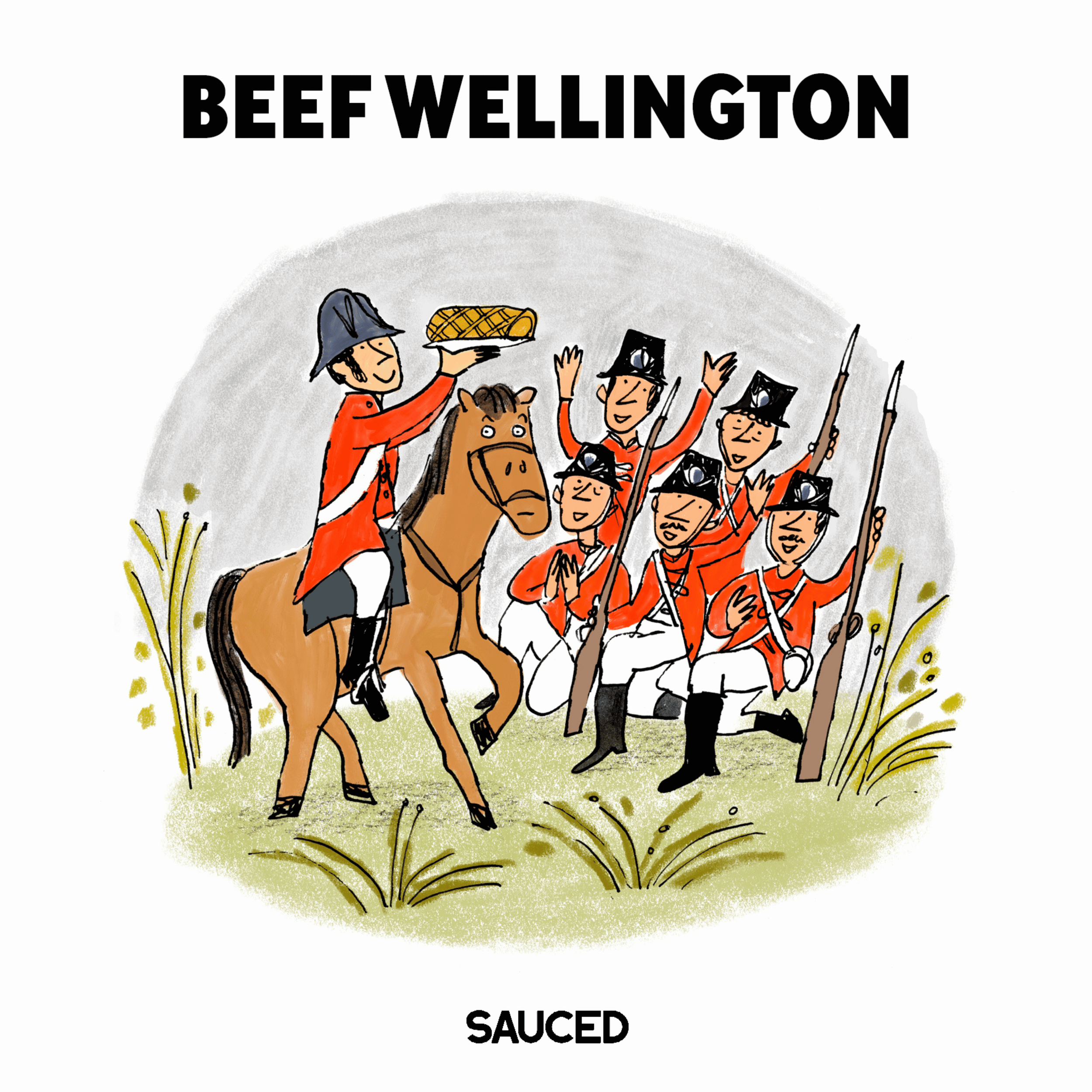
The hardest part of a Beef Wellington isn't the beef. It is getting a crisp pastry shell and a rare, rested center out of one oven at once, which is why people watch this dish online far more than they cook it.
We trace how a French classic in a British name became the internet's favorite showstopper, then take the build apart so it stops being intimidating.
"A feat of engineering."
What we settled on:
Center-cut beef tenderloin, the Châteaubriand, trimmed even
A hard sear, then Colman's English mustard while it is still hot
Bone-dry mushroom duxelles, deglazed with Madeira
Parma ham as the moisture barrier, no pâté
All-butter puff pastry kept cold, with a triple egg wash
Oven at 425, pulled at 115 and rested
A Madeira pan sauce, with mash and creamed spinach
The Cocktail:
The Wellington Manhattan, a Manhattan of overproof rye and Madeira with a mushroom bitter.
RECIPE CARD:
Premium subscriber? Check out the full recipe card here.
LISTEN
EpiSOde Partners
Thanks to the following brands for partnering with Sauced to bring you this episode:
TRANSCRIPT
Sother Teague: Tim. I'm excited about today.
Tim McKirdy: I'm excited about today. Really excited. Beef Wellington.
ST: I mean, it's the big show. It's the big game.
TM: Well, it's the big show. Remember —
ST: No, I don't. But I think that we both discovered in getting ready for this episode that there is a preponderance of information out there. And all of it's pretty good. But boy oh boy, is this a popular dish all over the place. In books, on the internet, YouTube, Instagram — this is a dish that is a showstopper. People stop.
TM: And we mentioned this right back all the way in episode one, Beef Bourguignon. This, I think, stakes a reasonable claim as being the most viral dish when it comes to Instagram, YouTube, TikTok, people sharing it online. And I think I have a few theories on why that is specifically. Some are to do with people and others are to do with just the dish itself. But speaking of the dish itself — I know everyone knows what it is, but give us your standard elevator pitch, your summation on this.
ST: Sure. Beef Wellington is a center-cut beef tenderloin wrapped in mushroom duxelles, often with prosciutto, and then rolled in puff pastry and baked until medium rare with a crisp golden crust.
TM: Beautiful.
ST: I mean, it sounds pretty simple, right? And it's been around for a long time, baking meat inside of bread — en croûte, as the French call it. There's plenty of pâtés en croûte out there that have been around. The original Wellington used more of a pâté brisée, which is a pie crust instead of a puff pastry, so a more denser version. There's even a version out there that uses brioche, where you rise the brioche with the beef inside of it and bake it. So meat baked inside of bread is not an uncommon thing, and this is just sort of the evolution of the elegance that that can achieve.
TM: It's taking that idea of the sandwich and elevating it.
ST: I mean, is Wellington just a real fancy burrito? I guess it would be a chimichanga.
TM: What about your personal and professional — I mean, sorry, I cannot go past it just on that sandwich and Wellington. Some people think the Earl of Sandwich, some people maybe think the Duke of Wellington, but we will get into that on the origins.
ST: We'll get there. We'll get there. Personal or professional — I've never worked anywhere where we had a Wellington on menu. I have certainly ordered a Wellington, or a pâté brisée, which is a similar thing, at places when I'm out and about. And then this is the real stumper. Given the popularity and the virality that this dish has across all social media platforms, I polled my own audience. I asked some of my friends, have you made this? Do you know anyone who has made this? The answer overwhelmingly is no. And then even I had to look inside myself and be like, who do I know that's made this? I know one person. Todd, my best friend of 25 years, makes a Wellington for his family for Christmas almost every year, but he only makes it on Christmas. So it's a very celebratory dish. And I think we can demystify some of that, because I think there's a hesitance to make the dish that exists because of the number of steps that are involved. But none are very difficult. So I think we can hopefully encourage people to not only look at this dish and sort of salivate and click like on social media platforms, but maybe get in the kitchen and make it themselves. What about you? Did you ever work anywhere that had a Wellington on?
TM: Never on menu, I would say. That, to your point — pithiviers, things of that nature, we might have them more on menu. And I think certainly during the winter months, right? I think this is, to your point, the holiday season, colder months as well. Celebration. Pithiviers we would generally do is single-serving things.
ST: That's the kind of difference right there.
TM: Because I never worked in a restaurant that was tasting menus. And I think if you're going to have this as part of on offer for guests, just because of the very nature of how you cook it and potential wastage, you need to know how many guests are coming through that evening. And you can be like, okay, we are definitely going to sell 45 of these tonight, or serve 45 of these tonight. Whereas if you have it on the menu — I just think there are components of it that make that really tricky on an à la carte perspective. Although, in saying that, one of the people who's closely associated with it has it in many of their restaurants now, and I think that's just because they know they're going to get through it. But it's not — I've cooked it though, at home. Not a million times, but — and again, I believe the last time I made it was during the pandemic, and around the holiday season, Christmas.
ST: I think for me, again, professionally I've never had a Wellington specific on the menu, but we've had other items on the menu. And certainly during my time as a butcher, we made just an absolute mountain of pâtés en croûte of different variety, which is again super similar. But they're cousins, right? It's not the same.
TM: Well, speaking of cousins, how about we get into the parent of this dish.
ST: All right, who you got?
TM: The French sort of prototype that evolved into it, or was the starting place. As you say, en croûte is a type of cooking, a preparation that has been employed for a long time. Starts in French as filet de bœuf en croûte — French for beef fillet in a crust. The duxelles, the mushroom preparation that you mentioned, that has a story as well about how that came into it. So if we think of just filet de bœuf en croûte as being beef wrapped in pastry, and then we get these certain elements that are added to stop moisture seepage into the puff pastry. That being — I think the whole tension of this dish is, how do you get your pastry beautifully golden brown and shining, and not overcook the meat inside, but also not be served soggy? You need color on the pastry, texture, no sogginess, and no gray overcooked beef inside. I think those are your three big things. So one of the ways people — like you said, those crepes, or the mushroom duxelles — those are said to have been invented or created by a 17th-century French cook named François Pierre La Varenne, and named for his employer, the Marquis d'Uxelles. Said to have been created by and named after — but again, there's no real documentation that confirms that, the British name, or the anglicization of the name Beef Wellington, because it could just be beef fillet in a crust. The main theory and romantic version is that it was named for Arthur Wellesley, the first Duke of Wellington, who beat Napoleon at Waterloo in 1815. Us Brits do love celebrating various whatnot. We got —
ST: Various conquests.
TM: Trafalgar Square, you know, we got the Battle of Waterloo. Sources such as the Encyclopedia Britannica do repeat that claim, but again, that connection is unproven, and no sort of origin cook or place has ever been named for that. The other candidates for the name: simply a tribute to the Duke, or that the browned pastry loaf resembles a Wellington boot. But I don't really get that — most of my Wellies I've ever had have been green.
ST: I was about to say that. I don't know the colors, but that one weirdly seems kind of plausible to me, in more of the sort of Italian nomenclature way. One of my favorite Amaris is called Amaro CioCiaro, and the woman on the label of the bottle is wearing a certain style of sandal that is known as a Ciociaro. And then there's the same thing with ciabatta, right? Ciabatta is supposed to look like a shoe.
TM: Well, let's be honest, forget the colour, because that doesn't make sense to me. But yeah, the shape of a Wellington boot, it very much looks like the pastry wrapped around the Wellington, without the fancy lattice that a lot of people add. And does look good. That seems plausible to me.
ST: Anyway, this does pop up a lot in our research for these episodes, especially classic dishes, where I always lament how I feel like the English language isn't as full of colorful or whimsical nomenclature. So I can see it. Weirdly, I can see it more than naming it after a guy whose name just happened to sound cool or whatever.
TM: Yeah, maybe it's two steps removed. Maybe the boots are named after him, and this is named after the shape of the boot. Beyond just where the name comes from and the origins, I actually think a more interesting aspect of this story is where it's gone, where we've arrived at now — speaking to that virality and just the popularity of this on Instagram and stuff. This seems to start in the 2010s and beyond, and the one person we can point to who's involved in so many ways is Gordon Ramsay.
ST: Yeah, I mean, he should be the official spokesperson of the Beef Wellington.
TM: This is his signature restaurant dish. He teaches it on Masterclass, and the "it's raw" meme has just taken on a life of its own — and just memes of Ramsay in general, shouting at people, idiot sandwiches and whatnot.
ST: You donkey. You donut.
TM: So that's taken on a life of its own. So much so that in a 2024 interview, Ramsay joked that his own mother had sent Beef Wellington back at one of his restaurants, claiming that it was undercooked. But it goes from being something associated with Ramsay — and Ramsay has so many TV shows — so it's the emblematic dish of Hell's Kitchen, both the show and his restaurants, because it's so easy for it to fail in plain sight. It's kind of like the soufflé that we talked about on a recent episode too. Once that thing goes in the oven —
ST: It's out of my hands.
TM: It's success or failure, and there's not really a lot you can do, which is brilliant for TV.
ST: Creates a lot of tension and drama, that's for sure.
TM: Top Chef ran a 2023 episode billed as Battle of the Wellingtons. Very creative on their part. MasterChef leans into it as the skills test. So you go from TV personality, celebrity chef — it is synonymous with him. He brings it onto TV, and what do we love doing? In the modern social media age, people bring it onto the newer platforms, which are Instagram, YouTube, TikTok. In 2023, a YouTuber called Nick DiGiovanni — yeah, I've seen him around, but I don't actively follow him — he combined with Gordon Ramsay to build the world's largest Beef Wellington. They won the Guinness Book of Records for this.
ST: Which way are we talking? Most circumference or most length?
TM: Both. They had 40 pounds of beef that they glued together using meat glue and cooked using sous vide. I can't remember the total and cooked weight, but it was likened to an animal. Roughly 18 times the weight of a normal Beef Wellington. And in 2024 — I thought this was very nice — a self-taught 13-year-old from Phoenix posted a from-scratch Wellington that pulled in over a million views, and Ramsay reacted on camera and invited him to Hell's Kitchen. Imagine Ramsay just showing up, 13-year-old boy.
ST: It was a point of pride for me during the Twitter days — I gave up Twitter when X came along — but Gordon Ramsay followed me.
TM: Oh wow, nice. Maybe fire that back up, see if we can get Ramsay's attention on Sauced here. But yeah, I think just the final point on all of that: when there was a big period — it still exists — of those stitched videos where people would react to other people's videos, Ramsay very much made it his bit to react to people making Beef Wellington on TikTok or whatever. And so if you're a home cook, or if you're an aspiring social media cook and you're trying to get Ramsay's attention, it's a pretty easy formula. Post a Wellington, and wherever he is in the world — the guy's on the road 250 days a year, he's in a hotel room, and he's just going to make a bunch of videos being like, either you're a genius or you're a donkey.
ST: It's raw, you donut. Well, let's even talk about — I don't know if I'm jumping ahead here — but let's talk a little bit about the engineering of the thing, right? I think that it came along in stages. As you mentioned earlier, beef en croûte was likely in the beginning just meat inside of a crust, and probably pretty gray and probably overcooked and texturally a nightmare. But this was probably in its earlier stages just sustenance. It was just, we have this, we're going to make this. The addition of the duxelles, the addition of then pâté of some kind if using, the addition of the Parma ham, the crepes come into play — all that is now creating insulation around. So if it was just bread and meat, the meat's going to be gray, there's no way to get the bread done. We create an insulating layer or two or three, and some moisture barriers at the same time, then that's how we can get the outside cooked and the inside not overcooked, right?
TM: Totally.
ST: It's a feat of engineering is what it is.
TM: Totally. And it's patch fixes every step along the way, versus reimagining from the ground up and saying, actually, cooking beef in pastry doesn't work because it's always going to be soggy. It's like, okay, no, how can we fix these? And I find that fascinating that we would strive for that. Final question for us to answer before we take our first break today, Sother — is this a prince's or a pauper's dish?
ST: Oh man, there's no question. This is a prince's dish. Every piece of it is expensive and laborious, and real butter in a puff pastry. The beef itself is the center cut of the tenderloin, pretty expensive cut. Duxelles of mushroom — mushrooms are pretty dear, especially depending on variety, and then to cook them down, to really reduce them, is to even make them more expensive by the pound, basically. And all the technique involved — like, this is prince, prince, prince. This is a dish you're going to see at celebrations and at big parties.
TM: And a final thing we haven't even touched upon, just because there's so much to get into with the Beef Wellington — we're deglazing at various stages of cooking with alcohol.
ST: Oh sure, yeah. Also expensive, yeah.
TM: Expensive. And the alcohol's not in there to tenderize or to cook. It's to bring opulence.
ST: And then there's plenty of versions out there that also involve truffles. What are we going to do, we're going to make our dough with saffron in it? Like, how much further can we go?
TM: It's worth its weight in Wellington, folks. All right, Sother, time to take that first quick break, and then we'll be back with the culinary luminaries.
ST: Can't wait.
TM: All right, we're back. The luminaries. I'm sorry that I've taken Ramsay away — I'm sure he was on your scorecard. But how do we get to Ramsay?
ST: Yeah, well, I think we can go way back to Escoffier. Auguste Escoffier, who was kind of the father of at least written cuisine, right? He kind of codified everything. He didn't speak specifically to Beef Wellington, but he spoke to the thing we keep talking about, filet de bœuf en croûte, which kind of laid those foundation stones. It evolved over time from there. There is a guy, jumping ahead, named René Verdon, who was the cook at the White House for the Kennedy and Johnson administrations. He included Beef Wellington in his menus for dignitaries and for things like that, which I think kind of elevated it to a place of opulence. He's also the first who we can see put goose liver specifically into his duxelles, right? Because if we think about the duxelles, it's effectively a mushroom pâté, so then some chefs started using actual pâté, or a hybrid thereof. So this guy is kind of first on record as using both. And I can understand why you would do that, because you want that duxelles layer to be able to be pliable, to be able to fold around, wrap around the beef that's in there. And of course, I looked at our sort of personal luminaries, Jacques and Julia. Julia — her approach was more the beef en croûte, and she did a brioche one as well, but she never really delved entirely into what we know as Wellington today. Jacques pretty much didn't have much to say about this dish at all. His normal patter about technique and time, but nothing specific to the Wellington.
TM: There's no way to speed it up. Maybe this is just too pedestrian for Jacques.
ST: Pedestrian, or the opposite, too opulent, right? He couldn't make it reach the audience that he was engaged with so greatly.
TM: On Julia, sorry, just for a second — the brioche approach is not something I've ever tasted. So what is the difference there? You're proofing your dough with the thing inside, because puff pastry you don't need to, once it's set — whereas dough you need to proof.
ST: Right, so you have to prove it in a box, or a tube. I've seen both. I think she did it in a box, which is a proofing box that has a lid, like for a Pullman loaf. That way it can't get too crazy, so the beef sort of stays in the middle. Otherwise the beef would be just on the bottom and you'd have this huge bunch of bread on top. So you have to encase it in something so that the proofing can only go so far.
TM: Interesting. That's cool.
ST: Pretty cool. But again, none of the other trappings. No duxelles in there, no crepes, no ham. Just beef and bread, really. Hopefully well-seasoned beef. And then I have a list of some French dudes who had their toes firmly in the British style of cooking, that I think you may have a little bit more context for. Michel Roux Jr. I don't know why I said Junior, because I was stuck in France for a minute. He considered Beef Wellington to be like a defining dish of grand hotel cuisine — the big buffets that you would see at these crazy hotels back in that time. You have some info on him, right?
TM: Well, so Michel Roux Jr is synonymous with the British version of MasterChef, I want to say. He is basically in a family of culinary royalty, and up until very recently his family oversaw a restaurant in London called Le Gavroche.
ST: Closed in 2024.
TM: Probably the most notable fine-dining establishment in London, had three Michelin stars. It was run by his father and his uncle, Michel Sr and Albert Roux. And those guys end up being — well, there's a bridge between them and Gordon Ramsay, too, which is a guy we know and have spoken about on this show before as well: Marco Pierre White. He worked for both of them, and there's this series that you can still watch on YouTube. It's amazing. It's from the 80s, it's Marco's heyday, when he himself had three Michelin stars — and that had always been his goal. That's why he learned from all these guys. And it's Marco cooks for his former chefs. He does all these elaborate preparations. I don't think any of them are Wellington, but they're very much dishes in that mold. And so it's like the apprentice now cooking for his former employers. It's great. It's 80s, it's weird, it's Wandsworth in London. And another one of the people who is on that, I believe, is another chef that you have here for us today too.
ST: Yeah, Raymond Blanc. A French guy who really had his toes firmly into the British cooking world even though he was a French guy. But I think that, again, this dish has its origins in French classic cuisine. It jumped over to the British world because of these luminaries who really brought it around. And he was the first guy — Raymond Blanc was the first guy to incorporate the thin herbed pancake, a.k.a. the crepe. And I think without these guys coming before, Ramsay would never have been able to engineer, or architect, the version that he has made so powerfully famous. And when I was researching for this episode, I found a video of Gordon a couple of years ago — so we don't even know now what the number is — where he said, we've crossed the million sales mark at all my restaurants combined of the Beef Wellington. So there is no greater spokesperson for this particular dish than Gordon Ramsay.
TM: So Raymond is another one of Marco's chefs, and one of the people that he cooks for in this series. Also, Raymond's restaurant, Le Manoir aux Quatre Saisons, two-Michelin-star place out in the country. It's supposed to be beautiful. I've never had the joy of eating there, but I will say I've cooked with Raymond on quite a few occasions.
ST: Oh wow, yeah.
TM: So Raymond, interestingly, his background isn't in French brigade cooking. He had a whole other career that I forget what it was, before he bought Le Manoir and turned it into this fine-dining Mecca in the country that it became. And I think Raymond's great skill was, and continues to be, finding people and having them channel his creativity, or execute his creativity. So one of his senior chefs would have been Marco Pierre White. Another was Bruno Loubet, who was my chef the whole time I was in London, and who overlapped briefly with Marco at Le Manoir. But every year when I was working at the bistro, the Le Manoir team would come in and do a pop-up at the bistro where we worked. And it was really weird, because we'd split the menu 50/50. They'd come in with this boisterous team of basically exclusively French chefs — I think apart from maybe their sous chef was English — whereas our brigade was the opposite. Our sous chef and chef were French, but everyone on the team was British, Brazilian, Jamaican, like a hodgepodge, a lot of Italians. And there was this kind of culture war in the kitchen and competition between us all. It was all fun and games, but they'd be singing the French national anthem.
ST: Rally songs.
TM: And we'd be reminding them of various battles gone by where we had beaten them just as a nation. It was a lot of fun. But I think that's a really interesting through line, right? So Marco works for these people who have put a stamp on it, and he becomes the bridge to Ramsay.
ST: Ramsay. Because Ramsay worked for Marco. It's fun to trace the DNA of something like this.
TM: And I think it's a fascinating representation of the identity of this dish, right? French cooking technique, French soul, adopted by the Brits — or perfected by French chefs and their influence in London and beyond.
ST: Yeah. I mean, again, there's no doubt about it in my mind, just from doing the research for this dish, that this dish is powerfully captivating for the imagination of professional cooks, home cooks, aspiring cooks, people who just like to eat but don't like to cook. This dish pulls at some strings in every person in the audience.
TM: Yes. I have a final luminary for us here today.
ST: Who you got?
TM: I got someone called Delia Smith. Do you know Delia Smith?
ST: I don't, but my great-grandmother's name was Delia, and that's amazing.
TM: Well, Delia is to Britain what Julia Child is to the US. And a very similar sort of era — Delia's, I believe, in her 80s now, so maybe a little bit younger than Julia, but Britain's most trusted home cook. She's the woman who taught the country to actually make things. And her cookbook — I forget what it's called now, but it's similarly like Mastering the Art of French Cooking. I know, for example, my grandmother would have had a copy of this book. She would have probably given a copy to my mom. I know my aunt — like, Delia is —
ST: Or they passed down the notated copy that they used all their lives, right?
TM: Even better. Her recipe was the accessible one: a browned fillet, bone-dry wild mushroom duxelles built on porcini, no ham, no crepe, and a red wine sauce on the mushroom soaking liquor for the dried porcini. But I got a fun fact for you. Beyond being the nation's cookery teacher — so Delia arrived in cooking in a very weird way. She did spend the time in the kitchen, but not like a brigade. As her fame grew, or as she was doing various projects — she would do cooking for set design, and then being on TV — she was the one who baked the cake for the cover of the Rolling Stones album Let It Bleed. She later recalled that the brief was for a quote, "gaudy cake," unquote, that had to look quote, "really horrible." Which is really crazy, because imagine — and again, the comparison holds here — imagine Julia Child cooking a cake for the front cover of, I don't know, insert rock band here. Or like, Notorious, I don't know.
ST: Yeah, Led Zeppelin.
TM: Yeah, exactly. Also British.
ST: But like, yeah, just a band of great renown and history, reaching out to Julia Child and saying, hey, we need some opulent but gross-looking item for the cover of our next album. How did Delia feel about that? Was it an honor, or was it like, why do you want me to make something ugly?
TM: All in a day's work for Delia, I think. All these different assignments.
ST: Get that bag, Delia.
TM: Trust me, she's done well. She's done well for herself. Well, that's my final final luminary for us today. But that was our Porco fun pudding fact of the day.
ST: Pudding.
TM: I use pudding in the British sense.
ST: I understood.
TM: Any more on the luminary front for yourself?
ST: I mean, there's one just casual mention. There's a guy named Jose Garces, who I'm sure you've heard of. He advanced Wellington in a completely different way — and by that I mean he does other things instead of beef. He famously did the Iberico ham, Iberico pork Wellington, with a duxelles that had shishito peppers in the mushroom. So he is now kind of the first guy to look at the Wellington as a template and not as a single dish. And then there are others — the lobster Wellington that's famous, there's plenty of salmon Wellingtons out there. Like, there's ways to Wellington. Wellington becomes the verb, right?
TM: Fascinating. And I'm surprised we don't see more of that experimentation taking place. It's like that guy who turns everything into a burrito. Oftentimes, like — maybe a Wellington in there, the British guy who cooks everything outdoors.
ST: Oh yeah, yeah, I've seen him.
TM: Haven't seen him for a little while. I don't know, maybe that's just my algorithm. But yeah — scran, scran, scran.
ST: I don't know what that word means. Is that a British word?
TM: Yeah, scran means food.
ST: Okay. Anyhow — will it Wellington?
TM: Will it Wellington.
ST: That's going to be our new —
TM: Brought to you by OXO.
ST: All right.
TM: All right, so there, those have been the culinary luminaries. Time for another little break for us here today.
ST: Yeah, we still have much to cover.
TM: Yeah, we will be back with the non-negotiables.
ST: Let's go.
TM: All right, Sother, we're back. It is the non-negotiables.
ST: Here we go.
TM: I'll let you kick it off.
ST: I just want to point out — I know I pointed out a lot, but I love the fact that there aren't a ton. This dish doesn't take a lot of things, it takes a lot of techniques. So I think the first non-negotiable, it has to be beef tenderloin. It has to be the center cut of that beef tenderloin, specifically. No other piece of meat is going to work correctly in this dish. And it's not because the beef tenderloin is the most flavorful — we've talked about this before, it delivers on its promise of tender, but it's not the most flavorful — but it's the right piece of meat to use for this dish.
TM: Red is green, and this one is very green. It's very expensive. Former butcher — tell us more about the tenderloin and the center cut, and how a butcher gets down to it, and what folks might ask for if they're going specifically out of their way for this dish.
ST: Yeah. It runs along the longissimus muscle. It's got another name — I can't think of it right now. It's a muscle that, in an animal that walks on all fours, the cow never gets used, really. So it runs sort of the length of the frame, but it's never engaged, like when we use it to stand up. So our tenderloin would be quite firm and tough. It never really gets used. When you're looking at a whole one lying on your table, it kind of looks like the size and shape of your arm, right? It's fatter on one end and it tapers off and gets flatter and thinner on the other end. That fatter end is known as the head, that's closer to the sirloin. It's got a separate piece of muscle that is always attached to it, that you can trim off and use as a sort of a mock Châteaubriand. Châteaubriand specifically is the center cut, though. This is where that round, arm-shaped, baseball-bat-shaped fillet, now cutting into rounds — those are filet mignon, those are steaks. But if we take just a chunk in the middle that's about 12 inches long, that's going to be your center cut. And even that has some known integers too, right? We want to be closer to the head when we take the center, because it does taper off and get thinner. We want it to be as uniform in size as possible for this dish, so that it will cook evenly throughout. If we go too far towards the other end, it's starting to get thinner, so part of your Wellington will be more cooked.
TM: Is this essentially the most expensive part on the whole animal?
ST: Oh yeah. Not essentially — for sure. But again, I argue all the time, and it has its place and its purpose, I totally understand that, but I don't think it's the best steak. But there's no other steak for this dish. I can't make a Wellington with a ribeye.
TM: What is the cut that has that thick piece running through it that you're never going to cook down? Like a cut that looks to the eye very tender — I forget the name of it now, but we mentioned it in the Beef Bourguignon episode. I had seen someone attempting to make a Beef Wellington with that.
ST: Oh, like an eye round, maybe? Yeah. No good.
TM: Yeah, presumably to save a little bit of money. And this thing came out looking great, but you had that —
ST: The graininess. You can see the run of it.
TM: Running right through it. That's never going to cook down. So, a bit of a failure there.
ST: Anyway, I think of the non-negotiables, that is the most important one. This is specifically center-cut, closer to the head, beef tenderloin, about 12 inches long.
TM: My first non-negotiable, puff pastry, after beef. Sorry, I know, like you said, there are the other pastries that people use. I see some people continuing to use them — like the pie dough, that I just don't think works for this. Brioche, as we said, cool but not classic. What are your thoughts on the relative merits of making or buying puff pastry?
ST: I think for a dish like this, you're already going to be a little bit nervous about so many of the steps going into it. Let's buy some real butter puff pastry, and make sure you look at your labeling for that real butter. There are ones on the market that are not all butter, and they probably work perfectly fine for some uses, but go for the real butter ones. There are bakeries in your town — we talk about getting to know your butcher all the time, and your liquor store, and your wine —
TM: Your wine somm.
ST: Let's get to know these people. There are bakeries all over your town that sell croissants and they're making their own puff dough. There's a good chance if you ask them nicely, they'll sell you some puff dough, so you don't have to get the stuff out of the frozen counter. But again, puff dough is just butter and flour manipulated in a certain way to make it do what it does. So frozen stuff isn't necessarily bad, but make sure you're getting one that's all butter.
TM: I totally agree. All butter is a non-negotiable for me, but I'm not going to the hassle of making this, for a few different reasons. A, your baker is always going to do a much better job of this. And it's not like you're buying — to the extent that some people care about this — a finished product. There's still a lot of work that needs to go into the puff pastry for this dish. And then, to speak briefly of the process for anyone listening who's not familiar with it: you start by manipulating your butter into a uniform square. Separately, you make your dough with flour and water and salt, and that then needs to be rolled out into also a uniform square — but I think the butter is four by four inches and the dough is seven by seven inches. You place your butter within that square, but turned, so it looks like a diamond.
ST: 25-degree angle.
TM: 25-degree angle. And then you close it like you're folding a letter, with the four points. You close those in, seal it nicely. And then the whole process of working with puff pastry, right, to create those layers, the things that make croissants and whatever look so magical — we're talking about laminating and doing folds and rolling. They're called letter folds, is it?
ST: Yeah. Basically, once you've got that square, you're going to park that in the fridge for a bit to let it firm back up. And when you pull it out, you sort of literally beat it with your roller to thin it down a little, and then you roll it. Once you've got it rolled out, you fold it in thirds, almost like you fold a towel to put in your linen closet, and then you roll that out, and you do that a second time, and then you let it rest again. You need to give it rest every time so that it can hydrate the dough. And then what's happening here is — now you've created a math problem, or math solution, I don't know which way you want to go with this — but each time you do this trifold and roll and trifold again, you're creating these crazy layers. And it's only four or five turns of doing this and you've got over 700 layers. And what happens is butter, which also has water in it, when you finally get to the point where you're going to cook this thing, the water evaporates and creates steam, which creates lift between each of these layers. So suddenly these layers become layered, they puff up, and that's what puff dough is.
TM: Totally. So it's an absolute pain to work with. When I've been on the pastry section at the bistro, I used to hate it. I used to like it a lot more when we were buying in the blocks of puff pastry, high quality, like we say. And really the question for me is, beyond the satisfaction of having made it from scratch — I mean, what are you making your butter? Are you sifting down your — you know, are you milling your flour? It's like, there's no quality gain from doing it yourself beyond satisfaction, I think, right? If you're buying a high-quality puff pastry dough, it's all goodness in there.
ST: Yeah, I agree. I don't think you have to make this. I think it's one of those things where the curiosity might be overwhelming for you at some point, that you need to make puff dough for yourself just to see.
TM: Do it once.
ST: Yeah, and then go find a reputable source of purchasing it. I'm going to tell you, I haven't made puff dough in my home kitchen ever.
TM: Me neither, not at home.
ST: I've definitely made it in restaurant kitchens, but this is not a thing I'm going to make at home. Not just because — it's not that difficult, it's just a whole bunch of steps that I don't have the patience for.
TM: Next non-negotiable for you.
ST: Mushrooms, for making duxelles. And in that duxelles I want some shallots. So mushroom duxelles is the answer, not just mushrooms.
TM: I will say, my next non-negotiable here is something between the duxelles and the puff pastry, but it doesn't necessarily have to be Parma ham or a crepe, right? Whichever way you want to go. Some people do green, like spinach crepes, beautiful bit of color in there. Some people do Parma ham.
ST: Some people just do leaves of blanched spinach, or even chard, right? Like, you just need a moisture barrier.
TM: Those things as well — you've got to really squeeze out that water. But all this stuff is doable and great. Do you have any strong feelings when it comes to what's in between the duxelles and the pastry?
ST: I'm more focused on the duxelles than I am with the crepe notion. I would go with the Parma ham, or I would incorporate the duxelles into a pâté of chicken liver. But I think that's not a non-negotiable for me.
TM: My worry about the pâté is then we're introducing a lot more butter, and that's going to turn to liquid when we cook. The whole idea is we're trying not to. And also, then, when you do the final hero cut, there's going to be —
ST: Separation.
TM: Gaps between. And I think if you're making a Wellington, at least 50% of the appeal of this thing is the visuals.
ST: Yeah, oh yeah, I think even more. Because — I don't want to trash the dish, but I could just have a beautifully cooked piece of meat and some beautifully cooked mushrooms and a croissant.
TM: True. Or cook it all, a little puff pastry part. Fair. Also, I just think maybe crepes, hard to get the right consistency, maybe you go a bit too thick. I don't know. We have a whole crepe episode, folks. Episode number three.
ST: That's right. Crêpe Suzette. Yeah, I think I'm more inclined to add another layer of something savory and tasty like the Parma than I am to add a crepe — which again, if done correctly, the crepe should be almost unnoticeable. So if it's unnoticeable anyway, I think I'd rather just make sure that my duxelles is nice and dry and I use the Parma.
TM: Next non-negotiable for you.
ST: Doneness. We need to have a crispy exterior and a medium-rare interior.
TM: Agreed. We'll get into that a little bit down the line on some technical considerations, but total agreement with you. Next one for me — surprised you didn't come in with this. So once we've seared our meat, as one of the stages —
ST: Oh yes, I know where you're going.
TM: Mustard.
ST: Mustard. I love mustard.
TM: English. Most people out there I see are doing it with Dijon.
ST: No, no, no, you need that.
TM: You're missing an opportunity here.
ST: Yeah, I think so.
TM: Colman's English mustard. The best. Back to you.
ST: I think we're going to need some booze, again, back to the duxelles. And I want it to be Madeira. I think that just fits the profile of flavor. A lot of people, of course, use brandy or cognac, but I think Madeira is the way to go here. It adds a little nuttiness. Madeira's it for me.
TM: Well, that would speak as well, interestingly — Madeira being Portuguese. But the sauce historically that was served alongside this, in the filet de bœuf en croûte, after the invention of the duxelles, it was a sauce de Madère. It was Madeira sauce. So it's interesting, because you would assume, when you think about cuisines, that countries lean into what their country has to offer, so you would assume, why aren't you going cognac? But the French, being great chefs, just like — Madeira is where it's at with this, and might not be ours. I don't have any other non-negotiables, do you?
ST: Nope, I don't think so. Again, a pretty short list. I can't believe I skipped over mustard. Just checking my notes to make sure I did, and I did, I completely skipped it. But it has to be there.
TM: The mustard connoisseur.
ST: Yeah, I know. Wild.
TM: All right, so I think that's basically all of the other ingredients covered as well. I mean, there's sides to talk about eventually. Let's talk about a couple of science points here that I want to get you — science, you know, or technical considerations. Number one being, we mentioned one of the first stages is going to be searing your beef and resting. You only want to get a really hard sear on it, because, like you said, you want this to be medium rare.
ST: Yeah, really hard. You're browning on the outside, but you're not really trying to cook the thing.
TM: How do you feel about doing this sous vide?
ST: I only came across one — so you're saying cook the meat in advance? I only came across one example of that, and they didn't use sous vide, which shocked me. It was Chef Steps, you know that website. They did their Wellington by searing it and then putting it in a low oven to achieve a certain temperature while they made the rest of the mise en place, and they put it together, and it looked gorgeous. It came out to the right temperature. It was amazing. So I can see some merit to doing this, especially if you're doing, as we're talking about, the full Wellington, multiple servings, not just an individual one like Ramsay does. I could see it, but you still got to brown it.
TM: Yeah, no, totally. And so, for anyone listening, this is weird, right? Okay, you're pre-cooking meat that's then going to be cooked in a hot oven to get the golden shine on the puff pastry. The key to this dish, right, is when you put it in the oven and you're cooking it, that you're browning the pastry, warming the meat to a serving temperature — and a beautiful jus and sauce is going to be your friend on that front too — but you're not cooking it anymore. Or if you are cooking it more, it's to the point where you're getting it perfectly medium rare. I think the way I'm leaning on this is, if I'm going to go to the effort of trying to make a perfect, amazing, showstopping Wellington, and if I have that option for complete control — so I've done the hard sear, I've backpacked it, I cook it for two or three hours on a very low temperature to make sure and know that I'm getting perfectly medium rare — I think I'm going to take that opportunity, and I'm going to say, yeah, I like the extra control that that adds me. I'm not saying it's a non-negotiable for everyone, but I feel like it's a useful tool.
ST: Listen, and that's what tools are about. If you can find a good use for the tool, the tool is useful. I don't have a problem with a microwave, I just don't happen to have one. I don't know that everyone's got an immersion circulator out there. They're not that expensive. I don't use mine very often, but when I do, the results are incredible.
TM: Consistency, and a dish that requires it, I think.
ST: I'm not going to say no.
TM: Next technical consideration I have here would just be how active a role your refrigerator plays in the overall preparation of it. It's cooking and chilling and cooking and chilling. We mentioned it with the puff pastry, but maybe illustrate it more for the entire process.
ST: Yeah, exactly what you just said. It's a running routine of cook and chill, cook and chill. So you're going to sear the outside of the beef, that's cooking it. You're then going to chill it, while you're then cooking the duxelles, which then you're going to spread thin on a sheet pan so that you can get it in the fridge and get it chilled as quickly as possible. The puff dough itself, you're going to roll it out to the right thickness, but then you're going to chill it while you're doing the next steps. So everything needs to be as cold as possible, and the reason is, honestly, it's all about that puff dough. Puff dough, as we mentioned before, is full of layers and layers and layers of very thin layers of butter, and butter melts and starts to slack, and your puff dough won't be as firm in your hands. So you're constantly trying to chase down keeping the puff dough as cold as possible. So we don't want to add warm beef to the inside of the puff dough. We don't want to add warm duxelles into the inside of the puff dough.
TM: It's funny that if you were to be doing the puff pastry from scratch, or even for certain aspects of this, it's like ships passing in the night, right? Stuff you're putting into the fridge to refrigerate before the next step — and the puff dough you have to bring up to room temperature before you can work with it, so you're almost doing the opposite. You don't want to get it too warm, but you cannot work with it properly straight out of the fridge. It's just not going to be your friend at all, and it's not going to end well. So, real understanding of temperature and temperature control, right? Like you said, that beef, if I'm doing it sous vide, I'm definitely going to rest it to room temperature before putting it in the fridge, and then before cooking. A whole bunch of stuff. Any more technical considerations for us today?
ST: Yeah, I'm really interested in getting the color right on the puff, and I think an egg wash is absolutely critical. But I think something people forget is a layered egg wash. So I want to, once I'm now wrapped in the puff dough, I'm going to egg wash it, back into the fridge — cook and cool, cook and cool, cook and cool. So it's going to go back in the fridge. When it comes out, I'm going to wash it one more time, and that's when I'm going to decorate it, if I'm going to decorate it with that lattice or with little extra pieces of puff dough that I've cut to look like leaves or stripes or whatever. Then I'm going to egg wash that, and put it back in the fridge till that firms up, and then I'm going to pull it out before baking and I'm going to egg wash it one more time. So it's going to get three layers of egg wash for me, and that's going to create a real shiny mahogany look. And you've got to make sure that you're doing it quite evenly.
TM: Building upon that, or in a similar vein — once we've cooked everything, we need to let it rest. If you slice into this thing straight away, it's going to bleed. Funnily enough, the cake that Delia made — the album that she made the cake for — is the exact thing we do not want this dish to do.
ST: Correct, yeah. Well, resting is going to help redistribute the juices of the meat, of course, but it's also going to allow it to kind of carry over. So we want to pull it out — another technical consideration here — there's no way to touch the meat to judge its doneness. It's inside of a case. So you've got to have a thermometer for this guy. There's no cheating around the thermometer. So you want to make sure you're pulling before it's done, so the rest and the carry-over is what you're really looking for. And also, again, it's going to redistribute the juices, so that when you do slice into it, there's not a lot of bleed from the beef, which will go directly straight down into the bottom part of the puff pastry, which is already a challenging part to get cooked and crisp.
TM: Worth also noting here for people, when we're talking about steak and doneness and whatnot — it's never blood that we're seeing.
ST: No, no. I said bleed, I didn't say blood.
TM: Yeah, yeah. But no, I think there's a common misconception that that is blood that we see coming out. When I'm resting, I'm probably going to do it on a wire rack too, just so that the bit that's sat isn't getting soggy.
ST: Might be dangerous with the puff, but I'm not against it. But we're going to pull this thing around 115, which seems low. But because it's encased in a thing, it's going to have more carry-over than if it were just a roast. Because you put this whole thing in an oven, but then the thing itself is its own little oven. So the heat is going to stay for longer and continue to rise. So I would pull this at around 115.
TM: Interesting. No more technical considerations for me here.
ST: Yeah, I think there's one last one I would throw in there as a technical point. Make sure you have a long enough serrated bread knife when it comes to slicing. Your sharpest knife is still not going to be your friend when you're cutting through a layer of puff and mushroom and ham and beef. You're going to sort of crush it a little. You want a very gentle sawing motion through the puff first, and then you'll feel your knife hitting all the other things, and you can slide it longer. So you get real clean-looking cuts, and hopefully not damage and create separation between those layers that you worked so hard to achieve.
TM: Very nice, Sother. I feel like we're now sufficiently armed with all of our ingredients, both negotiable and non-negotiable, our technical considerations, some of the preparation. I think we're almost ready to bring all of this together, which means we're going to take another break. But before we do — we're going to bring it all together, having devised our recipe together now, or discussed our preferences. We don't have our recipe yet.
ST: Nope.
TM: But by the time this episode comes out, we will.
ST: That's right. And if you're a loyal listener and a subscriber, you'll get it in your email box in a beautifully, artistically designed card. Charlotte Ager is our artist. It's a real human person, not an AI, who makes the artwork for each episode. And we'll have the recipe with all the specs and numbers, weights and measures, for you to get in the kitchen and get working.
TM: It'll land in your inbox 5 a.m. Eastern, probably before even the butcher's at work. Actually, I'm not sure.
ST: I mean, my call time was 4 a.m.
TM: All right, we need to start releasing our episodes earlier so butchers have something on the way to work.
ST: That's right. That's a good idea.
TM: But yeah, that's a great reminder, Sother. And that is, of course, can be yours for the price of $7 a month, $70 for the year — that's two months' discount essentially that you're getting, and a bunch of other perks. All right, let's take that break, and then we'll be back with the preparation.
ST: Let's go.
TM: All right, Sother, we're back with the preparation.
ST: Time to get in the kitchen, baby. Let's go.
TM: Let's build this Wellington.
ST: And build is the right word. Again, I've used the terms like engineering and architecture — like, this is a built product. And to be honest, I didn't think about it earlier, but if it were ever on a menu in a restaurant where we had to have them every day, this would be a pretty easy dish to put together. Because someone would have already made pounds and pounds and pounds of duxelles, and it would be dry and cold and ready to go. There'd be puff dough laying around ready to go. We'd already have the tenderloins seared off and ready to go. It's just a matter of assembly. This is like a Lego kit.
TM: Yeah, you're right. I was saying this wasn't a great candidate for à la carte menus, just because once you cook one, you're committing to four to six portions, I guess, depending on how generous you're being, maybe more.
ST: I mean, the golden Ramsay has sold over a million.
TM: But what I'm saying is, you cook a Wellington because you got one on order, and if no one else orders it the rest of the day, you got your five portions there. Like, are you — I don't know. Anyway, I think that's a great point. It scales really well, this dish. All right, so we're going to start with our beef. I'm going to season it. Whatever weight your beef is — that Châteaubriand — one correct by weight, volume of salt. I'm going to leave it for at least 10 minutes. We're going to see that salt draw out the moisture and then that moisture seep back in. You know where we covered that, by the way?
ST: That was in the —
TM: Brining and curing bonus episode.
ST: Oh yeah, yeah, that's right, the bonus episode.
TM: Exclusively for the paid subscribers in that feed. But season it, leave it 10 to 15 minutes. I'm going to pat it dry with a paper towel, going to get a pan ripping hot. I'm going to use either a high smoke point neutral oil, or, as I saw some people doing, clarified butter, which is not going to burn.
ST: Or tallow.
TM: Tallow, ooh, very nice. We're going to get a very hard and fast, colorful sear on all edges. Then I'm going to sit that, I'm going to rest until it gets down to room temperature. At this point you have two directions you can go. You can either A, set up that sous vide slow-cooking station that we talked about, or you can put it in your fridge to chill down until you need it later. Regardless of which approach you're taking, while it's still hot and out of the pan, that's when we're going to brush it with our beautiful English mustard. You can also use Dijon, it is the more common one, but I like the English here.
ST: Yeah, a little sharper.
TM: And you're going to either cook or chill. Meanwhile, we're going to finely brunoise our shallots, we're going to chop very finely our mushrooms. We didn't really get into the mushrooms that we want to mix. Button, cremini —
ST: I think it's cremini. They have a little bit more of a depth of flavor without adding another layer of expense to this dish. And then I also would say, because of the way that it's going to result in the end anyway, I'm just throwing my shallots and mushrooms and some thyme right into the food processor. I'm not brunoising this thing.
TM: Fair play. Good knife skill practice, but ultimately you're pretty much right there. So if you're doing it that way, you're going to get everything into a pan. I'm going to cook this in butter, because that's where I'm going to get my richness from. And I'm going to put that in a pan, cook it, I'm not going to touch it, because we're looking to get Maillard reaction, browning, flavour, and we're looking to get rid of the moisture. So you've got to leave that thing. The more you play around with it, the longer it's going to take, the harder it's going to be to get that nice Maillard — our Maurice Maillard, favourite friend of the show. Both Maillard itself and Maurice, our chef. Then we're going to deglaze with Madeira, and then we're going to cook that right down. We're going to take it out of the pan. We're going to season that, obviously, while we're cooking it. Those mushrooms — that's going to help dry out that moisture. Going to get it on a plate or a tray or whatever, spread it out very thin, get it in the fridge, chill it down. I'm going to commit us to the Parma ham too. I think we're making a lot of stuff for this as well. So in the meantime, I'm going to pull out my plastic wrap, I'm going to shingle out my Parma ham. I'm going to be looking like I'm a kind of a builder or a joiner here, like building a wall of Parma ham. Slight overlap, but not too much. You don't want to go too thick on this. Then we're going to bring out our cold — well, three things. I'm going to have brought out my puff pastry first, to come up to something approaching room temperature to make it more pliable. Then I'm going to do my Parma ham step. Then we're going to bring out our dry duxelles. We're going to thinly line that on top of our Parma ham. We're going to pull out our chilled beef, with its beautiful mushroom-mustard exterior. I'm going to put that on top, in the middle. And because we're doing this with plastic wrap and whatnot — I just realized, we don't want to be bringing out the puff pastry earlier, because we want to ideally let this all chill and set again as well, because that's going to be our friend. Sorry, folks, there's a lot of different stages to building this dish. So we're going to wrap that all up into a nice tight cylinder. You're going to be using the plastic wrap to help you roll it, but it's also going to tighten itself and come into a uniform cylinder, like you said about the beef. Uniform is the goal here, it's key. Getting that back in the fridge, chilling it down, letting it set again. When we're happy with that, at that point we are going to pull out our puff pastry, maybe 15, 20 minutes before we think we're going to need it. Roll that out, once it's come up to temperature, into the right shape. Get our cylinder, our Wellington sans pastry that we've nicely prepared, take that out of the plastic wrap, put that in the middle. We're going to roll up in the puff pastry. And then, as you mentioned earlier, we are going to decorate, either with the lattice structure, which requires a special tool for —
ST: Well, first, remember, we're going to egg wash and cool again.
TM: Oh yes, sorry, yeah.
ST: Then we can take some puff dough and either make a lattice, or cut some leaf shapes that are pretty common, or just even thin strips that we can lay over the top and have it be striped or what have you. Again, pull it out from the fridge at that point, layer those things onto it, egg wash once more, put it back in the fridge so that that egg wash can sort of seep in and make something almost like a lacquer you're making. Then get your oven up to temp.
TM: Yes, I was just going to say, I'm not going to go with the lattice, because A, it's requiring you to buy a tool that you're not going to use for anything other than this, unless you do a lot of pastry work. And B, you will have off-cuts here and there from when you've been rolling your puff pastry and rolling your beef onto it. Use those pieces of puff pastry. And that's another technical consideration when it comes to off-cuts of puff pastry — if you want to use them again, you can't just throw them into a bowl, because, like you said, this is a thing that's layers and layers of dough and butter and dough and butter. The minute you make a ball out of it, the lamination effect, the layering effect, is just gone.
ST: It's ruined, yeah.
TM: Yeah. But if you have those little off-cuts here and there, make decorations out of them — leaves, whatever, triangles —
ST: Flower petals, whatever, yeah.
TM: Looks great. And then, as you said, after we've done the chilling and washing and chilling and washing, we're going to bring our oven up to temperature. We're probably going to cook this at what, around 425 Fahrenheit?
ST: I think so.
TM: And then, like you said, we're aiming for that internal temperature of —
ST: I want to do around 115, because when I pull it out, it's going to carry over quite a bit more than a normal carry-over, because again, the whole encasement that you've created for it is its own little oven. So you've got a thing out of the oven, but it's still in a little oven. So it's going to continue to rise at a greater range than if you just pulled out a roast.
TM: We're going to cook it, we're going to rest it before slicing. One final thing to mention here — that pan that we're using for the beef, we can use that for the duxelles too. We'll be using it at every stage of the way. And for our final sauce, keep that, right? Don't clean that pan ever, even if you're using it the next day, if you're finishing everything the next day. Keep it. There's fond on there, it's going to be a beautiful base for a pan sauce that we can make. We can bring shallots into it again, we can deglaze with Madeira, we can add stock or a demi-glace. That's going to be our finishing sauce. It's going to be our friend when it comes to warming that beef too. But yeah, do not wash the pan until the sauce is finished.
ST: Exactly. Yeah, I mean, that all sounded great. I think you're going to come out with a beautiful mahogany-brown yet shiny, crisp exterior. You're going to get to the right temperature because you checked it with a probe thermometer.
TM: Where are you wanting to go in with that?
ST: Well, ideally anywhere, right? Because we've made this thing uniform in size. So it kind of doesn't matter, but your brain is going to tell you, put it in the middle. But it should be able to go in anywhere. I would probably put it in from one end or the other, as deeply as the probe can go.
TM: Yeah, because then you're not piercing a presentation piece of pastry, right? It's going to be the end. Final question for you — sides. What do you want to serve this with?
ST: Yeah, so this dish is rich, buttery, and rich mushrooms and rich salty ham, and of course that rich piece of beef in the middle. I want to have something, just like with drinks, right — go right at it or go against it. I think the right-at-it is what you see all the time. I think Gordon serves his with whipped potatoes.
TM: Ooh.
ST: Which seems a bit much for me. I'm thinking something more like glazed carrots or haricots verts, staying in that sort of Frenchy vibe, but let's get a vegetable on the dish. Because I think the mushroom is already there, the starch is there in the form of the pastry, the beef is obviously there, we'll have a little bit of sauce. I want something lighter, but I'm game to go any direction, to be honest. The star of the show is this. Honestly, it could sit on a plate by itself.
TM: I'm going with that decadent mash. And you know what —
ST: If you're going decadent, I was also thinking like creamed spinach. Very steakhouse vibe. This is a steak, for sure. Creamed spinach and mushroom, creamed spinach and beef, it all matches to me. But again, this dish reads so opulent already, I kind of feel like I want something to lighten it up.
TM: The last time I made this, I served it with pommes lyonnaise, which is kind of —
ST: A lot of onion going on.
TM: Onion, bacon lardons, thyme, discs of potato built in a serving dish, semi-covered with stock. It's like a dauphinoise but without cream and with other things. I would also love dauphinoise with this. But you know what, given that we're committing to mash, given that we mentioned earlier about our bonus episodes, that once-a-month —
ST: One of the earliest bonus episodes was sides, and it was mash.
TM: It was mashed potatoes, as you reminded us. And you know what, as a wee treat to the listeners of Sauced — that was exclusive to paid subscribers, but we're going to put that one out in the feed later this month. We're going to put that out for free, so folks can say, hey, you know what —
ST: These are worth it.
TM: Try before you buy.
ST: Yeah, we're teasing them out.
TM: All right, so there, that's been the preparation. Time for us to take our final break of the day, before we get into your favorite section.
ST: The drinking.
TM: All right, so there, we're back, the pairings. I'm very excited about this one, because we both tried a very special bottle befitting the opulence of this dish. So, as we've been doing in recent episodes, we tasked the fine folks over there at Wines 'Til Sold Out. We said, we're making Beef Wellington —
ST: Crack team of somms over there.
TM: We need a showstopper of a wine.
ST: Yeah, the dish is a showstopper, let's showstop the glass too.
TM: Ideally, can you give me that without the price tag? Without the numbers that normally come with it? Well, it turns out that's their specialty over there. That's literally what they specialize in.
ST: That's their whole business model.
TM: And we can confirm. So the pairing that we got today is a bottle. It is Right Bank Bordeaux. It is Château Fleur Cardinale, Saint-Émilion Grand Cru Classé 2015, 11 years old, 60.
ST: An incredible deal.
TM: Their sommelier said to us, this is a lavish Merlot-based blend from Bordeaux's Right Bank — and just a reminder, folks, Right Bank Bordeaux, Merlot-heavy; Left Bank Bordeaux, Cabernet-driven — from Bordeaux's Right Bank, that's had more than a decade for its dark fruit and oak to integrate and tannins to soften, which will easily round out the rich combination of tender beef, savory sauce, and earthy mushroom notes in the recipe. I mean, I'll be honest, it's not very often that we get to try wines that have had 10-plus years of aging, from regions that benefit from that, or that can handle that kind of evolution. And it's just such a great call. I love this wine. I thought it was decadent. I love seeing how wines have evolved and getting those tertiary characteristics, right? Your fruit moves from fresh berries to dry, you get more of the savory notes, it calls back to the Madeira in some respects.
ST: Yeah, richness, but also, again, as you mentioned, enough structure from the tannins to complement the rich dish that we are pairing it next to. I think this is a great option.
TM: What I like about this recommendation too, and just going Bordeaux in general, is the age, yes, but also tannins with a dish like this. Like, if we went Left Bank, if we went Cabernet Sauvignon-driven, or if we went Napa, where you might have even bigger tannins and you need more time to either decant it or age it in bottle — the tannins can really read drying against puff pastry. Whereas Merlot is the grape, it's the softer side of Bordeaux, it's the more approachable from an earlier age, but also just as interesting as it ages. So I like that call. And I like the fact as well that we're like — you know what, this is a dish that really brings together the nations of Britain, France — and Bordeaux's wine trade is so tied to Britain. So there we go. Otherwise, Saint-Émilion just in general, our regions here — it is on Bordeaux's Right Bank, it is the heartland of Merlot, as we mentioned. It has clay and limestone soils. That's really getting into the wine-nerd stuff, but that and the climate are why this is one of the best regions for Merlot in the world. So, folks, look for those things. We would say go for the bottle we've had today, 60. You spend more than 100, use the code PAIRING, 10 off. Thanks to them, and for Sauced listeners. But beyond that, if you're just in your wine store, like, oh, I need to buy a bottle of Saint-Émilion, Right Bank Bordeaux, Merlot — and looking beyond that, some other ones there: Pomerol, Castillon Côtes de Bordeaux, a little bit more budget-friendly, dare I say. Bolgheri, the Tuscan Bordeaux blend, love that, but those tend to be Super Tuscans and those price tags tend to be pretty high.
ST: Look, you're already going so opulent on the dish itself. You're spending some money to make this dish, you want to pair it with something that's delicious and goes well with it, but you also don't want to maybe double down on breaking the bank. I think the WTSO option that they delivered us is great. And frankly, on my list of options for this dish, I have Cabernet Sauvignon, but I also have Brunello di Montalcino, which — if you were listening last week, that's the wine that they recommended with that dish. I think if you bought a couple of those, then you can just carry it right into this dish too.
TM: Oh man, imagine that. People out there doing their mixing and matching with their dish and their bottles. I'd love to try that. Great shout on that. Beyond wine — beer.
ST: You're going to need something pretty malty and deep to go with this dish. Again, it's the against-it or with-it, and I think this lets us go with it. Belgian dark strong ales, like we've talked about in our Carbonnade Flamande episode — gosh, I don't know why I butcher that word every time, Flamande — the peperkoek. Or, similarly, a Belgian dubbel. So these darker, stronger beers. We talked about bocks recently. I think a Doppelbock, which is a double bock, would be good here as well, because that malty nature is going to pair really well with the sort of nuttiness that comes from making mushroom duxelles. The Parma ham also has a nuttiness to it as well. And I think that, combined with the bread on the outside, which gives you that yeasty flavor, is going to go well with any of those three beers. And then I think about booze. Let's get into booze, which is where I live, the most —
TM: Can I pause you for a second?
ST: Yeah, please, what do you got?
TM: I don't know where I would be able to do this, but if I was eating this at a restaurant rather than at my house, and that restaurant had a really good Guinness on tap — that's what I mean, this has to be a Guinness on tap. But I think this, especially with a place that doesn't serve the Guinness too cold.
ST: Okay, so I got a plan here, you ready? We're going to make Wellington right here in the Sauce HQ, building three. And when it comes out of the oven, we've got 15 minutes of rest time. That 15 minutes of rest time, we are walking this thing over to Queue Beer. We are slicing it when we get there, and getting a Guinness off the tap.
TM: One of the best Guinnae in the city.
ST: Guinnae.
TM: Little-known fact, that's the plural.
ST: Ha ha.
TM: I also think that anyone here in New York — by the way, to like Hartley's, temperature-wise, they go a little closer to room temperature than almost anywhere else I've had Guinness in the city. And my God, is that a wonderful experience. So that's the Guinness I want, or the Queue Beer. And they're very comparable, actually. They're both beautiful, beautiful pints.
ST: Love it. Now we got a plan. We're going to be running across Brooklyn with a tray of Wellington in our hands, and we're going to have to feed other people, so we're going to make a big one, and we're going to slice it.
TM: Maybe we'll beat Ramsay's record.
ST: Well, no, we're going to sell a million. No.
TM: No — 40 pounds of stitched-together —
ST: Oh, make a huge one. We should set this up, this sounds fun.
TM: Ours could weigh as much as a nine-year-old.
ST: Anything but the metrics. I think this is fun, we should do this, this just sounds fun. We'll let them know, of course, in advance, and we'll have maybe, what, 10 slices if we slice them thin. We'll have a little gravy boat full of some Madeira sauce, and we'll get the bar to line up with Guinness. Guinnae. We'll get the bar to line up with Guinnae.
TM: I'll get at least 10 score Guinnae.
ST: We'll make an event out of it. I've done dumber. Yeah, Guinness — I didn't even put it on my list, because, you know what, I don't know why I didn't. Guinness doesn't get as much love as it should get. It is a great beer for pairing with food. In fact, there are many dishes that use Guinness in the preparation. Steak and kidney pie. Yeah, I don't give it enough love, I think. So I'll make sure to keep it on my radar. All right, to spirits. You ready? I'm thinking something like a Rob Roy would go great with this dish.
TM: Ooh, classic cocktail.
ST: Classic cocktails. I'm thinking a nice restrained Old Fashioned.
TM: So, Rob Roy — I think folks will know Old Fashioned across the board. Rob Roy is blended Scotch, or Scotch — it's like a Scotch Manhattan.
ST: Yeah, sweet vermouth and blended Scotch.
TM: Perfect.
ST: I know I say it a lot, and this dish has its roots in the French world — I want maybe just a neat pour of Armagnac. I think that goes brilliantly well with the duxelles, and with the sauce that we're going to make, and with the pastry, and of course the beef. But I think for my choice of drink to create for this, I want to make a Manhattan, with rye whiskey, overproof — let's go at least 100 proof on the rye whiskey. So two ounces into my mixing vessel. And then, instead of sweet vermouth, an aromatized fortified wine — I'm going to use the same Madeira that we used to deglaze the mushrooms. And then here's where it's going to get a little bit tricky, so one ounce of that. So it's a standard Manhattan, two to one. And then here's where it's getting a little bit tricky. I have, as you know, at my fingertips all the bitters. And I have one that I love. It's from a company called Miracle Mile out in California, and it's called Candy Cap. Candy Cap is a mushroom, so it's a mushroom bitter. So I've got the Madeira that's in my mushroom duxelles, I've got a mushroom bitter that's going to back that up too. Now, I know that's a little tricky for most of you listening — I have ultimate reach when it comes to bitters. But there's a more common one that I think you could get a hold of, which would make this drink just as delicious: walnut bitters. The many makers that make it, it's pretty common, you can find it anywhere. So if you can't get a hold of the Candy Cap, which I recommend, then get a hold of at least some walnut bitters. And also, I realize that Candy Cap mushroom bitters are pretty specific, and maybe it's not worth your time to buy a 20-something-dollar bottle of this and not know when and where you're going to use it again. Although, delicious in a standard Manhattan, we've used it in a lot of different drinks. So anyway, two parts of the whiskey, one part of that Madeira, to two dashes of the bitters, whichever you choose, either the walnut or the Candy Cap mushroom. Stir this, serve it up in a coupe or Nick and Nora style glass, and I think it needs no garnish. And as always, I leave it to you, Tim, to name this thing.
TM: Well, we've got a couple of options here. So, you know how the evolution of the Manhattan and modern cocktail culture, and the drinks that it gave us, have often been either named after New York neighborhoods, or an addition to Manhattan the name —
ST: Sure, you have Manhattan, the Brooklyn, the Greenpoint.
TM: The Black Manhattan. So we can either call this the Bœuf Manhattan, or just simply the Wellington, because I'm sure Wellington's a place somewhere. It's not a Manhattan, it's not a New York neighborhood. But so, either you get the modifier or the geographer.
ST: I think I like the modifier.
TM: The Bœuf Manhattan.
ST: Bœuf Manhattan. First we Bœuf Manhattan, then we Bœuf Berlin.
TM: One of my favorite Chelsea legends from the 90s, Frank Leboeuf. Frank the Beef, soccer player, that's going completely over your head, I know. He was a French legend.
ST: You said Chelsea, I was thinking a neighborhood in New York. I don't know what you're talking about.
TM: No, no, Chelsea football club. Probably dined weekly at Le Gavroche, RIP. All right, Sother — this is one of those ones where I think, going all the way back to your first statement today, or one of the first statements that you made about this dish: everyone's heard of it, all over social media, and yet almost nobody in your orbit has ever made it. Make that right. Give us at least one reason, or the reason, why everyone should make this at least once in their life.
ST: I mean, I've mentioned it more than once throughout the episode. This is a feat of engineering and architecture, and if you don't make this at least once, then you're depriving yourself of the DIY nature of "I built this." Now, don't forget that just building it is one thing, but it's also delicious. It will absolutely stop the show. When you bring this thing out of the oven, you're going to get the hushed oohs and ahs, and then you're going to make them salivate, because you're going to tell them, yeah, we can't even slice this thing for another 15 minutes or so, while I'm finishing the sauce or whatever. But you absolutely have brought this out of the kitchen and put it on the table while you're doing that stuff, right? You want their mouths to water. So I think it's a great example of how to construct something that's going to be powerfully impactful to your guests and your friends. Because you're not making this for yourself. This isn't just a Tuesday night dinner. This is somebody's birthday or a holiday. And you're going to come away with a lot of skills that you can translate into other things. But the bottom line is, it's going to be really fulfilling to make that first slice. That first slice is going to be nerve-wracking. You're going to maybe be a little bit shaky. But man, once you slice it open and the reveal — you've become the hero of whatever your friend group is. It's now, remember that time that Tim made us a Wellington. Legends and songs are going to be written about you.
TM: You become a legend, officially.
ST: Yeah. So if you don't make this at least once in your life, you're missing a pretty easy layup at becoming a legend.
TM: You know what we'll do, we'll remake the cover of the Will Smith movie, we'll put you on there instead of Will Smith.
ST: I Am Legend.
TM: I tell you what, you're coming at it, why people should make it. I'm going to come at this, why they should be less afraid than they are. And I think we've laid everything out, but let's just remind folks — like you said, this is a dish that you build as much as you cook. Individually, none of the aspects of it are too technical or too difficult. When you make this once, the main danger, as it were, comes with cooking it — knowing your oven, knowing temperatures. Like you said, a thermometer is an absolute must, and it's going to be your friend here. But if the first time you make it is for your family, if you slightly overcook it or don't rest it enough or whatever, your family's going to forgive you. But all you need is that one time to really get to understand, okay, next time I'll cook it slightly lower and slower, whatever. Understanding your oven. Once you have that down, it's just repeat. And then, like you said, all those individual components you can control, and you can become a legend.
ST: Yeah, I think, again, the list of non-negotiables isn't lengthy. The techniques aren't difficult to master. It's just that it's a whole bunch of them stacked on top of each other all at once, and that makes it feel daunting.
TM: And you have control over every aspect of it as well. You're the one putting stuff in and out of the fridge. There's nothing to be worried about.
ST: Yeah, I think, you know, we're a little over six months into the show now, and what I'm realizing is that our job here is to, of course, encourage people to cook with booze and drink with food, but it's also to demystify and take a few of these things off the mantle that are, for reasons unbeknownst to me, somewhat terrifying to the home cook. Like, just get in there. Have fun.
TM: Fantastic. All right, one last thing for us to do today.
ST: What's up, buddy?
TM: Time to put on the apron.
ST: Break out the shaker.
TM: And let's get cooking.
ST: And drinking.
TM: Cheers.
ST: Cheers, buddy.