Episode 33:
CHICKEN PICCATA
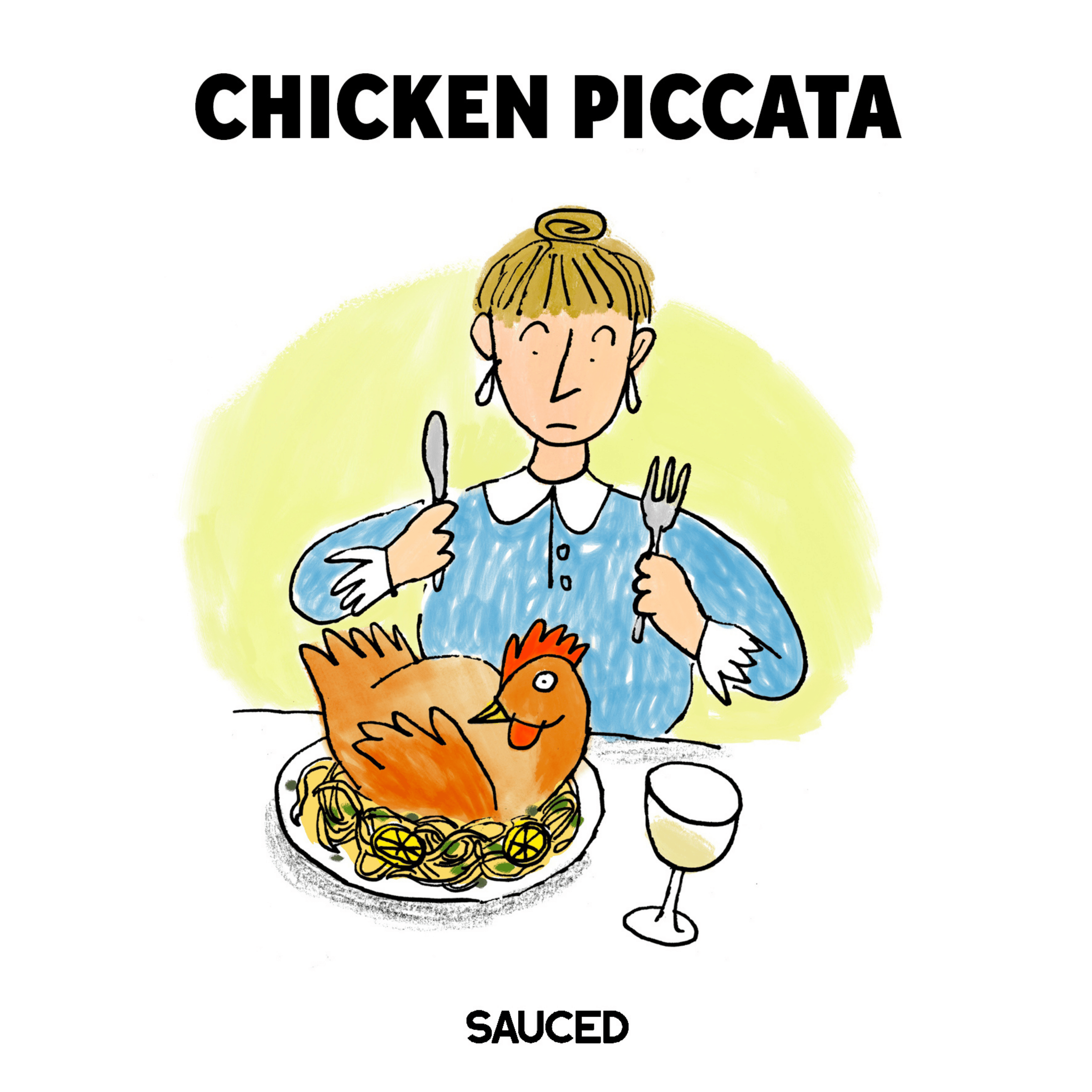
Chicken Piccata puts the bird in its title, but the capers run the show. That hand-harvested flower bud, too precious to come in a normal-sized jar, is the one thing two chefs agree the dish cannot lose.
It is a fast, bright weeknight plate with a surprising amount of mystery folded in, from a name no one can define to an ingredient no one can date. We came for the technique and left arguing about capers.
"Light and bright, lemon and caper."
What we settled on:
Even chicken cutlets from the breast, pounded to about a quarter inch
Season first, then a light flour dredge, shaken off
Sauté in olive oil, 2 to 3 minutes a side, until just golden
Pan sauce on the fond: vermouth reduced by half, then stock
Lemon three ways: juice, supremes, and zest to finish
Capers, and cold butter mounted off the heat for gloss
Finish with parsley, over buttered angel hair with spinach, or a bright green
The Cocktail:
The Piccatini, an Italian gin martini with dry sherry, Bianco vermouth, and caper brine, served up in a Nick and Nora. And the Dirty Limoncello Spritz, homemade limoncello with caper brine, Prosecco, and sparkling mineral water.
RECIPE CARD:
Premium subscriber? Check out the full recipe card here.
LISTEN
EpiSOde Partners
Thanks to the following brands for partnering with Sauced to bring you this episode:
TRANSCRIPT
Tim McKirdy: So, Sother. We covered the sort of winter/spring version of this already with Chicken Marsala, and now we're back in the seat with Chicken Piccata.
Sother Teague: Yeah, a little bit brighter, more summery. I'm excited.
TM: Associations with this dish. First thoughts, first thing that springs to mind?
ST: It's delicious. I think it's got a lot of cousins, so we've got a lot of crossover — we can talk about other dishes, Sole Meunière or Chicken Française, kind of cousins to this dish. Even Marsala, frankly. I've never worked anywhere that had this on the menu, but I do like this dish, and it's a real easy home run to cook at home on the fly.
TM: Yeah, totally. Great weeknight dish.
ST: You don't need a lot of preparation, frankly not a lot of ingredients, and the result is delicious.
TM: I'll tell you one of the standout things for me here, the thing I associate with it: capers, and how much I love that ingredient.
ST: Me too. I think capers, and frankly even aside from capers, caper berries are almost always present in my fridge and larder. I like the salt-packed ones as well.
TM: Probably an unanswerable question for us: why is the caper deserving of its own very specific type of jar?
ST: Yeah, I hate that jar. I don't have a single spoon that can get down in there. Over the years I've still affected no real technique of how to get them out easily without getting too much brine. So what I do every time — this is so stupid — I have my double strainer for cocktails and I literally pour the entire jar into a monkey dish, catch the capers, use them, and then painstakingly put them all back in the jar with the brine. So annoying.
TM: And I wonder too, why such a small size?
ST: Well, I do know they're difficult to harvest and so they're expensive, so I guess the small-size jar is to kind of highlight that notion. This is a dear thing. However, in the restaurant, in the back of the house, we're getting them in gallon jars.
TM: Exactly. You don't want sticker shock on the shelf.
ST: Yeah, here's your $90 jar of capers.
TM: But on the other hand, they're brined. Like you said, these things aren't going to go bad on you too fast.
ST: Yeah, they're not. Period. They'll outlast you.
TM: So I don't really get it, but maybe it just speaks to the special nature of this wonderful ingredient, that it has its own size despite how frustrating it is. Because I'm telling you, all the special slotted spoons I have individually from kitchens — they don't fit in there.
ST: No. I have a demitasse spoon and I was like, finally, I have a spoon that'll fit. Nope, doesn't fit. It's really frustrating.
TM: Obviously, like Marsala, this is one where you can go the veal route.
ST: Well, I think that's the traditional route. We're going chicken because that's the more Italian-American variant that arose here in America, and that's where we are and that's what we know.
TM: And actually, much of what we associate with this dish — some of the stuff we've mentioned already — is not traditional in any way. We just adopted it this side of the Atlantic. It's been interesting for us this first year of doing Sauced, just how many of these Italian-American classics lean into the American side and are not traditional. But it's interesting where things come from and what that says about culture and history.
ST: Well, and what it says about how things migrate. You're going to use the things that you have that are going to give you that nostalgia, and then that's going to create its own nostalgia with the generation coming up behind you, and then it becomes the canon.
TM: Much like a lot of these dishes, the origins are not as far back as we would think. But before we get into the origins, let's hear your elevator pitch on Chicken Piccata.
ST: Sure. Chicken Piccata: thin chicken cutlets, quickly sautéed and finished in a briny pan sauce of butter, lemon and capers. That's pretty much the gist. Like cooking an omelet, or even as simple as a whole roast chicken, this is a real test of whether a cook understands timing and balance and—
TM: Temperature.
ST: —restraint. So yeah, pretty straightforward. Again, applicable to many other proteins, but the techniques involved apply to lots of other things. So I think this is like a foundational building-block dish. And that was longer than an elevator this time. Sorry.
TM: It was a long ride. We were heading up to the top of the rock. So, looking at those origins — we mentioned veal would have been the traditional one, especially from Italy. What we're looking at is a preparation that falls under the scaloppine family tree: small thin cutlets, usually pounded thin to spread them wider and more consistent. Although, as you mentioned in our Chicken Marsala episode, you prefer to be cutting these. I would build on that just by saying maybe a light pounding for consistency more than anything else. You don't need to go at this with a hammer.
ST: Yeah. I know I said that in the Marsala dish, but I kind of like it a little more textural in Marsala, a little thicker. In this dish I am going to hit it with the hammer a little bit, just a little. We don't need to go nuts. We can still use our knife skills and slice the chicken in such a way that it doesn't need a lot of pounding. Don't just take your chicken breast and go at it — slice it into manageable pieces and then even them out.
TM: I mentioned Italy. We're of course talking more northern Italy, and that region is full of dishes with scaloppine, often cooked with lemon or Marsala wine. The traditional version, as we mentioned, piccata di vitello al limone, veal piccata finished in lemon. But here's the thing: piccata is absolutely an Italian word, but no one can really agree on what it actually means. There are some candidates. I'm not going to choose — we'll lay them out and have a discussion. One is from the Italian piccare, which variously means to lard, to prick, or to pound flat.
ST: Wow, that's a pretty broad spread right there. Those are not the same thing. For the listener, to lard is to take pieces of fat and push them into something with a pin, and lard it — you're adding fat to it, making it fattier where it was lean.
TM: Exactly, to stop things drying out.
ST: And then to pound out — that's totally not even— it's not the same thing.
TM: Those are at odds with each other.
ST: They're not even at odds. They're just not even the same thing.
TM: No, exactly. It variously means those things, but there's no need to lard something if you pounded it thin, because you're cooking it super fast.
ST: Sure, and if it's thin you couldn't lard it.
TM: You couldn't lard it. It probably arrived in Italian by way of the French word piquer, which means to prick, so there's some consistency there. Weirdly, Merriam-Webster leans into the larding sense, where others look at seasoned or pounded flat side by side. So again, the word piccata — it's a preparation. It would seem to suggest pounded, but that's not actually fact.
ST: Yeah. I just assumed piccata had something to do with the caper, I don't know why.
TM: Well, let's get on to that. But before we do — that is the piccata porco conundrum of the week, the piccata porco puzzle of the week. So the dish arrives in America by way of Italy, via Italian immigrants, early 20th century and onwards. The dish that came over here very much would have been veal, for various reasons: it's harder to find here, it's pricier, and later carried an ethical baggage that firmly pushed home cooks to poultry and chicken, which would have been cheaper.
ST: You seem to be looking at me. What's the ethical baggage?
TM: Well, there's an association with veal that it's cruel to cook.
ST: Certainly today I can see that, but even back then there was that connotation, you think?
TM: I said later carrying ethical baggage.
ST: Oh, okay, later. All right, for sure.
TM: So I think it very much would have been more availability and price that pushed us that way. We have no single inventor to point to, no founding restaurant, no ground zero. There are articles out there from the Washington Post that mention it in an offhand way in the '70s and '80s, which suggests it had firmly become part of the vernacular. People understand what this dish is, and oftentimes in more recent decades people have associated it, like you say, with capers. But capers are not in the Italian original, and once again no one knows when exactly people started adding them and that became the calling card for the dish. Looking at it, certainly by the '70s and '80s they were an established part of it, but this is something that would have been made for four, five, six decades commonly before we had that association.
ST: So just with lemon and probably parsley, like Meunière.
TM: Yes, a pan sauce of lemon, butter and parsley, optional white wine.
ST: Right, but Meunière is typically brown butter. So not brown butter, brighter, but no caper. Crazy. Because — when we get to the non-negotiables — I think capers come before veal or before chicken even. If capers aren't in this dish, I'm like, this ain't it.
TM: Well, if chicken's not in the Chicken Piccata you order at a restaurant, I'd argue you have a bigger problem there. Let's talk about this plate of capers that I have here. So the two things that would define this dish: the name, no one can quite agree on, and the capers, no one knows when they arrived. But those are the two things that would be first of mind.
ST: History's mysteries.
TM: History's mysteries, again, here on the show. All right, Sother, that's been the origins. We're going to take a little siesta in the studio and we'll be right back with some culinary luminaries.
ST: Not many.
TM: All right, Sother, we're back. Piccare — which reminds me, just thinking of our Prince's or Pauper's dish for you.
ST: Oh, well, we kind of already described it. And it's happening a lot lately that it splits the difference. I think it started as a Prince's dish when it was veal — more dear, more expensive, at least middle class and above, butcher class. But then when it moved to America and became Chicken Piccata it shifted gear and moved to more of a Pauper's dish. More just — not even Pauper, I think it's pretty squarely in the middle the whole time. It's not super elegant even when it was veal, but it's not super Pauper now that it's chicken either.
TM: Especially with those expensive capers.
ST: Right. Capers are a pretty expensive item. You can use them in moderation, or you can just go at it like you and I apparently do, but they are technically on the expensive side for what they are.
TM: The thing with capers is, whenever we encounter these rare or expensive ingredients, usually the two come hand in hand. But they don't have the same feel as some others — they have a rustic feel to them, in terms of their profile, what they are. It's not something where, if you handed someone a ramekin of capers and they weren't familiar with them and you said here, try this, they'd probably find them delicious but they wouldn't go, oh, this is expensive, like saffron.
ST: Yeah, exactly. Even though there are some parallels. This guy's pretty difficult to harvest. It's the tiny bud of a flower that's yet to open, on a bush that grows on craggy rocks and cliffsides, that must be continually harvested — because you don't harvest the entire bush at once. You get the smallest ones you can, then you come back the next day and get the smallest ones. It's a continual process and it has to be done by hand. There's no machine that can do this, so that's why they're costly. But also, if you handed someone these blind, without any instruction, you'd hope they wouldn't just take a big old spoonful.
TM: I hope they would.
ST: Because then they'd be like, I don't like these. But if they took a couple they'd be like, oh, I can see the value. Same thing with anchovies. If someone took a big old mouthful of anchovies they'd probably never eat anchovies again. It's an item that must be used in moderation.
TM: Well, speaking of which — this is a bit of an aside, but you might appreciate it, or you might be horrified. You know cod liver oil, the supplement people take for the good omegas. When I was growing up, my dad was taking them, and he said to my mom, you should be taking these, good for your health. And she goes, okay, I'll get on it. And he's like, but the thing is, you have to chew them for it to work.
ST: Oh my gosh. Yeah, cod liver oil is quite strong.
TM: And of course that was a lie. I don't know whether she ever went past one dose after that.
ST: This is the nature of the practical joke. There's a measure of cruelty built into the program.
TM: Something I saw as well, while we're on this expensive conversation — every month we do a bonus episode here on Sauced. Those bonus episodes go out to our premium subscribers. Quick reminder: it's $7 a month or $70 for the year, where you get two months free, plus all the recipe cards that accompany each dish and each episode and the drinks. One of the types of episodes you love doing, we call them rotten histories. I think for our next bonus episode we should do one in that vein, but it's called "One Time More Expensive Than Gold." Because how often does that come up?
ST: Oh, yeah. Salt, pepper we found out, saffron for sure.
TM: I reckon probably capers.
ST: Capers making a run for the money here.
TM: I think so. And I saw a video — I can't believe I'm forgetting it — a really common ingredient, someone cooking with it, and they were like, one time it was more expensive than gold. And I'm like, maybe gold just wasn't worth something a long time ago. So maybe we'll do an exploration of all the ingredients that at one point were.
ST: Listen, not to get on too much of a tangent, but my dad worked for NASA for many years, so I always had my eyes to the skies. It's an interesting thing to point out that in the universe, probably one of the most rare items is wood. We have so much of it, right? But there's gold out there, we know of planets that are mostly made of gold. Wood is worth more than gold universally.
TM: And we can grow it.
ST: Yeah, that's why it is. It's an organic material that grows, and we don't have a lot of planets we can see that have growth of any life.
TM: True. I'd put water up there as well.
ST: Yeah, water's pretty rare. But I like this idea — used to be more than gold, or still is. Caviar probably ranks at a higher price than gold. But common ingredients: salt used to be worth more than gold.
TM: Meanwhile we're looking at things like our lobsters, which were used as fertilizer. Everything changes, everything flips. So there you go, folks, expect that for our premium subscribers later this month. Usually it's the last weekend of the month, we drop it on a Sunday. I like to listen on a Sunday and go to the grocery store, do my meal prep for the week, spread it out, take it easy.
ST: Set the tone.
TM: Well, speaking of setting the tone — talk to me about culinary luminaries and their interpretations on this dish. What do they have to say, how do they approach it?
ST: Yeah, came up a little empty-handed on this one. There are a lot of chefs who talk about the techniques involved in this dish, because these are pretty much universal techniques we can use over and over in a myriad of different ways, in a myriad of different dishes. But no one really stepped forward and said, I'm going to take ownership of Chicken Piccata. Closest things are our good friend Marcella Hazan, whom we constantly refer to as the Julia Child of Italy. She talked about veal piccata, because she mostly stayed in the Italian classics lane, so she didn't say much about chicken piccata — but she didn't have much to say about veal piccata either. Lidia Bastianich kind of embraced both versions, because she has her foot in both camps, but again didn't have a whole lot to say about them, just that she enjoyed them. Our boy Jacques thought it embodied classic French sauté techniques but used Italian flavors, which is true. When I was in culinary school, my French chef — it was a very French-driven school, I think all culinary schools are mostly French-driven, really — he would say things like, the French not only invented food, we invented fire. So he goes even one layer deeper, like all techniques seem to originate from there.
TM: I imagine Jacques loves this dish just because of his love of cooking things fast, and speed, getting things on the table. Weeknight dish.
ST: So again, there are lots of examples. I dug through his YouTube videos, skimmed the books — lots of examples of him using these different techniques, pounding, flouring, dredging, sautéing, making a pan sauce. Not always piccata, but he talks about all the same parts a lot. Same with Julia — she does a lot of dishes where she pounds out a cutlet of some variety and sautés it quickly and makes a sauce that finishes with lemon, but not necessarily capers. So it was a bit of a slog trying to find anyone wanting to be the voice of piccata specifically, which is shocking because it certainly belongs in the canon of classic dishes.
TM: What I find interesting as well: we've said capers are probably most likely an American addition, or certainly more of a modern one. I can think of puttanesca, that classic Italian preparation with olives and capers—
ST: Olives, capers, anchovies, chili flake.
TM: So yes, that contains capers. But I would maybe associate it as an ingredient more with French cuisine than with Italian.
ST: I think it's deeply rooted in the techniques of the French. And even as you said at the top, piccata — the root word was the French term that meant to prick.
TM: Yeah, piquer.
ST: Right, to prick. Which still doesn't make sense. So I feel like this dish is shrouded in a bit of mystery. But oftentimes that's how we get where we're at.
TM: We would do so many preparations with capers as well. Sometimes you'd deep-fry them to serve on fish and chips.
ST: Love a deep-fried caper on a grilled romaine salad. Let's crack out the grill this summer in my grilled romaine salad.
TM: Chopped fresh through salads, through preparations, into our compound herb butters.
ST: You know one I've never seen, that I've always wondered why it doesn't exist? Why isn't there caper cream cheese?
TM: Because it's so commonly used on lox and bagels.
ST: Right. And what do they do? They roll around, they fall off everywhere, I hate that. Just fold them into the cream cheese. You know how you're eating and you're having to pick up the ones that fall off?
TM: Yeah. Meanwhile you get a massive chunk of red onion and you're like, oh, I'm going to smell for the rest of the day. Bagels.
ST: That's it, caper cream cheese, that's going to be our million-dollar idea.
TM: That sounds like a good caper for us.
ST: Why are those two words tied together?
TM: A good question, to which I do not have an answer.
ST: All right, worth more than gold — we're going to dig into that, that's going to be an upcoming bonus episode. I like this idea. And I bet capers fall into it.
TM: They must do. So, I didn't have any other folks. I figured you might go the Marcella and the Lidia route. I like that you sought out Jacques.
ST: I mean, Ina Garten is in that mix as well, but no one is stepping forward to be the voice. I think if any chefs are out there listening, this is your opportunity. Champion this dish, codify it, and be the leader.
TM: You can become the piccata guy. Or gal, or whatever. Speaking of Ina Garten, was she not the one who did shrimp scampi in the oven?
ST: Yeah, we talked about that on the show.
TM: I think I saw a preparation she did for this which was almost more like Milanese, where she incorporated not just dredging it in flour but a bit of egg and breadcrumb as well. And I'm like, that's not—
ST: Too heavy for this dish. The whole idea of this dish is light and bright, lemon and caper and a little bit of wine, maybe. That's going to be a lighter, brighter—
TM: Parsley. Your favorite.
ST: Love parsley, you know me.
TM: Hate it.
ST: You don't hate it.
TM: I don't hate it. But you know what, I think I'm just—
ST: You don't love it. Like I do — I take an entire bunch of parsley and chop it, not even fine, pretty coarsely, and then the entire bunch goes into a salad mix.
TM: I think I'm maybe just bitter because we recently shared our opinions on lobster sides.
ST: And you're getting trounced. Everyone wants chips, baby, I got the proof. Last I looked it was 63 percent chips, some percentage fries, and then the other option I gave them was screw with both of them, more lobster, and some people just went for that.
TM: Well, the thing is, where I come from, chips mean fries. So I was still calling it a moral victory. And someone did — JP Watson, actually, co-founder of our network, the host here — sent me a photo of those salt-and-shake chips. And he said, send these to Sother. So I know you enjoyed those.
ST: Yeah, I got the photo. Now I need the bag. We talked about it on that episode, but thin, plain, salted potato chip is the answer for a side dish for a lobster roll.
TM: It's not.
ST: And it might be the answer for Chicken Piccata. Stay tuned.
TM: Tell me now. Let's get into it. Sides.
ST: Oh, let me jump to the bottom of my notes, that's usually later in the game.
TM: Just putting you under pressure, just after that. I'm just fighting back.
ST: Oh, I know. I think that typically here in America what it gets served with is not my choice — some kind of pasta, angel hair or spaghetti, buttery. Sounds pretty good. But for me, frankly, I want something green. I want some sautéed spinach or gently cooked broccoli or asparagus. Something bright and green to match that sauce.
TM: Yeah. When I was looking at some of those old Washington Post articles that referenced this in an offhand way — signifying that people were familiar with the preparation — they were talking about some party on Rodeo Drive, a fancy event, and it was Chicken Piccata, which is quite surprising really, with a spinach soufflé. And I'm like, oh, that sounds nice.
ST: I could absolutely get behind that, to be honest. And also, soufflés are much easier than people want them to be. I don't know why people want them to be so difficult, they're not. I make them — I'm not going to say a crazy number, but I make them 12 times a year, at least once a month. Some kind of soufflé is coming out of my kitchen. Cheese soufflé, Natalie loves them. Chocolate soufflé, Natalie loves them. Spinach or something for me, that's what I love.
TM: I think that's another great bonus episode for us, the soufflé. We'll line that one up too.
ST: Is that an ingredient or a side dish? How do you rank it?
TM: Side dish.
ST: Okay, it's a side dish. All right, so we're lining up our bonus episodes today.
TM: Getting work done.
ST: We're double dipping.
TM: The other thing to note about sides — one of the things we're very much not used to here is coursing. We might have starter, main, dessert.
ST: The Italian way to eat.
TM: This comes as a primo course, before the pasta course. So the two wouldn't be mixed on the plate.
ST: Right, you wouldn't mix this with a starch, pasta or otherwise.
TM: But who has time for that these days?
ST: The Italians. They make time for it. We just don't make the time, but I get it, you're right. But yeah, when you're in Italy this would be a dish of its own just on the plate, with maybe some bread.
TM: I know you've done a ton of work travel to Italy, especially being the Amaro guy, that being part of your wheelhouse. One thing I find funny — whenever I've been on work trips out there, certainly from a journalist perspective, being taken around for wine or spirits and regions — not to sound like a total first-world problem here, but everywhere you'd go, someone would put on lunch and then you'd have dinner. And I was probably eating 10 to 12 courses per day.
ST: No, it's nuts.
TM: It's wild, and just so full all the time. Delicious food, but—
ST: I thought you were going to say one of the things that shocked me the first time I went to Italy, and ever since — now I know it's going to happen — when you get a course that is one single plate, but there are two types of pasta on the same plate. Often it's a lasagna and some kind of other pasta on the plate, which is bananas.
TM: It's wild.
ST: And again, that's not your meal, that's a course. Just one of the many courses coming your way. What is this, breakfast?
TM: And listen, if it's a wine trip as well, there's a bottle for every course.
ST: Indeed. And then at the end there's grappa and amaro and a corretto espresso, a coffee with some booze in it. You know the difference between the corretto and the resonato?
TM: No.
ST: Corretto — the word means to correct, so you're correcting your coffee by adding booze to it. Granted, I don't do any of this because I don't touch coffee with a 10-foot pole, it's my one kryptonite on earth. Resonato is the one I'd probably be more interested in — when you take your espresso down, oftentimes you drink it so fast that even the sugar didn't fully dissolve, so there's a little left in the bottom. Resonato, to rinse. So you pour booze into that cup and rinse out whatever coffee or sugar might be left, to take that down.
TM: It's the oyster luge of the food world.
ST: So you can have a corretto with booze in it, finish it, and then in the same cup you make a resonato.
TM: Very cool. So if we were to commit to a side, I think what people would want — maybe we'll split the difference and say we'll have some kind of pasta and a green on our plate.
ST: Sure. We could even incorporate them together. We could have chopped spinach into my pasta, toss it in the pan, lay it down, and then put the piccata on top.
TM: Spinach gnocchi, maybe. Might be a little heavy, but I do love gnocchi.
ST: You do love gnocchi.
TM: Again, it's my Gaelic roots, I love potatoes.
ST: You're always seeking potato.
TM: In all forms, folks, chips or otherwise. All right, Sother, those have been your luminaries for the day, and our accompanying friends on the plate. We're going to take another break now and we'll be back with the non-negotiables.
ST: Cool.
TM: All right, Sother, we're back. The non-negotiables, Chicken Piccata. And for you, the number one is capers.
ST: I didn't say number one, but I said it's just as important. I know non-negotiables are non-negotiables and maybe there's no rank of importance, but you've got to have capers in this dish for me. And you said it's not even fully known as a traditional thing, so I'm out in left field already. Do you consider capers to be a non-negotiable for this dish?
TM: A hundred, a million percent.
ST: All right. And chicken, maybe 100 percent. So somehow the capers outrank the chicken?
TM: It's impossible.
ST: Well, because I could swap. It could be veal, it could be turkey, it could be shrimp piccata, I've had it before.
TM: But if you order Chicken Piccata at a restaurant and butterflied shrimp turns up, then I'd say alarm bells are ringing, although probably delicious.
ST: Yeah, sure.
TM: Okay, so we'll say chicken. We'll say cut evenly from the breast. I know we both prefer thigh—
ST: Not for this dish.
TM: No, I just mean in general. But for this dish it has to be the breast, cut into cutlets to make them even.
ST: When we say even, quarter of an inch. We're looking for a quarter-inch thickness throughout.
TM: So, chicken and capers. What next for you?
ST: We need some flour. We don't need a ton, it's a super light dredge on a piccata, you're just going to dust them. It's not a three-stage — it's not egg, flour, breadcrumb, it's just flour, and we're going to knock as much of it off as we can. We want just a bare coating. This is going to help get a little bit of golden browning when we get into the pan, and it'll aid in pulling the sauce together a little too, but it's really just for that bit of browning.
TM: Yeah, I think it's threefold. Initially that browning, so our Maillard, we get there. It's also going to create that fond in the pan. So when we deglaze with our booze, which you're saying is optional—
ST: I mean, everything I found for traditional, it wasn't there. Everything said you can optionally add this, you can absolutely add this, but it wasn't a requirement. And I think from the original it wasn't. But we are going to, obviously.
TM: A hundred percent. And then the other thing is it will help — we're making a pan sauce here, a one-pan dish, so that's going to help thicken it and give it some texture.
ST: Not a ton, because we're making sure we shake off most of the flour. But there will be some starch in there that will absorb some liquid and create a thickening agent, create a matrix.
TM: Next.
ST: Butter. If they were in order, I think I would have said lemon first, but butter — gotta have butter.
TM: Butter to finish, oil to begin.
ST: Yeah, off heat.
TM: Olive oil, finished with butter, mounting the butter. We always talk about that. Let's get into a little technical consideration there — I just want to throw a number out. We're mounting the butter, and what that means is taking the pan, once everything's done and ready, off the heat, adding cold butter and stirring or swirling that in. Because butter starts to break — I never knew the figures for this, so I looked them up and wanted to share. 158 degrees Fahrenheit, or 70 degrees Celsius. And even a properly mounted and emulsified sauce will separate if pushed past 190 Fahrenheit, or 88 degrees Celsius. So you're never boiling this sauce, never on a rapid heat.
ST: You're barely even at the poaching level. You don't want any kind of bubble to be visible, really. And that's why you do it off heat — the thinness of it in the pan, you can almost guarantee that just pulling it off the heat will stay out of that temperature danger zone for breaking the sauce.
TM: You mentioned lemon. Something I really like — I think it's more a fish preparation, like a lemon caper butter sauce — but I really like not just juice but some lemon segments in there. And depending on when you add them, they'll almost cook completely out, and a little goes a long way. I think it's a nice little touch.
ST: So you're saying let's throw in some supremes. That's what we call it.
TM: You call it a supreme?
ST: Yeah, when you segment out the lemon, or any citrus fruit, without any of the membrane.
TM: Peeled, yeah. I just always went — what did I say, segments? Yeah.
ST: I'm down with that. I was actually going to say, one of the things I like to finish this dish with when it's hitting the plate is some lemon zest. So we've got three types of lemon in here — let's get juice, supremes and some zest. Sounds good to me.
TM: Perfect.
ST: Booze.
TM: White wine — oh, vermouth. That's kind of our hard—
ST: That's our new thing, and I'm enjoying it. Every time we make something and use vermouth instead of wine, I'm like, why wasn't I doing this all along? And I know why — because I was cooking in kitchens and it's more expensive. We have a bottom line to take care of. We have a bottom line to take care of at home as well, but a bottle of vermouth is always on my bar cart.
TM: I think that also speaks to the fact that until recently there's been very much a separation between bar and kitchen. We see the bar being heavily influenced by kitchens in the past 10, 15, 20 years, but prior to that, completely different lanes. So it doesn't surprise me that chefs aren't as familiar with vermouth as they'd be with wine.
ST: I mean, yes and no. Most of the kitchens I worked in were headed up by French dudes, so they certainly knew about vermouth, and they were using alternatives to just the boxes of white wine we'd get, that were no name brand, no—
TM: No grape.
ST: No grape.
TM: No region.
ST: No. It's just—
TM: White and red.
ST: Exactly. Mix them together and it's rosé, with the chef drinking while he's doing the paperwork.
TM: I think for us as well, this being Sauced, we'll call it a non-negotiable. It's not classic. Chicken.
ST: Well, I've got one that does and doesn't rear its head. The recipes I looked at, some involve it, some don't — stock. I think we need it. Some were simply relying on the lemon juice and maybe some wine. I think it needs some stock to give it more richness and sauciness, otherwise it's just too acidic, and for lack of a better word, whiny.
TM: Yeah, same. And then finally, I've only got one more here. Parsley.
ST: Oh, you consider it a non-negotiable? I was going to say, I want it, but it doesn't have to be there. Why is it a non-negotiable for you this time, knowing your history with parsley? Tim grew up on a poor parsley farm where he was forced to the fields every day.
TM: Well, that's a wild guess as to why it might be a non-negotiable for me and not for you.
ST: I mean, why it's not one for me — because I don't think it's a requirement for the dish, but I want it.
TM: Color.
ST: Oh, okay. Yeah, that doesn't matter to me. You don't feel like you get enough dots of green with the capers in there?
TM: Listen, buddy, let me tell you something about green. There's green and there's green. And an olive — I know you know that as well. I'm just saying, we eat with our eyes first. That we can agree upon.
ST: It stings, it stings.
TM: That took me a while. We eat with our eyes first. And like you said, this is a dish that's supposed to be fresh and bright and summery. An olive-colored caper, or a caper-colored olive, a browned chicken breast and a pan sauce — that's not the most—
ST: Kind of heading down the beige road. So let's get some bright green.
TM: Some bright green in there.
ST: I'm hip to that.
TM: Well, those have been the non-negotiables. Any more for you?
ST: Nope. I think that's the complete list of everything necessary to make this dish. Are there any negotiables you'd want in this? Normally we do — did you? I mean, maybe the supremes were your negotiable.
TM: That's a negotiable for sure. I was just going to say I'm having caper berries as well as capers in my finished version.
ST: In the sauce itself, or is this a garniture for the plate?
TM: Garniture for the plate. That is very much a negotiable. And also, it's just a very convenient way for me to say, Sother, I know you've been doing some research on capers, why don't we explore that now? Because looking at our other ingredients — chicken, I don't think there's anything we need to do a deep dive on. And certainly capers — we've maybe mentioned it once in one episode to date, but this is our first caper-focused one. So what the hell are they, beyond more expensive than gold?
ST: Well, at least at one time they were. Or do you think they still are? I don't think they still are. As mentioned at the top of the show, it's the unopened flower of the Capparis spinosa — I'm probably butchering that, former butcher — commonly called the caper bush. So it's a big craggy-looking bush, and it's the flower bud, so it's like a hop.
TM: A bud, yeah. A hop, okay.
ST: So you're getting this floral nature from capers. We've talked about what capers taste like — they're not just salty, not just kind of olivey, they also have a really floral backbone, especially if you take one on its own and really study it when you taste it. If you leave them on the plant, they will flower. They turn into this pretty little four-leafed white flower, apparently quite gorgeous. I looked around to find if they're edible, but it seems like no one eats them, even though you probably could — because they only last a day. They're so delicate and small that they fry in the sun and fall off the bush.
TM: Kind of reminds me of edelweiss.
ST: Edelweiss. I'm not going to sing this song. And then speaking of the caper berry — after the thing flowers, the caper berry is the fruit that grows. A pretty radically different flavor from the bud, more firm in texture, and — I don't know how to say the flavor — it's kind of like okra. Kind of an okra vibe. Am I wrong about that?
TM: No, it's a difficult flavor to describe.
ST: They're not slimy like okra, but they have pretty large seeds inside and a hollowish interior that vibes like okra. Strangely, they're pickled or processed just like capers are. I wonder if they processed them differently, if they'd taste different.
TM: I wonder. I mean, curing, just as part of the process, in salt or brine, apparently triggers an enzyme reaction that releases mustard oil.
ST: That's what I was going to say as well. So you get this mustardy vibe too.
TM: And that floral again, and certainly citrus and lemon notes. So it all comes together spectacularly well.
ST: And that transformation during curing, with salt or brining in vinegar — salt and vinegar, I should say. You can't really eat them before doing this, they're wildly bitter, really astringent. And this is obviously why they cure them like this. Kind of like an olive — you can't eat an olive right off a tree, it's super bitter, olives have to be cured with lye before they're edible. So you have to do that before you can eat them at all. And then there's a crazy amount of market sizes they sell them in, which I was unaware of. I knew the one size I like is called nonpareil, which I believe translates to simply unparalleled, and they're the smallest ones. Those are the ones you're going to get on your bagel, the ones you'll probably see in the tiny skinny jars at the grocery store. The next one is called surfines, a little bit larger, pretty much the same but probably a little cheaper. As we climb the ladder, capucines are medium in size and more assertive, considered a little more all-purpose, so not just for garnishing and being in a sauce. Capotes are even larger and much firmer, and have to be chopped up to be used, because you want to chop them down to the size of the nonpareil we started with. Weirdly, fines — which sounds like it's fine, you'd think it'd be smaller — they're even larger, with a much more pronounced texture and higher aromatic quality, more of that hoppy, floral situation. Grusas are the giant ones, often used whole in salads and cold preparations. And then of course we have the two varieties, either salt-packed or vinegar-packed, and you get each of those sizes in both. Salt-packed ones — you almost never see them at the grocery store, but a lot of chefs use them, I see them in kitchens all the time. You have to rinse and soak them a little before you can use them, because they're very, very salty.
TM: Worth noting, just an observation: I rarely come across most of those sizes. The common ones are, like you said, the most expensive.
ST: Six different varieties. I had no idea there were six.
TM: Where do you go to get this selection from, and why so many?
ST: I think it's kind of like the USDA gradings for beef. We're only going to see a few at the market. The other ones are either used for industrial use, canning et cetera, or in restaurants.
TM: So I wonder — hear me out on this — you mentioned these buds grow at different rates, so you have to come back at different times. What if instead, because you have to hand-harvest them, which is where the price comes in — what if you just harvest the whole plant and then process them by size?
ST: I bet there's a bit of both happening. Surely, if I'm the harvester, I've probably got some kind of basket, and I'm plucking off the ones I think are ready today, and then they go through a sifting machine where the larger ones fall this way and the smaller ones go that way. So it's just what you plucked that day, and it's not only size, you're going for ripeness. The buds are ready to be picked whatever size they're at, and then they get sifted out, I'm assuming. Again, this is going to be in our bonus episode that we're definitely going to put together.
TM: Not a job I would want.
ST: I don't know, man, it's probably a lot of solitude, you'd listen to some podcasts. Marcella Hazan — back to her — early in her career she preferred the tiny Provençal, which are French nonpareil capers. Later she came out and said she enjoyed the flavor of the larger Sicilian and Sardinian ones, because she said they were "more expansive and stirring" — those are a direct quote — than the smaller ones. Which of course busts our common belief about these capers, that smaller is always better.
TM: I think Marcella sold out to Big Caper.
ST: She was influenced by Big Caper.
TM: I would love to be a caper spokesperson. You know who's that wonderful Salvatore Calabrese, Italian bartender, made his name in London, martinis and vintage spirits?
ST: Heck yeah. He's the guy who really spearheaded making an entire cocktail out of all things vintage.
TM: Cool guy. Inventor of the Breakfast Martini. If you follow him on social media, he spends most of his time on a beautiful boat somewhere in Southern Italy, eating lemons and making martinis, because he's an ambassador for — is it Sicilian lemons, or—
ST: Amalfi.
TM: Amalfi. Whatever the caper equivalent is of that, just throw my hat in the ring.
ST: Yeah, you want to be the Lorax and speak for the trees.
TM: Instead of a boat I'm just in a pickup truck in a forest, I don't know. Anything left for us to add here, just on the ingredients front or technical considerations?
ST: I think we've touched it all. I think we should get into putting this together.
TM: The preparation. All right, so we're back. The preparation, which will of course be going out by the time people are listening to this — to the premium subscribers, in their email inbox, 5 a.m. Eastern. The recipe will be there, but for now, because we come up with that after we've been on air — walk me through the preparazione.
ST: Oh, Italian even. All right, so we're going to start with some chicken, as aforementioned, sliced to the correct size and then gently pounded to have an even thickness throughout. But most of this is getting done with your knife, less with your meat mallet or the back of a pan. You're going to pat it dry, season it — go ahead and season it with salt and pepper, I'd probably use white pepper here. Dredge it lightly in flour and then shake the flour off. And you're going to season first, because if you put the flour on first the seasoning won't stick — that's a common thing. And we're not using enough flour to bother seasoning the flour. So a super light dredge, shake off any excess. You're going to heat in your pan a bit of oil to a medium heat. We're not deep-frying, we're not even shallow-frying, we're sautéing, so you just need enough to get in the bottom of the pan. When I say medium heat, you want to see it shimmer but not whispering smoke. Because this is pounded, it's going to cook quite rapidly, so we don't want the pan and the oil too hot. Lay your chicken in, away from yourself of course so you don't splash. We're talking literally two to three minutes for the first side, it should get nice and golden brown. Flip it over, one and a half to two minutes for the second side, and then remove them to a pan where they can rest while you're building your sauce. At this point maybe pour off some of the excess fat, but make sure you're not letting any of the fond get out of the pan, which should have formed while you did the chicken. We've decided on vermouth — we're going to go in to deglaze and reduce that by about half. Then we're going to go in with some stock and reduce that by maybe a third, not so crazy on that one. Then we're going to add in lemon juice and capers, your supremes that we talked about, and just swirl the pan around. We don't need to use a tool here yet. Swirl it around and simmer until everything comes together and tightens up a little, 30 seconds, maybe not even that long. Then you're going to remove it from the heat — either turn it off or slide it over to another eye. And you should have already — I should have mentioned earlier — some butter that's cold but cubed into pretty small cubes, not fine dice, but not huge slabs either. You're going to start gently whisking those in, swirling them in, so the sauce starts to get glossy and pulls together. At this point, when it's all pulled together, put your chicken back in the pan just to get everybody coated and acquainted with one another. Finish with a healthy dose of parsley, my favorite, and then serve it immediately. Did I skip anything? Oh, I did say I'd like to have a bit of lemon zest, which, if we're going to do supremes, means we need to zest the lemon in advance. Then supreme — I'm using it as a verb as well. So when it hits the plate, whatever you're serving it with, hit it with a little lemon zest on top.
TM: Interesting. We're just like — no onions, no garlic even, just keep it clean, keep it bright.
ST: Yeah, pretty.
TM: Nice. That sounds amazing. And then some kind of spaghetti, or you said angel hair.
ST: I said spaghetti or angel hair. I'd probably lean to angel hair on this one, because angel hair is more compact to itself, so the sauce would adhere a little better. And we talked about maybe chopping some spinach into the angel hair. No real added sauce to it — maybe a little that's left from the pan, from your chicken pan, you could toss into the pan with your pasta and spinach just to pull it together. Twist it up, put it on the plate, put the chicken on top, hit it with a little zest.
TM: Beautiful. That sounds really nice. And once again, just one of those weeknight dishes — from arriving back from the grocery store to plate, if you're dialed in, you can have this served up easily in 20 minutes.
ST: I think so.
TM: Half an hour, maybe give yourself.
ST: I was about to say that might be ambitious for the typical home cook, but a goal to strive for. I think 30 to 35 minutes could easily be done for our listener.
TM: Very cool. Well, Sother, that has been the preparation.
ST: Quick one.
TM: Speaking of bright and refreshing—
ST: Let's have something to drink.
TM: Yeah, let's take a final break and then we'll be back with the pairings and the custom cocktail.
ST: Yeah, I have one.
TM: All right, Sother, we're back. The pairings.
ST: Let's go, it's my favorite part of the show.
TM: Same here, I love it. Man, let's not pick favorites.
ST: I love the show.
TM: No, no, I agree. This is the third episode we're putting out where we've been working closely with our partner, Wines 'Til Sold Out, WTSO, with a bottle recommendation for us. We say these are the dishes we're doing, what are you going to put up for us? I was surprised — I feel like these guys know us really well already, because rather than opting for Italian today, which is where I think both of us would have gone (and we'll get into it), the white we've been served up to pair with this dish is an Albariño from Rías Baixas. 2023. The producer is Rectoral do Umia Miudiño. Yeah, difficult — that sort of Galician, northwest-of-Spain dialect is one I struggle with. It's kind of like Portuguese and everything. But the notes from the somm: this, for $14.99, is an excellent match, thanks to its crowd-pleasing, mouth-watering nature and saline notes that pair wonderfully with the lemony butter sauce and the briny capers in this recipe. I feel like Albariño is a stalwart for us, and it's a wine we really like. I've enjoyed this. We've spoken in the past that one of my go-to little secrets is Albariño that's spent time on the lees to give it a bit more texture. I don't believe that's the situation here, both from what I could look up online and tasting it — it's cleaner, more focused, more precise, and gets that beautiful lemony citrus primary character. Of course that bottle is available to everyone, but to Sauced listeners with a discount of $10 on orders over $100 using the code PAIRING.
ST: That's a specific wine that these guys have attached to us — a sommelier who we tell what we're going to make, and he pairs a wine for us, which is awesome. But we're still going to talk about what wines we think would go great with this dish, and their region and the grapes, et cetera.
TM: Well, here's the thing, man, it's Wines 'Til Sold Out. Once they're gone, they're gone. Take advantage of it, by all means. $15, amazing. What can you get for $15 these days? Not even a cocktail here in New York City.
ST: No, you're right.
TM: Times are tough. But more broadly, I think it's a great pairing for this dish, we love the region and the grape. So just a little background on Rías Baixas: like I said, Galicia, northwest of Spain, right on the Atlantic. Not my favorite ocean, I don't know about you.
ST: I don't think I have a favorite ocean. I have a favorite body of water, it's the Gulf of Mexico, where I grew up.
TM: Yeah. Well, I think mine is the Pacific. You know what the Mexicans say about the Pacific?
ST: What's that?
TM: They say it has no memory.
ST: Did you just watch Shawshank again?
TM: No, but you know. I've got a whole thing about Cebuano — a different day. We're back. Atlantic. Among the rainiest wine regions in the country, but with enough sunlight to ripen. And we're looking at two things here: it's not just sugar and therefore brix and your alcohol level, but phenolic ripeness, turning the character, going from green to fruity, even if it's just primary fruit. The cool, wet maritime climate is why the wine keeps its bracing acidity instead of baking it out, and the freshness is what we're looking for. And then the granite soils, and vineyards set amongst the rías — these are sea inlets where fresh and salt water mix, and they're the explanation, what people talk to, when it comes to the saline snap in the glass, that saltiness.
ST: Which I love.
TM: Although — that maybe is true, but you know how people are, like minerality in wine. People are like, well, that's from the minerals in the soil. Minerals can't pass through roots, so no one really knows what minerality is. And again, okay, this is saline water, maybe we just associate it, maybe it's the salty air, who knows. But we love it. Albariño, like we said, great grape for this. Fresh. If we were to go elsewhere, though, I'm sure you have some Italian options for us.
ST: Just the one, really. I thought, for me, this dish says Pinot Grigio.
TM: Yeah, fresh.
ST: From like Alto Adige. Nice and fresh, nice and bright. The dish is fresh and bright. Again, go at it or go against it — this is kind of going at it.
TM: Yeah. I guess the other one's just Vermentino, saline, citrusy once again, or Verdicchio.
ST: I thought about a Verdicchio, but I don't know enough about it to be confident enough to put it down. If someone was sitting in front of me and I said, I've got you this Pinot Grigio, I'd feel confident saying it. Verdicchio is not quite in my wheelhouse.
TM: Not quite as common that we see, is it? But also, if you're in Portugal, Alvarinho or Vinho Verde. Picpoul de Pinet, that's the Aldi favorite, sort of the new — I'm calling it the new Grüner. And Grüner would be another great option for this. So you know what, folks, just light, primary-driven — by primary we mean fresh fruits, apple, orchard fruits, citrus. Good to go, refreshing. What are you thinking in terms of beer that's not Saison?
ST: Yeah, I got a couple. I'm going to lay off the Saison for a while, apparently I've been hitting it too hard. A couple of Italians by name. I'm going to call them — Birra Messina, do you know this one? It's a Sicilian, and it's known for having salt crystals in the unfiltered version. They have a filtered and an unfiltered, so it's kind of a salty beer. And I think that would go quite well with this dish, because it's pairing up against those salty capers. Salt on salt. Either go at it or go against it. Then there's Menabrea. I'm sure you've heard of them, they're the oldest continuously active brewery in Italy, been around since 1846, but they use Alpine mountain water when they make their beer, so it's got this exceptionally crisp quality. I think that would go great as well. Beyond that, I only have one more I'd really stand behind: a German Kölsch, which has the body of an ale but the crispness of a lager. So a little richer on the palate, but still crisp and clean on the finish.
TM: Standing up to that protein. Cutting.
ST: Standing up to that butter.
TM: Love it. Beyond that, custom cocktail — I've actually got one for us today too, but I'll cede the floor to you.
ST: Well, first I want to talk about what classic cocktail would go with this. And I know this — I've been saying it a few times recently — but this one is square on the mark here. It's a Martini with a lemon twist. I would maybe go a step further and put in — I know you're going to frown at this — a bar spoonful of the caper brine.
TM: Hold your thought.
ST: Okay. And then I do have a custom cocktail here, and I'm going to offer to our listener a bonus on the custom cocktail.
TM: Oh, we're plussing it up.
ST: We're going to plus it up.
TM: Like our guy Barry Enderwick.
ST: Let's give this cocktail a go. And again, I'm going to leave naming it to you. I'm going to make us a spritz, and the plus-up I'm going to give you is that the spritz starts with limoncello, and I'm going to give you the recipe for the limoncello that I make. So the home user can make their own limoncello and be very proud of it. And the limoncello can translate to any cello — you can use any citrus fruit twist and make grapefruit cello, lime cello, limoncello. So I'm going to give you the template to make that. Anyway, let's start out this cocktail with two ounces of limoncello, hopefully homemade, into a big wine goblet, along with a quarter of an ounce of caper brine, and then a bunch of ice. Stir that to get it cold, then pile in a little more ice, and top up with about three ounces of Prosecco and an ounce and a half of sparkling mineral water — because I'm looking for that minerality, not just seltzer this time. And then give that a gentle swirl to pull it all together, and throw in a lemon wheel and a couple of fresh capers, three or four, just to give a visual cue to this drink. And that's going to be your delicious homemade limoncello spritz.
TM: Homemade lemon jelly.
ST: Your Dirty Limoncello Spritz. I hate that word though, dirty.
TM: I like it. Dirty Limoncello, Dirty Spritz. So if someone out there makes their own limoncello and they document it and share it and tag Sauced — I was going to say we'll send them some of your hot sauce, but that seems unfair, you haven't agreed to this on air.
ST: I'll do it. Why not?
TM: We'll send a Sauced apron to whoever it is, the first person to make their own limoncello.
ST: All right, it takes a couple of weeks. So you've got a couple of weeks, but you've got to get ahead now.
TM: Now.
ST: All right, did you just think that on air? Because we didn't plan that.
TM: No, exactly. That's why I felt bad, being like, you're on the hook. We'll give away a Sauced apron as well, which, by the way, folks, just a reminder, those are available on the website, saucedpodcast.com. They've been available for a little while now. We haven't really mentioned it too much, but if you see the videos we make, you don't know who it is, because all you'll see is the apron and Maurice. That's our Maurice moment of the week.
ST: Yeah, the Maurice highlight. Get the apron. We've also got a few candles up there still.
TM: Speaking of martinis, we've got Martini-scented candles and Manhattan-scented candles.
ST: I cannot decide which one I'm more partial to. I like them both, same as the drink. I'm not going to give up either of those drinks, and I'm not going to give up either of these candles either.
TM: I know what I'm partial to.
ST: Which one?
TM: A Martini.
ST: Of course. Well, speaking of a Martini, I'm assuming that's the road you're going down, because you've made now more than one hint about it. So what's your custom cocktail for this dish? You've got no poker face.
TM: The Piccatini.
ST: Oh wait, by the way, you never named my drink.
TM: The Dirty Spritz.
ST: That's it, just Dirty Spritz.
TM: Well, I'm on the hook for two names this week.
ST: Well, you probably already named yours.
TM: I hadn't.
ST: Mine you have to do on surprise.
TM: On surprise? You mean by surprise.
ST: By surprise, on demand, is what I really meant to say.
TM: Anyway, let's not, folks. So one of the things, speaking about those trips to Italy that I've done — I've been various times over the past five, six years — it's been really interesting to see Italy embracing gin and coming up with some high-quality versions themselves.
ST: Well, I feel like — as I think got emphasized recently with Philip Duff's World Gin Week activation — gin is becoming more popular everywhere. Everywhere is now making gins, everywhere is now drinking gin more than they used to. It used to be pretty—
TM: Statistically, we're drinking less gin in America than we were.
ST: In America. But more people are getting really — with the current popularity of the Martini, we're drinking less than— wow.
TM: Consumption is down, or sales are down. Who knows if people are drinking it or not, but they're certainly buying less of it.
ST: Buying less, or buying less expensive? What does sales mean? Does it mean bottles or dollars?
TM: Volume sales are down.
ST: Volume sales, okay.
TM: So there's a bunch of amazing, again in the London dry style, but some of them incorporate ingredients like basil. I've had ones that have really beautiful character. But yeah, folks, seek out an Italian gin. We're going to go two ounces of that.
ST: Say the name again. Or did you say the name?
TM: I didn't say the name.
ST: Oh, what did you just say?
TM: Seek out an Italian gin.
ST: Seek Out — oh, I thought that was a name. Seek Out Italian Gin. Oh no, seek out. Got it.
TM: Yeah. I think Poli — P-O-L-I — is one I've really enjoyed, but I forget exactly. I can see it, it's got a blue label.
ST: Poli's also a grappa maker, so that makes sense.
TM: Probably that'll be the one. If you're really interested, folks, you can look up gin spirits reviews on VinePair, I've got a couple hundred on there under my name, so you can find them.
ST: You did some heavy lifting over there.
TM: We did that. So I'm going to go two ounces of that.
ST: Okay, two ounces of Italian gin.
TM: In the London dry style. I'm going to go three quarters of an ounce of dry sherry.
ST: Ooh, yeah.
TM: A quarter ounce of Bianco vermouth.
ST: Okay, to give it some florality and some lift.
TM: Three bar spoons of caper brine.
ST: All right, so you were on board with my dirty action.
TM: We're going to stir that, strain it into a chilled glass, served up, obviously — a Nick & Nora, I think a Nick & Nora for this. And my garnish is going to be a beautiful caper berry wrapped in a twist, and we're just going to put a little prick through that and save it as a treat.
ST: But you've got to express the oil of the twist over the drink first, and then wrap it and stab it. Or have them ready and wrapped and stabbed, and have other twists nearby to do the expression.
TM: You know, some people twist and discard. We twist and wrap and stab. It's the lesser-known technique over here.
ST: It's more of a mouthful. All right, so let's cap it again. Gin, dry vermouth—
TM: Dry sherry.
ST: Dry sherry, sorry. Blanc vermouth, you said?
TM: Just a quarter ounce.
ST: Yeah, but still, that's going to give it some body.
TM: Some body, some roundness.
ST: For sure. This sounds delicious. And then caper brine. What's the name?
TM: The Piccatini.
ST: Piccatini, because we don't know where the word came from. It's meaningful and meaningless at the same time.
TM: Yeah. It's been a hell of a caper this episode.
ST: Where does that come from?
TM: I was just wondering if you have any final thoughts for us today, or what people are missing out on.
ST: Yeah. I think I kind of touched it at the top of the show. You're missing out on an opportunity to really get your reps in on a bunch of techniques that are useful to this dish, but useful to many dishes. What did we say off air? The three Ms. Mallet—
TM: Timmy Mallett, get your old Timmy out, the Mallet.
ST: That's where you're going to pound out — so we're talking about cutlet, slash, pounding out.
TM: Maillard.
ST: Maillard, we're going to get a little browning happening.
TM: And monter.
ST: And then monter, which means to mount with butter, the technique of pulling a sauce together with just cold butter. So all of those techniques can be used, and that's just three of the techniques involved in this dish, but they can be used on this dish and other dishes. So what you're missing out on is simply the joy of repetition, the joy that comes from doing a thing over and over to strengthen your craft. Reps.
TM: The Bruce Lee.
ST: Yes, get your 10,000 in.
TM: I love it. I think this is a great dish. This is one where I'm not happy that what we think of as Chicken Piccata is not traditional, because I like the non-traditional, I like the capers. Don't get me wrong, I love veal too, but I love chicken. Some people call it the salmon of the earth.
ST: Because tuna's the chicken of the sea.
TM: And yeah, I just think this is a wonderful dish and a great weeknight option.
ST: Yeah, I'm going to make this this weekend for sure. Based on what we've come up with today, and what we'll jot down, which will be the recipe cards for our listeners, I'm going to make this dish this weekend.
TM: I'm going to make the Piccatini tonight.
ST: Ooh, challenge accepted. I don't have any limoncello at home right now, I'll start one. All right, so again, to the listener: first one to post and tag us with their own homemade limoncello — and don't do it too soon, or I'll know you didn't really make it — we'll send you out a Sauced apron. And I'll challenge myself to do the same. I'll try to get one started over the weekend, so it'll be ready in a couple of weeks.
TM: Fantastic. All right, Sother, well, only one final thing for us to do today.
ST: What's that?
TM: Time to put on the apron.
ST: Break out the shaker.
TM: Leave us a review on Apple or Spotify or wherever you get your podcasts, and let's get cooking.
ST: And drinking.
TM: Cheers.
ST: Cheers, buddy.