Episode 9:
BOUILLABAISSE
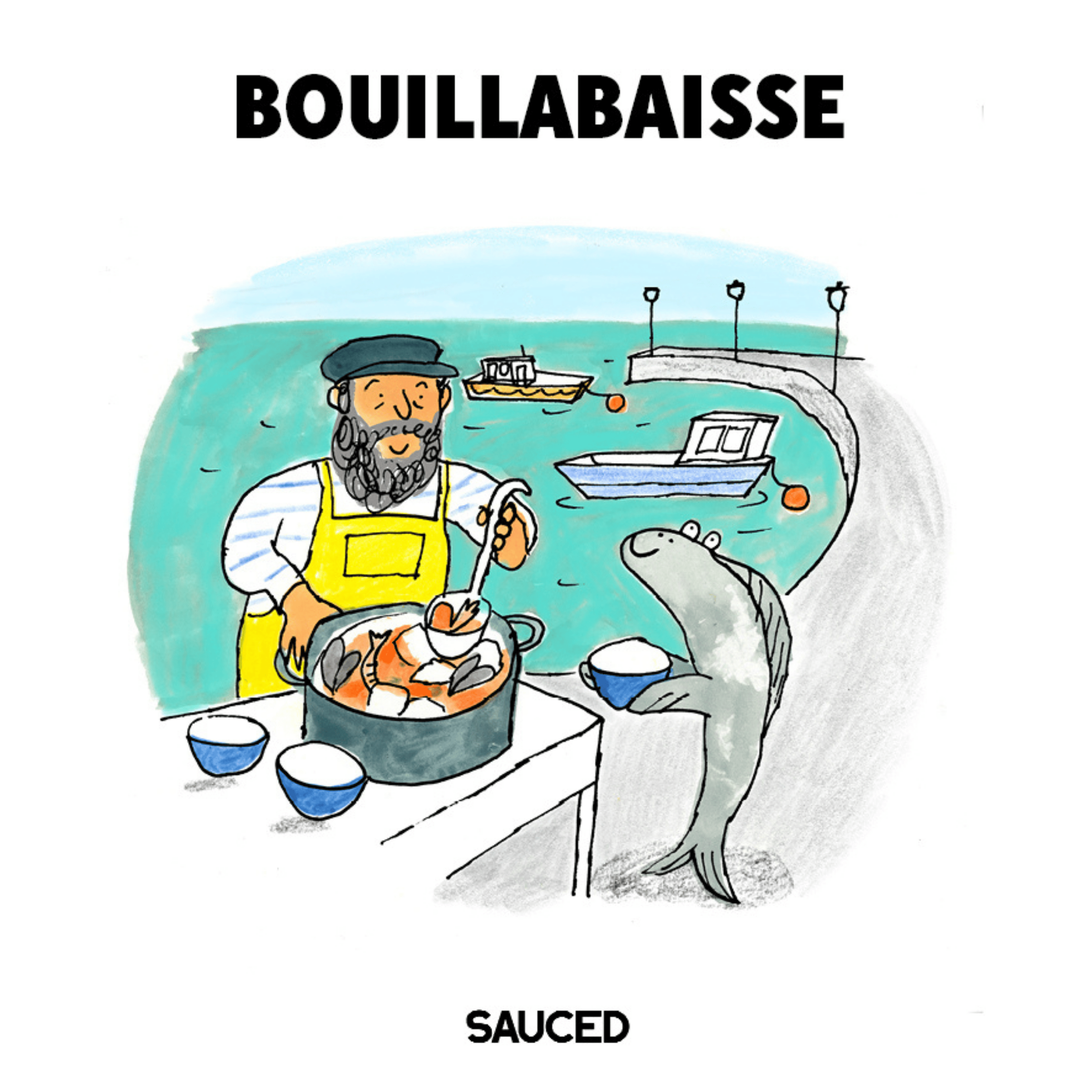
A pauper's dish with a prince's charter — this week we tackle Marseille's most iconic seafood dish, from its 600 BC roots in Greek kakavia to the 1980 Charte de la Bouillabaisse that codified it.
"Paupers built this recipe, princes wrote the charter."
What we settled on:
Pastis to deglaze, white wine in the broth, saffron bloomed in wine to activate all three key compounds
Three to five white fish, staged into the broth by density — monkfish first, shellfish last
No oily fish — salmon, mackerel, and bluefish overpower the delicate broth
A hard 40-minute simmer that emulsifies olive oil into a golden, creamy broth without cream, butter, or thickeners
Rouille two ways — stale bread or dry mash
Communal service — bring the pot to the table
The cocktail:
The Mauresque: 2 oz pastis, 1 oz orgeat, topped with ice-cold water or seltzer. Simple, quenching, and straight from the south of France.
RECIPE CARD:
Premium subscriber? Check out the full recipe card here.
LISTEN
EpiSOde Partners
Thanks to the following brands for partnering with Sauced to bring you this episode:
TRANSCRIPT
Tim McKirdy: Sother Hope you've got your saffron bloomed —
Sother Teague: The world's most expensive spice —
TM: Integral to today's dish. A hundred percent. In many instances or in multiple ways. That is of course Bouillabaisse. Thoughts on covering Bouillabaisse today?
ST: I'm excited. I grew up on the coast. I love seafood. It's been a big part of my life. It's been a big part of my career. We've talked about oysters in the past. My first shop ever — I was an oyster shucker when I was 14 years old. I think seafood is in my blood.
TM: And I gotta say, this is probably one of the most iconic seafood dishes out there that has been codified. And I don't mean that in the literal sense, although we will get into that. But I do think it's one of those where it's like in the pantheon of great fish dishes, Bouillabaisse is up there.
ST: There's a lot of seafood dishes obviously in the pantheon, but this one is sort of like the big boy.
TM: This isn't a soup, right? This isn't fish stew. This isn't a chowder. This isn't Cioppino. This is Bouillabaisse. And it's an icon.
ST: I'll tell you, when I was in culinary school, this dish was so special that the head chef of the entire school — his name was Eve Labon, wherever he is in the world, I hope he's out there. And we called him Harvey behind his back. But Eve would take over one of the classroom suites and make Bouillabaisse once a week. And it was — all comers were allowed to come. No matter what class you were in. You could break away from class and go and be part of the Bouillabaisse class. And it was a weekly event and he would be so enthused about it. He was from the south of France. And his passion was evident — him making the dish week on week on week, the craft was solidified.
TM: This is for me as well. I do recall making it once in culinary school — doing that class, the week that we were focusing on that, or the couple of days. But then as I moved into restaurants, and one restaurant in particular that I worked at — Bistrot Bruno Loubet — it was on the menu pretty much at all times, and you'll find it in Bruno's most recent cookbook from that era when I was working there. It's called Mange Tout. I believe that should still be available online. But I had some nice memories sort of flicking through that earlier. And his whole thing as well was like, we will do it sustainably. So when we get into the specific fish that we'll use for this, I think ours looked very different. But yeah, just talking about those personal or professional memories, I gotta say — I mean, I love the dish. I hate the prep.
ST: Well, I think unlike our recent episode of French Onion Soup, which in the end is really a short list of ingredients with a lot of prep involved, this one kind of goes the other way. In a strange way. It's a longer list of items that you need to procure. But the prep is pretty easy. I think the weight of this dish is collecting the items you need for this dish.
TM: I agree with that for sure. Especially if you're a home cook. A lot of the stuff, a lot more of this stuff you will have on hand or you'll be ordering regularly if you're in a restaurant. When it came to that restaurant thing though — and I think we spoke about this in our bonus episode about mashed potato — when you put this item on the menu, and it was one of our biggest sellers, of course, especially at lunchtime, keeping up with the volume of prep was a lot. And specifically when it came to processing everything once cooked. Your bones, your stock, your soup, and the passing through the fine sieve —
ST: Oh yeah.
TM: And just with the ladle and the quantities that we were getting through — I mean, we were making this thing almost every day, if not every other day. There was some stage of prep going on. And I just — it was one of those where the manual labor sticks out in my brain. Not a bad memory, but not something I miss about the kitchen.
ST: A bit of toil, right? But that's okay too. Whether we like to admit it or not, in both the kitchen and the bar, that is the nature of craft — repetition. Repetition, repetition, repetition, muscle memory. That's what craft is. So I'm happy to hear that you persevered. And I'm excited to see the Bouillabaisse that we make together.
TM: Same here. I'm really excited for that. And because when you don't have to pass too much liquid, I think it's gonna be easier. Now listen, for those folks who are not familiar with it or who need a little bit more info to build upon what we've shared so far — what is the elevator pitch for Bouillabaisse?
ST: I wrote down here — Bouillabaisse is a hearty seafood and vegetable dish from the south of France. And that's it. That's the one sentence elevator pitch. It's got a unique service. It's got a pretty standard process. But it's got some unique ingredients, and we're gonna get into that. I'm very excited for this dish.
TM: I think that really covers everything. You could zoom in on more details, which we're going to now, but I think that covers it. Hearty fish dish, stew, soup — interesting service aspects to talk about, like you said. And some ingredients that must be in there. Definitely some non-negotiables for this. Oh man.
ST: We're gonna get in there.
TM: Alright, well let's do that. And let's start chronologically here with the origin story. So I want to get into some etymology first. The name Bouillabaisse comes from two Provençal words. And neither of us loves when we have to do French words here. I'm gonna give it my best shot. The first one being bouillir — B-O-U-I-L-L-I-R — which means to boil.
ST: To boil. That's an easy one.
TM: And abaisser — A-B-A-I-S-S-E-R — which means to reduce. So quite literally the name of this dish is to boil and reduce. Some linguists argue it means boil and lower. But when we get into our technical considerations, I think the boil and reduce is what I'm going with for this.
ST: Oh, really? I think it's boil and lower.
TM: Huh?
ST: We'll cross that bridge when we get there.
TM: I always like it as well when we just have these things where it's like — okay, we are coming —
ST: Well, as has been pointed out numerous times, I'm a bit pedantic. So I have a reason for mine.
TM: So you said south of France, particularly the Provence region. And most closely tied to it would be the port of Marseille. So this dish, as with so many of the ones — and let's just say everything, right — arrived in Marseille by way of, this time, Greeks and Romans. Greek colonists founded Marseille around 600 BC and brought kakavia, which is fish boiled in a clay pot over a beach fire. So those are the very early roots of this. But then fast forward to the 1700s — Marseille, with its location and being a port town, a great trading town, a hub for spices and fishermen — those fishermen would return to port. They would sell all their premium fish and everything they could get rid of. And then the stuff that they couldn't sell, the stuff that looked ugly, the stuff that was harder to eat, the stuff that was really gelatinous — they would save it for themselves and they would cook it out there on the rock pools of the calanques in Marseille. And this was truly a fisherman's dish. And it became so entrenched in local culture that people started feeling very passionate about their belief in what it had to contain. It starts including a lot more of those spices, and suddenly you get this thing that — and we both talked about this beforehand and can't believe it — in 1980, the Charte de la Bouillabaisse. I know you know about this. So why don't you take over the story from here?
ST: Well, the Charte de la Bouillabaisse came in 1980 from a set of, I don't know, 12 or 15 restaurateurs there in Marseille who decided to codify the dish so that they could — honestly, it's like France and Italy and lots of places in Europe have AOCs, right? So they've sort of made a mini designation of origin for this dish and codified it in an effort to protect their businesses and also to protect the consumer. So still to this day, if you go into any of these restaurants who've signed on to the charter — again, it was only about 15 places who made the charter, but numerous places have now signed on. So now as a visitor or as a local, you know that you're getting the true Bouillabaisse when you go to a place that has signed on to the charter. I think that's pretty brilliant, to be honest. And that's what AOCs are. They're a protector of the maker and producer of the product as well as the consumer. And those two things go hand in hand.
TM: So the official name — the Charte de la Bouillabaisse, right? The charter. I think that's an interesting question. You think this is a great idea? I wonder whether — so I see the positives, right? This especially protects you from tourist traps popping up and diluting the authenticity of something, or the price of ingredients that go into it.
ST: Or maybe you stop using saffron and you're using turmeric, so you got the color but not the flavor. There are ways to cheapen this dish and still have a lot of the components that are there that visually would be a trick. So I think the charter makes it so that it does what it says on the tin.
TM: Yes. On the other hand —
ST: Oh, oh.
TM: Does this merely preserve tradition or does it fossilize it? Again, this is something we spoke about in one of our recent episodes when it comes to Penne alla Vodka and AOCs and things like that. It does protect the dish. But if you look at it in a different way — if you look back to all those fishermen who were eating the stuff they couldn't sell, imagine how preposterous they would find it that there's a charter that exists for this thing, right? That these are the roots. And if you're not doing it this way, then it's not Bouillabaisse. I don't know. I enjoy the tension. I don't really have too strong of an emotion either way.
ST: Well, to be perfectly honest, I feel like this then puts us right squarely into our next question. Which is always — was this originally a prince's or a pauper's dish? And I think that discussion of the charter answers the question, which is it was absolutely a pauper's dish and it has become a prince's dish. Because it now has been codified and it has been elevated and it has been, as you just said, sort of fossilized. And I think there's a part of me that laments it, only because then that kind of maybe takes away some creativity.
TM: Yes.
ST: But I also think that this charter, unlike an AOC which says if I've got a bottle of wine here in New York City and it says Champagne on it, I know it came all the way from the Champagne region in France — I think this charter is really for Marseille. Because if I'm living in southern California and I'm making Bouillabaisse, I'm making it with whatever seafood is coming out of the water right there. So I see both sides.
TM: Exactly right. Like if you were to make a genuine charter version of this dish in New York, it would almost be impossible because a lot of those fish that are codified — we simply cannot get. Or it wouldn't make sense for us to use those fish even if we could, when there are other more regional, more native alternatives we can turn to. I agree with you. I think the paupers built this recipe. The princes wrote the charter. And to that point as well — the irony of if you go to charter restaurants in Marseille, they are serving this for between $60 to $120 per person.
ST: At lunch.
TM: At lunch. That's extremely expensive. I've had the extreme pleasure of going to the old port in Marseille. I haven't been to any charter restaurants. But I was visiting a former colleague and friend at the time who was doing a stage at Leis, which is a three-star Michelin restaurant just outside of Marseille. And they are famous for having — I think it's like a 12-course degustation of Bouillabaisse on the menu. Which, hey, put it this way — if I'm not having the $60 version, I'm certainly not going to try that one. But I think that was fun and just another thing about Marseille for me — having been to the spice market and being there, I've only been a handful of times, but I enjoyed it.
ST: Listen, again, I can't stress enough — I mean, we're food nerds. That's the whole reason the show exists. I can't stress enough how much I really love when I get to go to a region of anywhere. And well, hell, here in New York City, of course we have the battle over the best piece of pizza. Let's go to Philly and get a cheesesteak. Let's go to Texas and have barbecue. Let's go have chili down there that doesn't have beans in it — on purpose. Let's get behind things that people are behind. Let's get as passionate as they are. So again, I'm thrilled to be talking about this dish and I'm very excited to be making it.
TM: You mentioned the AOC connection. The only other thing that I've seen similar to this, or that immediately springs to mind in the food world, is the Neapolitan Pizza Council. Where they have their own specific standards as well. And they have to certify a restaurant or whatnot. I don't know — I mean, I like anyone that takes things as passionately as we like to or considers it. It's a good thing.
ST: I mean, you can crank down the microscope on anything. What are you passionate about? Shoes, watches, food, drink, whatever. There's minutiae that you can get into that will probably annoy your friends, but be fulfilling to you. So let's do both. At least I can annoy my friends and feed 'em.
TM: It's very hard to annoy people or to have people fully annoyed at you when you're passing them a delicious bowl of whatever it may be. Anyway, what are the culinary luminaries saying about Bouillabaisse? What have you encountered in your travels?
ST: Well, I of course always consult first Jacques and Julia. And both of them have different approaches to the dish, which is what I both love and hate about them sometimes. But that's that tension, right? We love that tension. We have that tension, you and I. And I'm sure that we'll get comments about the tensions that other people have about the things that we're doing, the way they like it or the way they don't. So neither of them came to the place of the codification that we talked about with the charter. And I didn't really walk away with any great insights from the two of them. Did you find anything from them or anyone else?
TM: I got one or two quotes here that I could share. I think it's interesting — some people really zone in on, or hone in on — this is what you must do for this dish. And then other people, it's more like this is what the dish symbolizes. But that's just 'cause of the quotes, right? So Julia said — and I think this was in Mastering the Art of French Cooking — "Bouillabaisse is not a dish to approach casually. The fish must be impeccably fresh, the broth rich and aromatic, and the saffron generous."
ST: But she goes on and on in numerous occasions. So that's the thing about her. I read a few different books of quotes from her about this dish, and then I watched three different episodes of her making the dish. And in all three, she makes it slightly different. But I will say in all three — and I only bring it up because of what you just said, "be generous with the saffron" — in all three, she mentions too much saffron, to her taste, is medicinal. Which I don't get. I find too much saffron tastes quite floral. I don't want to have flower water in my soup. But she was quite cautious in all the videos that I saw of her. And this goes all the way back to the black and white episodes on KQED — the very beginning. And then even in that series, she did Bouillabaisse again, and then a third time later in life on video. All three — quite different.
TM: I wonder if —
ST: And surely one of them was past 1980 when the charter was written.
TM: This was 1961, I believe. Mastering the Art. So —
ST: But I think one of — yeah, I think that last video had to be past 1980. It could have been the seventies. True. It was kind of grainy.
TM: Then yeah, other people as well. It just all stems back to this idea that everyone has their version. Everyone thinks their version is right and every version is different. So Jacques Pépin said — "There's no such thing as the definitive Bouillabaisse. There are as many versions as there are cooks in Marseille, and each one of them is better than the other."
ST: Very diplomatic, Jacques.
TM: Escoffier said basically the same thing, but how you might imagine it said 70 or 80 years prior to that. "In matters of Bouillabaisse, there is no consensus of opinion as to which is the most correct method."
ST: Right.
TM: The charter put paid to that, maybe.
ST: I mean, it's like what Robert Simonson said about the Martini, right? It's made of gin, vermouth, and opinions.
TM: And just to round everyone out — got Anthony Bourdain here for us.
ST: Oh, okay. Curious what he said.
TM: "Asking what a quote-unquote authentic Bouillabaisse is invites a fist fight. That's what makes it great."
ST: Another person who enjoys the tension that arises in these conversations.
TM: Yeah. And again, the whole sort of Anthony Bourdain punk rock and all this stuff — I do wonder what he might have thought of the charter. But I think it's nice and it gives it identity. So — people have opinions about preparation and people have opinions about opinions.
ST: That's half our job.
TM: Alright. Well, those have been the culinary luminaries for us here today. We're gonna get into non-negotiables, but before we do — we kind of teased earlier the fact that you might be boil and lower and I'm boil and reduce, but we might be agreeing on the same thing. So tell me what you are referring to specifically when you go in that direction.
ST: Well, when we talk about building this dish, we're going to bring the stock part of it — the part that we're making out of all the bones and the vegetables — we're creating our base layer of flavor. That's gonna come to a boil and roll for around 40 minutes. And we actually do want to boil this at a higher bubble than we typically make a stock, because there's gonna be some olive oil that starts the dish and we want that oil to be emulsified as well as it can into the water. So it'll be a little bit cloudy. My thinking is that later in the process, when we've now probably pureed everything that's in there and passed it through, as you said, the fine sieve — and then that liquid is back on the flame. Bring that to a boil as well. Not to reduce it — I think the etymology comes from the fact that all the seafood goes in in stages. First thing in is the thing that takes the longest to cook. And then you keep putting things in as time passes — starting with the heavier, denser fishes, lighter fishes, and then shellfish at the end. Every time you put those things in, it brings the temperature down. So we're boiling and reducing the temperature.
TM: Yes.
ST: That's me. And that's totally etymological. I think that's really just what the words meant. Now as far as cooking goes — what's your side of this coin?
TM: We're using different currencies. Which is good. 'Cause I really agree with what you're saying when it comes to that whole idea of — yeah. I think the distinction in our approaches, or our interpretation, is at which stage this is applying to. Because my thinking and the way that I would perhaps make this, or would've made it before, is that I'd have a standard fish stock that we'd made on the side, and then when you bring everything together and bring it up to a boil — but there is a rapid reduction phase in the way that I would make this, that happens way before service, but serves the purpose of what you're talking about, which is trying to emulsify the olive oil with the other ingredients. But a lot of the gelatinous material that will come out of our fish bones and from that stock — you need that rapid reduction to get that creamy texture. If you bring it down slowly, it never emulsifies. And it just stays thin. So yeah, we're talking about different stages — or we're working in pounds and euros, or dollars and yen, I don't know.
ST: The exchange of our currency is — we're meeting in the middle though. I think we both have an understanding of what the word itself means and how it affects our approach to the dish.
TM: Lovely stuff. Well, that's been what the culinary luminaries have to say. That's been our linguistic interpretation, much as we are experts in that field. We're gonna explore the non-negotiable section. And Sother, I do believe this is the first time we've covered a dish where there actually exist some official non-negotiables. Now I'm curious to see whether those will align with what we both have to say today. And we don't know what each of our approaches are right now.
ST: We didn't share prior to recording. I mean, are we going back and forth like we did before? I would start with — and in no particular order this time. Normally I put them in order, but I just started writing things down — fennel.
TM: Interesting. No — yeah. So I was thinking about the fact that fennel is to Bouillabaisse what thyme is to French Onion Soup. It's that subtle identifier. But I agree with you, a million percent — has to be in there.
ST: Okay.
TM: I'm just gonna raise the question — actually no, let's get saffron out of the way. We both agree it should be in there, and you're probably using it on two different components.
ST: And maybe even in two different ways, right? Saffron powder plus the saffron threads.
TM: Fantastic. Then I wanna set up the question here. So typically — of the many different things that the charter codifies, one of which is those species of fish that we're talking about, right?
ST: That's the thing that I think we can't escape here. Or we can escape here — because the codification is to protect the dish in the town of Marseille. And again, if I'm living in California, I'm gonna use probably all these things and I'll get some of those fish if they're available where I'm at. But if I'm not getting those fish, I'm getting other fish.
TM: Exactly. So we agree — has to have fish, right? Fish is non-negotiable.
ST: Seafood. Sure.
TM: Seafood, sure. That's the top of the funnel. The bottom of the funnel is the Marseille ones, or what is codified. So rascasse is one of the main ones — scorpion fish. I don't believe that we will say that there are X, Y, Z species of fish that have to be in there for our non-negotiables. Can we maybe say we're going to have three to five different types of fish in here — that also bring different things to the plate? Like some might be flaky.
ST: I want something gelatinous — maybe even eel. I want something flaky, like hake or cod. I definitely want something in a shell — like mussels or clams or oysters. I might even want squid, but probably not octopus — that could go into this dish. But generally speaking, I would say this — if you think of everything I just listed, when we look at the style that they all are, they're all pretty much what we'd call white fish.
TM: White fish.
ST: Right. Leaner. We're not looking to put in chunks of salmon or mackerel or bluefish, by God.
TM: Definitely not oily fish.
ST: That would really taint the whole —
TM: Hard work. Yeah. That you put in to get this beautiful clean broth. So yeah — and also, just you reeling them off right there, I think you were three for five out of what we used to put in every one at Bistro Bruno Loubet. So we'd always have mussels, some prawns or shrimp, squid. And then there would be two white fish — one might be a firmer one and one might be a flaky one.
ST: Yeah.
TM: And that, for me — you're golden. And actually sounds a lot more appetizing to me than some scorpion fish or some monkfish or whatever. You know what I mean? I want the bones, but I don't want the — yeah. Alright, cool. So this is pretty smooth sailing for a couple of seafaring blokes over here in the studio. Next one from yourself.
ST: We gotta have some potatoes. And maybe even in two ways.
TM: But you're talking potatoes as a garnishing vegetable in the dish.
ST: Mm-hmm.
TM: Coming back to you with another question here. Right at the top of the show, you said this is a seafood dish with a unique service. Traditionally — why don't you walk us through, actually.
ST: So traditionally — and I'm curious if you did it this way at your bistro — traditionally, if you've served this in a restaurant or in someone's home, the idea is that the fish gets obviously cooked in the broth, but then it gets removed onto its own platter with just a ladle or two over the top to keep it moist and warm. And then the remaining broth is strained into a tureen of some kind. And then service is — you take your plate and you are either served or you gather some seafood onto your plate, or it's more of a bowl, right? One of those wide bowls — wide plate with a lip, like a bowl. And then you ladle some of the broth over the top. And you eat it this way and serve, of course, with toasted bread with rouille, which can either be in the bottom of the bowl or on the side. We'll get into that more. And then also some chunks of potato. So it's like — it's made into a stew, but then it's deconstructed and served as a dish, but then the dish is quite wet.
TM: Yeah. And those rouille croutons — that's gonna be a saffron, garlic mayonnaise situation. Let's just say it's been elevated — it's got a few additional steps. I think a lot of the traditional ways that I'd seen it as well is that you would either serve those croutons in a bowl and top that with the broth as the first course. And then the fish course comes afterwards. Which really doesn't make any sense to me.
ST: No, I don't like that.
TM: I don't like it at all. But that sort of two-course approach — if I were to commit, I would say let's just serve everything in the one bowl and let's serve the croutons and the rouille on the side.
ST: I mean, general restaurant service, that's the way it's gonna come. If you're at a, quote unquote — I hate that — nicer place, they're gonna do this sort of separated service. And even at the nicer places, the places you just mentioned, they're charging 60 to a hundred-something dollars per serving at lunch. That platter is gonna come out and the server is going to stand there with a couple of fish spoons and maybe debone some pieces for you, or even peel the skin off some pieces for you. Because it's supposed to arrive looking quite rustic. But then the service in these establishments that are elevating the dish involves a little bit more touch at the table. And it's just — it's a show. It's part of the — it's dinner and a movie.
TM: Yeah. Sorry, that took a second to drop. I'm like — yeah. Okay. That's great.
ST: You're paying for the entertainment as well.
TM: But the rouille and those croutons — non-negotiables. The only other one I have — well, I have two more here. One is tomatoes.
ST: Yep. On my list as well. Gotta have 'em because they're gonna bring some fresher, lighter, juicier, even quite fruity parts to the broth.
TM: And they're gonna help with the color as well.
ST: That doesn't matter to me, but yes. We all know that Sother is colorblind.
TM: Oh, just check that one off the list. Alright, so tomatoes for me.
ST: I mean, we're missing the big one for me.
TM: I know.
ST: I mean, this is Sauced. We have to have some spirit in here. And this is pastis specifically. Pastis is an anise liqueur that is from the south of France, that has its origins right there in Marseille. What is the difference, you say, between pastis and absinthe? Well, generally speaking, pastis is much higher sugar content and lower ABV and no presence of wormwood, which is a bittering agent. So all those things being the opposite for absinthe — higher ABV, lower sugar, and a bittering agent. So basically pastis is like absinthe light.
TM: Yeah. Training wheels absinthe.
ST: And you have to have it 'cause it's gonna bring that anise note that we all know and love with French seafood dishes.
TM: Is that your only alcohol?
ST: No, I want some wine too.
TM: Are you approaching this in a similar way that you did for your French Onion Soup — where you're gonna use the spirits alcohol to deglaze? And then your wine later on.
ST: You got it.
TM: Yes. Okay. Sensing a theme here.
ST: Sensing the rhythm of the techniques that we're learning together, that we're teaching together.
TM: Let your conscience be your guide. I have seen — that's always the method that I've done as well. I would also say that separately, when I'm making my fish stock for this, or my fish stock to have if it's just on hand, there will be white wine in that too. So I'm probably gonna hit it with wine twice here. Have seen some people doing, again, what we saw Julia doing a couple of weeks back with French Onion Soup — doing it the opposite way. So deglazing with the wine and then finishing with pastis.
ST: Hmm.
TM: I would have to give it a go. I've never had it that way.
ST: I mean, it would make the anise notes stand forward more and I don't know that I necessarily want that. It's, again, one of those things that — I would prefer it if I only notice it when it's not there. Does that make sense?
TM: Don't bay leaf it.
ST: Yeah. I'm gonna feel like something's missing if it's not there. But when it is there, I'm not like — ooh, bay leaf.
TM: Exactly. So those are the non-negotiables then, I think.
ST: Absolute non-negotiables. There's a few more things we wanna get in here, but those are the non-negotiables.
TM: And I think that's a pretty good framework as well. I think that's a nice middle ground between fishermen cooking on the beach and codified rules from 11 restaurateurs — I think that's a nice middle ground and one that no matter where you make this — and that's the other thing too, that sustainability. It doesn't just matter where you make this dish, it's when as well. And you need to be on top of — is this a good time of year to be ordering this fish so that we're not disrupting mating seasons, or so that it's sustainable at this time of year? And we're getting it from — if you know your fishmonger's name, you're not gonna have that problem.
ST: That's right. I'll constantly beat the drum of knowing your bartender's name, knowing your butcher's name, and knowing your fishmonger's name. Create relationships with these people and the benefits and dividends will pay for — you'll go into your seafood monger and say, hey, what's good? I'm thinking about making Bouillabaisse. And they will point you to all the things that'll be perfect for that dish.
TM: So I think that if we do, by the end of this, have our fish categories codified — then every time you make this, you could go to your fishmonger and be like, I have four categories to fill here. And just change it up every time.
ST: And that way the dish is a good template for you to continually practice on and always have a new dish that's the same old dish.
TM: I know a lot of people out there, Sother — including yourself — that have, here's my Daiquiri spec, here's my very specific Martini spec. What's your Bouillabaisse spec? And I don't mean recipe — like, by spec I would mean, okay, these are my five fish that give me any opportunity and this is gonna be in there. Recipe and spec are the same thing, but they're also slightly different. The preference comes in the spec, I think.
ST: I don't know that I have a — well, let me think. I would definitely want the three shellfish we mentioned — shrimp, mussels, and squid. By the way, squid is a shellfish for all those interested. It is a cephalopod — the shell is the beak of the animal. And people who have a shellfish allergy cannot have that fish, be advised. But I like squid in a dish like this because it gives a little bouncy chew that I enjoy. Obviously mussels and shrimp we all love. Then I want some firmer fish — probably monkfish specifically. Which for a long time was called poor man's lobster, until monkfish became more expensive than lobster. And now lobster is poor man's monkfish. And then definitely I want something really clean and white and flaky. Probably — let's go for cod.
TM: Yeah.
ST: So if I had to make it every day for the rest of my life, that would be my five pieces.
TM: Nice. Your Bouillabaisse spec. If I — who wants to be a millionaire? I mean the final question, and it's like four names you can choose for who's gonna pick up the phone and you can guarantee they'll have a spec — you’re my guy.
ST: Am I? That makes me feel pretty proud.
TM: You'd probably be the person on the other end of that call for a multitude of things, whether that's grilling advice or sending you a photo of this cut of meat I just got — like, what do you reckon about this? So there's my go-to guy, folks. Just for the record.
ST: He's definitely reached out to me numerous times about grilling and smoking, which we're gonna get into on this show too. Come the right season.
TM: Once the conditions clear out back — oh gosh, we'll be out there. But in the meantime, we're in here. I like it. Those are our non-negotiables, now let's look at our ingredients. And what I like to think of as the more negotiables — or the "let's discuss further" section of this. So Sother, I think that's our fish covered. We've explained the categories that you want and the reasons why.
ST: And the ones we don't want. Again, we don't want anything oily. Don't get me wrong — when I listed those fish that I didn't want, those are not fish that I don't like. In fact, I love them. I am a huge fan of mackerel. Bluefish is one of my favorite fishes to eat in any way. Tuna, of course. But those fishes are too fatty and oily, and they'll bring properties to this dish that will overtake everything else. Because truly the broth in this thing is pretty delicate.
TM: Yeah. And the broth is — I mean, contrary to so many other fish dishes or types of cooking — the broth was what we agonized over. The broth was the thing that you worried about. The cooking of the fish and everything else was sort of secondary.
ST: Right. That's gonna happen. The fish are gonna speak for themselves.
TM: They're gonna speak for themselves as long as it's fresh, clean, whatever. As long as you know when to add them and we're gonna be adding in stages — you're fine. But otherwise, in terms of priorities, for me I would say — broth is number one, rouille is number two, and then everything else is number three.
ST: I agree with that. And there's a lot of dishes and things out there that fall into this line. I think it really comes down to the fact that in this particular dish, you're building a broth slash stock to make the dish all at once. You're not just saying, I'm gonna build a fish stock that I will then use later. You're building the fish stock to make the dish. So just like when we're in the kitchen making any stock that we know is gonna be used in a bunch of other dishes — the stock is quite important 'cause it's gonna play a role in so many other things.
TM: So I want to fly through some of the charter-approved fishes for this.
ST: Super fascinating to me. So let's go.
TM: So I mentioned already rascasse — scorpion fish. Mandatory.
ST: Not a pretty fish, by the way.
TM: No. Bony, ugly, but incredible gelatin and flavor. This is the soul of the dish. John Dory — delicate, firm, sweet. Monkfish we've spoken about.
ST: Poor man's lobster.
TM: Sea robin. Not something I'm familiar with.
ST: Don't know that one unless it has another name here.
TM: Bony but rich — great for stock. Grondin, but I think that's the French name. Conger eel — adds body and gelatin.
ST: Which I mentioned earlier. And eel gets a bad rap, I think, here in America. People are really squeamish on eel, although — it's funny to me, right? Just as many people who say, "I can't drink tequila, I had a bad experience in college" — number one drink in America is the Margarita. But then people say, "I don't like eel." But I think the number one piece of sushi sold in an American sushi bar is the barbecue eel. So we have this weird love-hate relationship with things. Like "I don't eat turkey at Thanksgiving, it sucks" — turkey's the number one deli sandwich in America. We eat more turkey than we think we do. So I think it's a pretty funny little thing. But eel gets a bad rap. It's not oily. I think people think it's oily because they're slippery when they're alive — read, slimy. But they're not an oily fish. They do have a lot of collagen in their system because they have a lot of — an eel can bend and flex because they're not as bony. They have bones, obviously — it's cartilage. And cartilage is full of collagen, and collagen is where we're getting body. So yeah. That's my two cents on eel.
TM: I love it. Then I have here weaver fish, which is again not one I'm familiar with.
ST: No.
TM: And red mullet. Small, delicate — added last. Very nice.
ST: Yeah, they're tiny.
TM: And then we just ran through some American substitutions. We said monkfish — I'll add red snapper, sea bass, halibut. Great if you want that firmer one. Cod you mentioned. And then mussels, shrimp, lobster.
ST: You could maybe for the red mullet sub in flounder. You'd have to go in very last, 'cause it's delicate. But it's white meat. Yeah, there's plenty of options. Many fish in the sea, Tim.
TM: Oh, what about the ocean?
ST: Let's get into it.
TM: Next — let's talk about aromatics. So fennel — come back to it. Or add on to your fennel chat.
ST: Well, there's nothing much to add on to fennel. I think we're really just gonna come down to — on these things that we talked about that were non-negotiable, fennel, tomato, et cetera. All these things in the first round of this cook are gonna get cut pretty finely, 'cause they're eventually gonna get pureed or strained out or both. So it really kind of doesn't matter. So let's get a whole bulb of fennel and whack it in. But what we didn't mention in the non-negotiables are the negotiables. I think this dish also needs garlic. And it needs — not much, but some kind of moderately spicy, specifically red chili. Like I could get away here in America with a red jalapeño or a Fresno. Or we can use some Espelette chili flakes. But there needs to be some kind of background heat note. I'm not trying to make this thing spicy. Again, it's a delicate dish, but I think it needs to be in there.
TM: Could I offer an alternative at this point? Just based on where we are in the world and being right down there close to North Africa — let's throw some harissa in here. Also, vibrant North African communities in Marseille as well. Algerians — some of the best merguez sausages of my life there. So some harissa in there might do the trick. Beyond all those things — okay, so ingredients. We've mentioned alcohol, fish stock we talked about. We'll get into that during the preparation. One more that I wasn't sure whether this was a non-negotiable for me, but just —
ST: I bet I know what it is.
TM: Tell me.
ST: Orange peel.
TM: No, actually I think that should be a non-negotiable. That is a non-negotiable.
ST: Well, we didn't say it in the non-negotiables. I know. I didn't forget it. It's on my list, but I don't think it's a non-negotiable.
TM: Okay. No, you're right, actually. Let's go back to that definition that we've tried to codify — where it's like, if it wasn't included in the preparation, you would miss it. I agree with you in that line of thinking. Herbs de Provence.
ST: Sure. I mean, we're in the right part of the world.
TM: You have to. And again — this does very much tie back to when we would make this in a restaurant, but at any time, 365 days of the year, we would be making our own fresh herbs de Provence mix. We'd be drying herbs out in different areas of the kitchen. Painstakingly picking it. And we're in Provence. It's a Provençal dish, and those flavors go amazing with everything else that's in here.
ST: Well, just briefly for the listener — let's edify them on what herbs de Provence has in it.
TM: Okay.
ST: If you can recall — I know it was 15 years ago, Tim. You're not a young man anymore.
TM: Look, there are some that I know for sure. And honestly, sometimes it might have been what we had available.
ST: Listen — do what you can with what you have, where you are. It is how I live my life.
TM: The most important ones that stand out to me would've been thyme, oregano —
ST: Same thing.
TM: Rosemary — sometimes yes, sometimes not. But I personally think that does align with the flavor of everything for this. Sage as well. And just anything that's gonna make you feel like you're in that area.
ST: I think marjoram has to be in there.
TM: Marjoram, for sure.
ST: And then you've got the other ones — savory, tarragon, obviously bay leaf, basil, et cetera. But the ones you nailed at the top were the most classic.
TM: And honestly, if you're gonna just buy one of those fresh, I'd probably commit to the oregano. That's the one. Or thyme. Alright. Another ingredient here. It was one of our non-negotiables, but we said pastis and then white wine. Do you have any preference on white wine, or are we just — something acidic?
ST: Yeah, I think something acidic. And if I was in Marseille, I'd be picking a wine that's regional to them because it would be — again, that word sustainability — but also regional and fitting. In this case, we've talked about working in kitchens where the white wine was just an amalgam of any scraps of white wine that were left over from the bar or whatever, with whatever boxed wine the house bought, and you just blend it all together in a big bucket. And that's what you used. Certainly something that's drinkable, but you don't have to go to that nth degree that I think people have been tricked by the winemakers into thinking they have to do — which is, it has to be of excellent drinking quality to use in the food. No. What we want from a wine that we're going to cook with is some acidity and some fruitiness. And obviously a bit of alcohol.
TM: Beautiful. And ideally affordable. So we can use more of it. It's not an ingredient — it's a preparation. We both mentioned it — it defines this. So let's talk about the rouille now.
ST: Rouille — do you know what rouille means in French? Oh, I actually — I just remembered as I was talking. It means rust. Why is it called rust? Because other languages beyond English are quite descriptive, and this sauce has a sort of rusty color. But again, that's probably why I forgot it.
TM: Color doesn't matter to you.
ST: That's why I probably forgot it. But I remembered. I'm happy I remembered. So what is rouille? It's basically an aioli — kind of a mayonnaise.
TM: Let's run that back even more.
ST: Aioli is kind of a mayonnaise situation that's typically flavored with garlic. And this one is as well. I think what makes rouille different is the rust color. And the rust color comes from saffron — which is where I'd probably use a bit of saffron powder. And then there's a bit of negotiation here. This is thickened with some stale bread thrown into the mixture — right, we're gonna blitz this probably in a food processor — or some cooked potatoes. I'm of the stale bread camp, and I think you have a potato issue.
TM: Listen, I'm Gaelic. We have an affinity for both things, but especially potatoes. No, this was one of those where you follow a method that your chef did. I believe my chef's preference for dry mash over stale bread was that the end texture was velvety — or more velvety. Also takes it away from that mayonnaise consistency too — so this isn't just like an aioli with a cool color.
ST: Right.
TM: And plus, dry mash is just something we had on hand all the time in the kitchen, so you could use it.
ST: You've brought up dry mash on another episode and someone wrote in and questioned what exactly is dry mash. 'Cause I don't think the home user thinks of dry mash. I think even the question that came into us — they thought you were referring to powdered flake potato in a box.
TM: Smash.
ST: Idaho potato flakes or what have you.
TM: Instant, yeah. I think SMASH is the instant smash. But no — and listen folks, if you are not a paid subscriber, now is a great time to remind folks that our first ever bonus episode was on mashed potatoes, as a side dish. Something that could be served with many of our early dishes that we covered. And we got into this topic and shared our recipe. But dry mash is the cooked, boiled generally, or cooked potatoes that have then been processed either using a ricer or through a mill. And then you leave them at that stage.
ST: You're probably gonna spread them thin on a sheet pan, get them cooled off —
TM: Get them cooled off in the blast chiller. And then you have that on hand — whether my guy on one section needs dry mash for his Yorkshire, and my guy on the other section needs mash for mashed potatoes as a side dish for service, or the other guy on the fish section is making their rouille. If you have this one stock of dry mash, it can go everywhere. Generally it stores a little bit better as well than the end product. Rather than mash that has cream and butter and has been reduced and has all that in it.
ST: Right. So wise — it's a step in the processing of your potatoes for multiple different uses that can be like commissary for the entire kitchen.
TM: Although I would love to see or try making this with those flaked potatoes.
ST: I mean, why not? I just made jokes about it, but I've worked in kitchens where we had instant potatoes on hand for a quick thickener for a sauce or a soup. We didn't use them for mashed potatoes, but they do serve a function. It is effectively large flakes of potato starch. If you threw that into your coffee grinder, you'd pulse it down to potato starch. So they do have a use.
TM: Question for you then — you know we like to send each other videos a lot, all the time, back and forth. About cooking especially, but we'll send it all —
ST: For work.
TM: Yeah. Depends what line of work you're in. Correct me if I'm wrong — were we not sending each other back and forth a video of someone making rouille in the traditional way?
ST: Yeah. In a mortar and pestle.
TM: Can you talk through what that looks like? And also — the results just look phenomenal. Different to an improved mayonnaise, for sure.
ST: Well, I think the mortar and pestle argument comes up often in kitchens. I have one in my kitchen. Do you have one?
TM: Yeah.
ST: I would absolutely hands down rather have a mortar and pestle pesto than through the food processor or blender. The flavors are just — even when you're making a chimichurri — the flavors are just much more present. The texture is not as processed feeling. 'Cause all this is processed, right? As soon as we do anything — as soon as I pull a fish out of the water, I've begun processing it. I'm about to scale it, break it down. That's all processing. So I'm not afraid of the word processed. But I do find that there are steps that we can take that maybe we shouldn't always. So — I think that was a long way to just say that this rouille will have a different texture and flavor than one you make in a processor. So anyway — what are the steps? You're gonna start with some garlic. You're gonna pulverize it into your mortar and pestle. Then you're gonna go in with an egg yolk and sort of emulsify those two things together.
TM: White or yolk?
ST: Sorry — yolk. Thank you. Go in with your egg yolk and start — again, we're making a mayonnaise here. So you get the yolk in there and start creaming those two things together. You go in with a bit of saffron powder or threads — either your choice, I think the powder's the way to go to make the rouille. And then slowly drizzling in some oil. Oh crap — I skipped the breadcrumb, right? You're gonna take some stale bread as well. So again, it's garlic, egg yolk, breadcrumb or stale bread that you're pulverizing into this mix and creating this paste. Then you start slowly drizzling in olive oil to create an emulsification. And you go until you get the consistency and the flavor that you like. Pretty straightforward.
TM: And again — you're making this dish at home for four? Totally fine. If you're serving it for dinner service —
ST: Break out the Robot Coupe.
TM: So in the spirit as well of garnishes generally being more visually appealing when served in odd numbers rather than even — it's pretty stingy to get three little croutons of rouille. So five is your minimum.
ST: I mean, when I'm serving this dish — again, if it's to one person at the restaurant, I'm probably spreading a thick, healthy amount of rouille on several croutons for them. If I'm serving this at a table at my home, there is a bowl of rouille. And there are croutons. Have at it.
TM: But you don't wanna run out.
ST: It's a big bowl.
TM: You have big bowls. And you do not lie.
ST: Right.
TM: Speaking of saffron —
ST: It's expensive, but don't let that deter you. Because it's expensive by the pound, and it's lighter than a feather. You get a plenty amount for the dollars that you spend. I got a shop in the East Village near my bar called Dual Specialty, which sells bulk spices and herbs. You get a little — it's a tiny little box. It's adorable. It's like a little thing that an earring would come in. And it looks like it's just a pinch and it is just a pinch. But that pinch — and it costs maybe like $11, I think, is the last time I bought it — but that pinch is gonna make numerous versions of Bouillabaisse and rouille.
TM: I wanna talk about blooming saffron. So you mentioned powdered version versus the threads. Blooming would be the act of placing that saffron in a liquid beforehand. I think it depends on your end use. You can combine it with something that's gonna be in there. So for later on, we could talk about maybe blooming the saffron in some white wine. It's the same idea of when we make a custard and you pull some of the hot liquids to then mix with your egg mixture and you're tempering it. You're bringing it to the right temperature, then you're adding that back in. Same thing here. But I got some science. Saffron's three key compounds — and I'm gonna need to read these. Crocin is for color. Safranal for aroma. And picrocrocin brings bitterness. Each activate at different temperatures.
ST: How interesting.
TM: But blooming activates all three of them. So conversely, if you have a pan of Bouillabaisse broth, rapidly reducing, or even gently reducing, but boiling — that's gonna give you color faster, but less of your aromatic safranal. So we bloom in order for the whole profile to bloom, I guess.
ST: I love it. That's really interesting. As a guy who makes a lot of tinctures and bitters and things like that, that's very fascinating to know — that the aromatic and flavor compounds come out at different temperatures. Cool. Thanks for the good science, Tim.
TM: I got some science for you. I got a question for you.
ST: Got your lab coat on. Well — I wanna say one more thing about rouille though. This is a seafood dish in the end, and rouille is made with egg yolk. There's another form of egg out there that you could use instead. That I think would be a unique way to add another layer of seafood to this dish. Use uni. Instead of — or in addition to — some of your egg yolk.
TM: Wow.
ST: To make your rouille. And that's my Porco technique of the week.
TM: Yes. A little uni upgrade. I mean, we are living in an era of uni subscription boxes and stuff.
ST: Unbelievable. I mean, I've always been a big fan of uni. Again, it's the flavor of the sea. My first experience with uni, though — real quickly, off to the side. It has nothing to do with cooking. I was in my hometown of Panama City Beach. I was swimming the jetties at St. Andrews Bay. The park there, which is also known as the Amazons or the 'Zas — it is the largest surf break on the Gulf Coast, and that's where all of the professional surfers in Florida hang out, at 'Zas. Anyway, I was swimming at the jetties and I approached the rocks to climb up on them and I slammed my hand down and just nailed a sea urchin — just drilled a bunch of spikes into my hand.
TM: No.
ST: Yeah. I was a kid. I didn't know what even this thing was. Now I eat 'em. That's my revenge.
TM: That's your revenge. An entire species feeling the wrath of one incident. So — off the shot here, and what folks can't see — if they were in the studio, but if they were sat where I'm at right now, I'm looking directly ahead and I'm looking at an old-school poster from a brand called Fernet Branca. Ever heard of them?
ST: Yeah, I've heard of Fernet Branca.
TM: I hope so. 'Cause with your association to a certain category of spirits and preparations —
ST: Not only that, I think I know where you're going.
TM: Closely tied to the saffron trade.
ST: Are they the number one purchaser in the world? That's what I've heard in the past anyway. Could be an inflated statement.
TM: Allegedly. So apparently — I don't know whether this is a chicken and egg situation where no one knows what came first — but I don't know whether it's because of Fernet Branca's consumption that prices are so high, or prices are high regardless and Fernet Branca just consumes a lot of it. But the statistic that's out there is 75% of the world's supply they consume for their products.
ST: Wow. That is incredible. And especially given what I just said earlier — that it's the most expensive spice. And you know why it's the most expensive, right? Because —
TM: Fernet Branca's buying so much of it.
ST: Well, it could be — could be they're pushing the price. But the second part is — there's no mechanized way to harvest the product.
TM: Oh, okay.
ST: Yeah. It has to be done by hand. And what is it — you said those scientific words, and I heard the word in there — it's a crocus flower.
TM: Mm-hmm.
ST: And that makes sense — crocin. So the crocus flower — it is the stamen. And there's only three. Those little threads, there's only three per flower, and they have to have a human hand remove them.
TM: Wow.
ST: And they weigh less than a feather. So it just takes so many of them to get anywhere in weight and so difficult to harvest that — that's why they're so expensive. And yeah, you're probably right — if Fernet Branca is committing to buying 75% of the world's supply, then that remaining 25% is somewhat rare.
TM: Can I ask though — I mean, Fernet Branca's got a lot going on flavor-wise. And I say that in a very good way.
ST: No, even as an expert in this — not only field, but this particular category — if I were to say, "yeah, I taste saffron in Fernet Branca," I would be lying to you.
TM: The juice ain't worth the squeeze, is it?
ST: But I have to assume that they know better. If it weren't there, there would be something missing. Again — one of those things you don't miss unless it's not there.
TM: I wonder whether that Fernet Branca fact — 'cause I have tried to chase this down. I've even commissioned this story back in the day when I was an editor — be like, "let's try and get to the bottom of this." Does this seem logical? Plausible? And the only place that you can find that fact now, you have to go into the internet Wayback Machine. And there were some articles on Fernet Branca's English language website. But other than that, I think it's just a myth. That's a nice talking point to eat up five minutes of the podcast.
ST: Well, mission accomplished.
TM: And I tell you what — if you cannot detect it in Fernet Branca, with all of your experience — the way that most Fernet Branca is consumed in the world by volume, with Coca-Cola, in Argentina — so you definitely ain't tasting it once you've mixed that with three quarters of a bottle of Coke. Alright — any other ingredients, or I think that might be us?
ST: I think we got it.
TM: The only one I would say — sorry — basil as a garnish.
ST: Oh, as a garnish. Sure. I would also just throw out there — if we're just gonna add a garnish to the end, which I don't think this dish necessarily needs — I think the beauty of the dish is the garnish. But I would probably go towards tarragon.
TM: Ooh, okay. Yeah — with the anise and the fennel and the pastis.
ST: Sure.
TM: Okay. Well those have been our debatable negotiables — our ingredients. Let's move onto the preparation. Time to commit to the Sauced Bouillabaisse. And just before we get started with this as well — we're gonna do a separate episode, a bonus episode for our premium subscribers, at some point to talk through the Sauced fish stock. Because I think that's a full episode in and of itself.
ST: A hundred percent.
TM: We're gonna say here — we're gonna be using fresh for this dish, but we'll need to commit to that in a different conversation.
ST: I think that's valuable. Valuable for us and valuable for the listener, and certainly valuable for our subscribers. So you should become a subscriber and receive that value.
TM: Less than a container of saffron per month it's gonna cost you. I don't know whether that's the easiest way to sell this, actually.
ST: We gotta pick an ingredient every time.
TM: Subscribe to Sauced — we're cheaper than saffron. More flavorful, though.
ST: Alright, well let's talk about making Bouillabaisse. We're gonna get our aromatics mise'd up. So that means we're gonna dice up some fennel, some garlic, some onion. We're gonna have some tomato, and that tomato can be fresh tomatoes or tomato product, depending on the time of year. I think if it's the right time of year, let's use some fresh tomatoes. Beautiful. If it's not, let's use a can of maybe crushed tomatoes augmented with a little bit of tomato paste. And if it's close to the time of year that tomatoes are good but not quite, then we can use some combination thereof. But tomato — on your board and ready to go. You're gonna have some kind of chili we mentioned earlier — a red chili specifically that's got a medium amount of spice. Or even if it's a low amount of spice, then maybe a little bit more of that chili. Again, we're not looking to make a spicy thing. We're looking to make a flavorful layer. And again, that chili could be — even like you said, harissa. That sounds brilliant to me. Then as soon as you said it, I thought — what about gochujang? That kind of works too. But we don't wanna digress anymore. Okay. So then — into the pot goes a pretty healthy amount of olive oil. And I think that's gonna come into play later. But kind of more than you think you need to do the sautéing and sweating that we're about to do. So then let's get all of our aromatics in there — sautéing and sweating. Once we've got them to a nice place — if we've acquired some bones from either breaking down some fish of our own or just purchasing some bones from the fishmonger — let's get those chopped into manageable pieces for the size of our pot and thrown in as well.
TM: If we have the heads in there, we're removing the eyes and the gills.
ST: Oh yeah. Thank God — thanks for mentioning that. If you got some heads — gills and eyes have to go. Gills for sure. Eyes you can get away with. But for sure you gotta get those gills out of there. They will bring a lot of bitterness. They're the lungs of the fish and they are filtering all that water — and water's 800 times more dense than air. So unlike our lungs, or even other animals' lungs that we eat — we do eat cow's lungs in some preparations — the lungs of a fish are full of stuff that we don't want. So if you got heads in there, make sure the gills are removed. And again, the eyes are good to get out of there. Kind of a similar reason. However, they're not gonna do as much damage as the gills would do.
TM: Those are gonna be more for if you're making your standard stock. Those are gonna cloud up the stock. But this is gonna be an emulsified colored broth. So yeah, we need to worry about them a little bit less here, but it's just good practice.
ST: Once you get everything really good and sweaty — and maybe even a little bit of fond is happening on the bottom of your pan — now's the time to go in with a healthy dose of pastis to deglaze. Then we can go in with some fresh water. You could use a combination of water and maybe some clam juice.
TM: Ooh.
ST: But if you do, watch out for salt. Clam juice is quite salty. And even still, we're not seasoning this with salt until we get to the end of the process. Because again, all the seafood brings salt. If you got some shellfish in there in the end, we're gonna have salt from that too. So stay away from the salt until —
TM: What about Clamato?
ST: We'll get towards the end. Certainly — why not? That's tomato and clam combined. Now you've got hopefully some white wine on the side as well. And you've taken a little cup of that and you're blooming that saffron. So we can get all the aromatic and floral qualities coming through from there. And then — once we've got that saffron bloomed in the white wine and we've maybe brought the liquid up to a simmer — let's get the white wine in there, including the saffron. At this time, if we've got orange peels, I would put some orange peels in there. And those can be fresh. If you're gonna use a fresh orange peel, go ahead and peel the orange with your peeler and use an entire orange's worth of peels. If you got a hold of some dried orange peels, you'll need less by volume because they're concentrated in flavor. But we're just looking to get some of that oil happening. Now we can simmer for about 40 minutes. You don't need to quite go to an hour, but we wanna simmer — and we're talking a pretty hard simmer. Not quite a rolling boil, but constant bubbles. You're agreeing with me over there — you're just nodding your head.
TM: I'm agreeing with you. A hundred percent.
ST: And what's happening there? I think you have a few words you wanna say, right? This is where the oil is becoming sort of emulsified into the liquid and creating this — again, it's a temporary emulsion, it'll go away — but we're simmering hard enough to make sure that the oil becomes part of the water, not just a sheet of oil on top of the water.
TM: Exactly. And I think, again, this is about the identity of this dish. Bouillabaisse gets its signature creamy, golden consistency through emulsification — although temporary — not through cream, butter, or thickeners. And that's the payoff of this dish. That's what makes it an achievement when you make it right. So — olive oil is hydrophobic. It naturally separates from water. Fish bones and skin release gelatin, and that collagen converts at around 160 degrees Fahrenheit. So you need to bring that up to temperature. A rapid rolling boil creates violent agitation that breaks olive oil into tiny droplets. Fish gelatin acts as the emulsifier — it coats the oil droplets and prevents them from recombining. And as a result, you get a stable, temporary but creamy emulsification — oil suspended in the broth. It will eventually separate if you give it too much time. But that is one of the key fundamental aspects of this dish — the texture and how you arrive at that. So just keeping that in mind — the rolling boil is gonna give you that real nice consistency.
ST: Right. And I did forget to mention — just as you're getting everything into the pot, don't forget your bouquet garni filled with the herbs that we've chosen. And that bouquet garni — you need to have it packaged in some way that you can pull it out of there. So either wrapped in leek leaves and tied together, which is a very fancy French way —
TM: Ooh. Yeah.
ST: Or — now you can purchase empty tea bags and put everything in a tea bag and seal it up and have it floating in there. The reason we wanna do that is because we wanna be able to pluck these guys out of there. Once we've had our 40 minutes of this medium-high simmer happening to create that emulsification with the oil — you wanna pull that bag out, and then now you're gonna process this. Which is to say — at home, pull out any heads you might have in there. But everything else is gonna stay in and get pureed.
TM: Yes.
ST: Either doing it in batches in your blender, or if you've got a pretty strong stick blender slash immersion blender, you can get in there and grind it all up. Then you're gonna have to pass this through your finest mesh strainer. I recommend going through your not-finest one first. This is gonna save you a lot of headache. Trying to press everything through the finest thing first is never the right answer. And we can talk about that — that's a whole other episode of its own, honestly. Wherever I worked, the answer was always "pass it again."
TM: Yeah.
ST: No matter how many times you've passed something, the chef wants you to pass it once more.
TM: Always.
ST: So we pass and pass and pass. Anyway — you can get that stuff passed through. And now you've got your sort of completed, emulsified, beautiful — it's gonna be a rusty, orangey color — base. So now we've gone from broth to base. You bring that back to a simmer with your potatoes — wanna get the potatoes cooked in there. I like to cut them almost the way you cut fondant — little barrels that are kind of shaved around the top so that they'll get a nice shape.
TM: I might go for — and we didn't discuss this actually — are you —
ST: Gonna turn them?
TM: No, thank God. I'm gonna go for the in-between. I'm going to peel some part-cooked baby potatoes. And then I'm just gonna get them in some saffron water. Or actually, probably gonna take a shortcut on this one because we're using all that expensive saffron elsewhere — I might use some turmeric. But I wanna get those baby boiled potatoes nice and gold, almost bright yellow. Just to add a different visual cue, a different visual aspect to this dish. But yeah — that versus the fondant approach, which I like as well.
ST: I just like the way they look. So the fondant is the cut that I like to use — which again are just kind of little barrels that are trimmed off at the top so they have a nice shape. Now, once the potatoes get to a place where they're pretty tender and near ready to eat, now's the time to start adding our seafood. We're gonna add the most dense and gelatinous cuts first, 'cause they're gonna take the longest to cook. So let's call that — in this case, the monkfish. So the monkfish is gonna go in first, followed just maybe two minutes later by the piece of halibut, followed maybe four minutes later by all the rest of that shellfish. The shrimp, mussels, and calamari will all cook within four to five minutes of one another. And then you're complete. This is the dish. So now if we're gonna separate things out, I think the potatoes go on the plate to create almost a mosaic of stones. And that way you can perch your seafood on top of all of that. Splash a bit of broth over the top of that. This would be the place to use some fresh basil, as you mentioned, or maybe fresh tarragon as I mentioned — to dance a little bit across the top. Or even just a big plume of it. You don't even have to shred it up.
TM: Or what about some blistered cherry tomatoes in there as well, just to nod some of the other ingredients.
ST: Yeah, why not? There's so many ways to even further elevate this dish. And then strain the rest of your broth into a tureen. And serve these two on a big platter and a tureen on the table, side by side, with a platter filled with crouton toast points that you've made, with a bowl of rouille. And everybody can knock themselves out.
TM: Very sort of communal, family style in a way. Not elevated, but —
ST: Well, again, I think at the top of the show we talked about was this the pauper or the prince. And it has morphed itself into the prince, but it certainly was the pauper. And the pauper is a communal bowl. My vision is that this wasn't just a fisherman with his unsold or unsalable product who made himself a bowl of stew. This is probably one of the fishwives — fishermen's wives — who had a cauldron going that was making this emulsified broth, who then the neighborhood fishermen all contributed what they had left over. And then we all have this big soup, right? Like that's surely how this began.
TM: I love that idea. And I love this communal idea of gathering around the cauldron or the pot — maybe it's a clay dish or whatever — and just chucking stuff in there in the evening.
ST: You throw your piece in, right?
TM: Very tasty. Well, I'm going with that preparation. I think because so much of my experience with this dish had been in restaurants — and unless a table is saying, there's a four-top and all four of them are having Bouillabaisse — it was so much easier to have it all self-contained in that one dish with the croutons and the rouille on the side. But I really do like that idea of those rocks of potatoes. And again, just taking me back to the origins of this dish and the physical location of it.
ST: Listen — I tell you what, and it's an idea that's coming to me right now in this moment. So it's currently spaghetti that I'm about to throw against the wall — which you can tune into our spaghetti episode to hear more about. This is a dish I think you should say to yourself — I'm gonna go to the fishmonger and I'm gonna grab myself some fish frames and some heads, and I'm gonna start making the base of this. And I'm gonna invite my friends over and I'm gonna say — you bring some lean fish. You bring a flaky fish. You bring a shellfish in the shell. You bring some cephalopod. And whoever — whatever shows up, shows up. And we eat.
TM: It's like a fish fondue.
ST: Yeah. Not really, but you know what I mean.
TM: I took your meaning right away. Everybody contributes to the pot.
ST: Yeah. And that aspect that we come back to so often — that I know is really important to you — which is, let's not — if food were there simply just to fill us up, then there's quicker, easier ways to get your calories for the day. Let's make this about something more.
TM: Yeah. Let's make it an activity that we can do with the people we enjoy in our lives that can enrich us in ways more than just fill our bellies.
ST: Well, speaking of ways to enrich us more than just filling our bellies —
TM: We gotta enrich our soul with booze and pairings and whatnot. Time to get Sauced. I'm gonna hit you with some pairings first. Traditional and otherwise.
ST: I know there are some traditional wines.
TM: We're in Provence. It's very much become known for rosé.
ST: Rosé and seafood — who says no.
TM: Exactly. I mean, it's just refreshing and immediately transports one to hotter climes and fewer stresses. If you are going Provence, if you are going rosé, and if you want to stick to the Charte de la Bouillabaisse sort of idea of, okay, AOC — whatever — go Bandol. Look for that one word — Bandol rosé. It's the benchmark. It's Mourvèdre-based. It's structured enough that it will match up with that saffron, I was thinking about. It's fresh enough for fish. It's what they drink out there. And also — a good bottle of that, I'm not gonna say you want to age it, that's not the point — but it's not just cheap, "drink it as cold and as fast as you can" rosé. This is contemplative. You can think about it a little bit more. So I would go with a Bandol rosé. Or the other one — again, we're down in that part of France. I love a white wine. I love rich and complex white wines. This isn't gonna be for everyone. It's definitely gonna be more on a prince's budget. But a Châteauneuf-du-Pape Blanc. Phenomenal. Those folks down there really are the masters of blending — blending scores of varieties with surprising outcomes. So I would go for Châteauneuf-du-Pape Blanc.
ST: Châteauneuf-du-Pape. The new house of the Pope.
TM: Yep. Château — isn't it ninth? Isn't neuf nine?
ST: No.
TM: Châteauneuf —
ST: The new house of the Pope. I always thought it was new. Maybe I misheard it years ago and I never fixed it.
TM: We're supposed to be the linguists.
ST: Listen — I know about the English language. Pretty good.
TM: I was gonna say — you've pretty much mastered it.
ST: I'm getting there.
TM: But those would be my two standout wines. Looking at different specific aspects of the dish — I think they're all gonna stand up to the saffron and the richness and the wild complexity of flavors that are in there. And some traditional stuff — it's nearby.
ST: Always — what grows together goes together. And I'm gonna say the same thing on this episode's cocktail.
TM: Okay.
ST: I was introduced to this cocktail when I had a little bar in the East Village that got taken away from me by the pandemic. It was called Blue Quarter. And at Blue Quarter, we were heavily inspired by Morocco because we were in the back of this restaurant that was sort of Moroccan-inspired. So we took a lot of that inspiration into the bar as well. And one of the things they drink a lot there happens to be something that I think would go quite well with this dish. And it's called The Mauresque.
TM: Okay.
ST: And The Mauresque cocktail is pastis — two to one with orgeat. And if you're the listener and you're not sure what orgeat is — orgeat is simply almond syrup. So you take almonds and you soak them and then you pulverize them and you end up making almond milk, and then you flavor that almond milk with sugar to make a syrup. Or you could simply go out and buy some almond milk, 'cause it's a product that's on the shelf these days — didn't used to be. And make your syrup from there. If you're gonna make your own orgeat, it also gets a little tap of rosewater — which I think also kind of matches what's going on in the dish with that bit of saffron. The floral notes.
TM: Yeah.
ST: So two parts pastis, which we talked about earlier. One part orgeat — at a two-to-one ratio, two parts almond milk to one part sugar. And then just flood the glass with either ice-cold water or seltzer, and ice. The Mauresque. I think this would be so good with some piping-hot, out-of-this-broth shellfish, and that meaty monkfish or whatever your meaty fish in here is. And just quenching gulps of this — almost like, I don't know how to describe it. It's kind of like a lemonade almost, right? In its texture and body, but with these heavy notes of anise.
TM: Amazing.
ST: Almond — that marzipan-y quality that you get from almond. Delicious. The Mauresque.
TM: I love it. The Mauresque. Very cool. And not a cherry-based cocktail that I thought we were gonna head into with the — oh no, that's Marasca. The Marasca — different spelling as well. So that's been a fun one. It's certainly brightened our spirits, I would say. In terms of the conditions that we're recording in — just in New York right now, things are pretty —
ST: Cold. Yeah. The show's evergreen — you may be hearing it whenever. But we are one day past the 2026 blizzard of New York. Top 10 snowfall ever recorded here. I trudged my way here through hip-deep snow.
TM: 'Cause he said — you know what, folks? It doesn't matter. We're not —
ST: The show must go on.
TM: The show must go on. And because the show goes on — hey look, Sother, you came all the way here. Literally trudged through snow. I know there's mountains of snow out there. 'Cause you said — we're not skipping a recording. We're doing this. I think that kind of effort needs rewarding. Some folks might opt for a premium subscription. Others might say, this isn't on the cards for me right now. And we totally understand that. That makes sense. Folks can go out there and leave us a review though.
ST: Yeah, they can.
TM: Go into Apple or Spotify and just say — hey Sother, thanks for making the effort.
ST: Thank you. I would appreciate that. If you're listening — whether you're a subscriber or not, and of course we encourage you to be a subscriber so you can get all the perks of that. But even if you're not a subscriber, go and give us a review. It puts the show higher in the algorithm. We're all slave to the algorithm. Puts us in front of more eyes, gets us into more ears. And that just fuels us to be able to continue making these great shows. I mean, we are having a great time with it. And the response we're getting from you guys is kind of overwhelming, frankly. But a few reviews would certainly boost our egos and our positioning. And then keep them coming with the —
TM: Yeah. Plenty of people are out there making these dishes and some of these drinks and posting them and tagging us on social media. And I simply can't get enough of that. That is really what it's all about to me. That shows that you're listening, that you're enjoying the content, and that you are moved enough to go out and buy some groceries and get in the kitchen and then take photographs. Like — it's incredible to me.
ST: I'm thrilled by it every time.
TM: Same here. It really does blow us away. Amen. Couldn't have put any of that better myself. One final thing for us to do here today.
ST: Mm-hmm.
TM: Time to pull out the apron.
ST: Pull out the shaker.
TM: Put on the apron and pull out the shaker.
ST: It's that Fernet Branca break we took.
TM: Let's get cooking —
ST: And drinking.
TM: Cheers, buddy.
ST: Cheers, buddy.