Episode 10:
Chicken Marsala
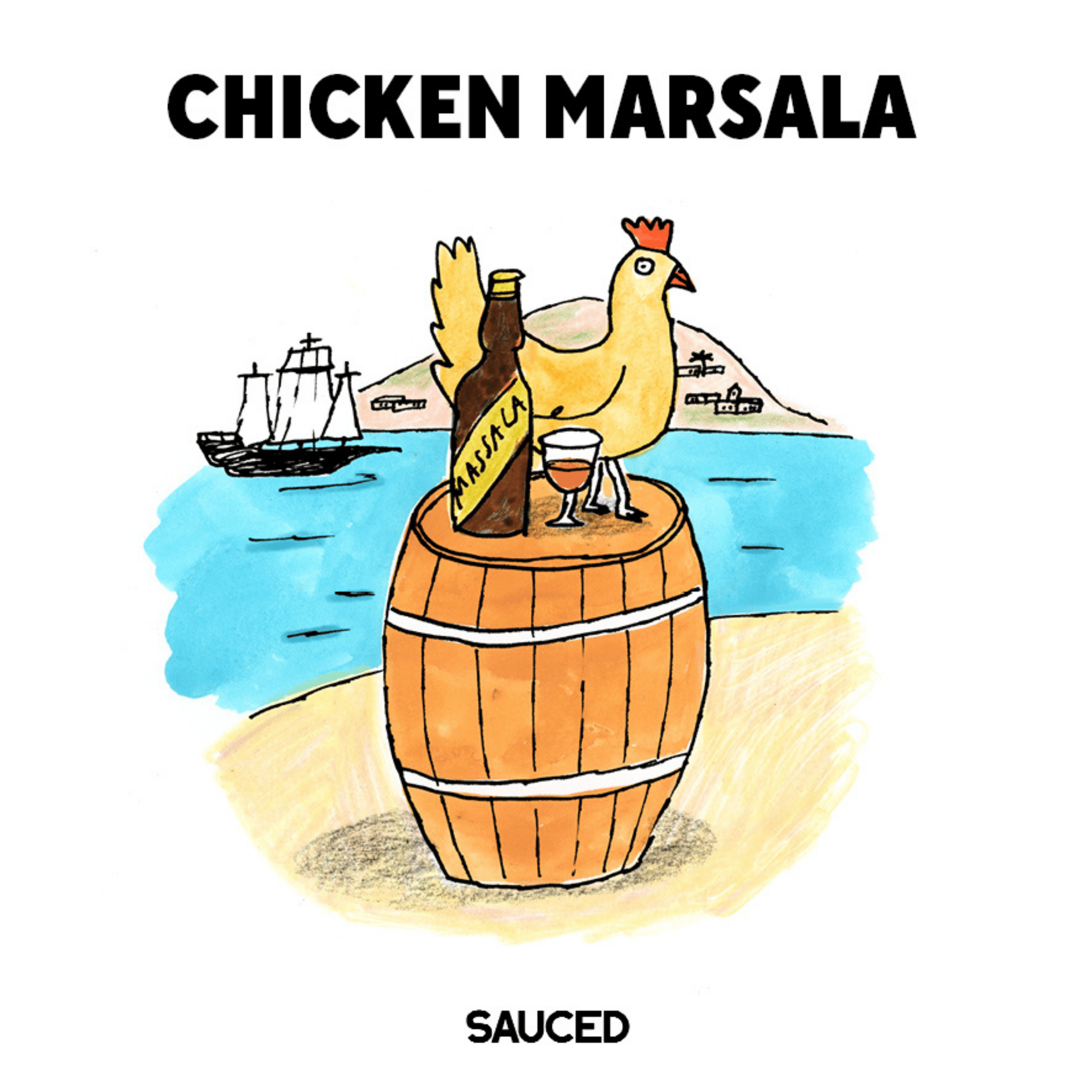
A storm forced an English merchant into a Sicilian port in 1773. The wine he discovered there ended up defining one of Italian America's most iconic dishes.
The story stretches from that shipwrecked merchant to the Italian American kitchens that gave Chicken Marsala its modern form. We unpack Marsala's DOC classifications, debate the myth of pounding chicken, and build a one-pan preparation with three types of mushrooms.
"One-pan wonder."
What we settled on:
Cut, don't pound — slice the breast into thin cutlets.
Three mushrooms: cremini, morels, and girolles — quartered, never sliced.
Bacon lardons render first and set the foundation.
Shallots before mushrooms. Always.
Dry Marsala only — Florio Superiore Secco.
Mount with creme fraiche and cold butter.
The Cocktail
Italian Margarita: 2 oz tequila, 1 oz amaretto, 3/4 oz lime juice, 3/4 oz orange juice, 1/4-1/2 oz agave syrup. Shaken, over fresh ice. No salted rim.
RECIPE CARD:
Premium subscriber? Check out the full recipe card here.
LISTEN
EpiSOde Partners
Thanks to the following brands for partnering with Sauced to bring you this episode:
TRANSCRIPT
Tim McKirdy: Sother — Is it an Ambra or Oro kind of day for you today, buddy?
Sother Teague: I think it's an Ambra kind of day. We got a little wintry mix out there.
TM: The classic wintry mix.
ST: Making me feel a little cozy. Let's stay in.
TM: It is definitely a beautiful day for cooking Chicken Marsala here. Just the conditions that we're recording in — not recording in the conditions outside. But Chicken Marsala, first thoughts. What's the first thing that comes to mind when someone brings up this dish or when you think about it for whatever reason?
ST: Olive Garden. I think it's the very first thing that comes to my mind. It's a dish that is, I would say, universally loved. And I would also say that it is not universally cooked at home. And I don't know why. I think the data proves out that the restaurants, especially the big chains that serve this dish, serve a lot of it. So it is a loved item, but why don't people make it at home? And I'm sitting here actually struggling to think — have I ever made it at home? And I definitely enjoy this dish. I really do. But I don't think I've ever made it at home. I don't think I've ever had a bottle of Marsala in my house. How about that?
TM: So I think that is the answer to all of those questions. Obviously, it's the through line of the dish, right? It's in the name, it's the booze that we're cooking with today. But yeah, I agree. I've seen your liquor collection — and not just liquor, I've seen your alcohol collection. I've got a similar one here as well, but I don't think I've ever had a bottle of Marsala around.
ST: Which is, I think, a shame. And it's also somewhat telling. Again, this is a dish that is ubiquitous — strong word, but it is out there. Even in the research for this episode, boy oh boy, there are plenty of articles. There are hundreds, maybe even into the thousands of videos that have all been viewed lots and lots of times. It exists. It's being ignored by the home cook, but there's interest by the home cook. All these articles and all these videos dictate that as well. I can't also recall a time that I was invited to someone's home where they were making Marsala. I've definitely been to restaurants where it's been on the menu. I've definitely been to events where it's in a chafing dish. It's a dish that's, again, beloved, but somehow overlooked. Let's maybe not even say ignored — it's just overlooked.
TM: What is the occasion that calls for a Chicken Marsala? When are you like, "You know what I'm craving this weekend is Marsala." I think you have to be in the moment and in the setting — a sort of classic Italian American restaurant. We're gonna make that distinction again as we have done recently. I think this is Italian American, right? You're there. It might be an Olive Garden or it might be a sort of red sauce New York joint. And you see it on the menu and you go, "When was the last time I had or made Chicken Marsala?" Yeah, I'll go with that. Or — and you said this off air beforehand — you might go past the chicken and go for the veal instead.
ST: Yeah, 'cause Marsala is the preparation. It can be chicken, it can be veal. I think I would probably lean towards the veal. But we're talking chicken today.
TM: We're talking chicken today. So that's our personal — no professional connection for me.
ST: Oh, I have one. I worked at a bistro — and bistro is probably an extremely strong word for the place I worked — when I was living in Durham, North Carolina. And there was a restaurant in Chapel Hill, which is where the university is there. It was called Spanky's. It was kind of like a college hangout, but sort of bistro in style and flavor. And we had a pasta dish of Chicken Marsala. But the pieces of chicken were cut into kind of bite-size. And we would sauté those with mushrooms and Marsala wine and then put it over pasta. But that's my only connection — and by the way, again, this is a long time ago. We served a lot of it. This is a dish that is loved. People enjoy it. But I think that's my last — maybe even at Spanky's was the last time I cooked it.
TM: Spanky's. Come on. Was this before or after you worked at Shuck 'em's?
ST: Way after. Spanky's had another sister restaurant called Squid's Oyster Bar. And the thing I loved about Squid's is that all of their logo stuff was just SOB.
TM: Oh my God. One of the things you say there, though, I wanna hone in on. And it is gonna fast forward us, but I'm happy for us to cover it here. You said you served it with pasta. Is there a universally agreed thing that you have this with?
ST: I don't think so. I think people's first instinct is pasta. And again, at Spanky's we were cutting the chicken into small pieces and sautéing it, so it was pasta ready. I like the cutlet to be bigger. So I would prefer this dish to either be on something as beautiful as some mashed potatoes, which we've talked about in our bonus episode. But what I really like this on is either just some really solid white stone ground grits, very Southern style, maybe with some Italian cheese folded into them, or just straight up polenta.
TM: Polenta. I thought you might be going there. And I'm totally with you on that as well. It's got the consistency of mash, but it's — I dunno — a little bit more exotic, or maybe I'm just saying that as someone who grew up in the U.K., so potatoes are such a staple. But polenta — okay, now we're getting a little bit fancy.
ST: Anything that's gonna be absorbent of the pan sauce slash gravy that we're making here — I could see this being over couscous or orzo, obviously rice. There's plenty of starchy options for this dish to shine by. But I think polenta for me would probably be the number one choice.
TM: The lack of just immediately going for pasta or there being a defined style and type of pasta that you would have with this — it does kind of lead us nicely into our origin story here.
ST: Oh, does it? 'Cause I have no clue where this dish came from. Did it come from the Olive Garden? Did I nail it from the beginning? Or The Macaroni Grill, which is like their competition.
TM: I think they came up with that one around the same time they started doing floats of amaretto with their Margarita. Have you had the Olive Garden Italian Margarita?
ST: I planned on talking about that later.
TM: Interesting. You know, I was once on a Margarita crawl in Times Square and the surrounding neighborhoods. And that was a highlight — the Olive Garden one for us.
ST: There's two known versions of what's commonly referred to as the Italian Margarita, and you just nailed one of them.
TM: So we are actually gonna head to Sicily where Marsala wine is native to. And I think there's kind of three acts to this story, as with all good stories. So we'll begin in Sicily in 1773. An English merchant named John Woodhouse — a storm forced him into the port of Marsala in Sicily. His ship, I believe it was called Elizabeth — I'm only saying that 'cause that's my sister's name, so that stuck out for me.
ST: Nice.
TM: And there he discovers Marsala, which at the time — so Marsala is a fortified wine from Sicily.
ST: Well, just for the listeners' edification, let's talk about what fortified wine is. Fortified wine is wine, first and foremost, that has been fortified with spirit — with alcohol — to do a few things. To elevate the ABV, which then buys a bit more shelf stability. That's the reason that it was put in there. It's almost like a stabilizer. But it also, of course, brings some flavor notes from whatever that spirit or alcohol is that you're adding into your wine.
TM: Although I think oftentimes that grape-based distillate — I think a lot of the time that is neutral alcohol.
ST: Yeah, a lot of the time. But as we discussed in the Penne alla Vodka episode, the higher proof alcohol is gonna do some extraction to the flavors that are already present in the wine and highlight them or accentuate them in some way or another. And we do consume a lot of fortified wines. There's obviously Marsala that we're talking about here. I think the number one consumed fortified wine is vermouth, which is an aromatized fortified wine. Then there's Sherry, Madeira, Port. There's plenty of them. So it's a category that I believe is pretty sorely misunderstood. But fortified wines are important to both our drinking culture and our cooking culture.
TM: One of the other benefits from fortifying the wine does mean that you can decide to stop fermentation of the base wine earlier than all the sugar has done its job converting into alcohol. Which leaves a residual sweetness there. And so adding that spirit — that higher ABV booze — is going to kill fermentation or stop it and keep the sweetness in there, which otherwise would continue to ferment. And if that happens in bottle, you get bubbles and all kinds of stuff. But 1773, when John Woodhouse arrives, they are not making the wine in this way. They're not fortifying it. They are introducing, or some folks are, aging the wine for a long time. It will have some of those oxidative notes that Mr. Woodhouse would've been very familiar with at the time from other, much more popular regions that had been popularized by the Brits, including your Sherries and your Ports and your Madeiras. So he discovers this wine and he says, "Look, there's gonna be a huge market for this back home because I already know that people back in Britain love this stuff." He knows that adding that fortification will allow it to last better and longer — taking it on a voyage to the U.K. and the British colonies. So he introduces that kind of production of it. The origin of Marsala and the Marsala that we know today owes everything to Sicily and a little bit to an English merchant. Its standing increases massively when Admiral Horatio Nelson —
ST: Is he the blind eye guy?
TM: I dunno. Was he blind?
ST: No. But do you know — this is completely off topic, this is not germane to the show at all — I think this is the same admiral who was blind in one eye and was in battle one time and was being signaled by his superior officer's ship to retreat from the battle, but he held his scope up to his blind eye and said, "I can't see the message." And went on to continue fighting and won the battle. And this is what's known as turning a blind eye. I think that's the guy.
TM: Very likely. I do not know, but that's incredible if true. If it is Nelson — but it's still a great origin of that phrase.
ST: Anyway — so wait, what I'm more fascinated by though, right at this moment, other than the blind eye thing, is this merchant was waylaid by inclement weather and then created this product. The wine existed, but it wasn't fortified. He fortified it for the long journey. As I said, it's a preservation method effectively. And then this became the standard of how this is made. So for who knows how long the people were making their wine and this guy came in and said, "Well, do it like this." And then they're globally popular.
TM: Well, and this speaks to the Brits of that era. There's another guy who comes after John Woodhouse — his name I'm forgetting, I think it's Oliver or something. He's from Leeds. And he sees the opportunity, or he sees that the seeds that John Woodhouse has planted, and he says this can be a major industry. So he moves there. And because there's no demand for it as well — this is cheaper than your Sherries and your Ports and whatnot. But stylistically very similar and some people might argue even more complex. So he goes there, he establishes an industry — there's a lot of British folks at the time who spend a lot of money developing the port of Marsala and basically getting an industry up and running. Then in 1833, we do have an Italian — a Sicilian, I believe — Vincenzo Florio, who kind of reclaims the wine from the English and brings it back to a sort of Sicilian-led industry. And in fact, that brand Florio is one of the most recognized Marsala brands.
ST: I knew it right away when you said it.
TM: And that date, 1833, I think is adorned largely on their bottles and stuff. So that is our act one there. And then just to try and rush through acts two and three — around this time, the Sicilians aren't making Chicken Marsala. In fact, there's not really — in the sort of mid-1800s, early 1900s — there are some instances of people cooking chicken with Marsala. Escoffier had one in his repertoire, but no one's doing it with the mushrooms, no one's adding bacon. We will get into that debate later. And so it's really only when Sicilian immigrants start arriving in the U.S. that we develop the modern preparation that we know today — where we have this sort of chicken breast pounded very thin, the addition of the mushrooms, the pan sauce, the deglazing, the fond, everything like that. So once again, I think this very much is a dish where you have the Brits kicking off the industry, utilizing Italian ingredients. It is being made with chicken throughout Europe and in various cuisines, but not until it arrives in America — not until immigrants bring it here — do we have the sort of modern version of all those videos that you've seen and those preparations of people making it today.
ST: There were so many videos — prolific. You type in "Chicken Marsala" to a search bar, and so much information is gonna pop up. But again, not codified. I would point out that you didn't touch on the fact that Marsala's been around for a long time, and Mr. Woodhouse sort of popularized it, but it finally got a DOC in Italy in 1969. It's a protected thing. Can't be Marsala if it's not from there, following all these rules. And then there's all the different levels.
TM: Should we get into those now? We don't need to get too deep into them.
ST: I don't think we need to go nuts. There are a few, and I think for the purposes of what we're doing, there's only one that's really appropriate for what we're gonna use it for.
TM: Interesting.
ST: Well, one, you talked a little bit with me while we were researching for this about how there's color.
TM: So there are three columns of classification. Column number one is color. And you're gonna have Ambra — gold, Oro — or ruby. Then you're gonna have three classifications of sweetness: dry, semi-sweet, sweet. And then you have your classifications of aging, ranging from Fine, which has been one year. Superiore is two years, and then there's one at four years plus — Superiore Riserva. And then you get into your higher sort of classifications. So color, sweetness, and age.
ST: Well, as far as age goes, I don't think we need anything past the Superiore. Which is two-year aged. And then I don't think we need to deal with semi-sweet or sweet. We need to deal with dry for cooking this dish. If I wanted to put some Marsala in a dessert dish, maybe the sweet would be the way to go.
TM: Is that zabaglione?
ST: Sure.
TM: It's on our list, folks. We don't know when we're gonna do it, but it's on the list.
ST: And then the color — I didn't even really know that that was a thing. I knew that the Ambra was the one. So Ambra, Superiore, dry is what I wanna use to make this dish.
TM: Actually, I think it's Oro, which is more often.
ST: Oh, is it the Oro? Is this my color blindness coming into play again?
TM: It's been 20 minutes, folks. It took us a little while to get there, but we have — break out your Bingo card. So this is actually a really interesting thing, one of the things that makes Marsala unique. Cooked grape must.
ST: Oh yeah.
TM: So we mentioned you can create a sweet fortified wine by killing fermentation. But what they do in Marsala — what some people do, and this gives it both color and sweetness — is they will take unfermented grape must, put it in a big copper kettle, and reduce it down. And they're doing massive quantities of this — reduce it down over the course of like 24 hours. So it's lost half of its volume, increased in sweetness, and they add that to the fortified wine. That gives it its color, but also gives it a sort of nutty sweetness. It's not just Brix we're talking about here, where we have that sweetness of grapes. And when you add that to the base wine, that's when you will take it from an Oro to an Ambra. But there's also — you can have Oros that do have some of the cotto added and Ambras that don't. But generally speaking, that's gonna give it color and sweetness and what makes it unique.
ST: And then just one final note. The way that these wines are then stored creates a bit of homogenization because they do what's effectively a solera system known as In Perpetuum — it is a solera. It's just the Italian version.
TM: I prefer to call it something else.
ST: What's that?
TM: In Porco Toum.
ST: In Porco Toum! And that's your Porco fun fact of the week.
TM: Porco obscure wine aging technique of the week. Nice. We mentioned earlier it's cold, it's rainy outside. If this were summer, what is the sister preparation? Actually, I don't think it has booze, but what is the sister preparation to Chicken Marsala?
ST: I don’t know?
TM: Piccata. And that's what — lemon butter, lemon, capers.
ST: So brighter. This is a little bit more —
TM: Moodier.
ST: You said pan sauce and I said gravy. This kind of does give a gravy vibe. Mushroom gravy on chicken with fortified wine.
TM: Is that gravy as in on a British Sunday roast, or —
ST: More close to the British Sunday roast than the Sunday gravy at the Italian — at Bamonte's here in Brooklyn. "Oh hey, gimme that gravy." Which has nothing to do with the gravy we eat in the Deep South. How did this word "gravy" even — we have to devote a whole side episode to gravy.
TM: Also, did I not have a Marsala dish when we went out to a very old school Italian American restaurant?
ST: Wait a minute, you did?
TM: I think it was veal though.
ST: You had veal Marsala when we went out.
TM: All I can remember is the distinct lack of salt. That was a shame.
ST: That was kind of across the board with the whole meal there, but we knew what we were signing up for. We went to a place because we wanted that pomp and circumstance of the Italian American — they bring over the raw vegetable plate on, literally floating in a bowl of ice, basically afraid to crunch on while you're perusing the far too large menu.
TM: Average age there was definitely about 75 years old — on a Friday night. Wonderful.
ST: Love it. We were children.
TM: Well, those are the origins. And that's some surprisingly good technical, deep wine knowledge from us here today. Not that often that we get to going that far.
ST: And again, I think it's because fortified wines at large are misunderstood. And I just wanna get people to understand what fortified wines are, because we do consume a lot of them. We just don't think about them very much. Again, overwhelmingly I think the one we consume the most is vermouth. But there are plenty of other fortified wines that we do consume, and I think it's a misunderstood category. So let's dive into it from time to time.
TM: And let's dive into our culinary luminaries and our culinary figures now. You alluded to this earlier — not a bunch of love or words and column inches from those people.
ST: Again, when I did internet searches and thumbing through books that I have at home — the books that I have are from heroes and luminaries of my own. And the internet, of course, is everybody. But again, tons of recipes pop up, tons of videos pop up. Absolutely tons. Kind of crickets from all of my sort of heroes that we talk about all the time. Nothing really from Jacques or Julia. Didn't even see anything from — I saw a video from Josh Weissman, I think, or maybe it was Babish. Only one of them had touched it, but they didn't have much to say about it. It doesn't seem to be — again, as popular as it is out there — getting any sort of love from the high hats.
TM: Didn't see Julia or Jacques going anywhere near it. And then you start to look at maybe more Italian-leaning chefs. So I looked at Lidia Bastianich.
ST: Did she have anything to say?
TM: Not too much. She focused very much on the mushroom stage — how to cook off that water and the order you should be doing things in the pan to get her gravy. And then I had Marcella Hazan. Is it Marcella or Marsella? I think it's Marcella.
ST: I think it's Marcella.
TM: Kind of like Italy's — she is to Italian cooking what Julia is to French cooking, here in America. She opts to use cream to soften the Marsala.
ST: Soften the Marsala. I think the Marsala is kind of softened just by cooking.
TM: And I think that was also her way of counteracting — 'cause she was like, dry Marsala only for this. But I think that's just what a lot of chefs do or opt for — the dry. Doesn't use mushrooms in her primary version either.
ST: No mushrooms?
TM: No. Or not definitely not cremini or button. I think she might have resoaked some dried porcini ones. But not a bunch there. The only other one, and this is not a name that I certainly knew — 1891, someone called Artusi. This is like one of the earliest recorded Italian versions of this dish. But it was basically just large pieces of chicken braised in the oven, and Marsala was added as a finishing touch. So this is kind of the ancestor to the dish, but that's 1891 and I think it's gonna take another sort of more than 150 years before anything like the modern version comes to be. So not really a lot on the luminary front.
ST: No. I did see a few dishes that were whole bird chopped into sort of fricassee style and braised in Marsala with mushrooms and other vegetables in the oven. But that's not what we're looking for here. We're looking for this more neoclassic Italian American version of this dish.
TM: This kind of is — and again, I don't love to go there because I don't want to immediately associate an entire culture with one of the darker aspects of their culture — but this dish, I'm thinking of Artie Bucco in The Sopranos, in his restaurant Vesuvio. There's one great scene where there's a storm and all the power is out and he sort of got the passion for cooking back and he's just cooking in one pan. And I definitely think of that, or it's a Carmela Soprano dish for me. But there's a lot of Italian American culture beyond that. Those have or have not been the luminaries. Now for the non-negotiables. What does this absolutely have to have for it to be considered a Chicken Marsala?
ST: Well, I'm gonna go crazy on a limb here and say chicken.
TM: Do you wanna go beyond that?
ST: Following that immediately is Marsala wine.
TM: On the chicken front — do you think that the butterflied, pounded breast is a non-negotiable?
ST: I don't. I was gonna talk about that when we talk about assembling the dish, but we can get into it real quick. I think that I don't know why that dish was ever pounded out thin. You're not trying to make a crispy schnitzel-style thing, which is why we pound out chicken for a chicken schnitzel. Because this dish is gonna get pan fried first, so it's got a little browning, and then it's gonna get sort of braised in the gravy. So there's no opportunity for crispness — it's gonna be literally bubbling in liquid, crispness goes out the window. So I prefer — but I still do like it thin, like a cutlet. A cutlet to me — get your Bingo card out — as a former butcher, a cutlet is exactly that. It is cut. So instead of taking your chicken breast and butterflying it into two thin pieces and then pounding those out, take your chicken breast and slice it into four thin pieces. Cut it — cutlet. And then forego the pounding. People say it's gonna yield a more even thickness for better cooking — again, it's chicken. We're gonna cook it all the way no matter what.
TM: So you're cutting that in that way pre-cooking.
ST: Yeah, of course. And just quickly — that's butchery. Once something is cooked, we carve.
TM: Ever been to a Toby's Carvery? It's an institution in the U.K.
ST: And then people say it's to tenderize — chicken is tender. I don't need to tenderize my chicken breast.
TM: Okay, a couple of follow up things then. If you're saying we're not pounding — I agree — can we also theorize maybe that this is like a parmigiana thing? Like someone dredged it, they pounded their chicken out — 'cause you're dredging it in flour. But you're not then going into egg yolk or breadcrumbs. I don't really understand. So maybe someone was doing that but they didn't do the other half of the technique — they just dredged it in flour and cooked it. 'Cause otherwise, to your point, I don't understand why you would do this. But if you're not gonna pound it, why do we need to go thin anyway? Why do you need to butcher it? Why can't that happen in the carving? Why can't we sear both sides of the breast and then finish it in that liquid? We could do that too. And then carve it nice and thin. That's what I thought you were going for.
ST: I could see that doing that as well. However, I do think that there's something to be said for the texture that you get from having it be thin, coated with the flour, and then in that enriched gravy slash pan sauce, when it's thin like that. But again, there was definitely a guy in one of the numerous videos who just left them whole.
TM: Can I take us in a different direction here? Why is it breast anyway? Why not go thigh? Why are we not doing this with chicken thigh?
ST: Oh my gosh. So much more forgiving.
TM: Pound a thigh. You can still do your dredge. It's gonna be juicier. There's more flavor to that meat. That's part one of two reasons why I think people are doing Marsala all wrong.
ST: All wrong! Wow. Do we continue on to part two or do you wanna have that pop up somewhere?
TM: Let's continue with the non-negotiables and I'll bring that up when it arises. So we're saying chicken, we're saying Marsala, we're saying thin chicken is our non-negotiable.
ST: Doesn't have to be breast. And I was gonna bring that up in building the thing. 'Cause more than 70% of the time, if I'm making a chicken dish, I'm gonna prefer the dark meat. Flour — you gotta have flour for this. Flour's gonna get a little browning, it's also gonna help with thickening the sauce itself. If you're gluten-free, let's use a gluten-free flour. Easy enough. Mushrooms I think are definitely a non-negotiable. Now, what type of mushroom? You got a lot of options here and I think most people go with cremini slash Baby Bella. 'Cause they're easy to get ahold of, they're pretty inexpensive, and they're reliable. But if I'm gonna make this dish, I'm probably reaching for something more punchy of flavor. And there's a reason I choose this specific mushroom — I'm gonna go for some morels. Because if we're gonna make this pan gravy, morels have all those little crags — they're gonna pick it up and hold onto it. It's like choosing the penne rigate for the Penne alla Vodka. So the sauce will hold on better. I think there needs to be some kind of onion here. It can be onion or shallot.
TM: I think you gotta go shallot just because, as we've spoken about before, it's a quick cooking dish. I think shallots here — and it's just finer, right?
ST: Well, and that's — the finer notion. The morels are a little bit finer. The shallots are a little bit finer. And then you're gonna need some fat. I think you need both oil and butter — some pretty decent olive oil and some butter.
TM: Fantastic.
ST: And that's it for non-negotiables. Again, we're tackling another dish, and I think a pattern is beginning to emerge this early in our run of Sauced — the bulk of the dishes that we are examining are low effort. This is not a long list of ingredients, and this is a super loved dish.
TM: If you're going to the store, chances are the only things you really need to buy are those shallots, your mushrooms, your chicken, and probably you're heading to a separate store to buy your bottle of Marsala. Everything else you probably should have on hand at home.
ST: Oh, we should have mentioned that before. Please head to a separate store to buy your Marsala. Do not buy the Marsala at the grocery store. The Marsala at the grocery store is categorized as cooking wine, and they are heavily salted.
TM: Why is that?
ST: I think it has something to do with liquor laws. They're selling you a wine that's effectively undrinkable on its own.
TM: And look, we always say it — don't cook with a wine that you wouldn't drink. But this one — let's not cook with a wine that is undrinkable.
ST: Please don't buy — you're gonna be sorely disappointed in the end result if you pick up the cooking wine version of Marsala at the grocery store. So head to the wine shop or the liquor store.
TM: Fantastic. I think that's a nice way to round out our non-negotiable ingredients and techniques as well. Another thing we've established many times — this is a pan sauce, a gravy. This has to be done in one pan.
ST: That's another appealing notion to this dish. It's a one pan wonder.
TM: One pan wonder. I like it. Very cool. Alright, we're gonna take another quick break now and then we're gonna be back with our slightly more negotiable ingredients and a little exploration there.
TM: Alright, we are back in the studio. Are there any — anything else to add about chicken here, or have we covered it all in the non-negotiables?
ST: I think we touched everything we need to touch as far as the chicken itself goes. There are some negotiables that pop up a lot and I bet the listener is already — the Italian American listeners are already screaming at the radio — because we didn't say cream, which I don't think is necessary in this dish. But if I was gonna use cream, I'd use crème fraîche. I'd put in a knob of crème fraîche at the end and sort of swirl it in.
TM: Beautiful.
ST: Swirl it in to emulsify. It's gonna bring a little bit more to the game than cream is gonna bring. A little tartness. I think I would use crème fraîche instead. We didn't mention any kind of salted meat — like bacon or pancetta or guanciale. I think I would add that. The morels — if I'm gonna use shallots, I wanna add another layer of opulence to this, again, pretty peasanty dish.
TM: It's interesting — so chicken, well, as is the case with a lot of things, it's basically just the vehicle for supporting everything else that's in the dish. You're not eating the chicken for the flavor.
ST: Chicken is live tofu. Especially chicken breast.
TM: I was wondering about this with the salted pork — 'cause we mentioned it for Bourguignon. I was like, is that too distracting from the beef? And beef has its flavor. So if we're talking about chicken having nothing — at what point is the chicken just not necessary?
ST: I mean, you could make this entire dish without chicken in it and use that as a sauce for maybe pasta or — delicious. Speaking of, one more negotiable. I only have three negotiables really listed here. We could probably go ad infinitum on what we could and could not add to this dish. But I think we're gonna have to have some herb presence. And overwhelmingly what I see on recipes that are available is parsley, which I love. But I think this dish is begging for sage. The nuttiness of the Marsala, the earthiness of mushrooms — let's get some sage in there.
TM: Where are you — are you finishing or are you cooking with sage?
ST: I'm gonna do a little bit of both. I'm going to have some that's finely minced that's gonna go in while I'm cooking the sauce. And then some that's maybe even fried and crispy that I can put on top of the dish at the end. I do love a crispy piece of fried sage.
TM: I love the idea of when we're starting to build that pan sauce, getting a bit of sage in there. A couple of leaves whole that are still attached by the stem, just sort of infusing the fat with it and getting that backbone of flavor there. That's how I like to cook bacon as well, just with a little bit of sage, especially if it's some back bacon. Fantastic. I want to return to mushrooms briefly. And part two of what I think people are doing all wrong with this dish.
ST: Oh yeah — let's get part two.
TM: Part two of you're doing it wrong. I'm not saying you can't cook. You could be a very good cook, but if you take the wrong approach — as you know, there's no wrong way.
ST: There's no wrong way, but there is a right way.
TM: So our mushrooms — I'm with you. I had cremini, morels — I love. And I want girolles as the third. Just those little individual ones — they take a little bit of effort to clean and they're gonna be expensive, you don't see 'em year round, they're not the easiest to come by, but it just gives a pop of color to the dish.
ST: Plus they're quite uniform. They look quite attractive.
TM: But the thing that I'm more passionate about is why is everyone slicing their mushrooms for this dish?
ST: This is a quarter or half.
TM: Quarter or half, right. Exactly.
ST: You want some texture. I think when you slice mushrooms, they can kind of disappear into the sauce.
TM: And much like our onions in our French Onion Soup, we're talking like 90% is water. You gotta cook all that out first. And if you're slicing them really thin, it's harder to get color. They just end up being sad in the dish. So quarter your mushrooms, three types of mushrooms minimum, and then I'll be happy. Do you go stock for your sauce as well?
ST: Oh yeah, absolutely. Of course. It can't just be the wine. Gotta have some stock in there. We missed that on the non-negotiables.
TM: And are you finishing monté au beurre?
ST: I am. That's why I said you need both oil and butter. 'Cause we're gonna need that butter to mount at the end, to pull the sauce together and enrich it and give it that shine.
TM: Anything else there in terms of the ingredients or technical considerations?
ST: I think we covered everything that's in the dish. One of the things we kind of always do mention — is this a prince or a pauper's dish? I think origins-wise it's for a pauper. But I think with the things that we are talking about adding — some salted pork product, using a finer mushroom or set of mushrooms, using a bit of crème fraîche instead of cream — those are elevating this dish. And again, I think of pauper's dishes as things that you make at home. And for whatever reason we don't make this at home. And we should. We're changing that today. Dear listener, you are going to go and buy a bottle of Marsala and make this dish.
TM: The only slight contention I would have with this being a pauper's dish is that I generally think of pauper's dishes as things born out of necessity. You're braising something for a long time 'cause you have the cheapest cut of meat. Or it's your bouillabaisse and you have this rockfish that no one else wants to buy. We are talking about the premium cut of chicken.
ST: But the whole bird is a pauper's bird.
TM: True. The other thing as well is I think this is a Frankenstein fabricated dish. This wasn't — it's evolved. And different countries and continents and centuries have had different things to add to it. But it's not like a classical, "Oh, the rooster's time's up, let's kill him and tenderize him in some red wine and let's get it done." You know what I mean? A dish that you and I would both like prepared for a prince. Fantastic. One final thing when it comes to ingredients. We mentioned it earlier, but worth repeating that name — Florio Superiore Secco. That's gonna be your widely available Marsala brand. If you have a more specialty liquor store or wine store, keep an eye out for Marco de Bartoli. Gonna be the gold standard. And I think interestingly, that is not labeled Marsala 'cause they don't fortify the wine. But their aging does eventually allow that wine to be bottled at 15 to 17%. But no fortification, therefore not technically a Marsala.
ST: Not technically a Marsala —
TM: The gold standard for Marsala. An Italian wine perfected by English — and it's not actually Marsala.
ST: I think another thing we didn't point out is Marsala is inexpensive. You're gonna pick up a bottle for 10 to $12.
TM: That Superiore might run you closer to 20, but still — in this economy. And the Marco de Bartoli is gonna be closer to 40, 50 bucks. But I actually haven't had it — by all accounts, it's supposed to be the gold standard, so check that one out. All right. We've made all of our major decisions. Time to bring it all together in one pan.
ST: One pan wonder.
TM: Kick it off for us.
ST: You're gonna need a side pan to remove the chicken too, but anyway — one pan. I mean, technically the Bourguignon is one pan, but we wrecked the kitchen making that stuff. We didn't really vote, but I think it needs some bacon. I want a bacon lardon because bacon and mushrooms are just peanut butter and jelly — this is a match made in heaven.
TM: Lovely.
ST: So I'm gonna have some bacon lardons that I'm gonna render first. I'm gonna pull those lardons out of the pan, and then I'm gonna have my sliced chicken that we described earlier that's been dredged in seasoned flour. I'm gonna brown the chicken on both sides in that bacon fat. Then I'm gonna remove those from the pan. Then I'm gonna go in with a bit of butter and oil — 'cause most of that bacon fat will have been absorbed by the flour on the chicken. So I'm gonna go in with just a little bit of butter and oil with my minced shallots, and cook that until fragrant and slightly sweated out. Then I'm gonna add my mushrooms — again, I'm gonna use for sure morels. And if you can't find fresh morels, dried morels are great too. You just gotta rehydrate them first.
TM: Will you allow us to go with the three mushrooms?
ST: A hundred percent. Let's use all three. The girolles and the cremini — cremini, we're gonna either quarter or half, depending on their size. Some could be one or the other. The girolles, you leave alone as they are because they're beautiful and they have a really uniform size — they're cartoonish almost. So I'm gonna add in all my mushrooms. I'm gonna get some caramelization with a healthy pinch of salt at this point — that'll help pull some moisture out of the mushrooms. I'm gonna get some caramelization on the mushrooms themselves and get them cooked. Then I'm gonna hit the pan with the Marsala to deglaze — get all the fond off the bottom that's built up from the bacon, from the chicken, from the mushrooms. I'm gonna reduce that Marsala down till basically sec, which means getting back to dry. Then I'm going in with our chicken stock, maybe a roasted chicken stock if you're feeling fancy. Oh — well, one step back. On the mushrooms as they're getting down, then I'm gonna hit it with some sage. Then I'm gonna deglaze with the Marsala and reduce that down with the mushrooms, sage, shallot situation. Then going in with the stock, I'm gonna reduce that down by about half. And then I'm going to put my chicken cutlets back in along with the bacon. Let that simmer for a bit. And then I'm gonna mount with some crème fraîche — to bring that little bit of creaminess. Not a lot. Even when people make it with cream, they don't use a lot. But I'm gonna up the ante and use crème fraîche instead of cream. I don't need a lot — like when I say a knob, for one chicken breast cut into four pieces, we're talking maybe like a tablespoon just to kind of mount it a little. And I'm gonna mount it with a bit of butter 'cause that'll give it a sheen and pull it together. And then it's time to serve.
TM: Beautiful.
ST: And this whole process, by the way, I'm talking from coming in the door with your groceries in your bag to sitting down to this part of the dish — if you're gonna make anything else to go with it, obviously there's other steps. But just to make this from grocery bags to on a plate, you could do this in 45 minutes. If you're pretty efficient and speedy in the kitchen, we can cut that to 30. This is not a lengthy — again, there's so many arguments for why we should be making this dish at home and kind of nobody is.
TM: That's why I would also go with polenta on this side as well. Rather than going through the rigmarole of making mash and whatnot. Not that it's gonna take too much longer, but polenta is easier and that's gonna be on the side there and I can keep my eye on it while I've got my pan going. A few follow up things and some things that maybe we missed or didn't discuss. Mushrooms — I was thinking specifically about our girolles. Like you said, you don't need to cut them at all, but you will need to clean them. And that's very much gonna be like the preparation we had for mussels — getting them in ice cold water, letting them sit there, letting the dirt fall off. And I think you need to lift them out of the water rather than pouring it. And you will need to do that four or five, maybe sometimes even six times to properly clean these things. I think it's been proven that the whole idea of don't leave your mushrooms in water for too long is just a myth. Doesn't matter. These things are already 90% water.
ST: Plus I'm gonna cook it out anyway.
TM: You're gonna cook it out anyway. Okay, so we're on the same page there. I like where you went as well, because in almost all of the videos I saw of people making this dish, they went chicken, then mushrooms, then added their shallots and garlic. And I'm like, no — it's always the shallots first.
ST: Onions start everything.
TM: But did you encounter that a lot as well?
ST: I did. But the way I cook, the way I think one is to cook — onions start everything. Your alliums, all of them. If you're using leeks and onions and shallots, those go in kind of first.
TM: Like that's our sort of European cuisine. Or like you mentioned before, Latin America has sofrito, Italians have bomba.
ST: The bomba. The flavor bomb.
TM: But that should always come first. And again, if your worry is "Well, I can't get enough color on the mushrooms" — it's 'cause either the heat isn't high enough, you're not cooking them long enough, or don't be fidgeting around in that pan. Don't be scraping it around. I know it looks cool — you wanna feel like you're Jamie Oliver or Gordon Ramsay or Julia Child. But leave the pan. Let it get the color.
ST: The instinct to move things around in a pan is a hard one to ignore. But the bottom line is if you want that caramelization and that color, that's what you have to do.
TM: My Maillard reaction, folks.
ST: And you gotta cook that water out to make that happen. So it doesn't matter if they've been soaked in water to clean — the mushrooms, you're gonna cook it off.
TM: Fantastic. Well, I'm happy with our preparation there.
ST: Me too. I'm hungry.
TM: I'm hungry. I'm getting thirsty as well.
ST: Let's have a drink.
TM: This is the pairing section. Where does your mind go to immediately?
ST: I mean, I think your mind goes immediately to wine as it always does. My mind always goes to a cocktail. And you sort of let the cat out of the bag earlier in the show. I think the cocktail that you find at the Olive Garden, which is known as the Italian Margarita, is the right fit for this dish.
TM: Really?
ST: Yeah, because — so let's talk about what the Italian Margarita is. It is tequila. It is lime juice. It is orange juice instead of triple sec. A bit of agave syrup. And then amaretto, which is very nutty in flavor. And the Marsala combined with the mushrooms, combined with the caramelization, all hit on this nutty note — this oxidized, nutty quality that I think goes — I've said it before when pairing — you either wanna go right at something or kind of against it, and I think this one goes right at it. There is a secondary version of the Italian Margarita that doesn't have the amaretto in it, but replaces the triple sec with limoncello. And I don't think that this would be a terrible option either. This one would do the opposite — it would go away from it, be a little bit more tart. But I think this dish asks for — if you're gonna have a cocktail, it needs to have a sweeter note.
TM: Maybe I'll do the limoncello version when I'm having piccata. And I'll do the amaretto version when I'm having Marsala.
ST: Pretty standard Margarita-style volume. Let's go with two ounces of tequila up against an ounce of amaretto. Three quarters of an ounce of lime juice, three quarters of an ounce of orange juice. And depending on how sweet your orange juice is, please taste and then go in with a quarter to a half of agave syrup just to bring some body. Give that a good shake and serve it over fresh ice. I don't think you need a salted rim on this guy. But I think you'll be pleasantly surprised with this cocktail.
TM: Nice.
ST: Well, you know, there are a lot of cocktails out there that I think get poo-pooed out of hand. There was a great article recently that quoted our good friend and certainly luminary in the cocktail world, Dave Wondrich, about the Long Island Iced Tea and how he enjoys them. And they're pretty complex. And I chimed in immediately and was like, if I'm on a beach somewhere, I'm drinking a Long Island. I'm not the type of bartender slash mixologist that's gonna look down my nose on a drink that is arguably delicious. So anyway, this is an arguably delicious drink — the Italian Margarita.
TM: And it'll bring balance to the dish as well with that sweetness. I really like it. I'm gonna stick to wine then — I'm gonna focus on wine here. First of all, 'cause I don't make this dish very often, I am gonna spend a little bit more. It's probably still gonna be a Superiore, but I'm gonna spend a little bit more on a nice Marsala. I'm gonna get a recommendation from my wine merchant.
ST: Well, you may as well make it a one-two punch. If you're gonna buy the cheapest one that is passively drinkable just to use in making the dish, then you're probably gonna have a bottle of wine sitting around for a while that you're not touching. Whereas if you buy a bottle that you would enjoy drinking, you'll make the dish with some of it and then you'll drink the rest.
TM: Exactly. And I'm gonna be enjoying that while I'm making the dish. Sort of get that appetite going. Especially if it's a drier seco that we want.
ST: Oh, and by the way, I am 1,000% drinking some of this while I'm making the dish. Again, it's only gonna take 30 minutes. A little nip of wine. I'm gonna have a two, two and a half ounce pour that I'm just sipping on while I'm making the dish.
TM: For sure. Delicious. Then with the dish, I'm gonna stay in Sicily. If I wanna go white, I'm looking for the Grillo grape. Which is also most commonly — there's a bunch of different grapes that are allowed, but I think it's the most common one for the production of Marsala. But I'm actually gonna go red and I'm gonna go Nero d'Avola. Again, staying in Sicily. Medium body — it's not gonna be too heavy for this dish. Soft tannins as well. I think the tannins could really compete with the sort of velvety, rich, creamy nature of the dish, even if there's no cream in there. And some dark fruit. If I want to be more earthy, I'll instead turn to an Etna Rosso — another fine Sicilian wine. But yeah, I think just keep it Sicilian.
ST: Grows together, goes together.
TM: And I do wonder whether this is also a dish where I might be tempted, if I had one on hand, to go for a Belgian beer. Like a dubbel — the malt sweetness that you get from that. I think that could be quite nice. I can see some kind of synthesis between all those different flavors.
ST: I would opt for that beer if I replaced the polenta with either polenta fries or just fries.
TM: French fries for this would be awesome.
ST: Because disco fries are basically fries with gravy. This is basically a mushroom gravy on chicken. And we could have fries underneath it and have this sort of disco Marsala.
TM: After we've had our Penne alla Vodka party, we're going disco fries. Well, any final thoughts from yourself today? What are people missing out on if they never make this dish?
ST: Man, I think it's a dish that — you're going to enjoy it. If someone serves this to you, you're gonna eat it, enjoy it. If you make it yourself, you're gonna feel a little bit more fulfilled that you made it yourself, and you're gonna enjoy it. And you're gonna then serve it to someone and they're gonna enjoy it. There's just a lot of enjoyment in this dish. Even though there's some misunderstood ingredients — the Marsala itself — even though there's maybe some approaches like pounding the chicken, I think is unnecessary. There are some parts of it that are weirdly mysterious, but it's not a code that can't be cracked. And I think you and I are gonna make it over the weekend for sure. But I think you have to make this dish. Go out, listener, and buy yourself some Marsala and make this dish.
TM: Couldn't be more in agreement there. I think my lingering thought when it comes to this is just once again that idea of the evolution — that there's no real — that this is kind of stitched together throughout history. A Sicilian wine, British merchants, the British Navy, Italian American immigrants, the American kitchen. All these constituent parts that sort of come together for something that belongs to neither and all. So a fun one. And also just, on a rainy wintry mix day — something to warm the soul. Chicken Marsala. Let's have it. Alright, time to put on the apron —
ST: And pull out the shaker —
TM: And let's get cooking —
ST: And drinking.
TM: Cheers, buddy.
ST: Cheers, pal.