Episode 11:
CHILI
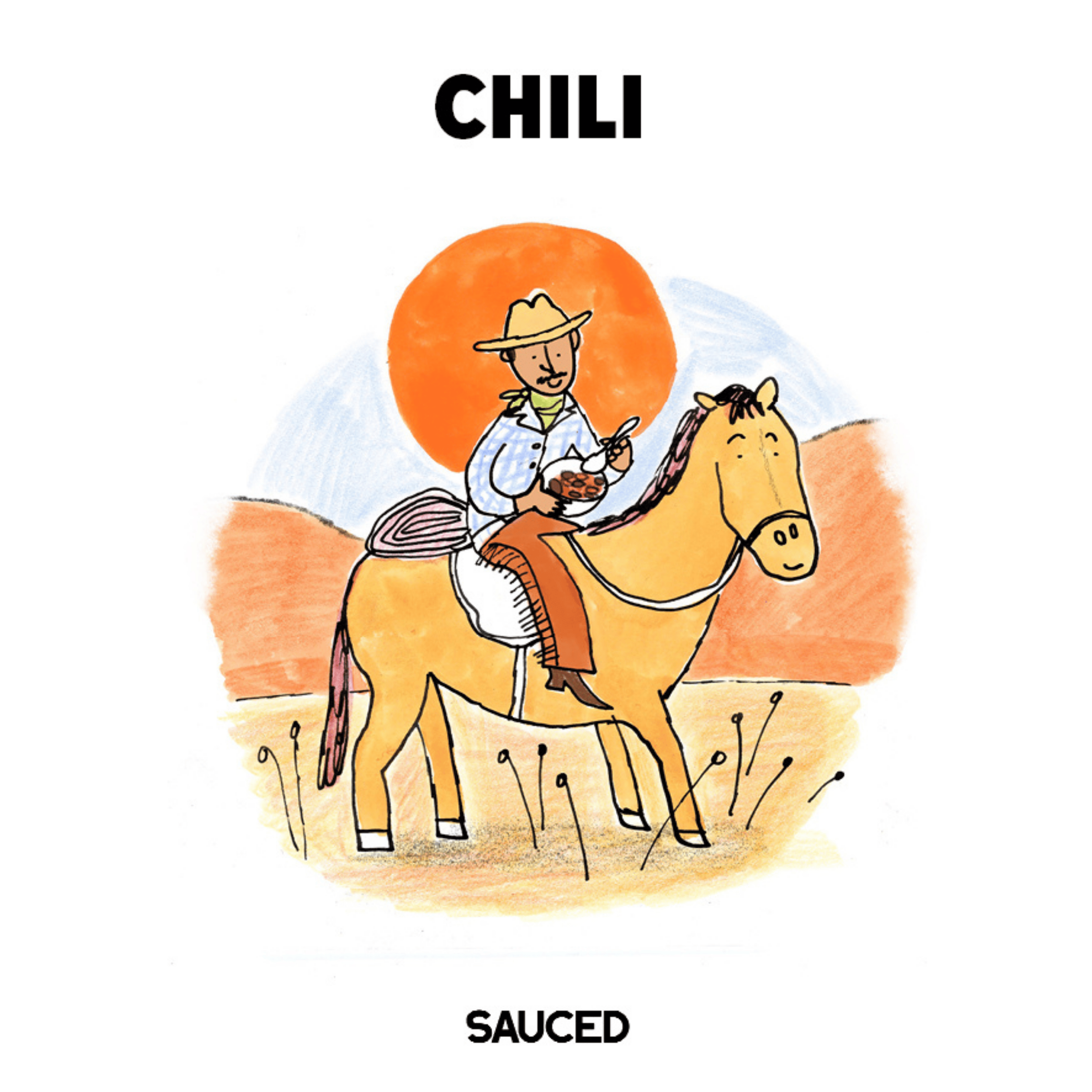
There are Chili competitions — and there are Chili opinions. One bean and you're disqualified. One wrong take and you'll hear about it.
We trace Chili from the Chili Queens of San Antonio's Military Plaza through Gebhardt's chili powder revolution and the legendary Terlingua cookoff. Along the way, we build a five-dried-chile sofrito, settle the beef question (ground, 80/20, browned as one giant patty), and make the case for beer in the pot.
"Addictions to it are formed early in life and the victims never recover."
What we settled on:
Five dried chiles for the sofrito — ancho, pasilla, guajillo, chipotle, arbol — plus roasted red bell peppers
Two-dump spice method: bloom half in rendered fat, add the rest mid-cook
Tomato paste only — no crushed tomatoes
Beer (Modelo Negra or bock) for dark, malty depth
Masa harina finish for body and sheen
Pauper all the way — trying to make the prince's version only makes it worse
The Cocktail
La Cerveza de Los Reyes: blanco tequila, fresh lime, and hot sauce stretched with beer in a spice-rimmed Collins glass.
RECIPE CARD:
Premium subscriber? Check out the full recipe card here.
LISTEN
EpiSOde Partners
Thanks to the following brands for partnering with Sauced to bring you this episode:
TRANSCRIPT
Tim McKirdy: Beans or no beans, tomatoes or no tomatoes, cubed or ground. This is arguably the most contested — figuratively and literally speaking — dish we have done to date. It is Chili. Chili con carne, no less. And therein lies some of the contested nature of this.
Sother Teague: So what do we have here? This is a spicy — definitely gonna be spicy, chilies are in the name — it's a spicy stew of Mexican origin containing chili peppers. Both dry and fresh, often both. It's got meat, obviously. It's almost always beef, but that is up for debate as well. It often but not always has tomatoes, and sadly for me, apparently sometimes has beans. Although I won't say "not if it's yours," I'll say never.
TM: What really stands out about this dish being notable for me is that it's one of those where you have the origin, and then you have this path that goes away from the origin. You have folks like yourself who are purists, and then you have this mainstream identity, literally to the point where you can get versions of this prepared and served in cans that you just heat up.
ST: There's a big bean brand that sponsors the big Chili cookoff every year. That's how they did it. Corporate has ruined your Chili.
TM: Well, let's talk about that. Let's talk about why this is something that you feel so strongly about, because I knew that coming into this. And I know, having grown up in the Deep South — this dish means a lot to you. And I know just as a chef anyway. What is it about yourself — are there folks that make you feel so passionately about the lack of beans?
ST: I think it just deviates from the norm. And I always kind of rely back on the organizations that lay some sort of grip over some of the dishes that we talk about — not necessarily even on the show, I just mean in general. And the organization that oversees the biggest, most prestigious Chili competitions literally states in their rules: no beans.
TM: And I think that then is the standard bearer. So that has stuck with me. We talk about it from time to time — I'm a little bit pedantic. I certainly have more rules than I ever knew that I had about food, and they keep showing up. They're often arbitrary.
ST: They're often arbitrary. I think this one isn't. But at its purest base, Tim, we can certainly understand that food is arbitrary. People are out there making Rockefeller pizza. I made a French Onion Soup grilled cheese sandwich. We can take these ingredients and bend them to our will.
For me, Chili con carne is chilies and meat. When people ask me what I put in my Chili, I say, well, it's right there in the name — chilies and meat.
TM: So you're happy with the con carne designation in the name? Because some folks are like, that's redundant.
ST: It's just Chili. In my notes here I have Chili con carne, but it's just Chili. Chili is made mostly of chilies. Chili is a salsa that got stretched into a stew, in a lot of ways. And it is an evolution of a preparation and a cooking technique that shows up in basically every cuisine around the world. Braised protein plus base flavoring sauce and water — this is classic throughout the world.
TM: Where I struggle to align with or fully understand the no beans argument, just personally —
ST: Listen, I love beans. You've been to my house. There's almost no time when I don't have some beans in my fridge that I've cooked from dry. I cook dry beans almost every week of the year. There's beans in my house right now.
TM: So often this Chili is being served with a side of beans. Chili is served with a side of rice. I was curious to get your take on that.
ST: I like it with nothing. Maybe some tortilla chips. Because again, it's basically — I think about it like this, and I'm only thinking this now, so forgive me if I don't sound rehearsed. Beans are somehow in my mind, once they're added, they're saying I didn't have enough meat. And so they're somewhat of a pretender.
When I was a young chef coming up and got to be around caviar for any substantial amount of time, one of my chefs who was very posh and quite French talked to me about caviar. And I mentioned to him, why don't we serve it with the hard-boiled egg whites and the hard-boiled egg yolks and the onions? And he said to me, those are the pretenders. Those are the things you have with your caviar when you don't have great caviar. So in my mind, the beans in the Chili — it's a pretender.
And if we were to ask a different question: what are the beans bringing to the dish when you're including them?
TM: I think a lot of people making them, people who make them like that because they think that's tradition or that's what the dish is, they would struggle to answer that. Why are they needed in here? To your point, if there's enough meat in there, if the meat's well seasoned, if you have a thick enough sauce. I get it. But I will contend that there are restaurants in Texas — not only Texas, throughout the country — where they are doing Texas-style Chili without beans in the dish. And you can get beans as a side. And to me that is just weird. Like, hi, I would like two slices of bread please. Then on a separate plate, I'm gonna get two tablespoons of butter. Then on a different plate, I would like three slices of ham and some lettuce and some tomato. Oh, so you'd like a sandwich? Yeah, no, but I want them on separate plates. Bring it all together.
I wanna get into the Chili con carne and that name, because I think the name and the etymology is the through line of this. But before we do that — I mentioned the South, and I know this is a dish that means a lot to you. Can you tell me about that? How this has become so beloved for you?
ST: I'm not exactly sure, to be honest. I grew up on the beach, so we ate mostly seafood when I was young, just out of proximity really. We would go fishing, we would fish for things that we enjoyed, but then we would trade that fish with other families around for things that they gathered, like crawfish. We'd go scalloping in the bay. I would say 90% of my youthful memories of food revolve around seafood.
And I think now that I'm saying it out loud, that maybe explains it. When we would have Chili, it would be this thing that we got to have. My dad would labor over it and the house would smell so amazing and it would be meat, which was uncommon in our house. So I think maybe that's where my love of it comes from.
And then there's a process — and we've spoken about it numerous times — the thing I enjoy the most about cooking beyond the eating is I like the process. And there's many, many pieces to the process here.
TM: And so many different directions you can take, even if you have one take on what Chili is. If you understand the destination, there are multiple routes you can choose to get there.
ST: Well, in doing the research for this episode, what I discovered mostly is it's not codified in any way. I mentioned that the ICS has their rules, and if you want, indulge me for one second, I'll read you real quickly what it says on their website about traditional Chili.
Traditional Chili is any kind of meat or combination of meats cooked with red chili peppers — specifically red — various spices and other ingredients. Beans and non-vegetable fillers such as rice and pasta are not allowed. Preference is not given to either cut meat, ground meat, shredded meat, or cubed meat.
And that is basically the outline that they give their contestants. Then they have a green chili version, they have a homestyle which can involve beans and things like that. But when you just boil it down to that descriptor of what can be in there, that leaves it open to many, many interpretations.
And I think that is its ultimate — it's a pretty blank canvas as far as things go. It's kind of what I call F and F. It's fascinating and frustrating. You can either be fascinated by the fact that there's kind of no real answer, or you can be frustrated by the fact that there's no real answer. And I choose — if we keep beans out of the conversation — I choose to be fascinated, which is the hint of potential for frustration with a little bit of malice.
TM: So the ICS — that is the International Chili Society. One of two major organizations that have tried to codify and definitely do competitions. The other would be CASI — that's the Chili Appreciation Society International. I love that they're both international. It's kind of like when we play the World Series here in America — you are the champions of the world of a sport that only one nation competes in. Congratulations.
We're gonna get back to those organizations in a little bit, but I'll say this from a professional perspective. You might be surprised to learn that I have worked somewhere where we had Chili on the menu.
ST: Oh, I never did.
TM: And into that etymological word debate — it was Chili con veggies. It was a mushroom Chili. It was one of our biggest sellers. This was at the Grain Store, a second restaurant I worked in in London that was vegetable focused and forward. It wasn't vegetarian by any means, but most of the dishes were heavy veg, maybe a little bit protein. Anyway, it was a French chef heading up a London restaurant recreating a Mexican-inspired, Tex-Mex dish — and I'm gonna create that distinction there because I think this — with a line cook from Scotland. We had line cooks from Estonia, we had a former Sherpa working in our kitchen.
ST: The international colors of Benetton Chili, vegetarian version.
TM: But I wanna hone back in on that text. I wanna get to our origins here, because I think as we've established in many shows, cooking beef with chilies or a vegetable base is in practically all cultures. So you can argue about how this came to be and where it came from with different immigrants. I just wanna start our story today in the 1860s, in San Antonio, and this wonderful group of women called the Chili Queens of San Antonio.
This is where I think we should start our story, because this is where we start seeing Chili in the way that we're talking about, and where the language debate comes in. These are women vendors of San Antonio's Military Plaza. Each evening in that square, they would set up stands, kind of like tables, and they would bring their chilies that they had cooked at home in big pots. They would build fires and keep them warm and they would sell them from wagons and on these tables for 10 cents a bowl, which I believe included bread and water.
And we're talking between the 1860s and the 1890s here. Your crowds at the time were mixtures of soldiers, tourists, cattlemen. Hard to say whether the official language would've been English or Spanish — probably both, but very heavily Mexican influenced. And originally, the dish they served was that carne con chile.
ST: Oh.
TM: It was beef cooked down with fresh and or dried chilies, fat, and water. And that was it. That was the dish they would serve to all those folks. Traveling folks.
So it was carne con chile, and it was later anglicized by visiting people. Partly because they knew this dish — and we'll get into that. But just this idea that I think the moment that carne con chile turns into Chili con carne is where we're talking about the beginning of this dish that we know in the modern preparation and the heated arguments that surround it. Heated — no pun intended.
So the Chili Queens of San Antonio — was that something you were familiar with?
ST: Not at all. But I love that right there in their name — Chili Queens. They weren't here for the meat, they were here for the chilies. So they called it carne con chile? Meat with chili? Wait, that's backwards. Carne con chile — meat with chili. So then they should have been the meat queens.
TM: No, because anyone can make meat. But not the way these folks are with chili, I guess.
ST: That's cool. Great that it started in San Antonio, which effectively in the 1840s was still northern Mexico. And Anglicization happens all the time. The gringos took it over and tried to make it their own, and we're still trying. And I think that's the point at which it becomes Tex-Mex.
TM: So then 1893, the Chicago World's Fair. The Chili Queens of San Antonio — their fame became so great and people embraced this dish so much that they set up a San Antonio Chili stand at the World's Fair. And that was the moment that Chili goes national. And that's probably the moment as well where you start to see that Anglicization. People after that, if they happen to be in the area, if they're making a pilgrimage there to try these dishes — it becomes Chili con carne.
ST: And this is probably also when it starts to become changed. Because when food leaves its home, it changes. When food leaves its place of origin and goes somewhere that people decide they like it and want to recreate it, they recreate it with whatever they have on hand, not necessarily what was close by in the place of origin.
TM: And if we press pause on the story — this probably allows us to go, like, without that World's Fair moment, potentially you don't get all these other crazy types of Chili that are made in different parts of this country. Can you get into some of them for us here? Because I know for sure our British listeners won't be familiar with them, but I'm sure a lot of our American listeners won't be familiar with some of the weird and wacky regional Chili styles that are out there.
ST: You mean like Cincinnati five-way? They serve it over spaghetti pasta, with cinnamon. Well, I put cinnamon in mine — fair. I love cinnamon. Here's why I put cinnamon in mine: Chili is spicy, and though the typical consumer, if you told them something had cinnamon in it, they would probably think it was sweet. Cinnamon is not sweet. In fact, it is quite spicy on your tongue. But it also brings a little bit of earthy baking-spice notes. I just throw in a couple of sticks. I don't crush them up or anything, and then I fish them out later. It just adds an extra layer.
There's also the hot dog Chili, which is kind of the same but different — it's more like a sauce than a stew. And then there's some places — is it Arizona? Definitely in the Southwest — where people will ask you, is it red or green? The ICS recognizes that. Red Chili is always made with red chilies, but it's also got a lot of chili powders, not just fresh or dried chilies. Whereas green Chili is almost exclusively fresh green chilies. It's like when you make your tomatillo salsa — tomatillos and onions and lots of chilies, you roast them off and puree them, and you're kind of done. Add meat to that, you'd have a green Chili. More fresh and bright.
Just like when I make my two hot sauces — they're both mezcal, pineapple, and habanero, but one is fresh habanero. It's brighter, a little more floral. Dash away, have a good time — it is spicy, but dash away. The other is made with dried habaneros. It is dark, brooding, and extremely fiery. Use some drops and use them with caution. That's kind of the difference when you think of red and green Chili — one's gonna be brighter and more floral and tart, whereas the reds are darker and more spicy.
TM: Nice. So that red or green decision — both are maintaining the soul of this dish. But serving over spaghetti, adding all kinds of other stuff.
ST: I mean, we also serve Chili over fries, a Chili dog, a Chili burger. I love it.
TM: Chili dogs are great. So I think we can agree — if this starts out with the Chili Queens of San Antonio selling it for 10 cents a bowl — this is a pauper dish.
ST: I wasn't even gonna question that one. On this particular dish, it's made with what's around, it's made with cheap items. It's largely minimalist. It's kind of ugly. Chili's not an attractive dish. If you made it right, it should look kind of ugly. A bowl of red.
TM: I would even go so far as to say that this is the only dish that we've covered so far on this show where I don't even want to think about or be served what might be the prince's interpretation. I think trying to make the prince's version only makes this dish worse.
Where would we even go with that? What is the refined version of chilies and meat? I mean, you could go — like we said with our Bourguignon — cheeks and short ribs, pay a bit more on the meat. But you're still braising and slow cooking. That's still pauper cooking for me.
ST: Me too. I would like to point out — do you know how chilies have gotten spread all over the world?
TM: No.
ST: Chili peppers themselves are a flowering plant. And they're generally pretty brightly colored, so they are quite attractive to birds. Birds eat the chilies and fly away and evacuate the seeds, and the seeds propagate wherever they land. Why do birds eat so many spicy chilies? Birds don't have taste buds. Other animals don't eat the chilies — the birds do, because the birds don't notice the taste. That's why birds will eat worms — they don't have taste buds.
TM: To be fair, I've never eaten a worm to know whether it's tasty.
ST: But I've eaten worms. I have.
TM: Knocking around in the sandbox, six years old.
ST: Well, I've eaten grubs and stuff. Listen, if people eat it, I'll eat it. The dried worms that you get in Mexico — phenomenal, with some mezcal.
TM: Okay. So those are our Chili Queens. That's our prince or pauper debate. I wanna bring up the next point — bowl of red, Chili powder. This is what I like to think of as the great democratization of Chili.
ST: I know where you're going.
TM: William Gebhardt. Born in Germany in 1875, he immigrated to the U.S. in 1883 — so 10 years before the great Chicago World's Fair. He settled in New Braunfels, Texas. I think that actually — that's a lie. That is where we're heading later in the episode. New Braunfels is close to San Antonio. I think it's northeast. But you can check that up, folks — it's called Google Maps. He opened a cafe in the back of a saloon at the age of 17 years old, which, you know, people were doing these jobs earlier back then.
ST: Because you died earlier. If you're only gonna live to be 40, at 17 he's middle-aged.
TM: Already got a couple of kids. Like our good friend the waiter who invented Crêpes Suzette.
ST: If you're not a success by 17, you're a failure.
TM: So at this time, Chili's being made with fresh chilies. Dried chilies, the ones we encounter very regularly in the grocery store these days — those would help preserve it, but they're not gonna last forever. And they took up a decent amount of space. So he created and starts selling Gebhardt's Eagle Brand Chili Powder in 1896. He opened a factory in San Antonio two years later. And within 20 years this guy was doing about a million bucks a year in profit.
ST: A million dollars at that time? Wow.
TM: This thing took off.
ST: My guy's a Chili baron, a proper Chili baron.
TM: But he creates a powder, which means you can travel far with this, it doesn't take up a lot of space, a little goes a long way. And generally that's how you're gonna use it anyway. I don't know how he was the first genius to say, I'm already carrying around these dried chilies that I'm going to pulverize for my meal — why not go ahead and pulverize them now?
ST: It's true. Doing the work before people. There are a lot of inventions out there that drive me crazy, that took so long to make. In my grandmother's house in the South, the sink in her bathroom was original to the build. So it had two faucets — a cold and a hot. And it's like, no one thought right away these should just come out of the same tube? That way we can kind of blend them. So no one thought to pulverize the chilies, even though that's pretty much the only way a dried chili can be used.
TM: Maybe a little like the process of rehydration and turning it into a paste. The point being that you have Chili powder being made. But prior to this as well, the army that was operating out there in the desert — they would get these Chili con carne packs, where it's dried meat, fat, and chilies all pressed together. Slice off a brick, cut it into cubes, and just add it to water. Kind of like astronaut food.
So William Gebhardt and Eagle Brand Chili Powder — still available. I think it's interesting to note that the guy came over from Germany.
ST: There's a huge German influence in Texas, and that'll rear its head when we get to my ingredients list.
TM: And New Braunfels in particular, I believe there's a deep German immigrant history there. My final stop on our history tour today — we're staying in Texas. Terlingua, Texas.
Between the years of 1966 and 1967, a bit of a feud happens. I think you're familiar with this, so pick up at any point, but I'll set the foundation. Frank X. Tolbert is a Dallas newspaper columnist and Chili evangelist who'd published a book called A Bowl of Red in 1966. H. Allen Smith, a New Yorker raised in the Midwest, fired back with an article in Holiday magazine titled "Nobody Knows More About Chili Than I Do."
ST: Ooh.
TM: He dismissed Tolbert's masterpiece as a bowl of slop.
ST: Them's fighting words.
TM: They are fighting words. Again, we see this a lot with these heavily contested dishes. So Tolbert responded — not with words, but with a competition. The first-ever World Championship Chili Cookoff took place in Terlingua, Texas. He himself didn't cook. Another Texan called Wick Fowler — a Texas legend — cooked on his behalf against H. Allen Smith. There were three judges. One vote for Fowler, one vote for Smith, one Porco. The final judge spat it out and called it a draw, declaring a moratorium for one year because his taste buds were, quote, ruined. And thus a tradition was born.
ST: Because they were too spicy. Which is what we talked about before — the ICS that holds their Chili competition annually. But they also host smaller ones kind of all the time. State competitions that hold to their rules and their standards.
TM: I even know some guys here in New York that do chili-offs. They've never invited me and I'm quite bitter about it.
ST: I did one once at a bar that I loved — it's gone now, called Extra Fancy. I was beat out by a woman who not only made turkey Chili, but it had beans in it. I think I threw my apron down and stormed out and vowed to never come back. I was probably there the next day.
TM: Can we do the first Sauced Chili-off?
ST: I think we have to. I think we have to get our listeners involved. We'll have to figure out logistics on how and where it can be. But I would love that. There's a lot of trash-talking, but there's also a lot of camaraderie. You can look over people's shoulders and see their techniques. You can learn some stuff, impart some stuff onto other people. It is fun.
I'm harsh about a lot of things, but not food, really. I do have my own standards and my own rules, but I'm willing to bend them and break them all the time. You make me a bowl of Chili and it's got beans in it, I'll probably eat it. I'll just tell you it's not really Chili. It's delicious up and down — probably the best whatever-this-is I've ever had, but it's not Chili.
TM: Did you mention earlier as well that in many of the competitions, you're not allowed to preseason or marinate the meat in any way?
ST: Correct. It's a weirdly mid-level time commitment to make Chili. It's not a super long slow braising situation — though it is braised. It's not quick. But you're required to show up. You can have your meat cut — raw. Either cut or ground, if you want to do cubes or shreds or whatever. But you can't marinate it, you can't season it. The whole rules packet is like 18 pages long, pretty small print. And you can clearly see that they had someone with a law degree who wrote the rules because they double-talk and repeat things over and over, as legalese does. They take it seriously.
And that's what I like about it. When you really lock people into a system, then the creativity starts to bloom.
TM: I had a lot of fun looking those rules up. The other thing I enjoyed was someone wrote an article for a local Texas magazine — kind of like a Town & Country, but just Texas-specific — who took part as a guest judge on a mid-2000s iteration of this now-annual competition that takes place in Terlingua every first Saturday in November.
And I found it fascinating. The judges — how this works is the Chili is served in a styrofoam cup. Each judge gets one spoon. You can't garnish, passes it to the next one along. You're allowed to drink beer. You are not allowed to look at what the other judges are writing or thinking. The rules of this judging are that you have to be in your own lane.
ST: I'm surprised you don't have those little voting booths.
TM: I just love the fact that you get beer.
ST: I would think they would make you just drink water so you can remain neutral with your palate. And then in this experience, they got through like 88 chilies. I mean, imagine — that's only 88 spoonfuls, but that's a huge bowl of Chili by the end of the day.
TM: How many beers do you think they had? Anyway, anything else to add? I feel that it's a really solid Chili foundation.
ST: We got a good foundation here for a thing that has no codified rules. I really do enjoy it. It is a favorite dish of mine. I will also say before we start moving into preparation and stuff like that — I don't think I've ever made the same Chili twice.
We are obviously gonna create these beautiful recipe cards for our subs. And we will land on one. But I think we should put in the directions some sort of double asterisk that says, this is a guideline. Color outside the lines. Do this exactly and you'll be totally satisfied. Do this 70% and do other things 30% — you'll still be totally satisfied. Fill in one ingredient of your own and we'll leave one space on the recipe card. And as long as it's not beans.
TM: Can you believe that, though — in those rules, it's like if even one bean makes its way into the Chili, you're toast. Disqualified.
ST: And what I really love is that they specifically — it goes on to say "beans or other vegetables." They didn't just say you can't have corn or other vegetables. They specifically said beans. Beans — no beans or other vegetables, all the way. And by the way, corn's a grain and beans are legumes. But you understand what I'm saying — they specifically picked on one thing, even though they meant everything. Nothing else is allowed, but specifically not beans.
TM: You know what I like to call that? The poco pedantic pinto rule of the week. What, hypothetically speaking, would be the beans you would put in your Chili if you had to?
ST: Forced? Gun to my head? I guess I'm going with your standard red kidney bean. Bowl of red, let's stay red. Red kidney beans are pretty structurally sound. They're not gonna fall apart and become a mash inside my Chili. But I'm not putting beans in there.
TM: Not putting beans in there. And that is that, folks. That's also a nice signal for us to take our first break of this week's show. And then we will get into our culinary luminaries.
Alright, Sother — we're back. Culinary luminaries. Interested to hear what you got for us.
ST: Not much. And I don't know why that is. It's such a beloved dish globally — the International society. Couldn't find even a single thing from Anthony Bourdain or Jacques. Well, sorry — found a few things from Jacques, but nothing quotable or notable. I only found two videos where he's making Chili, and both of them, he puts beans in there. So you know how I feel.
Found nothing from Julia. Tried to look into even the younger guys that I like out there, like Josh Weissman. Couldn't find anything from him. Kenji Lopez-Alt said one thing that I thought was poignant and funny: if you wanna start a fight on the internet, post a photo of Chili with beans in it.
And maybe some of the success of organizations like the ICS comes from the fact that they have made this stand that is controversial. Thus in a way — maybe they founded in 1967 — a little bit of early days trolling. Because any response is gonna up your cred. But I think he's right. We could probably literally demonstrate that. We could post a bowl of Chili with some beans in it and say, so here's my delicious Chili with beans, and watch the comments come flying at us on both sides. People are gonna defend and people are gonna decry.
And he even took an aside — in the video that I saw of him making it, he said, I'm putting fish sauce in this and I know people yell at me. I put fish sauce in everything. Well, I like fish sauce. And I think that is actually kind of defensive of what Chili is. Chili is pretty personal. I've never put fish sauce in mine, but when he did it, I thought, actually — you know, because people do put Worcestershire sauce. And Worcestershire is kind of the British version of fish sauce in a weird way.
TM: It's just umami, isn't it? It's bringing a little salinity, a little fermented funk. Nothing wrong with any of those things. Why wouldn't they maybe be in this? But again, as we know, I only eat vanilla and chocolate ice cream because I don't think there's any other ice creams.
ST: I'm not gonna do that with my Chili. But if you put it in yours, I'll probably eat it and say this is delicious. I think it's that understanding of these are the components, this is what makes a balanced dish. And someone like Kenji — the way he approaches cooking — it's kind of like yourself with "the only way to misuse bitters is to misuse the bitters." Kenji probably feels the same about umami. There are some people who think more about these things and are like, okay, where is that coming from?
I follow some Chinese chefs, and I constantly forget every time I see a video from one of them — sugar. How often Chinese cuisine reaches for sugar just as much as European cuisine reaches for salt. It's kind of always in there because they're looking for balance. They're gonna hit all of them — every bite of every dish should focus on all of the flavors that we taste, unless specifically designed not to.
So he calls himself out because he knows that his audience is gonna call him out for sliding fish sauce into a lot of things.
TM: I think this is gonna be where — and we shall return to this when it comes to negotiable ingredients. I've got a few options to run by you later that I'm not sure if you're gonna say this is heresy or this makes sense to me.
I'm with you on this one as well, though. Really couldn't find too much when it comes to our usual luminaries or quotes. I was actually kind of surprised that I couldn't find anything from Bourdain. I figured Bourdain would have a voice on Chili.
ST: Nothing. Couldn't find anything. Probably too busy with brisket and barbecue whenever he was in Texas.
TM: I do have what I think is potentially the most famous individual version of this dish. Are you familiar with Pedernales River Chili?
ST: Pedernales River Chili? Sounds like it's gonna be made with catfish. No, I've not heard of it.
TM: So the Pedernales River flows through the LBJ Ranch in central Texas. You know LBJ? Lyndon B. Johnson. Whose wife was…?
ST: Lady Bird.
TM: So they had a chef.
ST: You know I had a restaurant called Lady Bird?
TM: Really? That's funny. You haven't opened up a lot of spaces over the years.
ST: Lady Bird was in the East Village.
TM: What was the specialty?
ST: Lady Bird was kind of tapas — American style, kind of eclectic. We had bao buns but we also had cauliflower mac and cheese, chili paneer.
TM: Pedernales River Chili? No Chili?
ST: Missed out on an opportunity there.
TM: So their chef — the Johnsons' chef, right through the time where they were in the White House, but prior to that too — Zephyr Wright. She was a Black civil rights activist and cook, and came up with this version of Chili that the Johnsons loved so much that they took it to the White House with them.
And there were so many requests following serving that at state dinners and official dinners, that Lady Bird had these cards made that she would send out to folks — like, you loved that dish so much, here's the recipe. I thought that was fun. The Pedernales River Chili version — I've looked at different versions of it online. It's very similar.
Another layer of democratization, literally, of this dish. The First Lady was sending you the recipe. Street food — the Chili Queens are precursors to street food. That becomes a big thing in Austin or wherever.
ST: The way you were describing it earlier, I thought you were about to give me another Bouillabaisse example. I thought you were gonna say all the vendors would come by and throw in their bits of meat. But you went a different route with it. It's for the people. Street food. Although I do find it difficult to think, back in the late 1800s, that street food involved a utensil. You gotta have a spoon. You cannot eat Chili with your hands.
TM: And this practice got shut down by the city in I think the 1930s for health concerns. But I thought that's nice — we are both in agreement this is a pauper's dish, but it's really nice to see street food making its way to the White House.
ST: Really awesome.
TM: Zephyr Wright is the name of the chef there, and she has a cookbook out. I think there's a bunch of different interesting dishes in there to explore as well.
Moving on from our culinary luminaries — or anyone else you want to go through? I didn't find anything of note really from anybody.
ST: Which, again, surprising — because as you described, people go into the White House. This dish can be served to anyone anywhere and it is generally universally enjoyed. So I would've thought there would've been greater opinions on it from more of our idols. There were just general good quotes out there, but nothing really.
TM: Alright, well let's dive into the non-negotiables now. Let's go back and forth as we like to do, and we'll knock out some of the easier ones first. I believe today's non-negotiables are brought to you by Tequila Ocho — family-owned and produced since 1937. Ocho recalls tequila's pre-industrial era and delivers a profile that places cooked agave front and center, right where it should be.
ST: I think for me, even though the rules say any meat, for me it's beef. This is a beef dish. It's coming from origins in Texas slash Mexico, cattle country. This is a beef dish.
TM: To your point about the cookoff that you were in — it wasn't just the fact they had beans, it was turkey. And if you went to a restaurant and it was one of those white chilies — you missed on all points.
This definitely passes our test of: if you went to a restaurant and you ordered one thing, and the thing that arrived wasn't beef and it wasn't specified in the name, I'd have problems. So beef it is. If you say turkey Chili, okay. But if it just says Chili, I expect beef.
ST: Cool. Chilies? Multiple types and multiple states of being. We want dried ones and we want powders.
TM: No beans. We're in the non-negotiables here.
ST: I don't think beans have to be there. In fact, the rules kind of state that they shouldn't be there. So it's a negotiable because there is the homestyle category. And also I'm willing to understand that food, like language, is fluid and it changes. A hundred thousand years from now, Chili always has beans in it and they don't even remember a time when it didn't — that's fine. But that ain't today, so I'm gonna keep fighting the good fight.
TM: It's not a non-negotiable — it's a negotiable.
ST: Again, I'm not a hard liner. I'm not gonna make it that way. But if you serve it to me, I'll eat it. And then I'll make fun of you.
TM: Alright, another ingredient the purists have thoughts about — tomatoes or no tomatoes.
ST: For me, I think it's totally negotiable. I don't use it. I see that it can be — this is the first where I might push back and say you gotta have it. You're looking for that acid.
TM: And here's my thinking about how this dish evolved.
ST: What are the tomatoes — crushed, tinned, not paste? I'd be more willing to say yes to paste.
TM: I would do both actually. I know a tube of paste goes a long way for you. And I love that. Something ingrained in the way that I've been taught to cook and the way that I cook dictates that I will go a bit of paste and then fresh or crushed. But if we're gonna say okay, some form of tomato — if that's where we're meeting in the middle of the aisle here, I'm happy. Because I think what you're looking for with tomato — correct me if I'm wrong — is acidity. And you're gonna get the most bang for your buck on acidity if it's paste. The only other thing I'll say — I think the tomato was introduced because of people who weren't able to handle the heat. And I think that's where it works its way in first.
ST: I could see that. And it also brings some fruitiness. I would like to pause right here and mention to the listener something that I don't think people recognize. We can agree right here, all of the Sauced listeners — we only taste five things: sweet, sour, salty, umami which means savory, and of course my favorite, bitter. Where on this list is spicy? It's not. Humans don't taste spice — they feel it.
So when someone comes into the bar or restaurant and says, I'm interested in this dish but I don't like spicy, what I hear is "I don't like pain." So I don't ever make fun of people who don't like spicy. They just don't know how to tell me they don't like how it hurts.
I, on the other hand, am the opposite. I'm a chili head. I make two hot sauces. I love this kind of thing. I want it to hurt — like, I want it to hurt today and tomorrow. Anyway, I think that's important to mention. And you're probably right. I bet someone who likes the notion of this beautiful-looking stew, and everyone around them is eating it and it smells amazing, but it's too much pain for them — maybe we can thwart some of that by folding in some tomato paste or tomato puree. So I can see that.
TM: Okay, the final things I had to debate.
ST: Onions — I gotta have onions in here. But they're gonna be so cooked down by the end of it, you won't be able to recognize them.
TM: And then the last one — is some type of thickener a non-negotiable for you?
ST: Oh, no, but I do use one. It's not non-negotiable because we can achieve thickness through other means by cooking down slower. But I do like to use one, and it's also a flavor enhancer. I use masa.
TM: Masa harina — nixtamalized corn meal. You get that flavor.
ST: It's the corn meal you use to make tortillas. You get a little bit of a corn aroma and flavor. It doesn't take much. You fold it in right at the end — take some of the liquid or even just water, make a slurry, and do it at the end and it'll thicken up really nicely. It also brings a little shine because it helps emulsify. What I thought you were gonna say was the last non-negotiable: we gotta have some fat, but most of it's gonna come straight out of whatever beef we're using.
TM: And we didn't talk about how we like our beef. I don't think the preparation of beef can be considered non-negotiable. The fat — I agree with you. What is your non-negotiable beef prep? There's a world in which we say beef is a non-negotiable, but also the specific preparation — and what we're talking about here is cubed or ground.
ST: I think cubed or ground is up for debate. We're talking cubed or the right one.
TM: Wow. A purist such as yourself — I am surprised to hear that.
ST: The texture, the homogenization versus the last spoon — ground beef is the way to go for Chili.
TM: Your man Kenji does both in the same bowl.
ST: I didn't notice that. Maybe I watched a different one. I like that approach though. I also saw Matty Matheson — he uses pork ribs on the bone, beef short ribs cut Chinese style on the bone, both ground pork and ground beef. The multi-meat mélange.
TM: So I do agree with you. Fat, traditionally, would be beef fat. Tallow. I don't want butter personally — this isn't a butter dish for me. So I'd either go neutral oil or an animal fat and a neutral oil.
ST: Personally, for me it's gotta be beef fat. Frankly, if we're doing ground, then the fat's just gonna render out and that's gonna be the fat that we use. I wouldn't necessarily need to add anymore. But if I'm gonna use cubed, then I'm gonna use some beef fat to brown the beef before everything gets going.
TM: I had a question for you, but let's wrap up the non-negotiables there. I think it's more of a negotiable. We're making great progress. This is the great Sauced Chili of 2026. Now: negotiables to negotiate. I'm gonna come back to that beef here for a second.
ST: So this is our most contentious so far. Your argument is texture and consistency and homogeneity — or regularity — of bite to bite.
TM: In that vein, what is the ratio of fat to lean that you're gonna go with?
ST: Well, if I'm using ground — I don't want to go past 80/20 for this dish. 80% lean, 20% fat. Because I don't intend to drain off any fat. So I might even go a little leaner — 90/10, 85/15. Because I probably am gonna use that masa at the end, and that masa is going to emulsify basically the fat into the situation. It's gonna be glossy, a little bit shiny. It's gonna give it that really red sheen. Because I'm not taking it out. Effectively — don't hold me to canon here — it's like making a roux late in the game. You are using the fat that's just in the sauce to mix with a flour of sorts, and it's gonna make it thick and shiny. So I want some fat, but I wouldn't go any fattier than that because I don't want the dish tasting just like fat.
TM: Or having it coating your tongue too much.
ST: I don't wanna come back to my Chili tomorrow — which, by the way, I'm not making Chili just for today. We're eating Chili for a few days. Ideally you don't even need to eat it today. Frankly, going back to the competition — I always thought, wow, they make it start to finish that day, right there and then, and eat it — when it is a known truism that this is going to get better tomorrow.
Anyway, that aside. I don't want so much fat in my Chili that when I put it in the fridge overnight and then come back tomorrow morning, there's that greasy orangey-red — well, I'm colorblind, but you know — that rusty color. I don't wanna see that on top of my Chili with little icebergs of ground meat sticking through it.
So I don't want a ton of fat, but I need some fat. If you were to join me on the cubed chunk train for a second — most people are gonna go chuck. And we've discussed chuck before multiple times, so we're gonna move on from that.
TM: I've got a question for you as the former butcher.
ST: That's two on the bingo card — because I just mentioned my colorblindness. We have to make the official bingo card. We'll make T-shirts of Sother-isms and a bingo card.
TM: Tri-tip — I had this down here as a competition favorite. Tell us what this is.
ST: I don't think I've ever worked with tri-tip before. The tri-tip is a flat piece — it's called tri-tip because when you look at the muscle itself, it has basically three points. It's almost like a triangle. It's a flat piece of beef coming off of the bottom sirloin. And it's really well marbled. It's also a favorite in the barbecue world, so I think that's why it's made the crossover.
TM: From what I could gather — one and a half to two and a half pounds will be your sort of finished trimmed cut. Apparently it's well marbled, but it's less marbled than chuck, which means it stays chunky over longer cooking time — so you're not gonna get that shredding in your competition. But on the downside, because it doesn't throw off any excess grease into the sauce, you're not gonna get that emulsification or that natural thickening. It's not one that I'd come across before, and I'm like, huh, I'd be super curious to use it now.
ST: No, it's a good cut of meat. It's one that gained some popularity — I won't say recently, but within the last 10 to 15 years. As a cut that was almost always held back by the butcher for himself or his own family. It's not big — there's only two of them per animal. We're eating this.
So it became more well known when it was more widely available. What happened with a lot of pieces of meat is butchers used to be a family shop that got in a whole animal and broke it down and put it in their case. That was one animal at a time, maybe two. And now we have mass butchery that happens out of sight and out of mind — dozens of cows going through an hour. And now where do we put all these tri-tips? So people see these things. Like the hanger steak — it literally used to be called the butcher's steak because there's only one of them per animal. The butcher kept it for himself.
TM: Is picanha another one that would've historically been held behind? Just before we move on from meat.
ST: Oh, no, I don't think so much. It's just becoming more popularized by the rise of the Brazilian-style steakhouses that are all over the place. The picanha is the one you see on the skewer, bent into a half-moon. It's a delicious cut of meat. But I think it was always popular down there — South America eats a lot of beef, more than anywhere in the world if I'm not mistaken. So they're using up everything. But no, I don't think it would fall into that same category of popularized by time passing.
TM: So next ingredient category — in order of importance, and maybe it's the number one importance. Chilies.
ST: Oh man. So many.
TM: So I wanna break this down into three camps. And correct me if I'm wrong here, but you can't go with just one dried chili. I'm just talking about dried for now. You go into the store, you see all these different types of chilies grouped together, and you're like, even one of these packets is more than I need today, but I know I need a blend.
So I like to think of it in terms of an anchor — which is the base — the mid spiciness and brightness, and then the heat. How would you build your blend?
ST: In a similar way. But I'd throw in two more. You're also gonna look for things that are fruity, and then things that are smoky. All those components need to come into play.
TM: Where are you getting each from then?
ST: I'm gonna use some arbols. They're a pretty small dried pepper, and they're gonna bring some heat. I'm gonna use some chipotles — and I prefer both the canned variety, which are the wet ones, and the dried chipotle. A chipotle is just a jalapeno that's been smoked and in some cases packed in what's called adobo sauce, and in other cases dried. So that's gonna bring smokiness.
I like a guajillo. And you're the guy who speaks Spanish — the Scottish guy speaks Spanish — so correct me if I'm pronouncing any of these wrong. Guajillos have a real fruity quality. And then I'm gonna have to have some anchos, which bring kind of almost another fruity quality but a dried fruit, like raisin. They have this raisiny quality. Even when you get ahold of an ancho, they're not as dry and snappy as other ones — they're still bendable because they have so much residual sugar.
And then if I didn't mention — I think I skipped the first one. Pasilla. Pasilla is kind of my base level. It's just a nice chili flavor. But those other ones bring other things: arbols bring spice, chipotles bring smoke, guajillo brings fruit, ancho brings dried fruit.
And if you're looking at it purely from the Scoville level, I think that goes up just in terms of — ancho's gonna be your least spicy, then guajillo, then arbol, then chipotle. And I don't know where pasilla sits on all of that. Probably the least.
TM: The least? And that's the one you're using as your base? Very nice. So you wanna be mixing and matching. Say 60-70% is your base, and then you're getting 20, 30, and 10 — or just mixing and matching — sort of painting with different chilies and spices and flavors. Love it. What are the fresh and or different preparations you would use as well? So if you're using this, do you also do powder, or do you forego the powder?
ST: No, we have to have powder. And let's not forget that chili powder is often a blend of powdered chili and other spices, whereas powdered chili is typically just whatever chili it says on the label. Just be aware of that and take a look at the label. It's quite confusing, and there's probably no actual governing body overseeing it.
So I'm gonna need some dried chilies as well. And they might mimic the same chilies. But the powdered version is also going to be a thickening agent. And when we get to talking about preparation, I'll mention that we do the dried parts in two separate dumps. When you're making Chili, you have your early dump or your late dump. I take a significant portion — that's my first dump, after I've browned the meat and not removed the fat. You dump in half the chilies, and the fat is sort of frying it. Like when you see people make chili oil — you're blooming it like saffron. And toasting it. So it's blooming and toasting.
And then the other dump will come after we've done the first simmer, which will be an hour or so into the process — with the remaining part that doesn't get bloomed. So you're creating layers of flavor.
TM: And I tried to avoid getting into this earlier, but there's so much to unpack with this dish. In that chili powder — so we're not talking powdered chilies, we're talking chili powder, a prepackaged blend like you would get curry powder — one of the flavors that I think we would most associate with it is cumin.
Cumin was much more commonly used in North African cooking than North and Central American cooking. Some people trace this dish back — or try and trace it back — to the Canary Islands and Spanish settlers who arrived in Texas from the Canary Islands, because there was a lot of Moroccan influence there. So they brought their cumin and would've made their carne con chile with cumin in there. I think that's a big part of where we get our savory spice.
ST: Cumin's a big one. For my dry dump — can I jump to that? The whole chilies that I mentioned, I'm gonna toast them off in the pan to get the oils going. Then I'm gonna soak them in some liquid before pureeing. But also, here's where I'm gonna take a few regular old off-the-shelf red bell peppers and blacken them — roast them, steam them, peel off the skins. And that's gonna get pureed with that liquid and those chilies. And that's gonna give me a sofrito.
TM: Nice.
ST: But now if we wanna talk about dry stuff — I'm definitely gonna have cumin. I'm gonna have a few allspice berries. I'm gonna have some Mexican oregano. Both garlic and onion powders. And then a bit of MSG. I'm putting MSG in my Chili.
MSG really brings out the flavor in meats especially, and this dish is mostly meat. And then I'm gonna throw in a couple of bay leaves and a couple of cinnamon sticks that I'll retrieve later. But all those other spices are going into a pan — maybe with the exception of oregano, don't need to put dried oregano in your pan — and toast them up before hitting them in my mortar and pestle. I prefer the mortar and pestle for these kind of things over the coffee grinder that people use for spices, because we get a slightly coarser outcome but we're also really pulverizing and getting the oils out. So that's kind of it for me.
TM: Wow.
ST: This dish is — man. You were like, let's do Chili. And I was like, no problem. And now I'm like, wow. This one's really knocking me over.
TM” Well, to keep us moving then. The only other ingredient I'd talk about here — when you're adding liquid, it's gonna be stock rather than water. So we're gonna go beef stock. The last one. And it's a bit of a glaring omission for us thus far.
ST: Because it's so negotiable.
TM: It is so negotiable. The booze.
ST: It's beer. And you could easily get some mezcal or tequila in here, but I don't think it's necessary. I think beer's the way to go. To me, that's like doing the Worcestershire sauce rather than just getting your umami from elsewhere. I got my smoke from my chilies. Unless you're literally gonna put your Dutch oven on your smoker — which I've done. Which I love doing as well. Because it's a great way to cook slow and get some smoke into the dish. But that's Chili episode number two.
I think we're gonna use beer. And frankly, as mentioned before, with the German influence — I think we're gonna not use a Mexican beer in the dish. I'm gonna use a bock.
TM: Interesting. It's gonna have some darker, maltier qualities. It's gonna bring a bit of a layered sweetness to the dish. That's my vote. I'm going Modelo Negra — a dark Mexican beer.
ST: So we're looking for the same outcome. You've gone the German immigrant route, which makes sense. And I'm just going across the border to a beer that's owned by an American conglomerate — or British, depending on where you are in the world.
TM: But we're good on that. And no Bourbon — because I think folks might gravitate towards that, but we really don't need to.
ST: The real crux of this entire episode thus far is the malleability and customization of this dish is literally never-ending. So if you wanna do that, do that. Show your work, tell us about it. But I think for our standard — this is now gonna become canonized as the Sauced Chili — I think it's beer.
TM: I agree. Two optional ingredients for you to consider. And I know you're not saying, by having not mentioned them, no. I like to call them the depth builders. Option number one: unsweetened dark chocolate.
ST: I'm not a no. It's quite common in Mexican cuisine, using chilies and cacao and chocolate. I love that it brings a bitterness and a subtle sweetness. I'm not opposed.
TM: The other one — and I got this from a Texas competition Chili cookbook that I don't have anymore, which is a real shame. Coffee or espresso.
ST: Well, you know how I feel about that. I don't do coffee. It's my one kryptonite on earth. There's a long story — you can DM me and I'll give you the story. But I don't touch coffee. So I have a pretty hard bias against it. But I have enjoyed dishes in the past that have coffee, because it's gonna bring a bitterness, a toasty layer. I understand what it's doing. But for me it's a no.
TM: When we're committing to this Sauced recipe, I don't feel strongly enough about either of these ingredients that they have to be in there, but they're good options. It's worth mentioning.
ST: It really is. Mole came to mind. Some Mexican chocolate in here would probably be good. But it's not the one that I make, it's not the one we're gonna land on.
TM: And from a science perspective — coffee is used a lot in the barbecue world. Ground coffee, ground espresso beans rolled right into your rub on your brisket. That's very common. The science behind that — bitterness boosts umami. So you've got your brisket, it's gonna help. In this dish, all of these chefy hacks or upgrades that people are trying to do revolve around umami or amplifying it. So those would be two ways you could do that. But we're covering that with our MSG.
And honestly, that's all I got for ingredients.
ST: That's all. We've been talking about it for an hour.
TM: Anything else from yourself on ingredients? Or I think we're good to take another quick break.
ST: Let's take a quick break and hear from our sponsors, and then when we come back, we'll get into the build.
TM: Alright, so here we go. The preparation. The codified Sauced Chili. Take it away.
ST: We're gonna do cubes. Is that where we landed?
TM: Why don't we do both?
ST: Okay.
TM: No. Actually, let's make this decision. And this is good for the listeners to hear as well — we do not agree on these things beforehand. We sort of build it in the air, after our conversations. If you were to ask me what I grew up thinking of as Chili —
ST: In Scotland, just wanna point out.
TM: In Scotland and in England, both — that speaks to the reach of this dish. It's international. I think most people would go ground meat.
ST: I think you took yourself out of the equation. What do you think? What I enjoy eating more are chunks. Because it takes it away from that false version that I've had my whole life. So I'm like, that to me is the bean distinction. You're hung up on beans — you have your thoughts about beans. I am hung up on the meat more.
TM: Well, I'm gonna say — let's give them the option. Of course we can give them a quick option, but I'm gonna say, we've done a lot of stuff with chunks of meat. I think maybe we could do ground on this one.
ST: Alright. So ground beef, probably 80/20 — no fattier than that, and possibly a little bit leaner. Into your nice enamel Dutch oven situation — that's gonna be your best option for this dish. Get it heated up. I don't think you need to even slick the bottom of the pan with any kind of oil.
Here's a unique thing that I do when I'm making a dish like this with ground meat. The meat's gonna come typically in a package with a styrofoam tray that it's sitting on. Basically, I'm just gonna dump it in there as one kind of big giant burger patty. That way I've got a lot of surface area to get some nice browning without tearing it up yet. Don't tear this thing up yet. Just let it kind of brown like a giant burger. Then try and even flip it almost like a big giant burger and let it get brown on the other side. Then once it's nice and brown, you can go in there and break it up a little.
You'll see bits of pink, bits of brown. As this is happening, some moisture's coming out of the meat as well. You're gonna have to let that moisture sizzle off a bit so that we can continue that browning. Because as we've spoken numerous times — Maillard reaction happens at a temperature much greater than 212 degrees. So until the water portion is gone, we're not getting any browning.
Now that we've got some good beef browning happening and the water is wicked away by evaporation — this is when we're gonna go in with maybe half of our dry spice mix. This is the first dump. You wanna get a good stir because you wanna get those spices coated with that oil. The oil is toasting the spices, blooming them. In your mind, picture chefs making chili oils — garlic and scallions and ginger and a bunch of chilies in a bowl, and then they dump hot oil on it and it sizzles and they've got this beautiful, vibrant red. That's where the color comes from. When the fat is frying the dry spices, the aroma is gonna pop and it's gonna color it some.
Then go in with your onions — dice them pretty small, because the idea is that they melt away and we don't see them in the end product. And then once that has gotten to where it should be, go in with some beer to deglaze, scrape up the fond. We're using our wooden spatula that has an angular tip on it so you can really scrape the bottom of your enameled pan.
Let the beer reduce down to almost nothing. And then — this is a process you've had to do prior to getting started — you've made your sofrito out of all those things I mentioned earlier and pureed them. You pour that in, fold everything into it, and bring that situation up to a simmer.
Oops, sorry — I skipped one. Once the beer gets almost completely evaporated, then in goes some stock. Beef stock. Then in goes your sofrito situation. Get that up to a simmer and let it ride for about 40-45 minutes.
TM: So we're going no tomato?
ST: Oh, right. You convinced me. I typically don't, but you convinced me. So let's get some tomato in there. Tomato would've gone in at the same time as the onions. The tomato gets cooked a bit and it'll bring some acid. So at the same time as the onions, then we went in with some beer until it was almost gone, then some stock.
The stock and the sofrito could be together, but we don't wanna put them together because we're gonna judge our moisture level. So the stock goes in, then the sofrito. Get that up to a simmer — 40-45 minutes. Then in goes your second dump. Stir that around, and then go another 40-45 minutes.
Now if you wanna stand over the thing or swing by every now and again and give it a stir, that's smart to do. But if you don't wanna do that, put the lid on your Dutch oven and put it in the oven at 275-300. You'll have a similar result. I like the oven method because I don't have to think about it as much.
And after that second 40-45 minutes, I'm gonna pull it out. I'm gonna take the lid off, smell it, taste it, and then put it back in the oven maybe for another 20 minutes without the lid. So we'll get a little bit more evaporation. And then when I pull it out for the final time, I can look at it and say, how thick is it? How thin is it? And if it's not thick enough, this is when I'm gonna stir in a bit of masa.
TM: Beautiful.
ST: And that's Chili. And we didn't even get to — and we shouldn't — garnish. Because again, the rules say there is no garnish. But we're certainly eating this, and when we're not in competition, we're eating this with garnishes — and the garnishes are literally impossible to enumerate.
For me — some crema. Not sour cream, not crème fraîche — the Mexican version, which is buttermilk, heavy cream, and lime juice that kind of thickens on its own. With just some sea salt and then a dollop of that. It's not gonna stand up like sour cream — it's gonna be kind of loose, but it's like a clotted cream almost. I want a little dollop of that, some tortilla chips, and maybe some cilantro leaves.
That's kind of it for me. But add in your whatever — corn, top it, put it on top of french fries. Rice — of course. There's no real wrong answer. Listen, you live in Cincinnati, let's get some spaghetti. Cheese — people love cheese on their Chili. I don't particularly, but I get it.
TM: I grew up having pita bread with it.
ST: Oh yeah, let's put this in a pita pocket. Why not?
TM: Which is delicious. Which again, maybe that's that sort of North African connection there. Although that certainly wasn't it. That was just what we thought was Chili in the U.K. That has been how we're making it, what we're eating it with — the possibilities are endless. And now let's take a final quick break before we talk about what we're drinking with this thing.
ST: Heck yeah.
TM: Alright, time to get Sauced. Beer, wine, cocktail — where do you want to go first?
ST: You will surprise my pants off if you come up with a wine that you think goes with Chili. I think this is beer all the way — but not quite the entire way. I'm certainly gonna be cracking a bottle of whatever it is I'm putting in the Chili to drink while I'm making the Chili. In my opinion this is gonna be a bock beer, probably Shiner. But I could go with that Modelo. That's what I'm drinking while I'm making the thing. And then I got a cocktail I wanna drink while I'm eating it, but you tell me what you got first.
TM: Well, I would cook with dark beer, like we said. I don't know whether I would go as far as a stout or a porter. A fairly — you know what you were talking about, the malts. Sweet, right? Bocks are malty — they're nice, but they don't have too much of the body as well. I'd rather drink like a lager — maybe a Shiner or a Lone Star. Just a lager while I'm making it or eating it. I will take you up on your wine challenge, though.
ST: What you got? I bet it's — well, I have a clue, but I don't think you're gonna say what I say.
TM: What do you think?
ST: Like a Riesling?
TM: Oh no, no, no.
ST: Why not? The German influence is here.
TM: I like it — Rieslings go with spicy things. But my thinking is I'm going red. The beginner entry-level, perfect wine for this dish is an Argentine Malbec. It's fruity, approachable, no real tannins to speak of. Cheap. Got some oak. It's sweet — not too complex. I think it's a great wine and really versatile for this. An everyday, every-person wine.
One of the things I like to talk about with people who are on their progression — Malbec is such a great starting point for reds. I say, hey, come back to the U.S. Go to California, but not exclusively California. Check out a grape that we actually can claim some ownership and authority over: Zinfandel. Old Vines Zinfandel.
Now, there are no legal definitions on what is and isn't old vine, so you kind of have to trust the producers when they claim that theirs are being made using hundred-plus-year-old Zinfandel vines. But I just think the jamminess, the approachability, the pepperiness of Zinfandel will work really well with this. Definitely got that inherent sweetness that's gonna dial down some of the spice. You don't need to be concerned about tannins. And it will thrive really well in warm conditions.
And I gotta say — I've had some Zinfandels from Texas that I've been like, okay, this is a big wine, but I like it. And it's ripe for the moment. Texas wine country in Texas Hill Country is getting better year after year. And there's a bunch of history there.
So I would say if we're gonna go wine, it would be Zinfandel. But if we're making this in the middle of summer, I'm probably gonna skip that and just go straight for those beers. Until you can entice me with a cocktail.
ST: Well, guess what I'm gonna do? I'm gonna entice you with a beer cocktail. I call this one La Cerveza de Los Reyes — the Beer of Kings. Not to be confused with the King of Beers. So this is effectively Michelada-adjacent. You can mirror some of the same spices. What I'm gonna do is take — per bottle of beer, 12 ounces — a quarter of an ounce of fresh lime juice, along with a quarter ounce of your favorite hot sauce, whatever that is. Probably something tart. Desert Curse for me, or one of the ones I make. Desert Curse, which is what I have listed here — Desert Curse is gonna have some fruitiness.
So a quarter ounce lime juice, a full quarter ounce of the hot sauce, one full ounce of blanco tequila. Put that in the bottom of your already-rimmed glass. The rim — you could use some of your dry dump. Fold in just a little bit of sugar into that and make a rim with it. But if you don't wanna do that, and you're one of our subs who got ahold of our spicy blend that I made — that'll make a perfect rim for this glass.
So rim a Collins glass. Drop the hot sauce, the lime juice, and the tequila right into the bottom of the glass. Pile in some ice. And then gently pour in the beer. It won't all fit — your Collins glass is typically only 10 to 12 ounces, and the beer is 12 ounces plus the space you've taken up with the tequila and the other things.
What you have here is a little bit of beer left in the bottle, which you should have on the side with your drink — like a snit. So keep drinking, and then it's gonna start off pretty spicy because we put in a quarter of an ounce. Keep drinking and then you can keep adding, so it gets less spicy as you go.
It's super refreshing. It matches well with the dish that we've created here. And by the time you get to the bottom of it, you will instantly want another one.
TM: Beautiful stuff.
ST: So it's an elevated boilermaker. It's a beer cocktail.
TM: Alright, two follow-up questions for you. Number one — if folks wanna try the original version of that, they would need to get Desert Curse or Desert Fire. Where would they be able to get that?
ST: You can get those at my website — it's Big Cartel. If you search Creative Drunk, Sother Teague, Big Cartel, it'll come up. And I deliver those directly from my home.
TM: We'll put a link in the description as well so folks can check that out.
ST: Thanks. That's nice.
TM: Fantastic. Second question for you. I was thinking about what I would do, where I would go cocktail-wise with this. And I thought one of the ingredients I'd be tempted to use would be Ancho Reyes — chili liqueur. And I was thinking about maybe an agave root, so mezcal or tequila as well, bringing the Mexico factor into that.
If I were to combine those and opt for a spirit-forward drink — no citrus — is that gonna be okay? Or is that gonna be too sweet? Like, if I wanna do an Old Fashioned-style thing, can I get away with that? Or is that gonna be too sweet with the liqueur and possibly some agave?
ST: I would draw back on any agave syrup. If you're just making an Old Fashioned — so let's call that out. That would be a Reposado or Añejo of either tequila or mezcal. They do make those, by the way.
TM: With the Ancho Reyes, and maybe just a scant amount of agave — just for body and mouthfeel, not necessarily for added sweetness, because the Ancho Reyes itself is a little bit sweet. And then serve over a big brick of ice with maybe some mole bitters.
ST: Some mole bitters — that's exactly what I was gonna say. Or chocolate bitters. Which are kind of the same. I would see maybe going Reposado or Añejo, Ancho Reyes as a cut — part of my fortified wine in a sort of Manhattan style.
TM: That's what I was thinking as well, which would be really cool. Still go in here with the bitters — maybe then totally get away from the agave syrup, stir it and serve it up.
ST: I would drink both of those right now.
TM: We've had Oaxaca Old Fashioneds up the wazoo. Where's my San Antonio Manhattan? Or what's it called again — the town?
ST: Terlingua.
TM: Terlingua via Manhattan. Nice. Well, there's only one thing left for us to do today.
ST: What's that, my friend?
TM: It is to ponder and discuss — what is someone missing out on if they never make this dish at least once in their life?
ST: Man. Based on the episode that we've just laid down on this track, I think what you're missing is a real rollercoaster of emotions. A real view into everyone's home on how they feel about this dish — which has some pretty heavy ties for people. People get up in arms about this dish, as we have a little bit throughout this episode. As I have a little bit throughout this episode, for sure.
So I think it's an exercise in exploration. You're gonna get to explore the depth and breadth and absolute myriad of opportunities that this dish offers you. And the other things I've mentioned — your house is gonna smell amazing. You're gonna walk through some techniques that we've outlined for you that are gonna add to your skillset. You're gonna get to hopefully go do some fun procurement exercise.
Go shopping. I'm not a — get those different varieties of chilies. Don't just get one. Don't just say, okay, they said chipotle, I'm just gonna go with that. Go for all of them. Three minimum. No — five minimum. I'm saying minimum here. I'm trying to get the person who buys one to buy three.
TM: You're encouraging.
ST: We are encouraging you to go shopping and talk to your purveyor. Don't just go to your local grocery store for this one. Go find the store in your town that caters directly to Mexican ingredients. Chat with those people. Through cooking, we become better citizens. Become the best citizen you can be. So this dish is gonna encourage you to be a better citizen. How about that?
TM: I like it. It took me a minute to get there, but I got there. I have two things. One — when we recorded Beef Bourguignon, you had a moment in there and you said, "this is Chili."
ST: I did. For all the steps involved — but that's a Chili that's codified.
TM: And thinking about this and going through all the prep and the thinking and our discussion — now I'm speaking directly and not exclusively to, but directly to our British listeners here. Hi, folks. This is curry.
So what we're talking about is a dish that has been covered in every single way when it comes to prepackaged — you can get jars of curry spice, you can get tubes of curry paste, you can get jars of curry sauce. You can get pre-made packaged curries with the rice on one side and the curry and the sauce on the other side that you put in the microwave. If you've never gone out there and made your own curry paste from scratch and your blend and cooked everything from the ground up, then you're missing out on the beauty of that.
So this, to me, very much speaks to our sort of fascination with and love of curry. And it's all those same things, which you should do. So I would urge not just the Brits, but hopefully I will appeal to them there.
The other thing I wanna finish with — I was on the fence. I had two quotes. And I'm like, where is Sother's final thought gonna get closest to? And I'll deploy that quote. You covered them both. So I'm just gonna have to give both.
Frank X. Tolbert, the author of A Bowl of Red, 1966, who gets into that first row — he said, "The aroma of good chili should generate rapture akin to a lover's kiss."
ST: Wow.
TM: So that's speaking about the house, the cooking.
ST: I mean, I don't disagree with him. Chilies are fiery, chilies are hot, chilies are passionate.
TM: And then the final one — this is a quote attributed to Margaret Cousins, the novelist. I don't know where it's from — I've seen the quote attributed to her, but I don't know where it was. Whereas that Frank Tolbert quote is in A Bowl of Red.
Margaret says, "Chili is not so much food as a state of mind. Addictions to it are formed early in life, and the victims" — i.e., Sother Teague — "never recover."
ST: Wow. A state of mind.
TM: Folks, I am here with a recovering Chili addict.
ST: I'm never gonna recover.
TM: He's not recovering.
ST: And he does not intend to. Every dish that I eat — if I'm eating at home or sometimes in your home — there is a chili pepper of some variety on the side that I'm just eating raw on the side of whatever I'm eating. Every time I eat anything. Currently I've been really stuck on serranos. I'm constantly eating serranos. But I'll eat Thai bird's-eye chilies, I'll eat habaneros, I'll eat Scotch bonnets. Bring them on.
TM: Alright, well speaking of bring it on — time to pull on the apron…
ST: Break out the shaker…
TM: And let's get cooking…
ST: …and drinking!
TM: Cheers, buddy.
ST: Cheers, pal.