Episode 32:
OSSO Buco
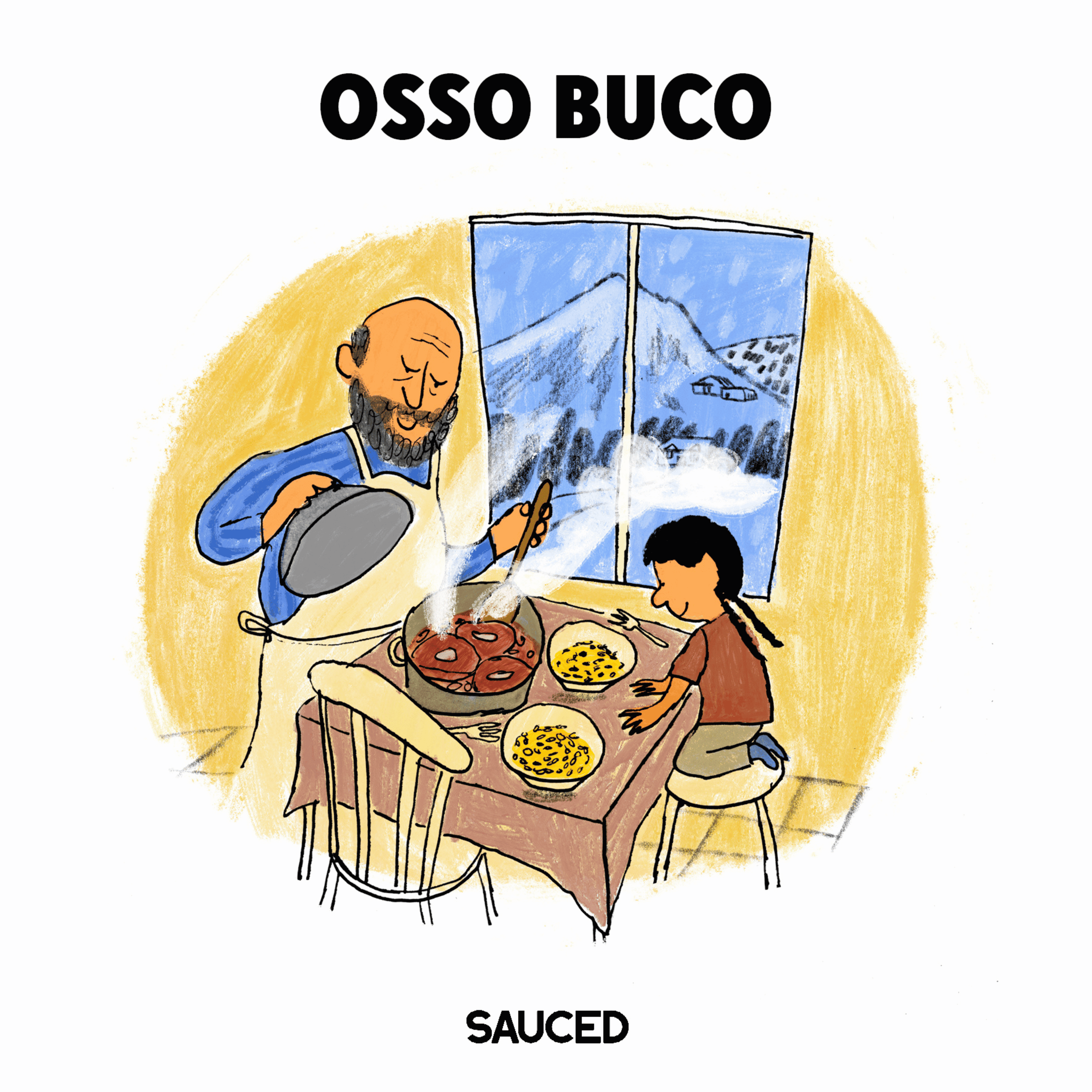
The same thing that ruins osso buco is the thing that makes it. The silverskin around a veal shank cups the meat as it cooks, and that same collagen, held low and slow, melts into the gelatin that turns a cut the butcher couldn't give away into a special-occasion plate.
There's no tomato up in Lombardy and no booze in the braise you can't taste, so this one is as much about what you pour beside it.
"Don't fear the braise."
What we settled on:
Veal goes in bianco: white wine, no tomato; beef gets red wine and tomato
Score the silverskin so it can't cup the meat, and have the butcher tie the shanks
Brown light, not dark, after a fine flour dusting
325 degrees, two and a half to three hours, cut-side up, no flipping
Rest it overnight in the sauce and reheat gently the next day
Gremolata is the non-negotiable finish, raw, and don't skip it
Serve over risotto alla Milanese, polenta, or mashed potatoes
The Cocktail:
The Ponte Vecchio: a brandy Boulevardier with Amaro Nonino and Punt e Mes, over a rock with a lemon twist.
RECIPE CARD:
Premium subscriber? Check out the full recipe card here.
LISTEN
EpiSOde Partners
Thanks to the following brands for partnering with Sauced to bring you this episode:
TRANSCRIPT
Tim McKirdy: Sother — got to see how a dog goes about a bone.
Sother Teague: Okay, that's a good lead into our episode today, I think.
TM: Yes. The word bone with a hole, better known around the world as osso buco.
ST: Yeah.
TM: Oss bus, if you're speaking in the Milanese dialect.
ST: Sure. Also osteo, right? That's where all the bone sciences come from.
TM: Ah, yeah, right. You know, I only know one other word in Milanese.
ST: What's that?
TM: Bomber. It means, like, dude. So if you ever meet someone from Milan, you say "Ciao Bomber," they'll love it.
ST: Love it. See ya, dude.
TM: But it means, like, bomber, like, you know, whatever, fire. Everything's fire.
ST: Sure.
TM: Everything's one word these days, isn't it? Just, you know, vibes. So I was thinking about this. I think this might be the dish that, on a scale of how much I love it to how often I get to eat it or cook it, there is the biggest gap. Yeah, I love osso buco.
ST: Why do you reckon that is? Is it just something you don't consider making? Is it the time commitment?
TM: It definitely is a commitment.
ST: But we do a lot of things that are time commitments. I think you and I really enjoy low, slow cooking, braising, smoking, and so on.
TM: The other aspect, I would say, is it's not something you have to go out of your way to find.
ST: Yeah, you do these days.
TM: And when you do, it's pretty expensive.
ST: It ain't cheap.
TM: It ain't cheap. So it's one of those special treats. You know, we have a policy on this show, right? As much as possible, go to a butcher shop, get to know your butcher's name.
ST: That's right. We say it all the time.
TM: But for the most part, you're doing your weekly shop, it's in a supermarket.
ST: Right. Out of sight is out of mind. You don't have to roll past cross-cut veal shanks at the Key Food or whatever, pre-packaged.
TM: Well, this is the thing. We do have them in my local supermarket, which has a great butcher counter, I should say.
ST: Plus you live in somewhat of an Italian-leaning neighborhood.
TM: Definitely. But they sell them in these massive boxes.
ST: Oh, yeah. It's 50 pounds.
TM: Yeah. And frozen, right? So it's like, where do we keep it? Still waiting for our chest freezer here at the Sauce HQ. And also, not just where are we keeping it, but it's a big financial commitment. Those big boxes are hundreds of dollars.
ST: Yeah. We should find a couple of folks to go in on a box with us. Let's do some communal shopping.
TM: Yeah. Also, Buco Party. You mentioned it, but for those who don't know, I always love your one-sentence elevator pitches. You mentioned veal shank. What exactly is the cut, and what is the dish?
ST: The dish, osso buco, is a braised cross-cut veal shank, meaning we're just going to cut the shank. Picture your forearm. You're just going to cut it into rounds. That's cross-cutting, where the collagen, marrow, and aromatic vegetables create a rich, elegant, luxurious dish out of what used to be inexpensive ingredients, now a little bit more dear.
TM: Yeah. It's funny how often that comes up on this show. I mean, right the way back to episode number one, when we were talking about bourguignon, one of the cuts we brought up were the cheeks. We recently did lobster rolls, right, used prior for fertilizer. Fisherman's stew. We have basically all of these things, and I'm getting ahead of myself here, but this propelling from pauper's dishes into prince's ingredients and dishes. Why do you think that is in this case?
ST: I think that this dish, you know, the shank is full of connective tissue and sinew and collagen, of course. From the butcher's perspective, I think people really enjoy cuts of meat that are relatively quick to cook, i.e. steaks, right? So what gets relegated to the poorer end of the spectrum are the things that take time. Because, love it or hate it, it's a true sentiment, time is money. So, strangely, I might spend more on a steak, but then I have to spend more time on this shank, so in the end I've spent the same amount of money. Does that make sense? In an abstract way. And I think that what poor people had on their hands was more time than money. So you'd put a pot on, put it in a Dutch oven next to the coals of your fire, and go off to work the fields, and you'd come home hours later and have this delicious, luxurious, flavored and textured dish to eat. Whereas maybe the aristocracy or the middle class was like, let's just throw a steak on the grill and have it in the next 10 minutes.
TM: I think another part of it is price, right? Supply and demand. Oftentimes with these historically cheaper cuts, they were also not in plentiful supply. The cheeks are a great example.
ST: Yeah. There's only two.
TM: Only two. Okay, the shanks, the animals have four legs, but you're cutting a section of that cut. There's not that many of them per animal.
ST: Sure.
TM: So maybe that comes into it too. It becomes prized because there aren't that many you can get.
ST: I would argue that, similar to what we talked about in the lobster roll episode, it also comes down to the perception of the protein in discussion, but it also comes down to learning how to manipulate it. When we talked about how maybe the prisoners were being fed lobster while the guards were eating chicken, they weren't getting butter-poached, sous vide lobster tails. It was hammered, it was stewed for too long, a rubbery little ball, probably no seasoning. So until we discovered that the technique is the key to unlock the flavor of the thing, that's where things changed. That's when the aristocracy started smelling the aromas coming out of the servants' quarters and being like, wait a minute, what do you got in there that I should have out here?
TM: I think another aspect of this dish in that conversion from pauper to prince is, this is the first time we've been able to turn around and say 50 percent of this dish, or the classic preparation, is another dish we've already covered on Sauced.
ST: Sure, a few really. But which one are you talking about specifically?
TM: Risotto alla Milanese.
ST: Oh, what goes with. Yeah, of course.
TM: And okay, I'm not even going to say that's my favorite thing to have it with.
ST: Not mine either.
TM: But that's a saffron risotto. That's a prince's dish. So that elevates the whole thing. And something that's notable, connected to that: this is probably the first one where what we serve it with dictates how I prepare this, which is weird, because this is supposed to be the star of the show. What I'm talking about there is essentially the white wine or red wine question.
ST: Ooh, yeah.
TM: Which is a debate we'll get into.
ST: I'm sure we will.
TM: All right then. So that's the elevator pitch. Have you ever worked anywhere where you serve this?
ST: Oh yeah, 100 percent. I worked at Pops in Durham, North Carolina, for Scott Howell and Ben Barker and Chef Brackman at the time, and we had osso buco on the menu. Not all the time, but often enough. And it was always, I don't think it was ever printed. Well, we printed the menu every night, you know what I mean, but I don't think it was ever a menu item. It was an item where it was special.
TM: Or, as you Americans like to say, it's never on menu.
ST: Yeah, it were all on menu. We would feature it. It'd be the verbal thing, because we don't have so many of them per service. And you have to make them the day before. We'll get into that too.
TM: And yeah, I mean, as I've mentioned, I've worked in plenty of places where braising and longer cooking was always the focus but never something we had on menu. And I don't know why that phrasing really stands. Well, it does a little bit, I'll be honest.
ST: I think it's a derivative of the opposite, right? When you're ordering off menu.
TM: Exactly. I've literally thought about that when I've been listening back to our conversations. Who knows. What an existence. All right, well, let's get into some of the origins now. Not the meatiest story ever, but we'll see where we can take this. So the dish belongs to Lombardy, and to Milan in particular, foreshadowing our risotto alla Milanese. It's a classically home-cooked dish that found its way onto the white tablecloth. We mentioned osso buco is Italian for bone with a hole, from the marrow cavity in the middle of the cut. You talked about the long cooking preparation, collagen, sinew, whatnot. I would argue that that is very much, pun intended, the tension of this dish. Most accounts read it as a fixture of 19th-century Milanese home cooking, with some older versions. Historically, the shank was a scrap cut, tough, sinewy, marrow-filled bottom of the leg that a butcher could rarely even give away. No one wanted this thing.
ST: Yeah, it was known as a butcher's cut, right? Back to the prince and the pauper, a butcher's probably solidly in the middle class, but these are the things you're eating at home as a butcher. Your wife is having to deal with all this. I'm selling all the good stuff, baby, you got to make something nice out of this for us.
TM: Well, that also flies in the face of something that comes up a lot here, when you talk about butchery and you're like, yeah, that's the butcher's cut, we keep that for ourselves. I know we both follow butchers and we like seeing that on Instagram. Kind of selfish from the old butchers there, keeping the best for themselves.
ST: Well, again, in this scenario I don't think it's the best. I think it's the thing that, as you just said, he's either giving it away or eating it himself. And if he gives it away, then he's got to eat something else that he didn't get to sell either, right? So he'd lose twice. For an instance like the hanger steak, at a butcher shop back in the day, you may get, in one cow, this two weeks, three weeks, a month, and there's only one hanger steak. I don't think it's selfish of him to keep it. There's only one. I can't put it in the case.
TM: And most people do know, right? Everyone says, ask your butcher ahead of time. Next time you get one of these, call me up and let me know. Yeah, just these butchers eating all this meat none of us ever get to see. So, as we mentioned, the classical pairing is risotto alla Milanese, the saffron risotto, which we covered a dozen or so episodes back. A little reminder on that one: the story goes back to the 1600s, or mid-1500s, while work was being done on Milan's famous Duomo. The apprentice to the master glazier Valerio was so fond of the saffron used to color the glass that he reportedly stirred it into the rice. I think we believe that's a bit of a tall tale. Why does this tie to the shank? The saffron risotto is delicate. And that, to me, is why this was classically a white wine dish. If you opt for red wine instead, and tomato, which arrives later, why are you serving that with the saffron side?
ST: Right. They're too bold.
TM: So, white wine. And that's something that, when we talk about being on autopilot, we never think of, because when we go beef, we go red.
ST: Yeah. Veal I treat and think about like I think and treat chicken, right? It's pale, it's white, it's delicate, I want to lean that way. And I'm certain we'll get to our approaches when we get to methodology, but real quickly: if I'm making osso buco with veal, it's white wine and no tomato. If I'm making the same dish with beef, it's red wine and tomato. I want a bolder, more robust sauce with beef shank than I do with a veal shank. And of course the difference is veal is just a young animal. The muscles haven't been formed. It hasn't done as much work.
TM: Yes. And just the white versus red conversation, looking at Italy, we need to remind ourselves that in the 1500s Italy was not Italy. Italy did not exist. We're talking about kingdoms within that area we now call Italy. Further down the line, there remains a big divide between north and south, and the south eventually would be home to incredible produce like tomatoes, but not in the north. So if we were up in Lombardy, in Milan, it makes sense there'd be no tomato, and therefore we'd go with the white. But really, beyond that, not too much in terms of notable people or things. I couldn't find out why, in this region specifically, they started saying, okay, we're going to focus on this cut. Must have just been some maverick.
ST: Yeah, it also makes me wonder where cross-cutting even came into play. The veal shank isn't that big, and people braised whole lamb legs, which are about the same size. So I don't know, is it the advent of the butchery saw? What changed that cut?
TM: Yeah, that's a great question. Why would you go to that effort? I don't think it's worth putting in all that extra effort for stock or something. Increasing your surface area.
ST: Right. You're cutting some of the cook time down. Is it presentation? I doubt it. That wasn't the goal.
TM: Yeah. Maverick, who knows. Anyway, speaking of Maverick — Sother, I want to get your take and hear what you've discovered by means of our culinary luminaries and what respected voices in the culinary realm have had to say about this. But before we get into that, first quick break of the day for us. All right, Sother, we're back. Hit me with some culinary luminaries.
ST: Yeah, a lot of the same names we know and love pop up on this dish, because it's so canonical, I guess. Marcella Hazan, who we've more than once mentioned as kind of the Julia Child of the Italian cooking world, gets a lot of credit for making osso buco a thing the American cook recognizes. Her advice, over and over, not just on this dish but certainly specific to it, was don't overcomplicate it. Tomatoes, if present at all, should support, not dominate. And again, for veal, no tomatoes; if you're doing beef, add some. And then she was a real strong proponent for gremolata, which she considered essential to the dish, to balance the richness with something bright and slightly acidic.
TM: And gremolata being lemon.
ST: Gremolata, just parsley, garlic, and lemon zest. So you're going to get some oils from the lemon, some zesty brightness, some clean herb from parsley, and then a little hit of garlic, which is raw, by the way. It doesn't get cooked in any way, so it really brings a pungent, bright freshness.
TM: Very cool.
ST: Lidia Bastianich, probably couldn't leave her out of the conversation either. She's kind of a maven of Italian cooking here in America, and has stemmed from her literal family tree many Italian places with her son Joe and her daughter, whose name is escaping me right now, who's her partner in a bunch of the restaurants as well. And she's a partner at several of the Eataly spots, so she has a big voice in Italian cooking and cuisine, and she's said plenty of things about this dish as well. I'm going to butcher this guy's name, but I have a few interesting facts about him because he fascinated me when I was diving in. Gualtiero...
TM: Marchesi.
ST: Yeah, okay, I got it. His restaurant, which opened in '98, is a mix of traditional and modern technology and is also a cooking academy, which I think is interesting, because we keep finding this happening, especially with the Italian cooks. They not only start cooking, they start teaching, and maybe that's why Italian food is so codified and so persnickety, I don't know what word I want to put on that. But he opened another restaurant in 2001, where he took over the oldest restaurant in Rome, located in a building that dates back to 1400 AD. And then, weirdly — just a fascinating career — in 2011 he became the first chef to design two hamburgers and a dessert for McDonald's.
TM: Wow.
ST: Just out of left field. Sadly passed away in 2017, but what an illustrious career. He was a huge voice for Italian cuisine, kind of the founder of the Italian nouvelle cuisine movement. Nouvelle cuisine was happening at the same time all over the world, but he was the spearhead in Italy's landscape. Pretty fascinating guy, look him up, cool stuff. Jacques Pépin, my hero, your zero.
TM: No, come on, I love Jacques.
ST: I know, I'm just teasing you. He praised, not specifically osso buco, but over and over in his work you can find him praising braising, the technique, as one of the most important to master. His constant refrain is, time is an ingredient. And we'll talk about that more in this one, time is definitely an ingredient in the dish. We have a nexus of what we have to achieve. We can't just achieve a time nor a temperature, but time is the balance.
TM: It's IME, not HYM. He is right.
ST: Well, tricky enough, they're both in this. Julia echoes his sentiment. She was a braise champion, and the main thing I found that she said about braising, not a direct quote, but something she iterated over and over in different ways, is to be fearless when braising, because the oven is doing most of the work.
TM: Be fearless when braising, like, that quote?
ST: Yeah, because it wasn't a direct quote, but that was the sentiment I derived from things I've read from her, because her message was clearly: yes, this recipe, if you look at it and read it, you're going to see there's a long time, but much of that time is passive. So you can be fearless. The oven's doing most of the work for you. And that's kind of all I have on luminaries and fascinating people who love Italian cuisine and braised dishes.
TM: Marchesi, just to go back two steps, was the first Italian chef to get three Michelin stars.
ST: Oh yeah, I think so. I didn't have that in my notes, but I think I read that.
TM: And just on the McDonald's front, I will say, on a personal level, probably the coolest McDonald's I've ever been to, in Rome, opposite the Pantheon. Which, again, the Pantheon goes back to, what, the 1500s, 1400s, maybe even more, that domed roof with the hole in the top, incredible feat of engineering, especially for the time. But yeah, just across the way. That's what a lot of Brits like to do, go to a foreign culture, visit a new city, and see what their McDonald's are like. See what they're serving. Oh my god, they have beer in Belgium.
ST: For me it's sad commentary, but it's not just the Brits, American people do it too.
TM: Everyone, probably more so.
ST: I'm sure. Everyone does it. Oh my god, they serve pasta at this McDonald's in Italy.
TM: Most expensive one I've ever had, Geneva, Switzerland, also where they have beer. You know, listen, I can get down with saffron risotto alla Milanese, and I can smash a Big Mac.
ST: Do you want a saffron Milanese Big Mac?
TM: No, I want to know what the burgers are. I assume you'd have told us if you had more info on them, but, not one but two burgers on the menu.
ST: Two burgers and a dessert. I'm curious, did he roll out the McTiramisu, the McApple Charlotte? I don't know, I'm just throwing stuff.
TM: Love it. Question for you that probably doesn't belong in this section of the show, but it just came to mind and I don't want to forget it. From a butchery perspective, we're talking about veal versus beef. There are certain cuts of veal that are extremely common, everyday cuts, and it's not going to surprise you.
ST: Sure, a veal chop, scallopini.
TM: Exactly.
ST: What else?
TM: What happens to the rest of the veal, though? Where's my veal brisket, where are my veal steaks? What happens to the rest of the animal?
ST: They're there. We just had chops, those are steaks, right? They can be from the loin or the tenderloin. The tenderloin's going to be quite small. Imagine when you get pork tenderloin. The pork loin is quite large, the pork tenderloin is quite small. So now shrink that to a smaller animal. The veal loin is pretty small, and the veal tenderloin is even smaller. So that's where you get the scallopini, when you take the tenderloin and slice it thin and pound it out a little. The cuts are all the same, they're just smaller.
TM: But where's my shoulder, where's my rump, this stuff?
ST: Oh, yeah. A lot of that winds up in braised dishes, and also sausage.
TM: Or mince, right? I imagine we see a lot of veal mince.
ST: Yeah.
TM: I want to smoke a whole veal brisket. Where do I get that from?
ST: Not going to be very big, but okay.
TM: Definitely my supermarket doesn't have it, so I'll probably just go back to those frozen boxes.
ST: We got to get Sauced signed up to a butchery box. What are they called, the farmer boxes you get every month? Community-something.
TM: I know what you're talking about.
ST: Natalie and I used to be part of one for a farm. It was a bunch of vegetables, which was great, but since we moved to Brooklyn we're not close to it anymore. But yeah, there are ones out there for butchery. We should get into one.
TM: Yeah, just seeing what different cuts arrive, the mystery box. That would be pretty fun.
ST: Mm-hmm.
TM: Well, one other thing you mentioned: you said that garlic is going into that gremolata raw. And it strikes me that someone would need to know how to handle that garlic, right? What to do, what not to do. Are we slicing, are we smashing, are we grating, are we using a tool that you hate? Who knows. I do know where you can find out, though, in one of our bonus episodes.
ST: Oh, that's right, yeah. We did a whole episode about garlic. All our bonus episodes involve either a single ingredient, like garlic, or a technique. We did polymerization, which was a cool one, all about how to season your cast iron and carbon steel pans. History, I'm finding the history ones to be quite fascinating, especially when we come up with agromafia.
TM: History is next up for us in the roster as well.
ST: I'm looking forward to it. Or a side dish. We've done things like mashed potatoes. They're a ton of fun, deep dives into a single thing, and I think we're having a real blast with them. And yeah, we did garlic, and it was a good one.
TM: I think they're great, I really like them. But in this instance, folks don't need to take our word for it, they can decide for themselves. That garlic episode, we put out a couple months ago in the public feed, just to give people a little taste, wet their beak.
ST: You got to give them a little for free so they'll come back to the trough.
TM: Exactly. The first hit's always free. But listen, head over there, that episode's going to be your friend, and that means we don't need to dive too much into the science of garlic when we're talking about gremolata later here, which for me is a non-negotiable. So that one's out there in the feed, and folks, if you like it, sign up, join us for the ride. And if not, we gave it a punt, didn't we?
ST: Yeah, why not. We're a couple of punters.
TM: All right, Sother, that does mean it's time for another quick break for us here, then we'll be back with gremolata and other non-negotiables. All right, Sother, we're back. Non-negotiables, hit me with number one. We're going in order of importance here.
ST: If we're doing traditional osso buco, which it sounds like we are, then it is specifically cross-cut shanks of veal. That way you get the marrow in there, which is essential. Without the bone, without the bone marrow, we're just making braised veal. So that's the essential of the non-negotiables.
TM: First one for me, weirdly, I would go past an ingredient and to a technique. Like you said, there's just no two ways about it: this has to be braised low and slow, and it needs to be cooked in a specific way. If that's not done, the beauty of this dish is just completely gone. Like those boiled lobsters, unseasoned. If you cook this too high and too long, it's just going to be not very nice at all.
ST: Right, there's a bell curve here. We want to get it cooked slow enough, and long enough, to break down that collagen and connective tissue. But then if we go too far, I want it to be spoon-tender, but I don't want it to be fall-apart.
TM: Yes, exactly.
ST: There's a line, you don't want to cross it. That was actually my second non-negotiable.
TM: Nice.
ST: Third one for me, you're going to need some vegetables here. It's pretty standard, but it's mirepoix. Celery, carrot, onion, no surprises. Chopped medium-small, because I want them to kind of melt in but still be a little bit visible.
TM: Mirepoix, your onion, carrot, celery. Nice.
ST: Yep, no surprises on that one.
TM: Non-negotiable for me: white wine.
ST: Yep, I already said it earlier. If it's veal, it's white wine and no tomatoes. So I'm hoping tomatoes don't show up on your non-negotiables. If it's beef, it's red wine and tomato product. So, white wine, and I'm going to say a light veal stock. You can get away with chicken stock in this scenario as well, but not roasted. I don't want a dark stock, I want it light.
TM: Stock for sure. Well, gremolata.
ST: That's the end of my list of non-negotiables. A pretty short list. I don't know if you have any. Gremolata, just to reiterate, is a collection of lemon zest, parsley, and garlic, raw. That is the final stage of the dish upon plating. It's an essential garnish. This does not leave the pass without getting hit with some gremolata. In fact, maybe even a little side dish of extra, a little monkey bowl of extra.
TM: Let's talk about side dishes. Well, there's no more ingredients really in the preparation.
ST: Right. Well, we've talked enough about risotto alla Milanese, which we even did a whole episode on. That is obviously canonically the classic accompaniment for this dish. For me, I want polenta.
TM: Same.
ST: Wow, all right, we agree. Not for once, we agree a lot. Yeah, I want polenta, and I want it relatively plain. I want the veal and the sauce created from the braise to be the star of the show. I'm not putting any cheese or anything weird in my polenta. Maybe a little bit of herb, salt, white pepper. Pretty straightforward.
TM: Yeah, I like hitting mine with some fresh garlic to finish, just really finely minced.
ST: Sure, I'm not opposed to that. I just don't want, a lot of times people are like, oh, I made polenta, and then it's like 50 percent cheese.
TM: Yeah, no. But I do want my polenta to be almost soupy in consistency as well. I think for me it does depend, though, right? If you served me this dish and it was with tomato and red wine, that's okay with me, if it's on polenta and if it's in winter. But if you're serving it with risotto, no, it has to be the white wine one. You know what I mean? I love a little red wine tomato braise with polenta, it's amazing.
ST: Me too. I mean, we talked about mashed potatoes and polenta before, right? I think mashed potatoes is a good side for this dish as well. Again, I want it relatively plain, just a little bit of herb maybe.
TM: And I want the expensive polenta, the really nice white one.
ST: Oh, I don't know what you're talking about, but I'm in.
TM: It's Italian, I forget. All right, so those are non-negotiables, those are our side dishes. I think we can agree on all of that.
ST: I would throw one more on there. Some freshly made wider pasta, tagliatelle, pappardelle, so you can almost flake it apart and make it into sort of a ragù.
TM: I think that definition you gave earlier is a very good one, too. You should be able to eat this with a spoon, but it should retain its structure.
ST: Yeah. And we've got a couple of techniques in the technical section where we can hopefully kind of guarantee it.
TM: Yeah, let's talk about that. You know that, the glorious return here of technical considerations slash science.
ST: Have they been gone for a while?
TM: Yeah, well, I think they overlap a lot with the science. But I mentioned earlier, collagen in this dish is both the villain and the hero. So the thing that's going to inform our technique here, I'll lay it up: how do you treat that collagen, or why is that happening? So that's the tough silverskin that holds all of that meat to the bone. It is collagen, and collagen shrinks as it heats, starting at around 140 degrees Fahrenheit, or four metric.
ST: Oh god, I don't know. Yeah, I was about to say it's going to be in the 60s.
TM: 60. Good guess. And because that ring wraps the whole disc, it will start to form a cup, and it doesn't look very nice at all.
ST: Right, it buckles, basically. So there's a couple ways to mitigate this. Number one is to simply make a couple of slits, two to four, depending on how large the disc is, because when we look at this thing, it's kind of a disc, sort of a hockey puck. And also a mitigating factor is when your butcher is doing this, he is overwhelmingly likely, but not all the time, so make sure he's tying it. There'll be a band of string around it as well. So ideally he'd put a slash down the length of the shank, then cut it into those discs, then tie it, so that those ties are holding everything together, but because of those slits, that silverskin, which isn't going to do anything but shrink, won't buckle and make a cup. When you envision char pepperoni on your pizza, it makes that little cup because it bends up like that. If you were to go individually and slice all the way around, like when you fry bologna, you got to make those cuts around the edges so it doesn't cup up.
TM: I'm still just in suspended disbelief here. I thought you were talking about having a wee cup of char.
ST: Hmm.
TM: Which is, I think, how some people in London say a cup of tea. A cup of char. Different cups. So yeah, 140, that starts to curl, and at 160...
ST: That's 71 degrees. I had that written down.
TM: Yeah, 160 up towards 180, that is where our collagen, that villain, is converting into gelatin, our friend.
ST: Which is the hero, yeah. We love gelatin.
TM: The hero. And that is why a cheap, sinewy cut has become a prince's dish, right here. And one more technique for us.
ST: Well, I would just pause you and say, let's not forget, just achieving that temperature isn't enough. We got to achieve and maintain that temperature for a while. There's a conversion that requires both the heat to be hit and an extended time to stay there. It's not a fixed spot. It's not like cooking my steak to 140 and that's where I want to stop. We got to cook it to this 180 degrees, up to even 205 degrees. For metric people, I wrote that down, it's 82 to 96 Celsius. But you got to maintain that for a while. And that's where the magic happens. That's what a braise is.
TM: Yeah, like, talk about that brisket from earlier, right? Reach that temperature, maintain it. Obviously we don't have the stall over here, luckily, because we're not smoking, we're not evaporating. This is happening in solution. The thing I was going to say, and I don't think we've really spoken about this before, and then I saw your guy Adam Byatt. Adam was evangelizing the other day about cartouches.
ST: Was he eulogizing or was he evangelizing?
TM: Evangelizing.
ST: He is a cartouche evangelist.
TM: Yeah. It's not, eulogy, I thought eulogy was a good thing, anyway.
ST: No, a eulogy is the speech you give over the box when the guy's inside the box.
TM: Oh, okay. So he was evangelizing, for sure.
ST: Evangelizing is when you're preaching.
TM: He wasn't committing the cartouche to Room 101. He was saying everyone should know this. And it's a great point, right? This is your sweet spot between when you're like, I need a lid, but I can't have the lid fully closed. So rather than have something teetering on the edge, create a cartouche. At which point I hand it over to you to tell us, what is the cartouche?
ST: A cartouche is just parchment paper that's been cut to fit the pan or pot or braising vessel you're using. It's going to capture some of the steam and reincorporate it back into the liquid below, but it's also going to let some of it go. So it's a good middle place to be. And Adam Byatt and the guys from Fallow, these guys are like cartouche champions. And there's a technique for making them. You take a piece of parchment paper and fold it in half. You fold that in half again in the same direction, so you have a seam. And then you start to flute it, I guess would be the word. Almost like a pleat. You're pleating it, and then you'll end up with what looks like a long pointed fan. You hold the point at the center of your round pot, and then wherever the edge is at the edge of your pot, you snip it there. And when you unfold it, it'll fit your pot. And then you snip off the center and you'll have a hole in the middle.
TM: Have a little hole in the... and you know what that is.
ST: We'll do a video about the cartouche.
TM: That is our Porco Creative Use of Parchment Paper of the Week.
ST: I knew you were going to come around with something like that.
TM: No, but I think the cartouche really is. And it's underused.
ST: In home kitchens, it is. And I think, frankly, even underused in a lot of commercial kitchens. And then you've got the opposite end, where Adam and the guys at Fallow kind of overuse it.
TM: Oh yeah, give me a cartouche on just everything.
ST: Yeah.
TM: But I like it. And you know what, I'm vowing, that's going to be my mid-year new year's resolution for 2026.
ST: More cartouche.
TM: Yeah, more cartouche. More marrow.
ST: More marrow and more cartouche.
TM: More veal shank, more cartouche.
ST: All right, I'm in. I'll get us a box of parchment from the restaurant.
TM: Well, that has been the glorious return of the technical considerations, as well as the non-negotiables. So time for another quick break, and then we'll be back with the preparation. All right, Mr. Former Butcher.
ST: Back in the ring to take another swing.
TM: Didn't realize you were a wrestler.
ST: That's an AC/DC line.
TM: Oh, sorry. Don't like Australians, are they? Australian?
ST: Wow. Don't alienate our audience.
TM: Listen, man, we're a big deal in Sweden, but we're not yet, you know, we're sort of percolating in Australia. We'll see if we can convince those folks. But hit me with your preparation now on classic osso buco.
ST: Sure. Go down and see your pal, who you should know their name, at the butcher shop, and pick up some veal shanks that have been cross-cut for you and tied. Make sure you've sliced that sinew we talked about that's around the exterior so they won't buckle. That's really just for presentation, it's not going to affect much. I guess the only thing it would really affect is if they buckle while they're in the braising liquid, which is only going to come up about halfway, then they might be too much iceberging, too much out of the water than in the water. So just do it. Get them out of the fridge and seasoned with some salt and pepper while you're working on a few other things. Let them come up to room temperature, it's going to be a little helpful. Then we're going to brown these guys off, just like we do for most braises. Get your Dutch oven or whatever vessel you're going in, because this is a one-pot dish, by the way. We didn't talk about that, and I love that about it. It's a lot of time but not a lot of effort, and then it's not a lot of cleanup, because you're only going to have really one dish to deal with. So heat it up to medium-high, 300, 325 degrees-ish, and then brown off the meat. But first we're going to dust it with some flour. If you've got Wondra flour, I recommend that, the most fine of the flours. But if not, just a quick toss, a very light dusting. We're not looking to have a crust on this thing, we're just looking to aid in browning. So you got your pot warmed up, a little oil in there, get them browned on all sides, not deeply browned. Again, if it's beef, go all the brown you want. On the veal, I'm staying kind of light. So get them nicely golden brown, not darkly brown. Then you can pull them out onto a plate while you go in with your mirepoix, which we talked about, just celery, carrot, onion, cut pretty small, not minced down to brunoise, but not as big as medium dice either. You're going to sweat those for eight to 10 minutes, until they're nice and soft. At the last minute you're going to add a bit of garlic, just one more minute of sweating, so you're not trying to get the garlic browned or anything. In goes your wine, to deglaze. Scrape the pan as thoroughly as you can and bring that wine down a little bit. Not necessarily almost to half, but bring it down by a third, let's call it. Then you're going to put your meat back in and add stock until it comes halfway up the sides of your discs. And by the way, the discs, you don't want them in there sideways. You want them so the circle is visible, the bone in the middle is visible. And then you're going to go in with any herbs. I think in this case, for me, it's just two really, they're not non-negotiables, they're just the two I like. Thyme and bay leaf. I know I get some flack about bay leaf, but I got to tell you, man, do some experiments with bay leaf and you'll understand what it brings to the table.
TM: You know what I didn't mention in the origin, and this is an optional step here that I would go for, because this is one of my favorite ingredients in savory preparations: a little bit of cinnamon.
ST: Okay, I'm absolutely not opposed. How are you getting it in there, dust or just a stick?
TM: A small stick. You know how you'll buy a container of cinnamon sticks and there's always a little flake of one left somewhere, or one snapped in half. Just a little bit, just a touch. Not a pinch. I don't really like the powdered stuff unless I have to use it for something.
ST: Yeah, same. I could see snapping a stick in half and throwing it in either end of the braising dish.
TM: Yeah. I just feel like that would really bring together things in an unexpected way, between that light stock, the white wine, the herbs, the meat that's been browned nicely.
ST: Yeah, I'm in. Cinnamon stick has now been added. So cinnamon stick, thyme, and bay leaf. And then, for bonus points, get your cartouche in there, and then get a lid on it and get it in that preheated 325 degree oven for two and a half to three hours. I have seen lots of cooks go in at the halfway mark and flip the osso buco. I don't do that. I want one side sticking out of the liquid and hopefully getting a little bit of extra caramelization on it, and then what's underneath the liquid can be the softer part. It's getting steamed anyway, it's not going to change its texture. I don't really understand why people do it, but I've seen them do it. Seemed pointless to me.
TM: Yeah, because what, the argument is, so it looks exactly the same on both sides? You know what people don't do when you cook for them and they come to your house?
ST: Complain about how things look.
TM: Just be like, oh, that's a beautiful looking osso buco, let me check the bottom to make sure it's the same color as the top.
ST: Let me look underneath. Also, like, you see fresh yeast doughnuts, they go into the oil, they do get flipped, but they have that stripe all the way around them. That's part of it. There's a part that just doesn't get the same treatment. So yeah, two and a half to three hours at that 325 degrees, or 163 degrees Celsius. And as I said before, when finished, the meat should yield pretty easily to a fork or spoon, but it should still maintain its shape. And here's a way that I think you're going to, oh wait, I got one more step, sorry. So at that point, then lift the meat out gently. Strain the sauce, then reduce. And then here's my key: putting the meat back in the liquid, allowing it to cool to room temperature before putting it in the fridge overnight. And then the next day, gently reheating it until it's temperature for eating. That's going to help you maintain shape as well. Because what happens when we cook protein, think of it as if it were a sponge, and think of the heat being applied as squeezing the sponge. When we put a piece of steak on the grill, it's soft, but as it cooks it becomes more firm, it's being squeezed. But then when we pull it off to rest, it relaxes again. So, using the sponge analogy, something that's been braised has firmed up while cooking, but then it will relax as it sits in that liquid, and hopefully, like a sponge, it will reabsorb some of the liquid. So now we're going to not only change the texture, but create something a little more juicy and unctuous. Then the final final is, pick it up in the liquid gently, however you're going to serve it, polenta, grits, mashed potatoes, pasta, risotto, whatever it is, have that at the ready. Place a nice chunk of your osso buco on top, ladle some of the sauce right over it, which should hopefully be at a good consistency, if not, there are some techniques we can use to tighten it up. And then do not miss topping it with that fresh gremolata.
TM: Fresh gremolata, cannot miss it. Maybe some nice bread on the side as well.
ST: Oh, something crusty. I want a crusty bread here. I don't want the focaccia we recently made, which was delicious, but I want something with some crunch.
TM: That was one of the side dish episodes, I believe, in the bonus series.
ST: Yeah. Sent me home to do some experimental baking. I had a couple of fails. The very first one, I hadn't baked in forever, and the yeast I had at home was clearly dead. I made crackers.
TM: Yeah, it's sort of like a Levantine flatbread you got going on over there.
ST: Weirdly, though, because I still tried to ferment it for three days, it was still very tasty. It simply wasn't focaccia. And you know what, this is how things happen.
TM: All right, so that's been the preparation. Any final thoughts on that before we start talking about your favorite part?
ST: Mmm, the booze. Yeah, no, I think I touched on all points. And of course, as an avid listener, you'll know we don't talk about amounts as we go through these preparations, because we don't want you to have to stop and take notes while we're chatting. Frankly, we put the recipes together as we discuss them, live on air with you guys. However, if you're a subscriber, which is only seven dollars a month, and if you subscribe for an entire year you get two months free, that's 14 percent off, so 70 bucks for the entire year, you get these beautifully designed recipe cards sent to your email, with all the recipes, not just of the food but of the drinks, which we're about to get into.
TM: Fantastic. Nice pitch.
ST: Yeah, man, I'm learning.
TM: You're teaching.
ST: Media savvy right here.
TM: Oh, fantastic. All right, so let's take that final break, and then we'll be back with what goes in the glass. All right, we're back. It's the pairings. We're going to kick it off with wine.
ST: As we always do, and I'm excited to hear what you got for us today.
TM: Yeah. So, a reminder for those who might have missed last week's episode, or for those maybe just joining, this is their first one. Some exciting news for us over here at the Sauce HQ. We are partnering with our good friends at Wines Till Sold Out.
ST: WTSO.
TM: Flash deals. We're partnering with those guys. So every week when we do a dish, their experts send us a recommendation. Here is a bottle, a physical bottle that exists, you can go out and buy. We're not just talking about grapes or region, which of course we will cover, but something tangible. And we kind of liken it to, whether you're in a wine store talking to the person behind the counter, which, much like your butcher shop, you should do, folks.
ST: Get to know your wine purveyor, get to know your liquor store owner, come on.
TM: Or if you're in a restaurant and the sommelier is there. We kind of have that scenario. We say, we're doing osso buco, we want something that's going to make this dish really shine. What have you got for us? So they sent us over their recommendation and a bottle. Brunello di Montalcino. The producer is Amantis, the vintage is 2019, and it's available for folks for the fine price of 40 dollars, which those who know Brunello will be like, wow.
ST: Yeah, that's a deal.
TM: There's a comparable price of this bottle of like 80 bucks, so you're getting at least 50 percent off.
ST: Right, and not to belabor it, but that's the whole point of WTSO, Wines Till Sold Out. They get a hold of all these great produced wines that are maybe the last of their kind, and they sell them at a discounted price. They go as quickly as they go, but then they have something else behind it. So I like it, it's an adventure.
TM: So I thought this was interesting, and I'm going to tell you what their wine experts have said to us. So they said, this wine, Amantis Brunello di Montalcino 2019, features a perfumed, vibrant style of Tuscan Sangiovese that pairs beautifully with dishes of savory intensity and melt-in-your-mouth marrow. And that is my Maurice alliteration for the week. The melt-in-your-mouth marrow, Maurice alliteration.
ST: Your mouth marrow Montalbano.
TM: But Montalcino, sorry, different.
ST: Much, much, much. You know.
TM: Montalcino, from Italy. But you know, I love a couple of things about this. Number one, we said Italy is a country that didn't exist until somewhat recently, considering a lot of regional pride, a lot of regional identity. We're not talking a Lombardy wine, though. We are going to Tuscany here. And I think with good reason, because I tried this wine myself as well, and I really agree with their notes there, that the one word, perfumed. Brunello di Montalcino, classically it's 100 percent Sangiovese, which is the Chianti grape. It's tart cherry, it's perfume, it's got some flowers. I would say this one as well has got a nice bit of citrus, almost, I saw a tasting note for this which is like orange oil.
ST: No.
TM: Which plays really nicely with that gremolata.
ST: Yes, right.
TM: Right. Which I really like. Some nice, kind of chalky tannins, clay tannins on this as well. So you're going to get that texture, which is going to contrast nicely with the smoothness of the long-braised osso buco. And whether it's polenta or risotto that we're having it with, right, like our whole thesis of risotto when we covered it was that it's a sauce, not like a plate. You treat it like a sauce. So that bottle there, available for Sauced listeners. Pairing. Use the code PAIRING during checkout, and you get 10 percent off orders of more than 100 dollars. And let me tell you, that will get you a couple of bottles at least on WTSO. So, money well spent. Just taking a step back, the region, Montalcino, we're talking one hilltop town in southern Tuscany. It's a fairly small appellation, all things told, which means plots and individual vineyards matter. You'll get a lot of variation from site to site. This one in particular came from the volcanic soils of the foothills of Monte Amiata, an extinct volcano, which is apparently rich in bones.
ST: Ties in well with the dish.
TM: I didn't even realize. Good call. Yeah. And the thing about Brunello, again, folks might have heard this wine even if they haven't had it before, like, Brunello di Montalcino, it doesn't just sound amazing to say, I feel like I'm a fluent Italian speaker when I'm saying it. Some specific rules there, things they have to follow. So by law it cannot be sold until January of the fifth year after harvest, with at least two of those years taking place in barrel.
ST: So at least two years in a barrel, not in stainless steel. But a five-year total from harvest to sale, beginning in January the year after harvest, the five years after that. Wow, okay. It's quite specific.
TM: Exactly. So this vintage, for example, 2019, couldn't have hit the stores until 2024 at the earliest. This is obviously 2026 as we're recording. I did see some folks online who reviewed this and gave their windows for when to drink. Some were saying 2027, it's good to go now. I can see it, but I will say, I had a little taster of this, came back the next day having had just one glass, and it opened up beautifully. So a decanter or something is going to be your friend here. Or, you know, maybe when you're starting the braise, if you're serving it tonight, open that bottle as well and hold off. But yeah, grape is Sangiovese, region is Montalcino in Tuscany. Look out for that, like I said, bright tart cherry, fruity, a little bit rustic. It's Italian wine.
ST: That orange oil is what sold me.
TM: Yeah, I thought you'd like that one. And that's just going to be a great pairing for this. Just don't tell the Milanese that we're going to Tuscany instead.
ST: No, they'll be happy.
TM: Other comparable regions or styles. Rosso di Montalcino, same grape, same price, without the appellation, so it's going to be younger and cheaper. I mean, again, 40 for this bottle, come on, they're giving it away. Chianti Classico.
ST: That was on my list. I was thinking of Chianti Classico just because it's rustic table wine, and again, this dish harkens back to a time of middle to lower class.
TM: You want that basket, don't you? It's got a name, I forget what it is.
ST: Yeah, what is it called? I do know what it's about, though, or some of its origin, some of it could be wrong. Correct me if I'm wrong out there. You listen, you put anything on the internet, you get the right answer right away. The Chianti, I believe the word, and this is catching me off guard, I didn't mean to talk about this, I believe the word means something about a mistake in the glass of the bottle itself. And Chianti bottles became the name of the wine that got put into them. But the glassblower there would have an error in the glass, and they'd wrap it so you couldn't see it. I think that's true. Yeah, it could be completely making it up.
TM: Let's not let the truth get in the way of a good story.
ST: Listen, either it's true or I made it up, playing balderdash. We'll figure it out. Someone let us know right away, believe me.
TM: Chianti, great option.
ST: Mm-hmm.
TM: Vino Nobile di Montepulciano, another great Italian red. And those are all our Sangioveses in different forms. If not Sangiovese, let's go back to the north of Italy. Let's say Nebbiolo.
ST: Nebbiolo is the only other one on my list. I have Chianti Classico and Nebbiolo.
TM: Whether you want Barbaresco, whether you want...
ST: I'm learning about wine from you, Tim.
TM: I would say Nebbiolo is going to really lean into those cherry notes. You're going to get more of the perfume, more floral. You're going to get tar.
ST: Tar and roses, baby.
TM: Tar and roses. I prefer them to AC/DC. Tar and Roses was much more my lane than AC/DC. But I would say that tar, and the heavier tannins, maybe I'm going to save that for the beef version of this that you were talking about.
ST: Yeah, Nebbiolos can get kind of big. But it was on my list because, frankly, I enjoy them. And then, little hidden secret, Natalie, this was her favorite wine when she was younger, and she has, her very first ever tattoo, she has many now, it's just the words "tar and roses," right up on her ribcage.
TM: Nice. Very cool.
ST: Yeah.
TM: Hit me up with other stuff, though. So that is our wine covered. Don't think I'm going to go white, white is going to be in the pan rather than the glass.
ST: I think so too.
TM: What about beer?
ST: I love a good beer with a dish like this. I'm thinking like a Bock, right? Getting some malty caramel stuff. Bock beers are similar to the wine thing you just said, there's rules. Bock beers are brewed in winter but made to be sold and consumed in spring, which seems off to me, but also weirdly apt. And, you know, veal is a young animal, typically best in spring, so it all seems to line up in my mind. You got this rich, unctuous dish, you got a beer that's a little malty and caramelly. Sounds good to me. Maybe also going the other way, like a farm ale.
TM: Saison.
ST: Saison.
TM: It wouldn't be a Sauced if you didn't mention saison.
ST: Do I really bring it up a lot?
TM: I feel like you do, yeah. You over-index on saison compared to how much saison you drink, I imagine.
ST: Yeah, not a lot.
TM: But it's just a very food-friendly beer.
ST: Right, I think that's the key, it's very food-friendly. I do have a third beer listed here, a Belgian dubbel. A little bit like the opposite of the Bock, not going to be as caramelly and malty, going to be a little more crisp. If we jump over to spirits, you know what I want, maybe after this meal, and I don't think we talked about after-meal enough, after this meal I want some aged grappa.
TM: I hoped you were going to say grappa.
ST: I also want cognac and Armagnac, always. But I think those two kind of fit the style of this dish. Even though it's Italian, it's got a very French influence on this cooking style. So then that leads me to cocktails.
TM: Before you get into that, let's just stop on grappa for a second. So, for anyone who might not be familiar, typically an unaged spirit. It's similar to brandy in that it's made from grapes, but this is not fresh grape juice that's fermented and then distilled. It is the pomace, the leftover, everything, crushed grapes, stems, things like that. We run water over it, we ferment that, and then we distill it. Lower quality ones will have a bit of an industrial character to them, kind of fire-watery. But really well-made ones, phenomenal. Largest producer in the world, I believe, is Nardini.
ST: Oh, really?
TM: Certainly the largest name in terms of share of voice, I would say, in terms of grappa.
ST: That tracks. They have many marks out there, many labels. I didn't realize they were the biggest, though, but it tracks.
TM: But you like Nardini, I've heard you bring up Nardini before.
ST: Both, because they make a few amari as well. So yeah, they're a big name.
TM: Or, you've been to Nardini?
ST: No. And if anybody from Nardini wants to take us, Sauced would love to go on the road.
TM: Man, I would love to get myself back to Nardini. I had the pleasure once of going to the town, Bassano del Grappa. It has this really old bridge, as I think they like to say in Italian, Ponte Vecchio, old bridge, right?
ST: Yeah. And that bridge is on the label of their grappa-based Amaro. I don't know if it's on the label of their grappas.
TM: I don't think so, it might be, I can't remember. There's a bar and restaurant in the bridge that I've been to. Amazing. All I will say is this, though, not that we ever celebrate overconsumption here, we don't condone it, we don't celebrate it, but we can appreciate when we meet a drinking culture and it's like, wow, these folks really do like getting after it. I don't think I've ever met folks who enjoy, and take upon themselves the task of enjoying, an alcoholic beverage quite as heartily as the good folks of Bassano del Grappa. Or that might just have been my trip. But hey, like you said, Sother, if we can get Sauced back over there to Nardini, we would love that.
ST: I would be thrilled to go back to Italy.
TM: But that was, sorry, a really long way of me saying, and I apologize for the detour, when it comes to an after-dinner drink, if I'm in an Italian restaurant, I will always be like, huh, I should have an Amaro now. And I always go to have an Amaro, and the grappa gets me at the last moment. And I'm like, nah, let me have a grappa.
ST: Oh, see, I have a different tack. When I'm in Italy, I have an Amaro after a meal, and then I have a grappa after. So the grappa's for after the Amaro, because grappa is usually more of a cleaner, one-note thing, whereas the amari are an amalgam of flavors, it's like tea. So I'll have an Amaro, which are typically lower ABV, and then I can climb back up, all in the effort to settle the stomach.
TM: Of course. Digestion, big fans.
ST: Let's talk about a couple of cocktails here. I think, weirdly, a Martinez would be quite good with this dish. It's got some herbal complexity. And for the listener, a Martinez is basically a Martini made with gin and sweet vermouth instead of dry, and then augmented with a bit of maraschino liqueur to add a little layer of fruitiness, and it also changes the mouthfeel. Gives it a different texture, or tongue texture, or whatever you people want me to say instead of the word mouthfeel. You got a lot of flack for that. I'll take it, if you've got a better thing for me to say, I'll gladly switch.
TM: I don't know why people don't like that word. It's like when people get annoyed when someone says something's smooth. If that's how someone experienced it, fantastic, I'm glad.
ST: Yeah. So I think a Martinez would be a good choice. I think a Boulevardier is an interesting choice, and that's kind of where I went with the cocktail. And a Boulevardier, by the way, especially with the veal, but especially if you do this with beef and tomato, right, going to amp it up. For the listener, the cocktail I'm going to present is somewhat of a Boulevardier, but instead of whiskey, let's use some sort of brandy. And I would also say that could be that aged grappa, but I know those are a little more dear and a little harder to get ahold of, so let's call it Armagnac, but you can go either way. So I'm going to go one and a half ounces of that, up against three quarters of an ounce of Amaro Nonino specifically, which has like a little fruitier, crisper angle. Then I'm going to go in with half an ounce, I'm reducing the amount a little bit of the vermouth because I don't want it to be so flabby, of Punt e Mes specifically, which is a much more demandingly sharp, bitter vermouth.
TM: Point and a half.
ST: Point and a half Punt e Mes. Three full dashes of orange bitters, right, and I've talked at length about what a dash is for me. I'm going to stir this, serve it over the rocks, and go in with a lemon twist, to mimic the flavor and aroma from the gremolata. As always, it's up to you to put a name on it.
TM: I know, I was trying to think of something that was, like, what would the equivalent of bone with a hole be?
ST: Sounds like that's for our top-tier subscribers only.
TM: That's for the top tier of subscriber. Let me just ask you a question, though. How are you serving that? Sorry. On the rocks?
ST: On the rocks. Stirred, on the rocks, and then lemon twist.
TM: A Boulevardier up, that's my camp.
ST: Are you? Say why.
TM: Well, A, I just prefer up cocktails. And whereas I think the Negroni is such a Campari drink and really benefits from that evolution in the glass, I think the Boulevardier, having classically whiskey, rye, some people like to go bourbon, it's got more going on. So it's more of a complete cocktail in the glass. And also, someone served me it once, and I'm like, yeah, I'm never looking back. I think it might have been Toby Cecchini and the folks over there at Long Island Bar.
ST: Could be.
TM: But that was just me stalling, trying to figure out a name. And I still don't have one. So I'm just going to go with Ponte Vecchio.
ST: Ponte Vecchio, the old bridge. Why not?
TM: The old bridge. Let's call it that.
ST: Why not.
TM: Very cool. What's, you said earlier, "don't fear the braise," I think you said.
ST: Yeah, the Julia Child pressed upon us to not fear the braise, because the oven does most of the work.
TM: Don't fear the braise. Some folks might still be fearful. So tell us, what are people missing out on if they don't make this dish at least once in their life?
ST: I think you're going to get plenty of lessons that apply across all the cooking we've talked about on our show so far, and all the cooking there is. There's lots of lessons to be picked up here. I think one of the most important things you're going to take away is a sense of your own importance. And when I say that, I mean, a beautiful steak that we talked about earlier is impressive because of the animal. Whereas a beautiful osso buco is impressive because of the cook. Because it's your time and patience and effort that go into it. Again, anybody can throw a steak on the grill and it'll be good. Not anyone can go through these steps, follow the trail of techniques, and wind up with a dish so that it's great. So it's going to help you learn some patience and some technique, and you're going to realize that one of the most important ingredients in cooking is the cook. And you, dear listener, are that cook.
TM: Time is an ingredient. And I'm not talking about the ingredients. Give yourself a bit of a pat on the back. If you're going out there, if you're taking that detour, if you're making a special appointment with your butcher, or if you're committing to that big box and going in with some friends, and then you're braising, and it's taking a couple of hours, and you're not cooking it too hard, too fast, and then, guess what, letting it cool in the braising liquid and bringing it up. Folks that are doing it, my god, is it worth it.
ST: Yeah. Your patience is rewarded.
TM: And a final thought from me here. You know what, the old bridge ain't too bad of a cocktail name, just because you bridged the Boulevardier to your drink, and the bridge to the lemon in the gremolata.
ST: Yeah.
TM: The old bridge.
ST: The old bridge.
TM: All comes back together. All right, so, they're bone with a hole. Time to put on the apron —
ST: Break out the shaker —
TM: And let's get cooking.
ST: And drinking, my friend. Cheers, buddy.
TM: Ciao Bomber.
ST: The bomber. Nice.