Episode 31:
LOBSTER ROLLS
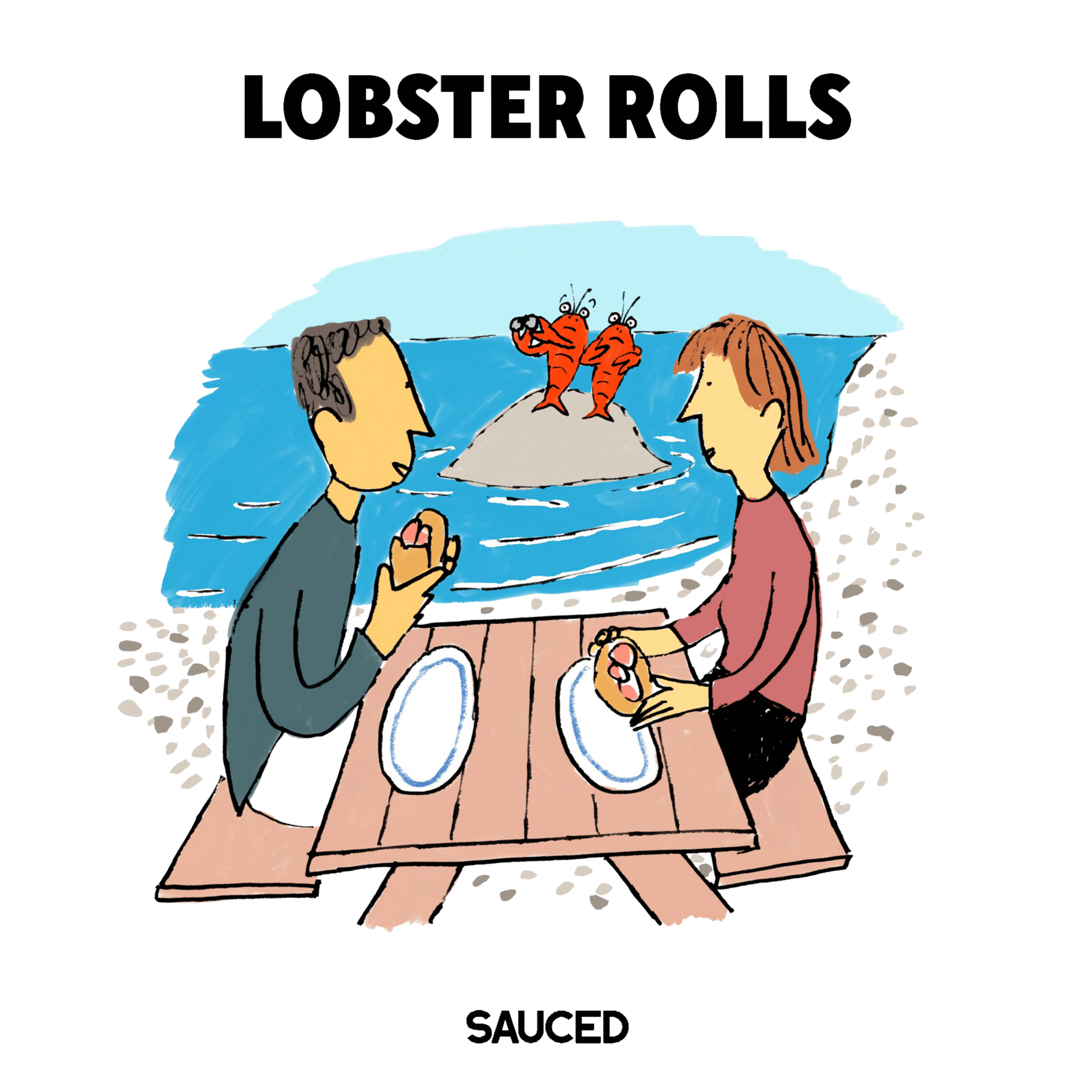
Lobster used to be fertilizer, fed to prisoners, piled two feet deep on the shore. In 1634, a heap of shells by your door meant you were too poor to eat anything else. This week we follow it to a fifty-dollar roll and figure out how the cockroach of the sea got its glow-up.
We take opposite corners on Maine (cold, mayo) against Connecticut (warm, butter). There's no booze in the dish, so this one is about what you pour beside it.
"This lobster got a real glow-up."
What we settled on:
Maine style: cold lobster, a little mayo, celery, on a griddled split-top bun
Steam to about 140 degrees in the tail, then shock in ice water
Keep the dressing light; the lobster is the star
The sweetest meat is the knuckle and claw, not the tail
Finish with Old Bay or paprika and a lemon wedge
The Cocktail:
The Maine Dispatch: an agricole rum Daiquiri with celery juice and tarragon.
RECIPE CARD:
Premium subscriber? Check out the full recipe card here.
LISTEN
EpiSOde Partners
Thanks to the following brands for partnering with Sauced to bring you this episode:
TRANSCRIPT
Tim McKirdy: Sother — height of summer as we record this. Perfect time for the shirt that you have on right now. Very nautical vibes you have going on. We are in Red Hook, a very nautical part of New York, where there happens to be a restaurant specializing in lobster rolls.
Sother Teague: Yeah, what's the restaurant here? Is it Luke's?
TM: No, Red Hook Lobster Pound.
ST: The Pound, that's right. It's right on the water too.
TM: No, that's the Crab Shack. Also does a lobster roll, slightly cheaper.
ST: The Crab Shack can't demand that cash because they don't have lobster in the title of their restaurant.
TM: Well, the Pound offers it with either fries or potato salad, and I'll be curious to get your take on that later on in the show.
ST: I have opinions, as you might imagine.
TM: This is one for opinions, right? There are two very specific regional or geographic approaches to this dish. We'll get into those in a little bit. But first, things that come to mind for you when it comes to the old lobster roll?
ST: I grew up on the coast. Not way up here, I grew up on the Gulf Coast, but seafood is a part of my DNA. I will default to it almost all the time. My desert island choice, if I had to pick only one style of protein, it would be seafood.
TM: That's pretty serendipitous.
ST: I have a huge attachment to lobster rolls because it really slots right into my favorite style of eating.
TM: I think for me, really not, I'll be honest with you. Lobster is one of those things that is much more held, kind of an elusive nature for me. Really didn't come across it a lot growing up. Really didn't cook with it all that much in restaurants where I worked. We had some nice little fresh starters, apps, but rarely would we do anything that would utilize the whole lobster or serving lobsters whole, and nothing like Lobster Thermidor, which of course is a dish where booze naturally finds a home in it. I will just say as an aside, I think for me, much like our recent burgers episode, this is more of a dish where I want to drink with food than say gravitating towards cooking with booze naturally.
ST: I kind of agree. There are some ways we could sneak it in if we really wanted to press the issue, but we'll get to that towards the end.
TM: So lobster, a little bit elusive for me, and then it's certainly something I've enjoyed moving here.
ST: Were you more attuned to langoustine then? That seems more UK menu.
TM: Yeah, certainly that would be much more common. And while we got into that whole debacle, not debacle, but the differences in our shrimp scampi episode. But langoustine definitely would be more of a fixture. I've been up to Maine, have had one of the classic styles there. Haven't had a lobster roll in Connecticut, which is the other claim to the throne.
ST: But you had the Connecticut style?
TM: I've had the Connecticut style, yeah.
ST: Just not in Connecticut. I mean, I've never had a lobster roll in Maine or Connecticut, but I love these things.
TM: Why don't you break down the styles for us now? Let's explore that early.
ST: All right. I have to build mnemonic devices for myself all the time to remember things, especially when it's just a binary. So the Maine I remember because it's M, mayonnaise. This one is served cold on a warm bun. The bun always needs to be warm and toasted. So Maine is the mayonnaise-based, kind of tuna salad but lobster instead, but a lot less ingredients. We want to make the lobster shine. C, Connecticut, clarified. So the Connecticut version is simply clarified butter and served warm in the toasted bun. And I have a druther, and I'm sure you do too, and we'll get to it. But I also have a situational druther. Do you know that word, druther? It's a very Southern word.
TM: We've been through this before. I think it's Scottish as well. But I might be confusing that with druth. Do you know what a druth is?
ST: No, I can't put it together. It's got something to do with truth.
TM: It's when you're thirsty, you have a druth. So maybe I'm mistaking that with druthers.
ST: Druther is a little more straightforward. It just means I'd rather. It's druther, somebody slipping in there with an apostrophe and shortening the words.
TM: Does seem more Southern than Scottish to me now that we're talking that through.
ST: It would be weird to say, do you have rathers? But do you have druthers? Does that make sense? I do, but again, they're situational, and we'll talk about why.
TM: Talk me through it.
ST: I think that growing up in Florida, a lobster roll to me was definitely the Maine version, mayonnaise, cold on that still-warm bun. Because where was I eating this thing? On the beach. And what was it on the beach? Hot. So I want this cold sandwich. Also, we probably packed it before to take to the sand with us. My house was on the sand, so we were always on the sand. But then I do think the purity of the drawn butter version, which is from New England where it's cold, so I think that's probably the one that's more traditional. And I think that's when I want that one. We're here in New York. If I want to go to Luke's Lobster in the city or wherever, I'm probably going there in the winter, and I still want that lobster roll. I want it to be warm.
TM: That makes sense to me.
ST: That's the druther to me.
TM: But backed into a corner and you have to pick one?
ST: The butter. Connecticut.
TM: The butter. Yeah, I knew it, because you're a purist.
ST: I think if you've listened to the show long enough, you know I have things like, I'll only eat chocolate or vanilla ice cream because I think that's the only two flavors there are. So that really aligns with my style of eating.
TM: Funnily enough, you also run a bar that has the largest selection of Amaro in the country, probably pushing worldwide top ten, I'm sure.
ST: I didn't say I wasn't eccentric and complicated.
TM: He's a complex man. He's our co-host over here, Sother Teague. I think myself, backed into a corner, I'm the Maine guy.
ST: You like the mayo.
TM: I like the mayo. And you know what I think it is, is that of course mayonnaise is rich and decadent, but there is an acidity to it, right? When you make mayonnaise, you need some form of acid component in there.
ST: Of course, vinegar, lemon juice, etc.
TM: I like that that helps just cut through things. I feel like it's a little bit more balanced. If I'm having the Connecticut style, it's rich on rich, arguably on rich, right? The bun that we're serving this in as well, I'm sure it's an enriched bun.
ST: Pillowy white, and you've got butter all over it and you've toasted it.
TM: So I think that's where I go. But I think also you're much more of a purist when it comes to really loving the essence of seafood, whereas I think my proteins are more on land or in the air for me. Or neither, as would be the case with the chicken's on land. Sorry.
ST: Where else would they be?
TM: I don't know, just hovering.
ST: They're not swimming.
TM: Neither up nor down. All right, Sother Teague, shall we get into some origins? Of course, we have exposed two of the main approaches there.
ST: Yeah, I'd love to know the origins of this. It seems pretty straightforward to me, but let's hear the facts you've unearthed.
TM: So you know how we have discussed in previous episodes that monkfish was poor man's lobster until it wasn't? Because it became so vaunted, people wanting it, that the price went more than lobster, which it was the replacement for.
ST: Right, it's what's known as bycatch. They weren't fishing for monkfish, but they would catch them accidentally, and then, honestly, the fishermen would eat them. But then they caught so much in abundance that they tried to sell them, and then they had to sell them pretty cheaply, because it's not the easiest thing to butcher, nor is it the easiest thing to look at. Monkfish is a fish that only its mother loves, on looks alone. But then this analogy got out there that it was poor man's lobster, because it has a very lobster-like texture and, frankly, flavor. And then the price sort of jumped exponentially. Monkfish is quite expensive.
TM: I liken it in the wine world to good Beaujolais, which was poor man's Burgundy, and now some of those Beaujolais crus are among the most expensive and sought-after wines in that style. But before monkfish, do you know what was poor man's lobster?
ST: I do, actually. It was lobster.
TM: It was indeed. I figured you'd get that one, but I thought I might catch you out. So lobster was not always a luxury. For most of American history, it was the opposite. Cheap enough to feed livestock and to bury in the fields as fertilizer. Native Americans along the eastern seaboard were the first to utilize lobster to fertilize their crops and use as bait for their fishing hooks, as well as eating the meat as a source of protein. Later on, when the first Europeans arrived, lobster was so plentiful that it reportedly piled up in mounds of up to two feet high on the shore after a storm. So you literally wouldn't even need to go fishing for these things.
ST: Well, right, but we know that lobster have that post-predation protection system where they begin to break down upon death. That's why we have to keep them alive until the last second.
TM: Well, get down to the shore. And I don't think they were necessarily dead, but just brought in from a storm, and it was just so many of them. But when they were caught up in fishermen's nets, they were considered cockroaches of the sea. As you mentioned, I think we see lobsters now, because of popular culture, as a luxurious thing that looks very interesting and very appealing. But I guess back in the day, and especially when they're not cooked, they don't look that appealing. We've been conditioned into thinking these things are really attractive.
ST: They look like a scorpion. Crabs look like spiders, you know. And I knew you were going to go down this road, because randomly, when I lived in North Carolina, I read a book that was some memoirs and letters back and forth from people who were imprisoned on the Outer Banks islands. And the prisoners were writing to their family, and there was more than one incidence in this book of the prisoners saying to their families things like, I've got to get out of here, I don't know if I can survive anymore, they're feeding us bugs. And that's because the prisoners were eating lobster while, on the other side of the bars, the guards were eating chicken. So imagine that. That's a real glow-up for the lobster.
TM: There are a lot of those stories as well, food historians saying prisoners were force-fed these or whatnot. I think there's the food historians' debate to what extent that almost hardship, as it were, was taking place. Some have actually traced it back to salmon, which would have been more common. But someone named William Wood in 1634 wrote that a heap of lobster shells outside of a house in New England, or wherever on the northeastern seaboard, was looked upon as a sign of poverty, because that was where you were getting your protein from. So do you know what causes the change in fortunes, or perception, of the old lobster?
ST: Randomly, I think I do. Refrigeration.
TM: Not quite, but close. So in Maine, the first lobster cannery opened in 1842, along with the building of the railroads and the spreading of the rail network across the U.S. Suddenly you get folks in the center of the country who have never come across this ingredient before. They judge it purely on taste, which I think we can all agree is delicious.
ST: Well, that's another thing that we could debate, right? If those prisoners were saying they're feeding us bugs, and they were eating lobster, it's not like they were getting a whole lobster with some crackers, a lobster tool to get in, some drawn butter on the side, perfectly poached. They were getting it stewed for hours. Probably really terrible texture.
TM: Yeah, rubbery, dry. I'm sure that whoever was serving the food wasn't going to the extent of breaking these things down, cracking the shell.
ST: Right, but they're basing their judgment on the flavor that they're getting out of these canned products. They're not seeing the whole animal. It doesn't look like a bug to them. Canned foods are honestly a revelation that saved lots of people's lives, because food was more accessible.
TM: So you have lobster travelling to the center of the country, and at the same time you have folks who might not have been able to get to the seaside being able to travel there with the railroads, coming to the coast, trying these local delicacies. The lobster roll itself, that is obviously harder to trace. There is the Connecticut claim of around 1929 in the Encyclopedia of American Food and Drink. It is credited that the first lobster roll was prepared in a place called Perry's in Milford, Connecticut, served hot, and the meat in drawn butter, which we'll get into in a little bit. And then up the coast in Maine, where we said we're going mayo, M, the place that a lot of people point to, Red's Eats in Wiscasset, Maine, is sort of the archetype for the Maine lobster roll. You heard of this place?
ST: No. I just like the name, Red's. Where are you going? I'm going down to Red's, get myself a lobster roll and a beer. I don't know, sounds good.
TM: Honestly, if you look up this shack, it's exactly what you think it might look like.
ST: I would hope nothing less.
TM: But they're known for serving these massively oversized, overstuffed rolls. At least, I think it's more than one lobster per serving that they serve. And their website very much looks like it comes out of the 1970s. It's still family run, I believe. It looks like this thing is Web 2.0 or whatever. I've got to get myself over there.
ST: Frozen in time. Let's go, road trip.
TM: What do you think a lobster roll runs you these days? And the standard is basically one per roll, right?
ST: Like a one-and-a-half-pound, what's called a chick lobster, is typical for a lobster roll. You're getting all that meat from the tail and the knuckles, which are the arms, and the claws themselves. They're probably not going through all the effort of getting the meats out of the legs, but they're probably using all those shells to make stocks and do other things with.
TM: Lobster bisque. Love it.
ST: So you're looking at a one-and-a-half-pound lobster per roll. I mean, standard price in New York anyway is like thirty, thirty-two.
TM: Some of the local institutions I looked up, and not just the two named earlier, I was doing a little peruse earlier today.
ST: A little price shopping.
TM: A little price shopping. Because I think it is one of those things, every year it comes around and people are like, wait, lobster rolls are how much this year? I saw prices much closer to thirty-five to fifty, depending on what it would be served with. But I'm not on about like with caviar, I'm on about, does it come with a side or not?
ST: Right. Wow, thirty-five to fifty.
TM: That's a lot of money, man.
ST: It is, man. Probably explains why I haven't had one this year yet. Summer's not over.
TM: He just does two a year, folks. One Connecticut, one Maine.
ST: No, I have no rules about lobster. If there's lobster around, I'm eating it.
TM: So that is the changing fortunes, and then further solidifying its place as a luxury product. In 1997, Rebecca Charles opened Pearl Oyster Bar on Cornelia Street in the West Village, serving a very pared-back Maine-style lobster roll, again just letting the bounty show its beauty. And then in 2009, something you referenced earlier, Luke Holden, who comes from a Maine lobstering family and had a finance job on Wall Street, opens Luke's Lobster in the East Village. And that subsequently has a couple more locations. At least I know there's one down in —
ST: He's global. There's one in Singapore. He's gone big.
TM: Oh, wow, okay. I didn't realize it was quite that big. I knew there was multiple locations.
ST: So he grew up as a fisherman. I do know about him. He was literally in high school, still a senior in high school, when he built his own lobster boat and got out there on the water to do some lobstering at that age. His dad was a fisherman as well, which is common in that area. He went off to law school, became a lawyer, did not love lawyering, and then got together with his dad, actually, and opened the first Luke's Lobster. And now they're a global situation.
TM: Wow.
ST: Chase your passion.
TM: Chasing that lobster tail.
ST: He really had an impact on the globalization of the lobster world. Certainly regional, certainly became popular in all of our country, because we're talking about the American lobster, right? Homarus americanus. As you said, you didn't eat these when you grew up in the UK, but I bet there's a Luke's in the UK somewhere now, and there will be more people who do have that experience where you didn't.
TM: Yeah. Well, I will ask you to pause for just a little bit more there with our culinary luminaries and notable figures, because we're going to take our first break of the show today, and then we shall be back.
ST: Let's go.
TM: All right, Sother, we're back. The luminaries. We mentioned Luke.
ST: We skipped a pretty important thing, but you sort of actually described it at length, and I'm just going to say it in short order. We always talk about, is this a prince's or a pauper's dish? Clearly it began as a pauper's dish, and it has absolutely moved up the ladder. This lobster got a real glow-up.
TM: Yeah. I mean, if I'm spending fifty for lunch, and that's for lunch, and I'm probably hungry by dinnertime.
ST: And that's for lunch. I think it's also important to note, lobster, and a lobster roll even with the bread, it's not a heavy meal. Even if it's rich, you've got some butter or mayonnaise happening here, you've got the bread, which we talked about, it's very pillowy soft and enriched. It's like hot dogs. I feel like I could eat another hot dog at any time. Even if I'm not hungry, I could eat a hot dog. I could eat four hot dogs, and I could eat a hot dog. If enough lobster rolls were lined up, I'd just keep on eating them. So I get what you're saying. They're expensive, and they're also delicious, but not really filling.
TM: That's the difference, and you said it there. They're rich, but that doesn't necessarily mean they're filling. Richness speaks more to flavor and texture, I would say. So, other figures, other folks to highlight in their approach or their words on the lobster roll?
ST: I think there's just two that I really want to talk about, that we'd be remiss if we skipped over. The late Jasper White, who passed in 2024, was, I think, the foremost authority on New England-style cuisine in our country. He wrote four different books, one of them called Lobster at Home, in 1998, where he dug very deeply into this dish and this whole culture of eating lobster and using it in the ways that we use it all over the world. He was a great dude and a real spokesperson for this region in general, and specifically this animal.
TM: And do you know what Jasper's signature move was?
ST: No, off the top ropes. What are we talking about? I didn't know he was a wrestler. What was his signature move?
TM: Jasper's preparation. Hellmann's mayonnaise with diced cucumber and sliced scallion in place of the sometimes more common celery.
ST: Cucumber with — what'd you say? Celery, and — I'm sorry, not celery. Cucumber and —
TM: Scallion.
ST: Oh, I love scallions.
TM: I like that, the cooling effect of the cucumber. I might top it with some paprika or Old Bay.
ST: Old Bay. I mean, that's where we're on the eastern seaboard.
TM: And some lemon. But we're getting ahead of ourselves. So you said two people. Is the next perhaps Rebecca Charles?
ST: It's not. It's not even a person, really. I mean, I guess it's a person. J.J. Nissen. Do you know who that is? So, do you know, if I just said Nissen Bakery, would you know who that is? So Nissen Bakery is the first to make the split-top roll, which has become sort of the signature of the lobster roll, right? You can't just use a side-split roll. It stands up, it's easy to toast on both sides, it cradles the ingredients when you put them in there. Without it, I don't know that you can't have a lobster roll, but this is an identifier. For me, when we get to the non-negotiables, a split-top roll is a non-negotiable. Doesn't have to be necessarily from Nissen, there's a bunch of people make them now, but the split-top roll.
TM: Do we think that that was one of those things, like the Sbagliato? It was like, oh crap, I cut the roll the wrong way, let's just tell them this is on purpose?
ST: Right, no, I actually looked into it, because I thought kind of the same thing, what's the difference? But you have to have different equipment, different machinery, and it's more labor-intensive. So no, you would not make this by accident and keep doing it, right? It's going to cost you more in every way. But no, it was an engineering question. They saw that there was a need for this, and they produced a product and filled the void.
TM: Do you remember, I want to say it was either 2018 or 2019, I don't know how much of an online person you are when it comes to internet culture, there was a meme going around that was like St. Louis style.
ST: I don't remember.
TM: So it started with something, I can't remember. Someone was like, this is how we do it in St. Louis. And it referred to some kind of food preparation that everyone was like, this is bizarre.
ST: Right, like Cincinnati chili. Cincinnati five-way, this is how we do it.
TM: And the response to it, as people do in glorious form on the internet oftentimes, where they were just parodying it. So imagine, for example, I think it was St. Louis, and it was like St. Louis-style hot dog. So imagine a hot dog bun, and rather than the hot dog running with the bun, they made a hole in it and the hot dog cut the bun perpendicularly, and they would cut pizza in a weird way, and everything was just like St. Louis style. Anyway, if it's not St. Louis, I'm sorry, folks over there, it was somewhere else. But honestly, it was one of my fondest memories.
ST: The internet, it remains undefeated.
TM: Simpler times, perhaps.
ST: I looked at both of our J's, Jacques and Julia. Julia just said that lobster's natural sweetness needs little embellishment, which I agree with. And I think that's why I prefer just the drawn butter version, clarified butter. Jacques just talked about always using all of the lobster. If you're getting a whole lobster, let's not squander the lobster. Let's use all the meat. Do you know the method of getting the meats out of the skinny little legs? You can lie them down facing away from you in a row, and you can take a wine bottle or whatever you've got handy, a roller, and you can kind of roll them, and it'll shoot out little spaghettis, little strips of lobster will come flying out of there. And then using the shells to make stock, pureeing them to make bisque. Jacques, of course, always very practical in his use of everything.
TM: My chef would always, whenever we were preparing lobster when we had it on the menu, be very careful for us to extract the coral. And we would use that to make like a modified sauce. It's kind of like mayo. Can you talk to us about that ingredient?
ST: Sure. You've got two different things up inside, what's the word I'm looking for, the physiology. We were looking at what we would call the head. So up inside the head there, you've got the coral, which is the roe effectively, and then you've got tomalley, which is the liver. One of them is a brighter color, coral.
TM: The coral is bright blue. It's electric blue.
ST: Yeah, and then the tomalley is dark, inky-looking, and kind of has an inky, seafood-y flavor. You can take both of these things and use them in things like you just said, like emulsify the coral into like a beurre blanc to serve with that lobster, delightful. That tomalley you can pull out of there, and it's not spelled like tamale, it's spelled different.
TM: I was going to say. Different kind of street food.
ST: Can we use that in a tamale? Tomalley tamales. Oh my gosh, we're starting our new business here.
TM: It's meta.
ST: It's tomalley squared.
TM: Anthropology.
ST: But that, you can use to whip into, make a tomalley butter to use, spread on toast, and griddle. Like if you had some tomalley butter to griddle the outside of your lobster roll, let's go.
TM: The coral I learned the hard way. The first time I was preparing a lobster, no one had told me about that.
ST: No, you threw it away.
TM: Threw it away. My chef went ballistic.
ST: Yeah, can't blame him. I can only blame him for hiring you. He can only blame himself for hiring you. Listen, you don't know what you don't know.
TM: Exactly. Listen, you make that mistake once, you will never make it again. It haunts me.
ST: To this day, apparently.
TM: But I'd asked you about Rebecca Charles. Obviously, mentioned Pearl Oyster Bar earlier on. Cold meat, a little Hellmann's, squeeze of lemon, snipped chives, and a touch of finely chopped celery.
ST: Gotta peel your celery, folks. You knew I was saying it. Peel that celery.
TM: You know where I might want to go, and this is a little riff.
ST: In this instance, also, if I was going to dice some celery, I would peel it, I would dice it, and I might even lightly poach it in a little bit of wine before adding it, chilling it, and adding it to my salad.
TM: Well, you just cut me off, and I was exactly about to say that, although I was going to be more like a pickled celery, pickled brunoise.
ST: I don't want to overtake any flavors of the lobster. We'll get to what we have, this is a great episode because I love this dish, when we get to it. One of the things I probably want on the side is like a nice crisp dill pickle, but I want it on the side so I can control the balance.
TM: Well, you know what you probably also will have on the side there.
ST: I know exactly what I want. I know we're probably going to argue.
TM: You're going to have a scallion.
ST: Oh, for sure. And what I'm probably not going to have, though, is a pepper, because I don't want to mask this thing.
TM: What I was going to say is, how I knew that is, we just recorded and released recently a bonus episode of Sauced. This goes out for our premium subscribers once a month. And that bonus episode was a deep dive on chili peppers, wherein you revealed, among many other things, all of them good —
ST: Probably not.
TM: Or maybe not, folks, you'll need to subscribe to find out. You revealed that you like to have a scallion and a hot chili pepper, hot in terms of SHUs, alongside every kind of plate of food you have. And like I said, that's for our premium subscribers. Tell us about the proposition there.
ST: Yeah, premium subscribers get all of the recipes that we do for both food and drink, delivered to your email on a digital card that's got this beautiful artwork done by our friend out in the UK. Her name I always forget.
TM: Charlotte.
ST: Charlotte Ager, right.
TM: Our illustrator.
ST: And you'll get bonus episodes, which, again, we just talked about the one we did about chilies, but we always dive deeply into an ingredient, aside, some sort of technique, or some history. And they're all tons of fun, because we get to get a little off-topic and rip it up. And all of this is for just the low, low price of seven a month. But if you sign on for an entire year at once, we'll knock off two months, so we'll save you fourteen, and you get all that cool stuff.
TM: I am in. You got me hook, line, and sinker.
ST: I got you with a lobster box.
TM: All right, Sother. Well, those have been the culinary luminaries. We're going to take another quick break now, then we're going to be back with the non-negotiables. All right, Sother, we're back. It's the non-negotiables.
ST: The brass tacks. Let's get to it.
TM: Number one?
ST: I mean, lobster. Preferably live and fresh, but if you can't get that, there's plenty of seafood mongers who will sell you already cooked and separated meats. But we need lobster, and it needs to be in pretty large chunks. I don't want it shredded. There's a use for shredded, but this ain't it.
TM: Non-negotiable number two. We've covered it. It's got to be the split-top bun.
ST: Yeah, for sure. And then for me, number three is, whichever way you decide to go, Connecticut or Maine, clarified or mayo, minimal dressing, right? Either one of these is a dressing. One's just butter, but the other one is literally a dressing. You don't need much. The lobster has to be the star of the show. And if I can take two in a row here, I'll also say you need to make sure that the bread-to-lobster ratio is lobster-heavy. The bread's the taco shell, it's not the innards, right? It needs to get it there. You need to have it, you can't have this dish without it, but the ratio needs to be lobster's the star. That's all I'm saying.
TM: I know, and I agree with that in principle. Just from a very personal perspective, I feel like I want a more even bread-to-lobster ratio. Just give me two rolls.
ST: Like tacos, street tacos. You get two tortillas, you pick up the top one and you eat it, and whatever falls off onto the other one, you then pick that one up and eat it.
TM: Exactly. I'm not asking you for more lobster, right? I'm not saying go two whole lobsters. Give me one, but just split it across two buns. Do you reckon I could go to a restaurant and ask for that?
ST: I'm a hundred. Listen, if it's a restaurant, they have food back there, they want to sell it. So you say, I would like your lobster roll please, as it comes. Can I have a bun on the side as well? They will charge you for that.
TM: That's the way to ask for it. What do you reckon they're charging me? Who knows.
ST: For a bun, two bucks, four bucks, who knows.
TM: What if I just bring my own?
ST: And a little electric griddle so you could toast it up.
TM: Well, I will say this, and that is part of the non-negotiable when it comes to the bun. Has to be buttered and toasted on the flat.
ST: Yeah, griddled. I think we keep saying toasted, because we know what we're saying, but what we should be saying to our audience is griddled, like a grilled cheese. You've got your flat split-top bun, which will lie flat on both of its sides. You butter both sides, you griddle it till it's nice and toasty, like a grilled cheese, flip it over, you do the same on the other side, keeping it still soft and warm inside. And then you put in that lobster, either the cold mayonnaise version or the warm butter version.
TM: Totally. You mentioned it earlier. Is this a non-negotiable? You mentioned you want chunks. Do you go as far as to say you don't want those to have been cut, you want them to be torn?
ST: No, no, no. You've got to cut the tail up. You've got to cut the knuckle, which is again the arms. Those will already kind of naturally be the right size. The claws will need to be cut, and the tail will need to be cut. Pulling it, it's not tender enough to pull.
TM: There are some folks out there who say that, and again, I don't believe this to be true, I'm just saying, that using a knife can impart an ever so slight metallic taste.
ST: So use your ceramic knife. Listen, try and pull shrimp apart. Lobster and shrimp have a very similar texture. It's not a pullable thing.
TM: I'm just telling you what's out there.
ST: Listen, I'm sure someone out there is using that little thing that you twist chicken in that looks like your tobacco grinder.
TM: Oh my God. Well, speaking of people using weird things on the internet, I know there is someone you follow who makes every single kitchen tool out of wood. He's set himself the task to turn everything into wood, and that's why I'm just like, wooden knife.
ST: Wooden knife win. Bring me my wooden knife. It's easy to sharpen, you just need some fine-grit sandpaper. Every time it's getting dull.
TM: I think there's one more thing that I want us to get into when it comes to the M's here. Mayo, but not melted butter. Drawn butter, as we have said, or we've said clarified butter. I'd never heard the term drawn before today.
ST: You kind of reminded me, that's the term that my parents used, my family, all my growing up. And then when I got in the kitchen, I code-switched to clarified. It's the same thing.
TM: You are turning the butter from a solid state into a liquid state, so yes, we are melting. However, we're also separating —
ST: The milk solids from the fat.
TM: And you're drawing off the fat or the solids, depending on how you're doing this. I have seen people do both ways. And you're not cooking it so far as to some of those milk fats are browning, that would be our lovely beurre noisette, phenomenal but not in this instance. But some people use the terms interchangeably, melted butter and drawn butter. Not the same thing, because melted is, those milk solids are still in there. And that is our Maurice melted butter myth of the day.
ST: Wow, good one. We used to use so much clarified butter at a restaurant that I worked at, that we'd take fifty-pound blocks of butter and have to cut some of it off so that the whole thing would fit in our thirty-five-pound-capacity fryer. And we'd drop the whole thing into the fryer and let it melt. Because when you look at a commercial fryer, if you're looking from above, it's got two sloping sides, and the heating elements are inside those, like it's like a wheel well of a car. But then it's sloped into the middle, so that way any solids, when you're frying whatever, chicken, etc., those solids fall down below the heating element, so they're not burning in the oil. So the same thing with butter. It's quite easy. You just put it on pretty low temperature, it melts the butter, and all the milk solids fall down to the middle without burning or browning, because we weren't trying to make brown butter. And then you have this whole thirty-five-pound well of clarified butter.
TM: One of the great kitchen lessons you learn by failure.
ST: Oh yeah, burning butter.
TM: Oh no, I was just going to say, with the deep fat fryer. Regularly you want to be cleaning your oil or changing the oil, so you're draining that thing, cleaning it. Hopefully you're doing it, but maybe the kitchen porters are doing it. Once you're done, remember to close it off again. I have seen it where someone's just done a great job.
ST: Close the valve. Oh, I've seen it too. We've all seen it.
TM: And also, I don't think this is a mistake that everyone needs to make once in their life, I don't think it's a mistake that anyone needs to make in their life, but I did see one fellow young chef sort of questioning, what would happen if I threw an ice cube in a deep fat fryer? Not good things, folks. Don't do that.
ST: Listen, curiosity will get the best of you. Crackling and popping and, depending on how much ice in there, we might have some overflow. No one needs to put a bullet in the furnace to see what'll happen. Eventually it'll go off, that's what'll happen. We don't need to do it to see it.
TM: Yes, please don't do that. Be very careful with a deep fat fryer, both at home and certainly in the kitchen. So those have been the non-negotiables.
ST: Yeah, pretty short list again, which I love. I love the dishes that we do that are the most simple, because weirdly, we come into the room here at the studio over in building three, and when it's so minimal ingredients and even technique, I'm always like, man, we have too much time. And then we get in it and I'm like, man, we could talk for another hour. But let's get to it. Okay, so that was the non-negotiables.
TM: I thought we should do a little bit more of an exploration of lobster, because I think it is probably one of those ingredients, correct me if I'm wrong here, where most folks listening will have eaten way more of it than they've cooked. And I think it can be an intimidating ingredient.
ST: Yeah. I think most of what we see the home consumer in America eating at home, they're probably eating plenty of lobster out and about, but the ratio of how much they're cooking versus how much they're eating over their lifetime is probably pretty skewed. I think what we see most, the American consumer eating, is frozen lobster tails, because you can see those everywhere, at the grocery store, at Costco. It's the whole lobster which we're talking about. And also, the frozen lobster tail is probably not an American lobster. It's the Australian one that doesn't have claws. It's a spiny lobster.
TM: So I wanted us to track it from the sea to the roll, essentially, here with your guidance. So if I'm questioning you here, talk to me about, you mentioned before, size of the lobster. What are we looking for? Market sizes, common variance?
ST: One pound is the lowest they're legally allowed to market, and most people don't. Most, what you're going to see is a one and a half, because they want to keep, for sustainability reasons, they don't really hold onto a lot of one-pounders. And one and a half is kind of a standard market size, one and a half to two. You can find some three-pounders at your local market, and you can special order larger ones if you want, and then you'll just have to wait for them to come. But generally speaking, you want to go to a place that has a tank, that has them alive, that you can see them in the water. They can live for quite some time out of the water. If you're there purchasing a lobster that's not in the water, look at their mouth area, and if there's a lot of bubbles there, they're foaming, they're struggling, so they're probably not in the best condition. When I was a seafood monger, when I would have the foamers happening, we'd pull them and we'd just cook them and we'd sell the cooked meat, because they need to go soon. Try and grab ones that are lively looking. And go to places that sell them consistently, because the longer the lobster's in the tank, the longer it hasn't eaten, and they lose weight. So suddenly you're paying for a lobster, and when you bust open his shell, there's not a lot of meat in there. You can see that sometimes when you break open a tail or a claw, and the shell is much — there will be shrinkage, there's always shrinkage from cooking, but if it's a huge difference in the size of the meat that was inside the shell versus the size of the shell itself, your lobster was probably somewhat starved.
TM: Let me pause you there for a second as well. We're talking about shells here. Tell us the difference between hard shell versus new shell.
ST: Well, hard shells are — so all throughout their lives, lobsters molt, and that's how they grow. They have an exoskeleton, so they can't grow until they've shed a shell. Then for a while they have what's called a soft shell, just like soft shell crabs, and then they go through a phase called paper shell, and then they have their hard shell again. So it's just the timing. The harder the shell is, the closer the lobster is to potentially molting and growing to the next size up. So to that end, the harder the shell, probably the opposite of what I just talked about with starving lobster, the more meat is inside the shell. Like, wow, how did this meat fit in the shell? It was almost bursting out, because it was about to burst out.
TM: So I have here, new shell or soft shell, roughly the season would be mid-June to November. And the seawater — this is what I came across that is totally all new to me, so tell me if I'm mistaken on any of this — seawater sits in the gap between the meat and the new shell and gently seasons it from the inside. So the newer shell ones, the meat is going to be the sweetest and the most tender you're going to get, but the payoff, like you say, is size. A new shell lobster gives you less meat and more water, and the fragile new shell doesn't travel as well compared to the harder shell, which is of course a consideration for us when transporting livestock.
ST: I mean, it's livestock.
TM: All right, cool. So then I think another thing —
ST: Well, there's one more thing to look out for as a consumer. And you're probably not going to find these in your market, to be honest. You'd have to go to like a monger. Not your normal grocery store, they're going to have whole lobsters. But if you go to a seafood monger, he's going to occasionally get ones that are missing an arm, or frankly missing both arms. They're typically cheaper by the pound, and there's good value there. They're called culls when they're missing one of their arms. They fight, they battle, they're out there living their Viking life.
TM: We have a different name in the UK, but you told me off last time I said it, so I'm not going to repeat it.
ST: Wait, what was it? You did tell me. What was it called? Pistols?
TM: No, we would order them from our seafood purveyors as crippled lobsters.
ST: Crippled. That's right.
TM: And it's very true to the meaning of the word. But there are some negative connotations there these days. Actually, one of the only times where I have cooked lobster for my family, we went out and bought those, what do you call them, culls. We bought culls and we served them by the sea. Very nice.
ST: Yeah, you can get culls, and then there's bullets. They're missing both arms.
TM: Bullets, okay, very cool. The next one that I think is the thing that people aren't sure about, there's some myths surrounding it, people don't know what to do, that is, once you're home with this live product, how do you ethically, and how should you, kill and dispatch the creature when cooking?
ST: Well, so that's the word you used, both. So I only use one word, right? It's dispatching. We're dispatching all these animals, whether it's this lobster or a chicken or a goat or what have you. They're going into service for us. And there's a new UK law that says you can no longer cook — restaurants, and certainly they're not going to come into your home, but the restaurants are now having to abide, you can no longer cook them from live.
TM: I think that was even in place when I was —
ST: Was it? I thought it was relatively new. I feel like I just read about it, maybe during research for this.
TM: Whenever any association I've ever had with lobster was like, you're not supposed to do that. So maybe it wasn't written into law, but it was standard practice and frowned upon, for sure.
ST: Sure. So, the most humane way is to lay the animal down, depending on your dominant hand, with the head facing your dominant hand. You'll see that there's like this little cross on the back of what we would consider the head. If you pinpoint your knife into that and then rock it forward, basically bifurcating his head in half, his or her, this is said to dispatch them instantly. So that's the most humane way to go.
TM: One thing you can do as well, if you're at home and if you're not too familiar with all of this, this is a creature, it's moving around, they will have rubber bands on their claws. You can put it in the freezer for fifteen to thirty minutes, and it's just going to relax that and make things a lot more calm before you're working. For those people who — the other common method beforehand, like you said, is head first directly into a screaming hot pan of water. And I say screaming because a lot of people thought that that was the lobster screaming when it went in. It makes a noise that is steam evaporating and leaving the shell.
ST: Yeah, they have no vocal cords. But I would reiterate, take that rubber band off. I never understood — and I worked for chefs who would argue with me about this — but if that thing is on the shell, and the shells are porous, which they are, then I can taste the rubber in the claw. Get the rubber band off of there. I used to work with another chef who would cook his asparagus still banded together.
TM: What?
ST: I'm like, bro.
TM: All right, so that's dispatching. And then let's talk about just cooking lobster now, because we mentioned a few times, screaming hot pan of water, people think that that's the way to go. It certainly is a way to cook them, but I know from a brief discussion, both of us are not in that camp.
ST: No. I think most of my young life, we certainly boiled seafood all the time, but I think if you're having lobster, you're better served by steaming it. Boiling the lobster is going to kind of waterlog it. Steaming will not do that. I mean, that's really the difference. I don't want to dilute the flavor of the lobster by plunging it into a depth of boiling water when I can just steam it. Also, steaming method is much quicker, not necessarily for the cooking time, but for the getting-to-temperature time. I can have just a couple of inches of liquid in the bottom of my braising pan or whatever with a rack in there, so that I can just get the steam.
TM: You want to cook it to around 140 degrees Fahrenheit in the tail. After that, it's going to very quickly turn rubbery and dry.
ST: Yeah, you're really cutting it close there, 135, 140, because once you hit 145, you're going to start to get that bounce that's not as delightful. I'm still going to eat it.
TM: The other thing for us to note here as well is, next to however you're cooking it, you want a big old bath of ice water so you can immediately shock it, which does make it difficult if you're trying to serve it hot.
ST: Well, I'm going to pick up the warm one. Pick up always means we've got all of our prep ready and now it's time to get to a place of eating. I'm going to pick up the warm one by tossing it into a warm bath of the butter.
TM: Drawn butter, not melted.
ST: Drawn butter. Sure. Not melted. Melted butter still has the milk fats in there. Clarified slash drawn.
TM: So definitely start paying very close attention at around 130, and start being ready to pull, like you said, 135, no more than 140.
ST: Yeah, and there's other ways to do lobster as well. We could certainly sous vide this guy if you've got the patience for that. And then at restaurants, we butter poach. So we're poaching, not in boiling water or poaching-level water, we're not steaming, we're literally cooking it in the butter that we're probably going to serve it with later anyway. So as time goes on and I cook numerous lobsters in that butter, that butter is lobster butter.
TM: Solera. Another thing here, if we did want to cook with booze, give me some options.
ST: There's a few. We just decided we're going to steam our lobster. We've been talking a lot throughout the life of Sauced here that anytime that we could cook with wine, we could probably use vermouth and get some herbal quality. So we could steam the lobster with some vermouth. I don't know how much of that's going to permeate the shell. It's going to make your house smell real good. If that's a qualifier for you, then that's good. You could also put your steamer basket inside for the lobster to sit in, and you could have the bottom be filled with beer, and throw a couple of brats in there, so you'd have some beer brats underneath the lobster. Like I said, a lobster roll is not super filling, it's rich but not filling, so maybe a brat would go with this. Throw some clams in there, like have a real New England boil.
TM: Crack a Narragansett.
ST: Oh, that's the pairing section coming later.
TM: Ha, that's the pairing section that's coming later.
ST: Narragansett literally says on their can, the official beer of the clam, made on honor, sold on merit. Narragansett. Listen, they're not a sponsor, but I just love them, ever since I saw Quint crush that can on Jaws. You saw Jaws? Tell me you saw Jaws.
TM: It's a clap, come on.
ST: Listen, you've never seen Saturday Night Live? Now I don't trust that you've seen anything. You told me you've never watched the Food Network, you've never seen Saturday Night Live.
TM: I've seen Saturday Night Fever, and I've seen Jaws, in fact.
ST: Saturday Night Fever is a different thing than Saturday Night Live. But yes, I understand. Anyway, Quint crushes the Narragansett can.
TM: When I was working as an editor at VinePair, we ran a series of articles that was all about drinking on the big screen, and friend of the show Brad Thomas Parsons wrote a wonderful piece that I edited and worked on with him about Jaws, and about the significance of the drinking scene in that movie, because it foreshadows a lot of stuff.
ST: It does. I'll have to go look it up, because I'm a huge fan of that movie. This past year was its fiftieth anniversary, and they replayed it in theaters, so I finally got to see it for the first time in my life on the big screen, because the movie came out when I was six years old, so I didn't see it in the theater.
TM: And I believe Jaws is the origin story for the word blockbuster.
ST: It is. You're right, it's the first blockbuster movie. But here's the thing about Jaws that's your real takeaway in learning, and then we'll get back to lobster. In Jaws 2, it's the same mayor. So it's real important to vote in local elections.
TM: There you go. Not just cooking advice, folks, or drinking advice.
ST: I'm just saying, it's real important to vote in general, but it's certainly important to vote in the local elections as well. All right, that was all our non-negotiables. That's our cooking methodology. What's next?
TM: That's our lobster deep dive. Let's do a little exploration now when it comes to sides. Normally, oftentimes we'll do it after the preparation, but let's throw it in before today.
ST: Let me scroll down. I know what I want, but I have a list of them here. Okay, you ready? What sides do you want first?
TM: I want fries.
ST: Wrong.
TM: Why?
ST: This is a situation where I think a French fry is going to get in the way, because what are you going to want to do with that fry? You're going to want to dip it in something like ketchup. Something's going to get screwy. Plus, I think texturally it's wrong. And I think, if I'm not incorrect, most of the places that I go that have a lobster roll, it's thin, crisp, salt-flavored potato chips.
TM: Nah, not for me. The lowest rung on the potato chip ladder, for sure.
ST: Oh my God, we're about to have a fight. That is the best potato chip.
TM: No, not for me. Do you remember — did they sell them here? They used to have, I can't remember what they were called, these really cheap bags of crisps, potato chips, right? You know how you'd see things on Looney Tunes that was like Acme-branded everything, and everything was just no branding? These were the most minimally branded potato chips ever, and they arrived with a little sachet of salt in there, so you salted your own. Interactive.
ST: Oh no, I never saw that. But that's amazing. But it wouldn't be stuck, right? You need to get them salted right out of the oil.
TM: Well, there's a whole technique. You rip it off, you pour it in, you give it a — it's a lot of fun. Don't play with your food, some people say, but time and a place.
ST: I think this entire show is about playing with your food.
TM: See what you're saying, but it's just, so what's the point of the potato chip then? Texture?
ST: A little bit of texture, a little added salt. Yeah.
TM: So what is the difference between a salted French fry and a salted potato chip?
ST: Well, a French fry is hopefully crispy on the outside but potatoey on the inside.
TM: But I'm talking flavor-wise.
ST: So it's a stick of mashed potato.
TM: Just, because some folks have ketchup with fries, I know people who have ketchup with potato chips. One of them is upstairs right now.
ST: Yeah, they're called Canadians. All right, the potato debate, we can go wherever you want to go.
TM: What about potato salad then?
ST: No. I don't think you mentioned that earlier, and it's not even on my options list here. I would say my next one would be, I would like to see, we talked about it already, like a crisp, dilly, maybe garlicky pickle on the side. Though I don't want pickle in my mayonnaise-y — which I do in tuna salad, but I don't want in lobster salad.
TM: I love how you set these arbitrary rules, but you don't hold yourself to them. The pickled flavor is arguably as sharp, as piercing, and as strong as ketchup.
ST: But it's briny, and so is my lobster. Ketchup isn't briny, ketchup is salty. There's a difference.
TM: Okay. What about when it comes to just on there with it, if we are going the Maine style? We've given a couple of options earlier, celery, pickled or otherwise, definitely peeled, cucumbers the outlier, scallions, chives. What are you thinking?
ST: I might throw in some tarragon, just because tarragon and lobster are such a common pairing. You could maybe even go, as you said, top it off once it's already in the bun, just a dusting of like Old Bay or paprika. I could see an argument for like small-diced and still kind of firm avocado, but that's kind of where it ends. And then you already said chives or scallions.
TM: Chives or scallions. That's the avocado, California style they're calling it. And then the other one that they serve over there at the Pound, they do a lobster BLT.
ST: Oh, bacon. Yeah, I can see bacon going in there. But again, I think, as you always say, the smokiness of bacon is going to detract from — I want this to be lobster. I feel like if I add too many things to this dish, we maybe don't drift too far from being still a lobster roll, but we drift far from me being able to say, man, today I had lobster.
TM: You see, the thing is, you can still say that, and you can still take my approach, which, I say lobster is the chicken of the sea.
ST: That's literally tuna. That's literally, canned tuna is chicken of the sea.
TM: I want my lobster to just be a vehicle for giving me some texture in the bun for a nice sauce.
ST: Well, there's so many less expensive ways to get that. Make a shrimp roll.
TM: But then I can't turn around and say —
ST: Today I had lobster. How about a buttery, butter-poached corn on the cob on the side?
TM: Yes. Now that you mentioned that, I did see, I can't remember exactly, but I'm pretty sure I saw, you had seen it too, something on Instagram recently where someone had this revolutionary corn cooking technique that I want to use. Did you see that?
ST: I did. I don't think it's necessarily revolutionary, it's just using the numbers that we have. There's a temperature point where the proteins in the corn break down without getting waterlogged. You know, often you have corn that's like too wet, and then when you bite the corn it doesn't pull away from the cob cleanly, it's like shreds in your teeth. So there's a temperature point you bring it to, and then you shut off the heat and put a lid on for X amount of time, to hold at that temperature. That's what's going to make the plumpest, juiciest, but still crisp corn. And I'd like to do that in butter.
TM: Same. Maybe sous vide. That's how I cook my corn at home.
ST: You're sous vide-ing your corn? You're an animal. I love it, that sounds great, but I'm just too impatient.
TM: Because I like to do it, when we grill, I'll do it the day before, so I cook it that way and then just really finish it on the grill, bring it up to room temperature and just char it on there. So you have to just keep an eye on that with the bag and the sous vide, you want to make sure it's clipped to the side of your pan, because it'll try and float up.
ST: I got two more that I might want on the side. Might. Honestly, for me, I think it's just those crisp chips. Two left, though. A nice chunk of like lightly salted watermelon.
TM: Interesting. Very non-traditional.
ST: Very non-traditional. And then the final, final one, the final boss, if I'm feeling super luxurious, a little bit of caviar. Like three little bumps right on top of the length of the roll, which also go very well with thin, salty crisps.
TM: That's true. Okay, and then I want some sour cream too.
ST: Oh my goodness. How about I'll split the difference? Take some of your mayonnaise out, replace with crème fraîche.
TM: Yes. Oh, that's decadent. I want a lemon wedge as well, which is a non-negotiable, but that's something expected. Well, that has been the non-negotiables, the lobster deep dive. So there's time for us to take another quick break now, and we'll be back with the preparation. All right, Sother, we're back. Pull out the steamer. Let's get cooking.
ST: Yeah. I'm going to get my largest pot that can accommodate the size of the lobster that I have. I'm going to put a steamer basket in the bottom of it. I think we decided not to go with vermouth this time, because again, it'll make your house smell good, but I don't think it's going to permeate the shell. Get your live lobster dispatched, one and a half pounds, I think, at least per lobster roll. Get everything to the rolling steam, and have at the ready a bowl of ice water, because this isn't going to take long. Get your lobster into the pot and put a lid on there, cracked. Don't seal it, because there will be foam. Even though you're not fully boiling, it could still foam out and just make a mess, so leave a crack. Have your bowl of ice water handy. You're going to cook this thing — for about a one-and-a-half-pound lobster, it's going to take about seven to nine minutes. Then pull it out and plunge it immediately into a bowl of ice water. Not just ice, not just water, ice water. And let it get cold. While that's happening, you can go ahead and prepare your dressing. We decided we're going to go with the Maine mayonnaise, that's my druther. So per one and a half pounds, I'm going to go pretty light, small amount of mayonnaise, a little bit of lemon juice because you want that, and let's go ahead and get some lemon zest in there, give some of that oily part to the mix. Some finely minced chives. I do want some celery in mine, I will be peeling it. I don't think I'm going to go through the poaching process, but I want some celery, and I'm going to dice it pretty fine, like almost the size of those chives, like brunoise. Then I'm going to need some butter. I'm going to butter my split-top roll. I'm not going to put it in the pan yet. I'm going to go back to that lobster and get it out of the shell. Now that it's chilled, I'm going to dice it to the size that I want, which is pretty large, let's call it three-quarter-of-an-inch cubes, both the tail and the claws. I am going to go through the trouble of getting the meat out of the legs. I'm going to keep those shells for later use, we'll talk about it on another show or on a bonus episode. Once I've got all that chunked up, I'm going to fold it into that dressing, and then I'm going to get my griddle warm enough to toast my bun on the side, and then I'm going to immediately load that delicious cold salad right into that bun and get right into it. There's no hesitation at that point. Oh, sorry, I might finish the very top of it with a little bit of —
TM: Old Bay.
ST: Old Bay, yeah, we talked about that earlier. I like that. Honestly, I like it for two reasons. One, I think it's going to just make the thing attractive, and B, it will obviously bring a bit of salt and spice. But again, not too much. Lobster is the king.
TM: And I'm going to ask you just for my separate bun on the side there.
ST: Extra bun for Tim. Yes. Do you need a whole one or just like a half?
TM: Oh, this ain't St. Louis style, man.
ST: All right, a whole extra bun for Tim.
TM: Listen, if anything. All right, well, that has been the preparation.
ST: Of the Maine style. If you want to do the Connecticut style, it's pretty easy. Do all the same things, get the lobster chunked up, and then just have some clarified butter on the warmer, and then toss the lobster back in there for two minutes while you're griddling your bun, and then put it in warm.
TM: Fantastic. Then maybe you could get a little bit of vermouth in with that butter as well, or something.
ST: Oh, sure. Or a little lemon juice and lemon zest.
TM: Little lemon juice in there, a little Bay in there too as well. Okay, so that has been the preparation. We're going to take a final break of the day here right now. Before we do, though, we mentioned the benefits earlier of being a premium subscriber. We also recognize that can be a bit of an ask for folks. And hopefully there's enough for folks to enjoy out there without the premium add-ons that you get here. If you are enjoying Sauced, we would ask if you could please leave us a rating, review, wherever you get your podcast. We're about to go into the final section of the show now, don't go anywhere, but afterwards keep us in mind. Say hey, throw those guys four, five stars if you like.
ST: Five. Throw us five.
TM: Five would be nice. Leave a review.
ST: Listen, to be honest, I want an honest review. Just leave us a review, because we are, all of us, not just here on the show, but all of us, we're all slaves to the algorithm.
TM: Well, this is the thing about podcasting. There is no algorithm. The only thing that happens is, with the ratings, we'll get more visibility. But no algorithm. This is the algorithm.
ST: We are the algorithm. Anyway, we'd love it, we'd appreciate it. We put a lot of effort into the show, and we'd just love to get your honest feedback, and it'll hopefully drive us to do better, or continue doing what we're doing.
TM: And you know what, folks, if you don't want to do that, but if the show does stick out, or if lobster comes up at all, or corn, or potato chips, or whatever, over the course of the next week, whoever you're chatting with, a little word-of-mouth recommendation goes a really long way.
ST: That is the best, honestly. That's how my businesses survive, and I think that's how the shows survive as well. If you've got a friend who's an avid cook and someone who enjoys drinking, one or the other or both, I think they belong here. Point them our way.
TM: Bring them together. Let's get them Sauced. All right, Sother, final break, and then we'll be back. All right, Sother, we're back with the pairings.
ST: My favorite part of the episode, actually this whole episode is my favorite part of the episode. I love lobster. I mean, I just love seafood, and it's summertime, I'm wearing my boaty shirt. Let's get it on.
TM: Ahoy, matey. Well, some exciting news for us here today. So normally, when we talk about wine, we'll look at grapes, we'll look at regions. Occasionally we'll mention specific producers, but not too often. We like to keep it pretty general. But we have something new today.
ST: Let's go. What you got?
TM: Well, thanks very much to a new partner of ours, Wines 'Til Sold Out. We have specific bottle recommendations for folks to walk away with. So if you're listening to this episode when it comes out, that bottle is available, you can literally drink with us, have the same wine that we have. And listen, if you're listening down the line, don't worry about it. Say you're listening to this a year after it comes out, we've got the regional recommendations, we've got the grapes, so we've got everything here. But I'm just excited that we have something, a specific bottle to talk about. So we tasked our friends over there at Wines 'Til Sold Out. We said, we're doing the lobster roll episode, you are our experts, your somms, what is going to match this incredible dish? And they sent over for us the Talbott Vineyards Sleepy Hollow Vineyard Chardonnay from 2023. Twenty-six ninety-nine, this bottle costs. It's a steal at double the price, but that's the case with these guys. And here's the notes from their somm, their expert: This Chardonnay from one of the leading producers in California's wind-swept Santa Lucia Highlands balances freshness with opulence —
ST: It's like yourself. I mean, that's what a lobster is. Fresh and opulent.
TM: The ideal style to complement the sweetness of the lobster meat, the creamy mayo — so good to know they're camp Maine over there as well — and the toasty, buttery character of the roll. This wine and this producer in particular, these are their prized vineyards. I was looking into this Sleepy Hollow, I want to say some are like north-facing and east-facing, but I just want to talk about the region a little second here. So, Santa Lucia Highlands. Are you familiar with it? Do you know where this is?
ST: No.
TM: So we're talking about, it's a bench of terraces that sit above the Salinas Valley floor, kind of near Sacramento. And I love that as well, because I'm a big Steinbeck fan. That's Steinbeck country, Salinas. You get the cooling effects of Monterey Bay. Apparently, I was reading into this, there's a submarine canyon offshore that pools cold water to the surface, and as the valley heats up during the day, that cooling air comes inland and the wind hits by the afternoon. So weirdly, the hottest part of the day is like noon to 1 p.m. All of which means cooler afternoons, longer ripening times, you can leave the grapes on the vines for longer. So in Burgundy, famed region for Chardonnay, those grapes are going to be on the vines for like 100 days. Here in the Santa Lucia Highlands — I hope I'm saying that right, Santa Lucia.
ST: I think it's Santa Lucia.
TM: Santa Lucia. I keep saying Santa. They can sit on the vines for up to 130 days.
ST: Oh wow, thirty more.
TM: Yeah, exactly. It's a third, I was thinking of. So that's how we've got, like, we think of California as really warm, but we're getting those cooling effects. The richness that they talked about, and this is one of the things that I think we would have gone to naturally when it comes to recommendations for this. Richness, Chardonnay, butter, butter's in the dish. And for some people, I think that puts them off. I think that poorly made Chardonnays have not benefited from that tasting note and descriptor. But when done correctly — and I'm sorry to say, I have actually tried this bottle. Before you were away, I had this one on my own.
ST: I got to go on a trip and you didn't, so you get to have the wine.
TM: And look, it's a rich wine, it's decadent. There are definite notes of oak, which is where you're going to get a lot of that richness. And I think, with these guys, depends on vintage to vintage whether you're getting complete aging in oak and fermentation in oak, or there's some stainless steel, again depending on the vintage. But another thing that made me want to talk about, right, rich Chardonnay, rich buttery lobster roll, incredible, match made in heaven. As you always say —
ST: Either go right at it or go against it.
TM: Exactly. Some other things that are going to add richness. Aging on the lees, the dead yeast cells that, once fermentation is done, they're sat there in the wine, we're bringing body and texture.
ST: Well, also, when you age on lees, you get a little bit of a bready note, and that's going to match really well with this toasted bread.
TM: That classic brioche character. The final thing, and this is a misnomer, so I thought you might like it, malolactic fermentation. You familiar with this?
ST: Of course. Love a good malolactic fermented pickle. You get it from the pickle guys down in the Lower East Side.
TM: You've got malic acid, which we associate with lime, turning into — and I'm being very careful about what I'm saying here — lactic acid. This is not a fermentation, actually. It's a conversion. And that conversion throws off something called diacetyl. Do you know what that is? That is the exact compound that makes butter taste like butter. So we've literally got the same compound here. Like I said, it's present in this wine, but just in general, if you're looking for the grape, we are saying Chardonnay. If you're looking for a great place to get high-quality Chardonnay at great prices in the U.S., Santa Lucia Highlands, look for it. Monterey Bay. Other regions you might be looking for, Sonoma Coast, Sta. Rita Hills, Margaret River if you're in Australia. Or if you want to go classic and kind of the model that this wine we've tried for this one is based upon, Meursault in Burgundy. That's where you're going to get that rich opulence. So yeah, I think this is a fantastic style of wine, perfect grape for it. Chardonnay is my favorite grape. And if listeners of Sauced want to take advantage of this, not only are they providing the recommendation, there's a special code, enter PAIRING during checkout, everything will be in the show notes, folks, for ten dollars off orders over a hundred.
ST: Well, that sounds amazing and like a really great deal. But if I'm not looking for Chardonnay or California, I think, again, lobster, opulence — I know I say this a lot because I also just love bubbles — I'm probably going to go for some Champagne.
TM: Same here. And again, we're going to get all of that malolactic conversion, time spent on lees, time in oak.
ST: Bready, buttery, yeah.
TM: We get the bubbles and the acid to cut through it. Because you won't allow my ketchup, if we're sticking on that acidic but can be rich and opulent as well, a dry Riesling, which I know you love too, that's going to be more aromatic. And then finally, talking about those lees, Muscadet sur lie, coastal, saline, and another wine you can get for great deals. You can probably still find Muscadets for like fifteen bucks.
ST: Let's jump the fence and go to beer. I already mentioned it, Narragansett, beer of the clam, it's from New England, it's a no-brainer. But either way, something crisp like a Kölsch would be excellent as well. Maybe going the other way, a little saison, kind of that buttery, more malty. And then let's get into booze.
TM: Have you come with a custom cocktail for us here today?
ST: I have, but I want to run a few by you first. Your favorite, a crispy, cold as I can get it, dry Martini. Let's go five to one, with a lemon twist to bring that citrusy pop.
TM: Can you solve a conundrum here for me? So I have a stance. It's probably one of the only stances I have in my life that's very sort of Teague-ish.
ST: I'm getting my own adverb.
TM: So I have said publicly many times, I don't think a Martini should ever be consumed outside.
ST: Outside, yeah, honestly, I could agree with that, because you need this thing to be as cold as it can possibly be, and if I'm outside, it's probably sunny, and it's a clear liquid in a clear glass, it's a magnifying glass of itself, so the sun is making it hot immediately.
TM: But if I'm eating a lobster roll, I kind of want to be outside. You know what, I need to be in a shack.
ST: I think that, yeah.
TM: You know what I mean? The inside-outside.
ST: Mostly windows and wide open doors, and maybe even a garage door is the front of the place. Yeah, there's that. But then there's also this, and I don't want to throw a real wrench in the works here, but we can eat this thing at night. Then I could be outside with a Martini.
TM: Yes, okay. All right, so that's that. Solved.
ST: I think another couple of good choices for drinks would be just a straightforward Gin and Tonic, a French 75 to get a little bit of that acidity going in there.
TM: And the Champagne.
ST: Champagne, yeah, of course. And East Side cocktail, you know the East Side, especially since you mentioned cucumbers earlier.
TM: Oh, is this —
ST: Oh, wait, I always get them confused. There's another one I need to have a mnemonic device for. East Side is just mint, South Side is mint and cucumber.
TM: Philly or DC?
ST: Is this a St. Louis style?
TM: But I think these are DC drinks, right, where they originate from. Yeah, I seem to recall that somewhere in there.
ST: An East Side or a South Side, I think, would work quite well here.
TM: I want the one with cucumber, and — oh man, we skipped past this earlier, but there was a trend a few years ago for goses, sour beers, cucumber goses. Oh my God, I love those in summer. Maybe not with the lobster roll, but in the same outing when I'm having my lobster roll, I want one of those beers.
ST: Well, listen, we always talk about what we would drink while cooking or eating, right? So maybe you're drinking that while you're cooking, and then when it's time to eat, you — but I'm going to make this cocktail here, and you're going to wind up naming it, of course. Oh, and then I do have one other thing I want to talk about before we wrap it up. I'm going to take some white rum, maybe an agricole, one and a half ounces. I'm going to go three-quarters — I'm making basically a Daiquiri here. I'm going to go three-quarters of an ounce of lemon juice, half an ounce of a standard white sugar simple syrup, I want it to be as clean as possible, up against then half an ounce of celery juice. And then I'm going to throw in just a few leaves of tarragon, and I'm going to shake the bejesus out of this thing and make a Daiquiri.
TM: That sounds phenomenal.
ST: Yeah. You got a name for me? I know I don't give you much time to think about it, but we're going to have this like fresh celery flavor, some tartness from lemon, some clean white sugar, agricole rum, and just a hint of licorice from the tarragon.
TM: We're calling this one the Maine Dispatch.
ST: The Maine Dispatch. I love it.
TM: One final pairing here, for the non-alc crew, something you put me onto.
ST: Dr. — Dr. Bronner's —
TM: Celery soda.
ST: Cel-Ray soda.
TM: Cel-Ray.
ST: I don't know, we need to look at why it's called Cel-Ray. It's a celery soda, but it's spelled on the can C-E-L-R-A-Y, even with a dash in the middle. R-A-Y. Cel-Ray.
TM: Did you see that collaboration they did with Lana Del Rey?
ST: No, but that's —
TM: Yeah, hasn't happened yet, but that's just a free idea out there for anyone working at Dr. Brown's. Lana Cel-Ray.
ST: Dr. Bronner's — I think I said Dr. Bronner, but that's a soap.
TM: Yeah, I was like, wait, have I been pronouncing it wrong the whole three months I've been aware of this thing?
ST: Isn't that those crazy liquid soaps that are tall and have all that lettering on them, like an Angostura bottle? Isn't that Dr. Bronner's?
TM: Could well be.
ST: Yeah, whatever. I did want to mention something here, that there is another myth that's out there, and I fell prey to the myth, by the way, but I've righted my wrongs, and I'm going to admit it to the world here on the show. I was under this illusion that lobsters had the ability to be immortal, that unless something predated them, they could kind of live forever. I'm not a hundred percent wrong, but I'm not right. Turns out the American lobster can live to be over 100 years old. They don't live forever. The immortal lobster claim is a myth, but they possess an enzyme called — bear with me — telomerase, maybe, I don't know, that repairs their cells at a DNA-structured level, allowing them to avoid all normal aging. They don't really age. So it's not that they live forever, it's that while they're alive, they don't really age. What typically kills them, once they reach that age of a hundred or so, unless they've been grabbed by us or predated by whatever, is what's called molting exhaustion. It takes so much energy and strength to shed that shell and reform the new shell, that they simply don't have the energy left at age 100 to get through the process.
TM: So I was just going to say, as a joke, just like general malaise. And I think we can all kind of relate to that. You're just like, you know what, I don't need to go through all this again.
ST: Yeah. So that's your Porco fact of the week.
TM: Porco fun fact of the week. Myth, semi —
ST: It's semi-dispelled.
TM: Dispelled, or busted, or whatever you want to say. So, are there any final thoughts beyond that here? Or, what are people missing out on if they never take it upon themselves to cook this dish at least once in their life?
ST: I think that the watchword of this entire dish is restraint. I think we've used the example of what Coco Chanel says as she walks out the door, like, look in the mirror and take one thing away. Stop adding to your lobster salad. Boil it down, as you know, to as few parts as possible. Respect the ingredient quality, only using the freshest possible things you can get. There's a little bit of preciseness to the cooking methodology here that you should pay attention to. And then just appreciate that this dish tells an American story about a regional dish that has proliferated throughout the world. A memorable meal, like a lobster roll. When you even pitched this episode idea to me, my brain flashed instantly to being on the beach and eating a lobster roll as a kid. So there's like sense memories here that are, what a simple dish this is, but what a complex flavor we can get out of it, and frankly, what complex memories and emotions we can have about it.
TM: Nice. I would urge folks, yes, to cook this dish, but also go out there and have it in Connecticut. Go to Perry's, if they're still around. Go to Red's Eats, which is where I want to go, in Maine. Have it in these places, have the regional styles. I was in Portland, Maine, a few years ago, and possibly the most Maine thing I think I have or will ever do, went to the L.L. Bean outlet just outside — you know L.L. Bean, you know that their headquarters are up there. Great discounts. Someone in the parking lot of the L.L. Bean outlet just serving up lobster rolls, and I'm like, I'll get one of those right now.
ST: Well, I think that there's a great — you know, both Chicago and New York have hot dogs and pizza, and they'll vehemently fight for them, right? We got Cincinnati chili, which we randomly mentioned earlier, but they'll vehemently fight for it. New Englanders are fierce about this dish, and they should be. It's their legacy.
TM: Fantastic. All right, Sother, only one thing left for us to do today. Time to put on the apron —
ST: Break out the shaker —
TM: And let's get cooking.
ST: And drinking.
TM: Cheers.
ST: Cheers, buddy.