Episode 12:
FISH AND CHIPS
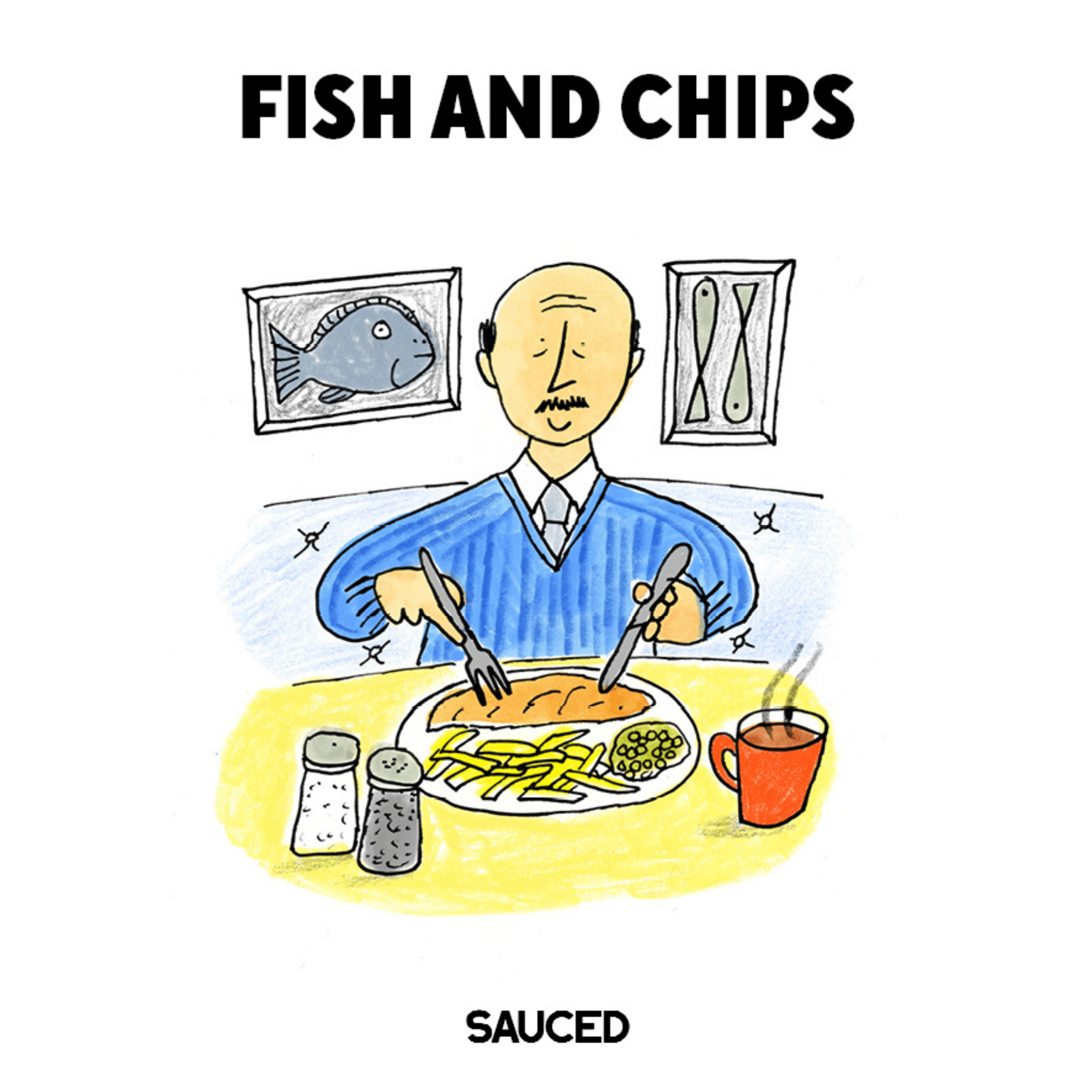
The most iconic dish in British cuisine was invented by a 13-year-old Jewish refugee and popularized by Italian immigrants — and the vinegar at most chip shops is fake. The real story is wilder than anyone gives it credit for.
This week, we dig into the batter science that makes everything shatter: rice flour, ice cold vodka, and lager all working against gluten in different ways. The chips get a double fry. And we settle the great condiment debate — malt vinegar, ketchup, curry sauce, or the tartar sauce most Brits quietly ignore.
"The hallmark of the English diet."
What we settled on:
Cod — both hosts, no debate
Beer AND vodka in the batter — double-agent gluten inhibitors
Rice flour mixed with AP flour at a 1:4 ratio
Mushy peas with fresh mint as the side
Double-fried chips at 300°F then 375°F
Malt vinegar powder in the flour dredge
Scrumps — the extra batter bits — served alongside
The Cocktail
The Good Companion: 2 oz London Dry gin, 3/4 oz dry vermouth, 1-2 bar spoons malt vinegar shrub (equal parts malt vinegar and Demerara sugar). Stirred, chilled coupe, and garnished with a Hayward's pickled silverskin onion.
RECIPE CARD:
Premium subscriber? Check out the full recipe card here.
LISTEN
EpiSOde Partners
Thanks to the following brands for partnering with Sauced to bring you this episode:
TRANSCRIPT
Tim McKirdy: Sother, you ready for a chippy tea?
Sother Teague: I would like a chippy tea.
TM: Would you like a chippy tea?
ST: Indeed, sir.
TM: You know, Fish and Chips. This is interesting. We're coming off the chili episode, which is very near and dear to your heart, as we explored. Fish and Chips. A U.K., a British icon. I'm feeling the pressure here today.
ST: Oh yeah. This one's gonna be all up in your wheelhouse, I think.
TM: Well, I mean, we'll see. We'll get to some of that stuff, but what is the first thing that you think about or your biggest association that you have with Fish and Chips?
ST: I mean, again, I grew up on the coast of Florida, the Gulf Coast. And seafood was a part of my life from early days. So, and then fried seafood certainly means part of that. I don't know that Fish and Chips specifically the dish and certainly some of the ways that it gets served in the traditional British way come into play too much. But fried fish has certainly been a part of my life all my life.
TM: I've had the privilege of living in a few different countries around the world and traveling around a little bit. And it is really interesting that whenever you tell someone you're British and the topic of food and drink comes up, everyone gives us a hard time for our cuisine or lack thereof. People think we are a country of just a couple of dishes, and I think Fish and Chips is most emblematic of those. You know, you only need to go to somewhere like London or Manchester, or even in the countryside of the U.K. to find that modern British cuisine and cooking is as thriving as anywhere in the U.S. or anywhere around the world. But for me, this is the one, right? Like you say you're from Britain, Fish and Chips, the Beatles. You know, someone will pull out a guitar and start playing Blackbird and they'll bring up Fish and Chips. It's just one of those things that you can never escape being a British person.
ST: That's not a bad thing. Right? Like, you know, I think if I were to play the same role as you and travel the world in this hypothetical, everyone's gonna say, oh, you're from America. How about a hamburger? You know what I mean? It's not a bad thing. It's a delicious dish that's satisfying and kind of everywhere.
TM: And has much in common with that as well. Fast food. That's literally the point of this — cheap sustenance as well. Definitely not healthy.
ST: I mean, I'll give you my elevator pitch here. Fish and Chips, classically, they're celebrated as a timeless, comforting staple, often called The Good Companions by Winston Churchill. They feature crispy, well seasoned batter and a simple nostalgic appeal. That's my one-liner about Fish and Chips.
TM: I think, and you know what was interesting as well, where I was thinking about like, what would be my personal connection to this or what is the first thing I think about — in a recent episode, you said Olive Garden for Chicken Marsala. And I think I could easily these days say Popeye's, and that is gonna sound weird, but the thing that makes me think most about Fish and Chips these days — there is a very distinct smell that Popeye's has. I can be walking in a neighborhood and I will get the smell because it's so similar to a traditional chippy in Britain. The smell of the fryer oil — that I can be walking around and I will be like, there's a Popeye's nearby somewhere. Like I'll stop and it's that exact distinct smell.
ST: Stops you in your tracks and suddenly you're like — again, to use a cartoon reference — that wolf who smells the pie. You just start floating off the ground towards the Fish and Chips. Well, I'll tell you, you said the word chippy a few times. British slang for a fish and chip shop is the word chippy. It's so iconic. I don't know if you know this, but it's been officially added to the Oxford English Dictionary, the word chippy, to mean a fish and chip shop.
TM: I love it. And you know, you being a pedant linguistically among other things — chips are chipped potatoes. So I think now you could argue, is it the supporting actor or do both get equal billing in terms of importance? But it is one of the things that makes this dish notable — the difference between a chipped potato and a french fry.
ST: A little bit bulkier pieces so that we have a greater density so that we can get some rougher exterior and still have that fluffy interior and nice and crispy. That's kinda my takeaway on chips.
TM: Yes. How that then became the thing that we call crisps in the U.K. over here, I don't know.
ST: You know, language is fluid and the separation of people leaving the other side of the ocean and coming to this side of the ocean and words just get jumbled up a little bit. That's all — it's just a movement of language.
TM: Language is fluid and Americans have no respect for the Queen's English — or the King's now.
ST: Long live the King, I guess.
TM: Do you wanna get into some history?
ST: Yeah, man. Hit me. You know, I've taken to leaving the history to you in these episodes because I feel like you are better at digging those things out. And especially this episode, I think is gonna be — I bet you're bringing the heat 'cause you're representing.
TM: Well, and thank you for that. You know what's interesting is when something is so present or you take something so for granted, you never consider the history of it.
ST: I found that on a few of these episodes, to be honest. And even in my life sometimes. And frankly, doing this show with you has made me look at some other things in life and say, you know what, why do I not know where this thing that's in my life came from?
TM: Yeah. Like, why do we take it for granted? So that was very much my experience getting into this. And it is a fascinating story.
ST: Let's hear it.
TM: So we will begin in the 16th century. Fish and Chips begins with the Spanish Inquisition. Sephardic Jews in Andalusia had a tradition of deep frying fish — would be called in Spanish, pescado frito — as a Shabbat preparation. So they would cook the fish on the Friday, battered and preserved it to eat it cold the next day. So it was a pre-cooking of fish. It was a way of preservation. When the Inquisition targeted Jews in the late 16th century, a lot of Sephardic families fled to England, settling mainly in London's East End. You know, your Jack the Ripper East London. They brought pescado frito with them, selling fried fish from trays hung around their necks by these leather straps.
ST: Like the cigarette girls.
TM: Yeah. On the streets of London, just selling fried fish. By the 1800s it had become a London street food staple, to the point where Charles Dickens mentions a fried fish warehouse in Oliver Twist. I'll need to reread that one to find that reference. But that's the earliest major literary reference. But importantly, it was fried fish — but there were no chips yet. The potato hadn't met the fish. So that happens in the 1800s. We're talking about London here — this is the south. There is a big north-south divide in the U.K. Northerners are seen as more blue collar, working class. Southerners, posher — although we are talking about the East End of London, which is a very sort of blue collar part of town.
ST: We have a similar divide here in America.
TM: And this divide will run through the course of this episode as well, by the way. So in Northern England, there was a separate trade in deep fried chipped potatoes that developed independently in the mid 1800s. The north was frying their chips. The south was frying their fish. They just hadn't combined yet.
ST: This is the Reese's Peanut Butter story. I think that might be a reference you don't get again. So in America, when I was a kid, there were always these ads. It would always be two unsuspecting people, one of them carrying their precious peanut butter. One of them carrying — like two aristocrats in the back of a carriage being drawn by horses and off to the castle or whatever. And one would have his peanut butter and one would have a chocolate. But then they'd hit a bump in the road and say, you got your peanut butter in my chocolate. You got your chocolate in my peanut butter. And then the great taste of Reese's was born. So the chips met up with the fish and this love affair was formed.
TM: Yes. So, you know, we don't have a Mr. Reese to thank for this. We have — there were two claims. I'm gonna go with the first one here though. Joseph Mallon. In the 1860s. So he was a 13-year-old — yet again.
ST: Yeah. Listen, you gotta start early if you're gonna die early.
TM: A 13-year-old Ashkenazi Jewish immigrant in the East End of London. He opened the first combined fish and chip shop around 1860. So a 13-year-old refugee created Britain's national dish. The shop was successful — it remained in business until the 1970s, when it sold its recipe and frying equipment to the American chain, Arthur Treacher's. Are you familiar with Arthur Treacher's?
ST: Only in name. I've never been to one, but yeah, I know of Arthur Treacher's.
TM: I think there's a handful of them left in the U.S. now. I don't know whether they still have the original shop in London. I should have looked that up. There's a handful left in the U.S. but at one point there was like eight or 900 of these franchises around the U.S. Then something that's near and dear to my heart here in my own background — while Jewish immigrants built the London fish and chip scene, it was Italian immigrants who dominated fish and chip shops and ice cream shops, particularly in Scotland and Wales in the late 1800s and early 1900s. One of the oldest surviving fish and chip shops in Scotland is Castelvecchi in Paisley — which is sort of the Glasgow area — founded by Alfredo Nutini in 1914, and I don't know if that name means anything to you, but he's the great-grandfather of the fantastic Scottish singer, Paolo Nutini. Italian, Scottish. Were you familiar with the Italian diaspora in Scotland?
ST: I definitely was not. No. Seems like it'd be an inhospitable place for the Italians.
TM: Yes. We don't have great weather. We are not known for our cuisine either. And our drinking culture is basically just beer and whisky. But Jewish immigrants bring fried fish to London. Predominantly Italians help the spread to Scotland and beyond. By 1914, Scotland had 4,500 chip shops. With Glasgow alone selling an estimated 800,000 fish suppers every week. And this was cheap sustenance, fast food. A treat at the end of the week. So once again, we're looking at a cuisine here that is intrinsically tied to a nation, but was built by different cultures that came to that nation. And I just love stories like that.
ST: Yeah. I think they're fascinating. And then to see how it ingrained itself and became such a part of everyday life, and remains that way today.
TM: That growth — by 1910, 25,000 fish shops across the U.K. It hit its peak in 1927 with over 35,000 chippies across the country, more than all other types of restaurants combined.
ST: Oh, wow. That's crazy.
TM: So it really is a big part of British culture and British history and British identity. You mentioned Winston Churchill earlier.
ST: I did.
TM: He called it what?
ST: The Good Companions. Fish and Chips.
TM: So important were — or was — Fish and Chips deemed during World War II that this was never rationed.
ST: If you gotta watch your consumption of everything except this.
TM: Except Fish and Chips. It was deemed so important to the morale of the country, and it was also cheap sustenance — that you didn't have to bring out your ration book in order to buy it. Which is fascinating.
ST: Which I bet helped to solidify it as a favorite. Because it wasn't limited. So you probably fell in love with it more because you could have it. And then that doesn't just stick during the war — that sticks for the rest of your life.
TM: But just sticking with wartime Britain. So during D-Day, you know, there's this sort of system of call and response — I forget the technical name for it. But so say you and I were parachuted into Normandy in the dead of the night, and we land and we wanna know who's with us. Are you a friendly soldier? If I'm part of the Brits — are you British? Are you German? So one soldier would say "fish" and the other would respond with —
ST: Chips.
TM: Because it was deemed difficult for Germans, in the way they speak, to pronounce the "ch" — chips — sound without giving away their being German.
ST: Wow.
TM: And you know what that is?
ST: That's gotta be the Porco fun fact of the week.
TM: That is the Porco fun fact of the week. Finally, just that we're talking about wars — this was something I was never familiar with. So I know that after World War II begins the Cold War. Late 1940s, 1950s and beyond. I wasn't familiar with the Cod Wars — between Britain and Iceland. From the late 1950s to mid 1970s, after World War II, Britain's cod stocks were depleted.
ST: Well, because they didn't ration it.
TM: They didn't ration it. We just ate the hell out of this fish. So we had become dependent on Icelandic cod for our chip shops. This led to three separate armed confrontations between the two countries. Each of which happened because Iceland expanded its fishing zone and Britain refused to accept it. I think at some point there's a complete breakdown in diplomatic relations between Britain and Iceland because of the lack of cod available for British Fish and Chips.
ST: You know, and now that I think about it, I think I did know a little bit about that from reading the book years ago. Cod, right? By Michael Pollan?
TM: Ooh.
ST: Yeah, there was mention of this in there. Cod kind of shaped some maps based on territorial wars over where you could fish for it.
TM: I mean, it's a fantastic fish. I wonder whether it'll make it into our non-negotiables a little bit down the line.
ST: We'll see.
TM: But yeah, just to sort of tie a bow there with some numbers. So I mentioned at its peak, 35,000 chip shops in the U.K. by around 1927. Today there are approximately 10,500.
ST: That's a two-thirds decrease in almost exactly a hundred years. '27 to '26.
TM: Exactly.
ST: Holy smokes.
TM: And the National Federation of Fish Fryers — yes, that is an official body.
ST: Do they have a uniform? I'd like to see these guys. What do they look like?
TM: They have predicted that that number could drop by a further third due to inflation and price increases in fish, oil, and energy.
ST: I was about to say the oil. The oil's probably gonna be the real price gouger.
TM: So that would be a real shame because you are talking about a cultural icon.
ST: Well, no matter how the numbers decrease, I can't imagine that they're ever gonna go away. This would be tantamount to telling people in New Orleans they can't have gumbo. Or Americans they can't have a hamburger. It's just not gonna happen. They might get expensive, things will change, but it's not going away.
TM: Yeah. And I would imagine as well, to your point earlier about McDonald's — those numbers maybe say less about inflation and also the popularity of this dish, and more about the fact that Britain has opened and embraced so many other cuisines, especially in fast food, but even just convenient food. Sushi from the supermarket, sandwiches, meal deals, things like that. There's other cheap food to be had.
ST: There is. You know, we've talked about this off air before. I think that the one thing that the Brits do really well, that would statistically seemingly do crushingly well in America are the pie shops, the hand pies. I don't know why we don't have more of those in America. In fact, we had one here in New York that I loved. It wasn't British necessarily. It was more Australian, but the Tuck Shop it was called. And it was great. And I loved it, and it didn't last. I don't understand — something that's delicious, protein based, fast, handheld — what incorrect box is that checking that it's not wildly popular here? Anyway, that's for another episode.
TM: Yeah. But I think another part of the demise of this dish that's going to lead us into our culinary luminaries is — what do you call it? Like, is it Sysco where you order food from? Like pre-prepared food that's then cooked in kitchens.
ST: Yeah. It's basically items that are ready to be picked up. When we say "pick it up" in the kitchen, what happens is when you get an order from the server for the Fish and Chips, it might have a salad or something first, and you say, order in salad and on order Fish and Chips. So that just tells the cook to get the mise en place ready. But you've already probably done some of the process that we're gonna talk about. Then it's just picking it up. Sysco sells stuff that's ready to pick up.
TM: I also feel for the people working in those kitchens too. Fast food is maybe a slightly different thing, but you know, the Sysco kitchens — you're doing 60% of the work of a chef and you're there for almost the same time, and you could be making this stuff from scratch.
ST: But that's the version of Fish and Chips that we're leaving behind.
TM: This — we're getting into the Sauced version today. Starting with inspiration from our culinary luminaries. And I want you to kick us off. I think we both have the same first name on our list here.
ST: We do. I almost guarantee it — it's Heston Blumenthal. This guy kind of codified the way in which we now — all professionals anyway — approach the batter for the fish. For the Fish and Chips.
TM: Yeah.
ST: And even the processing of the fish too, a little bit. Oh, and the chips.
TM: And the chips.
ST: Of course. Yeah. He's the first guy to triple cook the chips, which we'll get into. But he is the first to really examine the flour that was being used to look for something that would create less gluten and be crisper. He then added a bit of baking powder to amplify that reaction. And fish and chips is always made with a carbonated beverage to give it some light airiness — that typically you'd think would be seltzer. But he uses beer, which is not uncommon. Beer batter of course, but the beer brings some sugars and some maltiness for both flavor, and those sugars will help it get browner when it gets into the oil. But then crucially, he added vodka. Vodka has a lower temperature at which it evaporates, which again creates a much lighter, crisper crust. The way that the vodka, because of its high ABV, evaporates — it creates a really quick-forming shell. So suddenly the fish is encased. Because when we really think about frying a piece of fish in a batter or anything in a batter, what's happening is we're frying the batter, we're steaming whatever's inside that batter. So the fish is being gently cooked by the steam that's being created from frying the batter, and then the batter is getting crisp and creating a shell around that fish. So if you do this process that we're gonna get into correctly, you can easily eat that piece of fish 15 minutes later and it'll still be crunchy and still be hot because it's in that cocoon.
TM: So Heston really led the charge.
ST: He went one step further than we're gonna go, I think, when we get to the brass tacks of it. He put that batter that he makes into an ISI or iSi whipper and charged it. So the batter itself had some air pumped into it, not just the carbonation from the beer, which added yet another layer. But that's reaching for the Michelin star. We don't need to do that when we're making this at home. If you've got it, do it. But I don't think we're gonna get too deep into that part. But Heston really led the charge on the fish and the chips.
TM: So that's awesome. What I love about that is we're getting into science and we've introduced booze already — 'cause it took us a little while in our chili episode. I think the booze has to be in there, especially as this is Sauced.
ST: Of course.
TM: But I'm gonna ask you a little bit more about the science there. Because it sounds like everything Heston was doing was to make the ultimate batter, but also to answer or solve problems that would take away from the crispiness of your batter.
ST: Which I love, by the way — only because there are other things that we deal with in the culinary world where the component of it which seems the least important is kinda the most important. I would go this route when and if we ever talk about pizza — pizza has nothing to do with what's on top of it. Pizza is all about the dough. So in a crazy way, Fish and Chips is largely about the batter. Once you can secure a perfect batter, you are easily more than three quarters of the way on your way to the final greatness of this dish.
TM: Yes, a hundred percent agree with you there. So I wanna break each of those aspects of the batter down, given that we're talking about Heston.
ST: Let's do it.
TM: So number one — the flour. I'm calling it the gluten problem here. What is the potential risk that we run and how do we get past it when it comes to focusing on gluten alone?
ST: Well, I think the first risk you're gonna run — and what Heston did — is he split the flour. He didn't just use AP flour and you don't wanna use anything harder than AP. You don't wanna use a bread flour 'cause that's glutenous. You just wanna use AP — all purpose. But then he splits it out with rice flour, which has no gluten. You could also use potato flour. Some people do because they think potato — and this is gonna get served with potatoes anyway, so there's a little double down there. You could also split those two. You could just do 50% AP, 25% rice, 25% potato, but I think Heston's was just rice. Then with some baking powder — baking powder changes the chemical structure of the flour when it's mixed with something to hydrate it. In this case it's gonna be two different alcohols. But that inhibits gluten formation as well. Then the alcohol itself, especially the spirit — alcohol is a gluten inhibitor. And then the bubbles from the carbonation in the beer are gonna get in the way of gluten bonding together. And then the final one is really up to you, the user — not to overmix this product.
TM: Essentially, if you've ever made bread or focaccia — everything you wanna be doing there you wanna avoid here. Mix it as little as you can. Temperature wise as well — we wanna keep this as cold as we can.
ST: Yeah. And in fact, if you're really a nerd about it, you wanna maybe get your flour in the fridge so that it's nice and cold before you start. Obviously you wanna get your vodka in the freezer. You wanna get that beer as cold as it can be without freezing it. And then a final layer — you can make this batter yesterday and keep it in the fridge so that it'll get as hydrated as it's gonna get. But it'll be nice and cold when it's going into the fryer.
TM: I find it really funny that everything you mentioned there — in the kitchens where I'd worked, where they would have this on a lunch menu or whatever —
ST: Didn't do any of them.
TM: They did the opposite. So you would have the chef on the fryer station who generally half an hour before lunch service begins would get some bottles of sparkling water, flour in there, whisk it vigorously, maybe get a pint of beer from the bar as well, but whisk the hell out of it so that there's no lumps. And it's like, no, actually the lumps are good. If you're making fried chicken —
ST: If you're making fried chicken, if you're making waffles, pancakes, et cetera. A few lumps in here are much more beneficial and preferred than making it too glutenous.
TM: They'll take their ball of overworked batter, leave it next to the fryer —
ST: Nice and warm.
TM: All service. And then anytime a Fish and Chips order comes on, dunk some fish in there, cook it, and then at the end of service, chuck it away.
ST: Instead of putting it in the fridge where tomorrow it'll be better than it was today.
TM: So common. But again, this gets back to the point —
ST: You know, that's where science and intuition fight each other. Your intuition is like, I wanna mix this till it's mixed. I want to keep it right here next to the thing that I need it by.
TM: So, Heston — just to bring that back. I think Heston really not just changed this dish, but changed kind of how people thought about that kind of pub grub that I was talking about earlier, or the idea of gastropub.
ST: Well, yeah. He was kind of one of the pioneers of that whole movement. Which is to elevate the ordinary.
TM: Yes. And to think scientifically.
ST: Yeah. But to question anything and to think scientifically — I always say, whatever it is you like, whatever you're into, you can dial it way down. You can crank down on anything. You can get into the minutiae of coffee, of beer, of spirits — tomorrow, look at me. You can get into the minutiae of shoes, cars, tires. Like, if you love something, you're gonna look at it and then you're gonna crank it under the microscope until you see all of it. So he was just a guy who was curious about the world that he lived in.
TM: Yeah.
ST: And I said "was" — he's alive still, right?
TM: Yeah, yeah. I mean, one of the things about Heston, which has been wild, is he struggled with some really serious mental health issues. I think he actually had to be sectioned. But he's back and he speaks publicly about it and it's great. And that speaks to the stress he put himself under while doing this. Great to see that he's back. I just had a final question for you here. Blumenthal's method is objectively the crispiest result when it comes to the fish and the chips. But is this Fish and Chips anymore or is this a science experiment that happens to contain fish and chips?
ST: This is still definitely Fish and Chips. This is just being curious enough and being armed with more information so that you can go in and transform something ordinary into the extraordinary.
TM: I think fair. I think Blumenthal is the limit.
ST: Well, I don't — I think you and I talked off air. There's one more step he could have done that we think we could do — we could carbonate the vodka.
TM: Yeah. But that's 'cause we're drinks nerds. And we're going to do this.
ST: Well, he's a food nerd. We're food nerds. He's into the science. He's into the results. Results-based cooking, results-based drinking. I think that's what we are in the world of too. But at the same time, you don't wanna beat the horse until there's no joy in it.
TM: Exactly.
ST: I have an immersion circulator and a vacuum sealer, but I don't sous vide everything. Sometimes I still just want to cook. And by the way, I'd say the same thing about even this dish. Because we're doing this and for the show, the research, we're doing all these steps — but bottom line is, sometimes I do just throw some batter and some seltzer water and go, let's go. I still want Fish and Chips and it's still gonna be delicious.
TM: I think both of us being cooks who love projects — like that really appeals to us. So we are gonna do the carbonated vodka. I also — I just wanna make sure that we're not intimidating the listener. Every dish can also just be let's get it done.
ST: Absolutely.
TM: And I think we've covered our fair share of one-pan wonders. Like we've got our weeknight staples. This I would say is a Friday night or a Saturday night dish. Put aside some time to do the sciency stuff. But maybe our Sauced recipe won't go full Heston — but we'll be inspired by him.
ST: Absolutely.
TM: Very nice. Well, Heston is our guiding star here in the studio today. We're gonna take a quick break and then we're gonna be back with the non-negotiables.
ST: Yeah, it's time.
TM: Alright, we are back in the studio. Sother — non-negotiables. Kick us off.
ST: Fish.
TM: Yes. I think for today's episode we need to be slightly more specific.
ST: Okay. I talked to you off air and I said that the choices seem to me to be cod or hake, and you said one of those was correct.
TM: So —
ST: But you said there's a fish in Britain that's more common.
TM: The great British divide. That north-south that I was talking about earlier. It's cod or haddock. Now cod is 60% of the national market. Haddock is 25%, but concentrated in the north. So your classic options in chippies will be cod or haddock, but also hake is an option. Pollock. Or plaice.
ST: Any pretty large-flaked white fish is what we're looking for here. You're not gonna want to use an oily fish to make Fish and Chips.
TM: If I see someone making salmon Fish and Chips —
ST: I've seen it before and it's not a pretty sight.
TM: I bet it just gets so dry as well. I mean, if you're using salmon for Fish and Chips, I don't have a lot of faith in your batter, so it's probably gonna be very dry.
ST: Well, there's that, but I also don't have a lot of faith in your culinary intuition.
TM: I would say those are the sort of five — one of those five and you're golden. No pun intended.
ST: I'm a cod guy myself. That's pretty much what jumps to my mind.
TM: Same. Also, a nice piece of halibut too. I do like halibut. Is cod more expensive than haddock? Surely, right? So I want that. And in general, if we're talking about the distinction between those two, they're both mild in flavor. Cod is probably the milder of the two and dare I say, maybe a little bit sweeter.
ST: Well, these white fishes generally have a sweetness to them as well. Cod's gonna be — I'm pretty sure that all your Gordon's fish fingers out there are made of cod. We talked about cod earlier. There's a book about cod that talks about how it kind of set a lot of maps in the world. It grows in — it flourishes in a lot of different waters. So it's found everywhere. It's a good fish.
TM: It codified this dish.
ST: It codified this dish. And that's the Porco bad pun of the week.
TM: Double Porco for us today. And I think that also speaks to the fact that despite Britain being an island, despite the fact that we're having wars with Iceland over fishing territories — we're not a big fish-loving nation. We don't like fishy fish.
ST: I beg to differ. You guys eat jellied eel.
TM: That is again, in the East End of London. And that is a very specific cultural and culinary legacy, but that is not — you ain't getting that around the country, jellied eels. So we want fish. We want it to look like fish, we want it to whisper of fish, but we don't want to really taste or get into the fishiness of fish. Next non-negotiable for you.
ST: Potatoes. We need something pretty starchy, right? We're not looking for a waxy potato here. In Britain, that's gonna be your Maris Piper.
TM: That's the classic.
ST: But here it's gonna be your standard Russet.
TM: Your Russet Burbank. King Edward is another alternative in the U.K., but Maris Piper definitely is the gold standard. Battered. Crispy batter.
ST: Crispy batter, which we kind of already ran down. It's gonna be a low-protein flour split with rice flour. A bit of baking powder in there. And then of course the beer and the booze.
TM: Then I'm gonna say — in other episodes we have not discouraged, but we've said the juice might not be worth the squeeze when it comes to deep frying at home. But this is a dish that has to be deep fried.
ST: Absolutely. A must. This is not — you're not gonna get away with this in your air fryer. I'm sorry. You're not gonna get away with this in your oven. If you're thinking of those things, I hate to say this to the listener — just don't bother. Go out and have it. Find a reputable place in your town and go have it there.
TM: Yeah.
ST: Because you're only gonna disappoint yourself if you have it at home without deep frying. This is a dish that is heavily reliant on the cooking method.
TM: Yes. And I, I would go as far as to say that if you are going to do that at home — deep fry it and buy a thermometer so you know the temperatures you're working with. Especially as it comes to our preparation later and the chips and things like that. This isn't just a case of getting it hot and frying — you need to do some temperature control as well.
ST: A hundred percent. If you're a listener of this show, you probably have a pretty well equipped kitchen and you should have a thermometer of some variety that can get to frying temperatures. They're not that expensive. And you can use it for other things too.
TM: Would you — do you have any additional ones that you'd say are non-negotiable?
ST: Well, we haven't talked at all about the eating part of this dish. But for me, the final non-negotiable — we must have malt vinegar.
TM: A hundred percent. I agree.
ST: Those are the things I must have to make this dish.
TM: Fish — the varieties we spoke of. The batter the way we talked about it. The potatoes. And some malt vinegar. Everything else from there is garnish.
ST: For those who might not be familiar — because I'm thinking about my local grocery store here in the U.S. and I'm going down the vinegar aisle and I'm seeing distilled vinegar, apple cider vinegar, red wine vinegar —
TM: Champagne vinegar.
ST: All your different spectrums of wines, and balsamic. Not coming across malt vinegar. I don't think I see it often.
TM: I think it might be in the British section in my local store.
ST: Yeah, you're probably right. I've been to that store with you. And there are specialty stores that certainly have it, but Heinz I know makes one.
TM: What is malt vinegar for those who don't know?
ST: Well, you apparently found out that you've been lied to all your life. But malt vinegar is made from malted barley. That's then pitched with acetic acid, right?
TM: Yeah. So it's brewed into ale and then pitched with acetic acid to turn it — you know, your mother, as you were saying to me — to then turn it into vinegar through an aerobic fermentation. What I didn't realize is I've been lied to for so many years because most chippies don't serve real malt vinegar. They instead serve what they have to label as a non-brewed condiment. So it's synthetic acetic acid mixed with water and food coloring.
ST: Ouch. Basically this is the fake vanilla extract of the Fish and Chips world and the dirty secret of the chippies.
TM: Yes. Apparently this was exposed in Tom Scott's 2017 viral video. Regulations exist but they are rarely enforced. So yeah, I'm now on the hunt for real malt vinegar. Don't make this another project where I have to start making my own at home, please. But I'm gonna be double checking those bottles next time I see one to make sure.
ST: I will from now on. You know, I just said Heinz is kind of the easy one to find and I have to think that they're reputable. But if you said that high a percentage was pushing the fake stuff, then that makes me wonder and worry.
TM: Well — do you think there really are 57 different varieties of tomato in there? I don't know of 57 varieties to speak of. Although I do love ketchup with my Fish and Chips.
ST: Well, right. You were telling me that in Britain it's ketchup and curry sauce. And lowest on the totem pole in Britain is tartar sauce, which here in America is probably highest on the totem pole. But not for me. For me, it's just the vinegar. I just need the vinegar. I don't want ketchup. Even for my fries — I want my fries doused in vinegar also.
TM: Yeah. So fries doused in vinegar and salt, right? And then I would say — ketchup, curry sauce, mushy peas. Mushy peas might be higher for some folks, but that's more of a side than a sauce. And then tartar sauce would be right down there at the bottom. And often as well, the tartar sauce we're getting out of those little sachets — whereas properly made tartar sauce has texture. It's got shallots, pickles, vinegar —
ST: Capers, herbs. Tons of herbs. All chopped roughly so that there's texture. In fact, when I do tartar sauce — which isn't often, frankly — I like to have it with chopped up hard boiled eggs in it as well.
TM: Ooh.
ST: Almost like gribiche.
TM: Gribiche — that’s a banger. But for me, the thing about Fish and Chips is your two main components of the dish are both fried. So you've already got a bunch of richness happening. I don't need mayonnaise in this scenario.
ST: I would lean towards ketchup maybe, but I'm not a huge ketchup fan. So the vinegar is what sells it for me. The curry sauce I can see, but it makes me think of fries with gravy, which I certainly do enjoy, but again, it's not my first choice. So I can see the curry sauce, but for me it's vinegar all the way.
TM: And I think this is the point, right? Why do you have all of those pickles and capers and stuff in your tartar sauce? It's for vinegar. It's for acid. To cut through that richness. But if you're already getting that from acidic and sweet ketchup or even just lemon, but also tons of malt vinegar — we don't need more acid and we don't need more richness. Like you say.
ST: This is not — nothing against tartar sauce. This is not my first choice for this dish. I want it with steamed asparagus, because that's the thing that doesn't have a lot of fat of its own. It's not very rich. Let's fatten it up. But I did just have a thought — a real side thought. What if I took some malt vinegar and a healthy dose of curry powder and whipped those into a paste and then smoothed that paste into my vinegar? I'd have sort of a curried malt vinegar.
TM: That would be delicious.
ST: That sounds pretty good.
TM: This is like a shrub, a curry shrub. And put a pin in that one. But again, that curry sauce as well — I'm not talking about like you buy a chicken tikka masala, you take out the chicken and it's the curry. This is like a darker brown curry — a fast food condiment.
ST: It's like curry katsu. The gravy that comes with your katsu sandwich.
TM: Which is kind of all over the place in British cuisine. That's definitely all. So malt vinegar we had as a non-negotiable. Then we got into some other negotiables there. No other non-negotiables for us here today.
ST: I don't think so.
TM: Alright, we'll take a quick break now then, and then we'll be back with some science and a deeper dive on the old chippies.
Alright, Sother — we're back. Science plus potatoes equals where you come in right now.
ST: Delicious chippies. Okay, so Blumenthal's methodology is to cut the potatoes a little bit larger than you think you want them. Not like a McDonald's french fry like we have here in America. A bigger, thicker, chunkier chip. We're gonna cook them three times. The most common that we think of is the twice cooked. He added a third cook and then some other steps as well. So what we're gonna do is cut the potato down to the size that we're looking for — about three quarters of an inch thick square. Long batons about the size of your fingers, I guess. And then we're gonna rinse these under cold running water until we don't see any starch coming off of them anymore, then we're going to boil them. I like the method of starting the potatoes in boiling water. Because that'll kind of create a shaggy exterior because they're cooking on the outside faster than the inside. But if you wanna start from cold water, because that's more natural for you — we cook things that come from under the ground in cold water first — so that way it cooks more evenly. But just come by every couple minutes — 'cause it's gonna take 15-20 minutes this way — give them a good, vigorous stir, which will again create shaggy edges on the exterior. Then we're going to let those cool on a rack so they can steam off. They'll be really pliable when they come out. Some of them will even be broken. Don't worry about that — that's not a big deal. When they cool, they'll re-gelatinize and become firm again. Then we're gonna start with some oil — probably peanut oil, refined peanut oil — at around 300 degrees. And I only learned this kind of recently, which is crazy to me, but people with peanut allergies — the number one allergy that's out there — aren't necessarily allergic to peanut oil when it's refined. Because whatever the product that's in peanuts that is the allergen gets refined out.
TM: It's like — if you have a gluten allergy, all these gluten-free vodkas out there.
ST: Well, that's all of them. That's all spirits, actually. Gluten cannot pass through a still. That's definitely for another episode. But they'll firm back up and then you go into peanut oil at 300 degrees. This is to then get the exterior a little bit brown. It'll still be quite pale when we cook this time. Stay in this oil for maybe three to seven minutes, depending on how big your batch is and how hard you knock down the temperature of the oil. Take these out and put them back on a rack again, and then refrigerate to cool. If you've got a lot of time on your hands and you just wanna be ahead all the time, you can also put these directly into the freezer and let them get frozen, and then you can put them in bags. And then the last step is your pickup — anytime you're ready. And I prefer actually doing the freezer method, because then they get to cook longer in the third cook before they're hot in the middle and you get the most browning possible. So the third cook, we're going back in the oil at 375 degrees now, which is gonna do the browning and crisping. And then what you have when you're done with all that is super brown, super crisp on the exterior, fluffy, steamy potato in the interior. This is a perfect chip. As they come out of that oil, this is the time to season them. I say just some flaky salt, but you can certainly jazz that up with whatever you want. But I'm just looking for the salty potato situation. If we want to get real crazy, and you certainly can, we can back up to those first steps and say, after the rinse and the boil, let's add some vinegar to the boil. If you've got a lot of time on your hands, you can do the rinse and then put vinegar and water on the potatoes and store them overnight so that some of that vinegar actually permeates. So then we're almost making salt and vinegar chips. And there's other methodologies — we can take citric acid, and you can actually even buy literally malt vinegar powder.
TM: Ooh.
ST: Yeah. So you can take malt vinegar powder and incorporate that into your salt, your flaky salt. And when you're seasoning, you're seasoning with a salt and vinegar salt. So those are some extra ways to bump it, but the core way that I described is — cut them to the right size, boil them till they're pretty much cooked through, cool them, fry them at 300, cool them, fry them again at 375. Salt them and let's eat.
TM: Amazing. I love that. And that idea of creating your salt and malt vinegar powder — you just spent all this time and effort trying to get these things crispy. It avoids you having to use that liquid. Really cool, really fun method there. If we're gonna attach some science to the triple cook method very quickly — step one, gelatinize the starch in the potatoes. That's what makes the inside fluffy. Then, to your point, the first of the two fries creates a starch crust — especially with those cracks that you're talking about, if you're agitating them. And then the third and final fry is going to create even more of that starchy crust. I think Blumenthal almost called it something like a glass-like crust. So you can imagine that — something that will shatter if you break it, 'cause it's so nice and crispy. And so fluffy on the inside.
ST: Yeah. There's one other little thing you can do in between first and second fry. When they come out of the oil, before you go into the next one, you can toss them in a bowl with some potato starch so they have even more starch on the exterior. Which will give them another layer of that glass-like crust. But that's really — if you're really deep into this thing.
TM: So one of the places where I've worked in the past, rather than boiling first, we would confit in the oven the potatoes for the first step.
ST: Wow.
TM: So we triple fried in a sense, or triple — on triple fat, chips. But I think I would like to point out — let's not forget, when you're deep frying something, as long as it's bubbling, as long as bubbles are coming out, that means steam is being created. It's taking whatever moisture is in there and heating it past its sublimation point, which means it's changing form from liquid to gas. As long as stuff is coming out, the oil isn't penetrating.
ST: I always describe this as — you know when you're swimming underwater and you're slowly exhaling through your nose so no water goes up your nose? As long as the air's coming out, nothing's going in. So sure, if you did confit the potatoes that got nice and tender in that oil — then in the second fry they got that next layer of starch on the outside. Then the third — they're still bubbling. So no oil's penetrating. I just don't want the listener to think, boy, those sound oily or greasy or heavy. If you do french fries or any fried food correctly, it doesn't take on a ton of the oil. We've seen numerous experiments done on weighing a product to the milligram, pre and post frying, to see how much oil it picked up. And it's largely not a lot.
TM: Well, this is something I wanted to say when we were talking about the batter as well. If you make your batter properly and if you fry both of these ingredients correctly, this is nowhere near — and I'm not a nutritionist — but as unhealthy as we think it is, 'cause we're not cooking fat into either component.
ST: Exactly. It's not taking on any substantial amount of the fat. Where this changes, of course, is when you're not paying attention and cooking — and you can cook those potatoes until there aren't really any bubbles showing up. So then the oil is penetrating. And then that's — but then you'll notice that right away too, because all that work you did to make it crispy isn't crispy.
TM: No. And it's greasy and it's flabby.
ST: So, Sother — this is one of those places where I said earlier, where Heston's kind of a guiding north star, but I might opt to skip some of his steps. And in keeping with traditional fish and chip shops, I personally would just do a double fry.
TM: Sure. The 300 and the 375.
ST: Yeah. Or 325 and 375. But yeah, probably 300 is gonna be a better way to go. I would say that you probably get about 80% of the crispiness or the perfection of triple cooked with just twice cooked, and you're losing a third of the work. So the payoff is there for me.
TM: Yeah. No, that's the way I did it for years and years and years. I've never worked in a place that did the three stage. We always did the two. And I have done the three stage at home and — could go either way. It depends on how much of a nerd I'm feeling like that day.
ST: Yeah. Part of the fun is just the doing as well. So like, oh yeah, let's give ourselves an extra step. I'm happy to do it.
TM: Listen, you've been to my house when I've been grilling out and I had a lot of people in the backyard and they're out there, and I'm standing over by the grill and grilling, and in my mind I'm thinking — I don't need these people here. I just want to operate the grill. But if these people weren't here, then all this food would go into the garbage. So I need the people there just so I can do the thing I want to do.
ST: It's the same for me. So if I'm in the kitchen and I'm feeling it, then I'm gonna do the three stage thing. 'Cause I want to be in the kitchen. I want to be doing this.
TM: Fantastic. So — any other ingredients? I think maybe we can just touch upon one of the sides that we haven't really gotten into yet.
ST: Mushy peas.
TM: Yes.
ST: I found out something that I never knew about mushy peas.
TM: Tell me.
ST: They're neither mushy nor peas. No, I'm kidding. They're — I didn't know that they were marrowfat peas. I guess what I didn't know is what marrowfat peas are. Marrowfat peas are late-harvest English peas that are left on the vine longer. They take on a more starchy texture. I always thought it was peas that were mushed with bone marrow. But yeah, I love mushy peas. Frankly, I just love vegetables too. I love mushy peas as a side dish to not just Fish and Chips. And the thing I like about them the most, I think, is mint.
TM: Yes.
ST: There's mint in mushy peas. And I think people don't recognize that.
TM: Mint — plus my two non-negotiables that I'll go quite heavy on when it comes to mushy peas — are the mint and malt vinegar again. Tons of that in there. And you mentioned it as well — it's a strange texture, mushy peas. This isn't like a pea purée.
ST: Because it's quite starchy.
TM: It's the starchiness — you get that flouriness. And the malt vinegar just does a really good job of cutting through that. And then the mint — you wanna chop it pretty fine as well. Mint is one of those herbs where I'm like — it's quite abrasive.
ST: Yeah. Well you also wanna mince it pretty fine 'cause you don't want a ton of it. I think we pretty quickly associate mint with a couple of things. I think one of them is the Mojito and the other one is dessert. We're not trying to make dessert out of these mushy peas, but the bright, cooling mint — I like to sneak a little bit of mint in salads in the summer too. But again, a little goes a long way with mint in a savory dish. In a sweet dish, you can use as much as you want. And in a Mojito, bring on all the mint. But in a savory dish, you gotta be judicious.
TM: Beautiful stuff. Any other ingredients or sides or things for us to talk about today before we get into preparations?
ST: I think it's time to talk prep. We've touched on everything except tartar sauce, but I think we kind of ruled it out. You got a tartar sauce recipe you love, go with that one. Maybe we'll throw a rudimentary one on the recipe card for you. But tartar sauce isn't my first choice for this dish, and I understand that it's not for you and for the Brits. I do understand that most of our audience is here in America and it kind of is for them. So I'm not discounting it, guys — I'm just saying maybe have your tartar sauce when you're having a fish sandwich. Maybe have your tartar sauce when you're having steamed asparagus.
ST: Fish and Chips is for the vinegar.
TM: Yeah. And I'll say, I might be wrong — for our British listeners out there, please do reach out and tell me if I'm completely wrong there. But my associations with this dish are that tartar sauce is coming out of a packet. I didn't know what it was for years. I just wasn't gonna be bothered with it. And I think it's the Blumenthalization of this dish. Where you're gonna go to a gastropub in the countryside that has designs on getting one Michelin star. Maybe it's got a couple of AA rosettes. Are you familiar with rosettes? They're kinda like the poor man's Michelin stars in the U.K.
ST: Oh, yeah, yeah. I do know them.
TM: Not that they're that bad. I mean, if you have a five-rosette restaurant, it's incredible. You're doing well. But these country pubs that are elevating food, that are charging more — I think you'll have a perfectly crispy piece of fish. You'll have those triple cooked chips. And I'm also gonna be a little bit put off by them because they're probably cut a little bit too perfect. I want there to be some irregularity — I want the edges to be pointy. I don't want these to be perfect rectangles.
ST: Yeah, no — they're not Lincoln Logs.
TM: And then you might have a swipe of mushy peas on the plate and a bowl of perfectly brunoise tartar sauce. That's that type of Fish and Chips. We're chippy here today. At the start of the episode, I want a chippy tea. Alright, so we'll take a quick break and then let's get into the preparation.
ST: It's time to cook. I think I've been kind of taking the lead on preparation in a lot of them, but I think this is yours.
TM: And maybe we'll — there might be some deals we need to make along the way. We might need to meet in the middle of the aisle here. But I'll run you through what I have here and you tell me what you think. So we are gonna take our fresh fillets of cod or haddock. Both of us love cod, so we're gonna stick with cod.
ST: Let's go cod.
TM: You're gonna wanna make sure that the skin is off and that you've pin-boned the fish. Very easy fish to prepare. You're gonna wanna make sure you pat that dry. I might even have that on a rack in the fridge while I'm getting everything else prepared, just so it's gonna dry out a little bit.
ST: Do you do a little salt-sugar cure in the meantime, or no?
TM: No sugar. I would salt it though. So yeah — season that before it's even going in there, and that's also gonna dry out some of that moisture, if we have it on a rack. In the meantime, I'm going to cut my Russet potatoes. I like what you said — about three quarters of an inch thick. I do want these to be rectangular though. I want them to be longer than they are wide. Then when I have everything, when I'm happy with everything — because we're gonna do the double fry today, not the triple — then I'm gonna turn to my batter. In my batter I'm gonna add flour, rice flour — about a four to one ratio there. Some baking powder, salt. We need to do our experiment with carbonated vodka. So in the meantime, I'm gonna say an ice cold lager. We didn't really get into the beer, but we're going light, golden — the beer is helping with our color. It's also bringing some sugar, which is gonna caramelize during the cooking, and some mild flavor. We're talking macro lager here — so it doesn't have a bunch of flavor. So I'm gonna go in with ice cold lager and ice cold vodka. I am gonna mix this until it's barely incorporated. It wants to be lumpy — that's gonna help our final product, as we said. Then we're gonna be good to go. I'm gonna do the first cook on my chips — as you said, 300 — probably gonna be about 20 to 30 minutes, keeping an eye on that.
ST: So at this point you've got the batter back in the fridge, so it's staying cold.
TM: Batter back in the fridge. Yes.
ST: And it's hydrating. And it's relaxing.
TM: Actually, you know what? Ideally, if we're being Sauced, if we're preparing ahead of time — I've made my batter yesterday.
ST: Yeah.
TM: If I really think about it and I have the time and the space in my fridge —
ST: Hey, we know we're doing fried fish Friday, so Thursday we're making batter.
TM: Thursday making the batter. Perfect. Then the first stage of the potato frying is done. Take it out again, let it drain. Ideally, if you have a bit of time — into the fridge or into the freezer, even better. Then we're gonna up the temperature of our oil to 375. We're gonna finish those chips. We're gonna pull them out. We're gonna season them. I like the salt and malt vinegar.
ST: Sure.
TM: We'll have the vinegar as an optional condiment on the side, but if we're serving this to people, we're doing our salt and malt vinegar powder. Then we're frying the fish. I think you can potentially bring the temperature down a little bit, but you don't wanna be going below 350. But I think if you're still at that 375, you're golden — again, no pun intended there. That fish — when I'm pulling it out of the fridge as well, I might give it a little pat again. Just to make sure it's completely dry. I should have mentioned as well, we need to dredge this in flour before we put it in the batter.
ST: Yep.
TM: You gonna season that flour?
ST: Yeah, why not? You don't wanna put in there just a little bit of salt and a little bit of that malt vinegar powder?
TM: Beautiful. So we're gonna do that. One or two other things while we're talking about frying the fish here. Pat your fish in your flour. Shake it off, dust it off. Then you're gonna be confident with that batter. You're gonna hold the end of the fish. You're gonna dip it in. You're gonna get your fingers in there as well. You want the batter to absolutely cling to the fish. You're gonna pull it out. You're gonna let a little bit of it drip off. You don't want this to be too thick. Then you're going straight into that fryer. Then I'm gonna take a spoon and I'm gonna add little bits of batter into the fryer as well.
ST: Yeah. You know what I do? I put it in a squeeze bottle. So I take a little bit of the batter once it's been in the fridge all night, put it in a squeeze bottle with a fine tip on it. And then when my fish hits the oil, I sort of zigzag across the top of the fish with a little bit more batter. And it's gonna create this crazy texture on the side that's facing up at that moment. And when you pull it out, you'll see it'll be kind of smooth everywhere and then it'll have this craziness on top.
TM: Also, you want those floating around in the oil as well. They're gonna burn later, but here —
ST: Here in America, we have two restaurant chains that you may or may not have ever heard of. Long John Silver's — news to me — and Captain D's.
TM: No.
ST: Okay. These are both seafood fried fish chains. Obviously they aren't as popular as hamburger chains — you haven't even heard of them. But both of them, on their menu, it's a supplemental if you want extra of the — they have names for them too. Oh my God, I forgot. I know Long John Silver's has a name for them — they're called crumbles.
TM: Crumbles. Interesting.
ST: So you can pay like an extra 40 cents. 'Cause your fish is gonna come in a little cardboard boat and underneath are the crumbles, and then the fish is sitting on top of it. But if you want extra crumbles, it's like 40 cents.
TM: I can't believe we're upcharging for extra crumbles.
ST: Well, it's like when you get your crunchy spicy tuna roll — that's what those are, those are just crumbles.
TM: So we would call that — and again, this is a great north-south divide or depending on where you are in the U.K. you have different names for things. Like it might be a bacon butty, it might be a bacon roll, it might be a bacon bap. Some places call them scraps. And I want to say as well — some other places call them scrumps.
ST: Scrumps. Oh, I like that better than crumbles.
TM: And I think that's very much like Lincoln, where I grew up in the East Midlands. 'Cause we love scrumpy cider as well, so I think scrumps might be a Lincolnshire thing. But yeah, we're gonna serve some of those as well with it. Seasoned. But not tossed with the fries — that's the fish constituent.
ST: Yeah. You're gonna get your piece of fish that's got this craziness that we've created with either a squeeze bottle or drizzling some extra batter on top. You've got your chips on the plate. You've got maybe some mushy peas or not. And then a little stack — maybe a tablespoon full of the scrumps.
TM: So, do you know some of the other options available to you at the fish and chip shop?
ST: I don't, I mean —
TM: So — you will like a lot of them. I'm talking about the traditional classic things you'll get in jars in fish and chip shops.
ST: In a jar. I have no idea.
TM: Pickled eggs.
ST: Oh, listen, you're already talking up my alley. I love those things.
TM: And then these massive pickled onions that I just thought you would love.
ST: Massive. Like, how big?
TM: Like pearl onions on steroids.
ST: Like a golf ball? Or a ping pong ball?
TM: Anything to avoid the metric system — any unit of measurement. But yeah, you'll generally find a lot of pickles.
ST: That makes sense. You're eating all this fried food — you need acid to cut the fat.
TM: And also there's no kitchen to speak of. Or if there is a kitchen, it's very small. This is the open kitchen. There might be a small prep area, but that's why your curry sauce is coming from a tin probably. Your mushy peas are coming out of a tin for sure. And then you might season them. And then — what else do you have? Shelf-stable pickles.
ST: Yeah, it makes sense to me.
TM: Beautiful. And so that's how I'm gonna serve it. And you know what — I'm probably definitely gonna go mushy peas. Probably gonna skip the curry sauce. Definitely having ketchup. Definitely malt vinegar. And wow, I can't wait till we make this one.
ST: Oh, we're making it.
TM: Anything to add?
ST: I would just like to remind the listener that deep frying at home doesn't mean using that oil and throwing it away. I think that's a hurdle that the home consumer faces when they're looking at deep frying as a waste — and it's not. While the oil is still warm, go ahead and eat your meal. Enjoy the food that you've labored over. But when you finish with that, go and strain that oil through a mesh or even a coffee filter, whatever you've got. So you get out any bits that are in there. And then hang onto this — this particular oil that's had fish in it, you're probably only gonna want to use for doing fish in the future. But this oil isn't bad because it's been used one time. You can use it multiple times. The straining is what's gonna be the key here, because the more particulate matter that remains in the oil, the more it will burn the oil over time. But you can get several uses out of this. And that's true of any other oil deep frying that you're doing too. Hang on to all of those and reuse them again and again. This is a resource and I'm not asking you to throw away a resource.
TM: Label your oil.
ST: Yeah.
TM: And do not start introducing sweet or desserts in there.
ST: Yeah, don't make your churros, don't make your donuts in this.
TM: Speaking of which — so my first kitchen job in London, it was at County Hall, which is this massive big building — a five star hotel across the river from the Houses of Parliament, right there in front of —
ST: HP Brown Sauce.
TM: Another sauce you can have with this, and you should. Just next to the London Eye, right? We had a pastry chef called Phil. Phil was very close with the head chef. He was a trusted confidant of the head chef. And we had some VIP guests doing sort of meetings — you know, hotels, you do a lot of functions. So it might be a lunch, it might be a special breakfast, or it might be they're having coffee with some pastries. So Phil came in one day early because he was tasked with doing a VIP coffee morning — donuts. What did Phil not do?
ST: Changed the oil in the fryer.
TM: What did Phil — how did Phil's donuts turn out?
ST: They tasted like calamari.
TM: Fish. And he served them to the VIPs. And the sous chef hated Phil, so the sous chef was so happy that day. I remember coming in and just being like, wow. So yeah — reuse your oil. Strain it while it's hot. Not too hot to handle. Be safe.
ST: Of course.
TM: Label it.
ST: Store it somewhere cool and dark. Use it again.
TM: Very cool.
TM: Alright. Let's get Sauced. I'm curious to hear where you're coming at with us today. Look, we're not gonna be precious about pairings. We're not gonna be like, oh, you have to have this or that. Pint of lager? If you want Champagne, amazing — acidic white wine, go for whatever you want. Can of Coke — love it.
ST: Yeah. I think Champagne would really work for me. Or sparkling wine of any kind, really. Certainly I think I would still want a crisper lighter beer if I was having a beer. I'm not gonna — is it common to have a Guinness with Fish and Chips? Nah. I feel like that's too heavy. Heavy on heavy.
TM: Well, don't forget as well — if you're going from the fish and chip shop, you're not eating it there. You're taking it home or you're taking it somewhere. These places don't sell booze either.
ST: So it's not a big dish when it comes to — if you are having booze with it, it's probably just 'cause you're used to having alcohol with your meal.
TM: 'Cause you have a flask with you because you're Sother.
ST: But I think it's more common to have soda. And if you're in Scotland, it's gonna be Irn-Bru, folks. That stuff is made of girders.
TM: Is that a caffeinated alcoholic carbonated beverage?
ST: No. What's that called?
TM: Buckfast.
ST: Oh, Buckfast. What's Irn-Bru again?
TM: Irn-Bru is the national soda of Scotland. It's orange in color. It tastes like Inca Kola if you've ever had Inca Kola.
ST: No.
TM: So there are two countries in the world —
ST: Sorry, folks. Give me a thing that's rare and unusual and then compare it to a different rare and unusual thing.
TM: It's the only thing that tastes like it. So there are two countries in the world where Coca-Cola is sold and it's not the leading soda in that country.
ST: Scotland and —
TM: Peru. And in Peru they drink Inca Kola, which is bright yellow, and it tastes similar to Irn-Bru. And these are both ridiculously artificial tasting sodas and colored as well.
ST: I mean, isn't Coca-Cola that too? I haven't had a Coke in 26 years.
TM: Come back to us.
ST: Won't do it.
TM: They had to legally lower the amount of sugar in Irn-Bru a few years ago because of a new tax the government put to curb obesity. Which is a worthy cause, but it's a shame. I actually had a stash of pre-recipe-change Irn-Bru that I was aging. That's all gone. But yeah. So — you like to pair things with cocktails.
ST: I do. And so all the reading that I did on chippy tea — and by the way, let's not forget the word chippy, which we talked about, has been put into the Oxford English Dictionary to mean the chip shop. "Tea" in England doesn't just mean the liquid — tea means the mealtime.
TM: Yes.
ST: So chippy tea means let's go to the chip shop for dinner.
TM: Can I hold you there for a second though? Yes. So that north-south divide — tea is a northern word for dinner. And in the south, tea is more like afternoon tea. So chippy tea — you're in the north.
ST: The similarities stack up, you know. Here in America, in the south, we often say supper when we mean dinner. But I don't think supper's even used in the north.
TM: No.
ST: Anyway, so chippy tea. Not to be confused or confusing, although we already are — I looked it up, and every resource that I could find that talked about what to drink while you're eating your Fish and Chips was tea. So I thought, well — let's reach for a drink that's not quite a modern classic yet. I believe it will one day be a modern classic. I just don't think it's quite old enough. And let's look to my good friend and compatriot and colleague in the field, Giuseppe Gonzalez.
TM: Ooh.
ST: I think most famous for creating the Trinidad Sour, which is a cocktail that's based on Angostura bitters — an ounce and a half. But not that drink. He created a drink called the Duke of Suffolk. He created that for his bar, which was called Suffolk Arms. And it was on Suffolk Street in New York. The Duke of Suffolk is a hot drink. This is the surprise part — and I could see your face. I know. You wouldn't expect me to go for a hot drink. I think it's the only hot cocktail I've ever really enjoyed. And that says something about me. But don't forget, I generally don't like hot liquids. I don't even really eat soup 'cause I don't like hot liquids so much. But I really enjoyed this cocktail when I had it with him. It is a hot tea-based cocktail. It's gin, which is also surprising. But gin of course is quite British. So it's gin with a blend of Earl Grey and English Breakfast tea, with a tea syrup, with a float of lightly whipped cream on top. And when I say lightly whipped, I mean the cream goes into your shaker tin, you give it a good rattle to make it thick, and then you pour it across the top and it'll float. But the cream is quite cold. So you have this cold cream, hot tea, syrupy situation. I think this would be great with the meal that we just described.
TM: Wow. That is a big surprise for me.
ST: Yeah.
TM: Not expecting that.
ST: So just to edify the listener a little — Tim and I don't really talk too much about the episodes because we want to have our true reactions.
TM: Yeah.
ST: So I did mention to you, you're gonna be real surprised about my drink. And even when I said hot tea, your face —
TM: I was — but I like it. I like what you're thinking as well, just the bringing the tea aspect into it. Have you ever had the drink?
ST: No, never.
TM: You know, I never got to go to the Suffolk Arms, which is a real shame because I've heard a lot about that place. And I know there's a lot of late aughts, early 2010s lore around that place and just being a notable establishment in New York's drinking scene.
ST: You're a little early.
TM: So you mentioned this too. I figured, you know what — I wanna make a drink for Sother here.
ST: Well, thank you.
TM: And I was really honing in on that malt vinegar. So we're gonna make a shrub. We're gonna go equal parts malt vinegar and demerara sugar. I do want some flavor here as well — don't just want the sweetness. Just dissolve that — you don't wanna boil it. Then I'm gonna make essentially a Gibson.
ST: I was about to say — are you gonna make a Gibson out of those onions?
TM: Not those onions. But I'm gonna go for two ounces of London Dry gin. Three quarter ounces of dry vermouth. And then a bar spoon to a quarter of an ounce — what is a bar spoon in ounces?
ST: Well, they vary because the makers aren't standardized in their bowl size. But if you're using the Cocktail Kingdom brand, which is the brand that I use the most, their spoons are all roughly an eighth of an ounce per spoon. And that's across their whole line, so that's helpful.
TM: Perfect. So I would go one to two of their bar spoons of the shrub. Stirred, served in an ice cold coupe. And I'm gonna garnish it with a pickled onion. I'm not going to go — what is the one you love? The Japanese —
ST: Oh, the rakkyo.
TM: Those are fantastic. Love those. But I'm gonna go for a brand called Hayward's. They're called Silver Skin onions. They're in my fridge upstairs.
ST: Oh, that's probably where I saw them.
TM: Thanks to our mutual friend, Mr. Frank Caiafa. I know he is a listener of the show, so we gotta give him a shout out there. Hey Frank. And those are just really nice and sweet and vinegary and delicious. So that's gonna be our garnish. It's a Gibson. But I figured — rather than calling this the Malt Vinegar Martini, which is a bit lame or too obvious — we're gonna call it The Good Companion.
ST: The Good Companion. Oh, I love it. And also, let's back up two steps. How do you pronounce Frank's last name?
TM: Caiafa.
ST: I think I've been butchering it all this time.
TM: What have you been saying?
ST: I don't know.
TM: There's three A's in there and you're missing the one in the middle.
ST: Okay, fine. Sorry, Frank.
TM: You can find him, folks — Handlebars on Instagram. You can find us at @sauced.pod on Instagram as well. You know, when Sother and I talk regularly about — we're gonna make this, we're gonna make this together — those experiments, those cooking sessions, find their way onto Instagram, if you wanna see what we're doing.
ST: And also join us. I've mentioned on previous episodes — I get no greater thrill out of this show than the responses from the listeners who are posting to their social media and tagging us when they make the dishes or the drinks. I think it just shows that our efforts aren't going unrewarded. And it shows that the listener is putting an effort too. And I think that's a great two-way street. Like hospitality is all about the two-way direction of the event. So it really fills me with a great sense of satisfaction when I see you guys out there posting the efforts you put in.
TM: We love it. We love to see it, folks. And we love — as Sother likes to say — showing the work.
ST: Yeah. Show your work.
TM: Show up and show the work. Final thoughts for us here today? Any final thoughts for yourself? What are people missing out on if they never make this dish at least once in their life?
ST: I mean, such an iconic dish for an entire nation. I think it's a must-do at least once in your home just to walk through the process and honestly to learn some of the — to see the practical use of some of the sciency things. You know, we're not a nerdy show like Cooking Issues. I'm not gonna break down stuff like Arnold does. But to walk through some of these scientific processes that we discussed and see their results — I think will just make you a better home cook, if you do it. Also the satisfaction of just having this great meal at home that is typically, I guess, reserved for eating out.
TM: You know, I have some more sort of heartfelt and philosophical thoughts about it because you're so closely tied to the dish.
ST: Well, I think I just have really enjoyed — as always — the discovering, the history of this, the origins, how much that speaks to the many wonderful cultures and nations that make up Great Britain and the United Kingdom. And just considering our deep ties to it and what it says about the North and the South and how it ties into language, how it ties into the science, what the science means. I really enjoy that. And I did come across one quote for us here today.
ST: Okay, cool.
TM: It's from one of my favorite writers — George Orwell. Writing in The Road to Wigan Pier. He said: "Fish and chips has fed more people than any other dish in England. It is the hallmark of the English diet."
ST: Orwellian.
TM: Orwellian.
ST: Is that where I thought that was gonna go?
TM: You know, Orwell so often focused on working class life. On the depression. On what the fabric of culture and that working class roots — so for him to frame it in this way, and he said England. I think we can say Britain.
ST: There is one question I would ask you that didn't really come up during this whole conversation. We're making this at home, but — were all of your memories of it ever at home?
TM: Never making it. No.
ST: I mean, here we are encouraging people to make it at home. You've never had it at home.
TM: Oh, I've made it at home. But growing up —
ST: That's what I meant. Your mom didn't make it. Nobody made it in your house. You had that story of the Beef Bourguignon — your aunt who made it every Christmas.
TM: Look, we were definitely never a deep-fried household. But have we had the Sysco version at home — where you're getting the frozen chips from the bag? For sure. We've had that. But we've never done deep fried at home. But also, a fish supper is something you associate with a Friday night treat.
ST: So you're out.
TM: No, because you eat at home.
ST: But you had to be out at some point to get it.
TM: You go to fetch it. There are stories of policemen — they will get their Friday night fish supper. They might even be off duty and they'll turn on the lights so that they can get home faster. So their Fish and Chips are still warm.
ST: Nice.
TM: So you see a police car on Friday around 6:30, 7:00 PM bombing through your neighborhood — might be chasing crime. Might just be cradling a fish supper.
ST: Getting tea home to the lady. Getting tea home to Mrs. Bobby.
TM: Or Mr. Bobby — or yeah. Brave new world. We're here for all of it.
ST: I am.
TM: Time to put on the apron.
ST: Break out the shaker.
TM: And let's get cooking —
ST: And drinking. Cheers.
TM: Cheers, buddy.