Episode 4:
COQ AU VIN
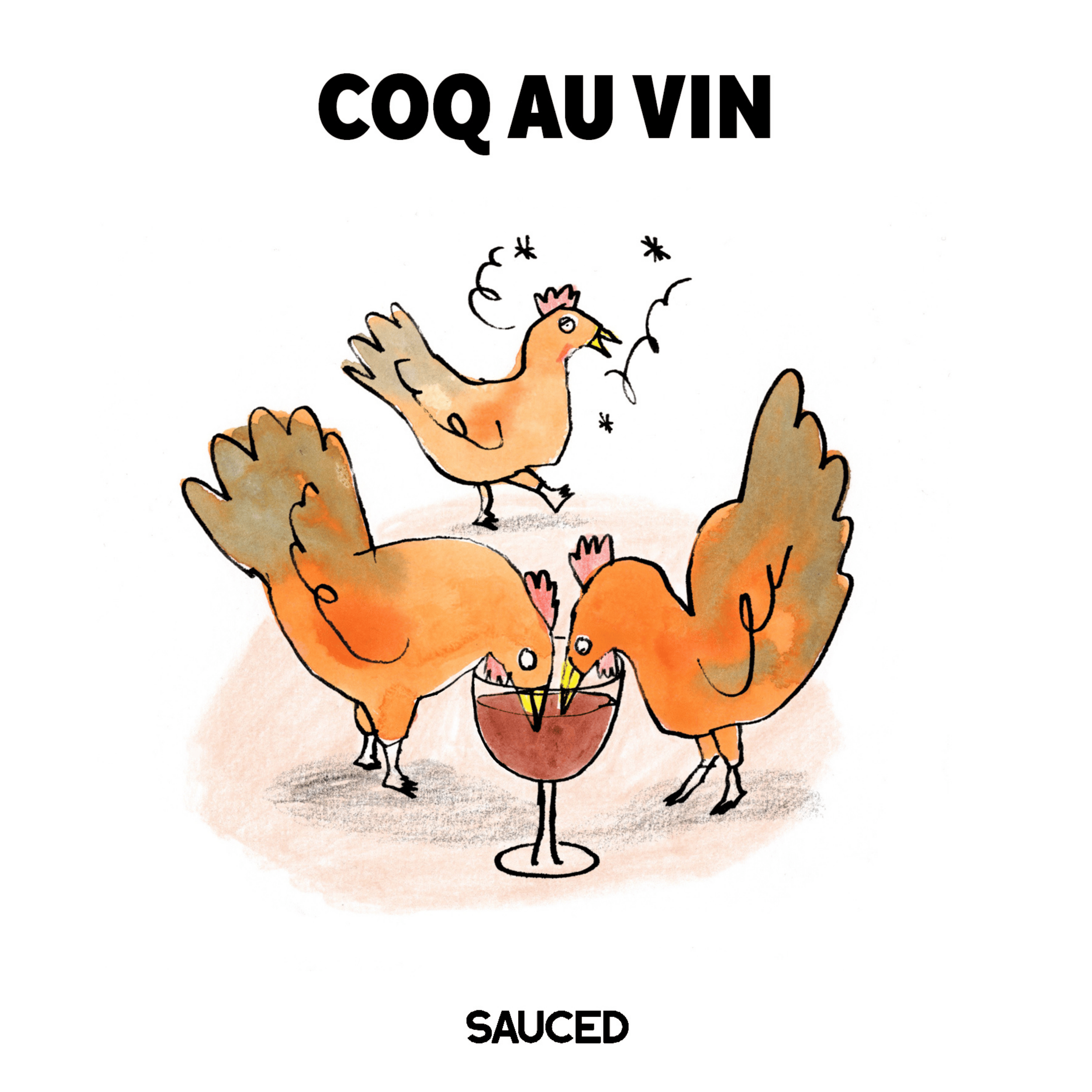
Coq au Vin — rooster in wine — sounds fancy but this dish started as peasant cooking. A tough old bird, slow-braised until tender in wine with bacon, mushrooms, and pearl onions.
"The perfect illustration of turning something big and tough and unlovely into something truly wonderful." — Anthony Bourdain
What we settled on:
Market chicken, legs and thighs preferred for the long braise
Red wine (Pinot Noir, Gamay, or Côtes du Rhône) — lighter wines reduce better
Bacon cut from a slab into lardons
Overnight marinade minimum, 24 hours ideal
Cognac flambé for deeper flavor
Beurre manié to thicken the finished sauce
Crusty bread and mashed potatoes to serve
The cocktail:
The Queen of Cocktails: Mezcal Pechuga, agave syrup, and lime juice, topped with ginger beer.
RECIPE CARD:
Premium subscriber? Check out the full recipe card here.
LISTEN
EpiSOde Partners
Thanks to the following brands for partnering with Sauced to bring you this episode:
TRANSCRIPT
Tim McKirdy: A Sauced classic for us today. It's got booze in the name — Coq au Vin.
Sother Teague: Let's get into it. Coq au Vin literally translates as rooster in wine, and it's a deeply flavorful and aromatic French stew of red wine braised chicken with bacon, mushrooms, and onions. Traditionally, the method of slow cooking was to tenderize a tough older bird.
TM: The old rooster.
ST: The rooster.
TM: A lot of symbolism in this dish, which I'm looking forward to exploring. But first, your own personal or professional connections to it?
ST: I would say personally, I'm for sure gonna cook this dish at least once a year. Overwhelmingly in the colder months of the year. Sometime like now-ish. It's satisfying and hearty. The cook fills my house with this crazy delicious aroma and it also adds a little bit of heat to the apartment because it's a slow process and having the oven on heats the apartment up a little bit. Professionally, I've never worked anywhere where this was on the menu.
TM: Likewise. And I mean, it's worth calling out the elephant in the room right now. This is a dish that shares a lot of overlap with beef Bourguignon, which we covered in our first episode. Much like that, my only real professional experience with this dish was for functions, for private dining rooms, for the busy time of year. But never really worked in a place where we had it on the menu as standard or we did our own sort of take or version of it.
ST: Same. I've obviously worked at tons of places. This just was never a dish that was on menu, and not for any frankly good reason. It's delicious. It's absolutely valid. It's absolutely a classic. It belongs. Why do you think that is?
TM: I think there's something to be said about that, and I think this maybe falls into that category of dishes that are bistro staples, bistro classics, and maybe we are just — maybe chefs feel like it's a little bit boring or maybe it's just a little bit overdone. Or maybe this is just more of a home cooking dish than a restaurant staple.
ST: Could be. Well, speaking of its ability to be a staple, what is the story behind this dish? You got some history on this one?
TM: I like the history on this dish. So we are gonna go all the way back in time to Roman times. Julius Caesar. And I know what you're thinking.
ST: The salad. This is a French dish. The salad to go on the side. I am thinking this is a French dish. What does Julius Caesar have to do with it?
TM: Yes, exactly. So, you know those Romans at one point controlled all of Europe, all the way up to Hadrian's Wall, which they built to keep the Scots out. That's right folks. They never invaded Scotland. They never made it that far. But the Romans, when they were in what would've been France at the time — or would've been Gaul, the territory, now modern day France — the Gallic chief...
ST: Oh yeah, his name's tough.
TM: Vercingetorix, I believe his name is.
ST: His name's as tough as the bird.
TM: Vercingetorix, I believe, Sent Caesar a rooster as a taunt, the rooster being a symbol of Gallic courage, as if to say we will never be defeated. So the legend goes, he sent that to Caesar. Caesar invited him over to dinner because there are rules of war and conduct and conflict, and apparently served that very same rooster to our Gallic chief, cooked in wine, as a show of dominance. What do you think about that one?
ST: I mean, as with many of these stories, it sounds touching. It also sounds a little like a lie. But great symbolism and great legend. And if that's maybe where it got its start, who knows? I know that there's some political symbolism with this dish later in the 1600s when King Henri IV famously promised the people of France a chicken in every pot for all peasants on Sundays, and that sentiment became deeply intertwined with the culinary identity of Coq au Vin as what is now a national staple.
TM: A staple dish. We don't see this dish appear in cookbooks until 1864. That's the first accepted written version of this dish. It appears in an English cookbook of all places called Cookery for English Households by a French lady. Now, notably a few things here.
ST: Do you wanna tell us who this lady was?
TM: I would love to, I would love to give them credit, but no one knows her name. So unfortunately, anonymous French lady, thank you for documenting it. Although she did cook the Coq au Vin Blanc — white wine.
ST: And that was 1864. The standardized red wine version appears in the early 20th century in Escoffier's Le Guide Culinaire in 1903.
TM: He's always knocking around, isn't he, Escoffier? Just when you wonder, did he have something to say? Did he imprint something on this dish? He did.
ST: I mean, yeah. This is what establishes him as like a master. I think if we had an equivalent in the drinks world, it's gonna be Jerry Thomas. And does that mean that — this is the question that I always come to though, and I don't wanna get us off topic here — but does that mean that he was the genius that we all give him credit for? Or simply was he first to document?
TM: I think it's a great question.
ST: And it can also be a little bit of both. If he had the genius to say, I'm gonna sit down and write all this down, that's a piece of genius right there. Even if it's mostly stuff that he just gathered from other people.
TM: Like Harry Craddock and the Savoy Cocktail Book I think is another great example. And I think in modern times we have realized that people like Ada Coleman had a much bigger impact on some of those recipes.
ST: Yep.
TM: So just because you're the first to document, it doesn't mean that perhaps you came up with a dish, especially as it's something as simple as tenderizing and cooking a tough old rooster in wine.
ST: Exactly.
TM: So that's the origin story based on all of those facts. Or fictions.
ST: Mm-hmm.
TM: But based on that lore, do we believe this to be a prince's or pauper's dish originally?
ST: I am firmly in the camp of pauper on this one. This is a dish that utilized the oldest rooster on the farm once it was too old, unfit for more breeding and, you know, they get quite cantankerous. So this bird probably had it coming. This wasn't considered your best cut of meat. This wasn't what you were saving to serve for family celebration, birthday, that kind of thing. You were going for a nice fat hen for those. This was like, it's just time for this bird and so I'm gonna cook it. And then this necessitated a long, slow cooking method. And then there's some salt pork in here, bacon typically, but that's not enough to elevate this dish past pauper.
TM: Totally. I think this is a really good example of an instance where necessity then evolves into, when you bring it into professional kitchens, how do you elevate the dish, even if it's still a pauper-style dish, even if it's more of a country dish. The way that you're serving it, you're applying elevated culinary techniques and ingredients.
ST: I think this is a dish that is gonna rely heavily on what we do to it more than it relies on what we add or subtract from it. The process and the technique is the paramount part of this dish.
TM: Absolutely. And I think that is a really good roundup and overview of Coq au Vin to get us going today. We're gonna take a quick break now, and then we're gonna come back and explore what some of our favorite voices and faces in the culinary world have to say about this dish.
ST: Heck yeah.
***
TM: Alright, we are back here at Sauced. It is the culinary luminary section here, Sother. What do Julia, Jacques, and other culinary icons have to say about Coq au Vin? Let's hit it with Julia first.
ST: Julia first. Okay, great. Well first of all, there's what we call the Julia Child Effect on this dish where it gained global iconic status in 1961 when her book Mastering the Art of French Cooking came out. And that was 58 years after Escoffier's book, by the way. Which also just puts into perspective — not that far apart.
TM: Right?
ST: It is not that long ago.
TM: Yeah.
ST: But she replaced the traditional old rooster with a modern tender chicken that you could get in any market at the time. And she made the dish accessible to home cooks literally worldwide, almost overnight. Pretty fantastic, her effect.
TM: That reminds me of something you said in that aforementioned beef Bourguignon episode when we were discussing beef cheeks. And it's like, how many cheeks are there out there? Every cow only has two.
ST: That's right.
TM: How many roosters are on a farm?
ST: Right. It's one of those things — there aren't enough old, ready-to-be-taken-off-the-farm roosters. So you gotta move to just normal chicken if you wanna have this dish. Also, it's better for the dish in the end. I think when we talk about free-range cows, or lambs, or things like that that are out there running around, or even wild game like elk or deer or boar — those things have a strong flavor of their own because they were out in the wild and working hard. But when we come to an old rooster, he's just old. His muscle mass is decaying because he's out there. So I don't think — I think it's a good thing that we now just have market chickens that we can just go pick up. I do think that the chickens in France and the chickens in Mexico are far superior to the ones you get in the United States. Like when I'm in the markets and I see the chicken — I'm colorblind — but they are yellow. Their skin is yellow. Their fat is gorgeous.
TM: Corn fed, you have to imagine.
ST: And marigolds. Here in America, our chickens are pretty pale looking in the market. But that's a topic for another discussion.
TM: I gotta ask you here. Was that an intentional D on the end of free-range?
ST: My pedantic nature never failed me. Yeah, free-ranged.
TM: I'm gonna move us on to Jacques Pépin now.
ST: Let's talk about Jacques. You got his book, right? One of his — how many has he written? Like 40?
TM: I've got one of his many books here. If you're watching on YouTube, I'm showing that — Jacques Pépin's Art of the Chicken, which if you're not familiar with this book, it's a series of paintings that Jacques has done over the years of chickens. He sort of built up a little bit of an obsession with chickens and, rightfully so, fantastic. Speaks to that symbolism. And that's the quote that I wanna get into here because it's not actually about this dish specifically. But I think if one of our culinary luminaries is gonna go all the way to write and illustrate a book about our hero ingredient, we should hear what they have to say.
ST: Sure. I think before you read it, I would like to just point out that it also speaks to his love and loyalty to his home country of France, his love and loyalty to this particular piece of protein, the chicken itself. And he painted these paintings over the course of his entire career and still paints them today, at his 90th birthday this year. But I think that alone speaks to what the chicken means to the country of France.
TM: And we will have some of Jacques's exact words to hear about what that means right now. So Jacques said, "For any French person, the Gallic rooster" — that's that Gaul again, coming back in there — "occupies an emotional space as profound as the bald eagle holds in American hearts. Le Coq Gaulois or Gallic Rooster was a religious totem in ancient Gaul. It was a symbol of French courage against the Prussian Eagle in World War I, and also a symbol of the French Resistance during World War II. Get this — of which my father was a member." Jacques Pépin's father. A member of the French Resistance. As if this guy couldn't get any cooler.
ST: Right?
TM: Right there. He's painting chickens. Dad was in the Resistance. Never ceases to amaze me, this fellow.
ST: Which, you know, I don't wanna beat a drum we've already hit, but again, that just shows like we live a long time as human beings. And if we connect to the person right behind us that's connected to the person right behind them, then we're very close to that third person. So he comes to the table with experience from his dad. He brings that experience to us. It's not that long ago in our minds, even though it's quite long ago. Am I making sense?
TM: Totally. And I think, talking about that connection to other people, I got one more quote for us here, just from someone who very much did resonate with people. And sadly we are saying that in the past tense — it's of course Anthony Bourdain. The first part of this quote is also echoed somewhere in Jacques's book. I was looking for it, I couldn't find it. But he says, "Coq au Vin is the perfect illustration of turning something big and tough and unlovely into something truly wonderful." It then goes on to say, "Like the very best dishes, it goes on the stove looking, smelling, and tasting pretty nasty. And then yet later, through the mysterious alchemical processes of time and heat, it turns into something truly magical." Anthony Bourdain.
ST: I mean, yeah. Listen, this guy had a way with words and he spoke to all of us as professionals in this field as well as anyone who was lucky enough to hear him speak or see his words written down. And I agree. There is something to the alchemy of cooking that has drawn, I think, both you and I to it as a place of obviously professional work, but to a lesser degree, a place of wonderment and a little bit of magic.
TM: Totally agree. Fully on board with what you're saying there as well. Now it's time for ourselves, Sother — our non-negotiables.
***
TM: Why don't you hit me with your first non-negotiable right now when it comes to this dish.
ST: Chicken.
TM: So you are going chicken, you're not going rooster?
ST: I'm going with a chicken. Market hen is gonna be fine for this dish. Chicken's a non-negotiable.
TM: My next non-negotiable in that order would be — the clue's in the name.
ST: Yeah.
TM: Wine.
ST: So was mine.
TM: However, I don't believe that red wine is non-negotiable.
ST: What?! Coq au Vin is red wine.
TM: Yes, but I think all of the history, everything we've explored, points to the fact that this is a wine dish rather than a red wine dish. And in fact, it wasn't even red wine in the first place as we explored. So I don't wanna be one of those people who's being like, "well, actually it's not Coq au Vin, originally it was white wine." I just wanna say, sure, this is wine.
ST: Well, plus we have evidence that there are plenty of riffs out there. The Coq au Riesling from Alsace using dry Riesling wine. The Coq au Vin from Jura using the region's famous yellow wine and morel mushrooms specifically. The Coq au Champagne — a lighter, more festive version from the Champagne region. Like, I'm not fully against your non-negotiable being wine, of course. But I guess like, if I went to a party and you said we're serving sandwiches and I showed up and there were hot dogs, I would be like, I thought you said sandwiches. And if I came to your house and you said we're gonna have Coq au Vin and it came out in a white wine sauce, I'd be like, I thought you said Coq au Vin. That's where I stand.
TM: No, you're right. I think, what is it — the letter of the law and the spirit of the law. And the letter of the law here is wine, but the spirit of the law, I will agree with you, what you expect and 99% of the time what people are gonna serve is gonna be red wine.
ST: Okay. Well if you're gonna jumble the thing, then I'm gonna jumble the thing. My next non-negotiable is bacon. But I could easily be swayed into any salted pork — guanciale, pancetta. Even maybe some fun ham. But we definitely need a pork product that's been salted.
TM: Salted, but smoking optional.
ST: Smoking optional. Similar to the conversation we had before.
TM: Julia tended to just blanch quickly her pork element, which if it is smoked, is gonna take a little bit of the edge off that.
ST: She did, in every recipe that I saw from her. But I also would go back and say, bacon back then could have also been easily saltier. Well, saltier, yes. But bacon back then, it was also known as salt pork or fatback. Which was a heavily salted product. And I think her blanching was less about reducing the smoky nature and more about reducing the salty nature. But that's just a sign of the time. 'Cause my grandfather had a smokehouse on his family home property, and we would always have fatback and salt bacon, and he would blanch that stuff first because it was very salty. 'Cause they were doing it themselves. They weren't weighing stuff. They were doing it by eye, and by eye, you wanna make sure it doesn't go bad. So we're putting a lot of salt on it.
TM: And this being a longer cooking dish as well, you really do want to worry about your salt levels at the beginning. Because chances are they're only gonna —
ST: We're gonna adjust later. You can't take it out.
TM: Exactly. And then leading on from that — smoked or our pork product — much like our Bourguignon as well, one of the other non-negotiable garnish-style ingredients for me, it's gonna be pearl onions.
ST: Oh, yeah.
TM: If you want our take or our advice on how to prep those, how to do a deep dive on them, once again, head over to that Beef Bourguignon episode. Next ingredient for you.
ST: You gotta have mushrooms. I think probably I'm reaching for button mushrooms — the white ones. You can elevate it slightly by doing cremini or brown ones. As I mentioned before, there's the version that uses morels. But you definitely need the earthy quality of mushroom in this dish. So mushrooms are non-negotiable.
TM: That sort of holy trinity there of those three things working so well in these braised dishes. Moving on from ingredients and into a technique that's a non-negotiable for me here.
ST: Ooh, okay.
TM: Soaking overnight, if not 24 hours.
ST: Oh, marinating the bird overnight in wine. I agree. I didn't agree when we did the Bourguignon. I do agree for this dish.
TM: Fantastic. We are on the same page there.
ST: I think with all of those things — or without any of those things — I think you can make a case for saying this isn't a classic Coq au Vin.
TM: Agreed. That's the definition of non-negotiable, Tim. Way to go.
***
TM: Just like that, we are back. Time to get into the ingredients. I'm gonna kick us off right here with chicken. And one of my favorite ingredients in the world. Or one of the ones that I find most fascinating. If you wanna do the Rolls Royce version of this dish, you gotta get yourself a poulet de Bresse. The Bresse chicken. I wanna get into this a little bit.
ST: Get into it. And, difficult to find here, but get into it. It's not impossible.
TM: Especially if you're maybe sourcing for a restaurant or a finer supplier, for sure. But you'd have to go outta your way.
ST: And you live in New York City.
TM: Yes, true. And you're gonna pay for it.
ST: Oh yeah.
TM: You are. It's gonna be expensive. This is the only chicken — or perhaps even poultry — in the world with dedicated Appellation d'Origine Contrôlée, AOC status.
ST: Mm-hmm.
TM: It's from the Bresse region of France, which is sort of just northeast of Lyon. So you're gonna be close to Burgundy. You've got Jura to the south. Basically the culinary capital region of the world, if you're a Francophile when it comes to a lot of the stuff that we're coming from there. But these chickens, this poulet de Bresse — beyond different ways in which they're raised to ensure the utmost quality and strict controls on these things — prized among the French for the fact that their heads are red, their bodies are white, and their feet are blue.
ST: Yeah.
TM: And their legs. Fantastic. Got one more little quote for us here just regarding these birds. Jean Anthelme Brillat-Savarin, author of The Physiology of Taste, is supposed to have described the Bresse chicken as the queen of poultry, the poultry of kings. Now it's so funny in the culinary world, especially wine, how often you hear that described. I've heard tokaji, Barolo — there's another wine as well that I am blanking on right now — but they say king of wines, wine of kings. I like that we're going queen here.
ST: Budweiser — king of beers. But High Life is the Champagne. So kings drink Champagne.
TM: So just wanted to call attention to that. But yeah, I mean, these are incredible birds.
ST: That's fascinating and I do wanna hear more about it, but I wanna just interject here and say, I'd never put it together — the color scheme of the bird. Again, I'm colorblind, but that's the colors of the French flag. Like that is hitting me right now. I'm sure the audience caught it right away, but I'm like, oh, wait a minute. That's the French flag.
TM: And, you know, few people know this, but the French are quite a proud nation.
ST: You think that's not a known fact?
TM: I say that with my tongue very much in cheek. But yeah, so I mean, look, if you're asking how is that better than another chicken — it's quality on every level. You're gonna get more flavor without verging into game territory. You're gonna get more tenderness from the parts that you wanna be tender. And again, just that beautiful color of the skin. You're gonna get that sort of marigold yellow, corn-fed-looking poultry right here.
ST: Amazing.
TM: Thoughts on chicken yourself?
ST: Well, I think if you're gonna do a whole bird, you need a large — the largest bird you can get — which is market size here in America, goes up to about four, four and a half pounds. The bigger the bird, the better. If you're gonna use the whole bird. I do recommend that we go leg and thigh, but we'll touch more on that in a minute.
TM: No, talk about it now.
ST: Oh, sorry. Okay. I think for the long slow cooking process, the breasts are going to be not the best part for this methodology. That's all. Braising a leg and thigh gives you a lot more comfort zone, a lot more room for error. They're gonna still be succulent and tender after an hour plus of braising than the breast. I just simply don't feel that that's the same. Even with the marinating overnight in the wine, the breasts are not gonna be, in my opinion, ideal. Let's just go with legs and thighs.
TM: I'm really torn on this one because everything you're saying there makes sense to me from a technical perspective. And you wanna be right from a technical perspective. But also like, look, let's be honest. You very much do have the ability these days to just buy legs and thighs or just legs if that's what you wanna do.
ST: I mean, I'm always gonna chime in from the butcher's perspective and also from the protection of our listener and the home cook. Buying a whole bird is going to be cheaper in the end than buying it butchered. Every time the butcher picks up his knife, the cost goes up. So I think what I would recommend heavily is, I think a lot of home cooks aren't confident in their home butchery skills. If you're gonna make this dish, decide how many legs and thighs you want, buy enough whole birds and go home and butcher them all at once. Because repetition builds confidence. If you're gonna butcher four chickens this month, one at a time — no speed of repetition, so no confidence building. But if you're gonna butcher four chickens today, one after the other, you will get better by chicken two, better by chicken three, and even better by chicken four. You will slowly build your confidence. And you can then break those breast cages down into their constituent parts and freeze those and have them for later use. But I think for the technical side, the dish will be better if it's legs and thighs. And I think for the cost side, whole birds are gonna be more cost efficient. So my solution to those problems is do some butchery at home.
TM: I think that's fair. I think that's fair on paper. I think this is one of those things where I say it's kind of horses for courses. It depends on, do you have the space in the freezer for eight or twelve breasts? Also, yes, it will be cheaper per part, but you're probably gonna spend more money on four chickens than you are if you just get the requisite amount of legs and thighs that you need. I think all approaches are good and really, like, what works for your situation.
ST: Yeah.
TM: Wine.
ST: Uh...
TM: Let's stick with red today.
ST: Okay.
TM: We've had that conversation. We know the other options are available.
ST: I think Gamay of some kind or — I mean obviously the recipe is from Burgundy, so we think in Burgundy of course — but we talked about that before too. So like a Pinot Noir, a Côtes du Rhône. Something not quite so heavy or tannic. 'Cause we're gonna reduce it down pretty considerably over a long cook. Not the crazy long cook, but a long cook.
TM: I think this is one of those opportunities to also maybe say what is the grape from the region and then maybe look somewhere slightly more economical or slightly more robust. So we're talking, if it's Burgundy, Pinot Noir — folks, look at those American Pinots, look at some other countries. Look at Austria. You have some fantastic examples there. And again, you don't wanna break the bank obviously when it comes to cooking with wine. We've been through it many times before — the whole idea, if you wouldn't drink it, don't cook with it. That's relative as well.
ST: What I have at home and what I've seen out and about in restaurants that I've worked in, or even restaurants that I've just been privileged to go into the back of the house of — especially for braising — box wines reign supreme.
TM: Well, this is something I wanted to say too. The whole point of what we do here at Sauced, the whole idea, is we really go deep on the details sometimes even more so than the reality in professional kitchens. Because to your point, we would have boxed wine in the kitchen. As far as I can remember, it wasn't regionally labeled or grape specific. Oftentimes you might get 15 to 20 liter boxes. Certain dishes might get finished with something that you're getting from the bar — maybe it's a fish dish with some white wine — but generally you have your white cooking wine and your red cooking wine. You pull it from the box.
ST: Not only that, when I worked in kitchens and then when I consequently worked in bars, whatever wines are open and going off just get dumped into their color bucket. It's red or white and shipped off to the kitchen to get blended into whatever it is they're using. They're not concerned with where it came from. They're concerned — is it red or is it white? It really does come down to just a binary.
TM: I know that doesn't happen at the Teague household though.
ST: No.
TM: No leftover wine.
ST: If you open wine, we're finishing it. You break the cork.
TM: Next ingredient. Bacon. Got it. Pancetta, we've discussed. Mushrooms.
ST: I do wanna talk just real briefly though — this needs to be cut from a slab, not from slices, because you have no control over how thick the slices are. And what I want are good-sized pieces of this. I don't want it to disappear into the sauce. That's my one note on that.
TM: You know, that reminds me of an Instagram reel I was watching earlier today as well, where it's like, if you go to that counter in your supermarket, they'll slice any thickness for you, within reason. They took some mortadella and they were like, buy mortadella in like three-quarter-inch thick slices. Diced that up. You got a quick pasta dish for the night. Really great. But same with your pork, salted pork, perhaps smoked product for this dish.
ST: Lardons. Have that good relationship with your butcher.
TM: Mushrooms. Pearl onions. They're non-negotiables. Other ingredients. Classic for this type of preparation — onion, garlic, thyme, bay leaf. Tell me if I'm missing anything. Parsley. We're having it. You've won that one.
ST: Love it. We're gonna need some stock as well. You can't just get away totally with the wine. And to fortify that stock a bit, we're gonna need some tomato paste. And then I think we're pretty much — oh, we're gonna need a bit of flour and butter to make a beurre manié for thickening.
TM: Can we return to stock for just a second? And this is something I genuinely don't know how you're gonna answer. Again, pragmatic — ideally, we might all have our own stocks that we're making at home, but reality is that you probably don't, or maybe you do. But what is your preference when it comes to off-the-shelf options from a supermarket? Purchased stock.
ST: Man, that's a great question. And I can't think of the brand name, but there's really just the one. I really fell in love with them a few years ago. And if I'm not making my own stock, which I do as often as I can, but as you just said, you can't do it all the time — the one that's a paste in the jar.
TM: Better Than Bouillon.
ST: Better Than Bouillon. Yeah, that's it. And I do like bouillon. That's what I've used for years and years. I prefer the one that comes in the jar that looks like a spice jar instead of the little cubes you have to unwrap so tediously. But if I had my druthers from all the pre-made ones, I'm gonna get the Better Than Bouillon. It's better than the boxed broths. And it's marginally better than the bouillon cubes. Delicious stuff. And they make a variety — they make a beef one, a regular chicken one, a roasted chicken one, a vegetable and a roasted vegetable one. They've got quite a bit and they last forever. I think that little jar makes 30 quarts or something like that.
TM: You really only need a tablespoon or two depending on the quantity of your liquid that you want overall. It can be quite salty too.
ST: It can be. And then there's another — if we're gonna talk about bouillon and stuff like that — what you're missing there is that collagen nature that you're gonna get when you make your own stocks. But there's a little hack for that. Get unflavored Knox gelatin and fold a little bit of gelatin into it. Bloom it — take your cold liquid and bloom it, basically dust the top of it. And then this will add an unctuousness to your final product as well. That's a little hack that is out there.
TM: There is a sneaky little addition of booze that we've not touched upon just yet.
ST: That's right. Some brandy. Let's get a little bit of Cognac in here and do a little flambé early in the process. That way we'll get a deeper, richer flavor. I think it's — we didn't list it in the non-negotiables because it is absolutely negotiable. But I feel like, for me, I'm gonna do it.
TM: Totally. And that's really gonna tie in nicely with the preparation of this dish. I love it. Brandy, you're a fine girl. Classic there as well. Put that one on in the background while you're cooking. Anyway, well those have been the ingredients.
ST: Yeah. Let's get onto what the most important technical considerations are when preparing and making this dish.
TM: Absolutely.
ST: Coq au Vin.
TM: I'm gonna swing it back to you again because you were the one who said butchering chicken. You know, we went into our butchering section there. If we are going whole bird — so forget traditional butchery of a chicken, or there might be some overlap — but if you're cutting this down, a lot of recipes I saw, or you will see printed, are like "chop your chicken into 10 pieces." What do those cuts look like, or where do those cuts happen?
ST: You're gonna split off the wings and split them in half. Get the flapper and the drum. Then you're gonna pull the breasts off and you're gonna cut the breast at an odd, juxtaposed angle, almost like a triangle in the middle of the breast. That way you have the piece where the wing was, a center piece, and then the bottom piece is the third piece. So each breast gets cut into three like that. You're gonna pull off the leg and thigh, hopefully keeping the oyster intact with the thigh. And then you're gonna split the leg off of the thigh. And that's basically it. Then you'll have the cage leftover — use it for stocks and whatnot. There's a couple of other small things you can do to make this easier to eat in the end. So when you have that flapper — the flat part of the wing that people call the flats or the flapper — if you trim off both ends of the bones where the two bones are connected, then the end result when it's time to eat will be, it will slide off so easily in one piece, perfect. Which makes dining more pleasant. Similarly, if you clip off the jointed end of the thigh bone — the end that connects to the hip itself — when it's time to eat, you can push the bone through in one direction and it'll come off real easy. 'Cause it doesn't have like — picture the cartoon look of a bone. It's a bone, but then it's a big ball on both ends. If that ball is still there, pulling it out is a little bit more difficult. And when this dish is braised, these things should slide right off the bone. And then finally, doing pretty much the same thing to the drumstick — taking off what would be where the foot joint would be. And that way when it braises, it'll actually pull away from the bone and it looks sort of Frenched — which is where we clean the bone. It'll look kind of Frenched when it comes out.
TM: That's how we chop potatoes.
ST: Well, there's that too. But when we French a bone, when we do French for the lamb chops or what have you, it's when we clean the bone before cooking. But in this case, the chicken will just pull away from the bone and that clean bone will be sticking out and be much easier to consume. One of the guys that I like to follow a lot on social media, his name's Adam Byatt. I'm probably butchering his name. I think I mentioned him in another show as well. He cuts his bird into 13, and how he gets to 13 is he leaves the oysters on the cage. So when he pulls off the legs and thighs, and then when he chops the cage around the oyster — so you've got this little, it's almost like a tiny saddle. Like a lamb saddle or what have you. But it's just a little chicken saddle that's only got the two oysters on there. Now, if you've got a big enough bird, that's a pretty good chunk of chicken. And also, to be honest, that is for the guest of honor at the table. So there's — that's just some easy-to-do breaking down stuff.
TM: That's negotiable for me.
ST: For me too. But it was cute and I thought, hey listen, this guy just elevates things in small tender ways that are charming. I would say — I am taking the skin off, because I don't — especially the breasts. I could maybe see leaving it on for the legs and thighs, but I'm taking it off the breasts because it just becomes flabby after all this cook. However, I'm not throwing those away. You put down some parchment paper and you lay down the skin as flat as you can get it on the parchment paper. You hit it with a heavy dose of salt. Put another piece of parchment paper on top and a second sheet pan on top, and you bake this guy off at 400 degrees. And you're gonna come out with this crispy, chewable, almost better than bacon kind of thing that you can chop up on top of salads or put inside of a sandwich. My mouth is watering talking about it. I love these things. Plus you get a lot of fat that renders off there. So you got chicken fat to use cooking other things later. So anyway, that's just the butcher and the garde manger in me. I'm not letting anything go to waste.
TM: I'm gonna say yes to taking it off the breast, but keeping it on the legs and thighs.
ST: Mm-hmm.
TM: Regardless. But also something that's gonna help on this front — and we were debating whether this is actually a non-negotiable — we think it's more of a technique. You have to, once you've soaked your chicken in that red wine with optional bouquet garni and mirepoix, things like that — I think that's what we agreed on for beef Bourguignon — we're gonna season that lightly as well. Once you've done that overnight minimum, 24 hours ideal, you're gonna remove the chicken and you gotta let this thing dry. And you gotta pat it dry. And it has to be 100% bone dry when it's going into a hot searing pan. So you get that color. And I think actually that it's even more important for this dish than it is for beef Bourguignon, because beef cooking in that sauce the color that it is — naturally at the end of the day, you're gonna be able to tell less whether or not you got a good sear on it and good color. But this absolutely needs it, otherwise it doesn't look as attractive and it's not gonna taste anywhere near as good.
ST: Yeah. Looks, I don't really care about — but yes, you're right. If we don't get a good sear on there, we're not gonna get that Maillard reaction, which is a caramelization of proteins which are gonna make heavy impact on the flavor. A hundred percent.
TM: Any other specific technical considerations for this dish here? Actually, yes, there is.
ST: There's always something we can talk about.
TM: Thickening the sauce.
ST: We can talk about every step for a million years. Thickening the sauce is beurre manié, which is just a flour and butter sort of made into a paste. You don't have to cook it like a roux — it's gonna get cooked by the process again. But then also, just as an aside, if you're getting whole chickens, they probably have their livers inside them. If you use your livers in the braise, they'll disintegrate and disappear effectively. But they're mostly blood. And blood is a thickener as well. So —
TM: This dish, especially.
ST: The old saying is blood is a thickener of water.
TM: No, it's not, is it?
ST: Yeah.
TM: Oh God. You had me there for a second.
ST: Yeah.
TM: That is the Porco fun quote of the day.
ST: You heard it here first today. Blood is a thickener of water.
TM: I think that's a Porco original right there. But I'll say this — I love Paul Bocuse, who's also very closely associated with this dish and its modern preparation. He's also one of those that's a stickler for the 24-hour marinade, the patting bone dry. And I saw him talking about as well the fact that in antiquity, and the earlier versions of this dish, blood would have been used as the thickener. It's a very classic French thickener. So beyond just the livers and whatnot. And that's where you see classics come out as well. Another one that you need a lot of booze for — Jugged Hare.
ST: Yeah.
TM: Classic dish. Thickened with the blood. Famously.
ST: A lot of people don't like hair in their food, though.
TM: I'm not giving you that one…
ST: Okay, fine. Listen. Blood is a thickener. You just can't find it that often in butcher shops anymore. We do have, especially chicken blood — we do have shops here in New York that sell live birds that they will dispatch for you on site, and they have blood. But —
TM: There's one right down there near Industry City and I drive past it a lot, and I'm curious.
ST: Let's go.
TM: Let's do it.
ST: Let's go get a chicken and we'll make a Coq au Vin.
***
TM: Alright, time for the preparation. This is gonna feel very familiar to us. I'm gonna get that pan on. Gonna get it on some heat, no oil, and I'm gonna throw in our preferred pork. Where am I taking it from there?
ST: Well, that's gonna be some large-diced bacon, guanciale, or pancetta, whatever salt pork product you like. And then once some of the oil comes rendering out of there and we get it pretty cooked off, we're gonna remove that from the pan. Before then going in with our now dried chicken. I'm on the fence — you can probably sway me either direction if you want — are we flouring the chicken or not? I think we got the beurre manié coming later, so we don't necessarily need it. But if you're taking the skin off, I think you might wanna put some flour on there. It helps brown.
TM: Are you going to add a little bit of additional oil at this point? 'Cause obviously —
ST: If necessary. Yeah, depends on how fatty my bacon is. Also just how much renders out.
TM: How much heat can pork fat take versus something like a neutral oil. And we really do wanna sear this.
ST: Right. That's probably a good thing to talk about just in general. Like oftentimes you see recipes that say add an equal quotient of butter and some sort of oil. That's because we want the flavor of the butter, or in this case the bacon fat, but we want the heat temperance ability of the other neutral oil or whatever that you're using. So yeah, I'll add some oil probably no matter what, but definitely if there isn't enough in the pan. And then, because I know that we're braising this dish and it's gonna go for a long time, I'm not in a hurry to get a brown. We can do a nice slow browning, which means we don't have to crank the heat and burn that oil.
TM: True.
ST: You know, we're not in a rush at that point. Now we got our chicken browned off. What's the next step?
TM: We are going to turn to those sort of garnishing vegetables. We're gonna get a nice amount of color on those as well. So, you know, after we've removed the chicken from the pan, this is all about —
ST: Are you trying to stay one pan for this whole dish?
TM: Yes.
ST: Yeah. Okay.
TM: Definitely. I mean, you may —
ST: But you may as well.
TM: Building flavor. As long as you're keeping on top of — you're not burning anything on the base — you're building flavor. It's all coming together in a homogenous but elevated way. And I mean that in a good sense. So I'm gonna go probably onions, then mushrooms. Those mushrooms are gonna release a lot of liquid as well. So we're gonna reduce that back down. So probably onions first to get that color, then we're gonna go with our mushrooms. And any liquid that that releases, we're gonna reduce that down before we move on.
ST: You'll notice that your mushrooms will go into the pan at that point and they will kind of absorb all the oil that's in there. But then as you cook them, they will start to — as they release their water as well — they'll also become shiny because the oil that they sucked up then becomes the surface of them. And that's just a good way to know your mushrooms are kind of where you want them to be.
TM: Beautiful. And then it's a case of, you know, we've got everything our color, we've set aside, and then it's a case of building in the way that most dishes would begin. So, onion, garlic, thyme —
ST: I'm gonna reuse the veg that was in my mirepoix that was in the marinade. Because when we took the chicken out of the marinade to dry it, we saved that marinade and we strained it. So the strainer is gonna be — now we got a vessel that's got all the wine, and then a vessel that's got all the mirepoix that was in there. So then I'm gonna go in with that, maybe bolstered with some more finely diced onion. 'Cause I love the way onions melt into a dish like this. But also — and the garlic — but also that's gonna be the stuff that's gonna help me get the fond off the bottom. 'Cause now I've browned that chicken and those onions and those mushrooms. There should be plenty of brown bits and stuff in the bottom there that I want to capture back. Then I'm gonna pour that wine back in —
TM: Two things for you first.
ST: Okay. Go.
TM: Number one, are you gonna serve those vegetables or is that purely for the sauce?
ST: We're gonna get 'em out later.
TM: Flavor and the sauce.
ST: Yep.
TM: Before you go wine — I think we can go in there with some tomato paste.
ST: You're right. I got ahead of myself 'cause I'm getting hungry talking about this delicious dish. So yeah, the veg is in there. We're gonna sauté that around, throw in some tomato paste, swirl it around just to coat everything. Cook it for maybe five minutes to get the tomatoes kind of cooked into the situation. Then I'm really gonna deglaze this pan by using all the wine left from the marinade. Then you evenly layer the chicken back in there, whichever pieces you've decided to use. And then you elevate the level of liquid by adding in your stock. But you're not trying to submerge everything. We want to get the liquid up to where you've got this sort of topographical map looking situation of chicken that's poking up out of the liquid.
TM: And I think there might have been a step in between those two where, if you're choosing to use brandy — deglaze. Don't worry about it. You might deglaze it there. But you've coated everything in your tomato paste. You got your chicken in there. You're gonna deglaze it with that. Then you're gonna reduce that down.
ST: Deglaze and flambé. Flambé.
TM: You wanna burn it off.
ST: Right.
TM: Reduce. Then we're going wine, stock.
ST: Wine, chicken stock.
TM: Wine, chicken stock.
ST: There we go.
TM: Bring it to a simmer.
ST: Mm-hmm.
TM: Put a lid on. Braise it in the oven or on the stovetop if you don't have space in the oven. At medium low to medium temperature. And —
ST: Yeah, 325, 350 for maybe like an hour. I'm a cartouche guy. I prefer the cartouche. Let's do cartouche, which is where you cut a piece of parchment paper to fit the size of your pan or pot or casserole dish instead of a hard lid. That way we do have some escape, which is reducing your sauce. But it's not entirely open, so it's not reducing too fast.
TM: Fantastic. Then to serve — or then once our chicken is done.
ST: Pull the chicken out of the pot again.
TM: We're going to pass off the sauce, so now we can finish it for texture and to get that exactly where we wanna go. And you mentioned earlier a beurre manié.
ST: Yeah, beurre manié, which again is just a paste made out of butter and flour, uncooked. So then when we're getting the sauce back on, we're probably gonna be reducing it a little bit more. Bring it down to where you think it's getting the right flavor by tasting obviously for seasoning. And then add in some beurre manié. Couple of tablespoons worth of it should do while it's simmering. It'll thicken pretty quickly right before your eyes. And then one more adjustment of seasoning. And then I think at this point, in goes now the mushrooms and bacon and pearl onions that you've reserved. And now you've got this beautiful sauce. Nice handful of chopped parsley. I love it. Then you stir that and then you can either put the chicken kind of back in and let it sort of get coated and everything. Or at this point you can spread your chicken out onto a beautiful platter and just pour this hot sauce with all the garnish right over the top.
TM: Mm-hmm.
ST: And serve communal style, I think. I don't think this is an everyone-has-to-get-their-own-plate situation.
TM: No, definitely not.
ST: Unless you obviously can. But I think it's a — this is a "let it land on the table and let people make their own plate" dish.
TM: You don't need to decide how much food someone will or will not eat for them. At this point I think we're ready to serve.
ST: Yeah. So what do we typically serve Coq au Vin with?
TM: So we're going back to non-negotiables. Crusty bread has to be on the table at all times for any meal, if you ask me. But especially for a country dish like this. And then, once again, I'm gonna go mashed potato. And failing that, I can be convinced into going boiled baby new potatoes instead. Or roast potatoes.
ST: Hmm.
TM: Roasted.
ST: Roast. I think would give a welcome textural change to this dish. I'm on board with you a hundred percent about crusty bread. But I'm specifically about the lion's tooth. You can look that up. The lion's tooth-shaped thing that Jacques did in the past, and I've seen other chefs do it too. It's almost like heart-shaped slices of bread that have been crisped, probably in some of the bacon fat that you're using before. And then you literally, when you put this platter out, you dip half of that crunchy piece of bread into the sauce that you've made, and then you dip that immediately into very finely chopped parsley. So like half of your crouton is brown from being toasted, and the other half is quite green from having parsley on it. So you got this like parsley bacon toast. It's so old school and kind of like — it hurts me even to say like, I like it so much — but it is so good. And that's why things are timeless classics, even though it looks a little hokey and kind of funny. But then everybody gets their piece of lion's tooth.
TM: Yeah.
ST: I don't know why it's called that. The shape.
TM: Failing mash or bread, I know you want to convince me with some other options. So —
ST: Yeah. I think like, if you're gonna go through the efforts of making a long cooking dish like this, and granted this isn't crazy long — we're talking like A to Z, we're talking an hour and a half — but that's a while. But also you're not making tonight's dinner from that. You're making multiple nights' dinner. But then if suddenly multiple nights you're eating mashed potatoes and Coq au Vin, that might get boring. If you're gonna go through all this effort, I think maybe you make enough mashed potatoes for tonight, but tomorrow night you have maybe polenta or even grits. Maybe you then look into roasting some vegetables for one night and have Brussels sprouts, or parsnips or turnips, as you said, the English-style roast potatoes. Or even frankly, this dish would be great with fries, Frenched fries. Frenched fries with this rich sauce and chunks of chicken on top of it, almost like disco fries that we have here in New York.
TM: Very bistro as well. I can imagine that. Where you're like, what is your side gonna be? You get your Coq au Vin, what is your side? French fries.
ST: Yeah. And a little bit of dressed watercress. My last choice on this is gonna be egg noodles. But certainly it's an option. But I think that if we're talking about the economy — which I think we're always talking about — the economy of the thing is the money, the economy of your time is something else, and then the economy of usage. If you're gonna spend this much time, you may as well make a big batch. If you're gonna make a big batch, but you don't wanna have such a repetitive dinner, you can have the one core piece of the dinner that's always there, but then the side dishes can change it every night.
TM: Mm-hmm.
ST: That's just my two cents on that one. Maybe four cents.
TM: Well, if folks wanna learn more about side dishes, if folks wanna hear our dedicated episodes about side dishes, or if they want our exact recipe for Coq au Vin or any of the other dishes we cover on this show —
ST: Mm-hmm.
TM: They're gonna need to sign up to be a premium subscriber. Is that correct?
ST: That's correct. And then you'll get digital recipe cards that have all the recipes for all the food that we talk about. 'Cause we don't talk about the exact proportions on the show. That doesn't make for good radio or good watching, frankly, for you thinking you have to stop and take notes or rewind and re-listen. So we're gonna send you full recipes so that you can create all these things. And then you're also gonna get recipes for all the drinks that we make as well. And we'll probably list in there somewhere all the other things we decided that we might drink with this. You're gonna get all that if you're a subscriber. For the low, low price of $7 a month.
TM: Very low price.
ST: And we're putting out five episodes a month. So that's negligible per episode.
TM: You're getting that bonus content right there, folks. Consider it. Check it out. And hey, if you sign up for a year, an annual subscription, there's a little bit of a discount there as well.
ST: We're always thinking about the purse strings over here.
TM: Exactly.
ST: We wanna make you happy.
TM: Exactly. You know what makes me happy?
ST: Drinks.
TM: Exactly. We're gonna get into those right now, but first, quick break.
***
TM: Alright. We have thirsts to quench.
ST: We do.
TM: Pairings to make. Let's start with wine. It's Coq au Vin. So let's start with the wine pairing.
ST: I think we should, and I think, you know, you are the expert voice on wine here. I think I'm gonna want something — it's a heavy, you know, it's not the heaviest dish. It's chicken, not beef or pork, but it's a pretty heavy braised dish. I think if I'm gonna drink wine, I want something a little bit lighter, like maybe a Beaujolais grape. Maybe I'm drinking what's in there, which we talked about was Pinot Noir or Bourgogne. And all of those being reds. I could also be swayed to a white.
TM: Yeah. I think this is a good candidate. Chicken being poultry — you can go obviously either way with the classical thinking of things. Okay, you've cooked this in red wine, so you're maybe leaning more that way. But listen, I think a robust white wine with some texture that's maybe spent a bit of time in oak — I don't know whether I would lean for a classic Chardonnay, but I might be looking for something, again, from the Southern Rhône. A nice big blend of all the varieties that — I forget how many they have down there — but they have a lot. But then otherwise, beyond the classics, I think if you wanna go really heavy or if it's an especially cold day and you want to really knock it out of the park with a big hitting wine, I would look to nearby-ish Châteauneuf-du-Pape.
ST: Mm.
TM: Talking about those massive blends. And then I got a wild card for us here today.
ST: Cool. Hit me.
TM: It's an episode all about symbolism. It's a dish about symbolism. If I am allowed to head outside of France and go to neighboring Italy —
ST: Mm-hmm.
TM: I'm gonna ask you to consider Chianti Classico for a few different reasons.
ST: I am already on board. I think you're gonna say economy first of all. I also think you're gonna say like, it's also a very symbolic wine of the people.
TM: Do you know what the symbol of Chianti Classico is?
ST: Uh —
TM: The rooster.
ST: Yeah.
TM: Is the symbol of Chianti. And there is a similar story — I'm forgetting it right now — but there is a similar story of, this is before we're talking about a unified Italy, so you have towns warring against each other and whatnot. There's a story about warring towns or cities and there's a rooster involved in some way for some kind of — I don't know, what's the word I'm looking for here — intimidation. But also, beyond that symbolism, a Chianti Classico — I am gonna look for a DOCG if I'm looking to get something that's sort of higher level and not only led or influenced by price. I'm gonna look for the words "Gran Selezione" on the bottle there. But what I love about that Chianti — you're talking for that specific subregion for that DOCG — you're talking 80% Sangiovese as a grape. I just like the rusticness. I like the herbaceous, kind of garrigue herb qualities that those wines have. There's a pepperiness. I think it would go fantastic with this dish, especially if you've got that rooster on there.
ST: Love it. Alright, I think that stacks and makes sense to me. Let's jump to beer real quick.
TM: Yes.
ST: I think, you know, again, let's go with region. We're in France. Let's do a French-style farmhouse ale, like a bière de garde, which has an earthy, biscuity, malty but crisp finish, which I think will clear the palate after this rich, saucy dish that's probably got mashed potatoes or something rich on the side as well. So that'd be my beer choice for our beer listeners. But you know me, I'm here to talk cocktails.
TM: Well, today is a rare instance in which we've both arrived with custom cocktails. I'm gonna cede the floor to you first, Sother.
SM: I think there's a classic cocktail out there that would go great with this dish. It is a bold cocktail, meaning it's all spirits and all stirred. So I don't know that I would necessarily drink it alongside the dish, but I would certainly drink this maybe after eating this dish. And it is just patently French. It's called the Widow's Kiss.
TM: The Widow's Kiss. I'd never heard of this drink before.
ST: Which doesn't shock me, but like — no, but seven years over at VinePair. It doesn't shock me. It's not the most common. But it's made with Calvados, which is apple brandy. Yellow Chartreuse, made by the Carthusian monks. Benedictine, made by Benedictine monks, both in France. And then a bit of Angostura bitters. At a 2-1-1-2 build. So two parts of the Calvados with one part each of Chartreuse and Benedictine with two dashes of bitters. Stirred, and served up with no garnish. Lots of broody notes from the Calvados. Lots of florality from yellow Chartreuse, which — when I explain Chartreuse to people, I say green is all about grasses and herbs, yellow is all about flowers. A lot of florality. Benedictine has honey notes because it's a spiced honey liqueur. And then Angostura bitters are tying everything together in a nice little bow. So that's what I would have. What do you got? I'm curious.
TM: I just wanna say before we move on from that, and I'm not just trying to build the suspense here — but it's building — I don't know how often Benedictine is gonna come up on this show. And I just wanna say, as an ingredient, I love it. A little goes a long way.
ST: Oh yeah, for sure.
TM: It has a lot of presence in drinks. And buy it, and then do this thing where it's like, okay, I bought my one bottle of Benedictine for the Widow's Kiss, and then search on the internet — other Benedictine cocktails. They're basically all bangers.
ST: They are, yeah. Benedictine kind of shows up to save the day in a lot of cocktails. Agreed. Also, it's delicious just as a sip.
TM: It is.
ST: You know, neat.
TM: Alright, so here's my thinking, and you're gonna need to follow along with me here. You know, I was thinking about this cocktail. Yours — I can't remember if you said, but that definitely feels very much like a drink that you're gonna have after the meal.
ST: I think so, yeah. Oftentimes I do drink spiritous cocktails with dinner. I think this is one of the rare occasions that I would probably reach for a wine, and over even a beer. Like, that's usually the direction I go. I'm typically drinking the spiritous alcohol cocktail or a beer, and thirdly wine. But in this case, I think I'm probably starting with wine and beer is third.
TM: Mm-hmm.
ST: Because of the rich nature of the dish and whatever.
TM: So I've come up with something for us to have while we're making the dish.
ST: Ooh.
TM: And inspired in different ways. So here's my thinking on this one. In the 1600s in the U.K. there is something called cock ale.
ST: Okay.
TM: It was a slurry of ale that included hard-boiled chicken, fruits, and spices, and was apparently at one point a staple and favorite of the British Royal Family.
ST: Okay.
TM: Cock ale. Some people think this, when you're exploring the etymology of the word cocktail, where does it come from, where the first uses are — some people point to cock ale. Other people, including Mr. David Wondrich, noted drinks historian, have said that the most plausible connection for early instances of the word cocktails was a stimulant or pick-me-up derived from the horse traders' practice of covertly inserting what is known as a "feague." It's like Teague, but it's with an F. And it's a raw piece of ginger or cayenne pepper that you put into an area of a horse you can imagine to stimulate it. At which point it cocks its tail and acts lively.
ST: Yeah, it does.
TM: So what does this have to do with what we're talking about today?
ST: Well, you're leading us down quite the trail.
TM: It's Coq au Vin.
ST: Yeah.
TM: Which made me think about cocktail, cock ale. Then I was thinking about cock ale, and I'm like, whoa, you're cooking ale with chicken. That reminds me of Mezcal Pechuga.
ST: Oh.
TM: Pechuga also meaning chicken breast, or breast, in Spanish. So I thought that could be a nice base for us. So that's what we've got for our cocktail. From our cocktail — from our feague — ginger is my inspiration. So I'm going like a ginger — you're not using the same piece, are you?
ST: Different piece.
TM: Okay, good. So I'm gonna go basically a Mezcal Mule here. So I'm gonna go one and a half ounces of a nice pechuga Mezcal. I'm gonna go half an ounce of agave syrup, agave nectar. Three quarters of an ounce of lime juice. I'm gonna put that in a highball glass. I'm gonna fill it with ice. Then I'm gonna top with a really good quality ginger beer.
ST: Okay.
TM: I'm not going to garnish it because I think most highballs really do not need garnishes. And I'm gonna do a little callback to our Brillat-Savarin. And I'm gonna call this drink the Queen of Cocktails.
ST: Listen, you know what, it sounds delicious. And here's the thing — even if I thought it didn't sound delicious, or if I thought maybe it didn't sound like it would pair with the dish, this is where the storyteller becomes the master of the evening. When you come out and tell your guests, I made this drink, here was my thought process, and here's why I think it'll go with this dish. By and large, they will get in line and believe you, and it will do the things you said it will do.
TM: Mm-hmm.
ST: So if that Coq au Vin was sitting here in front of us right now, and you handed me that dish and told me that story as I was sipping it and as I was taking a bite, I'd be like, this guy's a genius. Yeah. I'm in. My mouth is watering. I'm primed for this thing. The Queen of Cocktails.
TM: The Queen of Cocktails.
ST: Tim McKirdy. Queen of Cocktails. And he gave you specs in there. But we'll put the specs of course in the — you don't have to go back and listen and write 'em down.
TM: Yeah.
ST: We'll put the specs in the recipe cards for you, with sub-recipes as well.
TM: One final thought that I should mention, in my excitement going through that story. For those who aren't familiar, pechuga Mezcal — so this is during the distillation process of Mezcal, traditionally and ceremoniously and for special occasions, you would have a net dangling within that sort of distillation chamber. It's gonna be filled with amazing stuff — kind of like chicken breast or turkey breast, dried nuts, dried fruits, things like that. Things that are gonna be very expensive, and they're gonna add to the celebratory nature of this drink. So I don't think it has anything to do with cock ale, but I just found that through-line very similar, that this was happening in many different places. So yeah, Mezcal pechuga for those who aren't familiar.
ST: I totally get it. And I get the notion of what you said. Like, it just put that image into your mind. If they're cooking chicken into booze that they're gonna drink as a booze product, it made sense to me.
TM: Mm-hmm.
ST: Final thoughts for us.
TM: I mean — or do you have anything else?
ST: I got nothing else on the drinks front anyway. But I think the final question that we ask is —
TM: What are you missing out on?
ST: What would you miss out on if you never made this dish at least once in your life?
TM: So I think to your point earlier, this is a great opportunity to exercise some skills when it comes to poultry butchery, breaking down chickens. I think compared to beef Bourguignon, I think the wine, especially during the marination, has much more of an impact on the final flavor profile of this dish. So you wanna experience that. I think the final outcome, in a way, is like — this is a very, very unique preparation of chicken. I don't think that there are a lot of overlapping chicken dishes. This is very unique in terms of its final flavor profile. I believe this isn't a dish, it's a category. And just to wrap all of that up, I like to think that chicken is the mussels of the land.
ST: The mussels of the land?
TM: Yeah. That's a call-back.
ST: Haha. Nice one.
TM: How about yourself, Sother?
ST: I mean, I'm just gonna sum it up really briefly and say what you'd be missing out on is an opportunity to enjoy a deeply comforting, flavorful meal with a rewarding experience of creating what is definitely a culinary masterpiece. And part of that experience is the things you just named — getting to use some techniques that you don't often exercise, getting to have some flavors that you don't often get. And again, do this on a cold day. I think it's a cold weather meal. Do this on a cold day. Make up the Queen of Cocktails to eat it with. Maybe make the Widow's Kiss that I mentioned while you're cooking, while the house is warming and smelling so good. I think you'd be missing out on just this deeply comforting, deeply satisfying dish. In every way. It's satisfying to eat. It's satisfying to produce.
TM: And I think this is episode four. We've kicked off with some all-French, very iconic dishes, and we are gonna move on from France. Don't worry, folks.
ST: Oh, a hundred percent.
TM: Four dishes that really symbolize what we're talking about here at Sauced. And I think, for any one of those four, but again to your point there, this is an iconic dish. One of the things you're missing out on is not having cooked one of the iconic dishes that are out there. So go out, give it a shot. In the meantime —
ST: Yeah.
TM: Time to put on the apron —
ST: And pull out the shaker —
TM: And let's get cooking —
ST: And drinking.
TM: Cheers.
ST: Cheers, buddy.
TM: I'm gonna go drink some cock ale.