Episode 7:
French Onion Soup
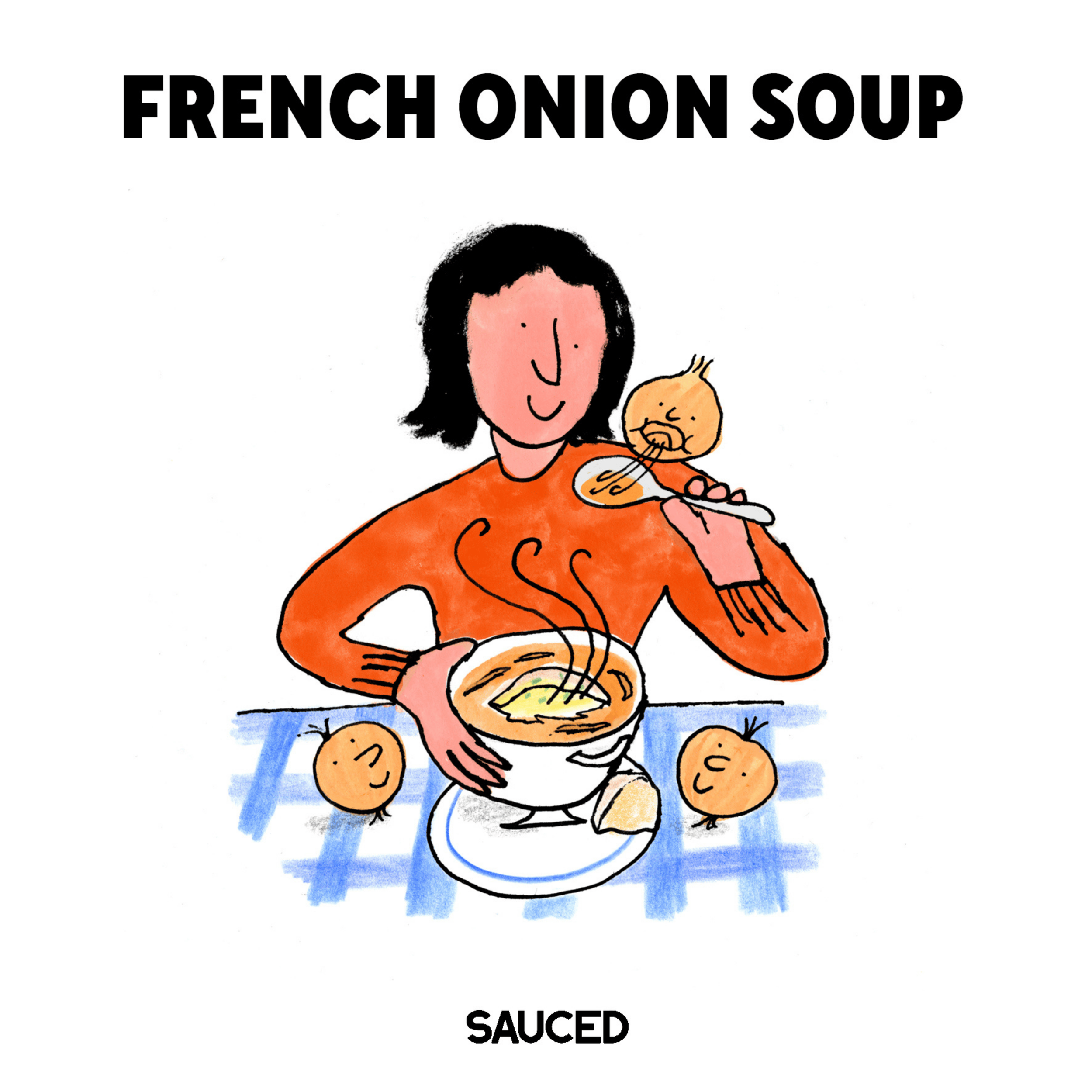
Once called the "soup of drunkards," French onion soup was born in the shadow of Les Halles — Paris's legendary night market — where butchers and aristocrats ate elbow to elbow at 3 AM. This week, we're adding booze to a dish that originally had none.
"Onions, water, cheese, bread, and opinions."
What we settled on:
Two alcohol paths — bourbon + dry vermouth or Cognac + Amontillado sherry
Beef stock, yellow Spanish onions, Gruyère, thyme, and bay
Low and slow caramelization — 45 minutes minimum, no shortcuts
Pole-to-pole slicing with one equatorial cut for spoonability
Baguette cubes piled high, a "nearly embarrassing" amount of cheese on top
Broil until bubbly, golden, and blistered
The cocktail:
The Gratinée: Amontillado sherry, Dolin Rouge, a barspoon of XO Cognac, orange bitters, and fresh thyme. Stirred, strained into a Nick and Nora with a flamed orange peel.
RECIPE CARD:
Premium subscriber? Check out the full recipe card here.
LISTEN
EpiSOde Partners
Thanks to the following brands for partnering with Sauced to bring you this episode:
TRANSCRIPT
Tim McKirdy: Sother — French onion soup. I just wanna make sure we're not falling afoul of any linguistic stuff here. We are sticking with French and not Frenched onion soup, correct?
Sother Teague: I guess technically this would be Lyon onion soup.
TM: I've always wondered what do the French call French onion soup?
ST: They call it…soup.
TM: Soupe à l'Oignon. There's an additional word that we will get into, but what is it? Caramelized onion broth, grated with bread. And I'm going to plant a stick in the ground here and say Gruyère cheese.
ST: That's what I have. But you said onion broth, I say it's beef broth with caramelized onions.
TM: Well, you know what's funny, one of the things that we had thought about coming into this episode is that beyond Crêpes Suzette, which is a dessert, we haven't done a vegetarian dish yet. So the fact that you would just take that away with one hand, giveth and the other hand directly take away there with the beef broth. But I gotta say I am with you. If there's stock going in there, I want it to be animal based.
ST: Same. So there's some contention out there though, and we'll dig. But I think for me it's beef.
TM: Personal or professional connections to this dish. Do you wanna kick us off today?
ST: I don't have any personal connection to the dish. I have a professional connection to caramelizing just absolute mountains of onions. My personal connection though, is Natalie, my partner is a massive fan of this specific soup. So I end up making it several times every winter. I think this is absolutely a winter, quintessentially winter dish. So I make it a fair amount and I have some techniques to save some time for doing that.
TM: Nice. And I think that will be great for folks to hear from the get go as well, because I think time is as much of an identity or part of the identity of this dish, the time that it takes to make. And the time that people decide to spend when making it. It's funny as well, Gabriela and my wife also absolutely loves this dish. And I think it is one of those, right, like you said, warms the body, warms the soul. Ideal cold weather cooking right here.
ST: You know, a lot of these dishes that involve some slow cooking really does make your home smell cozy, warm. Like inviting, like hearth style cooking.
TM: So weirdly, or in comparison to your own experiences, almost every restaurant I ever worked at had this on the menu.
ST: Well, you spent most of your restaurant time in European restaurants, or at least outside of America.
TM: French inspired restaurants. French cuisine for sure.
ST: And I think I spent most of my time in restaurants that certainly had French culinary technique as a cornerstone, but not necessarily French dishes.
TM: And then again, I never worked anywhere where this dish was on the menu. So I have an interesting professional anecdote that I'll save until later. But I will say that if I want to talk about first associations with this dish, where does my mind immediately go when talking about it professionally?
It was actually when I was a food runner, my first job. And the classic white, the lion-rimmed soup bowls, you know, those classic white ceramic French style soup bowls. Just having that and then having to balance that on a plate with a napkin, soup filled to the brim, bubbling as you're carrying it into the dining room. And just knowing as well, like, you can't touch this thing, it's so hot. It's just come from underneath the broiler. And just that slight trepidation — and this restaurant I worked in, by the way, you had to go down a set of stairs, then up a set of stairs between the kitchen and the dining room, which for a newly minted food runner is an absolute nightmare.
ST: There's always stairs.
TM: So regardless of the fact that I've cooked this in a lot of places, it's a home dish, right? Or it's definitely one that I think as always, we would encourage listeners to make it home. And hopefully over the course of the next hour or so, we will succeed in doing so.
ST: Well, not only that, I think it's a home dish more than a restaurant dish. I never worked in a restaurant where we made it. But also, even when I see it out and about, and you know, full disclosure, I've said this I think on the show in the past, I don't really eat soup. I don't like hot liquids. So I don't really eat this thing. But when I'm out and about and I see this thing, I can see the difference in how it's finished in a restaurant versus how it's finished at home. And that's true of many, many things, right? We have different techniques at the restaurant that get things almost cooked. That way when it's ordered, we can finish. I think this dish is better served when it's made and served fully in one go.
TM: Totally. And I think, you know, this is fast forwarding to one of the quotes or one of our culinary luminaries, but I saw something from Anthony Bourdain saying that French onion soup is something that's so simple to make, but like pasta, so many restaurants insist on doing it badly or insist on doing it wrong. And I think a lot of that comes from trying to avoid taking the long, slow route, which it is, and which is essentially unavoidable. Introducing all these techniques that are unnecessary, that speed things up. I'm doing that in air quotes as I often do, but actually don't. And they create a worse product.
ST: We sacrifice flavor and quality for convenience all the time in life. And I think restaurants are somewhat forced sometimes, you know, ideally, of course I'm gonna roll out my own pasta, and I'm gonna, you know, just to use it as an example, and then I'm gonna drop it in boiling salted water and I'm gonna toss it in the pan with the sauce and I'm gonna eat it right now. Well, in restaurants I might have to use dried pasta. I might have to blanch it in advance so that I'm really just dropping it in water to heat back up. We're gonna reduce the quality of the thing so that we can put a product on the plate quickly, efficiently, and at a price point that's gonna keep the business in operation. So there are techniques to this soup that fall into that category as well.
TM: We're gonna go into the origin story now and look at the beginnings of this dish at the extent to which we can, when you're talking about something which is an ingredient that's been around for centuries, millennia, actually.
ST: I'm curious to hear what you dug up, because this dish to me seems like simple, collective subconscious — onions are here, broth is here, let's make soup, right? But is there an origin?
TM: There's a really fun origin for us to dig into here. So folks have been making soup with onions and an onion style broth for ages. That dates all the way back to Roman times. They're not exclusive in that, but where we see this codified, where we see this become a thing, is in Paris. In Les Halles, which is, or was the central market of Paris.
ST: And famously Anthony Bourdain, the restaurant that he was the executive chef of, was named Les Halles after this place.
TM: So this was a night market open from 9:00 PM till 8:00 AM. And you would have, you know, butchers, fishmongers, all the classic stuff of a French market. The basically anywhere where you've had a job.
ST: My guys, my people represented in this market.
TM: And the restaurants surrounding that market would offer an onion soup. But there and then was popularized, and we're talking like 19th century here, was popularized the idea of not just having this onion broth with the onion still intact, but putting that crouton on there of stale bread, grating the cheese and serving like that. In fact, it was called the soup of drunkards.
ST: This is definitely made for me. Maybe I'll change my tune on hot liquids.
TM: Because on the one hand you had folks coming in, they're still with their aprons on bloodied, you know, they're butchering, they're fish mongering. But then also you had aristocrats, you had people out on the town going to shows, going to operas, and getting a late night, getting a late night bite to eat. Or a late night soup. It's very filling. Crucially, that version and the version served then didn't contain booze. And we will get into that. Of course, this is Sauced.
ST: We're gonna put booze in ours.
TM: But they called it the soup of drunkards because not only would it help sober you up, it might also mask the smell that you might be carrying of some late night out. Sadly, just to sort of round out that story, it closed in the late 1960s, I believe it was 1969. It was known as the belly of Paris or the stomach of Paris. And that moved out to the north of the city to somewhere called Rungis. Rungis is how it's spelled, R-U-N-G-I-S. But I might be wrong. And I only mentioned that because when I was at culinary school, we got offered to go on like a field trip for a day or two to Rungis market, but you had to get up at something stupid like 1:00 AM and I said, you know what, I'll skip that one. I can go to the market in London.
ST: When I was in culinary school, I was perfect attendance. I was one of only four people who was perfect attendance.
TM: The belly, the belly of France. That sounds perfect, right? 'Cause it's the market where you're going to buy everything or where everything's being processed, at least to be then purchased in. 'Cause those markets are generally speaking for the markets to shop at, right? You own a shop, you shop there to stock your place.
ST: So that's where all the foodstuffs were coming from to feed all of France. And that sounds pretty incredible. I think it's unusual to me, you know, like, because when I think of a market like that, like the seafood market in San Francisco, the dish that all of the people shopping at that market are eating is cioppino, right? A hearty fish stew. Why was it, rather, that they were shopping for their meats and their seafoods and probably pastries and other items, but the soup they were eating was just onion.
TM: Onion and cheese. Was there a cheesemonger in there who was running the show? A Gruyère importer from Switzerland? Maybe. I gotta say maybe it's a financial consideration. This is something that's hearty. It's gonna fill you up. I don't know if they were eating it in summer.
ST: Do you find it to be that hearty of a soup?
TM: It's a good question. I think it comes back to what you've mentioned before on this show, the idea that the very process of eating it takes time.
ST: Response cost.
TM: Response cost, right? More than a tomato soup, which you can drink down, this you need a spoon for and you're going spoon by spoon. Or I would hate to see anyone just drinking this directly from the bowl. We were talking about misophonia and echo.
ST: Well, there's that. There's also the bowl is too hot to pick up and like sip from. The liquid is too hot to drink at any speed. The cheese is melty and piping hot as well. This soup is piping hot. So it does slow you down. And when you eat slower, you do get full faster. So that could be completely, you know, I don't think they had the math or the science to understand that. But I think that sounds like it could be why.
TM: So that idea then of workers, I just like the image of them elbow to elbow with people in tuxedos having come from this show or this opera or whatnot. Does lead me to therefore question though, is this a princess or a pauper's dish?
ST: This is a pauper's dish. It is made with next to nothing very inexpensive ingredients that are bigger than the sum of their parts when assembled correctly. The most expensive item in the whole shebang is the cheese. You know, it's stale bread, so you may have even gotten that for free. As mentioned, it could be completely vegetarian. So the, you know, we're just talking about water. Onions are notoriously inexpensive and plentiful. So this is a pauper's dish for sure.
TM: Very cool. Do we want to get into what I'm calling here, the great alcohol debate. Or do you wanna save that?
ST: I think I'm gonna trash your debate already because I think the debate is greater than that. Your question is, is there or isn't there alcohol?
TM: No. We are adding alcohol.
ST: We are for sure. But is there classically?
TM: I think this comes down to the letter of the law versus the spirit of the law.
ST: Spirits. Yeah.
TM: Exactly. Being the operative word there. And I think if you're ordering this dish or if you're making it, there is an expectation that alcohol was used in the preparation of this dish.
ST: You think so?
TM: I think so.
ST: 'cause my study on this dish, this delicious soup, is that it is so wildly varied on what alcohol is in it, or even if alcohol is in it. And then frankly, going back to what we've already talked about, what stock is in it, or if stock is in it. Like Paul Bocuse, you know, chef of the century used water only. And I'm not kidding. He has that designation. He was known as the chef of the century. And he used water in his.
TM: It was an easy century though, if I remember. The competition wasn't that high.
ST: Pretty light. So my contention is more, not necessarily even of the alcohol, but of the recipe itself. I think Robert Simonson said it really well once about the Martini. The Martini is made from gin, vermouth, and opinions. I think this dish, this soup is kind of bulletproof. As long as you have the requisite ingredients, the very baseline of them, and you cook them in the correct way, you'll have French onion soup. Soupe à l'Oignon.
TM: So you're saying the French onion soup is a dish made with onions, water, and opinions.
ST: Yeah, kind of. Onions, water, Gruyère cheese and bread and opinions. It's not as clean as Robert's statement, but you know what I mean.
TM: One you could definitely put on a gravestone and the other, yeah. Maybe we can find a better quote for you there, Sother.
ST: What's his gravestone with a QR code? You gotta get more information.
TM: So I like that. I will say though, when it comes to the alcohol and I think what we're talking about here and as we do often at the beginning of the show is the identity of this dish. It's called French onion soup. Most of the preparations when I've made it in kitchens, but also a lot of the preparations that I looked up were either Sherry, port, or Madeira. Or a combination of the three.
ST: I saw literally dozens.
TM: None of which come from France.
ST: Correct. But I saw, maybe not an equal number, but I saw a tremendous number of versions that involved vermouth. Likely French vermouth. I saw many that use wine, red or white, but both dry.
TM: You could call that French.
ST: You could call that French. There is the idea of not just adding wine or fortified wine, which is all we've talked about so far, but to flambé at some point. I saw many that used Cognac. Personally, I like American whiskey. Bourbon, a little sweeter.
TM: Wow.
ST: Not my normal — caught you off-guard. But you know, again, I think, like I was saying, we're moving into what our culinary heroes and icons may have said about it. And you know, the two that we look at the most are Jacques Pépin and Julia Child because we both kind of have an affinity for both of those guys. Jacques Pépin prefers it with white wine. Julia Child prefers it with red wine. Jacques is more brothy and light. Julia Child is much more onions, so it's a much thicker soup just because the onions also, she uses flour in hers to kind of make a caramelized onion roux. So that brings some thickness as well. And again, I think it's much like the Martini, it's to your opinion. Unlike the Manhattan, which is a white, which the Martini came after the Manhattan. The Martini is just a white Manhattan. If it were made today, it would be called a white Manhattan spirit, vermouth, and bitters. But no one messes with the Manhattan. It's two to one. Two parts whiskey, one part vermouth.
TM: New York area code for the folks trying to remember that.
ST: It is the New York area code, but the phones came much after the drink did. But no one messes with that. But Martinis, you in particular have your, me too, by the way. I have mine that I like, have our ratio that we like. Bitters or no bitters. Garnish that we want. The Manhattan is so why is that? I wonder why is this soup, which is storied and well known, just like a Martini, why has it got so many variations?
TM: Well, I'm gonna continue then, and we're gonna move into the culinary luminary section here, because I think that's an important point. And we're talking about identity and you're talking about Julia Child. It's only through her book, TV programs that this starts to become known as French onion soup. And I would argue maybe Julia has done as much as anyone for the identity or the standing of this dish. And I think perhaps like elevate it into something seen around the world that was never really viewed that way in France. I don't wanna speak for the French or I don't have that lived experience, but certainly there is a kind of before and after moment, and it goes from being a simple onion soup that maybe you'll use alcohol with or maybe you didn't, and maybe you'll have the grated bread to a preparation with a solid identity. And as you said, she does have those rather interesting little additions. Including the float of Cognac.
ST: A float of Cognac. Pretty strange.
TM: What did you come across, because I saw some folks saying you float it just before you serve and then others you float it right at the end in order to serve the next day. So if you were preparing this soup to serve tomorrow, the last thing you add is the cognac. What was the one that you'd seen?
ST: I saw a few different ones. But I think all of them involved the float of Cognac going in just before service. So bubbling soup, floating the Cognac, which will certainly cook off some of it, but not in the same way that it would if you flambé the onions before getting to that, getting the broth and everything else in there. And I don't think it would bring as much flavor that way either. It would just bring a boozy flavor, which I'm not opposed to, but I don't think that's the way I would do it.
TM: That was an immediate red flag for me, to be honest with you. If someone does something that I don't agree with, but they have a clearly defined reason for doing so —
ST: I'm willing to hear it.
TM: Same here. In this instance, I don't really understand the science or the reasoning.
ST: It seemed to go against anything that even she would typically stand behind in all of her works that we've got. 'cause I could go all the way back and find her making this soup on her original show in black and white, and then I could go ahead to when she was in her declining years and see another show with her making the soup again and still doing the same method and thinking to myself, this doesn't seem right. You don't do this in any other preparation that I've ever seen you do or read about you do or read any of your books doing so. And then there's no explanation of it either. Just adding it in at the end.
TM: You gotta try it out then, I guess. One of those things.
ST: We still got plenty of winter ahead of us. We'll put in some time and make some caramelized onions and cook with Cognac and then finish with Cognac.
TM: So that's Julia.
ST: Because I could much more see finishing the dish with Sherry, like you do sometimes. You know, they bring over a little pitcher of Sherry and pour it over the top right there, literally at the table. It's not getting cooked at all. I could see that, but just pouring spirits, pouring alcohol right into the top of a soup as it's going out. That seems
TM: 14 to 16% of one of those things by volume is alcohol and 40 to 45 of the others. So it's a lot more alcohol you're bringing into it. I think generally those are the things that define Julia's preparation. I'm sure we might touch upon a few other things as we go through, but what about Jacques? What did you come across there?
ST: Jacques' soup is much more brothy. And he uses white wine if he uses anything at all. Julia again was using that cognac as a finisher and she was using vermouth and red wine, both and strangely white vermouth and red wine.
TM: The red wine. I've always wondered whether that is a color consideration that people are doing.
ST: Could be, because Julia also is using chicken stock and Jacques is beef. So she's getting the color from the red wine rather than the broth. She's getting more color more from that.
TM: Jacques. Look, I got some issues with this guy.
ST: We can beat up Julia. She's gone. You can't beat up Jacques till he's gone.
TM: Look, I got no issues with Jacques as a person. We love him. We love his paintings of chickens. We love the fact his dad was in the French Resistance. However, he caramelizes his onions for eight to 12 minutes only. Which is a lot more than the standard home cook is doing for anything when they're told in a recipe to caramelize the onions. Significantly shorter than anyone else out there, and than I have ever made this or you ever would make it.
ST: Well, the Bocuse method, the onions, they're pale, they're still pretty white. They're effectively just steamed down, in a massive amount of butter. The Bocuse method starts with a half a pound of butter to a pound and a half of onions. And they're cooked down. They're not brown really at all. Then they're passed through a mill. So it's a puree, effectively. And this soup is pale grayish, whitish, like a bisque.
TM: I think that's not, again, in the spirit of what we're talking about today.
ST: Not at all. But I think you kind of hit the nail on the head when you said you think that Julia kind of popularized the soup by codifying it. This soup did exist. Bocuse gave us the thing that existed. Jacques, I think stepped in with a kind of a mid step. His does get caramelized 'cause also when you have so many fewer onions in there, that 12 minutes of stirring on high heat will get 'em somewhere. When we start with a sauce pot that is full to the top and almost overflowing with onions, it simply takes longer because there's more of them. So they do get some browning on them, but I understand what you're saying. And that would not be satisfactory to the mouth that I have to feed this soup. She would not be happy. There would be no satisfaction.
TM: So Paul Bocuse as well, did say, and I wanna pull up the exact quote here, because these are fighting words.
ST: Uh-oh.
TM: He called his version the “original onion soup preparation ideal for late night snacks, not the imitations formally prepared in Paris at the famous Les Halles marketplace.”
ST: Now that's some fighting words.
TM: So Paul, chef of the century going out there, he has that as his backup. I will say this though, the preparation that you're talking about adds some additional steps. You talked about like passing some things or whatever. He could easily turn around and say they're missing out steps in the preparation. Theirs isn't as refined. Which makes sense for the setting in which it served. But that was the version that then became codified. So I think we're actually bit by bit nicely unpacking the evolution of this dish.
ST: For sure. We can see kind of where it started and where it wound up. But I will say, you know, Jacques, just because we learned before as well him not making his crêpe batter the day before. This is another Jacques the hack moment for me right now.
ST: Jacques the hack moment. We're having our Jacques the hack moment.
TM: Jacques the hack. But again, we're getting back to the notion that this is your heavily opinion laden soup, right? And when I say you, I mean the listener. You, me, everyone who makes this soup. I would hazard the guess that even in Europe, even in the same town, frankly, even on the same street, if you went into four or five different bistros and ordered it, it would look different in each one. This soup is a game of telephone, right? All the components are there. Just 'cause I have flour and sugar and eggs and milk doesn't mean if I just throw 'em in a pan haphazardly I've got cake. I got all the pieces of cake. But if I don't put 'em together correctly, we're gonna have different cakes. So that's where we're at on the soup. Any other culinary luminaries for us to round out today? Any other nuggets?
ST: Man, I think we tapped a bunch of the heavy hitters. Bocuse, Jacques Pépin, Julia Child. We had Bourdain earlier with his pasta reference.
TM: I think that's a good bunch of opinions for this big bowl that's swimming in them for us here today. So time for the non-negotiables section. This is where we are codifying the Sauced French onion soup, the things that have to be in there for us. Take it away.
ST: Do you want me to just run 'em off or do you wanna jump in?
TM: Let's go one by one.
ST: Butter.
TM: Butter's your first non-negotiable?
ST: I'm just thinking of how I make the thing and we're gonna start with butter.
TM: Unsalted as always.
ST: Unsalted as always. You know, we'll reiterate this throughout, but unsalted butter is your friend because if you use butter that has salt in it and then you don't have control of the seasoning as well as if you use butter that doesn't have salt.
TM: I like that you're including that as a non-negotiable as well too, because you know, right. We say these are the things that if the dish doesn't have it, it's not that, it's not the dish. And we've spoken about the fact there's so few ingredients in this. That butter is a defining flavor. It's not just a medium, it's not just a fat for cooking in. It's partly identity.
ST: Because theoretically you could cook the onions in beef tallow or obviously olive oil, but I think that the butter, which has milk solids in it, and the long slow cooking process, those milk solids are gonna add a flavor component to the onions in the final dish.
TM: Alright, well, I'll step in with our next non-negotiable here. Onions. Let's explore types of onions.
ST: Well, I did see a few again, this dish is so malleable. When I say any of them, that's any onion. And I saw a few recipes that use multiple. I saw Matty, actually making French onion soup from years ago, long before The Bear was out. Where he was using red onions, sweet vidalia, Spanish onions, white onions, shallots, and even cipollini, which are not onions, right? Cipollini are the bulb of the grape hyacinth plant. They play the role of onion in a lot of things. So he had this multi onion soup happening.
TM: Anyone doing pearl onion? Imagine a pearl onion French onion soup, what would that even look like?
ST: It looked like a big bowl of eyeballs.
TM: Eyeballs out of a Disney nightmare.
ST: Eyeballs bobbing around in broth.
TM: But what about yourself?
ST: For me, it's just your standard Spanish onion.
TM: Yellow onion.
ST: Right. I kind of don't want to use what you might think you want to use. We make caramelized onions with the vidalia 'cause that's gonna then result in a soup that's quite sweet.
TM: So the vidalia are reminiscent of a Spanish onion, but they're flatter. They're more of an ellipse versus an ovoid?
ST: Ovoid. Hell, I don't know.
TM: But those are, yeah. You want your Spanish onions. You avoid your white onions as well. I mean, I'm with you. I'm going yellow Spanish onions.
ST: Yellow Spanish onion.
TM: Cool. Next non-negotiable.
ST: I say dry vermouth, typically French.
TM: Can we just say alcohol?
ST: Well, 'cause I have two alcohols. I'm gonna also say bourbon. For me, that's how I make it. I don't know exactly. Like I said, I think the bourbon comes off bringing some sweet alcohol notes rather than the fruity alcohol notes of a brandy or a cognac or an Armagnac. Brandy, cognac, Armagnac, they're all brandy. But there's something about this sort of woody nature of a nice bourbon that's gonna add something to the caramelized nature of the onions. So that's what made me choose that. And I think I chose it at some point when I was first maybe making it and I've just stuck with it.
TM: I think we get to define this. We get to decide. I would say alcohol is the non-negotiable. It's the thing that people are gonna expect. And now we can explore that as an ingredient. So you're going with your bourbon. Because again, if there's no bourbon in this, that doesn't meet the spirit of it — no pun intended. Let's go through those. So why are you going with dry vermouth? First, I love it. It's a completely underutilized cooking ingredient. Why go with wine when vermouth is right there?
ST: I think because we're gonna keep ticking down our non-negotiable list, and on here, only a couple of herbs in my opinion, but dry vermouth, especially a French dry vermouth, are quite herbal. So they're helping pump up a little herbaceous quality to the dish.
TM: Yeah. And I think it being such a small list of ingredients you have to look at every single opportunity to add flavor. Build upon the flavor: butter instead of neutral oil. Choosing of the onions. Instead of a wine, you've got those aromatics. Wherever I have made this we've gone port for sweetness and Sherry for dryness. But those boxed cooking alcohols you get, whether it's Sherry or Madeira or whatever — is that dry? Like a Fino Sherry isn't gonna have some sweetness. I was never really stopping to drink it, and it was just like Sherry. You know what I mean? It's a broad category. But those are the two Sherry or what I would gravitate towards and Madeira coming sort of in third place for me and potentially just skipping the wine. But I think white wine as well, or red — yeah, I guess whatever alcohol you have on hand.
ST: Yeah. I think this is what I'm starting to realize, even through this conversation, it's a little bit of a catchall. If you have chicken stock, make it. If you have beef stock, make it. If you only have water, make it. If you have some wine around, make it. If you have some whiskey around, make it. Don't not make it. You know, even as I'm saying that, I'm thinking like, what about a peated Scotch? To deglaze the onions and now I've got this kind of smoked onion soup. You know, there's no wrong way, but there's definitely a right way. And that's your thesis of the episode.
TM: There's no wrong way, but there's definitely a right way. Okay. I'm just sort of mentally trying to figure out if that works. It does.
ST: It does. There's no wrong way to do it, but there's definitely a right way.
TM: I'm gonna propose another non-negotiable here. Gruyère — has to be Gruyère for me.
ST: I think specifically Gruyère. People use other Swiss cheeses like literally Swiss cheese or Emmental or what have you. But I'm a Gruyère stand on this one too.
TM: And I think the reason for that being that it's one of the best cheeses for melting and grating. It's got a high fat content, relatively low moisture content. Does well on that front. Comté would be an analog from France.
ST: I'm sure. And it's common again. I saw plenty of recipes using all the cheeses we just mentioned. And some recipes using more than one.
TM: Well, tell me about your herbs. And I'm gonna say that with a hard H here, because I've been getting some stick online from people about the fact I've been dropping the H sometimes. Listen, when I say herbs —
ST: If they can't understand your absolutely delightful accent, then they should hold their herbs. I think only two. And it's thyme. Bay. Like, that's it. And I don't wanna pick thyme. I don't wanna chop thyme. I'm gonna throw in whole sprigs in a bundle tied together with that bay leaf so that I can pluck 'em all out in the end. I just want the flavor. I don't want the bits.
TM: Yep. And some of those little bits that will naturally come off, they're gonna disperse throughout. It'll be a few, but they're gonna be edible.
ST: Oh yeah. But also there won't be that many. I don't wanna see 'em. It should be a pretty clear-ish broth with caramelized onions underneath a shielded layer of melted Gruyère cheese and toasty, soggy bread.
TM: So that's a really great moment to bring in something from culinary school, and it's ideal for this. My chef at culinary school was very adamant about certain things as culinary tutors often are. One of which was when you're serving soup, the solid parts that are gonna be in there — in this case, sliced onion — they should not be bigger by the time they've been cooked than the spoon. And also to your point about thyme, you have to be very wary of something that someone can get stuck in their teeth. Both of those considerations are for the comfort of the person eating and their company. They're not like struggling to get something into the mouth or they're not left with a piece of thyme between the teeth. Really nice considerations and good sort of black and white rules right there.
ST: Yeah. I think that's what we talked about even on the first episode. We're gonna cut this to a size that it can be eaten on a spoon because this is a soup. So I guess you're talking about what I consider to be the last of our non-negotiables — the crouton itself. Many times people cut it to be the size of the top of the bowl that they're serving in. I think that's a mistake. Let's cut it into cubes that are larger than you think you're gonna need because they're gonna get soaked and they'll kind of like become smaller so that they can be on a spoon. Because you're also having to fight a little bit with the cheese, because the cheese is gonna melt it into this big amalgam. So that's why this cheese is the perfect one — Gruyère. It does get quite melty. Your spoon can slip right through it. There'll be a cheese pull moment, but it won't be like a mozzarella stick where you can't get it to break. It'll come apart.
TM: Very cool. Final non-negotiable for me today.
ST: Oh, there's one more. That was my whole list.
TM: Mine is a technique.
ST: Oh wait, I think we skipped broth, but I already said mine's beef.
TM: I would say that comes into being a negotiable and an ingredient. But those are two different things. It's hard. We're still figuring this out ourselves, listeners. One is like, what do you expect when it arrives? You order it on the menu and it arrives. If it's not beef and it's chicken, I'm not sending it back. If it doesn't have —
ST: Oh, I'll go back to my Martini thing. Martinis, I've always said Martinis are like eggs. Everyone has a very specific way that they're gonna order them, but they'll pretty much consume whatever you put in front of them. So I may be specific about what I want in my French onion soup, but when it comes, I'm probably gonna have it.
TM: Fair. Yeah. I'm not sending this dish back for the record. But you know, just to drive home that difference between what is the Sauced version of something and what are the non-negotiables — the last one for me would therefore be that it has to have that bread and cheese, but that has to be grated. You can't just stick that on top. It has to be grated. We need flame, we need caramelization. We need that Maillard reaction.
ST: Yeah. We're gonna talk about that when we get to building it.
TM: We're gonna talk about that as well. So those have been our non-negotiables for today. Other ingredients now. Let's talk about that broth. You did a broth reveal. What is your thinking there for that?
ST: Why do I choose beef or veal stock? I think it's the richer of the stocks that we typically make in a kitchen. And I think beef and onions — let's talk about a Philly cheese steak with onions, beef and caramelized or grilled onions. Let's talk about smashburger, beef and onions. Beef and onions are fast friends. Not to say that onions aren't friends with kind of everybody. But I think in cooking the onions down, bringing out their umami qualities, beef is where I want to go.
TM: And why vermouth over the other ingredients. So not necessarily like why vermouth, but why do you think that's better than those other ingredients, those other alcohols?
ST: Well, like I said before, I think the vermouth is gonna bring in some — especially again, if it's a French vermouth, which with French onion soup we should use a French vermouth. I think it's gonna bring in a lot of herbal qualities to add to the fact that this dish only has the two herbs in it. And that was kinda universal, by the way. All the recipes I looked at, there weren't any like I'm gonna add tarragon to mine or anything else. It's thyme and bay. And frankly, some of them were just thyme. So thyme's kinda always there, but it was never anything more than bay. So I think the vermouth's gonna bring an herbal quality and how you're gonna get that in there, by the way, is adding the vermouth once the soup is kind of at the rolling point. We're not deglazing with vermouth. We're deglazing with a spirit. The vermouth's going in when it's soup. And that's how we watched Julia do it. That's how I saw numerous people. I watched about four and a half hours worth of clips of people making French onion soup because I went down the rabbit hole of like everybody's making it different. Can I find a thread here other than onion?
TM: So just to list through some of those others again and what they're gonna bring to the party and why you might consider them at home. Sherry's gonna bring nuttiness. Depending on the Sherry you choose — that's the other thing. Fino is gonna bring your searing acidity and dryness. Something like an Amontillado is gonna bring that nuttiness, richness. Port — which was Bourdain's choice. Bourdain went with port and balsamic vinegar.
ST: He's looking for fruit and tartness.
TM: Richness, sweetness, body, depth. The Cognac, brandy we've already mentioned, although I think we've exceeded our Cognac allowance on this show.
ST: Yeah. We've been leaning into it too much.
TM: Purely by accident.
ST: But if there's any Cognac brands out there that wanna sponsor us, just let us know.
TM: We are big fans of Cognac, actually.
ST: Both of us are.
TM: Yeah. Very, very big fans. Madeira's gonna do much of the same thing as Sherry. It is gonna bring that sort of nuttiness, which again, nuts big friends with onions, as you say. Final one for you: cider.
ST: You know, I saw a couple of different makers, and Jacques was one of them using apple cider — not even hard cider, just apple cider as part of the liquid. And I can see that. Onions and this fruity juice, or fruity cider would pair well together. I mean, I can certainly imagine myself having like some caramelized onions on a cheeseboard with slices of apple and there's onions and cheese in this soup. So it all starts to make sense to me.
TM: At this point, it would be remiss of me not to give a shout out to my old chef and mentor Bruno Loubet. I was looking through his book during the preparation for this, and he opts for a dry cider. He's a very classical French chef. One of the things he said in his book that I cannot verify, but I thought it was interesting, was he did a nod to Paul Bocuse and said that the popularity of this dish is probably related to Mr. Bocuse. And this is post Julia Child, but you have to remember, Bruno would've been cooking in London and came up in France. And certainly Julia really didn't have a presence across the pond. We had Delia Smith, we had some others. But he also said that William the Conqueror — I believe it was 1066, Battle of Hastings, people in the UK will know when William of Normandy came over to England specifically — he brought onions. Now I have to assume that onions were in England before that, but that is true.
ST: Some kind of allium, maybe.
TM: Some kind of a garden onion.
ST: Maybe he brought what we know as onions instead of maybe spring onions, leeks, garlic, leeks, et cetera.
TM: And therefore planted the seeds for what would become eventually an interest in French onion soup there. I don't know, but I thought that was an interesting point. I couldn't verify it, like I said. So if anyone does know, email us at sauced@the-coaster.com or reach out on Instagram and all that stuff. That is the booze, Sother. Do you wanna give us any other options on cheese? We mentioned a couple.
ST: I think we covered 'em pretty well. But if you don't have any of those on hand, I'm not gonna say — and again, I hate to keep pounding on this drum, but the malleability of this dish is somewhat incredible. You got some cheddar at home, make the soup. You know what I mean? Like we said about the booze — what have you got? Make the soup. Whatever stock you got. Or no stock, make the soup. You got onions, you got butter, you're 50% of the way there. So I think if you don't like Swiss cheese, it needs to be a cheese that's meltable. We don't we wouldn't go with like a Chèvre, or maybe I wouldn't. I don't know that I'd go with a Brie, but now that I say it out loud, maybe I would. I don't think there's a wrong answer. No wrong way to do this. There's definitely a right way.
TM: Yeah. And I've actually had versions of this with Brie and it's delightful. So you know, it works. Alright, well those have been non-negotiables, negotiables, plenty of opinions as we keep mentioning. Let's bring some science into things. Let's bring some technical considerations. Hard, fast facts that you can't argue with. Let's start with a caramelization time debate. We're going all the way from eight to 12 minutes from Jacques to three hours plus. Thomas Keller.
ST: Yeah, listen, Tom does nothing the easy way. But he's got time on his hands. He's got a million chefs as well to do whatever. Many hands make for light work. I think it's gonna depend on the amount of soup you're making, thus the amount of onions that you're using. It's simply gonna take longer to caramelize five pounds of onions than to caramelize to the same level one onion.
TM: Yes. But here's my response to that. Size of your pan as well.
ST: Size of the pan. Yeah.
TM: Heat source, thickness of your pan. All this stuff.
ST: Thickness of the onion slices.
TM: But Jacques, unless I'm mistaken, cooks this on high heat.
ST: He does. Yeah. My guy's all gas, no brakes. He cooks everything on high. You ever just watch his videos? Watch him and then have yourself a good time and watch like I watch on two times speed. The guy's a devil. He is spinning around like the Tasmanian devil.
TM: So Jacques is high. Thomas Keller is as low as possible and stirring and scraping that fond every 15 minutes. But that is — you know, people talk about the effort involved in this dish. That's only 12 visits to the pan. If you're cooking for three hours and you do it four times an hour, that's not a lot of work.
ST: Not crazy. No.
TM: And again, people can choose, choose your lane, choose your approach.
ST: Let your conscience be your guide.
TM: One of the things we cannot argue with — one of the things I want folks to understand is the science here. It's our Maillard moment. So the Maillard reaction takes place at 280 degrees Fahrenheit — which is what, 140 something Celsius?
ST: Onions, which are 89% water and water starts to boil at 212 degrees Fahrenheit, you will never get the Maillard reaction until your water has evaporated off. Essentially the temperature of your pan is always gonna be hovering around 212. Once you've cooked that water off, then your pan temperature starts to rise. That's when the Maillard reaction happens. So the point is not how high your flame is or whatever anything is. It's more about when you've cooked out all of the water from those onions and you start to caramelize. The caramelization is the Maillard reaction and the way that we get there — well, there are a couple of different ways as well that influence how we can get there. Does that all track with you, former chef?
ST: A hundred percent you are correct. Until the water's gone you're gonna hover at 212. It's not high enough to get any caramelization. So that initial part of the onion's going in the pot with butter is just to get them sweating. The liquid is coming out and that's why it's cold. And then it's sweating and then it's evaporating. The steam rising off of your pot. And then once that steam starts to dissipate, once there's less and less steam, now we're starting caramelization. And that is gonna create our fond.
TM: Fond. And what is gonna get rid of our fond?
ST: Deglazing.
TM: Cooking is — you know, sometimes I worry I'm like, are we being too clinical about things? When we think about these? Like, why do you need to know 212 versus 280, whatever. But like, when you are armed with those simple truths, facts, science, then it lets you go wild and lets you do different things or lets you understand. For me, like that's one of the things I've been really enjoying about Sauced is thinking about and digging into the science, 'cause I'll be honest, I don't know about you, but they didn't teach us this stuff at culinary school.
ST: Are you saying knowledge is power? Okay. Yeah. We were taught this stuff, but also we were taught — in life, but certainly at culinary school too — to be intuitive and to pay attention and listen. You can literally listen to a dish like this and it changes — the sound changes. Once those onions go in just from slicing and just from getting the butter melted, you will hear a light sizzling sound. That sizzling is the water escaping. That water is mixing with the oils and fats that are in the butter. Oil and water don't mix. The butter's hotter than the water. The water's turning into steam and evaporating. As this process continues, that noise will become less and less — less of a hiss and it'll dissipate until whisper. And then that's when you gotta like perk your ears up from whatever else you're doing, 'cause you put this on — as you said — it can take a long time. If it's a lot, you got other stuff to do in the kitchen. So you're doing those other things, but you're listening and you're smelling. You put some pine nuts in the stove to toast 'em off, you're smelling. And then when you start smelling toasty, you gotta go get 'em, 'cause you're almost to the point where they're burnt. So it's not just about knowing numbers and temperatures and those kind of things. Though that is part of it. I think the bigger part of cooking is intuition.
TM: Yeah. And I love bringing the senses into this because listening will alert you to something happening before smelling will. The point at which you start smelling the onions catching, they've gone too far. But you can hear they're about to be there. And you'll just get that repetition from cooking all kinds of things — whether it's a mirepoix or onions for caramelized onion or whatever. I mentioned Tom Keller earlier. Thomas Keller. Do you think he goes by Tom?
ST: I think it's Thomas. You’re gonna go, Hey Tom, and he's gonna go, It's Thomas.
TM: I hate people like that. He came into the bistro to eat once with — you know, what was it? Everyone loves Phil. What's that? Phil guy who eats.
ST: Yeah. I don't know his last name, but yeah, somebody feed Phil.
TM: So they filmed at our restaurant and we're just like, our chef was like, Thomas Keller is coming in tonight to film — everyone feed Phil or whatever. And we were like, Thomas who? And Phil what? This is the extent to which American cooking culture is separate from —
ST: We celebritize these people.
TM: Yeah. But even your celebrity chefs or our celebrity chefs here didn't make their way — or certainly I wasn't aware of them and I was cooking in it. I was deep in that and whatnot. But Tommy K — he's very specific about the way he slices onions. I too, and I wanna get your take on what you do here.
ST: I am too. And I bet we're in alignment. Although I did not see — in all that time — I did not see Tom Keller's three and a half hour caramelization onion soup.
TM: He is. I believe his is in his cookbook, Bouchon or whatever his cookbook. But anyway —
ST: But surely I thought I would see, 'cause I follow other people who literally just go — their whole YouTube presence is looking at books and —
TM: Yeah. But isn't Thomas Keller behind a paywall on MasterClass or something?
ST: Yeah. But I'm saying like, you know, he probably is. But I'm saying I follow so many content creators who are just like, here's the book by a person and I'm gonna make this recipe. I never saw anyone do a TK onion soup. Anyway, what you're gonna do — we're gonna take the onion, big round yellow Spanish onion. Top and tail the guy, split it in half from pole to pole, and then you're gonna lie this thing down. I like to then give it one slice equatorially and then we're gonna go pole to pole slices for the rest of it. This way we don't have a full half moon. That cut by the way has a name — it's émincé, which is from the town of Lyon, which is where onions are very popular, which is I think supposedly where this soup really really is, where —
TM: Paul Bocuse is from.
ST: Yeah. So that sort of like half moon. Wait, explain that again. So you're taking the top and the bottom off.
TM: You're cutting in half, top to bottom. From pole to pole.
ST: From pole to pole. From bear to no bear.
TM: And then you're gonna put those flat and then you're going in half, again, sort of perpendicular to the grain. So against the grain, in half. And then you're going with the grain.
ST: Yeah. So all the there's one slice that is equatorial. So going like if you're going around the equator of this planet. And then the rest of the slices are pole to pole. That's the Lyon shape, but I've cut that now in half. So instead of looking like sort of a half moon, they look more like sort of fingernails. The reason I like to add that extra cut there is because in the end result of this particular use, I don't like it when my spoon just — like we talked before — you want stuff to fit on the spoon. When you go to grab French onion soup with your spoon, oftentimes because they're so long, they're like hanging over the edge of the spoon. And the liquid is so hot and the cheese is all hot and melty, like there's just more opportunity to spill on your chin, on your shirt, what have you. I like to add that one cut while I'm slicing.
TM: Very cool. Also, there's a scientific consideration here.
ST: Yeah. Because if you cut them, if you cut them equatorially — if again, if you split the onion just like I did —
TM: If you go against the grain here.
ST: Yeah. If you go that way, we're cutting against the grain. There's a texture issue that results. They don't — they're not as tender.
TM: Actually it's the opposite. So when you cut against the grain — the cells break down more.
ST: They'll start to almost puree.
TM: So you get what is an onion paste versus onions that have to a certain degree maintain some structural integrity and can be identified as caramelized onions in the soup. Julia — she was definitely just doing this for speed on TV, the champion that she is — did both cuts. As she was chopping down the onion for speed, she would chop it until she got to a place where you're starting to get quite high up and then she would turn it around and go that way. So they both — you could argue that that is actually quite a cool method because not only does it allow you to chop fast, also then you're getting some puree, which is adding body to the soup. But you're also getting the stringy onion. So yeah, but Tom, Tommy K is very pro pole to pole.
ST: I could see your method there making sense. Because I have often thought — though never done it — of getting to the final product and removing a percentage of the caramelized onions and hitting that with my immersion blender. And then pitching it back in. So I could see that kind of just happening naturally if I put in some percentage of the onions sliced equatorially and letting them kind of fall apart during the caramelizing process. That makes sense.
TM: One final thing when it comes to just the cooking of onions or caramelization — some people might decide to add some baking soda as a shortcut.
ST: Yeah. This is something I've never done, but I see it out there. I saw a lot of people doing it. You add a small pinch of baking soda — very, very small — about a quarter of a teaspoon per pound of onions. This will drastically speed up your caramelization by — and you get real golden and Emmy in 15 to 20 minutes is what they say. But again, that's gonna depend on the volume and time. The alkaline powder's gonna raise the pH. This will accelerate what we talked about — the Maillard reaction. It will help break down the cell walls and quickly converting inulin — which is what's in the onions — into the sweet fructose, which is the sugar we're trying to get out. And sugar is what is caramelizing. Now that is your Porco science fact of the day. But I do not recommend doing it. I recommend doing something similar that is not quite the same. I think you have some opinions on the baking soda, but I would recommend adding a similar amount — about a quarter of a teaspoon per pound of onions — of both salt and sugar. Both of them are hygroscopic and are going to help draw moisture out. When that moisture comes out it will hit the hot pan, it will steam away. And now we're on our way to caramelization. The salt will help obviously season. The sugar will also help caramelization. So instead of using this alkaline powder, let's just use these two things that are a little bit more in line with what we're making in the first place and get a similar result.
TM: I like your Porco. I like that we found our Porco: Hygroscopic.
ST: It's water seeking. Draws out water.
TM: I'll say this though. The baking soda, you said it — it helps break down cell walls. That's not something I'm looking for here. Not if I'm cooking a soup, not if I'm caramelizing for anywhere from 45 minutes to three hours. And then adding broth, adding water. I don't want that cell breakdown. That's a hack and not a hack in a good way.
ST: A Jacques hack.
TM: No. Jacques didn't even go baking soda. He is just like all in on the flame. The other thing though, as well — I take your salt and your sugar. I'm gonna say forget the sugar. The onions have the sugars. The onions will caramelize. Why are we trying to speed this up? Let's just accept what's the difference between 45 minutes and an hour, you know what I mean? 15 minutes. You save yourself 15 minutes. What are you doing with that time? Me? I'm using that time. I'm getting to bed 50 minutes later at night, but I'm sleeping sounder knowing I didn't take any shortcuts. I made my French onion soup the proper way.
ST: Well done.
TM: Alright, final science for us today.
ST: Uh-oh. There's more.
TM: Well, I figured this is probably gonna be our biggest onion episode.
ST: How big are the onions?
TM: Depends. Are you using Spanish onions? Why do onions make you cry? Pop quiz. Name of the acid.
ST: I don't know.
TM: Syn-Propanethial-S-oxide. When you cut an onion, enzymes convert amino acids into a volatile gas. The gas reaches your eyes, it reacts, sights off tears. A couple of little things here, not that this is just to flex some effects. How do you counteract that? Chill your onions down.
ST: Chill them, and then sharp, sharp blade.
TM: Sharper knife, because then your knife is not gonna bruise those or disrupt those cell structures.
ST: Right? You're not crushing the cell, you're slicing the cell.
TM: Slicing the cell. And if you really wanna go technical about it, which is a technique that you're taught when you wanna slice basil — like roll up basil into little cigars — chiffonade. Pull the blade back so you're not pushing down and going forward, you're only pulling your blade back. See that on the YouTube there, that's just a nice reminder for the folks we are on YouTube. So there's an eye here, pull your blade back and that's gonna offer the sort of lowest chance of you bruising. Whether it's an onion that's gonna make you cry or basil that's gonna make you cry because it's black by the time you get it served.
ST: And your chef's gonna yell at you. That's what makes you cry.
TM: Alright, well, so there that has been the technical and scientific considerations for us here today.
ST: Holy cow. There was so much about French onion soup.
TM: Right? Now to preparation: French onion soup, Sauced, our version. Let's talk it through. Or let's just bring everything together. We've talked everything through already. We're gonna talk it through. Butter hits the pan. Are you adding a little bit of oil or not?
ST: You absolutely can. I don't think there's a reason to here.
TM: Especially if you're going low temperature.
ST: Exactly. We're gonna slice the onions in the way that we described, pretty painstakingly.
TM: You're looking at what, one and a half large onions per person, per serving.
ST: Well, here's where we're gonna maybe differ a little. I definitely prefer the more brothy Jacques Pépin style. Again, the mouth that I'm feeding. And I think maybe the expectation out there in the world, because it's just simply gone this way, is they want it more oniony.
TM: Onion stew with a bit of liquid. An onion stew. So I will certainly agree with you if that's what sounds right to you. A pound and a half. So you said a pound and a half.
TM: I said one and a half large onions. Which is large yellow. That's gonna be about a pound and a half. Yeah.
ST: The Spanish onions at their large market size clock in at about a pound. So you're gonna need three onions for two people, but I do not recommend making this soup for two people. You're making this soup for minimum eight people. So that's a lot of onions and a lot of butter. But here's the thing. There's a point where we can stop and take the onions out of the equation and put them into a zip top bag and mash them out flat and lay them into your freezer till they're frozen. And then you can stand them up like album covers, and then suddenly you've got French onion soup on demand. So it's not gonna take you any much longer to go ahead and caramelize a lot more onions than you need right now. And then you have them on hand. And you can pull out one of those sleeves and make onion dip for the big game. Or you can pull them out and you can toss them into any other preparation that you like. One that I really like, and I'll mention it really quickly so we don't get too far off topic. But take some crusty bread, take some of the same cheese Gruyère, take some caramelized onions, take some beef broth, all the right pieces. Make yourself a delicious caramelized onion grilled cheese with some broth for dipping. Delightful.
TM: I could've made French onion soup in the time we went on that tangent.
ST: Listen.
TM: No, that does sound absolutely delicious.
ST: It crushes. And again, for a guy who doesn't love soup, that's how I want these ingredients. So again we got our onions now sliced the way we talked about, butter, get it melted and slightly foaming in. It all goes. Bring this down to the caramel level that you prefer, and I think everyone listening probably wants them to be pretty dark and caramelized. Pay attention. Then you're gonna go in and deglaze with spirit. In my case, I'm using bourbon. I'm gonna let that go until it's dry again, so I can pull my spoon across the bottom of the pan and see through the onions and see the bottom of the pan. Then I'm going in with stock. I'm gonna use beef.
TM: I'm not shaking my head.
ST: Well, you were saying yes, but also earlier you were maybe gonna fight me and say it should be water.
TM: No. Oh no, no no. I'm always stock.
ST: You were saying we had a chance at a vegetarian dish.
TM: Oh.
ST: But then I was like there's butter in here.
TM: That is vegetarian! I was just saying we could have gone veggie here, however we're committing to the Sauced recipe. I would say I could go either way whether it's chicken or beef, but honestly you convinced me when you talked about beef and onions, so I was like, okay.
ST: There's so much information to mine here. Don't forget, you can beef up your own stock if you can't make your own beef stock. Buying beef stock is fine, but then maybe have some trimmings in your fridge from something else. Brown those off. Add them to it. Bring it home a little bit. The old semi-homemade. Great. Anyway, so now you got your stock in there. Let's bring that up to the simmer. Once we achieve a simmer let's add in some vermouth. Then we're gonna take the crock, the actual bowl that we're gonna serve this guy in. There's crocks out there that the one you mentioned I forget what it's called — the lion's head. That one doesn't have the lip inside. There's the French onion soup one that has a looks like a small weird pot, right? It's got a fist size handle sticking out of the side. That one has a lip inside and over and over in my looking around I found that that's the more preferred one because that lip helps the cheese kind of stay on top. So here's what you do. The Jacques Pépin method is a thinner broth. What he does is puts the croutons in the bottom of the bowl with a handful of cheese then he ladles the stock inside then on top of that more crouton and then a pile of cheese. And then he puts the whole thing in the oven for up to 40 minutes.
TM: This seems unnecessary to me.
ST: This I like. I like because you get the gratin without having to go underneath the broiler. The cheese caramelizes. It doesn't just get bubbly and brown. It gets kind of brown. So you get some Maillard on the cheese and then strangely those croutons they float to the top somehow. They pass through. And so all the bread is now on top even though it started on the bottom and that thickens the broth to some degree. Probably not gonna do that if we're making the soup that's thicker.
TM: Can I just say this is a guy who's spending eight to 12 minutes caramelizing his onions and then he's putting that in the oven for 40 minutes.
ST: This is where he's spending his time. The you can spend your time at the front of it or at the back of it. He's using up the same amount of time as everybody but we're not doing that. We're gonna do the thicker version with more onions because that's what I think people expect today. So that would be then ladle the soup into your crock. Hopefully have the one with the lip. Pile your croutons which we talked about cutting into just bigger than you think you'll need. Because toasting them they'll kind of shrink a little plus when they're in the liquid they're gonna absorb. I know that sounds like they get bigger but they actually get kind of smaller. Pile them up pretty tall on the top of the soup bowl. And then a nearly — I heard someone describe it this way and I loved it — a nearly embarrassing amount of cheese should go on the top. It should be draping over a little bit and that's where that lip is gonna help it. When it does melt it's gonna help it not just sink into the soup. Because it's gonna start to melt to the bowl first before it melts in the center. And so then it'll have like anchors all the way around. And then this doesn't go into the oven because now soup's hot, everything's hot. So this just goes in the broiler and the broiler will melt and bubble your cheese on top.
TM: Or if you do already have the oven running for something like you mentioned, right. Like ovens are always running in kitchens at 500. Smash it in the oven so the cheese melts. Hit it with a blow torch. To get that Maillard. And we're good to go.
ST: Yeah. Somewhere somewhere in there I think I forgot to mention but we mentioned earlier bay leaf. Bay leaf and thyme. And then pluck those out of there. I just want the flavor. I don't want the bits. Not gonna go plucking every leaf but I'm throwing them in whole that way and tied together. So they're one bundle. Pluck them out.
TM: I like that we have different approaches. I think we both agree on the method. The only thing that I will say here is if folks wanna make my version of this go with Cognac and Sherry. Or Madeira in place of Sother's bourbon and vermouth.
ST: What Sherry? What Madeira? Malmsey.
TM: Listen. We get granular with things.
ST: That's why we have a show.
TM: But let's be honest, cooking Madeira like I said it came from a box that said Sherry, it came from a box that said Madeira. It came from a box that said wine. We didn't know what color it was. So anyway. What bourbon are you going with? Is it Rye forward? Is it a wheated bourbon? I don't care. I can't taste it in the end. (But I am going Maker's Mark for this.)
ST: That's right. Something a little sweet.
TM: Other wheated bourbons are available. Alright. So that's been the preparation for us today. It does sound lovely, and I think I'm at that place where I'm like, I know what I'm doing this weekend. So I'm feeling good about that. I think we've settled what we are doing.
ST: You're gonna make yours your way. I'm gonna make mine my way. The correct way. And then we're gonna try side by side.
TM: And I tell you what,
ST: There is no correct way. This is what we've established.
TM: There is a correct way though. You know where it lies. In our digital recipe cards.
ST: Ah yes.
TM: Which can be yours for a small monthly contribution to the show. Seven bucks folks. Every month.
ST: The price of half a bowl of French onion soup.
TM: Wow. Where are you getting yours?
ST: Here in New York? Here in New York certainly $14.
TM: Can I just say, I mentioned about economics earlier. I mentioned there was an anecdote that I kind of forgot. Princes and paupers I think is where I might have mentioned it. So when I worked in Argentina, when I ran a French kitchen in Argentina —
ST: Scottish guy, grew up in London, lives in Argentina, running a French place. Just mapping it out for everybody.
TM: They call that the Argentine dream right there. El sueño Porteño. Anyway, 2015 inflation was at 40%. It was a hard time to run a kitchen. At the same time you would just weirdly have these moments where an ingredient skyrocketed or wasn't available, and generally supply and demand are linked, right? We always had French onion soup on the menu. We couldn't take it off. The owner, she was French and she loved it. The customers loved it. There was a week or two weeks where inexplicably, or I never was given a good reason for why, there was an onion shortage. I think there were floods in La Pampa around Buenos Aires to the point where price per pound of onions for me was the same as it was for ribeye steak.
ST: Was this your dish?
TM: I was just told. Figure out a way. Make it work. The dish doesn't come off the menu.
ST: Was your salary tied to cost of goods and at the end of the month?
TM: Sadly not. But we were still running at a profit the whole time. That was the thing I'm most proud of having worked at that restaurant. The kitchen always hit our margins.
ST: I mean you can still run at a profit but that just means you're having to charge so much for that bowl of soup.
TM: No, but we didn't change the price.
ST: Holy cow.
TM: Yeah, it was wild. I don't know, but it's one of the things I think about when I think of French onion soup and also definitely very much was a prince's French onion soup when we were serving it. You don't need to be a prince or have that kind of budget to afford a Sauced subscription. Now you know that.
ST: That's right. Seven bucks a month —
TM: We'll even give you an annual discount.
ST: It's a steal at twice the price is what I was gonna say.
TM: So check that out folks. Those are where we will share our recipes that we're gonna commit to. To the recipe cards. You can access the entire back catalog. We've been having a lot of fun with that. We've been having a lot of fun with this onion discussion. Time to get Sauced. Let's whiz through pairings and custom cocktails.
ST: Well, you know, you mentioned to me off air that you have a custom cocktail so I laid off of that one for this episode for you. I think for me, if I was gonna have this soup, I'd probably have one of the fortified wines that we listed in the options to put in the soup or something else we mentioned in the episode which only came to me since we mentioned it in the episode. So I would have maybe a nice dry Amontillado Sherry while you know to sip on, no ice no chill on that. Just as it is so that I can have this piping hot soup and this Sherry kind of going back and forth. I do like the idea of maybe sipping on a Malmsey Madeira with this because those things just go together right? The nuttiness of the Madeira, nutty sweetness. You get that sweetness from the onions. There's a contrast with the cheese — really delicious. But then the one that came up during the show I thought, that sounds really great too. And I don't know why I didn't think of it because we saw Jacques use it in one preparation. Let's have some hard cider like a nice hard apple cider.
TM: And that's the Normandy connection there.
ST: Grows together goes together.
TM: I like it.
ST: But you said you have a cocktail for me, so let's do that.
TM: I do. So thinking back to those fortified wines that I've always used in this I started thinking about the Bamboo. And then I thought take it a step on from there. The Bamboo is dry vermouth and Sherry. And then I start thinking about the Adonis. I thought I wanna do a little play on that. So I'm calling this one the Gratinée because I like to arrive with names.
ST: Okay.
TM: So I'm gonna go one and a half ounces of an Amontillado Sherry. I am gonna define which Sherry for this. One and a half ounces of sweet vermouth. And I wanna go Dolin Rouge here. I don't wanna go Italian. Just keep it in French although an Amontillado Sherry means Spanish. I'm gonna go one barspoon of Cognac. And I'm actually going to in this instance go XO — longer aged, more decadent, more woody because what I'm doing with that beyond being a nod to what we're cooking, I want to add even more complexity.
ST: I love that idea. If you're gonna use it in such a small amount you need something that's got a big impact.
TM: So I'm gonna go into a mixing glass with just a couple of sprigs of thyme.
ST: And do like a regal stir.
TM: Except not regal because that is an invention — that term doesn't exist.
ST: Everything's an invention.
TM: I'm anti regal stir, shaken, regal stir. So is my man Captain Brian Miller. I'm Dale DeGroff. A little bit of thyme in there and I'm in two minds as to whether I might hit that with a bit of a blow torch. Sother Teague VinePair After Hours 2024 or whatever it was. We did that with your terrible blow torch. But I'm gonna hit that with some thyme just to mix it up. I'm gonna stir that into a Nick and Nora and then — sorry, I forgot — two dashes of orange bitters because you can't miss the bitters.
ST: That's right.
TM: And then I'm gonna do a little flamed orange just to express and discard over it. Just to finish. Because I want some of that complexity. I wanna bring something smoky. That might be one piece of apparel too many but that is the Gratinée.
ST: I think it sounds pretty great to be honest. Sort of an augmented Adonis with the hit of a XO Cognac, thyme, and that slight smoky notion from a flamed orange twist. Sounds great.
TM: And it's an aperitif. This is something we're having before the meal.
ST: Well, this soup though, as we talked about in the beginning — I think it's really about the response cost of eating it slowly because it's so piping hot. It's not that filling so you don't necessarily need a drink that's gonna knock you over. It's mostly broth with a bit of bread and cheese. So imagine sitting and having a little cheeseboard and an aperitif but then add some broth to the bottom of the cheeseboard.
TM: Here's what I wanna see someone do, or I'm fantasizing about doing, but I don't know whether I ever would — but on paper it sounds great. Just to throw in my 20 pence on pairings here. I think this being a dish that is quite substantive — and as we said, might just be part of your imagination — but I wanna go somewhere on my own. I want a solo dine and all I'm gonna order is a French onion soup. That's gonna be my app and my main, my entrée. And the money that I save on having a proper entrée and an app, I'm gonna put that towards my wine budget. And I'm gonna buy myself either a reasonably priced white Burgundy that's seen some time in oak, or I'm gonna go Cru Beaujolais. And specifically I'm thinking Morgon. I'm going Morgon Cru Beaujolais or a white Burgundy. French onion soup, as they say — princes, aristocrats, tuxedos, butchers —
ST: Bakers. Candlestick makers.
TM: That's the one that's not on your CV.
ST: I know.
TM: That's my fantasy right there. I'm gonna do that one day.
ST: All right. Well that's excellent. It's achievable so I love that for you. In the meantime my fantasy is to make this soup, both of us over the weekend and compare and contrast in front of people on social media. But my real fantasy is to have someone make this soup and post theirs and show us that they're doing the work.
TM: How would they show us that they're doing the work?
ST: They could post it on their Instagram or TikTok and tag @sauced.pod where we will see it and we will repost it and we will chime in and say how stoked we are that they did it.
TM: I wonder who's gonna be first? I'm gonna be looking out for it.
ST: We've got a few front runners that have been out there really doing the work.
TM: Horses out of the gate before us sometimes. Alright so their final thoughts for today. What are people missing out on if they never make French onion soup in their life at least once?
ST: I think you're missing out on some quality time in the kitchen that is gonna exemplify some techniques and let you understand that we can have a recipe for any dish. But this dish allows for such a wide berth of movement in every category and every step that this can be totally customized to your tastes to your family's taste to your friends' tastes. I think this is a great lesson in let's go off book. Like let's have a book that guides but doesn't demand of us to stay right with it. This dish is gonna teach you how to cook not how to cook this dish.
TM: Exactly. And that brings me back to the Maillard reaction stuff we were talking about earlier. The 212 versus the 280. The people training their ears when they're cooking, listening what does it sound like when my onions are caramelizing versus sweating? What does it sound like when it's about to catch. What does it sound like when it's burning? Because you're gonna do that and you can scrape it and it's gonna be fine. You're gonna get a bit of those bits in there. It's great training wheels. The stakes are low. The results are high. Tuxedos and butcher aprons. That's what I'm gonna be thinking about from here on in. Speaking of aprons. Time to put on the aforementioned garment.
ST: Pull out the shaker.
TM: And let's get cooking.
ST: And drinking.
TM: Cheers buddy.
ST: Cheers, buddy.